Showing posts with label .Stephen Drus. Show all posts

Tuesday, April 10, 2018

The New Poverty. Stephen Armstrong. Verso. 2018.


The aesthetic of neoliberalism is sleek and futuristic. The ‘market’ is meant to reduce friction and cut through paperwork, flensing away the blubber of public institutions and leaving them lean and nimble. The reality of neoliberalism, as Stephen Armstrong shows in The New Poverty, is earthy body horror: pliers yanking out dead teeth from weeping gums in backyard sheds.

The New Poverty is a gruelling book. The social safety net built by the post-war Labour government, based on the 1942 Beveridge Report, is no longer ‘in crisis’. It has collapsed, and perverse incentives and petty cruelties have replaced it. Following the ‘five giant evils’ – want, squalor, disease, idleness and ignorance – set out in the Report, and in the spirit of George Orwell’s The Road to Wigan Pier (1937), Stephen Armstrong takes a tour of Britain that shows how globalisation and austerity have worked in synthesis to impoverish millions and put many millions more one or two lost paycheques away from poverty.

Armstrong witnesses much that is shameful, but his sketch of do-it-yourself dentistry in the UK is nightmarish. Market-minded reforms to the way dentists are paid for taking NHS patients, coupled with a highly uneven distribution of dental practices across Britain, have made finding a dentist on the NHS effectively impossible across swathes of the UK. Rather than miss a rent payment or a week of meals, many Britons pull out their own teeth or rely on DIY tooth-repair kits from chemists and pound shops – or superglue, or spackle or worse – to fill their cavities.

In Road to Wigan Pier, Orwell reported that in Britain’s industrial districts in the 1930s, ravaged by the Depression, there were ‘very few people with natural teeth at all’. Rotten teeth are a common thread between the ‘old’ and ‘new’ poverty in Britain – a symptom and a visible marker of the neglect of the state. But miners in the 1930s did not live in a society with a national insurance system or an NHS. What makes the ‘new poverty’ new is that people now live harassed and miserable with jobs, in a country with one of the pioneering welfare systems in the Western world. The mines and factories of Lancashire and Yorkshire that Orwell visited were shredded by unemployment. Now, in 2018, the splash page of the Department for Work and Pensions website celebrates Britain’s near-record 75.2 per cent employment rate. In post-industrial Britain, the problem isn’t a lack of jobs as such.

Orwell described newspaper-sellers in Wigan, whose ‘job seemed to me so hopeless, so appalling that I wondered how anyone could put up with such a thing when prison was a possible alternative’. Armstrong’s exploration of the kinds of jobs that characterise post-industrial Britain evokes a similar feeling. More and more workers rely on temporary jobs or work on ‘zero-hour contracts’. These contracts, common in retail, customer service, delivery and logistics jobs, have no fixed number of hours per week. They count toward employment statistics, but in practice can pay literally nothing.
Image Credit: Warehouse (CTsabre14 CC BY SA 3.0)

The ‘digital economy’ has, for most working people, meant a surge in the availability of jobs in parcel delivery, distribution and the like. These jobs are not ‘dynamic’. They aren’t ‘flexible’. Many are awful. Armstrong describes conditions in the mega-warehouses of companies like Amazon and Sports Direct, where workers are under constant pressure to move faster, monitored at all times to ensure they are on-task and driven to keep pace with orders and with the machines that move tirelessly around them.

More traditional working-class jobs are also menaced by globalisation. Armstrong visits Port Talbot’s steelworks, now owned by Tata, where fluctuations in the global price of steel expose workers to redundancy, and he tours Welsh farms where falling demand in China forces British farmers to sell off their wool at far below the cost of production. Armstrong’s point is that the kinds of jobs that the global economy throws up in Britain aren’t secure enough and don’t pay enough for people to get by. And so more and more people with jobs are looking to the welfare state to make ends meet.

Poverty is expensive. People who are at risk of overdraft in their bank accounts are less likely to use direct debit schemes to pay for utilities and services, and more likely to choose pay-as-you-go schemes, for which they pay a premium. More than a few of the people Armstrong interviewed for the book complain of being in the double-bind of having run out of money and minutes when they needed to make a phone call to stave off losing a benefit payment or to follow up on a job. The poor also pay more for credit and are more likely to use payday loans and cheque-cashing services, losing income in exchange for liquidity. They are more likely to rely on rent-to-own retailers like PerfectHome or BrightHouse that mark up prices obscenely but spread the cost over weeks or years – as Armstrong points out, a 40-inch television sold at Argos for £419 costs £1,014 when split, by BrightHouse, into 156 weekly payments of £6.50. To return to Britain’s rotten mouths, Armstrong notes that DenTek sells more than 250,000 of its DIY dental kits a year – when a loose tooth could mean a cascade of unpaid debts, it makes sense to have a stiff drink and perform a root canal at home. Armstrong’s combination of reportage and statistics is compelling and evocative: to live in poverty is to live in perpetual crisis.

Beveridge understood that poverty costs the state money too. The ‘giant evils’ identified in his Report overlapped and reinforced each other. Unsafe and unsanitary living conditions made disease more prevalent and sickness more debilitating and demoralising. Citizens living bare lives would be less likely to be well-informed, and less likely to find or keep a job. Concomitantly, people living in poverty would be more likely to disappear from the view of the state, except when they were in extremis. The poorest people would only seek help when their problems were intolerable – and complicated, and expensive to solve. The health costs of inequality in Britain are staggering – the NHS spends £5.5 billion per year on the health problems it causes – and the disparities between richer and poorer parts of Britain in terms of access to health care are inexcusable. The public health experts Armstrong interviews note that in the poorest parts of the north-east, there are effectively no NHS GPs – the public health service only treats people when they arrive at A&E. In Wokingham, Berkshire, one of the wealthiest communities in Britain, the average person can expect to live 71 years without disability; in Blackpool, one of the most deprived, the average is 55 years.

The Beveridge Report rejected means-testing for unemployment, disability and pension benefits on the grounds of basic fairness, and because means-testing, sanctioning and monitoring are wasteful. Much has changed. In December 2017, David Gauke – now the Lord Chancellor, then the Secretary of State for Work and Pensions – gave a speech at the LSE to commemorate the 75th anniversary of the Beveridge Report. Setting aside the black comedy of the fox giving a speech about henhouse reform, Gauke’s remarks point to a central feature of the new welfare system. A modern welfare system, the minister stated, ‘should be personalised’. He explained that he and his colleagues had met with their Belgian and Dutch counterparts to discuss using ‘data’ to target areas of special need. ‘In the rest of our lives’, he continued, ‘we are all coming to expect services – from online shopping to social media – that respond and develop to suit us and our lifestyles. The welfare state needs to be able to keep up.’ Tech, social media, ‘disruption’, the use of data to predict and shape consumer choice – all of the sleekest features of late capitalism have been applied to remodel a programme socialist and universal in its original design.

Proposing to run welfare like a business, as though the needy were customers rather than citizens, is one thing. Armstrong’s careful, dismaying reporting shows the absurd gulf between vision and reality. The Coalition government introduced Universal Credit in 2013 to replace six other means-tested benefits with a new, means-tested single monthly payment available to both people looking for employment and those in work earning below a minimum standard. In order to qualify, most applicants must prove that they are regularly applying for jobs or risk sanctions, including reductions to benefits or exclusion from the benefits programme entirely for up to three years. The programme was intended to be fully in place by 2017, but it has now been punted to 2021, and the benefits system is effectively two overlapping systems. To receive Universal Credit, would-be claimants must use the internet to apply for jobs, prepare CVs and register for required training courses. However, as Armstrong notes, the poorest 20 per cent of UK residents have restricted or no access to broadband. In 2016, Jobcentres had about 6,000 computer terminals available for 1.6 million unemployed people, all required to be online 10 to 35 hours a week applying for jobs. The people who most need Universal Credit are the most likely to be punished for not having enough means to get online to apply for it.
Image Credit: UK Jobcentre (J J Ellison CC BY SA 3.0)

Government Jobcentres are the main point of service for people applying for benefits, and the primary surveillance apparatus for ensuring that recipients comply with the conditions attached to Universal Credit and other programmes. Jobcentres show the effects of exposing a once-universal welfare system to the discipline of the market. Bear in mind that the actual amount of money paid out in benefits is a pittance. That notwithstanding, the system presumes that people would cheat if they could, and so Jobcentre employees are deputised as investigators. Their jobs depend on proving the validity of the surveillance system by finding people in violation of their conditions. This means that the most vulnerable claimants are most likely to be punished for alleged non-compliance. According to Observer reporting, claimants with disabilities are 26-53 per cent more likely to be sanctioned than non-disabled claimants. The main instrument of surveillance is the ‘Claimant Commitment’, which includes mandatory job ‘coaching’ – a gross little bit of echt-Malcolm Gladwell pop social science – as well as the requirement to agree to look for work for a fixed number of hours per week.

Auditing thus becomes an end in itself. As the theorist Mark Fisher wrote in Capitalist Realism, ‘work becomes geared towards the generation and massaging of representations rather than to the official goals of the work itself’. But Jobcentre bureaucracy – representations of self-reliance and personal responsibility – has real-world consequences: sanctions. The Department for Work and Pensions, Armstrong reports, spends between £30 and £50 million a year adjudicating and applying sanctions; another £200 million monitoring the conditions set for people receiving benefits; and an additional £35 million in hardship payments to allow sanctioned claimants to pay rent and other basic living costs. Sanctions don’t save money. Instead, they encourage ‘heightened vigilance from jobseekers and a greater attention to detail in meeting the demands of conditionality’. In other words, sanctions make people better at avoiding sanctions.

The New Poverty is in the tradition of both ‘State of England’ novels and non-fiction investigative work on poverty from Henry Mayhew to Orwell. Many of these, whether they focus on London or the North, the countryside or the docklands, rely on the trope of a ‘hidden’ Britain, invisible until its eruptions threaten middle-class comfort. Brexit, Armstrong argues, was one of these moments. He argues that there is no doubt that the poor helped to carry the day for Leave. Among voters with an income of £20,000 or less per year, 58 per cent voted Leave, compared to 35 per cent of voters with an income over £60,000. In areas where people have few qualifications, 75 per cent voted in favour of Leave; in areas with the highest rate, this was only 27 per cent.

One of the most revolting abuses of language in neoliberal Britain is the perpetual invitation to ‘have your say’. To ‘have your say’ is to replace democratic power with the expression of a consumer preference; you may say whether you approve or disapprove, whether you award a one-star or a five-star review of something that you had no input in making. There are a lot of people in Britain whose lives are difficult, EU or not – and whose lives have been getting more difficult regardless of the party in power. The Brexit referendum was a rare opportunity where ‘having a say’ could actually replace a miserable present with a future that was at least unknown. Armstrong finds plenty of racism and xenophobia among the poorest Britons. And yet, as he points out, some of the most ardent Leave voters live in communities with few immigrants or visible minorities. Armstrong finds inchoate anger, not ideology, among the alienated white working class.

In the second part of Road to Wigan Pier, Orwell makes a direct appeal to his readers among what he called ‘the sinking middle class’. The middle class has continued to sink. One in three middle-class people, Armstrong reports, could not pay an unexpected bill of £500 without resorting to borrowing, and 31 per cent of the higher-earning workers known in government statistics as ABC-1s simply couldn’t afford it. Audit culture, multiplying bureaucracy and crumbling public services will hurt everyone without the means to pay out of pocket. ‘Before you can be sure whether you are genuinely in favour of Socialism’, Orwell wrote, ‘you have got to decide whether things at present are tolerable or not tolerable’. Things at present, The New Poverty shows, are not tolerable.

Padraic X. Scanlan wrote this review that appeared in the LSE Review of Books.

Thursday, January 25, 2018

Zionism and the Fin De Siecle: Cosmopolitanism and Nationalism from Nordau to Jabotinsky by Michael Stanislawski Berkeley: University of California Press

Image result for Zionism and the Fin De Siecle: Cosmopolitanism and Nationalism from Nordau to Jabotinsky by Michael Stanislawski Berkeley: University of California Press
The Road to Jewish Nationalism

This latest work is an attempt by the renowned historian of Russian Jewry, Michael Stanislawski, to review our understanding of the origins of Zionism. Indeed, we discover a paradox. How is it that many of Zionism’s most revered leaders were actually deeply cosmopolitan intellectuals who knew no Hebrew and rather little about the Jewish tradition? Scholars have mostly explained this paradox by dividing the lives of such figures as Theodore Herzl, Max Nordau and Vladimir Jabotinsky into two parts, before their transformation from “assimilationists” to Jewish nationalists. But, as Stanislawski noticed, such a divide is unconvincing since all three of these individuals continued to abide by a cosmopolitan, Western-European cultural orientation, even applying their cosmopolitan views to the sphere of Zionist practice and theory. As an answer, Stanislawski offers the notion of the European fin de siecle, that period between the 19th and 20th centuries, which brought powerful new ideas of the role of culture, the purpose of the individual and nation. Through this new lens, we are better able to understand the psychological conflicts, intellectual confrontations and particular Jewish tendencies that brought about the highly unlikely result: such deeply cosmopolitan and artistically acute individuals as Herzl, Nordau and Jabotinsky who became unbending Zionists.

In the case of Herzl, Stanislawski discovered that even while Zionism’s leader was heading in the direction of Jewish nationalism, he was still employing the vocabulary of Viennese salon anti-Semitism. A short story, “Der Sohn,” written in 1890, some five years before he became a Zionist, is part of the mystery of Herzl because if events such as the Dreyfus case had turned differently, Herzl might have ended up a convert to Christianity. Similarly, using newly discovered letters between Nordau and a Russian aristocrat Novikova, Stanislawski determines that Nordau, too, was at first not particularly angry at Novikova’s anti-Semitism, willing to forgive the grand dame as a price for an erotic liaison. It was only several years later, after his passion had cooled around 1900, that he took personal offence at her anti-Jewish remarks and apparently used this ideological conflict as a means of breaking off their relations. With Zhabotinsky, Stanislawski finds that there doesn’t seem to be any distinct moment of transformation since, while he was writing his most uncompromising Zionist propaganda, he was penning the fine decadent novels and stories such as Piatero,Samson and “Edmee.”

The cosmopolitan and decadent source for the anti-cosmopolitan and anti-decadent ideology of Zionism has more than personal importance since Western-European orientations tinted these leaders’ conceptions of Zionism. It is well-known, for example, that Herzl wanted Palestine to benefit from the latest technological advancements and to share in the cultural plentitude of Western Europe. Similarly, it is easy to see Nordau’s advocacy of the muscular Jew as an antidote to the disease of European culture — the feeble, emasculated decadent intellectual. We also recall that Jabotinsky advocated the use of Western script to write in Hebrew as a means not only of helping new immigrants adjust but as a way to retain closer links with Europe.

The explanation for this paradoxical mixture of cosmopolitan and nationist thinking lies in the fin de siecle, we are told. In the longest part of the book, the chapters on Jabotinsky, we discover a number of models for his thinking but only some of them originate in the fin de siecle. For example, early in his career, as a journalist in Italy, Jabotinsky was enamored by the Italian radical, Felice Cavallotti, and the Italian patriotic writer, D’Annunzio. Later his economic utopian thinking was influenced by positivism, especially the Austrian Popper Lynkeus, a protege of Marx. Incidentally, economic positivism and, especially, nationalism were actually highly untypical of the fin de siecle, at least in its Russian form, which was foremost a cultural movement. Moreover, it strikes this critic as very strange that the major figures of the Russian fin de siecle are never mentioned. Where are Vladimir Solov’ev, Dmitrii Merezhkovsky, Vasilii Rozanov or Andrey Bely? Alexander Blok is mentioned only in passing.

But Stanislawski is up to something important here since we see a similar evolution toward nationalism in Russian intellectual history. Several important thinkers of the period, such as Petr Struve, Alexander Blok, Nicholai Berdiaev and Sergei Bulgakov, while starting their careers untainted by nationalist thought, did ultimately arrive at a more narrow pro-Russian position. But the Russians tended to embrace nationalism after 1905 because they had to overcome several obstacles. Self-respecting intellectuals of the time objected to the government’s state-sponsored nationalism, connected as it was with anti-Semitism, and, in addition, a concern with the treatment of the non-Russian nationalities was typical of the Russian intelligentsia.

As much as the cosmopolitan fin de siecle played a significant role, other sources also influenced the road to Jewish nationalism. For instance, at the end of the 19th century, we see the emergence of national politics, especially the politics of anti- Semitism. Certainly, the Zionist Congresses mimicked the international Congresses of Anti-Semites. Similarly, contact with the thought of such proto-Zionists as Leon Pinsker, Ahad Ha’am and Menashe Usishkin, while it did not provide the original inspiration, did influence the development of the thinking of those Zionists studied here. Professor Stanislawski raises broad and very vital questions about the meaning of late 19th-century Western culture in its relation to cosmopolitanism, nationalism and individualism. Moreover, he provides a particularly useful operation by rejoining the two parts of the lives and work of the early Zionists. Thanks to Professor Stanislawski, we now know a good deal more about the European sources for the thought and behavior of Herzl, Nordau and Jabotinsky. Although Stanislawski’s idea of seeking European sources for political Zionism in the fin de siecle will undoubtedly receive further development and correction, the original perception is absolutely valid, important and potentially extremely productive.

Saturday, August 19, 2017

Hitler’s American Model: The United States and the Making of Nazi Race Law. James Q. Whitman. Princeton University Press. 2017.


After the full horrors of Nazism were exposed at the end of World War II, eugenics – in Francis Galton’s words, the ‘science which deals with all influences that improve the inborn qualities of a race’ – as a social and scientific movement slowly faded from public view. The fact that Ronald Fisher, the founder of the modern discipline of genetics, and John Maynard Keynes, the economist whose ideas underpinned the New Deal, were active members of the Eugenics Society is now rarely discussed at Cambridge University, where they spent much of their academic careers. In 1954, the name of scientific journal the Annals of Eugenics was changed to the Annals of Human Genetics, and in 1965 the incoming recipient of the Chair of Eugenics at UCL, Harry Harris, became instead the Galton Professor of Human Genetics.
However, two groups of people have worked hard to keep memories of this great enthusiasm for a ‘scientific’ approach to institutionalised racism alive. The first are those who see understanding the history of the twentieth century as important, in order that we do not make the same mistakes again. They argue that whilst Nazism was the extreme end of the spectrum, it espoused views on nationality and race that were, if not mainstream, definitely recognised as acceptable by many sectors of society in Europe and the Americas. James Q. Whitman, author of Hitler’s American Model: The United States and the Making of Nazi Race Law, falls into this camp.

A legal scholar, Whitman identifies many commonalities between Nazi legislation in the early 1930s, which sought to exclude Jews from German public life, and the ‘Jim Crow’ laws enacted to exclude African Americans in the United States. Moving beyond commonalities, he argues that Nazi lawyers and the German public had a keen interest in US race law. As an example, he cites a 1936 article on racial policy in Neues Volk (New Volk), a propaganda newsletter from the National Socialist Office, which included a US map labelled ‘Statutory Restrictions on Negro Rights’, detailing disenfranchisement and anti-miscegenation laws in the 48 mainland US states.

The second group is the far-right movements arguably edging into the mainstream in the United States and Europe (in Hungary or Holland, for example). The chants of ‘Blood and Soil’ from the recent white supremacist rallies in Charlottesville, Virginia were an explicit reference to the Nazi ideal of ‘Blut und Boden’, and those gathered there are united by their fascination with fascist ideology and rhetoric. Vanguard America argues in its manifesto for an economy ‘free from the influence of international corporations, led by a rootless group of international Jews, which place profit beyond the interests of our people’. Membership of the Nationalist Socialist Movement (described on their website as ‘America’s Premier White Civil Rights Organization’) is ‘open to non-Semitic heterosexuals of European descent’, and a popular blogger for the alt-right, Mike Peinovich, who spoke at Charlottesville, hosts a chatshow entitled ‘The Daily Shoah’.

Hitler’s American Model is therefore a timely and sobering outline of how racist ideology can make its way into the political fabric of a country. It focuses on the changes introduced by Nazi lawyers post-1933, but we also learn much about how this developed in the United States. Whilst in the latter the case law excluding non-whites from public life developed over decades, in Nazi Germany the Nuremberg Laws were drafted and introduced in 1935, just two years after Hitler became Chancellor. Whitman’s main premise is that in this accelerated process, German lawyers and officials took inspiration and concrete guidance from legal practice across the Atlantic.
Image Credit: Crescent Theatre in Belzoni, Mississippi, 1939 (Wikipedia Public Domain)
Reading the book, two sets of records stand out, one for their presence, and the other for their absence. The first is the stenographic report of a 5 June 1934 meeting of the Commission on Criminal Law Reform. Whitman’s twenty-page description of this transcript makes for gripping reading, and is the highlight of the book (94-113). The second is the lack of documentation regarding a September 1935 US study tour by 45 German lawyers (132). The trip was apparently a reward for their success in finalising the Nuremberg Race Laws, laid out by Hermann Göring at a rally only a few weeks earlier. As Dr. Heubner, chief of the Nazi Jurists’ Association, told the tour group before they left: ‘through this study trip the upholder of German law [will] gain the necessary compensation for an entire year of work’ (133). According to Whitman, historical record tells us that on arrival in New York at a reception organised by the New York City Bar Association, the group were met by a noisy demonstration lasting six hours and requiring police presence. However, in Whitman’s words: ‘sadly it does not seem possible to learn more about how […] the group fared on their study trip’. From the first set of records we learn much about how German lawyers saw their American counterparts; from the second (missing) set, we might have learnt more about how the American establishment viewed legal developments in the Third Reich.
Assembled at the 1934 meeting were seventeen lawyers and officials, and their brief was to respond to the demands of the Prussian Memorandum of September 1933. This document argued that the ‘task of the National Socialist State is to check the race-mixing that has been underway in Germany over the course of the centuries, and strive towards the goal of guaranteeing that Nordic blood, which is still determinative in the German people, should put its distinctive stamp on our life again’ (85). The final outcome of such meetings was the Nuremberg Laws, which consisted of three parts. The first, the Flag Law for the Reich, declared the swastika to be the only German national flag. The second, the Citizenship Laws, created a difference between German nationals – ‘any person who belongs to the mutual protection association of the German Reich’ – and the citizen – ‘a national of German blood’ who was the ‘sole bearer of full political rights’ (29). The third, the Nuremberg Blood Laws, made a criminal offence of marriage or extramarital sex between ‘Jews and nationals of German blood’ (31).
Whitman’s description of the 1934 meeting is gripping for a number of reasons. Firstly, it allows the opportunity to witness the mechanics of discrimination at work. We learn how a group of highly educated professionals – civil servants, legal academics, medical doctors – came together to formulate a set of profoundly exclusionary and undemocratic laws. The committee was faced with a number of questions. How could one define race in legal terms? Could it be possible to criminalise an act (in this case, sexual relations between a German and a Jew) to which two competent parties had consented? Secondly, as a non-American, it further underscores the deeply institutionalised discrimination within US law at this time, belying the idea that a supposedly independent judiciary can act to protect the rights of all citizens.

In Whitman’s interpretation, two groups were pitted against each other at the 1934 meeting. The first were juristic moderates, who felt that a policy of criminalising German and Jewish sexual relations was not in keeping with the German legal tradition. German criminal law, they argued, was based on clear and unambiguous concepts (105). Race, and in particular Jewishness, was difficult to ‘scientifically’ define (105); judges could not be expected to convict on the basis of vague concepts. Their adversaries were Nazi radicals, who argued that a new Criminal Code should be drawn up using the ‘fundamental principles of National Socialism’ (96). According to Whitman, it was these radicals who championed American law, already touched on in the Prussian Memorandum.
As it turns out, the American approach to defining race was not greatly troubled by the absence of a scientific conceptualisation. For the Nazi radicals, this was a heartening example. Roland Freisler, a State Secretary attached to the Ministry of Justice, pointed out: ‘How have they gone about doing this [defining race]? They have used different means. Several states have simply employed geographical concepts […] others have conflated matters, combining geographical origin with their conception of a particular circle of blood relatedness’ (107). Freisler continued:
they name the races in some more primitive way […] and therefore I am of the opinion that we can proceed with the same primitivity that is used by these American states (109).
Contrary to established German tradition, Nazi radicals believed that judges should be given freedom to institute racist legislation, without the need to come up with a scientifically satisfactory definition of race.
Image Credit: ‘German Passengers Only’, Krakow train, 1941 (Wikipedia Public Domain)
It is hard to argue with Whitman’s assertion that Nazi jurists and policymakers took a sustained interest in American race law, and that this helped shape the legal and political climate that led to the promulgation of the Nuremberg Laws. What Whitman moves on to in his conclusion is the extent to which the American legal and political system as a whole, beyond Jim Crow, was permeated with racism: laws related to race-based immigration, race-based citizenship and race-based anti-miscegenation. He makes the unsettling argument that America and Nazi Germany were united by a strong egalitarian, if not libertarian (in the Nazi case), ethos. This ethos, he argues, is that of all white men being equal, and thus it was not surprising that Nazism – in Whitman’s view an egalitarian social revolution for those self-defining as of German origin – turned to America for inspiration. As Whitman points out, white supremacy has a long history in the US, from 1691 when Virginia adopted the first anti-miscegenation statute, to 1790, when the First Congress opened naturalisation to ‘any alien, being a free white person’ (145), to the anti-immigration laws that followed the San Francisco Gold Rush and the segregation laws that followed the Civil War. In the wake of the Charlottesville protests, he would probably argue against Senator John McCain’s assertion that ‘white supremacists and neo-Nazis are, by definition, opposed to American patriotism and the ideals that define us as a people and make our nation special’.

Whitman also questions whether the US common law system really serves to protect the freedom of individuals against an over-reaching state. He points out that the Nazis, rather than taking over the pre-existing German civil law system, reformed it according to a common law model. Nazi officials were given discretion to act in what they believed to be the ‘spirit of Hitler’ (149), brushing aside the legal scientific tradition of the moderates of the 1934 meeting. He argues that when it came to race, American ‘legal science’ tended to yield to American politics and left much racist legislation untouched.
So where does that leave the ‘science’ of eugenics, and the ‘legal science’ of the jurists working in a civil code system? Does a logically consistent approach of any kind protect individual liberties, or rather open up a way to discriminate based on supposedly objective measures? An important point, not explicitly made by Whitman but implicit throughout the book, is that the supposed objectivity of a scientific approach (whether in biology or the law) can easily be misused by those whose aims are clearly undemocratic and unegalitarian. On ‘The Daily Shoah’ and other racist websites, substantial discussion is devoted to ‘metrics’ related to, for example, race and IQ or sexual orientation and the chance of conviction for paedophile offences.

The Charlottesville protests were sparked by the decision to remove a statue of Robert E. Lee, a Confederate General in the Civil War: proponents of the removal argued that it served as a monument to white supremacy. Conversely, in the United Kingdom, a similar controversy surrounding a petition to remove Cecil Rhodes’s statue in Oriel College Oxford failed to lead to its removal, and the Galton Institute in London (which acknowledges its founding as the Eugenics Education Society in 1907, but disassociates itself from any interest in the theory and practice of eugenics) continues to fund research and award essay prizes on genetics for A Level students. Clearly retaining the material legacy of historical figures runs the risk of allowing their glorification (as in Charlottesville), whitewashing or suggesting implicit sanction of their actions.
However, in Whitman’s view, to try to forget or ignore these figures and their ongoing influence on society today is the more dangerous option. Hitler’s American Model is a thoughtful and carefully researched account of how the legal community in the US and Germany proved ‘incapable of staving off the dangers of the politicization of criminal law’ (159). He worries that:
the story in this book […] is not done yet […] what Roland Freisler saw, and admired, in American race law eighty years ago is still with us in the politics of American criminal justice (160).
Given recent developments in American politics, this should perhaps give us all pause for thought.

Friday, August 18, 2017

Aspirational Power: Brazil on the Long Road to Global Influence. David R. Mares and Harold A. Trinkunas. The Brookings Institution Press. 2016.


Despite Washington’s rebuff, Brazilian diplomacy and the trilateral accord demonstrated that there was a road to reaching agreement with Tehran to curb the weaponisation of Iran’s uranium enrichment programme. This experience raises a critical question for Mares and Trinkunas, but one they do not answer: did Brazil’s non-proliferation diplomacy contribute to bringing about the necessary conditions for framing the Joint Comprehensive Plan of Action (JCPOA) negotiated by the P5+1 and Iran in 2015?

Aspirational Power does provide a well-argued appraisal of Brazil’s economic development diplomacy during recent decades. The authors describe the Brazilian government’s critical leadership related to the Declaration on the Agreement of Trade-Related Intellectual Property Rights (TRIPS) and Public Health in 2001 to confront the HIV/AIDs epidemic by pressuring multinational pharmaceutical firms with compulsory licensing to lower prices for treatment. Brazil partnered with South Africa, India and Thailand to make the case for patient rights under the TRIPS agreement. These collective diplomatic efforts eventually flipped the US position to adopt national security and public health-related exceptions to the TRIPS intellectual property protections.

Yet, while the authors present this case as emblematic of the possibilities of Brazilian international trade diplomacy and soft power, they do not apply the same logic to an analysis of the ‘Cotton Dispute’ at the World Trade Organisation (WTO), which shattered the foundational myth underlying the US global leadership of trade liberalisation. Mares and Trinkunas explore Brazil’s strategies for creating a fair international trading system by establishing the Common Market of South America (Mercosul) and exercising leadership in the WTO, including electing its ambassador, Roberto Azevedo, as Director-General. Evaluation of these strategies requires analysis of Brazil’s struggle to lessen the world market distortions caused by US and European Union agricultural policies and programmes. Mares and Trinkunas examine Brazilian leadership of the G20 member-states at the WTO Cancun Ministerial negotiations in 2003, but they do not offer a synthesised interpretation anchored to the country’s pivotal role in the TRIPS negotiations over public health exceptions and the country’s decision to openly confront the EU’s sugar programme and the US cotton production subsidies and agricultural commodity export credit guarantees in the months leading up to the Cancun meeting. They highlight Brazil’s representation of both commodity exporting and subsistence agriculture member-states at the WTO, but do not weigh the extent to which Brazil’s trade diplomacy shaped the global political economy through its leadership at the WTO.

What Mares and Trinkunas do offer is an indispensable evaluation of Brazil’s rocky road to global influence. The authors effectively explain why Brazil has not yet consolidated a domestic economic and political foundation for gaining influence, paying the costs and creating the opportunities associated with a successful path toward global leadership. Their book provides a careful, even sympathetic, account of Brazil’s national faults and inability to consolidate a sustainable process of economic development under democracy to finance and inspire the national struggle to make the rules of the global order. The authors even offer up a menu of national policy options that Brazilian foreign policymakers and scholars should consider and debate (177-79).

Aspirational Power raises fundamental questions about the global order and Brazil’s place in it. It offers a comprehensive and comparable analytical framework for soft power that deserves expanded scholarly application and debate. Mares and Trinkunas may underestimate the analytical importance of the cases of the trilateral nuclear fuel exchange accord and the ‘Cotton Dispute’ at the WTO, but their book is a study of soft power in the global order that will likely become a central work of Brazilian foreign policy scholarship for decades to come.


Thursday, August 10, 2017

Asimbonanga (Mandela) - Johnny Clegg & Savuka


[Chorus X2]
Asimbonanga
Asimbonang' u Mandela thina
Laph'ekhona
Laph'ehleli khona


[Verse 1]
Oh the sea is cold and the sky is grey
Look across the Island into the Bay
We are all islands till comes the day
We cross the burning water

[Chorus X2]
Asimbonanga
Asimbonang' u Mandela thina
Laph'ekhona
Laph'ehleli khona

[Verse 2]
A seagull wings across the sea
Broken silence is what I dream
Who has the words to close the distance
Between you and me

[Chorus X2]
Asimbonanga
Asimbonang' u Mandela thina
Laph'ekhona
Laph'ehleli khona


Asimbonanga


"Asimbonanga"
Song by Savuka
from the album Third World Child
LanguageZulu, English.
Released1987
FormatCD, cassette
GenreAfro-popWorldbeat, South African traditional.
Length4:51
LabelCapitol
Songwriter(s)Johnny Clegg
Producer(s)Hilton Rosentha

Nelson Mandela, one of the anti-apartheid activists to whom "Asimbonanga" was dedicated.
"Asimbonanga", also known as "Asimbonanga (Mandela)", is an anti-apartheid song by the South African racially integrated band Savuka, from their 1987 album Third World Child. It alluded to Nelson Mandela, imprisoned on Robben Island at the time of song's release, and other anti-apartheid activists. It was well received, becoming popular within the movement against apartheid, and was covered by several artists including Joan Baez and the Soweto Gospel Choir.

Background, lyrics, and composition

The Afrikaner National Party (NP) was elected to power in South Africa in 1948, and remained in control of the government for the next 46 years. The white minority held all political power during this time, and implemented the system of apartheidSavuka was formed in 1985 by many of the members of the band Juluka, often credited with being the first racially-integrated band in South Africa, though frontman Johnny Clegg has stated that that was not the case. Savuka was also a mixed-race band, containing three black South Africans and three whites. Savuka, which means "awakening" in Zulu, played music that drew on Zulu traditions as well as on Celtic music and rock music, became popular with both black and white South Africans
Black South African leader Nelson Mandela was imprisoned on Robben Island in 1962. "Asimbonanga" was written while he was still in prison, and its lyrics alluded to his absence from society, as well as mentioning other anti-apartheid activists by name, including Steve Biko (who was also the subject of the 1980 Peter Gabriel’s song “Biko”), Victoria Mxenge and Neil Aggett. The song, described as "elegiac", included choruses sung in Zulu and verses sung in English.The title of the song translates approximately to "We can't see him" or "We have not seen him", and refers to the "need South Africans had for their persecuted icon." "Asimbonanga" has been described part of a trend that emerged within South African music after the 1976 Soweto uprising, of combining politically conscious lyrics with jive and dance rhythms. This style has been variously called "township jive", "township soul", and "bubblegum."

Release, reception and performances

The song was the second track on Savuka's album Third World Child, released in 1987. Johnny Clegg was credited as the composer for the song, as with the rest of the album. The song was a best-seller in France, reaching No. 1 on the singles chart. "Asimbonanga" became among the most popular anti-apartheid songs,and was adopted as an anthem by the United Democratic Front (South Africa). It has been described as among "three of the most incredible songs" written by Clegg.The music magazine The Crisis called it a "beautiful chant to Nelson Mandela",while scholar David Coplan called it a "haunting tribute".[12] The explicit dedication of the song to Mandela, Biko, and others led to the band experiencing trouble with the police; their concerts were raided, and they were arrested repeatedly. Clegg's interest in Zulu traditional music and his work with Zulu musician Sipho Mchunu had previously gotten him into trouble with the apartheid government. Asimbonanga was among several of his songs that were banned in South Africa.
The song has been covered by a number of artists, including Joan Baez, who included it on her recording Recently. Though Baez sang in her customary vocal style, the track included backing vocals drawn from traditional South African music, arranged by Ciaphus Semenya. The track brought Baez a nomination for a Grammy Award. Another notable cover was by the Soweto Gospel Choir, who performed it as a flash mob in 2013. At the Nelson Mandela 90th Birthday Tribute concert in London in 2008, Clegg, Baez, and the Soweto Gospel Choir performed the song together.
At a 1999 performance by Clegg, Mandela himself joined the band on stage for their performance of "Asimbonanga", and danced while the song was played. After the song ended, Mandela stated "It is music and dancing that makes me at peace with the world," and asked the band to play it again. The track was included on the collection Sounds from Soweto, which contained music from ten different artists.

Tuesday, August 8, 2017

What We Lose by Zinzi Clemmons, 4th Estate

What We Lose by [Clemmons, Zinzi]


American writer Zinzi Clemmons’s debut novel is about haunting. In a series of fragmented meditations and vignettes, it tells the story of Thandi, who narrates the trajectory of her life in the context of her mother’s death – a loss so great that it overwhelms her. In overt and subtle ways, the novel sets out to do important work: to explore the contours of race, class and gender and the legacy of apartheid; and it succeeds best when exploring these ideas through the delicately drawn and profoundly moving portrait it offers of a relationship between mother and daughter.

Like Clemmons, Thandi is half “Coloured” (a distinct ethnic group in South Africa) and a half African American. She is, therefore, heir to the peculiar pain of all people who are half something and half another, caught between cultures and identities: the dilemma of inbetweeness, the struggle of almost belonging.

Thandi’s only home is her mother, the lodestar of her existence, a woman who teaches her daughter how to live in the world and whose instructions Thandi faithfully follows, trying to please her even when she is not there, in everything from how to wear her hair to roasting a chicken for a man in an attempt to seduce him. When her mother dies, Thandi is distraught. The voice of the book is thus one of stunned grief: a kind of anhedonic restlessness, disconnected and dislocated. The narrative never settles in one place, but rather, moving through Thandi’s early life, her mother’s illness and death, and then finally her own motherhood and divorce, alights from memory to memory and idea to idea, always circling back to the loss of her mother. “This was the paradox: how could I ever heal from losing the person who healed me? The question was so enormous that I could see only my entire life, everything I know, filling it.”

Clemmons is ambitious with her narrative form: the fragments of the novel make associative leaps from narrated scene to excerpts from academic studies, graphs of Thandi’s depression, song lyrics, and musings on subjects as diverse as the death of the photographer Kevin Carter and studies of cancer rates in communities of people of colour.

But the novel is best when it simply tells the story of Thandi’s mother’s struggle with cancer, and it is here that Clemmons’s restrained prose reaches its full potential. The matter-of-factness and plainness of the language heighten the emotional intensity of Thandi watching her mother die. As she sits in the hospital room where her mother is in a coma, she says: “I let the smell [of her mother’s infection] overwhelm me until I couldn’t smell it any more. The stench was nothing more than molecules moving in and out of my nostrils, the scene nothing more than light reflected off objects alive and inanimate, some dying.”

That “some dying” strikes the reader like a blow, and achieves the effect of Thandi’s own realisation that her mother is actually going to die, that this is really happening. In another scene, Thandi tries to care for her mother by healing her with food, stocking the fridge with fruit and vegetables, banishing the artificial and the unhealthy. But when family friends visit, they bring offerings of their love: big pots of comfort food, fatty and rich, and as Thandi makes way for a congealed pork roast, she weeps as she realises her powerlessness. She cannot stop her mother from dying – she cannot even dictate the contents of the salad drawer.

That sense of helpless in the face of illness is one of the book’s great achievements and in combining it with Thandi’s rootlessness, her puzzling of her identity, Clemmons skilfully marries the themes of the novel. When Thandi’s mother, delirious from illness and painkillers, says: “I want to go home”, Thandi’s inability to fulfill her mother wishes is also a painful testament to her own separation from “home”, South Africa, a place to which she has never really belonged.

The novel occasionally falters, in the more overt exploration of South African history and culture. When rooted in Thandi’s experiences, when she admits that she is frightened of the country, its violence and restlessness, despite never having actually been a victim of crime, her responses feel surprising and important: they undercut the “rainbow nation” narrative of a place still haunted by apartheid and still reeling in its aftermath.

But in other places the novel seems to engage with an idea only half way: at one point, there is an intriguing section about Winnie Mandela and the kidnapping and death of Stompie Moeketsi, but this – a subject of immense complexity and significance – seems only to result in an underexplored idea about women’s capacity for both violence and motherhood. At times, Clemmons’s restrained prose, so powerful when the narrative lens is up close on Thandi’s mother, distances us from characters the reader longs to know more about.

Yet What We Lose never strays too far from its central concern: the matter of how to live after loss, of how to be an orphan, of lost expectations, dreams that go unrealised, relationships that seem never fully in our grasp.


Sunday, July 30, 2017

House of Fiction: From Pemberley to Brideshead, Great British Houses in Literature and Life by Phyllis Richardson is published by Unbound


Pemberley, Manderley and Howards End: the real buildings behind fictional houses

From Charlotte Brontë’s Norton Conyers to Alan Hollinghurst’s Canford Court – the little known locations that inspired the most famous homes in literature
Menabilly: Daphne du Maurier coveted the house for decades before she moved in and restored it


Howards End, Manderley, Brideshead – some fictional houses are as unforgettable as the characters who inhabit them. They can provide a sense of identity, as in the novels of Walter Scott, which were set in a time when a man was distinguished by the land and house from which he got his name. They can convey ideas of personality, as Charles Dickens’s living spacesreflect the quirks of his characters. They can offer us symbols of social status, as with Jane Austen’s Pemberley, or some tangible link to the past, as so ardently forged by writers such as Evelyn Waugh.

The house that commands the fictional centre of a story exerts a power over the characters: their behaviour, aspirations and fate. In my research into houses in British literature, I wanted to find out what drove authors, from Austen to Alan Hollinghurst, to home in on a particular house or type of house as the focus of their fictional worlds. The British may not have the monopoly on house-centred stories, but the literature is filled with thinking, writing, and imagining houses in ways that betray a particular consciousness of house and home. Some of the most celebrated novels, such as Howards End or Brideshead Revisited, signal this from the title, while others sneak us in through the back door, as it were, so that we understand the importance of the house only once we’re ambling along the passageways, scrutinising the furnishings. But once over the threshold, fictional houses have us in their spell. As Daphne du Maurier said of Menabilly, the house that inspired her characters’ devotion to Manderley, it possessed her “even as a mistress holds a lover”.
Shandy Hall, Yorkshire:


When a country parson published the first two volumes of the rollicking, digressive The Life and Opinions of Tristram Shandy, Gentleman, in 1759, it quickly became a publishing sensation. Sterne had the living at Coxwold, in the Vale of York, which included the tenancy of the cottage that became known as “Shandy Hall”. In such a house, whose close quarters give rise to interruptions – by a thumping across the floor overhead, for example, which disturbs Walter Shandy and Uncle Toby in the parlour, as the maid attends to Mrs Shandy in her struggle to give birth – digressions were inevitable. Sterne completed seven of the nine volumes of the book while in residence at Shandy Hall, and it is easy to see how the cramped conditions of his little home helped to set the stage for the accidents, intrusions, missteps and conversational meanderings of the story. In an age when authors like Samuel Richardson and Henry Fielding were writing about grand country piles, Sterne brought readers directly into the rooms of the humble cottage, sat them by the fire and gave them a cracking good tale.
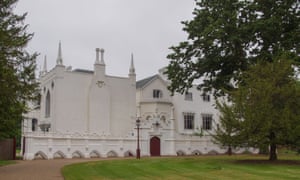
Strawberry Hill, London:Horace Walpole
FacebookTwitterPinterest Horace Walpole’s gothic villa, Strawberry Hill, in Twickenham. Photograph: Alamy

Walpole’s “little gothic castle” is seen by many as a folly created by a man with too much money and time on his hands. But Strawberry Hill, in Twickenham, played a key role in English literature in helping to inspire what is considered the first gothic novel in English, The Castle of Otranto (1764). At a time when most of the landed elite were still following the order and symmetry of Palladian architecture, Walpole embraced the ornament, the delicate tracery and heavy stonework, the darkened passages and what he called the “gloomth” (gloom plus warmth) of medieval gothic buildings. He drew on the designs of ancient churches and cathedrals, though the closest he came to worship was dressing up as a monk and play-acting around the house. His designs, too, were imitations of the real thing: wood dressed up as stone and papier-mache instead of plaster. Walpole claimed to have been driven to write the story of Otranto by a dream, but it was his own house that brought him the vision: “I had thought myself in an ancient castle, and on the uppermost banister of a great staircase I saw a gigantic hand in armour.”
Godmersham Park, Kent:
Jane Austen


The daughter of a vicar, Jane Austen grew up in a household of more modest means than many in her circle. She attended parties, balls and other social gatherings at plenty of grand Hampshire country houses, writing to her sister Cassandra in 1800: “I believe I drank too much wine last night at Hurstbourne; I know not else how to account for the shaking of my hand today.” But it was Godmersham, in Kent, and the smaller, less spectacular but still impressive Chawton House in Hampshire, two properties inherited by her brother Edward after he was adopted by childless relatives, that helped her to inhabit the world of her more privileged characters.


FacebookTwitterPinterest Godmersham, where Jane Austen spent long hours writing letters in the library. Photograph: Alamy

In Edward Austen’s day, Godmersham had 5,000 acres of land (today it still has 2,000). The house was built in 1732 by the Knight family, who added two wings in the 1780s before Edward inherited the property in 1797. It still has several wings and retains its elegant Italianate style. It is sometimes speculated that the more famous Chatsworth in the Peak District was the inspiration for Mr Darcy’s Pemberley, but it was at Godmersham that Austen experienced living in a large house, with many servants and entertainments. She spent long hours writing letters in the library, and the vicarage – still extant on the property – is thought to have inspired Mr Collins’s house in Pride and Prejudice. The place was luxurious to Austen: “I have no occasion to think of the price of Bread or of Meat where I am now; – let me shake off vulgar cares & conform to the happy Indifference of East Kent wealth.” By contrast, writing in 1798 from the rectory at Steventon in Hampshire, where she grew up, she complained: “People get so horridly poor & economical in this part of the World, that I have no patience with them. – Kent is the only place for happiness, Everybody is rich there.”
Norton Conyers, Yorkshire:
Charlotte Brontë
Advertisement


Jane Eyre first describes Mr Rochester’s home, Thornfield Hall, as a “gentleman’s manor-house”. Its contradictory nature – it has both “a picturesque look” and “a chill and vaultlike air” – grew from the mixture of awe and social awkwardness of her visits to various real houses. North Lees Hall in the Peak District has the three floors she gives Thornfield, and came with a fittingly grim tale of a madwoman confined to the upper storey. But the house most likely to have inspired the look and atmosphere of Thornfield is Norton Conyers, near Ripon, which Brontë is said to have visited in 1839. A Jacobean manor house with a great hall dating to the 14th century, Norton Conyers had belonged to the Graham family since 1624. At the time of Brontë’s visit, the house had come down to Sir Bellingham Graham, the seventh baronet, who gambled, fathered several illegitimate children and ultimately lost his ancestral home. It is unlikely that Brontë would have met Bellingham himself, but his troubled, Byronic character may have been partly responsible for the scandalous past and proud bearing of Mr Rochester. There are a number of similarities between Norton Conyers and Thornfield, the most tantalising being the stairway concealed behind the panelling of the first floor gallery, uncovered in 2004, which would have allowed Mr Rochester to slip upstairs surreptitiously and deal with his raving wife.
Rooks Nest, Hertfordshire:
EM Forster

Few can read Howards End without longing for a golden afternoon in the garden of an English cottage. The house represents the England of the past, threatened by a modern world in motion where motorcars speed people through a landscape they have no time to appreciate. “Only connect” is the motto of the book, and conveys a possibility for spiritual fulfilment that Forster felt strongly could be imparted through the life of a house. He was very clear about the inspiration for the house of his eponymous novel – Rooks Nest, his childhood home. After his father died of tuberculosis, when Forster was not quite two, his mother decided it would be healthier to move to the country. In 1883 she took the lease on Rooks Nest, near Stevenage in Hertfordshire, where they lived for the next 10 years. The house had belonged to a family named Howard, who had farmed there for three centuries. Forster began memorialising it while still in his teens. “I took it to my heart,” he later wrote, “and hoped … that I should live and die there.”
Talland House, Cornwall:
Virginia Woolf

FacebookTwitterPinterest Talland House, St Ives, Cornwall, where Virginia Woolf spent childhood holidays. Photograph: Paul Fearn/Alamy

For Woolf, Talland House represented a childhood idyll that would inspire her throughout her life. In 1881 her father, the eminent critic and biographer Leslie Stephen, had discovered Talland House in St Ives on one of his many walking expeditions. It was a three-storey detached house on a hill overlooking Porthminster Beach, with Godrevy lighthouse visible in the distance. From July to September each year, Stephen installed his large family in it with an array of guests there. The children made a sport of looking out towards the railway station from the front garden, to spy their visitors arriving: anyone from Henry James to George Meredith, or the American poet James Russell Lowell, Virginia’s godfather, might be stepping down on to the platform and needing a lift up the steep hill.

The family stopped visiting Talland House after the sudden death of Woolf’s mother Julia in 1895. Her half-sister Stella Duckworth died in 1897 and her brother Thoby in 1906. In To the Lighthouse (1927), Woolf made a lengthy imaginative visit to the Talland House of her childhood, where the ghosts of her parents and siblings reappear.
Menabilly House, Cornwall:
Daphne du Maurier

The inspiration for Manderley was an obsession born of frustration. Du Maurier had coveted Menabilly House in Cornwall for decades before she was able to live there. And it was in the years of pining for it that she created the enigmatic mansion at the centre of Rebecca (1938). The physical description of the De Winter seat was, in fact, drawn from Milton Hall, near Peterborough, which Du Maurier had visited as a child during the first world war. But in planning the story of Rebecca, Du Maurier said the house would be “empty, neglected, its owner absent, more like – yes, very like – the Menabilly near Fowey … where I had so often trespassed”.


The gardens were full of scarlet rhododendrons that symbolise Manderley’s secret passion and rage

The author first came across Menabilly during a family visit to the Cornish coastal town of Fowey in 1926. Menabilly had been owned by the Rashleigh family since 1573, and was largely transformed in the early 18th century. Like its fictional counterpart, the house is set well back into the woods. In Du Maurier’s time the gardens were full of those scarlet rhododendrons that symbolise Manderley’s secret passion and rage: “massive and high they reared above my head”. Her first attempt to visit the house was during an illicit ramble with her sister, Angela. The drive, as they had been warned, was “nearly three miles long, and overgrown”. As in the opening of the novel, the walk up that twisting path felt endless: the pair were forced to turn back by the onset of nightfall.

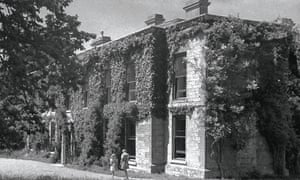
It took another year before Du Maurier made it through the woods and found the house abandoned, in a state of broken glory: “The windows were shuttered fast … Ivy covered the grey walls and threw tendrils round the windows.” Inside, “family portraits stared into the silence and the dust” and the library “had become a lumber place”. It wasn’t until 1943, five years after the publication of the novel that immortalised the house and its power to inspire obsession, that Du Maurier was finally granted a lease on the property and set to work repairing the “blitzed building”, as she called it, and making it into a family home.
Lawn Road flats, Hampstead, London:
Agatha Christie
FacebookTwitterPinterest Lawn Road flats, London, where Agatha Christie lived with her second husband. Photograph: Alamy

For all Christie’s care with naming houses, she gives us very little in the way of decorative detail, but her experiences of different houses come through her novels. Abney Hall in Cheshire was a special favourite of young Agatha: “a wonderful house to have Christmas in if you were a child”, she wrote, “an enormous Victorian Gothic, with quantities of rooms, passages, unexpected steps, back staircases, front staircases, alcoves, niches” and “three different pianos” to play. Christie wrote the novel After the Funeral and the short story “The Adventure of the Christmas Pudding” while staying there, and it featured as the Chimneys estate in two thrillers from the 1920s, The Secret of Chimneys and The Seven Dials Mystery.
Advertisement


But aficionados of television adaptations of stories such as “The King of Clubs”, “The Theft of the Royal Ruby” or The Murder of Roger Ackroydwill associate Christie with stylish modernism. On this note, Christie was also fairly vague. For example, Endless Night (1967) features a glamorous newly built house that fulfils the dreams of the low-born narrator. Yet there isn’t a lot of information about the design of this eventual home, apart from the description of it being “plain, very modern … with shape and light”. TV programme makers settled on the Homewood, Patrick Gwynne’s 1938 Surrey modernist gem, in the 2013 television version of a Miss Marple mystery. Christie would have had an awareness of avant-garde modernist design, particularly from the Lawn Road flats in Hampstead (now known as the Isokon building), where she and her second husband, Max Mallowan, went to live after their house at Sheffield Terrace was destroyed by bombing in 1940. The Lawn Road flats were built in 1934 by the architect Wells Coates, whose design echoes some of the new models for urban living espoused by Le Corbusier and other “utopian modernists”. Walter Gropius and László Maholy-Nagy of the influential Bauhaus school of art in Germany were residents, as was the designer Marcel Breuer. It is now a Grade I-listed building, having been completely refurbished in 2003, and is considered one of London’s important modernist landmarks.
Metroland:


Metroland embodies a significant cultural and social moment in postwar community development. Plans to extend the Metropolitan Railway to the new suburban areas had been in place nearly 70 years before Barnes’s novel was published in 1980. But his description of suburban life, delivered from the yawning lips of a middle-class teenager, captures the angst of outer city residential tracts. Even though I grew up in southern California, I could sense the familiar taste of the ennui unique to the suburban adolescent as I read of his narrator Christopher’s hatred of Sunday morning sounds – the lawn-mowing and car-washing – as well as the disappointment of returning to live, as an adult, in a suburb whose brown tones work like a sedative on ambition.


FacebookTwitterPinterest Sounds of the suburbs … ‘Metroland is about defeat”. Photograph: Bloomberg/Getty Images

“Metroland is about defeat,” the author said later. “I wanted to write about youthful aspiration coming to a compromised end.” The suburban setting provided “a background metaphor of disappointment” for the character, as it had for the larger aims of Metroland itself. “This London suburb where I grew up was conceived in the hope, the anticipation, of great horizons, great journeys. But in fact that never came to pass.”

This isn’t a story focusing on a house, so much as a chronicle a postwar change in living style. Amid the frenzy of urban building, people were leaching out into low-rise, low-density communities, if they can be called communities, since most lacked any unifying focal point, such as an easily accessible high street or existing village. Metroland doesn’t offer the country idyll or spiritual connection of Howards End, nor the excitement or anxiety of city dwelling. The book should come shrink-wrapped with a DVD of John Betjeman’s 1973 film documentary of the same title. As Betjeman intones over scenes of the car-washing and lawn-mowing that so pain Christopher Lloyd, Metroland was “the child of the First World War, forgotten in the second”.
Canford School, Dorset: Alan Hollinghurst

As the 20th century wore on, writers continued to be drawn to English country houses, but rather than oozing nostalgia for a golden era à la Brideshead, the books had a sharper edge that sliced at awkward angles into these monuments to the English class system. Novels such as Kazuo Ishiguro’s The Remains of the Day(1989), Ian McEwan’s Atonement (2001), and Alan Hollinghurst’s The Stranger’s Child (2011) cast a dispirited glance backwards. The manor house and the class it represents are degenerating. The members of the elite cannot be depended on to look after their stately homes any more than they can be relied on for their moral judgment.


'I designed country houses when I went away to boarding school'

Along with becoming hotels and retirement homes, a number of large country estates have been saved from demolition or neglect by being taken over by private schools. Hollinghurst has quipped that he was “an architect from the age of six or so … I designed country houses when I went away to boarding school”. In creating the rooms and atmosphere of Corley Court in The Stranger’s Child, he drew on his former school, Canford in Dorset. Like Corley Court, Canford had been a manor house, with some elements dating from the 14th century, before becoming a school in 1923. “Being a beautiful and interesting old house, it made a profound impression on me from an early stage,” Hollinghurst has said. Far from abhorring the Victorian style that so offends the character Dudley Valance, Hollinghurst says that he was “defending Victorian buildings” in the novel, although “I tried to make this Victorian house heavier and fiercer than my old school.”

The destiny of Corley Court is foreshadowed in the first chapter, during pre-dinner drinks in the drawing room at Two Acres, the less imposing home of the Sawle family. In this scene, Hubert Sawle, the heir to Two Acres, remarks on the evolution of the nearby Priory, from its moment of grandeur when Queen Adelaide lived there. A guest comments that later on in its history, the Priory had been “a very excellent hotel”:

“And now a school,” said Hubert, with a bleak little snuffle.

“A sad fate!” said Daphne.

Sad, but necessary. The preservation of the English country house has always depended on its ability to adapt to new circumstances. And each iteration will no doubt offer new stories to tell.

•