Showing posts with label @israelbookreview. Show all posts

Monday, June 18, 2018

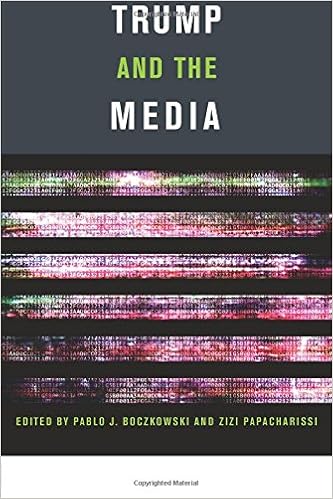
Trump and the Media (MIT Press) by Pablo J. Boczkowski (Editor), Zizi Papacharissi (Editor) ( The MIT Press)


The election of Donald Trump and the great disruption in the news and social media.
Donald Trump's election as the 45th President of the United States came as something of a surprise―to many analysts, journalists, and voters. The New York Times's The Upshot gave Hillary Clinton an 85 percent chance of winning the White House even as the returns began to come in. What happened? And what role did the news and social media play in the election? In Trump and the Media, journalism and technology experts grapple with these questions in a series of short, thought-provoking essays. Considering the disruption of the media landscape, the disconnect between many voters and the established news outlets, the emergence of fake news and "alternative facts," and Trump's own use of social media, these essays provide a window onto broader transformations in the relationship between information and politics in the twenty-first century.
The contributors find historical roots to current events in Cold War notions of "us" versus "them," trace the genealogy of the assault on facts, and chart the collapse of traditional news gatekeepers. They consider such topics as Trump's tweets (diagnosed by one writer as "Twitterosis") and the constant media exposure given to Trump during the campaign. They propose photojournalists as visual fact checkers ("lessons of the paparazzi") and debate whether Trump's administration is authoritarian or just authoritarian-like. Finally, they consider future strategies for the news and social media to improve the quality of democratic life.
ContributorsMike Ananny, Chris W. Anderson, Rodney Benson, Pablo J. Boczkowski, danah boyd, Robyn Caplan, Michael X. Delli Carpini, Josh Cowls, Susan J. Douglas, Keith N. Hampton, Dave Karpf, Daniel Kreiss, Seth C. Lewis, Zoey Lichtenheld, Andrew L. Mendelson, Gina Neff, Zizi Papacharissi, Katy E. Pearce, Victor Pickard, Sue Robinson, Adrienne Russell, Ralph Schroeder, Michael Schudson, Julia Sonnevend, Keren Tenenboim-Weinblatt, Tina Tucker, Fred Turner, Nikki Usher, Karin Wahl-Jorgensen, Silvio Waisbord, Barbie Zelizer


Sunday, May 20, 2018

Reuben Fine: A Comprehensive Record of an American Chess Career, 1929–1951 Hardcover– by Aidan Woodger (McFarland)


American Grandmaster Reuben Fine grew up in the East Bronx in an impoverished Russian-Jewish family, learning to play chess from an uncle at the age of eight. During his high school years, his stake winnings and coins earned from playing at a Coney Island concession helped support his family. After graduating from college, he decided to become a professional player. Though his active international career was brief, his accomplishment and talent are unmistakably significant. This comprehensive collection of 659 of Reuben Fine’s tournament and match games is presented chronologically, in context, and with annotations from contemporary sources. More than 180 other games and game fragments (rapid transit, correspondence, exhibition, blitz, and others) are also included. The work also includes a biography of Fine, and notes aspects of his career that merit further study: his contribution to endgame and middlegame theory, his methods and style of play, and his exhibition play. Fine’s career results, brief biographical data about his opponents, a comprehensive bibliography that includes his contributions to journals, and indexes of players and of openings complete the work.

Tuesday, March 13, 2018

Eye to Eye: Facing the Consequences of Dividing Israel Paperback – August 27, 2017 by William R. Koenig (Christian Publications)


2017 Expanded Edition. Over one hundred billion-dollar, record-setting catastrophes and/or events occurred while US presidents George H. W. Bush, Bill Clinton, George W. Bush, Barack Obama and Donald Trump were pressuring or calling on Israel to divide their covenant land.
  • The costliest insurance events, the costliest hurricanes, the largest tornado outbreaks, the " Perfect Storm," the 9/11 terror events, and Hurricane Katrina corresponded to White House pressure on Israel to divide their land.
  • The US, the UN, and the EU do not have the authority to divide God s covenant land.
  • Calling the Israeli-Palestinian talks "Middle East peace talks" is a false narrative.
  • Jews have a three-thousand-year history with Jerusalem, and Christians have a two-thousand-year history.
  • The biblical heartland of Israel - Judea, Samaria, and East Jerusalem - is not to be part of an Arab State.
  • The Bible declares that Jerusalem will become a burdensome stone, and efforts to divide the city and land will lead to Armageddon, the final battle for Jerusalem.
  • The God of Israel will continue to rebuke those leaders and their nations attempting to divide His land!

Thursday, February 15, 2018

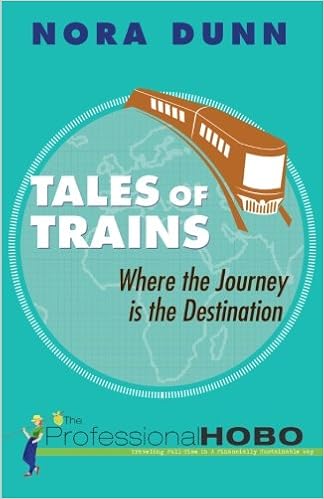
Tales of Trains: Where the Journey is the Destination by Nora Dunn and,‎ The Professional Hobo (#IBRTravelBooks)


42,000 kilometres. 11 countries. 44 days. Traveling by train isn’t always about getting to where you’re going – at least it hasn’t been for Nora Dunn, and the 25 or so countries she has traveled to and through by train.

 For her, the destination is irrelevant; rather, taking the train IS the destination. That is what this book is all about. Tales of Trains – Where the Journey is the Destination is a narrative about what it’s like to do some of the world’s most epic long-distance train rides, including the Indian Pacific and The Ghan in Australia, The Trans-Siberian from Moscow to Beijing, the world’s fastest train, and a whole host of much (much) slower trains as well. It covers over 42,000 kilometres of train travel through 11 countries, in 44 days (in two concentrated stints over a period of two years). 16,000 of those kilometres were done in Australia – including 11,000kms in 11 days straight….all to see if it was possible to get bored on a train. 

The following year Nora was invited to do the Ultimate Train Challenge, which involved 25,000kms of train travel between Lisbon and Saigon in 30 days….straight. These are the two main focuses of Tales of Trains – Where the Journey is the Destination. Among other things, you’ll read about: - 

The very slow “Very-Fast” train (and other paradoxical experiences) in Ukraine - Befriending a gaggle of Mary Kay conference attendees in China - Fending off a drunk Russian train conductor on the week-long Trans-Siberian - The million or so inhabitants Nora met in Cook, Australia - The most compelling toothbrush sales pitch ever given on a train (or elsewhere) - Having no money somewhere in Slovakia and almost getting kicked off the train - The glories of Gold Class in Australia, and Nora's sorry attempt at “train-yoga” - Fending off the flu while avoiding Barcelona's tourist traps - Meeting a worldly (and adorable) senior couple living in opposite corners of the world and who only meet up on trains - Arriving in Prague and ending up “naked at night” in the thick of it …and much, much more. Sit back, recline your seat, and enjoy these Tales of Trains.

Monday, January 29, 2018

The Time of Our Lives: Dirty Dancing and Popular Culture (Contemporary Approaches to Film and Media Series) Paperback by Siân Lincoln (Editor, Contributor),‎ Yannis Tzioumakis (Editor, Contributor),‎ Amanda Howell (Contributor),‎ Bill Osgerby (Contributor),‎ Claire Molloy (Contributor),‎ Cynthia Baron (Contributor),‎ Frederick Wasser (Contributor),‎ Gary Needham (Contributor),‎ George Rodosthenous (Contributor),‎ Hilary Radner (Contributor),‎ Jane Feuer (Contributor),‎ Mark Bernard (Contributor),‎ Millie Taylor (Contributor),‎ Oliver Gruner (Contributor),‎ Pamela Church Gibson (Contributor),‎ Richard Dyer (Contributor),‎ Tamar Jeffers MacDonald (Contributor),‎ Tim McNelis (Contributor) (Wayne State University Press)

A low-budget independent film made by a now defunct video company in the late 1980s, Dirty Dancingbecame a sleeper hit with a huge, primarily young audience. Even twenty-five years on, the film has found millions of devoted fans around the world through TV, video, and DVD releases. In The Time of Our Lives: Dirty Dancing and Popular Culture editors Yannis Tzioumakis and Siân Lincoln bring together leading scholars of film, media, music, culture, theater, dance, and sociology to examine for the first time the global cultural phenomenon of Dirty Dancing.
Tzioumakis and Lincoln begin by assessing Dirty Dancing's cultural impact in the decades since its release and introduce contributors in four sections. Essays in "Dirty Dancing in Context" look at the film from several perspectives, including its production and distribution history, its blending of genres, its treatment of race, and its place in the political and visual culture of the 1980s. In "Questions of Reception," contributors examine the many ways that the film has been received since its release, while those in "The Production of Nostalgia" focus on the film's often critiqued production of an idealized past. Finally, contributors in "Beyond the Film" examine the celebrated synergies that the film achieved in the "high concept" film environment of the 1980s, and the final two essays deal with the successful adaptation of the film for the stage.

With the enormous cultural impact it has made over the years, Dirty Dancing offers many opportunities for thought-provoking analysis. Fans of the movie and students and scholars of cultural, performance, and film history will appreciate the insight in The Time of Our Lives.

Tuesday, January 2, 2018

Elements of Architecture: Assembling Archaeology, Atmosphere and the Performance of Building Space. Mikkel Bille and Tim Flohr Sørensen (eds). Routledge. 2016.

In the new collection Elements of Architecture: Assembling Archaeology, Atmosphere and the Performance of Building Space, editors Mikkel Bille and Tim Flohr Sørensenseek to forge a meeting point between archaeology and architecture through focusing on the link between physical space and our sensual or ‘atmospheric’ encounters with it. While the sheer breadth of material offered by the book verges on dizzying, I welcome this as an important and critical read that will inspire further research into the relationship between archaeology, atmosphere and architecture.


The term ‘atmosphere’ has recently gained new momentum in interdisciplinary academic discourse, much of which revolves around discussions of ‘affect’ and sensual perceptions of place and architecture. This perspective puts the materiality of built space centre stage, emphasising the profound link between our physical environment and perception. This discourse appears to be ahead of, though potentially also complementary to, the ways in which archaeological studies construct the ‘social’, ‘economic’ or ‘cultural’ elements of architecture from found ruins or objects.

The substantial collection Elements of Architecture: Assembling Archaeology, Atmosphere and the Performance of Building Space, edited by Mikkel Bille and Tom Flohr Sørensen, aims to bring current architectural and archaeological thinking together in order to explore the atmospheric aspects of architecture, rather than ‘just’ its functional or aesthetic ones.

Key to this endeavour is promoting an understanding of architecture not as a static entity, but as an ‘assemblage of elements’, tangible and intangible, which oscillate between materiality, performance/process and meaning-making. By not advocating archaeological over architectural studies or vice versa, the ‘ontological vagueness’ (3) emerging from the focus on architectural atmospheres is here placed centrally for the study of built/building space, whether in the past, present or future.

What is most intriguing about this collection is how the editors set the scene: rather than juxtaposing architectural and archaeological studies, they outline a shared ontological problem. By deploying ‘documentation, drawing plans and making typologies’ as strategies to stabilise architecture into ‘bounded and tangible objects’ (6), both disciplines tend to be blind to the affective qualities of space. Departing from this shared problem, the editors provoke analytical tensions among contributions, which they channel intelligently and productively into four book sections: ‘Form and Temporality’ (Part 1); ‘Atmospheres’ (Part 2); ‘Performance and Process’ (Part 3); and ‘Disintegration and Unfinishedness’ (Part 4), each of which is introduced separately.


‘Form and Temporality’ focuses on temporality, motion and scale to explore how architecture gains form. It is premised on the assumption that archaeological studies of architecture have much to contribute to processual understandings of built space as they tend to privilege building practices over buildings as objects. Contributions in this section vary widely, ranging from Lesley K. McFadyen’s piece on the immanent materials that become invisible in archaeological studies of architecture; Michal Murawski on the affective, scalar and political powers of Warsaw’s Palace of Culture and Science; Jonathan Hill’s investigation of ruins and monuments; Gavin Lucas’s on building as constant and dynamic change; Alison Kohn and Shannon Lee Dawdy’s work on informal settlements in Bolivia; to a photo essay by Mark Minkjan and Ingel Vaikla on Brussel’s contested urban condition.

‘Atmospheres’ then explicitly turns to questions around how spaces feel. Focusing on the immaterial aspects of architecture, such as air and light, contributions explore the link between spatial atmosphere, perception and the built environment. Here, Tim Ingold argues for an inclusion of affect, emotion, rhythm, light and air into notions of architecture, which otherwise tend to focus on form. Jürgen Hasse surveys the German intellectual tradition of engaging with the term ‘atmosphere’ to argue for infrastructure, such as bridges or tunnels, as highly affective rather than surplus spaces. Oliver J. T. Harris returns to the notion of ‘assemblage’ to state that architecture is about ‘becoming’, and therefore not only includes the elements that form part of a building, but also a much wider network of human and non-human actors. Closing this section, Serena Love argues for the importance of materials and their meanings in relation to how spaces feel.

‘Performance and Process’ shifts focus to the social dimension of space, how enactments and lived experiences of people structure architecture and vice versa, premised on the understanding that social practices continuously transform built space. The section starts off with Albena Yaneva’s piece on how architectural images work beyond representation to participate in shaping the city. It then moves on to Larry J. Zimmerman’s intriguing work on homelessness and the necessity of home-making under the constant threat of eviction. Drawing on research in Mozambique, Morten Nielsen gives a detailed account of how personhood is deeply entangled with the ongoing process of building a house. The section closes with Nick Kaye’s explorations of the works of artist Vito Acconci and Augusta McMahon’s piece emphasising the significance of lived experience in ancient Mesopotamia.

The last section, ‘Disintegration and Unfinishedness’, turns to the question of what happens to built space when it decays and falls to ruin. Drawing again on assemblage theory, it argues that architecture does not finish when it fails but can adopt new forms of use and experience. Here, Tim Edensor investigates the reuse of industrial ruins in the UK and their newly emerging multiple temporalities. Þóra Pétursdóttir explores how an abandoned Icelandic herring station has become a popular tourist destination, while Michael A. Ulfstjerne investigates architecture and planning in post-economic boom Mongolia to promote an understanding of building as contingent. Jørgen Ole Bærenholdt analyses ‘designed tourist sites’ in Norway to argue that dissatisfaction among tourists may emerge from the fact that these sites are presented as finalised rather than emerging. Rosemary Joyce’s final piece looks at how architecture, materials and people are linked through notions of failure by investigating nuclear waste containment in the USA.

Unmistakably, this edited collection presents an enormous wealth of complementary work that all in some way links to atmosphere, architecture and archaeology. The intellectual ambition of this book is certainly impressive, and the editors deliver significant conceptual legwork to bring analytical frameworks together that have to date been referenced jointly, but never truly linked up. This is an important, if not the main, achievement of the book, but it comes at a cost: some readers may be overwhelmed by both the analytical density and the sheer amount of contributions in this hefty volume.

Though we can agree with the editors’ statement that the diversity of the approaches signals the quality of this volume, we need to ask if such breadth is actually helpful for advancing current thinking on atmosphere, space and the archaeological method, or whether it contributes to conflating these spheres. Perhaps we have to distinguish between the expert and the interested reader: while the book may well become a key work of reference for scholars and practitioners working on the themes it addresses and prompt conceptual and methodological debate, others may choose more selected reading and engagement.

However, what this collection certainly does is bring together some of the most relevant scholars in the field of social science studies of architecture, atmosphere and materiality, which is an accomplishment. Here, works that are grounded in empirical social research undoubtedly are highlights, not least because they take seriously the notion of ‘atmosphere’ which puts people (and not analysts) and their experiences centre stage.

Overall, the editors should be applauded for tying together not only the seemingly remote fields of architecture and archaeology, but also such wide-ranging contributions. With many thought-provoking statements, Elements of Architecture will most certainly kick off more debate on atmosphere, architecture and archaeology. And because some of it can also be read as a critical commentary on architectural and archaeological methods, it will be an interesting and critical read particularly for architecture and archaeology students, scholars and practitioners.

Sunday, November 19, 2017

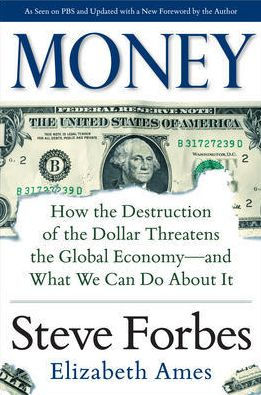
Money: How the Destruction of the Dollar Threatens the Global Economy—and What We Can Do About It. by Steve Forbes and Elizabeth Ames (McGraw-Hill Professional Publishing)

Money: How the Destruction of the Dollar Threatens the Global Economy - and What We Can Do About It / Edition 1

Steve Forbes's Money: The Gold Standard Is The World's Prosperity Engine

Ex Fox News Channel host Greta Van Susteren rightly calls Steve Forbes and Elizabeth Ames's new book, Money, “A gripping read….”

Steve Forbes, chairman and editor-in-chief of Forbes Media, and Elizabeth Ames have written their best book yet. It is entitled Money: How the Destruction of the Dollar Threatens the Global Economy—and What We Can Do About It. Money is, by far, the most important book on economic policy published this year. (Full disclosure, Forbes and Ames reference and acknowledge this writer’s work, including his collaboration with Forbes.comcontributor Charles Kadlec, in this work.)

The authors succeed in making money — as in monetary policy itself — fascinating and accessible. It has drawn glowing praise from many important thought leaders, including virtuoso retired banking titan (now Cato Institute president John Allison; Fox News Channel host Greta Van Susteren; Whole Foods co-founder and co-CEO John Mackey; former CNBC contributor Lawrence Kudlow; public intellectual Dr. Ben Carson; and Atlas Economic Research Foundation's Dr. Judy Shelton, among others.


Steve Forbes speaks at the Get Motivated Seminar at the Cow Palace in Daly City, California. (Photo credit: Wikipedia)

Significantly, one of the prime architects of the prosperity-inducing Reaganomics, Dr. Arther B. Laffer, has this to say about Forbes and Ames’s book: “A compelling and well-informed argument for a 21st century gold standard and a sound dollar, which will be the foundation for a new era of global prosperity.” It is very good to have the brilliant Laffer again speaking up for gold.

Laffer did seminal work, with Kadlec, on the gold standard in 1981. The record is contained in the Laffer Center’s archives: “Restoration of dollar/gold convertibility is the final and necessary link in the President’s program for an American Renaissance.”


Steve Forbes was featured prominently at an October 2011 Heritage Foundation Conference on a Stable Dollar: Why We Need It and How to Achieve it, also featuring Lewis E. Lehrman, the undisputed leading advocate of the classical gold standard (with whose Lehrman Institute's web publication this writer has a professional association). Lehrman appropriately is given pride of place in Money’s acknowledgements.

At that Heritage Foundation Conference Forbes made a wry and witty observation, reprised in this book: “conversations about monetary policy … (are) a surefire way to discourage unwanted conversations on airplanes." Forbes and Ames have found a way to make the conversation wanted, and even compelling. Forbes and Ames bring an abundant level of sanity, lucidity, and interest to what too often is considered as an arcane subject.

Good money is crucial to creating a climate of equitable prosperity. Forbes and Ames’s putting the case in terms accessible to regular readers is invaluable. Steve Forbes is a supply side icon. Money — this magnum opus on the gold standard, one of Forbes's signature issues — deserves to become a classic.

Money, far from being the root of all evil, presents (when, as here, golden) as delightfully virtuous. Its preface probes into just how our elites went so wrong in the mismanagement of our fundamental economic unit of account. Their analysis was anticipated by that of Frederick Hayek in The Pretense of Knowledge, his Nobel Prize acceptance speech:


It seems to me that this failure of the economists to guide policy more successfully is closely connected with their propensity to imitate as closely as possible the procedures of the brilliantly successful physical sciences - an attempt which in our field may lead to outright error. It is an approach which has come to be described as the "scientistic" attitude - an attitude which, as I defined it some thirty years ago, "is decidedly unscientific in the true sense of the word, since it involves a mechanical and uncritical application of habits of thought to fields different from those in which they have been formed." I want today to begin by explaining how some of the gravest errors of recent economic policy are a direct consequence of this scientistic error.

Great minds work alike.

In the spirit of Steve's late, great, father Malcolm S. Forbes, each chapter of this book is encapsulated by an aphoristic “Nugget.” If you have any doubts as to whether acquiring it is worthy of your (at discount) $20.72 (just a nickle more than an iconic gold standard definition of the dollar of $20.67/oz), consider them:

How We Got Here: “An unstable currency means an unstable economy and less prosperity.”

What Is Money: “Money measures wealth, but does not create it.”

Money and Trade: “The only real deficit is not enough trade.”

Money Versus Wealth: “To paraphrase Ron Paul: if printing money created wealth, there would be no poverty left on earth.”

Money and Morality: “When people stop trusting money, they stop trusting each other.”

The Gold Standard: “Gold remains the monetary Polaris: Every alternative has failed.”

Saturday, November 18, 2017

Literary St. Petersburg A Guide to the City and Its Writers By Elaine Blair (The Little Bookroom) (IBRChildrensbooks)

Literary St. Petersburg

Much of Russian literature is St. Petersburg literature: set in the city, about the city, or written by writers living there. This unique guide profiles fifteen authors whose works and lives were intimately connected to this magnificent setting. Biographical sketches focus on the city as the writers knew it, a sense of their work, the literary and social circles in which they moved, and the sites associated with them.
Travelers can wander through the museum where the teenage Vladimir Nabokov romanced his girlfriend and see the prison where Anna Akhmatova was inspired to write her epic poem about the Great Terror. They can find the statue that comes to life in Pushkin's poem The Bronze Horseman and visit the square where Crime and Punishment's murderer/hero kneels on the ground to ask God's forgiveness. Literary St. Petersburg opens the door to one of the most beautiful cities on earth and a body of literature that is as rich, subtle, and expressive as any in the world.

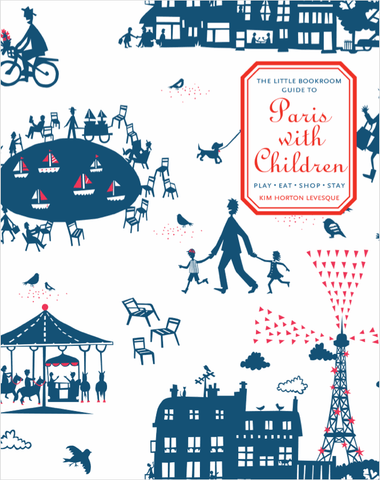
The Little Bookroom Guide to Paris with Children Play • Eat • Shop • Stay By Kim Horton Levesque (The Little Bookroom) (IBRChildrensBooks)

The Little Bookroom Guide to Paris with Children

The Little Bookroom Guide to Paris with Children focuses on what sophisticated parents with good taste want to know: how to see Paris’s most important sights and neighborhoods in a child-friendly way—in this case, through the eyes and experiences of author Kim Levesque and her three research assistants—her 2-, 4- and 6-year-old daughters.
Each neighborhood is organized around places to EAT, PLAY, and SHOP, and STAY and filled with information on:
• Family-friendly restaurants (yes, they exist in Paris, but don’t expect to find high chairs), classic cafes where Parisians take their children, items on Parisian menus that appeal to American children, charming tea salons for your little Madeline, picnic places, and ice cream stands and parlors;
• Parks near major attractions, and how to feel comfortable in the parks, including all you need to know about pony rides, marionette shows, model boat rentals, and playground etiquette;
• Highlights of major museums that appeal to children, and how to navigate your way through them;
• The best places to find—at exclusive shops and chain stores—quintessentially French children’s clothing (espadrilles, striped sailor’s jerseys, and, this being France, perfume for babies!), the best baby gear, stylish maternity wear, and toys, including custom teddy bears, sumptuous dress-up costumes, and more.
The guide also includes information on finding dependable and trustworthy child care; English-speaking playgroups and bilingual day camps; words you may need at pharmacies, whether the problem is a sore throat, blisters, or an upset stomach; seasonal activities; practical advice on apartment rental; and rainy day ideas.
The author also provides fascinating glimpses into the lives of Parisian children: typical school lunches (a cheese course? bien sûr!); the all-important after-school goûter; the classic French layette; formula and baby food (forget applesauce, think ratatouille, , artichokes, potato leek puree); and all sorts of fascinating and useful information that will make your trip en famille easy and, most important, memorable.

Monday, November 13, 2017

My Very First Dinosaurs BookFeb 1, 2016 by Alex Frith and Lee Cosgrove Board book (Usbourne Books) (#IBRChildrensBooks)


MY VERY FIRST DINOSAURS BOOK From the "My Very First" series by Alex Frith ; illustrated by Lee Cosgrove Age Range: 4 - 7

Dozens of dinosaurs and their contemporary cousins pose picturesquely in this expansive introduction for budding dinophiles.

Formatted for durability on large cardstock leaves with rounded corners, each prehistoric scene features a throng of variously sized creatures—nearly all depicted in full body portraits—with labels and informative comments interspersed. In his virtually gore-free cartoon illustrations, Cosgrove tends to endow dinos with smiles and googly eyes, but the colorful figures are otherwise realistically shaped and equipped (the predators, anyway) with properly serrated dentifrices. Along with carefully noting which creatures are not true dinosaurs, Frith points out significant anatomical features (“Concavenators had big humps on their backs. Some could grow long feathers on their arms, too, for extra showing off”), explains scenarios, and on one memorable page translates the names of seven T. Rex relatives such as “Tarbasaurus (Alarming dinosaur)” and “Teratophoneus (Murderous monster).” The spreads are topical rather than chronological, so dinos of different eras mix, but a closing timeline that leaves modern birds looking back quizzically at 180 million years of ancestors offers a sequential overview.

A populous but not overcrowded gallery, with opportunities aplenty to practice those polysyllabic monikers. (Informational picture book. 4-7)

Wednesday, November 1, 2017

The Jewish Wedding Now Paperback – June 6, 2017 by Anita Diamant ( Scribner)


Newly revised and updated, the definitive guide to planning a Jewish wedding, written by bestselling novelist Anita Diamant—author of The Red Tent and The Boston Girl—and one of the most respected writers of guides to contemporary Jewish life.

This complete, easy-to-use guide explains everything you need to know to plan your own Jewish wedding in today’s ever-changing world where the very definition of what constitutes a Jewish wedding is up for discussion.

With enthusiasm and flair, Anita Diamant provides choices for every stage of a wedding—including celebrations before and after the ceremony itself—providing both traditional and contemporary options. She explains the Jewish tradition of love and marriage with references drawn from Biblical, Talmudic, and mystical texts and stories. She guides you step by step through planning the ceremony and the party that follows—from finding a rabbi and wording the invitation to organizing a processional and hiring a caterer. Samples of wedding invitations and ketubot (marriage contracts) are provided for inspiration and guidance, as well as poems that can be incorporated into the wedding ceremony or party and a variety of translations of traditional texts.

“There is no such thing as a generic Jewish wedding,” writes Anita Diamant, “no matter what the rabbi tells you, no matter what the caterer tells you, no matter what your mother tells you.” Complete, authoritative, and indispensable, The Jewish Wedding Now provides personalized options—some new, some old—to create a wedding that combines spiritual meaning and joyous celebration and reflects your individual values and beliefs.

Sunday, October 29, 2017

Reconstructing Karl Polanyi: Excavation and Critique. Gareth Dale. Pluto Press. 2016

.
Gareth Dale’s latest book on the social theory of Karl Polanyi is a magisterial culmination of the author’s extensive decade-long research on the life and thought of ‘one of the most influential political economists of the twentieth-century’. As Dale highlights in an interview on the distinctive contributions of the three main book-length studies that have emerged from the project: ‘the emphasis of the biography is on [Polanyi’s] life and times, that of Karl Polanyi: The Limits of the Market is on exegesis and analysis, while that of Reconstructing Karl Polanyi is on critique’. Moreover, there is the edited collection Karl Polanyi: The Hungarian Writings, which brings together in one volume 56 texts made available in English for the first time. While each is praiseworthy in its own right, approaching them holistically guarantees an exceptionally rewarding intellectual expedition whose aim is to ‘reconstruct’ Polanyi, to ‘re-present’ his ideas ‘with attention to their historical and discursive context and drawing on a much broader range of sources’ than what the previous critical literature has had at its disposal (10).
The critical aims of Reconstructing Karl Polanyi are pursued in nine chapters. First, the author attempts to position Polanyi in respect to the various intellectual traditions of the ‘satanic science of sociology’ (18), then he examines his work in relation to different variants of Marxist thought and analysis. In fact, as Dale proposes at the very beginning, the ‘book covers a range of topics but its central thread concerns Polanyi’s relationship with socialist politics and ideas’ (8). Some concrete questions in this respect – such as Polanyi’s views on the connections between capitalism and democracy (or economics and politics), his assessment of the Soviet model of ‘actually existing socialism’ and strategies of coping with McCarthyism during a historical period in which Polanyi himself may have been ‘nudged “a little to the right”’ (160) – are posed in Chapters Three, Four and Seven respectively. Chapter Five looks closely at Polanyi’s masterwork, The Great Transformation (‘a deeply personal book’ that ‘no one but Polanyi could have written’ [99]), while Chapter Six casts a Polanyian eye on questions of regional integration and internationalism. The final two chapters focus on Polanyi’s later work on ‘ancient economic history’, specifically the function of markets in Mesopotamia and ancient Greece.
What connects the chapters to the teleological motif of theoretical ‘reconstruction’ is the recognition that, with respect to the topics discussed, Polanyi has ‘been subject to divergent interpretations’ (10). This has been as much due to carelessness on the part of his interpreters as to his own tendency towards conceptual inconsistency, semantic slippage and contradiction. His politics can be assessed either as social-democratic in a ‘soft’ interpretation (4) or as ‘red-blooded socialist’ in a ‘hard’ reading (5); his critique is aimed, according to some, at ‘capitalism’, while for others it merely targets ‘laissez-faire liberalism’ (123).
Image Credit: University library of Eötvös Loránd University, Budapest, Hungary, of which Karl Polanyi was an alumnus (Thaler CC BY SA 3.0)
To a great degree, Polanyi’s idiosyncrasies originate in his early intellectual development in the Austro-Hungarian melting-pot of peoples and ideas, as Dale’s broader project aims to stress. In Dale’s reading, while this may render Polanyi susceptible to misinterpretation, it is also the source of his originality: many aspects of his arguments ‘were being developed more or less simultaneously by others, but when filtered through his Christian-socialist outlook, and his idiosyncratic blend of socialist and Austrian conceptions of protectionism, the result was uniquely his own’ (122).
The sources of some contradictions, alternately, can be traced back to procedural or personal characteristics. As Dale’s ‘reconstruction’ evidences, for instance, common misunderstandings of the concept of ‘protectionism’ deployed in The Great Transformation emanate not only from Polanyi’s polysemic use of the term, but also from inconsistent revisions made to the original manuscript, which resulted in rolling ‘two distinct meanings of protection […] into one’ (119).
On the other hand, the formative influence that the ‘Austrian school’ had on Polanyi seems to have persisted throughout his lifetime, engrained in personal dispositions. This is hinted at by Dale when he assesses Polanyi’s other significant late-career body of work on trade and markets in pre-modern societies. The latter’s contribution to the understanding ‘of forms of pre-modern economic integration’ has ‘revolutionised the primitivism-modernism controversy’ (200), although it did not settle the debate between ‘primitivists’ and ‘modernists’ or ‘substantivists’ and ‘formalists’ (somewhat simplistically, between those proposing that the rationality assumptions and formal methodologies of modern microeconomics can be applied to the economic activities of past or ‘primitive’ peoples, and those challenging this idea). According to Dale, one of the reasons why the subsequent, supposedly synthesising New Institutionalist Economic History approach spearheaded by Douglass North – whose real achievements are vigorously questioned by Dale in the closing chapter – could emerge as victorious over the ‘sterility’ of these previous debates, was Polanyi’s ‘unwillingness (or inability) to critique [the formalists’] claims to have provided a valid method for understanding market societies’ (201, emphasis added). These shortcomings notwithstanding, ‘however, his substantivist “challenge” remains’ (201).
Overall, Dale’s complementary aims of conceptual archaeology and reconstructive critique are well balanced throughout the book. The one chapter where these aims, and Polanyi’s own work, are significantly transcended is the one on regionalism and the European Union. Here Dale takes on a topic of particular concern to him, but one in which ‘Polanyi expressed scant interest’ (128). The discussion therefore centres on assessing contemporary Polanyi-inspired research on the nature of the EU; and it is here that Dale’s voice comes through in its most critical tone: ‘any lingering illusions in the social-democratic configuration of the European project were pitilessly dispelled in the first decades of the present century’ (137). ‘If any “Polanyian content” is to be found’ in the political promise of the European project, ‘it will be in public debates over, and protests against, EU market integration’ (135). Yet, in light of the already mentioned idiosyncratic tendencies in Polanyi’s theory, one cannot but wonder whether, in contrast to currently dominant critiques from the left, a ‘Polanyian’ stance would not be more accommodating – albeit in ‘unique’ ways – of the ‘Hayekian setting’ of the EU.
In conclusion, the book lives up to its promise of reconstructing some of Polanyi’s elusive concepts, and does so in Dale’s always engaging style. However, Reconstructing Karl Polanyidoes feel occasionally dense: for readers seeking an easy point of entry into Polanyi’s writings, Dale’s previous works are probably a better starting point. As to its broader message, in the current political-economic conjuncture Polanyi is more alive than ever, but also better shielded from his own rekindled popularity. Following Dale’s feat, few acceptable justifications remain for Polanyi’s misinterpretation and misappropriation.

Wednesday, October 25, 2017

Totaled: The Billion-Dollar Crash of the Startup that Took On Big Auto, Big Oil and the World Kindle Edition by Brian Blum (Blue Pepper Press )


Just a few weeks ago, electric car manufacturer Tesla Motors handed over the first of its $35,000, 350-km range vehicles to eager customers. According to media reports, the company has a backlog of half a million orders.

This exciting news is coming out of California. It could have been coming out of Israel if a company called Better Place had fulfilled its dreams of changing the world. In hindsight, every decision Better Place, its management, and its narcissistic founder made was wrong.

In short, Better Place crashed.

Totaled: The Billion-Dollar Crash of the Startup that Took on Big Auto, Big Oil and the World by Brian Blum (Blue Pepper Press, August 2017), details the rollercoaster ride of what was possibly the most innovative concept to ever emerge from the Israeli ‘startup nation’.

Unlike Tesla Motors, which powers up its electric cars with a ‘fast charge,’ Better Place championed the concept of battery swap. Teaming up with French car manufacturer Renault, Better Place was “building an all-electric car with a battery meant to be switched. It was something that had never been done before.”

This is the statement of one of the many former Better Place employees interviewed by Blum for his exhaustive study of the rise and fall of the startup and its telegenic founder and visionary, Shai Agassi.

The Better Place story is the Shai Agassi story


Giving up a promising career as President of the Products and Technology Group (PTG) at SAP AG, Agassi apparently saw himself as the next Steve Jobs, the next Jeff Bezos. He was embraced by Shimon Peres, by investors, and by those who shared his vision of cutting the world’s dependency on the oil industry.

Yet, Agassi failed to make his dream come true. Investors lost nearly a billion dollars, and more than a thousand drivers, including the author, were stuck with battery-powered vehicles that could no longer be serviced.

Why did this happen? The question you should be asking is not why Better Place failed, but how could it not fail?

In Totaled, the Better Place story is told by a huge cast of characters and the reader can be excused for not remembering who is who. The narrative is a bit disjointed, but apparently that is the point. The fact that Better Place tried to expand into so many markets simultaneously, without really gaining a foothold anywhere, was undoubtedly one of the reasons it eventually went bankrupt.

Blum sees Totaled as a “compelling case study on the importance of managing change – and what happens when you don’t.” While that may be the focus of the book for entrepreneurs and executives, most readers will find the ups and downs of the Better Place story a fascinating ride!

Saturday, October 21, 2017

Disrupt This! MOOCs and the Promise of Technology. Karen Head. University Press of New England. 2017.


As I was finishing this book, I noticed an announcement on Twitter posted by my school for a public event about the future of education aided by technology. Not only this, but the conversation hashtag was a combination of the corporate partner’s name and the word ‘disruptor’. Such rhetorical moves are at the centre of Disrupt This! MOOCs and the Promise of Technology. However, in her book, Karen Head works to challenge the widespread ideas of disruption in education through technology by offering a more nuanced ‘view from inside’ (28). This is her personal tale of developing and teaching a first-year writing massive open online course (MOOC) at the Georgia Institute of Technology (hereafter ‘Georgia Tech’) in 2012-13. ‘Experience is a great generator of nuance,’ she points out (8).

Through this experience, Head opposes the rhetoric of two existing and influential books on MOOCs and disruptive innovation in education published in 2011: namely, Clayton Christensen and Henry Eyring’s The Innovative University: Changing the DNA of Higher Education from the Inside Out and Richard DeMillo’s Abelard to Apple: The Fate of American Colleges and Universities. For Head, the rhetoric in these books and other popular accounts, which she refers to as ‘punditry’ throughout her text, lacks the reflection of practice. The punditry on disruption, then, provides the context and the topical structure for her comparative analysis.

By promising us a ‘view from inside’, Head begins by outlining how she came to design and teach a MOOC. As it happened, the Gates Foundation had approached Georgia Tech with grants for this. The foundation had a particular interest in offering at least one non-traditional course: namely, First-Year Composition. Invited to join a Georgia Tech faculty-wide meeting on MOOCs, she describes that she pretty much involuntarily joined the bandwagon. As the director of the school’s Communication Centre with profound experience in composition, technical writing courses and peer-to-peer student mentoring, Head was considered by her school as the most promising candidate for this undertaking. Despite this, it was the opportunity to build her opinion about MOOCs through practice, instead of reading and hearing about them from others, that convinced her to take charge.
Image Credit: (Pixabay CCO)

The concept of disruption offers a new business model for Higher Education. As such, it is founded on the idea that the current state is slow-paced, traditional and non-responsive to the needs of a changing economy. However, to borrow from marketing terminology, the unique selling proposition of MOOCs is rather the promise of change for the good of everyone: that ‘the underserved around the world’ (31) will have free access to top-ranked university education. It is important to note here that the context of disruption is framed by the US Higher Education model. Moreover, in terms of MOOCs, the largest number of technical platform providers are also US-based, which predominantly partner up with the top-ranked US universities. Hence, the vision of democratisation behind MOOCs becomes murky as Head exposes this small network of players.

Head’s cautionary tale reflects on the concept of disruption in Higher Education from two different but interconnected perspectives. On the one side, she analyses disruption narratives on the large-scale level by focusing on questions of access, employability, corporate influence and the impact of rankings and status. On the other, she describes the notion of disruption on the micro-level of personal struggles from issues of privacy, public appearance, voluntary time and work to institutional politics. These two perspectives, as she shows, are oftentimes contradictory.

Access to education is a very contentious issue and tied to financial possibilities. The idea of access to high-quality education through MOOCs, as she points out, is an idea of ‘academic colonialism’ (147)—the adoption of paid content provided by top-tier universities to low or mid-ranked ones. The development and maintenance of a MOOC also comes with a high price tag that is very opaque. In Head’s case, and perhaps with most other courses, more than two-thirds of the grant went to pay the technical support of Coursera, a leading platform provider. The remainder of the grant barely covered her team of nineteen graduate teaching assistants. In the long run, Head asserts that such a scenario would cause a loss of jobs for educators, but also funding opportunities for lower-ranked schools.

This division between top-tier and low-/middle-ranked universities becomes a question of class, which MOOCs and disruptive education enforce rather than disrupt. In three chapters, Head focuses on the expectations towards these universities. Low- and middle-ranked universities are widely presumed to provide education for employability only, whereas the role of elite schools is education for education’s sake. Therefore, MOOCs need to adjust to meet the requirements for employability. In this case, it means offering job training, certification and course credits. Head opposed granting course credit for her writing course, as she experienced a large discrepancy between the large narrowed-down MOOC and the small, personal on-campus course. For her, a credit would be disservice to both groups of students.

Credits and certifications are also tokens of a standardised system of education. For US students who are conditioned to count what is being asked from them, as Head notes, a MOOC on writing hardly meets these standards. Composition courses are generally process-based and thus rely on a different assessment model. However, the technical platforms for MOOCs are built on the binary world of quizzes. For Head, this led to a significant amount of problems as the platform providers brought little understanding and flexibility in adapting the technical system to her course’s needs. Through this analysis, she aims to highlight the growing irrelevance of arts and humanities in a standardised, market-driven vision of education. As an example, she quotes one of Udacity’s founders’ decision to restrain from offering writing courses as they appear to be too challenging to teach in a technological environment.

Another aspect of a class system is who gets to teach and who gets to say something about MOOCs. From her experience, Head realised that these are not the same group of people. Considering all personal costs involved in standing in front of a camera to teach in a virtual environment, Head draws a conclusion that the perceived ‘experts’ from the top-ranked schools have not had the same experiences as her and many other teachers. ‘Disruption is something that happens to other people,’ she notes (135).

MOOCs require access to technology for those who want to teach and for those who ‘consume’. Hence, the idea of a technological fix for education becomes questionable. The way the current MOOC ecosystem works, Head concludes, distributes more inequality and aims for homogeneity. However, responding to the question about the future of MOOCs, she argues that while they might fail to become superior to traditional classroom experience, they would keep contributing changes in terms of technology incorporation.

The book shows how personal experience and practice can be a counter-balance to broader narratives on technosolutionism. Head’s eloquent and intricate analysis of two key books on the future of education with technology shaped by her own practical experience debunks the flat and glorifying picture of MOOCs. By showing how a professor in a top-ranked, well-funded university equipped with state-of-the-start technology was exposed to personal and institutional struggles, Head’s book asks as to the appeal for those with less financial and infrastructural privileges. Are MOOCs democratising or marginalising education? Perhaps we have to wait for another book from the perspective of those taking MOOCs to know better. Disrupt This! is a book that everyone interested in the subtleties of Higher Education and in the cost of technological changes should read.

Mercies in Disguise: A Story of Hope, a Family’s Genetic Destiny, and the Science That Rescued Them by Gina Kolata St. Martins, 262 pp., $25.99

Product Details

In screening for genetic mutations that can cause disease, the line between useful and damaging knowledge is hard to draw. We can in many instances find out who will fall victim to conditions for which no treatment exists. Huntington’s chorea is caused by a single mutation that can easily be identified. So is cystic fibrosis. Everyone who has the mutation will develop the disease unless he or she dies of something else first. No one who does not have the mutation will develop the disease. But though the etiology and development of both these afflictions are well understood, there is no way to prevent either of them.1 Hereditary prion diseases—genetic neural conditions caused by misfolded proteins—are rarer, but likewise play out with grim reliability. No treatment can slow the inexorable progress toward an agonizing death.

Bioethicists disagree on whether diagnoses of such diseases should be postponed until symptoms develop or should be made much earlier, even in infancy. More and more, clinicians argue that diagnosis before the onset of symptoms can benefit patients. It can circumvent an exhausting investigative odyssey; it can inform reproductive decisions; it can help a patient to plan; it can allow him or her to connect with others with the same condition, which is not only reassuring for the patient but also helpful to research scientists. But it can also cause despair. To what extent is information about an unpreventable genetic disease that has not yet caused any symptoms a gift and to what extent is it a burden?

This double-edged sword of genetic testing hangs over Gina Kolata’s Mercies in Disguise. Kolata, a well-known reporter on science and medicine for The New York Times, is a gifted storyteller. Her account of the Baxleys of South Carolina, a family with Gerstmann-Sträussler-Scheinker disease (GSS), is both engrossing and distressing. GSS is a rare hereditary prion disease symptomatically similar to Alzheimer’s mixed with Parkinson’s. All those who test positive for the mutation will develop the disease unless they die younger of other causes. The age of onset is between thirty-five and fifty-five, and once the disease sets in, the average survival period is five years, though some people live longer.

Those affected lose their sense of balance; they develop constant shaking; they become unable to walk and ultimately to control their movement at all; their speech becomes slurred, then incomprehensible; they find themselves unable to chew and swallow food; they cease to recognize their spouses and children; and finally, they become wild-eyed and fully demented. In postmortem examination, the cerebral cortex of a GSS patient is riddled with microscopic holes, making it spongiform, and the sheaths that should protect cerebral nerves are significantly abraded. A few treatments mitigate symptoms temporarily, but none can delay their onset; there is no cure; there is little promising research.
Vicki Reed
Vicki Reed: The Nest, 2015; from ‘What We Leave Behind,’ a series of lifesize cyanotype portraits on fabric that Reed made of her parents, in their late eighties and suffering from memory loss and dementia, before their move to a nursing home

In screening for genetic mutations that can cause disease, the line between useful and damaging knowledge is hard to draw. We can in many instances find out who will fall victim to conditions for which no treatment exists. Huntington’s chorea is caused by a single mutation that can easily be identified. So is cystic fibrosis. Everyone who has the mutation will develop the disease unless he or she dies of something else first. No one who does not have the mutation will develop the disease. But though the etiology and development of both these afflictions are well understood, there is no way to prevent either of them.1 Hereditary prion diseases—genetic neural conditions caused by misfolded proteins—are rarer, but likewise play out with grim reliability. No treatment can slow the inexorable progress toward an agonizing death.

Bioethicists disagree on whether diagnoses of such diseases should be postponed until symptoms develop or should be made much earlier, even in infancy. More and more, clinicians argue that diagnosis before the onset of symptoms can benefit patients. It can circumvent an exhausting investigative odyssey; it can inform reproductive decisions; it can help a patient to plan; it can allow him or her to connect with others with the same condition, which is not only reassuring for the patient but also helpful to research scientists. But it can also cause despair. To what extent is information about an unpreventable genetic disease that has not yet caused any symptoms a gift and to what extent is it a burden?

This double-edged sword of genetic testing hangs over Gina Kolata’s Mercies in Disguise. Kolata, a well-known reporter on science and medicine for The New York Times, is a gifted storyteller. Her account of the Baxleys of South Carolina, a family with Gerstmann-Sträussler-Scheinker disease (GSS), is both engrossing and distressing. GSS is a rare hereditary prion disease symptomatically similar to Alzheimer’s mixed with Parkinson’s. All those who test positive for the mutation will develop the disease unless they die younger of other causes. The age of onset is between thirty-five and fifty-five, and once the disease sets in, the average survival period is five years, though some people live longer.

Those affected lose their sense of balance; they develop constant shaking; they become unable to walk and ultimately to control their movement at all; their speech becomes slurred, then incomprehensible; they find themselves unable to chew and swallow food; they cease to recognize their spouses and children; and finally, they become wild-eyed and fully demented. In postmortem examination, the cerebral cortex of a GSS patient is riddled with microscopic holes, making it spongiform, and the sheaths that should protect cerebral nerves are significantly abraded. A few treatments mitigate symptoms temporarily, but none can delay their onset; there is no cure; there is little promising research.

Mercies in Disguise introduces us to the family patriarch, Bill Baxley, and follows his descent into misery, then death; we see two of his children, Billy and Buddy, succumb; and we learn that GSS will affect at least one of Bill’s grandchildren, Amanda, whose story frames Kolata’s account. The book opens with Amanda waiting to find out whether she has tested positive for GSS, and it ends with the story of how her life changes after she finds out that she has the mutant gene. She grapples with the question of whether to have children, and ultimately opts for preimplantation genetic diagnosis (PGD), a procedure to test embryos created in vitro so as to select those that are free of the GSS mutation.

The Baxleys are deeply devout Southern Baptists, and Amanda’s choice seems wrong to her sister, Holly, who declines to test for GSS in herself or to consider PGD. She says, “That is not the way I want to live as a Christian…. God has a purpose in not creating us with the ability to know our end. I choose to trust Him.” Kolata explains:


Holly was married and had a son when she learned her father had GSS, but she and her husband decided that Holly’s risk of getting ill herself and of passing on the gene was not going to deter them from having more children…. Instead of dwelling on the uncertainty of GSS, she would concentrate on her children’s relationship with God, on their eternal life.

Nor are Amanda’s parents supportive of PGD. Her doctors want a cheek swab from her father to confirm that she and he share a single mutation, but he refuses to assist her, and her mother will not intervene on Amanda’s behalf. Holly argues, “That idea carries with it the potential to create a medically induced genocide with the murdering of preborn children as a way of manipulating the gene pool and producing a utopia. Humans with too much knowledge are dangerous.” She seems unwilling to consider that God might have created our capacity for such knowledge, that this “unnatural” insight itself comes from our nature. Kolata relates how Holly worries that “in a medical family, science often becomes god instead of God.”


Amanda herself agonizes over the procedure even as she goes forward with it. “She had allowed those embryos to be destroyed as if they were meaningless. It was as if she had pointed to them, one by one, and said, ‘You’re sick. You have to go.’” Yet in choosing PGD, Amanda says firmly of GSS, “It stopped with me.” Mercies in Disguise can be read as a skirmish in the ongoing American conflict between science and faith.

Kolata has been dogged for many years by accusations that her reporting promotes conservative beliefs.2 In Mercies in Disguise she shows sympathy for Holly’s religiosity, writing admiringly:


From the start, Holly had been a light in both her parents’ lives. She was tall and beautiful and could always be counted on to stay out of trouble. She was an exemplary student, too…. In her early twenties, already married for three years to a man she had met in college, Holly had developed what she describes as “a closer relationship with Christ.” …When [her brother] Buddy got that letter [containing his genetic diagnosis], she and her husband already had one child, a baby boy. His life, she trusted, was in God’s hands. She was not going to worry about whether she or her baby had inherited her father’s illness.

Elsewhere, Kolata’s value judgments come through clearly. She explains in relation to PGD: “Whether or not they believe life begins at conception, few can see a human embryo as just a clump of cells, no different in kind than a piece of skin scraped off a knee. And no one—not even people who work in fertility clinics…—finds it easy to discard those balls of cells.” In fact, many people who work in fertility clinics find it deeply meaningful to help a family select for healthy children, and they do not execute their work with ambivalence or regret.

In many of her Times articles and in Flu: The Story of the Great Influenza Pandemic of 1918 (1999), Kolata has shown herself adept at translating scientific language for inexpert readers, but her prose sometimes grows mawkish and manipulative:


There was a remote chance that Bill had a condition called normal pressure hydrocephalus; they knew about it from their medical studies, but the neurologists they’d consulted had seemed uninterested—it took too much time to test for it and the chance that Bill had it really was remote. But Buddy and Tim had time for the test—Bill was their father, after all. They could make time.

Later, when Tim, one of the Baxley boys, learns that his aunt has troubling symptoms, “his heart began to pound as it had when he heard about his grandfather.” Soon he “felt the cold sweat of certainty…. He barely noticed the sun coming up.” Robert Edwards, a progenitor of IVF, is “flamboyant”; so, a page later, is the Russian geneticist and embryologist Yury Verlinsky. Kolata’s attempts to be colorful can drain her prose of authentic color.

The subtitle of the book is “A Story of Hope, a Family’s Genetic Destiny, and the Science That Rescued Them.” Kolata tends to take an upbeat, even celebratory tone, but Amanda is looking at an early deterioration and horrific death, which doesn’t exactly constitute a story of hope or a rescue by science. And what of Holly and her children, who may well be marching toward a similar agony? Kolata writes that “science presented the Baxley family members with a responsibility they’d never asked for or anticipated—but that each took on in their own daring way.” Yet she does not show that anyone other than Amanda took on the challenge in a particularly daring way. She calls her book “a story of how a horrific disease taught a family forbearance and the ability to find hope even as the daunting circumstances threatened to extinguish it,” but many members of the family don’t seem to have achieved forbearance or hope. “This is the story of disrupting destiny,” Kolata claims, but the destiny to which she refers seems not to have been much disrupted.

Interspersed with the story of the Baxleys is the story of prions. Kolata recounts how the physician Daniel Carleton Gajdusek came to study the neurodegenerative disease kuru, which causes a loss of coordination and control over muscle movements, in the Fore people of Papua New Guinea. Through follow-up work with chimpanzees, he demonstrated that this frightening disease was transmissible, then linked it to the Fore’s rituals of funerary cannibalism. Gajdusek ultimately connected kuru with many other diseases: scrapie (in sheep), Creutzfeldt Jakob disease (CJD), mad cow disease, fatal familial insomnia, and GSS, theorizing that the problem resulted from a “slow virus.” He won a Nobel Prize in 1976 for his work.

Stanley Prusiner proceeded from Gajdusek’s research but rejected the virus theory, observing that none of these related neurodegenerative conditions triggered any immune response. Prusiner knew these diseases were transmissible, but not contagious. In a radical departure from biological norms, he proposed that they were caused by proteins that could replicate themselves. “The idea of a protein that somehow reproduces itself,” Kolata writes, “seemed like asserting that a cup of egg whites—pure protein—on the kitchen counter could somehow start growing, and overflowing the cup, taking over the kitchen like slime in a horror movie.”

But Prusiner persisted, and in the early 1980s he coined the term “prion” for a class of proteins that can misfold. Contact between a normal prion protein and a misfolded one, he hypothesized, causes the normal one to misfold, too. That prion goes on to misfold further proteins. These misfolded proteins bond into dense amyloid plaques somewhat like those that develop in Alzheimer’s and effectively drill little holes in the cerebellum, eventually causing the onset of symptoms.

Prion diseases can be inherited; they can occur through new mutations that may subsequently be passed on to the next generation; they can also be acquired (in less than one percent of cases) if a healthy brain is directly exposed to misfolded prions, as happened among the cannibalistic Fore, or as might happen through surgical contamination. Prusiner’s protein hypothesis, which earned him a Nobel Prize in 1997, is now widely accepted. Kolata clearly admires Prusiner; oddly, however, in her scientific history she does not mention the work of Tikvah Alper and John Stanley Griffith, who had proposed fifteen years before Prusiner that spongiform diseases might be transmitted by proteins, and whose work strongly influenced him.3

The number of illnesses such as GSS that are inevitably caused by a single mutated gene is small. In the debates about genetic testing that now roil bioethics, the primary concern is with genes that confer only an increased risk of developing particular medical conditions. For some of them, the preventative measures are straightforward. Some 5 to 10 percent of colorectal cancers are known to be hereditary. About four out of five people who carry the gene for hereditary nonpolyposis colorectal cancer (HNPCC) will go on to develop the disease; even those who do not carry a known cancer-causing gene but have a family history of the disease are encouraged to have regular colonoscopies for early detection and treatment. People at risk for hereditary cardiomyopathies—diseases that affect the heart muscle—can regulate their diet and exercise to significantly reduce the likelihood of early death. It seems like common sense to do so, though research indicates that information from genetic tests is not a powerful motivation for people to change their behavior.4

When the risk conferred by a gene is lower and the preventative measures for the potential condition are more drastic, deciding whether or not to take advantage of them is more difficult. More than fifty hereditary cancer syndromes have been identified. Mutations of the tumor-suppressing genes BRCA-1 and BRCA-2 cause some 5 to 10 percent of all breast cancer, and about 15 percent of all ovarian cancer. While only about one in eight women develops breast cancer, more than half of those with BRCAmutations develop it; while only one of every hundred women develops ovarian cancer, more than one third of those with BRCA mutations do so.

Such statistics help women apprehend the seriousness of the risks, but do not make it easy to decide how to respond. We do not understand genetic and environmental factors well enough to predict who will succumb and who will not. Some women with BRCAmutations have had preemptive double mastectomies, hysterectomies, or both. Such procedures vastly reduce the risk of developing these cancers, but they are extremely invasive responses to a mutation that for many would never result in illness.

This confusion can only escalate as companies such as 23andMe offer, for a modest fee, to analyze genetic information from a cheek swab. Consumers can get information about their vulnerability to a variety of diseases for which the genetics are well understood—in the form of statistical likelihoods rather than definitive outcomes. 23andMe now offers testing for vulnerability to Alzheimer’s through the ApoE4 gene, as well as for the genetic risk of Parkinson’s and celiac diseases. What is someone to do with this knowledge? “People clearly want information about themselves,” said Anne Wojcicki, the chief executive of 23andMe. “There is a demand.”

In a 2016 STAT-Harvard poll, a majority of respondents said they would want to have genetic testing for Alzheimer’s or cancer (for each of which genetic links have been found), and eight out of ten who had had genetic testing were glad to have done so. The same study found that doctors took a much dimmer view of the process. Understanding the results of genetic analysis often requires the assistance of counselors who can interpret probabilities and risks, and there are too few such specialists to go around. As Mildred Z. Solomon, president of the Hastings Center, a bioethics research institute, told me, “There is a great chance to introduce enormous confusion among both prospective parents and the public more broadly.”

Both confidentiality and exposure of the results of such testing can be dangerous. The utilitarian argument would calculate burden against benefit for an entire society and acknowledge that mandatory genetic testing best protects public health by providing statistical information on untreatable conditions; enabling PGD for families who carry genes for serious illnesses; and allowing people whose conditions respond to lifestyle changes or medical treatments to access them efficiently. The libertarian argument would propose that individuals have sole jurisdiction over their physical selves and medical information.5 Along with Amanda Baxley’s right to know goes Holly Baxley’s right not to know.

A screening shortly after birth for sickle cell disease, which can be treated, is mandatory in all US states so that affected children can get care. For most other genetic defects, the choice to know rests squarely with the person at risk or, for juveniles, with their parents. 23andMe has a databank of information about a broad range of people—more than a million at this writing—and has made some of it available to researchers working on the demographics of particular diseases. Many Americans have expressed concern that any medical test may enter the public record, and worry that people with certain genetic liabilities would suffer from bias in matters of employment and insurance. Cases alleging such discrimination have already come before the courts, including an ongoing suit brought against the Palo Alto school district by the parents of a boy who, they allege, was removed from his class because a test showed that he had genetic markers associated with cystic fibrosis.

There are instances in which someone has been tested but does not wish to tell family members, some of whom cannot be trusted to maintain confidentiality, about troubling results. Any such circumstance provokes a moral conundrum for a doctor. K.G. Fulda and Kristine Lykens have argued in the Journal of Medical Ethics that “the physician’s decision not to inform family members simply removes any possibility of delaying or ameliorating the onset of symptoms. Consequently, the public policy function of public health may need to resolve these countervailing interests of individuals.” One court has held that a doctor must take “reasonable steps…to assure that the information reaches those likely to be affected or is made available for their benefit.”

In 1983, the President’s Commission for the Study of Ethical Problems in Medicine and Biomedical and Behavioral Research recommended that disclosure be required when efforts to elicit voluntary disclosure have failed; when there is a high probability of harm, which intervention might avert; and when prospective harm is serious. The commission confirmed that this information should be shared even without the primary patient’s consent if not disclosing the information could lead to harm. Some ethicists advise that physicians should notify patients prior to genetic testing about their own stance on information-sharing—what one writer has called a “genetic Miranda warning.”

Genetic information is pertinent to the person whose genome is being examined but also, as the Baxley story clearly illustrates, to his or her offspring, and the interests of parent and child may not coincide. Soon, scientists will be able to scan a full fetal genome with a simple maternal finger-prick test. This process, an early version of which is already used to diagnose trisomy-21 (the mutation that leads to Down syndrome), will yield a huge amount of information. Prospective parents may feel pressure to abort on the basis of information that reveals their child will be born with a disease that is expensive to manage. Pennsylvania passed Chloe’s Law in 2014, requiring health care providers to give information about treatment and support services to women who receive a prenatal diagnosis of trisomy-21, and several other states have passed similar measures.

These decisions about selective termination are extremely variable; a risk that does not trouble one person may terrify another. Is there any argument for terminating a pregnancy once a BRCA marker is found? What about doing PGD to weed out fetuses that carry a mutated BRCA gene? Some people have made these choices, but the shadow of eugenics always looms over them. Kolata asks what a couple should do if one of them carries a gene that creates a 50 percent chance of a midlife heart attack. What, too, would we do if we were to find gene combinations that increase the likelihood of autism, homosexuality, or deafness? Would we aspire to screen for traits as significant as intelligence or gender, as trivial as hair color, as socially loaded as complexion, as socially stigmatized as obesity? What about selecting for genes that appear to be linked to athletic prowess (which have been extensively but futilely sought)?

We might undertake PGD to cull embryos, for example, with a 50 percent risk for a condition likely to shorten life by more than ten years, or a 75 percent risk for a condition that would cause a lifetime of physical pain. Any attempt to standardize these choices would feel random, a decision about a life we cannot fully imagine. As for-profit companies do scans for a widening range of characteristics for those seeking preimplantation genetic diagnosis, such prenatal knowledge may become something of a luxury commodity. Kolata’s book raises crucial questions about knowledge that can be both vital and fatal, both palliative and dangerous.

1See Heidi Chial, “Huntington’s Disease: The Discovery of the Huntingtin Gene,” Nature Education Vol. 1, No. 1 (2008); and William Guggino and Bruce Stanton, “Mechanisms of Disease: New Insights into Cystic Fibrosis: Molecular Switches That Regulate CFTR,” Nature Reviews: Molecular Cell Biology Vol. 7, No. 6 (June 2006).
2Kolata’s health reporting for The New York Times is criticized in David Handelman, “Act Up in Anger,” Rolling Stone, March 8, 1990; Mark Dowie, “What’s Wrong with the New York Times’s Science Reporting?,” The Nation, July 6, 1998; Michael Shapiro, “Pushing the ‘Cure’: Where a Big Cancer Story Went Wrong,” Columbia Journalism Review, July/August 1998; Paul Scott, “Diet Wars Turn Family Feud,” Columbia Journalism Review, July 31, 2012; and David Bollier, “Did Commercial Journals Use the NYT to Smear Open Access?,” www.davidbollier.org, April 11, 2013.
3See, for example, Tikvah Alper et al., “Does the Agent of Scrapie Replicate Without Nucleic Acid?,” Nature, Vol. 214 (May 20, 1967); and John S. Griffith, “Nature of the Scrapie Agent: Self-replication and Scrapie,” Nature, Vol. 215 (September 2, 1967).
4See Gareth J. Hollands et al., “The Impact of Communicating Genetic Risks of Disease on Risk-Reducing Health Behaviour: Systematic Review with Meta-analysis,” The BMJ, Vol. 352 (March 15, 2016).
5For comparison of the utilitarian and libertarian perspectives on genetic testing, see K.G. Fulda and K. Lykens, “Ethical Issues in Predictive Genetic Testing: A Public Health Perspective,” Journal of Medical Ethics, Vol. 32, No. 3 (March 2006).

The Nazi-Fascist New Order for European Culture by Benjamin G. Martin Harvard University Press, 370 pp., $39.95


“When I hear the word ‘culture,’ I reach for my revolver.” This philistine wisecrack is often attributed to Air Marshal Hermann Goering, or some other Nazi notable. Benjamin Martin sets us straight on its source: the 1933 play Schlageter by the Nazi Party member Hanns Johst, in which a character says: “When I hear the word ‘culture’ I release the catch on my Browning.”

Martin’s illuminating book The Nazi-Fascist New Order for European Culture shows how badly astray this famous quip leads us: cultural concerns were in fact vital to the imperial projects of Hitler and Mussolini. We do not normally associate their violent and aggressive regimes with “soft power.” But the two dictators were would-be intellectuals—Adolf Hitler a failed painter inebriated with the music of Wagner, and Mussolini a onetime schoolteacher and novelist. Unlike American philistines, they thought literature and the arts were important, and wanted to weaponize them as adjuncts to military conquest. Martin’s book adds a significant dimension to our understanding of how the Nazi and Fascist empires were constructed.

German power and success gave the Nazi case particular salience. The special meaning of Kultur in Germans’ evaluation of themselves is an important part of the story. According to a famous essay by Norbert Elias, the meaning of Kultur for Germans is hardly comprehensible without reference to a particular historical development.*Kultur, he explains (along with Bildung, or education), denoted in pre-unification Germany those qualities that the intellectuals and professionals of the small, isolated German middle class claimed for themselves in response to the disdain of the minor German nobles who employed them: intellectual achievement, of course, but also simple virtues like authenticity, honesty, and sincerity.

German courtiers, by contrast, according to the possessors of Kultur, had acquired “civilization” from their French tutors: manners, social polish, the cultivation of appearances. As the German middle class asserted itself in the nineteenth century, the particular virtues of Kultur became an important ingredient in national self-definition. The inferior values of “civilization” were no longer attributed to an erstwhile French-educated German nobility, but to the French themselves and to the West in general.

By 1914, the contrast between Kultur and Zivilisation had taken on a more aggressively nationalist tone. During World War I German patriotic propaganda vaunted the superiority of Germany’s supposedly rooted, organic, spiritual Kultur over the allegedly effete, shallow, cosmopolitan, materialist, Jewish-influenced “civilization” of Western Europe. Martin’s book shows how vigorously the Nazis applied this traditional construct. Hitler invested considerable money and time in the 1930s, and even after World War II began, in an effort to take over Europe’s cultural organizations and turn them into instruments of German power. These projects had some initial success. In the end, however, they collapsed along with the military power they were designed to reinforce.

In a parallel and even less enduring effort, Mussolini’s Fascist regime tried to establish the primacy of Italian culture under the umbrella of Hitler’s conquests. Mussolini’s cultural executives, such as his Minister for Press and Propaganda Dino Alfieri, asserted that the Mediterranean and classical tradition of Italy was the proper foundation of a European “cultural Axis.” Having thrown in their lot definitively with Hitler, the Italians could hope to be the contemporary Greece to Germany’s new Rome, but the Nazi leaders never entertained the slightest doubt that German Kultur was the foundation stone of the “new cultural order” for Europe.

An extensive network of international cultural organizations already existed before Hitler came to power. They had been greatly expanded after 1919 in the orbit of the League of Nations. Hitler saw them cynically as instruments of French cultural influence and as a reinforcement of Allied hegemony. Just as he planned to overthrow the political system set up by the victorious Allies after World War I, he was determined to overthrow the democratic cultural network. He intended to replace it with his own organizations headquartered in Berlin and dedicated to spreading throughout Europe the Nazi conception of the unique racial character of each national culture.

The word “international” acquired a special meaning in its usage by Nazi and Fascist cultural officials. The Allies’ international cultural associations had rested on a set of liberal democratic assumptions: that works of art and literature should be evaluated by universal standards of quality; that masterpieces were the product of individual creativity; and that no national culture deserved hegemony over another. The Nazi and Fascist dictators reversed all of these assumptions. They measured the merit of works of art and literature by their significance within unique national cultural traditions. Masterpieces, in their view, grew out of community roots. And national cultural traditions were ranked in a natural hierarchy, with the German and Italian ones at the top.

Hitler concerned himself with cultural matters as soon as he became chancellor of Germany in January 1933. He purged the German section of PEN International of “leftist” and Jewish writers. When PEN International protested, Hitler dissolved the German section altogether at the end of 1933. During this dispute the president of the Italian PEN club, the provocateur Futurist intellectual Filippo Tommaso Marinetti, supported the German position. Thus from the earliest days, Nazi cultural projects proved capable of enlisting foreign support.


Hitler made his ambitions for German culture clear from the beginning. At a Nazi Party Congress on Culture in September 1933 he promised that the Nazi state would intervene more actively in cultural matters than the Weimar Republic had done, in order to make art an expression of the “hereditary racial bloodstock” and to transform artists into defenders of the German Volk.

Hitler left the daily tasks of his bid to reorganize European culture under German dominance to his propaganda minister, Joseph Goebbels. Goebbels—another would-be intellectual and a failed novelist—threw his frenetic energy, his ideological passions, and a generous budget into spreading abroad the Nazis’ racialist and nationalist approach to the arts.

Cinema was the Nazi leaders’ first cultural target. Goebbels and Hitler were as obsessed with movies as American adolescents are today with social media. Convinced that cinema was their era’s main engine of cultural influence, they tried to control filmmaking as far as their influence could reach. At the Venice Film Festival in 1935, at Goebbels’s instigation, delegates of twelve nations agreed to create an International Film Chamber (IFC) designed to establish a continent-wide system of film exchange and regulation. As the possessor of the continent’s largest and most powerful film industry, Germany became the dominant force in the IFC. Fascist Italy, however, assured for itself a strong second position by exploiting its considerable film-producing assets, such as the technologically advanced studios of Cinecittà and the Venice Film Festival, which continued to be the main venue of IFC activities.

The IFC was a genuinely European organization, and even had a French president in 1937. Its inspiration had been German, however, and its organizational form was less international than something Martin usefully calls “inter-national,” a federation of national arts organizations on the model of the Reich Film Chamber, which Goebbels had formed in July 1933 on corporatist principles. Corporatist doctrine required that capital, management, and labor abandon their separate advocacy groups and sit down together to find their common interests, alongside state representatives. Corporatism smothered internal conflict in film production and gave determining influence to the state rather than to the market.

Each IFC member nation was expected to have a national film organization similar to the Reich Film Chamber. Within Germany the Reich Film Chamber became the instrument through which the Nazi regime controlled an increasingly concentrated German film industry purged of Jews. In 1942, the largest production companies, such as UFA and Tobis, were merged into one state-controlled entity.

Benjamin Martin shows most interestingly that the Nazi and Fascist “inter-national” organizations had authentic appeal to some European intellectuals and arts executives who were not themselves Nazis or Fascists. These organizations promised material as well as intellectual advantages. The IFC provided access to a market of continental dimensions, a feature particularly attractive to European filmmakers who all suffered from the limited size of their national audiences. It also simplified thorny problems of cross-boundary payments and differing copyright laws.SZ Photo/Scherl/Bridgeman Images
Sepp Hilz’s Peasant Venus, shown in the ‘Great German Art Exhibition,’ Munich, 1939

The main role of the IFC was to combat the Hollywood menace. The dominance of American films had troubled European filmmakers and intellectuals from the beginning. By 1928 54 percent of all films shown in France, 72 percent in Britain, and 80 percent in Italy came from Hollywood. Already in the 1920s most European countries had imposed quotas on American films or limited them by reciprocity agreements. The respite given to European films by the arrival of “talkies” in 1929 had been brief, as expert dubbing soon allowed Hollywood films to predominate again. Many Europeans endorsed the IFC position that American films were trivial entertainment designed to make money, while European films were artistic creations that deserved protection. Although the British and Dutch refused to join, IFC membership extended by 1935 “from Belgium to Hungary [and] revealed a Europe,” according to Martin, “ready to accept German leadership.”

German military conquests early in World War II enabled the Nazis to tighten even further their control of European cinema. In August 1940 they banned American films altogether in the territories they occupied. A similar ban within Germany itself followed in 1941. The Fascist regime had already reduced the number of Hollywood films shown in Italy by the “Alfieri law” of 1938 that created a state monopoly with sole authority to buy and show foreign films (Hollywood’s four biggest studios withdrew from the Italian market in response). The unintended result of such protectionism was to give Hollywood films the allure of forbidden fruit and to prepare their triumphant return to Europe in 1945. In Jean-Pierre Melville’s Resistance filmArmy of Shadows, two underground leaders are smuggled out of France to consult personally with Free French leader General Charles de Gaulle. The first thing they want to do in London, after eating a filling meal, is to go see Gone with the Wind.

Beyond cinema, the Nazis meant to reorganize the whole range of German cultural activities along corporatist lines. The Reich Chamber of Culture contained subgroups for music, literature, theater, press, radio, and so on. The Nazis soon tried to extend the reach of these cultural corporations to the entire European continent, according to their geopolitical vision of a world divided into blocs, or “great spaces,” continent-scaled, self-sufficient economic systems aligned with the appropriate cultural associations protected by authoritarian states. Their European “New Order” was meant to be cultural as well as economic and political.

Music was a realm that Germans felt particularly qualified to dominate. But first the German national musical scene had to be properly organized. In November 1933 Goebbels offered Richard Strauss the leadership of a Reich Music Chamber. In June 1934 Strauss invited composers from thirteen countries to the annual meeting of the German Music Association in Wiesbaden. The delegates created a Permanent Council for International Cooperation among Composers.

The Permanent Council grew by exploiting an aesthetic rift in European musical culture. Since the early twentieth century a generation of gifted innovators had created new musical languages, such as Arnold Schoenberg’s twelve-tone technique. Organized in the influential International Society for Contemporary Music, the avant-garde had come to have a powerful influence on the European musical scene. Traditional composers resented the modernists’ celebrity, and the Nazis (Mussolini remained more open to modernism) attracted conservative support by attacking the avant-garde as internationalist, rootless, and Jewish. In a famous speech in December 1934 Goebbels derided “an atonal noise maker,” by whom he was generally assumed to mean the composer Paul Hindemith (who was not Jewish). Goebbels organized in Düsseldorf in 1938 a presentation of “degenerate music” following the better-known 1937 exhibition of “degenerate art.”

Most of the composers who were affiliated with the Permanent Council, advocates generally of a national, rural, or folklorist approach to musical composition, are forgotten today. The council did draw some prestigious composers who were not really Nazi or Fascist, like Jean Sibelius and Albert Roussel. The presence of Richard Strauss, a onetime moderate modernist who resented the decline of his fame, gave legitimacy to the IFC. He continued to preside over it even after he had been removed from the Reich Music Chamber in 1935 in a dispute over his continued association with Stefan Zweig, who had written the libretto for his opera Die schweigsame Frau.

The Permanent Council’s attention to composers’ material problems was an additional attraction. These included inconsistencies among different national copyright codes, problems of international royalties payments, and droit moral—the right claimed by authors and composers to assure that their work was not presented in a deformed way or with offensive associations. Thus the Permanent Council was able to fill a busy schedule of concerts in various European capitals through the late 1930s.

The Nazi organization of European literature came later, but by similar tactics: a federation of national corporative bodies. German authors already gathered annually in Weimar. In connection with the 1941 Weimar authors’ meeting, Goebbels invited fifty foreign writers to visit the city of Goethe and Schiller at the expense of his Propaganda Ministry (an indulgence that caused many of them trouble after the war). The following October authors from fifteen European countries met at Weimar to found a European Writers’ Union.

As with music, the Nazis were able to attract writers outside the immediate orbit of the Nazi and Fascist parties by endorsing conservative literary styles against modernism, by mitigating copyright and royalty problems, and by offering sybaritic visits to Germany and public attention. Some significant figures joined, such as the Norwegian novelist Knut Hamsun, winner of the 1920 Nobel Prize in literature, but most were minor writers who employed themes of nationalism, folk traditions, or the resonance of landscape. Martin unravels these multinational connections with clarity and precision, aided by research and reading in at least five European languages.

Painting and sculpture, curiously, do not figure in this account of the cultural fields that the Nazis and Fascists tried to reorganize “inter-nationally,” perhaps because they had not previously been organized on liberal democratic lines. Within Germany, of course, modernists could not show or sell their work, but this was not the case in occupied Paris, where Picasso and Kandinsky painted quietly in private and Jean Bazaine organized an exhibition with fellow modernists in 1941. Nazi cultural officials thought “degenerate” art appropriate for France.

Hitler made effective use of some German intellectuals’ resentment at being shut out of international cultural institutions after 1919. Martin seems to accept this sense of victimhood as legitimate, but it is difficult to square with the prestige of German cinema, music, and science in the 1920s.

Science would have made an interesting case study, a contrary one. Germany dominated the world of science before 1933. Germans won fifteen Nobel Prizes in physics, chemistry, and physiology or medicine between 1918 and 1933, more than any other nation. Far from capitalizing on this major soft power asset, Hitler destroyed it by imposing ideological conformity and expelling Jewish scientists such as the talented nuclear physicist Lise Meitner. The soft power of science is fragile, as Americans may yet find out.

Without specifically setting out to do so, Martin casts interesting light on soft power and the conditions for its success. Nazis and Fascists turned out to be poor at it. Inherent contradictions undermined their attempts at cultural dominance. Dictatorial methods clashed with literary and artistic independence. Nazis had burned books, and both Germany and Italy had excluded prominent writers and artists. Their evident desire to put their own cultures first undermined their lip service to “inter-national” cooperation.

Within the “cultural Axis,” the relationship between Germany and Italy was strained. Martin was right to include the Italian case, even if Mussolini’s parallel bid for cultural power, like his parallel war, accomplished little. Hitler always accepted that Mussolini was his forerunner—the Duce’s bust stood on his desk—and while always ready to try to upstage him never let him drop. And so his “inter-national” organizations often attributed a strong second role to the Italians. But the Italians worked from within to subvert German claims to primacy.

A major obstacle to the success of Axis “inter-national” cultural organizations—especially with the Nazis—was their ideological narrowness. While an alignment with militant antimodernism attracted conservative writers and artists, these generated little excitement compared to the modernists. Hitler’s efforts to stem the mass appeal of Hollywood films and jazz only made them (as Martin suggests) more seductive and, in a final irony, prepared for the triumph of American music, jeans, and film in the postwar world by trying to make them taboo.

Soft power seems to have thrived best without direct military occupation. The global influence of French language, manners, and ideas began in the seventeenth century, and depended little on the conquests of Louis XIV and Napoleon. The ascendancy of the English language began with the commercial and financial power of the City of London in the nineteenth century, and owed little to conquest or colonial occupation, though those helped. The soft power of the United States, the most successful yet, spread far beyond direct American military presence. It prospered by appealing to mass popular tastes in music, dress, and entertainment, while the “cultural axis” aimed at conventional forms of high culture. The United States government did not ignore high culture—consider the activities of the United States Information Agency and the Congress for Cultural Freedom after World War II. But American soft power thrived mostly through the profit motive and by offering popular entertainment to the young.

Far from reaching for a revolver to deal with “culture,” Hitler (with Mussolini struggling behind) tried with at least some initial success to use international cultural organizations to enhance his military power. This story has been approached mostly, if at all, in individual national terms, but Martin has brought the whole Axis cultural project admirably into focus.