Showing posts with label . @israelbookreview. Show all posts

Wednesday, August 22, 2018

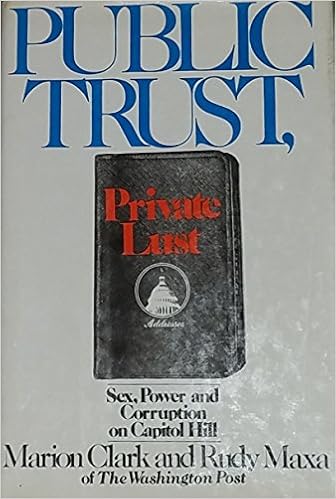
Public trust, private lust: Sex, power, and corruption on Capitol Hill Hardcover by Marion Clark (William Morrow)


One of the vanities of youth is that each discovery is a revelation, and a year or two ago Marion Clark and Rudy Maxa, "two young Washington Post investigative reporters," after months of exhaustive research and hundreds of interviews with thousands of sources on land, sea and in the air, concluded that various members of Congress are known to have mistresses whom they sometimes employ in their offices. As with everyone else before Watergate, Clark and Maxa undoubtedly thought the world of their elected officials, and were therefore so astonished by the sleazy truth that they could ever after only write sentences that resembled Mickey Spillane's, refer to themselves in the third person (just like Bob Woodward and Carl Bernstein) and thank God that The Washington Post, at least, is above such arrangements

This book will serve as a warning to indiscreet congressmen, but leaves unsolved the problem of maniacal ascetics in office. For that matter, what is worse — Liz Ray playing backgammon at government expense, or journalists who assert that in the '50s it was fashionable to be a dumb blonde? Who whom, anyway? The penultimate line of Public Trust. Private Lust says, ". . . the reaction to the congressional scandals of 1976 held the promise of better government in Washington: campaign speeches everywhere were filled with pledges of a new political morality." Even a dumb blonde wouldn't pay $8.95 to read that.

Friday, July 27, 2018

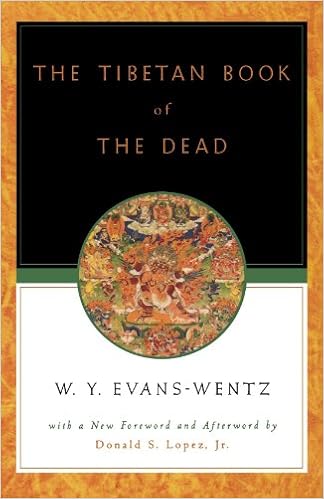
The Tibetan Book of the Dead: Or the After-Death Experiences on the Bardo Plane, according to Lama Kazi Dawa-Samdup's English Rendering Paperback – September 28, 2000 by Karma-Glin-Pa (Author), W. Y. Evans-Wentz (Author), Donald S. Lopez Jr. (Author) (Oxford University Press)


In 2005, Penguin Books published a new translation of Bardo Todol, the collection Buddhist texts that, in the West, has been known as The Tibetan Book of the Dead for three-quarters of a century, and touted it as “First Complete Translation” of a work dealing with life between a person’s death and reincarnation.

Actually, as Donald S. Lopez Jr. points out in his 2011 book The Tibetan Book of the Dead: A Biography, “complete” here is somewhat inexact since Bardo Todol is a cycle of texts of which many versions exist.  Even so, the Penguin book, Lopez writes, is an improvement over the original English edition, put forth by American Theosophist Walter Evans-Wentz.

Many more texts of the cycle are translated [in the Penguin edition] for the first time, the translation is made from a better manuscript, and the translation is more accurate than that first published in 1927.

Lopez, an American expert on Buddhism and Tibet who has edited books by the Dalai Lama, notes that the publicity for the Penguin book is overblown, asserting that the book “embraces the concept of enlightened living and the importance of being open to the wonders of the human experience while, at the same time, thinking beyond this lifetime to a vastly greater and grander cycle.”

In other words, as he summarizes it, “Tibetan Buddhism as self-help.”

The Penguin book itself, however, doesn’t have that tone at all.

“Relative obscurity”

The book begins with an introduction by the fourteenth Dalai Lama, who provides a clear and learned contextualization of the material that will follow, setting forth Buddhist views on the nature of the person, of the process of death, and the principles of the practice of Highest Yoga Tantra.

Such background is essential for understanding the Tibetan text, yet no such introduction has been provided in any of the previous translations.

Lopez writes that the Dalai Lama “deftly alludes to the relative obscurity of the Bardo Todol in Tibet,” and adds:

His implication is that the Bar do thos grol chen mo [another title for Bardo Todol] was not one of the best-known works of Tibetan literature in Tibet.  Indeed, even given the great advances in scholarship on, and the popularity of Tibetan Buddhism since the 1920s, it seems unlikely the Bar do thos grol chen mo would have been translated into English even once, much less five times, by the beginning of the twenty-first century, had Evans-Wentz not purchased it…in 1919.


Sacred texts

Lopez’s discussion of the Penguin edition comes toward the end of his book, and I’m emphasizing it here because I want to stress the point that the Bardo Todol is part of the holy literature of Tibetan Buddhism.

The texts that are well-translated and well-presented in the Penguin book (and were less well-translated and less well-presented by Evans-Wentz) are part of the religious thought of that faith.

They are sacred texts.

Nonetheless, they aren’t the core of Tibetan Buddhism.  They’re secondary texts.

It is akin, it seems to me — Lopez doesn’t say this — to trying to understand the Jewish Bible knowing only the Book of Micah, a seven-chapter text about the judgements and warnings of one of the 12 minor prophets.

Or of trying to gain an insight into the Christian New Testament knowing only the 25-verse Epistle of Jude with its railing against apostates.

In either case, the work is part of the broader faith, not the core.


“Timeless world spiritual classic”

Lopez mentions the obscurity of the Bardo Todol as a contrast to overblown rhetoric that Evans-Wentz and others used in promoting The Tibetan Book of the Dead as some key to the inner secrets of Tibetan Buddhism.

What’s clear to me, from reading the Lopez book, is that these texts deal with one small area of Buddhist thought and can easily be misunderstood without the sort of context that, for instance, the Dalai Lama brought to the Penguin book.

OK, so why is Lopez writing his book?

Why is his biography of The Tibetan Book of the Dead included in the Lives of Great Religious Books, that sterling series of religious, social and cultural history by Princeton University Press?


Why?

Because, over the past eight decades, The Tibetan Book of the Dead has been a crazy-wild bestseller in the West, read by millions, including Allen Ginsberg, John Coltrane, Timothy Leary, Arthur Conan Doyle and Carl Jung.  “From the time of its first incarnation in a Western language, The Tibetan Book of the Dead has taken on a life of its own as a timeless world spiritual classic,” writes Lopez.


“Strange story”

Yet, what readers have gotten from these English versions (except, aside from its publicity, the Penguin book) isn’t what they thought they were getting.

Again, I want to stress that the texts themselves are sacred and real.

But, starting with the Evans-Wentz publication and continuing with the many later editions of that work, the texts have been put in settings that made them look like something they weren’t.  Lopez writes:

Thus, although the first sentence of Evans-Wentz’s preface to the first edition reads, “In this book I am seeking — so far as possible — to suppress my own views and to act simply as the mouthpiece of a Tibetan sage, of whom I am a recognized disciple,” the version of the book that we have today is filled with other voices (the various prefaces, introductions, forewords, commentaries, notes, and addenda comprise some two thirds of the entire book) that together overwhelm the translation.

A few pages later, Lopez writes:

Removing the Bardo Todol from the moorings of language and culture, of time and place, Evans-Wentz transformed it into The Tibetan Book of the Dead and set it afloat in space, touching down at various moments in various cultures over the past century, providing in each case an occasion to imagine what it might mean to be dead.

[Lopez’s] book tells the strange story of The Tibetan Book of the Dead.  It argues that the persistence of its popularity derives from three factors…The first is the human obsession with death.  The second is the Western romance of Tibet.  The third is Evans-Wentz’s way of making the Tibetan text into something that is somehow American….

The Tibetan Book of the Dead is not really Tibetan, it is not really a book, and it is not really about death.  It’s about rebirth: the rebirth of souls and the resurrection of texts.

Evans-Wentz’s classic is not so much Tibetan as it is American, a product of American Spiritualism.


“Shanghaied” — my word

What happened is that the sacred Buddhist text was shanghaied by Evans-Wentz and put to his own purposes — that its words were presented in a way to prove points that Evans-Wentz wanted to make, regardless of their true meaning.

Those are my words.  Lopez doesn’t use the word “shanghaied.” Yet, he does write:

During the last decades of British and American colonialism, the Tibetan text of the Bardo Todol became a kind of colonial commodity, the raw material exported to the city of the colonizer, where it is manufactured into a product…


“Any Asian text”

My reading of the Lopez book leads me to think that Evans-Wentz was well-meaning in the sense that he didn’t think he was perpetrating a fraud.  Yet, what he did was arrogant and disrespectful.  He already thought he had answers to life’s great questions.  He took the Bardo Todol to use as a vehicle to sell those answers.

Evans-Wentz gave his book the name The Tibetan Book of the Dead because there is an Egyptian Book of the Dead.  He thought they both came from the same source although he had no evidence of that.

Here’s how Lopez puts it:

It seems, then, that Evans-Wentz knew what he would find in the Tibetan text before a single word was translated for him.  It almost seems that Evans-Wentz’s spiritual vacation [during which he found the Bardo Todol] could have taken him to any Asian country and that he could have randomly chosen any Asian text, and he would have produced some version of the book published in 1927. 


Strange, indeed

My reading of the Lopez book is that it is a debunking of the Evans-Wentz book.

Lopez doesn’t use any word like “debunking” in his text, and neither does it appear on the book jacket.

Yet, the great accomplishment of Lopez is to show, in 157 pages, how sacred the Bardo Todol is while at the same time obscure, and detail how that sacred text was twisted and tortured by Evans-Wentz to say what he wanted the book to say.

Wisely, Lopez doesn’t speculate on those millions of readers of the various editions of the Evans-Wentz book.

How much of the popularity of the Tibetan Book of the Dead has to do with the texts themselves?  With what they actually say?  With what they actually mean?

And how much has to do with Evans-Wentz’s fuzzy-minded, wrong-headed interpretation of the texts?

To what extent are those who think they are learning about the supposed secrets of a supposedly hidden Asian faith are actually learning about the tenets of Evans-Wentz Spiritualism?

Lopez is to be congratulated for writing a book about such a complex and convoluted story — strange, indeed.


Sunday, July 22, 2018

How Google Works Paperback – March 21, 2017 by Eric Schmidt (Author), Jonathan Rosenberg (Author) (Grand Central Publishing)


Eric and Jonathan cover a vast territory in their engaging discussion of Google's leadership in our software driven era. While their Google specific comments are singularly informed and compelling, I suspect their most valuable lessons are those applicable to virtually any venture. Many of these are recurring thematics within discussions of modern leadership, but rarely have so many useful concepts been so well and accessibly summarized as in "How." Despite 30 plus years in the business I furiously jotted margin notes throughout the book, reminding myself for instance, of the primacy of purpose, as illustrated by the story of a company, beginning with why it is important that it exists; the defining competitive separation afforded by traction and momentum or, get big fast; speed kills; iteration informs. This is a great read; informative, smart and wise, as reflected by their admiration of John Wooden and his aphorism "it's what you learn after you know it all that counts." For those interested I'll summarize below my 'Top 10' of the books many quality, illustrative elements. There are abundant actionable insights in this book and of course, the occasional tendril of presumption. Overall, my sentiment about the book is summarized by my ordering copies for my sons, nieces and nephews, regardless of the sectors they work within, or majors they are pursuing.


I read How Google Works on two flights before attending a ThinkHR executive off-site meeting. Good timing! Every manager at your company should read this book. HR included. It contains a wealth of wisdom. It also embodies a significant challenge to employers. It sets forth a "new age" of human resource and management practices. These practices are not for the timid, mediocre or control freak. They are for those that trust smart people and want to be part of creating something special.

While there is a measure of old wine in new bottles, it is the implementation of these practices which is so exciting and challenges us to rethink the role of human resources. Having read the books criticisms I agree the Google approach will not work in every environment. It is young male centric (ping pong and beer anyone?). It’s also easy to say how wonderful you are when you’re at the top. GM was once wonderful and at the top too. Google is rich and can afford to do many things other companies can’t do or don’t want to do. I don’t expect to see McDonalds giving every service employee 20% of their time off to help reinvent the company.

What follows are some the key points gleaned from the book.

The purposeful use of languaging. Right out of the gate Google cofounder and CEO Larry Page describes the culture of Google. The following phrases are used in the forward and throughout the book "autonomy of thought", "moonshot thinking", "incrementalism leads to irrelevance over time", “focus on the user” Page recognizes the importance of defining a culture. To what degree can you help leadership in delivering the message?

Keep a spreadsheet ranking the company’s top projects. Google did this for years with its top 100 projects. What are the top dozen projects in human resources and how are they ranked? Are they in alignment with the company’s list?

Don't live by schedules. This is in alignment with the TQM ideas of Dr. Edwards Deming who said you manufacture towards perfection not towards a tolerance. Likewise when you put a deadline or date on something you manage the project towards it. Google realized it had to loosen the reins and allow its engineers the freedom to move fast. Not according to any deadline. And yes, we have to schedule meetings and the like. This is a conceptual point being made.

Product excellence is now paramount to business success. Not the control of information, not a stranglehold on distribution, not overwhelming marketing power (although these are still important). This is largely because of better informed consumers. For the consumer this is a good thing. The same concept applies to managing the workplace. Employees are better informed than ever too. Top employees can insist on management excellence…or work someplace else.

The primary objective of business is to increase the speed of product development and quality of its output. The only way to do that is to attract and hire what Google calls "smart creatives". Here's a list of smart creative characteristics: technical knowledge, hands-on experience, an expert in doing, analytically smart, business smart, competitive smart, user smart, new ideas smart, seriously creative, risky creative, self-directed creative, open creative, thorough creative, communicative creative. No smart creative has all these characteristics. These are the type of employees that can get a job anywhere. It is not about finding them but rather attracting them.

Hiring is the most important thing a leader does. This does not differ from what Peter Drucker, Jim Collins and every other management expert has told us. Problem is half of the companies choose to execute on it better than the other half. To be effective, there has to be a culture of execution when it comes to great HR practices. Is it more important your mangers hire fast or hire right?

Employees at Google have the freedom to solve any big problem that stands in the way of success. Google's culture turns their engineers into problem-solving ninjas.

Diversity. Google's approach is simple: "it doesn't matter who you are, just what you do". There are critics of Google who claim this diversity doesn’t exist.

The rule of seven. This is an interesting conversation. It's hard to manage 27 employees. Many experts, including me, have recommended a limit on direct reports. Google does just the opposite. They feel that if somebody has too many reports then they won't have the ability to micromanage them. We must test to find out what approach works best in our environment.

"Your title makes you a manager. Your people make you a leader" Debbie Biondolillo, Apples former head of HR

Overworked in a good way. Every company is rightfully concerned about the excessive stress placed on its workforce. Google believes that highly engaged employees stress only about their desire for accomplishment and little else. Not everybody agrees. Many a working parent has commented on the brutal reality of this overworked approach (put the kids to sleep and check in for the next three hours).

A culture of "yes" – as opposed to a culture of "no". HR, who has been painted squarely in the corner of no, needs to communicate yesses better. Let leaders and workers know the yes agenda (you have one…right?). Create skunkworks, experiments, tests, etc. so you can fail quickly and find out what works. This can be a real challenge for HR executives as their personality profiles reveal a personality geared towards rules and conformity, not experimentation. They're very concerned about any judgment that may come with mistakes made. Not exactly an innovators profile. Time to get over it.

Have fun, at your own expense. A good sense of humor can keep people humble. Google gives example after example of how they poke fun at themselves.

Open, open, open. While Google has its critics about openness on the outside, it is determined to create an open culture internally. Google believes openness is the only way to deal with a rapidly changing, chaotic business environment. Yes it can get sloppy but falling behind the times due to stagnation at ever accelerated rates is not an option. "With openness, you trade control for scale and innovation."

"You must wear something". Eric Schmidt's answer to the question of what the Google dress code was.

"Don't be evil" Another mantra at Google. While few would profess a desire otherwise, at many companies it is not a mantra attached to a commitment. Enron being the classic example. Highly productive managers, with good numbers, can get away with brutish tactics at many a company. The don't be evil mantra can avoid many lawsuits, agency investigations, media problems and employee turnover.

"Giving the customer what he wants is less important than giving him what he doesn't yet know he wants". Such as an amazing HR experience. Maybe HR must give CEOs what they didn’t know they wanted: a kick ass HR department. Curious-if you could create an X prize for human resources what problem would you try to solve?

"If you focus on your competition, you'll never deliver anything truly innovative” This is true for your HR practices too. Yes it's fine to learn from other company experiences. It is even better to generate your own. To be a great observer of your own environment, condition and opportunities.

"It didn't matter if the person would be an entry – level software engineer or a senior executive; Google made it a priority to invest the time and energy to ensure they got the best possible people". One would think this level of commitment to excellence would be common but it is not. Google believes the higher you go in the organization, the more attached executives should be to the hiring process Google also believes that hiring should be peer – based, not hierarchical, with decisions made by committees.

"The objective is to create a hiring culture that resists the siren song of compromise.”- A song that only gets louder amidst the chaotic whirlwind of hyper growth.

Hire "learning animals" or people with a growth mindset. When you do, offer training and growth opportunities. Problem is most people do not have a personal learning culture. Perhaps one out of ten do… at best. One reason there is no substitute for required learning, as most won't do it voluntarily.

Interview questions:
• Reflect on a past mistake you made. What did you learn from it?
• What books are you reading right now?
• Take them through problematic case scenarios
• "Could you teach me something complicated I don't know". A favorite interview question by Sergey

Identify candidates who asked thoughtful questions

Conduct 30 minute interviews and limit yourself to four. My feedback is why do they impose an artificial limit if their mantra is to not live by schedules? I say take the time you need to make a great hire.

Create a hiring packet for executives including a one page summary with all the key facts and supporting material. There is no substitute for a well prepared hiring system.

There is always an "up" opportunity available at Google. It amazes me when people must leave organizations to grow. What a waste of human capital investment

Test yourself: “if you could trade the bottom 10% of your team for new hires, would your organization improve?”

Another test: “are there members of your team whom, if they told you they were leaving, you would not fight hard to keep? If there are employees you would let go, then perhaps you should.”

The first step in the decision-making process is to understand the data. The next step is to engage in an open dialogue where opinions and objections are welcome. There's a bias for action and a decision must be made and that is the ultimate responsibility of the executive.

Google believes in daily executive team meetings. Short meetings that are action oriented. My only feedback is to make sure that is what happens. Why the meeting, how long, what outcomes, get it done.

Many chapters of the book focused on communication and decision-making. I saw nothing I would label as new. The principles for communication and wise decision-making have been with us for thousands of years and half of executive teams apply them better than the other half. Seems like Google does a good job of it.

Have a playbook. Google challenges its business leaders to have a playbook with notes on how to communicate to employees, bosses, directors, customers, etc. For example, a playbook for one on one meetings, or to discuss performance, manage relationship with peer groups, innovation/best practices, etc. Again, a bit of old wine in new bottles. Playbooks, scripts and SOPs have been around for years.

Innovation. The end of the book is spent on this subject, something near and dear to the DNA of Google. But it should also be near and dear to the DNA of every company and career. According to Google innovation "entails both the production and implementation of novel and useful ideas". It also requires much optimism. If you want to be innovative you have to "think big". This means you set goals that are almost and often unattainable.

20% time. Allows its engineers and presumably others time to experiment, test, identify novel projects and find others interested in supporting them. How do you catch up for the company that gives its engineers that level of freedom? Odds are you don't.

Conclusion

I regularly speak to company CEOs. They continue to state their greatest business concerns center on the ability to hire talent, get them to produce, keep them engaged, and retain the star performers. While this book is a self-serving manifesto, How Google Works provides a formula how to do each of these critical business objectives in a great way. It is as insightful as any human resource book you'll ever read. A strategic HR executive would well embrace the Google approach.

Friday, July 20, 2018

The Burning Shores: Inside the Battle for the New Libya Hardcover – April 17, 2018 by Frederic Wehrey (Farrar, Straus and Giroux )


A new book explores the Libyan Civil War, the West’s intervention and how hope and promises turned to hellish conflict.

In 2016, a Libyan general named Khalifa Haftar was trying to cleanse the eastern-Libyan city of Benghazi of jihadists and Islamist militias. He had them surrounded. One of his special forces commanders was caught on video executing some prisoners from the battle and an arrest warrant was issued by the International Criminal Court charging the commander with “unlawful deaths.” Several months later, in September 2017, two US B-2 bombers dropped 100 bombs on two Islamic State camps in eastern Libya, killing dozens. Unsurprisingly, the ICC asked no questions about who died in the US bombing.

The juxtaposition of the two incidents, both in Libya – one by a Western power, one by a local commander – are emblematic of the Libyan civil war that erupted after the fall of the brutal dictator Muammar Gaddafi. Frederic Wehrey, a senior fellow at the Carnegie Endowment for International Peace, with long experience in Libya working for the US government and doing research, provides an excellent and thought-provoking narrative of what happened in Libya after the fall of Ghadafi in 2011. Weaving together the personal stories of those like Salwa Bugaighis, an erudite activist and intellectual from Benghazi, as well as militia leaders, smugglers and migrants, The Burning Shores tries to provide a glimpse into all sides of the Libyan conflict.

Wehrey is strongest in looking at the zig-zag of US policy on Libya, an issue he is intimately familiar with. One of the strongest points of the book is his re-telling of the murder of US Ambassador John Christopher Stevens on September 11, 2012. Unfortunately, Stevens was made famous by his death when he should have been more well-known before for his actions to help Libyans gain independence from the Gaddafi regime. He went to eastern Libya during the rebellion aboard a Greek ship to link up with the rebels and brought optimism to the table through his constant interest in learning more about Libyans and their concerns.

The US never quite figured out what it wanted in Libya. On the eve of the uprising, one of Gaddafi’s sons was touring the US, being lavished with attention and promises to train Libya’s army back home. US diplomats and CIA experts did not expect the country to fall to the Arab spring. They were partnering with Gaddafi to “fight terrorism,” according to the account. Then the Obama administration decided to bomb the very same military units it had once thought to partner with. Gaddafi was pulled from a gutter, sodomized and killed by the rebels. “We came, we saw, he died,” Hilary Clinton said. Obama wanted the Europeans to do more in Libya, since the US was leaving Iraq and dealing with Afghanistan. Instead, the UN and EU talked but did little.

The US thought that elections in 2012 might help things along.

“We did this transition in less than a year, now on to Syria,” one US diplomat thought. The problem was that the Americans saw Libya through their lens of “hardliners” and “moderates” and seemed to prefer the smiling Islamists to other groups. Part of this was ostensibly pragmatic. The Islamists had support on the street and militias. But Washington didn’t seem to understand the chaos, and killings that would come next. Soon the liberals were driven from the country or hunted down and killed.

Into the vacuum came Haftar, a greying general who had lived in the US for decades but positioned himself as a savior come to cleanse the rot. With backing from Egypt and the UAE, and eventually also from the Russians and Western special forces, he broke the back of the militias and drove them from eastern Libya. The author is critical of these achievements, seeing in them the meddling of Gulf Arab states and also critical of the way Haftar as seemed to merely recreate a new military dictatorship.

Western powers certainly tried to help Libya after 2011. A training program for Libyan soldiers went awry when some of them, flown to the UK for training, groped women and raped a man. In Libya, they stole from the very Western governments that were supposed to be helping them. Eventually, the Westerners closed up shop and what remained was Obama’s anti-ISIS campaign from the air and various programs from European countries aimed at stemming the flow of migrants from Libya.

This is a book about Libya, but it’s about much more than Libya. In one incident, ISIS fighters escape Libya for Niger, spreading their terrorism to other countries in Africa. The Libyan conflict sucked in foreign fighters from all over the Middle East and became a proxy conflict of competing agendas between Qatar, which supported Islamist extremists, and the UAE and Egypt, which supported Haftar. The lesson is that what happens in one country in the Middle East does not stay in that country.

One of the downsides of this book is the author doesn’t spend much time looking at the wider implications of his Libya coverage. Nevertheless, any perceptive reader will quickly understand the strands connecting Libya to what happens in Jerusalem, London and Washington.


On Anarchism Paperback – November 5, 2013 by Noam Chomsky (Author), Nathan Schneider (Introduction) (The New Press)


Unless your interest in this book is purely academic analysis of political systems, I assume you have some leanings in its direction. If so, you know that anarchy has a bad rep; I've seen it equated with 'chaos' in crossword puzzles. Chomsky acknowledges this early on and refutes it; he takes us back to the original goals of anarchy, devoid of people who riot and throw bricks through windows, the goals of individual freedom, economic equality and democracy built from the ground up.

The first is an essay entitled 'Notes on Anarchism' and is just that; a wide variety of thoughts, with quotes from others, as to just what true anarchism is, and is not. The second chapter, excerpts from Understanding Power, is worth the price of the book. A question and answer session (Chomsky giving the answers) seemingly in a group setting with various people raising the essential questions of anarchism (tension of collectivism vs. individual freedom etc.) Chomsky gives a magnificent tour-de-force performance in replies. He also mentions the anarchy/chaos situation.

The third chapter is one of very heavy reading. Stating that the Spanish Revolution, 1936-37, is of great historical significance, Chomsky not only reviews the history of the 'people's revolution' which was crushed by those in power, but, citing numerous historians, questions whether or not their views coincided with reality as to what was happening. If you're not familiar with the named historians or their works, this is a tough read. However, if you bypass all of that and accept Chomsky's opinions, you will learn a lot regarding the Spanish Civil War and especially the entrenched power response to anarchists.

The fourth chapter is an interview with Harry Kreisler (of UC Berkeley), Chomsky is the interviewee; the effect is similar to chapters one and two, a variety of anarchist thoughts and concepts are discussed.

The last chapter is the transcript of a lecture given at Loyola University in 1970; Chomsky is a linguist so he is seemingly in his element as this address is entitled -Language and Freedom. But no, he raises the question as to just how language and freedom are related and admits, at the end, that he is still not sure but much intrigued by the association. An interesting essay which will challenge your thinking in many areas, but may also, answer many questions you have had in your pursuit of an understanding of anarchism.

Thursday, July 19, 2018

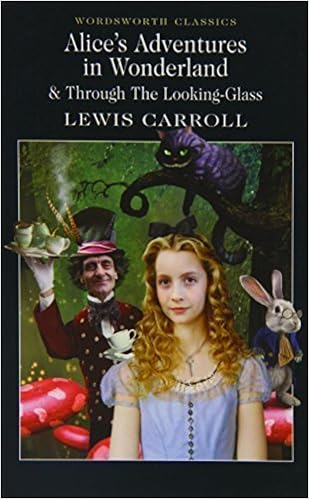
Alice's Adventures in Wonderland (Wordsworth Classics) by Lewis Carroll Paperback – by Lewis Carroll (Wordsworth Editions )


Its fantasy plot, humorous rhymes and brilliant use of nonsense was revolutionary.

What’s down the rabbit hole?

A hot summer’s day on the riverbank, and young Alice is bored. Bored, that is, until a white rabbit in a checked jacket scurries past in a great hurry, examining a pocket watch. Burning with curiosity, Alice can’t help but follow the rabbit down the hole which leads to a long passageway – and a tiny door too small to get through.

So begins Alice’s adventures in the amazing world of Wonderland. In the pages that follow a strange liquid will shrink her to only ten inches tall; a curious cake will disappear before her eyes; a mad hatter will invite her to tea – and Alice will play a very dangerous game of croquet…

The character of Alice is based on Alice Liddell, the ten-year-old daughter of an academic at Christ Church College in Oxford, where author Lewis Carroll studied and taught. Carroll would tell Alice stories to entertain her: Alice begged him to write them out and he presented them to her in 1864. He was later persuaded to publish and, after further additions, the book as we know it today appeared in 1865, including the famous illustrations by John Tenniel.

Alice in Wonderland was Lewis Carroll’s first novel and its fantasy plot, humorous rhymes and brilliant use of nonsense was revolutionary. Nineteenth-century children’s writing usually served moral or educational purpose, but Alice was written firmly and purely for the amusement of children. Critical response was lukewarm, but the book was still a great success, and remains a hugely influential classic of children’s literature.

Alice appeals to adults as well as children and over the years readers and critics have found within it all manner of riddles, puzzles, mathematical concepts and references to Carroll’s famous and not-so-famous friends.

Lewis Carroll was the pen-name of Charles Lutwidge Dodgson, born in 1832 in Cheshire in the north of England. His father, the local rector, came from a family of distinguished scholars and clergymen. Dodgson continued the academic family tradition and studied mathematics and theology, eventually becoming a mathematician at Oxford University.

He first began to write comic poetry and prose in the 1850s and had several pieces published in magazines, where he first began to use the name Lewis Carroll. In 1856 he met four-year-old Alice Liddell who was to inspire the book which made Dodgson’s name, Alice’s Adventures in Wonderland, published in 1865. The book was an immediate success, was translated into many languages and soon established itself as an English classic. Its sequel, Through the Looking-Glass, appeared in 1871. Their revolutionary combination of word-play, humour and nonsense had never been seen before in writing for children. His other great masterpiece of nonsense is the poem The Hunting of the Snark (1876), and other books for children including Phantasmagoria (1869) and Sylvie and Bruno (1889).

Charles Dodgson never married and remained at Oxford all his adult life, where he wrote several books on mathematics and logic as well as devising board games and brainteasers. He was also an expert photographer, famous for his portraits of children and many artistic personalities of the day. He died in 1898.

Tuesday, June 26, 2018

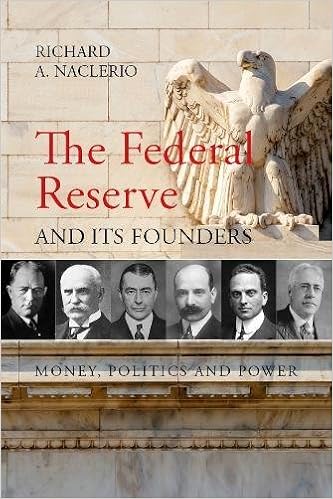
The Federal Reserve and its Founders: Money, Politics, and Power Paperback – August 28, 2018 by Richard Naclerio (Agenda Publishing)


The U.S. Federal Reserve has been with us for just over one hundred years. Founded in response to a major economic panic, it has played a key role in the world economy ever since, including the recent global economic downturn. The Fed's structure is unique among central banking systems. Many people think it is a government agency, that it was created by politicians for the benefit of the U.S. economy, and that it is regulated by the U.S. government. None of these assumptions are true. To fully understand the Federal Reserve and its role today we need to examine its origins and the men that founded it.

Using extensive archival sources, Richard A. Naclerio investigates the highly secretive events that surrounded the Fed's creation and the bankers, financiers, and economists that played a fundamental part in shaping both its organization and the role it was to play over the next century. In particular, the book examines the motivations of those sevestn men who met in secret on Jekyll Island, Georgia to create the first draft of the Federal Reserve Act, and reveals the banking and business ties and shared ideologies that bound these men together. The book makes a significant contribution to economic and financial history and sheds new light on the making of one of the world's most important financial institutions and how it came to have the national and international influence it does.

About the Author

Richard A. Naclerio has worked extensively in business operations and real estate investment in New York City and Denver, Colorado. He continues to manage his own real estate companies and stock portfolios. Although he enjoyed some financial success, personal fulfilment eluded him. So in 2010, at the age of 40, he decided to pursue his passion for history. Still lacking a college diploma, he received his BA and Masters from Iona College, graduating first in his class at the age of 43. He taught business communications and English at Monroe College in the Bronx, New York and worked for three years at Sacred Heart University in Fairfield, Connecticut as an adjunct history instructor and academic advisor. Awarded a fellowship to the history doctoral program of the Graduate Center at City University of New York, he is now, at 48, a third-year PhD candidate. He is also a graduate teaching fellow at Lehman College. He is married with four children and lives in Westchester County, NY. This is his first book.

Tuesday, May 22, 2018

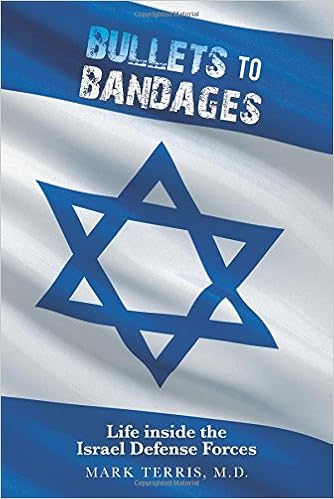
Bullets to Bandages Paperback – April 17, 2017 by Mark Terris (XLIBRIS)


Mark Terris wrote the first draft of his new book just after his discharge from the Israel Defense Forces. Over the next 35 years, the manuscript mostly stayed in a box except when the author drew it out for polishing (something he became good at during basic training.) Thus, the box became a time capsule which I’m glad Terris has now opened.

Terris, an American, moved to Israel with his family when he was 11. He had the opportunity to immigrate back to the states when he graduated, but instead he chose to enlist and serve the usually mandatory 3 years in the Israel Defense Forces.

Terris writes in detail about his basic training with the paratroopers, his medical training within the military, and the rest of his service. He takes his time with events and people, giving us an idea of what it is like to serve in Israel, and making us feel like we know him and his friends and the other characters.

Rather than this being an action packed military book where the warrior-author takes us from battle to battle, this book shows us the other side of military life; a side that is at times mundane. Guard duty, polishing shoes, polishing bullet casings, making beds, raking dirt, sweeping roads, endless inspections. But there’s also excitement and adventure, though it comes more from the pranks and mistakes of 19 and 20 year-olds than from enemy attacks.

Terris gives us a thorough record of his service. He writes well and with warmth and humor. While the book is long, I enjoyed it, and I recommend it to anyone interested in the Israel Defense Forces, medicine, or the military in general.

#OyVeyDonaldTrump and the Death of Democaracy .....John Gray’s latest book is “Seven Types of Atheism” (Allen Lane) How Democracy Ends David Runciman Profile, 256pp, £14.99 How Democracies Die: What History Reveals About Our Future Steven Levitsky and Daniel Ziblatt Viking, 320pp, £16.99, review essay by Stephen Darori, The Bard of Bat Yam, Poet Laureate of Zion

Image result for Cartoon Donald Trump , democracy

The fundamentals of Western politics are under threat. So what’s next?

 “Democracy is no longer the only game in town.” In this short sentence, David Runciman states the most important political fact of our time. When Winston Churchill wrote in 1947 that “democracy is the worst form of government except for all those other forms that have been tried from time to time”, he did so in a context in which the alternatives were Nazism and fascism, which had recently been defeated, and the Soviet Union, which was consolidating its tyrannical hold over half of Europe. Seventy years later, it is no longer obvious that democracy is always the least bad form of government. Runciman explains:

Churchill was only half right. Democracy remains the least worst option for many of us, for now. But it is not the least worst option for everyone… The 21st century is likely to see Western democracy confronted by a rival political system that will vary from place to place and will occasionally stretch to include the edges of our politics. The temptations are real, even if the alternative is unrealistic for most Western societies.


The uncertainties surrounding democracy have two dimensions, one domestic and the other global. Internally democracies are faced by varieties of what is loosely described as populism – the rejection of established political elites and their policies. Externally democracy is confronted by the fact that dictatorship may be accepted and supported as legitimate by large majorities in countries where it prevails.


Democracy has overcome both of these challenges in the past. In the US, following a financial crash in 1893, William Jennings Bryan captured the Democratic Party and stood three times as its presidential candidate with a populist message and campaign methods very like Donald Trump’s. Bypassing mainstream media, Jennings used local news outlets and pamphlets to cast professional politicians – including his own party’s – as the enemy. His campaigns failed, and the next Democrat to reach the White House, in 1913, was a former president of Princeton, Woodrow Wilson. In interwar Europe fascism and Nazism commanded large majorities in many countries, not least among the continent’s middle classes. That did not prevent stable democracies developing in western Europe after the Second World War. So why is the present crisis of democracy different from any in the past?

Runciman points to three fundamental differences. First, political violence is less of a threat in democracies; lurking on the fringes of politics, it lacks the capacity to overthrow governments. Second, threats of disaster paralyse rather than galvanise politics. We have become used to the nightmarish prospect of nuclear war, so that even when it seems imminent – as it did to some people during the recent Korean crisis – it has little or no effect on the democratic status quo. The danger of catastrophic climate change has had a similar lack of impact. As Runciman puts it, “Entropy replaces explosive change as the default condition of politics.” Third, information technology has transformed the conditions in which democracy operates. The media environment is a battle-ground fought over by forces elected governments neither control nor fully understand.


Pursuing these themes, Runciman explores three ways in which democracy can end: through coups, catastrophes or technological takeover. None of these is inevitable. In many cases democracy will have a long, lingering half-life. There are no solutions. Solutionism – the belief that every social evil can be removed or managed – is part of the problem democracy faces. But we can understand better the situation in which we find ourselves, and make a better job of what can be done in it. Along the way to this sober conclusion there are comments on the political applications of futurism, Cormac McCarthy’s novel The Road, the late Oxford philosopher Derek Parfit’s argument for the ethical unimportance of personal identity and dozens of other interesting topics. Presented in pellucid prose free of the jargon of academic political science, How Democracy Ends is a strikingly readable and richly learned contribution to understanding the world today. If it does not always answer the questions it asks, this is surely one of the most luminously intelligent books on politics to have been published for many years.

Runciman begins with a story. Watching the inauguration of Donald Trump on 20 January 2017, in a draughty lecture hall in Cambridge, where he is head of the Department of Politics and International Studies, professor of politics and a fellow of Trinity Hall, he observed how the mood of the students who had gathered there changed when Trump started speaking. Initially almost festive, it turned suddenly to one of fear and foreboding:

The speech Trump gave was shocking… He bemoaned “the rusted-out factories scattered like tombstones across the landscape of our nation… the crime and gangs and drugs”. In calling for a rebirth of national pride, he reminded his audience that “we all bleed the same red blood of patriots”. It sounded like a thinly veiled threat. Above all, he cast doubt on the basic idea of representative government, which is that the citizens entrust elected officials to take decisions on their behalf… Was he going to mobilise popular anger against any professionals who now stood in his way? Who would be able to stop him? When he had finished speaking, he was greeted in the lecture hall back in Cambridge by a stunned silence. We weren’t the only ones taken aback. Trump’s predecessor but one in the presidency, George W Bush, was heard to mutter as he left the stage: “That was some weird shit.”


None of this suggests Trump is about to install fascism in America. The US is not Weimar Germany, and it will take more than the digital revolution to destroy American democracy. Near the end of the book, Runciman makes a prediction: “On 20 January 2053 there will be a ceremony in Washington, DC to mark the inauguration of the duly elected president of the United States… American democracy will survive the presidency of Donald Trump.” It is a reasonable enough bet. The question, though, is what sort of democracy America will then be.

Runciman says very little about populism or illiberal democracy, and what he does say is dismissive. Defining populism as “the idea that democracy has been stolen by the elites”, he writes that illiberal democracy is “not an alternative to democracy. It is simply the populist distortion of it. Democratic authoritarians like the Hungarian leader Viktor Orbán – who describes himself as an ‘illiberal democrat’ – take their inspiration from Vladimir Putin rather than the Chinese Communist Party. Democracy is talked up, stripped of its liberal credentials… As a result it is barely democracy at all… This is a parody of democracy rather than a replacement for it.” Unusually, Runciman is here endorsing a consensus view: illiberal democracy is impossible, a contradiction in terms, or else just a fraud.

It is an odd stance for a scholar immersed in the history of political ideas. It is only in the last few decades that liberalism and democracy have been conflated. There has long been an influential tradition of illiberal democratic thought, articulated in 18th-century France by Jean-Jacques Rousseau, who represented democracy as the pursuit of the general will by a semi-divine legislator – a conception the great French liberal Benjamin Constant (1767-1830) considered dangerous enough to attack relentlessly. Later in the 19th century, liberals beginning with John Stuart Mill devoted much of their effort to working out how liberalism and democracy could be reconciled. In the 20th century, Lenin’s scorn for bourgeois democracy owed something to Rousseau’s account of the corruption of civil society, while the French Enlightenment thinker’s conception of the legislator was one of the inspirations of the leader of the Islamist revolution in Iran, the Ayatollah Khomeini.

It is unlikely that Trump has ever heard of Rousseau, or would give a damn about him if he had. But if democracy in America were to face a second Trump administration it could emerge at the end as a caricature of Rousseau’s illiberal ideal. Trump would do all he could to neutralise the judiciary, so that it no longer functioned as a meaningful curb on executive authority but instead became the servant of the presidential whim. Of course this would not be American democracy as we have known it. Elections might be rigged to a degree; freedom to oppose the incumbent administration could be curbed. But nor would it be a rerun of interwar European dictatorship. It would be democracy of the illiberal kind that can now be found in Putin’s Russia and Orbán’s Hungary. If Runciman fails to take illiberal democracy seriously, one reason may be that he regards Xi Jinping’s China as the only credible alternative to Western democracy. Unlike Putin’s Russia, China does not need to display enmity to the West. It can outpace the West through economic expansion and technological innovation, while steadily acquiring key Western assets.


Far more than Russia – with its economy stuck in the fossil fuel era – China can deliver growing prosperity to its population. Both are authoritarian regimes. At the same time, both are types of popular government that depend ultimately on majority consent. In contrast to pre-modern regimes whose legitimacy derived from authority inherited from the past, they survive by promising a future better than the past. If this promise is no longer believed, they crumble away or morph into another kind of regime. The same is true of liberal democracies, which are subject to the same imperatives.

There is more to populism than material grievances. But an important strand in the revolt against Western ruling elites is a perception of their economic incompetence. Not only did they fail to anticipate the financial crash, they failed even to recognise such a thing was possible. When the crash happened, a great depression was avoided by expansionary monetary policies; but the result has been a massive surge in debt and asset prices, which leaves the system as fragile as before, if not more so. Of what value, then, is the expert knowledge on which liberal ruling elites have based their legitimacy?

Runciman has some sympathy for “epistocracy” – rule by the knowers, the system of government advocated by Plato in ancient Greece: “In the age of Trump and [Narendra] Modi, climate change and nuclear weapons, epistocracy has teeth again.” But he draws back from advocating it. Epistocracy is a reckless idea, he thinks, because democracy is better at avoiding disastrously bad solutions than a system that puts power in the hands of those who can supposedly identify the best.

To my mind, epistocracy has teeth when the knowledge in question is grounded in experience – practical and historical. On this basis, the professional military has been rightly sceptical regarding the succession of disastrous wars launched by Western governments from Iraq onwards. If a larger conflagration has been avoided in Syria, much of the credit goes to knowledgeable minds in the Pentagon.

But who any longer gives any credence to theories of globalisation that provided a spurious rationale for the almost forgotten “Washington consensus”? Who does not recognise that much of “social science” is actually little more than coagulated ideology? If highly educated people had more votes than those without university degrees – as JS Mill advocated – we would end up being governed by the intellectual fads of a generation ago. The case against epistocracy in the West today is that, in practice, it means rule by defunct ideologues.

This brings us back to China. The Chinese system may not be as meritocratic as it claims. Doubtless nepotism and corruption are rife. But the ruling elite has the advantage over its Western counterparts in not being hobbled by ideological correctness. If China is the only world power with a consistently rationalist foreign policy – one based on pursuing achievable goals by effective means – it is because it has not imbibed the liberal ideology that dictates thinking in the West, which condemns realism in foreign policy as immoral. Of course this freedom from ideology might not last. Xi could turn to inflaming nationalism if the economy falters. But at present – in its dealings with Trump, for example – China is the only adult in the room.

The most striking feature of Steven Levitsky and Daniel Ziblatt’s How Democracies Die is that China is barely mentioned. Bizarrely, neither the country nor its current leader appears in the index. Levitsky and Ziblatt might defend this omission on the grounds that their subject is how democracies succumb to authoritarianism and China is not a democracy. But India does not appear either, despite the fact that many observers see clear signs of populism in Modi’s approach to democracy. The result of these omissions is an oddly parochial study. Part of the crisis of democracy is the realisation that it is no longer the wave of the future. If China keeps raising living standards, tackles environmental problems and manages the social costs of automation, the legitimacy of liberal democracy will be badly shaken.

Both of them professors of government at Harvard, the authors are at pains to make their analysis international. Erdogan’s Turkey, Pinochet’s Chile and Fujimori’s Peru are examined as case studies in democratic failure, along with countries such as Finland, where a fascist movement was seen off successfully in the 1930s. The result is an informative analysis that will help readers recognise the signs of creeping authoritarianism.

But the book’s limited international references serve the authors’ central focus, which is on the Trump administration. When they consider what “we” can do to resist the threat to democracy, “we” means liberal Americans. America is not the centre of the world, however, and the fate of democracy is unlikely to be decided there. As Runciman writes, “Trump’s presidency could be a vast distraction from the greater threats to democracy elsewhere.”

Needing to meet the demands of those they govern, all modern states are forms of popular government. Even Saudi Arabia, an absolute monarchy, must show it is delivering a better future – hence the grandiose reform programme currently being promoted by its ambitious new leader, Mohammed bin Salman. There is nothing special about liberal democracy, and no guarantee that it will survive the demands that modern populations make on those who rule them.

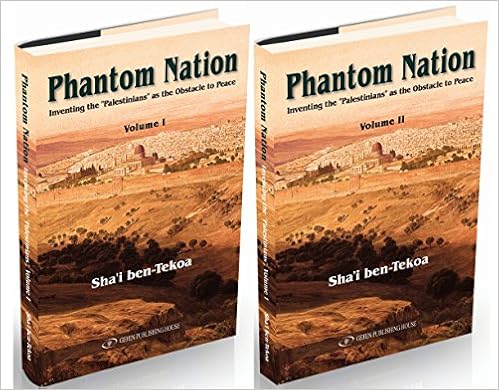
Phantom Nation: Inventing the Palestinians as the Obstacle to Peace (Volume One and Two Box Set) Hardcover – June 1, 2018 by Sha'i ben-Tekoa , $70 (288NIS) 1360pages ISBN 9789652299253 (Gefen Publishing Company)


Sparring with a ghost nation.

I went to a lecture on "Palestine" given by Sha'i ben-Tekoa. I had never heard of him before, but I was favorably impressed. I was impressed enough to buy his book. Sha'i ben-Tekoa writes in a very precise manner, with no sugar coating or compromising the truth. Nor does he become preachy or self-righteous. He has a very impressive recall of the history of conflict between Jew and Arab that does not just start with the creation of Israel. One of ben-Tekoa's main points is that Israel does not face a conflict of nationalities, but a conflict of religions. In fact, ben-Tekoa shows that "Palestinians" are a recent and artificial construct, dating from the 1970's that is useful in obscuring the aggression of Israel's neighbors. Thus ben-Tekoa concludes that the conflict is not Arab/Israeli but rather Islam/Jew and thus is much more intractable. In fact, ben-Tekoa prefers not think of the continuing violence as "conflict", but rather as a centuries-old assault of Islamic Extremists on infidel Jews.

Right or wrong, ben-Tekoa's book would not have value if it did not articulately make its case. Whether you agree or disagree with his conclusions, this book will give you insight into the belief and thinking of those who do.

Phantom Nation: Inventing the Palestinians as the Obstacle to Peace (Volume One and Two Box Set) Hardcover – June 1, 2018 by Sha'i ben-Tekoa , $70 (288NIS) 1360pages ISBN 9789652299253 (Gefen Publishing Company)


Who are the Palestinians? Why is there no book in any library on the planet narrating their history? Why are there no references in United Nations records to the Palestinians for the first quarter-century of UN resolutions of the Arab-Israeli conflict?
Phantom Nation is an exhaustive survey of historical records and news accounts that demonstrates conclusively that the Arabs currently inhabiting the land of Israel have no indigenous ties to the area, and that Palestinian nationalism is verbal camouflage for belligerent Islam and functions as this generation's politically correct, even fashionable mutation of the ageless fear, loathing and hatred of Jews.

Meticulously researched [and] packed with more information than any single book on the history of Israel.… Ben-Tekoa understands the role that the Koran and Islam have played in the Muslim/Arab war against Israel [and] goes beyond some of the best books on the conflict, including the late Irish politician Conor Cruise O'Brien's The Siege and Samuel Katz's Battleground.… I highly recommend Ben-Tekoa's work. Phantom Nation belongs in homes, libraries, and should be studied by all Israel support organizations

Who are the Palestinians? Why is there no book in any library on the planet narrating their history? Why are there no references in United Nations records to the Palestinians for the first quarter-century of UN resolutions of the Arab-Israeli conflict?
Phantom Nation is an exhaustive survey of historical records and news accounts that demonstrates conclusively that the Arabs currently inhabiting the land of Israel have no indigenous ties to the area, and that Palestinian nationalism is verbal camouflage for belligerent Islam and functions as this generation's politically correct, even fashionable mutation of the ageless fear, loathing and hatred of Jews.

About the Author
Sha'i ben-Tekoa is an American-Israeli journalist. He studied comparative religion at Columbia University and the University of Chicago before serving in the Yom Kippur War effort of 1973. His articles on the Arab-Israeli conflict, terrorism and Islamic fundamentalism have appeared in the Wall Street Journal, National Review, Midstream, Congress Monthly, Jerusalem Post and Israel National News, where he was formerly the lead English-language commentator. In preparation for 1991's historic Arab-Israeli peace conference in Madrid, he worked on assignment for the Office of the Prime Minister of Israel Yitzhak Shamir, developing the research on which this book is based.