Showing posts with label . @stephendarori. Show all posts

Saturday, July 21, 2018

Women in Israel: A State of Their Own (Pennsylvania Studies in Human Rights) Hardcover by Ruth Halperin-Kaddari (University of Pennsylvania Press)


When Israel declared its independence in 1948, it vowed to ensure equality for all citizens, regardless of religion, race, or gender. History shows, however, that this promise has been broken in the case of women, who generally live under circumstances significantly worse than those of men. Women in Israel is the first comprehensive overview of discrimination in a state dominated by a patriarchal religious order, and brings fresh insights to the efficacy of the law in improving the status of women. Providing a sociolegal perspective on women in Israel viewed, Ruth Halperin-Kaddari examines all aspects of Israeli women's lives, looking at legal issues such as affirmative action, motherhood and the workplace, and mechanisms for the advancement of women, as well as conditions of education, employment, health, family, and prostitution.

While tracing legislative evolution in Israel, Halperin-Kaddari discusses the extent to which law can create social change. Because of its unique position as an economically developed democracy and yet a state where government tries to maintain a special cultural tradition and religious identity in a heterogeneous society, Israel has failed to adopt a single national standard for women that would bring Israeli law into compliance with international human rights. Halperin-Kaddari concludes that the improvement in women's status has not been due to egalitarian consciousness, but rather is incidental to Israel's overall socioeconomic advancement.

Grappling with the Bomb: Britain’s Pacific H-Bomb Tests. Nic Maclellan. ANU Press. 2017.


Sixty years after the British hydrogen bomb test series Operation Grapple was conducted in the South Pacific, its remaining survivors — now octogenarians — continue to fight for recognition and recompense from the UK government. The Grapple series, running from May 1957 to September 1958, consisted of nine nuclear detonations across test sites on Malden and Christmas (Kiritimati) Islands and announced the UK’s arrival as the world’s third thermonuclear power. As a shrinking Empire trickled through Britannia’s fingers, Grapple briefly salved the rapidly developing British condition of postcolonial melancholia by anointing the UK with destructive capabilities disproportionate to its diminishing influence, and helping to secure British ‘seats at the table’ in global affairs for decades to come.

The Grapple tests, overseen by the British Army, were supported by Commonwealth troops from New Zealand — formally independent from the UK since 1947 — and Fiji, which would declare independence thirteen years later in 1970. Christmas Island and Malden Island formed part of the Gilbert Islands, which gained independence from the UK as the Republic of Kiribati in 1979. Gilbertese civilians were employed in logistics and support roles during the tests, and some worked on coconut plantations on Christmas and the surrounding islands. Despite official British claims that both participants and bystanders received ‘little or no additional radiation’ (4) as a result of the Grapple tests (a frankly untenable position that, as of 2018, the British government maintains), islanders and ex-service personnel continue to report chronic illnesses, birth defects and premature deaths. The legacy of Grapple, in part, is another shamefully familiar story of Britain’s abdication of its responsibilities to former colonial subjects.

However, Nic Maclellan’s Grappling with the Bomb: Pacific H-Bomb Tests — available open access to download here — is a successful effort to contextualise and augment this narrative. Using meticulously-gathered oral history and archival materials, Maclellan aims to search for experiences beyond victimhood, exploring how the Pacific islanders themselves experienced — and indeed participated in — the operation. Others excluded from mainstream accounts, including Fijian veterans and political figures as well as the only two women stationed on Christmas Island during the tests, are also afforded a prominent position in the book. The result is a textured, multi-layered story that is surprising and sobering in equal measure.

Maclellan approaches the task of weaving a more democratic history of Operation Grapple by organising the book into a series of vignettes, each one loosely centred around a particular individual or group involved in the tests: the diverse cast includes (among many others) British pilots, Japanese trawlermen, an Australian businessman, Gilbertese mothers and President John F. Kennedy. Each chapter begins with a brief biography, producing a series of remarkable accounts of how the participants of Grapple — in many cases radically separated by physical distance, social class, race, gender, colonialism and occupation — were drawn together into the labyrinthine world of nuclear geopolitics. Many of these participants are still alive and interviewed in depth by Maclellan, in some cases still battling the British government for recompense (or even simple recognition), adding a further dimension of urgency and contemporary relevance to their character studies. Their stories develop into wider discussions of Grapple’s political and historical legacy.

This is a novel way to structure the book, and one which makes Grappling with the Bomb an arresting read: it offers up a profoundly human account, rather than a stuffy piece of diplomatic history. Almost every chapter offers an unusually revealing nugget of information or thought-provoking observation of unusual poignancy: for example, that Fijian High Chief Ratu Penaia Ganilau was fiercely loyal to the British crown up until his death from leukaemia, which his family attribute to exposure to fallout during the Grapple tests (154), or that the British government was so concerned with obscuring the human effects of nuclear testing that it refused even to acknowledge that previous testing had provoked ‘slight alarm’ among Gilbert and Ellis Islanders in official Colonial Office reports to Parliament (50). One drawback with this approach, however, is that it makes for a slightly disjointed and confusing read: despite the chapter titles implying a detailed focus on a particular person or group, some of the vignettes are relatively short and quickly give way to broader discussions. This is not a particularly serious criticism; Maclellan is correct not to advance a simplistic linear narrative. Grappling with the Bomb ably demonstrates that the British nuclear tests were messy affairs, complex pieces of geopolitical theatre which involved a multitude of actors beyond the UK and its military.

Perhaps the biggest strength of Grappling with the Bomb is its relevance to current and emerging debates in nuclear studies. Maclellan explicitly situates himself among other historians of nuclear testing and the South Pacific, rightly differentiating his work from existing accounts by ‘tell[ing] some unfamiliar stories that show the human impact of the Grapple tests, with a particular focus on perspectives from the southern hemisphere’ (10). However, Grappling with the Bomb is likely to find considerable favour across disciplines, offering extremely useful insights to scholars of International Relations (IR), Science and Technology Studies (STS), history, human geography, anthropology and beyond.

Maclellan deftly exposes the inter-departmental struggles over Grapple and atomic weapons more broadly that took place inside the British government, echoing historian Gabrielle Hecht’s study on the ‘technopolitics’ of French nuclear power after World War II, which investigates how the physical properties of technologies can embody competing political agendas. The book also sharply demonstrates the myriad forms of agency and participation in world politics that can be brought about by new technologies: a subject of great interest to those who advocate for IR to recognise the analytical importance of technology and to better integrate insights from STS. There is even something on offer for students of literature, with Chapter Three (‘The Fisherman’) discussing the responses of Fijian, Marshallese and Māori poets to nuclear testing.

As a policy-focused journalist and researcher, Maclellan can scarcely be criticised for not engaging more deeply with these debates, even though this reader (typically, for a student of IR) found himself scanning the pages in vain for conceptual embellishment. Grappling with the Bomb can nonetheless advance our understanding of world nuclear histories by illuminating a treasure trove of raw materials to help us think about nuclear weapons and their devastatingly human effects in a more nuanced way. For those with even a passing academic interest in the topic, this book comes highly recommended.

However, with Grappling with the Bomb, Maclellan makes a far more important contribution — one which transcends the boundaries of scholarly thought, which we are all guilty of taking far too seriously. Aside from the odd lonely voice in the Scottish Parliament, the lasting human damage of Operation Grapple is rarely officially recognised in Britain. This book highlights the hypocrisy of the UK government, its determination to ignore the transgressions of Empire and its callous disregard for those who bear the scars of Grapple today. By letting those touched by the British hydrogen bomb speak for themselves, it provides sorely-needed amplification to the small chorus of Pacific voices that continue to demand justice. The book’s concluding chapter quotes the Fijian sailor Paul ah Poy:

To the government of Great Britain, the people of Great Britain, we would like to say, please, do what is right. We have done our duty to our Queen and our country. We can only wait and see, hopefully, that you will do something (338).

Grappling with the Bomb reminds its British readers in particular that to ‘wait and see’ is not an adequate response to nuclear harm and injustice.

Tuesday, June 26, 2018

Holy Hip Hop in the City of Angels By Christina Zanfagna Published 08.29.2017 University of California Press 189 Pages


At first glance  , the phrase “holy hip-hop” seems like a writer’s clever mash-up of terms that often carry contradictory associations — the orderliness of sanctuary juxtaposed with the wild concrete jungle. But hip-hop is nothing short of sacred for its millions of fans and cultural participants across the globe. For me, hip-hop is entirely holy. I was “saved” by it in my adolescence. By the time I was 12, I had been expelled from four schools for violence and promoting gang activities. On the verge of my fifth expulsion, I was sent to a boot camp where instructors helped students find “more productive outlets” for our energy. Listening to hip-hop helped me discover mine.

People turn to the church to find that peace, value systems that one can live by and feel proud of. In this way, hip-hop is my church. “Ghetto Gospel,” “Thugz Mansion,” and “PRIDE,” are hymns more familiar to me than those of any major world religion. On Sundays, I listen to Tupac, Kendrick, OutKast, Biggie Smalls; the congregation spits more than it hums. God enters the room through the subwoofers.

Because of my relationship to hip-hop, I was both excited and intrigued immediately by the title of Christina Zanfagna’s Holy Hip Hop in the City of Angels, a thoughtful examination of the development of Los Angeles’s hip-hop culture as it “sounds out” the political, social, economic, and physical eruptions that have pushed so many black and brown Angelenos to spiritual, ideological, and physical conversions, both in the church and the streets. As the site of the 1943 Zoot Suit Riots, the 1965 Watts Riots, and the Los Angeles Uprising in 1992 — a city in which black folks are five times as likely to be arrested than their white counterparts and three times more likely to be killed by police — Southern California remains a microcosm of black experiences in America.

Though Zanfagna’s work focuses on hip-hop in Los Angeles, she carefully recounts the story of hip-hop’s origin from the Bronx; highlighting the similarities between the conditions of New York’s crack epidemic and those of the explosion of gang and police violence in Los Angeles, with the response of the respective black communities to each crisis. Though the particulars of each story is unique, the violence and poverty of 1970s New York and the 1990s escalation of the War on Drugs both gave birth to musical forms as a mode of storytelling and catharsis for the affected people.

If one imagines holy hip-hop as a major response to these events, one could argue that nearly all hip-hop is, as the writer defines, a “musical practice used to articulate both a spiritual and social conception of self.” Spirituals served a similarly expressive purpose for those enslaved on plantations, as did the blues for Southern blacks during Jim Crow. Black Americans have always invented or innovated modes of expression and worship in a language that would ensure their safety. The slaves sang in coded language. They gathered in secret. Jazz clubs became a haven for New Yorkers during the Harlem Renaissance. Basements and warehouse parties were where B-boys and DJs could hide among the faithful. In this way, contemporary hip-hop is a continuation of a long tradition in black music.

Indeed, the writer notes in her introduction that there are no “specific sonic signifiers that distinguish holy hip-hop from ‘secular’ rap.” At least part of the reason for this is presented in the text. Zanfagna explains that in addition to the state-sanctioned segregation — which continues to the present day through redlining and unfair housing practices — “increased poverty and unemployment, gang violence, police brutality, mass incarceration, [and] intergenerational social alienation” drive black and brown folks to hip-hop as a vehicle to find “spiritual salvation, artistic expression, financial opportunity, and local community.”

To affirm these claims, one need only look to artists like rapper-turned-pastor Mase, or Young Jeezy, street entrepreneur and self-proclaimed “trap star.” Jeezy rose to fame in the early 2000s alongside Gucci Mane, Rick Ross, T.I., and a host of rappers whose lyrics center on and celebrate hustling, selling drugs — what they dubbed “trapping” — as a means of transcendence from the United States’s “trap” to keep black youth uneducated, in poverty, or incarcerated.

Though T.I. is credited with and most known for popularizing trap music, his religiosity is present on nearly every album, whether in tracks “Prayin for Help” or, when his time comes, hoping he’ll “Live in the Sky.” Ross’s debut album, Port of Miami, literally ends with “Prayer.” One of Jeezy’s most recent albums, Church in These Streets, finds the artist in a state of confession and repentance for the souls lost to the streets. It seems apparent that even the rappers whose public image is primarily associated with stereotypical ideas of money, drugs, cars, and clothes maintain a level of spiritual awareness. That’s not to suggest that Zanfagna is misinformed. The opposite is true. Her work is comprehensive and thoroughly insightful. Rather, in the words of poet and essayist Hanif Willis-Abdurraqib, “What I’m mostly saying is that I know of no secular black people.”

Not unlike the devout Christian or Catholic who accepts their inherently sinful nature as a step toward salvation, the pioneers of trap music understand the limitations white supremacy imposes on black bodies, while asserting their agency through their commitment to economic freedom and ceaseless joy.

Even rappers like Nipsey Hussle or Mozzy, who are most associated with their gang-centric, often violent lyrics, are almost constantly negotiating their concern for spiritual virtue against the limited options presented to them for survival. Nipsey, a known and respected member of Los Angeles’s 60s Crip set, puts his “Right Hand 2 God” on the final track of his most recent album, Victory Lap. Nip makes it clear he wants to “Hussle & Motivate,” while also reminding his listeners that they “got a soul to save.” Mozzy’s 1 Up Top Ahk is a direct reference to God, or rather, “the dude above.” Throughout the album, he laments the “days [he] forgets to pray,” and recalls relatives encouraging him to seek solace in church.

Georgia-born rapper and Kanye West ghostwriter Cyhi the Prynce opens the title track of his debut album, No Dope on Sundays, with an excerpt from the Gospel of Luke and some personal musings: “They say gangsters don’t pray. I beg to differ. […] We pray every night to make it out of this hell we stuck in.” In fact, Khanchuz, one of the primary subjects in Zanfagna’s ethnography, is a former L.A. gang member who was a rapper before he converted and began to “bang for Christ.”

The question I kept circling while I read seemed to refract Zanfagna’s own inquiry: what exactly makes “holy hip-hop” holy? While the church has historically been a center for community building in the black community, hip-hop has traditionally served related purposes. From hip-hop’s earliest moments, DJs like Kool Herc and Afrika Bambaataa were most concerned with advocating for the sociopolitical and economic freedom of black people and creating safe spaces for black people to congregate and thrive. Kool Herc’s original invitations promised “a fun safe time” to any partygoer. Though I’m not sure there were ever any ordained ministers present, I imagine those original block parties to be no less holy than an Easter Sunday service. I don’t mean that people were absolved of their blackness the way sinners are absolved of wrongdoing, but instead that they were liberated; they could “come as you are,” and be loved for being so.

Zanfagna engages with this liberation most in the chapter “Roads to Zion,” which is probably my favorite in the book. As she ties up her study, the writer highlights and explores hip-hop’s diasporic elements, particularly its coalescence of Muslim, Christian, and Rastafarian religious practices in the continuous search for “Zion,” or “Babylon.” Zion — like the ambiguous North the slaves sought, or Martin Luther King Jr.’s “promised land” — demonstrates the common pursuit of liberation across formerly colonized and enslaved peoples. Zanfagna agrees with Jacqueline Nassy Brown’s assertion that place is an “abstraction, not a set of physical properties.” Thus, finding one’s place in this world, or indeed one’s peace can require invisible conversions, both spiritual and ideological. For people like Khanchuz, converting street corners and alleyways into worship spaces is an act of spiritual self-preservation. His only route to God must be invented. Because he stopped banging, he is no longer accepted in his old streets, but his appearance and musical style leave him excluded from the church as well. Holy hip-hop offers him something nothing else can: sanctuary.

Historically, American Christian ideologies have been deeply rooted in respectability politics that deem blackness — especially blackness as it is commonly presented in hip-hop — unacceptable or inappropriate for a place of worship. This is true even in some black churches.

Though black churches in America were originally established as centers of black community, they were also born because white folks didn’t want black people to worship in their spaces. Unfortunately, the same respectability politics that governed the white church carried into black spaces of worship and serve to generate internal racism within black communities. When arguing for abolition, or speaking out against lynchings, or protesting for civil rights, black people have often worked to demonstrate their adherence to what America defines at the time as “good Christian” values in the hopes that that these traits could yield them real freedom and fair treatment by the government. Unfortunately, that myth persists, which is why rappers like Khanchuz and many — maybe all — black Americans are searching for and building spaces that Pac described as “a spot where we can kick it, where we belong, that’s just for us.”

Perhaps one of the best things about Holy Hip Hop in the City of Angels is that it doesn’t offer solutions to the complex social, political, and spiritual challenges that gave birth to holy hip-hop. There is no point at which the author turns to the reader — or to her subjects — to suggest some action. Zanfagna’s book is demonstrably aware of the injustices that permeate black existence, but to argue policy means to turn away from the victim to the perpetrator. Instead, Zanfagna observes, listens, and records. This book — like the church, or hip-hop itself — embraces its congregation. It says: “I see you. I feel you. We’re in this together.”

Monday, June 11, 2018

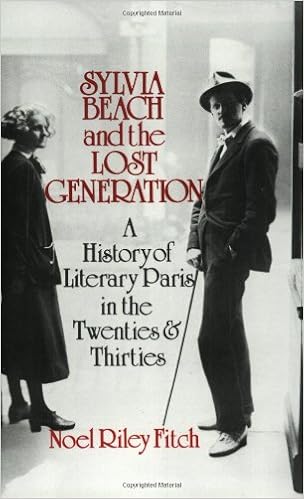
Sylvia Beach and the Lost Generation: A History of Literary Paris in the Twenties and Thirties Paperback – May 17, 1985 by Noel Riley Fitch ( W.W. Norton and Company)


In 1917, Sylvia Beach walked into a Paris bookshop, where she met Adrienne Monnier, the woman who would become her life companion. In 1919, Beach opened her own English-language bookshop and lending library, Shakespeare and Company, which would become the cynosure of an entire literary movement. Literary expatriates were drawn to her shop, and Ernest Hemingway declared of Sylvia, "No one that I ever knew was nicer to me." But her most celebrated literary efforts are those she made on behalf of her literary idol, James Joyce, undertaking the publication of Ulysses. Noel Riley Fitch uses Beach as the focal point for a fascinating portrait of an artistic community filled with anecdote after anecdote. From the intellectual salons at Natalie Barney's residence--of which "William Carlos Williams would recall only the lesbian women dancing together"--to the seemingly constant presence of Ezra Pound, Fitch's account solidifies the importance of the time and place he so vividly re-creates.

Courageous, hardworking, self-sacrificing, determined, witty, and charming, Sylvia Beach built her famous Shakespeare and Company Bookshop into a veritable hub of international literature, published Joyce's Ulysses, [and] served as cheerful den-mother to hundreds of writers, artists, and composers.... Professor Fitch's richly detailed biography, the product of ten years' research, projects Miss Beach's busy life against the moving background of literary Paris in the golden age between the wars, and stands as an admirable and wonderfully readable achievement in historical biography.

Fitch fills out many gaps in the Joyce story and offers us a new view of Joyce, the genius, the injustice collector, and the most incredible literary leech of all time. Sylvia Beach emerges as one of the most remarkable women of the twenties.

This is an absorbing book, backed by an impressive amount of research. Working from the rich collection of Sylvia Beach's papers, Noel Fitch has written an objective story that corrects many of the errors and misjudgments to be found in other literary memoirs of those eventful years in Paris.

Sunday, June 10, 2018

Ephesos: The Beauty of Destruction | Bir Harabenin Cazibesi | Der Reiz der Zerstörung by Sabine Ladstätter and Lois Lammerhuber (Edition Lammerhuber )


120 years ago the first permission was granted for archaeological excavations in Ephesos. The signature of Emperor Franz Josef I laid the foundation for one of the most prominent excavation enterprises in the world and to this day it has lost none of its significance for science or its fascination for visitors.

The pulsating, cosmopolitan metropolis of antiquity may have turned into a site of ruins, but here, more than anywhere else, archaeology has succeeded in bringing past eras into the focus of both science and the public. Today more than 2 million people visit Ephesos every year indisputable proof of the fascination and interest that earlier cultures can arouse as well as confirmation for the relevance and topicality of archaeological research.

In their joint book project, archaeologist Sabine Ladstätter and photographer Lois Lammerhuber venture behind the historical front. Central for them is the economic role of Ephesos as antique trading town, modern archaeological enterprise and visitor magnet.

Text in English, German and Turkish.

Friday, May 25, 2018

The Complete Poetry of Edgar Allan Poe (Signet Classics) Mass Market Paperback by Edgar Allan Poe (Author), Jay Parini (Introduction), April Bernard (Afterword) (Signet)


This pocket edition of the Poetical Works of Edgar A. Poe is illustrated with a very much idealized portrait of the author. The poems are introduced by an original memoir, which, without eulogy or anathema, gives a clear and succinct account of that singular and wayward genius. The copies of verses are many in number, and most of them are chiefly remarkable for their art, rather than for their power of awakening either pleasing or profound emotion. It is one poem alone which makes an edition of these works emphatically called for. That poem, it is nearly superfluous to mention, is "The Raven," and truly it is unforgetable. In this weird and wonderful creation, art holds equal dominion with feeling. The form not only never yields to the sweep of the thought, but that thought, touching and fearful as is its tone, is made to turn and double fantastically, almost playfully, in many of the lines. The croak of the raven is taken up and moulded into rhyme by a nimble, if not a mocking spirit; and, fascinating as is the rhythmic movement of the verse, it appears like the dancing of the daughter of Herodias. This looks incongruous; and so do the words of the fool which Shakespeare has intermingled with the agonies and imprecations of Lear. In the tragedy, this is held to be a consummate stroke of art, and certainly the reader is grateful for the relief. Had Poe a similar design? Closely analyzed, this song seems the very ecstasy of fancy; as if the haunting apparition inspired the poet more than it appalled the man. We can call to mind no one who had ever played with an inexplicable horror more daintily or more impressively; and, whether premeditated or spontaneous, it is an epitome of the life of the writer, for the marked traits of his character are there, and almost the prevailing expression of his countenance.

Alone

From childhood's hour I have not been
As others were; I have not seen
As others saw; I could not bring
My passions from a common spring.
From the same source I have not taken
My sorrow; I could not awaken
My heart to joy at the same tone;
And all I loved, I loved alone.
Then- in my childhood, in the dawn
Of a most stormy life- was drawn
From every depth of good and ill
The mystery which binds me still:
From the torrent, or the fountain,
From the red cliff of the mountain,
From the sun that round me rolled
In its autumn tint of gold,
From the lightning in the sky
As it passed me flying by,
From the thunder and the storm,
And the cloud that took the form
(When the rest of Heaven was blue)
Of a demon in my view.


About the Author

Edgar Allan Poe was born in Boston in 1809, but was orphaned in 1811 and went to live with a foster family in Virginia. The relationship was conflicted, and the Allans withdrew their financial support after Poe had completed only one semester at the University of Virginia. He enlisted in the Army, then enrolled briefly in West Point, meanwhile publishing three volumes of poetry: Tamerlane (1827), Al Aaraaf (1829), and Poems (1831). From 1831 to 1835, he lived in Baltimore with his aunt, where despite his increasing literary success, he began a lifelong struggle with poverty and addiction to alcohol. In May 1836, he married his first cousin, Virginia Clemm, a child of thirteen. In April 1844, he moved his family to New York, and in January of the following year, his literary fortunes turned when his poem “The Raven” appeared in the New York Evening News. Overnight, he became the most talked-about man of letters in America. Early in 1847 his wife died of tuberculosis and he sank further into alcoholism. On October 3, 1849 he was found wandering the streets of Baltimore, delirious, and died four days later from an unknown cause.

Thursday, April 26, 2018

A State Beyond the Pale: Europe's Problem With Israel by Robin Shepherd , Hardcover by Robin Shepherd (Weidenfeld & Nicolson) (W & N)

In a State Beyond the Pale, Robin Shepherd has written a devastating critique of arguments and accusations levelled at Israel in the battleground of public opinion. This isn't so much a book about the 'usual issues' we hear, it's more a book about what critics of Israel say and think; the reaction to Israel, rather than solely being about Israel.

Sheppard is an immensely creative writer, never once needing to 'cry wolf' and settle for the label 'antisemite' as defence for Israel. He looks at a broad range of arguments from journalists, writers, politicians and people when discussing Israel, and builds his case very convincingly for what is fair, and unfair criticism of Israel. He even rejects Bat Ye'or's prolific Eurabia, which has become a source of inspiration to so many writers on this subject. This may ruffle a few feathers among the die-hard Israel lovers...

Quite interestingly, and probably quite indicative of the arguments relating to Israel, is the preface and introduction, both of which are 51 pages long (out of a 310 page book). But this by no means reading 51 pages before getting to the heart of the matter. From the first page Shepherd wastes no time in getting down to business saying 'Arguments relating to this subject very quickly become personal; arguments should be judged on their own merits, not on who's making them.' I had quite forgotten what part of the book I was reading before turning the page and seeing "Chapter 1". It's fair to say this is an engrossing read!


It would be easy to compare this to The Case for Israel by Alan Dershowitz, but this is something very different, and deals with this topic in a very unique way.

One of my favourite 'dissections' was in showing how anti-Zionism is anti-Semitism. For without Zionism, Israel would not exist. And without Israel, as we saw from the Holocaust, the Jews would not exist for very much longer. In his comparison he takes the minority of Jews who are anti-Zionist and compares them to being much like the African village leaders who sold so many millions of their people into bondage.

Another argument I thought brilliant, was the defence of the organisation called MEMRI, which translates Palestinian and other Islamist writings and broadcasting in the Middle East showing how widespread antisemitism and incitement to jihad are etc. Many Israel-haters simply dismiss MEMRI by claiming it is full of former Israeli military personnel. Shepherd argues that it doesn't matter who works there, either the translations from Arabic sources are accurate, or they aren't.

This book has cost Shepherd dearly. Once having worked at Chatham House in the UK, he was summarily expelled from that institution because of his opinions which deviate from the politically correct discourse about Israel in much of Europe. Chatam House, ironically claiming to be a '...world-leading source of independent analysis, informed debate and influential ideas on how to build a prosperous and secure world for all.'

As a Brit myself, the sorry state of affairs is all too evident. In the stories continually appearing in the headlines, from MI6 (the UK's CIA) inadvertently using al-Qaida's top man in Europe for intelligence gathering. Or the Mayor of London, inviting a radical Islamist to give a talk on affairs relating to 'inter-community harmony' in London. It is quite clear, the British establishment doesn't even understand who its friends are, even a decade after 9/11, and after the London bombings of 7/7 2005.

I did want say it would be interesting to see how opponents of Shepherd answer his book, but as with The Case for Israel those same people chose not to answer; instead, simply attempting to deceive and dissuade people from reading it. In the realm of public discourse, Shepherd has raised the bar to a new level, and his work is simply in a category of its own. I'm sure it is destined to become the book by which all others on the subject are judged.

I would defy any open-minded person to read this and not come away with a much better and fairer understanding of what is legitimate - and illegitimate - discourse when discussing Israel.

Monday, April 16, 2018

A SHORT HISTORY OF THE TWENTIETH CENTURY by John Lukacs (Belknap / Harvard University Press)


Compressed history as sharp and provocative as it is short.

Though the matter-of-fact title might suggest a primer or student guide, renowned historian Lukacs (The Future of History, 2012, etc.) demonstrates the argumentative power of the simple declarative sentence. “The twentieth century was—An? The?—American century,” he writes. It “meant the end of the European age” and was “a short century, seventy-five years, from 1914-1989.” True to that last declaration, Lukacs begins with the start of World War I and closes with the belated end of the Cold War, consistently contending that the Soviet Union was overrated as a threat to the United States and American primacy. Some will take issue with how much this history focuses on Europe in general and the two world wars in particular; it gives comparatively short shrift to the Holocaust, the atomic bombing of Japan, the emergence of the Third World and the cultural upheavals of the 1960s. Yet the author has a solid point of view and requires readers to come to terms with it, whether they agree or not. Where other histories focus on larger economic, cultural and political forces, Lukacs stresses the crucial roles played by individuals, “the historical importance of national leaders.” If someone like Hoover rather than FDR had been president in 1940, he claims, “Hitler would have won the war.” He writes convincingly about the confusion of communism with anti-Americanism and how, in the United States, conservative “meant to be fixedly and rigidly anti-Communist,” sardonically noting that “many of the now self-proclaimed American conservatives were not really very conservative at all.” He furthermore asserts that the advancement of “the equality of human people...is God’s design.”

A masterpiece of concision and a marvel of clear, controlled prose, a quality lacking in much academic writing.

Monday, April 9, 2018

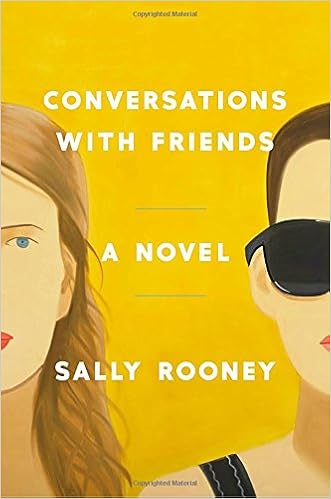
Conversations with Friends: A Novel Hardcover – July 11, 2017 by Sally Rooney ( Hogarth)


‘Bobbi and I,” the novel begins – because Frances, the narrator, still regards herself as one half of a twosome. They were girlfriends at school for two years; now they are on their summer holidays from Trinity College Dublin, performing spoken word poetry as a double act.

After one performance they follow Melissa, a photographer and essayist, home to the wealthy part of Dublin where she lives. Melissa says she wants to profile them for a prestigious magazine and they encounter her husband, Nick, a handsome actor. This is the world of grownups who have grown-up problems, but Bobbi and Frances do not know this yet. Bobbi gravitates towards Melissa; Frances later embarks on an affair with Nick. The “Bobbi and I” unit is fractured. The novel charts the seven months that follow, tracking the effect of the affair on Frances.

Rooney sets her story in the post-crash era, among a Dublin elite. Her characters work in the arts and denounce the evils of capitalism while living off inherited wealth. The novel, indeed, is almost post-Irish. In earlier Irish fiction, the narrative would have focused on the social tensions surrounding a gay relationship – and a female one at that. In Conversations With Friends, Frances’s mother describes it as “a real shame” when the girls break up. Similarly, that great stalwart of Irish writing, the alcoholic father, is present, but he is a spent force, having been dispatched from the family home years ago; the greatest trouble he causes is when he stops paying Frances her monthly allowance.

The apparatus of church and state haven’t repressed these people. Rather, the women have repressed themselves: they are too guarded to articulate their vulnerabilities. Frances is crippled by the pressure to perpetually “act unfazed”, to “affect an ironic tone” in situations that demand serious emotional engagement. “I just don’t have feelings concerning whether you fuck your wife or not,” she lies to Nick. “It’s not an emotive topic for me.” The self-harm she perpetrates on her thin young body reveals otherwise. When she finally blurts out that she loves Nick, he tells her she’s “being unbelievably dramatic”.

Frances is an unusually contradictory creation, so clever and yet so blind. Her formidable intellect prompts her to adopt an ironic position towards everything – including herself. She repeatedly declares herself to be emotionally cold, despite evidence to the contrary. But as Bobbi points out: “I don’t think ‘unemotional’ is a quality someone can have. That’s like claiming not to have thoughts.”

Conversation in the world of the novel is – like the spoken word poetry, which unfortunately isn’t depicted – a performance art, often a gladiatorial one. Bobbi and Frances excel in this arena. Frances explains that she “wanted to destroy capitalism and that [she] considered masculinity personally oppressive”. The girls (they object to that term) become so habituated to interrogating everything that it becomes an in-joke: “What is a friend? we would say humorously. What is a conversation?” Their discursive anti-establishment flair serves them well at dinner parties, but when applied to matters of the heart, it proves catastrophic to Frances.

Rooney is not a visual writer. There are no arresting images, no poetic flights. She is of the tell-don’t-show school: many of the conversations that comprise most of the novel are presented as he-said she-said reportage. The characters are keen to label themselves. “I’m gay, said Bobbi, and Frances is a communist.” Melissa declares herself “a neurotic individualist”, and Nick tells Frances he is “‘basically’ a Marxist, and he didn’t want me to judge him for owning a house”. This desire for labels, seeking always to box off the great flux of human experience, to achieve mastery of it, is shown to be a reductive force: “No one who likes Yeats is capable of emotional intimacy.” The body, however, is the wild card. It will not be suppressed, and instead flares up in outbreaks of sexual desire and acts of self-harm. Another wild card is the baby, Nick’s niece Rachel, who makes a brief but lovely appearance. She is the only person for whom Nick can freely express emotion. Even Frances finds herself caught off guard when Rachel is placed in her arms.

The salvation for Frances? Art, it is to be hoped – but she is far from out of the woods by the end of the novel. On reading the short story that Frances has written about Bobbi, Bobbi says she “learned more about [Frances’s] feelings in the last twenty minutes than in the last four years”. Frances has found freedom on the page. Rooney writes so well of the condition of being a young, gifted but self-destructive woman, both the mentality and physicality of it. She is alert to the invisible bars imprisoning the apparently free. Though herself young – she was born in 1991 – she has already been shortlisted for this year’s Sunday Times EFG short story award. Her hyperarticulate characters may fail to communicate their fragile selves, but Rooney does it for them in a voice distinctively her own
.

Monday, April 2, 2018

Peter Taylor: Complete Stories, Vol. 1, 1938–1959 by Peter Taylor, edited by Ann Beattie Library of America, 695 pp., $37.50 Peter Taylor: Complete Stories, Vol. 2, 1960–1992 by Peter Taylor, edited by Ann Beattie Library of America, 703 pp., $37.50

Peter Taylor: Complete Stories 1938-1959 (LOA #298) (The Library of America)


Let’s imagine a street of big houses in the 1930s—deep lawns, servants in the kitchen, and a clear sense of who belongs and who doesn’t. The paperboy doesn’t. The neighborhood girls may be sweet on Tom Bascomb, but he lives in an apartment building and even at thirteen everybody knows that he doesn’t quite fit in. The elderly Dorset siblings do, simply because they always have. Their ancestors made money in town before moving on to the West, and they belong even though their house lies near ruin and they have grown shabby. Brother and sister are forever speaking of what they’ve sacrificed for each other, and the neighborhood parents find them unspeakable. Yet they wouldn’t dream of keeping their boys and girls from the children’s party the Dorsets give each year; an invitation to that oddly indecent affair has become a “way of letting people know from the outset who you were.”
“Venus, Cupid, Folly and Time” first appeared in The Kenyon Review and won the 1959 O. Henry Award as the year’s best short story. A print of the Bronzino painting that provides its title hangs on the Dorsets’ wall, and a plaster replica of Rodin’s Kiss sits embowered in an arrangement of paper flowers. The old couple describe their annual evening as a dance, but they’re the only ones ever to take the floor; they waltz beautifully together, too beautifully, and the children know that such a pair shouldn’t. This year’s party will, however, have a surprise, for little Ned and Emily Meriwether have decided to smuggle in their paperboy. They will make Tom pass as if he were Ned, and at a certain moment he will cover Emily’s face with kisses.
The short story writer Peter Taylor was born in Tennessee a century ago, and described this sad and intricate comedy as an allegory: its characters may all be white, but its concern with passing and incest does seem to align it with the great questions of Southern fiction. That’s not wrong, and yet it’s not entirely right either, for in its last pages the story twists, in a way that anticipates Alice Munro, and the work we finish isn’t quite the one we thought we were reading. A first-person narrator appears, who years later uses the old tale of the Meriwethers’ prank to show a newcomer how things once were in this closed and settled world. The folly doesn’t belong to the Dorsets alone, and by its end the story has gone deep into the history of the region’s settlement, and become a rueful account of the tension between rootedness and restlessness in American life itself.
That indirection is typical of Taylor’s best work, and that tension is something he knew a great deal about. He came from a small cotton town called Trenton, a county seat northeast of Memphis where the men in his family practiced law and owned land; his mother’s family was from Tennessee’s eastern end, and her father had served as its governor. But in the 1920s the Taylors began to move. His father wanted more than the small town could give him and joined an investment company in Nashville, where he had earlier been a Vanderbilt football star. Business success then took Hillsman Taylor to a grand house in St. Louis; a Depression-era failure brought him to a modest one in Memphis. More modest, I should say—his reverses were temporary and the family always kept a cook and a chauffeur at the least, invariably black men and women from “home” in Trenton.
Such moves gave Taylor some of his richest material, and not only for A Summons to Memphis (1986), the Pulitzer Prize–winning novel he wrote in his late sixties. His characters often start in a place like Trenton—he called it Thornton in his fiction—and may even believe they’ll return someday, back to a place “where their name will mean something to them.” In the meantime, however, they have become city people, some making their own migrations north, to Chicago or New York, others at home in the newly booming big cities of the upper South, comfortable wherever there’s a country club and someone to vouch for them.
Taylor had found that urban professionalized world by the time he published his first book in 1948, a collection called A Long Fourth, and as Robert Penn Warren noted, he was then “the only writer who has taken this as his province.”1 It’s a milieu that in some ways resembles John Cheever’s Westchester more closely than it does William Faulkner’s Yoknapatawpha; and Taylor’s imagination lies nearer to Edith Wharton than Eudora Welty. In some ways, not all; we will come back to those servants.
It was also a world Taylor wanted to leave—to go north for college and study literature, even as his father insisted upon Vanderbilt and the law. Neither caved; the boy stayed home and then signed up for a class at the local college—and got lucky. His freshman English teacher in the spring of 1936 was Allen Tate, who soon passed him on to Vanderbilt and his own mentor, John Crowe Ransom. That was something his father could accept; safety lay in being taught by southerners, even about books.
In Taylor’s Nashville fraternity house he met a recent graduate called Randall Jarrell, and the two of them followed Ransom to Kenyon College in Ohio, where they found another of his acolytes, Robert Lowell, a transfer from Harvard. Lowell and Taylor were roommates during their last two years of college, combative but inseparable, and the Tennessean wrote of their friendship in a fondly comic story called “1939.” Jarrell was their housemaster. Taylor stayed friends with both, and spoke at each man’s funeral; he himself died in 1994.
But the teachers may have mattered more than the friends. Ransom and Tate had started as poets and then tried to turn themselves into social critics as part of the collective behind a 1930 book-length manifesto called I’ll Take My Stand. Not against the North, or not only. The real enemy for newly citified “Twelve Southerners” was modern capitalist society, and they looked to an imagined agricultural past, an ordered traditional society, as an antidote to the present. Taylor was drawn to those ideas, but he also recognized their fantasy. For one thing, there wasn’t a clear split between the country and the new businessman’s South; his own family history showed that, and undercut the nostalgia with which the Agrarians saw places like Trenton. Nor could he forget about the black people whom they tended to write out of their picture.
What Taylor really got from his teachers was their next act, in which literature itself became an alternative to the world of getting and spending, a privileged realm of ideal forms and equipoise, of balanced periods and paradox resolved. Over time it became known as the New Criticism, and among its progeny were the little magazines in which he published many of his stories, quarterlies like The Southern Review and The KenyonReview, and the creative writing programs in which, from the late 1940s on, he would teach and make his living.2
Tate later claimed he had little to show Taylor, that even as a teenager he owned a finished style. This new edition of his complete short fiction leads off with the stories he wrote in his twenties, and though he’s yet to find his voice they all remain readable; one of them approaches perfection, an account of young marriage called “Rain in the Heart.” Still, his first fully mature piece is “A Long Fourth,” a story that Sergeant Taylor finished in England not long after VE Day. He typically tells several stories at once, and on this holiday weekend each of the characters has his or her own going on alongside the others. The center of it all, however, is Harriet Wilson, a Nashvillian “just past fifty,” who wants to make something perfect out of her son’s last visit before he joins the army. Meanwhile her longtime cook, Mattie, fears that her own nephew, B.T., will be drafted, and Harriet consoles her with a hug.
Yet when Mattie says that for her B.T.’s going will be “like you losin’ Mr. Son,” the white woman backs off. “How dare you? That will be just exactly enough from you!” Just exactly enough. Harriet wears out a rocking chair in anger, marvels that she didn’t answer with a slap, and feels that the “open comparison of Son’s departure to that of the sullen, stinking, thieving, fornicating black B.T. was an injury for which Son could not avenge himself.” Her husband knows none of this, but when he later asks her to intervene in a quarrel between Mattie and her nephew, she feels him “making a larger and more general inquiry into her character than he had ever done before.” And she will have no answer.
The New Criticism gave the young writer the belief that a fictional page could be as compressed and elliptical as a sonnet, along with an emphasis on voice and tone and point of view that taught him how to place and judge his characters without ever saying so. That aesthetic worked perfectly with short fiction—better in fact than it did with novels. I don’t think it’s an accident that the New Critics’ influence coincided with the greatest age of the American short story, the thirty years or so that began with Welty’s A Curtain of Green (1941) and that included Cheever and Flannery O’Connor, J.F. Powers and Jean Stafford, Bernard Malamud and Taylor himself. “A Long Fourth” has an extraordinary technical assurance, dropping into Harriet’s mind for a grimly revealing sentence or two, or showing how her speech changes to match the person she’s talking to; there are racial epithets she won’t use in speaking to the girl her son has brought down from New York.
Its real achievement, however, lies in its sense of moral balance, the empathy with which it depicts a woman up against the limits of her world and her mind, even as it never spares her for having accepted those limits in the first place. In a 1985 interview Taylor said that he saw two things when he began to write. One was how consistently black people got the “short end” of the Southern stick. That wasn’t always obvious to writers of his background, and the second thing was less obvious still: the degree to which women got the short end from men. His own impulse was to try to understand “what other people unlike yourself are like,”3 and in the 1950s that meant stepping inside their subjectivity with a freedom—a privilege?—that few in his position would assume today.
The test case here is a 1951 New Yorker story called “What You Hear from ’Em?” The question belongs to an old woman in Thornton called Aunt Munsie, one she asks about the white children she raised, men who have long since moved away and now have children of their own. What she wants to know is when they’re coming back—back for good, not just a visit—and the business of the story lies in charting her growing awareness that they won’t, that they’ve made lives in which she can have no part. Taylor slips inside the character’s mind enough to show her contempt for the “utterly fool answers” her question usually gets, or for the “shiftlessness” of those whites without the energy to have left this backwater in the first place. But the story more often looks at her from the outside, seeing her as the white town does, and the Thornton it shows us seems without racial tension; a firmly inscribed racial hierarchy, yes, but with great good feeling and no sense on anyone’s part that things ever could or should be different.
So in reading it one at first feels a touch of anger, not at Thornton but at the work itself; a sense that it hasn’t quite seen its own point, that in Chekhov’s terms Taylor hasn’t stated the problem correctly. Yet you can never judge one of his stories before the end, and its last sentences reveal how fully ironized his use of the white town’s point of view has been throughout. He’s channeling its choral voice, working it alongside Aunt Munsie’s, and that ventriloquized paternalism shows just how much Thornton has missed about her, and about what it calls its “other old darkies” as well. “What You Hear from ’Em?” takes an awl to anyone who might find her quaint, its readers included, and the more I read it the less uncomfortable I become; or rather the less uncomfortable with Taylor’s own performance.
Still, such stories invite their own misreading; they are tightropes from which it’s all too easy to fall, and Taylor did not keep walking that wire into the civil rights era. He was never prolific. By the mid-1960s he had published four volumes of stories along with a little-read novel called A Woman of Means; but his production had already slowed and he filled out Miss Leonora When Last Seen (1964) with work recycled from earlier collections. What didn’t slow was his rate of motion. For the first twenty years after the war he skipped restlessly from one teaching job to another: Indiana, Chicago, and Ohio State; back to Kenyon for a bit, and repeatedly with Jarrell at Greensboro. Then in 1967 he settled into a job he decided to keep, at the University of Virginia, while also spending a few terms at Harvard.
Poets and fiction writers had always had an occasional place in the American university; Frost remains the classic example. But after the war that place became regularized, institutionalized. Taylor belonged to the first generation to benefit from what Mark McGurl has called “the program era,” the first in which it became common—indeed the norm—for writers to support themselves by the teaching of creative writing itself.4 The kind of fiction he wrote seemed to offer a codifiable, workshop-ready body of technique, and a faculty salary provided an incongruous relief from what he saw as a soul-killing professionalism. It freed the Agrarian in him from having a daily quota of words to finish and sell.
A fortunate man, one might say—and yet something happened to him in the 1960s. Taylor had had a contract with The New Yorker since 1948, giving it first refusal on his work, and its editors had taken more of his stories than not; my own favorites include “Two Ladies in Retirement” and “Reservations: A Love Story,” in which an accidentally locked door leads to some bitter wedding-night truths. But now the magazine stopped buying—and in most cases rightly so. Much of the fiction he wrote in that decade is far more formulaic than his earlier work, short clipped tales that end with a regulation epiphany. They are weak enough to make me think that the Library of America would have served his case better by publishing a single, slightly thicker volume of his stories, as it did with John O’Hara.
There were other frustrations as well. Taylor wrote a series of unproduced plays, and tried for years to finish the major novel his publishers had always demanded. Short stories were luxury items. They got you the esteem of your peers, and yet in the American century even one of the form’s masters was expected, and expected himself, to do something more.
His biographer says little about these failures, and if there were any crises off the page he remains too discreet to mention them.5 But only at the end of the decade did Taylor begin to find a second act. “Dean of Men” (1969) is cast in the highly unreliable voice of a college president, a man bemoaning his son’s long hair and wondering “whether you or that young girl you say you are about to marry is going to play the male role in your marriage.” To set the boy straight he tells him a set of stories about the betrayals his grandfather, his father, and he himself have suffered at the hands of the men they trusted—political allies, business partners, university colleagues. His grandfather became an “embittered old man,” and his father was “lonely and bored.” But he has become a success, helped by his own tightly buttoned lip, his sense of when not to complain. Of course “one sacrifices something” for that success, including perhaps “the love, even the acquaintance of one’s children. One loses something of one’s self even.” That, however, is what it takes to be a man; that’s the one “essential” thing his son must hear. Only who, in hearing it, would ever want to play that part?
Taylor had written of his female characters in the third person, but from now on he almost invariably chose the first person, and adopted a point of view superficially like his own: a southern male of the same age and cushioned upbringing, and with some of the same family history as well. There would be other blind alleys over the next few years. He tried a set of one-acts with ghostly themes, and experimented with what he called “stoems,” verse narratives that read like scenarios for stories he didn’t write.
“Dean of Men” nevertheless gave him the model for a series of long tales about the relations between the generations, tales about the way we miss out on our own lives, concerned with the difficulty—the impossibility—of ever fully “understanding what has happened to us,” and why. “The Captain’s Son,” “The Old Forest,” A Summons to Memphis: they return obsessively to the Tennessee country in which Taylor’s imagination was rooted, to the cities of his childhood and adolescence. Each of them features a narrator recalling the scenes of his past, a long-ago and yet entirely present world; more present, paradoxically, than it would have been in the 1940s or 1950s, when it hadn’t begun to be forgotten. And what those narrators remember above all is the things they didn’t do, and the words that nobody said.
With A Summons to Memphis Taylor finally wrote the significant novel that had been too long predicted of him, and was pleased and surprised by the sales and the prizes that greeted it. My own choice among these late works is, however, “In the Miro District,” a 1977 fabliau about a Jazz Age Nashville teen whose grandfather finds a naked girl hiding in his wardrobe; it was the only place he could think to put her once they heard the old man’s car in the driveway. Of course there’s more to it than that. Major Manley is both a Confederate veteran and a country lawyer who stood up to the nightriders, and he’s forgiven the narrator’s earlier peccadilloes. But this time it will snap their relationship and change the major’s attitude toward everyone around him. Decades later that onetime boy will still see the moment as a question for which there is no answer, and find himself thinking about it “whenever I am lying awake at night or when I am behind the wheel of my car on some endless highway.”
The stories in these volumes define their time and place with an unrivaled precision; they offer a complete account of their milieu. Not everything here seems worth preserving, but “In the Miro District” and a good two dozen more have earned their permanence.
  1. 1
    Robert Penn Warren, “Introduction” to A Long Fourth. Reprinted in Critical Essays on Peter Taylor, edited by Hubert H. McAlexander (G.K. Hall, 1993), p. 74. ↩
  2. 2
    On the relation of Agrarianism and New Criticism, see especially Mark Jancovich, The Cultural Politics of the New Criticism (Cambridge University Press, 1993). ↩
  3. 3
    Interview with J. William Broadway, The Chattahoochee Review (Fall, 1985). Reprinted in Conversations with Peter Taylor, edited by Hubert H. McAlexander (University Press of Mississippi, 1987), pp. 78–79. ↩
  4. 4
    Mark McGurl, The Program Era: Postwar Fiction and the Rise of Creative Writing (Harvard University Press, 2009).  ↩
  5. 5
    Hubert H. McAlexander, Peter Taylor: A Writer’s Life (Louisiana State University Press, 2001). ↩

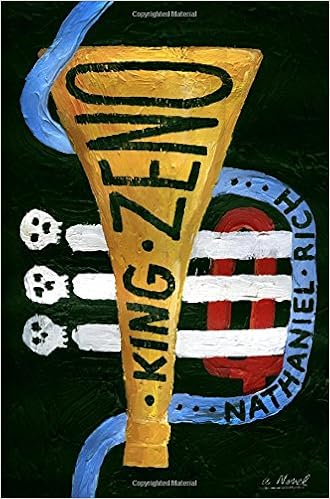
King Zeno: A Novel Hardcover – January 9, 2018 by Nathaniel Rich ( MCD)


New Orleans is a cliché, a loud, brassy, brazen hussy of a cliché, lubricated with booze and animated by jazz. Tits and beads. Corruption and hurricanes. Thanks to the copious, seasonally ubiquitous marketing efforts of Big Beer, that’s all you know and all you need to know.
And yet New Orleans keeps tempting writers to discover, in archaeological digs of the heart and the soul, what else is in this unlikely settlement in the swamp at the mouth of the continent’s great river. John Kennedy Toole legendarily wrote his life away creating the city’s great comic novel, A Confederacy of Dunces (1980), populating midcentury New Orleans with a gallery of only slightly exaggerated grotesques. (The legend includes his mother getting the novel, rejected by twenty-two publishers, into print after his death. It won a Pulitzer.) Michael Ondaatje used dreamlike imaginings in Coming Through Slaughter (1976) to conjure an undocumented reality of the city’s great claim to American cultural primacy, the birth of jazz in the front parlors of New Orleans brothels.
The bookshelf containing the outpouring of “post-Katrina” books has been groaning for a decade now. John McQuaid and Mark Schleifstein’s Path of Destruction (2006) and Ivor van Heerden and Mike Bryan’s The Storm (2006) set themselves the task of dismantling the media narrative of the 2005 flood that nearly wiped New Orleans off the map. That narrative included a city below sea level, poor black people as the primary victims, and a Category 5 hurricane whose ferocity/wrath/rampage was unprecedented—all found, thanks to painstaking research (largely conducted by two major projects, at UC Berkeley and LSU), to be largely or completely untrue.
Dave Eggers’s Zeitoun (2009) told, in careful, unsensational prose, the shocking story of an ordinary New Orleanian (a Syrian-American, as it happens) caught up in racial profiling at a most unfortunate moment, and revealed the one thing the federal government was able to do with remarkable alacrity in the middle of the flood: namely, assemble a secret prison in the parking lot of the Greyhound bus depot. Tom Piazza, in Why New Orleans Matters (2005), made a reasoned, passionate case for the city that then House speaker Dennis (“Coach”) Hastert thought was better left for dead. And on television, David Simon and Eric Overmyer’s Treme (2010–2013) attempted the near-impossible: an impeccably fact-checked fictional portrait of the city’s musical and culinary culture as it worked and played its way through the early stages of post-flood recovery.
An HBO executive said, when I offered them my documentary feature on the flood’s real causes, “We’ve done New Orleans.” Have we? Unlike the crude oil under the Gulf or the wetlands through which pipelines and canals to transport it have been built, the city’s great natural resource, story, is in no danger of being depleted. When you live in New Orleans, you apportion substantially more time for every errand, knowing that someone along the way, friend or stranger, will arrest your progress with a deliciously detailed account of their day, their post-flood recovery, their life. Knitting those stories into a credible and absorbing narrative is still the mandate of New Orleans writers who choose to set their work in their fascinating and infuriating home.
That’s the task Nathaniel Rich sets for himself in King Zeno, a sprawling novel about a pivotal year and a half in the city’s history in 1918–1919. Some New Orleanians, like police detective Bill Bastrop, are returning from World War I, with scars that are barely visible but unbearable. Others, like Beatrice Vizzini, the doyenne of a Sicilian family in a small-time protection racket, are using the opportunity of a crony connection in constructing a new canal to try to move from the “shadow business” to something slightly more legitimate. And Isadore Zeno, a young musician with an ear (and the lips) for a new way to play his cornet, is trying to give up being a sideman in petty street crime before his luck runs out.
The previously prim and comfortable life of New Orleans’ privileged is experiencing fissures. The waterway being built, the Industrial Canal, is the first of several attempts to more closely connect the city with the Gulf of Mexico, to the supposed benefit of commerce and to the ultimate detriment of the wetlands that (we’ve learned only recently, as they disappear at the rate of a football field per hour) help protect New Orleans from storm surge and hurricane winds. What started in 1918 culminated in the 1960s with the Mississippi River–Gulf Outlet, whose design and failed maintenance both contributed to some of the 2005 flooding.
The city’s racial divide was never textbook southern; New Orleans had the largest population of free people of color before the Civil War, while at the same time serving as the nation’s largest slave market. The free people of color became part of the city’s ruling class, and Creoles learned their lessons from their white brothers well: some Creole social clubs had a “paper-bag test” for admission (you could not gain entrance if you were darker than it was). But “jass music,” as it was first known, started to bridge those divides long before the civil rights movement. Isadore Zeno, who styles himself Slim Izzy (but who is granted the sobriquet King Zeno by the real-life bandleader Kid Ory in the same breath that he refuses to hire the youngster), longs for the chance to play his music for white people, to drive them crazy past the point of caring about color.
Like Treme, King Zeno hews closer to the truth—the historical truth, at least—than much fiction; there really was an Industrial Canal project and a Spanish flu epidemic and an Axman terrorizing the town in 1919. Jazz really was breaking out of the brothel parlors and black bars in the “backatown.” Rich has done his research well. The city’s geography, always quixotic (its streetscape follows the curvilinear path of its river, so the East Bank is west of the West Bank and parallel streets end up intersecting), was subjected to some drastic urban renewing after World War II. But you walk, or run down, the old streets in King Zeno with the joy and dread of the time.
For the folks in this book, carnival is a peripheral moment, not—as it was for the town’s hierarchy then and now—a central organizing principle. These people aren’t playing at topsy-turvy, kings becoming paupers and vice versa for a day; the world at the end of its first global war is doing that for them, for real.
Over the half-century before the 2005 flood, New Orleans, like many older American cities, was shrinking. White flight to the suburbs combined with the oil industry’s exodus to Houston (after it littered Poydras Street with undistinguished modernist towers) to reduce the population by about a third. The waves of immigrant groups—the Germans, the Greeks, the Irish, and the Sicilians that ran the corner groceries preyed upon by the Axman—receded. Brasher southern rivals like Charlotte and Atlanta raced ahead as regional banking centers, while New Orleans seemed content to bask in its uniqueness, as the American city that embraced its past even at the risk of letting its future float away.
The city continues to feel more European, and Caribbean, and even African, than American. Through the efforts of early preservation activists like Clay Shaw (rewarded for his efforts by being prosecuted by then district attorney Jim Garrison in the Kennedy assassination case), the “urban renewal” craze was halted at the border of the French Quarter, left instead to drive concrete wedges through the heart of downtown black neighborhoods. But unlike other American cities, there’s much history beyond the borders of the well-preserved Old Town. Buildings, like people, still tell their stories, reminding us that aping old styles cannot recapitulate the delight of knowing what these walls have witnessed along a city’s wandering path toward its upcoming tricentennial.
The “federal flood” of 2005 marked a turning point. It got that name among locals for reasons that harken back to the digging of the Industrial Canal in 1919. Critics back then, as Rich recounts, feared the new waterway would bring storm surge into the heart of the city, by connecting the river to Lake Pontchartrain. They may have been right. A floodwall along the canal (built by the Army Corps of Engineers) collapsed in two locations, though the surge never got to the top of the wall, launching an eighteen-foot wave that inundated homes in the Lower Ninth Ward.
Mark Twain may or may not have said that “history doesn’t repeat itself, but it often rhymes” (or the addendum that “in hip-hop history, only the vowels have to match”), but another part of the 2005 flood had an eerily similar pattern. In the 1940s the corps pitched business-hungry city fathers on the Mississippi River–Gulf Outlet, a direct connection between the Gulf of Mexico and the Industrial Canal, a straight-line bypass of the curvy Mississippi. Critics, decades after the time of King Zeno, again predicted disaster. Again, they were right: the design and maintenance failures of the Mississippi River–Gulf Outlet were so egregious in causing the flooding of St. Bernard Parish (and the destruction of nearly the entire housing stock of that suburban county) that a federal judge excoriated the corps in a 150-page opinion. That finding was upheld by a three-judge appeals court panel, which, in a turn of events any novelist would envy, decided six months later to reverse its own ruling.
Having survived the most existential of its many crises (not only the Spanish flu epidemic in King Zeno but also, a decade earlier, the last yellow fever epidemic in North America), New Orleans renewed itself as it restored itself. In 2005 it had lost 100,000 of its poorest to a federal relocation that included no return tickets. The renewal took place on two different levels simultaneously: grassroots and institutional.
On the grassroots level, early returnees phoned and e-mailed their former neighbors to persuade them to join the homecoming. Homeowners and businesses gutted and demolded their properties, with the help of friends, family, volunteers, and, later, the hard-to-navigate system of federal aid for property owners called Road Home (hard to navigate by design, given congressional distrust of “those people down there”; there was no such program for owners of rental properties or for renters). Volunteer organizations sprang up, almost always headed by women, to agitate for structural reforms—to the levee boards and the tax assessment system, primarily—which succeeded at the ballot box. As a veteran of public meetings, council hearings, and protest gatherings, I marveled at the discipline and economy of the community meetings that weighed and popularized these reforms: the prospect of civic death really does focus the mind.
Salivating at the “clean slate” they perceived down yonder, city planners and urbanists and urbanologists flocked to the stricken city, inviting citizens to hundreds of meetings at which its future would be imagined. The results ended up as hefty unread volumes on city officials’ shelves and in front-page stories about neighborhoods that would be “green-dotted”—allowed to return to nature as the metropolis shrank. The citizens of those neighborhoods had different ideas, and LaToya Cantrell, the leader of one such neighborhood movement, has just been elected mayor, one of two African-American women in the runoff. It turns out that the future the people of New Orleans imagined looked a lot like…New Orleans.
Up on the institutional level, things were very different. Three vital local systems—health care, education, and public housing—were subjected to dramatic if not brutal restructuring with the impetus of the Bush administration, which saw an opportunity to undo “statist” New Deal–era arrangements. It must be noted, in fairness, that state and local officials abetted these “reforms.”
What the city feared, as it gazed at its sudden conversion to an involuntary Venice, were the problems of failure, like the “jack o’ lantern” effect in which few residents returned, and generally dark neighborhoods were pockmarked with the occasional lighted home. It feared disinvestment, the exodus of the young, the return of crime. Crime has returned, but the problems New Orleans faces now are those of success—like gentrification and the possible dilution of the intense local culture. Ada Colau, the radical mayor of Barcelona—a city not unlike New Orleans in its vivacity, exuberance, culinary tradition, and complex relationship to the dominant national culture—won election in 2015 by warning that her municipality, experiencing a major upsurge in tourism, risked losing its soul. It rang a certain bell.
The flood, and the exodus, tore at the tightly knit fabric of the community—three generations of a family often lived within blocks of one another. Rising rents have exacerbated that threat to the fabric, upon which depends the survival of many of the city’s unique traditions.
For all that change, the city is still recognizably New Orleans. It is, as Dan Baum writes in Nine Lives (2009), his invaluable portrait of locals pre- and post-flood, a city that lives by neither the dollar nor the clock. The infamous corruption, in the time of King Zeno and today, is ridiculously penny-ante compared with, say, New Jersey or Illinois (although, in fairness, a recent indictment alleges that New Orleans has just joined the million-dollar club in “diverted” public funds). Brutal crime coexists, then as now, with refinement and that most rare of civic virtues, grace.
Despite some new arrivals complaining to police of “noisy musicians coming down the block,” the music lives in clubs and concert venues, but it’s still born and bred in the streets. Despite a world of guitars and DJs, the piano and the trumpet reign. Local musicians, just as in Slim Izzy’s time, face a binary choice: migrate north to become ambassadors of the city’s music (Kid Ory, Louis Armstrong, Dr. John, Wynton Marsalis) or stay home (like Izzy) and become one of its kings.
Crime, music, corruption, lively conversation among friends and strangers alike—the (to use a cliché) gumbo of social relations that, along with festivities and culinary traditions like red beans and rice on Mondays—define New Orleans culture: they are not so very different now than they were in the world inhabited by the vividly drawn people in Rich’s novel. Central to that world then and now is the Industrial Canal, that deep dig into swampy muck where the lives of the detective, the doyenne, and the cornetist tangle and mingle in King Zeno. Its excavation is the book’s central metaphor—for how far down depravity can sink, for how low you have to stoop to recover your manhood, for how deep you have to dig to discover your future. The animating impulse of the canal is that of the city’s birth: the human demand that water be tamed in the service of commerce.