Showing posts with label . @stephendarori. Show all posts

Saturday, July 28, 2018

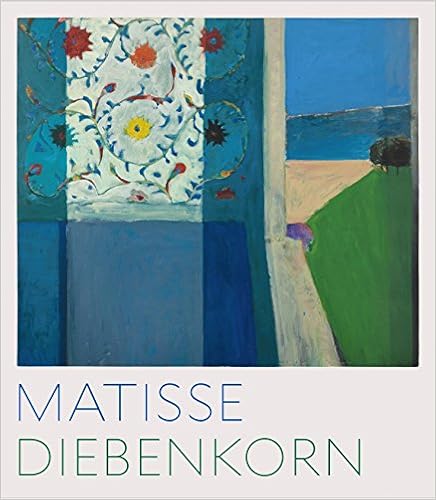
Matisse/Diebenkorn Hardcover – October 23, 2016 by Janet Bishop (Editor), Katherine Rothkopf (Editor), John Elderfield (Contributor), Jodi Roberts (Contributor) (Prestel)


Matisse/Diebenkorn,” a deeply stirring exhibition at the Baltimore Museum of Art (it was co-organized by the San Francisco Museum of Modern Art), demonstrates that Diebenkorn’s intense love extended to every corner of Matisse’s career. The result is an unusually beautiful show, in which the unique glow emitted by one painter meets the glow from another and seems almost to create new atmospheric conditions.This volume charts the evolution of Diebenkorn by featuring dozens of his paintings and drawings alongside those by Matisse; it becomes readily apparent, through subject, composition, and technique, how prominent Matisse's impact was on Diebenkorn.

This sumptuously illustrated book brings together the work of Henri Matisse and Richard Diebenkorn as never before, illuminating unexpected resonances that connect the two artists across time and space. Featuring stunning pairings of more than 80 paintings and drawings, this book charts the evolution of Matisse’s impact on Diebenkorn over the course of Diebenkorn’s career. Though they never met, Matisse was an enduring source of inspiration for the Californian artist, and their works share surprising similarities in subject, composition, palette, and technique. Essays by Janet Bishop and Katherine Rothkopf explore how this influence evolved over time, connecting the work of the two painters and highlighting the ways Diebenkorn drew from Matisse’s example to forge a style entirely his own. The volume is rounded out by an introduction by John Elderfield, who knew Diebenkorn personally and has curated exhibitions of both artists’ work; an essay by Jodi Roberts on parallels between the artists’ drawings; and a bibliography documenting Diebenkorn’s collection of books about the French artist. The first in-depth examination of the relationship between the work of Diebenkorn and Matisse, this publication offers new ways of understanding both artists.

Sunday, July 22, 2018

Crisis of Character: A White House Secret Service Officer Discloses His Firsthand Experience with Hillary, Bill, and How They Operate Hardcover – June 28, 2016 by Gary J. Byrne (Center Street)


 Many things we knew already in this story, if we lived through the Clinton years and a lot of these antics of theirs were also supported by many other books and documents. They had no respect at all for authority, rules, or the secret service and people in uniform then and they still don't seem to care, from what I read today about the Benghazi reports and Mrs Clinton's response "Let's move on" she said almost without any emotion or a tear in her eye about the dead. After concluding her discourse, she smiles, inappropriately because we are talking about four people that have not just died, but has been tortured and died horribly and her lies to the public overtly and without apology. To say she is cold and insensitive is an understatement. Based on seeing her recent behavior and responses at age 64, a time when most people mellow, I don't doubt she cursed and treated these good officers with contempt when she was much younger and less guarded in the 90's. I saw some of her interviews of that time, looking so young, she was obstinate, had a quick answer for everything and seem very combative, justifying everything. I also took the time to read her emails online, and they match her personality. Someone that seeks foreign policy and updates advice from outsiders rather than their own staff while Secretary of State, makes me think she wants to play by her own rules, outside of the inner team or circle. She wrote a lot of emails about Libya and Benghazi to Sid Bloomenthal, and he wasn't even part of the staff. So her early behavior during the Clinton presidency does not surprise me and believe this story 100%. They brought in their own big staff of interns and fired the travel staff to put in her own staff, and threatened then with IRS audits and other means to get her way. Not a nice person. An abuse of power, for sure.

The author feels that the Clinton's treated them like "furniture" and were ungrateful of the fact they were there to take a bullet for them. The contrast between the Clinton's and the old school Papa Bush and Barbara, was so well presented. Clinton's cheating on his wife with Monica is a great story and presents many aspects that we didn't know, and much that we already knew. But that wasn't a shocker for the reader, after all, other presidents had mistresses too. Lewinsky flipping her dress to show her thong to Clinton in front of the officers, was no different than Marylin singing happy birthday seductively to JFK! They just want to broadcast their indiscreation, it's a turn on for them it seems. The American People are tolerant of these things, but it's the lying they can't stand.

None of this is fiction, for sure. Very believable. Do not believe the 1 star reviews because they are obviously planted, this book is good. You can tell right way, they are planted because there are either honest 5 star reviews, like mine or 1 star reviews that don't go into detail. I see fewer 4 and 3 stars, which is an obvious sign that the one stars seem to be manipulations. Obviously the democratic party wants to discredit the book because it might affect their campaign. I don't think it will because nothing that is told here goes to their issues or policies. It talks about character.

Having edited several other historical books, I think it is well written, edited and presented. What is outstanding about this book is how it is told, from the point of view of one person. The language, the way he explains his experiences, reminds me of a World War II book I edited as well.

The marketing was of course taking advantage of the election frenzy, but I don't fault the publisher for that, it's marketing and if you don't catch the wave you won't sell the book and of course we won't find out the truth. But, this book, is in no way fiction or made up. Having followed this topic for such a long time, I have found so many other independent sources that confirm this information. These are the quintessential Clintons as we know them well. You either love them or hate them.

Does Hillary Clinton have an issue with her character? Maybe. I don't think that just because she curses like a truck driver, and she is insesitive that could make her a bad president. Plenty of males in top positions have been insufferable, and insensitive. The problem is her disdain for everything in uniform and poor performance when it came to a military decision in Benghazi and lately trying to throw her own boss under the bus to excuse her lack of action. This book explains where it comes from. She was asking the officers not to wear uniforms then and didn't even want to see them around. The author explains how they had to hide in the closet when she came around.

Militarily, they wanted to take away weapons from the military men "they wanted to help but not use force". The author says it's like a doctor wanting to operate without using a scalpel. It is so right, because this exactly what happened in Benghazi, she didn't want to send force to protect at the beginning, and when trouble started it was too late to have them rush in. The author points out this happened before in another situation. And, it will happen again because Today, on June 28th, 2016, her response to the Benghazi report shows that she hasn't changed her tune. Certainly the Clinton presidency was one scandal after another, always damage repair to extensive PR at the expense of the tax payer. Descriptions of lavish parties that were really a way to sell the Clinton brand and not the White House. This woman was already running for office then, setting things up for her future.

I strongly recommend that you read this book. More than Clinton Cash, this book is far more believable and an easy read. And, it also provides a lot of interesting information about the life of the secret service officers that risk their lives daily to protect our elected officials, and in this case, with the Clintons, they did not seem to show full appreciation when they took a bullet to protect them.

Charles I Cavalier King ...Charles I: King and Collector Hardcover – February 27, 2018 by David Ekserdjian (Author), Barbara Furlotti (Author), Erin Griffey (Author), Gregory Martin (Author), Guido Rebecchini (Author), Vanessa Remington (Author), Karen Serres (Author), Lucy Whitaker (Author), Jeremy Wood (Author), Helen Wyld (Author), Per Rumberg (Editor), Desmond Shawe-Taylor (Editor) (Royal Academy of Arts), The White King: Charles I, Traitor, Murderer, Martyr by Leanda de Lisle PublicAffairs, 401 pp., $30.00


The Royal Academy’s magnificent exhibition “Charles I: King and Collector” revealed a great deal about the collector, but almost nothing about the king. Perhaps this was a deliberate omission, for although Charles I, king of Great Britain and Ireland between 1625 and 1649, built up what became one of the greatest art collections to be found in mid-seventeenth-century Europe, he was a spectacularly unsuccessful monarch. As a boy, he was overshadowed by his dashing older brother, Henry, whose sudden death from typhoid in 1612 made the twelve-year-old Charles the unexpected heir apparent. He was a delicate child; rickets had given him weak ankles, but as he grew up, he overcame this disability and developed into an excellent horseman. He retained a bad speech impediment, however, and he was barely five feet four inches tall. Naturally shy in his dealings with people, he took refuge in extreme formality and regal hauteur.

His reign began badly. In response to the urging of George Villiers, Duke of Buckingham, his father’s favorite and his own close friend, he embarked upon two wars, first against Spain and then against France. Both failed miserably. Relations with his Parliaments, which were reluctant to fund these campaigns and hostile to his anti-Calvinist religious sympathies, became increasingly difficult. In 1629 he chose to rule without Parliament and continued for eleven years, funding his government by legally questionable methods.

His attempt in 1637 to impose a new Anglican prayer book upon the Presbyterian Scots was fiercely resisted. Charles responded with an armed invasion that he lacked the resources to sustain. By 1640 he was forced to turn to Parliament for financial help, only to unleash a passionate attack on his conduct during the period of personal rule and a series of measures designed to dismantle his entire system of government. His failure in January 1642 to arrest five of the most obstreperous MPs was the last straw. He left London to raise troops, and in August declared war upon the parliamentary opposition.

The two civil wars that followed brought in the Irish as well as the Scots. The king was defeated, but the deaths on both sides were proportionately as numerous as British losses in World War I. In the subsequent negotiations Charles failed to accept a peaceful settlement, exasperating his opponents by his duplicity and reluctance to compromise. His trial and execution in January 1649 as a “man of blood” who had levied war against his people were followed by the proclamation of a republic.

One of the new Commonwealth’s first acts was to confiscate the late king’s possessions. A few of his artworks were retained by the state, but the remainder were either used to settle the Crown’s debts or sold off on the open market. When Charles II was restored to the throne in 1660 a serious effort was made to get the collection back, and, amazingly, by the end of his reign the great bulk of it had been recovered. But many of the very finest paintings had ended up in the royal collections of Spain and France, and there they stayed. Others have since been scattered all over the world.

Most narrators of these dramatic events have been either Cavaliers or Roundheads. The Whig historians from Thomas Babington Macaulay to George Macaulay Trevelyan were Roundheads. They regarded Charles I as the would-be architect of royal absolutism. They noted that he levied illegal taxation, billeted troops on innocent householders, and arbitrarily arrested dissident MPs. The outstanding authority on the period, the Victorian Samuel Rawson Gardiner, could not forgive him for his willingness to condone plots to use force against Parliament long before war broke out. Charles was the authoritarian who said on the scaffold that the people were not entitled to a share in the government: “That is nothing appertaining to them. A subject and a sovereign are clear different things.”

On the other side, the Cavaliers recalled Charles’s grave demeanor, his chaste and affectionate domestic life, his courage, and his dignified behavior during the last weeks of his life. They admired his unshaken commitment to the liturgy and government of the Church of England, and they were moved by the pious sincerity of his spiritual and political reflections in his book, Eikon Basilike (the image of the king). Ghostwritten by a royalist cleric, it was published within days of the king’s execution and long remained a huge best seller. Charles’s status as a Christ-like martyr was officially recognized in 1660, when Parliament canonized him as an Anglican saint and ordered annual prayers in his honor on January 30, the day of his execution. This requirement remained in the Church of England’s prayer book until 1859, and there is still a Society of King Charles the Martyr. Today, as in the past, Charles remains a hero for many Tories, High Church Anglicans, and Roman Catholics.

After Trevelyan, Whig history fell into disfavor, though Marxist historians continued the Roundhead tradition by regarding Charles as a feudal survival doomed to be swept away by a rising bourgeoisie. In contrast, the so-called revisionist historians of the later twentieth century regarded the civil war as an unfortunate accident rather than the inevitable consequence of royal tyranny or social change. Their view of Charles was often more sympathetic. The most extreme statement was by Kevin Sharpe in The Personal Rule of Charles I (1992), in which he rightly noted that for most of the 1630s England enjoyed “halcyon days” of peace, at a time when Europe was convulsed by the Thirty Years’ War. More controversially, he played down the extent of opposition to what the Whigs had called the “Eleven Years’ Tyranny.” As he saw it, the rule of this hard-working and high-principled king over a largely contented people was disrupted only by the Scottish resistance in 1637 to Charles’s attempt to impose the new prayer book. But Sharpe could not deny that from that attempt followed the sequence of events leading to the Long Parliament, the civil war, and the regicide; and for all that, Charles bore the primary responsibility.

Like Sharpe, Leanda de Lisle is emphatically a Cavalier, though her vividly written biography The White King lacks the erudition underpinning Sharpe’s magnum opus. Resident in Leicestershire and with a surname that must have eased her relations with the local aristocracy, she makes great play of her finds in stately houses, particularly some unpublished letters of Charles’s queen, Henrietta Maria, in the normally inaccessible archives of the Duke of Rutland at Belvoir Castle.1 But though interesting, they do not add much to what is already known.

For the most part, de Lisle draws upon secondary works, and her endnotes are often slapdash. She has little time for Charles’s critics, and few of her readers will emerge with a very clear idea as to why he should have encountered so much opposition in his early Parliaments. In her eyes, Charles was a tragic hero, “a courageous king, of high ideals, whose flaws and misjudgements lead to his ruin,” and “a better exemplar of a chivalric knight than he ever was a king.” This is what the authors of 1066 and All That called the “Wrong but Wromantic” view of the king.

De Lisle is strong, however, on Charles’s domestic life. After a harebrained journey with Buckingham to Madrid in 1623 to court the Spanish infanta, he was married in 1625 to Henrietta Maria (Henriette-Marie), daughter of the late Henri IV of France and his wife, Marie de Médicis. The couple’s first years together were difficult. Henrietta Maria was fifteen. She was also an extremely pious Catholic. The queen’s confessors set severe limits on the frequency of her marital intercourse, while the king was sexually demanding. He may also have been closer emotionally to Buckingham than to his wife. It was only after the duke’s assassination in 1628 and the end of the war with France that the royal pair grew closer, coming to terms with their religious differences and forging an intense relationship that, despite their permanent separation after her flight to France in 1644, lasted until Charles’s death. After the premature birth in May 1629 of a son who lived for only two hours, Henrietta Maria went on to bear him seven more children, ensuring the continuity of the dynasty and diminishing the incentive for Charles to get involved in the Thirty Years’ War in the hope of recovering the Rhine Palatinate for his sister Elizabeth, the “Winter Queen,” and her sons, who would have been next in line for the succession.

One of de Lisle’s main objectives is to reveal the important place of women in the politics of the period. She reminds us of the red-headed and pockmarked royalist agent Jane Whorwood, to whom in 1648 Charles, then a prisoner in Carisbrooke Castle, made uncharacteristically lewd advances. She also has much to say about the promiscuous and socially ambitious beauty Lucy Hay, Countess of Carlisle, the queen’s onetime favorite, who betrayed her by warning one of the parliamentary leaders of the king’s intention to arrest the five MPs.

Above all, de Lisle seeks to rescue Henrietta Maria from the “misogyny, religious prejudice and the propaganda of her enemies.” She emphasizes the queen’s unrelenting efforts to end the persecution of English Catholics and her total commitment to her husband’s cause. Here she follows the historians Caroline Hibbard and Erin Griffey, though what they revealed was that the queen was as much a liability to Charles as a help.2 In the 1630s diplomatic relations with the papacy were resumed, and her Catholicism became increasingly visible. Charles himself was a firm supporter of the Church of England, but the installation of Catholic chapels in Henrietta Maria’s seven palaces, her entourage of priests and friars, and her being the goddaughter of Pope Urban VIII all gave credence to the abiding Protestant fear that the king was party to a popish plot. When the civil war broke out, her efforts to raise troops in Ireland and other Catholic countries only confirmed these suspicions. Her enemies published her captured correspondence with Charles to show that it was she who wore the breeches and was successfully persuading Charles to allow his Catholic subjects religious freedom.

Henrietta Maria had a large independent income, which she spent freely on clothes, jewels, court entertainments, and building projects. Like Charles, she was a great patron of artists. The French sculptor Hubert Le Sueur accompanied her to England, and it was for her that he did some of his best work. The pope’s nephew sent her pictures by Andrea del Sarto, Leonardo, and Giulio Romano. The Italian artist Orazio Gentileschi became her chief painter and did the ceiling for the Queen’s House at Greenwich. He was joined later by his daughter, Artemisia, a gifted artist who has attracted much interest among modern feminist historians because of her penchant for Old Testament scenes featuring strong, assertive women. The Royal Academy exhibition devoted an entire room to the Gentileschis and other paintings of powerful women, like Christofano Allori’s Judith with the Head of Holofernes. The exhibition’s title, however, concealed the fact that the pictures on view were not just the king’s, but what the Rump Parliament called “the goods and personal estate of the late King, Queen and Prince.”

“Charles I: King and Collector” was a valiant attempt to reunite what it called “a significant part” of the royal collection. Out of the 1,500 or so paintings and 500 sculptures once owned by Charles, it selected 140 items. But of these, about ninety came from the present-day Royal Collection and only twenty-two from outside the UK. The Louvre lent three pictures and the Prado five, but they held on to more remarkable works by Mantegna, Dürer, Raphael, Leonardo, Giorgione, Correggio, Titian, Tintoretto, and Caravaggio, all of which had once been part of Charles’s fabulous collection. Many of these are illustrated in the informative catalog accompanying the exhibition.


Bristol Collection, Ickworth
Hubert Le Sueur: Charles I on Horseback, circa 1630–1633

Charles’s collection derived from many different sources. Some works were inherited from his mother, James I’s queen, Anne of Denmark. She revived the royal collection, neglected since the days of Henry VIII, and encouraged her eldest son, Henry, to form his own collection of European masters, including the first Renaissance bronzes to reach England and a huge number of antique coins, medals, and seals. More important were the consequences of Charles’s otherwise ill-fated visit to Madrid in 1623. Not only was he profoundly impressed by the visual magnificence of Philip IV’s Escorial and other palaces, crammed with masterpieces, but as the Spanish king’s prospective son-in-law, he returned home laden with gifts and purchases, including works by Veronese and Correggio, a portrait of him by Velázquez, and four Titians, among them the erotic Jupiter and Antiope (the “Pardo Venus”) and Charles V on Horseback.

By the time he became king, Charles had already acquired a sufficiently respectable collection of European masters to allow him to hold up his head among the other English collectors of his day, like the Earl of Arundel, who had, among much else, forty paintings by Holbein and the greatest collection of old master drawings in Europe, or Charles’s friend Buckingham, who built up a uniquely impressive collection of works by Peter Paul Rubens. What put Charles’s collection in a totally different class was his acquisition between 1626 and 1632, through the shady Flemish collector and dealer Daniel Nijs, of the legendary collection of the Gonzaga dukes of Mantua, who had been forced to sell for financial reasons.

Thirty-one of the items in the Royal Academy’s exhibition came from the Mantua purchase. They included Titian’s magisterial Supper at Emmaus and The Allocution of Alfonso d’Avalos; Jan Gossaert’s living and breathing Portrait of a Man Holding a Glove; two outstanding Correggios, Venus with Mercury and Cupid and The Holy Family with St Jerome; Bronzino’s wonderfully serene Portrait of a Woman in Green; The Toilet of Venus by Charles’s favorite seventeenth-century artist, Guido Reni; and half a dozen superb pieces of antique sculpture, including the voluptuous “Crouching Venus,” baldly described in the Gonzaga catalog as “a naked woman sitting on her heels.”

Most magnificent of all were the nine huge canvases of Mantegna’s The Triumph of Caesar. Though damaged on its voyage to England, repainted and frequently repaired, this representation of the general’s triumphal procession seen from below remains an overwhelmingly impressive evocation of the material paraphernalia of classical antiquity, with its vases and urns, busts and statues, weapons and armor, banners and standards, lamps and candelabra, trumpets and tamborines, horses and elephants, all preceding the victorious leader in his heavily ornamented chariot.

After the Mantua acquisition, the king’s interest in painting was widely recognized and gifts from diplomats, courtiers, and aspiring artists flowed in. Rubens came to England in 1629 to negotiate the peace with Spain and celebrated its conclusion by presenting Charles with his Minerva [Wisdom] Protects Pax [Peace] from Mars [War]. English ambassadors were ordered to look out for suitable acquisitions and English collectors persuaded to swap their masterpieces for works that the king found less attractive. Charles also made great efforts to encourage foreign artists to come to London and work for him. The German painter Francis Cleyn was hired to design tapestries for the factory at Mortlake in Surrey. Rubens was commissioned to depict the apotheosis of James I on the ceiling of Inigo Jones’s Banqueting House. Hubert Le Sueur was employed by the treasurer, Sir Richard Weston, to produce the equestrian statue of the king that today stands in Trafalgar Square looking down to Whitehall. Above all, Rubens’s best pupil, the Flemish painter Anthony van Dyck, was knighted by Charles and appointed “Principal Painter in Ordinary to His Majesty.”

It is by Van Dyck’s portraits of Charles and his family that the king is best remembered today, and they formed the core of the Academy’s exhibition. All the most striking ones were there: Charles in his robes of state; Charles on horseback; Charles with Henrietta Maria; Charles the father of his family and guardian of the nation; Charles painted from three different angles so that Bernini in faraway Rome could make his bust; Henrietta Maria in a dashing black hat and a ravishing blue dress, accompanied by her dwarf and pet monkey; Charles’s five eldest children, calm in the presence of a giant mastiff. The most dramatic was the huge illusionist portrait of the king guiding his great horse through a triumphal arch and, it seemed, right into the gallery itself. The most beautiful, last seen in England in the 1640s (now in the Louvre), was of Charles in the hunting field: an anxious groom tends the king’s obviously exhausted horse, while Charles faces us, a superior, faintly disdainful figure, superbly elegant and totally unruffled by his exertions in the saddle.

For sheer bravura, Van Dyck’s fluid, romantic painting, with its delicate flesh tones, graceful postures, and shimmering drapery, has never been surpassed. Visitors to the exhibition marveled at his virtuosity, but in this astonishing accumulation of masterpieces they had so much else to admire as well: Gossaert’s muscular Adam and Eve; Peter Bruegel’s beguiling Three Soldiers from the Frick; an exceptional Adoration of the Shepherds by Jacopo Bassano; Rubens’s Landscape with St George and the Dragon, with Charles I portrayed as Saint George; and the great Mortlake tapestries, based on Raphael’s cartoons for The Acts of the Apostles and regarded at the time as much more valuable than paintings, because they were so labor-intensive and used up so much gold and silver.

Particularly enchanting was the partial recreation of Charles’s Cabinet and Chair Rooms in Whitehall Palace, where he kept some of his smaller and choicest possessions. They included superb portraits by Quinten Massys, Dürer, and Holbein; tiny versions by Peter Oliver of major paintings by Raphael, Titian, and Correggio; and Isaac Oliver’s miniature of Charles as a rather uningratiating teenager, followed by Peter Oliver’s image of him aged about twenty, with an embryonic moustache and looking much more alert. There were many exquisite miniatures by Nicholas Hilliard and the Olivers, small bronzes by Francesco Fanelli and Le Sueur, and commemorative medals in silver and gold. Especially memorable was the damaged but still marvelous Roman sardonyx cameo of the emperor Claudius, a superb example of classical art.

The exhibition made no reference to Charles’s political career, but provided the visitors with intense aesthetic pleasure largely devoid of historical context. The essays in the catalog offer helpful comments on the king’s taste, stressing his total indifference to artists working before 1500 (Mantegna excepted), his admiration for Correggio and Titian, his predilection for female nudes, and his willingness to exchange a whole album of Holbein portrait drawings for a single painting by Raphael. They also point out that Charles was highly dependent on agents and advisers. He had no systematic acquisition policy and was usually happy to leave his purchases to their judgment. What he wanted was to reinforce his international prestige with a collection comparable in magnificence to that of his Spanish and French counterparts. For that he was prepared to spend money on the Mantuan pictures that could have been spent on saving Buckingham from military failure in the war against France. His own commissions were largely confined to the glorification of himself and his dynasty, an objective that Rubens and Van Dyck achieved in spades.

The irony was that the representations of the diminutive king as a majestic emperor and of his little wife with a curved spine and protruding teeth as a ravishing and fertile beauty were hung in Charles’s private quarters and seen only by privileged visitors. They were there for narcissistic contemplation rather than the instruction of the king’s subjects. As it turned out, many of his enemies were highly suspicious of Catholic painters and lascivious nudes. When the time came, they unhesitatingly got rid of them, thus dispersing a wonderful collection that will never be reunited.


1

In much the same way, Lawrence Stone, the historian of the early-modern English nobility and a former student at Oxford’s most aristocratic college, was always careful to wear his Christ Church tie when seeking access to closed archives in stately homes.
2

Caroline M. Hibbard, “Henrietta Maria,” in Oxford Dictionary of National Biography (Oxford University Press, 2004); Erin Griffey, On Display: Henrietta Maria and the Materials of Magnificence at the Stuart Court (Yale University Press, 2015).

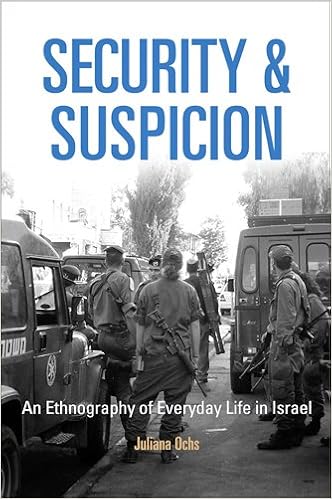
Security and Suspicion: An Ethnography of Everyday Life in Israel (The Ethnography of Political Violence) Hardcover by Juliana Ochs (University of Pennsylvania Press)


In Israel, gates, fences, and walls encircle public spaces while guards scrutinize, inspect, and interrogate. With a population constantly aware of the possibility of suicide bombings, Israel is defined by its culture of security. Security and Suspicion is a closely drawn ethnographic study of the way Israeli Jews experience security in their everyday lives.
Observing security concerns through an anthropological lens, Juliana Ochs investigates the relationship between perceptions of danger and the political strategies of the state. Ochs argues that everyday security practices create exceptional states of civilian alertness that perpetuate—rather than mitigate—national fear and ongoing violence. In Israeli cities, customers entering gated urban cafés open their handbags for armed security guards and parents circumnavigate feared neighborhoods to deliver their children safely to school. Suspicious objects appear to be everywhere, as Israelis internalize the state's vigilance for signs of potential suicide bombers. Fear and suspicion not only permeate political rhetoric, writes Ochs, but also condition how people see, the way they move, and the way they relate to Palestinians. Ochs reveals that in Israel everyday practices of security—in the home, on commutes to work, or in cafés and restaurants—are as much a part of conflict as soldiers and military checkpoints.
Based on intensive fieldwork in Israel during the second intifada, Security and Suspicion charts a new approach to issues of security while contributing to our appreciation of the subtle dynamics of the Israeli-Palestinian conflict. This book offers a way to understand why security propagates the very fears and suspicions it is supposed to reduce.

Saturday, July 21, 2018

City on a Hilltop: American Jews and the Israeli Settler Movement Hardcover – May 22, 2017 by Sara Yael Hirschhorn (Harvard University Press)


Thumbs up and thumbs down for "City on a Hilltop".

On the plus side, Sarah Yael Hirshhorn has invested an enormous amount of original research into detailing some aspects of American Jewish migration to the West Bank (historically Judaea and Samaria), and the Sinai's Yamit. They all became part of Israel after its stunning victory over Arab armies poised to destroy the Jewish state in 1967. Her narrative is readable and to me, as one who either personally knows or is acquainted with a good number of the personalities depicted, truly interesting.

On the minus side, Hirschhorn's stated goal "to provide an objective, rigorous, scholarly account" (p. 11) is not met. It's can't be objective if she refers dozens of times to the West Bank as "Israel/Palestine", when there's no current Palestinian state. Any use of "Israel/Palestine" is a politically loaded and pre-judged conclusion.

Just a handful of the author's negative characterizations --

She describes for 40 pages the efforts by Rabbi Shlomo Riskin, the famed former leader of Manhattan's Lincoln Square Synagogue, to establish Efrat, a highly desirable community in the Etzion bloc south of Jerusalem. Rabbi Riskin's religious moderation and daring innovations are well-known, as are his efforts to reach out to local Palestinian mukhtars willing to dialogue with him. Certainly over the course of 35 years in Efrat some of his early political views have changed given the reality of many more terror attacks around or in Efrat than the author cares to disclose, such as the infamous February 2002 Efrat supermarket terror bombing.

Yet in summing him up, Hirschhorn chooses leave the reader with a quote from a "progressive pundit": "Riskin could no longer masquerade as the liberal orthodox rabbi", but is really "a rightwing extremist in moderate's garb....through this life project, Riskin has caused more tragedy and pain to more Palestinians than any other rabbi of modern times, certainly more than Meir Kahane and his ilk" (p. 141).

Seth and Sherri Mandell of Efrat established a foundation to assist victims of Palestinian terror or other traumatic events after their teenage son Kobi was brutally murdered by Palestinian terrorists. Yet Hirschhorn complains, apparently with a straight face, that "it does not offer its services to bereaved Palestinians" (p. 172).

Hirschhorn begins her depiction of Tekoa, one of the three communities she describes in detail, as "deep the West Bank" (p. 143), and headlines the chapter, "Turn Left at the End of the World", subtle jabs. In reality, Tekoa is only seven miles east of Efrat.

The author discusses several cases of anti-Arab mayhem perpetrated by American immigrants to Israel. While the number of attackers is miniscule compared to the 60,000 Americans she estimates live on the West Bank, it's a necessary part of the discussion. Yet Hirschhorn is largely silent in describing the daily cascade of inflammatory anti-Israeli, anti-semitic rhetoric pouring out of the Palestinian media, whether it be from the official peace partners of the Palestinian Authority or the Hamas terrorists who rule Gaza, evacuated of its 21 Jewish communities in 2005 in a failed Israeli bid to achieve peace.

The author concludes that "American-Israeli immigrants within the settlement movement have contributed to making Israel less democratic while increasing conflict in the United States" (p. 228). I think that Hirschhorn's research -- as well as my own and my contemporaries' 50 years of interaction with these immigrants -- shows just the opposite. American olim largely do not accept stultifying Israeli bureaucracy or the commonly-heard phrase, "what can you do?" They act, they organize, they believe in a more democratic system, they always try to improve, they seek more communality with America.

What's the bottom line? "City on a Hilltop" is worthwhile reading -- but only if leavened with a healthy dose of skepticism for some of the author's descriptions, omissions and conclusions. It ain't the gospel truth.

The Origin of Others (The Charles Eliot Norton Lectures) Hardcover – September 18, 2017 by Toni Morrison (Author), Ta-Nehisi Coates (Foreword) (Harvard University Press)


Morrison's latest contribution to world literature is a dissertation on racism; it’s origin, usability and detriments. "The Origin of Others" traces the construction of racism and how it permeates all aspects of American institutions and worldwide consciousness. Central to Morrison's critique is the denunciation of the misinformed notion that multiple races - i.e. whiteness and blackness - is a scientific fact (there is only one race – the human race). As the essays deconstructs the formulation of racism readers are exposed to how racism equates to power/control and the ends to which governments, institutions and individuals will go to maintain those benefits.

"The Origins of Others" is a perfect way to initiate discussions on racism. Book Clubs and classrooms will benefit significantly from the clarity provided this analysis. A bonus for this reader is Morrison's insight on how her body of work is primarily concerned with the exploration of racism and color-ism throughout American history. This is a highly recommended read that begs discussion and reflection.


America’s foremost novelist reflects on the themes that preoccupy her work and increasingly dominate national and world politics: race, fear, borders, the mass movement of peoples, the desire for belonging. What is race and why does it matter? What motivates the human tendency to construct Others? Why does the presence of Others make us so afraid?

Drawing on her Norton Lectures, Toni Morrison takes up these and other vital questions bearing on identity in The Origin of Others. In her search for answers, the novelist considers her own memories as well as history, politics, and especially literature. Harriet Beecher Stowe, Ernest Hemingway, William Faulkner, Flannery O’Connor, and Camara Laye are among the authors she examines. Readers of Morrison’s fiction will welcome her discussions of some of her most celebrated books―Beloved, Paradise, and A Mercy.


If we learn racism by example, then literature plays an important part in the history of race in America, both negatively and positively. Morrison writes about nineteenth-century literary efforts to romance slavery, contrasting them with the scientific racism of Samuel Cartwright and the banal diaries of the plantation overseer and slaveholder Thomas Thistlewood. She looks at configurations of blackness, notions of racial purity, and the ways in which literature employs skin color to reveal character or drive narrative. Expanding the scope of her concern, she also addresses globalization and the mass movement of peoples in this century. National Book Award winner Ta-Nehisi Coates provides a foreword to Morrison’s most personal work of nonfiction to date.

Capital in the Twenty-First Century Paperback – August 14, 2017 by Thomas Piketty (Author), Arthur Goldhammer (Translator) (Harvard University Press)


Thomas Piketty's book, "Capital in the Twenty First Century," has been resoundingly endorsed by Nobel Prize winning economist Paul Krugman. Since the reactionaries were freaking out, I couldn't resist reading it and finding out for myself what the hoopla was all about. The reason for the reactionary freak out is explained below.

Anyone who has bothered to read this book must admit that the writer is rigorous in his analyses and my impression was the writer eschews prejudgment. Piketty provides exhaustive data throughout in a fascinating historical analysis of capital and the inevitable pitfalls of indecent inequality of wealth ("...the `first globalization of finance and trade (1870-1914) is in many ways similar to the `second globalization' which has been underway since the 1970's." and, "...capitalism automatically generates arbitrary and unsustainable inequalities that radically undermine the meritocratic values on which democratic societies are based.") There were reasons for the financial shocks and the world wars of the 20th century, and if we're not paying attention...

Piketty notes that, "Economists are all too often preoccupied with petty mathematical problems of interest only to themselves." Nevertheless, the essential economic equations and trend analyses are sufficiently addressed and easily understandable by all. He notes that economics should be considered a branch of social science, i.e., "...politics is ubiquitous and...economic and political changes are inextricably intertwined and must be studies together."

If nothing else, the reader is warned, "...all citizens should take a serious interest in money, its measurement, the facts surrounding it, and its history. Those who have a lot of it [money] never fail to defend their interests. Refusing to deal with numbers rarely serves the interests of the least well-off."

So why are reactionaries freaking out over this book? Piketty concludes that national debt can only be reduced by: repudiation (bad), inflation (horrible), austerity (really horrible), or a progressive tax on capital (reasonable). Further, he recommends that the only reasonable way to address indecent wealth inequality is a progressive global tax on wealth, which in turn requires global transparency of accounts and an end to foreign tax havens; he goes on to say none of these measures will be easy, but does offer practical suggestions. Clearly, the plutocrats would panic over popularization of such a suggestion, and it only takes a word or two from them to spin up their PACs and puppet organizations (I won't name names) into blindly trashing these rational suggestions. Thus the one-star reviews from those who haven't read the book.

Other specifics of note:

* His rational explanation of what central banks do and why they are necessary is excellent and should be understood by all.

* His discussion of past and recent European economic issues, the creation the Euro, and administration by the ECB and European Committee should be of great interest to most Americans.

* The fact that income taxes were not invented by Woodrow Wilson and had been used successfully in Europe for many decades before that is probably news to most Americans.

* The real reasons why the gold standard had to be abandoned and is no longer feasible should be better understood by many.

* His explanation of what "rentiers" are (i.e. those with sufficient wealth to live off dividends, rents, and other financial instruments) is something that should be better understood by all. At some point, wealth takes on a life of it's own whenever r>g and this and what amounts to regressive taxation at the top of the pyramid, are the driving force behind income inequality.

* His explanation of the recent phenomenon of "super managers" who demand salaries in the tens of millions (the ones that piss everyone off), and how it was a result of the conservative revolution of the 1980s' is something that should be understood by all.

Though it's a tough slog for me, but I highly recommend this book be read be all. I recommend someone write a "Reader's Digest" version that could reference the original, since the average reader may struggle with it.

Uranium. Anthony Burke. (Polity Press). 2017.


The events of the past year have sparked renewed global interest in the murky world of nuclear politics. Commentators in academia and the media have repeatedly sounded the alarm over the Treaty on the Nonproliferation of Nuclear Weapons (NPT), warning that nuclear-weapons states are not fulfilling their disarmament obligations and putting the entire framework at risk. Non-nuclear states have demonstrated their dissatisfaction at the perceived hypocrisy of the ‘nuclear club’ by passing their own Treaty on the Prohibition of Nuclear Weapons, with nuclear powers predictably withholding their support. Japan still wrestles with clean-up operations following the Fukushima Daiichi reactor disaster of 2011, while the UK government pushes through a controversial deal for the joint French-Chinese construction of a new nuclear power station at Hinkley Point. Most ominously, the election of President Donald Trump has thrown into doubt the US-Iran nuclear agreement, and the world watches with alarm as the US and China respond ineffectually to the most recent rounds of North Korean nuclear brinksmanship. Events like these are jarring reminders that nuclear danger still exists, outside of the familiar security dilemmas of the Cold War. The publication of Anthony Burke’s excellent Uranium could therefore not have been timelier.

Burke is one of the most vibrant scholars working in security and international relations today. Having first trained in creative writing, journalism and cultural theory, he has trodden an eclectic career path, approaching security and terrorism – as many others have done before him – through post-structuralism, critical theory, materialism and cosmopolitanism. His very public clash with Australian security analysts in a 2008 controversy over the ideological biases of Critical Terrorism Studies (CTS) earned him, in the eyes of one journalist, ‘novelty value’. What truly sets Burke apart, however, is an unwillingness ‘to engage in postmodernist sophistry or cleverness’ at the expense of pursuing alternative political futures. Alongside producing intriguing and important, yet rather specialist, work on post-positivist nuclear politics, with Uranium Burke offers up an invaluable handbook on the contested politics of the world’s most unstable element – accessible to academics and interested novices alike.

Uranium is a relatively short and easily digestible survey of the global nuclear landscape. Its two major strengths lie in Burke’s chosen approach: first, he refreshingly chooses not to write ‘a theoretical or even academic work’ (8). This has the dual benefit of making the book appealing and readable to non-experts, as well as distancing it from the stale and counter-productive frameworks of nuclear thought foisted upon us in the twentieth century – what Michael MccGwire called ‘deterrence dogma’. Second, where Burke does adopt a loosely ‘new materialist’ theoretical framework, he argues that uranium itself has ‘a raw materiality and agency that acts upon the world, in a way that resists, frustrates and channels human intentions’ (9).

This pleasingly straightforward formulation also subverts the way in which we think about the power of the atom. It reminds us that there is nothing inevitable or natural about uranium being extracted from the earth, used to construct unthinkably powerful weapons or put to work in electricity generation. Uranium is an ‘actant’ in the world by virtue of its radioactivity, and humans have only partly domesticated it through ideas, technologies and cultures. Its ‘innate properties and dangers’, therefore, threaten our every effort to ‘bring it under rational use and control’ – potentially rendering it more dangerous than we care to imagine (144).

The premise widens Uranium’s scope, allowing Burke to discuss the history of atomic research, Cold War strategic thought, resource mining and its impacts on local populations and nuclear power in quick succession. In scholarly circles, these aspects of nuclear politics are often treated in isolation, obscuring their interlinked relationships. Chapters Two through Five provide meticulous yet concise summaries of each topic in turn, liberally punctuated with landmark dates and statistical data. Particularly welcome is Chapter Four, ‘Mining, Politics and People’, which raises the profile of uranium mining, examining the post- and neo-colonial relationships at play in extractive industries. This has resulted in displacement, illness, territorial disputes and insurgent politics from Niger to the Northwest Territories, yet is rarely considered under the umbrella of ‘nuclear security’. Burke concludes that:

when the experience of indigenous peoples with nuclear testing [another issue which Uranium covers commendably] is considered alongside their experience with mining, it is clear that they have been asked to bear a grossly unjust and inordinate burden of the nuclear age (108).

This humanitarian sentiment represents well the book’s overarching argument: regardless of the systems we conjure to reign in and exploit the awesome power of nuclear material, our efforts have unintended and often ethically unacceptable consequences. We will remain unable to adequately address these lingering after-effects as long as we continue to think of uranium purely as a neutral technology, turned by human hands to the service of modern society.

For newcomers to the fields of nuclear politics, security or Science and Technology Studies (STS), the book is a must-read, and would be an excellent addition to undergraduate and postgraduate reading lists. It will hopefully inoculate students against the dangerously instrumental systems of thought which dominate the discussion of nuclear technologies. Uranium is also a first-rate introduction to more detailed writing in the field, including Burke’s wider oeuvre and the works of scholars such as Joseph Masco, Gabrielle Hecht and Shampa Biswas.

More seasoned academic readers may find limited appeal in Burke’s relatively prosaic and narrative mapping of the nuclear world: the facts and figures are mustered expertly, the case for achieving meaningful nuclear disarmament is urgent and convincing, but there is ultimately little new here as the conceptual implications of the author’s ‘new materialist’ stance are not fully explored. Burke is aware, however, of his intended audience, providing a comprehensive ‘Selected Readings’ section which illuminates a disparate field and highlights knowledge gaps. As a teaching resource, an entry point into critical nuclear politics and an impassioned call for fundamental change in how we think about our world’s most volatile natural assets, Uranium is a resounding success.

Ethiopia (Bradt Travel Guide) Paperback – December 7, 2015 by Philip Briggs (Bradt Travel Guides)


Essential reading for anyone with the remotest interest in Ethiopia...a complete reference book to Ethiopia as well as an excellent travel guide.' Travel Africa 'An indispensable handbook for anyone wishing to visit Ethiopia.' The Guardian 'Thorough and reassuring, it provides all the practical and background information to make readers leap from their armchairs and visit this vast, magical country.' The Daily Telegraph "The Bradt Guide has almost everything you need to read about the country's history, tourist attractions and hotels, and proves itself to be an invaluable companion while in the country." SX News "Highly personal and informative guidebook ... his enthusiasm is reflected in every chapter." Business in Africa 'Readable, practical and authoritative' Bird Watching 'Offers an excellent and thorough overview of the country' The Times 'This guide gives detailed information on wildlife, national parks and trekking routes.' Trek & Mountain Recommended reading by National Geographic Traveller 'The best guidebook is one of the two editions by Philip Briggs; other options contain lots of mistakes.

Thebestselling guide to Ethiopia in recent years, this fully updatedseventh edition of Philip Briggs' acclaimed guide reveals an ancient countrythat continues to surpass all expectations: from the ancient Judaic cultures ofthe fertile highlands to the Animist people of the South Omo Valley, from theAfroalpine moorland of the Bale Mountains National Park to the thundering BlueNile Falls. This book also leads you further off the beaten track, sotravelers can see more of this expansive and beautiful land, believed to bethe cradle of humankind.

Friday, July 20, 2018

Forest Dark: A Novel Hardcover – September 12, 2017 by Nicole Krauss (Harper)


In Nicole Krauss’s fourth novel, two intertwining tales lead the story’s characters to a Tel Aviv hotel.

As Forest Dark, Nicole Krauss’s fourth novel, opens, 68-yearold Jules Epstein is drifting.

His parents have died, he has divorced his wife, and has retired from his law firm. Always on top of everything, Epstein has lost interest in striving as well as pleasure, and begun giving away his money and his material possessions.

On the first anniversary of his parents’ deaths, he decides to return to Israel, the land of his birth, “drawn back by a tangle of allegiances.” Soon after he checks into the Tel Aviv Hilton, his favorite hotel, Epstein runs into a rabbi he knew casually in New York, visits a school in Safed and finds himself on the set of a film about King David.

Nicole, the other main character in Forest Dark, is unhappily married in Brooklyn, has writer’s block, insomnia and anxiety. Mesmerized by a story about a man falling from the balcony of the Tel Aviv Hilton, a hotel she remembers with something less than affection, she flies to Israel, where a man named Eliezer Friedman (who may or may not be a professor of literature, a former Mossad agent, or “a door-to-door kiddush cup salesman”) enlists her in a project that has something to do with the life, death, manuscripts and letters of Franz Kafka.

Presented in alternating chapters, the quests of Jules and Nicole are, well, incredible.

And that’s the point. An internationally renowned novelist, the fictional Nicole, we learn, has lost her faith in narrative. The truth that narrative “must always betray,” Nicole maintains, is the reality of chaos, incoherence, and disorder in the world. In fiction, as in “real life,” our minds labor to produce coherence at any cost, invariably by producing credible stories.

Perhaps because Nicole does not want to relinquish narrative “or live without its consolations,” she strains to find it “merely elusive,” even though “it should have felt impossible.” And so, Nicole, and in his own way, Jules, search for a balance between creating and destroying form and formlessness “that suffuses nature with such peace.”


This is heady stuff. And Forest Dark is, at times, a heady novel. Fortunately, especially for those of us who are less than thrilled at the prospect of yet another writer writing about writing, it is also a tour de force of (you guessed it) storytelling by a splendid stylist.

By turns hilarious, haunting, poignant, and powerful, filled with reflections about mysticism, Jewish history, the existence of other universes and mothers who save their babies’ teeth, Forest Dark is a delight to read and a remarkable meditation on the meaning of life.

Some examples. With the Sabbath, Rabbi Klausner tells Epstein, God created menucha, a “unique positive” connoting not just rest, but tranquility, serenity and peace, “and the world was complete.” According to Klausner, tzimtzum, a key concept in the Kabbala, explains the paradox of God’s simultaneous presence and absence in the world: after deciding to create the heavens and the earth, God withdrew, then filled the void he had left. This primordial event, Klausner asserts, is ongoing.

Far less abstractly, Krauss describes the evolving attitudes of 21st century Jewish- Americans who visit Israel. For Nicole, the “never-ending argument” among Israelis who take the time to dispute the way the world appears, is “a relief.” At first, the narrator of the Epstein chapters explains, Jewish tourists fall in love with “the urgency and the argument and the warmth” in cafes and taxi cabs. “They find Tel Aviv so sexy, the sea and the strength” and the sense that “everything still matters and is worth fighting for.” Most of all, tourists think “this is where we come from as they duck through the tunnels under the Western Wall... scale Masada, hike the Judean, come to the Kinneret.”

In time, however, the “strength starts to stink of aggression, and the directness becomes pushy, it begins to grate how Israelis don’t have any manners, no respect for personal space, no respect for anything.”

But the narrator also tells us that as Epstein stands shirtless before the sea, he feels an “exuberance, a bird-like freedom,” drinking in “This lightness. This hunger. This ancientness.”

You may well remember these passages – I did – near the end of the novel when Nicole reveals that Kafka believed that the expulsion from the Garden of Eden was not a punishment for eating from the Tree of Knowledge, but for failing to eat from the Tree of Life. Had Adam and Eve made that choice, they and their descendants “would have woken to the presence of the eternal within us, to what Kafka called ‘the indestructible,’” and may have “stopped pretending that knowledge can be an end itself.”

Or, then again, I can hear Nicole Krauss saying, maybe Kafka and the narrator of Forest Dark have got it all wrong. 

Wednesday, July 11, 2018

HOW TO RIG AN ELECTION By Nic Cheeseman and Brian Klaas Yale. 310 pp. $26


Election rigging by dictators is too easy, and the West often looks the other way. In their book “How to Rig an Election,” Nic Cheeseman and Brian Klaas issue a plea to American and European leaders: Take a more skeptical look at fraudulent elections and recognize the danger of endorsing rigged votes. The book is an instructive, though thin, primer showing that sham elections are depressingly common. Today, “more elections are being held, but more elections are also being rigged,” write Cheeseman, a professor at the University of Birmingham, and Klaas, a fellow at the London School of Economics (and a contributor to The Washington Post’s DemocracyPost blog). The authors warn that “counterfeit democrats” have figured out not only how to rig elections but also how to dupe Western observers and governments into accepting the outcome — and often emerge stronger.

The book details rigging strategies from the outrageous (disappearing ballot ink in Ukraine and three candidates with the same name on a St. Petersburg ballot) to the familiar (gerrymandering and voter suppression). In 23 percent of recent elections, violence, intimidation or harassment was found to have played a role; vote buying occurred in nearly 40 percent. The “smartest way” to rig, according to the authors, is to start early, “when observers are likely to be thin on the ground, and [questionable tactics] can be presented as technical or legal decisions as opposed to political skulduggery.


Supporters of Turkish President Recep Tayyip Erdogan celebrate his reelection last month. (AP Photo/Emrah Gurel)

Cheeseman and Klaas argue that Western democracies either have not looked hard enough for election abuses or have willingly looked away. “Despite the wide range of rigging strategies that have been documented,” the authors write, “Western observation missions only raised the problem of fraud in 20 percent of the elections, and foreign aid was only stopped in the aftermath of around 6 percent.”


The payoffs for autocrats that successfully rig elections can include reinvigorated ruling parties, fractured opposition groups, and increased foreign financing, investment and aid. The “unsettling reality at the heart of this book,” the authors note, is that “their regimes have a better chance of survival if they hold elections and rig them than if they avoid holding elections altogether.”

The argument is provocative, and the authors’ plea would be more persuasive if the book contained a comprehensive list of the counterfeit democracies that have gotten a new lease on life after rigged elections and the Western governments and financial institutions that have helped prolong the reigns of the despots.

Cheeseman and Klaas criticize the United States as well as a number of other countries. They describe the role of former congressman Michael McMahon in monitoring the 2013 presidential election in Azerbaijan. Although the Organization for Security and Cooperation in Europe (OSCE) detected serious problems at 58 percent of the polling locations it visited, the New York Democrat deemed the election “honest, fair, and really efficient,” enthusing that unlike at U.S. polling sites, there were no lines in Azerbaijan. Cheeseman and Klaas write that while it is tempting to attribute McMahon’s comments to the naivete “of a single deluded Western official,” a European parliamentary delegation also declared that the vote in Azerbaijan represented a “free, fair and transparent electoral process.” According to the authors, Western governments were more concerned about access to the “energy rich Caspian region” than a clean vote.

In another telling incident, the authors recount Turkey’s 2017 constitutional referendum that granted sweeping new powers to President Recep Tayyip Erdogan. The OSCE described an “unlevel playing field,” and a member of the Council of Europe mission said 2.5 million pro-government votes could have been manipulated. Nonetheless, President Trump phoned Erdogan to congratulate him on his victory, prompting Cheeseman and Klaas to ask: “Why would Erdogan care about a report from the OSCE” after receiving “unfettered praise from the most powerful man in the West?”

Monday, July 9, 2018

The Ethical Slut, Third Edition: A Practical Guide to Polyamory, Open Relationships, and Other Freedoms in Sex and Love Paperback – August 15, 2017 by Janet W. Hardy and Dossie Easton (Ten Speed Press)


The Ethical Slut is a classic, a book that helped launch the modern non-monogamy movement. Updating a book of such historical significance is no easy task, but The Ethical Slut, Third Edition succeeds beautifully. Where the original broke radical new ground, this edition is more nuanced, a book for a more complex age. In the third edition, we see the wide variety of forms ethical non-monogamy, and indeed human sexual relationships, can take. This new version brings a new focus on consent, talks about the many wonderful and varied ways ethical non-monogamy happens, and shows an appreciation for the vast range of human sexuality. This is The Ethical Slut for a new era, and cements the book’s place as one of the cornerstones of modern non-monogamous thought

In the two decades since the first edition of The Ethical Slut has been published, polyamory has expanded into a practice that, if not outright mainstream, is at least much more widely accepted and understood. […] The 20th anniversary edition of The Ethical Slut, has been significantly updated and expanded from its humble debut, including sections to poly pioneers, black poly activism and yes, shifting attitudes towards polyamory within a new generation. They acknowledge that millennials reading the book today will not have been raised in the same context that Hardy and Easton were – before the sexual revolution, when saving oneself for marriage was considered the norm

Friday, July 6, 2018

Frankenstein (Dover Thrift Editios) 1st Edition by Mary Shelley (Dover Publicatios)


Ah yes, the words of Mary Wollstonecraft Shelley in Frankenstein; or, The Modern Prometheus, first published on Mar 11, 1818. I first read this story in high school, then again in college and love it both times. However, now just over two decades later I pick up this book to embellish in the immortal of dear Mary and wonder if when she wrote this work she had any inclination, it would be considered a masterpiece in its own right. She could not have known that one day it would be made into a picture, not one, not twice but numerous times the first in 1910.

The story of a man who’s expectation of knowledge led to the love of science, which resulted in a passion for exploration and grandeur that led to obsession and achievement. But to what end? Victor Frankenstein engaged in undertakings surpassing any ever attempted. He without consideration, self-preservation, or repercussions painstakingly constructed a human form and brought him life. Yet on the day of his creation birth, he ran from him calling him a monster and left him to his own devices. Some look at his creation as being just such named. However, was the creation indeed a monster? Is a living thing, which can think, love, empathizes, long, and want truly be considered a monster or, as Robert Waltson calls it, a hypocritical fiend. Or, should the creator, the one the creature relied on, the one who brought him life and then abandoned him be indeed perceived as the monster?
Many passages exist in these writing that I adore, but I will share just one with you:
“Nay, these are virtuous and immaculate beings! I, the miserable and the abandoned, am an abortion to be spurned at, and kicked, and trampled on. Even now my blood boils at the recollection of this injustice. But it is true that I am a wretch.” ~ Frankenstein’s monster

Thursday, June 21, 2018

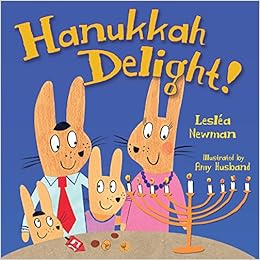
Hanukkah Delight! Board book – August 1, 2016 by Lesléa Newman ( Kar-Ben Publishing) (IBRChildrensBooks)


"In brief board-book form Newman revisits the familiar Hanukkah traditions she successfully introduced in Eight Nights of Chanukah, illustrated by Elivia Savadier (2005), and Here Is the World, illustrated by Susan Gal (2014). Here the holiday stands on its own without parodying a Christmas tune or being lost in a compendium of the Jewish year. Of course, a board book has space for much less information. The essential ingredients of the celebration―candles, blessings, latkes, dreidels, and gelt―are mentioned in nine lines of text that all rhyme with 'delight.' The finer points of theology, including the miracle Hanukkah commemorates, are left for older children to learn from experience, their own reading, or stories told round the holiday table. The fun is in the detailed pictures. Husband uses cheerful, well-dressed bunnies to depict a family as they celebrate the Jewish holiday American gentiles know best. Some subtle stereotypes still creep in. The family consists of papa, mama, big sister, and baby. A crocodile in a tie and a portly and bespectacled owl are among the friends. The males all wear yarmulkes, and the females all wear dresses. Otherwise they are just like anyone else who can be depicted as talking animals. Useful for both Jewish families and others seeking to give children a head start on religious pluralism.

In lines with simple meter that all rhyme with the second word in the title,
this board book runs through the high points of Hanukkah ('Dreidels spinning
through the night / Chocolate gelt―come take a bite') during a friendly
eighth-night gathering at a rabbit family’s house. The pastel-toned mixed-media
illustrations show the visiting 'friends and neighbors' as a congenial assortment of
animals, and they include accurate holiday details such as a row of dreidels with
correctly ordered Hebrew letters. A very first introduction to blessings, candles,
and latkes as well as holiday joy: 'Hanukkah―a wondrous sight!'

About the Author


Lesléa Newman is the author of more than sixty books for readers of all ages, including the children s classic Heather Has Two Mommies, as well as the young adult novel Jailbait, the middle-grade novel Hachiko Waits, and the adult poetry collection Still Life with Buddy. Her award-winning short story A Letter to Harvey Milk has been adapted for the stage. She has been awarded poetry fellowships from the National Endowment for the Arts and the Massachusetts Artists Foundation and is on the faculty of Spalding University s MFA brief-residency in writing program. She is also a former poet laureate of Northampton, Massachusetts. In addition, she works closely with the Matthew Shepard Foundation as a member of their speakers bureau. She has visited schools all over the country giving her presentation He Continues to Make a Difference: The Story of Matthew Shepard. Lesléa Newman lives in Holyoke, Massachusetts.

A Hanukkah with Mazel Paperback – August 1, 2016 by Joel Edward Stein (Author), Elisa Vavouri (Illustrator) (Kar-Ben Publishing)


Misha is an artist who lives alone, but does have his old cow Klara. One cold and windy night a cat wandered into the barn. When discovered by Misha he became a caring friend to the cat and named her Mazel. The two shared Misha’s meager party as they prepared to celebrate Hanukkah. Misha was too poor to own candles to light for the holiday, so instead he painted candles each day for his menorah art. One day a peddler came to visit and loved all of Misha’s art, and he was also the original owner of Mazel. The peddler traded money for Misha’s art. What do you think happened with Mazel?

Author Joel Edward Stein has created a gentle story of kindness. Young readers will see that a holiday can still be a happy one even when you don’t have much. It also speaks to how each person has something to offer and share. Easy to read sentence structure and beautifully illustrated, this story shares Jewish culture and the Hanukkah celebration.

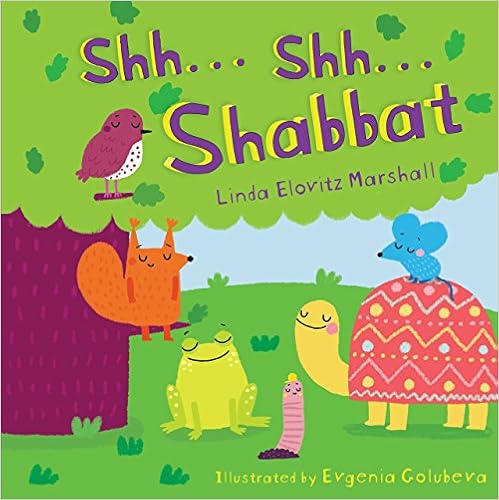
Shh...Shh...Shabbat Board book – by Linda Elovitz Marshall (Author), Evgeniia Golubeva (Author), Evgenia Golubeva (Illustrator) (Kar-Ben Publishing) (IBRChildrensBooks)


Sunday and Monday are very busy, busy days of the week. A trio of girls are listening to music and dance, dance, dancing. Squirrel watches as skateboards race past. Say, did you see that dog boarding with them? Mouse watches the neighborhood as someone mows their lawn and listens as music comes from a window. “On a morning-madness Monday, / Mouse hears / Motorcycles roaring past, / Music playing at full blast.” Then there are the other days of the week. What will they bring to the very busy, noisy town? On Tuesday Turtle watches ad the cars and trucks travel the roads. Vroom, vroom, beep, beep!

On Wednesday Worm watches bicyclists as they pedal uphill and listens to a whistle blast. On Thursday and Friday there is laughter at the basketball court for Thrush to listen to. Friday is extra busy as Frog watches and listens to a fire engine rush down the street, but something is so much different for everyone on Shabbat. “But each and every Shh ... Shh ... Shabbat, / Squirrel Mouse, Turtle, / Worm, Thrush, and Frog listen as ... / Soft winds blow, rhythms slow. / Noises hush, / There’s no rush.” Why is Shabbat so quiet?

This is a charming board book that will help little children learn about Shabbat. The artwork is very bright and appealing and the verse very lyrical and fun. I loved watching the animals as they watched and listened to the lively town during the week. Each little critter appears to smile as the busy, busy town goes about its business. Of course Shabbat is a very quiet day and parents and caretakers will be able to explain to their little ones just why the little town has settled down. A wonderful story in verse to introduce preschoolers to Jewish traditions.

Grade Level: Pre-K

Ages: 1 to 4

Monday, June 18, 2018

How To Go Viral and Reach Millions: Top Persuasion Secrets from Social Media Superstars, Jesus, Shakespeare, Oprah, and Even Donald Trump Paperback – May 23, 2018 by Joseph Romm (Luminare Press)


“We want to make a viral video.” Those are the words videomakers most dread when working for a client — as if “going viral” were an option. It isn’t. There are countless uncontrollable factors involved with today’s rapidly changing audience. Which means that in the end, the best anyone can do for “what goes viral” is to examine things that went viral and look for patterns -- which is what veteran climate blogger Joe Romm does very well in this valuable book.

The basic dynamic of figuring out what goes viral makes me think a bit of a book that made a big impression on me when I was in college -- the 1970’s classic, “A Random Walk Down Wall Street,” in which Burton Malkiel debunked most of the approaches of “experts” who claimed to be able to predict the stock market. You can’t predict the market any more than anyone can predict what will go viral on the internet.

But that said, there are some consistent patterns among the most popular memes and media. And that’s what Romm is good at — spotting the patterns using his analytical perspective. As a result, this book is filled with sections that will make you think and push you in directions that have high probabilities of producing something potentially viral with everything from the use of metaphor to repetition to irony. It’s the kind of a book that will probably be most useful if you’ve got an idea you’re wanting to propagate that is in your head as you’re reading, letting each chapter present suggestions to you.

A new update to Romm’s communication advice that gets a lot of attention here is story structure. This is very timely as throughout the business community in particular the awareness of story has exploded (Linked In recently documented that the number of people describing themselves as a “storyteller” in their profiles has gone from zero to a half million in about five years). The book covers everything from Joseph Campbell to Star Wars.

There’s lots to say but I’ll pick just three themes for both the book and Joe Romm himself. The first is courage. He’s always been a fighter and in this book he has the courage to do more than just ridicule and insult Donald Trump and the current Trump movement. He puts Trump's name in the title, though wisely qualifies it with, “Even Donald Trump.”

This is a very important fundamental divide — making clear he’s not a knee jerk Democrat with his fingers in his ears trying to discredit the Trump victory. There is a great deal to be learned and understood about why Trump won. Romm has the courage to wade into this.

Second is passion. The entire book is interlaced with the recent death of his brother Dave. Communication must always be human. His willingness to share this painful event and draw on it underscores the passion Joe feels for the need to communicate well.

And third is inspiration. He tells in places of his work with progressives, helping them improve their communication skills. He is clearly a source of inspiration to many, and this book ends up being his current manifesto. I say “current” because it’s clear he’s always continuing to listen and learn, which means that there will probably be further updates down the line. But for now, this is an invaluable resource for people seeking to communicate with the mass audience of today.