Showing posts with label . Stephen Darori. Show all posts

Friday, June 1, 2018

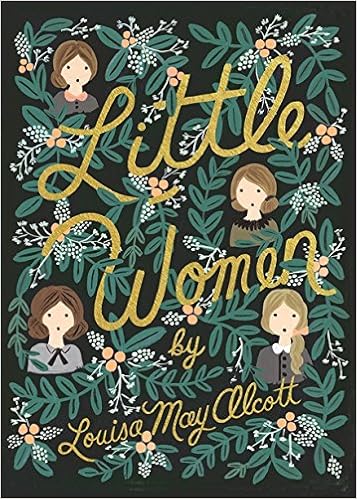
Little Women (Puffin in Bloom) Hardcover – August 28, 2014 by Louisa May Alcott (Puffin Books)


A very early reader, I received a copy of "Little Women" at age 7. From the very first time I read this lovely book, I fancied myself as Jo, and so thoroughly identified with her that even through all the succeeding decades and thousands of other books read, this book will remain one of my top five favourite books because of her. I read and reread this book sitting in a big apple tree in my parent's back yard, laying on the grass on a summer's day, and under the sheets with a flashlight I now suspect my parents knew I had stashed under my bed.

In an age of easily digested and mass-produced books with weak characters and plot, "Little Women" is a stand-out that resists the passage of time for its exemplary characters, theme of family unity, and love on so many different levels (friendship, familial, true love, and romantic love).

Readers today might find the writing and occasional chirpiness of the March sisters when faced with their poverty a bit difficult to relate to, but knowing stories of how my own mother and sisters faced the Depression and then WWII in the UK made me realise from an early age that trying to find things to rejoice in is essential to surviving tragedy and loss on a personal level.

The March sisters encapsulate female society in most countries even now, and are well-written individual characters, each with a different goal they wish to fulfil in life. The girls do not become career women, and their parents do preach the importance of family life and sacrifice, however, each one does what was expected of young girls at that time. Jo's daring in writing a sensationalist "man's" story and insisting on payment commensurate with a man was unheard of in those days and when one considers that women are still underpaid, it makes Jo's triumph still relative today. Amy's goal of being comfortably well-off is eventually tempered by her own personal sorrow at the poor health of her own little Beth, Meg wants to be a mother and wife, and she learns not to overachieve, and Beth who overcomes pathological shyness through her altruism and empathy for others and which leads to her death is still inspirational today.

My suggestion is that if you have a daughter, sister, granddaughter or friend, take turns reading it. It will improve your vocabulary, make you smile, and dear Beth's stoicism will bring a tear to your eye.

Monday, April 9, 2018

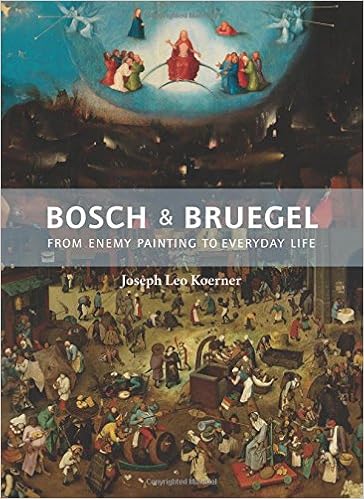
Bosch and Bruegel: From Enemy Painting to Everyday Life (The A. W. Mellon Lectures in the Fine Arts) Hardcover – December 6, 2016 by Joseph Leo Koerner (Princeton University Press)


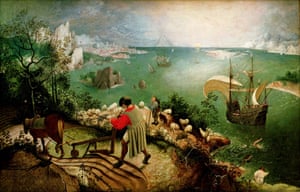
Hieronymus Bosch and Pieter Bruegel the Elder work like antagonistic muscles in the imagination, pulling with and against each other. Bosch is a painter of medieval hellfire whose fantastical creations exceed our nightmares. Bruegel, most memorably and wonderfully, shows us a recognisable world where children lick bowls clean, bagpipers draw breath and harvesters stretch out in the sun. Turning from metaphysics and from myth, he attends to the ploughman who labours his way across a field while Icarus falls into the sea far below. Bosch’s pale figures belong to the international gothic; Bruegel’s weighty peasants dance vigorously into modern times.

Yet Bruegel (born 10 years after the elder artist’s death) was greeted by his contemporaries as a “second Bosch”, and the connections between the two Netherlandish masters have fascinated viewers for centuries. In this revelatory new study, the US art historian Joseph Leo Koerner argues that they are – together – the originators of what would later be called “genre” painting.


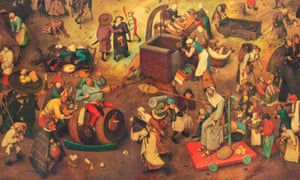
Everyday symbolism … detail from Pieter Bruegel the Elder’s The Fight Between Carnival and Lent (1559). Photograph: Alamy


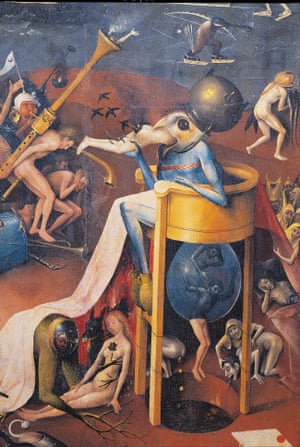
The very idea of Bosch as genre painter sounds at first absurd and horrifying, as if a devil were to break in through the open door of a Pieter de Hooch courtyard and Vermeer’s milkmaid were to let her earthenware pot smash across the tiled floor. Yet the doors and the pots and the floors, the dances, games and quarrels were there in Bosch. Almost all the themes that in Bruegel look like “genre” subjects were painted first by Bosch. The difference, and it is a giddying world of difference, is in tone and intent. “At its beginning,” Koerner writes, “the painting of everyday life was bound inextricably to what seems its polar opposite: an art of the bizarre, the monstrous, the uncanny.”


 Bizarre, monstrous, uncanny … detail from Bosch’s The Garden of Earthly Delights. Photograph: Photoservice Electa\UIG/Rex

These apparent contraries are yoked because for Bosch our material things and common activities constitute the devil’s prop-cupboard of lures and disguises. They are worthless or worse, the products of a corrupt and doomed humanity. To make them better, to make them beautiful, to lavish on them the attentions of art, is to risk a form of idolatry. But in order to make us feel the overwhelming fertility of the world, holding us on the vertiginous brink of mesmerised attraction and repulsion, Bosch has to paint the “enemy territory” that is everyday life.

He engineers the Haywain Triptych to look like an altarpiece. Its shutters break open, miming the priest’s breaking of the host, to reveal an image of celebratory worship. Crowds gather round to admire the glowing golden object at the centre. But this object, so gloriously revealed, is not Christ but a cart laden with hay, and so densely laden as to become sinister. This lumpen globe may be heavy but it is spiritually empty. Here is all flesh rendered grass, and the round world mere chaff. Those who grab at it, and throw themselves at its feet, are clutching at straws. The material painting, which might be called an “anti-altarpiece”, is an object, wood and pigment, cautioning against the love of things like itself.

Training our eyes to read these icons of corruption, Koerner leads us carefully towards The Garden of Earthly Delights, intent both on preparing us for the horror and on deepening our experience of it. In their closed state, the grisaille shutters bear the translucent sphere of a half-made universe, quiet and yet brewing, heavy with giant husks and seed-pods, “at once fecund and already decaying”. The doors of the world part to reveal what Koerner calls “psychology in painted form”. There in the middle is the eye of the owl, one of Bosch’s figures for himself, an emblem of the devil, yet all-seeing, like the eye of God.

And what does he see, that owl whose surveillance extends from the picture to its viewers? It is rare, when reading a work of scholarly criticism, to be so gripped as to feel nervous about turning the page. Be warned: there are chapters here more frightening than a thriller because they allow us to see, with Bosch, infinitely multiplying sin.


This is a book to read and reread in any moment of doubt about what critical analysis can achieve

It is a bodily relief to reach the section on Bruegel, but best not relax too much. Like Bosch, Bruegel is deeply interested in art as a form of oracular trap analogous with the traps man faces in the world. Whether he paints builders climbing to the impossible summit of Babel from which they can only fall, or a bird-stealer who lays a trap but will himself be caught, his panels are primed with “snares, nets, ambushes”. When he paints hell and death, Koerner writes, “he outdoes Bosch on Bosch’s home ground”. That’s saying something.

Still, even when Bruegel chooses the same motif as his forebear, he works towards an entirely different expression of lived human experience. Bruegel’s way of painting allegory is to depict ordinary people playing out that allegory, variously inhabiting and forgetting their symbolic roles. In The Fight Between Carnival and Lent, he shows us the spirit of Lent personified, and also the real person dressed as Lent, and the children who play around her. The grill outside a baker’s shop is a penitential symbol, but it is also – radically – a grill, which will slide back into an oven.

 Depicts ordinary people playing out the allegory … Bruegel’s Landscape With the Fall of Icarus (1560s). Photograph: Alamy

Everyday life, in Bruegel’s work, carries on insistently, urgently, even while miracles are happening. One has to look hard to see the Holy Family in the corner of The Adoration of the Kings in the Snow; the saviour is born, but it is a freezing winter day and people hurry through the gloomy streets, anxious to gather their fuel and be home. The falling snow gives the scene “a palpably present tense”; we see the weather closing in rather than eternity opening up. The events of Bethlehem are translated to the familiar surroundings of a Flemish town, so that the extraordinary is pictured within the commonplace. Religious painting becomes genre painting, and genre plays reciprocal host to the sacred.

This is a book to read and reread in any moment of doubt about what critical analysis can achieve. Koerner believes that every painting by Bruegel “can sustain a lifetime of looking”. He has written a passionately attentive book that brings all life to bear on these pictures, and makes one feel that a lifetime of looking would be well spent.

Wednesday, March 28, 2018

Persecution and Rescue: The Politics of the “Final Solution” in France, 1940-1944 Hardcover – June 30, 2016 by Wolfgang Seibel (University of Michigan Press)


In 1942, two years after invading France, the Germans implemented their policy of exterminating the Jews. In contrast to Jews in many parts of German-occupied Europe, however, the majority of Jews in France survived, thanks to opposition to the Nazi extermination policy from Church dignitaries and the moral indignation of the average Frenchmen. Seeking to maintain popular support, the Vichy Regime bargained with the Germans over the substance and extent of its collaboration, which the Germans needed in order to hold France. Drawing on German and French sources, Wolfgang Seibel traces the twisted process of political decision-making that shaped the fate of the Jews in German-occupied France during World War II. By analyzing the German-French negotiations, he reveals the underlying logic as well as the actual course of the bargaining process as both the Vichy Regime and the Germans sought a stable relationship. Yet that relationship was continually reshaped by the progress of the war, Germany's deteriorating prospects, France's economic and geopolitical position, and the Vichy government's quest for domestic political support. The Jews' suffering intensified when the Germans had the upper hand; but when the French felt empowered, the Vichy Regime stopped collaborating in the completion of the "final solution." Persecution and Rescue: The Politics of the "Final Solution" in France, 1940-1944 demonstrates the ways in which political circumstances can mitigate-or foster-mass crime.

Thursday, February 22, 2018

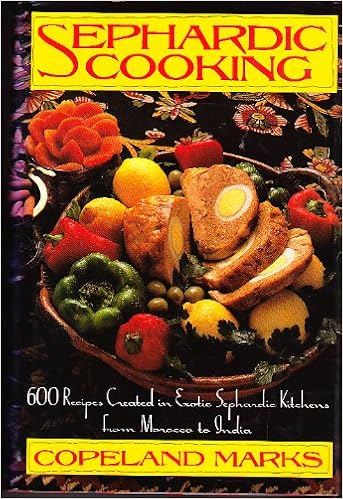
SEPHARDIC COOKING 600 Recipes Created in Exotic Sephardic Kitchens from Morocco to India by Copeland Marks(Dutton Adult) (IBRCookBooks)


 Marks, whose earlier cookbooks have featured such cuisines as Guatemalan, Burmese, and Indonesian, has ranged far and wide for this hefty collection, marking the 500th anniversary of the Jews' expulsion from Spain, that is held together by its focus on Sephardic Jewish and other related Jewish communities. With bits of sketchy capsule history introducing each place of settlement, Marks presents recipes from the community of 6000 Jews in Greece, the 50 or fewer (down from 6000 just decades ago) in Calcutta, the 38,000 from Libya (now completely transplanted to Israel), and several others. Some of the recipes, such as the ``Jewish eggs'' cooked in their shells for hours, he found in Jewish communities in Calcutta, Greece, Turkey, Tunisia, and Morocco; others, such as the walnut sauces of Georgia in the Caucasus, the injeera bread of Ethiopia, and the Moroccan bestila (``pigeon'' pie made here with chicken), are characteristic of the country of settlement but, as in other Marks collections, are considerably adapted here for American convenience. An interesting collection of dishes, many of them new to Americans, from a cuisine family that is becoming increasingly popular with American Jews raised on more stolid Eastern European fare. 

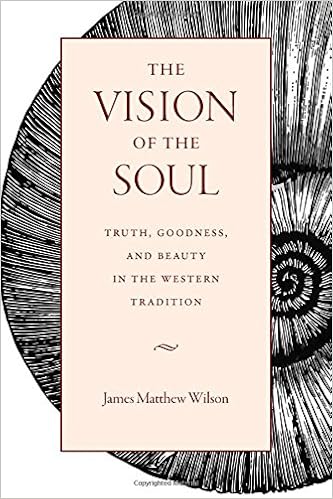
The Vision of the Soul: Truth, Goodness, and Beauty in the Western Tradition by James Matthew Wilson. The Catholic University of America Press, 2017. Paperback, 352 pages, $30.


Despite hitting a few bumps, poet James Matthew Wilson’s The Vision of the Soul delivers a stirring and timely account and defense of the West’s traditional way of understanding the universe and our place in it.

For Wilson, the Western tradition is the Christian Platonist one, in which the two basic facts about existence are that the universe is ordered and that its order is intelligible to the human mind. These two facts are augmented by Christian belief in a personal God who loves us unconditionally and desires that we love him. This tradition, argues Wilson, has been overshadowed by the Enlightenment and the philosophies descended from it. The problem with the Enlightenment is that while it begins as an attempt to understand the universe, it has devolved into a crude materialism that denies objective reality. However, writers such as Edmund Burke and T. S. Eliot preserved this culture, despite the dominance of liberalism.

In fact, Wilson maintains that liberalism can never be an actual culture because “it has no positive content, its goods being mere negations,” and so tends towards repetition and indifference. He says that liberal culture is moribund because its only goods are choice and equality, rendering quality and content irrelevant. The only thing that can be done is to transgress the established norms, but eventually there’s nothing left to transgress, only subjective tastes.


“Fine art takes on a new importance … because it attunes us, awakens and habituates us, to the perception of the ordered whole of reality.”

The discussion of the French philosopher Jacques Maritain and Thomist aesthetics is the core of the book. “Only in the Christian Platonist tradition … do we see beauty take on its full existential dimension, as a reality given to the senses, as drawing the mind to the perception of being and truth, and finally to a vision of beauty as the ordering principle of reality as a whole,” Wilson writes. “Fine art takes on a new importance … because it attunes us, awakens and habituates us, to the perception of the ordered whole of reality.” The Christian Platonist tradition Wilson writes of is not a specific intellectual position, but a more general perspective on the unique insights of the West. He describes its basic propositions as “bounding the map of reality” and so forming a “synthetic but readily unified tradition” that encompasses Plato of course, but also Aristotle and Aquinas.

The association of beauty, truth, goodness, and the ordering of reality is a key theme of the book and of the Western tradition itself. Wilson reiterates throughout that the world is ordered by and to beauty. The work of Maritain that Wilson discusses includes an exploration of the concept of ordered reality. Maritain argued that art was a virtue, one subordinated to higher virtues while subordinating lower virtues under it. “Maritain thus aligns art properly understood with a society ordered to dignified work … Man does not reduce himself to a beast of animal impulses to engage in ‘creative’ work, shedding his reason like so many mind-forged manacles.” And “Maritain’s theory of art insists upon the humility of even the fine arts as work; the artist, in bringing a new beauty into the world, does so by way of selfless imitation of the hitherto unseen.”

Because beauty is an existential dimension of human experience—that is, beauty reflects and helps explain reality—aesthetics can help us understand it. Maritain helped recover Thomistic aesthetics and Wilson draws on his work to explore three properties of beauty from the Summa Theologica: proportio, integritas, and claritas. This is the most important section of the book, because these ideas are fundamental to the Western understanding of beauty.

Proportio and integritas are very well explained. “Maritain rightly understands integrity as wholeness, the completion of a thing according to its nature” and “Aquinas most obviously intends by [proportio] … the relation of distinct beings and their formal elements relative to one another.” For instance, in a Shakespearean sonnet, the integritas in a specimen is that it has fourteen lines, twelve of which are cross-rhymed with the last two a rhyming couplet. The proportio is that the rhymes are good, the meter is followed and consistent, as well as other relational properties.

Claritas is more abstract and difficult. “When we perceive the clarity or splendor of a thing, we remark above all that its existence is intended, that the fact of its existence testifies not to the reality of a universal essence on which it is based, but on the mediated revelation of a divine mind whose knowledge is causative of being.” Maritain’s definition is not entirely correct, according to Wilson, so he brings in Umberto Eco, who defined claritas as the intelligibility of a form. “Whereas Maritain absorbed proportion into clarity as its mere handmaid, Eco insists that clarity is a secondary or phenomenal attribute of proportion,” but the possible proportions of any one thing are a virtually infinite “dense network of relations.” But this isn’t the final definition of claritas; instead Wilson offers a synthesis of Maritain and Eco, where claritas remains ethereal but is understood through proportion. “The path from a being’s individuality and interior wholeness (integrity) to its fullest realization as an intelligible radiance reflecting and participating in the light of the divine intellect (clarity) is one that proceeds on a proportioned path from proportion to proportion.”


The key to understanding claritas is appreciating the universal, intelligible order of the world.

Ultimately, according to Wilson, the key to understanding claritas is appreciating the universal, intelligible order of the world. Beauty is a transcendental property of the universe, like truth and goodness, and claritas is our perception of that order through proportion. “Beauty may well strike the vision of the eye and of the soul with its initial, isolated singularity in this or that particular form, but that initial seeing is but the opening of the soul to a comprehensive vision of all things, the whole of reality in its formal intelligibility.” In treating this topic, however, Wilson’s narrative sometimes collapses under the weight of its own abstraction. He uses synonyms like “shining,” “radiance,” and “splendor” to describe claritas, but switching them out does not help to shed any light on the subject. An example would have been a valuable way to illustrate the concepts. Such examples would be especially helpful in a culture buried in images and cultural products that do not recognize the importance of any of these elements.

From this climax, Wilson concludes the book with a few chapters meditating on the uses and nature of stories, building on beauty to truth because “Proportion is to beauty what reasoning is to truth. Beauty and truth are both perceptible in terms of different types of ratio. When perfected, such measures converge in intellectual vision, the vision of the soul, perceptive of form and splendor, of truth and being illuminated as beautiful” and stories and story-telling help people discover who they are and what they believe about themselves, as well being a method of reasoning in and of themselves.


The attempt to extirpate the need for story from human life has not only resulted in the isolation of modern life, but in the organization of society around power.

According to Wilson, stories and abstract reasoning have been split from one another, but should be seen as complementary. “When we reason, we reason about stories—when we reason, we reason in stories; when we examine the life of the intellect, we find it is a biography, a life-story.” People need stories to relate to each other, to examine the good life, and to remember the important things. Liberalism, at least in its more “rationalistic” forms, rejects the importance of story and narrative. The attempt to extirpate the need for story from human life has not only resulted in the isolation of modern life, but in the organization of society around power. As Tolkien understood, the drive to dominate existence ultimately diminishes the would-be dominator. We reduce everything to the single criterion of utility because the power we’ve amassed has no end other than itself.

The true achievement of Wilson’s book is not a didactic exploration of aesthetics, but in awakening a perception of humility by providing a vantage point where we can see the order of the universe and our place in it. Moreover, because he strips us of the illusion that we ourselves order the universe, Wilson allows us to see with fresh eyes the existence of things outside ourselves, with their own stories and as valuable in and of themselves, not just as something to consume. This perception inspires gratitude in addition to humility, unlocking the iron cage and allowing us to see the world as enchanted—and it is wonderful.

It is ironic that a movement calling itself the “Enlightenment” rejected the claritas, the splendor, of a universe ordered by and to beauty in favor of a dark one where any order we perceive is imposed by the human mind deluding itself into seeing patterns in randomness. But perhaps they are right. In that case, Wilson and the Western tradition would still offer a far better way of making art, of organizing society, and of being human. As Alma Deutscher says, “If the world is so ugly, then what’s the point of making it even uglier?”

The book is not always easy going. The prose is often dense, and sometimes concepts are introduced that are not fully integrated into the overall argument. For instance, Wilson discusses the work of Theodor Adorno of the Frankfurt School of philosophy, but does not fully engage Adorno with such thinkers as Aquinas. Overall, however, the defense of the West that Wilson presents in The Vision of the Soul rewards spiritually, as well as intellectually.

COOK THIS NOW 120 Easy and Delectable Dishes You Can't Wait to Make by Melissa Clark (Hyperion) (IBRCookBooks)


Delightful seasonal recipes from popular New York Times food columnist Clark (In the Kitchen with a Good Appetite, 2011, etc.).
More people are choosing local, organic food over mass-produced products, but knowing how to prepare each season’s fresh offerings can be overwhelming. Clark takes the guesswork out of succulent, healthy cooking with 120 creative, easy-to-peruse recipes. The author divides recipes by season and individual month, with dishes that include starters, entrees, sides and desserts. Clark highlights a variety of fresh ingredients, including Tuscan kale, sweet potatoes and rhubarb. Alongside the recipes, the author adds personal anecdotes from her own family of picky eaters. Additional segments, such as “What Else?” and “A Dish by Another Name,” offer advice, such as suggestions for substitutions if the dish is being prepared out of season or tips on how to tenderize free-range farmers’ market chicken legs, which can be more muscular than sedentary, factory-raised meat. Among the highlights of the book: the winter-hearty Port Wine-Braised Oxtails or Short Ribs; the spring-like Green Poached Eggs with Spinach and Chives; summery Maple Blueberry Tea Cake with Maple Glaze; and the autumnal Stupendous Hummus, which urges the use of dried chickpeas instead of canned for a fuller flavor. Delicious multicultural dishes like Israeli Couscous and bonus recipes from the author’s previous cookbook add additional variety.
A pleasurable collection for cooks of all skill levels.

Wednesday, February 21, 2018

GIRL COOK by Hannah McCouch (Villard) IBRCookBooks


If you can’t take the heat. . . .

But 28-year-old Layla Mitchner is not going to stay out of the kitchen. She didn’t blow most of her meager inheritance on courses at Le Cordon Bleu so some arrogant bastard who happens to think he’s the greatest chef in New York could force her to quit. Noel, the aforesaid arrogant bastard, keeps her making salads and vinaigrette while the men go on to bigger and better things. Trading dirty jokes with the Mexican underlings is one way to vent her frustration—they barely understand what she’s saying anyway. Does anyone but her notice that the new guy on the sauté station is high on coke? Of course not. Danny O’Shaughnessy is a man, so he can do no wrong—even if he is an ex-con and a complete incompetent. Layla seethes. What do you mean, her ice-cream balls aren’t tight enough? Take this scoop and shove it, bozo. A walk in the night air cools her off and reminds her why she can’t afford to quit. For one thing, she owes rent to her roommate. Her mother, a self-absorbed soap-opera actress, would help, but Layla would rather tough it out. Then Billy, her fey, gay sidekick (a great admirer of her mother’s campy histrionics), calls to invite her to a party. There, she meets Dick Davenport, a rich, self-absorbed hottie who thinks he’s all that plus a bag of blue-chip stocks. Billy points out tactfully that perhaps all Layla needs is a good lay, but she’s not sure she buys that. What about love? Finding a soulmate in Manhattan, though, is obviously impossible, and anyway, who the hell would want an underpaid, overworked, irritable female who arranges mesclun for a living? This guy Frank, a musician/promoter type, looks like a better bet than the too-perfect Dick—until Frank whips out handcuffs in a seedy motel.

Cheerfully raunchy first novel by a former chef, with some memorable moments and authentic atmosphere.

COOK IT! illustrated by Georgie Birkett Age Range: 2 - 4 (Child's Play) ( IBRchildrensBooks)


A cheery little girl and her dad plan a shopping trip, go to the grocery store (by bike), purchase ingredients and go home to make pizza for the whole family (a biracial one, in a nice touch). An enthusiastic running commentary narrates the activities, which all go smoothly and safely, with just a bit of mess. Birkett’s bright, line-and-color illustrations focus on the child and her contributions, evoking Aliki in line and mood. The narration, which seems to include both the child and her father’s dialogue without distinction, may confuse some readers slightly, but its rapid-fire enthusiasm is appealing. This entry in the Helping Hands series is joined by Clean It!(ISBN: 978-1-84643-283-6), Fix It! (ISBN: 978-1-84643-286-6) and Grow It! (ISBN: 978-1-84643-285-9). All have a thinner-than-usual page stock that suits them, appropriately, to toddlers. (Board book. 2-4)

COOK The Extraordinary Voyages of Captain James Cook by Nicholas Thomas (Walker) (IBRTravelBooks)


A richly detailed life of perhaps the greatest maritime explorer in history.

A partial life, that is: Thomas (Anthropology/Univ. of London; Colonialism’s Culture, not reviewed) shuns the “grandfather to grave” course of most biographies, beginning his study of the Yorkshire-born James Cook as he neared 40. By 1767, Cook was already an accomplished sailor and leader, driven by a keen desire to put points and lines on maps where none had existed before. As a surveyor, Thomas shows, Cook was nearly without peer, and his sea and coastal charts “produced a new kind of accurate knowledge that suddenly showed up his predecessors’ efforts for their amateurishness.” As Cook voyaged ever farther from England, now aboard the Endeavour, he added ethnographic skills to his quiver, thanks in some measure to the influence of his shipmate Joseph Banks; Thomas considers both to have been “embodiments of Enlightenment inquiry,” and both took care to record cultural, geographical, and natural-historical details in their journals and logs, even if they sometimes failed to record incidents that did not reflect well on the captain. We can only guess at those incidents, but some must have involved the deaths of native peoples. Though Cook had taken an interest in and even praised the lifeways of some of the indigenous peoples he encountered, he apparently had no qualms about raising his pistol; as Thomas notes, commenting on an account by a contemporary writer, “Cook’s excuse was, in effect, that you had to be there to see why this occurred . . . which was to beg the questions of whether civilized men were only civilized in civilized places, and whether their travels took them into situations beyond the scope of ethical and moral principles that were surely supposed to apply universally.” Thomas does well to sound that heart-of-darkness theme, which turns up at points throughout his narrative as Cook becomes ever gloomier about the enterprise of command and ever quicker to assert European, and his own, authority—behavior that surely contributed to his death at the hands of unimpressed Hawaiians in 1779.


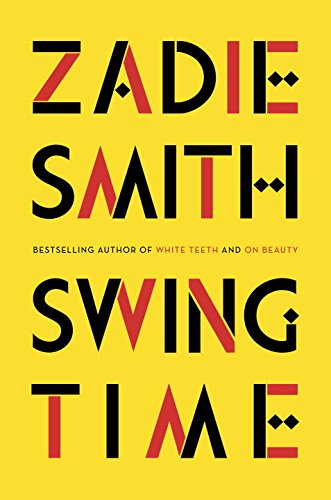
Swing Time Zadie Smith Penguin Press, 2016 464 pp., $27.00

Swing Time

Zadie Smith's best novel so far (and that's saying something).


When I was small, someone—maybe a librarian or maybe LeVar Burton—read me a story about an artist whose drawings came to life on their completion. The artist, though, wanted to keep his wild talent a secret. Which was, at first, easy. In drawing each picture, he simply left something out. He'd withhold a farmhand's Adam's apple, for instance, or rid a ship of an important cord in its rigging, and, sure enough, everything would keep still and two-dimensional. But then one day (of course) a bead of ink dropped from the artist's pen, landing in exactly the place where he had not drawn a bird's eye, and off the thing flew, blowing his cover.

I've long suspected Zadie Smith of possessing a similar magic.

And on reading her fifth novel, Swing Time, I'm sure she does. I'm sure, in other words, that it wouldn't take much more ink for the seven-year-old girls that appear on this book's first page—both brown, both British, and both in tap-shoes—to turn up incarnate in my living room. (Admittedly, it would be a long trip; Swing Time, like Smith's debut book, White Teeth, and her latest, NW, takes place in Kilburn and Willesden and their surrounds—in, that is, a working-class, immigrant-rich quadrant of London.)

As for these two girls, Tracey and the book's unnamed narrator, they throw in together thanks to a Saturday morning dance class. Apart from this shared activity, they are not likely friends. The only other circumstance in favor of their attachment is geographic proximity; the estates (read: lower-income housing complexes) in which they live sit kitty-corner. Much more works against their connection; they go to different grade schools and have mismatched dispositions.

Tracey is ringletted and foul-mouthed. She eats pink cereal for her tea (read: supper). She's a virtuoso of sass, of amelioration, of defensiveness. She slouches through school but is selectively keen. She can scan the choreography of a dance or the configuration of someone else's weaknesses without apparent effort—and can exploit such data, devastating rivals (and the occasional friend) and, yes, dancing. Exactly like the angel she is not.

Swing Time's narrator—flat-footed and enamored with the past, with Top Hatand Meet Me in St. Louis, with Bojangles and the Nicholas Brothers—cannot keep up. Not at Miss Isabel's middling dance school for girls and not in daring bad behavior. She has none of Tracey's imperviousness. On the contrary, everything sways her: songs, schoolyard fads, her mother's lectures, her father's shrugging, and whole species of silences. And Tracey, always Tracey.

Over the course of Swing Time, these two girls grow up and, fitfully, apart. By the time the novel ends, they are thirtysomethings. Tracey keeps her knack for mimicry and the narrator her bent for living vicariously, but both make compromises. Both, in fact, become compromised versions of their childhood selves, as I suppose we all do.

Swing Time's characterization, however, compromises nothing. I can imagine these grown women giving Smith's prose the slip and taking on flesh just as easily as I can imagine an incarnation for the asymmetric pair of girls with whom the book begins.

Yet here is an even more remarkable thing: it isn't just the two characters at the center of Swing Time that strike me as irreducibly themselves. It's also their parents. The narrator's mother, a woman prickly with aspiration, and her father, a kind sad sack, strike me as familiar yet unrepeatable. So does Tracey's mother, with her sloppy generosity, her sneer, her girlishness worse for the wear. And her volatile father, his long absences explained with an inspired lie (Tracey says he's one of Michael Jackson's backing dancers).

Likewise, the whole retinue of the narrator's eventual employer, the international pop sensation Aimee, hover very close to being itself, from crusty, trusty Judy to subtle, particular Lamin; from unsubtle Granger to leery, approachable Fern. And when a West African school teacher with "Disney-bright features" enters the narrative largely to give the narrator shelter in the village that Aimee has singled out for her patronage, even she cannot remain an extra. The lovely Hawa, too, comes across as ready to shake off her fictional existence in favor of the real thing.

Zadie Smith's dedicated readers, of course, will have already met, in her writing, characters who test the screen that separates art and life. I know because I am one of those readers. If you're not yet, let me point you to On Beauty's Kiki Belsey, who sweats and laughs more convincingly than some of my kin. Or toward Smith's short stories, toward Miss Adele (of "Miss Adele Amidst the Corsets"), and toward Fatou (of "The Embassy of Cambodia"). How easy it would be to mistake either of them, in memory, for folks who really did draw breath to waylay you with their stories.

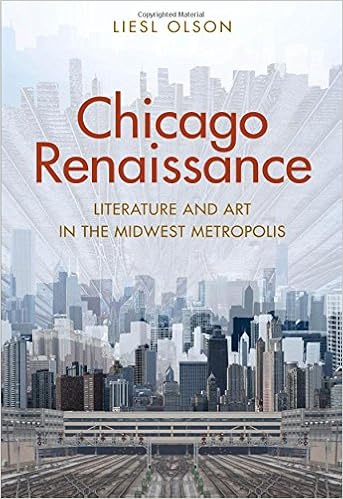
Chicago Renaissance: Literature and Art in the Midwest Metropolis by Liesl Olson. Yale University Press, 2017. Hardcover, 392 pages, $35. (IBR TravelBooks)


If you’ve ever wondered—and who hasn’t?—about what would happen if Mortimer Adler and Gertrude Stein met and talked about the concept of Great Books, then there is a scene in Chicago Renaissance for you. It occurred on November 27, 1934, in the Chicago home of Robert Hutchins who, along with Adler, had created and was developing the Great Books curriculum. Liesl Olson, director of Chicago Studies at the Newberry Library, writes:

According to Adler, Stein was “infuriated” by the idea that Great Books were read in translation: “She said that great literature was essentially untranslatable.” Adler describes how he and Hutchins “tried to argue with her, pointing out that we were concerned mainly with the ideas which were to be found in the Great Books. She might be right, we admitted, that fine writing suffers in translation, but ideas somehow transcended the particular language in which they were first expressed.” … Stein was stalwart and unconvinced. Hutchins then challenged Stein to teach their Great Books class the following week. As Stein writes: “I said of course I will and then Adler said something and I was standing next to him and violently telling him and everybody was excited and the maid came and said Madame the police. Adler went a little white and we all stopped and then burst out laughing.”

They could laugh because the police were there to take Stein and her partner, Alice B. Toklas, on a night tour of the city, the night, it so happened, when “Baby Face Nelson was shot and killed in the Chicago suburbs.”

This meeting between the conservative Hutchins and Adler, and the modernist lesbian Stein, is an representative example of a story, one of many “interlocking” ones, that recurs throughout this book. In it the forces of conservative capitalism keep meeting with, supporting, but also fighting with the liberal modernist movement in both painting and literature. What is amazing is that despite the genuine conflicts, so much gets done; the wealthy businessmen, seeking to earn status with their money, finance magazines such as Poetry, and Gertrude Stein teaches a Great Books course for Hutchins and Adler.

This book starts with Harriet Monroe, who published, with Ezra Pound’s prickly advice, the journal, Poetry, progresses through, among many others, Carl Sandburg, Sherwood Anderson, Ernest Hemingway, and Fanny Butcher (who ran a bookstore and also wrote many book reviews), and ends with a timely exploration of the work and lives of Richard Wright and Gwendolyn Brooks. Olson reminds the reader of how often the east coast has ignored the Second City, but how this allowed for a certain freedom “outside the supervisory eye of critics. This freedom meant that Chicago modernism became more expansive and varied than in other places. A twentieth-century Chicago Style was never just one thing.”


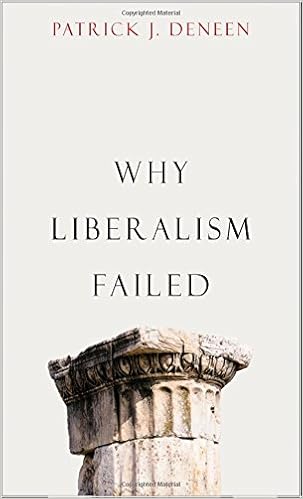
Why Liberalism Failed by Patrick Deneen. Yale University Press, 2018. Hardcover, 256 pages, $40.


Why Liberalism Failed is a timely and radical book. It is timely because it diagnoses the deep anxiety that now characterizes American life. It is radical—in the literal sense—because it seeks the cause in basic features of our political tradition. According to Deneen, liberalism has failed “not because it fell short, but because it was true to itself.” By pursuing freedom as the highest value of political and social life, liberalism made real freedom impossible.

More than any other nation, America is essentially liberal. The failure of liberalism thus implies that “we may be witnessing the end of the Republic unfolding before our eyes, with some yet-unnamed regime in the midst of taking its place.” Why Liberalism Failed, then, is not just an epitaph for a political theory. It is an elegy for a doomed society.

These features are likely to win the book deserved attention from readers who agree with Deneen that our increasingly ossified class structure, assertive bureaucracies, and pornographic media (what Deneen calls “anti-culture”) don’t look much like freedom. Not all these readers will recognize, however, that Why Liberalism Failed is a traditional book as well as a timely and a radical one. To be specific, it belongs to a genre that attributes profound social and political changes to arguments in philosophical treatises. Adapting a term from academic German, the late Richard Rorty described this genre as Geistesgeschichte: the history of mind or spirit.

Geistesgeschichte has had celebrated practitioners on the political left, including Theodor Adorno and other writers associated with the so-called Frankfurt school. In the English-speaking world, it is more closely associated with intellectuals who lean right. Leo Strauss and Alasdair Macintyre are among the recognized masters of Geistesgeschichte. Richard Weaver’s most famous work summarized its basic assumption: ideas have consequences.

The great merit of Geistesgeschichte is that it forces us to consider how the conditions under which we live are influenced by ideas of which we are only dimly aware. It is probably not the case, as John Maynard Keynes asserted, that “Practical men who believe themselves to be quite exempt from any intellectual influence, are usually the slaves of some defunct economist.” But it is true that the expectations and norms that guide our behavior are often proposed and refined by philosophers and theologians before they are ever put into practice. By tracing the development and reception of ideas, we can learn to understand better why we take some beliefs and institutions for granted and reject others as absurd.

The disadvantage of Geistesgeschichte is that it encourages the conclusion that, because ideas have consequences, they are the only things that matter. Yet history is just the unraveling of implications from given premises. When it is not practiced carefully, Geistesgeschichte becomes a “just so” story. In other words, it reaches back into the past to explain why things must be exactly as we find them today, without acknowledging non-intellectual factors, contingency, and just plain chance.


Deneen risks a kind of inverted Whig history that sees decline and corruption where liberals expected progress.

Why Liberalism Failed displays both the vices and the virtues of the genre to which it belongs. At its strongest, it demonstrates the interdependence of political positions that are widely regarded as opposed. At its least convincing, it suggests that the last five centuries have been governed by an ineluctable logic that leads from Thomas Hobbes to Anthony Kennedy. In his attempt to expose the errors of liberalism, Deneen risks a kind of inverted Whig history that sees decline and corruption where liberals expected progress.

Deneen’s core argument is that the appearance of bitter disagreement that characterizes American politics is illusory. Despite their opposition on comparatively trivial matters such as taxes, both progressives and conservatives are committed to the promotion of personal autonomy. Progressives believe that the greatest threat to autonomy lies in inequality, so they use government to level differences in economic and social resources. Conservatives believe that the state is the greater danger, so they oppose such direct coercion and prefer voluntary cooperation, especially through market exchange.

Adherents of both sides, however, assume that the purpose of politics is to secure the greatest possible space for individual choice. This fundamental agreement reflects the fact that progressive and conservative are adjectives. Their meaning is determined by the noun that they modify. In Deneen’s judgment, that noun is “liberal.” Conservative or “classical” liberals and “progressive” liberals share a “fundamental commitment to liberation of the individual” and to the use of human ingenuity, particularly as expressed in natural science, to achieve that liberation.

For Deneen, therefore, the relationship between the individual and the state is one of interdependence rather than opposition. As he puts it, “the liberal state serves not only the reactive function of umpire and protector of individual liberty; it also takes on an active role of ‘liberating’ individuals who, in the view of the state, are prevented from making wholly free choices as liberal agents.” Even markets, which classical liberals regard as spontaneously occurring, are the result of coercive intervention. Echoing Karl Polanyi, Deneen notes that in the eighteenth century, traditional modes of production had to be forcibly disrupted before the English were willing to treat labor and natural resources as commodities.

In addition to Polanyi, Deneen draws on Robert Nisbet, who depicted the fascism and communism of the twentieth century as a response to nineteenth-century liberalism. According to Nisbet, liberalism dissolved the local, trade, and religious associations around with medieval society was organized. Deprived of its traditional outlet, man’s natural inclination toward community and need for assistance from others sought a focus in the national or class-based state.


If liberalism is successful in providing a reasonable level of subsistence and avoiding outright tyranny, it is less successful in meeting our psychological needs.

Deneen acknowledges that liberalism is more successful in material and political terms than fascism or communism. For all its defects, “No other political philosophy has proven in practice that it could fuel prosperity, provide relative political stability, and foster individual liberty with such regularity and predictability.” But if liberalism is successful in providing a reasonable level of subsistence and avoiding outright tyranny, it is less successful in meeting our psychological needs. That is why the characteristic mood of a liberal society is what Alexis de Tocqueville called “restlessness”: a “strange melancholy” that arises when all opportunities are open to everyone, yet for that very reason the chances of success are infinitesimal.

“Restlessness” is a helpful way of describing the peculiar mix of panic and inertia that have been so widely reported in the wake of Trump’s election as president. Many Americans feel both that if they do not act swiftly and decisively that they will be excluded from important social goods, and that nothing they do makes any difference to their fate. And not only in their personal affairs. For the last decade, both progressive and conservative movements, Democratic and Republican administrations, have oscillated between manic activity and paralysis.

Deneen suggests that we have little prospect of escaping this condition so long as we are committed to liberal premises. The more we seek to exercise autonomous control over our lives, the more we subordinate ourselves to markets or to the state. The tragedy of American life, on this view, is not that it fails to deliver what it promises. It is that it gives us exactly what we demand.

Is this condition an inevitable consequence of a “political philosophy conceived some 500 years ago, and put into effect at the birth of the United States nearly 250 years later …”? In other words, is it primarily the result of ideas? Or a syndrome of developments that were encouraged and justified by philosophical arguments, but not produced by them? It is worth recalling that Tocqueville traced the “great democratic revolution” sweeping the West back to the admission of commoners to the priesthood and assertion by kings of a right to confer nobility. Neither of event was inspired primarily by changes in political philosophy.

Deneen, on the other hand, bases his argument on two propositions that are closer to Strauss than to Tocqueville. One is that books exercise a causal influence on society. A writer first pronounces some doctrine, in other words, and then it is put into effect. The other proposition is that liberalism is the product of a specific, relatively small set of books published between about 1550 and 1700. The founders of liberalism, on his account, were Bacon, Hobbes, and Locke.

There are number of difficulties involved with this position. Perhaps the most obvious is the fact, which Deneen openly admits, that neither Bacon nor Hobbes were liberals. Bacon articulated a vision of science as the liberation of man from natural limitation, while Hobbes derived political authority from the voluntary consent of free and rational individuals. Yet neither endorsed anything like the liberal vision of a constitutional government limited by juridical rights.


The framers were not scholars seeking to establish a doctrine, but statesmen trying to set up governments.

To identify liberalism with what Strauss called the “modern project,” it is necessary for Locke to be regarded as both Hobbes’s heir and the dominant influence on the American founding. Without venturing to review the enormous scholarly literature or reproducing a recent debate between Deneen and Robert Reilly on these questions, I can say that I do not find either claim fully convincing. Locke’s writings on religion show him to be, if not exactly an orthodox Christian, then considerably closer to contemporary Protestantism than Hobbes was. And whatever Locke’s private intention, it was these more conventional aspects of his doctrine that the founders of the Republic appropriated, often in combination with Greek, Roman, and common-law sources. The search for a coherent political philosophy of the founding seems to me a vain one. Although they were thoughtful and deeply read men, the framers were not scholars seeking to establish a doctrine, but statesmen trying to set up governments.

Moreover, the form that the American constitutions took—and their reciprocal influence on civil society—was not inevitable. As Tocqueville showed, the beliefs, goals, and strategies that the framers employed were less important in shaping American democracy than religious, economic, and social factors of which they were ignorant or dismissive, or that simply evaded their control. It may be true that the philosophical currents that Deneen traces back to Bacon were necessary conditions of the American founding. But they were neither sufficient nor determinative. To think so is the temptation of Geistesgeschichte.

That is not to deny that the idea of freedom plays a distinctive role in the American political tradition, which is accurately described as liberal in a broad sense. But I do not agree that it was based on a “political architecture that proposed transforming all aspects of human life to conform to a preconceived political plan.” Liberalism may have functioned that way in cases when it was imposed—generally unsuccessfully—on non-liberal societies. But its origins and the course of its development under the more favorable conditions in its countries of origins are the result of additional forces.


Compared to what is liberalism a failure? If we were to jettison liberalism what would replace it?

Yet these concerns are, at least to some extent, methodological and historiographical quibbles. The really important questions are much simpler. Compared to what is liberalism a failure? If we were to jettison liberalism what would replace it?

Because Deneen admits that liberalism has been more effective in every respect than its fascist and communist competitors, these questions are closely related. To make a just assessment, the failure of liberalism cannot mean only that it has not realized the most grandiose of promises of its most optimistic exponents (it has not), or that its benefits have come with heavy costs (they have). It must also be shown that it has been less successful than some alternative.

To meet this demand, Deneen gestures toward the possibility that new theories will emerge from practice. Like Rod Dreher, he has high hopes for intentional communities based on religious orthodoxy. By building interpersonal relationships, cultivating habits of duty and respect, and pursuing independence from the consumer economy on the local level, we may be able to recover a non-liberal form of subjectivity. Only on that basis could a postliberal theory be constructed.

At the same time, though, we should not expect that postliberal theory will answer the same questions as liberalism—at least not in the same systematic way. Deneen is probably right that the demand for an ideological replacement for liberalism is not only distinctively modern, but actually part of the problem. In seeking out a course beyond liberalism, we may find ourselves in a position that more closely resembles that of the ancients, who did not possess—and did not generally seek—a comprehensive political and moral doctrine. In this respect, he sounds a bit like the late Peter Lawler, whose “postmodern conservatism” meant a premodern acknowledgement of the limits of philosophy.

Even under postliberal or postmodern conditions, however, we would still need some notion of how government ought to be set up and how society should. I know of no better model than one that involves constitutional limits on state power, uses elections to give citizens some say over the laws under which they live, protects private property, and values the freedom of individuals to choose associations to which they will or will not belong. Deneen could rightly argue that all of these institutions have premodern origins and can be justified on very different grounds than those he criticizes in this book. Like Macaulay, Tocqueville, Gladstone, Acton, Aron, or Niebuhr, though, I know no better name for them than … liberalism.

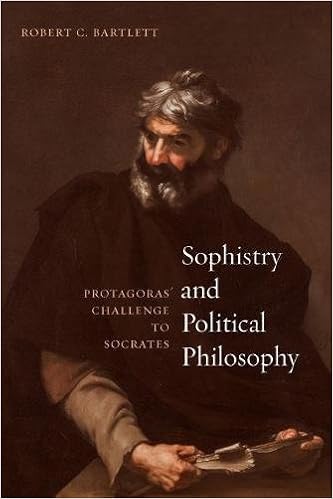
Sophistry and Political Philosophy: Protagoras’ Challenge to Socrates by Robert C. Bartlett. University of Chicago Press, 2016. Hardcover, 272 pages, $40.


One should be silent where one cannot speak, philosophy says, yet sophistry somehow keeps talking. Ancient philosophers respect limits to finding authoritative definitions to the nature of things, but ancient sophists go ahead because names vary as conventions. While one finds reverent silence, the other teaches for cash and power. Socrates ends like he begins, as perplexed, while Protagoras gives speeches. However, these spirits, Robert Bartlett writes, are kindred: sophistry attended the ancient birth and modern senescence of political philosophy. In Plato’s dialogues, veteran Protagoras encounters young Socrates. But unlike prior sophists, Protagoras openly charges to teach rich sons rhetoric. And unlike prior philosophers, Socrates’ examinations “turned” from nature to human nature. And as Protagoras was catalyst to Socrates’ dialectic, sophistry was midwife to philosophy’s becoming.

Both chronicling past claims and forwarding political agendas ignore truth.

Ancient sophistry’s purported obituary was written by its enemy, philosophy, but Plato’s report of its death was an exaggeration. Sophistry has arisen again in a more modern form. Academically, histories of political thought and identity narratives supplant the practices of political philosophy, Bartlett observes. Both chronicling past claims and forwarding political agendas ignore truth. Some return to basics, then, by understanding ancient sophistry, may enable modern souls to “turn” towards political philosophy. Bartlett is experienced for this venture: a chaired Boston College professor of political science, a specialist in Hellenic thought, as well as a co-translator of Aristotle’s Ethics. In this commentary, he admirably shows the game Socrates and Protagoras play by imagining a world without natural justice, but he understates the lessons for us moderns today, stuck with sophistry new and improved.

“Our contemporary way of thinking,” writes Bartlett, citing Nietzsche, is “Heraclitean, Democritean, and Protagorean”—as “Protagoras represented a synthesis of Heraclitus and Democritus” in divining that “reasons for morality are necessarily sophistical.” Heraclitus famously says, “one never steps into the same river twice.” Democritus posits that “The first principles of the universe are atoms and empty space; everything else is merely thought to exist.” In their combined vision of unstable materialism, speech loses reason. Sophists emulate this pre-Socratic denial of perennial and intelligible reality in their instruction of the few to flatter the many. Man becomes the measure, not the measurer, of everything. Yet, Protagoras indirectly aides Socrates, as they converse directly in Protagorasand indirectly in Theaetetus. Protagoras’ skepticism of natural justice is a challenge Socrates invites but rebuffs.

In Protagoras, Socrates joins a party hosting Protagoras and some of the usual suspects in Plato. Sophists since Homer disguised their teachings, Protagoras proclaims, but he teaches explicitly. Tempted, Socrates asks, what subject is taught? Political virtue, Protagoras answers. They then debate what constitutes virtue, specifically courage, the first political virtue. Protagoras gives a myth of human origins: our politics extends not from ethics, but from noble lies resolving a Hobbesian dilemma underneath a sky of godly indifference. Men live against men without divine beneficence. Socrates shows what thus entails from this vision.


Below knowledge of virtue lies the nature of knowledge and knowledge of nature.

From debates on definitions to sayings of poets, through questions of goodness and nobility, Socrates makes Protagoras’ skepticism conflict with his person. Objecting to all virtues being united by wisdom, Protagoras separates courage from justice, and justice from wisdom. But Socrates reveals the consequence: courage loses noble self-sacrifice, since, in Protagoras’ system, soldiers only follow individual self-interest. At this vision, Protagoras shudders, for he secretly admires the beauty of the brave. By Socrates holding an ironic mirror to Protagoras, his myth contradicts his intuitions. This political terrain has metaphysical subterranean: below knowledge of virtue lies the nature of knowledge and knowledge of nature. Metaphysical skeptics cannot intellectually affirm human goodness. Plato thus shows Socrates returning to explore the philosophical foundations of Protagoras in Theaetetus.

When Socrates asks what knowledge is, Theaetetus answers “perception.” Old Socrates, in his last year, shall soon unjustly die. Protagoras, now dead, subsists as an imaginary interlocutor in Socrates’ discussion with his mathematician host, Theodorus, and the soldier, Theaetetus. Socrates concludes from being’s instability (Heraclitus), atomism (Democritus), and knowledge-as-perception (Theaetetus), with Protagoras’ dictum: “man is the measure of all things.” These premises of Heraclitus, Democritus, and Theaetetus underlie Protagoras’ public and private teachings.

Protagoras, Socrates relays, publicly taught that external objects are accessed insofar as perceived, but privately taught all knowledge is individual perception of matter-in-motion. Truth becomes personal preference. Socrates’ response is twofold: because lower beasts also perceive objects, privileging man-as-measure is unwarranted; and further, such subjectivism prohibits shared inquiry. While Protagoras ironically demands justice for a better defense of his argument, the final objection is that his doctrine could not be true for anyone, including for his own book entitled Truth. Eventually Socrates dismisses the imaginary Protagoras to explore the war between the camps of Heraclitus and Parmenides, the lives of philosophers versus practical men, followed by more hypotheses on definitions of knowledge. Bartlett, however, largely focuses on the early sections with Protagoras.

The public relativism of Protagoras’ dictum relates to men-as-particular-beings, Bartlett suggests, while the private relativism relates to man-as-man. “Protagoras’ assertion,” he writes, citing Hegel, means “all is self-seeking, all self-interest, the subject with his interests forms the central point; and if man has a rational side, reason is still something subjective, it is ‘he.’” This Protagorean “enlightenment” publicly means all moral and political life is collective self-interest, and privately that claims to right are, per Nietzsche, “necessarily sophistical.” Notably, modern sophistry slightly alters these teachings.

For ancient relativists, Bartlett comments, morality as custom and justice varies, while goodness remains constant, if ungraspable. Today, morality as rights is absolute but the good life varies, as all ways of life look equal to us. While ancient pagans distinguished law (nomos) from nature (physis), biblical medievals and early moderns thought natural law and the law of nature denotate rights and duties. Now, modern sophistry swaps law and nature, but perceivers have hope. Socrates tied courage to wisdom. Isn’t it virtuous, Bartlett asks, to see the world as-it-is, come what may? When circumstances and appetites alter, human understanding needs steadiness. Intellectual courage becomes necessary for wisdom to become possible. Here, Bartlett implies ancient sophistry was midwife for a philosophical birth: skepticism of moral convention enables the study of natural justice. In Socrates’ laboratory, the soul questions conventional definitions, enters into perplexity (aporia), and then studies our place in nature. After finding inherited answers inadequate, we resist sophistry by courageously measuring nature. “Discovery of nature”—Bartlett quotes Leo Strauss—“is the work of philosophy.”

Bartlett’s overture to his textual commentary begins with crescendos—modern sophistry has supplanted political philosophy—but ends with whispers on how to ameliorate modern sophistry. Readers remain insufficiently enlightened on that note. Supposedly, political philosophy declined because moderns became Protagorean. Beyond pure self-interest, claims to the good life are subjective. What then? Bartlett seems to suggest intellectual heroism and contemplating nature are sufficient for political philosophy to overcome relativism after we disbelieve modern lies. However, since both of Socrates’ responses to Protagoras are incomplete, Bartlett makes several brief gestures to Meno.


For Bartlett, countering Protagoras means wagering that being is amenable to reason.

In that dialogue, Socrates notes how Greece ignored for decades Protagoras’ morally corrupting young men—a charge later repeated against Socrates. He also rejects skepticism as cowardly: inquirers become “better men, braver and less idle,” Socrates wagers that in believing “one must search for the things one does not know.” Thus far, courage preconditions political philosophy. But how is virtue taught? We learn by “recollection,” Socrates answers, citing doctrines he heard from priests and poets. This “myth” is suggestive. For Bartlett, countering Protagoras means wagering that being is amenable to reason. But his Socrates does not intimate whether intellectual courage is sufficient to intimate the good. Here, two approaches diverge.

One thus may take ironically or seriously Socrates’ digression to Theodorus: just and pious men escape evils on earth by becoming like God and following one pattern of reality, which is divine and supremely happy, rather than another pattern, being without God and supremely unhappy (176a–177c).

The first approach believes Socrates was truly guilty in denying Athenian gods and divinity as such. Thus, when Strauss emphasizes the need to conceptually restore “nature,” he also liberates Plato from Nietzsche’s charge of being “a metaphysician.” This approach, Thomas Pangle notes, “is extremely skeptical” of Socrates’ many explicit teachings, such as of the Good in The Republic. Here, Socrates is close kin to Protagoras. The question of knowledge is a quest for sufficient knowledge, Bartlett emphasizes, to live freely from claims of the “seers.”

Both sophistry and philosophy arrive at the ends of language—what “courage” and “knowledge” signify. Their speech (logos) becomes story (mythos) in creating worlds. Against ancient sophistry, Socrates made philosophy the study of human things by seeking a nature of things. Sophistry is rhetoric when our names for things decay, as philosophy asks what those names mean. Yet to grasp their meanings, Socrates often lapses into ironic perplexity and waxes into fables. Here, to surpass sophistry, philosophy takes more than courage.

In the second approach, Socrates is rewriting myths to point to a more metaphysical reality that liberates the soul. In Phaedo,Socrates says philosophy is practicing death and dying—which his martyrdom embodies. His turn from natural philosophy was partly towards divinity. Lecturing on Plato’s Cave, Simone Weil notes that those unable “to understand the unchanging patterns of things” suffer not from “lack of intelligence” but “moral stamina.” Heroic intellectual virtue is necessary, yet, she says, “Plato’s wisdom” is “the turning of the soul towards grace.” Philosophy as a figurative death means souls turn from inherited mortal patterns of life to divine ones, as one commentator describes. Being born again means learning how to die. Thus, as regimes change like cave shadows, courage is necessary for cave dwellers to see beyond the shadows, but one still waits to be freed by other beings to see the sunlight. Bartlett emphasizes the turn Socrates makes, but maybe there is more to this natural turn.

Another difficulty concerns modern sophistry: its fangs are sharper than what a turning to ancient thought conceived naturalistically might ably handle. The ancients knew about misleading speech: Virgil, with his imperial imagination, calls “Rumor” a winged-beast with as many eyes, ears, and tongues as feathers. Yet his Aeneas and Dido face actual rulers and ancestral gods, not public opinion, which is the political bent of modern sophistry. “‘They Say,’ is the monarch of this country,” James Fenimore Cooper declares. “No one asks ‘who says it,’ so long as it is believed that ‘they say it.’” This form of democratic modern sophistry the ancients might not have fully appreciated. From Alexis de Tocqueville’s warning of public opinion among equals that replaces “the authority of names” to George Orwell’s critique of political language, a long tradition of critics note how thought leaders and propagandists alter meanings to flatter what they say the many want to hear. Modern sophistry has deep roots.


To restore the practice of political philosophy means dealing with modern sophistry, and that effort takes more than recovering nature in the Straussian fashion.

Now speech restriction and language degeneration converge in new authoritative names. With reason did comedian George Carlin complainthat political correctness looks like “tolerance” but is “fascism pretending to be manners,” for this political edifice, like its ancient predecessor, has theoretical roots. In the “contemporary proliferation of bullshit,” philosopher Harry Frankfurt notes, “skepticism” of “any reliable access to an objective reality” leads one to “reject the possibility of knowing how things truly are.” A few persons have the moral stamina to see beyond the shadows of mannered fascism enabled by philosophical skepticism. But to restore the practice of political philosophy means dealing with modern sophistry, and that effort takes more than recovering nature in the Straussian fashion. But rectifying names is a longstanding problem.

Like Socrates, one man of the Axial age died an apparent failure as a philosopher aiding princes. But his followers collected his encounters into writings that aided future civilization. Out of reverence, Confucius took nature seriously by keeping silent on divinity and afterlife. “Whereupon a gentleman is incompetent, thereupon he should remain silent,” he says. Like Socratic aporia, his silence affirms the natura rerum. Words appear inadequate as conventional categories, yet degenerating names shows disconnect to reality. Politics needs metaphysics, for “rectifying names,” he says, preconditions political governance: without names matching realities, language becomes objectless, action impossible, and political management pointless. Language attunes to nature. When villager wiseguys of dishonorable behavior took titles without right, Confucius decried these sophists as “false gentlemen.” Notably, “gentleman” (junzi) also translates as “exemplary person.” Confucius injected new meaning into words: junzi no longer meant power gained by acquisition but virtue gained by wisdom. He innovated. Rectifying names means looking to the permanent things in new ways.

Sophistry enabled political philosophy with a dialectic to answer doubts sophists posed. But in his reply to the challenge of sophistry, Socrates points upward. Philosophy begins close to sophistry, but ends perhaps closer to an inspired, more chastened, poetry. Though politically quietist, Protagoras eroded political order because his refusal to speak on piety meant impiety. Socrates was likewise charged. Who really deserved it, Bartlett shows, although more is left unsaid.

The Vision of the Soul: Truth, Goodness, and Beauty in the Western Tradition by James Matthew Wilson. The Catholic University of America Press, 2017. Paperback, 352 pages, $30.


Despite hitting a few bumps, poet James Matthew Wilson’s The Vision of the Soul delivers a stirring and timely account and defense of the West’s traditional way of understanding the universe and our place in it.

For Wilson, the Western tradition is the Christian Platonist one, in which the two basic facts about existence are that the universe is ordered and that its order is intelligible to the human mind. These two facts are augmented by Christian belief in a personal God who loves us unconditionally and desires that we love him. This tradition, argues Wilson, has been overshadowed by the Enlightenment and the philosophies descended from it. The problem with the Enlightenment is that while it begins as an attempt to understand the universe, it has devolved into a crude materialism that denies objective reality. However, writers such as Edmund Burke and T. S. Eliot preserved this culture, despite the dominance of liberalism.

In fact, Wilson maintains that liberalism can never be an actual culture because “it has no positive content, its goods being mere negations,” and so tends towards repetition and indifference. He says that liberal culture is moribund because its only goods are choice and equality, rendering quality and content irrelevant. The only thing that can be done is to transgress the established norms, but eventually there’s nothing left to transgress, only subjective tastes.


“Fine art takes on a new importance … because it attunes us, awakens and habituates us, to the perception of the ordered whole of reality.”

The discussion of the French philosopher Jacques Maritain and Thomist aesthetics is the core of the book. “Only in the Christian Platonist tradition … do we see beauty take on its full existential dimension, as a reality given to the senses, as drawing the mind to the perception of being and truth, and finally to a vision of beauty as the ordering principle of reality as a whole,” Wilson writes. “Fine art takes on a new importance … because it attunes us, awakens and habituates us, to the perception of the ordered whole of reality.” The Christian Platonist tradition Wilson writes of is not a specific intellectual position, but a more general perspective on the unique insights of the West. He describes its basic propositions as “bounding the map of reality” and so forming a “synthetic but readily unified tradition” that encompasses Plato of course, but also Aristotle and Aquinas.

The association of beauty, truth, goodness, and the ordering of reality is a key theme of the book and of the Western tradition itself. Wilson reiterates throughout that the world is ordered by and to beauty. The work of Maritain that Wilson discusses includes an exploration of the concept of ordered reality. Maritain argued that art was a virtue, one subordinated to higher virtues while subordinating lower virtues under it. “Maritain thus aligns art properly understood with a society ordered to dignified work … Man does not reduce himself to a beast of animal impulses to engage in ‘creative’ work, shedding his reason like so many mind-forged manacles.” And “Maritain’s theory of art insists upon the humility of even the fine arts as work; the artist, in bringing a new beauty into the world, does so by way of selfless imitation of the hitherto unseen.”

Because beauty is an existential dimension of human experience—that is, beauty reflects and helps explain reality—aesthetics can help us understand it. Maritain helped recover Thomistic aesthetics and Wilson draws on his work to explore three properties of beauty from the Summa Theologica: proportio, integritas, and claritas. This is the most important section of the book, because these ideas are fundamental to the Western understanding of beauty.

Proportio and integritas are very well explained. “Maritain rightly understands integrity as wholeness, the completion of a thing according to its nature” and “Aquinas most obviously intends by [proportio] … the relation of distinct beings and their formal elements relative to one another.” For instance, in a Shakespearean sonnet, the integritas in a specimen is that it has fourteen lines, twelve of which are cross-rhymed with the last two a rhyming couplet. The proportio is that the rhymes are good, the meter is followed and consistent, as well as other relational properties.

Claritas is more abstract and difficult. “When we perceive the clarity or splendor of a thing, we remark above all that its existence is intended, that the fact of its existence testifies not to the reality of a universal essence on which it is based, but on the mediated revelation of a divine mind whose knowledge is causative of being.” Maritain’s definition is not entirely correct, according to Wilson, so he brings in Umberto Eco, who defined claritas as the intelligibility of a form. “Whereas Maritain absorbed proportion into clarity as its mere handmaid, Eco insists that clarity is a secondary or phenomenal attribute of proportion,” but the possible proportions of any one thing are a virtually infinite “dense network of relations.” But this isn’t the final definition of claritas; instead Wilson offers a synthesis of Maritain and Eco, where claritas remains ethereal but is understood through proportion. “The path from a being’s individuality and interior wholeness (integrity) to its fullest realization as an intelligible radiance reflecting and participating in the light of the divine intellect (clarity) is one that proceeds on a proportioned path from proportion to proportion.”


The key to understanding claritas is appreciating the universal, intelligible order of the world.

Ultimately, according to Wilson, the key to understanding claritas is appreciating the universal, intelligible order of the world. Beauty is a transcendental property of the universe, like truth and goodness, and claritas is our perception of that order through proportion. “Beauty may well strike the vision of the eye and of the soul with its initial, isolated singularity in this or that particular form, but that initial seeing is but the opening of the soul to a comprehensive vision of all things, the whole of reality in its formal intelligibility.” In treating this topic, however, Wilson’s narrative sometimes collapses under the weight of its own abstraction. He uses synonyms like “shining,” “radiance,” and “splendor” to describe claritas, but switching them out does not help to shed any light on the subject. An example would have been a valuable way to illustrate the concepts. Such examples would be especially helpful in a culture buried in images and cultural products that do not recognize the importance of any of these elements.

From this climax, Wilson concludes the book with a few chapters meditating on the uses and nature of stories, building on beauty to truth because “Proportion is to beauty what reasoning is to truth. Beauty and truth are both perceptible in terms of different types of ratio. When perfected, such measures converge in intellectual vision, the vision of the soul, perceptive of form and splendor, of truth and being illuminated as beautiful” and stories and story-telling help people discover who they are and what they believe about themselves, as well being a method of reasoning in and of themselves.


The attempt to extirpate the need for story from human life has not only resulted in the isolation of modern life, but in the organization of society around power.

According to Wilson, stories and abstract reasoning have been split from one another, but should be seen as complementary. “When we reason, we reason about stories—when we reason, we reason in stories; when we examine the life of the intellect, we find it is a biography, a life-story.” People need stories to relate to each other, to examine the good life, and to remember the important things. Liberalism, at least in its more “rationalistic” forms, rejects the importance of story and narrative. The attempt to extirpate the need for story from human life has not only resulted in the isolation of modern life, but in the organization of society around power. As Tolkien understood, the drive to dominate existence ultimately diminishes the would-be dominator. We reduce everything to the single criterion of utility because the power we’ve amassed has no end other than itself.

The true achievement of Wilson’s book is not a didactic exploration of aesthetics, but in awakening a perception of humility by providing a vantage point where we can see the order of the universe and our place in it. Moreover, because he strips us of the illusion that we ourselves order the universe, Wilson allows us to see with fresh eyes the existence of things outside ourselves, with their own stories and as valuable in and of themselves, not just as something to consume. This perception inspires gratitude in addition to humility, unlocking the iron cage and allowing us to see the world as enchanted—and it is wonderful.

It is ironic that a movement calling itself the “Enlightenment” rejected the claritas, the splendor, of a universe ordered by and to beauty in favor of a dark one where any order we perceive is imposed by the human mind deluding itself into seeing patterns in randomness. But perhaps they are right. In that case, Wilson and the Western tradition would still offer a far better way of making art, of organizing society, and of being human. As Alma Deutscher says, “If the world is so ugly, then what’s the point of making it even uglier?”

The book is not always easy going. The prose is often dense, and sometimes concepts are introduced that are not fully integrated into the overall argument. For instance, Wilson discusses the work of Theodor Adorno of the Frankfurt School of philosophy, but does not fully engage Adorno with such thinkers as Aquinas. Overall, however, the defense of the West that Wilson presents in The Vision of the Soul rewards spiritually, as well as intellectually.

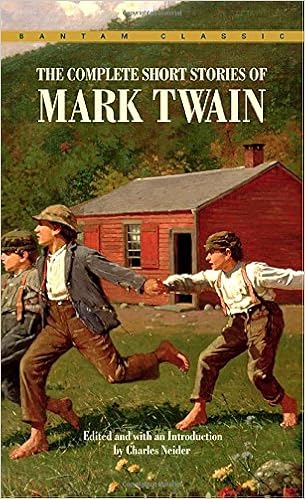
Complete Short Stories of Mark Twain (Bantam Classics) Mass Market Paperback by Mark Twain ( Bantam Books) ( IBRClassicReviews )


For deft plotting, riotous inventiveness, unforgettable characters, and language that brilliantly captures the lively rhythms of American speech, no American writer comes close to Mark Twain. This sparkling anthology covers the entire span of Twain’s inimitable yarn-spinning, from his early broad comedy to the biting satire of his later years.

Every one of his sixty stories is here: ranging from the frontier humor of “The Celebrated Jumping Frog of Calaveras County,” to the bitter vision of humankind in “The Man That Corrupted Hadleyburg,” to the delightful hilarity of “Is He Living or Is He Dead?” Surging with Twain’s ebullient wit and penetrating insight into the follies of human nature, this volume is a vibrant summation of the career of–in the words of H. L. Mencken–“the father of our national literature.”

Mark Twain was born Samuel Langhorne Clemens in 1835. He gained national attention as a humorist in 1865 with the publication of "The Celebrated Jumping Frog of Calaveras County," but was acknowledged as a great writer by the literary establishment with The Adventures Of Huckleberry Finn (1885). In 1880, Twain began promoting and financing the ill-fated Paige typesetter, an invention designed to make the printing process fully automatic. At the height of his naively optimistic involvement in the technological "wonder" that nearly drove him to bankruptcy, he published his satire, A Connecticut Yankee in King Arthur's Court (1889). Plagued by personal tragedy and financial failure, Mark Twain spent the last years of his life in gloom and exasperation, writing fables about "the damned human race."

THE NOTORIOUS JUMPING FROG OF CALAVERAS COUNTY
Excerpt. © Reprinted by permission. All rights reserved.


In compliance with the request of a friend of mine, who wrote me from the East, I called on good-natured, garrulous old Simon Wheeler, and inquired after my friend's friend, Leonidas W. Smiley, as requested to do, and I hereunto append the result. I have a lurking suspicion that Leonidas W. Smiley is a myth; that my friend never knew such a personage; and that he only conjectured that if I asked old Wheeler about him, it would remind him of his infamous Jim Smiley, and he would go to work and bore me to death with some exasperating reminiscence of him as long and as tedious as it should be useless to me. If that was the design, it succeeded.

I found Simon Wheeler dozing comfortably by the barroom stove of the dilapidated tavern in the decayed mining camp of Angel's, and I noticed that he was fat and baldheaded, and had an expression of winning gentleness and simplicity upon his tranquil countenance. He roused up, and gave me good day. I told him that a friend of mine had commissioned me to make some inquiries about a cherished companion of his boyhood named Leonidas W. Smiley--Rev. Leonidas W. Smiley, a young minister of the Gospel, who he had heard was at one time a resident of Angel's Camp. I added that if Mr. Wheeler could teStll me anything about this Rev. Leonidas W. Smiley, I would feel under many obligations to him.

Simon Wheeler backed me into a corner and blockaded me there with his chair, and then sat down and reeled off the monotonous narrative which follows this paragraph. He never smiled, he never frowned, he never changed his voice from the gentle-flowing key to which he tuned his initial sentence, he never betrayed the slightest suspicion of enthusiasm; but all through the interminable narrative there ran a vein of impressive earnestness and sincerity, which showed me plainly that, so far from his imagining that there was anything ridiculous or funny about his story, he regarded it as a really important matter, and admired its two heroes as men of transcendent genius in finesse. I let him go on in his own way, and never interrupted him once.

"Rev. Leonidas W. H'm, Reverend Le--well, there was a feller here once by the name of Jim Smiley, in the winter of '49--or maybe it was the spring of '50--I don't recollect exactly, somehow, though what makes me think it was one or the other is because I remember the big flume warn't finished when he first come to the camp; but anyway, he was the curiousest man about always betting on anything that turned up you ever see, if he could get anybody to bet on the other side; and if he couldn't he'd change sides. Any way that suited the other man would suit him--any way just so's he got a bet, he was satisfied. But still he was lucky, uncommon lucky; he most always come out winner. He was always ready and laying for a chance; there couldn't be no solit'ry thing mentioned but that feller'd offer to bet on it, and take ary side you please, as I was just telling you. If there was a horse-race, you'd find him flush or you'd find him busted at the end of it; if there was a dog-fight, he'd bet on it; if there was a cat-fight, he'd bet on it; if there was a chicken-fight, he'd bet on it; why, if there was two birds setting on a fence, he would bet you which one would fly first; or if there was a camp-meeting, he would be there reg'lar to bet on Parson Walker, which he judged to be the best exhorter about here, and so he was too, and a good man. If he even see a straddle-bug start to go anywheres, he would bet you how long it would take him to get to--to wherever he was going to, and if you took him up, he would foller that straddle-bug to Mexico but what he would find out where he was bound for and how long he was on the road. Lots of the boys here has seen that Smiley, and can tell you about him. Why, it never made no difference to him--he'd bet on any thing--the dangdest feller. Parson Walker's wife laid very sick once, for a good while, and it seemed as if they warn't going to save her; but one morning he come in, and Smiley up and asked him how she was, and he said she was considerable better--thank the Lord for his inf'nite mercy--and coming on so smart that with the blessing of Prov'dence she'd get well yet; and Smiley, before he thought, says, 'Well, I'll resk two-and-a-half she don't anyway.'

"Thish-yer Smiley had a mare--the boys called her the fifteen-minute nag, but that was only in fun, you know, because of course she was faster than that--and he used to win money on that horse, for all she was so slow and always had the asthma, or the distemper, or the consumption, or something of that kind. They used to give her two or three hundred yards' start, and then pass her under way; but always at the fag end of the race she'd get excited and desperate like, and come cavorting and straddling up, and scattering her legs around limber, sometimes in the air, and sometimes out to one side among the fences, and kicking up m-o-r-e dust and raising m-o-r-e racket with her coughing and sneezing and blowing her nose--and always fetch up at the stand just about a neck ahead, as near as you could cipher it down.

"And he had a little small bull-pup, that to look at him you'd think he warn't worth a cent but to set around and look ornery and lay for a chance to steal something. But as soon as money was up on him he was a different dog; his under-jaw'd begin to stick out like the fo'castle of a steamboat, and his teeth would uncover and shine like the furnaces. And a dog might tackle him and bully-rag him, and bite him, and throw him over his shoulder two or three times, and Andrew Jackson--which was the name of the pup--Andrew Jackson would never let on but what he was satisfied, and hadn't expected nothing else--and the bets being doubled and doubled on the other side all the time, till the money was all up; and then all of a sudden he would grab that other dog jest by the j'int of his hind leg and freeze to it--not chaw, you understand, but only just grip and hang on till they throwed up the sponge, if it was a year. Smiley always come out winner on that pup, till he harnessed a dog once that didn't have no hind legs, because they'd been sawed off in a circular saw, and when the thing had gone along far enough, and the money was all up, and he come to make a snatch for his pet holt, he see in a minute how he'd been imposed on, and how the other dog had him in the door, so to speak, and he 'peared surprised, and then he looked sorter discouraged-like, and didn't try no more to win the fight, and so he got shucked out bad. He give Smiley a look, as much as to say his heart was broke, and it was his fault, for putting up a dog that hadn't no hind legs for him to take holt of, which was his main dependence in a fight, and then he limped off a piece and laid down and died. It was a good pup, was that Andrew Jackson, and would have made a name for hisself if he'd lived, for the stuff was in him and he had genius--I know it, because he hadn't no opportunities to speak of, and it don't stand to reason that a dog could make such a fight as he could under them circumstances if he hadn't no talent. It always makes me feel sorry when I think of that last fight of his'n, and the way it turned out.

"Well, thish-yer Smiley had rat-tarriers, and chicken cocks, and tomcats and all them kind of things, till you couldn't rest, and you couldn't fetch nothing for him to bet on but he'd match you. He ketched a frog one day, and took him home, and said he cal'lated to educate him; and so he never done nothing for three months but set in his back yard and learn that frog to jump. And you bet you he did learn him, too. He'd give him a little punch behind, and the next minute you'd see that frog whirling in the air like a doughnut--see him turn one summerset, or maybe a couple, if he got a good start, and come down flat-footed and all right, like a cat. He got him up so in the matter of ketching flies, and kep' him in practice so constant, that he'd nail a fly every time as fur as he could see him. Smiley said all a frog wanted was education, and he could do 'most anything--and I believe him. Why, I've seen him set Dan'l Webster down here on this floor--Dan'l Webster was the name of the frog--and sing out, 'Flies, Dan'l, flies!' and quicker'n you could wink he'd spring straight up and snake a fly off'n the counter there, and flop down on the floor ag'in as solid as a gob of mud, and fall to scratching the side of his head with his hind foot as indifferent as if he hadn't no idea he'd been doin' any more'n any frog might do. You never see a frog so modest and straightfor'ard as he was, for all he was so gifted. And when it come to fair and square jumping on a dead level, he could get over more ground at one straddle than any animal of his breed you ever see. Jumping on a dead level was his strong suit, you understand; and when it come to that, Smiley would ante up money on him as long as he had a red. Smiley was monstrous proud of his frog, and well he might be, for fellers that had traveled and been everywheres all said he laid over any frog that ever they see.

"Well, Smiley kep' the beast in a little lattice box, and he used to fetch him down-town sometimes and lay for a bet. One day a feller--a stranger in the camp, he was--come acrost him with his box, and says:

" 'What might it be that you've got in the box?'

"And Smiley says, sorter indifferent-like, 'It might be a parrot, or it might be a canary, maybe, but it ain't--it's only just a frog.'

"And the feller took it, and looked at it careful, and turned it round this way and that, and says, 'H'm--so 'tis. Well, what's he good for?'

" 'Well,' Smiley says, easy and careless, 'he's good enough for one thing, I should judge--he can outjump any frog in Calaveras County.'

"The feller took the box again, and took another long, particular look, and give it back to Smiley, and says, very deliberate, 'Well,' he says, 'I don't see no p'ints about that frog that's any better'n any other frog.'

" 'Maybe you don't,' Smiley says. 'Maybe you understand frogs and maybe you don't understand 'em; maybe you've had experience, and maybe you ain't only a amature, as it were. Anyways, I've got my opinion, and I'll resk forty dollars that he can outjump any frog in Calaveras County.'

"And the feller studied a minute, and then says, kinder sad-like, 'Well, I'm only a stranger here, and I ain't got no frog; but if I had a frog, I'd bet you.'

"And then Smiley says, 'That's all right--that's all right--if you'll hold my box a minute, I'll go and get you a frog.' And so the feller took the box, and put up his forty dollars along with Smiley's, and set down to wait.

"So he set there a good while thinking and thinking to himself, and then he got the frog out and prized his mouth open and took a teaspoon and filled him full of quail-shot--filled him pretty near up to his chin--and set him on the floor. Smiley he went to the swamp and slopped around in the mud for a long time, and finally he ketched a frog, and fetched him in, and give him to this feller, and says:

" 'Now, if you're ready, set him alongside of Dan'l, with his fore paws just even with Dan'l's, and I'll give the word.' Then he says, 'One--two--three--git!' and him and the feller touched up the frogs from behind, and the new frog hopped off lively, but Dan'l give a heave, and hysted up his shoulders--so--like a Frenchman, but it warn't no use--he couldn't budge; he was planted as solid as a church, and he couldn't no more stir than if he was anchored out. Smiley was a good deal surprised, and he was disgusted too, but he didn't have no idea what the matter was, of course.

"The feller took the money and started away; and when he was going out at the door, he sorter jerked his thumb over his shoulder--so--at Dan'l, and says again, very deliberate, 'Well,' he says, 'I don't see no p'ints about that frog that's any better'n any other frog.'

"Smiley he stood scratching his head and looking down at Dan'l a long time, and at last he says, 'I do wonder what in the nation that frog throw'd off for--I wonder if there ain't something the matter with him--he 'pears to look mighty baggy, somehow.' And he ketched Dan'l by the nap of the neck, and hefted him, and says, 'Why blame my cats if he don't weigh five pound!' and turned him upside down and he belched out a double handful of shot. And then he see how it was, and he was the maddest man--he set the frog down and took out after the feller, but he never ketched him. And--"

[Here Simon Wheeler heard his name called from the front yard, and got up to see what was wanted.] And turning to me as he moved away, he said: "Just set where you are, stranger, and rest easy--I ain't going to be gone a second."

But, by your leave, I did not think that a continuation of the history of the enterprising vagabond Jim Smiley would be likely to afford me much information concerning the Rev. Leonidas W. Smiley, and so I started away.

At the door I met the sociable Wheeler returning, and he buttonholed me and recommenced:

"Well, thish-yer Smiley had a yaller one-eyed cow that didn't have no tail, only just a short stump like a bannanner, and--"