Jews Praying In The Synagogue on the Day of Atonement by Maurycy Gottlieb (Tel Aviv Museum of Art)
The Israel Book Review has been edited by Stephen Darori since 1985. It actively promotes English Literacy in Israel .#israelbookreview is sponsored by Foundations including the Darori Foundation and Israeli Government Ministries and has won many accolades .
Email contact: israelbookreview@gmail.com
Office Address: Israel Book Review ,Rechov Chana Senesh 16 Suite 2, Bat Yam 5930838 Israel
Showing posts with label . @israelbookreview. Show all posts
Showing posts with label . @israelbookreview. Show all posts
A fantastic book. Wry, ironic, hysterical, poignant, and thoughtful. It seems like some other reviewers were disappointed based on their expectations of this not comparing to Hornby's other books, although as someone reading him for the first time I must say they might be over-analyzing it just a touch. Not since Bill Bryson have I laughed out loud while reading. Hornby writes in a simple conversational style that grabs the reader. Although it is 464 pages, it reads fast and was a delight every time I picked it up. Above all he is to be prized for his honesty in admitting his own failures and in his necessarily oblique reviews of some books as to not run afoul of his employers in San Francisco and their white robes! If you are a voracious reader who loves books you will love this. How often do you begin reading a book that makes you—immediately, urgently, desperately—want to read more books?” (Booklist). Nick Hornby has managed to write just such a book in this hilarious, insightful, and infectious volume. Ten Years in the Tub chronicles Hornby's journey through a decade’s worth of books, as related in his wildly popular Believer column “Stuff I’ve Been Reading.” Ten Years in the Tub is a one-way ticket into the mind of one of the most beloved contemporary writers on his favorite pastime, but it's also a meditation on what Celine Dion can teach us about ourselves, a warning about how John Updike can ruin our sex lives, and a recommendation for the way Body Shop Vanilla Shower Gel can add excitement to our days. This "decade-long addiction for many... makes standing in line at the bank a blessed interval for snorting another page.
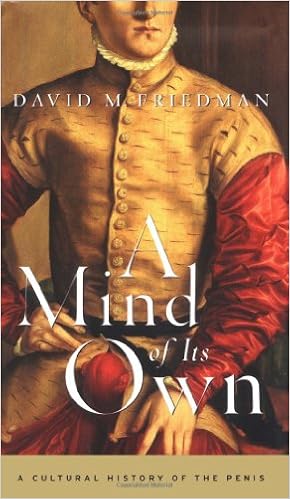
No David M. Friedman is not the current Ambassor to Israel, rather his namesake. His wikipedia summary needs editing .https://www.google.co.il/search?q=David+Freidman&oq=David+&aqs=chrome.0.69i59j69i60l3j69i59j69i65.3995j0j7&sourceid=chrome&ie=UTF-8 David M. Friedman has written for Esquire, GQ, and Rolling Stone, and was a reporter for New York Newsday and the Philadelphia Daily News. His first book, A Mind of Its Own: A Cultural History of the Penis, was published in more than a dozen countries. He is also the author of the widely acclaimed The Immortalists: Charles Lindbergh, Dr. Alexis Carrel, and Their Daring Quest to Live Forever. He lives in New York.
David M. Friedman With chapter titles such as The Demon Rod, The Gear Shift, The Measuring Stick, The Cigar, The Battering Ram--how can you loose with giving this book as a gift to yourself, if you own a penis. Or to a spouse or lover if he has one.
"A man can hold his manhood in his hand, but who is really gripping whom?" The book is worth it for this Big Question alone.
As a retired priest I was a bit surprised that Friedman was spot on with the Roman Catholic theologian, Augustine:
"Augustine, the sainted Bishop of Hippo, found his answer sixteen centuries ago in a man's lack of control. It was a proof of man's alienation from the sacred, and a punishment for Adam's insult of God in Eden that original sin passed from one generation to the next through semen. In a culture where the Virgin symbolized all that was pure, the penis stood for all that was evil. What defined Mary's sanctity was her lack of contact with a penis."
This book seems as much poetry, humor and history as it is a polemic. Are you an all power to the penis type person? Then read this book. I'm glad I bought it. Over time, the penis has been deified, demonized, secularized, racialized, psychoanalyzed, politicized and, finally, medicalized," declares freelance journalist Friedman in a serious yet entertaining book that weaves together an enormous amount of material. In the Greek and Roman worlds, statues of figures with erections were commonplace, he observes, though by the Christian era, the penis had become a source of evil and weakness. Doctors and scientists from da Vinci onward "deflat[ed] the religious rhetoric" and scrutinized the male organ sometimes with untoward results, as when American "semen science" led to the creation of antimasturbation products such as Graham crackers. Western man's fear of the African phallus undergirded colonialism and slavery, and resonates to this day, Friedman argues, as was evident in the case of Clarence Thomas. If some of Freud's case histories might be questioned, Friedman notes how the psychoanalytic interpretation enduringly places the penis and associated anxieties at the fulcrum of society. The rise of feminism put the penis in its place, as The Hite Report pointed out the limits of conventional intercourse in moving women to orgasm, and as Andrea Dworkin exposed penile pathology though the author concludes that male sexuality arises more out of evolutionary strategy than misogyny. His final and liveliest chapter concerns the medicalization of the penis, culminating in Viagra. Even though Friedman quotes a (female) sex therapist on the limits of such drugs, he concludes optimistically that "the erection industry" has performed a paradigm shift, allowing man to impose his will below his belt. The book has a few gaps -- there's little about the gay penis -- but it should reign as the seminal treatment of this topic (and inspire many more puns. This is a wonderful book.A good and unusual read Endulge yourself . Buy it .
Amoah da Costa, Pentecostal pastor and president of Rescue Mission 2000, argues that we are in the “last days,” an eschatological time when the “sins of many nations have come up before God” for judgment. Examining Jesus’s dire prophecy of the end of the world as professed in the Gospel of Matthew, da Costa contends that modern day calamities—floods, famines, pestilences, wars and earthquakes —indicate that we’re in the midst of the Great Tribulation when “the land of Israel…shall suffer an unprecedented outbreak of fury on part of the Antichrist.”
Searching for prophetic lessons in the Old and New Testaments, the author looks to give “all honest-hearted true seekers an opportunity of accepting the Lord Jesus Christ” into their lives. He warns against false prophets, urging believers to be “armed with truth” and embrace biblical teaching to avoid being left behind in the great reckoning. The author starkly details wars between 1990 and 2009 as affirmation of Jesus’ prediction that rampant aggression between nations would be a signal of his second coming.
Da Costa exhibits a strong understanding of scripture, and his chapter on miracles is well done as he examines the history and purpose of supernatural events and their connection to prophecy. Additionally, his use of modern day statistics on violence and natural disasters is informative and alarming.
Unfortunately, the book’s insights and logical arguments are largely overshadowed by the narrative’s grammatical problems. The text includes odd sentence structures and strange word choices (e.g., “Some think the seducers here pointed to be such as had been settled teachers in the Church and revolted to error, and from such, the danger is the greater…” ). There are also missing words, subject-verb agreement errors, and so on. Such problems are jarring and often make for a challenging read.
Overall, da Costa’s premise is an interesting one, but the book requires stalwart editing for his ideas to ring forth more clearly.
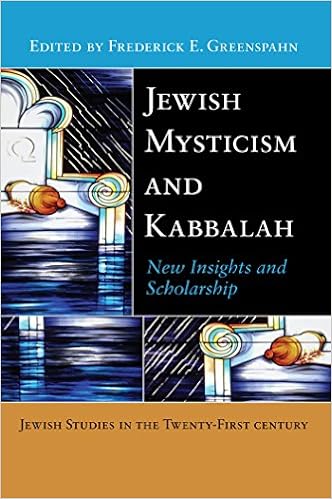
This carefully edited collection of essays on Jewish mysticism effectively delivers on its promise to be accessible to broad audiences. The volume amounts to a thoughtful and lucid conversation among leading scholars . . . It provides a sense of overall coherence as themes set forth in one essay regularly intersect with themes developed in other essays, the sum nicely ending up greater than the parts. The literate lay reader as well as faculty and students in a wide range of university courses will find this to be a most useful gateway to Jewish mysticism as well as an illumining account of current trends in scholarship
Over the past generation, scholars have devoted increasing attention to the diverse forms that Jewish mysticism has taken both in the past and today: what was once called “nonsense” by Jewish scholars has generated important research and attention both within the academy and beyond, as demonstrated by the popular fascination with figures such as Madonna and Demi Moore and the growing interest in spirituality.
In Jewish Mysticism and Kabbalah, leading experts introduce the history of this scholarship as well as the most recent insights and debates that currently animate the field in a way that is accessible to a broad audience. From mystical outpourings in ancient Palestine to the Kabbalah Centre, and from attitudes towards gender to mystical contributions to Jewish messianic movements, this volume explores the various expressions of Jewish mysticism from antiquity to the present day in an engaging style appropriate for students and non-specialists alike.
In "Twelve-Cent Archie", Bart Beaty examines a limited run of the "Archie" comics from the 1960s in order to counter the trend in comics studies that favors auteurism. Further, rather than order his book into regular chapters, he uses a multitude of short, 1-3 page chapter breaks in order to replicate the story length of the "Archie" comics. In this way, he challenges notions of what defines a monograph. These sections examine everything from character development, location, continuity (or lack thereof), race, gender, and the medium of comics itself. This level of close analysis offers a great opportunity for limited theoretical examination based on a handful of examples within the limited time frame of the twelve cent run. Though Beaty occasionally references events beyond the comics, either in the industry or other artifacts of popular culture in the 1960s, these are used primarily for context only when necessary. In rejecting auteurism in comics scholarship, Beaty counters the trend both from comics readers and scholars to dismiss Archie as unworthy of analysis or serious consideration. He also acknowledges gaps in the archive, as many of these comics have not been reprinted nor included in public collections and are only available through comics dealers for private purchase. In challenging notions of what deserves study and what comprises an archive, Beaty has advanced the rapidly expanding field of comics scholarship. This edition includes full-color reproductions of many of the panels and pages that Beaty analyzes, which aid his discussion as he need not spend undo time describing what can so easily be shown.
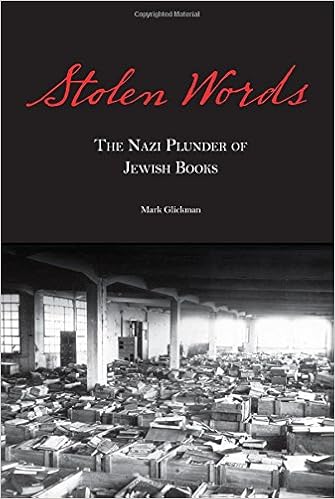
This is not an easy book to describe, but it is a very good one, and parts of it are outstanding. The writing is excellent, the research seems thorough, and as a rabbi, Glickman has a heightened understanding of the importance of books, learning and religious texts to Judaism. The photos are helpful, although the book could use more. Here's a sample of his prose, which also describes the importance of study: "Personal moments of transcendence might be moving, but what really counts is what God said to the Jewish people collectively. And what God said to the Jewish people collectively is called Torah. To study Torah, therefore, is to study a thunderous moment of divine revelation, To study Torah is to hear the voice of God."
The first half of the book is the best, describing the relationship of books to Jewish culture, and it has some fascinating detail about manuscripts, early printing in Hebrew, and how printing helped the standardization of texts, which in turned helped a sense of Jewishness in the widely dispersed communities making up the world of Judaism. Among other things, there's an excellent account of the early days of Hasidism. One outstanding feature is actually fiction, a fictional account of a visit to a real Jewish library in pre-war Vilna (the Strashun Library); sections of the visit mix with the first chapter. The fictional visit will have an impact on any reader, but if the reader loves books, he or she will be drawn deeply into Glickman's book.
Brainstorm: Detective Stories from the World of Neurology; Unthinkable: The World’s Strangest Brains – review.Books by Suzanne O’Sullivan and Helen Thomson offer fascinating insights into the ‘maverick brain’ and rare mental conditions When I was a boy I had a recurring dream that Lilliputian figures were scurrying under my bed. I can’t recall if they bound my hands and feet like Gulliver, but I certainly found their activities fascinating and made no effort to resist, even when, on occasion, they succeeded in moving my bed slightly to the left or right.
Every now and then, however, they would push the bed a little too close to the window. That I did not like, because it put me in range of the clown waiting on the balcony (I have always been terrified by clowns). Now, frozen by fear, I really was immobilised and it was only by screaming that I could snap myself awake and escape their night-time peregrinations.
I was reminded of my lucid dream by the story of Donal, one of the patients featured in Brainstorm, Suzanne O’Sullivan’s new book of “detective stories from the world of neurology”. For 30 years Donal led a perfectly ordinary and seemingly contented life as a school janitor. Then one day he was summoned to the headmistress’s office and informed the school was making cuts and his job might be in jeopardy. That’s when he first saw the dwarves – “seven small brightly coloured men”, as Donal put it – scamper across the room and disappear behind the headmistress’s filing cabinet. As you can imagine, at first Donal told no one, but when one night the dwarves appeared beneath his bed and he gripped his wife’s arm in fright, he was forced to come clean and seek medical help.
Despite advances in medicine, cures for many mental conditions remain out of reach. Photograph: Sebastian Kaulitzki/Getty Images
Those of us who have “normal” brains take our waking lives for granted. Levitating beds and cartoon characters are all very well for the dream world, but when we awake we expect to find the bus stop to be in the same place that we left it yesterday and the street to be the same reassuring shade of grey. But unusual spikes in electrical activity can happen to anyone at any time, sparking transient phenomena such as goosebumps or deja vu, which feel all too real at the time. Moreover, whether as a result of genetic abnormalities, hormonal imbalances, or microscopic lesions, some brains are wired or fire differently. Neurons responsible for one function get crossed with another and suddenly pains take on distinctive tastes, we begin to see vivid auras or are able to access long-lost memories or, conversely, can remember nothing at all and are condemned to the purgatory of the perpetual present.
As one would expect from a neurologist in the Oliver Sacks tradition, O’Sullivan is a sure guide to these maverick brains and strange auras – a word, she reminds us, that is Greek for “breeze” and was originally used in the context of epilepsy. And like the late Dr Sacks, she is careful not to pass judgment on her patients, studiously parsing their accounts of hallucinations and seizures for clues to the underlying neurological dysfunction. Thus, rather than dismiss Donal as a fantasist or someone with psychiatric problems when an MRI scan of his brain proves normal, O’Sullivan hooks him up to an EEG (electroencephalogram) and has him sleep for several days in her epilepsy clinic to monitor and film his seizures. In this way, she finally captures the sudden telltale increase in electrical impulses that attends the dwarves’ appearance and recognises it as a seizure affecting Donal’s occipital lobe, the brain region that controls visual phenomena. Why dwarves, and precisely what triggers these seizures she cannot say, but by giving Donal medication to control his hallucinations she restores his mental equilibrium.
The individuals canvassed in science writer Helen Thomson’s book Unthinkable are not so fortunate. The manifestations of their strange brains cannot be so easily treated, nor, in many cases, would they wish them to be. Take Bob. He can recall a day from 40 years ago as easily as yesterday. Not just who he was with and what the weather was like, but his exact thoughts and sensations. Sometimes, as when the experience was unpleasant, these memories can be a source of pain. But replaying such memories also enables Bob to learn from his mistakes and, in the case of a lost loved one, his extraordinary memory allows him to travel back in time. Indeed, Bob makes a point of memorising relationships that are valuable to him, the better to be able to relive them later.
According to Thomson, we can learn a lot from people like Bob. She too takes inspiration from Sacks, but not being a neurologist, she cannot bring us diverting tales from the bedside. Instead, Thomson makes a virtue of her limitations by travelling the world in search of “strange brains” in an effort to understand them as a “friend might”. It is, for the most part, a successful strategy and although I did not fully buy her claims to have entered her subjects’ peculiar sensory universes, by the end of her journey she had certainly persuaded me to see the world differently.
Take Reuben. Born with red-green colour blindness, Reuben nonetheless claims to be able to “see” vivid auras enveloping people and objects (someone to whom he is sexually attracted flashes red; those he dislikes are yellow, a colour he associates with sourness). The technical term for Reuben’s condition is synaesthesia (crossed senses) and, in case you think he’s faking, his colour blindness and ability to consistently identify coloured auras has been confirmed by rigorous scientific tests. But knowing that does not capture the mysterious nature of Reuben’s colour spectrum or indeed anyone else’s. In short, though we can both objectively agree that such and such an object is red, I cannot be certain that my subjective experience of redness is the same as yours.
It's as if when he zapped himself in the bath he also zapped his sense of self.But we can both agree that we are alive, otherwise how would we be conversing and exchanging notes about redness? Or can we? Graham can happily talk about redness, but insists he is dead. Specifically, Graham is convinced he is brain dead and finds living so pointless he sometimes forgets to eat – after all, if you’re dead what’s the point? Graham can trace his conviction to the day he tried to commit suicide by getting into a bath with a hairdryer after his wife left him. Afterwards, PET scans of his brain showed almost no metabolic activity in the regions governing his ability to rationalise and reflect on his own existence. The result is that even though Graham has been told he is suffering from a rare syndrome known as Cotard’s, no one can convince him he is alive. It’s as if when he zapped himself in the bath he also zapped his sense of self.
Of course, as with Donal and his dwarves, Graham’s abnormally low brain activity may be the physical manifestation of an underlying psychopathology. But that doesn’t detract from the realness of his symptoms to him. Maybe one day doctors will find a way to turn Graham’s brain back on but, until then, Thomson argues that his sense of being a member of the “waking dead” deserves to be taken seriously, offering yet another clue to the mysterious wizard behind the curtain.
That is a verdict with which O’Sullivan would concur. For all the advances in neurology – from MRI scans and EEG to the mapping of neurons for particular conditions, to new genetic techniques – she points out that cures for conditions such as epilepsy, Parkinson’s, autism and schizophrenia remain tantalisingly out of reach. That is why when it comes to probing the mysteries of our most complex organ there is no substitute for patients’ subjective accounts of their misbehaving brains. Even the names patients use to encapsulate their experience may contain vital clues. “When I record a patient’s seizures in their notes I always include these names,” she writes. “They are more vivid than any medical terminology.”
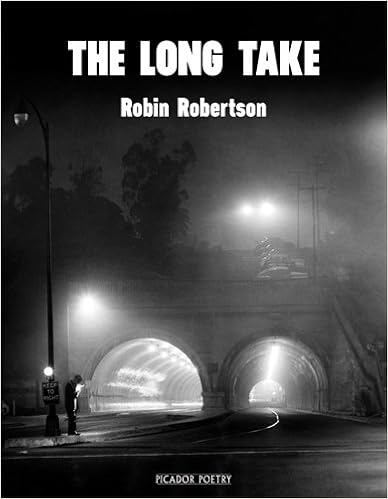
The Long Take by Robin Robertson review – a melancholy love song to America
Modelled on Hollywood’s postwar glory years, this masterful epic follows a second world war veteran across the US, and shows Robertson at the peak of his powers
In one of his more pontifical essays, TS Eliot declared that a poet could not be considered great unless he – he, necessarily – had produced an epic. The pronouncement takes for granted that there is general agreement on what constitutes an epic. But is there? Homer’s Iliad, Virgil’s Aeneid, Dante’s Divine Com
edy, certainly; but what about, say, Alexander Pope’s The Rape of the Lock, Louis MacNeice’s Autumn Journal, Basil Bunting’s Briggflatts, or even Philip Larkin’s The Whitsun Weddings? An epic does not have to be of epic proportions, nor does it need to take the lofty classical tone; it can be humble, like us, composed, as WH Auden has it, of Eros and of dust.
In The Long Take, which has an epical feel, Robin Robertson, one of the finest lyric poets of our time, deploys his artistic reach in a fiction narrative of more than 200 pages, composed in a mixture of verse and prose. It is a beautiful, vigorous and achingly melancholy hymn to the common man that is as unexpected as it is daring. Here we have a poet at the peak of his symphonic powers taking a great risk, and succeeding gloriously.
Robertson sings of arms and the man, though his model is not Virgil but the movies, and in particular the black-and-white (or soot-and-silver) masterpieces produced by Hollywood in, roughly, the latter half of the 1940s and first half of the 50s, such as Out of the Past, Kiss Me Deadly and The Big Combo. As Walter Friedländer, who was an émigré professor at Berkeley, California, and makes a brief appearance, gleefully observes of these films, “At last! / German Expressionism meets the American Dream!”
Robertson’s protagonist, Walker, is an emblematic figure, one of the walking wounded who survived D-Day and the invasion of Europe and returned home to find themselves outcasts in a world busy again with its perennial pursuit of money and power, and impatient of yesterday’s superfluous heroes. A Nova Scotian, Walker remembers home with hallucinatory clarity – “The frozen harbor like a terrible accident: as if some ballroom’s chandeliers had fallen, leaving smashed shards of inch-thick ice” – but knows he cannot go back there, not after the things he has seen, the things he has done.
He is, in his way, as much a casualty of war as the friends and foes who died in the slaughterhouse that was the coast of Normandy in the summer of 1944. Robertson, who must have given years to researching his material, writes of war with appalling immediacy, surveying the carnage with a calmly Homeric eye. His battle scenes are composed not of titanic struggles but, much more tellingly, of fleeting, unforgettable glimpses, lit as by the light of shellbursts: “Naked soldiers dead on the beach, clothes blown off by an anti-tank mine. I was staring at their crew-cuts washed flat by each wave, then the hairs springing back up.”
Walker’s postwar odyssey takes him first to New York, which yields a magnificent opening flourish to the book:
And there it was: the swell and glitter of it like a standing wave – the fabled, smoking ruin, the new towers rising through the blue, the ranked array of ivory and gold, the glint, the glamour of buried light as the world turned round it very slowly this autumn morning, all amazed.
Three cities, New York, San Francisco and Los Angeles, form the scarred and tattered backdrop of the narrative: “Cities are a kind of war, he thought: / sometimes very far away then, quickly, very close.” Walker heads to California as a result of a chance meeting in a New York bar with the film noir director Robert Siodmak. The long train journey west – “like his life, going by too fast” – is a tour de force of narrative verse writing; The Long Take, like Nabokov’s Lolita, is rapturously in love with America, that great, sad, sprawling, lovely land, in all its aspects, even the cheap and tawdry. Crossing the desert, Walker encounters Palm Springs: “In this place, the sand-traps are the only things that are real.”
In Los Angeles, he makes a friend, the fictitious Billy Idaho, a fellow veteran, who “was black, small and wiry, bright-eyed”, and who will come to a ghastly end; there are acquaintances, too, reporters on the newspaper where he finds a job, writing features about the denizens of Skid Row, many of them soldiers like himself, adrift in a peacetime in which there are “no jobs for us, the guys who fought, y’know, / fought for freedom”. Down there, in the lower depths, Walker hears the siren call of self-destructive repentance for what he has done in the war, a call that in the end he will have no choice but to heed:
“I can stop now,” he said, putting his mouth to the mouth of the bottle, “I’ll make my city here.”
The Long Take is a masterly work of art, exciting, colourful, fast-paced – the old-time movie reviewer’s vocabulary is apt to the case – and almost unbearably moving. Walker is a wonderful invention, a decent man carrying the canker of a past sin for which he cannot forgive himself. What Siodmak says of Walker can also be said of Robertson, that he has “what we call / deep focus. Long eyes for seeing.”
There are many writers—novelists, critics, journalists—who, after composing and even publishing poetry, come to a halt. Many find notable success in prose: Faulkner, Hemingway, Lawrence of Arabia. There is, however, a sadder version of the story, that of a writer who finds himself unable to continue as a lyric poet: Eliot is the most vexing example. Another, lesser poet, the Tennessean John Crowe Ransom (1888–1974), wrote poetry for only nine years, and spent the rest of his life being a critic (while obsessively revising, mostly for the worse, the poems he had published years before). Like George Herbert, afflicted because he “could not go away, nor persevere,” Ransom could not persevere in poetry; yet he could not retreat from it.
Although the American Academy of Arts and Letters bestowed the Gold Medal for Poetry on Ransom in 1973, the year before he died at eighty-six, he had not written poetry for decades, and as an ironist himself, he would have felt, one imagines, the incongruity of the medal at that moment of decline. Except for his service as an artillery officer at the front in France in World War I, he lived an uneventful life as a son, brother, husband, and father, while conducting a parallel life as a cultural advocate, literary critic, lecturer, teacher, and editor. That he was born a southerner, and a Methodist minister’s son, determined his intellectual and emotional affinities.
After his undergraduate degree in classics at Vanderbilt, his three-year Oxford experience as a Rhodes Scholar, and some high school teaching of Latin and Greek, Ransom was invited back to Vanderbilt as a professor of English. He probably expected to remain in Nashville, but Gordon Chalmers, the president of Kenyon College, pressed Ransom to come to Kenyon and found a literary magazine. In a life-changing move, Ransom at forty-nine went to Ohio and founded and edited for over twenty years the most influential literary journal of its era, The Kenyon Review. With firm taste, high intelligence, and confident literary power, he rounded up a dazzling stable of writers, himself included: Wallace Stevens quipped of the Review, “Why does it exist, if not for the very purpose of enabling Ransom to find himself in its pages?”
Ransom’s own literary criticism argued that since experimental science represents the factual in its universal generality, human beings need, as its complement, imaginative writing aiming at an exact representation of human consciousness and sensibility. If science was the world’s analytic mind, poetry had to be the world’s physical body, manifesting, with logic and precision, the particular nature of sense-phenomena, the feel of the felt world. In The New Criticism (1941), Ransom called for critics who could perceive and describe the high degree of technique and texture by which a poet not only expressed an individual sensibility but also brought to life a recognizable counterpart of the experienced world, making known the feelings necessarily suppressed in the abstract formulations of science.
Ransom’s criticism, dryly witty, is still readable and entertaining (far more so than his generally placid letters). The scant canon of his poetry, less esteemed now than in his own lifetime, will be newly assessed in light of the 380-page variorum Collected Poems, painstakingly edited and well introduced by Ben Mazer. Great poets, whose every word may be significant, require a variorum edition, but Ransom’s poems do not really call out for Mazer’s exhaustive treatment (including annotations, uncollected poems, and every peculiarity of obsessive textual revision). Perhaps to some readers this elaborate edition is justified by Ransom’s achievement; to others it will expose the damaging weaknesses—for so they seem to me—of Ransom’s verse.
In life, Ransom was a generous son to his minister-father and his mother (always in straitened circumstances) and an earnest encourager of his sisters’ education; he was a persuasive teacher, a man of probity, and a sincere and passionate critic. However, some who knew him thought him, however courteous and helpful, fundamentally withdrawn, emotionally inaccessible: a man of “naturally remote and circumspect disposition.” He remained chary of self-exposure even in his criticism, and when he wrote in rhyme and meter (aspects necessary, he thought, to a poem), he was fettered by both his narrow conception of lyric form (which he equated with technique) and by the self-conscious irony of his narratives.
What should we think of a thirty-one-year-old poet who in 1919 puts before the public, as the first stanza in his first book (strangely called Poems About God), these labored and unfunny lines?
In dog-days plowmen quit their toil, And frog-ponds in the meadow boil, And grasses on the upland broil, And all the coiling things uncoil, And eggs and meats and Christians spoil.
Other early poems exhibit a strange disjunction between title and fable. In one, a farmer, determined to make his every acre flourish, deplores those who would allow space to roses, claiming, before he falls silent, that “nothing is worse than a sniff of rose/In the good strong smell of hay.” Yes, but why is this poem called “One Who Rejected Christ”?
Ransom never reprinted those stumbling poems. In spite of many attempts, he had not yet found a style that fitted his topic. Or, rather, there were too many styles. Among them, we hear Christmas baby talk as a little girl resists her Christian father’s discourse, preferring to think about Santa: she (Ransom wants us to notice) weirdly rhymes “Jesus” with “tease us”:
Father, don’t talk of little Jesus, You’re only doing it to tease us, It isn’t nearly time for bed, And I want to know what Santa said.
Elsewhere in Poems About God we find a spectator scorning the “stinking sweat” of the “thirty fat men of the town” lifting their dumbbells. Yes, but what motive does he ascribe to them?
Dumb-bells left, dumb-bells right, Swing them hard, grip them tight! Thirty fat men of the town Must sweat their filthy paunches down. Dripping sweat and pumping blood They try to make themselves like God.
Turn a few pages, and God is talking in a language never heard on earth or heaven:
“For my absolute heaven is high, and nothing dependeth, Yet it twitcheth my heart, when weeping of women ascendeth.”
What cast of mind generates Ransom’s strange styles and his peculiar versions of conventional genres—allegory, ballad, love lyric, satire?
Ransom’s inner quarrel between the Christian faith of his upbringing (which included Sunday sermons by his father) and a modern rational skepticism is a familiar perplexity in the lives and writings of the Victorians (especially Walter Pater) and of Ransom’s contemporaries (Eliot, Stevens). Ransom’s early revulsion against modern society was complicated not only by his religious sentiments but also by his southern conviction that modern thinking would inevitably bring to the South the industrialism of the commercial North. His nostalgic political conservatism led him, in his forties, to join with friends in a 1930 volume of essays unfortunately called I’ll Take My Stand (a line from “Dixie”: “In Dixie Land, I’ll take my stand”).
The writers saw the (white) agrarian culture of the Old South, with its Protestant gentility and appreciation of leisure, as a heritage too precious to be abandoned. Yet the battle of southern literary intellectuals against modernization—factories, business, naked capitalism—was already lost. Their idyllic picture of staunch Christian farmers, their gentle wives, and their fertile farms left out far too much, notably the black population and its misery. Ransom himself at the time could write equably, “Slavery was a feature monstrous enough in theory, but, more often than not, humane in practice.”
The only contributor who faced “the negro problem” squarely was Robert Penn Warren, arguing that the South’s self-interest absolutely required the economic and vocational betterment of “the negro.” Warren’s tone—thoughtful and sociological—suggested that behind his appeal to white self-interest lay a philosophical argument envisaging the absolute right of the negro to educational access and to opportunity in labor.
Ransom, at seventy, turned a self-critical eye on his time as an agrarian:
I was once a member of a group of young men in Tennessee who made a public diversion in favor of an agrarian way of life which was fast becoming outmoded, even in that happy region. And I recall how it was a commonplace in our observation that it was always the woman of the house who made her husband sell the farm and move to the city, where her own drudgery would be lightened, and her children could go to proper school; we never found the right words to address to the woman.
That “group of young men” created a journal, The Fugitive, which, though it was short-lived (1922–1925), offered them companionship and a place to publish their poems. The young Fugitives evolved into the middle-aged Agrarians of I’ll Take My Stand, but Ransom soon turned back from economics to literature.
Throughout his nine short years of writing verse, Ransom persisted in his quarrel with God. In his second volume, Chills and Fever (1924), he first exhibited his characteristic manner, one conveying grief at a rather chilly distance (the reader is expected to see through the irony). The closing stanza of the frequently anthologized “Bells for John Whiteside’s Daughter” is spoken as the mourners of the young girl prepare to leave the house, where they have viewed her in her open coffin:
But now go the bells, and we are ready, In one house we are sternly stopped To say we are vexed at her brown study, Lying so primly propped.
I have never so disliked the coercion of rhyme and alliteration: “sternly stopped” and “primly propped” (“propped” in a coffin? “sternly stopped” by whom? And by whose “primness” is she thus “propped?”). The arch old-fashioned metaphor “her brown study,” placed as a deliberately chilly euphemism for death, fails to convince.
Another of Ransom’s middle modes is the faux-medieval. In “Fall of Leaf,” two lovers with banal modern names, Dick and Dorothy, ponder whether they should leave their love in the woods for religion’s “slim white spire.” Dorothy and Dick speak in alternation—but what they say is hardly credible as modern verse:
“Dick, those are the Holy Rood And sweet Saint Margaret’s sisterhood. Fearful are the maids, nor many, Narrow is their bed; They must open not to any Woodwife wrapped in red.”…
“Dick, they tend Saint Gregory’s tomb, The strictest monks in Christendom. Tenants of a godly house, Of cleanly gear and hallowed, They will think but little use Of woodman stained and yellowed.”
Other modern poets, notably Yeats, have put on medieval garb, following in the tradition of Dante Gabriel Rossetti’s “The Blessed Damozel,” but they have not inserted into their stanzas, like stones in a pudding, a Dick and a Dorothy. The glance back at the Middle Ages rose to fashion among the Romantics, in gothic tales such as Coleridge’s “Christabel” and Keats’s “La Belle Dame Sans Merci,” but in those works the fiction of the archaic was sustained. Only in the fin de siècle did the fiction become self-consciously staged: in Rossetti’s painting The Annunciation, the apprehensive virgin is a modern girl in a shift, but the biblical adaptation is still coherent in aesthetic tone. Ransom would have named the virgin Mabel, not Mary: he writes to puncture the religious fiction while still wanting to keep it alive.
Ransom’s cartoon self-portrait in “The Vagrant” as a medieval village idiot expects us to translate the portrayal into favorable terms. The vagrant, scorning the country maidens (with contemporary names), forswears their “sweet bites for red lips” in favor of imagined literary ladies:
With a knot in his bosom And a bee in his brains, He goes full of pictures Around the flat lanes….
Lou Margaret, Kittie, Em with the country curls, Are sweet bites for red lips, Very fine girls;
With the Queen Guinevere, Troy’s women, Eden’s, Towns not near.
“So leave him leering,/Loitering in the lanes,” says the speaker in his jaunty dimeter: “There’s no mischief in him/But a bee in his brains.” The coyness here reshapes “a bat in his belfry” to “a bee in his brains,” and expects congratulation for its wit.
Ransom finds yet another way to guarantee distance from his poem’s own narrative: closing a romantic encounter with ironic bathos. In “April Treason” a painter is drawn by sexual passion to destroy his painting, even “trampl[ing] it with loathing.” After kissing his beloved, the painter walks home, straight into bathos:
Then a silence straightway took them And they paced the woodland homeward. What a bitter noon in April (It was April, it was April) As she touched his fleeting fingers cold as ice And recited, “It was nice!”
What is one to make of this meager vapidity as a finale to the painter’s treason to his art? Tinkering with his prosody, here as elsewhere, Ransom tries lines of four, five, and three beats, but achieves none of the architectural firmness of comparable stanza variants in Yeats or Auden. Ransom was praised for his “irony,” for his “dualism,” but there has not been much inquiry into the ultimate poetic value of the repetitive fashion by which he creates a situation and then flings graffiti on it.
Many things, in Ransom, come to spoil romance: in “Good Ships” (an almost-Petrarchan sonnet), a couple who had fallen in love at “one of Mrs. Grundy’s Tuesday teas” but were afraid to pursue the affair are compared to ships that pass in the night and exchange only conventional “nautical technicalities.” For this evasion of their erotic potential, the lovers are metamorphosed into commercial ugliness:
Beautiful timbers fit for storm and sport And unto miserly merchant hulks converted. Robert Lowell giving John Crowe Ransom a gift for his eightieth birthday, 1968
Ransom’s morose conviction that (as Stevens put it) “fault falls out on everything” exists in an unconvincing intellectual space neither tragic nor comic nor truly ironic. The conviction cannot convince because it arrives always accompanied by an ironic gust of wind taking back all that was given. And there it ends. What comes after irony? Nothing; the imagination has been poisoned. In true irony, the poem must continue beyond the simple abandonment of a blighted idealism; see, for instance, Yeats’s ironic closing questions casting the initial premises of a poem into doubt: “Was there another Troy for her to burn?”; “Did she put on his knowledge with his power…?” Ransom is not inclined to second-guess his disappointments.
The attempt to stage aftermath can sometimes expire in weariness. In Ransom’s sardonic version of the apocalyptic encounter of Christ and Antichrist in the battle of Armageddon, Christ exchanges his “dusty cassock” for dress identical to Satan’s, and succumbs to the ministrations of the “perruquiers” (wigmakers) of the Antichrist’s pavilion, who dress his hair (“his thick chevelure”) and scent his beard. The central stanza of Ransom’s “Armageddon” preposterously harmonizes—with ostentatious rhymes—the Antichrist’s poetic art of sensual “dithyramb” with the “holy paternoster” of Christ the Lamb:
And so the Wolf said Brother to the Lamb, The True Heir keeping with the poor Impostor, The rubric and the holy paternoster Were jangled strangely with the dithyramb.
This “new brotherhood” in which the Antichrist and Christ sit “like twins at food” collapses under the withering eye of a Christian elder, and Christ decides to resume battle with the forces of evil. The Christian myth-devolved-into-farce comes to an end—as we now routinely expect in Ransom—in anticlimax, as Satan the petulant Adversary says he’s tired of Armageddons:
The immortal Adversary shook his head: If now they fought too long, then he would famish; And if much blood was shed, why, he was squeamish: “These Armageddons weary me much,” he said.
If these fanciful heavy-handed torsions of the biblical story pleased in 1924, they seem to me now to have lost their savor.
In 1963, when he was seventy-five, Ransom commented retrospectively on his own themes, insisting on “the parity of the two sides,” the impulses to evil and the impulses to good:
The man who limits himself, aspiring to pure goodness or saintliness, seems to us very far from possessing that entire vitality which Providence has meant for him. He has not elected the whole joy of life.
Yet it is not any impression of “the whole joy of life” that appears in Ransom’s overwrought manipulations of Christianity, but rather the grimacing spasm of the deathbed, followed by a fiercely whimsical shrug.
Ransom admired Hardy’s uneven meters, but when—as in “Here Lies a Lady”—he sets the hic jacet of the tombstone in a waltz rhythm, it is hard to see what he gains by his tripping anapests and dactyls:
Here lies a lady of beauty and high degree. Of chills and fever she died, of fever and chills, The delight of her husband, her aunt, an infant of three, And of medicos marveling sweetly on her ills.
Even the seriousness of the final stanza is marred, it seems to me, by Ransom’s posed reprise of her fever and chills:
But was she not lucky? In flowers and lace and mourning, In love and great honor we bade God rest her soul After six little spaces of chill, and six of burning.
It is certain that Ransom thought he had made something beautiful in texture by his waltz: But can it be ratified by a contemporary reader?
By his third and final volume of poems, Two Gentlemen in Bonds (1927), Ransom had quelled to some extent his obstreperous compulsion to vandalize the serious, to blaspheme against Christ, to waltz at tombs—and then to undo it all by a self-exculpating irony. Nonetheless, the curious notion that the medieval is a humorous façade for the modern still organizes the subtitle of part of the book, “A Tale in Twenty Sonnets,” in which we meet two “notorious brothers” (the titular “gentlemen in bonds”), Paul a sensualist, Abbot an ascetic. Paul lusts after their innocent cousin, Edith, dwelling with them in their castle, and Ransom’s stiffly uncertain tale goes overboard in describing Paul’s rape of Edith:
She was small, ripe, round, a maid not maculate Saving her bright cheeks, but the rude bridegroom Claims her, his heavy hand has led her home. Nor did he pull her gently through his gate As had a lover dainty and delicate: The two-and-thirty cut-throats doing his will Tore off her robe and stripped her bare until Drunken with appetite, he devoured and ate.
Ransom mocks his quasi-Petrarchan tale-in-sonnets by ascribing a Petrarchan taste to the gaunt monkish brother named Abbot: “The man could talk in Latin, music, mime,/Or sonneteer with Petrarch in his prime,” yet “He waved his black sleeves like an evil prophet,/Death in his every verse or not far off it.” (Polonius lurks: we hear him saying of the rhyme “prophet” and “off it,” “that’s an ill phrase, a vile phrase.”) The Manichaean brothers, and the rape of Edith, are means by which Ransom can sketch a base sensuality and a death-obsessed poetry, but the reductive scheme vitiates any human implication. If the twenty-sonnet narrative is an allegory, it has nothing to allude to; if a parable, it is too voluble.
The medievalism is notably diminished in Ransom’s famous poem “The Equilibrists,” which, although entirely indebted to Donne, finds its own originality within that “metaphysical” tradition. The speaker exposes the predicament of intense lovers who, observing Honor, continue their lives without yielding to forbidden sensuality:
At length I saw these lovers fully were come Into their torture of equilibrium; Dreadfully had forsworn each other, and yet They were bound each to each, and they did not forget.
Although the poem rehearses once again the Manichaean division of the ascetic from the sensual, and borrows from Dante’s pictures of hell the lovers’ incessant repetition of their sin, Ransom manages better than elsewhere the infiltration of the violent into the chaste. The narrator addresses the tortured lovers:
Would you ascend to Heaven and bodiless dwell? Or take your bodies honorless to Hell?… Great lovers lie in Hell, the stubborn ones Infatuate of the flesh upon the bones; Stuprate, they rend each other when they kiss, The pieces kiss again, no end to this.
As they refuse both chaste Heaven and a place in Hell, the lovers-in-equilibrium are exalted by their pain into two burning stars. Remembering Thomas Gray’s “Elegy Written in a Country Churchyard,” Ransom allows the narrator to compose an epitaph for the Equilibrists, inscribed on their shared grave:
But still I watched them spinning, orbited nice. Their flames were not more radiant than their ice. I dug in the quiet earth and wrought the tomb And made these lines to memorize their doom:—
Epitaph
Equilibrists lie here; stranger, tread light; Close, but untouching in each other’s sight; Mouldered the lips and ashy the tall skull, Let them lie perilous and beautiful.
The stately quatrains fit the stately Platonic lovers, and the classical epitaph brings Ransom back to his undergraduate study of Latin and Greek. Ransom’s discretion prevents any tethering of “The Equilibrists” to events in his own life. Still, for all its mannered stance, the poem remains human and unmocked.
Poetry was dear enough to Ransom for him to devote the rest of his long life to it, whether in writing essays, soliciting and choosing material for The Kenyon Review, or tirelessly giving lectures. It is often forgotten that the “New Criticism” assumed that its practitioners or theorists would know several languages, and would have read enough history and biography to prepare their minds to think about poetry. The New Critics whom Ransom summoned were to bring to their accounts of poetry all the sophistication that historical or biographical critics possessed, but they were to step further into the footprints of the poem than those academics—the majority—who stopped at a moral or academic commentary.
The New Critics who responded to Ransom’s call—Tate, Jarrell, Blackmur—had all begun as poets, and knew intimately what it was to shape a line or a stanza, to create a rhythm or a form of closure. They were evangelists of poetry, wanting others to see a poem not as a moral essay or a historical illustration but as the creation of a set of ravishing lines produced by a long discipline of study, training, and reflection. The cognitive value of poetry, for Ransom, lay in its recreation, in symbolic form, of the phenomenology of the world’s body, an irreplaceable process if human beings were to recognize themselves in their felt world.
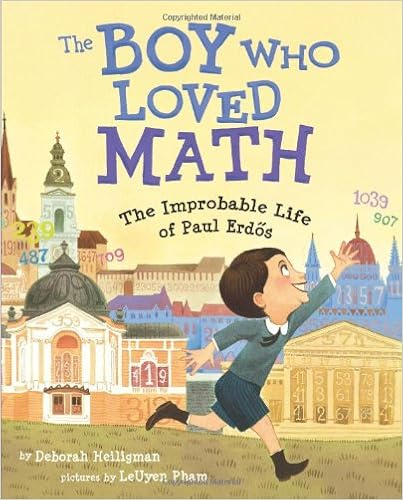
Most people think of mathematicians as solitary, working away in isolation. And, it's true, many of them do. But Paul Erdos never followed the usual path. At the age of four, he could ask you when you were born and then calculate the number of seconds you had been alive in his head. But he didn't learn to butter his own bread until he turned twenty. Instead, he traveled around the world, from one mathematician to the next, collaborating on an astonishing number of publications. With a simple, lyrical text and richly layered illustrations, this is a beautiful introduction to the world of math and a fascinating look at the unique character traits that made "Uncle Paul" a great man. Though eccentric mathematician Paul Erdos might seem an unusual subject for a picture book, his story makes for a memorable biography. Growing up in Hungary during WWI, Erdos tried school but chafed at the rules and convinced his mother that he should study at home. He was fascinated by numbers from an early age, and by the time he was 20, he was known as The Magician from Budapest. Unable to do common tasks such as cooking, laundry, or driving, he spent his adult life flying around the world, staying with other mathematicians, and working collaboratively on challenging math problems. Math is woven into the lively writing (Mama loved Paul to infinity. Paul loved Mama to 8, too!). The wonderfully vivid artwork, where ideas from the text are clarified, also uses decorative elements to support the idea that Erdos saw the world differently—numerically. Heiligman appends a lengthy note about writing the book, while Pham offers a more extensive note on creating the illustrations, in which she comments on the mathematical ideas and mathematicians depicted in the art. This excellent picture-book biography celebrates a man little known outside his field, but one well worth knowing. Grades K-3.
Why more books on Albert Einstein? Two years ago we marked the Year of Physics, celebrating the centenary of his great 1905 papers, including those on special relativity and the particle theory of light. There is already a definitive scientific biography, published by Abraham Pais in 1982. That Einstein had an interesting personal life, with many entanglements with women and at least one extramarital child, has not been news since Roger Highfield and Paul Carter’s The Private Lives of Albert Einstein and Dennis Overbye’s Einstein in Love, published in 1994 and 2000, respectively. His private letters continue to come to light, but do they really add anything to the portrait of Einstein’s character drawn so perceptively by Overbye?
In his new book, Einstein: His Life and Universe, Walter Isaacson explains that
studying Einstein can be worthwhile [because] it helps us remain in touch with that childlike capacity for wonder…as the sagas of [science’s] heroes reminds us…. These traits are…vital for this new century of globalization, in which our success will depend on our creativity….
As he elaborates in a recent interview with Thomas Friedman, “If we are going to have any advantage over China, it is because we nurture rebellious, imaginative free thinkers, rather than try to control expression.”1
Noble sentiments, and certainly sufficient justification for continuing to promulgate uplifting myths about science and its heroes. But what does this have to do with the actual character and life of the real person who happened to be the most important physicist of the last two hundred years? There is no doubt that any attempt to understand who Einstein actually was and what he actually did is hampered by a smokescreen that was created by his executors, his colleagues, his biographers, and perhaps even Einstein himself. The myth of Einstein presents us with an elderly sage, a clownish proto-hippy with long hair, no socks, and a bumbling, otherworldly manner. As Isaacson writes it:
Adding to his aura was his simple humanity. His inner security was tempered by the humility that comes from being awed by nature. He could be detached and aloof from those close to him, but toward mankind in general he exuded a true kindness and gentle compassion.
This certainly describes a role that the older Einstein might plausibly have chosen to play as a defense against the onslaught of fame and responsibility. But what Isaacson is describing is a role, not a human being. Who was the person behind that role, and what were his reasons for playing the endearing sage?
Of the new books, Jürgen Neffe’s Einstein: A Biography is the liveliest. It was a big success in Germany and one can see why. His prose is lively and the unconventional organization of his book, by theme rather than chronology, with asides about current science, tells an engaging version of Einstein’s story. Neffe is not afraid to speculate on the personality of the man behind the myth, even if not all his hypotheses are convincing. At the same time Neffe also tells the heroic story of the scholars hired by the Einstein Papers Project to catalog and publish Einstein’s collected papers as they struggled with, sued, and cajoled the executors and family to get the access to the letters and documents they needed to do their job.
The project was launched in 1986 under the joint sponsorship of Princeton University Press and the Hebrew University of Jerusalem. As Neffe explains, the executors, Otto Nathan and Helen Dukas,
made life difficult for anyone who tried to gain access to the approximately 42,000 items in the archives…. Hence it was not surprising that important papers vanished…. It is uncertain how many documents were removed from Einstein’s estate after his death. There is no doubt, however, that documents casting Einstein in an unfavorable light, at least in the opinion of his trustees, were eliminated.
As a result, the efforts of the scholars associated with the Einstein Papers Project—which is now based at the California Institute of Technology—have only recently begun to yield a mature understanding of Einstein’s character and his work. Anyone who really wants to get to know Einstein can do no better than immerse themselves in the books and papers coming out of the Einstein Papers Project, which has so far published ten volumes of correspondence and writings spanning the period from Einstein’s youth up to 1920.
Less ambitious readers who want an introduction to Einstein’s story, taking into account all the latest discoveries of letters and organized in a conventional chronological format, will find Isaacson’s workmanlike biography well worth reading. But I found his clearly written account marred by unconvincing attempts to reassure us that we need not be overly concerned by Einstein’s rough edges. For example, Isaacson takes pains to assure us that Einstein’s criticisms of quantum mechanics, which led to his dissenting from the theory that most of his colleagues thought was the greatest advance of the period, have since been resolved, an assertion that will surprise many scientists who continue to debate and study the issues.
Isaacson also assures us that Einstein’s worries about McCarthyism were “overstated” because “as it turned out, American democracy righted itself, as it always has…. Einstein was not used to self-righting systems…and did not fully appreciate how resilient America’s democracy and its nurturing of individual liberty could be.” Why does Isaacson feel he has to assure us that we don’t need to take his subject’s political views too seriously? 2.
The problem any biographer faces is that Einstein scholarship is still digging itself out of decades of mythmaking. While it is possible to extract a picture of a real person from the recent books, it takes some work, as the writers themselves still seem too much in awe and accept too easily the sanitized and domesticated version of the fierce and unruly spirit who was the greatest scientist in living memory. To untangle the person from the myth we can begin with the parts of the myth—both personal and scientific—that are inconsistent and incredible.
First the young Einstein, the one who actually made the great discoveries we associate with his name, is nothing like the mellow sage described during his Princeton years. He was seen by his contemporaries as arrogant, intolerant of authority, charismatic, good-looking, manipulative, and avidly engaged in his relationships with women, his children, his friendships, his music. One of his classmates described him as follows:
Sure of himself, his gray felt hat pushed back on his thick, black hair, he strode energetically up and down in a rapid, I might almost say, crazy, tempo of a restless spirit which carries a whole world in itself. Nothing escaped the sharp gaze of his bright brown eyes. Whoever approached him immediately came under the spell of his superior personality. A sarcastic curl of his rather full mouth with the protruding lower lip did not encourage philistines to fraternize with him. Unhampered by convention, his attitude towards the world was that of the laughing philosopher, and his witty mockery pitilessly lashed any conceit or pose.
David Reichinstein, a young physical chemist who knew Einstein in Zurich, wrote that “Einstein can express a strong dislike, and can fly into a passion, becoming intolerant and even unjust.” Einstein, in a rare written attempt at introspection, referred to his “hypersensitivity masquerading as indifference.”
The young Einstein’s contempt toward anyone in authority was strongly expressed and likely hurt his career. After an exchange with Paul Drude in which the unknown student tried, unsuccessfully, to point out an error in the professor’s work, he wrote,
It is such manifest proof of the wretchedness of its author that no further comment by me is necessary. From now on I’ll no longer turn to such people, and will instead attack them mercilessly in the journals, as they deserve.
The question that needs to be answered, although none of the biographers do so, is how this arrogant, charismatic revolutionary turned into the otherworldly sage who was said to be an “emblem…of the mature and reflective human being.” The man who was once seen as childish became admired for being childlike. How did this happen? Had Einstein become resigned after facing political and personal tragedies, or was his new character, as Overbye and Neffe both suspect, at least partly an act? “Einstein the lonely genius,” as Neffe writes, “was partly a creation of his own making.”
Peter Bergmann, a physicist who collaborated with Einstein at Princeton, used to recount Einstein’s reaction to their walk being interrupted once more by a stranger wanting to meet the great man. Einstein chatted amiably but when the person left he remarked, “Well, the elephant has gone through his paces again.”
Evidence that Einstein’s otherworldliness was at least partly a conscious strategy is to be found in a letter of spring 1915 to his good friend Heinrich Zangger, a doctor he had met in Bern, in which he explained how he kept his cool when his colleagues and friends in 1915 Berlin became fervid about pursuing war:
I always fare the best with my innocuousness, which is up to 20 percent conscious. This is easily attained when you’re indifferent to the feelings of your dear fellow humans—but you are never as indifferent to them as they deserve.
Then he explained what was really important to him: “I live completely withdrawn and yet I’m not lonely, thanks to the kind care of a cousin [his lover Elsa] who was the one who drew me to Berlin.”
Einstein’s letters show that in fact he was capable of considerable sensitivity to the feelings of other people. Here, in a letter quoted by Isaacson, is how he resolved a difficult conflict with the great mathematician David Hilbert over who should get credit for the equations of general relativity in December 1915:
There has been a certain ill-feeling between us, the cause of which I do not want to analyze. I have struggled against the feeling of bitterness attached to it, with complete success. I think of you again with unmixed geniality and ask you to try to do the same with me. It is a shame when two real fellows who have extricated themselves somewhat from this shabby world do not afford each other mutual pleasure.
And here he is in 1911, again in letters quoted by Isaacson, writing to Marie Curie to express support for her during a scandal caused by disclosures of a relationship with a married man:
Do not laugh at me for writing you without having anything sensible to say. But I am so enraged by the base manner in which the public is presently daring to concern itself with you that I absolutely must give vent to this feeling. I am impelled to tell you how much I have come to admire your intellect, your drive, and your honesty, and that I consider myself lucky to have made your personal acquaintance in Brussels. Anyone who does not number himself among these reptiles is certainly happy, now as before, that we have such personages among us as you….
A possible clue to Einstein’s character is an evident gulf between how women saw him and how men saw him. The men in his life, his friends and his sons, complained of his detachment. “For all his kindness, sociability and love of humanity,” the physicist Max Born wrote, “he was nevertheless totally detached from his environment and the human beings included in it.” But women saw in him “masculine good looks of the type that played havoc at the turn of the Century…. The lower half of his face might have belonged to a sensualist who found plenty of reasons to love life.” And there is plenty of evidence, from the stories of affairs lasting into old age and the letters between him and his women, that women continued to find him attractive.
Throughout his life, in fact, we see how important women were to him. His first marriage in 1903 to Mileva Maric�, a Serbian mathematician, began as a partnership between fellow students and soulmates. He risked a great deal for it, including his relationship with his parents. When it went bad, he might have stayed for the benefit of their children, but he gave it all up for a new love, that of his cousin Elsa Einstein. This cost him dearly in his relationships with his sons, as he wrote to Elsa:
I have carried these children around innumerable times day and night, taken them out in their pram, played with them, romped around and joked with them. They used to shout with joy when I came; the little one cheered even now, because he was still too small to grasp the situation. Now they will be gone forever, and their image of their father is being spoiled.
What he gained by this sacrifice was not just a life with Elsa, but a household of women, starting with Elsa’s two grown daughters—one of whom he apparently also proposed to. A decade later he added Helen Dukas, who became not only his personal assistant but a member of his household. In later years this circle of women came to include also his beloved sister Maja who, along with one of Elsa’s daughters, left her husband to live out her life with Einstein. But this household of women was not enough for him, for it seems Elsa did not interfere with his having many friendships—erotic or not—with women in Berlin.
Perhaps the stories of Einstein and others point to a kind of man who is most comfortable and engaged when in the company of women. Reading about his relations with them, we can ask whether there is an erotic component to some kinds of scientific and mathematical creativity.
This possibility challenges the stereotype that scientists and mathematicians tend to be nerds, out of touch with their bodies. Perhaps the notion that scientists are people of unworldly detachment is accepted uncritically because it supports the ancient idea that the mind and body are distinct entities. Some would prefer the myth of Stephen Hawking, who may seem to be a man with no body to speak of, in touch with only the universe (with his necessary support from a team of nurses and students hardly mentioned), than to think too much about Einstein seducing Berlin socialites in his sailboat, or Erwin Schrödinger inventing quantum mechanics during an erotic weekend with a lover and later showing up in Stockholm to receive the Nobel Prize with both his wife and his mistress. 3.
The discrepancies in the myth of Einstein are important, not so much for their own sake but because they point to contradictions in the perception of his scientific legacy held by laypeople and scientists alike. Corresponding to the apparent contradictions between the character of the young and the old Einstein, and between the detached sage and the man deeply involved with women, we can find in much of the recent writing two scientists called Einstein. The early Einstein, according to legend, was brash and revolutionary. His thinking was closely tied to experimental science and engineering practice. It was intuitive, centered on a search for general principles, and done with a light hand that employed the bare minimum of mathematics.
Moreover, as Peter Galison convincingly shows in his 2003 book, Einstein’s Clocks, Poincaré’s Maps: Empires of Time, the young Einstein developed his science while being closely involved with the technology of his time. Einstein’s father and uncle were high-tech entrepreneurs, which in those days meant they took part in the electrification of cities. In the patent office he dealt every day with cutting-edge technology, and some of it had to do with the issue of defining time and establishing simultaneity. The problem of synchronizing clocks in distant places, leading to a definition of simultaneous time, is central to Einstein’s 1905 special theory of relativity. From Galison we learn that the same problem was crucial for coordinating railway timetables and more generally for the establishment of national and global systems of time, and that Einstein likely examined patents relevant to this problem in his work in the Swiss patent office.
Einstein’s later work, beginning in the early 1920s, was very different. It was an almost random search through catalogs of inelegant mathematical formulas, in the vain hope of discovering a unification of the different physical forces, including both gravity and the fundamental particles. I agree with Neffe that this work was “lacking something that had previously served him well on two occasions: a principle…. It also lacked any empirical foundation.” According to Banesh Hoffman, one of his assistants, “The search was not so much a search as a groping in the gloom of a mathematical jungle inadequately lit by physical intuition.” The ever-acerbic physicist Wolfgang Pauli wrote to him in 1929: “All that is left…is to congratulate you (or had I better say ‘express… condolences’?) on your having gone over to the pure mathematicians.”
It is true that many mathematicians and physicists do their best work when young. But in Einstein’s later work we see something much more extreme than the usual falling off. It is as if Thelonious Monk or John Coltrane turned into an obscure twelve-tone composer. How did the greatest physicist since Newton turn into a failed player of mathematical games? All the biographers ask this question; none gives an answer that seems remotely plausible to me as a working scientist.
The key issue in the assessment of Einstein’s later years is his conviction that quantum mechanics could not be correct. Although in 1905 he had been the first to identify the need for a new quantum physics, he dissented strongly from the view that our understanding of quantum phenomena was put in final form by the invention of quantum mechanics in 1926 and 1927. In particular, he argued that quantum mechanics, while making predictions that agreed with experiments, could only provide an incomplete and approximate description of phenomena at the level of the atom. His objection was partly based on the fact that quantum mechanics gives only statistical predictions for many experiments, and partly on the fact that it gives no physical picture of precisely what occurs in individual atomic processes. For him then, quantum mechanics was at best a provisional step on the way to the right theory of atomic physics. A major motivation for his search for a unified field theory was his belief that it might lead to that correct theory. He was not alone; among the inventors of quantum physics, Louis de Broglie, Erwin Schrödinger, and others shared his skepticism about the theory.
As Freeman Dyson has described in these pages, Einstein was a leader of a generation of revolutionaries, every one of whom “had a crazy theory that he thought would be the key to understanding everything.”2 Like some of his fellow European refugees, such as Kurt Gödel, Einstein represented an older, philosophical approach to science that was based on attempts to think radically about the foundations of reality such as the nature of space, time, and causality. In America, however, he found a new generation of conservatives, among whom Dyson numbers himself. As Dyson saw it,
The old revolutionaries…believed that physics needed another revolution as profound as the quantum revolution…. Young people like me saw all these famous old men making fools of themselves, and so we became conservatives.
They were conservative because they thought the revolution was over and their task was to develop the applications of quantum physics, which they took to be the prime legacy of the revolution. “The physical ideas were basically correct,” Dyson wrote. His contemporaries
did not need to start another revolution. They only needed to take the existing physical theories and clean up the details. I helped them with the later stages of the cleanup. The result of our efforts was the modern theory of quantum electrodynamics, the theory that accurately describes the way atoms and radiation behave.
But for Einstein and others, who did not accept quantum mechanics, the revolution was not yet over. By the time Einstein moved to Princeton in 1933, he had already parted ways with most of his colleagues. As a result, although all the subsequent developments of twentieth-century physics were entirely based on Einstein’s early work, it can also be said that Einstein left very little legacy from his work at Princeton within the scientific community. His later views were for the most part not taken seriously, and those who followed him and worked with him during that period did not flourish. Indeed, his most important contribution of all, general relativity—which he had developed between 1909 and 1915, following his early work on special relativity—was mostly ignored from the 1930s to the 1960s as physics focused on the rapidly expanding sphere of applications of the quantum theory.
By the time Newton died the Royal Society was filled with Newtonians. But after Einstein’s death in 1955, to be an Einsteinian was to be in a decidedly marginalized position in the physics world, if by Einsteinian one meant someone who agreed with Einstein’s strongest convictions and consequently approached physics in the same style he did. The big question that any assessment of Einstein’s later period then hinges on is whether Einstein’s later views were correct or not. The least that can be said is that there is an entire field now devoted to questions raised by the counterintuitive aspects of quantum mechanics called the foundations of quantum mechanics. Most experts agree that the questions raised by Einstein have not been resolved, and a fair fraction of them suspect that in the end Einstein’s view that quantum mechanics is just a step on the way to the right theory will turn out to have been correct.
Nonetheless, for most of Einstein’s biographers, who have been either nonphysicists or, like Pais, particle physicists firmly in the dominant quantum theory camp, the question is closed. To them one of very greatest scientists in history was completely wrong about the truth of a theory whose development he initiated. Isaacson asks, “So what made Einstein cede the revolutionary road to younger radicals and spin into a defensive crouch?” The simple truth is that Einstein ceded nothing because he had well-thought-out and principled objections to the quantum theory. 4.
Paradoxically, it appears that the myth of Einstein may have diminished the influence he might have had. To understand how and why this happened, we should ask who benefited by the diminishment of Einstein’s legacy from that of the greatest scientist of the last two centuries to the gentle and wise clown of popular imagination.
First of all, his executors stood to benefit. They saw their role as establishing the legacy of one of history’s greatest scientists. But the man himself was an embarrassment. Politically he had supported causes such as socialism, pacifism, and racial justice that were considered—in the America of 1955, when he died—on the fringe or worse. He was well known and admired as a Zionist, but the truth was more complicated. He was in favor of a homeland for Jewish refugees, but, in a statement many Zionists would have opposed, he also wrote to Chaim Weizmann in 1929 that “should we be unable to find a way to honest cooperation and honest pacts with the Arabs, then we have learned absolutely nothing from our 20,000 years of suffering.” When he turned down the offer of the presidency of Israel in 1953 he said, “My relationship with the Jewish people has become my strongest human tie.” But he also told his step-daughter Margot, “Were I to be president I would have to say to the Israeli people things they would not like to hear.”
Einstein’s political engagements were an embarrassment even for the director of the Institute for Advanced Study, who had taken great pains to recruit the famous scientist to Princeton. He took to opening Einstein’s mail and turning down invitations—including an invitation to visit the Roosevelts in the White House—without even consulting the man to whom they were addressed. Einstein had to threaten to resign from the institute to get access to his mail.
Einstein’s unruly Bohemian personal life was also an embarrassment, to which the executors, as Neffe notes, responded by destroying documents and restricting access. The executors even went to court to block Einstein’s son from publishing letters between his parents that had been passed down to him from his mother. The result was that key facts about Einstein’s messy personal life were hidden from view before those letters finally came into the hands of scholars in the last few years.
In fact, what is in these letters is far from producing the scandal that the executors may have feared. What stands out instead is banal; his two marriages were not very different from those of many creative people today. How many marry their college soulmates only to have the relationship collapse in the face of diverging careers and the pressures of raising children? How many have weathered a difficult divorce without writing some angry letters that they would not want to see published?
Einstein’s scientific colleagues had even more to gain by the establishment of a myth that left him honored but unheeded. During his years as a professor and director of the Kaiser Wilhelm Physical Institute at the University of Berlin up to 1933, Einstein was a formidable obstacle to those who sought to establish quantum mechanics as the unquestioned paradigm for the new physics. This was so because his arguments were the hardest to answer and because of his unquestioned status as the dominant intellectual figure of twentieth-century science, holder of a prestigious chair in what was at the time the capital of science.
But once Einstein moved to the Institute for Advanced Study at Princeton he was no longer seen as a leading figure among scientists. His dissent from quantum mechanics and his entire philosophical approach to scientific research was an embarrassment to his younger American colleagues. While they may have been happy to have the old master as a trophy of America’s and their own dominance, they were not very interested in what Einstein might have to teach them about how to do science. And indeed, Einstein showed little interest in the discoveries they were most excited about, perhaps because they were expressed in the language of quantum mechanics, which he did not believe. The solution was to elevate Einstein to the status of a sage, a Yoda of Princeton, after which it would not be necessary to take him seriously. Indeed, apart from two or three assistants and some fellow refugees, few others in Princeton—even those who worked on relativity or quantum theory—ever had serious talks with him.
Einstein knew what was going on. In 1949 he wrote to Max Born,
I am generally regarded as a sort of petrified object. I find this role not too distasteful, as it corresponds very well with my temperament…. I…do not take myself nor the doings of the masses seriously, am not ashamed of my weaknesses and vices, and naturally take things as they come with equanimity and humor.
Indeed, Einstein also had something to gain by the propagation of a myth. Knowing that he had done the greatest science of the last two centuries, and aware of being the lifelong European Bohemian rebel that he was, can we imagine him descending into the pit of American academic politics and contending for a legacy measured in chairs held by students and collaborators? This indifference, however, infuriated some of the followers of relativity theory. The great astrophysicist Subrahmanyan Chandrasekhar told me that he held a lifelong grudge against Einstein for having, in his view, abandoned relativity theory and those who studied it, resulting in the subject and its followers being pushed to the fringes of physics for decades. Einstein was mainly interested in being left alone, to live his own kind of life, have his affairs and entanglements, and pursue his lifelong search for truth—a search that began and ended outside the academic establishment and indeed never fit comfortably within it.
But Einstein was famous, as no scientist has been before or since, so his every move was under scrutiny. And, in view of the tragedies that had driven him to give up his European home and move to America, we can imagine he felt compelled to continue to use his fame to speak out for principles and causes he believed in. But he was in a new country where his socialism and pacifism were widely seen as un-American. Perhaps playing the part of the lovable sage was a conscious solution to these problems; it is even possible to imagine that he borrowed something from his friend Charlie Chaplin, who also hid unpopular leftist views behind the famous image of a clown. This not only protected his privacy and excused his apparent irresponsibility, it gave him an unassailable position from which to continue to support causes then unpopular in America.
The myth describes Einstein as politically naive, but there is little evidence for that in two recent books on his political activities: Einstein on Politics, a collection of his writings, and Einstein on Race and Racism, an account of his friendships with Paul Robeson and members of Princeton’s African-American community. He was always as anti-Communist as he was socialist, and did not fall into the common trap of letting his support for good causes be exploited. He was flexible and engaged. He understood the Nazi threat earlier than many and as soon as he did he stopped supporting pacifists. His writings show that in politics as in science he had the ability to speak directly to the heart of the matter. In 1946 Einstein visited Lincoln University, a historically black institution in Pennsylvania, and was quoted as saying:
There is a separation of colored people from white people in this country. This separation is not a disease of colored people. It is a disease of white people. I do not intend to be quiet about it. 5.
In politics, it seems that Einstein was called naive for thoughts that we now understand to have been ahead of his time. Could the same have been true of his later science?
For science, the question to be answered is the paradox of Einstein’s failed last years. I would suggest that the resolution of the paradox is that Einstein’s dissent from quantum mechanics and immersion in the search for a unified field theory were not failures but anticipations. After all, even if many string theorists would disagree with Einstein about the incompleteness of quantum mechanics, much of what goes on in string theory these days looks a lot like what Einstein was doing in his Princeton years, which was trying to find new mathematics that might extend general relativity to a unification of all the forces and particles in nature.
Many of the avenues Einstein and his collaborators explored between the 1920s and the 1950s, for instance, such as the possibility of a higher number of dimensions, are now integral parts of string theory. Perhaps Einstein’s turn from analysis of physical principles to mathematical speculations was not just a foible; perhaps, in the absence of any relevant physical experiments, it was the only way forward. Or perhaps Einstein’s goal of complete unification can only be achieved by someone with the audacity and courage to disdain the mainstream and return to the physical, intuitive, and mathematically unsophisticated methodology of the young Einstein. The answers to such questions are still to come.
It is also disappointing that none of the biographers mention the writings that lead John Stachel, the founding editor of the Einstein Papers project, to speak of “the other Einstein.” These writings look beyond his struggles with the unified field theory to “the other possibility [which] leads in my opinion to a renunciation of the space-time continuum, and to a purely algebraic physics.” What Einstein is saying is that the smoothness of space is an illusion and the fundamental description of space will be in terms of algebra and not geometry. As Einstein wrote in a letter to the physicist H.S. Joachim:
An algebraic theory of physics is affected with just the inverted advantages and weaknesses [of prevailing ideas], aside from the fact that no one has been able to propose a possible logical schema for such a theory. It would be especially difficult to derive something like a spatio-temporal quasi-order from such a schema. I cannot imagine how the axiomatic framework of such a physics would appear, and I don’t like it when one talks about it in dark apostrophies. But I hold it entirely possible that the development will lead there….
Remarkably, this is precisely where most current work on unifying quantum mechanics with general relativity, apart from string theory, has led. Non-commutative geometry, spin foam models, loop quantum gravity, quantum causal histories, and others are each based on such an algebraic framework for spacetime. Between string theory and such approaches, the later Einstein appears to have anticipated much of contemporary research aiming to bring together and close the great revolutions he began.
But it also must be admitted that none of these approaches have, after great effort, succeeded in leading to either physical experiments or to complete theories that have the ring of truth that Einstein’s early theories have. A growing number of us engaged in this work believe that Dyson and his contemporaries declared the revolution over too soon, and that to finish the job Einstein started we will have to return to his preoccupations with the foundations of our understanding of space, time, matter, and the quantum.
As for Einstein’s dissent from quantum mechanics, there remains the stubborn fact that a significant proportion of those who have thought the matter through find themselves in agreement with Einstein that quantum mechanics must be understood as an incomplete approximation to a very different theory. Here also, no final judgment can be made until the scientific problems are resolved. But it is remarkable that Einstein’s last significant paper on quantum mechanics, written with Boris Podolsky and Nathan Rosen in 1935—well into his alleged deterioration—is more and more central for our understanding of quantum mechanics. This paper is built around a critical argument for the incompleteness of quantum mechanics; but its lasting significance is that it is the first paper to clearly identify a feature of quantum physics we now call entanglement.
According to quantum mechanics, once two systems have interacted they must from that point on be considered a single system, with joint properties, even if they fly far apart from each other and remain widely separated. This remarkable aspect of quantum physics—unappreciated before that paper—has become the basis of a quest for new technologies, called quantum communication, quantum computing, and quantum cryptography, which, during the next decades, may transform our world as much as the electrical technologies Einstein’s father and uncle pioneered.3 Should this happen, one can imagine that Einstein—whose revolution in science went hand in hand with his work in the patent office, observing the transformation of science into technology—would have been proud.
Are certain actions intrinsically wrong, or are they wrong only because of their consequences? Suppose that by torturing someone, you could save a human life, or ten human lives, or a hundred. If so, would torture be morally permissible or perhaps even obligatory? Or imagine that capital punishment actually deters murder, so that with every execution, we can save two innocent lives, or three, or a dozen. If so, would capital punishment be morally permissible or perhaps even mandatory? And how, exactly, should we go about answering such questions?
On one view, the best method, and perhaps the only possible one, begins by examining our intuitions. Some people have a firm conviction that it is wrong for the government to torture or execute people, even if doing so would deter murder. Some people think that it is plain that a nation should not bomb a foreign city, and thus kill thousands of civilians, even if the bombing would ultimately save more lives than it would cost. If we are inclined to agree with these conclusions, we might test them by consulting a wide range of actual and hypothetical cases. That process could help us to refine our intuitions, eventually bringing them into accord with one another, and also with general principles that seem to explain them, and that they in turn help to justify.
Many philosophers are inclined to this view. To test our moral intuitions and to see what morality requires, they have been especially taken with a series of moral conundrums that sometimes go under the name of “trolleyology.” Here are two of the most important of these conundrums.
The Trolley Problem. You are standing by the side of a railway track, and you see a runaway train coming toward you. It turns out that the brakes have failed. Five people are tied to the track. They will be killed unless you do something. As it happens, you are standing next to a switch. If you pull it, the train will be diverted onto a side track. The problem is that there is a person tied to the side track, and if you pull the switch, that person will be killed. Should you pull the switch?
The Footbridge Problem. You are standing on a footbridge overlooking a railway track, and you see a runaway train coming toward you. It turns out that the brakes have failed. Five people are tied to the track. They will be killed unless you do something. A fat man is near you on the footbridge, leaning over the railway, watching the train. If you push him off the footbridge, he will fall down and smash onto the track. Because he is so obese, he will bring the train to a stop and thus save the five people—but he will be killed in the process. Should you push him?
Most people have pretty clear intuitions about the two problems. In the Trolley Problem, you should pull the switch, but in the Footbridge Problem, you should not push the fat man. The question is: What is the difference between the two cases? Once we identify the answer, perhaps we will be able to say a great deal about what is right and wrong—not only about trolleys and footbridges, but also about the foundations of ethics and the limits of utilitarian ways of thinking. What we say may bear in turn on a wide range of real-world questions, involving not only torture, capital punishment, and just wars, but also the legitimate uses of coercion, our duties to strangers, and the place of cost-benefit analysis in assessing issues of health and safety.
<p class=”initial”>In an elegant, lucid, and frequently funny book,Would You Kill the Fat Man?, David Edmonds, a senior research associate at Oxford, explores the Trolley and Footbridge Problems, and what intelligent commentators have said about them. Philippa Foot, who taught philosophy at Oxford from the late 1940s until the mid-1970s, was the founding mother of trolleyology (and also the granddaughter of Grover Cleveland).
Though Oxford was dominated by men in this period, three of its leading philosophers were women: Foot, Elizabeth Anscombe (for whose appointment Foot was responsible), and Iris Murdoch. Edmonds explains that their mutual entanglements, philosophical and otherwise, were not without complications. Murdoch’s many discarded lovers included M.R.D. Foot, who became Philippa’s husband. The marriage badly strained the relationship between the two women (“Losing you & losing you in that way was one of the worst things that ever happened to me,” Murdoch wrote to Philippa). After M.R.D. Foot left his wife, she and Murdoch again became friends (and had a brief love affair themselves).
Anscombe once said that Foot was the only Oxford moral philosopher worth heeding, but the two had a terrible falling out over contraception and abortion, which Foot believed to be morally permissible. Anscombe vehemently disagreed, using the term “murderer” to describe “almost any woman who chose to have an abortion.” Foot thought that Anscombe was “more rigorously Catholic than the Pope.”
The Trolley Problem grew directly out of these debates. Haunted by World War II and its horrors, Foot rejected the view, widespread in Oxford circles at the time, that ethical judgments are merely statements of personal preference, and also the claim that the best way to analyze those judgments is to see how the relevant words are used in ordinary language. Foot believed that ethical judgments could be defended as a matter of principle. In 1967, she published an article, “The Problem of Abortion and the Doctrine of the Double Effect,” which introduced the Trolley Problem.
The Doctrine of Double Effect is well known in Catholic thinking. It distinguishes sharply between intended harms, which are impermissible, and merely foreseen harms, which may be permissible. According to Catholic theology, a woman is permitted to have a hysterectomy if necessary to remove a life-threatening tumor, even if a fetus in her womb will die as a result. The reason is that her intention is to save her own life, not to kill the fetus. To explore the distinction between intended and foreseen effects, Foot introduced a number of hypothetical dilemmas, including the Trolley Problem and the Transplant Case, which asks whether a surgeon should kill a young man in order to farm out his organs to save five people who are now at risk. Foot thinks it plain that the surgeon is not permitted to kill the young man, even if lives would be saved on balance. (Interestingly, Foot did not reach a conclusion on the question whether a woman may have an abortion when her life and health are not in danger.)
Perhaps the Doctrine of Double Effect can explain why it is right to pull the switch in the Trolley Problem (where you don’t intend to kill anyone) but wrong in the Transplant Case to kill the young man (whose death is intended). But in an intricate argument, Foot ultimately concluded that the best way to explain our conflicting intuitions in such cases is to distinguish not between intended and foreseen effects, but between negative duties (such as the duty not to kill people) and positive ones (such as the duty to save people). In a later article, Foot emphasized that in the Trolley Problem, the question is whether to redirect an existing threat, which might be morally acceptable, unlike the creation of a new threat (as in the Transplant Case).
The Footbridge Problem was devised and made famous by Judith Jarvis Thomson, a philosopher at the Massachusetts Institute of Technology. In asserting a moral distinction between the Trolley Problem and the Footbridge Problem, Thomson drew attention to people’s rights. In Thomson’s view, the fat man has a right not to be killed, but the same is not true of the person with the misfortune to be tied up on the side track in the Trolley Problem. “It is not morally required of us that we let a burden descend out of the blue onto five [persons] when we can make it instead descend onto one.” A bystander cannot push someone to his death, but he can legitimately seek to minimize “the number of deaths which get caused by something that already threatens people.”
Edmonds observes that in her work on these questions, Thomson was speaking as a follower of Immanuel Kant, who believed that people should not be treated merely as means to other people’s ends. Foot herself had referred to the “existence of a morality which refuses to sanction the automatic sacrifice of the one for the good of the many…[and] secures to each individual a kind of moral space, a space which others are not allowed to invade.” Many people believe that when we insist that it is morally unacceptable to push the fat man (or to steal people’s organs, or to torture or execute innocent people), we are responding to deeply felt Kantian intuitions, and rightly so.
Of course it is true that utilitarians reject those intuitions and insist that “the good of the many” is what matters. On utilitarian grounds, the Trolley Problem and the Footbridge Problem seem identical and easy to resolve. You should pull the switch and push the fat man, because it is better to save five people than to save one. But in a discussion that bears directly on the Footbridge Problem, and that might be enlisted on the fat man’s behalf, John Stuart Mill emphasized that from the utilitarian point of view, it might be best to adopt clear rules that would increase general “utility” in the sense of overall well-being or social welfare, even if they would lead to reductions of utility in some individual cases. In Edmonds’s words:
It would be disastrous if, each time we had to act, we had to reflect on the consequences of our action. For one thing, this would take far too much time; for another, it would generate public unease. Far better to have a set of rules to guide us.
In principle, utilitarian judges should be willing to convict an innocent person, and even to execute him, if the consequence would be to maximize overall well-being. But a utilitarian might acknowledge that if our legal system were prepared to disregard the question of guilt or innocence, it might collapse. In many situations, we live by simple rules that perform well as far as the aggregate is concerned and that make life a lot easier than case-by-case judgments would. Edmonds writes:
It would be unsettling to have to worry that any time you visited a sick relative in hospital, it might be you who ended up under the scalpel with surgeons cutting out your organs. So, we should adhere to the rough-and-ready rules.
Even if we accept this conclusion, utilitarians should be prepared to admit that it would be acceptable and indeed obligatory to push the fat man under imaginable circumstances—if, for example, social cohesion would not be at risk, and no one would ever learn what happened. In response, Edmonds invokes a famous argument by Bernard Williams, who contended that in problems of this kind, utilitarianism points in the wrong direction. Williams devised a now-famous case, closely akin to the Footbridge Problem, in which a character named Jim finds himself in a South American town in which armed men are getting ready to shoot twenty innocent people. The leader of the men tells Jim that if he shoots one of the twenty, the other nineteen will be freed. Should Jim shoot?
D. John Barnett/Princeton University Press
The Footbridge Problem, in which, Edmonds writes, ‘You’re on a footbridge overlooking the railway track. You see the trolley hurtling along the track and, ahead of it, five people tied to the rails…. There’s a very fat man leaning over the railing watching the trolley. If you were to push him over the footbridge, he would tumble down and smash on to the track below. He’s so obese that his bulk would bring the trolley to a shuddering halt. Sadly, the process would kill the fat man. But it would save the other five. Should you push the fat man?’
Williams contends that a person’s integrity matters, and hence that utilitarians are wrong to believe that because twenty is more than one, Jim’s choice is an easy one. In Edmonds’s words, the problem is that “all the utilitarian cares about is what produces the best result, not who produces this result or how this result is brought about.” Many philosophers believe that Williams is on the right track and that he has indeed identified a serious objection to utilitarianism, one that helps rescue our intuitions with respect to the Footbridge Problem.
In a related discussion, Williams explores the case of a man who, faced with a situation in which he can save only one of two people in peril, chooses to save his wife. Williams memorably notes that if the man pauses to think about whom he ought to save and whether he ought to be impartial, he is having “one thought too many.” Some people might say the same kind of thing about the Footbridge Problem. From the moral point of view, the correct answer might be a clear and simple refusal to push an innocent person to his death.
Edmonds is aware that psychologists and behavioral economists have raised serious questions about intuitive thinking, and that these questions might create problems for such philosophers as Foot, Thomson, and Williams.1 In their pioneering work, Daniel Kahneman and Amos Tversky have shown that our intuitions are highly vulnerable to “framing effects.” If people are told that of those who have an operation, 90 percent are alive after five years, they tend to think it’s a good idea to have that operation. But if they’re told that of those who have an operation, 10 percent are dead after five years, they tend to think it’s a bad idea to have the same operation. The setting matters as well. When people are placed in a good mood—for example, by good weather or by reading happy stories—their intuitions might be different from what they are when they are angry or sad.
Behavioral scientists (starting with Kahneman and Tversky) have also shown that people rely on heuristics, or simple rules of thumb, that generally work well, but that can produce systematic errors. When people depend on heuristics, they substitute an easy question for a hard one. Kahneman associates heuristics with what he calls “fast thinking,” found in the more intuitive forms of cognition that psychologists have described as System 1. “Slow thinking,” avoiding heuristics in favor of more deliberative approaches, is a product of System 2.2
Consider the representativeness heuristic, in accordance with which our intuitive judgments about probability are influenced by our assessments of resemblance (the extent to which A “looks like” B). The representativeness heuristic is famously exemplified by people’s answers to questions about the likely career of a hypothetical woman named Linda, described as follows:
Linda is 31 years old, single, outspoken, and very bright. She majored in philosophy. As a student, she was deeply concerned with issues of discrimination and social justice, and also participated in anti-nuclear demonstrations.
People were asked to rank, in order of probability, eight possible futures for Linda. Several of these were fillers (such as psychiatric social worker and elementary school teacher); the two crucial ones were “bank teller” and “bank teller and active in the feminist movement.”
Most people say that Linda was less likely to be a bank teller than a bank teller who was also active in the feminist movement. This is an obvious mistake (called a conjunction error), in which characteristics A and B are thought to be more likely than characteristic A alone.3 As a matter of logic, a single outcome has to be more likely than one that includes both that outcome and another. The error stems from the representativeness heuristic. Linda’s description seems—as a matter of quick judgment—to match “bank teller and active in the feminist movement” a lot better than “bank teller.” Reflecting on the example, Stephen Jay Gould observed that “I know [the right answer], yet a little homunculus in my head continues to jump up and down, shouting at me—‘but she can’t just be a bank teller; read the description.’”4
With respect to trolleyology, people’s intuitions are affected by framing and setting as well. When people are first asked about the Footbridge Problem, and then turn to the Trolley Problem, they’re much less likely to want to pull the switch in the latter case. If people watch a comedy before being asked about the Footbridge Problem, they’re more likely to want to push the fat man than if they watch a tedious documentary instead. If the fat man is called Tyrone Payton, liberals are less likely to push him off the footbridge than if his name is Chips Ellsworth III (as it turns out, conservatives are unaffected by such names). And if the question involves not the fat man but a fat monkey (who must be pushed to save five monkeys), people get a lot more utilitarian, and are more willing to push.
In recent years, neuroscientists have been investigating people’s intuitions as well. How does the human brain respond to the Trolley and Footbridge Problems? Joshua Greene, a psychologist at Harvard, has done influential work on this question, trying to match responses to actual changes in brain states.5 His basic claim is that far more than the Trolley Problem, the Footbridge Problem engages the brain’s emotional sectors. Greene and his coauthors find “that there are systematic variations in the engagement of emotions in moral judgment,” and that brain areas associated with emotion are far more active in contemplating the Footbridge Problem than in contemplating the Trolley Problem.6 A striking claim here is that the emotional parts of the brain, which evolved earlier and operate more quickly and automatically, are more likely to be associated with certain feelings of moral obligation—leading to approaches that philosophers call “deontological.”
Greene and various coauthors have engaged in a series of studies to support this conclusion. For example, people with the kind of brain damage that interferes with regions generally associated with emotion rather than cognition are far more likely to push the fat man than those without any such damage.7 So too, people who have a visual rather than verbal “cognitive style”—in the sense that they perform better on tests of visual accuracy than on tests of verbal accuracy—are more likely to favor deontological approaches (and thus to refuse to push the fat man). In the authors’ words, “visual imagery plays an important role in triggering the automatic emotional responses that support deontological judgments.”8
It might seem tempting to take these findings as a point for utilitarianism, but the temptation should be resisted. Suppose that emotional sectors of the brain do produce immediate deontological intuitions. It does not follow that those intuitions are wrong. To know whether they are, we need a moral argument, not a brain scanner.
Alert to this point, Edmonds ends by briefly offering his own view, which is that the Doctrine of Double Effect provides the right solution, and that Foot and Thomson led philosophers in the wrong direction by failing to embrace it. Recall that this doctrine distinguishes between intended harms, which are morally impermissible, and merely foreseen harms—as when an operation for a life-threatening tumor may cause an abortion. Edmonds insists that the doctrine “has powerful intuitive resonance,” and that there is a real difference between “intending and merely foreseeing.” For Edmonds, the solution to the Trolley and Footbridge Problems lies in accepting that difference, which helps to account for our intuitions. He thinks that solution has “many virtues: it is simple and economic, it doesn’t seem arbitrary, and it has intuitive appeal across a broad range of cases. It is the reason why the fat man would be safe from me at least.”
Edmonds has written an entertaining, clear-headed, and fair-minded book. But his own discussion raises doubts about a widespread method of resolving ethical issues, to which he seems committed, and of which trolleyology can be counted as an extreme case. The method uses exotic moral dilemmas, usually foreign to ordinary experience, and asks people to identify their intuitions about the acceptable solution. When the method is used carefully,9 the intuitions are not necessarily treated as authoritative, but they are given a great deal of respect, at least if they are firm. Hence Edmonds’s claim, in defense of the Doctrine of Double Effect, that it “has intuitive appeal across a broad range of cases,” and hence the emphasis—by Foot, Thomson, and Williams—on our intuitive reactions to particular cases that seem to confound utilitarian thinking. But should we really give a lot of weight to those reactions?
If we put Mill’s points about the virtues of clear rules together with a little psychology, we might approach that question in the following way. Many of our intuitive judgments reflect moral heuristics, or moral rules of thumb, which generally work well. You shouldn’t cheat or steal; you shouldn’t torture people; you certainly should not push people to their deaths. It is usually good, and even important, that people follow such rules. One reason is that if you make a case-by-case judgment about whether you ought to cheat, steal, torture, or push people to their deaths, you may well end up doing those things far too often. Perhaps your judgments will be impulsive; perhaps they will be self-serving. Clear moral proscriptions do a lot of good.
For this reason, Bernard Williams’s reference to “one thought too many” is helpful, but perhaps not for the reason he thought. It should not be taken as a convincing objection to utilitarianism, but instead as an elegant way of capturing the automatic nature of well-functioning moral heuristics (including those that lead us to give priority to the people we love). If this view is correct, then it is fortunate indeed that people are intuitively opposed to pushing the fat man. We do not want to live in a society in which people are comfortable with the idea of pushing people to their deaths—even if the morally correct answer, in the Footbridge Problem, is indeed to push the fat man.
On this view, Foot, Thomson, and Edmonds go wrong by treating our moral intuitions about exotic dilemmas not as questionable byproducts of a generally desirable moral rule, but as carrying independent authority and as worthy of independent respect. And on this view, the enterprise of doing philosophy by reference to such dilemmas is inadvertently replicating the early work of Kahneman and Tversky, by uncovering unfamiliar situations in which our intuitions, normally quite sensible, turn out to misfire. The irony is that where Kahneman and Tversky meant to devise problems that would demonstrate the misfiring, some philosophers have developed their cases with the conviction that the intuitions are entitled to a great deal of weight, and should inform our judgments about what morality requires. A legitimate question is whether an appreciation of the work of Kahneman, Tversky, and their successors might lead people to reconsider their intuitions, even in the moral domain.
Nothing I have said amounts to a demonstration that it would be acceptable to push the fat man. Kahneman and Tversky investigated heuristics in the domain of risk and uncertainty, where they could prove that people make logical errors. The same is not possible in the domain of morality. But those who would allow five people to die might consider the possibility that their intuitions reflect the views of something like Gould’s homunculus, jumping up and down and shouting, “Don’t kill an innocent person!” True, the homunculus might be right. But perhaps we should be listening to other voices.
1
In Experiments in Ethics (Harvard University Press, 2008), Kwame Anthony Appiah emphasizes the difficulties raised by behavioral science for philosophers’ use of moral intuitions. ↩
2
See Daniel Kahneman, Thinking, Fast and Slow (Farrar, Straus and Giroux, 2010). ↩
3
On some of the complexities in the example, which has spawned a large literature, see Barbara Mellers, Ralph Hertwig, and Daniel Kahneman, “Do Frequency Representations Eliminate Conjunction Effects?,” Psychological Science, Vol. 12, No. 4 (July 2001). ↩
4
Stephen Jay Gould, Bully for Brontosaurus: Reflections in Natural History (Norton, 1991), p. 469. ↩
5
Greene develops his arguments in detail in Moral Tribes: Emotion, Reason, and the Gap Between Us and Them(Penguin, 2013). ↩
6
Joshua D. Greene et al., “An fMRI Investigation of Emotional Engagement in Moral Judgment,” Science, Vol. 293, No. 5537 (September 14, 2001). ↩
7
SeeMichael Koenigs et al., “Damage to the Prefrontal Cortex Increases Utilitarian Moral Judgements,” Nature, Vol. 446 (April 19, 2007). ↩
8
Elinor Amit and Joshua D. Greene, “You See, the Ends Don’t Justify the Means: Visual Imagery and Moral Judgment,” Psychological Science, Vol. 23, No. 8 (August 2012). ↩
9
Frances Kamm, a student of Thomson’s, may well be its most careful and ingenious current expositor, and she has written detailed defenses of the method. See Frances Kamm, Morality, Mortality: Vol. 1 (Oxford University Press, 1993); and Intricate Ethics (Oxford University Press, 2007). Note her suggestion that “my approach is generally to stick with our common moral judgements, which I share and take seriously,” and also her arresting claim that “I don’t really have a considered judgement about a case until I have a visual experience of it,” producing “the intuitive judgement of what you really should do.” See Alex Voorhoeve, “In Search of the Deep Structure of Morality: Frances Kamm Interviewed,” Imprints, No. 9 (2006). ↩