Showing posts with label .@israelbookrevs. Show all posts

Friday, September 8, 2017

Middle Kingdom and Empire of the Rising Sun: Sino-Japanese Relations, Past and Present. June Treufel Dreyer. Oxford University Press. 2016.


China has experienced rapid economic growth since 1978. The opening up of the country and subsequent reforms have resulted in it growing at an annual average of ten per cent from 1978-2012, with higher rates after China joined the World Trade Organisation in 2001. As a result, China surpassed Japan in 2008 to become the country with the largest foreign exchange reserves and, in 2010, to become the second largest economy in the world. China’s rise has therefore led to a renewed rivalry between East Asia’s two great powers in the twenty-first century.

Middle Kingdom and Empire of the Rising Sun: Sino-Japanese Relations, Past and Present focuses on the relations between China and Japan from around 7 AD – when the countries first came into contact with each other – until 2015. The central hypothesis is that the Sino-Japanese rivalry has deep historical roots, and that it will endure in the future because it is impossible to fully reconcile the differences, myriad issues and concerns affecting the bilateral relationship.

June Treufel Dreyer argues that the economic, political and military rivalry cannot simply be explained by events between the nineteenth and twenty-first centuries, such as the first Sino-Japanese War in 1895 which led to the occupation of Formosa (now Taiwan) by Japan; the Japanese occupation of Manchuria from 1931-45; the second Sino-Japanese War of 1937-45; the Nanjing massacre and other Japanese atrocities committed in China; the issue of ‘comfort women’ (women who were forced into prostitution to serve the Japanese Imperial Army); China’s protests against Japan’s historical revisionism; tensions over the Diaoyu/Senkaku Islands in the East China Sea (controlled by Japan but claimed by China); or visits to the contentious Yasukuni Shrine – which honours fourteen Class A war criminals – by Japanese Prime Ministers and government officials, among others.

Instead, the genesis of the historical rivalry is shown to be the unwillingness of Japan, the ‘Empire of the Rising Sun’, to be considered subordinate to China, the ‘Middle Kingdom’. Although Japan has been culturally influenced by China, the nation never considered itself inferior. For instance, Treufel Dreyer cites a letter written by Prince Shotoku on behalf of Empress Suiko to the Sui emperor in China in 607 AD, which greatly offended the latter due to the tacit assumption of equality between the ‘barbarian’ princess (Empress Suiko) and the ‘son of heaven’ (the Sui emperor), as well as later correspondence between the Ming emperor in China and the Wa emperor in Japan from 1376-82.


Image Credit: (Xiaobin Liu CC BY SA 2.0)

This refusal to be considered inferior also manifested itself from 1970 until the beginning of the twenty-first century when Japan became the second largest economy in the world and it was even forecast that it would surpass the USA in the 1990s. In the 1970s, a survey of Japanese people revealed that they considered themselves superior to all countries apart from Germany. This is something that the ‘Middle Kingdom’ could never accept because, for more than 5000 years, China has considered itself the centre of the world and as the most advanced and superior civilisation in East Asia. Other East Asian countries paid tributes to the Chinese emperor as part of the tributary system and were considered by China as being either barbarians or uncivilised. The feeling of cultural superiority and of being an ancient civilisation is therefore shown to be deeply engrained in the Chinese psyche.

Treufel Dreyer provides a comprehensive discussion of various aspects of the contemporary bilateral relationship by dividing the book into two parts. Part One is divided chronologically and provides a thorough analysis of both the bilateral relationship and those with other countries: for instance, China and Japan’s struggle for influence over Korea and the complicated and convoluted China-Japan-US trilateral relationship. Part One also sheds light on the former Soviet Union’s relations with Japan and China, including attempts by both China and the USSR to influence Japan. A key feature of Part One is the sense of Japan having felt abandoned by the US when relations between the two were at a low or when the US tried to improve relations with China as in the 1970s, including the US recognition of the nation in 1979.

Part Two is divided thematically, focusing on economic relations and rivalry (Chapter Eight) as well as military and security apprehensions of the two countries both towards one another and in East Asia generally, especially with respect to Taiwan and North Korean nuclear and missile tests (Chapter Nine). It also has a separate Chapter Ten on China and Japan’s relations with Taiwan. Like Part One, Part Two illustrates the Chinese foreign policy of realist pragmatism: for instance, the Chinese government’s crackdown on anti-Japanese protesters to ensure continued investment and transfer of technology from Japan. It also highlights Japan’s realist mercantilism: that is, using trade, foreign aid, loans and foreign direct investment in countries in East Asia, especially the ASEAN countries, to achieve foreign policy objectives.

This well-researched book has its limitations. The book discusses in some detail how domestic politics in Japan affect the Sino-Japanese relationship; however, the role of domestic politics in China is not generally explored beyond a cursory mention. The book also fails to mention that Russia and Japan are still technically at war because Japan and USSR never signed a peace treaty after the end of World War Two. Moreover, Treufel Dreyer states that China agreed to support India’s but not Japan’s bid for permanent membership of the UN Security Council (UNSC). While it is true that in 2015, after years of oscillation, China agreed to support India’s candidature, the book does not fully comprehend the dynamics of UNSC reform. China is well aware that India and Japan are part of the G4 group of counties seeking permanent seats with veto power. The support is therefore an attempt by China to draw a wedge between India and Japan – both have territorial disputes with China and are wary of its rise – and, if Japan is unable to get the seat, none of the G4 countries will.

Despite these minor limitations, the book is a must-read for students, academics and policymakers who want to get a firm grip on Sino-Japanese relations and the international politics of East Asia.

Saturday, September 2, 2017

Trading Barriers: Immigration and the Remaking of Globalization. Margaret E. Peters.( Princeton University Press.) 2017.


:

If the Statue of Liberty didn’t exist, what public monument would be built in its place today? It’s unlikely to be one inscribed with the words: ‘Give me your tired, your poor […] The wretched refuse of your teeming shore.’ We’re more likely to see a dam, stretching across New York Harbour, just as President Trump’s wall would stretch ‘nice and strong’ across the Mexican border. Its inscription might start with ‘Keep’, rather than the Statue of Liberty’s ‘Give me’.

The Statue of Liberty is now more a symbol of what America once was than of what it is today. It reminds us just how far the nation has diverged from its earlier days of openness in general and open immigration in particular. With Trading Barriers: Immigration and the Remaking of Globalization, Margaret E. Peters wants to explain why immigration policy has changed in this way, both in the United States and globally. Drawing on current trade theory, which emphasises the role of trade between firms and not just between countries, Peters argues that freer international trade leads to more restrictive immigration policy.

Peters’s argument, both novel and intuitive, runs as follows. In developed countries, openness to international trade reduces the demand for low-skilled workers, as firms in developed countries are unable to compete with those in developing countries where production costs, especially wages, are lower. As immigration is a major source of low-skilled workers for firms in developed countries, and the means by which firms have historically kept their costs down, these firms become less likely to lobby for open immigration policy. In this way, freer international trade both reduces the demand for low-skilled immigrants and removes the support for open immigration policy. So much for the immigrants.

The firms that don’t close down in the face of freer trade either move overseas, where labour is cheaper, or they adopt labour-saving technology, reducing the need for labour altogether. Both adaptations, offshoring and automation, are defining stories of our time.

South of what was the US manufacturing belt, now ‘rust belt’, is Appalachia: once a centre of coal production, now of drug consumption. West of Appalachia is the ‘corn belt’: still a centre of corn production. Labourers in the first region lost out to offshoring as manufacturing moved overseas. Those in the second region lost out in the move towards green energy and the mechanisation of coal. In the ‘corn belt’, farms consolidated and mechanisation grew output, reducing the need for labour, and with it, the need for rural towns. It’s in these regions that President Trump finds some of his strongest support: home of the tired, the poor, the ‘wretched refuse’ of the global economy.
Image Credit: (XoMEoX CC BY 2.0)

This story isn’t limited to the United States. Peters assembles an impressive dataset on immigration and trade policy around the world — nineteen countries, some OECD members, some Gulf Arab and East Asian countries — over two centuries to test her argument. She starts by describing trade and immigration policy across this sample, referring along the way to changes in transportation that have lowered the costs of international trade. Peters shows that for this international sample, trade and immigration policy are negatively correlated: that as countries liberalise trade, they restrict immigration.

Following this broad overview, Peters provides an analysis of each step of her argument for the United States. Graph after graph, she shows that 1) industries that lose their trade protection become less supportive of low-skill immigration; 2) industries that are more mobile, and so can offshore production, become less supportive of low-skill immigration; and 3) industries that become more productive by replacing labour with technology become less supportive of low-skill immigration. Peters then provides subnational evidence from the US in support of these same three findings. She relates state-level changes in trade costs and exposure to freer trade to voting patterns in the Senate.

Peters’s empirical results are consistent with her argument and across a range of different geographical contexts and periods. She shows that there is a robust empirical link between freer trade and restrictive immigration. Along the way, Peters also finds varying levels of support for competing explanations, including nativism, protectionist labour unions and concerns over social welfare expenditures. While the evidence for these explanations is not as consistent across contexts as it is for the freer trade explanation, Peters sometimes downplays their role a little excessively.

An assistant professor of political science at the University of California at Los Angeles, Peters based this book on her award-winning doctoral dissertation. The book can read like a dissertation. The writing is defensive, continuously shutting down all plausible counter-arguments and stressing the importance and novelty of results.

The theoretical framework, which is interesting because it is so intuitive, is also drawn out over 35 pages, including a three-page table in Chapter Two following a summary in Chapter One. Chapter Eight, the concluding chapter, returns to the theoretical framework, drawing out its implications for, in separate subsections, eleven different fields of academic research. This style of writing limits the book’s appeal, making it inaccessible to non-academic and even some academic readers. It’s the former who are subjected to alarmist, evidence-scarce arguments on immigration daily and are in most need of Peters’s research.

Yet the book is worth the effort: Trading Barriers is a solid, interesting and timely piece of research, and contains valuable insights into the trade-offs between free trade and immigration.

Apocalypse by Frederick Turner, Ilium Press, 2016


There are nine Muses of poetry, daughters of Zeus or some say Apollo, and the Titaness, Mnenosyne, goddess of memory, past and future. And of these nine the most important is Kalliope, she of the Lovely Voice, and the muse of epic poetry; and she is considered by Hesiod and others, rightly in my opinion, to be the most important Muse.

Put another way, epic poetry is the greatest expression of poetry that we can attain to. It is so great and it is so difficult, and the proof of that assertion lies in absence of any great number of epics that we return to. In the Western tradition there is Homer, Virgil, Dante and Milton; there may be a few more. Spenser perhaps qualifies; perhaps Goethe and a few others. But really, not many. As we reach modern times, however, we suddenly find a surfeit of poets claiming to be epic poets; it’s a very large claim. Speaking personally, I feel like Moses might have felt before the Burning Bush – it is too big, too holy, too much for me to think, or even claim, that I could be in that exalted and select company. To say one is a poet is a big enough assertion, but to be an epic poet, then that is something of a different order.

Keen readers of reviews on this website may remember that I reviewed Frederick Glaysher’s The Parliament of Poets, which claimed to be an epic (which, with severe caveats, I considered just) not that long ago. Now Frederick Turner appears with his Apocalypse claiming to be an epic poet, and Apocalypse an epic poem. Is it? And is it possible, too, that we are in a golden age of poetry where 2 epics appear within two years of each other, whereas before we had to wait a millennium to nominate two reasonable candidates worthy of the name?

There are many things to praise in Turner’s Apocalypse. First, the sheer erudition that informs the writing. If one were a visitor from Mars and wanted some sort of overview of human history combined with a rap on what is current and techy now – and also projected 50 years into the future – this would be your book. It is full of arcane facts, demotic languages, and brands that give a very strong flavour as to what is going down now and whither these trends might lead in 50 to 100 years’ time. In fact, this leads me to saying that the book is prophetic: an epic Sci-Fi, set on Earth about to be destroyed by rising tides and then Wormwood, a black star on course to destroy us, and how humanity copes with these crises. The sheer sweep of information, then, could be considered Turner’s way of deploying our available resources.

Second, and even more impressively, Turner’s epic – unlike Glaysher’s (whose meter was all over the place) – writes in quite amazing blank verse. This leads to wonderful, aphoristic phrases that are eminently quotable, and seasoned too with wisdom, sometimes wit. For example:

“Is brain a robot with a muse in charge?”

“A crisis is a dreadful thing to waste”

“The poet is the linchpin of it all”

Note the strong iambic beat. And this extends to great couplets as well:

“Democracy is now irrelevant:
A beauty contest for celebrity.”

But more than this, Turner, at his best, creates some beautiful and exquisite lyrical outbursts:

“I took him by the elbow and withdrew him
Into the lovely still electric night
Where overhead the Milky Way rotated
In blackest hollows all shot through with light”

Isn’t that fabulous writing? Reminds me of Dante’s fascination with the stars and their significance in his writing.

Third, Turner writes consistently and with a consistent tone. He doesn’t seem to flag, which is an effect you get in many long poems: the poets seem bored even before you do with their efforts! So this work has been nurtured and grown a long time, and lovingly, there is much of the poet in it; and this poet is erudite, highly skilled in a technical sense, and possessed of a clear vision and visionary apprehension of the future of humanity.

Is it then a great epic?

Unfortunately, not. Whilst there are many felicities that I can enumerate, and whilst I fully consider Turner to be a good poet, I cannot consider him an epic poet because the faults of the work far outweigh the beauties.

First up, this is not an epic because there is no hero. Yes, there are dozens of characters, not one of which we care one jot about; and the only one I think the author actually “feels” for is Kalodendron, an advanced computer program. I have to say that personally I find the author’s attitude to technology somewhat creepy – as if there has been some transference from the normal love for people to actually loving a machine. But that is not the key point here. All the great epics are about one person: Gilgamesh, Achilles, Odysseus, Aeneas, the Pilgrim – Dante, and Milton almost gets away with two, Adam and the antagonist, Satan. But the point is: the epic is about the individual’s regeneration, salvation, destiny (or some such word) and we care passionately about that person. We follow them at every twist and turn and without that focus, what is there?

Well, as it happens, Turner answers that very point, late in book 9 (of the 10 books of his epic), when he says:

“No time for saving of your precious soul;
We have a planet that we’d like to save”

And that is what is so wrong. The great epic poets would never have been mistaken in thinking that saving a planet was more important than saving the individual soul; the soul’s the thing; we can do without collective souls, as paradoxical as that sounds. For even Stalin observed, “One death is a tragedy but a million deaths are a statistic.” In a way, Turner’s enterprise should not have been to attempt epic with his raw materials but a great Sci-Fi novel; and there still could be one from these amazing ideas he has put together.

But this leads to my second point: the absence of real transcendence means this is a purely humanist or secular epic. It’s value, therefore, are entirely solipsistic, albeit they chime in with much of what the scientific community think and believes these days. But let’s be clear: they are entirely subjective; there is no science which proves or validates “values.” Indeed, logic itself is not provable from logic; we all start from axioms and faith. The great epics wrestle with the gods or God: one man (and I say that as an historical point) on whom we focus takes on the gods or some cruel destiny they struggle with, and in that struggle greatness is borne – and the whole of human potential is realised whilst simultaneously being capped. Thus far, the gods say, and no further. As the Eagles sang long ago in California: one man can “take it to the limit!”

The trouble with Turner’s secular vision is that it’s going to excite Google, Apple and NASA employees; they will recognise their fabulous self-importance in the epic. They will be at the cutting edge – saving the world – in their own deluded and delusional technological “soap,” but really none of this speaks for anybody else. The people being saved are simply a bunch of ciphers that give the VIP’s a moral boost of self-congratulation: look what we’ve done for everybody.

On a sidebar issue, I don’t actually think that the vision of the future that Turner paints (the world seems to have become a fragmented extension of the European Union, incidentally, where the ‘good’ encourage co-operation, and the oligarchs and plutocrats rule – hmm, strange parallels to the current situation) is remotely prophetic. Keep in mind, the two great prophets of what was to happen in the Twentieth Century, H.G. Wells and George Bernard Shaw, shared three things in common: one, they were deep secularists, they were both spectacularly wrong on nearly all important questions, and they shared a common friendship with the Catholic convert, G.K. Chesterton. Bizarrely, Chesterton refused to describe himself even as a writer, much less a prophet, and always referred to himself as a mere “journalist”; but he accurately predicted many of the key trends of the Twentieth and Twenty-First centuries. So much for what we think we know. As John Gray put it, in his brilliant book, Heresies: “For many, the promises of religion lack credibility; but the fear that inspires them has not gone away, and secular thinkers have turned to a belief in progress that is further removed from the basic facts of human life than any religious myth.” Such is Turner’s epic – “removed from the basic facts of human life.”

And that leads on to my third criticism of this epic, which for me is the most decisive of all. According to Charles Williams’ writings, there is a great contrast in between our response to Milton’s Paradise Lost and his subsequent poem, Paradise Regained. Williams says, “We put down Paradise Regained but cannot put down Paradise Lost.” That is so right; the narrative of Paradise Lost is so compelling that it is difficult to stop reading it. Why is this? From memory, it was Dr. Johnson (though disliking Milton intensely) who observed that “whoever flew so high for so long?” The word I am looking for here, which I expect as a default position in any poem worthy of the name “epic,” is the word sublime. It is the sublime that makes the hairs go up on the backs of our necks. It is not only epic poems that produce the sublime: read Hamlet, Macbeth or King Lear, and you will find plenty of the sublime. Or, take Longinus at his word and read the opening verses of Genesis Chapter 1, and there – “And there was light,” we have more sublimity.

Sublimity completely arrests motion; we stand in awe of it. Awe is what it creates and we hold our breath as we reach that passage in the text where it is revealed. This in an epic poem is essential; it is an effect more than any technique. I suspect poets as fine as Tennyson, Idylls of the King, or Longfellow with Hiawatha, thought they were writing epics. I like these poems and read them a lot when I was young, but they do not achieve sublimity for all their interest and for all the skill in their compositions.

Part of this creation of sublimity is to do with the underlying value system, which I have commented on already; the lack of transcendence and confronting the transcendental in Turner is fatal. But one other aspect is the language: one needs an elevated style of writing. At the same time, this elevated style must not seem archaic, precious or stuffy. Despite, then, Turner’s magisterial handling of blank verse – which I deeply appreciate – the diction is frequently lack lustre or even inane. There is not that sure sense of style that marks the epic. A few example will demonstrate what I mean.

Epics typically have roll calls of names, but names have sounds, they evoke emotions and associations. One therefore has to be careful in one’s choice. Turner seems keen to promote his multicultural pretensions and all-inclusiveness at the expense of anyone being able to make sense of what these names signify. At the end of book 2 we run into a roll call of: Lucy Wu, Chandra and Gopal, Zhang Baojia, Firushan Koi, Noah, Miland Khodayar, Sahadeva, Manny Dandolo (“in a pink suit” – epic? – a Byronic one maybe), Ellie Tranh, Avi Bromberg, Costas Jack Barsoomian, Barfield Gates (probably an in-joke here, as I suspect this is a fourth generation descendant of a more famous Gates), Peter Frobisher RN, Joed van Heemskerck, and Anneliese Grotius. Cartoonish? Almost. Multicultural? Yes, and possibly a work team pulled together at Apple or Google or even Microsoft; but actually a spurious pickle of un-god-like individuals working in a modern, corporate ant-hill kind of way. Roll calls invoke heroes, not geeks. And it’s not just the names, it’s the technologies and philosophies too and the way they are concatenated into blocks of verse which are sometimes slangy, sometimes abstruse, but never that interesting:

“Lucy’s been working on a techie problem:
To make a Turing-founded internet
Emulate in its freedom quantum qubits,
And thus let Kalodendron’s consciousness
Become non-local, founded everywhere.” (From Book 6)

Or,

“Not even nothingness is absolute:
Zero is just one possibility
Among others, so its likelihood
Is infinitely small upon the spectrum
Of Cantor cardinalities, themselves
Infinite and yet further multiplied
Upon the hybrid Hamiltonian plane.” (From Book 9)

It will come as no surprise that there are – post T.S. Eliot – plenty of notes at the end to help explain difficult concepts! But this last quotation, of which there are plenty more like it, is not only not epic writing, it seems to be far more insidious; it is part of the mutual and “knowing” compact that the poet wants to strike between himself and the reader. This compact is an “understanding,” and what that understanding is seems simple. For what do the 7 lines add up to? They are a sophisticated way of saying – without being that direct – that God does not exist! That “nothing” existing is unlikely in the scale of all possible numbers; so existence exists, voila, because there is no improbability that it couldn’t. Using poetry – epic poetry at that – for this kind of fallacious and humanist “logic” I find wearing at best, and trivial at worst. I’d prefer an overt atheistic hero/anti-hero attempting – a la Stalin – to root God straight out of the universe rather than these effete, because intellectual, feints. Really, there is no feeling in intellectualisations, and the want of feeling reverberates through the whole work, passionate as it appears to be.

Ultimately, this epic comes down to the proposition that human beings will save the planet, resurrect themselves, and make all things well through their own intelligence and ingenuity, including the ingenuity to create an all-embracing computer program superior to themselves. It takes some swallowing in an epic (but not, as I said, in a sci-fi novel) and in any case is just so redolent of what the Greeks called hubris, which has the reverse effect: namely, it is in believing and acting on this kind of stuff that we destroy ourselves by earning the enmity of the gods, and so pay a dreadful penalty. A penalty we see all about us now. So, whereas Turner might position his epic as a great hope for humanity, I see it as a symptom of the dead-end of our current predicament worldwide: the nuclear threat, the biological contamination, the global warming, the oceanic pollutants, the polarisation of the peoples of the world, do not seem to me be issues solvable via science and technology as these twin Furies are largely responsible for the problems. You can’t solve problems at the level at which they were created is, I believe, an Einsteinian observation.

Thus, I conclude by saying that for all its cleverness, technique, erudition, moments of great lyrical beauty, deep insights into certain aspects of human life, this poem is not an epic in any true sense of the word. Towards the very end of the poem Turner possibly anticipates these objections to his work when he says, “The work of epic is to blaze new trails,” which indeed is true. However, you recognise a lion has certain very distinctive features, and although post-modernism likes to have it all ways, we don’t have to accept that a Chihuahua is a lion because, as postmodernism would have it, “it’s blazing a new trail”: if we hypnotise ourselves long enough that little yap will really sound like a deep, reverberant roar! Yea, right – we have had one hundred years of being fooled and hoodwinked by this kind of logic, so let’s not accept it now. Turner is a good poet; but epic he ain’t.

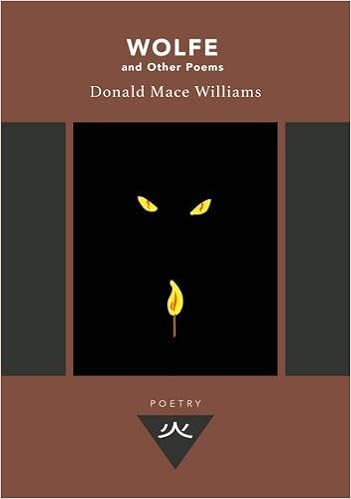
Wolfe and Other Poems by Donald Mace Williams, Wundor Editions, 2017


Wolfe and Other Poems is an extraordinarily good collection of poems, clearly written by a veteran writer. The underlying credo of the collection is very aptly summed up in the opening poem called, appropriately, 'Credo':
Step out under the stars on a dark night
Or open Rilke, Frost, or Dickinson.
Like that, all poems (mine too) should invite
Small breaths, quick nods, and ninety at the bone.
That last line is surely wonderful, surely anti-modern and anti-postmodern as it invites us into a coherent narrative, and there is also surely a sense of irony too about the 'ninety at the bone', since Williams is himself nearly 90 years old! This collection, then, could be seen to be an example of that late flowering of true poetry which sometimes accompanies masters of the art, most famously, Yeats.
The collection is actually quite brief and in two parts: there are 21 short lyric poems followed by 1 long narrative poem, Wolfe, which is a 'Western' re-telling of the Beowulf story. In a way they are quite separate things, and so in reviewing this collection I would like to consider them separately.
So far as the 21 lyrics are concerned, we have a master poet at work. At least 8 of the poems are sonnets, a definitive form in which to display skill, and here we see someone wrestling with his landscape, his heritage and history, and his feelings, and from all these particulars great and universal themes emerge. For example, 'The Canal, 1942' says, in its understated way, and as soldiers march past, 'how water that had just been green was red' - the disturbance of the water a prolepsis of the blood to come. Or, 'The Oak That Stayed,' in which finally, the poet asks:
Soon now, dear friend, I thought, you're down for good.
I almost think it thought the same of me.
That the 'Credo' poem cites Frost as an influence should be very clear from these two lines; but I think Williams, whilst influenced, has his own unique voice. And this leads on to the truly ambitious part of his collection, the narrative poem, 'Wolfe.'
I certainly would say, 'Buy this book; it's excellent poetry', but I almost must say that the 'Wolfe' poem leaves me with more mixed feelings. It is in one sense a triumph, for what do we want a narrative poem primarily to do? Well, we want it to engage us and keep us reading on; so, I found myself wanting to read it. And as far as a homage to the original Beowulf poem is concerned, it is extremely good. The narrative flows, there are some wonderful lines of pure poetry in it:
To ride out when the moon sat round
And dark on the far rim and sound
A sadness he could not explain,
As if pity and guilt had lain
Unknown through the long interval
Since the last moon had hung that full
Of melancholy, even fear.
And the transposition for Beowulf from Anglo-Saxon times to the American Wild West is extremely well done - I almost think a film could be made of it. So what is my problem with it?
The problem is a technical one. Williams has chosen his form to represent as closely as possible the original Anglo-Saxon. But he has substituted rhyming for alliteration, and opted for a tetrameter line, occasionally broken up with hexameters. Strangely, moments of brilliance occur often at these interfaces, these cross-over points:
Even him, and for just a breath
He felt a touch of pity at that great thing's death.
That's marvellous, but the trouble is, a long poem in iambic tetrameter, and rhyming tetrameter at that, invariably leads us to less than optimal sense, because it becomes more driven by rhyme. The fact is that the rhyming couplet form is really difficult to tell a compelling narrative in, and the best examples - like Crabbe's Peter Grimes for example - tended to use the pentameter line; in other words, the more extended line, which opens up far more syntactical and semantic possibilities. Of course, combine a tetrameter with a succeeding hexameter as in the example I quoted above, then you effectively have two pentameter lines. So because Williams is such a fine poet, he came to realise this - perhaps subconsciously - as he wrote the poem; for the incidence of hexameters increases as we progress.
But here's another thing: one needs to buy the collection anyway just so that one can have one's own debate with Williams' poetry, for it is a mark of how good it is that I am wrestling with my thoughts on its technical aspects now! So I invite all readers of The Society of Classical Poets to get their copies: there’s a lifetime’s wisdom and insight contained in Williams’ poetry, there are some truly beautiful lines and images, and finally there is also much that can be gleaned technically in the writing of poetry. If you love Frost, I think you will love this.
 Tha com of more   under misthleoþum
Grendel gongan,   Godes yrre bær.
—Beowulf
When he arrived at the cave or den, the hunter took a short candle in one hand, his six-shooter in the other, wiggled into the den, and shot … by the reflection of the light in her eyes.
—J. Evetts Haley, The XIT Ranch of Texas
Fat Herefords grazed on rich brown grass.
Tom Rogers watched three winters pass,
Then, all his ranch paid off, designed
A bunkhouse, biggest of its kind
In that wide stretch of Caprock lands,
To house the army of top hands
That rising markets and good rain
Forced and allowed him to maintain.
At night sometimes a cowboy sang
Briefly to a guitar’s soft twang
While others talked, wrote letters home,
Or stared into brown-bottle foam.
Rogers, white-haired as washed gyp rock,
Stood winding Cyclops, the tall clock,
One night and heard the sleepy sound
Of song across the strip of ground
Between the bunkhouse and the house.
He smiled and dropped his hand. Near Taos,
At night, pensive and wandering out
From camp, a young surveyor-scout,
He had heard singing just that thin
Rise from the pueblo. Go on in,
A voice kept saying, but he stood,
One arm hooked round a cottonwood
For strength until, ashamed, he whirled
And strode back to the measured world.
Strange, how that wild sound in the night
Had drawn him, who was hired to sight
Down lines that tamed. So now, he thought,
Winding until the spring came taut,
This clock, this house, these wide fenced plains,
These little towns prove up our pains.
He went to bed, blew out the light
On the nightstand, said a good night
To Elsa, and dropped off to sleep
Hearing a last faint twang.  
From deep
In the fierce breaks came a reply,
A drawn-out keening, pitched as high
And savage as if cowboy songs,
To strange, sharp ears, summed up all wrongs
Done to the wilderness by men,
Fences, and cows. With bared teeth then,
Ears back, the apparition skulked
Across the ridges toward the bulked,
Repulsive forms of house and shed,
Till now not neared. The next dawn’s red
Revealed a redder scene. The pen
Where calving heifers were brought in
In case of need lay strewn and gory,
Each throat and belly slashed, a story
Of rage, not hunger; nothing gone
But one calf’s liver. His face drawn,
Rogers bent close to find a track
In the hard dirt. Then he drew back,
Aghast. Though it was mild and fair,
He would always thereafter swear
There hung above that broad paw print
With two deep claw holes a mere hint,
The sheerest wisp, of steam. He stood
Silent. When finally he could, 
He said, “Well, I guess we all know
What done this. No plain lobo, though.
I’ve seen a few. They never killed
More than to get their belly filled.
This one’s a devil. Look at that.” 
He toed a carcass. Where the fat
And lean had been flensed, red and white,
From a front leg, a second bite
Had crushed the bone above the knee.
By ones and twos men leaned to see   
With open mouths. A clean, dark hole
At one side punched clear through the bole.
“That’s no tooth, it’s a railroad spike,” 
One cowboy breathed. Or else it’s like,
Tom Rogers thought, a steel-tipped arrow
Such as once pierced him, bone and marrow,
Mid-calf when, riding in advance
Of wagons on the trail to Grants,
Attacked, he turned and in the mud
Escaped with one boot full of blood.
At least the Indians had a cause,
He thought. This thing came from the draws
To kill and waste, no more. He spat
And said, “I’ll get hitched up.” At that,
Two cowboys jumped to do the chore
While from the pile by the back door
Others, jaws set, began to carry
Cottonwood logs onto the prairie  
Where horses dragged the grim night’s dead
Like travois to their fiery bed.
Rogers, with hands in pockets, stood
And said, “That barbecue smells good.”
But the half-smile he struggled for
Turned on him like a scimitar
And cowboys, sensing, kept their eyes
Down and said nothing. By sunrise
Of the next day the word was out
By mouth and telegraph about
The beast that crept out of the dark
And slaughtered like a land-bound shark,  
Evil, bloodthirsty, monstrous. Soon
The story was that the full moon
Caused that four-legged beast to rise
On two feet and with bloodshot eyes
To roam the plains in search of prey
Like some cursed half-man. In one day
Three of Rogers’ good cowboys quit,
No cowards but not blessed with wit
To fathom the unknown, and more
Kept glancing at the bunkhouse door
At night as if, next time, the thing
Might burst inside. “Hey, man, don’t sing,”
One said as a guitar came out.
There did seem, thinking back, no doubt
That music must have been what stirred
The anger out there. Some had heard
The answer. They agreed the sound
Came after Ashley’s fingers found
The highest note of that night’s strumming.
“Play it again you know what’s coming,”
Said one named Humphrey. Ashley, who
Like Humphrey had seen Rogers through
The hard first years of ranching there,
Loyal and lean, kept guessing where
The thing would strike next. Every night
He rode out to some downwind site
Deep in the wildest breaks and waited.
Nothing. But then, as if so fated,
Homeward at dawn, on this high rim
Or in that gulch he found the grim
Fang-torn remains of cow or calf.
Before long Rogers’ herd was half
What it had been. If half his hands
Had not already found the bands
Of loyalty no longer served
And drawn their pay and left, unnerved
By these unholy deeds, their boss
Would have no choice, with nightly loss
Of his best stock, but cut his force
Like cutting calves out with a horse.
Ashley, of course, would always stay 
Though everything else went its way.
Those two had cowboyed in all weather
And for a while had fought together
Against the Indians’ dwindling ranks,
Ending between the steep red banks
Of Palo Duro, that brief fight
That put the tribes to final flight,
Horseless and foodless. The next day,
Colonel Mackenzie took the way
Surest to keep the foe from turning
Back to his killing, theft, and burning.
He gathered his captains about,
Said, “Take these Indian horses out
And shoot them.” Rogers was the head
Of Ashley’s squad. The soldiers led
Horse after snorting horse away,
A thousand head to kill. They say
The white bones made, in later years,
A heap like bent and bleaching spears.
They might as well have been spears. Shorn
Of their chief means of war, forlorn,
Hungry, and whipped, the sad tribes found
The long paths to that plotted ground
Decreed as home for them, no more
To hunt and plunder. From that store
Of battle memories, of thirst
And weariness they shared, of worst
And best, noncom and soldier grew
To boss and hand when they were through
Clearing the way for settlement,
Theirs and the thousands like them, bent
On owning, taming that wild land.
Now, one had grown a wise top hand
In middle years, tough, and yet given
To strumming music, sometimes driven
To ride out when the moon sat round
And dark on the far rim and sound
A sadness he could not explain,
As if pity and guilt had lain
Unknown through the long interval
Since the last moon had hung that full
Of melancholy, even fear.
But Rogers, finding year by year
That sitting on a horse straight-spined
Was harder, most days stayed behind
While cowboys went out riding fence
Or pulling calves. His recompense
For his lost saddle was a chair
On his long, screened-in back porch, where
He rocked and watched his herd on grass
That not long back felt no hooves pass
But buffaloes’, there where the brim
Of Palo Duro Canyon, dim
And distant, showed. He was content.
Then came the night marauding. Bent
Or not, he started work again,
Helping fill in for the lost men
Who left for where no ghostly thing  
Came from the jumbled breaks to bring
Slaughter and ruin. So it went,
The kills still coming, no trap meant
For wolf or bear seeming to draw
Even a glance. One cowboy saw
A skulking form outlined at dusk
Once, and he claimed the creature’s tusk
Far off flashed like a polished blade.
He left. A dozen, shaken, stayed.

re.