Showing posts with label . The Darori Foundation. Show all posts

Friday, September 28, 2018

Rise and Kill First: The Secret History of Israel's Targeted Assassinations Audible Audiobook – Unabridged Ronen Bergman (Author), Rob Shapiro (Narrator), John Murray (Publisher) (Audio: John Murray/ Hardcopy: Random House)


“Rise and Kill First,” Ronen Bergman’s revelatory and astonishing history of Israel’s targeted assassinations, is a brilliant and prodigiously researched work. Readers will be riveted and amazed both by the scale of the killings carried out by the Israeli security services and by their tactical genius. They will likewise be appalled by the price in human lives, both innocent and not so innocent, at which Israel’s survival has been purchased. And they will be profoundly saddened as they comprehend how that survival has required the best and bravest of Israel’s young men and women to steel themselves against the fundamental moral precepts that govern ordinary life.

Bergman bluntly tells us – and most readers will agree – that the targets of Israel’s assassinations deserve to die. They have planned and
executed the cold-blooded murder of hundreds of Israeli civilians – men, women, children and infants – as they go about the activities of their daily lives. No cause, no grievance, can ever mitigate such atrocities. And in war, where there is no realistic possibility of arresting and trying the perpetrators, the justice of striking them down is, at least to this reader, not open to serious moral question.

But things are not always so simple, even when the target of an assassination is a terrorist murderer. As in one instance recounted by Bergman, it may happen that, despite the best efforts of counter-terror forces to ensure that the target will be at home alone when the hit occurs, he must be shot in front of his wife and teenage daughter. Unpleasant, says the operative in relating the story to Bergman, but the job must be done. And he does not hesitate to do it.

Infinitely worse, of course, is the loss of totally innocent life that is the virtually inevitable by-product of assassinations carried out from the air or by explosive. As detailed by Bergman, Israel does try to prevent this, and countless operations have been aborted because of the likelihood that unacceptable “collateral damage” will occur. But if no harm to innocents were deemed tolerable, many operations could simply not be carried out.

And that would not be without consequence to innocent Israelis. As Bergman shows, in some cases where operations were called off because of the likelihood of harm to innocent bystanders, the terrorists thus spared have gone on to commit attacks in which dozens of Israeli civilians were killed. That causes one security officer to tell Bergman that although it causes him genuine pain when an Arab child is killed in an Israeli operation, if a child is going to be harmed, he would prefer that the child not be Israeli. Is it wrong, or natural, to care for one’s own people first?

The Israeli government has no doubt about the answer. And although many innocent Arab lives were lost in the unprecedented number of Israeli assassinations that took place in response to the horrific wave of terrorism that struck Israel during the Second Intifada, those operations, together with the IDF’s Defensive Shield offensive in the West Bank, gave the lie to the familiar bromide that there is no military solution to terrorism. The Israelis found one, putting down the Second Intifada by force of arms. In winning that victory, Israel’s program of targeted assassinations played an important part.

More recently, Israel has targeted Iranian scientists working on the country’s nuclear program for elimination. That caused a female Mossad agent to stand up at one meeting and declare that her father was a scientist who had helped develop Israel’s nuclear capacity and ask her colleagues whether they would consider him a legitimate target for assassination by the enemy. Her question did not receive much by way of an answer, but the killing of Iranian nuclear scientists continued.

Unfortunately, the dazzling feat of groundbreaking reportage and riveting narrative achieved by Bergman in “Rise and Kill First” is marred in the book’s final pages by some unaccountable and highly misleading statements about the agreement concerning Iran’s nuclear program (formally known as the “Joint Comprehensive Plan of Action”(“JCPOA”))reached between Iran and six world powers in July 2015. Relating the prior clash between former Mossad chief Meir Dagan and Prime Minister Benjamin Netanyahu over the feasibility and wisdom of an Israeli military strike on Iran’s nuclear facilities, Bergman writes that the JCPOA , which mooted their debate, was

an Iranian capitulation to a number of demands that the ayatollahs had been rejecting for years. Iran agreed to dismantle the nuclear project almost entirely and to be subject to strict limits and supervision for many years into the future

In view of the heated controversy then raging in the United States over whether the JCPOA would effectively restrain Iran’s nuclear program, or put it on a glide path to becoming a nuclear-armed power, Bergman’s characterization of the agreement as an “Iranian capitulation” is nothing less than startling. And while one might argue that whether the deal was a good one or a bad one is a matter of opinion, Bergman misstates the underlying facts on which his opinion is based.

Thus, contrary to his assertion, the deal did not require Iran to “dismantle” anything, let alone its “entire[ ]” nuclear project; it only required that Iran mothball centrifuges that exceeded the agreement’s limits during its term. And the agreement provided that its restrictions on Iran’s enrichment of uranium to near-fissile purity would sunset after 15 years, hardly a prohibitive period to religious fanatics playing a long game.

Further, the agreement placed no restrictions on Iran’s development of ballistic missiles, and its research on high speed centrifuges was allowed to continue. As to the latter, even Barack Obama acknowledged that, after the agreement’s sunset, high-speed centrifuges could “[shrink] breakout times [for Iran to construct a nuclear bomb] . . . almost down to zero.”

Bergman refers to none of this in characterizing the JCOPA as an “Iranian capitulation.” Similarly, while asserting (without much explication) that the agreement represented “a double triumph” for Meir Dagan, he fails to mention that the JCPOA was opposed not only by Benjamin Netanyahu, but also by opposition leaders Isaac Herzog and Tzipi Livni, in very strong terms.

The result is that a not otherwise-informed reader could well come away with a false, or at best incomplete, picture of the issues surrounding the Iran nuclear agreement. To me that is a grievous fault, but one paragraph in a book of more than 600 pages cannot affect its overall quality.

Bergman ends his book with a lament that Israel’s intelligence and security agencies have been so successful as to foster “the illusion among most of the nation’s leaders that covert operations . . . could be used in place of real diplomacy.” Toward the end of his life, Bergman writes, Meir Dagan (who is the deserved hero of this book) realized “that only a political solution with the Palestinians – the two-state solution – could end the 150-year conflict.” Ill with cancer, Dagan tried with his last energy to persuade the Israeli public to elect a leadership that would vigorously pursue that aim.

But his efforts were to no avail. Despite the enormous adulation he enjoyed as the ultimate Israeli master spy, Dagan’s speech, as well as the calls of many other former heads of the intelligence and military establishments for a compromise agreement with the Palestinians
. . . have all fallen on deaf ears.

One can easily imagine what may animate the longing for peace of retired heroes like Meir Dagan. They have dedicated their lives to protecting Israeli civilians from the remorseless terrorists who would murder them, and that has required them to do terrible things. Reflecting on what they have seen and done, it would not be surprising for them to feel moral qualms and wish there was another way. As one former head of the security service observed in the film The Gatekeepers, “[w]hen you leave Shin Bet, you become a bit of a leftist.”

Being removed from the dirty business of targeted assassinations, the average Israeli voter may see things more dispassionately. What he sees is the Palestinians’ unremitting intransigence, their rejection without counteroffer of generous Israeli proposals for a two-state solution, the Palestinian Authority’s pension payments for the murder of Israeli men, women and children, and the Holocaust denial and gross anti-Semitism of Mahmoud Abbas, the supposedly moderate president of the PA.

What exactly can be done to persuade such people to negotiate in good faith about peace? Ronen Bergman doesn’t say.

Thursday, August 2, 2018

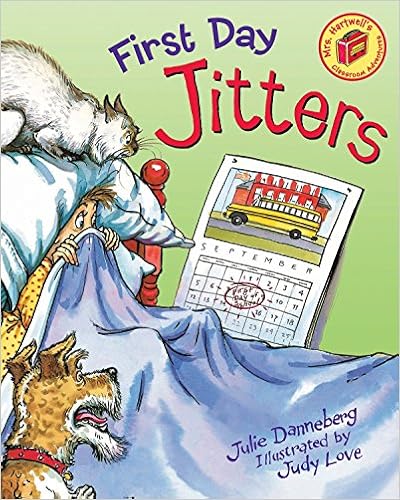
First Day Jitters (Mrs. Hartwells classroom adventures) Paperback – February 1, 2000 by Julie Danneberg (Author), Judy Love (Illustrator)(Charlesbridge )


I really like this book and read it every year on the first day of school to my second grade classes! It's a great way to start a class discussion and make the kids feel comfortable and that it's normal to be nervous on the first day. We share how each of us felt that first day and things we were nervous about like not knowing anyone. The story is about Sarah Jane Hartwell who starts the book in bed with the pillow over her head telling who we think is her father that she doesn't want to go and start over and that she's worried no one will like her. She finally gets out of bed and dressed and tries to hide in the car slouched down when the principal comes over and says they were wondering where she was and that she'd walk her to class since she's new. The book has a surprise ending when we find out that Sarah is the TEACHER and nervous about starting at a new school with a new class.

I bought this in my first year of teaching and it summed up how I was feeling and of course as most teachers are, I get nervous on the first day even though I've been teaching for years. The kids in class always love knowing that even teachers get nervous about the new school year and students - it makes teachers seem more human and relateable to the kids, which I really like.

I'm giving this 4 stars because the illustrations are HIDEOUS. The colors are fine and so are the background details, but the illustrations make the people's faces look distorted, exaggerated, and frightening. I also didn't like that the teacher says she'll "hate" her new school several times - I don't think that's the best choice of words so I replace that word when I read it aloud each year.

Overall, this is a great book to start the school year with!

Saturday, July 21, 2018

Botswana Safari Guide, 4th: Okavango Delta, Chobe, Northern Kalahari (Bradt Travel Guide) Paperback – June 17, 2014 by Chris McIntyre (Bradt Travel Guides)

Botswana: Okavango Delta, Chobe, Northern Kalahari (Bradt Travel Guides) by [McIntyre, Chris]

A safari in northern Botswana takes the traveller to a wilderness populated almost exclusively by wildlife. Here are the predators and their prey; here, too, are the elephants, the hippos and the astonishing birdlife of the Okavango Delta. This fourth edition of Bradt's Botswana Safari Guide provides unrivalled coverage of the region's wildlife, environment and history, as well as a thorough evaluation of when, where and how to go. The guide, written by an expert author, focuses on the country's most popular areas, the Okavango Delta and the Kalahari and Chobe deserts.

Tuesday, July 17, 2018

The Handmaid's Tale Margaret Atwood Introduced by the author Illustrated by Anna & Elena Balbusso (The Folio Society)

The Handmaid

‘Science fiction has monsters and spaceships; speculative fiction could really happen.’ Margaret Atwood’s chilling cautionary tale is illustrated by the Balbusso sisters.

Surely the essential element of a cautionary tale is recognition. Surprised recognition, even, enough to administer a shock. We are warned, by seeing our present selves in a distorting mirror, of what we may be turning into if current trends are allowed to continue. That was the effect of ''Nineteen Eighty-Four,'' with its scary dating, not 40 years ahead, maybe also of ''Brave New World'' and, to some extent, of ''A Clockwork Orange.''

It is an effect, for me, almost strikingly missing from Margaret Atwood's very readable book ''The Handmaid's Tale,'' offered by the publisher as a ''forecast'' of what we may have in store for us in the quite near future. A standoff will have been achieved vis-a-vis the Russians, and our own country will be ruled by right-wingers and religious fundamentalists, with males restored to the traditional role of warriors and us females to our ''place'' - which, however, will have undergone subdivision into separate sectors, of wives, breeders, servants and so forth, each clothed in the appropriate uniform. A fresh postfeminist approach to future shock, you might say. Yet the book just does not tell me what there is in our present mores that I ought to watch out for unless I want the United States of America to become a slave state something like the Republic of Gilead whose outlines are here sketched out.

Another reader, less peculiar than myself, might confess to a touch of apathy regarding credit cards (instruments of social control), but I have always been firmly against them and will go to almost any length to avoid using one. Yet I can admit to a general failure to extrapolate sufficiently from the 1986 scene. Still, even when I try, in the light of these palely lurid pages, to take the Moral Majority seriously, no shiver of recognition ensues. I just can't see the intolerance of the far right, presently directed not only at abortion clinics and homosexuals but also at high school libraries and small-town schoolteachers, as leading to a super-biblical puritanism by which procreation will be insisted on and reading of any kind banned. Nor, on the other hand, do I fear our ''excesses'' of tolerance as pointing in the same direction. Liberality toward pornography in the courts, the media, on the newstands may make an anxious parent feel disgusted with liberalism, but can it really move a nation to install a theocracy strictly based on the Book of Genesis? Where are the signs of it? A backlash is only a backlash, that is, a reaction. Fear of a backlash, in politics, ought not to deter anybody from adhering to principle; that would be only another form of cowardice.

The same for ''excessive'' feminism, which here seems to bear some responsibility for Gilead, to be one of its causes. The kind of doctrinaire feminism likely to produce a backlash is exemplified in the narrator's absurd mother, whom we first hear of at a book-burning in the old, pre-Gilead time - the ''right'' kind of book-burning, naturally, merely a pyre of pornographic magazines: ''Mother,'' thinks the narrator in what has become the present, ''You wanted a women's culture. Well, now there is one.'' The wrong kind, of course.

The new world of ''The Handmaid's Tale'' is a woman's world, even though governed, seemingly, and policed by men. Its ethos is entirely domestic, its female population is divided into classes based on household functions, each class clad in a separate color that instantly identifies the wearer - dull green for the Marthas (houseworkers); blue for the Wives; red, blue and green stripes for the Econowives (working class); red for the Handmaids (whose function is to bear children to the head of the household, like Bilhah, Rachel's handmaid in Genesis, but who also, in their long red gowns and white wimple-like headgear, have something of the aura of a temple harlot); brown for the Aunts (a thought-control force, part-governess, part-reform-school matron). The head of the household - whose first name the handmaid takes, adding the word ''of'' to show possession -''Offred,'' ''Ofwarren'' - is known as the Commander. It is his duty to inseminate his assigned partner, who lies on the spread thighs of his wife. THE Commanders, presumably, are the high bureaucracy of the regime, yet they are oddly powerless in the household, having no part in the administration of discipline and ceremonially subject to their aging wives. We are not told how and in what sense they govern. The oversight perhaps accounts for the thin credibility of the parable. That they lack freedom, are locked into their own rigid system, is only to be expected. It is no surprise that our narrator's commander, Fred, like a typical bourgeois husband of former times, does a bit of cheating, getting Offred to play Scrabble with him secretly at night (where books are forbidden, word games become wicked), look at his hoard of old fashion magazines (forbidden), kiss him, even go dressed in glitter and feathers to an underground bunny-type nightclub staffed by fallen women, mostly lesbian. Nor is it a surprise that his wife catches him/ them. Plusca change, plus c'est la meme chose. But that cannot be the motto for a cautionary tale, whose job is to warn of change.

Infertility is the big problem of the new world and the reason for many of its institutions. A dramatically lowered birth rate, which brought on the fall of the old order, had a plurality of causes, we are told. ''The air got too full, once, of chemicals, rays, radiation, the water swarmed with toxic molecules.'' During an earthquake, atomic power plants exploded (''nobody's fault''). A mutant strain of syphilis appeared, and of course AIDS. Then there were women who refused to breed, as an antinuclear protest, and had their tubes tied up. Anyway, infertility, despite the radical measures of the new regime, has not yet been overcome. Not only are there barren women (mostly shipped to the colonies) but a worrying sterility in men, especially among the powerful who ought to be reproducing themselves. The amusing suggestion is made, late in the book at a symposium (June 25, 2195) of Gileadean historical studies, that sterility among the Commanders may have been the result of an earlier gene-splicing experiment with mumps that produced a virus intended for insertion into the supply of caviar used by top officials in Moscow.

''The Handmaid's Tale'' contains several such touches of deft sardonic humor - for example, the television news program showing clouds of smoke over what was formerly the city of Detroit: we hear the anchorman explain that resettlement of the children of Ham in National Homeland One (the wilds of North Dakota) is continuing on schedule - 3,000 have arrived that week. And yet what is lacking, I think - what constitutes a fundamental disappointment after a promising start - is the destructive force of satire. ''Nineteen Eighty-Four'' had it, ''A Clockwork Orange'' had it, even ''Brave New World'' had it, though Huxley was rather short on savagery. If ''The Handmaid's Tale'' doesn't scare one, doesn't wake one up, it must be because it has no satiric bite.

The author has carefully drawn her projections from current trends. As she has said elsewhere, there is nothing here that has not been anticipated in the United States of America that we already know. Perhaps that is the trouble: the projections are too neatly penciled in. The details, including a Wall (as in Berlin, but also, as in the Middle Ages, a place where executed malefactors are displayed), all raise their hands announcing themselves present. At the same time, the Republic of Gilead itself, whatever in it that is not a projection, is insufficiently imagined. The Aunts are a good invention, though I cannot picture them as belonging to any future; unlike Big Brother, they are more part of the past - our schoolteachers.

But the most conspicuous lack, in comparison with the classics of the fearsome-future genre, is the inability to imagine a language to match the changed face of common life. No newspeak. And nothing like the linguistic tour de force of ''A Clockwork Orange'' - the brutal melting-down of current English and Slavic words that in itself tells the story of the dread new breed. The writing of ''The Handmaid's Tale'' is undistinguished in a double sense, ordinary if not glaringly so, but also indistinguishable from what one supposes would be Margaret Atwood's normal way of expressing herself in the circumstances. This is a serious defect, unpardonable maybe for the genre: a future that has no language invented for it lacks a personality. That must be why, collectively, it is powerless to scare. ONE could argue that the very tameness of the narrator-heroine's style is intended as characterization. It is true that a leading trait of Offred (we are never told her own, real name in so many words, but my textual detective work says it is June) has always been an unwillingness to stick her neck out, and perhaps we are meant to conclude that such unwillingness, multiplied, may be fatal to a free society. After the takeover, she tells us, there were some protests and demonstrations. ''I didn't go on any of the marches. Luke [ her husband ] said it would be futile, and I had to think about them, my family, him and her [ their little girl ] .'' Famous last words. But, though this may characterize an attitude - fairly widespread - it does not constitute a particular kind of speech. And there are many poetical passages, for example (chosen at random): ''All things white and circular. I wait for the day to unroll, for the earth to turn, according to the round face of the implacable clock.'' Which is surely oldspeak, wouldn't you say?

Characterization in general is weak in ''The Handmaid's Tale,'' which maybe makes it a poet's novel. I cannot tell Luke, the husband, from Nick, the chauffeur-lover who may be an Eye (government spy) and/ or belong to the ''Mayday'' underground. Nor is the Commander strongly drawn. Again, the Aunts are best. How sad for postfeminists that one does not feel for Offred-June half as much as one did for Winston Smith, no hero either but at any rate imaginable. It seems harsh to say again of a poet's novel - so hard to put down, in part so striking - that it lacks imagination, but that, I fear, is the problem.

The Lady Was Not for Hanging


The dedication of ''The Handmaid's Tale'' -''For Mary Webster and Perry Miller'' - holds clues to the novel's roots in our Puritan past. ''Mary Webster was an ancestor of mine who was hanged for a witch in Connecticut,'' Margaret Atwood explained. ''But she didn't die. They hadn't invented the drop yet'' - the part of the platform that falls away - ''so they hanged her but she lived.'' The author's studies in early American history under the Harvard scholar Perry Miller also informs her theme of religious intolerance. ''You often hear in North America, 'It can't happen here,' but it happened quite early on. The Puritans banished people who didn't agree with them, so we would be rather smug to assume that the seeds are not there. That's why I set the book in Cambridge,'' said the Canadian author, who lives in Toronto and has traveled widely in the United States. Like many of her fictional women (she has written poems, essays and novels, notably the feminist classic ''Surfacing''), she is wryly unpolemical. ''Feminist activity is not causal, it's symptomatic,'' she said of the book's antiwoman society. ''Any power structure will co-opt the views of its opponents, to sugarcoat the pill. The regime gives women some things the women's movement says they want -control over birth, no pornography - but there's a price. If you were going to put in a repressive regime, how would you do it?'' Despite the novel's projections from current events, Margaret Atwood resists calling her book a warning. ''I do not have a political agenda of that kind. The book won't tell you who to vote for,'' she said. But she advises, ''Anyone who wants power will try to manipulate you by appealing to your desires and fears, and sometimes your best instincts. Women have to be a little cautious about that kind of appeal to them. What are we being asked to give up?''

Friday, July 13, 2018

Lost Shepherd: How Pope Francis is Misleading His Flock Hardcover – February 26, 2018 by Philip F. Lawler ( Gateway Editions)


Thanks to the author for acknowledging that those of us who intuited early in this papacy that, while the cardinals may have thought they were electing Francis to reform the curia, Francis has a more expansive and radical view of his mandate, were not demon possessed. We must pray for the Church and for our clergy. However, we have the clergy we deserve. Witnessing the types of dissembling, intimidation tactics, and outright attempts to hoodwink people that we have come to associate with politics being deployed by some in the hierarchy against fellow members of the hierarchy, members of the wider clergy, and the laity has indeed been saddening. Worse still is the spectacle of people who should know and appreciate the harm being done to people's faith trying to avoid addressing the aberrant actions and pronouncements of the pope and some of his collaborators by blaming the media or feigning ignorance. When we remain silent in the face of scandal by members of our clergy or, worse still, try to justify such scandals we, are just as culpable as they.

Although respect for the office of supreme pontiff is our God-given duty as Catholics and is essential for the unity of the Church and our identity as Catholics, we do not advance in that duty by standing by silently while our faith is being stripped of meaning. We do not advance in the duty by keeping quiet or failing to notice as wolves in sheep clothing lead people astray, holding out before them a false promise of happiness now if only the Church would abandon its orthodox doctrines and teachings and compromise with the world. Rather, we best manifest our respect and esteem for the office by exposing and resisting all efforts to hijack the office to substitute a worldly theology based on human understanding for the gospel as preached by Christ and handed down by his disciples through the ages. For this if for no other reason, the author has done a great service by writing this book.

Monday, July 9, 2018

The Indonesian Killing Fields ..... The Army and the Indonesian Genocide: Mechanics of Mass Murder by Jess Melvin Routledge, 319 pp., $140.00 The Killing Season: A History of the Indonesian Massacres, 1965–66 by Geoffrey B. Robinson Princeton University Press, 429 pp., $35.00


On a baking hot afternoon in 2010, Jess Melvin, a young scholar from Australia, walked out of a government archive in Banda Aceh carrying a cardboard box. It was brimming with three thousand photocopied documents from the Indonesian army, and Melvin could barely believe her luck. These documents prove what has always been officially denied: the Indonesian army deliberately planned the 1965–1966 massacre in which up to a million suspected Communists died, one of the worst but least-known mass killings of the twentieth century.

Melvin’s astonishing discovery forms the core of her groundbreaking book The Army and the Indonesian Genocide: Mechanics of Mass Murder. She chronicles what happened after October 1, 1965, when six high-ranking army generals were yanked from their homes in the early hours of the morning and murdered by left-leaning junior officers who called themselves the 30 September Movement. They claimed they were forestalling a coup by a CIA-backed group of anti-Communist generals. Within hours, the junior officers were outmaneuvered by Major General Suharto, who staged a counter-coup and blamed the Communist Party of Indonesia (PKI) for the murders. By the end of the day, Suharto sent out orders to “completely annihilate” the 30 September Movement “down to the roots,” according to an army document Melvin discovered.

Melvin’s book will forever alter the telling of what happened next. Suharto, relying on an army command structure outside the control of the revolutionary leader and president-for-life Sukarno, issued orders to carry out mass killings. The documents Melvin uses to explain how the army planned and organized the killings shatter the official narrative that has prevailed for more than fifty years and continues to be taught to Indonesian schoolchildren today. This narrative holds that God-fearing, anti-Communist Indonesians, provoked for years by the PKI and outraged by the 30 September Movement’s treacherous murder of the generals, rose up in a frenzy to annihilate the PKI across the archipelago of 17,000 islands. According to the official 1966 Fact Finding Commission, the army could not contain the violence of the masses. Indonesia’s official history describes civilians seeking revenge, and there is no mention of the military’s participation in the killings. In fact, as Melvin’s book and other new scholarship show, Suharto instituted martial law, leaving the flamboyant leftist-turned-autocrat Sukarno stuck in the presidential palace as his supposedly unrivaled power dwindled away.

Melvin offers a fascinating day-by-day chronicle, based on the archival army documents and the 1965 annual report of the army commander in the northern province of Aceh, unearthed in a Dutch library. The documents reveal the army’s plan to pin the murder of the generals on the PKI and then wipe it out. The army took control of all newspapers and radio, and propaganda—including the fake and endlessly repeated story of how Communist women danced around the kidnapped generals as they castrated them and gouged out their eyes—played a huge part in whipping up support within Muslim militias, mostly organized by the army, for rounding up, detaining, and then killing suspected Communists.

The army’s own chronology, which Melvin annotates, shows how the provincial military commander would go to a town, denounce the PKI, organize a public demonstration, oversee the creation of militias and death squads, and then oversee the killings. They usually started with public executions of well-known PKI members and then escalated into mass roundups. According to Melvin, “The pogroms and public killings broke down normal social bonds and established violence as the manner in which the military’s campaign was to be pursued.”

In addition to proving the army’s involvement, the documents show that the tactics and scale of the killings evolved both for the army and for local civilians, who were often coerced into killing by the logic of “you are with us or against us.” Over the following weeks and months, annihilating the 30 September Movement morphed into annihilating the PKI. Melvin writes that it remains unclear if the army intended killings on such a vast scale. At some point, either because the army was unable to feed all the detainees or because the pogrom took on a life of its own, the army decided to kill them.

While Melvin’s cache of military records focuses on Aceh and the nearby provinces on the northern island of Sumatra, the documents prove conclusively that the Indonesian army expected a showdown with the Communists and devised a plan to exterminate them. Fortuitously, Melvin’s book appears at the same time as Geoffrey B. Robinson’s The Killing Season: A History of the Indonesian Massacres, 1965–66. Robinson, a veteran historian of Indonesia who teaches at UCLA, describes the broader cold war background to the massacre and digs into the available sources to prove that the US and British governments secretly backed the anti-Communist faction of the Indonesian army. The goal of the US and UK covert strategy, Robinson shows, was to provoke the PKI into action so that the army had a pretext to crush it.

An illuminating third perspective on this cold war epic comes from a Chinese scholar, Taomo Zhou, who adds missing information on the involvement of China in the showdown between the left and right in Indonesia. Zhou’s research started at Cornell University and is based on Chinese Foreign Ministry documents that were declassified in 2008, then reclassified in the summer of 2013. In an article in The China Quarterly, part of her forthcoming book, Migration in the Time of Revolution: China, Indonesia, and the Cold War, 1945–1967,1 Zhou, now teaching at the Nanyang Technological University in Singapore, documents that Mao Zedong and other Chinese leaders knew that the youthful and charismatic head of the PKI, D.N. Aidit, had developed plans to prevent an anti-Communist army takeover (relying on a handful of left-leaning officers), but the Chinese were not the architects of those plans.

For the first time, reading Melvin, Robinson, and Zhou together, the puzzle pieces of who was really behind the 30 September Movement and why its failure led to the murderous extermination of the left nearly fall into place. “Nearly” must be stressed since critical clues are still missing: most importantly from Indonesia, but also from the still-classified records of the CIA and the Defense Department in the US and of Britain’s MI6, and, crucially, from other documents from Chinese sources. But by early 1965, these studies reveal, both the army and the leaders of the PKI yearned to seize power, using President Sukarno as cover in their bid to destroy each other.

They also add to our understanding of how Indonesia, by 1965, was in the path of a cold war collision, with the US and Britain on one side and China on the other. Sukarno, who claimed to be the voice of his people and to reconcile Islam, nationalism, and socialism, marched ever leftward, decrying the “imperialist and neo-colonialist West” while embracing the PKI and the Chinese Communists. By this time, the PKIwas the third-largest Communist Party in the world, after China’s and the Soviet Union’s, claiming 3.5 million members and some 20 million sympathizers, mostly peasants and workers.

Robinson captures the high stakes: by 1965 the Vietnam War was raging; after the Sino-Soviet split China was determined to recast itself as the leader of revolution in Asia, and ensuring that Sukarno and the PKI looked to China for support and inspiration mattered to Mao. With China encouraging him, Sukarno had already launched the “Crush Malaysia” campaign, calling for an armed confrontation with the neocolonialists for creating Malaysia, which he called a puppet state meant to encircle Indonesia. Alarmed, President Johnson’s national security adviser McGeorge Bundy approved more intensive covert programs.

The extent of the programs remains unknown, but Robinson has pieced together the documents that have been declassified, which describe support for the Indonesian army and Muslim groups, and psychological operations designed to provoke the PKI into doing something—ideally attempting a coup—that would provide a pretext for the army to smash it and seize power.2 The British created a division for covert political warfare against Indonesia in Singapore. By mid-August, Bundy called for a meeting “to alert the President to the seriousness of the situation in which the Communists may take over Indonesia,” a development that Undersecretary of State George Ball said “would be the biggest thing since the fall of China.”

Meanwhile, China also was determined to win in Indonesia. Zhou describes how Mao thought that backing the PKI was essential to show the rest of Southeast Asia that China, not the Soviet Union, led the revolutionary movement. Aidit ingratiated himself with China. He soon became Mao’s—and China’s—man in Jakarta, as well as a forceful figure in Sukarno’s inner circle and in his cabinet. Mao and Zhou Enlai dangled promises of huge shipments of small arms and even nuclear technology. They supported Aidit’s plan, for which he also got Sukarno’s support, to create a Fifth Force and arm workers and farmers for the Crush Malaysia campaign.

By the summer of 1965, Aidit, who was confident one minute and anxious the next that the right-wing generals were about to launch a coup, had created a clandestine group that became the 30 September Movement, without the knowledge of the PKI politburo or the party’s millions of followers. The historian John Roosa, a professor at the University of British Columbia, was the first to delve into Aidit’s role in the poorly organized movement, which relied on a group of “revolutionary” officers without a clear plan.3

Zhou is the first scholar to find a document proving that Aidit described the movement to Mao. On August 5, Aidit was in Beijing when Sukarno collapsed from an unknown illness, and he decided to rush back to a tense Jakarta. Mao met with Aidit before he left, and asked what he would do if Sukarno died or the army moved to take over. Aidit laid out his plan for a preemptive strike. He told Mao, according to minutes of the meeting, that he planned to establish a military committee to confuse his enemies and to ensure that “military commanders who are sympathetic to the right wing will not oppose us immediately.” He then added, “After it has been established, we need to arm the workers and peasants in a timely fashion.”4

Zhou writes that the minutes do not include Mao’s exact reply, but that he told Aidit to be ready for both negotiations and armed struggle. It seems clear from Roosa’s and Zhou’s research that while Aidit was emboldened by Mao’s support and expected many guns to follow, China never sent any. Zhou, whose study is designed to add to the global history of the cold war, said in a telephone interview that opening up more of the historical record is unlikely in Xi Jinping’s China, where the 30 September Movement remains a taboo subject. As a result, Zhou said, she can only write about it in English.5

By August 1965, with Aidit back in Jakarta, the army and the PKI played out the last moves of this grand game of chicken. Over the next two months, tensions escalated, pro- and anti-Communist students clashed, and Sukarno’s self-proclaimed magic of holding the nation together was waning. Rumors flew. One day there were reports of guns from China arriving to arm the Fifth Force. Another day reports circulated that there was proof that the CIA-backed Council of Generals was going to seize power on October 5, Armed Forces Day. As the showdown was brewing, the US incited the right while China encouraged the left.


President Suharto with his wife and son at a military shooting range, Indonesia, 1967

Early in the morning of October 1, Aidit launched the plan he had outlined to Mao, only to watch it fizzle. There were no promised guns from China. PKI cadres did not rise up to support the 30 September Movement. Sukarno failed to support Aidit and the leftist officers. The brash and brutal Suharto moved quickly to declare himself commander of the army, and he ignored Sukarno’s order that afternoon to step down. Aidit fled to Yogyakarta and, during his weeks in hiding, he denied that he was involved in the killing of the generals and instructed party officials to call off any demonstrations and avoid any actions that would provoke an army response. Sukarno would protect the PKI, he told his followers. But Sukarno had no protection to offer; instead the unarmed PKI members and poor farmers and workers who belonged to affiliated organizations were defenseless as the army moved to annihilate them. Hiding in a village on the outskirts of Solo in Central Java, Aidit was tracked down by the army on November 22 and summarily executed.

Melvin adds a new understanding of why the army was able to move so quickly on October 1. Under the cover of the Crush Malaysia campaign, it had devised its separate command structure and trained civilian militias, ranging from gangsters to members of Nahdlatul Ulama (NU), Indonesia’s largest Muslim organization. When Suharto gave the order, the means to carry it out were already in place. Army commanders quickly met with NU leaders, handing out guns and money.6

In Aceh, Melvin follows what she calls “the coordination tour” of the Aceh army commander Brigadier General Ishak Djuarsa to explain how the civilian population was enlisted in the annihilation campaign. Mass rallies were held to rile up hatred for the PKI. Muslim religious leaders joined in, condemning Communists as atheists, giving religious sanction to the murders. The army issued edicts ordering civilians to crush the PKI. Death squads were formed all over the province, and by the end of October, Djuarsa declared war on the PKI. The militias and death squads collected accused Communists from army-run detention centers, mostly at night, and killed them, throwing the corpses into rivers or shallow mass graves.

Robinson argues that what happened in Aceh was not unusual. What makes the massacre in Indonesia remarkable is that the victims were killed for their political and ideological connections, not their ethnicity or religion. There were many willing executioners, especially in the Muslim militias, and Islam was often invoked to justify the violence. Yet in religiously diverse Indonesia, Christians, Hindus, and Buddhists also participated in the violence. Without the army, as Melvin and Robinson painstakingly detail, there would have been no mass murder. All of the evidence, Robinson writes, “points to the army as the chief instigator and organizer of the violence.”

One notable exception was the targeting of Chinese Indonesians, long stigmatized as clannish, unfairly wealthy, and not quite Indonesian. Hostility toward Chinese in the archipelago had simmered for hundreds of years, but the antipathy took on a political dimension in 1965. As Sukarno and the PKI allied themselves with China, anti-Communists in Indonesia insisted that Chinese Indonesians were disloyal and untrustworthy. Rumors spread that local Chinese were spies or were bankrolling the PKI. When the army went after the PKI, Chinese Indonesians became targets of violence as well, especially in Medan and Aceh. Melvin writes that indiscriminate violence against Aceh’s Chinese community erupted in 1966, and Djuarsa, the commander, issued an order that all “alien” Chinese had to leave by August 17, 1966. China sent ships to Medan to rescue them. Some ten thousand were expelled.

By March 1966, the killings slowed or stopped in most places. Suharto forced Sukarno to sign over his presidential powers on March 11, and embarked on his thirty-two years of strongman rule. Communism was outlawed. Every Indonesian had to declare belief in one of the official religions (Islam, Catholicism, Protestantism, Hinduism, and Buddhism)7 to inoculate against Marxism. Chinese characters were banned, and Chinese Indonesians were forced to adopt Indonesian names. China and Indonesia severed relations. The US and Britain, watching their covert dreams in action, rushed to help Suharto and the army and celebrated the elimination of the PKI. It was seen as a momentous victory and a turning point in the cold war. As if the massacre was a down payment for aid, money flowed into Indonesia in the form of loans, foreign aid, military funding and equipment, and private investment, especially in oil and mining.

Suharto’s New Order, as his rule was called, ushered in a period of high growth rates and harsh repression. Not only were up to one million alleged Communists massacred, another 1.5 million were imprisoned, and their families were shunned and discriminated against for generations. Suharto’s authoritarian control of society rested on the “latent danger of communism,” and an elaborate intelligence apparatus reached down to the village level to quash dissent or signs of leftism. Any talk about the killings became taboo except for the official version: the PKI had to be exterminated, and Indonesians themselves supported and joined in the mass murder.

This official version was embraced in high-ranking circles of the US and British governments. Many journalists and scholars accepted it as well. “The US government also went to extraordinary lengths to disguise its own role in the violence,” according to Robinson, including releasing Indonesia—1965: The Coup That Backfired, the CIA’s version of events, which echoed the Indonesian army’s official version. One reason the CIA took the extraordinary step of releasing this report, completed in 1968, was to counter what came to be known as the “Cornell Paper,” a dissenting study by two scholars, Benedict R. Anderson and Ruth T. McVey, who rejected the notion that the PKI was behind the September 30 Movement.8 Instead, they claimed that intra-army conflict was the cause. The Cornell Paper and the CIA’s report—both of which turned out to be wrong—gave rise to years of sharp polemics between pro–and anti–New Order officials and scholars.9

An exchange of letters in these pages from 1978 gives a taste of the bitter debate.10Francis J. Galbraith, ambassador to Indonesia from 1969 to 1974, lambasted an article by Huang Wen-hsien and David Hinckley, “In Indonesian Prisons,” based on an Amnesty International report that at least 55,000 and perhaps 100,000 political prisoners, rounded up in the annihilation campaign, languished as detainees without trial. Galbraith wrote that the Cornell Paper had been discredited, the role of the PKIhad been proven, and that Indonesia was still fighting a Communist insurgency:


The Suharto Government has understandably hesitated to turn loose the slightly more than 30,000 Communist cadres still detained (not 100,000 as alleged by Amnesty International) to fuel such an insurgency.

Anderson and McVey’s reply appeared a few months later. The CIA’s own study, they pointed out, showed that the PKI never took up arms or had plans to lead an insurgency. They also dismissed Galbraith’s claim that the PKI was to blame, instead asserting that it was the CIA that had the most to gain in stopping Indonesia’s “headlong slide to the left.” Anderson and McVey got a lot wrong in the Cornell Paper, but so did a subgenre of books in both Indonesian and English, including Marshall Green’s memoir of his time as US ambassador from 1965 to 1968, which obscures the role of the US and UK and the organizing of the killings by the Indonesian army.

According to Green, “The events of October 1, 1965, came as a complete surprise to us.” As for the killings, he describes them as the inevitable result of neighbor-against-neighbor antipathy with no mention at all of the army. In the last analysis, he writes,


The bloodbath visited on Indonesia can be largely attributed to the fact that communism, with its atheism and talk of class warfare, was abhorrent to the way of life of rural Indonesia.11

Since Suharto was toppled in 1998 and Indonesia entered its cacophonous and fragile democratic era, many have challenged the official narrative through personal memoirs, documentaries, and novels.12 Yet these efforts have led to a backlash, with a growing alliance of the right and Islamists attacking any effort to investigate the past as a neo-Communist threat to the nation. These deeply researched and authoritative new books should offer support to those who are searching for the truth. They have, at the very least, revealed the urgent need for a new account of a tragic chapter in Indonesia’s past that continues to haunt the present.


1

To be published by Cornell University Press in 2019. ↩
2

There was another declassification of US State Department records in 2017, which I wrote about in “Uncovering Indonesia’s Act of Killing,” NYR Daily, October 20, 2017. ↩
3

John Roosa, Pretext for Mass Murder: The September 30th Movement and Suharto’s Coup D’État in Indonesia(University of Wisconsin Press, 2006). Roosa discovered an analysis of the movement’s failure written by an army participant, Brigadier General M.A. Supardjo, who faulted the leaders for having bravado instead of a plan: “After all, the slogan of the leadership was always: ‘Enough, we just have to begin and everything else will just fall into place.’” ↩
4

Taomo Zhou, “Ambivalent Alliance: Chinese Policy Towards Indonesia, 1960–1965,” The China Quarterly, Vol. 221 (2015), p. 223. ↩
5

Robinson writes that while Zhou may be right, it is also possible that Aidit was only talking about how the party would react if Sukarno died. More documents from China are needed to settle this question. ↩
6

See Greg Fealy and Katharine McGregor, “Nahdlatul Ulama and the Killings of 1965–66: Religion, Politics, and Remembrance,” Indonesia, Vol. 89 (April 2010), p. 44. ↩
7

Confucianism was added in 2001. ↩
8

A Preliminary Analysis of the October 1, 1965, Coup in Indonesia (Modern Indonesia Project, 1971). The authors circulated the original paper among a small number of colleagues in early 1966 and sent it to two top US officials at the State Department. Anderson wrote later that he believed these officials sent the report to Indonesian officials, leading to the banning of both authors. In 1971, Cornell Press decided to publish their tentative study since it had become the subject of such debate. ↩
9

In 2007 the CIA’s report was republished, with some misleading changes, by Praeger Security International as Sukarno and the Indonesian Coup: The Untold Story by Helen-Louise Hunter. The 2007 book makes no mention that Hunter was the author of the 1968 CIA report. In a telephone interview, Hunter, now retired and living in Maryland, said she regretted that the 2007 volume did not disclose its origins as the CIA report. She also said she believes the CIA did not disclose all its files to her as she compiled her supposedly definitive report ↩
10

See The New York Review, February 9 and June 1, 1978. ↩
11

Indonesia: Crisis and Transformation, 1965–1968 (Compass, 1990). ↩
12

See Ian Buruma, “The Violent Mysteries of Indonesia,” in which he discussed Joshua Oppenheimer’s documentaries The Act of Killing and The Look of Silence, as well as Eka Kurniawan’s novel Beauty Is a Wound, The New York Review, October 22, 2015. ↩

Saturday, June 16, 2018

Brexit and Beyond: Rethinking the Futures of Europe. Benjamin Martill and Uta Staiger (eds). UCL Press. 2018.


With a deal on the post-Brexit transition period agreed in March, the UK and the European Union are getting closer towards building a framework for their new political, economic and security relationship. At the same time, both the process and consequences of Brexit remain complex and uncertain: as negotiators on both sides say, ‘nothing is agreed until everything is agreed.’

The difficulties of analysing the process and possible outcomes of Brexit are captured in Brexit and Beyond: Rethinking the Futures of Europe. The volume is a collection of short analytical essays that has for its main goal an examination of ‘the likely effects of Brexit for the futures of Europe and the EU’ (3). It points out that ‘neither the causes nor the consequences of Brexit can be adequately understood solely within the confines of the British state’ and that the UK’s departure is ‘of great significance for the future of Europe’ (260).

Acknowledging that Brexit is a unique phenomenon that needs to be examined from a multidimensional perspective and given the vast number of challenges that the EU27 need to address during the transition period and beyond, the editors make the case for an interdisciplinary approach. The first part of the book focuses on the impact of Brexit on actors including the UK, EU institutions and member states such as Germany, France and Ireland. The second part explores the effects of Brexit on various areas and policies, such as Europe’s political economy, legal and judicial issues, foreign and security policy and democratic legitimacy, and also offers a general evaluation of the future of Europe. Overall, five main questions are addressed: 1) How representative is Brexit?; 2) How do we define European integration?; 3) How to understand the crises that the EU is going through?; 4) What is the status of sovereignty and democracy in today’s globalised world?; and 5) What is the future of the EU after Brexit?


With regards to the last question, the authors and editors seem to agree that the effects of the UK’s departure on Europe will be significant, but the volume is not for those who expect a specific prediction of Brexit’s outcomes. Rather, a variety of possible developments is presented through different lenses. In terms of future consequences for the European economy, Waltraud Schelkle writes that the relocation of financial services from the City of London to the Euro area is likely to cause changes to the Eurozone’s regulatory approach and a strengthening of the euro in relation to the pound. Meanwhile, Christopher Bickerton warns that Brexit is just the tip of an iceberg of wider trends of discontent towards both European economic integration and national economic growth models. Elsewhere, Abby Innes points to a ‘crisis of ungovernability’ in the EU, caused by the pro-market reforms of the last thirty years.

In the field of legal and judicial issues, Deirdre Curtin assesses the options for future data-sharing arrangements between the UK and the EU, pointing out that while there is no precedent for the kind of deep partnership London is asking for, Brussels has been able to find flexible solutions before, as in the case with Denmark. Jo Shaw analyses the impacts on free movement, as well as the need to reassess the meaning of both national and European citizenship.

The future UK-EU relationship will also have an effect on European foreign and security policies. Amelia Hadfield points out that there are many formal and informal ways in which the UK can continue to be involved in European mechanisms while also seeking to be an independent ‘Global Britain’, and these interactions will have an effect on the future of European security. As Christopher Hill argues, the UK may not necessarily be ‘welcomed back to the centre of [EU] discussions’ on foreign policy (192). This could, for instance, lead the way for stronger Franco-German leadership in this sphere.

Last but not least, Brexit has important consequences for the future of the idea of the European Union, particularly the legitimacy of EU institutions. Euroscepticism is not a phenomenon exclusive to the UK. Many national election results suggest that citizens across the continent expect reforms at the EU level and an open debate on European policies. As Michael Shackleton observes, the EU27 will not ‘have the luxury, even if they had the desire, to stand still’ (204). Brexit has acted as a trigger for European leaders to search for a common post-Brexit European identity, produce visible and tangible benefits for citizens in the form of public goods and enable people to have a more direct role in EU politics.

The volume also puts forward a number of suggestions for the future of the EU, the changing nature of the EU27 and how European institutions could be modified in order to address the feeling that ‘something is rotten in Europe’ (10). Kalypso Nicolaïdis’s idea of ‘sustainable integration’ is one such proposal. She defines it as a ‘durable ability to sustain cooperation’ in the EU in the long term, a necessary change to make after Brexit in order to reshape a Union of which citizens want to be a part (213). In another chapter, Simon Hix suggests a model of ‘decentralised federalism’ for the EU: essentially a trade-off where member states would grant more competences to supranational institutions in some policy areas, while ‘granting a high degree of flexibility and discretion to the states in the application of central rules’ (78).

Elsewhere, Luuk van Middelaar urges the EU to show its commitment to protecting its citizens by finding a balance between providing economic freedoms and social protection in order to reassure both those who value the opportunities given by the EU and those who fear the ‘disorder and disruptions that the EU creates in terms of migration, competition for jobs, or the loss of national sovereignty’ (84).

Overall, while there is an agreement among contributors and editors that Brexit has served as a wake-up call that has encouraged an open public debate about the future of the EU, the diversity of the suggestions proposed in Brexit and Beyond demonstrates that there are many options on the table on how to move forward. This volume is also a good example of how comprehensive discussions can take place in an accessible format, not only in terms of its structure, but also as it is available to download for free, which opens the debate to the non-academic community as well.

From the time of the publication of Brexit and Beyond until now, much has already changed and much has already become outdated. As the editors admit: ‘Studying Brexit is like tracking a moving target’ (263). However, the book still fulfills its goal of demonstrating that Brexit has been a critical juncture for scholars and policymakers to ‘rethink the futures of Europe’, while exploring different types of scenarios and options, some of which have not been discussed before.

Sunday, May 20, 2018

The Perfect Omelet: Essential Recipes for the Home Cook Hardcover – May 2, 2017 by John E. Finn ,Countryman Press


A charmingly illustrated ode to omelets with step-by-step techniques and 100 recipes
The omelet is at once simple and complex, delicious at any time. John Finn’s mother was certainly a fan―she spent years searching for the perfect technique and has passed her knowledge, and her passion, to her son. Here Finn provides instructions for four master recipes―the classic French omelet nature, an American diner omelet, a frittata, and a dessert omelet―and delectable variations on each, including:
  • Omelet Bonne Femme (potatoes, bacon, and onion)
  • Many Mushrooms Omelet
  • Tortilla with Caramelized Onions and Serrano Ham
  • Chocolate Soufflé Omelet  
Omelettier John Finn leaves no eggshell unturned and provides readers with everything they need to find their way to their own perfect omelet.
Over 60 hand-drawn b&w illustrations

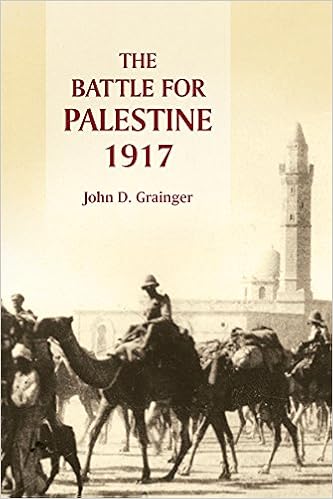
The Battle for Palestine, 1917 Paperback – October 20, 2017 by Teacher of History John D Grainger ,Boydell Press


Grainger has written an excellent book about this campaign in Palestine during World War I, also know as the Third battle of Gaza. He takes the time to describe what happened during the first two battles, how Allenby turned things around, and then the battle itself, through to the capture of Jersualem. Grainger is an admirer of Allenby but that does not stop him from pointing out Allenby's mistakes and changes of plan during the battle. He spends a chapter at the end of the book summing up why the British won in 1917 and its affects on the theater and the war as a whole. Grainger's sources are mostly regimental and divisional histories of the British, Australian and New Zealand units involved in the campaign. Those histories include a good deal of primary source material. Grainger also researched primary sources at several British, Australian and New Zealand libraries and archives. He has also made use of a good deal of other secondary sources in English. Because the book is from the British point of view, there is not much from the Ottoman or German point of view. Overall this is an excellent book and is recommended for anyone interested in the military history of this campaign in World War I.

Three battles for the control of the key fortress-city of Gaza took place in 1917 between the British' force (with units from across the Empire, most notably the ANZACs) and the Turks. The Allies were repulsed twice but on their third attempt, under the newly appointed General Allenby, a veteran of the Western Front where he was a vocal critic of Haig's command, finally penetrated Turkish lines, captured southern Palestine and, as instructed by Lloyd George, took Jerusalem in time for Christmas, ending 400 years of Ottoman occupation. This third battle, similar in many ways to the contemporaneous fighting in France, is at the heart of this account, with consideration of intelligence, espionage, air-warfare, and diplomatic and political elements, not to mention the logistical and medical aspects of the campaign, particularly water. The generally overlooked Turkish defence, in the face of vastly superior numbers, is also assessed. Far from laying out and executing a pre-ordained plan, Allenby, who is probably still best remembered as T. E. Lawrence's commanding officer in Arabia, was flexible and adaptable, responding to developments as they occurred. JOHN D. GRAINGER is the author of numerous books on military history, ranging from the Roman period to the twentieth century.

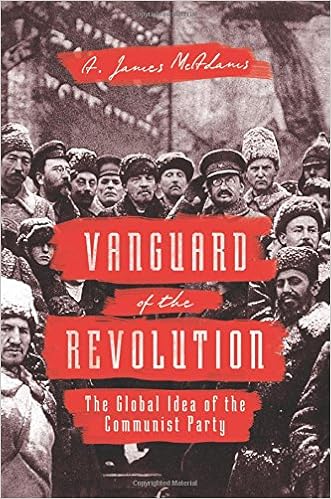
Vanguard of the Revolution: The Global Idea of the Communist Party Hardcover – September 5, 2017 by A. McAdams (Princeton University Press)


"The proletarians have nothing to lose but their chains. They have a world to win." The Communist Manifesto of 1848 gathered up all the ills of capitalism into an assurance of ultimate emancipation from wage slavery, but it had very little to say about how that transformation was to be effected. Karl Marx and Friedrich Engels concluded with a rallying cry, "Workers of the world, unite!" but what form was that common endeavour to take?

A distinction between the communist party as embodying the idea, or indeed the ideal, to which the makers of the new order dedicated themselves, and the party as an organisation capable of directing it, runs through this comprehensive survey of the communist party in all its national manifestations.

James McAdams, originally a German specialist and now a professor of international studies at Notre Dame University in Indiana, set himself the task of explaining the rise and fall of this fateful institution of the modern era.

The sudden collapse of communism at the close of the last century brought a flurry of post mortems. It seemed obvious after the event that the command economy was hopelessly inefficient, the official ideology bankrupt and that the ailing, sclerotic despots could not suppress the demand for freedom – even though some of those conducting the autopsies had argued previously that a totalitarian regime maintained total control.

McAdams rejects such blanket explanations. He sees different communist regimes that faced mounting difficulties in the 1980s responding with different strategies: Gorbachev's glasnost and perestroika, the erratic attempts to accommodate critics in Hungary and Poland, the path of modernising autocracy chosen in China.

A common predicament was how to breathe life into a revolutionary party that had become an instrument of control. That party was conceived by Vladimir Lenin as a body of dedicated individuals devoting themselves to the task of bringing revolutionary consciousness to a slumbering proletariat and guiding it to its appointed historical mission. This was a vanguard party primed for battle and governed by an iron discipline.

The Bolshevik party was the product of Russian circumstances that allowed very little space for open political activity and the breakdown of the Tsarist regime during the First World War that allowed Lenin's Bolsheviks to seize power. They did so in the expectation of a wider revolution across and beyond Europe, but the failure of these uprisings left them with the task of constructing socialism in one country, a country ravaged by civil war and beleaguered by external enemies. In response Lenin created the Communist International to direct the efforts of revolutionaries in all parts of the world and imposed his own party model on them.

McAdams rightly draws attention to the way that international communism was formed in an epoch of social upheaval, civil as well as global war, economic collapse, ethnic conflict, colonial uprisings and national humiliations.

The First World War was rightly known as the Great War, for it was unprecedented in its scale and ruinous consequences. It destroyed the longstanding Hohenzollern, Hapsburg, Romanoff and Ottoman empires, parcelling out their territories among new nation-states that were racked by ethnic and social conflict. It created destitution and left crippling weaknesses in the world economy. The history of communism ran in parallel with that of liberal democracy, and many of the new democracies failed to survive the rise of fascism over the following two decades.

If Lenin's vanguard party offered a model for gaining power, it provided little guidance how to govern. The practical tasks of government, moreover, had to be combined with the task of building a new socialist order.

As is well known, differences among Lenin's successors over how this should be done ended with Stalin using his control of the party apparatus to suppress dissent and then unleashing the Great Terror to eliminate any threat to his total domination. This culminated in show trials of his defeated rivals and a purge that removed the majority of leading party members – of 149 full and candidate members elected to the Central Committee in 1934, 98 were arrested and shot as enemies of the people.

As McAdams observes, Stalin replaced party rule with personal dictatorship; between 1934 and his death in 1953, there were just two party congresses. And his own cult of the all-powerful, all-knowing leader prefigured the way that communist regimes installed after the Second World War produced their own dictators.

This corrosive tendency to centralisation and absolutism was intrinsic to the vanguard party. Its centralised decision-making and disciplined obedience made it vulnerable to personal rule. In speaking for the party, the Titos, Maos and Hoxhas monopolised its authority and a lack of accountability was an endemic weakness. More than this, the party itself became a docile organisation incapable of animating the goal of a classless society.

The book excels in explaining the repertoire of methods whereby the new communist regimes that came to power after the Second World War tried to maintain their momentum. It has less to say about communist parties in the West, where the emancipatory endeavour was overlaid by the same form of party organisation, though without the sanctions available where communists ruled. The Cold War has little place in this history.

McAdams draws attention to an essay Lenin wrote towards the end of his life, when he likened the party to a mountain climber. During the ascent the climber reaches a point where it is apparent he can no longer continue. Naturally, he is discouraged at the prospect of retracing his steps to find an alternative route, conscious that those watching from the ground will ridicule his mistake. It is fortunate, said Lenin, the climber cannot hear their mockery for he needs to keep a clear head at high altitudes. It's a telling parable of the need to ignore criticism.

Nikita Khrushchev performed such a manoeuvre in 1956. Having won the struggle for succession, he set out to restore the party and his secret speech to the 1956 congress set Stalin's cult of personality against Lenin's supposedly collegial style of leadership. As he recited Stalin's crimes, it is said that a delegate had the audacity to demand of the new first secretary why he had done nothing to stop this tyranny. Khrushchev supposedly stopped and demanded "who said that?" Silence. "Now you understand why we didn't do anything," Khrushchev observed.

Khrushchev was not the only leader to retrace his steps and seek an alternative path to the goal of communism, but he and others after him found there was no way back from the party as a lifeless instrument of dictatorship. As McAdams puts it, instead of searching for a new path, they left the mountain behind. His carefully plotted account of their fruitless journeys shows why.

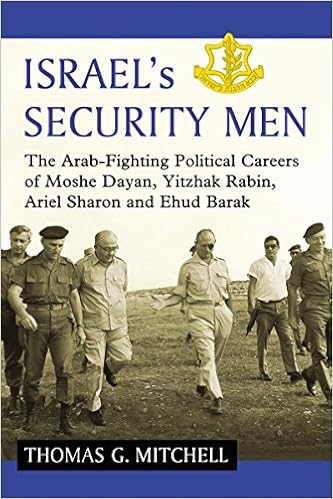
Israel's Security Men: The Arab-Fighting Political Careers of Moshe Dayan, Yitzhak Rabin, Ariel Sharon and Ehud Barak by Thomas G. Mitchell (McFarland)


Since the Six Day War in 1967, the tendency of IDF chiefs of staff to enter the political bearpit has been accentuated. Those who left under a cloud, such as David Elazar and Dan Halutz, probably were unlikely to pass over into this unholy of unholies; recent members of this elite, such as Gabi Ashkenazi and Benny Gantz, may well be biding their time. While Dan Shomron went on to chair Israel Military Industries, it was only the lanky Moshe Levi – Moshe v’hetzi – who had the good grace to retire to his kibbutz.

In the past, figures such as Mordechai Maklef and Haim Laskov entered public life to make a non-political contribution to Israeli society, but since 1967 the honored post of IDF head has been transformed into a shoo-in for a ministerial position. Accordingly the author of this interesting tome, Thomas Mitchell, argues that generals are given too much authority on departure from the military – and this, he believes, is demonstrated by the roller-coaster politics in which they immediately involve themselves.

In Israel’s Security Men: The Arab-Fighting Political Careers of Moshe Dayan, Yitzhak Rabin, Ariel Sharon and Ehud Barak, Mitchell looks at these four “Arab-fighters” turned politicians. Sharon, of course, famously was not appointed to head the IDF because he was often economical with the facts.

As Rabin told him when accepting him back into the fold: “Your trouble is, though, that people tend to believe you’re not a decent human being. I don’t know you well enough to say, I want to promote you, but I’ve got to be sure that your accusers aren’t right.”

Yet while Mitchell attempts to project a psychoanalysis of the inconsistent and often insulting Sharon in terms of his family background, “The Bulldozer” was revered as prime minister, someone who silenced the Islamist suicide bomber and broke the stranglehold of the official Left and Right.

Rabin – whom Sharon compared to Marshal Petain, the leader of Vichy France, shortly before his assassination – is depicted by the author as “an Israeli Eisenhower.”

On his return to Israel from his post as ambassador to the US, Rabin criticized both Dayan and Golda Meir for implying the Palestinians had no right to control their destiny; he never cared for the kippa-wearing West Bank settlers – whom he referred to as “propeller heads.”

Rabin’s first term of office was anything but a success; the Labor Party was in moral as well as political decline. Yet his willingness to resign after his wife’s misdemeanor in possessing a bank account in Washington marked him out from other politicians. Rabin’s inability to act out the public perception of programmed politicians endeared him to many – not least when he publicly flinched before shaking Yasser Arafat’s hand on the White House lawn in 1993.

The author is light on elucidating the ideological approach of each of his chosen subjects. Both Dayan and Sharon were admirers of David Ben-Gurion – and they followed him out of the right wing of the Labor Movement into a liaison with Menachem Begin’s camp. Sharon was the midwife in the birth of the Likud in 1973.

Dayan joined Shimon Peres, Teddy Kollek, Chaim Herzog and others in forming Rafi in 1965, and ended up as foreign minister in Begin’s first administration in 1977.

Dayan’s views on the future of the West Bank after 1967 changed regularly – and he would have seen this as embracing Ben-Gurion’s understanding of political reality. This was part of the attraction of both Dayan and Sharon to their supporters; indeed, Sharon’s volte-face in withdrawing from Gaza in 2005 can be understood in this light.

Rabin on the other hand was a member of Yitzhak Tabenkin’s Ahdut Ha’avoda, which advocated constructing a matrix of kibbutzim on the West Bank after its conquest in 1967; ideological Marxists could also be territorial maximalists.

Unlike other members of Ahdut Ha’avoda such as Yigal Allon, Moshe Carmel, Israel Galili and Uzi Narkiss, Rabin did not feel so ideologically deeply attached. When his old commander Allon turned towards dovishness in the 1970s, Rabin followed suit.

Barak, who came from a succeeding generation to the other three, also shared in a common belief – not to be entrapped by the ideology of the past, but to be sufficiently flexible in considering the reality of the present. When they came to power – like Begin – they began to understand the limits of treasured past principles. The transformation from slogan-spouter for the faithful to hard-nosed problem solver for the masses was most noticeable in the figure of Sharon.

Yet Sharon’s transformation in the mid-1990s from pariah to statesman is still shrouded in mystery. Indeed, Mitchell has difficulty in explaining this change.

Sharon always considered Benjamin Netanyahu “a political lightweight” – was it this perception that allowed him to become “the wise elder statesman”? Barak’s time in the Prime Minister’s Office was originally based on the public view that he too was “Mr. Security.” His stewardship of the General Staff Reconnaissance Unit was well-known – and he was the one who brought the news of his brother’s death at Entebbe to Netanyahu. But at the same time, he did not exude fidelity to yesterday’s “red lines” that many others, including Netanyahu, exhibited. In negotiations with the Palestinians, he was ready to officially divide an already divided Jerusalem.

The author shows that Barak commissioned a couple of opinion polls each week. Did Barak alter his approach in accordance with the latest poll findings? If not, why the obsession with polls? Was this flexibility or opportunism? Stanley Greenberg, his American pollster, collected $1.5 million during Barak’s short tenure in office.

This is a popular history of these four generals, and a panoramic appraisal of these men – with all their faults and flaws – who understood that the course of Jewish history had changed after 1948. 

Nine Lives of Israel: A Nation's History through the Lives of Its Foremost Leaders by Jack L. Schwartzwald (McFarland)


This study offers a concise yet comprehensive account of Israel's history as told through the lives of nine of its leading citizens and founders.  Each chapter chronicles a critical epoch in the Israeli saga and catalogs the impact made on that epoch by one of nine leading protagonists -- Theodor Herzl, Chaim Weizmann, David Ben-Gurion, Abba Eban, Moshe Dayan, Golda Meir, Menachem Begin, Yitzhak Rabin and Ariel Sharon.  The result is a narrative that traces events from the genesis of modern political Zionism in the late 19th century to the present.  A unique tapestry of history, biography and myth deconstruction, this 241-page volume provides a distinctive introduction to a nation that -- whether it inspires pride or incites passions -- never ceases to fascinate.


 Follow
Biography
Jack L. Schwartzwald is a Clinical Assistant Professor of Medicine at Brown University's Warren Alpert School of Medicine with eighteen years' experience in clinical teaching. He currently practices Hospitalist Medicine in Rhode Island. Before obtaining his medical degree from UMDNJ/New Jersey Medical School in 1989, he earned a BA in History from North Texas State University. 


Jack's articles and op-eds on Israeli history and politics have appeared in The Jewish Magazine, American Thinker, FrontPage Magazine, Israpundit, New Society, Rhode Island's Jewish Voice and Herald and Brown University's Daily Herald. He has contributed to three separate medical textbooks--most recently, Fred Ferri, ed., "Ferri's Clinical Advisor," Philadelphia (Mosby-Elsevier, 2010)--and served as principal physician-demonstrator in a series of instructional DVDs produced at Brown University detailing physical examination skills for 1st- and 2nd-year medical students. The original draft of "Nine Lives of Israel," won third prize at the 2009 Mayborn Literary Non-Fiction Competition in Dallas, Texas.

Lonely Planet Russia (Travel Guide) Paperback – March 20, 2018 by Lonely Planet (Author), Simon Richmond (Author), Ali Lemer (Author), Tatyana Leonov (Author), Mark Baker (Author), Marc Bennetts (Author), Stuart Butler (Author), Trent Holden (Author), Tom Masters (Author), Kate Morgan (Lonely Planet)


This 720-page book - the 8th (printed) edition of March 2018 - is an interesting and readable guide to the northern Asiatic country of Russia. This is a well-designed and presented guide, with useful maps. This is not a glossy guide with lots of colour pictures, but it is a well-designed and laid out guide, with colour used sparingly. It is intended to be a helpful guide to things to see and do, and not just a list of things to see and do.

This volume covers a lot of ground, so if you are only visiting one or two places, then a more specific book might be of more use; and remember, always be polite, don't mention the Ukraine, and you won't need the section on Siberia

It is broken down into four major sections:

Page 6 - Plan Your Trip:
This section is an introduction to Russia, showing/telling you what to look out for (Russia‘s Top 20), what you need to know in advance, and other important stuff for visitors.

On The Road (“The Guide”):
P054: Moscow
P125: The Golden Ring
P156: St Petersburg
P232: Western European Russia
P273: Kaliningrad Region
P291: Northern European Russia
P332: Volga Region
P369: Russian Caucasus
P411: The Urals
P435: Western Siberia
P475: Eastern Siberia
P540: Russian Far East

Page 592 - Understand (local culture):
This section has articles on history, landscape & wildlife, arts, people, cuisine, etc.

Page 666 - Survival Guide:
This section contains information on transport, the A-Z Directory, etc.
P691: Language
P701: Index

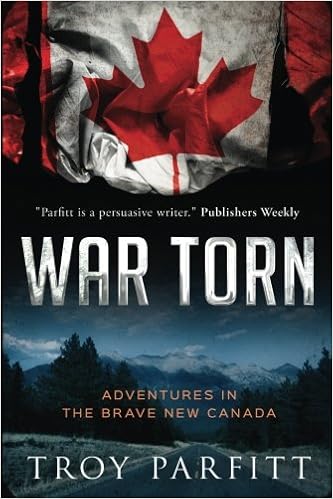
War Torn: Adventures in the Brave New Canada Paperback – August 29, 2016 by Troy Parfitt (Western Hemisphere Press)


War Torn: Adventures in the Brave New Canada is a transcontinental road trip account with a difference, politics mixed with travelogue as author Parfitt tries to get a handle on his homeland after a dozen years in Asia. He describes how, in his opinion, the country has shifted to the right, and how it has embraced shallow nationalism. He rues public indifference to and ignorance of Canadian involvement in Afghanistan.

Despite the political angle, it is still very much a travel book, one with a great sense of movement, the layers of info and politics restrained and woven in with skill. The book never drags because the writing is excellent and the pacing speeds up as we go through the provinces, more coverage on the eastern regions, less on the western provinces. There are a couple of fascinating side trips – one to Nunavat (“The Great White North’s Great White North”) and another to France (well, the island of Saint Pierre off the Newfoundland coast).

There are plenty of laughs in Parfitt’s books as he casts a cynical eye over some of the characters encountered, but the book is slightly depressing in some ways. The people and culture are often found wanting, and then there’s the author’s inability to reconnect to his country and his decision to once again leave it.

Despite Parfitt’s rather bleak take on Canada, if you were to ask me the simple question, "Did reading the book increase or decrease your desire to visit Canada?" I would say it made me keener to visit. Parfitt’s descriptive writing is superb, and War Torn beautifully conveys the size and majesty of the country, and the regional variations within it.

If Amazon had half stars, I’d take off half a star because I disagree with Parfitt’s political views, but I’ll give it five rather than four for its boldness.