Showing posts with label @israelbookrevs. Show all posts

Friday, September 1, 2017

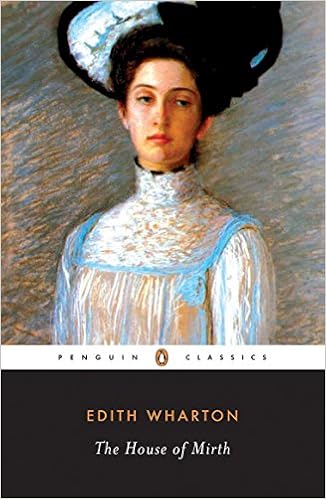
The House of Mirth (Twentieth-Century Classics) Reprint Edition by Edith Wharton (Author), Cynthia Griffin Wolff (Editor, Introduction) (Penguin Classics)


"The heart of the wise is in the house of mourning; but the heart of fools is in the house of mirth," warns Ecclesiastes 7:4, and so does the novel by Edith Wharton that takes its title from this call to heed. New York at the turn of the century was a time of opulence and frivolity for those who could afford it. But for those who couldn't and yet wanted desperately to keep up with the whirlwind, like Wharton's charming Lily Bart, it was something else altogether: a gilded cage rather than the Gilded Age.

One of Wharton's earliest descriptions of her heroine, in the library of her bachelor friend and sometime suitor Lawrence Selden, indicates that she appears "as though she were a captured dryad subdued to the conventions of the drawing room." Indeed, herein lies Lily's problem. She has, we're told, "been brought up to be ornamental," and yet her spirit is larger than what this ancillary role requires. By today's standards she would be nothing more than a mild rebel, but in the era into which Wharton drops her unmercifully, this tiny spark of character, combined with numerous assaults by vicious society women and bad luck, ultimately renders Lily persona non grata. Her own ambivalence about her position serves to open the door to disaster: several times she is on the verge of "good" marriage and squanders it at the last moment, unwilling to play by the rules of a society that produces, as she calls them, "poor, miserable, marriageable girls.

Lily's rather violent tumble down the social ladder provides a thumbnail sketch of the general injustices of the upper classes (which, incidentally, Wharton never quite manages to condemn entirely, clearly believing that such life is cruel but without alternative). From her start as a beautiful woman at the height of her powers to her sad finale as a recently fired milliner's assistant addicted to sleeping drugs, Lily Bart is heroic, not least for her final admission of her own role in her downfall. "Once--twice--you gave me the chance to escape from my life and I refused it: refused it because I was a coward," she tells Selden as the book draws to a close. All manner of hideous socialite beasts--some of whose treatment by Wharton, such as the token social-climbing Jew, Simon Rosedale, date the book unfortunately--wander through the novel while Lily plummets. As her tale winds down to nothing more than the remnants of social grace and cold hard cash, it's hard not to agree with Lily's own assessment of herself: "I have tried hard--but life is difficult, and I am a very useless person. I can hardly be said to have an independent existence. I was just a screw or a cog in the great machine I called life, and when I dropped out of it I found I was of no use anywhere else." Nevertheless, it's even harder not to believe that she deserved better, which is why The House of Mirth remains so timely and so vital in spite of its crushing end and its unflattering portrait of what life offers up. --

Saturday, August 19, 2017

Hitler’s American Model: The United States and the Making of Nazi Race Law. James Q. Whitman. Princeton University Press. 2017.


After the full horrors of Nazism were exposed at the end of World War II, eugenics – in Francis Galton’s words, the ‘science which deals with all influences that improve the inborn qualities of a race’ – as a social and scientific movement slowly faded from public view. The fact that Ronald Fisher, the founder of the modern discipline of genetics, and John Maynard Keynes, the economist whose ideas underpinned the New Deal, were active members of the Eugenics Society is now rarely discussed at Cambridge University, where they spent much of their academic careers. In 1954, the name of scientific journal the Annals of Eugenics was changed to the Annals of Human Genetics, and in 1965 the incoming recipient of the Chair of Eugenics at UCL, Harry Harris, became instead the Galton Professor of Human Genetics.
However, two groups of people have worked hard to keep memories of this great enthusiasm for a ‘scientific’ approach to institutionalised racism alive. The first are those who see understanding the history of the twentieth century as important, in order that we do not make the same mistakes again. They argue that whilst Nazism was the extreme end of the spectrum, it espoused views on nationality and race that were, if not mainstream, definitely recognised as acceptable by many sectors of society in Europe and the Americas. James Q. Whitman, author of Hitler’s American Model: The United States and the Making of Nazi Race Law, falls into this camp.

A legal scholar, Whitman identifies many commonalities between Nazi legislation in the early 1930s, which sought to exclude Jews from German public life, and the ‘Jim Crow’ laws enacted to exclude African Americans in the United States. Moving beyond commonalities, he argues that Nazi lawyers and the German public had a keen interest in US race law. As an example, he cites a 1936 article on racial policy in Neues Volk (New Volk), a propaganda newsletter from the National Socialist Office, which included a US map labelled ‘Statutory Restrictions on Negro Rights’, detailing disenfranchisement and anti-miscegenation laws in the 48 mainland US states.

The second group is the far-right movements arguably edging into the mainstream in the United States and Europe (in Hungary or Holland, for example). The chants of ‘Blood and Soil’ from the recent white supremacist rallies in Charlottesville, Virginia were an explicit reference to the Nazi ideal of ‘Blut und Boden’, and those gathered there are united by their fascination with fascist ideology and rhetoric. Vanguard America argues in its manifesto for an economy ‘free from the influence of international corporations, led by a rootless group of international Jews, which place profit beyond the interests of our people’. Membership of the Nationalist Socialist Movement (described on their website as ‘America’s Premier White Civil Rights Organization’) is ‘open to non-Semitic heterosexuals of European descent’, and a popular blogger for the alt-right, Mike Peinovich, who spoke at Charlottesville, hosts a chatshow entitled ‘The Daily Shoah’.

Hitler’s American Model is therefore a timely and sobering outline of how racist ideology can make its way into the political fabric of a country. It focuses on the changes introduced by Nazi lawyers post-1933, but we also learn much about how this developed in the United States. Whilst in the latter the case law excluding non-whites from public life developed over decades, in Nazi Germany the Nuremberg Laws were drafted and introduced in 1935, just two years after Hitler became Chancellor. Whitman’s main premise is that in this accelerated process, German lawyers and officials took inspiration and concrete guidance from legal practice across the Atlantic.
Image Credit: Crescent Theatre in Belzoni, Mississippi, 1939 (Wikipedia Public Domain)
Reading the book, two sets of records stand out, one for their presence, and the other for their absence. The first is the stenographic report of a 5 June 1934 meeting of the Commission on Criminal Law Reform. Whitman’s twenty-page description of this transcript makes for gripping reading, and is the highlight of the book (94-113). The second is the lack of documentation regarding a September 1935 US study tour by 45 German lawyers (132). The trip was apparently a reward for their success in finalising the Nuremberg Race Laws, laid out by Hermann Göring at a rally only a few weeks earlier. As Dr. Heubner, chief of the Nazi Jurists’ Association, told the tour group before they left: ‘through this study trip the upholder of German law [will] gain the necessary compensation for an entire year of work’ (133). According to Whitman, historical record tells us that on arrival in New York at a reception organised by the New York City Bar Association, the group were met by a noisy demonstration lasting six hours and requiring police presence. However, in Whitman’s words: ‘sadly it does not seem possible to learn more about how […] the group fared on their study trip’. From the first set of records we learn much about how German lawyers saw their American counterparts; from the second (missing) set, we might have learnt more about how the American establishment viewed legal developments in the Third Reich.
Assembled at the 1934 meeting were seventeen lawyers and officials, and their brief was to respond to the demands of the Prussian Memorandum of September 1933. This document argued that the ‘task of the National Socialist State is to check the race-mixing that has been underway in Germany over the course of the centuries, and strive towards the goal of guaranteeing that Nordic blood, which is still determinative in the German people, should put its distinctive stamp on our life again’ (85). The final outcome of such meetings was the Nuremberg Laws, which consisted of three parts. The first, the Flag Law for the Reich, declared the swastika to be the only German national flag. The second, the Citizenship Laws, created a difference between German nationals – ‘any person who belongs to the mutual protection association of the German Reich’ – and the citizen – ‘a national of German blood’ who was the ‘sole bearer of full political rights’ (29). The third, the Nuremberg Blood Laws, made a criminal offence of marriage or extramarital sex between ‘Jews and nationals of German blood’ (31).
Whitman’s description of the 1934 meeting is gripping for a number of reasons. Firstly, it allows the opportunity to witness the mechanics of discrimination at work. We learn how a group of highly educated professionals – civil servants, legal academics, medical doctors – came together to formulate a set of profoundly exclusionary and undemocratic laws. The committee was faced with a number of questions. How could one define race in legal terms? Could it be possible to criminalise an act (in this case, sexual relations between a German and a Jew) to which two competent parties had consented? Secondly, as a non-American, it further underscores the deeply institutionalised discrimination within US law at this time, belying the idea that a supposedly independent judiciary can act to protect the rights of all citizens.

In Whitman’s interpretation, two groups were pitted against each other at the 1934 meeting. The first were juristic moderates, who felt that a policy of criminalising German and Jewish sexual relations was not in keeping with the German legal tradition. German criminal law, they argued, was based on clear and unambiguous concepts (105). Race, and in particular Jewishness, was difficult to ‘scientifically’ define (105); judges could not be expected to convict on the basis of vague concepts. Their adversaries were Nazi radicals, who argued that a new Criminal Code should be drawn up using the ‘fundamental principles of National Socialism’ (96). According to Whitman, it was these radicals who championed American law, already touched on in the Prussian Memorandum.
As it turns out, the American approach to defining race was not greatly troubled by the absence of a scientific conceptualisation. For the Nazi radicals, this was a heartening example. Roland Freisler, a State Secretary attached to the Ministry of Justice, pointed out: ‘How have they gone about doing this [defining race]? They have used different means. Several states have simply employed geographical concepts […] others have conflated matters, combining geographical origin with their conception of a particular circle of blood relatedness’ (107). Freisler continued:
they name the races in some more primitive way […] and therefore I am of the opinion that we can proceed with the same primitivity that is used by these American states (109).
Contrary to established German tradition, Nazi radicals believed that judges should be given freedom to institute racist legislation, without the need to come up with a scientifically satisfactory definition of race.
Image Credit: ‘German Passengers Only’, Krakow train, 1941 (Wikipedia Public Domain)
It is hard to argue with Whitman’s assertion that Nazi jurists and policymakers took a sustained interest in American race law, and that this helped shape the legal and political climate that led to the promulgation of the Nuremberg Laws. What Whitman moves on to in his conclusion is the extent to which the American legal and political system as a whole, beyond Jim Crow, was permeated with racism: laws related to race-based immigration, race-based citizenship and race-based anti-miscegenation. He makes the unsettling argument that America and Nazi Germany were united by a strong egalitarian, if not libertarian (in the Nazi case), ethos. This ethos, he argues, is that of all white men being equal, and thus it was not surprising that Nazism – in Whitman’s view an egalitarian social revolution for those self-defining as of German origin – turned to America for inspiration. As Whitman points out, white supremacy has a long history in the US, from 1691 when Virginia adopted the first anti-miscegenation statute, to 1790, when the First Congress opened naturalisation to ‘any alien, being a free white person’ (145), to the anti-immigration laws that followed the San Francisco Gold Rush and the segregation laws that followed the Civil War. In the wake of the Charlottesville protests, he would probably argue against Senator John McCain’s assertion that ‘white supremacists and neo-Nazis are, by definition, opposed to American patriotism and the ideals that define us as a people and make our nation special’.

Whitman also questions whether the US common law system really serves to protect the freedom of individuals against an over-reaching state. He points out that the Nazis, rather than taking over the pre-existing German civil law system, reformed it according to a common law model. Nazi officials were given discretion to act in what they believed to be the ‘spirit of Hitler’ (149), brushing aside the legal scientific tradition of the moderates of the 1934 meeting. He argues that when it came to race, American ‘legal science’ tended to yield to American politics and left much racist legislation untouched.
So where does that leave the ‘science’ of eugenics, and the ‘legal science’ of the jurists working in a civil code system? Does a logically consistent approach of any kind protect individual liberties, or rather open up a way to discriminate based on supposedly objective measures? An important point, not explicitly made by Whitman but implicit throughout the book, is that the supposed objectivity of a scientific approach (whether in biology or the law) can easily be misused by those whose aims are clearly undemocratic and unegalitarian. On ‘The Daily Shoah’ and other racist websites, substantial discussion is devoted to ‘metrics’ related to, for example, race and IQ or sexual orientation and the chance of conviction for paedophile offences.

The Charlottesville protests were sparked by the decision to remove a statue of Robert E. Lee, a Confederate General in the Civil War: proponents of the removal argued that it served as a monument to white supremacy. Conversely, in the United Kingdom, a similar controversy surrounding a petition to remove Cecil Rhodes’s statue in Oriel College Oxford failed to lead to its removal, and the Galton Institute in London (which acknowledges its founding as the Eugenics Education Society in 1907, but disassociates itself from any interest in the theory and practice of eugenics) continues to fund research and award essay prizes on genetics for A Level students. Clearly retaining the material legacy of historical figures runs the risk of allowing their glorification (as in Charlottesville), whitewashing or suggesting implicit sanction of their actions.
However, in Whitman’s view, to try to forget or ignore these figures and their ongoing influence on society today is the more dangerous option. Hitler’s American Model is a thoughtful and carefully researched account of how the legal community in the US and Germany proved ‘incapable of staving off the dangers of the politicization of criminal law’ (159). He worries that:
the story in this book […] is not done yet […] what Roland Freisler saw, and admired, in American race law eighty years ago is still with us in the politics of American criminal justice (160).
Given recent developments in American politics, this should perhaps give us all pause for thought.
Thursday, July 20, 2017

Duress: Imperial Durabilities in our Times. Ann Laura Stoler. Duke University Press. 2016.

#is


Duress: Imperial Durabilities In Our Times is a timely book. It can be read as both a work of postcolonial analysis and a methodological guide to conceptual history. Ann Laura Stoler’s willingness to wrestle uneasy mercurial modern terminologies into valuable approaches to the histories of imperial formations is refreshing and exemplary.

Modern political discourse is inflected by threats and nostalgia: on the left and on the right, values appear under assault and facile apocalyptic defeatism obfuscates further debate. Stoler’s emphasis on the term ‘duress’ as a historical category of domination that looms over contemporary power dynamics is therefore a valuable contribution to the conceptual vocabulary of today’s politics. While other authors might struggle with the ambivalence of the term, Stoler exploits the elusive nature of ‘duress’ in order to rummage through the ruins of what modernity has deemed untimely.

For Stoler, duress is ‘a relation to a condition, a pressure exerted, a troubled condition […] it may manifest in a weakened constitution and attenuated capacity to bear its weight’. In the context of postcolonial studies, then, duress ‘is a relationship of actualized and anticipated violence’, pointing the reader towards a more subtle observation throughout the work: the threat of violence as a form of lingering power. A consistently able use of this term allows Stoler to take a point that has obsessed many historians further than most of the existing scholarship: historicised understandings of imperial sovereignty are better equipped than ideas of nation states to explain contemporary forms of exploitation and manifestations of resentment.
Image Credit: (Piervincenzo Madeo CC BY 2.0)

In her introduction, Stoler sees the exploration of duress as a way of mapping forms of occlusion – or the hidden – in traditional histories of empire, in order to address often invisible, overturned or neglected perspectives as the imperial origins of state dynamics and international relations are brought to the surface. Chapter Two deals with the failure to use the rhetoric of empire in discussions about Palestine. Chapters Three and Four constitute an assessment of the forgotten practice of punishment through colony-formation and the omission of discussions around this and other colonial practices from French history. Chapter Five explores the banality of modern uses of terms such as ‘benevolent empire’ and expands on the importance of using a historicised model of imperial sovereignty. Chapter Six pushes the Enlightenment links between knowledge and ideas of empire past the frontiers of the beginning of the nineteenth century to show how insecurity about the nature of information remains a central weakness in the modern state apparatus. Chapters Seven, Eight and Nine address the ways in which latent racism lies at the core of the modern idea of the French state and therefore appears to many as ‘common sense’. If this manifests itself politically today in the effervescent popularity of the Front National in France, it remains generally neglected in public discussion. Stoler uses her acute understanding of French politics and history in several chapters to show how her concepts can help us understand the woodwork supporting today’s political pillars.

Perhaps Stoler’s most outstanding contribution is her ability to show how much the notion of ‘newness’ – the idea that the leading conditions behind modern phenomena lack historical precedents – influences academic and public discussion of today’s problems. Scholars have argued this point at length: Antony Anghie suggests twentieth-century sovereignty was created ‘and improvised’ out of the colonial encounter, while Linda Gregerson portrays the formation of the nation as part of the retroactive logic of empire. But Stoler has managed to show how temporality – or rather the ‘uneven temporal sedimentation’ of empire – provides us with precedents that give a better historical context for addressing the problems of our time: waste lands, toxic dumping and the formation of ghettos are all the result of the logic of empire. In stark contrast with the liberal idea of the state, this logic relies on the threat of violence and porous borders of sovereignty to define rights.

Just how pertinent this logic is can be seen in the transferability of Stoler’s book to the most problematic political dimensions of 2017. Stoler’s discussion of nineteenth-century agricultural colonies as spaces that reveal how ‘being at risk and a risk is a fuzzier political line than most colonial stories would allow’ provides a precedent for today’s refugee camps. The common reading of the inequalities brought about by the economic crisis of 2008 as divided between the risk-makers who have the resources to shelter themselves from the risk they create and those who can only suffer through them is understood as reproducing the logic of empire, whereby nations ‘operate as states of exception that vigilantly produce exceptions to their principles and exemptions to their laws’. Hannah Arendt’s idea that imperial formations give rise to a ‘wild confusion of historical terminology’ can be best understood when considering the transformation of contested space and the problematic definitions of sovereignty in the face of historical contingency: ‘what happens to the threshold of transformation when unfinished development projects are put to other use […] when Soviet military camps are abandoned and remade as the Ukrainian-Polish borderlands?’

Book reviewers often attempt to review the book they wish the author had written. Throughout this work, Stoler demonstrates her understanding of the criteria behind today’s historiography – exemplified by her awareness of how and why both Michel Foucault and Edward Said’s contributions to the discussion on Palestine went largely ignored due to the political thorniness of the issue. If Stoler spends time engaging with the ways in which today’s perceptions have been shaped, this reader cannot help but wish more emphasis had gone into the historical formation of different ideas of imperial sovereignty themselves. The chapters that assess modern political discourse often suffer from an overreliance on a singular historical theory of imperial sovereignty that would benefit from more nuanced national contextualisation. This difference in opinion is merely one of emphasis. Nonetheless, Duress provides a great laboratory of ideas for scholars and for a public willing to engage with a deeply creative interpretation of modern politics.

Saturday, June 24, 2017

The Oxford Handbook of United Nations Peacekeeping Operations. Joachim A. Koops, Norrie MacQueen, Thierry Tardy and Paul D. Williams (eds). Oxford University Press


This volume is the latest offering from the Oxford Handbooks series, with similar publications already existing for the United Nations more broadly, the European Union, the World Trade Organisation, International Relations and Diplomacy. As with these other volumes, The Oxford Handbook of United Nations Peacekeeping Operations is intended to serve as a major reference work and totals some seventy-two chapters and in excess of nine hundred pages. The editors of the volume note in their introduction that ‘peacekeeping is arguably the most visible activity of the United Nations’. It is difficult to disagree with this assertion, making a major work that details the principles and aims of peacekeeping and explores their evolution through successive generations very welcome.

The seventy-two chapters which comprise the volume have been written by a diverse array of contributors from a range of backgrounds and disciplines who collectively share an enormous wealth of experience and/or expertise in matters pertaining to UN peacekeeping. They include academics, diplomats and military officers. The book is structured into two distinct parts. Part One is titled ‘Concepts and Perspectives’, and consists of five chapters which explore some of the key thematic issues relevant to UN peacekeeping. Part Two comprises the bulk of the text, and for each UN peacekeeping operation up to 2013 a brief chapter summarising its main features and activities is provided.

In Chapter One, Alex J. Bellamy and Paul D. Williams explore trends in peacekeeping operations from their first inception to the present day. Drawing on statistical data, they consider the locations in which peacekeeping operations have been deployed, the types of operations and their duration, and make comparisons between UN and non-UN operations. There is no express UN Charter basis for UN peacekeeping and in Chapter Two, Nigel D. White considers its status in international law, pinpointing the legal norms applicable to peacekeeping under UN auspices. The third chapter, by Joachim A. Koops and Thierry Tardy, is concerned with inter-organisational relations in peacekeeping processes. Although peacekeeping is most prominently associated with the UN, increasingly other organisations have come to undertake such functions – for example, the European Union, the African Union and NATO – and the challenges posed by these initiatives are given some attention here. In the next chapter, Thomas G. Weiss examines the humanitarian functions increasingly performed by peacekeeping operations, noting the need to maintain clear distinctions between the institutions of peacekeeping and humanitarian intervention, whilst acknowledging the impact of the ‘Responsibility to Protect’ doctrine on peacekeeping. The fifth chapter sees Paul F. Diehl and Daniel Druckman attempt to provide a framework against which the relative success of peacekeeping operations might be measured.
Image Credit: UN Peacekeepers Day 2013 Celebration in the DR Congo (MONUSCO)

Part Two’s systematic analysis of the sixty-seven UN peacekeeping operations created between 1948 and 2013 is broken down into four distinct historical periods, each preceded by a brief overview from the editors of the main themes and developments of the period in question. The first period covers the early years of the UN and spans from the creation of the United Nations Truce Supervision Organisation (UNTSO) in 1948 to that of the United Nations Yemen Observation Mission (UNYOM) in 1963. During this period, as the editors note, UN peacekeeping emerged as a significant but limited contribution to international efforts to maintain peace and security. The early operations were based on the core traditional principles of neutrality, consent to deployment on the part of the states upon whose territory the operations would be based and the non-use of force by peacekeepers other than in self-defence. This enabled peacekeeping to plug some of the gap caused by inactivity on the part of the UN due to the paralysis of the Security Council during the superpower struggle. The second distinct period covers the remainder of the Cold War era up until 1987. Relatively few new operations were created during this time, although peacekeeping became more institutionalised and some notable operations were nonetheless established, including the United Nations Peacekeeping Force in Cyprus (UNFICYP). This operation remains in place today, which perhaps speaks for its continued relevance, although it also reinforces the lack of any resolution to the situation that gave rise to its creation in the first place.

The end of the Cold War brought a new wave of opportunities for the United Nations to make a greater contribution to the maintenance of international peace and security. The expansion of peacekeeping formed a key part of the UN’s post-Cold War agenda as operations undertook a broader range of functions and the traditional principles of peacekeeping were called into question. The period 1988-98 marked the third distinct period in the evolution of UN peacekeeping. Operations began to take on functions pertaining to peacebuilding and increasingly found themselves deployed to internal conflict situations. The perceived failings of UN peacekeeping in the likes of the former Yugoslavia, Somalia and Rwanda gave rise to a degree of disillusionment over the very promise of peacekeeping, and its use declined. However, a surge was witnessed in the final period identified by the book, 1999-2013, with a record 100,000 uniformed peacekeepers being in the field in 2010. The early twenty-first century saw peacekeeping undergo a major re-evaluation in the form of the Brahimi Report (2000). Modern peacekeeping mandates tend to be broad and often have civilian protection at their very core, a far cry from those earliest operations created during the UN’s infancy.

This volume will be a much welcome addition to any library on the United Nations or related subjects. It will be of enormous use to scholars engaged in the study of peacekeeping, whether their perspectives are grounded in the disciplines of international law, international relations or defence studies, amongst others. It is eminently accessible while not neglecting to afford attention to some of the more difficult issues to have arisen in the context of UN peacekeeping. It serves two key objectives for the interested scholar in simultaneously providing critical analysis of some of the major themes and controversies inherent in UN peacekeeping practices, while also constituting a major source of reference for factual details of every operation to have been deployed over a period of 65 years. No reputable library should be without a copy.

Saturday, June 10, 2017

Vindictive Justice: Shakespeare, Revenge Tragedy and Early Modern Law by Derek Dunne (Palgrave Macmillan, 2016). ISBN 978-1-137-57286-8, 229 pp., £58.


The critical heritage surrounding early modern revenge drama has been inevitably dominated by Hamlet studies, with polite nods to Thomas Kyd’s Spanish Tragedy which inaugurated the genre, and Shakespeare’s own Titus Andronicus which preceded his more philosophical reflections on the idea of vengeance. Derek Dunne’s survey of the genre juxtaposes these canon-making texts with less prominent members of the tribe such as John Marston’s Antonio’s Revenge, or the even obscurer Tragedy of Hoffman (Henry Chettle), deftly sketching the developmental arc of the genre by drawing out structural, thematic, and rhetorical connections between the bigwigs and smaller fry. What stands out in this work is not merely the impressive range of texts it considers, but its methodological approach towards that strand of early modern drama which has attracted the greatest amount of analytical attention in the last century. Eschewing completely the ethical economics of vengeance or vengeance as remembrance in Elizabethan drama (comprehensively evaluated by John Kerrigan in his now classic work) or psychoanalytical/philosophical/moral discussions of retributive violence, Dunne uses the interface between early modern law and literature as his point of entry, focusing on the representations of law within plays which supposedly showcase lawless action.

The work begins with a succinct overview of the recent developments within the discipline of early modern law and literature, and astutely locates a gap in its engagement with the genre of revenge tragedy. Identifying Lorna Hutson’s pioneering Invention of Suspicion, as its starting point, the introduction declares that this work will build on Hutson’s analysis of forensic rhetoric in early modern plays but focus exclusively on revenge drama and ‘make new and concrete connections between specific plays and legal crises of their day’(p.11). The introduction also crisply outlines the overarching conceptual aims of the work and the critical commonplaces it wishes to modify: first, the work challenges the widely accepted oppositional relationship between legal justice administered by the state and private revenge, by highlighting the vindictive nature of structures of Elizabethan law itself. The first chapter analyses various jurisprudential histories and early modern legal treatises, to reveal that both the law and the avenger had a shared desire for retributive justice. Secondly, the work also aims to dismantle the myth of the ‘lone revenger’ or the revenger as a solitary vigilante, and to show that in many early modern revenge tragedies revenge is collective action, triggered by the failure of the judicial system, and manifesting itself in the form of communal action against a corrupt juridic-political order. This claim is borne out by Dunne’s analysis of individual plays in some of the subsequent chapters. While keeping the broader aims outlined at the beginning of the monograph in sight, each chapter focuses on one play in conjunction with a cluster of contemporary socio-legal issues refracted through the prism of dramatic representation.

 Thomas Kyd’s Spanish Tragedy established the archetype of the avenger figure in the character of Hieronimo, the Knight Marshall of the Spanish Court, who seeks justice for his dead son Horatio, murdered by Lorenzo, the King’s nephew. Within the person of knight marshall/ avenger Hieronimo, private revenge and public justice combine. Dunne suggests the play, through a number of mirroring trial scenes, presents to us the failings of a the judicial system caused by the misuse of royal prerogative, and this is why, for the morally upright legal officer Hieronimo, the distinction between justice and revenge collapses. This chapter also introduces the inter-relation between revenge and social reform. Hieronimo is denied justice partly because he belongs to the ‘middling sort’—he stands outside the charmed royal circle which provides Lorenzo and Balthazar with judicial immunity. Revenge tragedy thus offers a critique of the corrupt nexus between the judiciary and the political executive, and also a way of redressing the damage done by this entente.

[4] The next chapter analyses Titus Andronicus to reveal the ‘caveats and pitfalls of the English legal procedure’ (p.59) particularly the inadequacies of the evidential practices of English jury trial. This chapter opens with a reference to Holger Schott Syme’s influential work on jury trials and early modern theatre, and Hutson’s analysis of Titus as a displaced jury trial in which the absence of a participatory judicial system forces the avenger to don the mantle of the jury and become an evaluator of evidence. Drawing upon early modern legal treatises (Lambarde, Fortescue) and Cockburn and Green’s history of jury trials in England, Dunne posits that in the 1590’s the system of trial by jury was ‘under threat’, and not only does Titus’s displaced trial in fact refer to this crisis, but the play as a whole adumbrates the ‘dangers inherent’ (p. 69) in misinterpreting matters of ‘probability’ and ‘fact’ when human lives hang in the balance. In doing so Dunne significantly deviates from Hutson, who in fact questions the very premise of this ‘jury under threat’ scenario and forces us to re-evaluate the validity of Cockburn’s depiction of the system of trial by jury ‘as an institution in decline’ (Hutson, ‘Rethinking the “Spectacle of the Scaffold”’, p.36).

 This is followed by a discussion of John Marston’s Antonio’s Revenge which turns its gaze back onto the discussion of the corrupt alliance of judicial malpractice and abuse of royal prerogative, and sees revenge as an embodiment of the ‘spectre’ of socio-political unrest. In this play we have Piero who is both the tyrannical ruler and the corrupt judge, and who is ultimately brought down by a syndicate of avengers. Revenge takes the form of communal political action and Dunne suggests that there ‘is a strong sense that they (the avengers) are acting on the mandate of a wider social group’ (p.88).

The next chapter sees Hamlet as an anti-thesis to this idea of revenge as communal justice, as the avenger is shown to be isolated at a number of levels ranging from social to psychological. Hamlet is seen as not the archetypal but the exceptional revenge play, because of its conspicuous eliding of socio-legal issues. This chapter seems to be the least persuasive section of the monograph, and it is never quite clear how it fits into the larger pattern the book tries to establish. Besides a pithy summary of the extant scholarship surrounding Hamlet and the Hales vs Petit case recorded by Plowden, there is very little by way of legal issues. The figures of Fortinbras and Laertes are offered up in lieu of Hamlet, as characters who embody the socio-legal energies of the play. The analysis of Fortinbras’s role is too brief. We can see why Hamlet as the heir to the throne stands above the law, but why Laertes is seen as a figure whose ‘lower social standing places him outside the law’ (p.111) is never quite explained.

 The most canonical play of the genre is followed by the most obscure one: Henry Chettle’s Tragedy of Hoffman. The analysis of early modern piracy laws and the uneasy, amorphous boundaries between legal privateering and extra-legal piracy is used to foreground the vexed question of who can legitimately mete out justice to the wrong-doer, or, where can one draw the line between legal justice and extra-legal revenge. The repeated motif of the burning crown as the instrument by which the murderer Otho kills his victim, and is himself punished by the victim’s son, highlight the problematic nature of the sovereign prerogative of legal violence.

 The final chapter is on Middleton’s Revenger’s Tragedy, which is seen by Dunne as play of ‘post-participatory’ vengeance. The play—arguably one of the most reflexive plays of early modern theatre—is written after the characteristics of the genre have been ossified, and as such its primary commitment is to the aesthetics of the genre of revenge drama. It no longer looks beyond the theatre to engage in a dialogue with the socio-legal issues of its time, presents to us an intensely stylised iteration of the poetics of revenge. Dunne’s reading suggests the play cursorily hints towards King James’s altercations with Sir Edward Coke, but ultimately acknowledges that with the abatement of the specific legal crises which had plagued the English legal systems at the end of Elizabeth’s rule and at the beginning of James’s, vengeful violence on the early modern stage moved from the socio-legal realm to the aesthetic.

 Overall, the monograph is a concise but valuable study of early modern revenge drama from a unique socio-legal perspective. The writing is so lucid and engaging that even non-specialists and students can use this as an entry point into the nitty-gritty of English legal history. The book as a whole presents to us a persuasive narrative about the rise and apotheosis of the genre of revenge tragedy in conjunction with specific developments in the history of various strands of English law. For readers who are researching particular plays, it is also entirely possible to read the chapters individually, though, inevitably, the book as a whole offers a richer insight into the intermeshing of law and theatre in early modern England.

Friday, June 9, 2017

Hemingway :Swashbuck with and Outlandish Public Image...... Ernest Hemingway: A Biography by Mary V. Dearborn Knopf, 738 pp., $35.00 Ernest Hemingway: A New Life by James M. Hutchisson Pennsylvania State University Press, 292 pp., $37.95 Writer, Sailor, Soldier, Spy: Ernest Hemingway’s Secret Adventures, 1935–1961 by Nicholas Reynolds William Morrow, 357 pp., $27.99 The Short Stories of Ernest Hemingway: The Hemingway Library Edition edited and with an introduction by Seán Hemingway, and a foreword by Patrick Hemingway Scribner, 576 pp., $32.00 (to be published in July)


John F. Kennedy Presidential Library and Museum, Boston
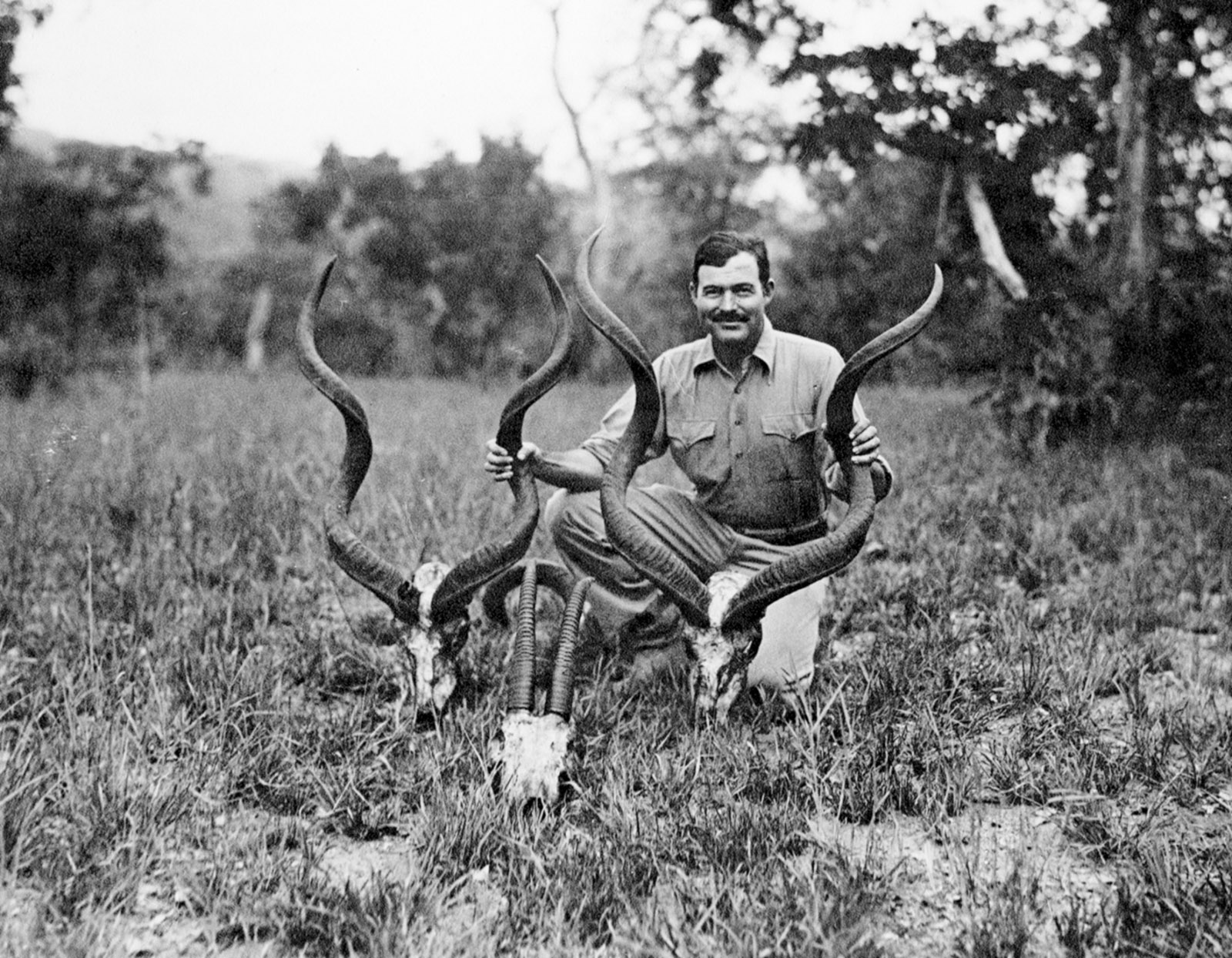
Ernest Hemingway on his first safari in Africa, 1933–1934

I am not sure whether the National Rifle Association has ever thought of having an official Nobel literary laureate. But if it did there is no doubt that it would choose Ernest Hemingway. There is a coffee table book, published by Shooting Sportsman in 2010, called Hemingway’s Guns. It is a lovingly detailed, lavishly illustrated, and creepily fetishistic catalog of the great writer’s firearms: the Browning automatic 5s, the Colt Woodman pistols, the Winchester 21 shotguns, the Merkel over/unders, the Beretta S3, the Mannlicher- Schoenauer rifles, the .577 Nitro Express with which he fantasized about shooting Senator Joe McCarthy, the big-bore Mauser, the Thomson sub-machine gun with which, he claimed, he shot sharks.

Here he is brandishing his Browning Superposed with Gary Cooper, or showing his Model 12 pumpgun to an admiring Hollywood beauty: “Hemingway enjoyed teaching women to shoot—and what man wouldn’t like to coach Jane Russell?” Here is the Griffin and Howe .30-06 Springfield—“already bloodied on elk, deer and bear”—leaning against a dead rhino. The one gun whose identity the authors seem unsure of is the one with which he took his own life in 1961.

Hemingway’s peculiar variation on American romanticism was a profound connection to the natural world expressed through violent assaults on it. In one of his still-radiant stories, “Fathers and Sons,” we find his alter ego Nick Adams driving through the landscape and “hunting the country in his mind as he went by.” This rapaciousness was what made Hemingway so famous in his own time as the gold standard of American masculinity. As David Earle has shown in All Man!, men’s magazines in the 1950s carried headlines like “Hemingway: America’s No.1 He-Man” and “The Hairy Chest of Hemingway.”*

Yet it is this same alpha-male persona and its relentless desire to possess women and defeat nature that now make Hemingway such a rebarbative figure. It is hard to sympathize with the Hemingway who cabled his third wife, the brilliant journalist Martha Gellhorn, while she was away covering World War II: “ARE YOU A WAR CORRESPONDENT OR WIFE IN MY BED?” Harder still not to recoil from accounts of Hemingway’s slaughtering of lions, leopards, cheetahs, and rhinoceros in Africa or from Mary Dearborn’s deadpan revelation of the fate of eighteen mahi-mahi caught by Hemingway and his cronies off Key West: “They would be used as fertilizer for [his second wife] Pauline’s flowerbeds.”

Add in the overwhelming evidence that Hemingway in his later decades was, in the words of his fourth wife Mary, “truculent, brutal, abusive and extremely childish” and his life story becomes ever more repellent. Yet the appetite for Hemingway biographies appears limitless. Michael Reynolds seemed to say everything worth saying in his five-volume life, published between 1986 and 1999, but the books keep coming. They raise the issue that Gellhorn stated in a letter to her mother when she was about to divorce Hemingway: “A man must be a very great genius to make up for being such a loathsome human being.”

The constant excavation of Hemingway’s life creates the danger of pollution: the loathsome sludge of the personality might seep into the genius of The Sun Also Rises, A Farewell to Arms, and a score of magnificent short stories. Unless, that is, we can see through the phoniness of America’s number-one he-man to the genuine tragedy of masculinity that is played out in Hemingway’s life and in his best work.

Early in his brisk new biography, James Hutchisson has an anecdote that smells as fishy as the dead marlin in The Old Man and the Sea. It sets up a physical and psychological contrast between the super-manly Hemingway and the weakling James Joyce in Paris in the mid-1920s:


Although Hemingway often made fun of the Irishman’s frail physique, this afforded opportunities for fun and games when they went out drinking together, as they did frequently. When Joyce got drunk and challenged some stranger in a café to settle things manfully, he would simply defer to his companion, saying, “Deal with him, Hemingway! Deal with him!”

Did Joyce really go around picking physical fights in bars? If so, his biographers have missed it. Michael Reynolds, in his authoritative Hemingway: The Paris Years, makes no mention of this delicious anecdote. The origin of the story, so far as I can tell, is Hemingway’s boasting thirty years later. He tells it an interview with Time when he won his Nobel Prize in 1954. And the context makes it obviously bogus. The tale of the frail Irishman hiding behind the manful American is part of a longer quotation in which Joyce allegedly tells Hemingway that “he was afraid his [own] writing was too suburban and that maybe he should get around a bit and see the world.” Nora, Joyce’s future wife, is listening in and adds her approval: “His wife was there and she said, yes, his work was too suburban—‘Jim could do with a spot of that lion hunting.’”


What makes the whole story so clearly specious is that Hemingway’s earliest lion-hunting exploits date from 1933, around a decade after this supposed conversation. Essentially, the Joyces are supposed to be admitting in the mid-1920s that Joyce would be a much better writer if only he were more like the Hemingway of later decades, the world-traveling he-man and hunter, and less like the weedy fellow who needed his bigger companion to “settle things manfully” on his behalf.

In one sense, this episode tells us nothing more than that Hemingway was a compulsive liar and that Hutchisson is foolish to fall for his bragging. The idea of Joyce on safari suggests the possibility of a parlor game: Proust in space, Kafka at the disco. But behind it there is an immense sadness. For this woeful fabrication substitutes for something that might have been real: Hemingway did have a deep connection to Joyce. His two earliest—and best—novels, The Sun Also Rises and A Farewell to Arms, pick up on what Joyce had done in Ulysses. As Hemingway admitted to George Plimpton in a celebrated Paris Review interview in 1958, “the influence of [Joyce’s] work was what changed everything, and made it possible for us to break away from the restrictions.”

These restrictions were partly questions of frankness about sex and the body and partly questions of style. Hemingway made wonderful use of the freedom that Joyce had created. The tone of his masterly Nick Adams stories comes from Dubliners: it is impossible to imagine his first fully achieved piece, “Indian Camp,” for example, without “Araby,” and we can see in Seán Hemingway’s introduction to the new edition of the short stories precisely how his grandfather ruthlessly cut eight pages from the beginning of that story to plunge the reader, as Joyce does, straight into the stream of the action. The long interior monologue of Harry Morgan’s wife, Marie, that ends To Have and Have Not may not be a worthy successor to Molly Bloom’s in Ulysses, but at least Joyce gave Hemingway permission to try.

However, even these influences may be less important than something else that Joyce gave Hemingway: a specific idea of maleness. That idea is the opposite of the persona Hemingway would later forge—the hero who “settles things manfully.” Joyce gave us, in Leopold Bloom, the hero who settles nothing and is not at all manful, the pacifistic little man who just lives with Molly’s cheating on him with Blazes Boylan. Hemingway’s great tragedy is that he delved deeper into this unmanliness but then turned himself into a parody of the very masculinity he had subverted. For all his talk of courage, his is perhaps the greatest loss of nerve in twentieth-century literature.

Hemingway had imaginative access to two things he hid behind his outlandish public image—a complex sexuality and a deep trauma. Since the publication in 1986 of the unfinished novel The Garden of Eden, which he had worked on fitfully from 1945 until 1961, it has been obvious that he was drawn to the excitement of crossing sexual boundaries. The he-man was at least in part imaginatively a she-man. It was already clear that Hemingway was drawn to the erotic potential of androgyny. In A Farewell to Arms, Frederic and Catherine discuss growing their hair to the same length so that they can be “the same one.” In the story “The Last Good Country,” Nick Adams’s sister cuts her hair off so she can be like him—“I’m a boy, too”—and Nick says, “I like it very much.” But The Garden of Eden took all of this much further. Catherine cuts her hair to match that of her husband David but she then becomes a boy, Peter, and David becomes a girl, also called Catherine. David/Catherine is penetrated by his wife/husband:


He lay there and felt something and then her hand holding him and searching lower and he helped with his hands and then lay back in the dark and did not think at all and only felt the weight and strangeness inside and she said, “Now you can’t tell who is who can you?”

Zelda Fitzgerald’s mockery of Hemingway as “a pansy with hair on his chest” was crude and inaccurate but no more so than Hemingway’s own self-caricature as the straightest hombre on the planet.

Mary Dearborn’s well-balanced and deeply researched new biography convincingly traces some of this interest back to Hemingway’s childhood and the way his formidable mother Grace insisted on treating Ernest and his older sister Marcelline as if they were twins, giving them the same haircuts and insisting that they be in the same classes at school. The strong antipathy that Ernest developed for Marcelline may be the first expression of his tendency to react to complicated desires by swinging to the opposite extremes.

But Hemingway’s sexual complexity may also be connected to his experience in World War I. Of course, he hated the idea that he was traumatized. In part, he hated it because it was a cliché. There is weariness as well as humor in the deadpan way the narrator of The Sun Also Rises, Jake Barnes, says of his first meeting with Brett Ashley: “We would probably have gone on and discussed the war and agreed that it was in reality a calamity for civilization, and perhaps would have been better avoided.” It is understandable that Hemingway, whose family was cursed through the generations by mental illness and suicide, did not wish to be reduced to a case study. In the 1954 interview with Time, he asked, “How would you like it if someone said that everything you’ve done in your life was done because of some trauma? I don’t want to go down as the Legs Diamond of Letters.” (Diamond was a gangster known for surviving multiple shootings.)

When Philip Young’s study of him appeared in 1959, Hemingway objected in a letter to Harvey Breit: “P. Young: It’s all trauma. Sure plenty trauma in 1918 but symptoms absent by 1928.” But if the exaggerated masculinity was an attempt to escape Hemingway’s attraction to androgyny, the exaggerated action-man poses, the constant return to sites of death and danger, were surely symptoms of the long reach of his early wartime experiences.

Hemingway was just eighteen—in our terms barely out of his childhood—when he arrived in Italy in June 1918. On his first day there, before he had even joined his Red Cross ambulance unit, he was called to the scene of a huge explosion at a munitions factory twelve miles outside Milan. His first taste of war was collecting the shredded parts of the workers’ bodies. Hutchisson quotes from the diary of one of Hemingway’s comrades, Milford Baker:


In the barbed wire fence enclosing the grounds and 300 yards from the factory were hung pieces of meat, chunks of heads, arms, legs, backs, hair and whole torsos. We grabbed a stretcher and started to pick up the fragments. The first we saw was the body of a woman, legs gone, head gone, intestines strung out. Hemmie and I nearly passed out cold but gritted our teeth and laid the thing on the stretcher….

Dearborn, rather startlingly, gives this incident a single paragraph in her hefty biography, and confines her commentary to the breathtakingly glib: “Ernest went at the job most likely with his heart in his mouth.” It seems more likely that a kid who had never seen violent death before, let alone picked up a torso with dangling intestines, and who “nearly passed out cold” at the sight, was profoundly affected.

When Hemingway used this experience, in the story/essay “A Natural History of the Dead,” he did so within a frame of exaggerated scientific objectivity. The story begins: “It has always seemed to me that the war has been omitted as a field for the observations of the naturalist.” The passage dealing with the incident moves quickly from “I” to “we” and says nothing about almost passing out. It attempts a cold, neutral tone:


I remember that after we had searched quite thoroughly for the complete dead we collected fragments. Many of these were detached from a heavy, barbed-wire fence which had surrounded the position of the factory and from the still existent portions of which we picked many of these detached bits….

It is worth noting the (unconscious?) repetition of “detached”—the first time in the passive voice to distance us from the action of Hemingway and his colleagues actually picking body parts from the barbed wire, the second to distance those “bits” from the humanity to which they so recently belonged. There is something unconvincing in the prose, something panicked in the need for so much insulation from the reality being described. And that distancing becomes downright demented when Hemingway goes on to write, with a surreal blitheness, that “the pleasant, though dusty, ride through the beautiful Lombard countryside…was a compensation for the unpleasantness of the duty.” This takes protesting too much to a riotous pitch. When, in an early draft of the story published in Seán Hemingway’s new edition, his grandfather writes, “As for thinking about what I had seen; I have never been much impressed by horrors so called,” it is simply very hard to believe him.

Yet what is also very striking about the account in “A Natural History of the Dead” is that it strangely prefigures his interest in hair as a token of sexual inversion:


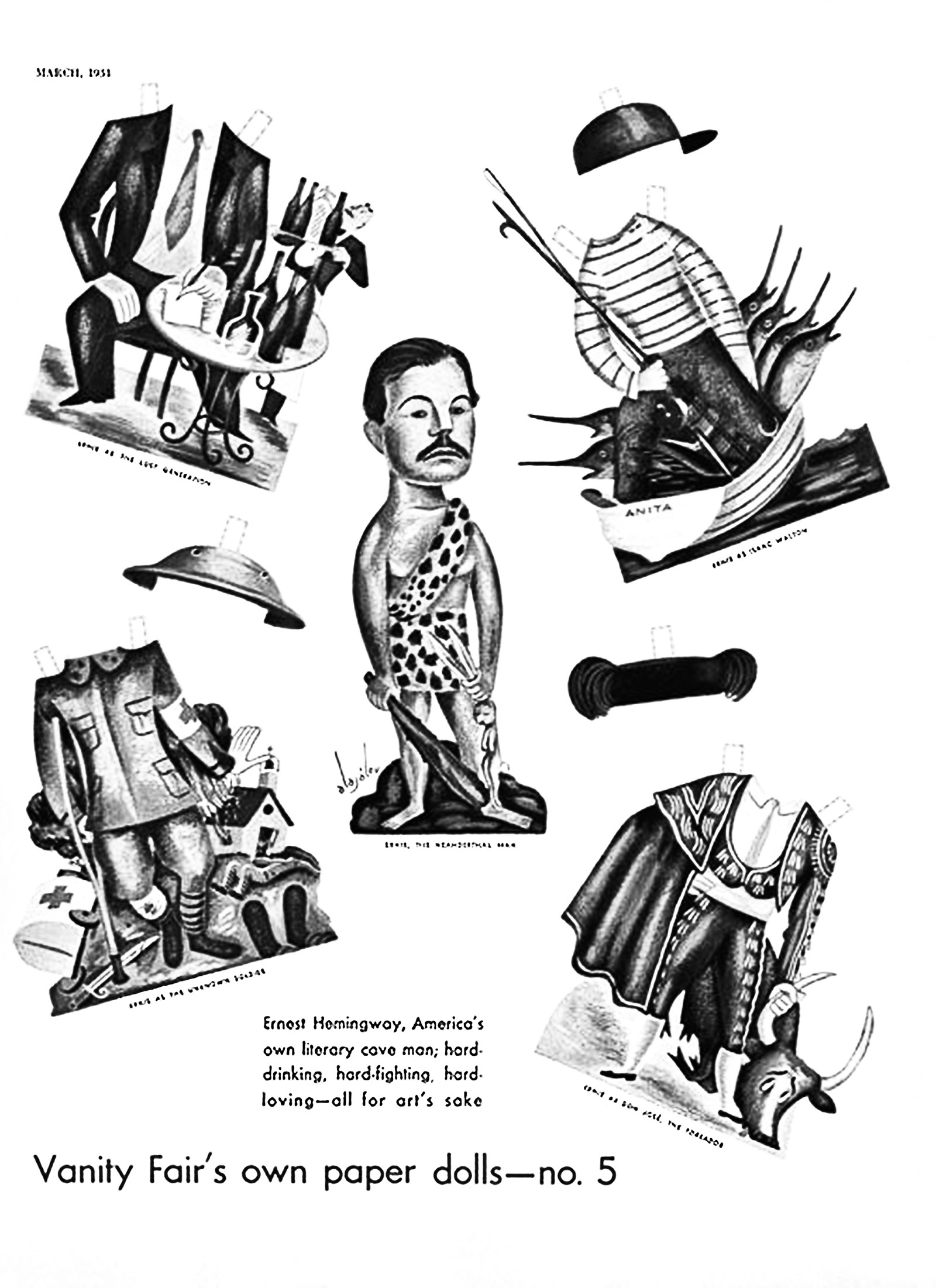
Regarding the sex of the dead it is a fact that one becomes so accustomed to the sight of all the dead being men that the sight of a dead woman is quite shocking. I first saw inversion of the usual sex of the dead after the explosion of a munition factory which had been situated in the countryside near Milan…. I must admit, frankly, the shock it was to find that these dead were women rather than men. In those days women had not yet commenced to wear their hair cut short, as they did later for several years in Europe and America, and the most disturbing thing, perhaps because it was the most unaccustomed, was the presence and, even more disturbing, the occasional absence of this long hair.Paper dolls of Ernest Hemingway from Vanity Fair, March 1934

Here we can see Hemingway’s secret erotic interests—the inversion of gender, the fetishizing of hair—becoming entangled with extreme violence and grotesque horror. We do not have to reduce all of his life to trauma to understand how powerful the disturbance must have been for a teenager. It is hardly surprising that Hemingway’s career as a childish liar began after this psychological wound was compounded by a real one in July 1918 when he was hit by shrapnel and machine-gun fire. He began to tell tales of phoney heroics and he never really stopped. When the boasting was not enough, he threw himself into reckless adventures, going on safari, becoming (illegally) a combatant in World War II, and accumulating more and more of the brain injuries that surely hastened his descent into mania.

Oddly, the bragging sometimes obscured realities that were remarkable enough in themselves: while Dearborn, for example, dismisses Hemingway’s wartime links with the NKVD, forerunner of the KGB (“The NKVD connection never really bore fruit”), Nicholas Reynolds’s fascinating new research in Writer, Sailor, Soldier, Spy shows that he was in fact working for both the Russians and the Americans: he visited the Chinese Communist Party deputy leader for the NKVD on a reporting trip to China in 1940 even though two years later he was producing fantastical reports for the FBI on German spies in Cuba. (In one, he suggested using jai alai players to throw bombs into U-boats.)

Hemingway saw enough action not to have to make risible claims like his more-or-less single-handed taking of Paris from the Nazis, as Man’s Magazine had it in a 1959 spread entitled “Ernest Hemingway’s Private War with Adolf Hitler”: “When the Allies first marched into Paris, they found a sign reading ‘PROPERTY OF ERNEST HEMINGWAY.’” The truth that is most obscured by the puerile bravado, though, is the tenderness of Hemingway’s best fiction, its subversion of all those notions of heroic masculinity. In his sad little book, Papa: A Personal Memoir, Hemingway’s son Gregory, who was transsexual, wrote: “What I really wanted to be was a Hemingway hero. But what the hell was a Hemingway hero?… A Hemingway hero was Hemingway himself.” In this he was mistaken. The Hemingway hero, at least in his most important work, is very far from the hairy-chested ultra-male that his father pretended to be.

In one of his finest stories, “The Short Happy Life of Francis Macomber,” the Hemingwayesque great white hunter Wilson is not the hero. The hero, Macomber, is a coward and a cuckold. In The Sun Also Rises, the central character Jake has no penis. And this is not, as it would have been in any novel before Hemingway, a symbol or a joke—it is a human reality evoked with gentle subtlety and infused with a simple dignity. Hemingway’s introduction of the fact is one of the great episodes of artistic tact. In the third chapter, the prostitute Georgette says, “‘It’s a shame you’re sick. We get on well. What’s the matter with you, anyway?’ ‘I got hurt in the war,’ I said.” In the next chapter, Jake is undressing and looks at himself in the mirror. Hemingway’s genius is to reveal Jake’s “hurt” to us while the narrator is also thinking about the furniture, so that what he sees in his reflection—his mutilated self—is mixed up with banal thoughts on the mirror in which he is seeing it:


Undressing, I looked at myself in the mirror of the big armoire beside the bed. That was a typically French way to furnish a room. Practical, too, I suppose. Of all the ways to be wounded. I suppose it was funny. I put on my pajamas and got into bed.

The rhythm of the prose here comes from Leopold Bloom, but Hemingway is going even further than Joyce did with Bloom in making the unmanned man a living and unashamed presence in literature. Jake recalls an Italian officer telling him that he has sacrificed more than life to the cause in losing his penis—but the book tells us that life, after all, is more than a penis.

This embrace of unmanliness extends, in A Farewell to Arms, to the ultimate betrayal of male honor, desertion from the warfront. Arguably the single greatest passage in Hemingway is about running away from war. The long description of the Italian army’s retreat from its disastrous defeat at Caporetto is a bravura set piece in itself and it is worth noting that for all Hemingway’s exaltation of true firsthand experience it was constructed from other people’s testimonies. It is also a farewell to valor and power and a manliness that expresses itself with a stiff upper lip. The carabinieri who question the retreating soldiers and summarily execute those they suspect of treason are models of coolness and courage, rendering those qualities appalling. That word “detachment” returns with all its psychotic resonance:


So far they had shot every one they had questioned. The questioners had that beautiful detachment and devotion to stern justice of men dealing in death without being in any danger of it.

And the hero of the book is literally fleeing from this beautiful detachment of the cool killer. He makes a break for it, both physically and psychologically: “I was through. I wish them all the luck…. But it was not my show any more.”

In these great books, Hemingway made his own break for it. And he nearly made it too. Aesthetically at least, manliness wasn’t his show anymore. Or at least it wasn’t until the world became enormously interested, not in his grown-up truths, but in his childish lies. He ran away from his own brave desertion. He became a male impersonator—the swagger, the drinking, the trading in of wives for younger models, the boy’s own adventures, the male harem of cronies, the exaggerated gestures of butchness became Hemingway and he became them. Having so heroically left the show, he ended up making a mock-heroic show of himself.

The Man Without a Face: The Unlikely Rise of Vladimir Putin Hardcover – March 1, 2012 by Masha Gessen ( Riverhead)


Vladimir Putin; drawing by John Springs

On November 20, 1998, Galina Starovoitova, a member of the Russian parliament, was murdered in the stairwell of her St. Petersburg apartment building. In the weeks that followed, obituaries, articles, and tributes to her life poured forth from all over the world. Starovoitova, almost everyone agreed, was different from the Russian politicians of the past and different from her contemporaries too. She spoke differently, moved differently, thought differently. She was frank, she was energetic, and she seemed genuinely interested in improving people’s lives. “Everything she said seemed fresh,” wrote The Economist. “Unlike others, she did not compromise her principles as the political winds changed; she did not mix business with politics,” wrote The Independent.

To many Russians at the time, Starovoitova’s murder also seemed like an ill omen, maybe even a major turning point in Russian politics. “If at the beginning of the reforms there was an enthusiasm, an optimism, now something has changed,” one of the thousands of mourners at Starovoitova’s funeral told The New York Times. “This shows that in our society the process of intolerance to each other is developing. I think we are on the brink,” a liberal Russian parliamentarian told Ekho Moskvy, a Moscow radio station.

It was therefore not for reasons of sentiment that Masha Gessen chose to begin The Man Without a Face, her book about Putinism—the system both created by Vladimir Putin and embodied by him—with the death of Starovoitova. In November 1998 Gessen was a young journalist who had just returned to Russia after several years in America, and she had thrown herself into Moscow life with enthusiasm. She was personally close to Starovoitova (“Galina clearly felt motherly toward me,” she writes), but she also understood Starovoitova’s symbolic significance:

In a country where political role models ran from leather-jacketed commissar to decrepit apparatchik, Galina was trying to be an entirely new creature, a politician who was also a human.

For Gessen’s generation—liberal journalists, activists, and intellectuals in Moscow, mostly under the age of thirty when the Soviet Union dissolved in 1991—Starovoitova represented the hope that Russia, and Russians, could change. Uncorrupt, unscripted, dedicated to serving her constituents, willing to speak honestly, able to laugh at her own flaws and foibles—perhaps if more politicians were like her, then Russia’s future really could be very different from the past. By contrast, her death represented the end of that hope. It also coincided with the beginning of Putin’s rise to power.

In fact, at the time of Starovoitova’s murder, Putin was not yet president of Russia. He had only recently been named head of the FSB, the successor organization to the KGB, and was just beginning to become a nationally known figure. Until then, most of his career had been passed in Dresden, East Germany, where he worked for the KGB, and in St. Petersburg where, Gessen believes, he continued working for the KGB, both while “studying” (he wrote a plagiarized thesis) and while serving as deputy to Anatoly Sobchak, the city’s flamboyant and rather opaque mayor in the tumultuous years between 1991 and 1996.

Though he hadn’t been in office very long, Putin had already begun to work on the FSB’s tarnished image, and the even more tarnished image of the KGB that had preceded it. He brought back the word “Chekist,” an old term for Lenin’s political police, coined in the 1920s, and used it with pride. He also initiated a minor cult of Yuri Andropov, the longest-serving KGB boss in Soviet history (1967–1982), as well as general secretary of the Soviet Communist Party, a post he held only briefly, in the year before his unexpected death in 1984. As FSB chief, Putin laid flowers on Andropov’s grave, and dedicated a plaque to his hero inside the Lubyanka, the KGB’s notorious Moscow headquarters. Later, as president, he ordered another plaque placed on the Moscow building where Andropov had lived and erected a statue to him in a St. Petersburg suburb.

But Putin wanted to restore more than Andropov’s name. He also, it seems, wanted to restore the old KGB boss’s way of thinking. Andropov, in Soviet terms, was a modernizer—but not a democrat. On the contrary, having been the Russian ambassador to Budapest during the Hungarian Revolution in 1956, Andropov understood very precisely the danger that “democrats” and other freethinking intellectuals posed to totalitarian regimes. He spent much of his KGB career stamping out dissident movements of various kinds, locking people in prison, expelling them from the USSR, and sending them to psychiatric hospitals, a form of punishment invented during his tenure.

At the same time, he understood, like everyone else in the KGB, that the Soviet Union was falling behind the West economically. At the time of his death he was seeking ways to solve that problem, and he’d come to the conclusion that the problem was one of order and discipline. Though some, in retrospect, believe he sought a “Chinese” path to reform—free markets and unfree politics—only one of his ideas was ever put into practice. This was the mass anti-alcohol campaign, which included everything from restricted vodka sales to the destruction of Moldovan vineyards, and it was carried out by one of his successors, Mikhail Gorbachev.


The anti-alcohol campaign was a disaster. Not only did it create sugar shortages—sugar being an ingredient used in homemade vodka—it may have unbalanced the budget, which had relied heavily on alcohol taxes. In any case, Gorbachev abandoned it, decided that more profound changes were necessary, and the rest is history. Nevertheless, nostalgia for Andropov remained widespread among the ex-KGB elite for a very long time. The idea that Andropov died “too early” was a sentiment common to many in the ranks of the former KGB, and some even saw a conspiracy in his premature death. “They got him before he finished the job,” one ex-officer told me wistfully in 2000, just after Putin became president for the first time.

But Putin had not only made his career in Andropov’s KGB, he also shared some similar experiences with the former secret police boss. As ambassador to Budapest, Andropov had been shocked when young Hungarians first called for democracy, then protested against the Communist establishment, and then took up arms against the regime, even lynching one or two secret policemen along the way. Putin had a similar experience in Dresden in 1989, where he witnessed mass street protests and the ransacking of the headquarters of the Stasi, the East German secret police. Both men drew the same conclusion: talk of democracy leads to protest, protest leads to attacks on the Chekists, better to stop all talk of democracy before it goes any further.

For Putin, and for those in his generation—twenty years older than Gessen, and as loyal to the old Soviet state as Gessen’s friends were to the idea of a “new Russia”—Starovoitova was not, therefore, a happy harbinger of a better future. On the contrary, she was exactly the kind of person who threatened the social order. Putin understood very well the threat that uncorrupt, unscripted politicians had posed to the KGB. By 1991, he also understood very well the threat that uncorrupt, unscripted politicians posed to the secret business empires then being created by the former KGB.

Gessen does not suggest that Putin killed Starovoitova. In fact, she never found out who killed Starovoitova. The two men eventually convicted of the murder were just hired hands. As Gessen writes, “It was impossible to determine what had gotten Starovoitova killed, precisely because her standing as an enemy of the system had made here a marked woman, a doomed one.” But her friend’s death did lead her to explore, as a reporter, the secret police milieu from which Putin had emerged, and within which there were so many people who might have wanted Starovoitova out of the way.

Her book, although focused on Putin and his rise to power, is at heart a description of this secret police milieu. Born in Andropov’s KGB, it subsequently gave rise to the Russian business and political elite, while never losing the deeply cynical worldview and twisted morality of the Soviet secret police. Putin did not bring this elite to power. On the contrary, it was already in place by the end of Boris Yeltsin’s first presidential term in 1996, by which time Yeltsin, not Putin, had already restored many of the powers and privileges of the security services, and Yeltsin, not Putin, had overseen the redistribution of Russia’s natural resources to a tiny group of insiders. But as Yeltsin’s health declined, some of these insiders began to look around for a trustworthy successor who would look after their interests, and Putin seemed to have all of the right qualities.

To illustrate the nature of Russia’s new ruling class, Gessen provides portraits of several major and minor characters who have functioned within and around it since the 1990s. They include Mayor Sobchak, a friend and mentor to both Putin and his sidekick, ex-president Dmitri Medvedev; Boris Berezovsky, the oligarch—a former mathematician and engineer—who, by his own account, introduced Putin to Yeltsin, and thus facilitated his rise to power; Andrei Bystritsky, the Russian state television executive who was one of the chief propagandists for the Putin reelection campaign in 2004; and Alexander Litvinenko, the FSB officer murdered by radiation poisoning in London in 2006, after attempting to expose corruption in the FSB. She investigates Putin’s role in the botched KGB coup attempt of 1991, in the terrorist attack on a Moscow theater in 2002, and in the prosecution of Mikhail Khodorkovsky, the oil oligarch who was arrested in 2003 after becoming too critical of Putin, and who remains in prison almost ten years later, following a series of what can only be called show trials.

In some ways the most intriguing of all Gessen’s characters—with the exception, of course, of Putin himself—is Marina Salye, a liberal St. Petersburg politician who was chairwoman of the Leningrad City Council’s committee on food supplies in 1991 (and who died at age seventy-seven on March 21 of this year). At that time, Sobchak was the mayor, Putin was his deputy, and Leningrad, now renamed St. Petersburg, ran out of food. The Soviet economic system was imploding, there had been a tobacco riot and a sugar riot, and the city council negotiated the purchase of several trainloads of meat and potatoes. Salye was sent to Berlin to sign the contracts, as Gessen relates:


“And when we get there,” Salye told me years later, still outraged, “and this Frau Rudolf with whom we were supposed to meet, she tells us she can’t see us because she is involved in urgent negotiations with the City of Leningrad on the subject of meat imports. Our eyes are popping out. Because we are the City of Leningrad, and we are there on the subject of meat imports!”

The meat never appeared. The money Salye thought was earmarked for the purchase—90 million deutschmarks—disappeared. Subsequently, Salye discovered that Putin, who then headed the mayor’s “Committee for Foreign Relations,” had been responsible for that swindle as well as many others. She learned that Putin, a trained lawyer, had knowingly entered into a dozen legally flawed contracts on behalf of the city, mostly involving the export of timber, oil, metals, cotton, and other raw materials. As Salye explained:


The point of the whole operation was this: to create a legally flawed contract with someone who could be trusted, to issue an export license to him, to make the customs office open the border on the basis of this license, to ship the goods abroad, sell them, and pocket the money. And that is what happened.

Although she couldn’t track most of the contracts, she did find documentation proving that Putin had arranged, at a minimum, for the export of some $92 million worth of commodities in exchange for food that never arrived. She wrote her findings into a report for the Leningrad City Council, which passed it on to Sobchak, with a recommendation that he fire Putin and his deputy. Salye also passed the report to President Yeltsin’s comptroller, who interviewed Sobchak and then passed the same conclusions on to President Yeltsin. “And then,” writes Gessen, “nothing happened.” The story died.

The Leningrad City Council did not get rid of Putin. Instead, Putin—or rather Mayor Sobchak—got rid of the Leningrad City Council, which was dissolved by administrative fiat not long afterward. Salye left politics. In 2000, she wrote one final article about Putin’s years in St. Petersburg. Its title: “Putin Is the President of a Corrupt Oligarchy.” That was her last public statement on the subject. Not long afterward she was so badly scared—by something—that she ran away. Gessen found her ten years later, living in a tiny village twelve hours’ drive from Moscow. Even then she wouldn’t tell Gessen what or who had frightened her. And there, once again, the story ends.

Ultimately, Salye’s story, like many of Gessen’s stories, is unsatisfactory. We never find out what really happened. We never learn why she retreated to the provinces. We never identify the mysterious forces that somehow conspired to prevent the missing meat and the crooked contracts from becoming a public scandal. Some of Gessen’s other reviewers have complained about her failure to fill in the blanks (“The problem is, there is no proof for these claims,” one wrote), or have implied, almost condescendingly, that she is a little hysterical and perhaps prone to “conspiracy theories.”

But that is exactly the point about contemporary Russia: there is no proof of anything that happened. Documents are missing. People have disappeared or changed their identities. Major companies are owned by nonexistent shell companies, and they mysteriously do the president’s bidding. After Putin’s government arrested him in 2003, Mikhail Khodorkovsky’s company, Yukos, was driven into bankruptcy and its enormous assets were sold at auction. Only one buyer turned up to bid at that auction: a previously unknown company called Baikal Finance Group, whose listed address turned out to belong to a vodka bar in the provincial town of Tver. That company then sold those assets for a pittance to Rosneft, another oil company whose major shareholder is the Russian government. Rosneft’s CEO, in addition to his business career, also held down a second job as President Putin’s deputy chief of staff.

Rosneft subsequently received the imprimatur of the international financial establishment and sold its shares on the London Stock Exchange. Yukos’s former owners and shareholders are now in jail or in exile, reduced to filing endless lawsuits against the Russian government. At times, some of them do seem a little hysterical. So does William Browder, the head of Hermitage Capital, who launched a personal and political vendetta against the Russian government after the FSB tortured and murdered his lawyer, Sergei Magnitsky, in a Russian prison. Before her death, the journalist Anna Politkovskaya could also seem a little hysterical. Her own book about Putinism contains even more convoluted tales of corruption, mafia, and terrorism than The Man Without a Face.*

Like Starovoitova, Politkovskaya was murdered in the stairwell of her Moscow apartment building in 2006, and that murder has never been solved either. As the corpses pile up, as the capital flows out of the country, as colonies of Russians pop up like mushrooms in London, Nice, and Courcheval, where they busily launder themselves into respectability, it’s hard not to develop a conspiracy theory, or even a set of conspiracy theories, to explain what is going on. Gessen’s book has some flaws—she fails to fill in some of the background, skips too quickly over major events, and slightly loses the chronology as a result—but it has one major virtue. Although Gessen is enough of an outsider to write beautifully clear and eloquent English, she is enough of an insider to convey, accurately, the wild swings of emotions, the atmosphere of mad speculation, the paranoia, and, yes, the hysteria that pervade all political discussion and debate in Moscow today.

Though not a standard biography, Gessen’s book is also very good at evoking not so much the precise details of Putin’s life but the culture and atmosphere within which he was raised, and the values he came to espouse. Though “proving” nothing, she establishes that he probably came from a family affiliated with the KGB—his parents were suspiciously well off, relative to their surroundings—and that he was certainly obsessed with joining the KGB from an early age. By his own account, he was drawn to the organization’s glamour, secrecy, and power. “I was most amazed by how a small force, a single person, really, can accomplish something an entire army cannot,” he told his official biographers. “A single intelligence officer could rule over the fates of thousands of people. At least, that’s how I saw it.” Putin, Gessen concludes, “wanted to rule the world, or a part of it, from the shadows.”

Eventually Putin was accepted into the secret service and went through extensive training, learning not only the techniques—including, presumably, how to assume an alias, live undercover, manipulate foreign bank accounts, and create fake companies—but also the mentality of a secret policeman. It is not by accident that Putin and his colleagues all share the KGB’s belief in the power of the state to control the life of the nation, and not by accident that they are instinctively skeptical of independent businesses, people, and organizations. In the course of their training, they learned that events cannot be allowed to just happen, they must be controlled and manipulated; that markets cannot be genuinely open, they must be managed from behind the scenes; that elections cannot be unpredictable, they must be planned in advance—as, indeed, Russia’s now are.

More importantly, these former secret policemen learned to assume that anyone critical of them and their regime is suspicious by definition, probably a foreign spy, and certainly an enemy. Starovoitova was an enemy, Politkovskaya was an enemy, Khodorkovsky was an enemy, but so is anyone who dares to question the absolute right of the Chekists to run Russia. At the end of The Man Without a Face, Gessen has appended a brief epilogue, describing the genesis of the “Snow Revolution,” the series of demonstrations that took place in Moscow at the end of 2011 and the beginning of 2012. She explains that these were unplanned gatherings—the product of text messages, telephone calls, Facebook postings, and conversations between friends—that no one was in charge of, and at the beginning no one was very enthusiastic about them either. She set off for one demonstration on December 5, quite reluctantly. “Who is going to brave this kind of weather to fight the hopeless fight for democracy?” she wondered. As it turned out, the answer was “everyone. At least, everyone I know.” Her generation, fed up with the corruption and menace of public life, had finally decided, spontaneously, to take to the streets. Momentum grew, culminating in a demonstration of 50,000 people on December 10, probably the largest opposition demonstration in Moscow since 1991.

But Putin, and Putin’s henchmen, did not believe these protests came about spontaneously, because the FSB does not believe that anything comes about spontaneously. Nor does the FSB believe that independent civic groups are really independent, that nongovernmental organizations are unconnected to foreign governments, and that “democrats” really believe in democracy. “Unfortunately,” he declared back in 2007, “there are still those people in our country who act like jackals at foreign embassies…who count on the support of foreign funds and governments but not the support of their own people.” This was a direct warning to Russia’s tiny community of human rights and trade union activists, and it was perceived as such at the time.

On the night of his third and most recent reelection on March 4, Putin repeated this charge, this time describing the protesters—the men and women of Gessen’s generation—in stark and one might even say hysterical terms. “We showed that no one can impose anything on us,” he declared with great passion, tears welling up in his eyes:


We showed that our people can distinguish between the desire for renewal and a political provocation that has only one goal: to destroy Russian statehood and usurp power.

Putin doesn’t merely dislike his would-be opponents, in other words, he believes that they are sinister agents of foreign powers. He doesn’t just object to the liberal political system they support, he believes they are plotting to “usurp power” and hand the country over to rapacious outsiders. In order to keep them well away from the levers of power, he allowed only officially sanctioned candidates onto the most recent ballot—all tired, familiar faces who have lost to Putin many times before, or who stood no realistic chance of victory. Thus does Russia’s president protect his countrymen from those who would “destroy Russian statehood.”

There is no reason not to take Putin at his word here, or to doubt that he means what he says. As work in Soviet archives in recent years has shown, Soviet secret policemen also usually meant what they said. They really did believe that their internal critics were “enemies,” that the forces of imperialist-capitalist bourgeois reaction were seeking to undermine the regime, and that only the fearless Chekists stood in the way of chaos and defeat. As Gessen demonstrates, Putin has proudly inherited those beliefs, and he runs Russia in accordance with them.

From the Back Page to the Front Room: Football’s Journey through the English Media. Roger Domeneghetti. Ockley Books. 2014.

From The Back Page To The Front Room: Football's Journey Through The English Media by [Domeneghetti, Roger]

From the Back Room to the Front Room coverThe Turbulent World of Middle East Soccer‘The first prize of superstition goes to the English, who for many years now have been worshipping Beckham as the thirteenth Apostle, and this is why they have built him a huge statue in Trafalgar Square, to worship in his shadow and pray.’ This claim from a Greek bishop in The Turbulent World of Middle East Soccer might make you guffaw, but perhaps he is right. David Beckham could be the nearest thing we have to a deity: he has transcended the earthly football pitch to command the respect of billions through his handsome looks, amicable demeanour and, of course, financial clout. Beckham even recently waded into the recent EU referendum debate in the UK to implore support for the ‘Remain’ campaign. His significance beyond the ‘Beautiful Game’ is emblematic of football’s ability to reach all parts of the globe. More darkly, though, football is not simply a recreational pursuit, but also a means of exercising control and a tool for power.

Control and power are themes at the heart of James M. Dorsey’s The Turbulent World of Middle East Soccer and Roger Domeneghetti’s From the Back Page to the Front Room: Football’s Journey through the English Media. Although very different in focus – Dorsey concentrates on politics and protest in Middle Eastern football, whilst Domeneghetti writes about English football’s fractious relationship with the media – both show that football is not simply a game, but more often than not a cash cow to be milked no matter the cost to on-the-pitch aesthetics or the fans. In fact, it is the disempowerment of fans in the face of pillaging political owners and media moguls that sticks out when reading both books in conjunction. However, all is not entirely sombre – when fans have successfully claimed football as their own, they have been able to use it as a source of escapism, expression, protest and, above all, pleasure.

In oppressive societies with limited opportunities for expression, the football stadium offers one of the few venues for airing grievances. As an Iranian journalist noted in 2003:

in terms of freedom of expression, soccer stadiums are nearly as important as the internet in Iran now. The protest is more secure there because the police can’t arrest thousands of people at once […] They’re showing banners and singing protest songs, which is why some games are broadcast without sound now.

Although the stadium can act as a place of suppression – as evidenced by the mass graves discovered in Iraqi stadiums by US troops following the toppling of Saddam Hussein in 2003 – it can incubate revolutionary ideals, as shown not only in Iran, but also in countries including Libya, Turkey and Egypt. Stadiums are also barometers for gauging levels of frustration in a population and a training ground to build battle-hardened protesters for confronting government might. In the Tahrir Square revolution of 2011 in Egypt, footballing Ultras stood between the mainstream protesters and police fury. From regular training altercations on Saturdays when supporting their teams, they were prepared for the onslaught of tear gas, had honed ‘hit-and-run tactics’ and had mastered strategies of rotation and withdrawal to avoid panic and fatigue.

In Western countries, the stadium is not as politicised or as violent a crucible, but it remains the domain of supporters with a controversial history. The British press frequently demonised fans, lumping them into one venomous hooligan cult that congregated on Saturdays. In the 1980s, the bleakest of decades for football’s public image, The Times newspaper penned an editorial that derided football as a ‘slum sport played in slum stadiums and increasingly watched by slum people’. For The Times, stadiums evoked low social stratification, arguably in a similar way to social housing. The stadium therefore became a locus for blinkered hostility towards fans and the game itself. This culminated with the Hillsborough catastrophe of 1989 in which 96 fans were crushed to death, and witness voices were silenced by a prejudiced police force and media. It took many years for this injustice to be heard (as recently documented in Hillsborough Voices: The Real Story Told by the People Themselves), but this shows how with perseverance, fans can eventually tell their side of the story.

The determination of fans to tell their own story is frequently undertaken with ingenuity. Domeneghetti writes vividly of the advent of fanzines that confronted these stereotypes. Soon after the Hillsborough incident, one fanzine editorial noted that supporters are:

deemed to be passive accomplices to the sociopathic minority. The police see us as a mass entity, fuelled by drink and a single-minded resolve to wreak havoc by destroying property and attacking one another with murderous intent. The implication is that ‘normal’ people need to be protected from the football fan. But we are normal people.

The proliferation of fanzines began in the 1970s, riffing off the Private Eye format. With hundreds to choose from, often locally produced and geared to local audiences, they were a localised form of expression that allowed fans to organise themselves to build a mosaic of intertwined identities across the UK, challenging negative perceptions of football.

Alongside fanzines, the Football Supporters Association (FSA) also used the media to project alternative images of football fans via localised FSA branches. This reached a zenith at the 1990 World Cup where lawyers, journalists, medical staff and interpreters were on hand to resolve any ‘area of potential friction’ and to ensure that the stories that reached the British public were not misrepresentative.

Although the stadium is still the domain of fans, how long for is another matter. Domeneghetti notes that in the final season of the old First division, the forerunner to today’s glitzy English Premier League that commenced in 1992, children could stand for 90p. That has now exorbitantly risen by 2240 per cent. Working-class fans are getting priced out by owners who mine the commercial power of football. Hundred-million-pound TV deals transformed football in England, but, as Domeneghetti reminds readers, if you look beyond Rupert Murdoch’s wily brinkmanship in securing the deals, it is the fans who are the driving force behind them. They are the ones with BskyB dishes – fans who had been demonised in the Murdoch-owned The Times as ‘slum’ people and were falsely accused, in another Murdoch-owned title The Sun, of robbing the dead.

It is not just powers of commerce that shape and share complicated relationships with fans, but also political owners. In Turkey, increasing wealth and the professionalisation of football has encouraged socially climbing owners to buy up clubs to gain political leverage and increased personal recognition. Clubs can be symbols of power, and the central football asset is Fenerbahçe – coveted by Turkish Prime Minister Recep Tayyip Erdoğan and cleric Fethullah Gülen. The latter wished to reduce Erdoğan’s power over the club and a member of Gülen’s movement to be placed at its heart following match-fixing scandals. The club became a key piece in the political chess match between the two, as recounted in detail by Dorsey. This acrimonious dispute highlighted murky but inextricable ties between football clubs in Turkey and organised crime, with football emerging as a ploy for obtaining wider political power.

The commercialisation of football and the acquisition of clubs by political owners also raises the issue of ‘the outsider’ in football. Football can be a close-knit homogenous world where fans nurture kinship through collective chants, their team’s run of form and shared ideals about the club (the latter may include views on race, class and locality). A national team’s success is one of the few things that ties together fans who are otherwise in perennial internecine confrontation. The Chairman of the English Football Association recently noted the Premier League has been a ‘massive success […] except it’s owned by foreigners, managed by foreigners and played by foreigners’, all of which are seen as having a knock-on effect on the England team.

However, blaming foreigners is not a new spectacle in English football. Domeneghetti observes how the Roy of the Rovers comic strip – a long-running popular comic following the topsy-turvy world of fictional footballing demi-god, Roy Race – expressed negative stereotypes held by British fans when Roy ventured into European adventures. Opposition teams were often ‘sneaky’, ‘unfit’ and more defensively inclined, unlike the cavalier Roy Race. Visits to South America were even more dangerous, with Roy’s entire team being kidnapped twice whilst on different tours in the 1960s.

Football Long Read Image 1Image Credit: Anglo-Italian Cup 1973 – Official Souvenir Handbook. Newcastle Utd beat Fiorentina 2-1 in the final (footysphere CC 2.0)

Alongside this fear of ‘the other’, football itself has been viewed as a dangerous Trojan horse importing alien values. Al-Qaeda-affiliated bomb maker Noordin Mohammed Top asserted that the 2009 bombings of Western hotels in Jakarta were to kill ‘salibis (crusaders)’ – i.e. the Manchester United team. However, Dorsey interestingly recounts that among Islamist factions across the world, there are split views on football. Whereas Osama Bin Laden was an Arsenal fan who utilised football as a tool for physical enhancement and recruitment, other Islamists were more concerned by the sport’s threat to conservative values, condemning the 2006 World Cup as a ‘plot aiming to corrupt Muslim youth and distract them from jihad’.

Furthermore, as Domeneghetti observes, perceived ‘others’ need not be from outside of a country. English football’s attitudes towards women’s involvement in the men’s game is notably poor. Manager Dave Bassett’s opinion of the female commentator Jacqui Oatley in 2007 epitomised this antagonism: ‘It’s a disgrace! Football’s against it.’ Bassett’s view stemmed purely from Oatley’s gender, disregarding her expertise garnered from working at numerous radio stations as well as a coaching qualification. Four years later, Sian Massey acted as a lineswoman for a Premier League game to the disbelief of two male Sky Sports pundits, Andy Gray and Richard Keys. Off-air, Gray remarked, ‘women don’t know the offside rule’, to which Keys replied, ‘the game’s gone mad.’

These are not isolated incidents, but part of a wider phenomenon where many within football see the sport as a bastion of masculinity to be protected from feminine encroachment. Domeneghetti hints at one solution to ensure greater parity in women’s involvement in, and playing of, football: more media exposure. This is most profoundly demonstrated by John Morgan, sports editor of the Daily Express, who held many reservations about women’s football in the 1960s. In 1977, he watched an England women’s game and contritely wrote: ‘Ladies, I apologise unreservedly […] I went with all the usual male prejudices about soccer being ‘‘unfeminine’’ that the girls would break down and cry if someone kicked them […] I saw instead the best game of football I have seen since the famous Wolves managed by Stan Cullis.’

There is much to be gained from reading both books: Dorsey’s is academic in tone and politically focused, whilst Domeneghetti’s is constructed through loving anecdotes and a close study of the media. Both are accessible to non-football fans whilst offering new interpretations for anoraks. These are also timely works as the footballing world comes to grips with the possibility of a resurgent spectre of hooliganism at the 2016 Euros. With the 2018 World Cup due to be hosted by Russia, there are potential lessons enclosed in the book for fans concerned about the image of the sport. It may also be interesting to build on these studies with a look at the role of managers in the football power nexus. Managers make decisions that affect the game and fans – see the intense ire heaped upon Roy Hodgson as part of the now biennial phenomenon of England managerial recriminations – yet are also beholden to the whims of owners and whatever backlash the media can arouse. Strong managers, like Sir Alex Ferguson, can wield control and use owners and the media for the purpose of the game, whilst others are conduits for enacting decisions from above.

For all the power dynamics swirling around the football pitch, it is a relief to note that it still lacks predictability and thus can never be fully controlled by the media, owners and external forces. Chris Anderson and David Sally’s theory that about 50 per cent of occurrences in a match are down to luck comes to mind. Football’s beauty transcends winning, with a far greater purpose of giving escapist pleasure to millions of fans and a means of expression. This lies beneath both Dorsey and Domeneghetti’s complementary texts. Although they approach the subject in very different manners, they understand the essence of football and the centrality of the fans. A fitting summary comes from Dorsey’s book as one Egyptian supporter explains in 2008 that the average fan at their club ‘is paid minimum wage and life sucks. The only thing is that for two hours on Friday he goes to the stadium […] that is why it is such an obligation to win every game. It makes people’s lives happy.’