Showing posts with label . #stephendarori. Show all posts

Friday, July 27, 2018

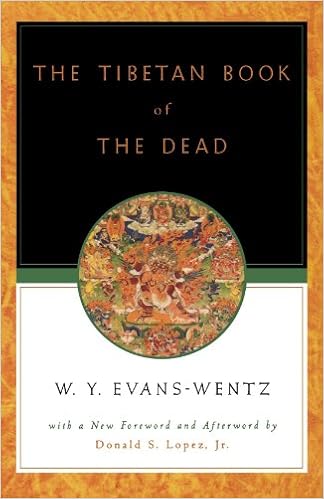
The Tibetan Book of the Dead: Or the After-Death Experiences on the Bardo Plane, according to Lama Kazi Dawa-Samdup's English Rendering Paperback – September 28, 2000 by Karma-Glin-Pa (Author), W. Y. Evans-Wentz (Author), Donald S. Lopez Jr. (Author) (Oxford University Press)


In 2005, Penguin Books published a new translation of Bardo Todol, the collection Buddhist texts that, in the West, has been known as The Tibetan Book of the Dead for three-quarters of a century, and touted it as “First Complete Translation” of a work dealing with life between a person’s death and reincarnation.

Actually, as Donald S. Lopez Jr. points out in his 2011 book The Tibetan Book of the Dead: A Biography, “complete” here is somewhat inexact since Bardo Todol is a cycle of texts of which many versions exist.  Even so, the Penguin book, Lopez writes, is an improvement over the original English edition, put forth by American Theosophist Walter Evans-Wentz.

Many more texts of the cycle are translated [in the Penguin edition] for the first time, the translation is made from a better manuscript, and the translation is more accurate than that first published in 1927.

Lopez, an American expert on Buddhism and Tibet who has edited books by the Dalai Lama, notes that the publicity for the Penguin book is overblown, asserting that the book “embraces the concept of enlightened living and the importance of being open to the wonders of the human experience while, at the same time, thinking beyond this lifetime to a vastly greater and grander cycle.”

In other words, as he summarizes it, “Tibetan Buddhism as self-help.”

The Penguin book itself, however, doesn’t have that tone at all.

“Relative obscurity”

The book begins with an introduction by the fourteenth Dalai Lama, who provides a clear and learned contextualization of the material that will follow, setting forth Buddhist views on the nature of the person, of the process of death, and the principles of the practice of Highest Yoga Tantra.

Such background is essential for understanding the Tibetan text, yet no such introduction has been provided in any of the previous translations.

Lopez writes that the Dalai Lama “deftly alludes to the relative obscurity of the Bardo Todol in Tibet,” and adds:

His implication is that the Bar do thos grol chen mo [another title for Bardo Todol] was not one of the best-known works of Tibetan literature in Tibet.  Indeed, even given the great advances in scholarship on, and the popularity of Tibetan Buddhism since the 1920s, it seems unlikely the Bar do thos grol chen mo would have been translated into English even once, much less five times, by the beginning of the twenty-first century, had Evans-Wentz not purchased it…in 1919.


Sacred texts

Lopez’s discussion of the Penguin edition comes toward the end of his book, and I’m emphasizing it here because I want to stress the point that the Bardo Todol is part of the holy literature of Tibetan Buddhism.

The texts that are well-translated and well-presented in the Penguin book (and were less well-translated and less well-presented by Evans-Wentz) are part of the religious thought of that faith.

They are sacred texts.

Nonetheless, they aren’t the core of Tibetan Buddhism.  They’re secondary texts.

It is akin, it seems to me — Lopez doesn’t say this — to trying to understand the Jewish Bible knowing only the Book of Micah, a seven-chapter text about the judgements and warnings of one of the 12 minor prophets.

Or of trying to gain an insight into the Christian New Testament knowing only the 25-verse Epistle of Jude with its railing against apostates.

In either case, the work is part of the broader faith, not the core.


“Timeless world spiritual classic”

Lopez mentions the obscurity of the Bardo Todol as a contrast to overblown rhetoric that Evans-Wentz and others used in promoting The Tibetan Book of the Dead as some key to the inner secrets of Tibetan Buddhism.

What’s clear to me, from reading the Lopez book, is that these texts deal with one small area of Buddhist thought and can easily be misunderstood without the sort of context that, for instance, the Dalai Lama brought to the Penguin book.

OK, so why is Lopez writing his book?

Why is his biography of The Tibetan Book of the Dead included in the Lives of Great Religious Books, that sterling series of religious, social and cultural history by Princeton University Press?


Why?

Because, over the past eight decades, The Tibetan Book of the Dead has been a crazy-wild bestseller in the West, read by millions, including Allen Ginsberg, John Coltrane, Timothy Leary, Arthur Conan Doyle and Carl Jung.  “From the time of its first incarnation in a Western language, The Tibetan Book of the Dead has taken on a life of its own as a timeless world spiritual classic,” writes Lopez.


“Strange story”

Yet, what readers have gotten from these English versions (except, aside from its publicity, the Penguin book) isn’t what they thought they were getting.

Again, I want to stress that the texts themselves are sacred and real.

But, starting with the Evans-Wentz publication and continuing with the many later editions of that work, the texts have been put in settings that made them look like something they weren’t.  Lopez writes:

Thus, although the first sentence of Evans-Wentz’s preface to the first edition reads, “In this book I am seeking — so far as possible — to suppress my own views and to act simply as the mouthpiece of a Tibetan sage, of whom I am a recognized disciple,” the version of the book that we have today is filled with other voices (the various prefaces, introductions, forewords, commentaries, notes, and addenda comprise some two thirds of the entire book) that together overwhelm the translation.

A few pages later, Lopez writes:

Removing the Bardo Todol from the moorings of language and culture, of time and place, Evans-Wentz transformed it into The Tibetan Book of the Dead and set it afloat in space, touching down at various moments in various cultures over the past century, providing in each case an occasion to imagine what it might mean to be dead.

[Lopez’s] book tells the strange story of The Tibetan Book of the Dead.  It argues that the persistence of its popularity derives from three factors…The first is the human obsession with death.  The second is the Western romance of Tibet.  The third is Evans-Wentz’s way of making the Tibetan text into something that is somehow American….

The Tibetan Book of the Dead is not really Tibetan, it is not really a book, and it is not really about death.  It’s about rebirth: the rebirth of souls and the resurrection of texts.

Evans-Wentz’s classic is not so much Tibetan as it is American, a product of American Spiritualism.


“Shanghaied” — my word

What happened is that the sacred Buddhist text was shanghaied by Evans-Wentz and put to his own purposes — that its words were presented in a way to prove points that Evans-Wentz wanted to make, regardless of their true meaning.

Those are my words.  Lopez doesn’t use the word “shanghaied.” Yet, he does write:

During the last decades of British and American colonialism, the Tibetan text of the Bardo Todol became a kind of colonial commodity, the raw material exported to the city of the colonizer, where it is manufactured into a product…


“Any Asian text”

My reading of the Lopez book leads me to think that Evans-Wentz was well-meaning in the sense that he didn’t think he was perpetrating a fraud.  Yet, what he did was arrogant and disrespectful.  He already thought he had answers to life’s great questions.  He took the Bardo Todol to use as a vehicle to sell those answers.

Evans-Wentz gave his book the name The Tibetan Book of the Dead because there is an Egyptian Book of the Dead.  He thought they both came from the same source although he had no evidence of that.

Here’s how Lopez puts it:

It seems, then, that Evans-Wentz knew what he would find in the Tibetan text before a single word was translated for him.  It almost seems that Evans-Wentz’s spiritual vacation [during which he found the Bardo Todol] could have taken him to any Asian country and that he could have randomly chosen any Asian text, and he would have produced some version of the book published in 1927. 


Strange, indeed

My reading of the Lopez book is that it is a debunking of the Evans-Wentz book.

Lopez doesn’t use any word like “debunking” in his text, and neither does it appear on the book jacket.

Yet, the great accomplishment of Lopez is to show, in 157 pages, how sacred the Bardo Todol is while at the same time obscure, and detail how that sacred text was twisted and tortured by Evans-Wentz to say what he wanted the book to say.

Wisely, Lopez doesn’t speculate on those millions of readers of the various editions of the Evans-Wentz book.

How much of the popularity of the Tibetan Book of the Dead has to do with the texts themselves?  With what they actually say?  With what they actually mean?

And how much has to do with Evans-Wentz’s fuzzy-minded, wrong-headed interpretation of the texts?

To what extent are those who think they are learning about the supposed secrets of a supposedly hidden Asian faith are actually learning about the tenets of Evans-Wentz Spiritualism?

Lopez is to be congratulated for writing a book about such a complex and convoluted story — strange, indeed.


Thursday, July 26, 2018

Moby Dick (Wordsworth Classics) Edition Unstated Edition by Herman Melville (Wordsworth Editions)


With an Introduction and Notes by David Herd. Lecturer in English and American Literature at the University of Kent at Canterbury Moby-Dick is the story of Captain Ahab's quest to avenge the whale that 'reaped' his leg. The quest is an obsession and the novel is a diabolical study of how a man becomes a fanatic. But it is also a hymn to democracy. Bent as the crew is on Ahab s appalling crusade, it is equally the image of a co-operative community at work: all hands dependent on all hands, each individual responsible for the security of each. Among the crew is Ishmael, the novel's narrator, ordinary sailor, and extraordinary reader. Digressive, allusive, vulgar, transcendent, the story Ishmael tells is above all an education: in the practice of whaling, in the art of writing.

It is difficult to separate Moby-Dick, the book, from Moby-Dick, the whale.Both are epic in scale, and both have been met with wildly different perceptions and interpretations.You only need to browse Amazon reviews to get a taste.

I’ve now read this book twice, and I can’t say that the second time around was any easier than the first, though the second time was a different experience.

The first time I read the book, I was awed by the construction, the different styles of writing, and the numerous, mind-numbing asides that Ishmael takes with the reader.

On my second time through, I found myself thinking again and again about just how sad it all was.

Many years have passed between my first reading and my second and, in those years, I’ve come a very long way in how I view the animals we share this planet with.

Where once I was content to view the whale as an adversary or antagonist, I now see a creature simply trying to defend himself.

I also see a human species hell-bent on extracting every last living creature from the sea.

And, worse, spinning the entire endeavor into some high-seas adventure.

I can’t say with any degree of certainty that Herman Melville felt sad for the whales — or guilty for his role while he worked on a whaling ship. But several times during the novel I got the feeling he was struggling with this issue. On occasion, Ishmael imagined the oceans from the whale’s perspective, and was often amazed by the great intelligence, empathy, and bravery the species displayed through their actions. Melville writes:

The more I consider this mighty tail, the more do I deplore my inability to express it. At times there are gestures in it, which, though they would well grace the hand of man, remain wholly inexplicable. In an extensive herd, so remarkable, occasionally, are these mystic gestures, that I have heard hunters who have declared them akin to Free-Mason signs and symbols; that the whale, indeed, by these methods intelligently conversed with the world. Nor are there wanting other motions of the whale in his general body, full of strangeness, and unaccountable to his most experienced assailant. Dissect him how I may, then, I but go skin deep. I know him not, and never will. But if I know not even the tail of this whale, how understand his head? much more, how comprehend his face, when face he has none? Thou shalt see my back parts, my tail, he seems to say, but my face shall not be seen. But I cannot completely make out his back parts; and hint what he will about his face, I say again he has no face.

In one passage in particular he calls out not only whale hunters specifically but carnivores in general:

It is not, perhaps, entirely because the whale is so excessively unctuous that landsmen seem to regard the eating of him with abhorrence; that appears to result, in some way, from the consideration before mentioned: i.e. that a man should eat a newly murdered thing of the sea, and eat it too by its own light. But no doubt the first man that ever murdered an ox was regarded as a murderer; perhaps he was hung; and if he had been put on his trial by oxen, he certainly would have been; and he certainly deserved it if any murderer does. Go to the meat-market of a Saturday night and see the crowds of live bipeds staring up at the long rows of dead quadrupeds. Does not that sight take a tooth out of the cannibal’s jaw? Cannibals? who is not a cannibal? I tell you it will be more tolerable for the Fejee that salted down a lean missionary in his cellar against a coming famine; it will be more tolerable for that provident Fejee, I say, in the day of judgment, than for thee, civilized and enlightened gourmand, who nailest geese to the ground and feastest on their bloated livers in thy pate-de-foie-gras.

But Stubb, he eats the whale by its own light, does he? and that is adding insult to injury, is it? Look at your knife-handle, there, my civilized and enlightened gourmand, dining off that roast beef, what is that handle made of?—what but the bones of the brother of the very ox you are eating? And what do you pick your teeth with, after devouring that fat goose? With a feather of the same fowl. And with what quill did the Secretary of the Society for the Suppression of Cruelty of Ganders formally indite his circulars? It is only within the last month or two that the society passed a resolution to patronize nothing but steel pens.

I suspect, based on Melville’s earlier writings, that he initially set out to write another epic adventure — the type of book that always sells — but at some point found himself writing something quite different, less black and white, more ambitious.

Now, is this book eco-literature?

Absolutely.

While you could argue that the book glorifies whaling, I get the sense — certainly the second time around — that Melville was playing more the role of the documentary filmmaker, displaying the gruesomeness of it all. I’m not sure he was trying to turn people against whaling — for the industry was already seeing its days numbered at that point in history — but I think he was deeply conflicted about the industry and America’s role in leading it.

I think Ahab holds the clue to the novel, a man obsessed with the “one that got away.”

And this obsession is with our culture still.

When I finished reading the book I noticed that the Spielberg film Jaws was on the television. And in that movie we see the very same dynamic at work. This demonization of nature, this never-ending need to control that which cannot be controlled, and the irrepressible need for humans to create monsters where monsters do not exist.

This text from Ahab’s perspective:

God help thee, old man, thy thoughts have created a creature in thee; and he whose intense thinking thus makes him a Prometheus; a vulture feeds upon that heart for ever; that vulture the very creature he creates.

From sharks to whales to seals and, on land, to wolves and bears and even deer –the pattern repeats.

I believe eco-literature has an important role to play in making this pattern apparent to people so that we may finally one day break it.

As an aside, for years I believed that Moby-Dick received bad reviews simply because the public wasn’t ready for such a “modern” work. But I recently read that London readers first experienced a book that was missing entire sections, including the epilogue. 

At any rate, the book is a fascinating and challenging read for both its glimpse into the past and its possibility for changing the future.

A Curious Man: The Strange and Brilliant Life of Robert “Believe It Or Not!” Ripley By Neal Thompson Published 2013-05-07 00:00:00 (Crown Archetype) 432 Pages


When I was seven or eight, my family vacationed at Ocean City, Maryland. Every night, walking the boardwalk with my dad, we’d pass the Ripley’s Believe It Or Not Museum, and I’d linger, staring up at its lurid red sign. One night, he offered to take me inside.

“Just so you know,” he said, at the last moment, “you might see really creepy things.”

“Like what?”

“Like a baby in a jar.”

I can’t quite explain the complicated rush of feelings that followed: horror, curiosity, exhilaration, fascination. Suddenly, I couldn’t go inside.

And at its core was this: I wasn’t ready to admit, to myself or to my dad, that I was the kind of person who most definitely did want to see a baby in a jar. It became my darkest secret.

The truth was that much of my childhood was devoted to All Things Unusual, and I spent countless hours devouring Ripley’s compendia, The People’s Almanac Book of Lists, Time-Life’s Curious and Unusual Facts, TV’s In Search of… and That’s Incredible! In the privacy of my bedroom, though, I didn’t have to admit anything — least of all the thing that Ripley seemed to know about me: that I wanted nothing more than to step inside those museum doors.

Today, it is primarily through these museums, including a mammoth one in Times Square, that Ripley is remembered (if he is remembered at all), meaning his legacy is that of a commercial freak purveyor, a kind of P.T. Barnum promoter of oddities in the grand American huckster tradition. But, as Neal Thompson reveals in A Curious Man: The Strange and Brilliant Life of Robert “Believe It Or Not!” Ripley, Thompson’s deliriously entertaining new biography, Ripley was far more than a sideshow hawker — and his insight into the curiosity of the American public was timely and enduring but also utterly native to him. Because it was a curiosity he shared.

In Thompson’s vivid rendering, LeRoy Robert Ripley (1890–1949) led a life best described as Horatio-Alger-as-directed-by-Preston-Sturges-at-his-madcap-best. Like Alger, he started out on the lean, a poor kid in Santa Rosa, California. In 1906, the San Francisco Earthquake decimated his town. This event, along with his father’s death the year prior, became the “dark scar” on Ripley’s childhood. But just as the quake launched his tiny childhood home into the air, timber buckling and heaving, it also launched Ripley, sparking a hunger in the 16-year-old to escape the confines of his small town and hunt for success in the Big World.

Thus begins the magnificent rise of Ripley, first as a sports cartoonist at the San Francisco Chronicle and eventually at The New York Globe during an era when newspapers were entering their zenith. But it was Ripley’s personal fascination for odd spectacles and human feats that transformed what might have proven a short flurry of newspaper success into something quite larger. Demonstrating versatility and ingenuity early on, Ripley took advantage of the “off season” in sports by featuring for readers unusual facts — the man who once remained under water for six minutes, the time two men boxed for seven and a half hours before ending in a draw. The seeds for his grand success were sown.

In 1918, Ripley launched “Chumps and Champs,” a compilation of sports facts. Within months, the column expanded beyond sports to become “Believe It Or Not,” which appeared sporadically over the next year, eventually becoming one of the nation’s most voraciously consumed comic strips. Readers were hungry to read the daily assemblage of odd facts (it takes two years to make a billiard ball!), miraculous feats (a Frenchman once drank 13 pints of wine in one breath!), and nature’s oddities (four-legged chickens, peg-legged cows), encouraging readers to send in their own stories, to be a part of it all. While no overnight sensation, the comic grew in popularity with the passing years and made Ripley’s name.

As Thompson points out, the era in which Ripley first came to fame was one marked by the transient success of countless cartoonists who tapped into a gimmick briefly and then the gimmick passed. And, in fact, Ripley spawned countless imitators of his particular brand of facts, oddities, and phenomena. So, other than luck and timing, why did Ripley succeed? Thompson makes the claim that one of the comic’s strengths is that his curiosity came from an entirely genuine place. Saddled with an inglorious mug — in particular, a set of buckteeth that humiliated him as a boy — Ripley, according to Thompson, “always had an affinity for underdogs and outcasts since he often felt like one himself.” Ultimately, “Believe It Or Not” was at once utterly universal (insatiable curiosity for the “strange”) and deeply idiosyncratic.

In 1929, after the success of a compilation book of “Believe It Or Not” columns, Ripley heard the siren’s call (in the form of a $100,000 annual salary) of William Randolph Hearst, which wanted to syndicate the column, expanding its reach across the globe. Thompson sums it up thusly: “Hearst […] sent a two-word telegram to one of his editors in New York: ‘HIRE Ripley.’” We can picture the swirling black-and-white newspaper montage to follow.

In a style neatly mimicking the speed and verve of the era (complete with its own “Believe It” sidebars about the sundry characters to cross Ripley’s path), Thompson carries us through these dizzying years, a time when Ripley worked constantly, churning out daily cartoons day and night and traveling constantly while also somehow managing to become one of the nation’s top handball champs (a habit he picked up during his 15 years as a hard-living, man-about-town bachelor at the New York Athletic Club), marrying and, very publicly, divorcing a Ziegfeld Follies dancer, buying Chinese “junk,” amassing countless objets from around the world, and generally living the life of a staggeringly successful but also hopelessly restless man — a man chasing something and never quite finding it.

It is hard to overestimate Ripley’s popularity and reach during the 1930s and ’40s. His comic, read daily across the globe, spawned a book series, comic books, Vitaphone variety shorts, radio shows, a chain of museums (“odditoriums”), the world’s first “oceanarium,” countless promotional “events” (“Ripley to broadcast his entire radio show … from underwater!”) and, in the last year of his life, a television show. At the peak of its popularity, “Believe It Or Not” had more than 80 million readers and received around two million fan letters a month. Meanwhile, Ripley’s personal life was as overstuffed as his professional one, as he compulsively collected objects, pets, and mistresses to fill his grand 28-room mansion, a “moated castle” stuffed to the rafters with everything from African idols to medieval armor, sealskin kayaks from Alaska, a guffa boat from Iraq, the dried penis of a whale, and a basement grotto filled with erotica. In other words, a “living” version of his own world-famous comic strip.

¤

“Believe It Or Not” owes two great debts: first, to Ripley’s invaluable researcher Norbert Pearlroth, who spent his days poring over the New York Public Library collections for obscure facts and figures, and second to Ripley’s countless, heavily publicized overseas adventures — long tours funded by his employers to exotic locales from Shanghai and Singapore to Delhi and Cairo to Azerbaijan and far Siberia, during which he offered a steady stream of dispatches about the oddities and wonders he uncovered. While permitting Ripley to indulge his lifelong taste for the exotic, for exploration and for oddity, these trips proved critical to “Believe It Or Not,” giving it a “living authenticity” that facts and feats gleaned from books alone could not provide. Ripley proved a natural curator for the masses.

An intrepid, curious traveler, Ripley roamed not just to see renowned wonders and not just to drink and tomcat (though he would do both, vigorously, through his entire life), but to unearth the unusual, the hidden, the specific. His travel dispatches, laden with stereotypes of the day, reflect Ripley’s private obsessions — in particular, “the inexplicable things people did for their gods,” particularly if they appeared, to American eyes, grotesque, such as the man Ripley dubs the “Hanging Hindu,” an adherent dangling from a tree via a hook stuck in his back.

Ripley’s complicated relation to “the Other” is one Thompson explores in depth. He locates in Ripley a genuine desire to burrow into the cultures he explores and share the glories and mysteries of other places. But, in large part, the comic’s success hinged on Ripley’s expert skill not at penetration but at sensationalization. And sensationalizing came naturally to him. His entire life, he remained a parachuting explorer, never staying long, never digging deeper. While Thompson notes his horror over the poverty he uncovers and, in particular, as war ravages the places he loves most, Ripley always stops well short of transforming that desire into something more significant: an effort to bridge cultures, to gain understanding or, when encountering humanitarian crises, to call to action. After his first trans-global trip, Thompson notes, Ripley struggled with seeing widespread hunger in India and China “while America was so full-fed.” At the same time, he admits that “whatever miseries he had witnessed […] he wasn’t ready to reform the world. ‘I can’t reform myself!’”

These conflicting impulses would never resolve themselves. While in many ways a typical “ugly American,” Ripley increasingly found himself returning to one of more than 200 countries he’d visited and bemoan the flattening impact of Westernization. After a visit to Nairobi, he disparaged the efforts of “stupid white people trying to change the age-old habits of the Africans.”

But, at heart, Ripley was not a man given to introspection or to cause. The froth and frenzy of his life suited his restless nature, and the next possibility always tantalized most. This quality means A Curious Man never penetrates Ripley’s interior life. He was not prone to self-reflection but rather manic projection. In the end, this is a biography less about the man than about a man-in-(and of)-his-time. He is less important for who he was than the impulse he tapped into: a desire to explore and to connect, particularly as the nation struggled through the changes brought on by modernity and war.

Near the end, a year before his death following an on-air heart attack at age 59, we experience the book’s bravura setpiece. After winning a radio show contest, George McMillin, a young stockbroker from Chicago, won an all-expenses-paid trip on the S.S. President Cleveland to the Orient with Ripley, “the most traveled man in the United States.” Thanks in large part to the invaluable reminiscence of McMillin, we are able to experience through his eyes the swirl of Ripley’s increasingly frenzied life, much of it of the screwball variety, with Ripley juggling girlfriends and mistresses, wild parties, revolving state rooms — but also of growing darkness, as the glories of the good life contrast with visits to Manila in ruins. As they continue, McMillin notes Ripley’s increasing absences but lacks the life experience to fully understand it. Thompson, however, offers us a striking picture: 

Ripley seemed to spring to life just before his broadcasts, and performed dutifully. Then he’d disappear back to his room. Windows shut and shades drawn, it became rank with leftover food, fruit peelings, unwashed clothes, and empty cocktail glasses. One night, in a rare display of hospitality, Ripley hosted a cocktail party for thirty guests, all of them getting bombed and silly. Li [one of Ripley’s girlfriends] sang “When Irish Eyes Are Smiling” and Storer [Ripley’s frequent production partner] and McMillin performed a mock Believe It Or Not radio show that had Ripley howling. “Gosh, life is wonderful,” McMillin declared in that night’s journal entry.

If much of Ripley’s life feels like a madcap Preston Sturges film, in the vein of Hail the Conquering Heroes or Palm Beach Story, this trip feels more Billy Wilder — wickedly funny but darker, richer. McMillin’s exuberant naiveté plays off Ripley’s world-weariness, as he tries and fails and tries again to resist the darkening pall of cynicism and disillusionment about the state of the world and perhaps his own personal life — the insatiable desire to collect objects, homes, business, and women — to ward off what? Mortality? The pains of introspection? And, perhaps, in true Citizen Kane fashion: loneliness. In him, we see someone overwhelmed by modernity, savoring its gifts but alarmed at its dangers — and increasingly bewildered by the bright horrors of the world around him, which once seemed to offer only mystery and pleasure. 

¤

When one looks at “Believe It Or Not” today, random captioned groupings of facts, feats, and reader-contributed oddities in a style of illustration that seems lost to another era (perhaps an era before Ripley — more like 19th-century advertisements), it has the quality of peeking into a cabinet of curiosities. Celeste Olalquiaga differentiates between the curiosity cabinet, which had its heyday during the rationally focused 17th and 18th centuries, and its Renaissance precursor, the Wunderkammern, or “wonder chambers.” The former reflects a desire to order and control the natural world (“divide and conquer”) and highlight the privilege of its owner who could afford to gather such objects. The Wunderkammern, by contrast, sought to offer “objects of puzzlement and awe” for an effect of exhilarating spectacle.

And “wonder chamber” seems a perfect way to describe each daily “Believe It Or Not” strip. There is no desire to order (just as we see in the chaos of Ripley’s personal life), only to dazzle and provoke — but also to invite us in, just as its title implies: it is we who must decide! And while, like the curiosity cabinets, the strip relied heavily on Ripley’s financial capacity (and Hearst’s) to explore the globe, the comic’s was, at heart, a highly democratic operation.

With every dispatch, readers were invited to this marvelous and strange party, submitting their own items, commenting on, and even challenging others’ letters from around the world. There was, after all, Ripley’s masterful provocation: “I dare you to prove me wrong.” The cartoon even bore the tagline: “Full proof and details on request.” And to see one of their items — the armless man in their town who could play piano with his toes, the chicken born with two heads — featured and illustrated in the cartoon and to know it reached readers across the world — what could be more thrilling?

Reading A Curious Man, it’s easy to see the hunger into which Ripley tapped still raging. In his conclusion, Thompson notes that Ripley’s “burning ghats in India, shrunken heads in Ecuador” would likely seem tame today alongside the excesses available on reality TV shows like Fear Factor and Bizarre World. It seems a closer parallel can be found not in these slick, packaged-product shows that are commercially driven Cabinets of Curiosity, curated to draw the eyes of bored viewers; Ripley’s comics feel more akin to one’s inaugural ventures into YouTube, particularly in its early days. The novelty or even extremity is not the true appeal — instead, it’s the experience. Random discovery. Each link leading to other links, creating a simulacrum of worlds both remarkably similar and remarkably different from our own: the sad-faced 12-year-old girl in remote Lampang offering a poignant cover of Ke$ha’s “TiK ToK,” the gray-faced Indiana man in a paneled basement much like our own who somehow has mastered swallowing his own tongue. The same, but different. Familiar, exotic. Lacking only a curator — rendering us, if we so choose (and many have — on Tumblr, in particular) our own curators. A dizzying kaleidoscope that makes the world seem larger and stranger and smaller and strange-like-me at the same time. And we could find ourselves there too. In an instant. Standing on the boardwalk, the gaudy red sign summoning us with secrets to shock and amaze if we will come inside its doors, summoning us to see ourselves.

Gulliver's Travels (Wordsworth Classics) Reprint Edition by Jonathan Swift (Wordsworth Editions)


With an Introduction and Notes by Doreen Roberts, Rutherford College, University of Kent at Canterbury Jonathan Swift's classic satirical narrative was first published in 1726, seven years after Defoe's Robinson Crusoe (one of its few rivals in fame and breadth of appeal). As a parody travel-memoir it reports on extraordinary lands and societies, whose names have entered the English language: notably the minute inhabitants of Lilliput, the giants of Brobdingnag, and the Yahoos in Houyhnhnmland, where talking horses are the dominant species. It spares no vested interest from its irreverent wit, and its attack on political and financial corruption, as well as abuses in science, continue to resonate in our own times.

First published in 1726, this collection of Lemuel Gulliver’s fascinating voyages all over the world, has been loved, read and re-read by every child and adult familiar with the English language. The story appealing the children for its fictional quotient made of wonderful creatures ranging in size from a few inches to several feet, flying island, etc. and to adults for its keen representation of human nature and European society. The witty and satiric style of Jonathan Swift’s narrative has an universal appeal to every intelligent reader while the circumstances and surroundings aid in accomplishing the tale by providing the elements of fantasy and thrill.

A short introduction in form of a letter by Gulliver to his readers precedes the travel chronicles, which comprises of four parts, each containing Gulliver’s experiences in a different land. Following is the synopsis of each story:

Part I: A Voyage to Lilliput (4 May 1699 — 13 April 1702)

Gulliver, a surgeon on a merchandising ship, finds himself to be the lone survivor after a shipwreck on an unknown shore where he falls asleep out of weariness. The next morning, he wakes up to find himself bound by tiny threadlike ropes and surrounded by a crowd of people, less than 6 inches high. After a while, “the Lilliputians” are convinced of his being harmless to them and slowly Gulliver gets accustomed to the people and the place. His observations of this race and their way of living, their king and his court, Gulliver’s accommodation and way of living form the next few chapters of the book. Gulliver also assists the king in a war with their enemies, the Blefuscidians, by depriving them of their entire feet but refuses to help the king in enslaving them. This and the strong dislike for him by some of the king’s ministers bring on Gulliver the dislike and penalty of the king. To escape from this, he runs away to the island of Blefuscu, from where he manages to leave the country in an abandoned boat. A passing ship rescues him and brings him back to England.

Part II: A Voyage to Brobdingnag (20 June 1702 — 3 June 1706)

Gulliver ventures to a sea voyage again on a ship called Adventure which facing a storm goes off course and is forced to land at an island for fresh water. Gulliver goes on the shore and finds himself abandoned while roaming around as his fellow shipmen are driven away from the land by a monster. On the island he finds himself with the race of giants with height more than 70 feet. A farmer brings Gulliver home where his daughter nurses him. The farmer treats him as a curiosity and exhibits him for money. The Queen of Brobdingnag takes a liking to Gulliver and buys him off along with hiring his nurse as governess. Gulliver becomes a favourite of the royal family and discourses with the king at length about his native country and the rest of mankind. Though treated kindly, he keeps encountering many ridiculous accidents due to his puny size. Finally, one day, when on sea-shore, a giant eagle takes away Gulliver’s wooden house with him inside and drops him in the sea, from where he is rescued by some sailors and comes back to England.

Part III: A Voyage to Laputa, Balnibarbi, Luggnagg, Glubbdubdrib, and Japan (5 August 1706 — 16 April 1710)

This time, Gulliver’s ship is attacked by pirates who force him to leave the ship and the guy finds himself on a desolate rocky island, from where he is rescued by the inhabitants of a flying island, called Laputa. The description that Gulliver gives of the Laputians, is a strong caricature of that of musician and mathematicians, describing them as totally impractical race dwelling in the theoretical arts only. Laputa flies over a bigger island called Balnibarbi by virtue of its magnetic properties. Gulliver describes the people, the king and his kingdom, and his method of ruling from sky. He next ventures to visit the capital city of Lagado and its grand academy where all kinds of disgusting, ridiculous and fruitless research work is done.

Waiting for a ship to go to Japan, Gulliver takes a short trip to the island of Glubbdubdrib, which is inhabited by magicians. The chief of magician has power to bring back the dead and Gulliver enjoys conversations with all his favourite philosophers, politicians and other great men from history of his choice. In Luggnagg, he comes across immortals called struldburgs and for the first time starts considering the problems that immortality will bring in form of old age and infirmity. Finally, he goes to Japan, and from there to England with an intention for staying home for the rest of his life.

Part IV: A Voyage to the Country of the Houyhnhnms ( 7 September 1710 – 2 July 1715)

But the sea calls Gulliver again, and he starts his journey as a captain of a ship. During the voyage he loses some men due to illness and is forced to recruit others from different places, who finally turn the crew against him. This band of seamen is going to become pirates and hence casts away Gulliver in a landing boat. On this island, he first encounters a deformed, hideous and savage race of animals and later the masters of this land, apparently horses with advanced and reasoning intellectual capacity, who call themselves Houyhnhnms. The savage race is nothing but uncivilised and brute humans known as “yahoo” on this island.

Gulliver becomes a member of the horse’s household, and slowly becomes extremely fond of their lifestyle and way of thinking, realising all the follies and vices of humankind during his conversations with his master horse. He reloves to spend rest of his life on this island but the Assembly of the Houyhnhnms rules that Gulliver, a Yahoo with some semblance of reason, is a danger to their civilization, and expels him.

He is then rescued, against his will, by a Portuguese ship, and is surprised to see that Captain Pedro de Mendez, a Yahoo, is a wise, courteous and generous person. He returns to his home in England, but he is unable to reconcile himself to living among Yahoos and becomes a recluse, remaining in his house, largely avoiding his family and his wife, and spending several hours a day speaking with the horses in his stables.

Gulliver’s Travels is often considered to be a children’s book, mainly due to the wide publicity and popularity that the first part of the novel describing Gulliver’s adventures in Lilliput has received. But, the book in reality, is a reflective and mufti-dimensional work that addresses and represents many a traits of the human nature and human society. The chronicles are full of metaphors and the best part that links these together is the change of perspective. In every part of his voyage, Gulliver encounters a different race i.e., small, big, scientific and eccentric, wise and natural, and hence, starts viewing himself and rest of his brethren with a different point of view, identifying the evils in the human society and their root causes step-by-step. At the end of his voyages, Gulliver is a changed man, so much so that he abhors the mankind in general.

The book consists of ever-lasting wisdom and though the metaphors become crude and complex, especially in the last part, is still a worthy read. “Gulliver’s Travels” is one of those books that never lose its contemporariness …

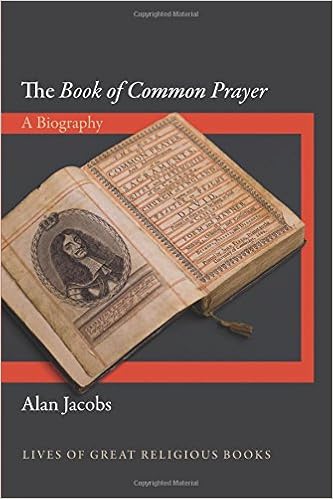
The Book of Common Prayer: A Biography (Lives of Great Religious Books) Hardcover – September 29, 2013 by Alan Jacobs (Princeton University Press)


Originally, that institution had been part of the Roman Catholic Church, but it was separated from Rome by King Henry VIII and became a national church, constitutionally established by the state with the monarch as its supreme governor.

Thus, The Book of Common Prayer, created to replace the Catholic prayers in religious services, was, in effect, a government publication.

This led to complexities for the prayer book in England that it wouldn’t have in other nations, such as the United States, where the Episcopal Church, part of the Anglican Communion, is just one of many organized religions rather than under the sponsorship of the state.

“Eternal Rest”

For instance, as Alan Jacobs writes in his energetic look at creation and history of the prayer book The “Book of Common Prayer”: A Biography, there have been times over the past five hundred years when the book was seen not just as an expression of religious faith but also as a stand-in for the nation in some way.

World War I was one such time. Indeed, Jacobs writes:


One of the recurrent themes of the literature of the Great War is the ironic contrast between the long-standing habits and practices of English society and the blunt horrors of the battlefield. The beautiful language of the prayer book clashes dissonantly with the soldiers’ experience.

One of the great books of that literature is Testament of Youth by Vera Brittain, a nurse during much of the war. Attending the funeral of a friend of her fiancé, she was incensed at


the calm voice of the local clergyman intoning the prayers: ‘Grant, we beseech Thee, O Lord, Thine Eternal Rest to all those who have died for their country, as this our brother hath.…” Eternal Rest, I reflected, had been the last thing that Victor wanted; he had told me so himself.


“Blithely send young men to death”

For writers such as Brittain and Robert Graves — and not only them, but also the chaplains with the troops — the prayer book became a symbol for the almost criminal cluelessness of those on the home front regarding the reality of the war. Jacobs writes:


The prayer book, then, becomes a synecdoche for English society in time of war: civilian incomprehension of the war’s miseries illustrated through an ongoing sanctimonious recital of the Cranmerian cadences. The intrinsically repetitive character of liturgy reinforces the feeling of mindlessness, of saying without thinking, and the prayer book’s fixed place in the Establishment connects it with vast, pitiless, institutional forces — forces that blithely send young men to their deaths…

Many priests who served as chaplains during the war reported that the illiterate, or barely literate, foot soldiers they were charged to serve could make no sense of sixteenth-century diction and syntax, and were therefore left uncomforted in their time of need.

The Green Book, Orange Book and Grey Book

This sense that the prayer book was out of touch with modern life led to efforts in the 1920s to revise it. Mild changes were approved with few difficulties in Canada and the US.

That wasn’t the case in England where liberal-conservative, high church-low church divisions were stark. Jacobs writes:

So little were the various parties able to collaborate that each was allowed to develop its own prayer book, with the idea that once that work was complete the necessary horse trading could begin in earnest. This could not be construed as an indicator of hopefulness.

Various factions produced documents that came to be known as the Green Book, the Orange Book and the Grey Book. The evangelicals didn’t come up with a revision, asserting that they were pretty much comfortable with the Book of Common Prayer that had been in use since 1662. (That version was the last in a series of revisions that the prayer book had undergone since it was first composed by Thomas Cranmer in 1549.)


“Specter of establishment”

Between 1925 and 1927, the English House of Bishops worked to merge the Green, Orange and Grey books into one. That new book was endorsed by the necessary church bodies and the House of Lords, but never saw the official light of day.

In December, 1927, the House of Commons rejected it 238-205. A second attempt in June, 1928, also lost 266-220.

“Once more,” Jacobs writes, “the specter of establishment returned to haunt the Church of England.”

Once more, decisions about the faith life of English Anglicans were decided not by church leaders or theologians or pastors or even the believers themselves, but by politicians.

Consider how this would seem if, in the United States, the prayer book of, say, the Catholic Church or of Judaism or any faith tradition were in the hands of Bernie Sanders, Paul Ryan, Mitch McConnell, Nancy Pelosi, Ted Cruz, John McCain, Diane Feinstein, Devin Nunes, Luis Gutierrez and the rest of Congress. Yet, because the Book of Common Prayer is essentially a government publication, that’s what happens in the United Kingdom.

As a result, the official Book of Common Prayer still in use in England is one that is more than 350 years old.


“An instrument of social and political control”
In fact, politicians and politically involved clerics were responsible for the prayer book being written in the first place.

In the first paragraph of his Chapter I, “One Book for One Country.” Jacobs writes:


The Book of Common Prayer came into being as an instrument of social and political control. There will be much else to say about its origins, but here we must begin: the prayer book was a key means by which the great lords who ruled on behalf of the young King Edward VI consolidated English rule of the English church. In making one book, according to which the whole country would worship, Cranmer and his allies were quite consciously dismantling an immense and intricate edifice of devotional practice. They had both theological and political reasons for doing this, but the immediate effect was political and was widely seen as such.

Meaty and tasty

As Jacobs notes in that opening paragraph, there is much more than politics in The “Book of Common Prayer”: A Biography — the beauty of language, the expression of belief, the quirks of people who created it or loved it or hated it.

As with the other installments in the Princeton University Press series Lives of Great Religious Books, this book by Jacobs, published in 2013, is wonderfully accessible, smart and knowing, meaty and tasty.

Any member of the Anglican Communion would find this book of great interest.

But its audience is anyone interested in Western culture, literature, history and art.

Actually, anyone interested in a good book — about a good book.

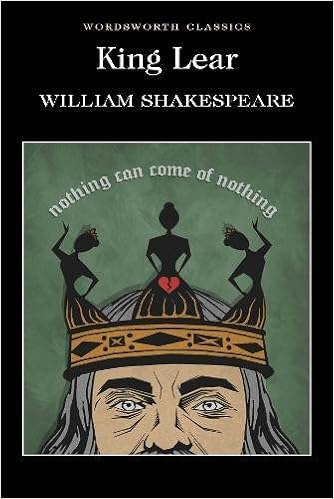
King Lear (Wordsworth Classics) Revised ed. Edition by William Shakespeare (Wordsworth Editions)


Edited, introduced and annotated by Cedric Watts, Research Professor of English, University of Sussex King Lear has been widely acclaimed as Shakespeare's most powerful tragedy. Elemental and passionate, it encompasses the horrific and the heart-rending. Love and hate, loyalty and treachery, cruelty and self-sacrifice: all these contend in a tempestuous drama which has become an enduring classic of the world's literature.

Talk about Shakespeare’s great King Lear tends to focus on the action of the play and its meaning.

A self-satisfied monarch, blind to the consequences of his actions, splits his realm in two, giving half to one daughter and half to the other. To his third and dearest daughter, he gives nothing. Her sin: Failing to flatter him enough.

This is a play about loyalty and disloyalty, about parents and children, about wisdom and foolishness, and about the many forms of madness — arrogance, greed, anger, ambition, dementia and pride.

It is a play filled with murders and hangings and a suicide and not one but two eyes being ripped out.

It is a lot like the Book of Job in the Bible in which the central character rails at the unfairness of life. It is a story about pain and stupidity and the cruelty of being a human being, prone to failure.

King Lear is also a work of great literary beauty, and that’s what I want to focus on.

This is, of course, Shakespeare, so we expect great poetry. Here, though, there is a concentrated fierceness to his words that make them seem like knife slashes or the bludgeoning of a baseball bat.


King Lear: “Dry up her organs of increase”

Here is Lear who has finally realized that his daughter Goneril is betraying him. In his condemnation of her, he reaches deep inside his kingly self to curse her with awesome grandeur:

Hear, nature, hear; dear goddess, hear!
Suspend thy purpose, if thou didst intend
To make this creature fruitful!
Into her womb convey sterility!
Dry up in her the organs of increase;
And from her derogate body never spring
A babe to honour her! If she must teem,
Create her child of spleen; that it may live,
And be a thwart disnatured torment to her!
Let it stamp wrinkles in her brow of youth;
With cadent tears fret channels in her cheeks;
Turn all her mother’s pains and benefits
To laughter and contempt; that she may feel
How sharper than a serpent’s tooth it is
To have a thankless child! Away, away!


The Duke of Cornwall: “Vile jelly”

After ripping one of the Earl of Glouchester’s eyeballs out, the Duke of Cornwall, the husband of Lear’s daughter Regan, fights a duel with a faithful servant who is aghast at his master’s action. He kills the servant, but suffers what he doesn’t yet realize is a mortal wound. In anger, in celebration, he turns to Glouchester and tears out his second eyeball.

Lest it see more, prevent it. Out, vile jelly!
Where is thy lustre now?


The Earl of Glouchester: “This villain of mine”

Earlier in the play, Glouchester, like Lear, is tricked by one of his children. His bastard son Edmund leads him to believe that his legitimate son Edgar wants to kill him and take over his title.

These late eclipses in the sun and moon portend
no good to us: though the wisdom of nature can
reason it thus and thus, yet nature finds itself
scourged by the sequent effects: love cools,
friendship falls off, brothers divide: in
cities, mutinies; in countries, discord; in
palaces, treason; and the bond cracked ‘twixt son
and father. This villain of mine comes under the
prediction; there’s son against father: the king
falls from bias of nature; there’s father against
child. We have seen the best of our time:
machinations, hollowness, treachery, and all
ruinous disorders, follow us disquietly to our
graves.


Edmund: “Villains by necessity”

When Glouchester leaves the stage, Edmund turns to the audience and, in one of his many asides, readily acknowledges that his betrayal of his father has nothing to do with celestial bodies, but with his own ambition.

This is the excellent foppery of the world, that,
when we are sick in fortune — often the surfeit
of our own behavior — we make guilty of our
disasters the sun, the moon, and the stars: as
if we were villains by necessity; fools by
heavenly compulsion; knaves, thieves, and
treachers, by spherical predominance; drunkards,
liars, and adulterers, by an enforced obedience of
planetary influence; and all that we are evil in,
by a divine thrusting on: an admirable evasion
of whoremaster man, to lay his goatish
disposition to the charge of a star! My
father compounded with my mother under the
dragon’s tail; and my nativity was under Ursa
major; so that it follows, I am rough and
lecherous. Tut, I should have been that I am,
had the maidenliest star in the firmament
twinkled on my bastardizing.


Fool: “Before thy time”

As the play unfolds, it becomes clear that Lear’s Fool is one of the monarch’s best friends and advisors. He is filled with pity and sorrow to see his formerly majestic lord cast aside like garbage. What’s worse is that Lear’s fate is of his own doing.

If thou wert my fool, nuncle, I’ld have thee beaten
for being old before thy time….
Thou shouldst not have been old till thou hadst
been wise.


Duke of Burgandy: “Must lose”

Lear disinherits his dearest daughter Cordelia on the day that she is to be engaged to one of two suitors — the Duke of Burgandy or the King of France. When the two enter the throne room, they are told that, because she has been disowned, Cordelia no longer has the dowry that Lear had earlier promised: a third of his kingdom. That settles it for Burgundy, as he tells the young woman.

I am sorry, then, you have so lost a father
That you must lose a husband.


The King of France: “Most rich”

The King of France, though, has a different response.


Fairest Cordelia, that art most rich, being poor;
Most choice, forsaken; and most loved, despised!
Thee and thy virtues here I seize upon:
Be it lawful I take up what’s cast away.
Gods, gods! ’tis strange that from their cold’st neglect
My love should kindle to inflamed respect.
Thy dowerless daughter, king, thrown to my chance,
Is queen of us, of ours, and our fair France:
Not all the dukes of waterish Burgundy
Can buy this unprized precious maid of me.
Bid them farewell, Cordelia, though unkind:
Thou losest here, a better where to find.


Edgar: “So many fathom”

By the end of the play, Edgar is taking care of his sightless father who is so despairing that he wants to commit suicide by jumping off a cliff.

Edgar tricks him, and Glouchester falls forward, but, instead of plummeting to his death, lands on the grass in front of him. Even so, Edgar tells him that he has miraculously floated down, safe and sound.

Hadst thou been aught but gossamer, feathers, air,
So many fathom down precipitating,
Thou’dst shiver’d like an egg: but thou dost breathe;
Hast heavy substance; bleed’st not; speak’st; art sound.
Ten masts at each make not the altitude
Which thou hast perpendicularly fell:
Thy life’s a miracle. Speak yet again.

(When Glouchester asks, “But have I fall’n, or no?”)
From the dread summit of this chalky bourn.
Look up a-height; the shrill-gorged lark so far
Cannot be seen or heard: do but look up.


Regan: “The goodness I intend”

Regan and Goneril are each wanting to share Edmund’s bed, but they fear each other. Regan wants Edmund to tell her that she’s the one she wants.


Now, sweet lord,
You know the goodness I intend upon you:
Tell me — but truly — but then speak the truth,
Do you not love my sister?


Goneril: “Milk-liver’d man”

Goneril is angry that her husband the Duke of Albany isn’t as blood-thirsty and ambition as she is, and she lets him have it.


Milk-liver’d man!
That bear’st a cheek for blows, a head for wrongs;
Who hast not in thy brows an eye discerning
Thine honour from thy suffering; that not know’st
Fools do those villains pity who are punish’d
Ere they have done their mischief. Where’s thy drum?
France spreads his banners in our noiseless land;
With plumed helm thy slayer begins threats;
Whiles thou, a moral fool, sit’st still, and criest
‘Alack, why does he so?’


Kent: “Reverse thy doom”

The Earl of Kent is perhaps Lear’s closest friend and ally, and, as such, he risks everything to try to talk his king out of his disastrous splitting of his kingdom. Lear won’t hear it, though.


Royal Lear,
Whom I have ever honour’d as my king,
Loved as my father, as my master follow’d,
As my great patron thought on in my prayers…
Let it fall rather, though the fork invade
The region of my heart: be Kent unmannerly,
When Lear is mad. What wilt thou do, old man?
Think’st thou that duty shall have dread to speak,
When power to flattery bows? To plainness honour’s bound,
When majesty stoops to folly. Reverse thy doom;
And, in thy best consideration, cheque
This hideous rashness: answer my life my judgment,
Thy youngest daughter does not love thee least;
Nor are those empty-hearted whose low sound
Reverbs no hollowness.

The Merchant of Venice (Folger Shakespeare Library) Mass Market Paperback – January 1, 2004 by William Shakespeare (Author), Dr. Barbara A. Mowat (Editor), Paul Werstine Ph.D. (Editor)(Simon & Schuster)


"The Merchant of Venice", one of William Shakespeare's best-known plays, gets the graphic novel treatment, courtesy of Campfire Classics, adapter John McDonald, and illustrator Vinod Kumar. The play offers a carefully crafted and extremely clever plot and several strongly-developed characters, including Shylock the Jewish money-lender and Portia the beautiful, rich and intelligent heiress. It would be a matter of debate as to whether the play is best characterized as a romantic or a tragic comedy.

As the story opens, the merchant Antonio agrees to lend his spendthrift friend Bassanio enough money to woo the rich heiress Portia of Belmont. As Antonio's funds are tied up in several trade ventures at sea, he borrows the money from Shylock, a man whom he openly despises as a moneylender who charges interest. Shylock, no friend of Antonio, inserts a potentially cruel penalty clause in the contract, which Antonio agrees to.

Bassanio will hurry on to Belmont to woo Portia. To succeed, he must face a challenging test of judgement devised by Portia's departed father. On the heels of that test will come news that Antonio has forfeited his bond to Shylock, and faces a difficult day in court. There, his life will depend on the skill of a young and unknown lawyer and his law clerk.

"The Merchant of Venice" includes a number of sub-plots which add to the comedy and to the romance of the basic story. The artwork of this graphic novel is quite good, and it is generally easy to follow the story. This particular version of the play has adapted Shakespeare's Elizabethan English into modern English, which removes an element of the grace inherent in several famous speeches. A second questionable adaptation is the blurring of Shylock's identity as a Jew, which also blurs the rather disturbing anti-Semiticism of the original play and robs the plot of some of its meaning, and its controversy. Cautiously recommended
.

A Midsummer Night's Dream (Wordsworth Classics) Paperback – January 5, 1998 by William Shakespeare (Wordworth Editions)


Edited, Introduced and Annotated by Cedric Watts, Professor of English Literature, University of Sussex Its lyricism, comedy (both broad and subtle) and magical transformations have long made A Midsummer Night s Dream one of the most popular of Shakespeare's works. The supernatural and the mundane, the illusory and the substantial, are all shimmeringly blended. Love is treated as tragic, poignant, absurd and farcical. 'Lord, what fools these mortals be!', jeers Robin Goodfellow; but the joke may be on him and on his master Oberon when Bottom the weaver, his head transformed into that of an ass, is embraced by the voluptuously amorous Titania.

Plot Summary

Duke Theseus and Hippolyta are preparing for their wedding, when Egeus arrives with his daughter Hermia, along with Lysander and Demetrius. Hermia and Lysander love each other; but Egeus wants Hermia to marry Demetrius (who is loved by Helena). Theseus insists that Egeus must have his way, and gives Hermia a month to marry Demetrius, or either die or become a nun. Hermia and Lysander decide to run away and to meet in the forest. Hermia tells Helena of their plans, and she in turn tells Demetrius, in the hope that he will like her more for telling him. Demetrius chases after the eloping couple, and Helena chases after him.

A group of tradesmen meet to discuss a play on the theme of Pyramus and Thisbe which they want to perform at Theseus’ wedding. They plan to rehearse in the forest.

Oberon and Titania, the king and queen of the fairies, are arguing over who should have a changeling boy that Titania has stolen. Titania will not give him up, so Oberon takes his revenge by having his servant Puck find a special flower whose juice he will squeeze onto Titania’s eyes while she is asleep. This will maker her fall in love with the first person she sees upon waking. Oberon, seeing Demetrius reject Helena, tells Puck to put the potion on Demetrius’ eyes also. But Puck mistakes Lysander for Demetrius, and Lysander wakes to see Helena, whom he falls in love with and chases after, leaving Hermia alone.

The rustics begin their rehearsal near where Titania is sleeping. Puck gives Bottom an ass’s head. Bottom frightens his friends away, and in doing so wakes Titania. She falls in love with him, and Bottom is treated like a lord by the fairy retinue.

Hermia, having lost Lysander, thinks Demetrius has killed him, and when he denies it she goes to look for him. Oberon is furious with Puck for his mistake and tells him to find Helena and bring her to him. Oberon squeezes the flower onto Demetrius’ eyes while he sleeps. Lysander enters with Helena, begging for her love, telling her Demetrius does not love her; Demetrius then wakes, sees Helena, and begs for her love. Hermia enters and is snubbed by Lysander, while Helena thinks all three are tricking her.

Demetrius and Lysander challenge each other to a duel. Oberon gets Puck to imitate the two men’s voices, leading them around until they fall asleep. Puck puts an antidote on Lysander’s eyes so that he resumes his love for Hermia.

Oberon then releases Titania from her spell, having received the changeling boy from her. Puck removes the ass’s head from Bottom.

Theseus and Hippolyta arrive to hunt in the forest, along with Egeus, where they discover the sleeping lovers. They hear their story, and Theseus decrees they shall be married as they wish, despite Egeus’ will.

Bottom is reunited with his friends, and they rehearse their play, which has been selected as one of those to be made available as entertainment at the wedding. After supper, Theseus chooses their play, which is presented in front of an audience of all the lovers. They all retire to bed, and Oberon and Titania enter to sing and dance; Oberon blesses the three couples, and Puck is left to address the audience.


Overview

Midsummer Night's Dream Overview

Category: Comedy

Period written: 1595-1596

First known performance:

Number of lines: 2165

Number of scenes: 9

Total Characters: 24

Prose/Verse: 19%/81%

Folios: Folio 1 (1623, based on Q2), Folio 2 (1632), Folio 3 (1663-4), Folio 4 (1685)

Quartos: Quarto 1 (1600), Quarto 2 (1619)

Possible Sources: Metamorphoses (Ovid, 8 A.D.), The Tragedy of Pyramus and Thisbe (B. M. Add., 8 A.D.), The Knightes Tale (Geoffrey Chaucer, 1386–1395), Huon of Bordeaux (Lord Berners, 1545), The XI Books of the Golden Asse containing the Metamorphoses of Lucius Apuleius (William Adlington, 1566), Thesaurus Linguae Romanae et Britannicae (T. Cooper, 1573), The Life of Theseus (Plutarch, 1579), The Discoverie of Witchcraft (Reginald Scot, 1584), A Handefull of Pleasant Delites (Clement Robinson, 1584)


Truly Madly Guilty Paperback – July 25, 2017 by Liane Moriarty (Flatiron Books)


This is a story that begins with a barbeque". So begins Truly Madly Guilty. Erika and Clementine have been friends since school. Erika had a difficult childhood and Clementine's home and family became something of a refuge for her. Now, years later, both are married. Clementine is a cellist, married to Sam, with two young daughters. Erika and her husband Oliver are childless and fanatically tidy and orderly. They invite Clementine and her husband Sam over for afternoon tea, but it evolves into a BBQ at their neighbour's house. And at that BBQ, something will happen. An event which will be extremely traumatic for everyone who is there.

That's the premise for this book. From the start we know that something significant has happened. We know that Erika has problems remembering it, that Clementine doesn't want to think about it, that their husbands are struggling with their feelings. But it will take until over the halfway mark - a looong time - before we find out what happened and after all that build up and suspense the truth is more than a little anticlimatic. Even then, Moriarty teases us with the idea that there is more to be revealed, and while this is true, it's not enough and not sufficiently important. Essentially, it's a book that's structured on a flimsy base.

There are glimpses here and there of Moriarty's trademark humor and relatable characters but somehow I didn't warm to the story as I have to others that she's written.