Showing posts with label Stepehen Drus. Show all posts

Friday, January 26, 2018

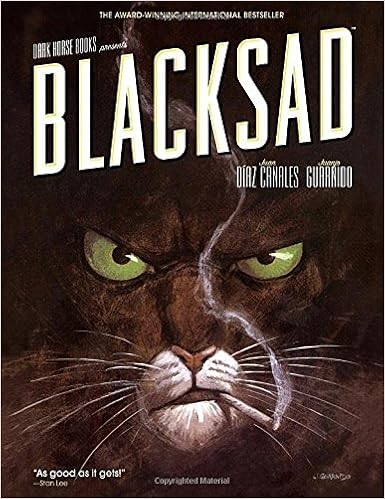
Blacksad by Juan Diaz Canales and Juanjo Guarnido Hardcover (Dark Horse Originals)


What is it with the Europeans and their mastery of the anthropomorphic sub-sub-sub genre? Written by Spaniards for French audiences, the award-winning series has been published in more than 20 languages. The stories closely resemble American pulp fiction, with the titular PI a big, black, burly kitty in a trench coat, more Philip Marlowe than Sylvester in his mien. Blacksad investigates all the underbelly society has to offer in 1950s New Orleans, the perfect setting for racial tensions, abductions, murder mysteries and beatdowns. Wars — in this case the specter of WWII and the height of the Communist Red Scare — make cameos, and Blacksad bears it all with stoicism, when he doesn't get seriously pissed off. Beautifully painted panels and sharp pacing will keep you turning pages, as will the many mentions of key historical moments — and oh so many unsavory characters and hot dames — woven into the storylines.

Sunday, December 3, 2017

Desire A Memoir By Jonathan Dollimore Published 07.27.2017 Bloomsbury Academic 192 Pages

There's something deliciously indulgent about Jonathan Dollimore’s new memoir, Desire. Neither tedious nor tawdry, the book is a delightfully cheeky yet earnest reflection on the utopian and pedestrian possibilities of sexual life, told in the campy register particular to a queer elder of a certain stripe. There is much to admire here: the dewy beauty of Dollimore’s limpid prose, the way his punctuation marks, like so many finely gloved fingers, point out the words and phrases to savor. There’s the self-aware humor of a rebel-cum-scholar with a working-class background who clearly revels in a love of language that is never too far from the love of men.
These are also, perhaps, characteristics that could turn off some readers who may find Dollimore’s sudden movements between the particulars of his personal sexual history and the vast philosophical questions that he brings to bear on them just a bit inflated, the language a bit too performatively grandiose. Consider these two passages from the memoir’s early pages:
I had gone looking for my mother and found her outside, sitting with Tony in the family car. As I approached, unbeknown to them, I saw that Tony was trying to have sex with her. One of several complications swirling from this scenario was that at the time, Tony, an adult friend of my parents, was also having sex with me.
[…]
[This memoir] includes the squalid and the precious, the suicidal and the elated, the sublime and the absurd, the tender and the callous and the dangerous and the beautiful — the last two being, perhaps, the most important of all, if only because I encountered them in even closer proximity than the others.
The shift between the flat humor of Dollimore’s awkward first forays into gay sex and the lofty staging of his life as a fire sale of descriptive dyads (“the squalid and the precious, the suicidal and the elated,” et cetera — I guess “the agony and the ecstasy” were already taken) combine a cool campiness with a flourishing gesture at the greater significance of an individual life. Desire’s tone can, in moments such as these, approximate the aesthetic poise and preciousness of Alan Hollinghurst — though removed from and critical of the upper echelons of class and educational privilege — as it moves between snatches of diary entries from the past and the author’s commentary on them in the present.
Yet readers who may not find such queer signatures their cup of tea would do well to stay with the narrative, which is considerably leavened by Dollimore’s equally apt facility with checking the intellectual’s tendency to build castles out of cum. “I wonder if my same-sex desire will strike some as absurdly cerebral or aesthetic,” a younger Dollimore wonders in an excerpt from a journal. “Anyhow, it couldn’t have been that cerebral because all this means is that one night, P and I fuck each other; I have no idea it can be this ecstatic and there’s no going back.” In such moments, Desire gives up its tendency toward stylistic swells and is buoyed by wry, playful prose and the naked sincerity of a seasoned thinker who has waded into a very personal analysis of the flows of risk, relation, possibility, and disappointment that attend our sexual lives.
Desire doesn’t offer some novel, earth-shattering revelation about sex, gay or otherwise. Many of Dollimore’s experiences and reflections are by now commonplaces for most gay men, if not as thoroughly excavated with the precision brought to bear on Desire. What details we get of Dollimore’s life — his interest in the mechanics and danger of motorbikes, to the mechanics of gay sex, risk, culture, and language as a young man, journalist, and professor — are subordinate to his central meditation on how desire and its inverted form, depression, operate. “I’m not attracted to the confessional for its own sake,” he writes; “to be worth writing about the personal needs to have a meaning beyond me.” This is a welcome relief from the sort of navel-gazing that can define the memoir genre for young ingénues with little life experience to draw upon and older authors with much life experience but little of gripping relevance to contemporary readers. And, true to the author’s promise, Desire shines brightest when Dollimore writes about signal moments that are his specifically but also ours generally: the fumbling confusion of youthful sex, the powerful and ephemeral connection one feels with a one-night stand, the amplified experience of sex with a repeat partner, the loneliness that simultaneously draws us to and repels us from others.
In line with critics such as Leo Bersani, Desire renders sex as a scene in which the self is momentarily suspended, altered under the electric heat of orgasm to the point that it risks being shattered, even if only momentarily.
Though at the time we’re usually too delirious to realize it, sexual abandon risks, even courts, self-annihilation if only in fantasy. Is that why, I find myself wondering, we mostly do it in the relative security of the bed? It’s often said that each orgasm is a little death — la petite morte. It’s also a little contradiction: the most intense experience the self can have is a temporary obliteration of self and in this respect carnal ecstasy echoes its religious counterpart.
The sense that sex bears some ecstatic truth of the self is central to the gay experience. Claiming pleasure in a constellation of bodies and experiences often condemned by mainstream culture is usually the moment of coming into one’s sexual identity as a queer person. The moment is often described as one in which something “clicked,” in which the self and its desires were somehow made intelligible, affirmed, clear. Dollimore resists this epiphanic narrative. While other people “‘come out’ as who they really are,” he writes, “for me sexual desire confuses, undermines or at least alters my sense of self. […] [W]hen the confusion of desire clarifies, the always present possibility that what reappears is an altered self.” He understands sex not as the promised revelation of an authentic identity or self, but rather as the possibility of transformation: a fleeting moment in which we might become someone new. Yet Dollimore also confesses a desire for the very self he delights in seeing undone in sex. Caught with the rest of us in the ambivalence of identity, Dollimore wavers between “the desire to consolidate [the self] … [and] an equally powerful desire to relinquish it.”
That ambivalence mirrors the memoir’s treatment of the political potential often assigned to gay sex. For Dollimore, gay sex becomes a site of radical openness, but also decidedly conventional commonplaces. He distinguishes gay sex from its heterosexual counterpart in ways large and small: the “dissolution of the gaze” lasts longer in gay sex, fusing an appreciation of beauty with pleasure, and a relational difference wherein the partner’s “desire becomes the focus of my desire […] in a way which is subtly different from wanting to give pleasure, or wanting him to desire me.” These differences, which undergird the celebration of sex as a path to utopia, are by turns sources of hope and disappointment for Dollimore. In Desire, he reflects on his formative middle years during the 1970s and 1980s, when gay male sexual cultures dramatically shuttled between soaring visions of a new world on the horizon and the terror of the HIV/AIDS epidemic. Calling out the “radically egalitarian” culture of the bathhouse and sex club as little more than “commercialized decadence” and “well-heeled hedonism” is well-trod territory. But by linking these critiques to his own struggles, Dollimore manages to make the familiar fresh:
I […] pretended to myself that the hedonism of gay culture was the answer to the recurring depression which had haunted me for at least a decade by then, I told myself that I hadn’t lived enough, that all I needed to do was seize the night a bit more zealously and I could shake off the darkness. It was naïve, of course, as was my inclination, when I sensed that this wasn’t working, to try even harder.
I wonder what gay man has not experienced this feeling, and yet I can’t think of a single instance in which I, a friend, or an acquaintance has ever so clearly articulated what reverberates here as a sense of queer failure. If sex is supposed to bear some truth, some power to liberate the gay subject from the shame, resentment, and condemnation with which our culture treats his sexuality, then not finding that truth can feel like a failure to be the thing that you always already are. If you could only be gay correctly — if you could throw off all of those negative emotions on a dance floor, in a backroom, in the bedroom — then you might be transformed. In pausing over the slippery terrain between desire and its failure, Dollimore illuminates the centrifugal force that keeps gay men bound to a particular vision of sex and liberation that can be “conformist even in its excesses.”
Failure and loss are also intimately connected to the story of Dollimore’s struggle with depression, one that plays out across the memoir as it has his life, a permanent auxiliary character awaiting its turn on the stage. Depression is described as “desire turning back on itself,” a visitor that one never knows when to expect and of whom one can never make much sense. Depression is “a feeling of permanent incompleteness, of happiness as permanently elusive,” trapped in some earlier moment that Dollimore admits may have never existed, at least not in the way that depression makes us believe it may have existed in the irretrievable past. Pulling him back into a past saturated with grief, depression opposes the future-leaning force of desire tearing at the subject in the present where both “desire and grieving merge.”
Ironically, if not surprisingly, the pull of both forces is kept at bay only in the fleeting moments of absorption when Dollimore finds his “pathological sensitivity had softened into something still heightened but insightful, not unlike the effect of narcotics.” As desire turns outward again, it leads to the paradox of seeking out the very experiences that seem to invite grief alongside the promise of ecstasy. “I freely admit that I lived a strange and deep contradiction around cruising, one which remains inexplicable to me to this day. For someone as haunted by loss as I am, these ephemeral and transient encounters should have been the very last thing I went in search of.” In these moments, when desire turns toward experiences that promise but fail to deliver transformation, Dollimore’s memoir closes in on what theorist José Muñoz identified as queerness’s utopian horizon. Straining toward a world and self transformed by the open and ephemeral connection we experience in sex with others, desire retains its glimmer of utopian potential to bring us to a place not yet known save in dreams.
Monday, September 18, 2017

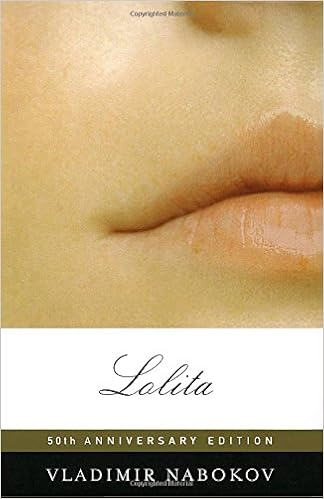
Lolita Paperback by Vladimir Nabokov (Vintage) (#IBRClassicsBooks)

Lolita is Nabokov’s best novel because it is the book that best synthesizes all his major characteristics as a writer:
(1) A love of language
(2) Delight in word play, patterns, puzzles, and games
(3) A highly intelligent, narcissistic-sociopath narrator
(4) A resilient victim who is  the center of Nabokov’s sympathy
(5) A pre-occupation with perception, consciousness, time, and memory
(6) A belief in fate and the existence of a great design behind what seem to be the random and irrelevant facts of ordinary life
(7) The conviction that art is a refuge from the assault of death
In addition, Lolita is the disturbing story of a successful child rapist. It features brilliant miniature portraits of postwar America – almost Vermeer-like in their lucidity – as well as a phantasmagorical climax that takes place in a fairytale nightmare land. Lolita is funny, harrowing, heartbreaking, and transcendent. It caused a scandal, was a critical and then a popular success, and made Nabokov a mint of money. As art and cultural phenomenon, Lolita excels. The Lolita article on Wikipedia is pretty good.

Saturday, May 27, 2017

Six Day War.... 50 years of legal issues related to deacto annexation of the West Bank :Political Decision Making and Non-Decisions: The Case of Israel and the Occupied Territories 2,015th Edition, Kindle Edition by R. Ranta(Palgrave MacMillan);The Oslo Accords: International Law and the Israeli-Palestinian Peace Agreements 1st Edition by Geoffrey R. Watson (Oxford University Press);Conflicts in a Conflict: A Conflict of Laws Case Study on Israel and the Palestinian Territories (Cile Studies) 1st Edition by Michael Karayanni (Author), Center for International Legal Education (Author)(Oxford University Press)Kingdom of Olives and Ash: Writers Confront the Occupation Paperback – May 30, 2017 by Michael Chabon (Author), Ayelet Waldman (Author) (Harper Perrenials)The Case for Israel 1st Edition by Alan Dershowitz (John Wiley & Sons)


Informally but on the ground, Israel has effectively annexed portions of the West Bank without a formal legal announcement.


Image result for ISrael Settlements Icon Pictures


Though it is not widely known, the legal status of the West Bank was decided by 1963.

True, Israeli forces did not gain control over the West Bank, also known as Judea and Samaria, until the June 1967 war.


Meir Shamgar’s ideas, embodied by a series of IDF military orders issued soon after the IDF took over the West Bank, have dominated the Israeli debate for the 50 years since then, certainly up until the Settlements Regulation Law passed in February.

How could this be when few – if any – in 1967 imagined that the West Bank would still be in Israeli hands 50 years later with around 400,000 Israeli Jews living in the massive enterprise known as the “settlements” of the West Bank? How have major Israeli legal thinkers conceived of the status of the settlements and how has that impacted the legal status of the West Bank over the last 50 years?

Meir Shamgar, former Supreme Court president. Credit: Kobi Gideon/GPO

ACCORDING TO former Hebrew University Law School dean and Israel Democracy Institute Fellow Yuval Shany, the starting point for the discussion was Shamgar and Israel’s acceptance of the 1907 Hague Regulations applying to the West Bank.

This means Israeli control over the West Bank falls into the category of “belligerent occupation.”

In less fancy language, it means that Israel has not annexed the land and is holding it temporarily. Further, it means that Israel has certain obligations not to change the face of the land or harm the rights of the local people already there – the Palestinians.

Shany said that agreeing to apply the Hague principles “was the only possible decision since there was no political decision to annex the West Bank.”

He noted that Israel could have decided to extend Israeli law to the West Bank, as was done in east Jerusalem, “but the government did not want to make that political decision. All governments since also did not make this decision,” so accepting the international law obligations and limits of the Hague Regulations was “the only option.”

In contrast to the Hague Regulations, Shany said there has always been a debate about the application of the Geneva Conventions to the West Bank.

Why has Israel accepted application of the Hague Regulations, but argued the Geneva Conventions do not apply and that Israel only voluntarily applies the humanitarian provisions of the Geneva Conventions? According to Shany, “Geneva has been understood to talk about a prior sovereign state. The Hague does not, it just talks about entering enemy/disputed territory.”

Why does this matter? Israel took control of the West Bank from Jordan, but Jordan had, according to most countries in the world and the UN, illegally annexed the West Bank in a land grab during the 1948 war.

There was no way that Israel would recognize Jordan as having been rightfully and legally in control of the West Bank, so the Israeli position was that when it took over the West Bank, it had taken over disputed territory as part of a war.

Soldiers at the Awara checkpoint near Nablus in 2008. Credit: MOSHE MILNER / GPO

Accepting The Hague without accepting Geneva was designed to convey to Israel would protect Palestinian individual human rights, without recognizing Jordanian sovereign land rights. Israel could now stake its claims to the West Bank in negotiations under UN Security Council Resolution 242, which dictates the terms of peace negotiations between Israel and its Arab neighbors.

Shany said Shamgar set out this balance in a public speech in 1971 when he had moved on from being the MAG to becoming the attorney-general.

Further, the High Court of Justice declared in a 2000 decision that Israeli law demanded application of The Hague and Geneva, saying they had become binding international commitments. Shany added that the government stills take the position that Geneva’s provisions do not apply to the settlements.

Human rights lawyer and Israeli government critic Michael Sfard said that Israel’s position of accepting The Hague, but not Geneva, was designed by Shamgar to satisfy the political class’s desire for flexibility on future issues of dividing territory. He said that Israeli lawyers like Shamgar “knew Geneva applied to conquered areas [like the West Bank], but wanted creative ways not to admit it.”

In fact, Sfard said that the first IDF proclamation for the West Bank included Geneva as applying, but that this was “very quickly erased” and replaced with “other creative phrases such as ‘administered areas,’ which had not previously existed.”

Former Foreign Ministry top legal adviser and Levy Report author – referred to also as the Report on the Legal Status of Building in Judea and Samaria – Alan Baker, disputed that account, saying that the first orders only said the requisite norms and rules of international law would apply.

Sfard said this “ambivalence” by many of the lawyers on key issues from the beginning was responsible for opening things up for the settlement enterprise, instead of “stopping it all from the start.”

MUCH OF what has happened with the settlements since then, Shany said, had more to do with politics than law.

First, the settlements ballooned from zero to a tiny smidgen of villages in the late 1960s.

Then they jumped somewhat to 6,000 people in 20 settlements up until 1977 when Menachem Begin ousted Labor from power for the first time.

After 15 years of mostly Likud rule, the settlements jumped to 100,000 people in 110 settlements by 1992, when Yitzhak Rabin fully ousted Likud from power.

By 2015, according to government statistics, there were around 389,000 Jewish settlers in the West Bank and another 375,000 Jews in disputed east Jerusalem neighborhoods.

What is the legal status of Jewish settlers and how did their presence change the legal framework of the West Bank’s status? Even if the 1967 Levi Eshkol government’s original intention was mostly just to hold on to the West Bank as a bargaining chip to achieve peace, around three months after the war, on September 1, 1967, the Arab League declared it would not negotiate land for peace at the Khartoum Conference.

Sfard rejected any narrative where there were not Israeli plans for partial annexation from the start, pointing out that Israel applied Israeli law to east Jerusalem (effectively annexation) even before the Khartoum conference.

In addition, from the start, Shany said that the Labor Party was split, and there were always elements who wanted to hold onto parts of the West Bank, such as some of the Jordan Valley, for security purposes.

This, combined with a strong push on the Right for settling the West Bank, created fertile ground for Israel taking the theoretical position that all of the West Bank land was negotiable with its Arab neighbors as part of UN Security Council Resolution 242, while eventually directly or indirectly facilitating or allowing a ballooning settlement movement.

This is how de facto, informally and on the ground, Israel has effectively annexed portions of the West Bank without a formal legal announcement.

The Judean Hills as seen from Ma’aleh Adumim in 2009. Credit: Mark Neyman/GPO

Changes and turning points

According to Baker, the main change on the Israeli side has been placing greater emphasis on the basic historical and legal rights of the Jews to the land according to the Balfour Declaration, the 1920 San Remo Declaration and other prestate documents.

Former IDF deputy MAG, West Bank Courts chief justice and “Hebron shooter” defense lawyer Ilan Katz said that neither the Oslo Accords, which divided the West Bank into areas A, B and C, nor various other major points changed the basic dynamic in which international law does not recognize the legality of the settlements.

Though Katz and Sfard agreed on little, they did concur that the Oslo Accords changed little regarding the settlements and the West Bank. In Sfard’s view, the accords succeeded in “changing the occupation from a regular occupation to a deluxe occupation.

“The occupier was free of obligations to the Palestinians,” but the Palestinians could not operate as an independent state. In the meantime, Sfard said, Israel “could present to the world – look there is autonomy” for the Palestinians.

Katz said that Geneva permits building only temporary security outposts in areas under belligerent occupation and prohibits moving civilians into such areas.

But there is one major exception to the idea that even major recent events like Oslo have not significantly changed the legal framework.

Discussing the 1979 Elon Moreh ruling, Katz said that this was a turning point in which the High Court intervened – not to endorse or reject the legality of the settlement enterprise, but to place limits on where civilian settlements could be built.

The High Court ruled that private Palestinian land could not be taken from Nablus for the benefit of the Jewish settlement of Elon Moreh. At the same time, according to Katz, the High Court effectively endorsed Jewish settlements in the West Bank that were built on state land by not blocking such settlements.

Interestingly, Katz said that this was the point where the state could have limited the High Court from intervening further in the settlement enterprise. In other words, if the Knesset had decided back then to limit the High Court from deciding certain issues related to the settlements, it would have been easier politically to “get away with it” than now when there are decades of court decisions regarding settlement issues. Decades later, with Elon Moreh such a hardened precedent, he does not think recent proposals to compensate Palestinians for instances in the past where their private land was built on will be upheld legally.

This is especially interesting coming from Katz, who is highly critical of the international community and its interpretations of international law when it comes to accusing Israeli soldiers of war crimes in battle. Katz explains that he consistently follows the classical interpretation of international law regarding laws of war as well as settlements-related issues.

According to him, regarding settlements, classical international law has consistently classified them as illegal, whereas regarding the laws of war, he believes much of the international community has departed from traditional interpretations to try to hold Israel to a higher and incorrect standard. He found the world’s “double standard” especially problematic in light of the constant bombings, rammings and rocket threats.

Another key legal point that needed to be struggled with, according to Sfard, was Justice Ministry lawyer Plia Albeck’s legal approach after the High Court Elon Moreh decision. As head of the Civil Department of the State Attorney’s Office, her ruling opened up possible use of around 1 million dunams (100,000 hectares) of West Bank land as “state land,” tripling the size of the area where Jews could establish new settlements.

If the High Court forbade confiscating private Palestinian land, here was a way to redefine huge swaths of land as non-private, and therefore available, said Sfard.

Albeck’s approach, which she later admitted she was ideologically committed to for broadening the settlements, was that according to an 1858 Ottoman law, agricultural land that had not been tended for a certain number of years could be declared abandoned and state land. The High Court accepted her verdict as legal, the international community does not.

WHEREAS KATZ regards the High Court’s rulings as legally correct and sees the court as a badge of pride for its independence and readiness to rule against the government on sensitive issues, Sfard takes an entirely different turn, attacking the High Court as an enabling agent of the settlement enterprise.

“There are three main legs for the occupation: the rifle, the settlements – which have no logic from a diplomatic,security or economic perspective – and the High Court,” said Sfard.

Even if the High Court sometimes restrained government actions regarding the settlements, Sfard said it had a negative impact overall because it “strengthened the Israeli approach, gave huge power to Israeli institutions, approves almost all state national security decisions and the state’s use of violence. By virtue of the High Court, Israel’s conquest was very stable.”

He admitted that if the High Court had not been involved at all, the government would have been less restrained. But he said it also would have made its violations of international law clearer and less subject to the defense that the government only acts when the High Court approves its actions’ legality.

Despite High Court interventions, Sfard feels that, “even if there is no dictator, the occupation is brutal and dictatorial to the Palestinian community since there is a total absence of inclusion” of their needs, wishes and aspirations.

Forces preparing to evacuate the settlement of Amona in 2006. Credit: Avi Ohayon/GPO

RECENTLY, THE UN Security Council passed Resolution 2334, condemning the settlements as illegal for the first time since 1981. Another interesting event happened in February, when the Settlements Regulations Law was passed, which permitted, for the first time, certain settlers’ residences to be retroactively legalized, even though they were built on private Palestinian land (provided the Palestinians get some compensation and that other criteria are fulfilled).

According to Shany, the two events apply opposite pressures on the unsustainable status quo. The resolution, he said, showed that the world still does not recognize the settlements’ legality, despite the length of Israeli possession of the West Bank and the growth of settlements on the ground. In contrast, the Knesset law tries to validate the de facto presence of settlements on the ground, but in doing so undoes Israel’s careful balance of arguing that it follows the international law of belligerent occupation and protects Palestinian rights, such as the right to private property.

Katz and Baker were dismissive of the UNSC resolution “because there was no operative decision saying ‘if you don’t move the settlements, you will be kicked out of the UN or face sanctions,’” said Katz.

Regarding the Knesset law, Baker and Katz both said they did not think it would have much impact. With the attorney-general rejecting its legality, they said it was highly likely that the High Court would strike the law as unconstitutional.

Discussing the Knesset law, former Supreme Court Justice Dalia Dorner said, “I separate my private opinion from what the law says. You can interpret within the rules of the game. That does not mean that I like a law personally if I or the High Court reject a petition to strike a law. It just means the law is legal. I am not a judge for politics, but for the judiciary.”

She added that “Judge Moshe Landau was a believer in Greater Israel, but he wrote the Elon Moreh decision [evacuating settlers] because it was built on private land. We cannot do otherwise because we are judges.”

Sfard, noting that he filed one of the major petitions to strike the Knesset law as unconstitutional said that “it is a dramatic change. International law is very complex. One weakness is it gives lots of power to declarations. But there is a gap between words and deeds.

“Israel has succeeded in exploiting that weakness so far, despite being in disagreement with the world for 50 years… saying it won’t violate fundamental international law of acquiring land… but has totally offended these principles in practice by building settlements.”

Sfard said that the Knesset law “closes the gap between the words and the deeds. Israel is not talking anymore about negotiations, but about annexation.”

Palestinians working in Israel stand in line early in the morning as they wait to cross through Kalandiya checkpoint near Ramallah in April. Credit: Reuters
What does the future hold?

According to Shany, “The status quo is not sustainable… there will be a political settlement, including Israel giving up territory and the setting of borders.”

According to Baker, “There will be some political settlement dividing the territory between the sovereign entities present.”

Katz was the hardest to get to make a prediction. He said, “I can’t tell… It is like asking what number will win in the lottery. There are several reasons it is hard to predict. All the time there are new players in the picture,” noting that Hamas became a player only in the 1990s.

He also noted that the Palestinians are now influenced by “outside authorities, like Iran, Hezbollah, Islamic Jihad” and potentially even ISIS.

Mainly, he predicted that things would get much worse before they get better, and that in the coming years there would be another war with harsh results.

“Only after that might there be talk about an agreement,” said Katz.

Sfard predicted, “I believe that the occupation will end, but I don’t know what the price will be. Maybe a bleeding democracy, since we have harmed our democracy to perpetuate the occupation.

“We can’t continue like this… It is a great disaster for both Israel and the Palestinians. Whether with negotiations or a catastrophe, the occupation will end because such an oppressive regime is by its nature unstable. There is a limit how far it can continue to prevent millions of people from determining their own fate,” said Sfard.

After 50 years, one thing that is clear is that the legal status of the West Bank and the settlements are as unresolved as ever. In the final analysis, while the top experts surveyed here have very different predictions about the future, all of them believe the present is unsustainable and that 50 years from now the picture will look much different.

Friday, May 19, 2017

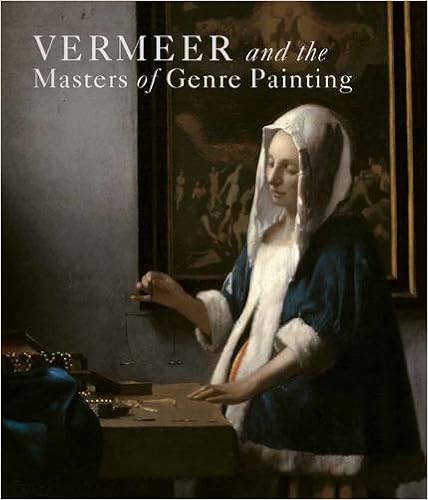
Vermeer and the Masters of Genre Painting: Inspiration and Rivalry Hardcover – April 11, 2017 by Eddy Schavemaker (Author), Adriaan Waiboer (Editor), Arthur K. Wheelock Jr. (Contributor), Blaise Ducos (Contributor), Eric Jan Sluijter (Contributor), Piet Bakker (Contributor), E. Melanie Gifford (Contributor), Marjorie E. Wieseman (Contributor), Quentin Buvelot (Contributor), Lisha Deming Glinsman (Contributor)(Yale University Press)

A landmark exploration of the engaging network of relationships among genre painters of the Dutch Golden Age 

The genre painting of the Dutch Golden Age between 1650 and 1675 ranks among the highest pinnacles of Western European art.  The virtuosity of these works, as this book demonstrates, was achieved in part thanks to a vibrant artistic rivalry among numerous first-rate genre painters working in different cities across the Dutch Republic.  They drew inspiration from each other’s painting, and then tried to surpass each other in technical prowess and aesthetic appeal. 
 
The Delft master Johannes Vermeer (1632–1675) is now the most renowned of these painters of everyday life.  Though he is frequently portrayed as an enigmatic figure who worked largely in isolation, the essays here reveal that Vermeer’s subjects, compositions, and figure types in fact owe much to works by artists from other Dutch cities.  Enlivened with 180 superb illustrations, Vermeer and the Masters of Genre Painting highlights the relationships – comparative and competitive – among Vermeer and his contemporaries, including Gerrit Dou, Gerard ter Borch, Jan Steen, Pieter de Hooch, Gabriel Metsu, and Frans van Mieris.
Landmark Exhibition Brings to Light Relationships Between Vermeer and his Contemporaries
More than 20 years after the legendary exhibition Johannes Vermeer, the National Gallery of Art, Washington, presents Vermeer and the Masters of Genre Painting: Inspiration and Rivalry. On view in the West Building from October 22, 2017, through January 21, 2018, the exhibition examines the artistic exchanges among Dutch Golden Age painters from 1650 to 1675, when they reached the height of their technical ability and mastery at depicting domestic life.
Some 65 masterpieces by Johannes Vermeer and his contemporaries—including Gerard ter Borch, Gerrit Dou, Pieter de Hooch, Nicolas Maes, Eglon van der Neer, Caspar Netscher, and Jacob Ochtervelt—are grouped by theme, composition, and technique, thereby demonstrating how these painters admired, challenged, and pushed each other to greater artistic achievement. The paintings also reflect how these masters responded to the changing artistic climate of the Dutch Republic in the third quarter of the 17th century, particularly in Amsterdam, Haarlem, Leiden, Deventer, Rotterdam, and Delft.
Since 1995 the Gallery's curator of northern baroque paintings, Arthur K. Wheelock Jr., has mounted more than a dozen exhibitions on Dutch artists, including several featured in this exhibition. Among them are Johannes Vermeer (1995), Jan Steen (1996), Gerrit Dou (2000), Gerard ter Borch (2004–2005), Frans van Mieris (2006), and Gabriel Metsu (2011). As the culmination of these monographic exhibitions, Vermeer and the Masters of Genre Paintingreveals how these painters were artistically more connected than has previously been understood.
"The 1995 Johannes Vermeer show endures as one of the most significant exhibitions in the Gallery's history. Vermeer and the Masters of Genre Painting will undoubtedly have the same impact while also deeply enriching our understanding of the web of influence among 17th-century Dutch artists," said Earl A. Powell III, director, National Gallery of Art, Washington. "This exhibition would not have been possible without the incredible generosity of the lenders, both museums and private collectors, or the support of the Hata Foundation, Dr. Mihael and Mrs. Mahy Polymeropoulos, The Exhibition Circle of the National Gallery of Art, and BP p.l.c."
Exhibition Support
BP p.l.c. is proud to sponsor this exhibition as part of its support of the arts in the U.S. and U.K.
"As the nation's largest energy investor, BP's commitment to America goes well beyond providing the energy and jobs that fuel economic prosperity. We also have a long history of supporting the arts and cultural activities in the U.S. and around the world," said Geoff Morrell, Senior Vice President, U.S. Communications & External Affairs, BP America. "We are especially delighted to be able to play a part in helping the National Gallery of Art make this historic exhibition possible, and we hope it will be a tremendous success for the museum and a memorable experience for all who see it."
The exhibition is also generously supported by the Hata Foundation, Dr. Mihael and Mrs. Mahy Polymeropoulos, and The Exhibition Circle of the National Gallery of Art.
Exhibition Organization and Curators
The exhibition is organized by the National Gallery of Art, Washington, the National Gallery of Ireland, Dublin, and the Musée du Louvre, Paris. The exhibition is on view at the Musée du Louvre from February 20 through May 22, 2017 and at the National Gallery of Ireland from June 17 through September 17, 2017.
The exhibition is curated by Arthur K. Wheelock Jr., curator of northern baroque paintings, National Gallery of Art, Washington; Adriaan Waiboer, head of collections and research, National Gallery of Ireland, Dublin (who initiated the exhibition concept); and Blaise Ducos, curator of Dutch and Flemish paintings, Musée du Louvre, Paris.
Exhibition Highlights
Dutch genre painting reached the pinnacle of its popularity and technique during the third quarter of the 

17th century as a network of artists working in different cities found success depicting scenes of the daily life of the elite. Vermeer and the Masters of Genre Painting makes clear that artists often studied and emulated paintings by other masters. While little is known about exactly when artists saw paintings by those working in different cities, travel across The Netherlands was relatively easy at the time with the country's efficient infrastructure of roads and canals. Artists would have been able to make short journeys to visit painters' studios as well as the homes of collectors and art dealers. There are also specific instances of contact between artists such as cosigned documents, as with Vermeer and Ter Borch; a few known teacher-student relationships, including Dou and Van Mieris; and anecdotes—for example, that Steen and Van Mieris were reputedly drinking buddies.

The paintings in the exhibition are presented in groups that illustrate how artists inspired each other in their subject matter, figural motifs, stylistic decisions, and painting techniques. Subjects include women writing letters, musical duets, astronomers, lace makers, and a woman holding a parrot. One group compares three paintings of women with lutes by Van Mieris, Van Der Neer, and Vermeer while another demonstrates how a number of artists adapted an important pictorial motif in their work—a female figure standing with her back to the viewer. The motif was introduced by Ter Borch in his famous Gallant Conversation ("The Paternal Admonition") (c. 1654, Rijksmuseum) and then utilized in a variety of ways by De Hooch, Steen, and Ochtervelt.

The direction of influence did not strictly flow from masters to their followers. In many ways, Ter Borch and Dou were the forefathers of high-life genre painting in The Netherlands. They were incredibly influential to the younger generation of artists, many of whom were their pupils. However, the two painters also studied and emulated the work of their admirers. For instance, Dou, in his painting The Dropsical Woman (1663, Musée du Louvre), looked carefully at Van Mieris's earlier depiction of that same theme, but enlarged his interior setting and increased the number of figures to create a more ambitious work than his former pupil produced.

Vermeer, no less than his contemporaries, looked carefully at paintings by different artists, and most of the groups in this exhibition include at least one work by the Delft master. A particularly interesting connection exists between Vermeer's Woman with a Pearl Necklace (c. 1662–1665, Gemäldegalerie) and Van Mieris's Woman before a Mirror (c. 1662, Gemäldegalerie). The similar subjects of these paintings, in which a woman is shown standing in profile before a table and adjusting her necklace, was not their invention but that of Ter Borch in his Young Woman at her Toilet with a Maid (c. 1650–1651, The Metropolitan Museum of Art). Through such juxtapositions, one is able to understand the distinctive qualities that each of these artists brought to their subjects. For example, the woman in Vermeer's Woman with a Pearl Necklace has a timelessness that evokes inner strength and purity, thus providing this genre scene with a moral and philosophical underpinning more traditionally associated with history paintings.

Catalog and Related Programs

Published by the National Gallery of Art, Ireland, National Gallery of Art, Washington, and Musée du Louvre, Paris, in association with Yale University Press, a fully illustrated catalog features essays by the curators and an esteemed group of international scholars. The catalog also includes a timeline of the recorded and conjectured visits of ten of these artists and 22 entries discussing the various thematic groupings of paintings. Featuring 180 color illustrations, the 320-page catalog will be available in both hardcover and softcover at shop.nga.gov/, or by calling (800) 697-9350 or (202) 842-6002; faxing (202) 789-3047; or emailing mailorder@nga.gov.

Tuesday, April 18, 2017

An Ounce of Practice by Leo Zeilig, Hope Road Publishing;


Writer and Researcher Leo Zeilig‘s new novel tells a gripping tale of an intellectual leftie from London, a group of southern African activists in Zimbabwe and England, and the emotional battles of living and acting in the struggles of the 21st century.

Viktor lives in London. His life is bedevilled by inertia, a sense of dying really. His family life disintegrates. It doesn’t help much that he spends his days immersed in his computer. He connects with the world through Facebook and Twitter, writing blogs and posting them on a website of radical politics.

He longs for practice, for life in action. But he remains stuck in theorising, with his comrades at the university, even in his connection with his young daughter.

Tendai is Viktor’s friend. Now trailing a London university campus as a reading worker and strike organiser; he’s been steeled through a life lived in the southern African struggles against colonialism and apartheid. Tendai believes in practice to prevail over theory. He challenges Viktor:


If you haven’t seen and lived, what good are you?

Anne-Marie is in Harare. She works with the development NGO set of expats, though deeply cynical about their politics and lavish lifestyle. Her life finds more clarity and radical action through her involvement with the “Society of Liberated Minds”, a small band of self-styled revolutionaries who rename themselves “Lenin”, even “Stalin”, but also “Biko” and “Cabral”.

Anne-Marie’s double predicament is her prominent Congolese family’s expectations towards her womanhood and her unpredictable lover, the Society’s leader. Biko is an activist in Bulawayo. He burns with desire, rage and action. Biko lives the practice and action that Viktor longs for and, at once, shirks. In his personal life he craves connection with his family, his past, his throbbing loneliness driving him to more and more dangerous action.

Zeilig’s characters connect, at first tentatively, in virtual space. Then Viktor, pushed ever deeper into his crisis and persuaded, cajoled and seduced, travels to Zimbabwe. There he hopes to find “some bloody practice”, grabbing a chance to write “at last for a movement, a people struggling against dictatorship and neoliberalism”. And to meet Anne-Marie …

The action heats up in Harare and Bulawayo. Hotter, more raging, more engaging, more dangerous, more violent than he could have ever imagined.
Credible characters

As in his 2013 debut novel “Eddie the Kid”, Zeilig draws his characters with a close eye, deep psychological insight and extraordinary empathy. When I interviewed him, he emphasised that he wanted to avoid portraying activists as “iron Lenins”, which he sees as “an unfortunate tendency in left-wing fiction”.

His characters are enormously credible. Description and dialogue convey inner reflection and outward expression in words and action. In their different ways each of the left-wing activists – from the bumbling Viktor through to the passionate if somewhat dangerously zealous Biko – is well-meaning and flawed.

Even the white Zimbabwean businessman and coffee shop owner Louis, who befriends Viktor in Harare, while portrayed as crudely racist is also vulnerable and capable of love. This appears as the main thrust of this beautifully written novel: in the end, it’s love that’s at the heart of resistance and revolution. Of life itself. This is vividly imagined in Viktor’s loving relationship with his young daughter, which, even though somewhat hapless, is depicted in scenes of moving tenderness.
Breathing authenticity

Zeilig’s novel breathes authenticity with a superbly crafted cast of characters and poignant dialogue. He also impresses with acute, sensuous observations of place. The sights, smells and sounds of Harare take the reader into the dilapidated resilience of this once opulent, colonial city.Leo Zeilig. Hope Road Publishing

For “An Ounce of Practice”, Zeilig – who has been an academic and an activist in left-wing politics in both the UK and southern Africa – has drawn inspiration from two seemingly unconnected social and political struggles. When he was working at the University of London a few years ago, he became involved with a strike of cleaners at the university.

His second theme is the “catastrophic fall” of Zimbabwe, caused by the “twin evils” of IMF/ World Bank structural adjustment policies and President Robert Mugabe’s dictatorship. In Zimbabwe he also witnessed the courageous resistance of small groups of activists. In the novel he connects these stories through crafting a cast of Zimbabwean migrants at the heart of the labour action in London.

Zeilig explained during the interview,


the story is about the connections of the Global North and South, the link between how we live, love and struggle. It also looks at the 'neo-liberal’ hurricane in both parts of the world.

He emphasised the connection of personal and political crisis and, “the hope, if we are to become truly human, of breaking down the barriers to action, connection and hope”.
Engagement with political activism

“An Ounce of Practice” succeeds as an imaginative engagement with the predicament of global political activism today. It elegantly weaves nuanced philosophical reflections on the opportunities and dangers presented by social media and the precarity of existence in the neo-liberal academy through a vivid narrative of an individual journey, intimate love and life that never loses sight of the “bigger us”.

As the main protagonist of this African Bildungsroman slowly begins to live by a saying attributed to Friedrich Engels that, “an ounce of practice is worth a ton of theory”, Zeilig shows the exhilaration and hope that comes with activism. At the same time we see excruciating pain, despair and loss emerging in the encounter with violent dictatorship and repression.

“An Ounce of Practice” is a brilliant work of literary imagination that takes the reader to new realities in an engaging, moving read, hilariously humorous at times. Zeilig’s new novel is a page turner for readers interested in the profound questions of radical politics and humanity in today’s world.

Friday, February 10, 2017

SIX ENCOUNTERS WITH LINCOLN A President Confronts Democracy and Its Demons By Elizabeth Brown Pryor Illustrated. 480 pp. Viking. $35.


A rare visit to the front: Antietam, 1862.CreditMPI/Getty Images

SIX ENCOUNTERS WITH LINCOLN
A President Confronts Democracy and Its Demons
By Elizabeth Brown Pryor
Illustrated. 480 pp. Viking. $35.

At a moment when questions about the efficacy of democracy are on everyone’s lips, this book eerily reflects some of today’s key issues. Among them are the military’s part in domestic policy; the protections appropriate to noncitizens (in Lincoln’s case, Native Americans); the limits of female citizenship; the meaning of free speech; and states’ rights to contravene personal liberty.

Abraham Lincoln confronted these and other issues during his tenure as president, often choosing between expanding democratic potential and adhering to constitutional mandates. Deploying humor as a weapon, Lincoln emerges from the history books as a benign and democratic figure, ultimately a champion of slave emancipation.

A different Lincoln inhabits the pages of “Six Encounters With Lincoln.” Here we meet the skilled raconteur whose tales promote vacillation, and whose humor disguises costly indecision and delay. Many of his contemporaries labeled him cowardly and vulgar, an illegitimate ruler and despot. Elizabeth Brown Pryor, the author of two previous Civil War-era biographies, sees him as none of these, and yet she has produced a portrait of a president whose failures to act often undermine the democratic ideals and the moral values to which he claims commitment.

Uncertainty manifested itself in a complicated stance, sometimes fostering democracy and at others sticking to the letter of the Constitution. Convinced that states had a right to determine their economic and social priorities, Lincoln debated the use of military force to coerce recalcitrant states to remain in the Union. He wavered only when states’ rights threatened national unity. But once decided, he acted unilaterally to increase the size of the Army without elucidating lines of command. From that followed Lincoln’s dragging his feet on the issue of slave emancipation because he hoped that he could bring the South back into the Union with compromise rather than military victory. The dilemma inherent in using force to ensure liberty emerged most starkly in loyal border states that continued to legitimize slave owning. To ensure their commitment to the Union, Lincoln simply turned a blind eye, dashing the democratic aspirations of thousands of enslaved people.

Book Review

Be the first to see reviews, news and features in The New York Times Book Review.

Sign Up

Receive occasional updates and special offers for The New York Times's products and services.

In other instances, Lincoln did not hesitate to curtail constitutional rights in the interests of an initially controversial war. He famously ignored habeas corpus, claiming the right to seize suspicious individuals in wartime, and he attempted to control flows of information: acts that placed him at odds with the principle of safeguarding informed criticism in a democratic society.

Nor did Lincoln imagine extending democracy to Native Americans or to women. Pryor tells us that the greatest contradiction he faced was between the ideal of democracy and prevailing negative views of Indians. Like others of his generation, he thought all men were created equal except for Indians and women. He did not hesitate to abrogate Indian treaties, though he sometimes expressed concern for Indian life. He consistently rebuffed or denigrated women’s efforts to participate in wartime activities, rarely acknowledging even their heroic work as nurses.

Pryor died in 2015, and so she could have hardly intended this posthumously published book to suggest any parallels between Lincoln’s ambivalent politics and contemporary efforts to limit suffrage, spread fake news and eliminate federal efforts to protect the civil rights of women, African-Americans and the poorest wage earners. Yet the notion that democracy involves compromises resonates today. Lincoln’s dilemmas illuminate how apparently benign federal mandates — like universal health care, paid maternity leave or federal land acquisition — that seem on their face to extend democratic possibilities, can be viewed from within state borders as coercive. Fascinating reading on its own terms, “Six Encounters With Lincoln” nevertheless confronts readers with startlingly relevant questions.