Showing posts with label #IBRClassicsReview. Show all posts

Friday, May 4, 2018

Meditations (Penguin Classics) Paperback – 27 Apr 2006 by Marcus Aurelius (Author), Diskin Clay (Introduction), Martin Hammond (Translator) (#IBRClassicsReview)


Originally written only for his personal consumption, Marcus Aurelius's Meditations has become a key text in the understanding of Roman Stoic philosophy. This Penguin Classics edition is translated with notes by Martin Hammond and an introduction by Diskin Clay.
Written in Greek by an intellectual Roman emperor without any intention of publication, the Meditations of Marcus Aurelius offer a wide range of fascinating spiritual reflections and exercises developed as the leader struggled to understand himself and make sense of the universe. Spanning from doubt and despair to conviction and exaltation, they cover such diverse topics as the question of virtue, human rationality, the nature of the gods and Aurelius's own emotions. But while the Meditations were composed to provide personal consolation, in developing his beliefs Marcus also created one of the greatest of all works of philosophy: a series of wise and practical aphorisms that have been consulted and admired by statesmen, thinkers and ordinary readers for almost two thousand years.
Martin Hammond's new translation fully expresses the intimacy and eloquence of the original work, with detailed notes elucidating the text. This edition also includes an introduction by Diskin Clay, exploring the nature and development of the Meditations, a chronology, further reading and full indexes.
Marcus Aelius Aurelius Antoninus (121-80) was adopted by the emperor Antoninus Pius and succeeded him in 161, (as joint emperor with adoptive brother Lucius Verus). He ruled alone from 169, and spent much of his reign in putting down various rebellions, and was a persecutor of Christians. His fame rest, above all, on his Meditations, a series of reflections, strongly influenced by Epictetus, which represent a Stoic outlook on life. He was succeeded by his natural son, thus ending the period of the adoptive emperors.

Thursday, May 3, 2018

The Prince (Penguin Classics) Paperback – International Edition, July 26, 2011 by Nicollo Machiavelli (Author), Tim Parks (ISBClassicsReview)(Penguin UK)


This is excellence. The translation is fluent and clear. This book should be read in schools, on streets, at houses, shortly everywhere and everyday. A very honest and realistic account of how politics actually works, very differently from how we all desperately expect and wish it to work. I shall say no more because the writing on Niccolo Machiavelli's grave already gives an answer to my passionate desire to praise this gentleman: TANTO NOMINI NULLUM PAR ELOGIUM (with such a name, there is no need for eulogy).

This fascinating, elegant book was based on a terrible time for Italy when the Borgias ruled the Vatican, blood engulfed the peninsula and Leonardo was managing to keep out of trouble and was painting the Last Supper. Machiavelli deeply admired the rampaging Cesare Borgia and describes him as "a man of great courage and high intentions, and he could not have conducted himself other than the way he did". Five hundred years later, Italy still reels under factionalism and mistrust and Silvio Berlusconi would be described by some in the same terms that Machiavelli used for the ruthless Borgia. To admire such people, Machiavelli was realistic rather than amoral. As he says, "the fact is that a man who wants to act virtuously in every way necessarily comes to grief among so many who are not virtuous". He is telling us that we are naive if we think we leave ourselves open to other people. Being kind and generous, he explains, can get you into big trouble (and five hundred years ago that could mean ending up dead). As he says: "one can be hated just as much for good deeds as for evil ones". Recently tortured and imprisoned himself, Machiavelli knew the risks that he was writing about. But despite all that he writes in a chipper tone. As has been said before, The Prince could serve as a guide to modern office politics as well as being a survival guide in blood-thirsty times.

The Prince (Penguin Classics) Paperback – International Edition, July 26, 2011 by Nicollo Machiavelli (Author), Tim Parks (Introduction)#IBRClassicsReview


The Prince (Italian: Il Principe [il ˈprintʃipe]) is a 16th-century political treatise by the Italian diplomat and political theoristNiccolò Machiavelli. From correspondence a version appears to have been distributed in 1513, using a Latin title, De Principatibus (Of Principalities). However, the printed version was not published until 1532, five years after Machiavelli's death. This was done with the permission of the Medici pope Clement VII, but "long before then, in fact since the first appearance of The Prince in manuscript, controversy had swirled about his writings".

Although it was written as if it were a traditional work in the mirrors for princes style, it is generally agreed that it was especially innovative. This is only partly because it was written in the vernacular Italian rather than Latin, a practice which had become increasingly popular since the publication of Dante's Divine Comedy and other works of Renaissance literature.

The Prince is sometimes claimed to be one of the first works of modern philosophy, especially modern political philosophy, in which the effective truth is taken to be more important than any abstract ideal. It was also in direct conflict with the dominant Catholic and scholastic doctrines of the time concerning politics and ethics.

Although it is relatively short, the treatise is the most remembered of Machiavelli's works and the one most responsible for bringing the word "Machiavellian" into usage as a pejorative. It even contributed to the modern negative connotations of the words "politics" and "politician" in western countries. In terms of subject matter it overlaps with the much longer Discourses on Livy, which was written a few years later. In its use of near-contemporary Italians as examples of people who perpetrated criminal deeds for politics, another lesser-known work by Machiavelli which The Prince has been compared to is the Life of Castruccio Castracani.

The descriptions within The Prince have the general theme of accepting that the aims of princes – such as glory and survival – can justify the use of immoral means to achieve those ends:
He who neglects what is done for what ought to be done, sooner effects his ruin than his preservation.

The Prince (Penguin Pocket Hardbacks) Paperback by Niccolo Machiavelli (Author), Tim Parks (Author) (#IBRClassicsReview) (Penguin Classics)


Niccolo Machiavelli's book was written in the mid 16th century; this is a later translation from the 17th century converted into ebook format. There are a couple of issues with the format on the Kindle; some missing page breaks, and some odd sentence breaks. The ebook version also includes a couple of additional items written by Machiavelli later in his life.

"The Prince" of the title is merely a generic label for a leader, rather than a given level of nobility. The main book is a study of the concept of leadership, and particularly the application of politics within a nation or state. It is based upon a very careful study of the leaders of the time, especially within Italy and from the classical period of Greece and Rome. Although written some 500 years ago, most of the precepts can be seen to have been relevant throughout the intervening period and in many ways are still pertinent today.

In fact some of the material could equally be applied within large organisations; examine the biographies of some of the most famous business leaders and entrepeneurs, and you will see many of the factors that enabled them to rise up being the same that Machiavelli identified as being desirable in a great leader. It does perhaps portray a certain level of cynicism and certainly indicates the ruthlessness that is required to become a political figure; and it is this that has made the name of Machiavelli synonymous with political intrigue.

In many ways, this book is to political governance, what Sun-Tzu's "Art of War" was to the concept of military leadership. Careful study will reveal a lot of valuable advice and information; and although not the easiest book to read, the end result is well worth the effort.

Sunday, April 8, 2018

Romeo and Juliet (Norton Critical Editions) 1st Edition by William Shakespeare (Author), Gordon McMullan (Editor) (W.W. Norton & Compan) (IBRClassicsReviews)


This much-anticipated Norton Critical Edition of Shakespeare’s best-known play is based on the Second Quarto, widely agreed to be the most authoritative early text.
By carefully selecting extracts from sources, scholars, and scriptwriters, Gordon McMullan tells a series of stories about Romeo and Juliet, globally and from their legend's origins to the present day.

The Norton Critical Edition includes:
· Introductory materials and explanatory annotations by Gordon McMullan as well as numerous images.
· Sources and early rewritings by Luigi Da Porto, Matteo Bandello, Pierre Boaistuau, Kareen Seidler, and Thomas Otway, among others.
· Critical readings and later rewritings spanning four centuries and including those by Stanley Wells, Wendy Wall, Dympna C. Callaghan, Jill L. Levenson, Nia?h Cusack, David Tennant, and Courtney Lehmann.
· A Selected Bibliography.

Friday, March 16, 2018

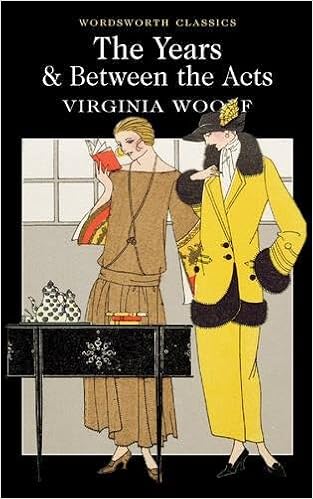
The Years / Between the Acts (Wordsworth Classics) UK ed. Edition by Virginia Woolf (Wordsworth Editions) (IBRClassicsReview)


The Genius of Virginia Woolf
In Her Last Book the English Novelist Again Says the Unsayable

When Virginia Woolf quietly wrote a farewell note to her husband, took her stick--so fixed is habit--and went on her favorite walk across the summery meadows down to the Ouse to slip under the water, it was a sad hour for English letters. Why did she do it? No one knows precisely. It may well have been a combination of four factors--sorrow over the war with its breeding hatreds; the demolishment of her Bloomsbury apartment ("They are destroying all the beautiful things!" she cried); the revising of her book, which always caused her pain; and the fear of "an old madness" coming over her.

"Between the Acts" had been completed before her death, but she was still working on the final revisions when the compulsion for the ultimate escape seized her. It is with curiosity, profound regret, and a cool sort of reverence that one takes up the last work of the sole indisputable genius among contemporary British women-of-letters.

Virginia Woolf has left to posterity a shelf of sixteen volumes that enrich our literature in a very special way. Two are books of criticism of extraordinary perception, and ten are novels, in which she has achieved inimitable distinction. And though her fiction has been predominantly caviar to the general, yet in two of her novels she achieved best sellers--one, "The Years," held the top place on best seller lists for months in 1937. With "Jacob’s Room" in 1922 Mrs. Woolf was recognized by the discriminating as a novelist of first rank. From "Mrs. Dalloway" on, she was widely regarded as the foremost woman writing in English.

As the bulk of the iceberg lies beneath the water’s surface, so the greater opulence of Mrs. Woolf’s prose fiction may be said to lie above the clouds. In rarefied strata of pure sensation, ephemeral beauty, celestial imaginings, she flies with skill and daring. Without eager wings and sympathetic vision, even the practiced reader may fail to realize how she has pierced the screen ‘twixt thing and word, "where language is lit straight from soul."

"Between the Acts" is one of Mrs. Woolf’s most seemingly simple books: the plot well integrated, the fancy under deft control. There is even a new calmness, a new clarity. She is not lost in webs of speculation, thin-drawn to incommunicability as in "The Waves," where she wrote, "I desire always to stretch the night and fill it fuller and fuller with dreams."

Yet in her "easier" last book, ingeniously the story is played out on three levels--a pageant within a pageant and all within the vaster pageant of creation and infinity. The animal plane, the human and the spiritual, each has function and counterpointal significance. As to actual plot, despite the disciplined guidance, what does it amount to, and who seriously cares?

Did the plot matter? She shifted and looked over her right shoulder. The plot was only there to beget emotion. Don’t bother about the plot: the plot’s nothing.

So says Miss La Trobe, the enigmatic author and producer of the pageant, who seems to represent the creative mind in relation to an audience and actuality.

On a single day of June, 1939--with the war imminent but virtually unperceived--the action takes place at Pointz Hill, an English country house. It revolves about a pageant played upon the lawns by the local villagers. In its unity of time "Between the Acts" recalls "Mrs. Dalloway." Through implications of the scenes touching on the whole history of England and the mutations of English literature it suggests "Orlando."

Despite her necessity, the solitary, thick-legged, masculine Miss La Trobe, who knew how "vanity made all human beings malleable," is not one of the principal characters. The chief actors are the members of the Oliver household. The head of the house is old Bartholomew Oliver, who like so many retired English soldiers has only his India to cling to. He marvels at his widowed sister’s orthodoxy. ("Deity," as he supposed, "was more of a force or a radiance, controlling the thrush and the worm, the tulip and the hound; and himself too, an old man with swollen veins.") This aging sister, Mrs. Swithin, who would have become a clever woman is she could ever have fixed her gaze, is the most sympathetic figure in the book. Living with the older Olivers are Isa, the poetry-quoting daughter-in-law, temporarily attracted to a gentleman farmer, and Giles, the stock broker son, handsome, hirsute, virile and surly.

To this special group are added buoyant, big-hearted Mrs. Manresa, "a wild child of nature" for all that her hands are bespattered with emeralds and rubies, dug up by her thin husband himself in his ragamuffin days in Africa. Uninvited she drops in at luncheon, bringing along with the picnic champagne a maladjusted, putty-colored young man named William Dodge, whom Giles contemptuously sizes up as "a toady, a lickspittle, not a downright plain man of his senses, but a teaser and a twitcher, a fingerer of sensations; picking and choosing; dillying and dallying; not a man to have a straightforward love for a woman."

William tries dallying with Isa, and Giles, partly to annoy his wife, pays court to the full-blown charms of sparkling Mrs. Manresa, who confesses she loves to take off her stays and roll in the grass.

Outstanding among the villagers in pageant and audience and the gentry from neighboring estates, is the minister.

The Reverend G. W. Streatfield looked at the audience, then up at the sky. The whole lot of them, gentles and simples, felt embarrassed, for him, for themselves--there he stood, their representative spokesman, their symbol, themselves, a butt, a clod, laughed at by looking glasses, ignored by the cows, condemned by the clouds which continued their majestic rearrangement of the celestial landscape, an irrelevant forked stake in the flow and majesty of the Summer silent world.

There is explanation, but no development of character in "Between the Acts." Mrs. Woolf seems to be saying that for all the transcendental beauties of nature and the high-breeding processes of civilization, human beings haven’t changed much from the time when "prehistoric man, half- human, half-ape, roused himself from his semi-crouching position and raised great stones." Fashions change, days are wet or fine, but the essential heart of man remains much the same. Mrs. Woolf is as poignantly aware of the durability of land and sky as she is of the impermanence of man’s relationships. "That’s what makes a view so sad," says Mrs. Manresa nodding at the strip of gauze laid upon the distant fields. "And so beautiful. It’ll be there when we’re not."

As in most of her novels, the cream of "Between the Acts" lies between the lines--in the haunting overtones. And the best of the show--the part one really cares about--happens between the acts and immediately before the pageant begins and just after it is over. So the play is not really the thing at all. It is merely the focal point, the hub of the wheel, the peg on which to hang the bright ribbons and dark cords of the author’s supersensitive perceptions and illuminated knowledge. It is in her imagery, in her felicitous gift for metaphor, for cadence, for exciting association, in her "powers of absorption and distillation" that her special genius lies. She culls exotic flowers in the half-light of her private mysticism along with common earthgrown varieties and distills them into new essences. Her most interesting characters move in an ambienteof intuition. With half a glance they regard their fellow-mortals and know their hidden failures. They care less for the tangible, the wrought stone, than for fleeting thought or quick desire.

In ten novels Mrs. Woolf lifted veil after veil to reveal what she perceived as the secret meaning of life. When one finishes a book of hers it is not characters he remembers but their spiritual emanations, which are in reality manifestations or facets of Virginia’s Woolf supervision. Her peculiar interest not in surfaces but in mysterious motivations and subterfuges that do not meet the eye. And no other English novelist has ever written more dazzling passages of poetry undefiled than Virginia Woolf. Like the great poets--Shakespeare, Donne, Shelley, Blake--Mrs. Woolf could say the unsayable, and it is there in her books for those who have ears attuned to unheard melodies, even if they can never recommunicate it in any language except Mrs. Woolf’s own precisely.

At once a woman of profound erudition and intuitive intelligence, she is also the most poignantly sensitive of English novelists. Yet there was a leaven of zest and humor in her make-up, and her wit was akin to that slyly malicious kind that ran in the veins of Prince Hamlet. Steeped in the classical tradition, she was an audacious experimentalist. She looked upon existence as a maze of paradoxes, but she was continually uplifted and renewed by the transient beauty of the world. One passage from "Between the Acts" seems to epitomize the attitude of mind, the prose style, the whole art of Virginia Woolf:

"Here came the sun, an illimitable rapture of joy, embracing every flower, every leaf. Then in compassion it withdrew, covering its face, as if it forebore to look on human suffering."

"Between the Acts" has no more ending, no more conclusion than English history. The pageant is played out, the guests depart, night falls. The old folks retire and Isa and Giles are alone for the first time that day.

"Alone, enmity was bared; also love. Before they slept, they must fight; after they had fought, they would embrace. From that embrace another life might be born. But first they must fight, as the dog fox fights with the vixen, in the heart of darkness, in the fields of night.

Isa let her sewing drop. The great hooded chairs had become enormous. And Giles too. And Isa too against the window. The window was all sky without color. The house had lost its shelter. It was night before roads were made or houses. It was the night that dwellers in caves had watched from some high place among rocks.

Then the curtain rose. They spoke."

The physical embodiment of Virginia Woolf is no more, but her inimitable voice remains to speak to generations yet unborn. The first line of her last book begins, "It was a Summer’s night and they were talking"--The last paragraph ends: "Then the curtain rose. They spoke."

As long as English is read the voice may go on--if without new delight, also without fresh pain. For Virginia Woolf, the woman, "Peace, Let her pass!" as the author says of a person just dead in the pageant. "She to whom all’s one now, Summer and Winter."

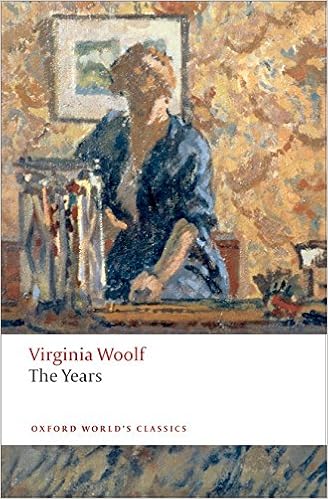
The Years (Oxford World's Classics) Paperback – May 28, 2009 by Virginia Woolf (Oxford University Press) (IBRClassicsReview)


Virginia Woolf's Richest Novel
In "The Years" Her Art Reaches Its Fullest Development to Date

Mrs. Woolf's novel, her first since "The Waves" of 1931, is rich and lovely with the poetry of life. It might be called a chronicle novel, since it begins in 1880 and ends in the present day, or a "family" novel, since it narrates the fortunes of the large and representative Pargiter family. But it eludes both classifications. Though the founder of the present family, old Colonel Pargiter, who lost two fingers in the Indian Mutiny--is, in habit and class, a bit of a Forsyte, there is nothing of the careful solidity of Galsworthy's saga, with its verifiable genealogy, interludes and corroborative detail.

Rather this is a long-drawn-out lyricism in the form of a novel, with flying buttresses to sustain its airy and often absent-minded inspirations. There is the minimum of substructure. But there is everywhere, on one lovely page after another, a kind of writing which reveals a kind of feeling that is more illuminating than a dozen well-made and documented novels. Mrs. Woolf has made, or unmade, her novel in the form of a poem or a piece of music.

And so not built at all
and therefore built forever,

and it is this subtle and oblique composition, though we may perhaps exaggerate its durability, that gives whatever she writes its distinction.

She has not continued from "The Waves," which was the furthest the novel could go in the way of freedom, or even license, of reverie and the stream of consciousness. Instead she has turned back to earlier forms of her own. "The Years" resembles somewhat the general motive of "To the Lighthouse" in its marking of time as the chief protagonist of recorded life. But sometimes there is the traditional form of narration that she mastered so easily in the early "The Voyage Out." There is also the discontinuity of "Jacob's Room." There is also the unity and singleness of "Mrs. Dalloway," with the years of five decades toiling instead of the chiming of a day's hours. In short, Mrs. Woolf has written her longest novel, her richest and most beautiful novel, out of many years in the practice of writing.

The Pargiter family she writes of might very well be, in its extensions and influence, a summary of her own family or any upper middle-class family, though it is a relief to record that she never descends to personal justifications. The Colonel has seen service in India. Retired, well-to-do, with an invalid wife in the foreground and a mistress in the background, he gives way to his family. Children in the Eighteen Eighties, they begin to form their lives. Martin goes into the army, Morris to the bar, Edward to Oxford and a distinguished scholar's life. Delia marries and becomes a brilliant hostess. Milly marries into the squirarchy and a routine of horses and children. The militant Rose will take to smashing windows to demonstrate the right of women to vote and Eleanor will stay home to look after her father the Colonel. How very representative it is, and how very natural--almost like one of nature's laws--that this English family should spread itself imperturbably throughout the professions and the counties, with a fling at India and Africa, and still remain completely itself, unmistakably Pargiter.

So far as the book is a chronicle of family life, we must note that it has a perfect beginning and a perfect end, and almost no middle. The development of character, the process of growing up, the movie-life of fiction, so to speak, has never been easy to Mrs. Woolf; or perhaps she distrusts its genuineness. The childhoods in the house in Abercorn Terrace, opening at tea-time with Milly taking her invalid mother's place at the tea-kettle which works so badly, and the family coming in from here and there: Martin from school, Eleanor from being kind to the poor, the Colonel from his club and his mistress, Morris from his law office; and the dinner that follows and is interrupted with the death of the long-ailing mother--this opening is so brilliantly composed that one looks back with dismay to the opening of another novel of about the same year and time of afternoon, Galsworthy's "The Man of Property," so full of upholstery and exposition. Mr. Galsworthy himself wrote of "picking" and "embalming" his characters. But Mrs. Woolf's persons are alive with the excitement of life. No one, I believe, has quite her immediacy of effect, her recklessness of sensation, tempered by breeding and intelligence, turned into pure expressibility.

The ending is in the same key, which means that though her characters have become older and have suffered the Boer War and the war of 1914, the suffragette movement and the Irish trouble, and some have been killed and others have lost their money, they are still young at heart. The grand party that ends the book, like a grosse fuga, is still gay and lively with memories, dreams and aspirations. Some nostalgia there is, certainly, and melancholy for the passing years; but there is still the perpetual bubbling of sensation, like old wine into a new glass, perhaps a cheaper glass-- but still something to contain the poetry and effervescence. Mrs. Dalloway's party, which took so many pleasant pains of composition, is merely a precious and somewhat malicious prelude to this family largess of personalities and histories.

Between the beginning and end there is a sort of stasis, possibly more true to life than the dynamics of other novelists; but still part of a criticism of Mrs. Woolf's method. The characters were young; now they are old; and both Mrs. Woolf can render to perfection. In the meantime, events happen, and they are arbitrarily selected. Eleanor at a committee meeting, Rose in prison because of Votes for Women, Eleanor at dinner with her cousins during an air raid; these are pictures, vividly painted but without a frame, unless one's own experience supplies one. It is here that one recalls Galsworthy again, who charted the course of each character. Mrs. Woolf lets them wander at will, forgetting and remembering, as one does really in life, moving slowly or standing still and musing while new inventions and policies clamor for attention. Her people live in the past, in the family, in all the roles of Victorian decorum; and yet with a sense of fun and intelligence and common sense and uncommon sensibility; and, above all, with the eccentricity of personality, so that no category quite contains them: they are as likely to burst into poetry as politics, or to qualify the army with a quotation from Horace. There is no cataloguing them, and no way of regimenting them into the customary form of fiction.

It is this, really, that gives Mrs. Woolf's novels their utmost delight, a quality of pleasure in living, a lovely sense of people thinking and feeling and brooding by themselves, with vague memories and sharp present sensations, with bits of song and odd poetry; and still their contact with life, in 1880 or 1930, is quite definitely realized. The Years neither retreat into history nor knock at the future. They are there as something done, and something still existing, as Martin picking up his cousin Sally from St. Paul's and carrying her off to lunch at a City chop house, and then to a famous walk to the Serpentine; or Eleanor, the best prototype of Mrs. Woolf's Betty Flanders, Mrs. Dalloway and Mrs. Ramsay, picking out absent-mindedly her sisters and cousins, her nieces and nephews, taking her pleasure from them as human beings of bright and various discrepancies and compensations; or Peggy wondering if they are all they are said to be; or Nicholas, who, at the end of the party, makes no peroration, because, as he says, there had been no speech--so there they are, without peroration, or propaganda, or even perspective, exactly and minutely as they lived, a family through fifty-odd years from 1880 to 1930, delighting, in spite of their years and the wars and their attendant worries, in being alive and feeling the new warmth of fresh family life around it.

Lovely as "The Waves" was, "The Years" goes far behind and beyond it, giving its characters a local habitation and a name, and expressing Mrs. Woolf's purpose in the novel more richly than it has ever been done before.

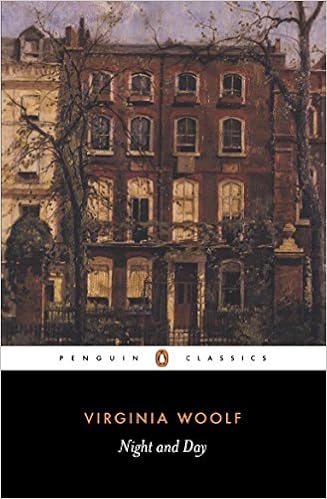
Night and Day (Penguin Twentieth Century Classics) Reprint Edition by Virginia Woolf (Author), Julia Briggs (Editor, Introduction) (Penguin Classics)


Virginia Woolf’s novels have always seemed waif-like to me; slight, ethereal wisps of poetic prose that can be read in a single sitting. Night and Day, her second novel, couldn’t be more different to this impression; it has far more resemblance to the doorstop length sagas of her father’s contemporaries than to her later works that so epitomise the modernism of the 1920s and 1930s. It took me a long time to read; partly due to the sheer amount of words, but also because I was enjoying it so much that I wanted to remain immersed in it for as long as possible. It is an intriguing mix of 19th and 20th century, of classic and modern, of past influences and forward thinking innovation. Despite its seeming distance from her later novels, it is still unmistakeably Woolf. Only she could write the magnificently atmospheric scenes of misty twilight walks in London, only she could write with such passion and insight of the importance of work to a woman, only she could bring to life the quirks of a family whose existence is enshrined within the memory of famous Victorian ancestors, and only she could create prose with moments of beauty so profound that you can’t help but stop and revisit them again and again, drinking in the words with a thirst that can’t be satiated. It’s not her best work, by any means, but it is certainly rippling with greatness, and is a must read for those who wish to understand more of Woolf’s development and influences as a writer.

On the surface, it’s a rather conventional love story. In places it reminded me of an Austen novel, and in others, a Shakespearean comedy. Whomever she borrowed from, Woolf owes much to the greats in her plotting, as she uses a very traditional three act structure that introduces our protagonists, moves them off to different scenery to throw a spanner into the works, and then brings them back to their original habitat to tie everything up with a neat and tidy bow. However, as this is Woolf, there’s much more to it than that, and she introduces many ideas, philosophies and wonderful idiosyncracies throughout the novel that make it uniquely hers, and uniquely of its time.
The main character is Katherine Hilbery, a beautiful, free spirited girl in her late twenties who lives on the infamous Cheyne Walk in Chelsea with her well to do, intellectual parents. Her mother is the only child of England’s most treasured poet, and is much feted by the great and good of society thanks to this connection. As such, Katherine has grown up in a home of ideas, of intellect, of literature, romance and reverence. History and ancestry weigh heavily upon her, especially as her days are largely taken up with helping her overly romantic and easily distracted mother write a seemingly never ending biography of her famous grandfather. Katherine is being pursued by William Rodney, a very eligible, achingly conventional would be poet in his late thirties, who thinks that Katherine is a perfect exemplar of womanhood and an ideal model for his wife. Pompous and earnest, he writes reams of terrible Elizabethan inspired drama and imagines himself desperately in love with Katherine, when really he doesn’t know her at all. He reminded me of Pride and Prejudice‘s Mr Collins in many ways, and I do wonder whether Woolf used him as an inspiration when she wrote this character; his melodrama and insincerity are absolutely hilarious. However, William isn’t the only one who admires Katherine; Ralph Denham, an idealistic young lawyer who writes articles for Katherine’s father’s periodical, comes along to one of her parents’ salons and falls in love with her at first sight. He too will join the pursuit for her hand, though this will be complicated by his close friendship with Mary Datchet, a sensible suffragette who works for the cause in a dingy office in Bloomsbury and lives alone off the Strand. She is hopelessly in love with Ralph, and is in agony in his presence. Woolf sends this motley crew on a fateful Christmas in the countryside, where Katherine’s cousin Cassandra will enter the action, and set everything spinning on its head…
This summary makes it all sound very light hearted and comical, but amidst the almost farcical elements, this is actually a very serious and ambitious novel about women and men and their search for personal freedom. Katherine delays marriage because she wants to be able to pursue her own interests and not be bound to anyone else. She is afraid of the sacrifices marriage will entail, but she is also afraid of having to remain dependent on her parents forever. As a woman, what real choice does she have? Is there another way? Mary thinks she is in love, but she gradually learns that her work is the only thing that gives her true satisfaction. Able to channel her passion and talents into a fulfilling form of self expression, Mary doesn’t necessarily need a husband; her work is sufficient, and this can be a legitimate way to live her life. This is a daring conclusion indeed for a novel written in 1919. Night and Day might be mainly about the difference between men and women, but it is also to a certain extent about the difference between the soul and society, and how we are often forced to behave in a way that is totally opposite to our desire in order to satisfy others and conform to the expectations of our peers. There is a darkness, an unfathomable depth within each of us that we are never permitted to expose to the light of day; how do we find happiness when so much of our true selves is forced to remain hidden?
There is much hand wringing, much angst, much waffling philosophy, and it is overlong, with too much of some characters and not enough of others; I would particularly have loved to have seen more of the magnificent Mrs Hilbery, who floats through the novel quoting Tennyson and dreaming of Shakespeare’s tomb. Also, I didn’t agree with the outcome, and I thought that Mary Datchet was given rather short shrift; much more could have been done with her character. However, overall, this is quite a remarkable novel, a bridge between Woolf’s early and later works, and arguably most notable for its brilliant depiction of London, for which this could feasibly be used as a tour guide. The characters all roam the streets of a smoky, gas lit London, walking for miles along the river, riding atop omnibuses, pounding the red brick streets of Chelsea, working in the tall black terraces of Bloomsbury, mingling with the faceless crowds on the Strand, stopping in cafes dripping with condensation, rambling through the exotic plants at Kew, watching the monkeys perform acrobatics at the zoo…London is a character all of its own, and is beautifully, passionately, lovingly brought to life in all its splendour. I don’t think any novelist can quite capture London in the way Woolf does, and Night and Day is definitely worth reading for that alone.
‘Although the old coaches, with their gay panels and the guard’s horn, and the humours of the box and the vicissitudes of the road, have long mouldered into dust so far as they matter, and are preserved in the printed pages of our novelists so far as they partook of the spirit, a journey to London by express train can still be a very pleasant and romantic adventure. Cassandra Otway, at the age of twenty-two, could imagine few things more pleasant. Satiated with months of green fields as she was, the first row of artisans’ villas on the outskirts of London seemed to have something serious about it, which positively increased the importance of every person in the railway carriage, and even, to her impressionable mind, quickened the speed of the train and gave a note of stern authority to the shriek of the engine-whistle. They were bound for London; they have must have precedence of all traffic not similarly destined.’

Tuesday, March 13, 2018

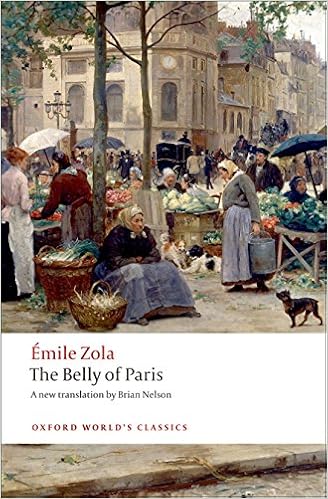
The Belly of Paris (Oxford World's Classics) Paperback – September 28, 2009 by Emile Zola (Oxford University Press) (IBRClassicsReview)


Zola at his best


Monday, March 12, 2018

The Unbearable Lightness of Being: A Novel Paperback – Deckle Edge, by Milan Kundera ( Harper Perennial Modern Classics) (IBRClassicsreview)


A Pithy Masterpiece

Milan Kundera's The Unbearable Lightness of the Being is a pithy masterpiece. The author captures the essence of the 'being' of four or five chief characters. He manages to describe their thoughts and deeds, what weighs upon their souls, what rescues their selves from onerous existence, in an achingly beautiful, yet unobtrusive way. The infidelity & philandering of Tomas, the doubts and dreams of Tereza, the artistic idiosyncrasies of Sabrina and the intellectual myopia and indulgences of Franz are as engaging as the philosophical and historical notes that flow through the story.

The novel is a deep and defining study of humanity in 20th century, of our hopes and failings, of the moral and material needs and our capacity for being tormented by our pasts and passions. There are paragraphs and paragraphs of poetic beauty, and yet everything is written in the most simple, straightforward sentences. The description of Karenin, the dog owned by Tereza, is brilliant, especially in the final chapter of the book. Another favorite chapter was on "words misunderstood", for in the romance between beings belonging to two different pasts and two countries, where seemingly same words assume drastically different connotations.

This is a mature novel, meant for readers who can look beyond the surface. On surface this is novel laced with sexual content and contexts, a novel that describes the gimmicks of communist Russia and their stay in Czech country, a novel that spurns philosophical ramblings interwoven with discussion about the "sh** being a onerous theological problem". On surface the novel is story of infidelity. But deep down this is a novel that strikes chord with the intelligent reader on so many different levels, be it romance, ethics, interpretation, or our own complexities arising from our own unique pathways of life.

The novel weighed on me, confronted me with many issues, ideas and memories, and then at times, it released me from my own suffocating and smothering thoughts and experiences. I highly recommend this novel. If you enjoy Lawrence, Joyce and Gibran, be introduced to Kundera, who carries the torch of modernist writing ahead: and in what style!

The Good Soldier Svejk: and His Fortunes in the World War (Penguin Classics) Paperback – December 27, 2005 by Jaroslav Hasek (Author),‎ Josef Lada (Illustrator),‎ Cecil Parrott (Translator, Introduction) (Penguin Classics) (IBRClassicreview)


Jaroslav Hašek's black satire, the inspiration for such works as Joseph Heller's Catch-22

Good-natured and garrulous, Švejk becomes the Austro-Hungarian army's most loyal Czech soldier when he is called up on the outbreak of the First World War - although his bumbling attempts to get to the front serve only to prevent him from reaching it. Playing cards, getting drunk and becoming a general nuisance, the resourceful Švejk uses all his natural cunning and genial subterfuge to deal with the doctors, police, clergy and officers who chivvy him towards battle. The story of a 'little man' caught in a vast bureaucratic machine, The Good Soldier Švejkcombines dazzling wordplay and piercing satire to create a hilariously subversive depiction of the futility of war. Cecil Parrott's vibrant, unabridged and unbowdlerized translation is accompanied by an introduction discussing Hašek's turbulent life as an anarchist, communist and vagranty, and the Everyman character of Švejk. This edition also includes a guide to Czech names, maps and original illustrations by Josef Ladas.

For more than seventy years, Penguin has been the leading publisher of classic literature in the English-speaking world. With more than 1,700 titles, Penguin Classics represents a global bookshelf of the best works throughout history and across genres and disciplines. Readers trust the series to provide authoritative texts enhanced by introductions and notes by distinguished scholars and contemporary authors, as well as up-to-date translations by award-winning translators.

Friday, March 9, 2018

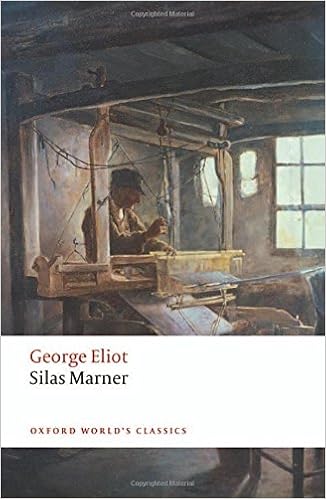
Silas Marner: The Weaver of Raveloe (Oxford World's Classics) 2nd Edition by George Eliot (Author),‎ Juliette Atkinson (Editor) (ISBClassicsReview)


Silas Marner: The Weaver of Raveloe is the third novel by George Eliot, published in 1861. An outwardly simple tale of a linen weaver, it is notable for its strong realism and its sophisticated treatment of a variety of issues ranging from religion to industrialisation to community.

Summary 
The novel is set in the early years of the 19th century. Silas Marner, a weaver, is a member of a small Calvinist congregation in Lantern Yard, a slum street in Northern England. He is falsely accused of stealing the congregation's funds while watching over the very ill deacon. Two clues are given against Silas: a pocket knife, and the discovery in his own house of the bag formerly containing the money. There is the strong suggestion that Silas' best friend, William Dane, has framed him, since Silas had lent his pocket knife to William shortly before the crime was committed. Silas is proclaimed guilty, however, after a drawing of lots. The woman Silas was to marry breaks their engagement and instead marries William. With his life shattered and his heart broken, Silas leaves Lantern Yard and the city for a rural area where he is unknown.

Marner travels south to the Midlands and settles near the rural village of Raveloe in Warwickshire, where he lives isolated and alone, choosing to have only minimal contact with the residents. He throws himself into his craft and comes to adore the gold coins he earns and hoards from his weaving.

One foggy night, the two bags of gold are stolen by Dunstan ("Dunsey") Cass, a dissolute younger son of Squire Cass, the town's leading landowner. Silas then sinks into a deep gloom, despite the villagers' attempts to aid him. Dunsey immediately disappears, but little is made of this by the community because it coincides with the death of the horse he was meant to be selling for his brother.

Godfrey Cass, Dunsey's elder brother, also harbours a secret past. He is married to, but estranged from, Molly Farren, an opium-addicted woman of low birth living in another town. This secret prevents Godfrey from marrying Nancy Lammeter, a young woman of high social and moral standing. On a winter's night, Molly tries to make her way to Squire Cass's New Year's Eve party with her two-year-old girl to announce that she is Godfrey's wife. On the way, she lies down in the snow and passes out. The child wanders away and into Silas' house. Silas follows her tracks in the snow and discovers the woman dead. When he goes to the party for help, Godfrey heads outdoors to the scene of the accident, but resolves to tell no one that Molly was his wife. Molly's death, conveniently for Godfrey and Nancy, puts an end to the marriage.

Silas keeps the child and names her Eppie, after his deceased mother and sister, both named Hephzibah. Eppie changes Silas' life completely. Silas has been robbed of his material gold, but thinks that he has it returned to him symbolically in the form of the golden-haired child. Godfrey Cass is now free to marry Nancy, but continues to conceal the fact of his previous marriage—and child—from her. However, he aids Marner in caring for Eppie with occasional financial gifts. More practical help and support in bringing up the child is provided by Dolly Winthrop, a kindly neighbour of Marner's. Dolly's help and advice assist Marner not only in bringing up Eppie, but also in integrating them into village society.

Sixteen years pass, and Eppie grows up to be the pride of the village. She has a strong bond with Silas, who through her has found a place in the rural society and a purpose in life. Meanwhile, Godfrey and Nancy mourn their own childless state, after the death of their baby. Eventually, the skeleton of Dunstan Cass—still clutching Silas' gold—is found at the bottom of the stone quarry near Silas' home, and the money is duly returned to Silas. Shocked by this revelation, and coming to the realisation of his own conscience, Godfrey confesses to Nancy that Molly was his first wife and that Eppie is his child. They offer to raise her as a gentleman's daughter, but this would mean Eppie would have to forsake living with Silas. Eppie politely but firmly refuses, saying, "I can't think o' no happiness without him."

Silas revisits Lantern Yard, but his old neighbourhood has been "swept away" in the intervening years and replaced by a large factory. No one seems to know what happened to Lantern Yard's inhabitants. However, Silas contentedly resigns himself to the fact that he will never know and now leads a happy existence among his self-made family and friends. In the end, Eppie marries a local boy she has grown up with, Dolly's son Aaron. Aaron and Eppie marry and move into Silas' house, which has been newly improved courtesy of Godfrey. Silas' actions through the years in caring for Eppie have apparently provided joy for everyone, and the extended family celebrates its happiness.

Characters

Silas Marner: lower class by birth, a weaver who is betrayed at Lantern Yard (site of a dissenting sect) by his treacherous friend William Dane, moves away to Raveloe (where the community is Church of England), becomes taken for a miser, as he accumulates a small fortune, only to have it stolen by Dunstan Cass. After these misfortunes, he gradually finds his happiness and virtue by the arrival of young Eppie (biological daughter of Godfrey Cass) who he raises as his adopted child.

Squire Cass, Lord of the Manor of Raveloe and host of the party on the night when Eppie comes into Silas's life so unexpectedly.

Godfrey Cass: upper class by birth but troubled by money, eldest son of the local squire, who is blackmailed by his dissolute brother Dunstan over his secret first marriage to Molly. When Molly dies, he feels relief, and escapes punishment for his betrayal and deceit, instead marrying Nancy.

Dunstan Cass: second son of the local squire. He blackmails his older brother, until he disappears. He steals Silas' gold after accidentally killing his older brother's horse Wildfire. Many years pass before his corpse is found in a newly drained pit.

Molly Farren: Godfrey's first (and secret) wife, who has a child by him; an opium addict; lower class, impoverished. She dies in the attempt to reveal to the community her relationship with Godfrey, leaving the child, Eppie, to wander into Silas' life.

Eppie (Hephizibah): daughter of Molly and Godfrey, who is named by and cared for by Silas after the death of her mother. Mischievous in her early years, she grows into a radiant and beautiful young girl, devoted to her adoptive father.

Nancy Cass (née Lammeter): Godfrey Cass' second wife, a morally and socially respectable young woman, admired by her husband but deceived by him as regards his past.

Priscilla Lammeter, Nancy's plain, unwed sister, who supports Nancy and their father.

Aaron Winthrop: son of Dolly, who marries Eppie at the end of the novel and is considered a happy match for her.

Dolly Winthrop: mother to Aaron, wife of Ben; godmother to Eppie. Sympathetic to Silas and offers him practical support in raising the child.

Ben Winthrop, wheelwright, largely invisible in the novel.

Mr Snell, landlord of the Rainbow Inn, Raveloe.

William Dane: William Dane is Silas' former best friend at Lantern Yard. At the start of the novel, William betrays Silas by framing him for theft and marrying Silas' fiancée Sarah.

Sarah: Silas' fiancée in Lantern Yard, who subsequently marries his treacherous friend William Dane.

Mr. Macey: the clerk at the local church, a tailor, very elderly by the end of the novel.

Solomon Macey, Mr Macey's brother, a talented violinist.

Mr Crackenthorpe, rector of Raveloe and a Justice of the Peace.

Bob Lundy, the butcher of Raveloe.

John Dowlas, the farrier of Raveloe.

Jem Rodney, a local poacher, initially suspected by Silas of stealing his money.

Mrs. Kimble, the sister of Squire Cass, and the doctor's wife, thus considered a double dignitary.

Dr. Kimble, the doctor of Raveloe, who attends when Molly is found dead.

Analysis

Lawrence Jay Dessner has drawn connections between the biographical circumstances of Eliot's life in relation to events in the novel.[1] Bruce K Martin has discussed Eliot's use of Godfrey Cass as "both parallel and foil" to Silas Marner in the structure of the novel.[2] Fred C Thomson has examined the multiple levels of the idea of alienation in the novel.[3] Joseph Wiesenfarth has noted undercurrents of myth and legend, incorporated into a 'realistic' context, along with contrasts of responsible and irresponsible behaviour in the contrasting fates of Silas Marner and the Cass brothers.[4] David Sonstroem has studied ideas of chance and Darwinian thinking in the context of the plot and character fates in the novel.[5] Susan Stewart has looked at the influence of folktales and ideology related to 'work' vs 'labour' in the novel.[6] Ian Milner has examined two overarching themes of Silas Marner's 'loss and recovery of his humanity', and of a conflict between stated moral values and the social realities juxataposed with them.[7] Robert H Dunham has analysed the influence of the ideas and philosophy of William Wordsworth on the novel.[8] Brian Swann has examined mythic and religious undertones in the novel.[9] Jeff Nunokawa analyses ideas about physical touch, with respect to Silas Marner's handling of his gold compared to his raising of Eppie, and connects them to sexual and sensual themes.[10] Kate E Brown has discussed overarching themes of time and temporality, with respect to the interlocked stories of Godfrey Cass and Silas Marner.[11]

References

[1] Dessner, Lawrence Jay (Fall 1979). "The Autobiographical Matrix of Silas Marner". Studies in the Novel. 11 (3): 251–282. Retrieved 2017-08-21.


[2] Martin, Bruce K (Fall 1972). "Similarity Within Dissimilarity: The Dual Structure of Silas Marner". Texas Studies in Literature and Language. 14 (3): 479–489. Retrieved 2017-08-21.


[3] Thomson, Fred C (June 1965). "The Theme of Alienation in Silas Marner". Nineteenth-Century Fiction. 20 (1): 69–84. Retrieved 2017-08-21.


[4]Wiesenfarth, Joseph (June 1970). "Demythologizing Silas Marner". ELH. 37 (2): 226–244. Retrieved 2017-08-21.


[5] Sonstroem, David (October 1998). "The Breaks in Silas Marner". The Journal of English and Germanic Philology. 97 (4): 545–567. Retrieved 2017-08-21.


[6] Stewart, Susan (Summer 2003). "Genres of Work: The Folktale and Silas Marner". New Literary History. 34 (3): 513–533. Retrieved 2017-08-21.


[7] Milner, Ian (Autumn 1966). "Structure and Quality in Silas Marner". Studies in English Literature, 1500-1900. 6 (4): 717–729. Retrieved 2017-08-21.


.[8] Dunham, Robert H (Autumn 1976). "Silas Marner and the Wordsworthian Child". Studies in English Literature, 1500-1900. 16 (4): 645–659. Retrieved 2017-08-21.


[9] Swann, Brian (Spring 1976). "Silas Marner and the New Mythus". Criticism. 18 (2): 101–121. Retrieved 2017-08-21.


.[10] Nunokawa, Jeff (Spring 1993). "The Miser's Two Bodies: Silas Marner and the Sexual Possibilities of the Commodity". Victorian Studies. 36 (3): 273–292. Retrieved 2017-08-21.


[11]Brown, Kate E (Spring 1999). "Loss, Revelry, and the Temporal Measures of Silas Marner: Performance, Regret, Recollection". NOVEL: A Forum on Fiction. 32 (2): 222–249. Retrieved 2017-08-21.

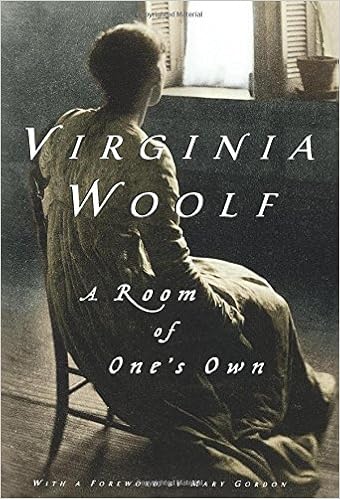
A Room of One's Own Paperback by Virginia Woolf (Mariner Books) (IBR ClassicsReview)


A Room of One's Own is an extended essay by Virginia Woolf. First published on 24 October 1929, the essay was based on a series of lectures she delivered at Newnham College and Girton College, two women's colleges at Cambridge University in October 1928. While this extended essay in fact employs a fictional narrator and narrative to explore women both as writers of and characters in fiction, the manuscript for the delivery of the series of lectures, titled "Women and Fiction", which was published in Forum March 1929,[and hence the essay, are considered non-fiction. The essay is generally seen as a feminist text and is noted in its argument for both a literal and figurative space for women writers within a literary tradition dominated by men.

History
The essay was based on a series of lectures Woolf delivered at Newnham College and Girton College, two women's colleges at Cambridge University in October 1928. She stayed at Newnham at the invitation of Pernel Strachey whose family were key members of the Bloomsbury Group and was also Newnham's principal.

Themes
Women's access to education
The title of the essay comes from Woolf's conception that, "a woman must have money and a room of her own if she is to write fiction".[5] Woolf notes that women have been kept from writing because of their relative poverty, and financial freedom will bring women the freedom to write; "In the first place, to have a room of her own... was out of the question, unless her parents were exceptionally rich or very noble".[6] The title also refers to any author's need for poetic licence and the personal liberty to create art.

The essay examines whether women were capable of producing, and in fact free to produce work of the quality of William Shakespeare, addressing the limitations that past and present women writers face.

Woolf's father, Sir Leslie Stephen, in line with the thinking of the era, believed that only the boys of the family should be sent to school. In delivering the lectures outlined in the essay, Woolf is speaking to women who have the opportunity to learn in a formal, communal setting. Woolf lets her audience know the importance of their education at the same time warning them of the precariousness of their position in society.

Judith Shakespeare
This article is about the fictional character. For the real-life individual, see Judith Quiney.
In one section, Woolf invented a fictional character, Judith, "Shakespeare's sister," to illustrate that a woman with Shakespeare's gifts would have been denied the same opportunities to develop them because of the doors that were closed to women. Like Woolf, who stayed at home while her brothers went off to school, Judith stays at home while William goes off to school. Judith is trapped in the home: "She was as adventurous, as imaginative, as agog to see the world as he was. But she was not sent to school."[7] Woolf's prose holds all the hopes of Judith Shakespeare against her brother's hopes in the first sentence, then abruptly curtails Judith's chances of fulfilling her promise with "but." While William learns, Judith is chastised by her parents should she happen to pick up a book, as she is inevitably abandoning some household chore to which she could be attending. Judith is betrothed, and when she does not want to marry, she is beaten and then shamed into marriage by her father. While Shakespeare establishes himself, Judith is trapped by the confines of the expectations of women. Judith kills herself, and her genius goes unexpressed, while Shakespeare lives on and establishes his legacy.

Building a history of women's writing
In the essay, Woolf constructs a critical and historical account of women writers thus far. Woolf examines the careers of several female authors, including Aphra Behn, Jane Austen, the Brontë sisters, Anne Finch, Countess of Winchilsea, and George Eliot. In addition to female authors, Woolf also discusses and draws inspiration from noted scholar and feminist Jane Ellen Harrison.Harrison is presented in the essay only by her initials separated by long dashes, and Woolf first introduces Harrison as "the famous scholar… J ---- H---- herself".

Woolf also discusses Rebecca West, questioning Desmond MacCarthy's (referred to as "Z") uncompromising dismissal of West as an "'arrant feminist'". Among the men attacked for their views on women, F. E. Smith, 1st Earl of Birkenhead (referred to as "Lord Birkenhead") is mentioned, though Woolf further rebukes his ideas in stating she will not "trouble to copy out Lord Birkenhead's opinion upon the writing of women". Birkenhead was an opponent of suffrage. The essay quotes Oscar Browning through the words of his (possibly inaccurate) biographer H. E. Wortham: "'… the impression left on his mind, after looking over any set of examination papers, was that…the best woman was intellectually the inferior of the worst man.'" In addition to these mentions, Woolf subtly refers to several of the most prominent intellectuals of the time, and her hybrid name from the University of Oxford and the University of Cambridge—Oxbridge—has become a well-known term, although she was not the first to use it.

The Four Marys
The narrator of the work is at one point identified as "Mary Beaton, Mary Seton, or Mary Carmichael", alluding to the sixteenth century ballad Mary Hamilton.[8][14] In referencing the tale of a woman about to be hanged for existing outside of marriage and rejecting motherhood, the narrator identifies women writers such as herself as outsiders who exist in a potentially dangerous space. It is important to note that Woolf's heroine, Judith Shakespeare, dies by her own hand, after she becomes pregnant with the child of an actor. Like the woman in the Four Marys, she is pregnant and trapped in a life imposed on her. Woolf sees Judith Shakespeare, Mary Beaton, Mary Seton, Mary Carmichael, as powerless, impoverished women everywhere as threatened by the spectre of death.

Lesbianism
In another section, describing the work of a fictional woman writer, Mary Carmichael, Woolf deliberately invokes lesbianism:
"Then may I tell you that the very next words I read were these – 'Chloe liked Olivia...' Do not start. Do not blush. Let us admit in the privacy of our own society that these things sometimes happen. Sometimes women do like women."Woolf references the obscenity trial and public uproar resulting from the publishing of Radclyffe Hall's lesbian-themed novel, The Well of Loneliness published in 1928. Before she can discuss Chloe liking Olivia, the narrator, has to be assured that Sir Chartres Biron, the magistrate of Hall's obscenity trial is not in the audience: "Are there no men present? Do you promise the figure of Sir Chartres Biron is not concealed? We are all women, you assure me? Then I may tell you..."

Woolf scholar and feminist critic Jane Marcus believes Woolf was giving Radclyffe Hall and other writers a demonstration of how to discuss lesbianism discreetly enough to avoid obscenity trials; 
"Woolf was offering her besieged fellow writer a lesson in how to give a lesbian talk and write a lesbian work and get away with it." Marcus describes the atmosphere of Woolf's arrival and presence at the women's college with her lover Vita Sackville-West as "sapphic." 
Woolf is comfortable discussing lesbianism in her talks with the women students because she feels a women's college is a safe and essential place for such discussions.
Quotes
In this paragraph, Woolf sums up the stark contrast her research has uncovered between how women are idealised in fiction written by men, and how patriarchal society has treated them in real life:

Women have burnt like beacons in all the works of all the poets from the beginning of time. Indeed if woman had no existence save in the fiction written by men, one would imagine her a person of the utmost importance; very various; heroic and mean; splendid and sordid; beautiful and hideous in the extreme; as great as a man, some would say greater. But this is woman in fiction. In fact, as Professor Trevelyan points out, she was locked up, beaten and flung about the room. A very queer, composite being thus emerges. Imaginatively she is of the highest importance; practically she is completely insignificant. She pervades poetry from cover to cover; she is all but absent from history. She dominates the lives of kings and conquerors in fiction; in fact she was the slave of any boy whose parents forced a ring upon her finger. Some of the most inspired words and profound thoughts in literature fall from her lips; in real life she could hardly read; scarcely spell; and was the property of her husband.

Criticism
Woolf's famous demand on behalf of the hypothetical female author, narratively framed by the Four Marys, is articulated in the line:

Give her a room of her own and five hundred a year, let her speak her mind and leave out half that she now puts in, and she will write a better book one of these days.[18]

Inflation-adjusting £500 in 1929 to the present (2013), gives about £25,000 (about US$43,000) (using inflation of the cost of goods) or about £75,000 (about US$130,000) (using inflation of people's earnings). Converting £500 in 1929 to 1913 yields £230 to £310, which is below the group that George Orwell describes in The Road to Wigan Pier (published in 1937, but describing pre-War life in this passage) as the lower end of the upper-middle class:

To belong to this class when you were at the £400 a year level was a queer business, for it meant that your gentility was almost purely theoretical. You lived, so to speak, at two levels simultaneously. Theoretically you knew all about servants and how to tip them, although in practice you had one, at most, two resident servants. Theoretically you knew how to wear your clothes and how to order a dinner, although in practice you could never afford to go to a decent tailor or a decent restaurant. Theoretically you knew how to shoot and ride, although in practice you had no horses to ride and not an inch of ground to shoot over.

The £500 was just enough to live on without employment but without any extravagance. This (minimal) independent wealth introduces a socio-political element into Woolf's argument which speaks not only to gender dynamics but to divisions in social class. This element of Woolf's argument has been addressed in a number of scholarly and literary attacks.

Alice Walker, to the subject of much criticism, demeaned Woolf's essay for its exclusion of women of color, and women writers who do not have any means for obtaining the independence of a room of their own. In In Search of Our Mothers' Gardens: Womanist Prose, Walker writes:

 "Virginia Woolf, in her book A Room of One's Own, wrote that in order for a woman to write fiction she must have two things, certainly: a room of her own (with key and lock) and enough money to support herself. What then are we to make of Phillis Wheatley, a slave, who owned not even herself? This sickly, frail, Black girl who required a servant of her own at times—her health was so precarious—and who, had she been white, would have been easily considered the intellectual superior of all the women and most of the men in the society of her day."

Walker recognises that Wheatley is in a position far different from the narrator of Woolf's essay, in that she does not own herself, much less "a room of her own". Wheatley and other women writers exist outside of this room, outside of this space Woolf sets asides for women writers. Though she calls attention to the limits of Woolf's essay, Walker, in uniting womanist prose (women's writing) with the physical and metaphorical space of "our mothers' gardens", pays homage to Woolf's similar endeavour of seeking space, "room", for women writers.

Sunday, March 4, 2018

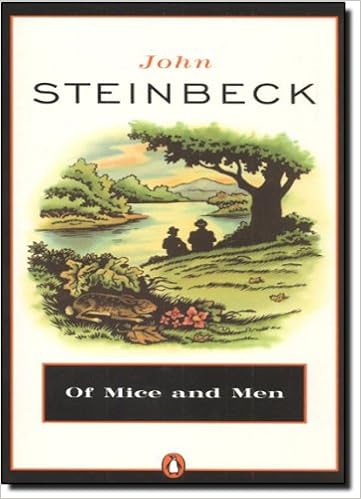
Of Mice and Men Mass Market Paperback – September 1, 1993 by John Steinbeck (Penguin Books) )


Of Mice and Men is a novella written by author John Steinbeck. Published in 1937, it tells the story of George Milton and Lennie Small, two displaced migrant ranch workers, who move from place to place in California in search of new job opportunities during the Great Depression in the United States.

Steinbeck based the novella on his own experiences working alongside migrant farm workers as a teenager in the 1910s (before the arrival of the Okies he would vividly describe in The Grapes of Wrath). The title is taken from Robert Burns' poem "To a Mouse", which reads: "The best laid schemes o' mice an' men / Gang aft agley". (The best laid schemes of mice and men / Often go awry.)

While it is a book taught in many schools, Of Mice and Men has been a frequent target of censors for vulgarity and what some consider offensive and racist language; consequently, it appears on the American Library Association's list of the Most Challenged Books of 21st Century.

Plot
Two migrant field workers in California on their plantation during the Great Depression—George Milton, an intelligent but uneducated man, and Lennie Small, a bulky, strong man but mentally disabled—are in Soledad on their way to another part of California. They hope to one day attain the dream of settling down on their own piece of land. Lennie's part of the dream is merely to tend and pet rabbits on the farm, as he loves touching soft animals, although he always kills them. This dream is one of Lennie's favorite stories, which George constantly retells. They had fled from Weed after Lennie touched a young woman's dress and wouldn't let go, leading to an accusation of rape. It soon becomes clear that the two are close and George is Lennie's protector, despite his antics.

After being hired at a farm, the pair are confronted by Curley—The Boss's small, aggressive son with a Napoleon complex who dislikes larger men, and starts to target Lennie. Curley's flirtatious and provocative wife, to whom Lennie is instantly attracted, poses a problem as well. In contrast, the pair also meets Candy, an elderly ranch handyman with one hand and a loyal dog, and Slim, an intelligent and gentle jerkline-skinner whose dog has recently had a litter of puppies. Slim gives a puppy to Lennie and Candy, whose loyal, accomplished sheep dog was put down by fellow ranch-hand Carlson.

In spite of problems, their dream leaps towards reality when Candy offers to pitch in $350 with George and Lennie so that they can buy a farm at the end of the month, in return for permission to live with them. The trio are ecstatic, but their joy is overshadowed when Curley attacks Lennie, who defends himself by easily crushing Curley's fist while urged on by George.

Nevertheless, George feels more relaxed, to the extent that he even leaves Lennie behind on the ranch while he goes into town with the other ranch hands. Lennie wanders into the stable, and chats with Crooks, the bitter, yet educated stable buck, who is isolated from the other workers racially. Candy finds them and they discuss their plans for the farm with Crooks, who cannot resist asking them if he can hoe a garden patch on the farm albeit scorning its possibility. Curley's wife makes another appearance and flirts with the men, especially Lennie. However, her spiteful side is shown when she belittles them and threatens Crooks to have him lynched.

The next day, Lennie accidentally kills his puppy while stroking it. Curley's wife enters the barn and tries to speak to Lennie, admitting that she is lonely and how her dreams of becoming a movie star are crushed, revealing her personality. After finding out about Lennie's habit, she offers to let him stroke her hair, but panics and begins to scream when she feels his strength. Lennie becomes frightened, and unintentionally breaks her neck thereafter and runs away. When the other ranch hands find the corpse, George realizes that their dream is at an end. George hurries to find Lennie, hoping he will be at the meeting place they designated in case he got into trouble.

George meets Lennie at the place, their camping spot before they came to the ranch. The two sit together and George retells the beloved story of the dream, knowing it is something they'll never share. He then shoots and kills Lennie, with Curley, Slim, and Carlson arriving seconds after. Only Slim realizes what happened, and consolingly leads him away. Curley and Carlson look on, unable to comprehend the subdued mood of the two men.

Characters
I was a bindlestiff myself for quite a spell. I worked in the same country that the story is laid in. The characters are composites to a certain extent. Lennie was a real person. He's in an insane asylum in California right now. I worked alongside him for many weeks. He didn't kill a girl. He killed a ranch foreman. Got sore because the boss had fired his pal and stuck a pitchfork right through his stomach. I hate to tell you how many times I saw him do it. We couldn't stop him until it was too late.
John Steinbeck, interview by The New York Times, 1937
George Milton: A quick-witted man who is Lennie's guardian and best friend. His friendship with Lennie helps sustain his dream of a better future. He was bound in teasing Lennie since he was young. He is described by Steinbeck in the novel as "small and quick," every part of him being "defined," with small strong hands on slender arms. He has a dark face and "restless eyes" and "sharp, strong features" including a "thin, bony nose."
Lennie Small: A mentally disabled, but physically strong man who travels with George and is his constant companion.[6] He dreams of "living off the fatta' the lan'" and being able to tend to rabbits. His love for soft things conspires against him, mostly because he does not know his own strength, and eventually becomes his undoing. Steinbeck defines his appearance as George's "opposite," writing that he is a "huge man, shapeless of face, with large, pale eyes" and "wide, sloping shoulders." Lennie walks heavily, dragging his feet a little, "the way a bear drags his paws," adding that his arms do not swing at his sides, but hang loosely.
Candy: An aging ranch handyman, Candy lost his hand in an accident and worries about his future on the ranch. Fearing that his age is making him useless, he seizes on George’s description of the farm he and Lennie will have, offering his life’s savings if he can join George and Lennie in owning the land.
Slim: A "jerkline skinner," the main driver of a mule team and the "prince of the ranch". Slim is greatly respected by many of the characters and is the only character whom Curley treats with respect. His insight, intuition, kindness and natural authority draw the other ranch hands automatically towards him, and he is significantly the only character to fully understand the bond between George and Lennie.
Curley: The Boss' son, a young, pugnacious character, once a semi-professional boxer. He is described by others, with some irony, as "handy", partly because he likes to keep a glove filled with vaseline on his left hand. He is very jealous and protective of his wife and immediately develops a dislike toward Lennie. At one point, Curley loses his temper after he sees Lennie appear to laugh at him, and ends up with his hand horribly damaged after Lennie fights back against him.
Curley's wife: A young, pretty woman, who is mistrusted by her husband. The other characters refer to her only as "Curley's wife". Steinbeck explained that she is "not a person, she's a symbol. She has no function, except to be a foil – and a danger to Lennie."
 Curley's wife's preoccupation with her own beauty eventually helps precipitate her death: She allows Lennie to stroke her hair as an apparently harmless indulgence, only for her to upset Lennie when she yells at him to stop him 'mussing it'. Lennie tries to stop her yelling and eventually, and accidentally, kills her by breaking her neck.
Crooks: Crooks, the black stable-hand, gets his name from his crooked back. Proud, bitter, and cynical, he is isolated from the other men because of the color of his skin. Despite himself, Crooks becomes fond of Lennie, and though he claims to have seen countless men following empty dreams of buying their own land, he asks Lennie if he can go with them and hoe in the garden.
Candy's dog: A blind dog who is described as "old", "stinky", and "crippled", and is killed by Carlson.
Carlson: A "thick bodied" ranch hand, he kills Candy's dog with little sympathy.
The Boss: Curley's father, the superintendent of the ranch. The ranch is owned by "a big land company" according to Candy.
Whit: A young ranch hand.

Themes
In every bit of honest writing in the world there is a base theme. Try to understand men, if you understand each other you will be kind to each other. Knowing a man well never leads to hate and nearly always leads to love. There are shorter means, many of them. There is writing promoting social change, writing punishing injustice, writing in celebration of heroism, but always that base theme. Try to understand each other.

— John Steinbeck in his 1938 journal entry
Steinbeck emphasizes dreams throughout the book.[clarification needed] George aspires to independence, to be his own boss, to have a homestead, and most importantly to be "somebody". Lennie aspires to be with George on his independent homestead, and to quench his fixation on soft objects. Candy aspires to reassert his responsibility lost with the death of his dog, and for security for his old age—on George's homestead. Crooks aspires to a small homestead where he can express self-respect, security, and most of all, acceptance. Curley's wife dreams to be an actress, to satisfy her desire for fame lost when she married Curley, and an end to her loneliness.

Loneliness is a significant factor in several characters' lives. Candy is lonely after his dog is gone. Curley's wife is lonely because her husband is not the friend she hoped for—she deals with her loneliness by flirting with the men on the ranch, which causes Curley to increase his abusiveness and jealousy. The companionship of George and Lennie is the result of loneliness. Crooks states the theme candidly as "A guy goes nuts if he ain't got anybody. Don't make any difference who the guy is, long's he's with you."[8] The author further reinforces this theme through subtle methods by situating the story near the town of Soledad, which means "solitude" in Spanish.

Despite the need for companionship, Steinbeck emphasizes how loneliness is sustained through the barriers established from acting inhuman to one another. The loneliness of Curley's wife is upheld by Curley's jealousy, which causes all the ranch hands to avoid her. Crooks's barrier results from being barred from the bunkhouse by restraining him to the stable; his bitterness is partially broken, however, through Lennie's ignorance.

Steinbeck's characters are often powerless, due to intellectual, economic, and social circumstances. Lennie possesses the greatest physical strength of any character, which should therefore establish a sense of respect as he is employed as a ranch hand. However, his intellectual handicap undercuts this and results in his powerlessness. Economic powerlessness is established as many of the ranch hands are victims of the Great Depression. As George, Candy and Crooks are positive, action- oriented characters, they wish to purchase a homestead, but because of the Depression, they are unable to generate enough money. Lennie is the only one who is basically unable to take care of himself, but the other characters would do this in the improved circumstances they seek. Since they cannot do so, the real danger of Lennie's mental handicap comes to the fore.

Regarding human interaction, evil of oppression and abuse is a theme that is illustrated through Curley and Curley's wife. Curley uses his aggressive nature and superior position in an attempt to take control of his father's farm. He constantly reprimands the farm hands and accuses some of fooling around with his wife. Curley's Napoleon complex is evidenced by his threatening of the farm hands for minuscule incidents. Curley's wife, on the other hand, is not physically but verbally manipulative. She uses her sex appeal to gain some attention, flirting with the farm hands. According to the Penguin Teacher's Guide for Of Mice and Men, Curley and Curley's wife represent evil in that both oppress and abuse the migrants in different ways.

Fate is felt most heavily as the characters' aspirations are destroyed when George is unable to protect Lennie (who is a real danger). Steinbeck presents this as "something that happened" or as his friend coined for him "non-teleological thinking" or "is thinking", which postulates a non-judgmental point of view.

Development
Of Mice and Men was Steinbeck's first attempt at writing in the form of novel-play termed a "play-novelette" by one critic. Structured in three acts of two chapters each, it is intended to be both a novella and a script for a play. It is only 30,000 words in length. Steinbeck wanted to write a novel that could be played from its lines, or a play that could be read like a novel.

Steinbeck originally titled it Something That Happened (referring to the events of the book as "something that happened" because nobody can be really blamed for the tragedy that unfolds in the story). However, he changed the title after reading Robert Burns's poem To a Mouse.Burns's poem tells of the regret the narrator feels for having destroyed the home of a mouse while plowing his field.

Steinbeck wrote this book and The Grapes of Wrath in what is now Monte Sereno, California. An early draft of Of Mice and Men was eaten by Steinbeck's dog, named Max.