Showing posts with label @stephendarori. Show all posts

Sunday, March 25, 2018

Joseph: Portraits through the Ages Hardcover – September 1, 2016 by Dr. Alan T. Levenson Ph.D. (The Jewish Publication Society)


The complex and dramatic story of Joseph is the most sustained narrative in Genesis. Many call it a literary masterpiece and a story of great depth that can be read on many levels. In a lucid and engaging style, Alan T. Levenson brings the voices of Philo, Josephus, Midrash, and medieval commentators, as well as a wide range of modern scholars, into dialogue about this complex biblical figure.

Levenson explores such questions as: Why did Joseph’s brothers hate him so? What is achieved by Joseph’s ups and downs on the path to extraordinary success? Why didn’t Joseph tell his father he was alive and ruling Egypt? What was Joseph like as a husband and father? Was Joseph just or cruel in testing his brothers’ characters?

Levenson deftly shows how an unbroken chain of interpretive traditions, mainly literary but also artistic, have added to the depth of this fascinating and unique character.


Tuesday, March 13, 2018

The Belly of Paris (Oxford World's Classics) Paperback – September 28, 2009 by Emile Zola (Oxford University Press) (IBRClassicsReview)


Zola at his best


BETWEEN THE WORLD AND ME Notes on the First 150 Years in America by Ta-Nehisi Coates (Spiegel & Grau)


The powerful story of a father’s past and a son’s future.

Atlantic senior writer Coates (The Beautiful Struggle: A Father, Two Sons, and an Unlikely Road to Manhood, 2008) offers this eloquent memoir as a letter to his teenage son, bearing witness to his own experiences and conveying passionate hopes for his son’s life. “I am wounded,” he writes. “I am marked by old codes, which shielded me in one world and then chained me in the next.” Coates grew up in the tough neighborhood of West Baltimore, beaten into obedience by his father. “I was a capable boy, intelligent and well-liked,” he remembers, “but powerfully afraid.” His life changed dramatically at Howard University, where his father taught and from which several siblings graduated. Howard, he writes, “had always been one of the most critical gathering posts for black people.” He calls it The Mecca, and its faculty and his fellow students expanded his horizons, helping him to understand “that the black world was its own thing, more than a photo-negative of the people who believe they are white.” Coates refers repeatedly to whites’ insistence on their exclusive racial identity; he realizes now “that nothing so essentialist as race” divides people, but rather “the actual injury done by people intent on naming us, intent on believing that what they have named matters more than anything we could ever actually do.” After he married, the author’s world widened again in New York, and later in Paris, where he finally felt extricated from white America’s exploitative, consumerist dreams. He came to understand that “race” does not fully explain “the breach between the world and me,” yet race exerts a crucial force, and young blacks like his son are vulnerable and endangered by “majoritarian bandits.” Coates desperately wants his son to be able to live “apart from fear—even apart from me.”

This moving, potent testament might have been titled “Black Lives Matter.” Or: “An American Tragedy.”

Friday, March 9, 2018

“Time Pieces: A Dublin Memoir” by John Banville Knopf, 212 pp., $26.95 (IBRTravelBook)


‘Time Pieces’ is a meandering walk through the author’s and Dublin’s past


Banville takes us through Dublin’s Georgian doorways, across green parks populated by the shadows of memories, down rainy cobbled sidewalks, telling stories of those places.

If you’ve ever wandered the streets of Dublin, you’ve heard the music of the voices; it’s a place where everyone, in one way or another, seems to be singing. Short of flying there for St. Patrick’s Day (ah, if only), you can hear that music in John Banville’s companionable new memoir-of-a-city, “Time Pieces: A Dublin Memoir.”

Banville, the acclaimed author of both literary novels and crime fiction (the latter under the name Benjamin Black), isn’t quite a native Dubliner, though he’s lived and strolled there for many decades. He grew up in the small town of Wexford, and in the book’s opening section describes yearly trips to the big city for his birthday. Going home on the train after a day of treats and curious adventures, Banville would always weep, hiding his tears from his family, and not know why. Now, he muses, “I suppose it was because something was ending, was being folded up, like a circus tent; was becoming, in short, the past.”

“Time Pieces” is a meandering walk through the past, both Banville’s and Dublin’s; illustrated with poignant photographs. (They’re taken by the acclaimed Irish photographer Paul Joyce, the great-grand-nephew of James Joyce — Dublin, it seems, is a city of circles.) Often accompanied by his friend Cicero, who “knows a Dublin that few others are aware of or have forgotten ever existed,” Banville takes us through Georgian doorways, across green parks populated by the shadows of memories, down rainy cobbled sidewalks whose bricks “gleam and glitter like the flanks of a galloping racehorse,” into long-ago pubs where “a solid cube of tobacco smoke stood in the air and filled the room, cobweb-colored, thick and unmoving.” And he tells stories of those places; the kind of stories told on a cozy night with friends when you don’t want the conversation to ever end.

I read the book breathlessly in one go, falling a little bit in love with the author (as one should, for all memoir) and wishing myself on those ankle-twisting sidewalks. If I’m lucky enough to go to Dublin again, I’ll visit Banville’s beloved Iveagh Gardens, which boasts various grottoes, fountains, woodlands, rockeries — and a maze that Banville, in many visits, has never been able to find. “Now, it is one thing to be lost in a maze,” he writes, in delighted puzzlement, “but that there should be a maze one cannot find seems to me a truly marvelous thing, a conceit straight out of a wonder-tale by Borges.” Here’s hoping he finds it, some day.

Thursday, March 8, 2018

Van Gogh: Complete Works Hardcover – December 15, 2012 by Rainer Metzger (Author),‎ Ingo F. Walther (Editor) (TAschen) (IBRArtBooks)


Vincent van Gogh’s story is one of the most ironic in art history. He lived an unhappy and difficult life during which his work received almost no appreciation—finally killing himself by a bullet to the chest, so great was his despair—and is now widely considered one of the most important painters of all time, his works fetching record prices of tens of millions of dollars at auction. This comprehensive study of Vincent Van Gogh (1853-1890) represents a rarity in art history: a detailed monograph on his life and art combined with a complete catalogue of his 871 paintings. These volumes also reproduce most of Van Gogh’s paintings in color.


Today, the works of Vincent van Gogh (1853–1890) are among the most well known and celebrated in the world. In paintings such as SunflowersThe Starry Night, and Self-Portrait with Bandaged Ear, we recognize an artist uniquely dexterous in the representation of texture and mood, light and place.

Yet in his lifetime, van Gogh battled not only the disinterest of his contemporary audience but also devastating bouts of mental illness. His episodes of depression and anxiety would even

Basquiat (Taschen Basic Art Series) Hardcover – October 29, 2015 by Leonhard Emmerling (Taschen) (IBRArtBooks)


Life lines: The 80s art star who put poverty, power, and racism on the wall
An icon of 1980s New York, Jean-Michel Basquiat (1960–1988) first made his name under the graffiti tag "SAMO", before establishing his studio practice and catapulting to fast fame at the age of 20. Although his career lasted barely a decade, he remains a cult figure of artistic social commentary, and a trailblazer in the mediation of graffiti and gallery art.

Basquiat's work drew upon diverse sources and media to create an original and urgent artistic vocabulary, biting with critique against structures of power and racism. His practice merged abstraction and figuration, poetry and painting, while his influences spanned Greek, Roman, and African art, French poetry, jazz, and the work of artistic contemporaries such as Andy Warhol and Cy Twombly. The results are vivid, visceral mixtures of words, African emblems, cartoonish figures, daubs of bold color, and beyond.

This book presents Basquiat’s short but prolific career, his unique style, and his profound engagement with ever-relevant issues of integration and segregation, poverty and wealth.

Monday, March 5, 2018

Mass Flourishing: How Grassroots Innovation Created Jobs, Challenge, and Change by Edmund Phelps Princeton University Press, 378 pp., $29.95


Edmund Phelps, Amartya Sen, and Joseph Stiglitz at a conference on the future of capitalism, Paris, January 2009


In his inaugural address on March 4, 1933, Franklin D. Roosevelt sought to reassure his fellow citizens that he would devote full effort to putting them back to work and lifting them out of the widespread poverty and destitution into which the Depression of the past three years had sunk so many. But the new president also struck a different tone, departing from the stricken nation’s natural focus on restoring employment and material living standards. “Happiness lies not in the mere possession of money,” Roosevelt declared; “it lies in the joy of achievement, in the thrill of creative effort. The joy and moral stimulation of work no longer must be forgotten in the mad chase of evanescent profits.”


In highlighting the importance of creativity and achievement, and therefore the moralvalue of work, Roosevelt—the US president who, more than any other, quoted from the Bible and appealed to biblical themes—was harking back to a traditional religious interpretation of humanity.1 In the account given in Genesis, God created man “in our image, after our likeness.” But what image was that? As of the sixth day of creation, when the story has God making Adam and then Eve, all that God had done was create: first the light and the darkness, then the sky and the earth and the oceans, then plants, then the sun and moon and stars, then birds and fish, and finally—until man, that is—land animals. The essential trait to be imparted when God created man “in his own image,” therefore, was creativity. Although the creation story as we have it is from the Hebrew Bible, the identification of creativity as the intrinsic essence of the human character, on just these grounds, is familiar among Christian thinkers as well.2


Secular thinkers have often expressed the same idea. David Hume, the quintessential Enlightenment philosopher, departed from the traditional Western view, dating to Aristotle, that the distinguishing characteristic of man is reason. Hume argued that it is the human imagination. His protégé Adam Smith followed his lead in this respect. The main theme of Smith’s first book, The Theory of Moral Sentiments, was the paramount role in human relations of what he called “sympathy”; but sympathy of the kind he envisioned—a “fellow-feeling” that requires “placing ourselves in [another person’s] situation”—is possible “by the imagination only.”


Not surprisingly, Smith also wrote about the importance of imagination in his economic analysis. He did not have in mind the modern idea that creative people continuously devise inventions that enhance productivity and therefore enable ongoing economic growth of the kind the West has enjoyed for the past two centuries; he lived too early to understand this process, nor did he envision it. Instead, as he highlighted at the beginning of his second book, The Wealth of Nations, Smith thought improvements in productivity, and therefore in living standards as well, came from increasing specialization and routinization of the tasks individual workers performed—what he called the “division of labor.”


But Smith also understood that the narrower and more repetitive a worker’s job became, the more constricted were the possibilities presented to the human being inside:


The man whose whole life is spent in performing a few simple operations…has no occasion to exert his understanding, or to exercise his invention, in finding out expedients for removing difficulties which never occur. He naturally loses, therefore, the habit of such exertion, and generally becomes as stupid and ignorant as it is possible for a human creature to become.


The corrective Smith recommended for the “torpor of [the] mind” to which ever-increasing division of labor would lead was state-sponsored mass education.


In the two-plus centuries since Smith wrote, the tension between the social aspiration for intellectually and morally stimulating work and the basic need to get the economy’s work done has been a continual theme. But starting in around the 1830s, it became obvious that creativity and innovation had practical value as well. By the end of the nineteenth century, especially in the United States, technological progress—the steam engine, railroads and fast ships, electricity and its myriad uses, the telegraph and telephone—were adding as much to the economy’s productive powers as the increased specialization of tasks associated with new methods of mass production. By the end of the twentieth century, throughout the Western world, the drive to generate ever more output from the limited human and other resources available had become largely a matter of pushing out the technological frontier.


Edmund Phelps, a Columbia economics professor who won (and richly deserved) the Nobel Prize in 2006, has thought through this challenging intersection of economics and philosophy. Phelps’s subject, in his wide-ranging book Mass Flourishing, is what he calls “modern capitalism.”3 In his interpretation the crucial feature of this way of carrying out economic activity is not just private ownership of the plant and machinery used for production—he takes this for granted—but the centrality of creativity and innovation, and the resulting dynamism of what a modern capitalist economy produces and how it goes about it. Importantly, therefore, an economy can have private ownership of the means of production and, if it fails to foster creativity and innovation, still fail to qualify as “modern capitalism.” Indeed, that is Phelps’s diagnosis of the Western economies today. Moreover, “the economic growth rate of a country is not a useful measure of dynamism.” Even apart from what remains of its once-pervasive socialist ownership, China is not a modern capitalist economy either.


In the spirit of FDR, as well as of Hume and Smith along with the more recent thinkers on whom he draws (he especially favors the philosophers John Rawls and Thomas Nagel and the economist/philosopher Amartya Sen), Phelps values creativity and innovation not just on the grounds of productivity but because of their value to human well-being more broadly. “For an ever-increasing number of people in the modern economies,” he writes, “continued growth of their wage rates and salaries is not among the most important things in their lives.” What then do people value? For Phelps, the essence of human nature is “a desire to express creativity, a relish for challenge, an enjoyment of problem solving, a delight in novelty, and the restless need to explore and to tinker.” Taking a phrase from Aristotle, this is what he calls “the good life.” It is what he means by “flourishing.”


And this is precisely why Phelps thinks modern capitalism matters. From its beginnings in the mid-nineteenth century, he argues, the modern capitalist economy “altered human experience by enlisting creativity, inviting experimentation, and fostering innovation,” and on this account it “earned its place as a watershed development in world history.” “A modern economy turns people who are close to the economy, where they are apt to be struck by new commercial ideas, into the investigators and experimenters who manage the innovation process…. It turns all sorts of people into ‘idea-men.’” In short, the modern capitalist economy is “a vast imaginarium.” And because our use of the imagination is central to what “the good life” is all about, “a modern economy, when functioning well and justly, is tailor-made to produce the flourishing and personal growth that are at the core of the good life.”


Moreover, again in the spirit of FDR and now of Smith as well, Phelps’s concern for this kind of “flourishing”—and therefore his enthusiastic endorsement of modern capitalism—is deeply democratic. In a modern capitalist economy, he argues, everyday work for ordinary citizens provides “the experience of engagement, personal growth, and fulfillment.” It does so because of “the endless succession of new problems” that “keep their work challenging”—and not just for some elite: “In an economy of dynamism, some portion of most participants’ time is spent looking at current practice with the expectation that a new idea will occur for a better way to do things or a better thing to produce” (my italics). “Every company or participant is like a forward observer, or scout ant,” he writes. “In the modern economy, careers almost force participants on a winding voyage of exploration.” Indeed, “a modern-capitalist economy is outstanding in the prospects it offers ordinary people for the good life” (my italics). Phelps admires modern capitalism because it provides not just flourishing but mass flourishing.


But Phelps’s book, while a paean to the possibilities of capitalism, is far from optimistic. The Western economies, he claims, including that of the United States, have lost their dynamism and hence no longer meet the conditions of modern capitalism as he defines it. In America the dynamism essential to modern capitalism ended approximately in the 1970s. In Europe and Japan, which never had much creative capacity to begin with but rather relied on innovations pioneered and developed in the US, the end of dynamism in America meant the end there too. The result is the pervasive slowing of economic growth that has attracted so much attention in recent decades, and still does. Here too, however, Phelps’s focus is on the nonmaterial dimension of life. Today, he laments, “There is no longer in America or in Europe [even] a sense of what mass flourishing was like.” “The rich experience of working and living in such an economy” is gone.


Phelps’s explanation in part agrees with the standard literature seeking to explain the slowing of American and European economic growth, but the emphasis is different and so too is his interpretation. Many of the now familiar elements of this story are present in his account: bloated corporate bureaucracy and the ever-increasing focus on the next quarter’s earnings; the progressive shift of stock ownership to mutual funds, which rarely challenge managements on matters of long-term business strategy; a mania for speculation and mergers on the part of banks newly empowered by the collapse and then formal repeal of the Glass–Steagall Act that once separated banking from the investment business (“the banking industry betrayed the very concept of a modern economy”); the fixation of America’s economic elites on making money for its own sake (“wealth seeking competes with innovation seeking”); the parallel rise of “a culture of self importance or entitlement”; ever greater polarization of America’s politics; and the expansion of the social welfare state.


But Phelps’s main concern goes beyond this standard dirty-laundry list. He thinks America has succumbed to a “new corporatism” in which large, established business firms enlist the government’s help to block economic innovation in order to preserve their existing position and advantage. This new “corporatist complex between the government and the private sector” stifles competition through a combination of subsidies to the already-dominant firms and impediments to aspiring competitors. Specific forms of this new corporatism include excessively protective patent laws and a variety of regulations that enable those who got there first to shut out new innovators, together with subsidies of all kinds, including farm subsidies and the subsidies to finance that had an ultimately disastrous part in leading to the housing and mortgage debacle of the last decade. Phelps also refers to a “congressional-banking complex” in which “banks and political interests have entered into new arrangements for their mutual benefit”:

Mabel Poulton in the 1931 film Number, Please


The explosion of corporate welfare, self-serving regulations and deregulations, and a sea of social insurance have all depended on a willingness or eagerness on the part of government officials and legislators to protect vested interest and to cater to special interests in return for electoral support and financial support. It is a system of interlocking parts.


The end result is that “the economic performance of the economies that had so recently been exemplars of modern capitalism has recently been disastrous.” In America, “The economy seems to be moving to a frozen state.”


But Phelps makes it clear that economic policies, like other social institutions, do not simply materialize on their own. They represent the “values,” collectively the “culture,” of the society itself, and here is his most fundamental concern. Phelps believes that the “modern values” that gave rise to modern capitalism—“thinking and working for yourself,” “readiness to accept change caused or desired by others,” “the desire to test one’s self against others,” “the willingness to take the initiative,” “the welcoming of hurdles to surmount,” “the desire to be intellectually engaged”—are in retreat. Moreover, in what will be a surprise to many politically and socially conservative readers, who up to this point will have nodded in agreement all through the argument, what these modern values are so disastrously retreating in the face of is “a resurgence of traditional values” and “a new attention to family values.”


What, then, is to be done? Phelps’s goal is clear: “enlisting the imagination and energy of participants [in the economy] from the grassroots on up…engag[ing] the mind and seiz[ing] the imagination of participants down to draftsmen, day laborers, farmers, traders, and factory workers.” The democratic spirit, the value placed on inclusion, the concern for everyday Americans who make up the bulk of the country’s workforce, are a large part of what makes his argument appealing.


To achieve these ends, Phelps would recruit more people to government who have had practical experience innovating in business. He would shrink corporate welfare and repeal anticompetitive regulation. He would “stop the corporate practice of paying CEOs very high salaries over a term expected to be very short,” and ban “golden parachute payments.” He would reform mutual funds. He would revive “old-fashioned…‘relational banking’” and “restructur[e] the banking behemoths of the present day into smaller units with much less latitude.” Above all, he would “strengthen the modern values” that used to lie behind America’s modern capitalist economy, in the first instance by “reintroducing” into secondary and higher education concepts like individualism, which he sees as having been replaced by assignments “aimed more at communicating feeling and compassion.”


What is not on Phelps’s list is noteworthy too. He of course believes in both personal and economic freedom. But “America is unlikely to recover the dynamism and resulting prosperity it had up to the 1970s as long as it operates on the belief that freedom is sufficient to do so, and that freedom can always be dialed up by a downward adjustment of tax rates.” Further, “Not all freedoms are good for dynamism.”


All of these proposed changes are worthwhile, at least at the level of abstraction at which Phelps, in this book writing as much as a philosopher as an economist, offers them. (In matters like reforming corporations and mutual funds and banks, the debate is usually over the more specific substance, even the details; in arguments over school curriculum it is even more so.) If his book were simply about economic growth, these steps would be plausible entries on the policy agenda of anyone without a vested interest in the status quo (such as the bankers and corporate CEOs he so harshly criticizes).


Phelps’s objective, however, is not economic growth per se but mass flourishing—that is, delivering the good life, centered on the exercise of creativity and intellectual stimulation, to the broadest possible swath of the working population. And there his program is open to question.


To begin at the beginning, saying what constitutes “the good life,” not just for oneself but for men and women generally, is inherently problematic. In response to the emergence of sustained rapid productivity growth in the early nineteenth century, the future-oriented utopian socialists who proliferated at midcentury mostly supposed that people would devote their freed-up time to activities like gathering to read plays. Among the pursuits that real people turned out to prefer instead, as the work week continued to shrink, the utopians forgot about gambling and engaging in sports, and they never imagined the opportunities modern telecommunications would open up for watching other people engage in sports. Phelps may be right that what most people want in life, and find satisfying when they find it, is the challenge of creativity at work. But this is mostly a philosophical assumption.


The greater problem is Phelps’s further assumption that with the changes he advocates—indeed, under any plausible set of conditions at all—the broadly democratic, inclusive character he envisions for economic creativity can be a reality. The point of his argument for what he calls “modern capitalism” is not the importance of creativity and innovation in improving the material living standards that the majority of citizens enjoy as consumers; rather he emphasizes the moral value of creativity and innovation in what the majority of citizens do as workers.


As a historical matter, it is not obvious, and Phelps provides little evidence, that the American economy ever provided such opportunities on the broad basis he envisions, even during the century-plus before the 1970s that he hails as its great era of modern capitalist success. To be sure, many people during that era did face challenges, and solve problems, and devise new methods, and even invent new products in the course of their everyday work; and many of those started out as ordinary workers. Carnegie and Edison and the Wright brothers and Alexander Graham Bell are all part of American history and legend. But the percentage of 1880s steel mill workers, or 1920s shop clerks, or 1950s waitresses and automobile salesmen who fulfilled this aspiration (assuming it was what they aspired to) is not known. Nor is it obvious that the percentage then was actually greater than it is today.


One clue to Phelps’s reason for thinking that the economy did once provide such broad opportunities lies in his discussion of the kinds of work that do or do not provide the opportunity for creativity. In contrast to work of the modern capitalist kind, which he takes to provide ample opportunity for creativity and innovation, he also considers “priests, ministers, rabbis,” “caregivers in a nursing home or a hospice,” “positions in nonprofit organizations aimed at a cause, such as the environment,” and other “work in an organization where the individual’s own benefit is not the objective”—in short, anything not in the economy’s for-profit sector. “In these lines of work,” he states, “there is relatively little prospect, if any, of experiencing exploration or creation.” Creativity is limited to the for-profit sector.


This claim—not that such jobs add less economic value than those in the for-profit sector (which may or may not be true), but that they are devoid of opportunities for creativity and problem-solving—is astonishing. Is it true that nurses face fewer on-the-job challenges requiring solutions than do waitresses and secretaries and call-center operators? Or that someone devising legislative strategies at the Sierra Club has less opportunity for creativity than an opponent on the lobbying staff of Peabody Coal? What of the foundation-funded research scientist looking for a way to produce energy with less pollution? What about teachers? Would it matter whether the school is a public school or private? Or if it’s private, whether it’s for profit or not? (Phelps teaches at Columbia and I’m at Harvard. Would we have more opportunity for creativity at the for-profit University of Phoenix?)


If the question at issue were whether those who work in organizations not driven by the profit motive have less chance of being an innovator like Bill Gates or Steve Jobs or Sergey Brin, Phelps’s bias would perhaps be more understandable. But that is not the question he’s asking. His argument is about the mass of workers, not the elite. It may be true that intellectual challenge and the opportunity for creativity are, or could be, part of the everyday working life of ordinary people working in business firms in ways that they are not, and cannot be, for those working in government or private not-for-profit organizations. But establishing that proposition would require both argument and evidence that Phelps does not provide. It is certainly not obvious on its face.


A parallel concern surrounds Phelps’s policy recommendations. Restructuring America’s banks, reforming executive pay and other elements of corporate governance, and improving the curriculum of US education (whether in Phelps’s suggested direction or not) should be on every American’s action list for the coming decade. Doing so would surely contribute—no one knows by how much—to the economy’s ability to grow and to improve citizens’ living standards. But whether these steps would create (or as Phelps believes, recreate) an economy in which intellectual challenge and the opportunity for creativity and innovation are pervasive throughout the work force is dubious.


In The Cultural Contradictions of Capitalism, published in 1976, the great American sociologist Daniel Bell predicted that capitalism would undermine itself, not by failing but by succeeding. Writing just at the time when Phelps argues that the American economy began to lose its “dynamism,” Bell followed Max Weber in believing that an identifiable set of cultural values underlay capitalism’s early development and subsequent success. But, he argued, over time the rising incomes and improving living standards that this novel way of organizing economic activity delivered would inevitably change the objective circumstances on which those values in turn depended. As the society grew richer, the importance attached to further gains in material living standards would diminish while other, nonmaterial aspirations would assume ever greater priority. As a result, willingness to sacrifice the latter for the former would erode, and, in time, so too would capitalism.


The phenomenon lamented in Phelps’s Mass Flourishing, nearly forty years later, is a realization of what Bell envisioned. Looking backward, Phelps sees “modern capitalism” as having eroded since the 1970s. And as Bell anticipated, he attributes this deterioration to a weakening of the values on which modern capitalism depended. Unlike Bell, Phelps takes the society’s values—its “economic culture”—as the starting point of the causal chain. If Bell was right, however, these changing values are themselves the result of capitalism’s success up to the time (the 1970s) when Phelps sees its deterioration as having set in. The interaction between the society’s values and its economy has followed its own internal dynamic.


Because he mourns the passing of “modern capitalism” not for its material benefits but rather for the moral value of creative and innovative work it provided, Phelps gives a rationale for seeking to reverse this dynamic.4 Further, he sees the problem as due not just to changing economic values, as living standards have risen, but to the perverse ability of large business firms and other interests to protect their existing economic advantage by capturing government. His argument therefore presents the possibility of both philosophical and practical routes to reversing the dynamic that Bell predicted.


If Phelps is right that people value the opportunities for creativity and innovation that a healthy “modern capitalist” economy offers, and right, too, that modern capitalism provides these opportunities on the widespread, inclusive basis that he claims, making all this known may alert citizens to what they have sacrificed. And if he is right that the “new corporatism” is the mechanism by which these opportunities have been lost, the policy proposals he presents, and others like them, offer the hope of regaining them.


Phelps’s image of the democratic, inclusive character of “modern capitalism” is probably romantic, and it may prove unrealistic. But he shows why it is worth fighting for.


1


See, for example, James MacGregor Burns, Roosevelt: The Lion and the Fox (Harcourt Brace, 1956), p. 476, and Ronald Isetti, “The Moneychangers of the Temple: FDR, American Civil Religion, and the New Deal,” Presidential Studies Quarterly, Vol. 26, No. 3 (Summer 1996), p. 678.
2


A recent example from an economic perspective is Edd Noell and Stephen L.S. Smith, “Economic Growth: Re-assessing the View from Christian Theology and Morality,” ASREC Conference, March 2015.
3


See also his summary in “What Is Wrong with the West’s Economies?,” The New York Review, August 13, 2015.
4


My own book The Moral Consequences of Economic Growth (Knopf, 2005) likewise argued for nonmaterial (moral) reasons for valuing the success of capitalist economic activity, and on that ground likewise lamented the prospect of reduced growth; but the moral benefits for which I argued are not the same as Phelps’s, and the emphasis was on economic growth, however achieved, rather than capitalism per se.

Gaza Hell and Beyond .... Gaza: A History by Jean-Pierre Filiu, translated from the French by John King Oxford University Press, 422 pp., $29.95 Palestine Speaks: Narratives of Life Under Occupation compiled and edited by Cate Malek and Mateo Hoke Voice of Witness/McSweeney’s, 346 pp., $16.00 (paper) Gaza and Israel: New Obstacles, New Solutions a report by the International Crisis Group Middle East Briefing No. 39, 11 pp., July 14, 2014; available at www.crisisgroup.org


Magnum Photos
A smuggling tunnel in Rafah, Gaza Strip, 2012; photograph by Paolo Pellegrin

In 332 BC Alexander the Great conquered Gaza. It was not easy going. The siege lasted for one hundred days, and the Gazans, led by Batis, the “king of Gaza,” defended themselves skillfully, notably by extensive use of tunnels. Alexander himself was wounded in the fighting. He revenged himself by killing almost all the city’s young men, including Batis, who was tied to Alexander’s chariot and dragged to death beneath the ramparts (shades of Achilles’ humiliation of the dead Hector). The story seems all too familiar; for us, too, Gaza calls up violent images. It’s relatively easy to dig tunnels in its sandy subsoil, as we know from the brutal war that broke out this summer.

I’m not sure “broke out” is the right phrase. Human agency was very much at work on both sides. Hamas, battered, isolated, and impoverished, had little to lose and, as things turned out, much to gain in popular support by launching missiles and mortars at Israel and inviting another round of severe Israeli punishment. Benjamin Netanyahu, by ordering a large-scale attack on Hamas activists and institutions on the West Bank in response to the kidnapping and killing of three Israeli teenagers on June 12, gladly accepted the invitation.

One of the most striking elements in the murderous melodrama that ensued was the utter confusion in the Israeli leadership about what might constitute a credible war aim. Stopping the renewed missile fire from Gaza proved to be impossible, though Israel’s Iron Dome anti-missile system worked for the most part effectively. Only after Israel’s land operation in the inner periphery of Gaza got underway was the army able to seize upon the extensive tunnels, many crossing under the fence around the Strip and opening into Israeli territory, as a possible raison d’être for the whole campaign.

Without minimizing the real threat posed by these tunnels—which the army apparently had known about for years—one might note the evident relief the government felt at having finally found a military target they could handle. The citizens of Israel, who will usually believe anything the army says, seemed entirely persuaded. Some thirty tunnels were blown up. I assume that by now many new ones are being dug.

Clearly, this was the summer of Israeli discontent. Nothing was able to put an end to the rain of missiles and mortar shells from Gaza. Israeli settlements near the Gaza border were evacuated; and when the army announced that it was safe to return, renewed attacks killed residents and soldiers stationed nearby. (In Gaza and Israel combined, sixty-seven Israeli soldiers and six civilians were killed.) For weeks the most common word on the TV and radio news and talk shows, with their familiar line-up of dusted-off former generals, was “deterrence.”

More specifically, the question was how to restore or reinvent this somewhat nebulous, almost metaphysical objective. The campaign—named “Protective Edge” in English (tsuk eitan, “Steadfast Boulder,” in Hebrew)—aside from dealing with the tunnels, was supposed to deter the enemy from launching more missiles and from any other such acts in the future. The Hamas leadership repeatedly refused to play the part they had been assigned. Despite the immense destruction they absorbed and the deaths of some 2,200 Palestinians, the vast majority of them innocent civilians (including some five hundred children), Hamas was, to put it simply, undeterred.

It’s not unlikely that the Israeli army and, in particular, those responsible for strategic intelligence and long-term planning are now struggling with the implications of this stubborn fact. I think most Israelis are well aware that the war did not end with anything like an Israeli victory, and that the next round is likely to be similarly inconclusive, or worse—much worse, if Hezbollah in Lebanon joins in the fighting. In his press conference following the cease-fire, Netanyahu himself uncharacteristically confessed that sometimes force cannot achieve all goals. He also, at an earlier press conference on July 20, callously blamed Hamas for using “telegenically dead Palestinians” to win sympathy, as if he himself had nothing to do with either the number or the identity of those telegenic dead.

One has to bear in mind that Israelis live in a largely mythic world, a somewhat modified and vastly simplified version of the Iliad. In this starkly polarized vision of reality, in which Israelis are by definition innocent victims of dark, irrational forces operating against them, heroic death in war always makes sense, and violent coercion is the option both of necessity and of choice. The Hebrew proverb says: “If force doesn’t work, use more force.” But this summer the proverb failed to deliver.

In theory, this moment might generate in both ordinary Israelis and their elected leadership the kind of insight that has been so lacking for the last few decades. Are we going to go on fighting these futile wars every couple of years, killing large numbers of innocents in the process, with mounting casualties among Israeli soldiers and civilians as well? There is, after all, another, rather attractive option, as Assaf Sharon has recently, and eloquently, said in these pages.1 If violence doesn’t work, Israel might consider cutting a deal with the Palestinian moderates, ending the occupation, and making peace along the lines of the Saudi peace proposal (or “Arab Peace Initiative”) of 2002.


In this respect, two developments of note followed closely on the cease-fire. First, well within the mythic tradition, Netanyahu announced a new and huge appropriation of land for settlement on the West Bank—3,799 dunams, or about one thousand acres, the largest such appropriation in three decades. Included in the new takeover (along with lands from the villages of Husan, Nahalin, Jaba, and Surif) is Wadi Fuqin, one of the most beautiful valleys in all of Palestine, which until now had been saved from the settlers largely by a concerted campaign of Israelis living in Zur Hadassah, close to the threatened wadi.

Apart from the human tragedies involved, the irreparable ecological tragedy about to happen should be squarely faced, though I assume it counts for nothing in the eyes of Netanyahu’s right-wing cabinet. It’s not enough to see this new, dramatic land grab as an act of political expediency meant to appease the government’s extremist ministers. Much deeper currents are at work. One could conclude that the Gaza war was a sideshow, maybe even a useful distraction hiding the really serious business of taking more Palestinian land. So much for making peace.

Then on September 12 a group of forty-three officers and soldiers from Unit 8200, the cream of Israeli army intelligence, a unit only slightly less prestigious than the combat squadrons of the air force, published a letter to the prime minister and the chief of staff in which they state that they will no longer serve in their former capacity. They wrote:


The Palestinian population under military rule is completely exposed to espionage and surveillance by Israeli intelligence…. There’s no distinction between Palestinians who are, and are not, involved in violence. Information that is collected and stored harms innocent people. It is used for political persecution and to create divisions within Palestinian society by recruiting collaborators and driving parts of Palestinian society against itself. In many cases, intelligence prevents defendants from receiving a fair trial in military courts, as the evidence against them is not revealed. Intelligence allows for the continued control over millions of people through thorough and intrusive supervision and invasion of most areas of life.

As Gideon Levy wrote in Haaretz on September 14, it’s as if Stasi operatives in the GDR had suddenly turned against their commanders. No one should underestimate the importance of the soldiers’ statement; the timing, so close to the dismal war of this summer, is also important. In 2004, the last time there was a wave of refusals to serve on the part of air force pilots and of soldiers in one of the elite combat units, Israel, under Ariel Sharon, responded by dismantling the Gaza settlements and retreating from Gaza. Sharon, through his close confidant Dov Weisglass, famously listed the pilots’ protest as a major factor in the decision to abandon the settlements.

Along with the letter of the members of Unit 8200, more detailed accounts of what this kind of intelligence work entails have been emerging in the press (one can also see the system in operation in two recent films, Omar and Bethlehem2). If you are Palestinian and happen to be gay, or need some special kind of medical care, or are in financial straits, or want a permit so that you can travel to visit a relative or spouse, or have had some run-in with the security forces, you’re fair game for blackmail or bribery or both.

If anyone has any doubt about the veracity of the soldiers’ reports, he or she has only to read the superb Palestine Speaks, edited by Mateo Hoke and Cate Malek, a collection of documentary interviews with ordinary Palestinians living on the West Bank or in Gaza. It’s all there: the regime of surveillance and blackmail, the constant threat of arbitrary arrest and likely torture, the continuous theft of land, and the more mundane, but no less tormenting, reality of the roadblocks, state-inflicted terror, random violence, lack of legal recourse, and disenfranchisement.

The voices of these ordinary individuals, so similar to those Palestinians I encounter regularly in the territories, speak here with unsettling eloquence. There are heartrending stories, such as the autobiographical sketch of a courageous fisherman from Gaza, Jamal Baker, whose life has been more or less destroyed by the Israeli blockade, his new boat (worth $10,000, an astronomical sum in Gaza) blasted out of the water by a caprice of soldiers in the Israeli navy, his son nearly killed in this attack. The basic idea governing the entire appalling system is to stamp out the Palestinian nationalist movement and to block all Palestinian aspirations to live a normal life in dignity—and at the same time, to steal huge chunks of land. Whatever Israel does in Gaza ultimately serves this goal.

The process of disenfranchisement and consequent eviction goes on. In early September the government leaked its plan to resettle some 12,500 Palestinian Bedouins from the Jahalin, Rashaida, and Ka‘abna tribes in a new city to be built for them in the Jordan Valley. Needless to say, the Bedouins are strongly opposed to this move, which will destroy their culture and their historic way of life. The plan is the final, logical move in a decades-long process of undermining the West Bank Bedouins, denying them access to wells and grazing grounds, starving them of infrastructure and services, including proper medical care, and ruthlessly depriving them of basic human rights—the goal being to cleanse areas marked for Israeli settlement of their presence.

I have seen the process with my own eyes in the small, ravishing encampment at Khirbet al-Duqaiqa on the edge of the desert in south Hebron. Like dozens of other such encampments, al-Duqaiqa is scheduled for destruction. This is the Israeli version of culturecide, sometimes expressly rationalized by old-fashioned colonial rhetoric about enlightening the benighted natives, as we have heard from the bureaucrats of the Civil Administration at the larger site of Susya, also slated for demolition, in the hilly heartland of south Hebron.

Gaza was the bone Sharon threw to the world in order to allow Israel to carry out its long-term annexationist program on the West Bank. There is a certain poetic irony about this process. It’s worth remembering that Gaza is no ordinary place. It was there that the Palestinian national movement reinvented itself after the 1948 war, when the West Bank had been taken over by Jordan. Gaza was also a historic dumping ground for Palestinian refugees; most of the estimated present population of some 1.8 million, crammed into an area of about 140 square miles, is made up of refugees and the descendents of refugees, some of them displaced several times. Some 200,000 fled to Gaza in the course of the 1948 fighting, quadrupling the original population.

In the early 1950s, after the war and the armistice agreements, Israel continued to expel Palestinian villagers from the surrounding area, notably from the large village of Majdal (today the city of Ashkelon), into the Strip. (Moshe Dayan, then commander of the southern front, gave the order.) The ongoing, routine business of dispossession and expulsion proceeding apace throughout the West Bank, with new refugees spilling over into cities such as Yata and Hebron, thus has a long-standing precedent; and Gaza serves as the definitive example.

In Gaza: A History, Jean-Pierre Filiu, who teaches at Sciences Po in Paris, tells the story of Gaza’s modern political history in impressive, agonizing detail. The body count adds up from page to page. Fierce conflict between Palestinian factions accounts for some of it. Perhaps the most original part of this book is its exploration of the origins of Hamas and the Islamists’ gradual rise to power, including their assumption of an active military role. One tends to forget that at the early stages the Israelis actively encouraged the formation of the new organization in the hope that it would serve as a balance against the PLO mainstream—and that initially this movement was largely opposed to armed resistance, though Hamas might not like to be reminded of that today.

Its charismatic founder, Shaikh Ahmad Yassin (who would eventually be assassinated by Israel in 2004), was a disciple of Sayyid Qutub, the main founding figure of the Muslim Brotherhood in Egypt (he was hanged there in 1966). In the early days, in 1973 and 1974, the new organization in Gaza, named al-Mujamma‘ al-Islami or “Islamic Collective,” focused its efforts on religious education—on what it called the development of “the thinking Muslim individual”—and on social works, charity, a health system, sports, and building civil society. Some of these early Hamas institutions, in particular the effective network of schools, still survive today both in Gaza and in the West Bank, where the movement spread during the 1980s and 1990s. When seen together with the endemic corruption and impotence of the old Fatah elite, they account to no small degree for popular support of Hamas.

At this early stage, the leaders of the Mujamma‘, including many names that would subsequently become familiar from Israel’s hit lists, held themselves aloof from politics. These were the days after Sharon had “pacified” Gaza by the most brutal repression it had ever seen (apparently he also made use of the infamous tunnels for his own purposes).

The armed Palestinian resistance had failed, at great cost; the Mujamma‘ appeared to offer a new way, a grassroots-level attempt to build institutions and inculcate a severe, purist version of Islam. Its emblematic institution was the newly founded Islamic University situated in Gaza City, where men such as ‘Abd al-‘Aziz Rantissi and Mahmud al-Zahar were appointed professors.

By the early 1980s, however, the embryonic Hamas began drifting into more violent strategies and methods, especially with regard to its mainstream nationalist rivals in the Fatah organization, among others. In part, this process was inherently teleological, the natural development of a movement driven by fanatical purism: “Even football matches were used as a stage for their battle between Islam and ‘unbelief.’” Hatred of Fatah became an article of faith for Hamas. These were also the years in which Israeli settlements were planted in Gaza, most of them in the Gush Katif enclave to the south, but some in the heart of the densely populated central urban core of the Gaza Strip.

The effect of the settlements on the mostly refugee population in Gaza was predictably devastating. As Filiu notes, “Each settler…had 400 times as much land at his disposal as a Palestinian refugee and twenty times more water than a peasant farmer in the Gaza Strip.” The Mujamma‘, rapidly becoming more radical and already dreaming of seizing power, now renamed itself “Hamas,” literally “zeal”—an acronym for harakat al-muqawama al-islamiyya, the “Movement of Islamic Resistance.”

A charter was proclaimed in 1988, a document apocalyptic in tone and paranoid in relation to the Jews, who are accused of having been the driving force behind the French Revolution, the Communist Revolution, World Wars I and II, and most other disasters of modern history, including, of course, the Palestinian catastrophe. Hamas thus opposed what was eventually known as the Oslo process, with its critical component of Palestinian recognition of Israel as part of an eventual end to the occupation and the realization of Palestinian statehood.

Hamas took over Gaza in early 2007, after having won, by a small margin, the general Palestinian parliamentary elections in January 2006 but having been denied the fruits of this victory through the refusal of Israel, the US, and Europe—with the active collusion of the PLO–Fatah leadership—to accept these results. The Hamas assumption of power in Gaza was accompanied by deadly clashes with Fatah, and after Fatah’s defeat was quickly followed by an Israeli blockade that is still in force today. In the years that followed the takeover, the inevitable series of mini-wars began, culminating in this summer’s campaign.

The blockade created a surreal reality that many have recorded.3 On the one hand, the part of the Gazan economy that existed above ground—farming, small businesses—rapidly collapsed. Some two thirds of the population were unemployed; many lived in a kind of absolute impoverishment, surviving on bread, hummus, and tea. On the other hand, the underground economy based on the vast network of tunnels leading to and from Egypt was thriving, and what might optimistically be called the Gazan middle class, or what was left of it, could buy almost anything they needed, including smuggled-in luxury cars, albeit at high prices. Almost anything: the Gaza Zoo, highly popular among the huge population of children, tried desperately to import a zebra via one of the tunnels, but this didn’t work out (it was too expensive, at $40,000 per zebra); in the end they painted black and white stripes on two donkeys.

It would be nice to think that the current cease-fire, which seems likely to hold, could produce some amelioration of this volatile, unacceptable reality, as “Gaza and Israel: New Obstacles, New Solutions,” a report by the International Crisis Group, issued in July, earnestly advocates. Like everyone else, the ICG is in favor of opening the southern border of the Strip with Egypt and of easing the transfer of goods to and from Israel on the northern and eastern borders. One also hears the fond hopes that the Palestinian Authority can return to Gaza, and that it may even eventually replace Hamas as rulers. But the report concludes by saying, probably correctly, that “the policy of trying to topple or weaken Hamas was misguided when it was designed and remains so today.”

The underlying recommendation of the ICG is that the PA-Hamas unity government formed, after extraordinarily difficult negotiations, in April 2014 be reinstated and actively supported by the West as well as the major Arab states. Note that in signing this agreement last spring, Hamas explicitly agreed to renounce violence and implicitly accepted the moderates’ strategy of negotiations for peace. Netanyahu, not surprisingly, saw the agreement not as an opportunity but as a threat; hence his all-out attack on Hamas activists in the West Bank that quickly led to war. Reports from late September indicate that the unity agreement is indeed being resuscitated and that, if these efforts don’t break down again, the PA may soon be ruling Gaza jointly with Hamas.

So far it looks as if the terms of the cease-fire agreement will mostly replicate the understandings that were in place since 2012, before this summer’s fighting. It would take some imagination on the part of the Israeli government and the cabinet ministers to do something more creative; unfortunately, imagination is not one of their strong points—except for the commonplace visions of impending doom when any form of compromise is contemplated.

Meanwhile, on another level, grave questions remain about the way Israel conducted its latest Gaza war (and will probably conduct the next one). It’s too early to know what the various official bodies of inquiry will find; on the basis of past experience, I wouldn’t expect much from the army’s internal investigations. Both B’Tselem, the well-known human rights organization with impeccable credentials, and Breaking the Silence, one of the most effective of the peace groups, are carrying out their own research on what happened, including interviewing many soldiers who were in the war.

Early results are far from encouraging; to take but one example, credible eyewitness accounts emerging from the village of Khuza’a, near Khan Yunis, speak of widespread, lethal shooting by soldiers at civilians attempting to follow the army’s own orders to evacuate their homes on July 23. Khuza’a has been more or less reduced to rubble.

Probably the most trenchant statement on the underlying principles involved was published in Haaretz on August 4, while the war was still raging, by Michael Sfard, an outstanding human rights lawyer and jurist from the legal aid organization Yesh Din. Its main point has to do with the army’s policy called, colloquially, “Knock on the Door.” This procedure, very widely adopted during the fighting, allows for air strikes or artillery shelling of targets embedded in civilian areas if the civilians are given advance warning and told to leave. Typically, a phone call or text message is sent to such civilians, or leaflets are dropped, informing them that their home is about to be bombed. Sometimes a preliminary missile is fired at the house as an announcement—a knock on the door.

The army and the government pride themselves on the moral righteousness they think is demonstrated in this way; but a large percentage of the civilian casualties in the summer’s fighting were connected to this policy, which, writes Sfard,


does not take into consideration the question of whether the prior warning given the population is effective—i.e., whether the population can in fact leave, whether solutions have been found for the elderly, the ill and the children. Nor is it accompanied by the creation of a safe corridor through which people can flee to some place that won’t be fired on, and where civilians have what they need to survive.

There are indications that the advance warning was, in some cases, given only a matter of seconds beforehand. Imagine what it’s like to get a text message saying your house is about to be blown up: What do you do first? What, or whom, do you take with you in your flight? Moreover—though Sfard doesn’t say this in his essay—it’s far from clear that if a civilian fails to heed such a warning he or she becomes, ipso facto, a person who can be killed with impunity. Even soldiers are not usually executed for disobeying an order. Sfard does not hesitate to describe the Knock-on-the-Door policy, along with the extremely lax definition by the army of what constitutes an acceptable military objective, as a “‘targeted assassination’ of the principles of international law.”

The dimensions of destruction in Gaza are terrifying, and only a fool, or a blind nationalist, would blame them all on Hamas and its nefarious policies. The present disastrous situation in Gaza has a long prehistory and a wider political setting. This summer’s war might have been meaningful, or at least intelligible, if Israel had embarked on it with the aim of strengthening the Palestinian moderates in order to reach an agreement. That was not the case.

But it is not right to couch this conclusion only in conventional pragmatic terms. There is a complex but urgent moral dimension to what happened this summer. Large-scale civilian casualities, including hundreds of children classed as “collateral damage,” cannot be justified even under conditions of combat such as the army faced in Gaza. No more amenable to rational justification is the continued occupation of the West Bank. By now, after forty-seven years, we use the word “occupation” as if it were almost a routine, or normal, form of existence. It is not.

Faced with these grim realities and their no less grim antecedents, a reader of Filiu’s account might be forgiven for retreating into the distant past when Gaza was home to a scintillating world of Greek-speaking sophists, pro- and anti-Chalcedonian monks and intellectuals, Christian Neaplatonists such as Peter the Iberian (mid- to late-fifth century), sober historians, secular rhetoricians, and inventive artists and builders.4 To my taste, the most fascinating part of Filiu’s history is the short introductory survey of Gaza in ancient and medieval times. Here is a Gaza that has been lost to us. Alexander’s conquest, like many others, was a passing episode. Imam Shafi’i, the founder of one of the four great schools of Islamic law, was born in Gaza in 767; his daughter’s tomb and those of some of his pupils are still there in the Zeitun neighborhood.

Although nearly all Israelis now know the name of the Shuja’iya neighborhood, the site this summer of the first heavy battle, probably only a few know that it is named after the local Ayyubid hero, Shuja’ al-Din Uthman al-Kurdi, who died fighting the Crusaders in Gaza circa 1239. Mamluk-period Gaza, following the collapse of the Crusader kingdom, left behind an astonishing richness of Islamic monuments—mosques such as the great ‘Umari Mosque rebuilt by Sultan Baybars in the mid-thirteenth century on the ruins of a Crusader cathedral and famous for its enormous manuscript library, madrasa academies, Sufi Khanqahs or monasteries, glittering palaces, and caravanserais.5 We have to hope that at least some of them are still standing.

1

Failure in Gaza,” The New York Review, September 25, 2014.
2

See my review in these pages, April 24, 2014.
3

See my “Eyeless in Gaza” in these pages, July 15, 2010.
4

See Christian Gaza in Late Antiquity, edited by Brouria Bitton-Ashkelony and Aryeh Kofsky (Brill, 2004), and in particular the essay there by Yakov Ashkenazi, “Sophists and Priests in Late Antique Gaza According to Choricius the Rhetor.”
5

See Mohamed-Moain Sadek, Die Mamlukische Architektur der Stadt Gaza (Klaus Schwarz, 1991).

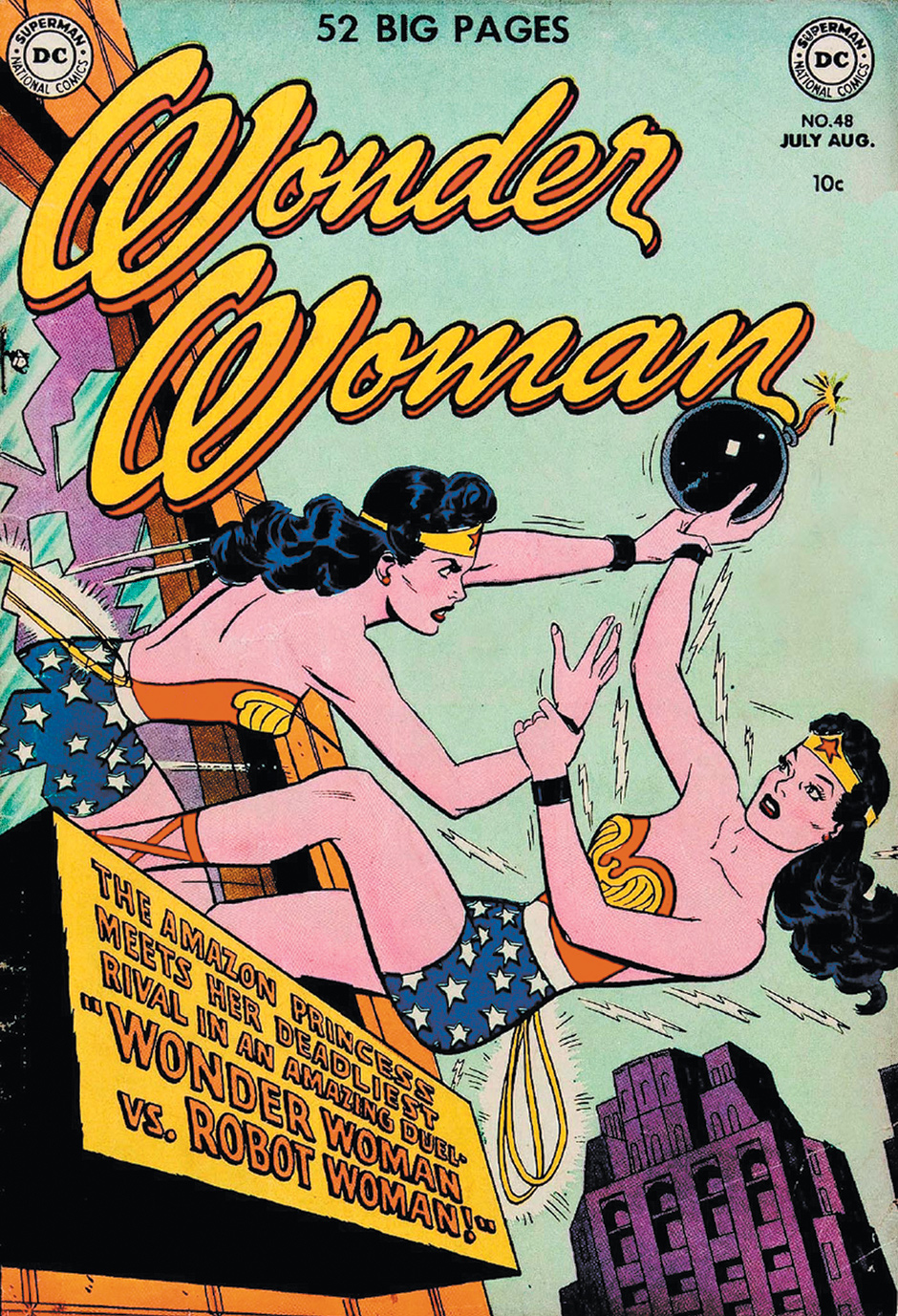
Wonderful Wonder Woman ...The Secret History of Wonder Woman by Jill Lepore Knopf, 410 pp., $29.95 Wonder Woman Unbound: The Curious History of the World’s Most Famous Heroine by Tim Hanley Chicago Review Press, 320 pp., $18.95

Wo

Wonder Woman is TM and © DC Comics
The cover of the July–August 1951 issue of Wonder Woman, by Irv Novick

In 1978, David Levine drew the birth control pioneer Margaret Sanger wearing a leotard with stars below the waist, bouncing confidently off what looked at first like a trampoline. On second glance it was a springy contraceptive diaphragm. Of course: Sanger as Wonder Woman. (See illustration below.)

The choice of imagery was obvious. Many decades earlier, Sanger had argued that women should be taught about sex, its pleasures and consequences, and given the information and medical support they needed to determine their destinies as mothers (or as not-mothers, should they so choose). In cofounding America’s first birth control clinic in Brooklyn in 1916, Sanger launched a movement that would eventually complete the job of making contraception and reproductive medicine available in the United States and much of the world (even if rearguard legislative actions today keep the descendant of that early clinic, the now venerable Planned Parenthood, fighting to stay viable in America’s red states).

Wonder Woman was one of only a few symbols of womanhood who could be considered strong enough to win so big a battle. And she was enjoying a revival in the 1970s. In 1972, Gloria Steinem and the cofounders of Ms. magazine picked Wonder Woman to be the cover girl of its first issue. Ms. even helped publish a book, a culling of feminist-friendly story lines, that for decades was a much-used compilation of the comic’s early years. In the introduction, Steinem recalled the thrill she felt encountering at the age of eight this stunning, buff Amazon princess, flying by invisible airplane from her sheltered island to help America in World War II: “Looking back now at these Wonder Woman stories from the ’40s, I am amazed by the strength of their feminist message.”

It’s Jill Lepore’s contention in The Secret History of Wonder Woman that in looking back to the original Wonder Woman for a model, Steinem and her cofounders were on to more than a commercial hook. The superheroine, Lepore argues, has all along been a kind of “missing link” in American feminism—an imperfect but undeniable bridge between vastly distinct generations. Hiding in her kitschy story lines and scant costume were allusions to and visual tropes from old struggles for women’s freedom, and an occasional framing of battles like the right to a living wage and basic equality that have yet to be decisively won.

Wonder Woman stories showed women shackled in endless yards of ropes and chains—a constant theme in art from decades earlier demanding the right to vote. The traditional allegory of an island of Amazon princesses appears in feminist science fiction early in the twentieth century; the rhetoric of a nurturing, morally evolved strongwoman opposed to the war god Mars goes back even further. At the same time, the early comics often included a special insert, edited by a young female tennis champion and highlighting women heroes. Those chosen ranged from white suffragettes to Sojourner Truth to Elizabeth Barrett Browning, professional and sports pioneers, and a founder of the NAACP. It’s unlikely that any platform for American girls’ role models was as popular as this one until three decades later.

Wonder Woman was, in short, an explicitly feminist creation. Yet younger generations of feminists have lacked an awareness of the degree to which this is so, just as 1970s feminists were baffled when asked to identify pictures of the early suffragettes. So Wonder Woman is also the symbol of a culture-wide amnesia, part of the more general problem that American feminists can’t be inspired or taught the most useful lessons by their past until they gain a more cohesive sense of it.

On a literal level, too, Lepore has telling details to add to the feminist backstory of Wonder Woman. Officially, the comic (not a comic strip in a newspaper but a book following the serial adventures of a hero or in this case a heroine) was launched in 1941 by a man named William Moulton Marston. Marston, working under the name Charles Moulton, was without doubt the creator, but in practice he was assisted by his wife, Sadie Elizabeth Holloway Marston (sometimes called Sadie, sometimes Betty), and by a younger woman, Olive Byrne, who had lived with the married couple for years. After Marston died, in 1947, Sadie and Olive would live together for several more decades. The trio’s domestic arrangement has often been called “polyamorous,” a shorthand label that doesn’t quite capture its alternating vibes of sexual fluidity, personal and professional fusion, and the convenience of its work–life balance.

In any case, Olive became the main rearer of both women’s children by Marston. And Olive was none other than the niece of Margaret Sanger. To be precise, she was the daughter of Margaret Sanger’s younger sister—Ethel Higgins Byrne, who was a cofounder with Sanger of that first birth control clinic in 1916 and who, for a brief period after the sisters’ arrest for distributing contraception, achieved worldwide fame as America’s first hunger striker. More radical than Margaret, Ethel was soon to be marginalized from posterity, a result of her sister’s hardheaded sidelining of her from the kind of strategic movement Margaret intended to lead.


What are we to make of these interesting facts? William Moulton Marston was born in 1893 in what is now Saugus in northeast Massachusetts. His father was a wool merchant, while his mother grew up in what must have been a hothouse environment: a gigantic, turreted medieval castle built on a commanding hill north of Boston. Annie Moulton was one of five girls reared in the castle.

Lepore, scrupulous about not speculating where she lacks documentation, has disappointingly little to say about the scene of young Marston’s Sunday night family dinners at the castle. We learn that Marston was fussed over and multitalented, and by the eighth grade he had met the opinionated tomboy—Sadie, recently arrived in America with her family from Britain’s Isle of Man—who would be his sweetheart through college at Mount Holyoke, and soon enough his wife and close partner in various professional endeavors. When Marston was eighteen he contemplated suicide. Was he depressive? Was there some other precipitating event, or was it a weird instance of social contagion, some kind of passing adolescent fad for neo-Romantic melancholia? Not for the first time Marston comes across as mysteriously fascinating and a bit of a cipher.

At Harvard, he was a good student, outwardly a hail fellow well met but one who attended galvanizing speeches by the visiting British suffragette Emmeline Pankhurst, and was already a compulsive entrepreneur of his intellectual wares. When his family’s financial picture worsened, he entered and won a national screenplay-writing contest with a one-reeler about a college football player. He also got a law degree. But most of his achievements came in psychology, a field that was coming into its own, led by work being done at Harvard.

Here begins a side story in Marston’s life that enriches Lepore’s book, giving it a second layer of the kind of theme she excels at exploring, though it adds a few cul-de-sac wanderings. A Harvard historian as well as a New Yorker staff writer, Lepore specializes in excavating old flashpoints—forgotten or badly misremembered collisions between politics and cultural debates in America’s past. She lays out for our modern sensibility how some event or social problem was fought over by interest groups, reformers, opportunists, and “thought leaders” of the day. The result can look both familiar and disturbing, like our era’s arguments flipped in a funhouse mirror.

Marston studied with Hugo Münsterberg, a world-famous German psychologist recruited by William James, who had realized that Harvard’s department needed an experimental lab but didn’t feel like heading the effort himself. Münsterberg was a lightning rod of flashpoints, weighing in on topics ranging from how the new medium of movies molded viewers’ minds (he has been called film’s first theorist) to criminal evidence to the deeply unpopular German point of view on World War I.

One of Münsterberg’s best-known beliefs was in the inferiority of women, and Lepore draws the link between him and an early foe in Wonder Woman: the bitterly anti-woman scientist Dr. Psycho, a professor at Holliday College (Holliday College also being the home of Wonder Woman’s most dependable mortal friend, the fat and jolly student Etta Candy, who greets the superheroine’s telepathically brain-waved calls for backup with the catchphrase “Woo Woo!” and organizes an army of helpful coeds). Münsterberg was near the peak of controversy over his ideas when Marston came to work for him—he was soon to be ostracized for his pro-German views, and to die amid the stress. But while he worked for Münsterberg Marston invented a systolic blood pressure test that would become the basis of the lie detector.

The first half of Marston’s career was his attempt to make financial hay out of his invention. He misjudged its most promising future commercial use by police departments. Set up in the 1920s as chairman of the new department of psychology at American University, Marston helped to direct—in a closely watched national case, but in secret, even to the poor accused—his students’ defense of an African-American man charged with killing a distinguished African-American doctor. So focused was the defense on getting Marston’s lie-detector evidence admitted as a matter of principle that the team forgot to secure an alibi.

Worse, Marston’s error was horribly timed to coincide with his carelessness in a business proceeding. In the same month that the defense filed its appeal, newspapers reported that Marston, the presumptive scientific expert, had been arrested for fraud. The result was a brief, blunt ruling against the defense that Lepore astonishingly identifies as one of the most consequential decisions in the history of American criminal law—about standards that must be met when considering scientific expertise as evidence.

Marston appears to have been, if not a genius, clearly an original—and not unlike a comics character in his knack for getting into scrapes. During his decade in academia, he worked his way down the ladder from department chair to disposable adjunct. Still, Zelig-like in his ability to visit nearly every scene in the exploding field of psychology, he managed to be among early testers of American prison inmates and advised the army on how to deal with traumatized soldiers. He cooked up an early taste-test ad on behalf of Gillette razors.

He published an unusually tolerant academic book on the theory of human emotions, based on experiments some of which either Sadie or Olive, whom he met when she was his student at Tufts, had helped him conduct (Olive’s assistance included taking him to a “baby party” of blindfolded and bound freshman girl pledges, whom they interviewed about the pleasures of captivity and punishment). In Lepore’s description, Marston’s book argued that


much in emotional life that is generally regarded as abnormal (for example, a sexual appetite for dominance or submission) and is therefore commonly hidden and kept secret is not only normal but neuronal: it inheres within the very structure of the nervous system.

Margaret Sanger; drawing by David Levine

The book had one positive review—written under a pseudonym by Olive Byrne. But Marston’s theory was influential enough decades later to inform a test, still widely used, of how people behave in action. The theory also won for Marston a Hollywood stint as a moral-psychological adviser, until the Hays Code came along and rendered that job moot; one of his main ideas about the movies was that movie emotions must be believable, and for a love affair to be believable the woman must direct its course. The man’s job, beneath the bluffing surface, was to submit.

Television shows like Mad Men have brought home to today’s public how the pre-1960s closet had room for all manner of business besides being gay. Nonconforming domestic arrangements, partly abandoned old identities, and half-invented new ones were easier to keep out of sight. Thus Olive raised the Holloway- and Byrne-Marston children; Sadie shouldered much of the money-earning burden; Marston pursued experiments and self-help consulting. He ham-handedly publicized his expertise while eating and drinking enough to become roly-poly. If anyone asked, the story for the outside world was that Olive was a servant.

In a way, what’s more interesting about Lepore’s story is how the trio’s lack of traditional boundaries only began at home. We think of midcentury America as the time of a mass public, united in a popular culture, shepherded by hierarchical professions, and pushed toward consensus by newly authoritative experts. Lepore the flashpoint excavator does some of her best work conveying how the notions of credentialized expertise and the journalism needed to dispense all its wisdom were so new that a lot of it was made up on the fly.

It was the trio’s proximity to this game and its role-playing that led, in part, to Wonder Woman’s birth. Olive contributed for years to Family Circle magazine as the freelancer Olive Richard, using as the springboard for her articles a series of “visits” to the house of a renowned expert, Dr. Marston, to seek his advice. In one such article she asked him whether the new, addictive medium of comics was dangerous to children. Comics were virally successful, and they were provoking a mild panic over their potential impact on the young.

Again the parallel to debates of our time is striking. Within the past decade, entries in the Dark Knight Batman film series have sparked discussion about superheroes and the War on Terror, superheroes and the Occupy Movement, and whether Batman was reveling so much in the annihilation of villains that he risked exiting the moral world. Within two years of Superman’s launch in 1938, before the United States even contemplated entering World War II, a debate raged in Time about whether superheroes were fascist. (Writing in Library Journal, the poet Stanley Kunitz worried that comics would “spawn only a generation of Storm Troopers.”)

Dr. Marston reassured the Family Circle reporter that there was nothing worrying about children’s fascination with comics. Fantasies about besting the bad guys were understandable as wish fulfillment; the salacious presentation of people in danger was all right as long as they got rescued without lingering over anyone’s pain. Maxwell “Charlie” Gaines, founder of what would become DC Comics, saw the interview and thought Marston might be able to help him counter public-relations problems. With pronouncements Marston had made in the media over the years about the superiority of female leadership, it was a natural segue to thinking about how he might create a female superhero.

If Wonder Woman hadn’t arrived, it’s easy to imagine that someone else would have created a major superheroine around this same time. Circumstances—the new medium’s need for strategic moral cover, market opportunity, the national hunger for heroes—were urgently calling her into being. But Marston answered the call with forward-looking ideas about the secret psychological appeal and salutary social good of women’s strength. He also brought to the project his breadth of experience, a brazen declarative energy, and his own unselfconscious kink.

Like the fallout after a space collision, the details scattered into place. There was Marston’s hiring of veteran illustrator H.G. Peter, ancient by comics industry standards at the age of sixty-one, himself a suffrage sympathizer back in the day, classically fluent in standoffish, Gibson girl grace but up on Varga girl pizzazz. There was the famous lasso by which Wonder Woman compels a captive to do her bidding and, lie-detector-like, to spill the truth. Wonder Woman, undercover as Diana Prince, first as a nurse at Walter Reed Hospital, then working near her beloved American pilot Steve Trevor as a secretary in military intelligence, exclaims “Suffering Sappho!”—a nod to Sadie Marston’s adoration of the poet. (Another feminist angle: Steve’s preference for the muscular, omnicompetent heroine over her mousy counterpart.) Like Olive, Diana Prince is a freakishly fast typist. Also like Olive, Wonder Woman wears chunky metal bracelets, a version of which would soon become her best-known protector against enemy fire.

After laying out the why and how of her landing in America, Wonder Woman started out with fairly standard spy-catcher plots. Everywhere she turned there were enemy rings to break. Soon there were distinctive motifs and plot devices: enslaved or even reanimated agents of villains like the Baroness Paula Von Gunther sent cowering from their cellars to trick Steve Trevor or Wonder Woman, as well as more everyday scenes of the superheroine’s feminist bravado in a strength contest or a sports setting.

A mission from military intelligence might lead to a crime-solving caper at Holliday College and then a peek inside the offices of a puppet Hitler, controlled via “mental radio” by the vengeful Mars, aided by the astral-body projections of his Roman-headgear-wearing deputies the Earl of Greed and the Duke of Deception. (Sample caption, following a frame in which Hitler has been shown suffering an “attack of nerves”: “GIVING WAY TO A STRANGE IMPULSE WHICH AT TIMES POSSESSES HIM, HITLER BITES THE RUG, THEN SUDDENLY HIS WEIRD BRAIN RECEIVES THE MARTIAN RADIO MESSAGE.”) At times it feels like an affectionate parody of something that had once been more sane.

Nor is there any getting around the ever-present theme of—the obsession with—bondage. When Wonder Woman isn’t tied up, she’s rescuing someone else who is. Lepore notes that the often wordy Marston became strictly precise when instructing the illustrator which chains should go where:


Put another, heavier, larger chain between her wrist bands which hangs in a long loop to just above her knees. At her ankles show a pair of arms and hands, coming from out of the panel, clasping about her ankles. This whole panel will lose its point and spoil the story unless these chains are drawn exactly as described here.

Tim Hanley, an independent comics writer and the author of another recent book on Wonder Woman’s history, Wonder Woman Unbound, is less of an archive hunter than Lepore regarding the comic’s creators, but he has written a useful companion history that’s good at placing the character in the setting of her comic-franchise peers. His comparison on this question to other superheroes of the time finds Wonder Woman far and away the tie-up champion. “Bondage in Wonder Woman comic books was a vast and all-encompassing phenomenon,” he writes. Hanley also faces up to Marston’s creativity about ways to threaten and torture a bound person. (“Wonder Woman is embedded within a statue of herself or turned into a being of pure color, and prepped for boiling like a crayon.”)

On the other hand, it’s possible that this uncensored quality, with its frank appeal to fantasy, is what lends Wonder Woman her sincerity, her tenderness able to coexist with strength. Having thrown her lot in with America, she is intimate with and strictly supportive of our military goals. Yet ultimately she fights for the spread of love and peace, which are the moral core of her upbringing. Compassionate toward some of her misguided human foes, she takes an interest in their rehabilitation; in a Christmastime gloss on a typical plot of Nazis fleeing to Canada, Wonder Woman demonstrates not just an Amazon-trained facility with languages but her ability to commune with a gentle fir tree. As the singer Judy Collins points out in a foreword to the first volume of Wonder Woman: Archives, what was most amazing and inspiring to young girls encountering her in the 1940s was her sadly rare quality of being ethical.

Besides archives and comics Lepore relies on journalism, notebooks, letters, and traces of memoir left by the principals, as well as interviews with surviving colleagues, children, and extended family. Her discipline is worthy of a first-class detective. Still, one wonders if she doesn’t leave some themes underexplored. Lepore convinces us that we should know more about early feminists whose work Wonder Woman drew on and carried forward. But her portraits of figures like Annie Lucasta “Lou” Rogers, a suffragist cartoonist who led the way for women cartoonists and art directors at Judgeand other major magazines, can feel too quickly rendered to take hold. A key spotter of connections, Lepore retrieves a remarkably recognizable feminist through-line, showing us 1920s debates about work–life balance, for example, that sound like something from The Atlantic in the past decade.

To the more mysterious question of why Wonder Woman had such an aesthetic pop, she brings a little less flair. And what if we want to know more about early feminist utopian fiction, and the art and ideas that nurtured it? Why did Amazon imagery come to dominate? What about the seeds of Aquarian ideas that would later reappear in New Age writings? These are part of the history; should today’s feminists feel responsible for knowing about them? (By the same token, should we feel embarrassed for forgetting the Theosophist underpinnings of L. Frank Baum’s The Wizard of Oz?) Finally, where is Marston’s mother? Her relative absence from the book hovers like a ghost in that Massachusetts castle.

Marston contracted polio in 1944, and then cancer; he died in 1947. Even while he lived, Wonder Woman’s strength was vulnerable to stewardship by other men. In 1942 she joined the Justice Society—the big leagues—to pursue supervillains with Superman and Batman. But that group franchise with its own joint comic book was headed by someone else, and in its plots she often got cast as the male heroes’ note-taker in dull meetings—a “secretary in a swimsuit,” Lepore nicely puts it. Over the decades, she would move through scenarios familiar to anyone already aware of how women were treated by the movies and television. For a while she would grow to care a little less about the world. By the late 1960s, she had surrendered many powers and settled for being a skilled fighter, all in order merely to date the pilot Steve Trevor—only to see him murdered, further narrowing her once world-historic purpose to avenging his death.

Those years, referred to as “the Diana Prince era,” are regarded as her nadir. By the end of the following decade Wonder Woman was for the first time the star of her own TV show. Until I read Lepore’s book I had no idea how fondly, if vaguely, I remembered watching that show as a child. Not that it was good or empowering. Apart from the theme song’s disco uplift, the memories are all visual, as if there were no plots or interplay between actors. There was the star Lynda Carter’s perfect black hair and corset-assisted superphysique; the then-fashionable owl-eye glasses she wore as Diana Prince; the comically cheap prop of her invisible plane; the gunmetal hair of Steve Trevor, played by Lyle Waggoner, a 1970s signifier of bland handsomeness who had been a straight man on The Carol Burnett Show. (It’s fitting that the forgettable Waggoner is more memorable here than Debra Winger, who briefly played the kid sister Wonder Girl.)

And of course there was the moment in every show where Diana would spin and transform herself into Wonder Woman. A cautious symmetrical whirl, it was too slow to suggest physical power. But there was something dumbly hypnotic about it. The young feminist artist Dara Birnbaum mixed dozens of spins from the show with explosions and siren sounds and spliced them all into a 1978–1979 video, Technology/Transformation: Wonder Woman. Today you can find mashups like it all over YouTube. For its time it was pioneering video art.

Wonder Woman has continued since, in comic-book form, through many regimes of writers and illustrators, and through several later story lines (with which I admit to being not very familiar) that have been far better received. But the fact that she has never been depicted in a live-action movie underlines Lepore’s point. If Wonder Woman is as recognizable a symbol as ever, outside the avid comics community there has been a gap between her fame and most people’s knowledge of what she’s been up to.

That will change in the spring of 2016 with the release of Batman v. Superman: Dawn of Justice, to be followed in a just-announced sequel, for 2017, by the first-ever stand-alone Wonder Woman movie. Wonder Woman will be played by the model Gal Gadot, like Lynda Carter a former beauty queen (Miss Israel), but unlike Carter a veteran of the Israel Defense Forces, so that her fighting can be expected to look more real, just as costume previews suggest that the bright old red, white, and blue will be traded in for a girdle of walnut and oxblood in line with today’s preference for materials at once more digitally perfectible and “naturalistic.” She will be strong and, at last, after all this time, the lead. Did she change the world? It’s hard to answer yes. But she was needed, and she has survived.