Showing posts with label The Darori Foundation. Show all posts

Monday, October 29, 2018

Conan Doyle for the Defense: The True Story of a Sensational British Murder, a Quest for Justice, and the World's Most Famous Detective Writer Margalit Fox Random House 2018 352 Pages


In 1893, the world was shocked to learn of the death of one of its heroes: Detective Sherlock Holmes had fallen off of a cliff while battling his arch nemesis, Professor Moriarty. Holmes's creator, Arthur Conan Doyle, had tired of the character, and killed him off in the story "The Final Problem.” His death was met with such widespread backlash, however, that Doyle revived him. The public's thirst to read about the brilliant British detective and his adventures has barely waned since.

In Fox's new book, Doyle, not Holmes, is at the center of a long-forgotten criminal episode that reads like one of his mysteries. Fox, a former obituary writer for The New York Times (she composed over 1,400 obits), details the investigation of, and fallout from, the murder of a wealthy Glasgow woman in 1908. The lead suspect, Oscar Slater, a German Jewish gambler, ended up being wrongfully convicted, and imprisoned for close to twenty years, in a case dubbed "the Scottish Dreyfus affair" for the pivotal role Slater’s ethnicity played.

Fox explains that the crime took place when the field of criminology was in its nascent stages. The discovery of DNA was decades away, and even fingerprinting by the police was only slowly starting to be implemented. This is the context into which Doyle entered and began his involvement in the case, eventually successfully freeing Slater from prison.

In this captivating tale, Fox traces the development of Doyle's career—including the fact that once his literary creation became so famous, requests flooded in for him to solve actual mysteries—through his efforts on behalf of Slater. In a particularly cinematic instance, a letter smuggled out of prison in a fake tooth seals Slater’s freedom. Fox's writing, clearly honed by her years writing obituaries, effortlessly balances expertly-researched historical and archival data with the pathos and emotional nuance of any great drama. Like a classic Holmes yarn, Conan Doyle for the Defense is full of shady underworld characters, thievery, inept police officers, and a mystery whose historical setting belies its deep relevance to our own era.

Sunday, October 21, 2018

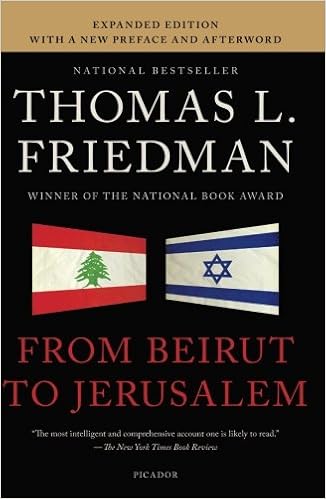
From Beirut to Jerusalem Revised Edition by Thomas L. Friedman (Picador)


This book has almost too many good qualities to list. It is excellently nuanced and balanced, detailed enough for the expert, but explained and fast paced enough for the novice of the region. Do not be fooled by the length of the book, it is a genuine page turner, with only a few slow points, and by the end you are wishing someone would take the initiative and cover the years in depth since its printing in 1988. I was initially afraid at a book so old, afraid I would be missing newly found information unavailable at the time of writing, but unfortunately the region, particularly Lebanon and Syria, isn't covered much even by scholars.

Mr. Friedman is passionate about the topic, to be sure, but as he notes, true friends are honest with each other. Having lived in Beirut for a number of years, and then moving to Jerusalem, he has friends on both sides of the situation, but isn't afraid to discuss issues for a real and lasting peace. The biggest issue, for both sides, seemed to be a misunderstanding of the other group. While some Palestinians viewed the Israelis as a minor blip in time on the land, who would eventually surrender the land and leave forever, the Israelis viewed the Palestinians under the umbrella of "Arabs" who would be at home anywhere, refusing to distinguish between an Arab in Egypt and an Arab in Iraq. Leadership, or lack of it, fed into those beliefs. Both sides lacked bold leadership, as neither led from the front, but rather led from the polls. Instead of making bold initiatives toward peace, both felt that time was on their side, when it obviously only made the divisions deeper. In the rare case where leaders did make bold moves (Sadat), they were taken out by their own group, making it even more difficult to lead from the front.

While the time in Beirut was the most interesting to me, his chapter on religion in Israel is really eye opening. We Americans tend to see other countries in generally black and white (West Germany good, East Germany bad) and forget that not all Israeli Jews are the same. The way Friedman goes into this topic is supremely interesting and profound, and something American Jews should certainly look at and discuss.

It is something of a miracle that this book was written, on a region that is so often overlooked. With such an important topic, I'll take away everything bad I ever said about Mr. Friedman. My only regret on this book is that I did not read it earlier. This book is great for someone with very little information on the region or the expert on the region. Read it as soon as you can.

Saturday, January 27, 2018

MacArthur’s Spies By Peter Eisner Viking, 368 pages, $28


MacArthur’s Spies’: A Song of Bravery  Anti-Japanese underground proves successful during WWII.


The Japanese occupation of the Philippines isn’t the first topic that comes to mind when many of us think of World War II.

But Peter Eisner’s well-researched and compelling “MacArthur’s Spies: The Soldier, the Singer and the Spymaster Who Defied the Japanese in World War II” reminds us of that cruel clampdown and shines a light on an unheralded guerrilla battle against the occupiers.

The title refers to Gen. Douglas MacArthur, the American commander who pulled out of the Philippines after the Japanese onslaught and vowed to come back. One of the memorable quotes of the 20th century is MacArthur’s utterance in Australia after he left the Philippines: “I shall return.”
And he did so victoriously, thanks in part to daring and resilient American and Filipino guerrillas and spies who worked to undermine an imperial Japan big-footing its way through Asia.

“MacArthur’s Spies,” which Eisner will discuss Nov. 12 at the Book Festival of the Marcus Jewish Community Center, contains vivid vignettes throughout.

Descriptions of Japanese brutality hit you like a slap in the face from start to finish. The colorful personalities who compose this grassroots resistance come to life.

The spymaster is businessman Chick Parsons. The soldier is guerrilla leader Col. John Boone. The singer is Claire Phillips, an American spy who ran a Manila spot called the Tsubaki Club. The story of this “valiant but not angelic” woman, the book’s major character, is a hymn of bravery.

Known at the club as Madame Tsubaki, Phillips and other club hostesses teased, tantalized, cooed and in one case ginned up a Sally Rand-style fan dance for loose-lipped and inebriated Japanese officers kicking back in the club.

The result? Nuggets of intelligence inadvertently passed along by the officers found their way to U.S. guerrillas based in Bataan.

Also known by a nom de guerre, High Pockets, Phillips helped get medicine, food and clothing to prisoners of war in the Philippines.

The woman garnered some postwar fame with a memoir called “Manila Espionage,” published in 1947, and a portrayal of her in a 1951 movie called “I Was an American Spy.”


But her image, as conveyed in popular culture, was weak, vague and in many cases fictional.

Eisner, who saw a mention of her in a book about the rescue of Bataan march prisoners called “Ghost Soldiers,” set out to find more about the mysterious High Pockets.

He used intelligence files, guerrilla operational reports and military histories. He retrieved depositions, court filings and sworn testimony from a court case for a claim of restitution she made “for the money she spent feeding guerrillas and prisoners of war.”

“It was a gold mine of information about the anti-Japanese underground and about how Claire and her allies supported both guerrillas in the mountains and prisoners of war who were starving in camps,” Eisner writes.

Her wartime diary appeared in the court case folder. It depicts “the life and times of a woman who maneuvered her way through Japanese occupation in the Philippines, suffering through deadly disease, indignities and imprisonment while concealing her efforts to spy on the Japanese.”

This laudable legwork is a lesson on how to get a great story. The story is a tribute to the people who took it upon themselves to battle and thwart a ruthless enemy.

Tuesday, January 23, 2018

The Battle for Syria: International Rivalry in the New Middle EastOct 25, 2016 by Christopher Phillips Hardcover (Yale University Press)

Syria’s war is far from over but it is already the subject of a large number of books – many about the internal dynamics of the conflict or the headline-grabbing jihadis who dominate perceptions of it. Christopher Phillips’ impressively-researched study of its international dimensions is an important contribution to understanding the bleak story so far. Based on interviews with officials and a mass of secondary sources, it identifies and examines the key external components of the worst crisis of the 21stcentury: the fading of American power, Russian assertiveness, regional rivalries and the role of non-state actors from Hezbollah to ISIS.


The Battle for Syria: International Rivalry in the new Middle East (Yale University Press, 2016)

Phillips’ principal argument is that the Syrian uprising of 2011 – pitting ordinary people against an unforgiving regime – was transformed into a civil war because outside involvement helped escalate and sustain it – and of course still does. Bashar al-Assad’s brutal crackdown was followed by other actions that made a significant difference: ‘omni-balancing’ Qatar’s early backing for rebel groups despite its own limited capacity; ill-considered US and Western calls for the Syrian president’s departure; Turkish and Saudi sponsorship of anti-Assad forces; and, from the start, Russian and Iranian support for Damascus that raised the stakes and created an asymmetry of strategic commitment that persists to this day.

Inaction mattered too – whether in the lack of adequate assistance for the rebels or Barack Obama’s failure to response to the breaching of his famous ‘red line’ when Assad used chemical weapons in Ghouta in August 2013. Phillips correctly acknowledges the lingering after-effect of the false prospectus of the 2003 Iraq war on the British parliamentary vote against military action but I think underplays the wider paralysing role of that intervention.

It was the misfortune of Syrians that their chapter of the Arab uprisings opened in what the author succinctly characterises as ‘an era of regional uncertainty as the perception of US hegemony was slowly coming undone’. Obama’s reluctance to get involved may well have made sense after the lessons of Iraq, Afghanistan and Libya, but he was unable to manage his allies and, crucially, raised unrealistic expectations amongst Syrians and the Gulf states. Only ISIS, with its transnational agenda, moved him to act.

The landmarks of the crisis are familiar but they are illuminated by some fascinating details: Before 2011 knowledge about Syria was surprisingly limited, so there was insufficient understanding of the differences between its security-obsessed, ‘coup-proofed’ regime and those in Tunisia, Egypt and Bahrain. In 2009, the US Department of State Syria desk consisted of one official; of 135 Turkish diplomats working on the Arab world, only six spoke Arabic. Francois Hollande’s diplomatic adviser, wedded to the ‘domino theory’ that meant Assad would follow Ben Ali, Mubarak and Gaddafi, didn’t want to hear the nuanced reports from the well-informed French ambassador in Damascus. Mistaken analysis drove what Phillips calls the ‘escalator of pressure’. Russia, with better intelligence, understood that Assad was more secure than others predicted (or wanted to believe) and that the appetite for western involvement was limited.

If underestimating Assad’s durability was a key failure, that was compounded by over-stating the capabilities and cohesiveness of the opposition. Sponsorship by rivals who prioritised their own agendas, misleading extrapolations from the Libyan example, inevitable tensions between the external opposition and fighters on the ground, and the exclusion of the Kurds were all highly damaging. Policy towards the armed rebel groups was incoherent: despite vast expenditure, no foreign state was able to gain leverage over them.

International and regional institutions performed little better, Phillips argues. The short-lived Arab League mission to Syria was led by a Sudanese general linked to the genocide in Darfur. UN envoys Kofi Annan and Lakhdar Brahimi failed to overcome US and Arab resistance to Iran taking part in the 2012 Geneva conference, thus excluding a key player at a sensitive moment. Staffan de Mistura shuttled between parties who refused to even meet each other in Geneva, where the Syrian government delegation specialised in stonewalling and abuse. It has not been a case of third time lucky for the UN. ‘Everybody had their agenda’, in Brahimi’s words, ‘and the interests of the Syrian people came second, third or not at all’.

This judicious and measured book stands well back from the Twitter-driven ‘war of narratives’ that has distorted too much media reporting on the Syrian conflict. In the heat and controversy of complex and terrible events, it is helpful to pause and look coolly at the big picture. But it is sobering to contemplate the damning evidence of how outside actors helped fan the flames of ‘an internationalised civil war’ without any end in sight.

Sunday, December 17, 2017

Millard Salter's Last Day By Jacob M. Appel ( Simon and Schuster )

Millard Salter's Last Day

The Best Novel of 2017 That You Never Heard Of

 Jacob M. Appel’s life-affirming elderly suicide novel ‘Millard Salter’s Last Day’ is a highwire act balancing tragedy and comedy.

Hidden beneath a perplexingly nondescript book jacket is one of the best novels of 2017, Millard Salter’s Last Day by Jacob M. Appel. Millard Salter is a wry old New Yorker who after 75 mostly satisfying years wakes up on his birthday determined to leave the party fashionably early. With the exception of a single dodo son, Millard’s children are successful, his practice as a shrink is in good shape, and the state of his love life means he has likely contributed to the growing STI epidemic among senior citizens. What better moment to commit suicide?

Appel’s opening paragraph has all the right measurables: a complex first sentence full of information but bursting still with question marks, a whole life story without any nonsense distracting details, introspection, warmth, and finally, that shoulder-shrugging sort of wit that shows you humor even in the grim subject of suicide. The entire novel is the same kind of complex juggling act. For a less skilled writer, the subject of elderly suicide offers ample opportunity for ham-fisted sentimentality that leaves you with a compulsion to call your grandparents. Conversely, in trying to put off all those icky feelings associated with death, it would have been easy enough to let things turn slapstick. But this book does neither.

Appel goes after the more difficult task of writing a compelling story about death that is neither tragic nor outright comic. Death in this book is treated not with disregard, but with a sort of irreverence, a light touch that allows the writer to stack details and ideas without ever getting too macabre or pedantic. And yet somehow even beyond that, there’s a strange, wise charm to it all. You really don’t ever think a book on suicide could ever be life-affirming, but this one is.

Most of the book physically takes place while Millard goes from appointment to appointment on his last day, counting his lasts, getting his affairs in order, spending time with his terminally ill girlfriend and his patients and children, even saying a short goodbye to his estranged ex-wife. Yet the true setting of the novel is Millard’s cerebral cortex. In one scene Millard meditates on the improbability of finding love and its supremacy over all human affairs by lightheartedly casting aside the importance of things like childbirth and parenting. These are just trifles. What really matters is the moment before the universe has fully decided whether two people talking about Leontyne Price in an elevator will become lovers or remain friends. What an unlikely little miracle love is, Millard reflects.

As Millard keeps looking at his watch, always afraid of falling behind schedule on his last day, you inevitably start to feel a certain anxiety not only when he gets side-tracked, but whenever it becomes clear that some of his activities aren’t worthy of anyone’s last day. But because Millard sees serenity in death, it is treated with ease and insouciance, with plenty of louche New York Jewish humor. And so greater yet is the anxiety that comes as Millard, with a wistful chuckle, ticks things off of his list, realizing that he won’t be able to accomplish them before the end of the day, and therefore won’t ever accomplish them.

Death, really, is something that happens to other people. Internalizing the idea that we might eventually run out of time—that there are books we won’t be able to read and places we won’t ever be able to visit or even that at some point we’ll have a last lunch with someone we love—is about as difficult as trying to understand an abstraction such as what exists beyond the universe.

Even for Millard the notion of death is almost too foreign and too hard to grasp. He routinely puts things off until tomorrow before quickly correcting himself.

This, really, is the genius of the book. Even for someone dedicated to the idea of killing himself, the inability to understand death as anything other than a purely theoretical but ultimately imaginary concept—like lizard morality or the L train shutdown—offers up the notion of perpetual tomorrows. The idea that we have a last day, that there is a last time we’ll do certain things, even when we are determined to make it happen ourselves, is almost ridiculous. Millard doesn’t doubt that he will kill himself and yet at the same time there is also a part of him that believes he really will get to these things tomorrow.

Tomorrow is an inescapable concept, even for someone who is about to kill himself. Whereas death, well, that can be put off until tomorrow. I wonder why more books can’t be written this way, and of course, if they’ll jazz up the book jacket for the second printing.

Monday, December 11, 2017

Literature?Tthe next frontier for branded content?


Mercedes-Benz Italia commissioned a personalised, branded novella


While branded content has proven to be a semi-reliable bedfellow for editors, broadcasters and even the music industry, certain marketers are now looking to the enduring power of the novel as their next medium for advertising copy.

Almost a year ago, Mercedes-Benz’s Italian division released a novella – not a tome dedicated to its rich history but a 33-page work of fiction. Partnering with Google to create a personalised story, the idea was, according to marketing manager Cesare Salvini, explicitly to increase the brand’s coolness factor.

“Six or seven years ago the average image of a Mercedes driver was an old guy with a hat driving a C-Class,” he said. “We want it to be a millennial driving an A-Class.”

La Forma della Nuvole, translated for an English-speaking audience into The Shape of Clouds, uses Google’s technology to pick up where in the world the reader is and what situation they’re in. As they get deeper into the story, it soon transpires that they are the protagonist, with location and weather data used to set the scene – literally.

The creator of this book was not a marketer or copywriter, but the Italian bestselling novelist Gianrico Carofiglio. And while it’s not the first time an author has collaborated with a brand, it was a watershed moment for branded content – copy that usually lies within journalistic publishing and not literature.

“Sometimes readers ask: ‘Is [working for a brand] against the nature of writing?’” Carofiglio said. “’Shouldn’t you seek your own inspiration?’ But inspiration is something that comes later. [The project was] not against creativity. You find very interesting things when you’re fenced in, when you’re behind bars.”


This openness towards working on tech-laden, brand-led projects may be surprising from a novelist, but it’s not uncommon. While authorship is, for the Faber Academy’s fiction programme director, Richard Skinner, a “very monastic” process of early starts and solitude, most novelists find it necessary to supplement their writing through more commercial means. After all, just 11.5% of professional authors – both literary and academic – can afford to earn a living from writing alone, according to the Authors' Licensing and Collection Society.

“I don’t think of myself as a novelist,” said Skinner, who has published three novels, when asked if he would take on a project such as The Shape of Clouds. While he admitted many writers would be averse to entering the dark side of branded content (“There are a lot of writers who feel … that the page is a sacred space”), he himself feels like “a writer – writing across genres”.

“If something came up like that, I’d be interested,” he said.

It’s not the first time Skinner has heard of novelists writing fiction outside of the traditional publishing world. In his circles he’s noted peers working in the worlds of gaming and cinema, using their grip on “highly sophisticated storytelling techniques” and translating them off the page.

Naomi Alderman, the author of 2017 novel The Power, has written about the connection between non-traditional storytelling genres, too. Herself a game designer, Alderman has written extensively on the potential for writers to explore technology in order to create immersive stories that give the reader choice and a voice in a fashion far more erudite than the ‘choose your own adventure’ books of the 80s.

She also argues that these stories are already prevalent – they’re just called videogames.

Authors – usually of the more successful variety – have also begun reaching out to brands in the digital space themselves, looking for new ways to tell their stories. This conversely provides these brands with fresh opportunities to connect with consumers’ cultural interests, if only on a secondary level.

JK Rowling’s partnership with Sony, forged to launch Pottermore, is the leading example of this. While the deal came to an end three years after the digital reader experience was unveiled, the site collaborated with the expertise of the tech brand for launch; indeed, Rowling herself praised the brand for its “unique philosophy of creativity in harmony with technology that made them my first choice”.

As well as the priceless PR, Sony was able to utilise the site’s shop to push its products and services related to Pottermore. Rowling, on the other hand, found a way to expand the universe of Harry Potter outside of the traditional publishing sphere.

For brands and agencies, working with novelists on a project-led or internal basis may also prove fruitful. Successful authors know how to discover “wonderful ideas, to look in unexpected places for creativity – places copywriters might not have looked before”, said Skinner, thereby adding another dimension to the industry’s standard ‘creative’ process. As Alderman succinctly put it in a Guardian column: “When digital people run workshops … about storytelling, they often seem not to notice that quite a lot of very clever people have been thinking very hard about stories for, oh, the past 3,000 to 4,000 years.”

Symbiotically, the novelist would benefit from learning to work to deadlines, something Skinner admits his kind are “terrible” at.

As for the efficacy of the branded novel? Salvini noted the Italian version of The Shape of Clouds has been downloaded more than 90,000 times, and “caught the attention of publishers” looking to innovate the e-book format. But he couldn’t say how many cars had been sold off the back of the exercise.

Like most forms of marketing, it may be ROI that stands in the way of the branded publishing revolution.

Monday, December 4, 2017

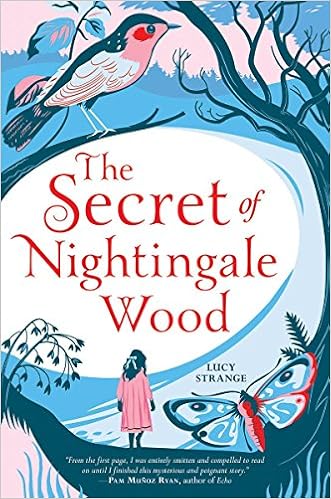
The Secret of Nightingale Wood Hardcover – October 31, 2017 by Lucy Strange Age Range: 8 - 12 years Grade Level: 3 - 7 Hardcover: 304 pages Publisher: Chicken House (IBRChildrensBooks)(


For young readers, a fairy tale filled with real-life concerns

When Henry walks into rundown, slightly spooky Hope House, her father calls it a “fresh start” for the family. But the troubles they carry with them aren’t so easy to set down for Henrietta Georgina Abbott and her little sister, Piglet, who are trapped in a world where the adults’ motives are as murky and confusing as the woods surrounding the house.

Lucy Strange’s “The Secret of Nightingale Wood,” set in England just after World War I, is filled with fairy-tale references, from the elaborate book of stories Henry treasures to a mysterious witch living in the woods (Chicken House, ages 10 and up, $16.99). But Henry’s problems are very real – a heartbreaking family secret, an absent father, a mother crushed by grief, and doctors at a nearby asylum whose treatments for the suffering woman are the stuff of nightmares.

Henry is hurting, too, but plucky and determined enough to battle her way through a world of grieving people, with some help from her friend Moth, who helps her draw on reserves she didn’t know she had, to “look for the part of the moon that is hidden in shadow. … Trust that it is there even when it can’t be seen.”

The hidden strength Henry uncovers leads to an ending that’s not full of fairy-tale magic but of the everyday kind – courage, kindness, forgiveness, and a little bit of mischief. Somehow, first-time author Strange finds an ending more complex than “happily ever after,” and far more satisfying, because there is plenty of hope to lighten the sadness.

Sunday, December 3, 2017

The Story: A Reporter’s Journey By Judith Miller Published 2015-04-07 Simon & Schuster 400 Pages


In the epiloque of her memoir, The Story: A Reporter’s Journey, Judith Miller declares that she has “tried to review [her] mistakes, to correct errors, add new facts, and update them in the fullness of time.” This final manifesto, delivered in the concluding paragraphs of her weighty book, is essentially its mission statement. By writing about, closely scrutinizing, and heavily commentating on the drama surrounding her departure from The New York Times, Miller attempts to set the record straight and prove why her version of events is the accurate one — the one that readers should accept as the truth. She attributes writing this memoir to a higher journalistic principle, asserting that “[c]orrecting and completing the record are part of the pact that journalists make with readers.”

Miller’s intentions for writing this memoir aren’t in question: readers recognize that Miller strives to redeem herself from rumors, refashion the narrative in her favor. What has been, and what continues to be, questionable is the accuracy of her writing. This — even supported by the purest of intentions — cannot be redeemed by writing a memoir.

Throughout most of the memoir, Miller examines her failure as a reporter. She explains why she reported on weapons of mass destruction in Iraq, and confronts the consequences of that reporting for her, personally and professionally. Her primary defense is that she merely reported what her sources told her. She asserts, “The earlier stories were wrong because the initial intelligence assessments we reported were themselves mistaken — not lies or exaggerations.” When discovering that her sources were wrong, and therefore her heavy reporting on the subject was also, Miller paints herself as a scapegoat. She states that “[b]loggers and other media critics” portrayed her as “either a closet neocon bent of taking the country to war, or a credulous dupe spoon-fed by Ahmad Chalabi [her source] and the White House ‘shillsters’ — a ‘useful idiot’ with ‘blood on [her] hands.’” Miller is certainly correct in asserting that her reporting did not cause the war. To place the blame for an executive decision by the commander in chief on a single woman who is not an elected official, appointed spokesperson, political pundit, or supernatural force endows her with a power she does not and cannot possess. Journalists do not create news — they report news.

Despite this, Miller is blamed. According to her, the leadership at The New York Times “tried to blame the paper’s alleged reporting failures on [her].” In May 2004, The New York Times, under the leadership of Bill Keller, ran a note that implied that Miller “had written only stories that supported President Bush’s assertion that war was justified because the intelligence community had concluded that Saddam was hiding unconventional weapons.” Though she is never explicitly named, this note, among others, “scars her reputation.” Miller claims that this note — one that blatantly exposes the flaws in her reporting — implied that she “had written [her stories] to build a case for the war” and that “that [her] stories had a political agenda.” She claims that she “had never taken a public position, a mortal sin for a Times reporter.” But political agendas and public positions, however subtle or nuanced, pulsate beneath any story. Telling a story without a slant is impossible, regardless of whether her agenda involved a position on the war itself, or just a blind desire to get a scoop on a story that was clearly being peddled to the American public through journalists like her who were too eager to see the red flags, in the story itself, or the sources selling it.

Miller argues that her inaccurate reporting “spark[ed] a sustained campaign against [her] and [her] reporting.” While that may be how she experienced what happened, another way to look at it is this: the journalistic profession is built upon a clearly defined set of parameters, beaded links. A journalist is only as good as her reputation. Her reputation is only as good as her reporting. Her reporting is only as good as her sources. Break a link along the chain and the pretty beads tumble forth, away, beyond your grasp.

The second struggle that Miller writes about is the time she spent in federal prison for protecting her sources. This account is less defensive than the first half of her memoir and certainly more intriguing. For me — an ardent fan of the First Amendment — this is where Miller’s fame resides. As a college student, nearly a decade ago now, the journalist who went to jail fascinated me. The notion was startling, provocative, glamorous even. Miller’s story is still fresh. The drama surrounding her refusal to divulge her sources — conversations with attorneys, contempt of court, and a goodbye to her husband — all feel palpably relevant still. This is probably because although Miller’s imprisonment raised a heightened awareness for the need for a federal shield law that would protect journalists, her imprisonment did not actually achieve obtaining this federal shield law. Journalists can still be sent to federal prison for refusing to share their sources.

Placing Judith Miller — and imprisonment for her refusal to divulge her sources to a grand jury — within a historical legal context here provides a richer understanding of Miller’s efforts. Miller knew that her refusal to provide a source was not protected by the First Amendment. The legal precedent for this — which is still good law today — is the Supreme Court’s decision in Branzburg v. Hayes, 408 U.S. 665 (1972). In that case, the split Court, led by Justice White, held that requiring a journalist to appear and testify before state or federal grand juries does not abridge the freedom of speech and press guaranteed by the First Amendment. Unlike attorney-client privileges, spousal privilege, and psychotherapist-patient privilege, no privilege protects agreements, conversations, discussions between journalists and their sources. Quite simply, the Court held, that the First Amendment does not relieve journalists “of the obligation that all citizens have to respond to a grand jury subpoena and answer questions relevant to a criminal investigation.”

The journalists in Branzburg argued that if reporters were forced to respond to subpoenas, identify sensitive sources, and divulge confidential information, then the sources would refuse to furnish newsworthy information in the future. In essence, journalists argued that a federal shield law was necessary because without this protection sources would be less willing to share news. The Court in Branzburg disagreed with this notion, stating that “[r]eliance by the press on confidential informants does not mean that all such sources will in fact dry up because of the later possible appearance of the newsman before a grand jury.” The Court characterized the relationship between the press and its sources as a “symbiotic one.” Sources need journalists as much as journalists need sources.

Miller — and her team at The New York Times — hoped to change the law in Branzburg. This was not the first time that The New York Times challenged the government. In the early 1970s, Daniel Ellsberg leaked classified information to The New York Times from the United States Department of Defense regarding the Vietnam War. Although the Times was aware it could possibly face repercussions under §793 of The Espionage Act of 1917, the paper nonetheless published the information. Soon after publishing a portion of it, the government sought a restraining order that would stop The New York Times from publishing anything further. In the highly celebrated Pentagon Papers case (New York Times Co. v. United States, 403 U.S. 713 (1971)), the Supreme Court held in a per curium opinion for The New York Times. The Court declared that “any system of prior restraints” bears “a heavy presumption against its constitutional validity.” The Court further explained that to justify the necessity of a prior restraint on publication, the government would have to prove that publication would cause “grave and irreparable damage,” “a heavy burden.” In refusing to reveal her sources, Miller and The New York Times hoped to herald a new law in favor of journalists.

When Miller became aware she could be subpoenaed to testify regarding her sources in the Valerie Plame affair, she immediately consulted the then New York Times assistant general counsel George Freeman (full disclosure: I worked briefly with Freeman at the Media Law Resource Center) and told him she “could not answer questions from a grand jury about [her] discussions of top-secret information without violating a pledge [she] had given [her source].” She said she could not risk an open-ended prosecutorial fishing expedition into her sources and “comply with the subpoena, even if it meant going to jail.”

Miller is never naive, and so her imprisonment is not an unforeseen consequence, but a calculated decision. This does not detract at all from her bravery. In her memoir, she writes that although “some critics wrote [she] was eager to go to jail as a First Amendment martyr, nothing was further from the truth.” Eagerness to be imprisoned aside, Miller is still, in some sense, a First Amendment heroine. Although she describes herself as “the only inmate with a key to the jail,” and although she states that she was “being incarcerated not for a crime but for a matter of conscience and principle,” she still was an inmate and still was incarcerated. No one can say Miller does not push herself to the limits. This requires courage.

Once in prison, however, the situation changes. Her source gives her a waiver, allows her to testify, and Miller is eager to oblige. If her source no longer demands protection, why should she remain in prison? She misses her husband, misses her life, and wants, understandably, out. However, despite this, her attorneys at The New York Times urge her not to testify because testifying would mean that she “had gone to jail for nothing,” would make them “look weak.” Testifying meant that another grand victory for journalism would be abandoned. While Miller wanted to testify, the paper wanted her to remain in prison so that they might achieve more than Branzburg. Miller testifies anyway, and is forced to resign from The New York Times soon thereafter.

Her relationship with the publisher and her old friend, Arthur Sulzberger Jr. was irreparably scarred by her decision, Miller writes. When she questions Sulzberger, asks him what she has done to “offend him or betray the paper” (after he allows an editorial by Maureen Dowd to be published, where she colorfully exclaims that should Miller be allowed to report, “the institution most in danger would be the newspaper in your hands”) he “mumbles” that she “hadn’t stayed in jail as [she] had promised.”

Ultimately, this is a memoir about failed relationships within one of the most prestigious institutions in the United States. Throughout the book, Miller paints herself as a determined journalist. This determination is intriguing and even inspiring when reading about her adventures as a young reporter in the Middle East at the beginning of her memoir (possibly the most fascinating part of her book — I wished for more details here, of Miller in her heyday). However, it quickly becomes clear that this determination does not translate into collegiality, congeniality, or genteelness. Aggression gets the scoop. She admits that she “did not appreciate the importance of building a network of friends inside the Times.” She “tended to regard time spent at the coffee cart with colleagues as goofing off since [she] was not reporting.” While her single focus is admirable, her prioritization of the story is laudable (“the story would always come first”), her relationship with other reporters, her editors, her newspaper, and the public withers.

The problem with The Story exists in its form: the memoir. Miller writes under the impression that her account provides probing examination of her personal story; however, because of the memoir’s highly intimate and volatile nature, Miller cannot separate herself from her subject. Although she repeatedly references notes that she took following controversial incidents, these notes — her own records — do not detract from the bias intrinsic to her work. The Story is not a ruthless journalistic venture as Miller wishes to believe, and wishes to persuade her readers into believing.

Saturday, December 2, 2017

Once Upon an Algorithm: How Stories Explain Computing. Martin Erwig. MIT Press. 2017.


Most of us enjoy listening to stories. They can serve as mnemonic devices as well as teach us about and perhaps even change our lives, lives which are increasingly fast-paced and much more digital than they once were. Whilst stories can have a transformative effect, computers have, in fact, changed how we live. For some, computers and computing may appear to involve difficult-to-understand, complex and abstract processes and terms. To this end, Martin Erwig, Professor of Computer Science at Oregon State University, has written his third book, Once Upon an Algorithm: How Stories Explain Computing.

In this book, he takes a more bottom-up approach, introducing concepts of computation and computer science to the general public one at a time, and linking these to the activities that we engage in throughout the day. By doing so, he aims to spread an interest in computer science and to motivate readers to learn more about this field. The main argument of this book is, then, that there are parallels between the processes of computation studied, tested and applied in computer science and the problem-solving actions we take on a day-to-day basis.

Throughout the book, Erwig references popular culture, including the fairy tale Hansel and Gretel, the movie Groundhog Day and the Harry Potter books. As such, this work delightfully differs from the standard introductory textbook in computer science as well as manuals designed to teach specific programming languages, such as the ‘For Dummies’ series (e.g. Data Science for Dummies; Coding for Dummies). Although the majority of these books do tend to clearly explain and introduce the most important concepts, they do not use such memorable examples.

That being said, these manuals typically offer exercises and opportunities for practically applying the material learned. This book serves a different purpose: its examples explain theory, and it should therefore rather be seen as an extensive, occasionally heavy, reference work with a glossary that could improve the theoretical knowledge and understanding of a motivated reader. It does not contribute towards skill-building.


The start of the day and the book is reserved for the famous tale of Hansel and Gretel by the brothers Grimm. This story is used for introducing the key foundational concepts ‘computation’ and ‘algorithm’, which are of such importance that they feature in the morning routine. According to the fairy tale, Hansel and Gretel find themselves all alone in the woods, left by their parents in a time of raging famine. Wanting to find their way home, the siblings engage in a process of problem-solving. Hansel decides to drop the pebbles he has previously collected at intervals, and by revisiting these pebbles, following the created path step-by-step, Hansel and Gretel reach their parents’ home.

This solution could be made into an algorithm once written up in a computer or programming language: it involves a mechanism for stepwise finding one’s way from A to B, which can be used repeatedly. To be an algorithm, the solution – like a story – should also have an ending and lead to some resolution. Whereas in the fairy tale Hansel and Gretel do reach home in the end, where they are accepted with open arms by their grieving father, for the algorithm the solution is obtaining accurate results. In this case, the correct house is successfully reached.

In a later chapter, Erwig addresses the extent to which we spend our days habitually. If we have grown comfortable with folding a paper in a certain way so that it fits in an envelope, then we have grown accustomed to using a certain algorithm. However, if we choose to continue to repeat the action, then we require a description of this repetition and a control structure, such as the ‘loop’, to make sure that an operation does not run indefinitely. Erwig uses Groundhog Day to clarify how loops and control structures work.

In this film, a weather reporter called Phil Connors is made to continuously relive ‘Groundhog Day’. As Erwig explains, this is the day on which a groundhog – a type of rodent – is thought to predict when winter will come by choosing to come out or stay in his burrow. In his desperate attempts to break this cycle, Phil explores his actions. Surely, if he gets rid of Punxsutawney Phil, the groundhog, Groundhog Day should end? However, as it turns out, to leave the loop Phil would have to change his attitude towards the festivities and perhaps even life in general. Such terminating conditions are to be specified for each loop.

Next to the concepts of computation, the algorithm and the loop, Erwig also uses the story of Harry Potter for explaining how ‘types’ work. When we are finally sitting down to dinner, we would struggle eating soup with a fork rather than a spoon. This would be a type error: an error in the type of utensil used. Types have certain properties which distinguish them. Harry Potter-related examples are the difference between muggles and wizards and witches – the difference between Harry and his aunt Petunia – and the properties of Harry’s invisibility cloak compared to the other cloaks he owns. In this way, types help make sense of the world through classifying objects and thereby managing expectations for computation.

In the end, the content of this book, as well as the way it is structured, moving from one concept, theme or topic to another, could be repetitive. Admittedly, Erwig does provide some guidance in the introduction, indicating which sections would be relevant to read in which cases. His writing style does also appear geared towards the academic reader. A reader may find some parts of the book dry reading, exacerbated by the fact that it does not have a narrative arc and little plot. The book would specifically have benefited from a more elaborate and engaging writing style as well as an introduction and conclusion that briefly contextualise and describe the history and development of the discipline.

Overall, Once upon an Algorithm is recommended to anyone new to the field of computer science with an interest in learning about the theoretical basics of the field as well as its application to our lives. Some sections will require close attention from the reader, due to the complex nature of the matter at hand and the occasional heavily informational presentation of the content. However, the use of concrete examples as well as entertaining stories generally makes this book a fun and accessible read.

Sunday, November 19, 2017

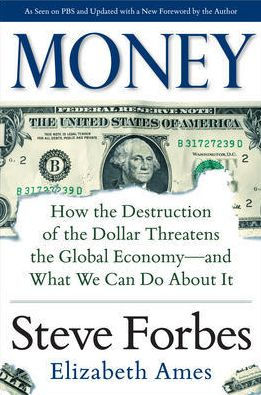
Money: How the Destruction of the Dollar Threatens the Global Economy—and What We Can Do About It. by Steve Forbes and Elizabeth Ames (McGraw-Hill Professional Publishing)

Money: How the Destruction of the Dollar Threatens the Global Economy - and What We Can Do About It / Edition 1

Steve Forbes's Money: The Gold Standard Is The World's Prosperity Engine

Ex Fox News Channel host Greta Van Susteren rightly calls Steve Forbes and Elizabeth Ames's new book, Money, “A gripping read….”

Steve Forbes, chairman and editor-in-chief of Forbes Media, and Elizabeth Ames have written their best book yet. It is entitled Money: How the Destruction of the Dollar Threatens the Global Economy—and What We Can Do About It. Money is, by far, the most important book on economic policy published this year. (Full disclosure, Forbes and Ames reference and acknowledge this writer’s work, including his collaboration with Forbes.comcontributor Charles Kadlec, in this work.)

The authors succeed in making money — as in monetary policy itself — fascinating and accessible. It has drawn glowing praise from many important thought leaders, including virtuoso retired banking titan (now Cato Institute president John Allison; Fox News Channel host Greta Van Susteren; Whole Foods co-founder and co-CEO John Mackey; former CNBC contributor Lawrence Kudlow; public intellectual Dr. Ben Carson; and Atlas Economic Research Foundation's Dr. Judy Shelton, among others.


Steve Forbes speaks at the Get Motivated Seminar at the Cow Palace in Daly City, California. (Photo credit: Wikipedia)

Significantly, one of the prime architects of the prosperity-inducing Reaganomics, Dr. Arther B. Laffer, has this to say about Forbes and Ames’s book: “A compelling and well-informed argument for a 21st century gold standard and a sound dollar, which will be the foundation for a new era of global prosperity.” It is very good to have the brilliant Laffer again speaking up for gold.

Laffer did seminal work, with Kadlec, on the gold standard in 1981. The record is contained in the Laffer Center’s archives: “Restoration of dollar/gold convertibility is the final and necessary link in the President’s program for an American Renaissance.”


Steve Forbes was featured prominently at an October 2011 Heritage Foundation Conference on a Stable Dollar: Why We Need It and How to Achieve it, also featuring Lewis E. Lehrman, the undisputed leading advocate of the classical gold standard (with whose Lehrman Institute's web publication this writer has a professional association). Lehrman appropriately is given pride of place in Money’s acknowledgements.

At that Heritage Foundation Conference Forbes made a wry and witty observation, reprised in this book: “conversations about monetary policy … (are) a surefire way to discourage unwanted conversations on airplanes." Forbes and Ames have found a way to make the conversation wanted, and even compelling. Forbes and Ames bring an abundant level of sanity, lucidity, and interest to what too often is considered as an arcane subject.

Good money is crucial to creating a climate of equitable prosperity. Forbes and Ames’s putting the case in terms accessible to regular readers is invaluable. Steve Forbes is a supply side icon. Money — this magnum opus on the gold standard, one of Forbes's signature issues — deserves to become a classic.

Money, far from being the root of all evil, presents (when, as here, golden) as delightfully virtuous. Its preface probes into just how our elites went so wrong in the mismanagement of our fundamental economic unit of account. Their analysis was anticipated by that of Frederick Hayek in The Pretense of Knowledge, his Nobel Prize acceptance speech:


It seems to me that this failure of the economists to guide policy more successfully is closely connected with their propensity to imitate as closely as possible the procedures of the brilliantly successful physical sciences - an attempt which in our field may lead to outright error. It is an approach which has come to be described as the "scientistic" attitude - an attitude which, as I defined it some thirty years ago, "is decidedly unscientific in the true sense of the word, since it involves a mechanical and uncritical application of habits of thought to fields different from those in which they have been formed." I want today to begin by explaining how some of the gravest errors of recent economic policy are a direct consequence of this scientistic error.

Great minds work alike.

In the spirit of Steve's late, great, father Malcolm S. Forbes, each chapter of this book is encapsulated by an aphoristic “Nugget.” If you have any doubts as to whether acquiring it is worthy of your (at discount) $20.72 (just a nickle more than an iconic gold standard definition of the dollar of $20.67/oz), consider them:

How We Got Here: “An unstable currency means an unstable economy and less prosperity.”

What Is Money: “Money measures wealth, but does not create it.”

Money and Trade: “The only real deficit is not enough trade.”

Money Versus Wealth: “To paraphrase Ron Paul: if printing money created wealth, there would be no poverty left on earth.”

Money and Morality: “When people stop trusting money, they stop trusting each other.”

The Gold Standard: “Gold remains the monetary Polaris: Every alternative has failed.”

Charles Darwin: Victorian Mythmaker by AN Wilson( John Murray / Harpur )


AN Wilson writes with ‘Dickensian energy’ but seems determined to cast his subject in a bad light

“Darwin was wrong,” begins AN Wilson in this entertaining and maddening book. Thus having tossed a dead pigeon upon the picnic rug, he gleefully sets about ruining everybody’s lunch. The originator of “the single greatest idea anybody ever had” was, we are told, an intellectual thief, a morose hypochondriac, objectionably flatulent, obnoxiously ambitious and – worst of all – mistaken.

The author follows Darwin from boyhood bereavement to the deck of the Beagle, thence to the study and sickrooms of Down House and the publication of On the Origin of Species, evoking the epistemological hurly-burly of the mid-Victorian age in characteristically stylish prose. These are vividly peopled pages: here is the pious depressive Robert FitzRoy, captain of the Beagle, fretfully clutching his bible; here is Emma Darwin, who preferred her husband sickly to well. Episodes are narrated with Dickensian energy: the tubercular death of Annie Darwin is highly affecting; there’s comical verve in the scene of the Oxford debate at which “Soapy Sam” Wilberforce inquired of Thomas Henry Huxley if he was descended from an ape on the paternal or maternal line (a nearby lady fainted); and there is enjoyment to be had in watching Darwin scrutinise the sexual organs of barnacles, puzzling over their relevance to his nascent theory.


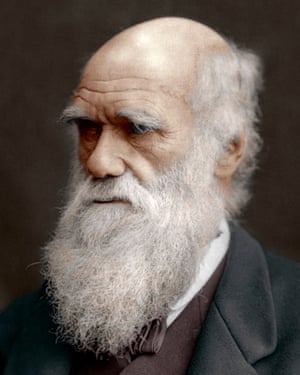
Charles Darwin photographed in 1878. Photograph: Print Collector/Getty Images

Such are the book’s pleasures; but it contains, so to speak, no small number of missing links. The author deplores Darwin’s lifelong failure “to acknowledge intellectual debts and influences” – yet in just one paragraph of one chapter of On the Origin of Species the reader will find a debt to William Buckland and his “long ago” remarks; to “our great palaeontologist”, Richard Owen; to Georges Cuvier and his discovery of fossil links; and to Joachim Barrande, than whom “a higher authority could not be named”. There are accounts of contemporaries very nearly pipping Darwin to the post – Alfred Wallace, who presented a paper with Darwin to the Linnean Society; Edward Blyth, whose work on the transmutation of the species faltered with the failure of his druggist’s shop – but this is evidence less of Darwin’s overweening ambition than of his operating within the zeitgeist of the age.

Some still attack Darwin and evolution. How can science fight back?

Elsewhere, Wilson ponders the influence on Darwin of Malthusian economics, and the theory that since food supply can never match population growth, humanity must be forever locked in a struggle in which only the ruthlessly self-interested can survive. Parallels with the proposition that adaptations within species enable survival are obvious; less obvious, however, is Wilson’s suggestion that Darwin favoured Malthusian thought because it bolstered his sense of “superiority to the working class”, and his entitlement to personal wealth.

One begins to feel that Wilson is motivated by personal dislike, as if he was once cut by Darwin at a party and has since nursed l’esprit d’escalier ever since. That Darwin endured chronic gastric distress is depicted as a failure of mind, not of body; his grief at the early death of his mother is portrayed as “compulsive time-wasting” and “mindless brooding”. Pondering Darwin’s confession that notwithstanding reservations over church doctrine he “liked the thought of being a country clergyman”, Wilson wonders if money was the sole allure, adding waspishly: “Dons love money. They can smell it” – as if the rest of us simply can’t abide the stuff.

It is no mean task for a reviewer untutored beyond a general grasp of evolutionary theory to assess to what extent Wilson’s critique of Darwin is inaccurate: in the New Scientist, it falls to the science historian John van Wyhe to offer a pithy rebuttal, citing for example a confusion on the author’s part between Darwinism and Lamarckism. But even the lay reader – certainly one who has seen, for example, the fossil Archaeopteryx lithographica in the Natural History Museum – will frown at the book’s thesis that an absence of “transitional forms” in the fossil record fatally undermines Darwin. Wilson cites the palaeontologist Stephen Jay Gould, who “quipped that the absence of transitional forms was ‘the trade secret of palaeontology’”– but Gould himself, exasperated at having offered grist to the creationist mill, said: “It is infuriating to be quoted… as admitting that the fossil record includes no transitional forms.”

Wilson states quite baldly that Darwin would respond in the negative to the question posed by an enslaved man on his grandfather Josiah Wedgwood’s abolition medallion, “Am I not a man and brother?”, and surmises that Darwinism informs Nazi ideology. Certainly Darwin betrayed the parochial bigotry of the 19th-century Englishman: he referred to the “immense mongrel population of Negroes and Portuguese”, and viewed Tahitian women with open distaste. (As an aside, this failure on Darwin’s part to enter priapic rapture at the sight of naked women causes Wilson to glance confidingly at the reader and raise the “unanswerable question of Darwin’s sexuality”).

No special pleading that these are views typical of the 19th century can mitigate the disfavour with which they should be met; but the argument does not evolve from here that Darwin supported the slave trade. His opposition to it was adamant and sustained. In 1861 he wrote to the American botanist Asa Gray deploring slavery as “the greatest curse on Earth”. This was no off-hand remark: in 1863 he wrote again to Gray expressing the hope that Lincoln’s “fiat against slavery” would succeed; in 1866 he celebrated the “grand, magnificent fact that slavery is at an end”. Indeed, it might be argued that a belief in the fundamental equality of man is logically essential to Darwin’s assertion that humans descended equally from a common ancestor – an assertion running counter to the scientific racism in circulation in the 19th century, when Arthur de Gobineau’s repellent essay On the Inequality of the Human Races had popular appeal.

This book, with its elisions, inaccuracies, vivid set pieces and palpable dislike for its subject, has I suspect achieved its end: the air is thick with ruffled feathers. Perhaps it will be looked on most fondly by those who find proponents of the new atheism intractable and priggish: they may well take enormous pleasure in watching a scholarly gentleman in a butcher’s apron approaching a sacred cow.


Saturday, November 18, 2017

Literary St. Petersburg A Guide to the City and Its Writers By Elaine Blair (The Little Bookroom) (IBRChildrensbooks)

Literary St. Petersburg

Much of Russian literature is St. Petersburg literature: set in the city, about the city, or written by writers living there. This unique guide profiles fifteen authors whose works and lives were intimately connected to this magnificent setting. Biographical sketches focus on the city as the writers knew it, a sense of their work, the literary and social circles in which they moved, and the sites associated with them.
Travelers can wander through the museum where the teenage Vladimir Nabokov romanced his girlfriend and see the prison where Anna Akhmatova was inspired to write her epic poem about the Great Terror. They can find the statue that comes to life in Pushkin's poem The Bronze Horseman and visit the square where Crime and Punishment's murderer/hero kneels on the ground to ask God's forgiveness. Literary St. Petersburg opens the door to one of the most beautiful cities on earth and a body of literature that is as rich, subtle, and expressive as any in the world.

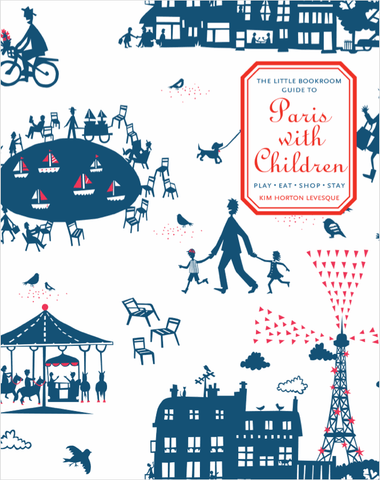
The Little Bookroom Guide to Paris with Children Play • Eat • Shop • Stay By Kim Horton Levesque (The Little Bookroom) (IBRChildrensBooks)

The Little Bookroom Guide to Paris with Children

The Little Bookroom Guide to Paris with Children focuses on what sophisticated parents with good taste want to know: how to see Paris’s most important sights and neighborhoods in a child-friendly way—in this case, through the eyes and experiences of author Kim Levesque and her three research assistants—her 2-, 4- and 6-year-old daughters.
Each neighborhood is organized around places to EAT, PLAY, and SHOP, and STAY and filled with information on:
• Family-friendly restaurants (yes, they exist in Paris, but don’t expect to find high chairs), classic cafes where Parisians take their children, items on Parisian menus that appeal to American children, charming tea salons for your little Madeline, picnic places, and ice cream stands and parlors;
• Parks near major attractions, and how to feel comfortable in the parks, including all you need to know about pony rides, marionette shows, model boat rentals, and playground etiquette;
• Highlights of major museums that appeal to children, and how to navigate your way through them;
• The best places to find—at exclusive shops and chain stores—quintessentially French children’s clothing (espadrilles, striped sailor’s jerseys, and, this being France, perfume for babies!), the best baby gear, stylish maternity wear, and toys, including custom teddy bears, sumptuous dress-up costumes, and more.
The guide also includes information on finding dependable and trustworthy child care; English-speaking playgroups and bilingual day camps; words you may need at pharmacies, whether the problem is a sore throat, blisters, or an upset stomach; seasonal activities; practical advice on apartment rental; and rainy day ideas.
The author also provides fascinating glimpses into the lives of Parisian children: typical school lunches (a cheese course? bien sûr!); the all-important after-school goûter; the classic French layette; formula and baby food (forget applesauce, think ratatouille, , artichokes, potato leek puree); and all sorts of fascinating and useful information that will make your trip en famille easy and, most important, memorable.

Sunday, November 12, 2017

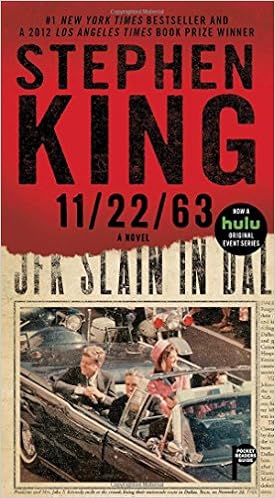
Stephen King's take on JFK's assassination....11/22/63: A Novel Mass Market Paperback 6 by Stephen King (Pocket Books)


"The past is obdurate. It doesn't want to change." The past is also a dangerous, fickle place — and woe to anyone who dares alter it. That's the mantra coursing through "11/22/63."

Stephen King's mammoth, generous and thrilling novel is about a man who travels back in time to prevent the assassination of President John F. Kennedy.

He is Jake Epping, a divorced, 35-year-old high school English teacher from Lisbon, Maine, who discovers a time-travel portal in the pantry of a neighborhood diner. When he walks through it, Jake is transported five decades into the past.

No matter how long he spends there, only two minutes will have elapsed in 2011 when he returns. And each time he makes the trip, time resets, and it's 11:58 a.m. on the morning of Sept. 9, 1958, again.

Surprisingly, "11/22/63" is the first time-travel novel the prolific King has written, and the author has obviously spent much time contemplating the paradoxes inherent in the genre. But King is more interested in history than he is in "Back to the Future" antics, and although he takes occasional liberties with the facts, readers steeped in the details of the assassination -- and the life of Lee Harvey Oswald in particular -- will get a rush out of following Jake, who goes by the alias of George Amberson in the past.

As George, he spies on Oswald and his wife Marina, even moving into the apartment below theirs at 214 W. Neely St., where the famous photo of Oswald holding a rifle was taken.

First, Jake performs a test run to make sure his actions in 1958 will impact the future. The experiment takes him to the evil capital of King's Yoknapatawpha: Derry, a town where a clown has been dismembering children and the vibe is one of prevailing evil.

The first 250 pages of "11/22/63" form a suspenseful, occasionally horrific mini-novel that will delight fans of King's magnum opus "It," capped off by a bittersweet resolution that is a harbinger of what's to come.

Once Jake is convinced he can alter the course of history, he sets out on his mission, which will require him to spend several years in the past (including a brief stint in Florida derailed by a Cuban bookie with mob ties and a fateful stop in New Orleans that has far-reaching consequences). Eventually, he moves to Texas and begins to plan for his pre-emptive murder of Oswald in 1963.

"Possibly later that April, more likely on the night of the tenth -- why wait? -- I would kill the husband of Marina ... If you saw a spider scuttering across the floor toward your baby's crib, you might hesitate. You might even consider trapping it in a bottle and putting it out in the yard so it could go on living its little life. But if you were sure that spider was poisonous? A black widow? In that case, you wouldn't hesitate. Not if you were sane. You'd put your foot on it and crush it."

But Jake can't simply hole up in a hotel room and make a living by placing bets on sporting events to which he knows the outcome. The bulk of "11/22/63" is not comprised of King's answer to the scenario "What if Kennedy had lived?" nor is the book the glorified "Twilight Zone" episode its premise suggests.

"11/22/63" is really King's ode to his youth (he was 16 when JFK died), a book that recreates the era of sock hops, 10-cent root beers, inescapable cigarette smoke and "the heyday of Jayne Mansfield, [when] full breasts are considered attractive rather than embarrassing" with such affection and detail that you are swept along on a huge wave of nostalgia regardless of your age.

The book doesn't neglect the dark underbelly of the period — the segregation, the racism, the repression, the hypocrisy, the chauvinism and the nuclear fears (King's recreation of the Cuban Missile Crisis is particularly vivid). But as Jake grows acclimated to life before cellphones and Google and meets a librarian who becomes the love of his life, "11/22/63" draws you into the lives of ordinary people and their problems with the pull that has always been the secret to King's success.

By the time the eponymous date draws near, and the novel hurtles toward Dealey Plaza and that awful Texas School Book Depository building, you're more worried about the fate of characters you've grown to love than how the world will change if Jake succeeds.

King has referred to "11/22/63" as a departure: His first foray into historical fiction. But this addictive, heart-stopping and ultimately moving novel is really a distillation of what King has always done so well, without the third-act problems that have plagued so many of his recent books and featuring a monster -- time -- that is most certainly not make-believe.

At one point, Jake laments the fact that "We never know which lives we influence, or when, or why. Not until the future eats the present, anyway. We know when it's too late."

Fortunately King, who is now 64, has long been aware of how much his faithful readers love him, and "11/22/63" is, in many ways, a gift from him to us.


Wednesday, November 1, 2017

Toward Nationalism's End: An Intellectual Biography of Hans Kohn (The Tauber Institute Series for the Study of European Jewry) Paperback – July 4, 2017 by Adi Gordon (The Tauber Institute Series for the Study of European Jewry , Brandeis University Press UPNE)


In this elegant biographical portrait of Hans Kohn, a doyen of the academic study of nationalism, Adi Gordon highlights Kohn’s personal intellectual and existential struggle with the distinctively modern concept of nationalism, particularly as it informed Jewry’s self-understanding. Kohn’s life and letters are, thus, in effect, a mirror of Jewry’s struggle with the ethical and political challenge of Zionism and its nationalist agenda and conception of Jewish peoplehood.

This intellectual biography of Hans Kohn (1891–1971) looks at theories of nationalism in the twentieth century as articulated through the life and work of its leading scholar and activist. Hans Kohn was born in late nineteenth-century Prague, but his peripatetic life took him from the Revolutionary-era Russia to interwar-era Palestine under the British Empire to the United States during the Cold War. Bearing witness to dramatic reconfigurations of national and political identities, he spearheaded an intellectual revolution that fundamentally challenged assumptions about the “naturalness” and the immutability of nationalism.

Reconstructing Kohn’s long and fascinating career, Gordon uncovers the multiple political and intellectual trends that intersected with and shaped his theories of nationalism. Throughout his life, Kohn was not simply a theorist but also a participant in multiple and often conflicting movements: Zionism and anti-Zionism, pacifism, liberalism, and military interventionism. His evolving theories thus drew from and reflected fierce debates about the nature of internationalism, imperialism, liberalism, collective security, and especially the Jewish Question.

Kohn’s scholarship was not an abstraction but a product of his lived experience as a Habsburg Jew, an erstwhile cultural Zionist, and an American Cold Warrior. As a product of the times, his concepts of nationalism reflected the changing world around him and evolved radically over his lifetime. His intellectual biography thus offers a panorama of the dynamic intellectual cornerstones of the twentieth century.

The Jewish Wedding Now Paperback – June 6, 2017 by Anita Diamant ( Scribner)


Newly revised and updated, the definitive guide to planning a Jewish wedding, written by bestselling novelist Anita Diamant—author of The Red Tent and The Boston Girl—and one of the most respected writers of guides to contemporary Jewish life.

This complete, easy-to-use guide explains everything you need to know to plan your own Jewish wedding in today’s ever-changing world where the very definition of what constitutes a Jewish wedding is up for discussion.

With enthusiasm and flair, Anita Diamant provides choices for every stage of a wedding—including celebrations before and after the ceremony itself—providing both traditional and contemporary options. She explains the Jewish tradition of love and marriage with references drawn from Biblical, Talmudic, and mystical texts and stories. She guides you step by step through planning the ceremony and the party that follows—from finding a rabbi and wording the invitation to organizing a processional and hiring a caterer. Samples of wedding invitations and ketubot (marriage contracts) are provided for inspiration and guidance, as well as poems that can be incorporated into the wedding ceremony or party and a variety of translations of traditional texts.

“There is no such thing as a generic Jewish wedding,” writes Anita Diamant, “no matter what the rabbi tells you, no matter what the caterer tells you, no matter what your mother tells you.” Complete, authoritative, and indispensable, The Jewish Wedding Now provides personalized options—some new, some old—to create a wedding that combines spiritual meaning and joyous celebration and reflects your individual values and beliefs.

Sunday, October 29, 2017

Reconstructing Karl Polanyi: Excavation and Critique. Gareth Dale. Pluto Press. 2016

.
Gareth Dale’s latest book on the social theory of Karl Polanyi is a magisterial culmination of the author’s extensive decade-long research on the life and thought of ‘one of the most influential political economists of the twentieth-century’. As Dale highlights in an interview on the distinctive contributions of the three main book-length studies that have emerged from the project: ‘the emphasis of the biography is on [Polanyi’s] life and times, that of Karl Polanyi: The Limits of the Market is on exegesis and analysis, while that of Reconstructing Karl Polanyi is on critique’. Moreover, there is the edited collection Karl Polanyi: The Hungarian Writings, which brings together in one volume 56 texts made available in English for the first time. While each is praiseworthy in its own right, approaching them holistically guarantees an exceptionally rewarding intellectual expedition whose aim is to ‘reconstruct’ Polanyi, to ‘re-present’ his ideas ‘with attention to their historical and discursive context and drawing on a much broader range of sources’ than what the previous critical literature has had at its disposal (10).
The critical aims of Reconstructing Karl Polanyi are pursued in nine chapters. First, the author attempts to position Polanyi in respect to the various intellectual traditions of the ‘satanic science of sociology’ (18), then he examines his work in relation to different variants of Marxist thought and analysis. In fact, as Dale proposes at the very beginning, the ‘book covers a range of topics but its central thread concerns Polanyi’s relationship with socialist politics and ideas’ (8). Some concrete questions in this respect – such as Polanyi’s views on the connections between capitalism and democracy (or economics and politics), his assessment of the Soviet model of ‘actually existing socialism’ and strategies of coping with McCarthyism during a historical period in which Polanyi himself may have been ‘nudged “a little to the right”’ (160) – are posed in Chapters Three, Four and Seven respectively. Chapter Five looks closely at Polanyi’s masterwork, The Great Transformation (‘a deeply personal book’ that ‘no one but Polanyi could have written’ [99]), while Chapter Six casts a Polanyian eye on questions of regional integration and internationalism. The final two chapters focus on Polanyi’s later work on ‘ancient economic history’, specifically the function of markets in Mesopotamia and ancient Greece.
What connects the chapters to the teleological motif of theoretical ‘reconstruction’ is the recognition that, with respect to the topics discussed, Polanyi has ‘been subject to divergent interpretations’ (10). This has been as much due to carelessness on the part of his interpreters as to his own tendency towards conceptual inconsistency, semantic slippage and contradiction. His politics can be assessed either as social-democratic in a ‘soft’ interpretation (4) or as ‘red-blooded socialist’ in a ‘hard’ reading (5); his critique is aimed, according to some, at ‘capitalism’, while for others it merely targets ‘laissez-faire liberalism’ (123).
Image Credit: University library of Eötvös Loránd University, Budapest, Hungary, of which Karl Polanyi was an alumnus (Thaler CC BY SA 3.0)
To a great degree, Polanyi’s idiosyncrasies originate in his early intellectual development in the Austro-Hungarian melting-pot of peoples and ideas, as Dale’s broader project aims to stress. In Dale’s reading, while this may render Polanyi susceptible to misinterpretation, it is also the source of his originality: many aspects of his arguments ‘were being developed more or less simultaneously by others, but when filtered through his Christian-socialist outlook, and his idiosyncratic blend of socialist and Austrian conceptions of protectionism, the result was uniquely his own’ (122).
The sources of some contradictions, alternately, can be traced back to procedural or personal characteristics. As Dale’s ‘reconstruction’ evidences, for instance, common misunderstandings of the concept of ‘protectionism’ deployed in The Great Transformation emanate not only from Polanyi’s polysemic use of the term, but also from inconsistent revisions made to the original manuscript, which resulted in rolling ‘two distinct meanings of protection […] into one’ (119).
On the other hand, the formative influence that the ‘Austrian school’ had on Polanyi seems to have persisted throughout his lifetime, engrained in personal dispositions. This is hinted at by Dale when he assesses Polanyi’s other significant late-career body of work on trade and markets in pre-modern societies. The latter’s contribution to the understanding ‘of forms of pre-modern economic integration’ has ‘revolutionised the primitivism-modernism controversy’ (200), although it did not settle the debate between ‘primitivists’ and ‘modernists’ or ‘substantivists’ and ‘formalists’ (somewhat simplistically, between those proposing that the rationality assumptions and formal methodologies of modern microeconomics can be applied to the economic activities of past or ‘primitive’ peoples, and those challenging this idea). According to Dale, one of the reasons why the subsequent, supposedly synthesising New Institutionalist Economic History approach spearheaded by Douglass North – whose real achievements are vigorously questioned by Dale in the closing chapter – could emerge as victorious over the ‘sterility’ of these previous debates, was Polanyi’s ‘unwillingness (or inability) to critique [the formalists’] claims to have provided a valid method for understanding market societies’ (201, emphasis added). These shortcomings notwithstanding, ‘however, his substantivist “challenge” remains’ (201).
Overall, Dale’s complementary aims of conceptual archaeology and reconstructive critique are well balanced throughout the book. The one chapter where these aims, and Polanyi’s own work, are significantly transcended is the one on regionalism and the European Union. Here Dale takes on a topic of particular concern to him, but one in which ‘Polanyi expressed scant interest’ (128). The discussion therefore centres on assessing contemporary Polanyi-inspired research on the nature of the EU; and it is here that Dale’s voice comes through in its most critical tone: ‘any lingering illusions in the social-democratic configuration of the European project were pitilessly dispelled in the first decades of the present century’ (137). ‘If any “Polanyian content” is to be found’ in the political promise of the European project, ‘it will be in public debates over, and protests against, EU market integration’ (135). Yet, in light of the already mentioned idiosyncratic tendencies in Polanyi’s theory, one cannot but wonder whether, in contrast to currently dominant critiques from the left, a ‘Polanyian’ stance would not be more accommodating – albeit in ‘unique’ ways – of the ‘Hayekian setting’ of the EU.
In conclusion, the book lives up to its promise of reconstructing some of Polanyi’s elusive concepts, and does so in Dale’s always engaging style. However, Reconstructing Karl Polanyidoes feel occasionally dense: for readers seeking an easy point of entry into Polanyi’s writings, Dale’s previous works are probably a better starting point. As to its broader message, in the current political-economic conjuncture Polanyi is more alive than ever, but also better shielded from his own rekindled popularity. Following Dale’s feat, few acceptable justifications remain for Polanyi’s misinterpretation and misappropriation.