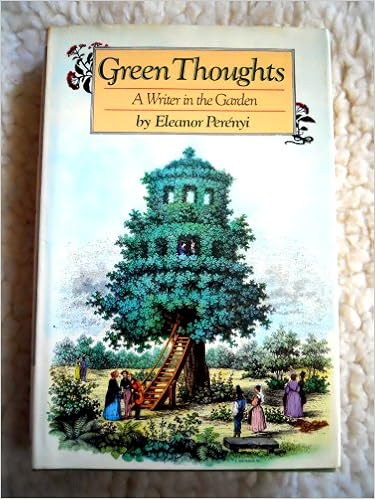
This books is about more than Gardens: Readers of "Green Thoughts: A Writer in the Garden" get a three-fer reward: a romp through fields of reading, eating, and planting. There are 72 essays in this 1981 book, some as short as one line (Mazes) and most considerably longer including almost a novella on herbs and 12 pages on Women's Place. Each essay has thoughts related to plants & gardens but can veer into quotes from the world's literature which author Eleanor Perenyi assumes her readers know, care about, and which she at times puts straight.
See for example her five page essay on Pruning (p.190) which begins:
"Never before or afterward did a gardening style evoke so much attention, generate so much literary heat, as one that overthrew the formal garden with its geometrically determined space and sculptured evergreens and replaced it with an imitation of wild nature....The leaders were Pope, Addison, Horace Walpole, and their friends among the Whig aristocracy..."
And she must have enjoyed cooking & eating, since perhaps a third of these green thoughts include recipes. Archival pictures (not included in this unillustrated edition) show a movie-star slender & elegant blonde. Her later years find her elegant in a more Julia Child way. P 181, e.g., has a fine recipe for potato salad and one for herbed fingerlings she grew herself that seem worth an addition to the waistline. The fingerlings were smuggled in but have since, Perenyi notes in a relieved way, been found in legal nurseries.
This book is likely to be read years from now:
--Perenyi had directed the proceedings at gardens larger (her husband's vast estates in Hungary) and smaller (her acres in Connecticut). She writes as knowledgable amateur as do, among others, Vita Sackville-West & Henry Mitchell. Essays begin with artichokes, asparagus and ashes, go on to a long list of culinary herbs such as borage, lavender, and tarragon, continue through toads, tomatoes and tree-houses and conclude with women & agriculture through the ages. The essays are arranged alphabetically, a refreshing change from the gardener's year organization.
--What she has to say may be superseded over the years with new cultivars and new techniques but is likely to stand oak firm on topics such as mulch, mauve, and pesticides. However, this is not a comprehensive, how-to book or an in-depth source on matters such as roses or ranunculus. There are other books for that.
--Perenyi was the editor of magazines such as Mademoiselle and Harper's Bazaar, a regular contributor to The Atlantic Monthly, the author of a prize-winning biography of Frans Liszt, and of a memoir of her life with her husband in Europe. She was a writer first and foremost, and her skills shine in "Green Thoughts," in which there seems to be nary a clunky sentence.
--Nor a dull sentence. Perenyi held strong opinions on every topic about which she wrote here. She disdained, for example, seed tapes and people who used them; her admiration for dahlias was almost unbounded; and she gave a go-out-and-win-the-game talk on failures. Her observations were ahead of her time in matters such as organic gardening, her advice makes sense, and her authoritative voice seems like instructions to Adam & Eve.
Here she is on Makielski Berry Farm, then located in Ypsilanti:
"This lttle company has a list, not a catalog, and wouldn't be worth mentioning except that they carry the only decent gooseberry I have been able to discover in America. The name is Poorman and while not comparable to the English fruit, it is far better than the dreary and ubiquitous Pixwell." (p 275)
--The book includes a ten page small print index that looks professionally done, a section on where to order plants and seeds that while it may be out of date, still makes for more good reading, and introductory material by series editor Michael Pollan and garden writer Allen Lacy. Perenyi is among the few writers who can make these popular authors seem serviceable rather than scintillating.
This book helped inspire a new generation of gardeners. However, its pleasures may be best enjoyed in small portions. Strong views can seem fresh. A lot of them at once can feel ill-tempered.
At used book prices, as low as a penny, "A Green Thought" can be bought in quantities for the reader's own pleasure and for sowing with a generous hand among friends. A new copy is still a fine value & a sumptuous treat, perhaps given with a quality dibble & a package of Johnny's seeds.

As the United Kingdom enters uncharted waters after the referendum vote to leave the European Union, many commentators are realising that the disconnection between elite politics and the general electorate is more important than had been assumed. Although not the main driver behind the vote to leave the EU, nevertheless disquiet over the seeming ability of the rich and well-connected to avoid the levels of tax levied on the general population (often by perfectly legal means) has led to greater attention being given to tax affairs. This has prompted increasing interest in the work of the Tax Justice Network, allowed critic Richard Murphy to become a social media sensation as his book, The Joy of Tax, became a surprise bestseller and has prompted a number of recent academic and popular books on tax havens, offshore finance and tax politics (including Richard Brooks’s The Great Tax Robbery and Nicholas Shaxson’s Treasure Islands). Now Taxing the Rich: A History of Fiscal Fairness in the United States and Europe seeks to expand our historical appreciation of the political economy of taxation, and specifically of taxing the wealthiest in society.
Starting with a general overview of how taxes on the rich are justified, Kenneth Scheve and David Stasavage contend that while it easy to discern three common principles – fairness, equity and compensation – it is the third of these, compensation, which tends to offer the most robust way of constructing a legitimate politics of progressive income taxation. While at times arguments around fairness (the ability to pay) or equality of payment for a range of social benefits have been popular with certain groups, compensation has underpinned the most extensive expansions of taxation over the rich in both European and American societies. Conversely, there also seems some truth to claims that the rich are taxed more lightly when they are able to capture the democratic process through the influence their wealth ‘buys’ them over legislators and governments.
Overall, then, the authors argue that both popular and analytical discussions of tax tend to focus on issues of fairness and inequality (partially rectifying social positional inequality), with compensatory arguments ebbing and flowing over the course of the twentieth century in Western democracies. The rest of Taxing the Rich is intended to test this proposition against the historical record.
 Image Credit: (Images Money (TaxRebate.org.uk) CC 2.0)
The first step that the authors take is to examine the marginal rates of tax for the wealthiest in society across two centuries, offering comparisons both between countries and across time within countries. The former analysis, they argue, deals a fatal blow to the notion that there is a close link between democratisation and taxation; the latter comparison of the domestic history of taxation leads to the conclusion that states that conducted mass mobilisation for both World Wars displayed a clear tendency towards taxing the rich more highly both during and, importantly, in the aftermath of the conflicts.
This result is then compared to the history of inheritance tax: a frequent mechanism intended to bring down wealth inequality. Again, the authors conclude that the political context (debates about fairness and inequality) play much less of a role in determining which states have high taxes on inheritance than the mobilisation for the two World Wars. Finally, the historical element of the book examines other forms of taxation. Once more, Scheve and Stasavage conclude that these have little impact on their overall finding that it is the necessity of financing total war that increases tax on the most wealthy. Having noted this clear correlation across a range of taxation methods, they ask why might this be the case?
Their central argument is that the need to prosecute a war with a mass conscripted army and large-scale technological investment in arms and equipment shifted the debates about tax decisively from arguments focusing on equal treatment and ability to pay to a much stronger emphasis on a compensatory logic. Tracking debates across the UK, France, Canada and the US, the authors identify a clear political realignment focusing on war profits and sacrifices in the field, which prompted a norm of social compensation for the inequality of the sacrifice.
However, as the idea of, and need for, mass mobilisation has faded – driven, they argue, by what others might call the recent ‘revolution in military affairs’ – so too has the mid-century logic of compensating the masses who are fighting while the rich profit from conflict. Thus, as memories of the World Wars and conscription rescind, and the Right continues to frame personal taxation on the basis of equality and (sometimes) ability to pay, the Left (crudely put) has found that the compensatory argument has become more difficult to mobilise. Taxing the Rich concludes with an interesting discussion of the prospects for taxing the rich, arguing that only a major crisis or a widely accepted argument that state policy itself is causing inequality can support an expansion of the tax take from the wealthiest.
One of the most intriguing aspects of Taxing the Rich is the realisation that arguments about taxation, its form and who pays the most go back at least a thousand years; like so many political arguments, our disagreements are not as novel as we might assume. However, equally the book, while not explicitly making this point, would support the belief that the expansion of popular interest in tax, tax avoidance and the modes the rich use to evade taxes is driven by the growing contemporary crisis of the neo-liberalised global economy and its impact on domestic polities. I have no hesitation in recommending this book to anyone interested in tax affairs as it is accessible and clearly argued, providing a set of analyses that illuminate the current debates about how we can (fairly) tax the rich.
 Rebel Law: Insurgents, Courts and Justice in Modern Conflict is a fascinating exploration of the role of courts and law in insurgencies and civil wars. The author, Frank Ledwidge, is a barrister and former intelligence officer in the British military who has had a varied career as an advisor in justice-related development projects, including in the British-occupied Helmand province of Afghanistan. The first half of the book examines how a variety of insurgent movements have used courts and law, while the second focuses on the role of law in counterinsurgency strategies, including a critique of British operations in Helmand.
From the perspective of my discipline of Islamic legal studies, the first half of the book is of particular interest. Ledwidge recasts the sharīʿa-based justice systems created in recent conflict zones in Afghanistan, Somalia, Syria and Iraq – usually portrayed as reversions to barbaric punishments driven ideologically by militants – as a phenomenon comparable to other insurgencies in non-Muslim countries. Observers of Afghanistan have noted previously that the Taliban built a reputation for providing justice in the context of the rampant warlordism of the 1990s: that their appeal was founded on fairness as much as the specifically Islamic character of their legal regime. But Ledwidge explores this idea at length, and illustrates it by juxtaposing Afghanistan and other Islamic examples against an event central to modern British history: the Irish War of Independence, when Sinn Fein and the IRA set up a network of courts in Ireland as part of their boycott of the British state. Their strategy was, of course, violent: litigants and witnesses were intimidated into not cooperating with the British justice system. But, at the same time, Sinn Fein’s courts were widely seen as fair and efficient. Brute force was not sufficient to mount a successful insurgency in Ireland: the republicans also had to offer the Irish people an alternative model of governance that they would accept.
Having presented the Irish case as the paradigm of an insurgent judicial strategy, Ledwidge then explores a series of insurgencies in the Muslim world in which law and courts have played a significant role. Beginning with the Taliban in Afghanistan, he moves on to the Union of Islamic Courts in Somalia, competing courts run by mainstream opposition forces and by the jihadist Jabhat al-Nusra group in rebel-held Aleppo and, finally, the judicial activities of ISIS in Syria and Iraq.
 Image Credit: Nawa District Justice Centre, Helmand, Afghanistan, 2011 (ResoluteSupportMedia CC BY 2.0)
These various court systems represent a range of models of justice. The Taliban, Jabhat al-Nusra and ISIS all claimed to ‘restore sharīʿa’ – by which they meant implementing a hardline interpretation of sharīʿa complete with harsh corporal punishment and attention to moral infractions. Somalia’s Islamic Courts were not driven by such an ideological Islamist agenda: they still relied partly on sharīʿa, Somalia’s major legal tradition, but were more eclectic in their interpretation of it and also used customary law. Meanwhile, the courts affiliated with Aleppo’s mainstream rebels ran the kind of civil law system that is typical of most Arab countries today, using a code of largely European extraction along with elements taken from the sharīʿa tradition.
But even in the most ideological of these insurgencies, the sharīʿa element was incidental to the courts’ appeal and success. What mattered was their efficiency and fairness, in the sense of procedural regularity and refusal to accept bribes. What made these courts effective tools of insurgency was that they brought order and stability where previously there had been chaos, and that their procedural standards compared favourably with the alternatives. The courts were a key component of the insurgents’ pitch to local populations. Not only did they focus on preventing the kind of crimes that plague communities after the breakdown of the state – kidnapping, robbery, extortion and so on – they also sought to prevent corruption among their own judges.
The second half of the book provides a critique of the ‘rule of law’ model of nation-building that the US and its allies have pursued in Afghanistan since the 2001 invasion. Ledwidge begins this section by discussing how older empires attempted to stabilise remote and volatile regions, exploring the strategies pursued by the Ottoman and British empires in Albania, Yemen, India’s North West Frontier Province and southern Sudan in the late nineteenth and twentieth centuries. Ledwidge claims that both Ottoman and British imperial elites recognised that engagement with local institutions and practices was crucial to success. He believes that US and British forces today have forgotten this lesson, insisting instead on the centralised state as the solution in unstable countries, even though such states often have little legitimacy and few ways to build it.
Ledwidge’s treatment of the British empire sometimes seems uncomfortably nostalgic: on page 125 he quotes, apparently approvingly, Charles Napier bemoaning that ‘so perverse is mankind that every nation prefers to be misgoverned by its own people than to be well ruled by another’. Ledwidge argues, based on military manuals, that British counterinsurgency doctrine in the mid-twentieth century emphasised the use of the minimum necessary force in order not to alienate the population. But he doesn’t do much to explore whether the British response to insurgencies lived up to the theory: the example of the Mau Mau rebellion in Kenya suggests not.
Ledwidge’s criticism of the British intervention in Helmand is much sharper. He reflects candidly on his own experience: at the time of his posting in 2007, Ledwidge writes that he ‘had never been to Afghanistan, spoke none of the languages and had but the haziest idea of how justice was provided in the country’ (140). His background was typical of those involved in ‘rule of law’ development projects, and Ledwidge argues that the resulting lack of local knowledge is one of the key reasons why most have failed. In the place of deep engagement with local networks and cultural traditions, British and US forces adopted a ‘cookie-cutter’ approach, transposing institutions and practices based on western models. Ledwidge argues that such projects are doomed to failure because they rely on an authority and credibility that the Afghan state lacks.
Ledwidge describes the judicial terrain in Helmand during 2006-14 as a situation of legal pluralism, with five options for resolving disputes: the formal judicial system; government officials acting informally; tribal elders; religious mullahs; and the Taliban. Litigants responded by forum-shopping, although their choices were often constrained by fear of violence. Within this range of options, the formal judicial system was not only ineffective and corrupt, but litigants often came under considerable pressure not to use it. In such circumstances, investment in the formal judicial system typically resulted in white elephants, such as the expensive but empty Justice Center built by the US in Khost, which Ledwidge claims failed to attract any litigants.
Ledwidge readily concedes that the alternatives to state-centric solutions – engaging with local and traditional practices of justice – also raise problems, in particular the lack of respect for gender equality and human rights norms among many local figures of authority. He doesn’t offer a solution to this dilemma. In places, he seems to be leading towards the suggestion that concerns about gender and human rights must be jettisoned if such projects are to succeed; but he backs away from this stark conclusion, citing an example when the mission successfully secured the installation of women members on a local judicial council. His ultimate conclusion is more modest: that just as development officials should be candid about the human rights failings of traditional practices, so they should be honest about the Afghan state’s lack of capacity and legitimacy.
Rebel Law is an intriguing and engaging book that covers a lot of ground. Ledwidge’s criticisms of the nation-building project in Afghanistan are broadly familiar, but they are presented with fresh details and anecdotes from his personal experience there. Meanwhile, Ledwidge’s approach to insurgent justice in the Muslim world is compelling: he brings a much-needed comparative perspective that serves as an antidote to the tendency to read such phenomena only through the lens of extremist ideology.
How Languages and Genes Evolve Together
Researchers have found that geography makes us who we are—genetically and linguistically.

As human populations disperse, the separation leads to changes both in genes and in language. So if we look at human DNA and languages over time, we should find that they differ along similar geographic lines.
It’s an intuitive theory, but difficult to prove. That is, until researchers decided to match large collections of geographic, linguistic, and genetic data on hundreds of human populations worldwide.
A new study, published in Proceedings of the National Academy of Sciences, quantifies the complicated relationship between these three factors. Researchers compared the geographic presence of two things in human populations across the world: alleles (trait-defining stretches of DNA) and phonemes (the distinct units of sound that make up spoken language).
This map shows a broad picture of the geographic spread of alleles and phonemes, according to the study’s findings. The arrows show that, in most parts of the world, languages and genes occupy the same areas and even appear to have traveled along similar trajectories. The data show where genetic and linguistic variation happen. (Creanza et al)
The scale of the research is impressive. “Our study directly compares the signatures of human demographic history in microsatellite polymorphisms from 246 worldwide populations and complete sets of phonemes for 2,082 languages,” the researchers write in their report. (Microsatellite polymorphisms are short DNA sequences that vary from person to person.)
These data have been available for some time, but never examined in the same place. “The thing we’ve done that no one else has is match worldwide genetic populations to their languages, so that you’re looking at a comparable set,” said Nicole Creanza of Stanford University, one of the report’s authors.
Using this new dataset and novel statistical techniques, the researchers were able to scratch an itch linguists and demographers have struggled to reach, showing that language and genes do in fact share similar geographic fault lines.
Here’s a more specific picture of what the results show. In the chart below, languages that are geographically near to each other are grouped into a tree structure. A gray circle marks the presence of a phoneme—/ʈ/, the voiceless retroflex stop—in that language. Only one language, Assamese, fully breaks from the trend in its geographic group.Creanza et al
This geographic relationship is no doubt compelling. But, as with any novel dataset, the analysis yielded several other thought-provoking results.
For example, according to the data, languages that are geographically close tend to share properties even if they are not linguistically related. “When two languages were geographically near, they tended to share more phonemes even if they were not closely related, suggesting a relationship between phonemes and geography both within and between language families,” the researchers wrote.
Another finding is related to isolation: When small populations separate from the gene pool, genetic diversity falls. In language, the opposite is true. The study shows that isolation leads to more diversity in phonemes. So while both are related to geography, biological and linguistic evolution operate at two very different speeds, with language being the much faster of the two.
 It is often asked around Washington, what will the Republican Party become once it stops being the plaything of Donald Trump? This day seems to be arriving more quickly than we might have thought not long ago, especially after President Trump’s wretched response to the Charlottesville rally, which at long last led some Republicans to begin to wonder about his moral fitness to be president.
This followed less shocking but nevertheless striking reversals for Trump, notably the Senate Republicans’ failure to repeal Obamacare. As a result, the president’s approval rating among Republicans has slipped in some polls below 80 percent. That’s not quite the danger zone yet, but it’s low for an incumbent president. It’s the number to watch for the simple reason that it’s the only one congressional Republicans care about. Republicans in Congress have carved their districts in such a way that they needn’t worry much about Democratic or even independent voters. In fact, many of them live in greater fear of losing a primary to a pro-Trump challenger from their right, should they waver in their support for his policies, than they do about losing a general election. But if Trump’s approval rating among Republicans falls considerably—to the point that Republican House members feel they have to worry more about losing a general-election race to an anti-Trump Democrat than losing a primary contest to a Trump loyalist—they’ll start deserting him.
Some event could propel the desertion forward. Charlottesville alone won’t quite do it, especially after Trump fired chief strategist Steve Bannon, which to some degree controlled the damage among establishment Republicans. But many potential flash points remain. A large number of Republican senators have cautioned, for example, that for Trump to order the firing of special prosecutor Robert Mueller would “certainly be an extraordinarily unwise move,” as Maine’s Susan Collins put it in June.1 On August 3, two bills—with bipartisan support—were introduced in the Senate, one to allow Mueller to challenge his firing in court and one to demand that Justice Department officials involved in any such firing be forced to testify. So the ground has been shifting rather dramatically.
The president, of course, remains obdurate and dangerously unpredictable. There are numerous eventualities about which the chatterers of Washington chat. Needless to say, in the reality that Trump has created, none is too outlandish to be taken seriously. I mentioned recently to a journalist friend that I could foresee the House impeaching the president and the Senate voting to convict, but Trump simply refusing to leave the White House. He countered with a hypothetical in which Trump does accept his removal from office but turns around and runs in the Republican primary against President Pence in 2020—and wins.
Other Republicans, naturally, are preparing for Trump’s demise. Imagine the following scenario: in 2018, the Democrats recapture the House. (That’s far from an impossibility; they’d need to pick up twenty-four seats to gain control, and the average loss for a president in the midterm election of his first term since Jimmy Carter’s time is twenty-eight.) Mueller, who somehow was not fired, issues a report that offers proof that the Trump campaign did coordinate certain matters with the Kremlin and beyond that paints an undeniably lurid picture of the president’s financial indebtedness to certain Russians. (It is believed that Mueller has, or will have, Trump’s tax returns.)
In other words, the evidence of collusion with Russia is enough to compel a third or more of Senate Republicans to agree to the grim duty of removing him from office. Mike Pence, according to this sequence of events, would become president in, say, the fall of 2019. As the incumbent, he would surely seek the Republican nomination in 2020. But he may have been too damaged by his association with Trump—dozens or hundreds of beaming affirmations by Pence of Trump’s greatness and integrity, all on video—that he won’t have time to get the stink off him. He will face challengers. For an incumbent president to be denied renomination by his party is unusual in our history; it’s happened just five times. But as we’ve seen, almost everything about the current moment is unusual.
Most of the best-known Republicans in Congress are either getting too old or are too compromised by their accommodations to Trump to be candidates. John McCain is about to turn eighty-one and has, we now know, a severe form of cancer. His dramatic vote against the Republican “skinny repeal” health care bill, just before the August recess, was no doubt cast with his legacy in mind. Mitch McConnell, the majority leader of the Senate, has now broken with Trump; in any case, he also is too old, and too much a creature of the Senate, to be a presidential contender. Lindsey Graham, at sixty-two, is younger than the other two, and he’s a Trump critic more often than not. But he has been around Washington a long time as well. A generational shift is underway.
And so, if you listen closely, you can hear the sound of some younger Republicans in the Senate positioning themselves to be the hero who rides in and picks up the pieces. The Republican most critical of Trump has probably been Arizona’s junior senator, Jeff Flake, fifty-four, who called on Trump to quit the race last fall after the notorious Access Hollywood tape emerged and who this year spoke disapprovingly of Trump’s firing of former FBI director James Comey. Recently, Politico reported that Trump has said privately that he would commit $10 million of his own money to a credible Republican willing to mount a primary challenge to Flake next year.2
That challenger appears to be an ardently pro-Trump former state senator named Kelli Ward. After Charlottesville, Flake tweeted: “We can’t claim to be the party of Lincoln if we equivocate in condemning white supremacy.” Ward tweeted: “I agree—stop the hate, violence, & rhetoric on both sides.” A Trump kind of gal. Flake isn’t generally put on insiders’ lists of potential presidential candidates, although he seems to be trying to change that. He just released a book of his own, which he had the chutzpah to call Conscience of a Conservative, echoing the famous Barry Goldwater title. In it, he reproves his party for creating Trump and urges his colleagues to stand up to the man. If Flake survives his reelection bid, we’ll surely see him trying to look presidential.
In the group that is already short-listed for 2020, which will likely include Senators Ted Cruz and Marco Rubio and House Speaker Paul Ryan, the figure who has engaged in the most insistent anti-Trump positioning—and may be the least tainted by Washington politics—is former university president and first-term Nebraska senator Ben Sasse. He refused early on to endorse Trump and wrote a long, solemn open letter to Trump supporters on his Facebook page last year explaining his opposition. “Do you believe,” he asked the then candidate’s backers, “the beating heart of Mr. Trump’s candidacy has been a defense of the Constitution?” Some Republicans, in an effort to thwart Trump, pressed him to jump into the race last year, but he demurred.
Back in January, he was the first Republican senator to criticize the new administration’s travel ban. He also does something no other Republican senator has been clever enough to do—he fights the president on his preferred terrain, Twitter. When Trump sent out a now infamous tweet in June describing MSNBC morning co-host Mika Brzezinski as “bleeding badly from a face-lift,” Sasse was quick to tweet back: “Please just stop. This isn’t normal and it’s beneath the dignity of your office.”
Journalists read Twitter avidly, and such are the standards in Washington these days that a tweet like that from a Republican counts as courage. And so Sasse gets press coverage, typified by this Time headline from May: “How Senator Ben Sasse Became the Anti-Trump.” Even the liberal magazine Mother Jones has sung from this hymnal, with a profile last fall under the headline “If the Republican Party Can Be Saved From Its Trumpocalypse, This Senator Could Be the Key.” That’s a quick ascent for someone who’s been a senator for just two and a half years. What’s he got?
It turns out that Sasse is the kind of Republican whom Washington prognosticators delight in. He’s from the heartland, but he has a hefty educational pedigree—Harvard undergrad and Yale doctorate in American history. He even spent a year at Oxford, and he earned a master’s degree from St. John’s College in Annapolis, Maryland, which may not be Harvard or Yale but is known for a blue-chip curriculum in the Great Books. He has spent time among liberals in their natural environment.
He has also worked as a bureaucrat, and not in the manly Pentagon but as an assistant secretary in the Department of Health and Human Services in George W. Bush’s administration. And he became a university president, at Midland University, about a hundred miles from where he grew up in Plainview, Nebraska. He is forty-five years old. He is by all accounts personable. He is handsome, but in a certain undemanding way, like the leading man’s best buddy in a 1930s screwball comedy.
He is also extremely right-wing. His Yale dissertation was about the backlash to the Supreme Court’s school prayer decisions of the early 1960s, which banned prayer in public school classrooms. The conservative Weekly Standard described it as “a sophisticated and brilliant dissection of how a lot of the standard liberal narratives about American political realignment in the last fifty years are woefully incomplete at best and self-serving fictions to attack religious conservatives at worst.”3 Sasse’s time in Health and Human Services helped him understand Obamacare in ways that his colleagues couldn’t, and this enabled him to play a particularly active part in seeking its dismemberment. During the 2014 race I e-mailed a prominent Tea Party activist to ask, roughly, which Senate races that year were most important to him; who would he most like to see as a senator? Sasse topped his list.
As his work on school prayer suggests, Sasse is a religious conservative. He opposes same-sex marriage, and his campaign website said in 2014 that government “cannot force citizens to violate their religious beliefs under any circumstances.” He’s a free trader. He was one of the first senators to suggest this summer, when it became clear that repealing and replacing Obamacare wasn’t going to be so easy, that the Republicans should proceed with repeal only. His one recent departure from party orthodoxy came when he questioned the large tax cuts for the rich built into the Senate health care bill, but he’s not against lower taxes—they’re just not as high a priority for him as social issues and cutting federal spending.
For all his criticism of Trump, Sasse has rarely voted against the president. The website FiveThirtyEight gives him a “Trump score” of 93.6 percent, which is 3.6 percent more than they might have predicted based on Trump’s victory margin in Nebraska (25 percent). Of fifty-one votes tracked by FiveThirtyEight through August 1, Sasse opposed Trump’s position just three times, twice on sanctions on Russia and other nations, and once on the nomination of Trump’s US trade representative, Robert Lighthizer, who was confirmed overwhelmingly and didn’t need Sasse’s vote. Sasse is a particularly ardent admirer of Education Secretary Betsy DeVos, who was occasionally confused and clearly out of her depth at her confirmation hearing.
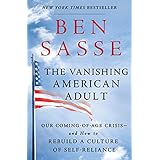
Sasse’s book is a sure sign that he is contemplating the presidency, but this is not a normal senator’s book. For starters, he is not pictured on the cover, staring meaningfully off into a better future that he alone has the fortitude to create. Second, it’s not a policy book; it’s not built around chapters on jobs and taxes and values, and it doesn’t even mention Trump. It’s a meditation on where America took a wrong turn. While this is a common-enough politicians’ subgenre, the twist here is that the social unit that Sasse calls upon to repair this torn fabric is not the government but the family.
Thus he hits a smart exacta. A thoughtful rumination that includes mentions of philosophers, theologians, and political scientists, from Rousseau and Martin Luther to Richard Hofstadter and Allan Bloom, appeals to the Washington swells; the lamentation about our dissipating resolve as a people, and his argument about the wellspring of our redemption, will warm the hearts of conservatives.
In The Vanishing American Adult, Sasse portrays a nation that has hurtled itself in a grave direction. He worries that our texting, sexting, video-game obsessed children will not be able to uphold and advance American greatness when they come of age, and he places the blame on parents:
I believe our entire nation is in the midst of a collective coming-of-age crisis without parallel in our history. We are living in an America of perpetual adolescence. Our kids simply don’t know what an adult is anymore—or how to become one. Many don’t see a reason even to try. Perhaps more problematic, the older generations have forgotten that we need to plan to teach them. It’s our fault more than it is theirs.
He goes on to explain that he was met with this epiphany during his tenure at Midland University, when a group of students was asked to set up a twenty-foot Christmas tree in the basketball arena. They put the tree up, but they decorated only the bottom seven or eight feet. A school official appeared and asked them why they hadn’t secured a ladder to dress the rest of the tree. They replied that this thought hadn’t occurred to them:
This startled me. It worried me for the kids. Was this a problem unique to Midland’s culture?… I simply couldn’t reconcile the decision to leave while the work was still incomplete with how my parents had taught me to think about assignments. I couldn’t conceptualize growing up without the compulsion—first external compulsion, but over time, the more important internal and self-directed kind of compulsion—to attempt and to finish hard things, even when I didn’t want to.Chip Somodevilla/Getty Images
Senators Jeff Flake and Ben Sasse during the Senate Judiciary Committee’s vote on the nomination of Neil Gorsuch to the Supreme Court, April 2017
One agrees that it is kind of hard to imagine why students would settle for decorating one third of a Christmas tree. One is not, however, hard-pressed to conjure explanations that fall well short of an alarming lack of national resolve. They might not have cared very much. They might have been anxious to get back to more pleasurable pursuits. And why weren’t they provided with all the needed supplies in the first place?
“Our kids,” Sasse writes, “no longer know how to produce.” And there is a sense in which he may be on to something. One reads frequently that today’s young people—born while Ken Starr was pursuing Bill Clinton, toddlers on September 11, grade-schoolers at the time of the great meltdown of 2008—don’t work as much as previous generations. Or that they keep their noses pressed to their smart phones (they were also grade-schoolers when the iPhone was unveiled), or that new technology has created a generation that will never, say, balance a checkbook or have to visit library stacks to gather information. We also read that working-class kids in rural America aren’t showing as much initiative as in the old days, since attractive jobs and opportunities have left many of the places where they live.
This sweeping assertion, however, doesn’t really square with evidence that the opposite problem is also pervasive. We hear endless stories of Tiger Moms who start planning their children’s assaults on Princeton and Wesleyan from the time they are twelve years old. In some counties—counties Hillary Clinton is likely to have carried last fall, by the way, which included just two of Nebraska’s ninety-three—a more prevalent concern is not that children are underachieving but that they are overachieving to the point of needing medication to manage their anxieties.
Sasse devotes a page or two to all this, but for the most part this overstressed America isn’t on his radar screen. What does get under his skin is the way the American school—under the guidance of John Dewey, who is the book’s dark eminence—“ceased to be an instrument supporting parents and became instead a substitute for parents.” One can see in these passages why Sasse is such a fan of DeVos. The vision of DeVos and her allies—a more authoritarian approach to education, more home-schooling, stricter discipline in charter schools—provides the solution for the problem Sasse apprehends and describes of an undisciplined, aimless teenage population. Clinton-voting parents of kids desperate to get a 98 instead of a 97 on that AP calculus exam see a very different set of problems—and solutions.
At the same time Sasse laments the rise of “softer parenting,” which is traceable to the influence of Benjamin Spock. He and his wife have homeschooled two of their three children and strive to teach them lessons like the “moral sense that air conditioning is a ‘nice-to-have’ luxury, not a ‘need-to-have’ requirement.”
This argument may seem hectoring, but the book has the opposite effect on the reader. Sasse’s tone is sincere and affable, and here and there he even pauses to cross-examine his own convictions. He comes across as intelligent and widely read, but he’s not a show-off. He ladles praise on several left-of-center thinkers, such as Paula Fass, the important historian of childhood in America, and the critic Neil Postman, whom Sasse adores. He may be a man who abhors more or less every social development in this country since Elvis Presley, but he does it in the nicest possible way.
The Vanishing American Adult is not per se a political book, but its author is a politician, so of course it is a political book. Its core assertion about “perpetual adolescence” is contradicted by mountains of actual data, which tell us that the United States is the most overworked nation in the world, with more households per capita in which two parents work than almost any other country, with longer hours worked, with shorter vacations (and no mandated paid vacation time, unlike every other advanced country in the world), with no paid parental leave, and more.
It’s an annoying attribute not just of Sasse’s book but of all such books by conservatives that structural economic effects are never to blame for anything. It’s always values-related; something “we” are guilty of having come to accept, usually foisted on us by liberals. But it might also be the case that the hardworking children Sasse remembers were hardworking because they had something to work hard for: they were growing up in an expanding economy with a real chance for upward mobility. Recreating those conditions may require a values shift; but it also certainly requires considerable public investment. To acknowledge economic causes, however, would be to admit that economic solutions exist, yet imposing those would mean government and taxes, and of course that cannot be considered under any circumstances.
Putting all that evidence aside, however, as Republicans so frequently and skillfully do, the message will touch conservative readers deeply, especially those most affronted by the perpetual adolescent currently living at 1600 Pennsylvania Avenue. Which brings us back to consideration of what a post-Trump Republican Party might look like.
Some matters are impossible to predict, depending on events. Still, I think this much is clear: There will be much talk of a return to normalcy. The press will help advance the narrative that the Grand Old Party has reversed course after a calamity, or—so we hope—a near calamity.
But what, for this party, is “normal”? It’s a party of increasingly hard-right positions across the board. Sasse gets 100 percent ratings from the Club for Growth, the Koch brothers’ Americans for Prosperity, the American Conservative Union, the Federation for American Immigration Reform, and other vote-rating groups on the right, and those that don’t give him a perfect score come close. His top two donors, by far, are the Club for Growth and the Senate Conservatives Fund, according to the Center for Responsive Politics. The latter group does not, as the name might suggest, give its imprimatur to pretty much any conservative out there doing battle against a liberal. It endorses only the rightest of the right. In 2014, for example, it supported only seven Republican candidates, four of them Tea Party challengers to Republican incumbents, all far to the right. Sasse was one of the seven.
And yet he does not present himself as an ideologue. In mid-August, he posted a longish message on his Facebook page in response to Charlottesville. It raised sixteen points of concern about the ruptured civic fabric, expressing fear of more violence and urging “each of us” to “pause and teach our kids again about universal human dignity and about love of neighbor.” This is pablum. And it’s stunningly passive. You’d never know this was written by a United States senator who has some power to guide his constituents away from the resentments that he describes them nursing.
But he likes Neil Postman and can quote Augustine—and temperamentally he will be about as opposite from Donald Trump as a person can be. Plus he’s not on his third wife, and he seems a wholesome and extremely pious family man who will be able to talk about how he made his daughter spend a summer castrating bulls so she’d know what hard work was. After Trump, a kind face to sell, or conceal, that party’s policies may be what the Republican Party will decide it needs.

On July 18, the Bank of England marked the bicentenary of Jane Austen’s death by officially unveiling a new £10 note in her honor, the second in a series designed to replace paper currency with a more rugged polymer. It would be nice to imagine that someone at the bank had been reading Thomas Piketty’s Capital in the Twenty-First Century (2014) and thought this an appropriate way of acknowledging the woman who figures in it as one of our most clear-sighted guides to the origins of current economic arrangements: one who grasped, in Piketty’s words, “the hidden contours of wealth and its inevitable implications for the lives of men and women…with a verisimilitude and evocative power that no statistical or theoretical analysis can match.” But Austen’s shrewdness about money seems to have been far less on anyone’s mind than a desire to rectify the absence of women other than the queen on British currency. (Churchill had pushed prison reformer Elizabeth Fry off the £5 note in 2013.)
It’s more than a little ironic, then, that what appears on the new £10 bill is not an authentic image of Austen but a prettified, Victorian version first circulated by her nephew, James Edward Austen-Leigh, as a frontispiece for his 1870 Memoir of his aunt. Based on a sketch of Austen by her sister Cassandra that is often said to be the only surviving portrait of the novelist—about this too there is controversy1—the Memoir’s version erases the downward-drooping lines around the eyes and mouth, plumps the cheeks, and softens the compressed lips into the hint of a smile, thus effectively airbrushing the sharp, rather dour original. Even the ruffles at the cheek and neck contribute to the effect, as does the cropping of the crossed arms that helped to give Cassandra’s portrait its faint air of defiance.
Austen’s Victorian relatives were notoriously anxious lest she appear not genteel enough for contemporary tastes, and the bank’s designers have duly obliged them by backgrounding her image with one of Godmersham Park, the landed estate owned by the wealthy relatives who had adopted one of her brothers when he was an adolescent. Like the other great houses Austen visited, this was a place at which she always remained something of an outsider—a point rightly emphasized in Lucy Worsley’s new biography of the novelist, Jane Austen at Home. To compound the offense, the bank has reproduced on the £10 bill an anodyne quotation from Pride and Prejudice (1813)—“I declare after all there is no enjoyment like reading!”—that is actually spoken by one of the novel’s snobs, Caroline Bingley, as she yawns and flings aside a book picked up only because it’s the second volume of one Darcy has chosen. Miss Bingley, in fact, has been “quite as much engaged in watching Mr. Darcy’s progress through his book, as in reading her own.”
Tinkering with Austen’s image has a long history. According to Kathryn Sutherland and Freya Johnston in Teenage Writings, their new edition of her juvenilia, even writing that Austen never intended to publish didn’t escape others’ propensity to touch it up. The work in question is a comparatively late piece of juvenilia here called “Kitty, or the Bower”—the title it was first given in the notebooks Austen kept of her adolescent writing—and the improving hand was that of the same nephew who later commissioned the Victorian portrait.
The future novelist had begun composing for the family circle when she was eleven or twelve, collecting her youthful experiments into notebooks self-consciously labeled “Volume the First,” “Volume the Second,” and “Volume the Third.” Originally dated August 1792, when the author was seventeen, “Kitty, or the Bower” appears at the end of Volume the Third, and it’s the single longest piece in the collection. It’s also the one that most closely resembles the fiction Austen eventually published. Unlike the boisterous parodies that dominate the earlier volumes, in which gleeful exaggeration and bathetic understatement alternate with dizzying rapidity while heroines drink, steal, and “run mad” at the slightest provocation, both the action and the style of this last piece are comparatively restrained.
We’re told at the outset of “Kitty” that its title character—whom Austen occasionally calls “Catherine”—“had the misfortune, as many heroines have had before her, of losing her Parents when she was very young.” But in this she only provides a less thoroughgoing send-up of novelistic convention than her namesake, Catherine Morland, in Northanger Abbey (1818), whose mother “instead of dying in bringing the latter into the world, as any body might expect…still lived on…to have six children more.” Though Kitty’s new acquaintance, Camilla Stanley, lacks Isabella Thorpe’s infatuation with the Gothic, she also seems like a dry run for the later work, with her vapid pronouncements about literature (Charlotte Smith’s novels “are the sweetest things in the world”) and her obsessive chatter about clothes. When the unfinished tale breaks off, the generally sensible Kitty has begun to undergo a disillusionment with her new friend very like Catherine’s with Isabella in Northanger Abbey.
Previous editors have assumed that at some point Austen herself decided to turn the homely-sounding “Kitty Peterson” into the upscale “Catharine Percival” and to retitle the work accordingly. But Sutherland and Johnston, in their introduction to Teenage Writings, argue that the revisions date to 1815 or 1816, when the now published novelist had partly handed over her notebooks to apprentice writers in the next generation—her niece and nephew—and that James Edward’s renaming of the heroine was effectively a political act. By eliminating the reformist aura that the vernacular would have carried in the 1790s, he also succeeded in blunting the original opposition between Austen’s down-to-earth heroine and the frivolous Stanleys, “people of Large Fortune & high Fashion.”
Austen’s own transformation of her art over the course of these notebooks proved far more consequential, however. As the raucous picaresque of the early writings gave way to the incipient courtship plot of “Kitty, or the Bower,” the young writer seems to have found her form: a comic structure so familiar from the mature works, in fact, that we should have little difficulty in guessing where this particular variant is heading. Though the manuscript breaks off just as Kitty manages to convince herself that Camilla’s brother is in love with her, no experienced Austen reader is apt to imagine that this heroine was destined to marry the flirtatious Stanley, who clearly belongs instead with the likes of Wickham in Pride and Prejudice and Henry Crawford in Mansfield Park(1814): the deceptive or unreliable suitor who simultaneously helps to drive the novel’s plot and to point up, by contrast, the merits of the hero. Comedy is an inherently conservative genre, and the very consistency of Austen’s fundamental design can appear to intensify the effect, as if the grown woman had decisively put behind her the buoyant energies that drove the writing of the teenager.
Yet we read Austen for style as much as—if not more than—for plot, and the relentless irony of her narrative voice continually unsettles easy certainties. Nor does the predictability of the novels’ resolutions necessarily signify a complacent endorsement of the status quo. She herself, after all, openly delighted in mocking their artifice, as when the narrator of Northanger Abbey observes that “the tell-tale compression” of the remaining pages means “that we are all hastening together to perfect felicity.”
To read the novels in sequence is also to register how she approached that artifice as a persistent challenge to experiment: alternating between her poor “creepmouse” of a heroine in Mansfield Park and the overbearing heiress of Emma (1816), for example, only to shift gears yet again in Persuasion (1818)—not just by focusing on the reticent and often marginalized Anne Elliot, but by following a novel whose social trajectory is so static that its married heroine remains in the very house where she was born with one whose heroine is perpetually on the move, even as the world continues to change around her. It’s no wonder that readers of Austen have been tempted to draw very different conclusions about her politics.
Twentieth-century feminists sometimes assumed that they were the first to challenge the domesticated image promulgated by Austen’s relatives, but in The Making of Jane Austen, Devoney Looser reports that Parliament was already debating her position in 1872, two years after the Memoir was published. At issue was the pointedly named Women’s Disabilities Removal Bill, which proposed to extend the franchise to women of property, and speakers on both sides of the question managed to invoke Jane Austen in support of their cause. While a Conservative MP from Wales was convinced that “the incomparable” Austen would have opposed the bill, a Liberal from Cork argued to the contrary—only to be countered by another opponent who didn’t specifically mention the novelist but announced, “I am against ‘woman’s rights’ because I wish to retain women’s privileges.”
Since the speaker turns out to have been E.H. Knatchbull-Hugessen, a great-nephew of Austen who would go on to produce the first edition of her letters (1884), we may not be so far from family politics after all. But battles over the vote continued to be waged in Austen’s name, from the suffragists who staged A Pageant of Great Women in 1909, with the role of the novelist played by a prominent militant, Winifred Mayo, to G.K. Chesterton, who amused himself after the General Election of 1929—the first in which women younger than thirty had the franchise—by imagining the smooth-talking Wickham from Pride and Prejudice as a modern politician successfully wooing “the Flappers’ Vote.”
Other chapters in The Making of Jane Austen take up illustrations of the novels, dramatic adaptations, including MGM’s 1940 film adaptation of Pride and Prejudice, with Greer Garson and Laurence Olivier as the sparring lovers, and early appearances of Austen in the classroom, whether as recommended reading or transformed into school texts through abridgment and excerpting. Looser has deliberately taken what she terms the “back roads” of Austen reception, and she has uncovered some arresting material: a turn-of-the-century vogue for amateur staging of scenes from the novels in which the heroines talk back or refuse marriage proposals, for example, that Looser associates with the incipient feminism of the era’s so-called New Woman; or the farcical history of MGM’s various attempts at the Pride and Prejudice screenplay, which at one point had Darcy requesting a copy of Macaulay’s Essays (1843), as he and Elizabeth meet cute in the “Misses Anderson’s Book Shoppe,” and at another had Wickham teaching Lydia Bennet to shoot a gun. Viewers who object to the final version, which avoided giving offense to the clergy by making the pompous Mr. Collins a librarian, draped its flighty Elizabeth in Victorian costume, and turned Lady Catherine de Bourgh into a crusty but kindhearted matchmaker, have reason to be thankful, Looser suggests, that the damage was no worse.
The Making of Jane Austen is far from the first book in recent years to concern itself more with what others have done with the novelist than with the novels themselves. Looser provides a “Selected Bibliography on Jane Austen’s Legacy” that runs to over a hundred entries, a majority published since the millennium. What distinguishes Looser’s work, by her account, is its focus on some hitherto obscure aspects of the Austen phenomenon and its doggedly populist slant: though there are moments at which she clearly can’t help flinching at what has been done to the novelist—MGM’s film is a case in point—Looser is determined not to identify with “the elite caretakers of her image” or to adjudicate among competing versions. “Who can say,” she asks at one point, which is “really” Jane Austen, “—and with what authority?” She isn’t wrong about the difficulty of pinning down Austen’s politics, but choosing to abdicate judgment seems like a perverse tribute to this most discriminating of writers.
Lucy Worsley has no such qualms about deciding which Austen she prefers. Though she begins, somewhat misleadingly, by quoting the nineteenth-century publisher Richard Bentley—“Miss Austen…is, emphatically, the novelist of home”—Worsley is less interested in the tranquil domesticity such pronouncements may evoke than in the single woman’s longing for a place of her own. While numerous biographers have puzzled over the gap between Austen’s life and her fiction, Worsley believes she deliberately chose to remain unmarried, so as to keep herself free of domestic entanglements. Private Collection
Jane Austen; watercolor sketch by her sister, Cassandra Austen, circa 1804
At the same time, Worsley thinks that both the woman and the novelist were deeply invested in the problem of finding a home: indeed, she proposes that this, rather than love and courtship, is the motor of Austen’s plots. Organized around the various places Austen inhabited, from the Steventon rectory in which she was born and raised to her “final home” in Winchester Cathedral, where she is buried, Jane Austen at Home offers an engagingly written account of a woman far more alert to hard economic realities than the original keepers of her image liked to acknowledge. Worsley’s Austen learns from her own experience the sort of painful inequalities that Piketty’s Austen anatomizes.
Lovers of Austen have often been tempted to revisit the places associated with her. Worsley recalls how Alfred Tennyson insisted on being taken to the Cobb in Lyme Regis, so that he could “see the steps from which Louisa Musgrove fell” in Persuasion; and at the turn of the last century Constance Hill and her sister Ellen commemorated their pilgrimage through “Austen-land” by writing and illustrating Jane Austen: Her Homes and Her Friends (1902). But Worsley, who has little patience with the Austen family’s retrospective claims to gentility, is particularly good at cutting through the aura of cozy charm that sometimes threatens to suffocate Austen’s story. At Steventon, she reminds us, both parents worked the land—Mrs. Austen kept cows and prided herself on her potatoes—and when finances pressed, they took in paying pupils, turning their house into “a kind of informal boarding school” where customers may well have shared beds as well as rooms.
Worsley paints a vivid picture of the domestic constraints that followed from Mr. Austen’s decision to give up his living and retire to Bath, as well as the downward mobility that afflicted the Austen women after his death. Reading Emma, one might be lulled into imagining that its author shared the comfortable outlook of its wealthy heiress, but Worsley’s sharp accounts of the Austen women’s various rentals in Bath and Southampton drive home, in more than one sense, the novelist’s potential affinity with Miss Bates: another downwardly mobile spinster in an all-female household, who must warn her visitors lest they stumble on a stair “rather darker and narrower than one could wish.”
“I write only for Fame,” Austen wrote to her sister Cassandra in 1796, “and without any view to pecuniary Emolument.” Worsley thinks this attitude changed as the writer came to realize the difficulties of life without an income of her own—an argument that would have been strengthened had she paused to register that Austen was not referring to her fiction but only responding ironically to Cassandra’s praise of a previous letter. Jane Austen at Home is nonetheless good at chronicling the novelist’s increasing attentiveness to the sums she earned from her work. It describes in some detail, for instance, how she managed to negotiate new terms for the publication of Emma by breaking with her previous publisher, Thomas Egerton, and signing up with John Murray, whose more distinguished list also included Byron and Walter Scott. Though Murray offered her £450 outright for the book—considerably more than Egerton had paid for Pride and Prejudice—Austen chose the riskier path of publishing on commission and reserving the copyright for herself. The gamble didn’t pay off in the end, but Worsley is probably right that the episode marks Austen’s growing professionalism as a writer.
Worsley is less persuasive, however, on the subject of Austen’s writing. An improbable observation attributed to “Jane herself”—“there are as many forms of love as there are moments in time”—turns out to come neither from the novels nor the letters but from Patricia Rozema’s 1999 film of Mansfield Park.2 (Had Worsley or her press seen fit to document such quotations, the slip might have been avoided, but not even chapter numbers or dates of letters are provided. Not coincidentally, the book was published the same month that Worsley—a rather gushing host of history shows on British TV—released a documentary on the houses Austen lived in, called Jane Austen: Behind Closed Doors.)
More substantively, Worsley’s insistence that Austen’s courtship plots are really house-hunts in disguise blinds her to the modern turn of Persuasion, which upends the dream of a settled home altogether. Rather than bring the heroine of her last completed novel “closer and closer to a house’s beating heart,” as Worsley contends, Austen sends her out to sea in the company of her naval husband—leaving her “at home in the world,” to adopt the title of a new book on women writers and public life by Maria DiBattista and Deborah Epstein Nord that aptly begins with Persuasion.3 Worsley’s prediction that Anne Elliot will follow Captain Wentworth “like a devoted dog,” only to retreat to land when children arrive, completely overlooks Austen’s obvious model for their relationship, the strikingly egalitarian—if not female-dominated—marriage of Admiral and Mrs. Croft. It may not be chance, however, that Austen imagines the Crofts as childless.
With its ironic dismissal of the landed estate and its openness to perpetual change, Persuasion would seem to provide the best case for the novelist that Helena Kelly claims to uncover in Jane Austen, the Secret Radical—except that there is nothing especially “secret” about the comparative radicalism of Austen’s last novel. Like Pride and Prejudice, which offers a milder critique of the landed aristocracy while granting its upwardly mobile heroine some spirited ripostes to class prejudice, Persuasioncertainly complicates any attempt to enlist Austen as a diehard conservative.
Mansfield Park and Emma are trickier, if only because both novels superficially appear to affirm the status quo—in the first case by seeming to forgive the ill-judging patriarch, Sir Thomas Bertram, while banishing his adulterous daughter and the urban sophisticates who have helped to corrupt her, and in the second by chastening the fantasies of social mobility in which Emma appeared to indulge when she encouraged her friend Harriet Smith to marry above her station. (Harriet proves to be not a gentleman’s daughter, as Emma has imagined, but only the illegitimate offspring of a tradesman, and she ultimately finds her level by marrying the yeoman farmer whose candidacy Mr. Knightley, Emma’s counselor and her own eventual suitor, has long supported.)
Of course, Austen’s novels are far subtler than these partial plot summaries might suggest, and ever since the British scholar Marilyn Butler paid Austen the compliment of taking her politics seriously by arguing the Tory case in Jane Austen and the War of Ideas (1975), others have been questioning Butler’s conclusions. They note, for example, the ominous silence with which Sir Thomas greets Fanny Price’s question about the slave trade when he returns from his West Indian estate in Mansfield Park,and connect the novel’s critique of Fanny’s own oppression to letters in which Austen expressed enthusiasm for the anti-slavery crusader Thomas Clarkson. Similarly Emmabalances the moral correction of its heroine both with Knightley’s admission that his frequent lecturing was as likely to have done harm as good and with the egalitarian implications of his willingness to begin married life in Emma’s house rather than his own, in order to engage in what we now might term elder care for her hypochondriac father, Mr. Woodhouse.
Kelly ignores this entire debate, even when other critics have made arguments that might seem congruent with hers. As its breathless title suggests, Jane Austen, the Secret Radical has no use for previous readings of the novels, since they all have apparently missed the coded messages Austen was trying to convey. Though Kelly sometimes waffles on this point, implying that the novelist’s contemporaries knew “how to read between the lines” as we do not, she offers no evidence to this effect, other than the extravagant claim that they would have developed this skill because the conservative backlash after the French Revolution meant that they were living in an “essentially…totalitarian” state.
Under such conditions, it seems, Austen could do no more than hint at the oppressive designs she wished to expose: the church’s complicity in the slave trade, for instance, which Kelly thinks is symbolized by the ominous fit between the cross and chain (read “slavery”) that Fanny Price wears to the ball at Mansfield Park, or Mr. Knightley’s sinister plans to enclose the Donwell estate and complete his domination of Highbury by marrying the heiress of the adjacent property. Isn’t this what he is really up to, Kelly asks, when he tells his brother he is thinking of moving a local path? (She doesn’t mention that he speaks of doing so only if it won’t inconvenience the neighbors, nor does she remark the comedy of the scene, in which he is attempting to distract his brother from the unwelcome medical advice of Mr. Woodhouse.) As for Knightley’s moving in with Emma, this only proves that “he’s a terrible landlord,” as quick to abandon his servants and parish as he’s already been to immiserate his neighbors.
Even when Kelly reads with rather than against the grain, she remains tone-deaf. “This, right here, is a revolutionary moment,” she says of the scene in which Elizabeth listens willingly to Wickham’s hostile gossip about Lady Catherine in Pride and Prejudice; and lest we somehow miss the fact that Austen’s aristocrat is “not a Lady Bountiful,” we are solemnly reminded of the consequences: “From the corner of our eyes we can see the shadow of the guillotine.”
Kelly apparently thinks that a generation raised on BBC costume dramas and film adaptations needs to be convinced that “Jane is an artist,” and that the way to do so is to demonstrate that her work is covertly designed “to examine the great issues of her day.” But a defense of Austen that has no ear for irony misses both the art and the real subversiveness of her writing. “Ignore the banknote,” Kelly exhorts us in closing. “Read Jane’s novels…. Read them again.” I prefer to call her Austen, but I couldn’t agree more.
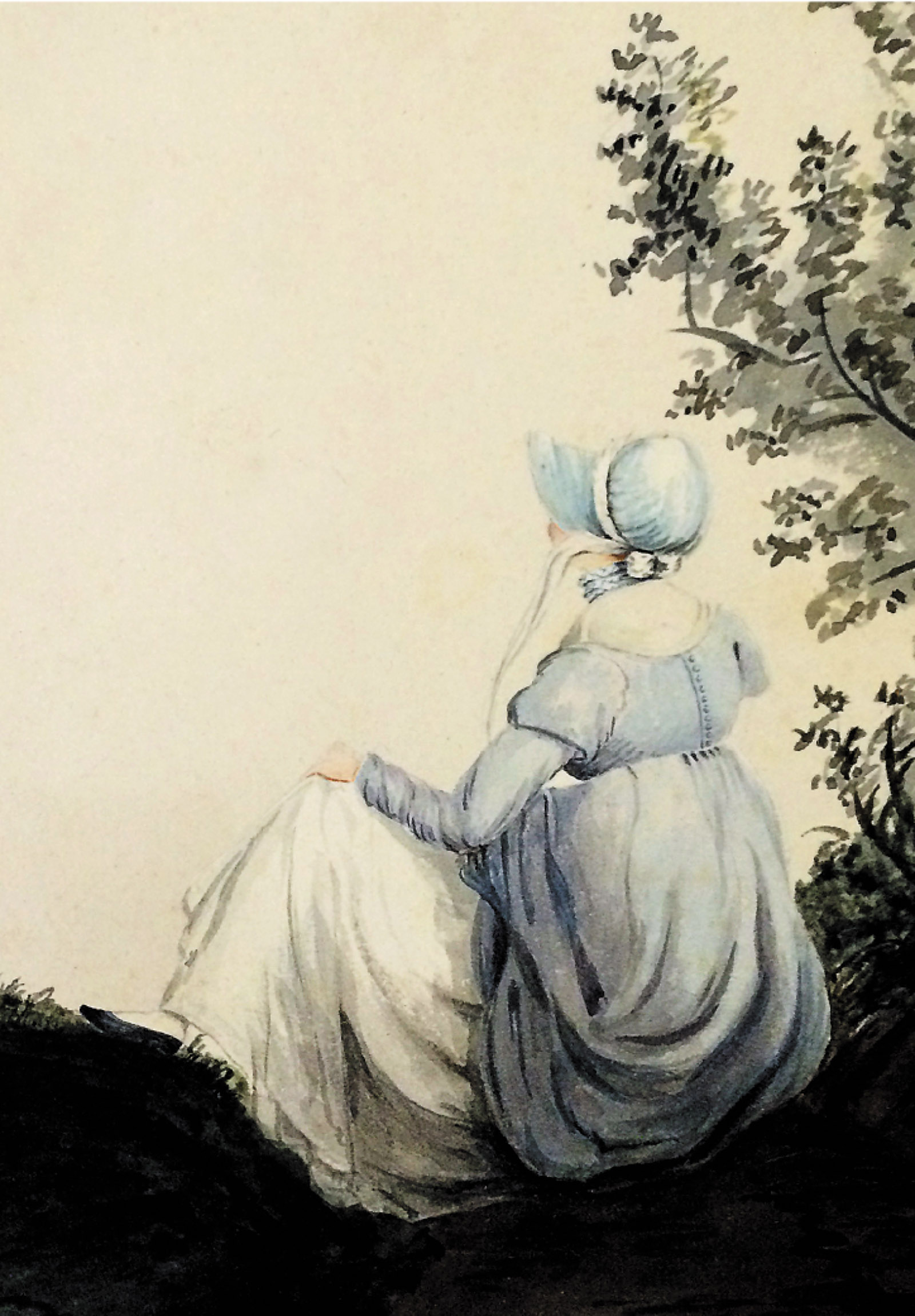
1.Though the National Portrait Gallery treats the sketch as authentic, the only portrait of Austen whose provenance can be strictly confirmed is a watercolor by Cassandra in which the subject turns her back to us. An oil painting of a young woman long misattributed to Johann Zoffany—the so-called Rice Portrait—has a strong claim, but the issue is still disputed. For a lively account of this and other candidates, see Claudia L. Johnson, Jane Austen’s Cults and Cultures(University of Chicago Press, 2012), pp. 16–67; and for the latest update on the Rice Portrait, whose authenticity Johnson supports, see www.janeaustenriceportrait.com. ↩
2.The Austen scholar Deborah Yaffe keeps a useful blog where she registers such misquotations. ↩
3.Maria DiBattista and Deborah Epstein Nord, At Home in the World: Women Writers and Public Life, from Austen to the Present (Princeton University Press, 2017). ↩

We’ve had post-Fordism; we’ve seen the rise of the new economy; and now we are confronted with the ‘sharing economy’. In The Sharing Economy: The End of Employment and the Rise of Crowd-Based Capitalism, Arun Sundararajan aims to explain both the origins and the implications of this new way of working, and how the ‘asset-light’ generation’s political economy is shaped by ‘sharing’.
For Sundararajan, the sharing economy is largely market-based, allows capital (material and virtual) to be used more fully, is based on crowd-based networks facilitated by platforms and, perhaps most significantly, blurs the lines between the personal and professional as well as between various forms of employment. He notes that ‘sharing economy’ may not be the best term; though using it due to its ubiquity, he prefers ‘crowd-based capitalism’ which he sees as ‘an interesting middle ground between capitalism and socialism’ (44): a claim to which I will return!
Sundararajan’s historical account of the sharing economy goes back to the establishment of eBay, Craigslist and other selling/contact sites; however, the key development was the subsequent ‘digitisation of trust’ which allowed one-off market exchanges to benefit from the reputational aspects of repeated interactions via peer-to-peer evaluations. Arguing that the long-term general urbanisation of the global political economy has promoted the condition for ‘sharing’, Sundararajan also picks up cues from various analysts of the information society/economy, sharing their breathless impatience with the past, seeing the future as nearly here. Soon the distinction between market and hierarchy will dissolve (as it has for digitised platforms), leaving a mesh/complex of continuing interactions that will reduce the fixity or specificity of assets, allowing them to be used more efficiently than when locked up in hierarchies (firms). At its most fully developed, this leads to blockchain technologies, most famously underpinning Bitcoin, where interactions are recorded in the code of the asset, not even requiring a platform to facilitate the ‘sharing’.
 Image Credit: (Mark Warner, CC 2.0)
Having set out how the new crowd-based capitalism might be organised, the book’s second half explores its likely effects. Sundararajan summarises these as increasing the impact of capital (enhancing its utilisation); the fragmentation of consumption with an increase in choice expanding uptake of goods and services; a shift away from economies of scale towards network effects; and the ‘democratisation of economic opportunity that promises inclusive growth’ (108). He then considers how preceding economic regulations might fit this new sharing economy, recognising that many of the issues remain the same. However, self-identifying as an economist, Sundararajan sees regulation’s benefits narrowly, only encompassing information asymmetries and un-costed externalities. These, he argues, can be dealt with in a sharing economy via peer-to-peer and brand-based reputational regulation alongside self-regulatory systems. In this lightly regulated market, a form of spot market for flexible independent contractors will revolve around tasks, often referred to as the ‘gig economy’. That this will (and indeed does) prompt considerable volatility in earnings, social benefits and welfare prompts Sundararajan to explore and support some form of universal basic income, while noting that there might be some difficulties funding it.
Professor at the Stern School of Business, NYU, Sundararajan is a self-avowed enthusiast for the sharing economy, but the ‘advantages’ he identifies might look rather different to many Uber-drivers in New York City. Therefore, while Sundararajan presents an interesting and highly detailed discussion of the sharing economy (including a wide range of examples, mainly but not exclusively drawn from the USA), like many digital idealists before him he does not recognise continuities with modern capitalism. Rather, he regards the sharing economy as a move towards a new mid-ground between capitalism and socialism. If socialism is about addressing inequalities and the socialisation of the means of production, then Sundararajan’s argument sadly does not stack up against the sharing economy’s real social relations.
At the heart of the book is the idea that a technological fragmentation of the previously more hierarchical economy will facilitate expanded opportunities for individuals to enhance their earning capacity and/or to become demi-rentiers if they have under-used but in-demand assets. Although Sundararajan manages to effectively downplay any technological determinism, it still underpins much of his argument; as such, he ignores a key element to the processes of outsourcing that feed the growth of this sharing economy. As William Milberg and Deborah Winkler (2013) have pointed out, outsourcing is facilitated and driven by financialisation alongside technological developments; financialisation is an agent-centred process prosecuted by financial and banking corporations in the USA and elsewhere. So like all good political economists, we should ask: who benefits from the sharing economy? A recent post from Branko Milanovic is particularly apposite: he observes that Gerald Davis has demonstrated that large hierarchical firms end up equalising rewards and benefits as large social systems seeking to maintain legitimacy, while based fragmentation of these hierarchies via outsourcing allows much smaller groups to capture rewards and exposes contractors to more voracious price competition for their labour.
Overall then, Sundararajan joins a long history of technological utopians who either willfully ignore, or have little interest in, the actual economic relations they are examining. Certainly, this book has a wealth of detail, but it mostly misses the real impact of the changes it posits on workers. Sundararajan’s sharing economy is not a new development but rather a revival of the share-cropping, insecure and brutal economy of the nineteenth century, which social democracy did much to (incompletely) alleviate in the last century. While this book may play well in Silicon Valley, the ‘freedoms’ of the sharing economy look a lot like Anatole France’s observation that the rich and poor are equally free to sleep under bridges.
Sundararajan recognises this might be an issue when he muses on universal income and other non-market welfare support for contractors (as also recently proposed by left-leaning US Senator Elizabeth Warren), but his acceptance that this might be politically difficult to establish does nothing to dampen his enthusiasm for the sharing economy. Unfortunately, the sharing economy seldom merely represents a little extra spending money to supplement an otherwise stable income; for most, this new economy threatens only to intensify the insecurity and inequality of their economic lives, and Sundararajan’s book would have been much better if this future had been more central to his account of the sharing economy’s likely political economy.

I never set out to become a connoisseur of White House men’s rooms. It just kind of happened. You move into a new apartment, get to know the area, and one day, to your surprise, you have strong feelings about every pizza place in the neighborhood. That’s what I went through, only with porcelain and liquid soap.
My favorite restroom was on the ground floor of the residence, next to the ceremonial library. The white marble floors and sinks radiated luxury, yet their muted, opaque quality kept them from showing off. “It’s honestly no big deal,” they seemed to say. “Some of us were just born pretty.” The overall effect was both stunningly impressive and refreshingly humble, the best of American democracy superimposed upon a WC.
West Wing men’s rooms offered unique charms of their own. For proximity to power, there was the stall tucked against the Roosevelt Room, just footsteps from the Oval. For retro quirkiness, there was the restroom across from Valerie Jarrett’s office. Urinals there were large and basinlike, like bathtubs sawed in half. (Even stranger, they flushed via bulky foot pedals placed twelve inches from the floor.) At ground level, the bathroom near Jon Favreau’s office boasted the building’s only shoe-polishing machine, the kind that looks like two Muppet scalps attached to opposite ends of a stick.
Not surprisingly, the facilities in the EEOB were less distinguished. If anything, their defining feature was a trigger-happy automatic flush. I won’t go into too much detail. All I’ll say is that I was the frequent victim of an impromptu bidet.
Yet despite these shortcomings, when it came to personal significance, no restroom could match the one in the southwest corner of the EEOB’s ground floor. This was because of something unforgettable (in advance, don’t worry, not gross) that happened six months after I started my new job.
It was a special time. I could finally navigate my surroundings, but the novelty of the building had yet to fade. Even the most routine pee break glowed with history. Descending a spiral staircase to the ground floor, I remembered that FDR had worked here during the 1910s. That was before polio claimed his mobility, and I imagined his shoes clicking and clacking on the steps. The EEOB was also home to the vice president’s ceremonial office. Tugging on the engraved metal knob of the men’s room door, I wondered if Nixon or Johnson had ever strained against its weight.
Then I entered the bathroom, and found the sole urinal occupied by someone in a bulletproof vest. This too was a kind of wonder. For the vast majority of my twenty-four years, I would have been stunned to see a real-life Secret Service agent. Diving in front of bullets. Driving through red lights. Sniping bad guys from rooftops. They were as mythical as X-Men, and no less devoted to saving the day.
Now, after a few months at the White House, I still thought of Secret Service agents as heroes. But they were also people I peed next to. Not wanting to wait for the agent at the urinal, I scooted past him and opened the door to the stall. Stepping inside, I closed the latch behind me and turned around.
And that’s when I saw it: a fillet of grilled salmon, unblemished by a single bite mark, sitting in the toilet bowl.
This was not the most historic thing I witnessed at the White House. It was not the most profound. But it was, without question, the most remarkable. Think about it. How many people have met Barack Obama? Tens of thousands, maybe even hundreds of thousands. How many people have found a salmon in the toilet at work?
I have. And because I have, I can assure you the experience raises more questions than it answers. For example, why aren’t there any side dishes? What would happen if I flush?
But those questions would come up anywhere. As I began the next phase of my inquiry, the search for suspects, a simple piece of fish took on far greater meaning. I knew it was an inside job — Ike’s was serving salmon that day — but beyond that, I was stumped. The National Security Council offices were only three floors above me. Was someone there really so woefully incompetent? Or maybe it was the econ team. Had a person responsible for billions in federal grant money simply snapped? And let’s not forget the man in the bulletproof vest I had spotted just feet from the crime scene. Could a Secret Service agent have gone rogue?
This, I was learning, is the power of the White House: it sprinkles its significance onto anything nearby. A staircase becomes more than a staircase. A doorknob becomes more than a doorknob. A toilet-salmon becomes more than a toilet-salmon. It’s astonishing to behold.
This is an excerpt from Thanks, Obama: My Hopey, Changey White House Years by David Litt.

Maja Lunde’s climate-fiction debut uses species extinction to ask its human characters: What’s more important, self-interest or sacrifice?
The category of literature known as climate fiction—“cli-fi,” as it’s known—has gotten quite crowded in recent years. Even just in the past six months, there’s been Paul Kingsnorth’s Beast, which remains hopeful about impending disaster; Lesley Nneka Arimah’s short story “What It Means When a Man Falls From the Sky,” which tackles both ecological concerns and the refugee crisis; and Ashley Shelby’s South Pole Station, which takes on climate-change denial. Into this busy field enters Maja Lunde’s novel The History of Bees. Lunde, a writer of children’s and young-adult books, pieces together a tale that makes the long-term effects of climate change the backdrop for a set of stories about familial relationships, love, and loss.
Following a simple premise—what would happen if bees disappeared?—Lunde’s novel, originally released in Norwegian in 2015, jumps back and forth, across time, between the stories of three beekeepers. The term, it should be noted, is used loosely: There’s William, a British biologist in the mid-1800s; George, a farmer in the contemporary Midwest; and Tao, a young Chinese mother in a bee-less 2098 who spends hours performing manual labor in the fields to make up for the lack of apiformes. All three are dealing with personal problems brought about by the existence—or lack—of bees in their life. But the novel smartly relies limitedly on its ecological-disaster framework and instead gains its best footing in the quiet and intimate relationships it depicts between its characters. At times, it’s easy to forget you’re reading a novel exploring the consequences of a species extinction—instead, you’ve become invested in the lives of the people whose stories it follows.
This family-drama quality stems from the fact that much of the book takes place before the Collapse, an ambiguous event that occurred over several decades, led to the obliteration of bees, and has greatly depleted the resources they help produce (crops, animal feed, and, in turn, a number of animals). Tao’s plotline is the only one that occurs completely in the post-Collapse world, one in which China’s citizens are forced to hand-pollinate trees, due to the country’s early use of pesticides. “It had paid off to be the ones who polluted the most,” Tao thinks to herself. “We were a pioneer nation in pollution and so we became a pioneer nation in pollination. A paradox had saved us.”
Tao’s story, which opens the novel, is easily the most captivating. It’s also the most urgent, because it takes place after, not before, global disaster. In addition to the stress and exhaustion brought about by her grueling work outdoors, Tao struggles to create a life for her 3-year-old son Wei-Wen, and her constant attempts to provide him the best possible education exasperate her husband Kuan, straining their relationship. When Wei-Wen mysteriously disappears, it pushes Tao and Kuan further apart. Lunde places you in Tao’s head and forces you to feel the emptiness around her:
This thing that was between us had grown to be insurmountably large. … It became almost unbearable to be in the same room. He stirred up the same thoughts again and again. The same two words. My fault, my fault, my fault.
Tao becomes so caught up in blaming herself for her son’s disappearance that she withdraws from those around her. Initially provoked by the ecological disaster, the void she feels deepens because of her lack of connectedness to those around her, and because of her belief that she alone can solve all of the problems—whether minute and personal or huge and systemic—that exist in her world.
If most of Tao’s storyline follows her attempts to discover her missing son, George’s and William’s more closely trace their irascible connections with their children. The difficulty with which the two men attempt to relate to their kids and their kids’ developing hobbies mirrors the trouble they have grasping the realities of a changing world. George, living during the beginning days of the Collapse in the United States, struggles to maintain his bees as he rejects new farming techniques meant to streamline the process of beekeeping. He’s disappointed in his son Tom, who’s recently gone off to college and seems wholly disinterested in his father’s profession, and much more drawn to pursuing a Ph.D. in writing.Lunde leaves open the possibility of a way of life that values the collective over the individual.
George’s decided unlikability—he’s oblivious to his son’s desires and puts himself above everyone else—is clearly intentional. With his rigid self-centeredness, he serves as a foil for the bees, which are both the novel’s primary symbol and its binding narrative force. In addition to being an integral part of keeping the environment in order, “each tiny insect was subordinate to the greater whole,” as William points out early in the novel, sacrificing an individual identity for collective wellbeing. George is the complete opposite. If his verve for beekeeping drives his life, it also results in the downfall of his relationships. Lunde, in creating this unbearably stubborn character, suggests the tricky balancing act between human self-interest and sacrifice, and shows how parents can sometimes be the ones who struggle with this tension most of all.
The third storyline, William’s, works as a combination of the other two, mingling the sympathy readers may feel for Tao with the contempt they might feel for George. When first introduced, William is immobilized in bed by an overwhelming depression brought about by his lack of scientific achievement. A renewed sense of passion—both for his family and his work—becomes the driving force behind the scientist’s return to life. But, his fixations come at a cost: Determined to make new strides in the world of mid-19th century beekeeping, he becomes blind to those around him. His egocentrism and need for recognition don’t allow him to realize that “a single person’s life, … thoughts, fears, and dreams meant nothing” if they don’t “apply to us all.”
William’s inability to comprehend the communal nature of life, a quality each character shares in some way, is central to the novel’s broader point—that self-interest alone can result in both personal destruction and larger catastrophes that affect those outside of one’s immediate orbit. The book does, however, leave open the possibility of a way of life that values the collective over the individual, as bees do from the day they are born to the day they die.
At times, the moralizing about the environment and humans’ role in global warming can come across a bit heavy-handedly. But increasing awareness of the earth’s fraught future, in the end, is not the main thing the novel is trying to do. Instead, it wants you to consider what it is you feel deeply about—whether that’s achieving fame, standing by traditions, or protecting your family—and then consider whether you would sacrifice those things for the greater good.