Israel Book Review

Jews Praying In The Synagogue on the Day of Atonement by Maurycy Gottlieb (Tel Aviv Museum of Art) The Israel Book Review has been edited by Stephen Darori since 1985. It actively promotes English Literacy in Israel .#israelbookreview is sponsored by Foundations including the Darori Foundation and Israeli Government Ministries and has won many accolades . Email contact: israelbookreview@gmail.com Office Address: Israel Book Review ,Rechov Chana Senesh 16 Suite 2, Bat Yam 5930838 Israel

Wednesday, May 31, 2017

Two Tales Paperback – October 1, 2014 by S.Y. Agnon (The Toby Press)

Shmuel Yosef Agnon (July 17, 1888 – February 17, 1970) is considered one of Israel’s greatest writers. Agnon shared the Nobel Prize with the poet Nelly Sachs in 1966. Some of his works deal with the conflict between the traditional Orthodox Jewish life and life and behavior in the modern world.
Many of his stories are told by a narrator, and he is credited for contributing to the broadening the characteristic conception of the narrator role in literature. Many are written in the magical realism style of another Nobel Prize winning author Gabriel Garcia Marquez. Magic realism a literary or artistic genre in which realistic narrative and naturalistic technique are combined with surreal elements of dream or fantasy. An example would be where an author tells realistically about a man beginning to cross a bridge, but when he gets about half way across, he begins to rise in the air and float the rest of the way. The style is entertaining, thought provoking, and it prompts readers to form their own interpretation of the tale, as parables do.
Betrothed is about a man and a woman who as children promised to marry each other as they stood at the edge of a Viennese garden pool, as the biblical Jacob and Rachel stood by water in Genesis 29 and as kings were crowned by water, as in I Kings 1. The story focuses on what transpires to the couple when they fail to marry as they swore to do and their reunion after the passing of many years. As with many other Agnon stories, this one can be read literally, what is said in the tale is what happens. It can also be read as a rich allegory, as scholars insist it be read and enjoyed.
Similarly, some scholars insist that Edo and Enam can only be read as an allegory; otherwise it is enigmatic and inexplicable. But the scholar Arnold Band inveighed against focusing on the complexity of the tale “which detracts the reader and critic from the aesthetic charm of the story.” The tale is set in Jerusalem in the final years of the British Mandate. A couple, husband and wife, are house sitting, while in an adjacent room sits a scholar, a recluse, a mysterious man, who is studying an ancient culture. The wife is from a faraway land. She has a strange sleep walking disease and seems to walk toward the scholar.
Both stories are erotic, and both are superb on many levels.
Posted by BardofBatYam at 10:12 PM No comments:
Email ThisBlogThis!Share to XShare to FacebookShare to Pinterest
Labels: . #CameoFromZion, . The Darori Foundation, .@stephendarori, .Israel Book Review, .Stephen Drus, @israelbookreview, #IsraelBookReview, #stephendarori, #stephendrus, Stephen Darori

Unusual Bible Interpretations: Ruth, Esther, JudithAug 9, 2016 by Israel Drazin Hardcover (Gefen)


Each of these books is named for a woman who is a major protagonist. Thus, many modern readers will want to think about the way the books and the Bible generally portray women. Drazin's commentary on each book will help the reader with this issue and with many other historical, literary, and theological issues in these fascinating books. There is something of earthiness and sexuality in each of the three books, shared with some of the other books of the Bible. Thus in a pivotal scene, Ruth approaches one evening her husband to be, Boaz, alone on the threshing floor in her most appealingly sexual attire and spends the night. Drazin shows the reader differences in commentarial views of what transpires. Most modern readers will have little doubt. The book of Esther involves a queen who loses her throne for her failure to appear naked, according to many sources, before a group of revelers assembled by the king. Esther is beautified with cosmetics, ointments, and finery for a year and then appears before the king to win his heart and libido and become the new queen. Judith, a widow without children, knows the ways of men and famously seduces Holofernes, a general intent on doing the Israelites ill, and cuts off his head.

“Unusual Bible Interpretations: Ruth, Esther, and Judith” is part of a larger series that explores questions that have puzzled readers of the Bible for centuries. Rabbi Israel looks at why Ruth and Esther were included in the Jewish Bible while the Book of Judith, which has a more openly religious character than either Ruth or Esther, was not and only appears in the Jewish apocrypha.

Drazin’s has divided is book into three units, one on each of the three books and then each unit is further divided into chapters that give an overview of each book and explore key themes in greater detail. Looking at the book of Ruth, for example, we read the textual evidence that suggests that Ruth did not convert to Judaism, despite Rabbinic interpretation which identifies her as an early convert. “The book of Ruth not only does not indicate that Ruth converted, it states seven times that she remained a Moabite—including twice in the final chapter. In fact. Boaz calls her a Moabite when he speaks about marrying her.”

In his analysis of the Book of Esther Drazin identifies several inconsistencies in the story and shows its pagan origins. For example, the primary practices of Purim (feasting, drinking, and sending gifts) mimic the practices of King Ahasuerus. Furthermore, the author notes that Esther is a reticent heroine and that Mordechai’s valor that is praised at the story’s conclusion and Esther’s. Nowhere does it say that there is a requirement to read the Book of Esther.

Judith is included in the Catholic and Eastern Orthodox Bible, while it is only included in the Protestant and Jewish apocrypha even though each of Judith’s sixteen chapters has references to God and prayer observances while Ruth and Esther, contain little or nothing about God or religion. Drazin gives us a review of the book’s plot and concludes by focusing on Judith’s heroism of Judith in defeating Holofernes and liberating the Judeans from foreign rule.

The rest of the book looks at why Judith was not included in the Jewish bible Drazin gives us several reasons that have been suggested in the past, many deal with Rabbinic Judaism’s discomfort with a strong female protagonist. However, he does not accept this and suggests that the real reason comes from Rabbinic Judaism’s dislike of a “proactive theology that denied a reliance on God”.

As a whole, we get new insights and a comparative analysis of three books with a female protagonist but I must say that I found what makes this book so interesting is that it introduces us to the Book of Judith.
Posted by BardofBatYam at 7:17 PM No comments:
Email ThisBlogThis!Share to XShare to FacebookShare to Pinterest
Labels: .@stephendarori, @israelbookreview, #IsraelBookReview, #stephendarori, #stephendrus, Israel Book Review, Stephen Darori, Stephen Drus, The Darori Foundation

Unexpected Israel: Stories You Never Read in the Media by Ruth Corman, is published by Gefen Publishing House, priced £22.50.


This wonderful book opens a door to a country with a significant history for all to know. Each chapter is about something that 90% the readers will never have the joy to experience.
Her knowledge and insights are inspiring, informative and joyful. Even if you are not interested in the country it is a worthwhile read because it opens windows of learning written with a most human and enjoyable style. I hope she writes more and more.The book is full of magnificent photos. Gives a better understanding of Israeli culture and lifestyle for those that have been to Israel many times or never at all. Each item is described in 1-4 pages, doesn't have to be read in order.

Prompted by recent press coverage, writer and photographer Ruth Corman explores the ‘real’ Israel in her new book, she tells Rebecca Wallersteiner

Ruth Corman’s life has had as many twists and turns as the stories in her beautifully-illustrated new book, Unexpected Israel.

The work reveals a mosaic of fascinating people from infinitely different backgrounds, each of whom, according to the author, contributes to the rich tapestry of the country.

“About five years ago I became increasingly irritated with the negative media coverage on Israel and decided to try and redress the balance. I wanted to show the beautiful, the creative, the positive, the caring side of Israel, which is usually overlooked,” she says.

Not only is Corman (pictured, right) a writer, photographer and, unexpectedly – a singer – but, during her varied career as director of the British Israel Arts Foundation, she curated many exhibitions both in Britain and Israel.

Her first book, now published in three languages, was the life story of photojournalist David Rubinger.

When I arrive at the author’s Hampstead home, she warmly welcomes me in and offers tea. Three hours flash past as she recounts her experiences, shows me her photography and even sings arias from Puccini, while I listen spellbound.

“Singing is like taking a happy pill – it should be given on the NHS,” quips Corman, whose witty northern humour reminds me of Howard Jacobson.

Is it true that Corman is happy to chat to total strangers? “Yes. Even as a child I was extrovert and have always been fascinated to find out how others tick. The only person I’ve ever met who talks to strangers more than me is Alon Galili, who became my guide and friend.

“I asked him to show me some lesser-known places in Israel and for five years we travelled in his 4×4 finding the “unexpected,” which I then converted into stories.

“Alon has always worked in the field of nature preservation, so he knows Israel like the back of his hand. He has the gift of bringing everything to life – even in the most arid landscape. Through him, I have been introduced to many of the fascinating people and places that feature in my book,” she adds.

Focusing on cameos of everyday life, Corman’s book introduces a rich collection of characters and places that one would rarely encounter – stories range from camels to caviar, sabras to snow and pilgrims to pomegranates, the humorous and the spiritual, the poignant and the dramatic.

She has a genius for spotting people who are different and getting them to tell her their stories. She is keen that people begin to realise Israel is like one huge family – caring, often interfering, but essentially kind.

“If I fall on a street in Jerusalem, everyone will immediately rush to help me, whether they are Arabs, Christians or Jews,” she explains.

She began writing Unexpected Israel in 2011 and, during her travels, has encountered many remarkable individuals – the sheikh of a Bedouin tribe who hosted her, Gershon Luxemburg from Uzbekistan who runs a boxing school open to all, Amnon Damti – recognised as one of the world’s leading deaf dancers – and Professor Yossi Leshem – an outstanding ornithologist, whose expertise is helping countries worldwide with many problems.

One of the most inspirational people in Corman’s book is 92-year-old Sister Emahoy Tsegué-Mariam Guebrù, who lives in a convent in Jerusalem and is something of a cult figure in music circles.

Corman enthuses when I ask her about her heroine. “Every time I visit Tsegué-Mariam, her smile lights up the tiny cell in which she lives. She has a wonderful gentle sense of humour and this, combined with her serenity, never fails to affect me.”

Despite her age, this remarkable woman still creates compositions for piano in her head before committing them to paper.

Another unusual story features the Hai-Bar Yotvata nature reserve, which Galili helped to establish in the 1960s, to repopulate Israel with now extinct wildlife mentioned in the Bible. So far, it has succeeded in rescuing several species, including the onager and white oryx to the wild, but were not so successful with ostriches.

On release, the birds ran towards Jordan and had to be rounded up and brought back to avoid being hunted. The second time they were released, they ran towards Egypt. They are back in the reserve pending their agreement to stay where they are supposed to.

One special project was the breeding of the scimitar horned oryx [Senegal’s national animal, that had become extinct], but Hai-Bar managed to breed and return a group of these animals back to their homeland in Africa.

Whether she is photographing owls or oranges, caviar or camels, musicians or market traders, Corman’s photographs have an unpretentious freshness and joie de vivre – rather like the author herself.
•
Posted by BardofBatYam at 6:37 PM No comments:
Email ThisBlogThis!Share to XShare to FacebookShare to Pinterest
Labels: .Israel Book Review, @israelbookreview, @stephendarori, #IsraelBookReview, #stephendarori, #stephendrus, Stephen Darori, Stephen Drus, The Darori Foundation

The Israel Warrior: Fighting Back for the Jewish State from Campus to Street Corner, by Shmuley Boteach. Gefen Publishing House, $19.95 USD/NIS 62 (222p) ISBN 978-965-229-883-6


This is an eloquent and powerful history of the Holy Land that empowers advocates of Israel to counter the biased and antisemitic arguments of those who wish to defame Israel in print and in public.Succinctly defies the problem of anti - Israel animus and provides practical ways to fight back. Deconstructs hysterical campus anti - Israel bias as anti Semitism, and provides persuasive arguments underlining Israel's success in remaining dedicated to the rule of law, maintaining an ethical civic society and democracy amidst the most virulent, prejudiced, concentrated p.r. attacks in recent history upon a true democracy.

Rabbi and media maven Shmuley Boteach (Kosher Jesus) piggybacks of off American-Israeli Cooperative Enterprise founder Mitchell Bard (Myths and Facts: A Guide to the Arab-Israeli Conflict) to reorganize and update the information in the latter’s popular primer for the latest cohort of Israel advocates, Jewish or otherwise. In addition to providing talking points about the Arab-Jewish clash and introductions to Zionism, the State of Israel, and its enemies, Boteach in his argumentation adduces a slew of evidence and offers commonsense suggestions for Israel Warriors-in-training to deploy against the barrage of calumnies Jews and Jewish students regularly face on campuses, in the public square, and in the media from the inimical and ignorant.

Boteach issues a clarion call to hate—evil, that is. The book is a sustained argument that without righteous indignation against the iniquity of terrorists and terrorism sponsors, such evil will only prevail. He asks readers to emulate Abraham Lincoln and Winston Churchill in their respective hatred of slavery and Nazism, so as to mobilize and confront anti-Semitism and anti-Zionism with similar fortitude and resolve. Whether touching upon the issues of 1948 refugees, the status of Jerusalem, the actions of the IDF, the blatant hypocrisy and spurious charges of BDS proponents, the obsessively biased UN, Arab corruption and incitement, or Iranian nuclear ambitions and deceptions, he emphasizes the necessity of furnishing basic facts and statistics to refute lies and slander, providing contexts, and debunking canards that scurrilous foes of Israel routinely employ to delegitimize and demonize the sole Jewish state, an island of freedom and democracy in the world’s most troubled region.


The book overall is a rehearsal of elementary historical facts occasionally supplemented with some useful details, but benefits from its current content and vigorous thrust. The author correctly highlights the crisis of irresolute leadership within the international community vis-à-vis prosecuting the ongoing war against terrorism, and his longing for unequivocal denunciation and explicit loathing of evildoers and their inhumane actions by world leaders is agreeable. Apologists making excuses or seeking “root causes” on behalf of the pathologically violent and cruel merely abet the gunmen, homicide bombers, and rocket launchers in their reified malice. Political correctness only obfuscates moral clarity and serves as the handmaiden of Islamic terrorism, the foremost challenge of our times. But it is in his preface that Boteach delivers the most crucial yet most neglected advice for would-be Israel advocates to internalize: “Fight when you can be heard, and when you have a chance of convincing others.” Veteran debaters recognize that for all the facts and figures, for all the truths and contexts, the first rule of debating forever remains: Pick Your Battles.
Posted by BardofBatYam at 4:40 PM No comments:
Email ThisBlogThis!Share to XShare to FacebookShare to Pinterest
Labels: . The Darori Foundation, .@stephendarori, .Israel Book Review, @israelbookreview, #IsraelBookReview, #stephendarori, #stephendrus, Stephen Darori, Stephen Drus

"Defensive Shield: An Israeli Special Forces Commander on the Front Line of Counterterrorism" was written by Gal Hirsch and published by Gefen

An exceptional story of leadership, illustrating the importance of professionalism, responsibility, accountability, values, culture, command climate, leading change, referential leadership, etc. Hirsch's accounts of the combat actions he led and wars he fought are vivid and relevant, putting into perspective all that should matter to the military leader, within the greater context of Israel's struggle against Terrorism. He also ventures into the operational art, at first slightly over-emphasizing the importance of new words to generate new ideas. However, he quickly moves away from such study of the phenomena to a theory of action in his in-depth account of the 2006 Lebanon War.
For students of warfare, Middle East enthusiasts or anyone inspired by stories of redemption after a fall from grace, a new English version of a book by retired Israeli Brig. Gen. Gal Hirsch, the original scapegoat of Israel’s 2006 Lebanon War, is well worth reading.
In "Defensive Shield: An Israeli Special Forces Commander on the Front Line of Counterterrorism," Hirsch engagingly escorts the reader through his 34 years in uniform, starting at age 15 in a pre-military academy up through the backbiting post-war period when he’s forced to fall on his sword for perceived wartime failings.
Timed to coincide with the 10th anniversary of that hybrid war with Hezbollah, Hirsch’s account of the 34-day fight and its aftermath is a compelling, albeit subjectively cautionary tale of the best and the worst of the Israel Defense Forces (IDF).
From the former commander of the 91st Division that bore the brunt of the fight in that summertime war, we gain insight into forces trained for high-threat ground maneuvers, yet relegated to a deterrence-sapping, anti-ambush posture across more than 100 kilometers of the border.
From his impassioned yet narrow field of view, Hirsch paints a chilling portrait of comrades in arms who conspired and cowered in the face of the faltering leaders they were honor-bound to obey and the casualty-averse public they were sworn to defend.
“An evil spirit struck the IDF at that time, and officers — mainly senior — acted behind the scenes in subversive and manipulative ways. ‘Me’ came before ‘we’ and I was stunned by the extent of this phenomenon,” he writes.
In the year leading up to the war, Hirsch’s division thwarted four abduction attempts and engaged more than a dozen, limited responses to cross-border provocations; responses Hirsch dismissed as “firing at rocks.” All the while, Hirsch insists he repeatedly warned that the defensive strategy of restraint — adopted following Israel’s withdrawal in 2000 from its 18-year occupation of South Lebanon — was unsustainable.
When Hezbollah eventually managed to pull off a July 12 attack on Israel’s side of the border fence — killing two reservists and absconding with what later was determined to be the bodies of two more — Hirsch ordered an air power-supported tank and infantry force on cross-border pursuit. But Hezbollah was well-prepared with a massive mine that sent the tank up in flames, killing all of its crew along with two more sent on the rescue mission.
Within 30 minutes of the attack that would trigger Israel’s second Lebanon war, the IDF lost 10 men. By the time it was all over — after three weeks of standoff strikes followed by a too-little, too-late ground offensive — the IDF had lost 121 of its best and brightest, 60 of them under Hirsch’s command.
Another 44 civilians would die in the more than 4,000 rockets that pummeled the homefront.
Once the war fog cleared and the cease-fire took hold, Hirsch writes bitterly about his no less brutal battles with peers maneuvering to supplant him; an “hysterial” media seeking a fall guy; and superiors who hoped one head on a platter would spare them a similar fate.
In detailed accounts of after-action confrontations, Hirsch exposes critical intelligence that never made its way to Northern Command; petty and costly changes to operational plans in the name of morale-boosting photo ops; kangaroo hearings and other wrongs done to him by active-duty cadre and retired officers clamoring for his head.
And he names names.
His j’accuse includes Lt. Gen. Dan Haultz, then-IDF chief of staff; deputy IDF chief Moshe Kaplinsky; Udi Adam, the former commander of the northern front who now serves as director-general of Israel’s Defense Ministry; and then Maj. Gen. Gadi Eizenkot, since promoted to the country’s sole three-star billet as IDF chief of staff.
“I was naïve and focused only on fighting the enemy, even as I was being stabbed in the back,” he writes.
Israeli Army Advances deeper Into Lebanese Territory

Gal Hirsch, center, here as an Israeli army division commander, talks with the service's chief of staff, Dan Halutz, right, as they watch troops advance from Israel into Lebanon Aug. 12, 2006, from an observation point along Israel's border with its northern neighbor.
Photo Credit: Abir Sultan/IDF via Getty Images

At times, Hirsch’s road to redemption reads like that of a jilted lover. “I loved you for 15 years,” he tells Halutz, urging the IDF’s top officer to back him against trumped-up accusations.
At other times, the book reads like a white-knuckled thriller.
Two memorable scenes take place far earlier in his career that give readers a sense of the true grit Hirsch would draw upon a decade hence in his quest to remain in the IDF’s top ranks.
The first involved an April 1995 overnight mission deep inside Lebanon. Hirsch at the time commanded the Air Force’s Shaldag (Kingfisher) elite commando force. As dawn approached, superiors back home were frantically urging him and his team to head for the CH-53 extraction point. But Hirsch refused to abort until the mission was complete.
The other scenario, as chief of operations for Central Command’s Regional Division in February 1998, was far more personal yet similarly illustrative of how Hirsch favored risk over rules to overcome adversity.
In a well-planned ambush, as he drove through the West Bank town of Birzeit, Hirsch’s jeep was literally crushed by a boulder dropped from a bridge overhead. With collapsed lungs, broken ribs, a shattered collarbone and a fractured spine that left him partially paralyzed, doctors doubted whether he would ever walk again.
After a year of painful recuperation, the wounded warrior had resumed his upward trajectory throughout the ranks.
A stint at the IDF’s Operational Theory Research Institute — an internal think tank for developing new battle concepts — was followed by assignments as brigade commander in the West Bank and then chief of operations (J-3) for Central Command. It was in his J-3 capacity for Central Command, the theater responsible for the West Bank and Jerusalem, that Hirsch put into practice the theoretical concepts he helped coin.
636065969168244121-galhirschpic-3-.jpg

At times, Hirsch's words read like that of a jilted lover. At other times, the book reads like a white-knuckled thriller.
Photo Credit: Courtesy of Gefen Publishing House

Israel embarked on its 2002 Operation Defensive Shield in response to a suicide attack that killed 30 on the eve of the Jewish holiday of Passover. Designed primarily by Hirsh (hence the title of this book) with the promise of “defeating Palestinian terror,” the operation marked the largest campaign in the West Bank since the 1967 Six Day War.
Fourteen years after the fact, that operation and the technologies, tactics and procedures it prescribed are still credited in large part for maintaining the relative calm in the occupied territories.
But the most provocative parts of the book ultimately bring the reader back to Lebanon, where Hirsch, on balance, offers constructive criticism based on his experiences at the front lines. He devotes a full chapter to lessons learned, key among them:
  • Accomplish the mission, regardless of changes in plan.
  • Clearly identify war aims and communicate operational orders in language that is clearly understood.
  • Don’t allow fear of casualties to blunt momentum during ground maneuvers. “War is not a cake walk. … It is essential to do everything possible to avoid hysteria emanating from singular events; and to refrain from making sweeping, all-encompassing decisions based on them."
  • View airlift operations not as special missions but as another form of transportation for crack forces.
  • Make ample use of engineering forces to prepare the battle space.
  • Employ “swarms” of infantrymen to overtake key areas and outskirts of urban areas before sweeping in with armored forces driving on defined routes.
  • In all but cases of moral failings, commanders must assume responsibility for their subordinates — not “deflect criticism by throwing lower echelons under the bus.”
It took six years for the high command to welcome Hirsch — a man who could have risen to IDF chief of staff — back into the fold as an active reserve officer and deputy commander of the new special operations Depth Command.
Two years into that position, which he held from 2012-2015, Hirsch finally found full redemption by the judge who headed the government’s official commission of inquiry into the war. In a January 2014 letter to then-IDF Chief of Staff Benny Gantz, Judge Eliahu Winograd exonerated Hirsch, insisting he would have done so earlier but that his commission at the time was precluded from appearing to interfere in personnel matters:
“Ever since the submission of the Winograd Commission report pertaining to the events during the Second Lebanon War, my conscience has tormented me, as we could not, as we had meant, include a warm recommendation that the IDF offer Gal Hirsch to return to full service in its ranks. ... It would be an expression of respect and appreciation to the man and his deeds in the IDF after the difficult years he underwent and is still suffering, since his forced retirement.”
As evidence of the full circle traversed by Hirsch, the book’s back cover bears this message from the IDF chief of staff, one of his former detractors: “Gal Hirsch [is] one of the main people to whom the residents of the north owe the [peaceful] period since the Second Lebanon War. I think you are a role model. You are an Israeli patriot.”

Posted by BardofBatYam at 4:13 PM No comments:
Email ThisBlogThis!Share to XShare to FacebookShare to Pinterest
Labels: .Israel Book Review, @israelbookreview, @stephendarori, #IsraelBookReview, #stephendarori, #stephendrus, Stephen Darori, Stephen Drus, The Darori Foundatin

Defensive Shield: An Israeli Special Forces Commander on the Front Line of Counterterrorism Hardcover – July 17, 2016 by Gal Hirsch (Gefen)


This is an interesting, credible, and very readable rebuttal to the criticism aimed at the author by the initial report of the Winograd Commission, and the news coverage and leaks that occurred in the immediate aftermath of the Second Lebanon War. Hirsch was blamed by Israel's post-war commission for problems in the war, and part of the reason for this book certainly is for him to make his own case, his personal Defensive Shield, as it were.

Hirsch comes across as very bright but you can imagine that he may have appeared arrogant to his peers and superiors with his novel new concepts and terminology. For example: "With all of my experience, I have yet to find a solution other than maintaining cyclic processes of learning-changing-learning, with increasing speed, in order to baffle the enemy," or "I truly believe that maneuvering without distinct vector patterns and a chaotic and Unpredictable manner could collapse almost any rival system." In fact, his "swarming" and bypassing of strong points is consistent with the shock troops/blitzkrieg tactics the Germans developed at the end of World War I.

The single longest part of the book is dedicated to the second Lebanon War, and the author's actions, decisions, and fights with military bureaucracy and superior officers. Assuming what he wrote is true, it certainly rebuts negative portrayals of Hirsch's role leading up to and in the war. He also makes clear that there was a lot more to the war, including IDF successes, then the battle at Bint Jbeil. Hirsch makes clear that it was the defense minister and chief of the general staff who ordered the conquest of Bint Jbeil for public relations reasons, which meant turning back from the planned advance, and even though the city had already been surrounded and the high ground around it taken.

Hirsch makes the very good point that the only way to get the international community involved enough to impose a cease-fire on Hizbollah, which was firing thousands of rockets at Israeli civilians every day, was for the IDF to invade Lebanon. The invasion, therefore, was actually a peacemaking move rather than an offensive action on Israel's part. He never makes this point, but implicit in his argument is that the better strategy for Israel would have been just a ground invasion of southern Lebanon, which only occurred in the last week or 10 days of the war, rather than to bomb Beirut and other Lebanese cities in an attempt to get the Lebanese government to pressure Hizbollah to stop firing its rockets at Israeli civilians.

It's interesting to read that in the late 1990s, the IDF's Operational Theory Research Institute (OTRI) reinvented the "signaling by escalation" concept that the US had tried and failed with in Vietnam 30 years earlier. Israel found out the hard way that you can't negotiate with an enemy that wants your complete destruction or withdrawal.

It's also interesting that Hirsch's description of "shock and paralysis" efforts in 2002 during Operation Defensive Shield in the West Bank presaged Donald Rumsfeld's "shock and awe" concept a year later in Iraq. Yet he does not draw the obvious conclusion that his eventual decision to destroy the Palestinian Authority's military and police infrastructure – destroying the enemy's forces – should've been done all along.

He does contradict himself on a fundamental matter. He says repeatedly that what matters are "missions", not "plans". And get several times he states that he wanted to implement "the original Magen Ha'aretz plan that I knew and valued." It's hard to tell from this whether Hirsch was as hide-bound by an existing plan as were his commanders.

Likewise, he criticizes higher command's tendency to break up organic units. Yet throughout his description of his division's actions in the Second Lebanon War, he frequently mentions his own detaching of battalions from brigades and companies from battalions, and assigning them to other units.

He makes a statement that I can't understand. He makes an aside about "those who believe that 'no day was better than yesterday." This seems to echo the motto at the US Navy SEALs' training center, "The only easy day was yesterday". I can't believe he would criticize fellow special forces operators," so his comment is lost on me.

My minor peeve: despite numerous mentions of the Nahal infantry brigade and it's 50th Battalion, for some reason the brigade does not appear in the book's index, even though the Givati brigade, which played a much lesser role in the narrative, does.
Posted by BardofBatYam at 4:09 PM No comments:
Email ThisBlogThis!Share to XShare to FacebookShare to Pinterest
Labels: . The Darori Foundation, .Israel Book Review, @israelbookreview, @stephendarori, #IsraelBookReview, #stephendarori, #stephendrus, Stephen Darori, Stephen Drus

Table Against Mine Enemies: Israel on the Lawfare Front Hardcover – April 1, 2017 by Larry M. Goldstein (Gefen Publishing House )


Larry Goldstein's "A Table Against Mine Enemies: Israel on the Lawfare Front" was one of the most informative books on the Israeli-Palestinian conflict and Middle East I've read. I teach Israel political advocacy to high school and college students and read many books and articles on the issues effecting Israel and her neighbors. I value an author who can discuss a complicated topic and explain it in layman's terms. With little background in lawfare or anything legal, I was able to grasp abstract and difficult concepts fairly easily as I read this book. The value of this book is the conquering of a challenging topic with little effort. I'm grateful for the education this book gave me.

The title says it all: a table against mine enemies. The book brilliantly expounds the nature of the assaults that the nation of Israel is experiencing on every front. Israel is challenged into a position of having to find ways and means to defend itself. A table of evidence has to be set up against these slanderous efforts that seek to question the legitimacy of the State of Israel as the nation State of the Jewish people. Placed under the microscope of enemies that seek to engineer its downfall, every possible avenue to discredit Israel in the eyes of the world is venomously pursued. What the author describes not as warfare, real or ideological, but as lawfare, is a vivid description of efforts to find reasons to drag Israel to the International Court of Justice in the hope to discredit it as a human rights abuser. 

The ingenuous and highly perceptive ways that Israel employs in calling the bluff of these falsified so-called cases against it, exposes the hostile Arab nations and groups as themselves the worst of human rights offenders. Sane consideration is given to the methods and techniques these hostile groups employ in their onslaught and how Israel can effectively counteract these efforts. The changing face of warfare and how to prepare for future assaults is another most valuable contribution this book has to offer. The style of the writer is clear, forthright and unambiguous. He is a superb master of logic, taking the reader along from one argument to the next. The intent of each chapter is clearly set out at the beginning and a summary given at the end of each. The book captures the interest and attention of the reader and sets out the truth of the matter in a way that is most enlightening to anyone who has eyes to see and ears to hear..
Posted by BardofBatYam at 2:47 PM No comments:
Email ThisBlogThis!Share to XShare to FacebookShare to Pinterest
Labels: .@stephendarori, .Israel Book Review, @israelbookreview, #IsraelBookReview, #stephendarori, #stephendrus, Stephen Darori, Stephen Drus, The Darori Foundation

Einstein’s Beets An Examination of Food Phobias By Alexander Theroux Published 05.23.2017 Fantagraphics 784 Page


TO BEGIN WITH the obvious question: Does the world need a more or less 800-page book on food phobias? Beats me. But the answer is in any case moot because, despite his subtitle, Alexander Theroux has written something rather different, more interesting and grander than that.
A phobia is generally considered (I’m quoting Merriam-Webster here) “an exaggerated usually inexplicable and illogical fear of a particular object, class of objects, or situation,” and certainly Theroux writes about those who suffer from (and let’s face it, sometimes celebrate) this condition, though he also tries to explain the “inexplicable.” Moreover he demonstrates that the distinctions between phobia, dislike, simple preference, aversion, obsession, and mere squeamishness are inevitably blurred. He’s concerned with food fetishes, fixations, fashions, food snobbery, and inverted snobbery, with food as a marker of class, status, and self-definition. He presents a parade of faddists, would-be revolutionaries, nutritional autocrats, cranks, and a few well-meaning folk with dubious ideas.
Inevitably the book contains a good deal of what we might call “food trivia,” although I’m sure the author would rightly insist that these matters are anything but trivial. This is a serious book. But that doesn’t mean we can’t have some fun along the way, starting with the title: it derives from the fact that “Einstein famously hated beets,” though it’s a limited fame as far as this reader was concerned. Einstein was not alone: Michelle and Barack Obama hate them too, as does the food writer and occasional novelist Gael Greene. In fact, the book demonstrates that you’re extremely unlikely to be alone in your phobia, however singular it may seem: Alfred Hitchcock wouldn’t eat eggs — but neither would President Taft, nor will Whoopi Goldberg. Naomi Watts and Jennifer Aniston can’t abide caviar. Colson Whitehead can’t face ice cream having worked an ice cream stand where the “perk” of the job was all he could eat.
William Cobbett eschewed tea because it was “a destroyer of health, an enfeebler of the frame, an engenderer of effeminacy and laziness, a debaucher of youth, and a maker of misery for old age.” Mussolini didn’t eat mashed potatoes because they gave him a headache. Idi Amin doesn’t seem like he’d have been a fussy eater, but he had his limits, “I tried human flesh, and it is too salty for my taste.” Of course the reader can’t be sure if this flesh was raw or cooked: if the latter, then surely the saltiness was the fault of the cook. There is also some speculation about whether Amin was actually speaking the truth or just buffing up his image as terrifying despot.
Prince (the purple one) didn’t like to eat much of anything, but he particularly disliked mushrooms, feta cheese, and onions, although when he let Heavy Table look in his fridge there were 18 jars of mustard in there, and he explained, “I don’t collect it, but LOL yeah there’s a lot in there.” Incidentally, Thomas Love Peacock, the 19th-century novelist and official of the East India Company, judged an inn by its mustard pot: if he didn’t like the look of the mustard he’d leave the place.
These unlikely connections across history and culture, surprising, entertaining, sometimes free associative but not exactly random, are what give Einstein’s Beets its special flavor and appeal. Theroux’s scholarship is wide ranging and digressive, drawing on a quirky, specialized knowledge of history, literature, the higher gossip, as well as pop culture. There’s even an unexpected “compare and contrast” between food attitudes in Star Wars versus Star Trek.
The book also contains much that is genuinely informative and educational. Who knew that T-bone steak became the vogue in South Africa after Archbishop Desmond Tutu pointed out that its shape resembled that of the continent? Who knew that celery, parsnips, figs, and parsley contain high levels of fucoumarins — “potent light-activated carcinogens”? How many of us are familiar with the philosophical poem by John Heywood (1497–1580) “Of Books and Cheese”? Well, I am now: it’s a good read.
Actually, cheese does seem to have the particular power to cloud men’s and women’s minds. Which is why Mitt Romney, when on the road running for president in 2011, though he ate a lot of pizza, always took the cheese off. T. S. Eliot declared “never commit yourself to a cheese without first examining it.” And Courtney Love, who hates cheese, calls it “sour milk LARD.” Like that’s a bad thing?
From time to time I was reminded of Robert Burton’s The Anatomy of Melancholy, similar in its baggy, overstuffed, eccentric, encyclopedic qualities, with the author by no means restricted to his alleged subject. Theroux’s book has something of the magnificent folly about it. He tells us Brief Lives, John Aubrey’s gorgeously chaotic collection of biographies, is one of his favorite books: no big surprise there.
The index of Einstein’s Beets is in itself a thing of wonder (if not of absolute accuracy): Angelina Jolie is there next to James Joyce, Jennifer Lopez next to Lord Byron, Homer next to J. Edgar Hoover next to Bob Hope next to Gerard Manley Hopkins. (Full disclosure, I should say that I too appear there, lodged somewhere between Isaac Newton and Friedrich Nietzsche.)
However, all that free-wheeling research aside, there is a personal, autobiographical element to the book. Fittingly enough the author tells us about his own phobias and dislikes. A by-no-means-complete list includes peppermint, margarine, marshmallows, kidneys, fruit-flavored teas, haggis, Scotch eggs, pork pies, all white bread, sweetbreads, overcooked pastas, salty chips, dried coconut flakes that taste like candle wax, fat-free yoghurt, three bean salad, pretty much all casseroles, head cheese, Waldorf salad, menudo, white chocolate, whole-wheat pasta, egg salad in any form, deviled eggs, any canned or jellied ham, yellow waxed beans, smoked salmon and cream cheese pinwheels, tossed salads with apples, mince pies of any stripe, store-bought candied fruits, “harsh” anchovies, tuna or sardines packed in water “or even for that matter cheap mushy tuna in oil.” Here’s an author who knows his subject.
Theroux emerges as quite a character, perhaps his own literary creation; irascible, opinionated, easily distracted, with a lot on his mind. He doesn’t do political correctness, hardly a shock to readers of his earlier works, and that may be an objection for some, though it would be a very sour individual indeed who could keep an entirely straight face at some parts of his chapter titled “Liberace’s Sticky Buns, or How Gay is Your Food?” which reaches an apotheosis in a description by Neil Patrick Harris of his visit to an Asian restaurant in Montreal where he ate “acupunctured snapper.” Theroux quotes Harris as saying, “It’s snapper that has been caught and then killed in a way that is very calm — the fishermen insert needles so that the trauma of death is avoided and the cut is really tender.” I’d have thought this must be satire, but apparently not. The information comes from an interview in Bon Appétit, a magazine not much known for its zesty sense of irony and subversion.
Theroux meanwhile does a very nice line in casual, personal abuse. Bill Cosby is “the moronic, face-pulling jester/rapist.” Andrew Zimmern — he of Bizarre Foods fame — is “[s]calp-bald, beaky and voracious, he has the head of a California Condor, except that the body is that of a manatee.” Diana Vreeland whom he despises for her snobbery (she once said, “I loathe native food”) is “[t]all, loud, brash opinionated, and as homely as an empty glass of buttermilk.” Both Ogden Nash and Elaine Dundy are dismissed as poetasters. Mahatma Gandhi was a “peevish foodie,” P. J. O’Rourke a “would-be humorist,” Dick Cheney a “sour ball and satanic creep.” He isn’t always politically incorrect.
Joan Didion the “cadaverous novelist” and a “frail, querulous near-dwarf” comes in for special treatment. The dislike here (and it does seem downright phobic) surely has more to do with her writing than her eating habits, though Theroux takes time to pour scorn on her “personal cookbook” — “a bunch of astonishingly unoriginal recipes.” And he finds a surprising ally in Angela Carter — “Although I am a card-carrying and committed feminist,” she writes, “what I would like to see happen to Joan Didion’s female characters is that a particularly hairy and repulsive chapter of Hells Angels descend upon their therapy group with a special squeal of brakes and sweep these anorexic nutters behind them despite their squeaks of protest.” Ouch, in all sorts of ways.
Being an equal-opportunity abuser, Theroux also directs some venom at his own brother, “Dear Paul who is also compulsively and self-admiringly forever the steadfast, brave, and unwavering hero of his own books, both fiction and non-fiction.” He also casts doubt on Paul’s claims to have eaten owls, sparrows, and beaver, among other rarities.
As for his high seriousness, there’s a polemical section about the Israeli government’s policy to restrict the amount of food going into Gaza, and he quotes Dov Weisglass, senior advisor to (now-disgraced) Prime Minister Ehud Olmert, as saying they were “putting the Palestinians on a diet but not to make them die of hunger.” There’s also a pretty sharp analysis of Hillary Clinton’s political disingenuousness, in her refusal to express any food preference whatsoever, declaring that “all food is good,” presumably for fear of offending anyone. Trump is simply dismissed (the book was evidently written before the election), not least because Trump’s a man who will eat a whole bucket of chicken with a knife and fork.
But above all the book is an attempt to understand the various meanings that attach to eating and food, not only, or at least not narrowly, in terms of phobias and aversions. It may be a cliché to say that we are what we eat, but it’s true enough. And perhaps we’re even more defined but what we don’t eat, or what we refuse to eat. Theroux writes: “A negative chic attaches to refusing something outright. The act of spurning acquires a kind of power. It gives advantage, dominance.”
Well yes, most of us carnivores have ceded power to the vegetarian at our table, haven’t we? And most of us, however omnivorous, have probably turned up our nose at mom’s cooking in order to assert our independence. Theroux has a chapter titled “We Inhabit the Universe of Mom.”
Not that it’s only about mom. In a different chapter, titled “Hearst, Hebrews, and Hydrophones,” he offers a convincing analysis of Kafka’s “The Hunger Artist.” Kafka may or may not have been suffering from anorexia nervosa, but he was certainly suffering from a troubled relationship with his father. Theroux sees the repudiation of food in this short story as an example of self-cancellation. “The Hunger Artist controls the one thing that he can,” and later he adds, “I have often thought that in extreme cases the food a person selects to dislike might very well be an objective correlative of his or her guilt, the projection of an inner demon.” The hunger artist “selects” to dislike everything.
Elsewhere in the book Theroux writes, “resistance, outward and inward, is nothing less than a whispering answer to our need […] The struggle is for freedom,” although of course it may well end up as a kind of enslavement. The last line of the book asks: “Why can’t food have its own devils?” But by then, Theroux has proved that it can, it does, and probably it must.
So to return to that opening question, does the world need an 800-page book on food phobias, as well as dislikes, simple preferences, aversions, obsessions, squeamishness, food fetishes, fixations, fashions, snobbery, and inverted snobbery? Simple answer: Damn right it does — and with Theroux at the helm, you can’t help wondering why it wasn’t a thousand, two thousand pages long. Some of us will be eagerly awaiting an expanded edition.
¤

Posted by BardofBatYam at 10:34 AM No comments:
Email ThisBlogThis!Share to XShare to FacebookShare to Pinterest
Labels: . #CameoFromZion, .@stephendarori, .Israel Book Review, @israelbookreview, #IsraelBookReview, #stephendarori, #stephendrus, Stephen Darori, Stephen Drus, The Darori Foundation

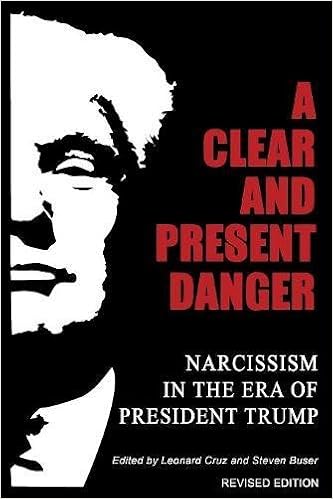
The psychiatric debate over diagnosing Trump, explained : A Clear and Present Danger: Narcissism in the Era of President Trump Paperback – February 2, 2017 by Steven Buser (Editor), Len Cruz (Editor), Jean Shinoda Bolen (Contributor) (Chiron Press)


Psychiatry’s “Goldwater Rule” has never met a test like Donald Trump
.

Photo by Chip Somodevilla/Getty Images


Ever since the primaries, it’s been something of a parlor game to weigh in on Donald Trump’s psychological state. We’re awash in armchair analyses from mental health professionals and journalists: in Atlantic cover stories, in Vanity Fair, on Twitter, and even here at Vox. The latest entry: Stat News has a report that strongly suggests Trump’s odd and deteriorating speech patterns are the result of cognitive decline, or perhaps early-stage Alzheimer’s.


And yet many of the country’s top experts on mental disorders have stayed largely silent in all these takes. Psychiatrists are not talking for a reason. The American Psychiatric Association, the leading professional organization for shrinks, has a longstanding ban on its members commenting on the mental health of public figures, called the Goldwater Rule. The rule not only forbids psychiatrists from diagnosing a public figure’s behavior without obtaining their consent or personally evaluating them but also forbids any public opining on them at all. Even if to say, “Trump doesn’t have a mental illness.”


RELATED
The psychiatrist who wrote the guide to personality disorders says diagnosing Trump is "bullshit"

Some psychiatrists are saying it’s time to rethink this core ethical guideline. The rule, they say, is acting like a gag order, preventing qualified psychiatrists from giving the public important perspective on the mental health of a president whose behavior is out of step with any other president in history.

“The public has a right to medical and psychiatric knowledge about its leaders — at least in a democracy,” Nassir Ghaemi, a Tufts University psychiatrist, recently argued at an APA conference. “Why can’t we have a reasoned scientific discussion on this matter? Why do we just have complete censorship?”


The controversy is sure to rage on, as many psychiatrists stand by the professional precedent. The rule itself has even been expanded recently. But just the existence of the debate is an incredible moment not only in the field of psychiatry but in American politics. It’s not just armchair psychiatrists who are concerned about Trump’s mental health — some of the real ones are even willing to rethink their professional ethics because of it.


The Goldwater Rule has really never met a situation quite like Donald Trump.
What is the Goldwater Rule?

In 1964, Fact magazine sent a survey questionnaire to all 12,356 members of the American Psychiatric Association, asking: “Do you believe Barry Goldwater is psychologically fit to serve as president of the United States?” Only 2,400 responded, and about half said that either Goldwater — the Republican candidate for president, who was rumored to have suffered through nervous breakdowns — was fit for the office or they didn’t know enough to make a call.


The other half? Hoo boy.

“It is ... abundantly clear to me that he has never forgiven his father for being a Jew,” one respondent wrote. “The core of [his] paranoid personality is ... his anality and latent homosexuality,” wrote another. “I believe Goldwater has the same pathological make-up as Hitler, Castro, Stalin and other known schizophrenic leaders,” wrote yet another. (Comparisons to Hitler came up a lot.)

Fact magazine called this “the most intensive character analysis ever made of a living human being.” What it was: a complete embarrassment to the field of psychiatry and the beginning of the end for Fact. After his election loss, Goldwater successfully sued the magazine for libel; the $75,000 settlement put the small publication out of business.

And the episode compelled the APA’s ethics committee to ban its members from making future diagnoses about public figures in the press.


It only applies to card-carrying APA psychiatrists. It doesn’t apply to psychologists, social workers, or New York Times columnist David Brooks. In February, a psychologist told me with deadly seriousness, “This is the worst case I have seen in my career,” regarding Trump and a diagnosis of narcissistic personality disorder.

So while claims about the president’s mental health have been made by just about every other group of person on earth, psychiatrists are discouraged from jumping in, even to correct the record.
The Goldwater Rule recently got broader

The temptation to break the Goldwater rule exists every election cycle, but it was exceptionally high in 2016. And in August, the APA issued a warning to its members, reminding them that “breaking the Goldwater Rule is irresponsible, potentially stigmatizing, and definitely unethical.” But after Trump assumed the presidency, the APA went further. This past March, the APA ethics committee reevaluated the rule — in part in response to the media interest in Trump’s mental health, and in part because APA members requested it.

The review didn’t just reaffirm the rule. The board actually published an opinion that broadens the scope of it to include all “professional opinions” about a person’s psychological state.

For instance, if a psychiatrist were to say, “Trump looks disheveled,” that could be construed as a professional opinion. “What they [the APA] essentially did was say anything that could be casual observation is now off limits to psychiatrists to comment on when it comes to public figures. ... That’s absolutely everything,” Claire Pouncey, a Philadelphia-area psychiatrist, tells me.


Let’s pause on that for a second. The ethics of my profession allow me to publicly conclude that Trump’s behavior has been “erratic at times.” But Pouncey — who has spent her professional career deeply and systematically analyzing human behavior — cannot.

Furthermore, the APA even clarified that a psychiatrist saying “a person does not have an illness” is also a “professional opinion” and in violation of the rule.

The penalty for breaking the Goldwater Rule (potentially being kicked out of the APA) also isn’t drastic as it seems. The APA is a professional organization that publishes scientific journals, puts on conferences, and provides opportunities for continuing education. It’s not a medical licensing board. You can be kicked out of the APA and still practice psychiatry. On the other hand: If you’re a doctor, being kicked out of the APA for an ethics violation would not be great publicity.

While the APA is standing by its rule and its reevaluation (APA president Maria Oquendo confirmed this to me in an email), it did set up a forum to debate it at its annual meeting in San Diego this past weekend, in which Pouncey took part. I didn’t attend, but I obtained a recording of the session.
The case for the Goldwater Rule

The primary case for keeping the Goldwater Rule is pretty simple: It protects “the integrity of our profession from members who are willing to draw judgments on the basis on information that’s incomplete,” Paul Appelbaum, a Columbia University psychiatrist and former APA president, said at the San Diego debate last weekend. There might be a few bad apples who make spurious claims about candidates, but the APA can disavow them taking cover under the rule.


But there are also a few other considerations. In its March opinion, the APA ethics board outlined three main reasons to keep the rule.
A psychiatrist should ideally conduct evaluations with the consent of person being evaluated (there are exceptions for emergencies and people in the custody of police).
Psychiatrists ought to conduct in-person evaluations before reaching their conclusions.
There’s the threat of further stigmatizing mental illness. (There are plenty of people with mental health problems who rise to powerful positions and are productive members of society. Historians like to point out that Lincoln suffered through depressive episodes.)

“We can do a great deal of public education without putting a label on people,” Appelbaum argues. “The rule ... encourages us to speak in general terms about mental disorders while underscoring our own lack of knowledge about this particular individual.”
The case against the Goldwater Rule

Pouncey, who also has a degree in philosophy and has written on the ethics of the rule, actually agrees with much of the Goldwater Rule. Personally, she doesn’t feel it is appropriate for her to comment on the mental health of the president. But she worries: If there were a case that she felt compelled to speak out on, she’d like to reserve the right to do it.

“I don’t want to use diagnoses as epithets, but if I have real concern about a possible public risk, and I really feel compelled to speak out about it, I’m going to do that,” she says.

The rule — and the revised interpretation of it — goes too far in restraining a doctor’s speech, Pouncey says. (She also points out there’s no empirical evidence to show the public discussion of a celebrity’s mental health further stigmatizes mental illness.)


Pouncey argues there are other forces to restrain doctors from making inappropriate public diagnoses that negate the need for the Goldwater Rule. One is legal. If you’re a psychiatrist who makes a suspect diagnosis that damages the reputation of an individual, well, that sounds a lot like libel. (And remember: Goldwater successfully sued for libel, with the Supreme Court making the final call) There’s also the court of public opinion. If a psychiatrist steps out of line in 2017, you can be sure there will be tweetstorms condemning him.

Overall, Pouncey wishes the APA had trust in its members to make the right determination of whether to go public with an opinion.

She’s not alone.

“The Goldwater rule is really a masterpiece in contradictions,” Jerrold Post, a psychiatrist at George Washington University who spent much of his career crafting psychological profiles of world leaders for the CIA, said at the APA meeting. The APA code of ethics encourages psychiatrists to engage with the public — but not on the one topic psychiatrists are expertly informed on.

Post laments that during the 1993 siege of the Branch Davidian cult compound in Waco, Texas, he missed an opportunity to go on the news and offer an analysis of David Koresh, the cult’s leader.

“I had been studying him for years, and saw him as a narcissistic borderline who under pressure ... could be led to seek martyrdom,” he said.


Meanwhile, the federal government was doing nothing but amping up the pressure — staging a weeks-long raid and standoff. Rather than surrender, Koresh lit the whole compound on fire, killing 76 inside. “When I believed I had something useful to say, I did not,” Post said. “That still bothers me.”

Tuft’s Ghaemi argues public discussion of politicians’ mental health doesn’t need to be stigmatizing. History has shown that some psychiatric diagnoses — like depression — imbue a leader with advantageous qualities, like increased empathy. If there’s a stigma around mental illness, he argues, it might be partly psychiatry’s fault for not highlighting this nuance.

The APA justifies the Goldwater rule by arguing doctors need to have obtained consent and have conducted in-person exams to offer a professional opinion. But Ghaemi points out doctors make exceptions to these rules all the time. One: It’s often the case that psychiatrists can’t trust their patients to be honest about their symptoms (so they have to find corroborating reports of behavior). And two: they don’t always have to obtain consent when it comes to dangerous situations (like in an emergency room.)
With so much of Trump and other public figures’ behavior logged online, the Goldwater Rule may be harder and harder to justify

It’s not 1964. And Trump isn’t Barry Goldwater.

Never before has a president come with such a massive trail of behavior to analyze, in the form of 34,000-plus tweets, hundreds of hours of TV appearances, and a huge trove of journalism documenting his actions, decisions, and lies. He also continues to behave in ways that defy historical precedent for a president — for instance, intervening over and over in an investigation into his campaign’s ties to Russia.

Donald Trump’s digital trail makes him one of the most analyzable public figures in history.


And it’s still an open question in psychiatry the extent to which our digital footprints can be used for diagnosis.

“We now have more information than ever about many politicians,” says Joshua Miller, a psychologist who directs the University of Georgia’s clinical training program. And this information, “paired with the reality that clinical interviews are not some magical source of information with regard to psychiatric disorders, suggest that diagnoses made from afar in these cases may not be inferior to diagnoses made following an in-person interview.”
Trump’s behavior could have more to do with personality than a mental health disorder

In February, I reported on a Change.org petition that’s now signed by more than 55,00 people. It’s headlined “Mental Health Professionals Declare Trump Is Mentally Ill And Must Be Removed.”

The petition struck a chord. It declared Trump has a “serious mental illness.” The petition was started by John Gartner, a clinical psychologist and former Johns Hopkins professor. He’s convinced Trump has an array of personality disorders, including narcissistic personality disorder, that make him unfit for office and a danger to the world. “I would bet my life of my children on it [the diagnosis],” Gartner told me. “That’s how confident I am.”

Gartner is not a psychiatrist, and therefore not subject to the Goldwater Rule. But was he right to diagnose Trump, considering that he had not personally evaluated him? And further, what use is it to label Trump’s behavior as pathological?

I knew Gartner could make the diagnosis. And indeed, if you go down the list of diagnosing criteria for narcissistic personality disorder — which include things like “has a grandiose sense of self-importance” and “requires excessive admiration” — it does sound a lot like Trump.

But the diagnosis was missing one hugely critical factor: suffering.

“Everyone has a personality,” Allen Frances, a psychiatrist who took part in writing the DSM, told me. “It’s not wrong to have a personality; it’s not mentally ill to have a personality. It’s only a disorder when it causes extreme distress, suffering, and impairment.” (Frances colorfully told me diagnosing Trump “is bullshit.” And to be clear, mental health researchers are deeply split on the question of whether one needs to personally suffer to be mentally ill.)

Complicating matters further: These days, most mental illnesses exist on a spectrum. “Even disorders we thought ... you either had it or not — categorical things like schizophrenia — we now know are much more like spectrum disorders,” UGA’s Miller says. “You can have some schizophrenic traits, but not all.” And that’s especially true of personality disorders, which he says are all just extreme manifestations of otherwise “normal” personality traits. The question What is a mental disorder? he says is “probably one of the most intractable debates that exists. And it’s playing out with Trump now.”

Which is to say: To an extent, a diagnosis of Trump will always fall on a matter of opinion.

If Trump’s behavior is purely the result of his personality — and not a disease --- that’s still consequential. Psychologists generally feel personality is a stable trait. And that means our past behavior predicts our future behavior. What’s more, research finds ascending the ladder of power only magnifies your personality traits, and makes you more likely to act in accordance with them. You don’t need a diagnosis to say Trump has a troubling pattern of behavior or to conclude that pattern is bound to continually repeat.

Trump has narcissistic tendencies, avoids acquiring expertise, is impatient, impetuous, and obsessed with winning, often lies, turns around on campaign promises, is running an extremely disorganized White House, and so on.

This is a clear pattern of behavior. And it’s likely to continue.
If psychiatrists could diagnose Trump, what would it accomplish?

Those who want to diagnose Trump — I believe — are doing it out of genuine concern. They don’t want someone with a disordered manner of thinking in charge of the nuclear codes.

But we also have to consider this deeply pessimistic question. And finally, there’s this thought to consider. If psychiatrists were to speak up against Trump, would it even matter?

After all, voters were well aware of his behavior, thinking style, and history before the polls opened in November. Due to partisanship, new information about a candidate tends to not actually change your behavior.

“We have a problem with narcissism, but the narcissism isn’t outside of our profession; the narcissism is within our profession,” Appelbaum said at the APA meeting. “There are very few unemployed steelworkers in Michigan whose votes would have been changed hearing me as a psychiatrist at an Ivy League university in New York opining on why I thought the candidate they were going to vote for was unbalanced.”
Posted by BardofBatYam at 6:51 AM No comments:
Email ThisBlogThis!Share to XShare to FacebookShare to Pinterest
Labels: . @stephendarori, . Stephen Darori, . The Darori Foundation, .Israel Book Review, @israelbookreview, #IsraelBookReview, #stephendarori, #stephendrus, Stephen Drus

#OyVeyDonaldTrump: The Bullshitter-in-Chief Post-Truth: HPost-Truth: Why We Have Reached Peak Bullshit and What We Can Do About it Paperback – May 25, 2017 by Evan Davis(Little Brown) How Bullshit Conquered the World Paperback – November 14, 2017 by James Ball (Biteback Publishing); The Dictionary of American Political Bullshit Paperback – October 1, 2014 by Stephen L. Goldstein (Hellgate Publishing);Crazy Sh*t Presidents Said: The Most Surprising, Shocking, and Stupid Statements Ever Made by U.S. Presidents, from George Washington to Barack Obama Paperback – May 1, 2012 by Robert Schnakenberg (Running Press)


Donald Trump’s disregard for the truth is something more sinister than ordinary lying.


Donald Trump says a lot of things that aren’t true, often shamelessly so, and it’s tempting to call him a liar.


But that’s not quite right. As the Princeton University philosophy professor Harry Frankfurt put it in a famous essay, to lie presumes a kind of awareness of and interest in the truth — and the goal is to convince the audience that the false thing you are saying is in fact true. Trump, more often than not, isn’t interested in convincing anyone of anything. He’s a bullshitter who simply doesn’t care.

In Trump's own book, Crippled America: How to Make America Great Again, our now-president describes himself in a way that Frankfurt could hold up as the quintessential example of a bullshitter. Trump writes that he’s an "I say what’s on my mind" kind of guy. Pages later, he explains that doesn’t mean he’s necessarily an honest guy.

"If you do things a little differently," he writes of the media, "if you say outrageous things and fight back, they love you." The free publicity that results from deliberately provoking controversy is invaluable. And if a bit of exaggeration is what it takes, Trump doesn’t have a problem with that. "When," he asks "was the last time you saw a sign hanging outside a pizzeria claiming ‘The fourth best pizza in the world’?!"


When Trump says something like he’s just learned that Barack Obama ordered his phones wiretapped, he’s not really trying to persuade people that this is true. It’s a test to see who around him will debase themselves to repeat it blindly. There’s no greater demonstration of devotion.


In his first and best-known book, The Art of the Deal, Trump writes a passage that is one of the most remarkable ever set to paper by a future American president. It’s deeply telling about Trump’s views on the distinction between integrity and loyalty. Trump sings the praises of Roy Cohn — Joe McCarthy’s infamous legal attack dog later turned Trump mentor:


Just compare that with all the hundreds of “respectable” guys who make careers out of boasting about their uncompromising integrity but have absolutely no loyalty. They only care about what’s best for them and don’t think twice about stabbing a friend in the back if the friend becomes a problem. What I liked most about Roy Cohn was that he would do just the opposite. Roy was the kind of guy who’d be there at your hospital bed long after everyone else had bailed out, literally standing by you to the death.


Trump, ironically, would not stand by Cohn’s deathbed as he perished of AIDS; instead, he disavowed his friend. For Trump, loyalty is a way to size up those around him, suss out friend from foe. It is not a quality he cares to embrace in his personal life. Now president, it’s the same in his political life.

The two passages taken together illuminate an important facet of Trump’s personality, and of his presidency. He’s a man who doesn’t care much about the truth. He’s a man who cares deeply about loyalty. The two qualities merge in the way he wields bullshit. His flagrant lies serve as a loyalty test.

Trump’s tactics, in a different context, would be understood as typical authoritarian propaganda — regimes often propound nonsense more to enforce expectations on their citizens than because they are expecting anyone to actually believe it. The United States isn’t the kind of place where that can work. There’s a free and vibrant press and political debate operating wholly outside the world of Trump’s bullshit. But by filling the heads of his fans — and the media outlets they consume — with a steady diet of bullshit, Trump is nonetheless succeeding in endlessly reinscribing polarization in American politics, corroding America’s governing institutions, and poisoning civic life.

Harry Frankfurt’s theory of bullshit

As Frankfurt put it in his groundbreaking essay “On Bullshit,” “one of the most salient features of our culture is that there is so much bullshit.”

Frankfurt attempts to give the term definition that distinguishes the bullshitter from the liar, with the most salient distinction being that the liar is genuinely trying to trick you.

“The bullshitter,” by contrast, “may not deceive us, or even intend to do so, either about the facts or about what he takes the facts to be.”

The liar wants to be seen as the one telling the truth. The bullshitter just doesn’t care. That’s Trump. During the course of the 2016 campaign, he said over and over again that America is “the highest-taxed nation in the world,” which isn’t even remotely close to being true. But he kept saying it, despite having been called out repeatedly, and then he said it again in a recent interview with the Economist.

Trump says, over and over again, that he won one of the greatest Electoral College landslides in history. It’s not true, it’s obviously not true to anyone who bothers to look it up or remembers any past presidential elections, and it’s not even remotely clear why it’s important. But Trump keeps on saying it.


This is just how Frankfurt defines bullshit:


For the bullshitter, however, all these bets are off: he is neither on the side of the true nor on the side of the false. His eye is not on the facts at all, as the eyes of the honest man and of the liar are, except insofar as they may be pertinent to his interest in getting away with what he says. He does not care whether the things he says describe reality correctly. He just picks them out, or makes them up, to suit his purpose.

This is a perfect portrait of a typical Trump statement. His assertions about policy matters are often so garbled as to make it nearly impossible to work out what he’s even trying to say in order to evaluate its truth or falsity.

The reason is that Trump is often completely indifferent to accuracy. His administration, like all administrations, sometimes tries to sell the public on something or other using tactics that are at times deceptive. But where he breaks from the mold is in the sheer quantity of things he seems to say for no reason at all, utterly outside the context of a planned sales pitch.

The annals of Trumpdown are simply littered with this kind of casual, fundamentally pointless falsehood:
He told the Economist that he invented the phrase “prime the pump.”
He says China stopped manipulating its currency only after he won the election.
He says “millions” of illegal voters cost him the popular vote.
He claims to have had an incredibly productive first 100 days in office.
He says labor force dropouts are counted as employed by the Bureau of Labor Statistics.
He says Germany and other NATO members owe money to the United States.

None of this is useful in moving the ball forward on any kind of policy goal. And indeed, Republicans on Capitol Hill and even in the executive branch typically groan about these outbursts of Trumpian bullshit that throw their work into chaos and tend to at least temporarily derail the GOP’s substantive goals. But Trump not only keeps bullshitting, he tends to demand that his team offer a zealous defense of whatever bullshit he happens to spout on any given day — putting staffers and legislative allies in the untenable position of defending the indefensible.

The function of bullshit in the Trump regime

Trump launched his term in office by dispatching White House press secretary Sean Spicer to deliver an inaugural press briefing dedicated to disputing clear photographic evidence about crowd size.

It seemed insane, and one popular interpretation was that Trump had, in fact, lost his marbles and simply couldn’t stand the blow to his ego implied by mocking media coverage. But George Mason University economist Tyler Cowen argues that this kind of thing can serve a strategic role.

The key issues are trust and loyalty. By asking subordinates to echo his bullshit, Trump accomplishes two goals:
He tests the loyalty of his subordinates. In Cowen’s words, “if you want to ascertain if someone is truly loyal to you, ask them to do something outrageous or stupid.”
The other is that it turns his aides into members of a distinct tribe. “By requiring subordinates to speak untruths, a leader can undercut their independent standing, including their standing with the public, with the media and with other members of the administration.”

Both of these things allow Trump to do a better job of operating in a low-trust environment. All presidents face a mild form of a principle-agent problem in which their subordinates’ interests are only imperfectly aligned with their own. In the past, presidents like Dwight Eisenhower and John Kennedy tended to solve this by selecting White House staffs full of longtime personal loyalists.

In more recent years, ideological polarization of the parties has produced what Richard Skinner calls the “partisan presidency” — White House teams are made up primarily of generic party operatives who have deep party ties that transcend their personal connection with the president. This works for a president like George W. Bush or Barack Obama because the president himself is also a long-term party loyalist who does not perceive there to be a huge divergence between the party’s priorities and his own.


Trump is clearly not a longtime Republican Party loyalist, so he can’t rely on this solution. In part, he is reaching for a personal presidency — installing, for example, his son-in-law in a senior advisory position. But an old-school personal presidency wouldn’t work for Trump. For one thing, he needs the support of congressional Republicans, which means he needs people they trust on his team. But beyond that, unlike Ike or JFK, Trump has no experience in politics or government, so a team of pure personal loyalists would have no idea what they’re doing.

He needs to operate in the context of a mostly partisan presidency, even though he knows most of the members of his party would probably prefer to see Mike Pence sitting in the Oval Office. Throwing out a constant stream of bullshit simultaneously helps the president assess whom he should regard as loyal, and also serves as a filter to increasingly bind a growing circle of politicians and political operatives to him and his family.
Post-totalitarian bullshit

Frankfurt initially wrote his essay in 1986 (it found a lay audience on the internet in the early 21st century and was published as a book in 2005) largely as an amusing observational piece about life in comfortable capitalist liberal democracies. He did not, primarily, have the practical conduct of politics in mind — though he did suggest that bullshitting about politics is a particularly common form of bullshit, he regarded it primarily as a recreational habit of citizens rather than as a governing tactic.

Eight years earlier, the Czech dissident (and later president of his country) Václav Havel wrote on a similar theme of truthlessness in “The Power of the Powerless,” taking as his backdrop the very different situation of what he called “post-totalitarian” communist dictatorships in Central Europe.

He considers the case of the grocery store manager who places in the shop window a sign emblazoned with the slogan “workers of the world unite.” The poster would have been delivered from headquarters along with the vegetables and placed in the window “simply because it has been done that way for years, because everyone does it, and because that is the way it has to be.” As Havel writes, the display of the sign surely communicates something, but it equally surely does not communicate a desire to see unity among the world’s workers:


Obviously the greengrocer is indifferent to the semantic content of the slogan on exhibit; he does not put the slogan in his window from any personal desire to acquaint the public with the ideal it expresses. This, of course, does not mean that his action has no motive or significance at all, or that the slogan communicates nothing to anyone. The slogan is really a sign, and as such it contains a subliminal but very definite message. Verbally, it might be expressed this way: "I, the greengrocer XY, live here and I know what I must do. I behave in the manner expected of me. I can be depended upon and am beyond reproach. I am obedient and therefore I have the right to be left in peace."

Yet equally crucially, the regime itself does not post these signs in the hopes of convincing anyone of anything, or of conveying any kind of meaningful information about the world. The sign — the slogan itself — is mere bullshit. But according to Havel, it serves an important function:


The greengrocer had to put the slogan in his window, therefore, not in the hope that someone might read it or be persuaded by it, but to contribute, along with thousands of other slogans, to the panorama that everyone is very much aware of. This panorama, of course, has a subliminal meaning as well: it reminds people where they are living and what is expected of them. It tells them what everyone else is doing, and indicates to them what they must do as well, if they don't want to be excluded, to fall into isolation, alienate themselves from society, break the rules of the game, and risk the loss of their peace and tranquility and security.

Trumpian bullshit involves the transplantation of the kind of social and political role that Havel envisioned into a society that is much closer to the one Frankfurt lived in. Nobody in America is coerced into parroting the Trumpian line, and indeed, elements of the media that lie outside the Trumposphere appear to be prospering and flourishing under his regime.

But it is still true that Trumpian bullshit serves not only as a test of elite loyalty, but as a signifier of belonging to a mass audience. One chants, “Lock her up,” at a rally not to express a desire or expectation that Hillary Clinton will serve jail time for violating an obscure State Department guideline, but simply because to be a certain kind of member of a certain kind of community these days requires the chant.


The big, beautiful wall that Mexico will allegedly pay for, the war on the “fake news” media, Barack Obama’s forged birth certificate, and now the secret tape recording that will destroy James Comey are not genuine articles of faith meant to be believed in. Their invocation is a formalism or a symbol; a sign of compliance and belonging. The content is bullshit.
Bullshit as a coping mechanism

Critically, though bullshit plays a genuine functional role for the Trump regime, there is no particular reason to believe its adoption as Trump’s primary rhetorical mode is a strategic choice. Trump is wildly unfit for the presidency in obvious and well-known ways, including, critically, a total lack of knowledge of or interest in any area of public policy.

Trump lacks the knowledge to govern, the patience to learn how to govern, or the humility to admit it. Consequently, he bullshits, telling Time that he “only needed a short time to understand everything about health care” and the Economist that his tax cut plan doesn’t benefit the rich because “I mean I can tell you this, I get more deductions, they have deductions for birds flying across America, they have deductions for everything.”

As Frankfurt writes:


Bullshit is unavoidable whenever circumstances require someone to talk without knowing what he is talking about. Thus the production of bullshit is stimulated whenever a person’s obligations or opportunities to speak about some topic are more excessive than his knowledge of the facts that are relevant to that topic. This discrepancy is common in public life, where people are frequently impelled whether by their own propensities or by the demands of others to speak extensively about matters of which they are to some degree ignorant.

Nobody, needless to say, could actually have predicted Trump’s ascension to the presidency. But Frankfurt’s 30-year-old analysis perfectly forecasts the consequences of electing a profoundly ignorant man to the most powerful political office in the world — an unprecedented explosion of bullshit.

The president bullshits because he is ignorant. But his aides, in order to manipulate Trump into governing in ways they find reasonable or ideologically congenial or both, must echo his bullshit to prove their loyalty. This winds up creating substantial levels of second-order bullshit as flunkies pony up an outlandish series of pro-Trump claims — claims that are then echoed in a large and vibrant ecosystem of pro-Trump media.

This sphere of bullshit ultimately ends up encompassing not only flunkies like Sean Spicer and Kellyanne Conway but aides such as Deputy Attorney General Ron Rosenstein or National Security Adviser H.R. McMaster, who entered Trump’s service with sterling reputations yet inevitably find themselves fronting for one form or another of flimflam.
Trump’s bullshit is contagious

For somebody who is so poorly informed, Trump is by all accounts a voracious news consumer. Shane Goldmacher reports for Politico that on a typical morning, “Trump reads through a handful of newspapers in print, including The New York Times, New York Post, The Washington Post and The Wall Street Journal — all while watching cable news shows in the background.”

He watches, most of all, to see who is defending him zealously. The Washington Post reports that in the wake of Comey’s firing, Trump “sat in front of a television watching cable news coverage of” the firing and “noticed another flaw: Nobody was defending him.” As a result, he was “irate” and “pinned much of the blame on Spicer and [White House Communications Director Michael] Dubke’s communications operation,” even as allies of Spicer and Dubke complained to the press that it was unreasonable to expect them to have a surrogate strategy to roll out when Trump had given them no advance notice of the move.

But the president doesn’t want a well-planned communications strategy; he wants people who’ll leap in front of the cameras to blindly defend whatever it is he says or does.

And because he’s the president of the United States, plenty of people are willing to oblige him. That starts with official communicators like Spicer, Conway (who simultaneously tries to keep her credibility in the straight world by telling Joe Scarborough she needs to shower after defending Trump), and Sarah Huckabee Sanders. But there are also the informal surrogates. Trump is tapping Callista Gingrich to serve as his ambassador to the Holy See, an honor that Jonathan Swan reports he was initially reluctant to grant “because he likes seeing her husband Newt defending him on TV.” When reassured that there would be a satellite link for Newt in Rome, Trump agreed.

House Intelligence Committee Chair Devin Nunes embarrassed himself but pleased Trump with a goofy effort to back up Trump’s wiretapping claims. Treasury Secretary Steve Mnuchin, who certainly knows better, sat next to Trump in an Economist interview and gave him totally undeserved credit for intimidating the Chinese on currency manipulation. Commerce Secretary Wilbur Ross hailed a small-time trade agreement with Chinaconsisting largely of the implementation of already agreed-upon measures as “more than has been done in the whole history of U.S.-China relations on trade.”

This kind of bullshit, like Trump’s, couldn't possibly be intended to actually convince any kind of open-minded individual. It’s a performance for an audience of one. A performance that echoes day and night across cable news, AM talk radio, and the conservative internet.
The growing bullshit zone threatens reality

Havel’s post-totalitarian bullshit would be reinforced and undergirded by a state-controlled media apparatus. In Peter Pomerantsev’s evocative phrase about media and society in Vladimir Putin’s Russia, in such a place, “nothing is true and everything is possible.”

Trump’s America is, obviously, not like that. The United States lacks a major state-run broadcast agency, and PBS television is more likely to show you old episodes of British TV shows than government propaganda. America has a large and vibrant independent media sector that is, if anything, prospering financially as a result of Trump’s ascension to power.

What we have instead is Fox News, Sean Hannity, Rush Limbaugh, and other talkers — a constellation of conservative-themed commercial mass media outlets that decided during the 2016 primary that ratings were more important than ideology and that now serve as a nonstop amen chorus for the White House.

Slate’s Will Oremus wrote on May 10 that “Fox News is covering James Comey’s firing from an alternate reality”:


No one familiar with the network's popular prime-time opinion shows will be surprised to know that they responded to the news unanimously with full-throated Trump boosterism. But even a jaded Sean Hannity viewer might have been brought up short by just how hard he spun the Comey firing throughout the course of his 10 p.m. show. The FBI director had been blasted by Hillary Clinton supporters for publicizing the agency’s investigation into her emails at the height of the presidential campaign — a criticism echoed in the memo from Deputy Attorney General Rod Rosenstein that Trump used to justify Comey’s dismissal. Yet Hannity suggested that Comey’s real failing was that he let Clinton off the hook. The host called him “a national embarrassment” who “has failed you, the American people, on a spectacular level” by not going after Trump’s election rival more aggressively. Hannity closed his show with what he called “the most important question of the night”: With Comey gone, will Clinton finally face the criminal prosecution she deserves? All three members of his expert panel proceeded to agree that she was a felon who should be indicted, though they differed on whether that would actually happen.

Bill Kristol, the veteran conservative operative and longtime proprietor of the Weekly Standard, told a Mediaite podcast that the tenor of Fox’s Trump coverage is “ridiculous, honestly, and depressing.”

National Review’s Kevin Williams has been in a long-running Twitter feud with Hannity, in which the more thoughtful and more ideology-oriented writer calls the radio host and television personality a “sycophant” who is also “dumb and dishonest and has no self-respect” (he is not wrong).


Follow

Kevin D. Williamson @KevinNR


The problem with Hannity is that he is dumb and dishonest and has no self-respect. https://twitter.com/breathtkinan/status/863016427481174018 …
5:33 PM - 12 May 2017

8484 Retweets
321321 likes
Twitter Ads info & Privacy


Follow

Kevin D. Williamson @KevinNR


He's a sycophant. He does what sycophants do, that's all. https://twitter.com/MarshallLocke/status/863097803760779264 …
9:46 PM - 12 May 2017

1717 Retweets
8282 likes
Twitter Ads info & Privacy


Rush Limbaugh opened his May 15 show, by denouncing all interest in the Comey story as just a feeble effort to take down the president, arguing that “the real Watergate comparison here would be Barack Obama ordering the FBI to spy on Republican campaigns, maybe not just Trump’s.”

CNN long ago sidelined its normal roster of conservative pundits in favor of reliable Trump defenders Jeffrey Lord and Kayleigh McEnany. George Will lost his contract with Fox Newsin favor of a new gig on MSNBC. Trump critic Bret Stephens is gone from the Wall Street Journal op-ed page and over to the New York Times, while over at the Journal, you can read Daniel Henninger explain that the Clintons are to blame for Comey’s firing.
In the United States of Bullshit, anything can happen

For Trump, the constant bullshitting serves as a highly effective filter. Senators like John McCain and Ben Sasse, who’ve overwhelmingly voted with Trump when it counts, have nonetheless refused to echo his bullshit — proving their integrity to the world and their disloyalty to Trump. But formerly obscure figures such as Lord and Nunes who’ve proven their subservience to Trump are on the upswing, while other longtime players in conservative politics are debasing themselves on Trump’s behalf.

“Since his selection as vice president,” Abby Phillip writes at the Washington Post, “[Mike] Pence has been unflagging in his loyalty and deference to Trump. But in return, the president and White House aides have repeatedly set Pence up to be the public face of official narratives that turn out to be misleading or false.”

The upshot is a conservative movement and a Republican Party that, if Trump persists in office, will be remade along Trumpian lines with integrity deprecated and bullshit running rampant. It’s clear that the owners and top talent at commercial conservative media are perfectly content with that outcome, and the question facing the party’s politicians is whether they are, too.

The common thread of the Trumposphere is that there doesn’t need to be any common thread. One day Comey went soft on Clinton; the next day he was fired for being too hard on her; the day after that, it wasn’t about Clinton at all. The loyalist is just supposed to go along with whatever the line of the day is.

This is the authoritarian spirit in miniature, assembling a party and a movement that is bound to no principles and not even committed to following its own rhetoric from one day to the next. A “terrific” health plan that will “cover everyone” can transform into a bill to slash the Medicaid rolls by 14 million in the blink of an eye and nobody is supposed to notice or care. Anything could happen at any moment, all of it powered by bullshit.
Posted by BardofBatYam at 6:06 AM No comments:
Email ThisBlogThis!Share to XShare to FacebookShare to Pinterest
Labels: .Israel Book Review, .Israel Book ReviewI, @israelbookreview, @stephendarori, #IsraelBookReview, #stephendarori, #stephendrus, Stephen Darori, Stephen Drus
Newer Posts Older Posts Home
Subscribe to: Comments (Atom)

About Me

BardofBatYam
View my complete profile

Blog Archive

  • ►  2018 (4496)
    • ►  December (1)
    • ►  November (21)
    • ►  October (324)
    • ►  September (576)
    • ►  August (448)
    • ►  July (430)
    • ►  June (436)
    • ►  May (834)
    • ►  April (823)
    • ►  March (302)
    • ►  February (187)
    • ►  January (114)
  • ▼  2017 (1441)
    • ►  December (73)
    • ►  November (67)
    • ►  October (121)
    • ►  September (268)
    • ►  August (83)
    • ►  July (73)
    • ►  June (112)
    • ▼  May (249)
      • Two Tales Paperback – October 1, 2014 by S.Y. Agno...
      • Unusual Bible Interpretations: Ruth, Esther, Judit...
      • Unexpected Israel: Stories You Never Read in the M...
      • The Israel Warrior: Fighting Back for the Jewish S...
      • "Defensive Shield: An Israeli Special Forces Comma...
      • Defensive Shield: An Israeli Special Forces Comman...
      • Table Against Mine Enemies: Israel on the Lawfare ...
      • Einstein’s Beets An Examination of Food Phobias B...
      • The psychiatric debate over diagnosing Trump, expl...
      • #OyVeyDonaldTrump: The Bullshitter-in-Chief Post-...
      • How to Read Medieval Art (The Metropolitan Museum ...
      • Pergamon and the Hellenistic Kingdoms of the Ancie...
      • Max Beckmann in New York Hardcover – November 8, 2...
      • Economics and Free Markets: An Introduction (Liber...
      • City of Lions By Józef Wittlin, Philippe Sands Pu...
      • The Fall of the House of FIFA: The Multimillion-Do...
      • All the Presidents' Gardens: Madison’s Cabbages to...
      • How do Worms Work? By Guy Barter Mitchell Beaz...
      • That Swing Poems, 2008–2016 By X. J. Kennedy Pub...
      • The Complete Book of Vegetables, Herbs and Fruit ...
      • Botanicum By Katie Scott and Kathy Willis Big ...
      • The Ethics of Liberty by Murray N. Rothbard , Han...
      • Democracy doesn't automatically mean Freedom: No I...
      • 1984 Paperback – Deckle Edge, May 6, 2003 by Georg...
      • Pergamon and the Hellenistic Kingdoms of the Ancie...
      • Jews in Poland and Russia: A Short History (Littma...
      • Yankel's Tavern: Jews, Liquor, and Life in the Kin...
      • Facebook For Dummies 6th Edition by Carolyn Abram ...
      • #OyVeyDonaldTrumpet and The Meaning of "Asshole".....
      • Assholes: A Theory Hardcoverby Aaron James (Nichol...
      • Assholes: A Theory of Donald Trump ( Anchor Books ...
      • Land for Peace Catch 67 Israel is not facing a dil...
      • Isaac the Alchemist: Secrets of Isaac Newton, Reve...
      • Valentin de Boulogne: Beyond Caravaggio an exhi...
      • Six Day War.... 50 years of legal issues related t...
      • The Purse and the Sword: The Trials of Israel's Le...
      • The Rise of Adolf Hitler: Hitler: Ascent 1889–1939...
      • Adolf Hitler and the Rise of Nazism and Muslims Is...
      • The End of Progress: Decolonizing the Normative F...
      • Theory of the Border. Thomas Nail. Oxford Universi...
      • Strangers in Our Midst: The Political Philosophy o...
      • Martin Luther and Renaissance and Reformation: Ge...
      • The End of the Soviet Was It Pushed Or Did It Fall...
      • Reflections on the Revolution In Europe: Immigrati...
      • Hebron ....the conflict in a nutshell :Lives in Co...
      • Brobot Bedtime.written by Sudipta Bardhan-Quallen,...
      • The Israeli Solution: A One-State Plan for Peace i...
      • According to a Source by Abby Stern (Thomas Dunne)
      • Park Chung Hee and Modern Korea: The Roots of Mili...
      • Facebook and the Rise of Trumpetism and the Elect...
      • Why the Two State Solution is destined to fail mis...
      • A Path to Peace: A Brief History of Israeli-Palest...
      • Why Art Photography?by Lucy Soutter Paperback
      • The Quilts of Gee's BendJun 13, 2017 by Susan Gold...
      • The Fence and the Bridge: Geopolitics and Identity...
      • Thinking Like a Political Scientist: A Practical G...
      • The Booming Post Great Recession Economy has absol...
      • Alexander Haig's Strategic Consensus Approach to F...
      • Magpie Murders by Anthony Horowitz June 2017. 464p...
      • Before I Wake Up written and illustrated by by Br...
      • Beyond the Plate: Top Food Blogs from around the W...
      • The Egg written and illustrated by BrittaTeckentru...
      • Immigration Detention: The Migration of a Policy a...
      • The Historical Atlas of New York City, Third Editi...
      • Living on the Margins: Undocumented Migrants in a ...
      • Lonely Planet's Ultimate Travelist, (Lonely Planet)
      • Refuge: Transforming a Broken Refugee System. Alex...
      • New York School Painters & Poets: Neon in Daylight...
      • Joe Brainard: I RememberFeb 15, 2001 by Ron Padget...
      • , Proper Names by Michael Ned Holte, (Golden Spike...
      • What Art Is by Arthur C. Danto, (Yale University P...
      • Charles AtlasFeb 3, 2015 by Stuart Comer and Dougl...
      • Restisting #OyVeyDonaldTrump's America :Poetry How...
      • The Role of Economic Advisors in Israel's Economic...
      • 50th Anniversary of the 1967 War : Nasser's Legacy...
      • Move Fast and Break Things: How Facebook, Google, ...
      • The False Difference Between the Right and the Lef...
      • OPTION B Facing Adversity, Building Resilience, an...
      • Transitioning from Yom Hashoah to Yom Haatzmaut : ...
      • The Godless State of Israel :The Making of Modern ...
      • A guide to the wilder ways in which some of us enj...
      • Future Sex: A New Kind of Free Love Hardcover – Oc...
      • Fake news and its corrosive impact on western demo...
      • Hitler's American Model by James Q.Whitman ( Princ...
      • 50 years of Israeli Occupation:Beware Tyranny of t...
      • U2: Past, Present, Future by Ernesto Assante Hardc...
      • The Legacies of President Bill Clinton ,,,,,Inside...
      • REMEMBERING J.F.K. On the centenary of his birth, ...
      • Richard Nixon's Court ....The Long Reach of the Si...
      • The Financial Diaries: How American Families Cope ...
      • The Age of Noise in Britain: Hearing Modernity. Ja...
      • Syrian President Bashar al-Assad: Facing down rebe...
      • Menachem Begin and The Rise of Right Wing in Isra...
      • Liar Liar Your Pants are on Fire.#OyVeyDonaldTrump...
      • #OYVeyDonaldTrump introduces a new brand of chaos ...
      • Shakespeare and the JewsMar 8, 2016 by James Shapi...
      • The Rise and Fall of American Growth: The US Stand...
      • Where Poppies Blow John Lewis-Stempel (Weidenfeld ...
      • Lost England: 1870-1930 Hardcover – October 31, 20...
      • How Keynes overwhelmed Hayek....Nicholas Wapshott ...
    • ►  April (140)
    • ►  March (101)
    • ►  February (94)
    • ►  January (60)
  • ►  2016 (252)
    • ►  December (10)
    • ►  November (10)
    • ►  October (37)
    • ►  September (32)
    • ►  August (31)
    • ►  July (19)
    • ►  June (11)
    • ►  May (35)
    • ►  April (48)
    • ►  March (16)
    • ►  February (3)
  • ►  2014 (1)
    • ►  August (1)
Simple theme. Powered by Blogger.