Showing posts with label The Darori Foundatin. Show all posts

Wednesday, August 9, 2017

Latino City: Urban Planning, Politics, and the Grassroots. Erualdo R. González. Routledge. 2017.


A little over 50 years ago the word ‘gentrification’ was coined by Ruth Glass, resulting in a research field that has traced this phenomenon to identify its agents, effects and contexts. In recent years, the discussion of gentrification has become more prominent in the popular press as tensions have risen due to the threat of displacement and cultural erasure. In his book, Latino City: Urban Planning, Politics, and the Grassroots, Erualdo R. González engages in the gentrification debate by focusing on Latino urbanism, which he defines as: ‘a theoretical and practical approach to community development and planning policy that seeks to understand how socio-economic and political change affects the nature and functioning of cities with large Latina/o populations over time’ (1). Placing a focus on his positionality as a resident of Santa Ana, California, González presents a critical and nuanced analysis of gentrification in which he urges academics to consider how racist and elitist ideologies play a role in the spatial alienation of predominantly poor neighbourhoods of colour – specifically Latina/o neighbourhoods.

Through an analysis that incorporates racial, intra-ethnic and class dimensions, Latino City offers a study of gentrification that pays attention to the ways that power operates in its processes. In short, gentrification is not a natural, neutral or inevitable process of an urban city. The author uses mixed and community-based methods to conduct his case study on Santa Ana gentrification, ranging from participant observation in a grassroots organisation to archival research on community organising as well as the city’s redevelopment documentation from 1958 to 2015. Ultimately, González argues that planners (i.e. elected and appointed officials, developers and civic leaders) use gentrification to benefit an imagined future for the white middle-and upper-middle-class population.

There is no clear answer in the dominant gentrification literature as to who is responsible for gentrification processes. In recent years, scholars like Neil Smith (2002) have pointed out that the term ‘gentrification’ has all but disappeared from official city documentation to be replaced by words like ‘revitalisation’, ‘renaissance’ and ‘redevelopment’. What has not disappeared, however, is the anti-ethnic rhetoric used to justify the process of gentrification in neighbourhoods made up of people of colour. González presents two major insights into the gentrification of the Latina/o neighbourhood of Santa Ana. First, he shows the ways that city planners strategically erase or minimise the existing Latina/o population in Santa Ana, thereby making ‘gentrification’ and the ultimate displacement of Latina/o bodies more palatable for the city to approve. Second, he focuses on the ways that grassroots organisations fight the city’s erasure of their neighbourhoods by placing their Latina/o identity at the forefront of political activism.
Image Credit: (Loco Steve CC BY 2.0)

The first half of the book highlights how the city planners actively worked on the revitalisation of Santa Ana while simultaneously failing to present Latina/o population in their future vision for the city. González instantiates this when he describes the influx of Mexican and Mexican-American people to the city of Santa Ana, specifically in the downtown commercial zone established in the 1970s, which became known as La Cuatro (the Spanish translation of Fourth Street). In Chapter One, the author connects the creation of La Cuatro with rampant white flight. Overall, this set the precedent for city officials to have grown weary of the decline in consumer power with regards to the new citizens of Santa Ana: ‘the city’s assessments of the downtown sales tax revenue during the 1960s and 1970s almost always involved brief qualitative assessments of an underperforming zone, accompanied with mentions of blight’ (25, my emphasis). The focus on ‘blight’ lead to the creation of the Downtown Santa Ana Development Plan (DSAPD), a 1974 report that specifically targeted La Cuatro and Latina/o neighbourhoods in Santa Ana for possible redevelopment.

Through the analysis of the DSAPD, it becomes clear that the Latina/o business districts and neighbourhoods were labelled by the city as hostile and unsafe spaces. The report ‘vilified the area and local community’, since it placed the dangers within Latina/o bodies by categorising the Latina/o barrios as areas for ‘winos and prostitutes’, ‘illegals’, a ‘high transient population’ and ‘crime association’ (29). Due to this correlation between ‘illegals’ and ‘criminals’ and Latina/o neighbourhoods, ‘the DSADP’s final assessment […] erases mention of families and residents living in and around the downtown and privileges civic professionals to reap from redevelopment’ (30). Through this analysis of city planning texts like DSAPD, Gonzalez highlights the inherent racist ideologies embedded in future city economic prosperity. This racial tension set the foundation for local grassroots organisations to present their Latina/o identity at the centre of their opposition.

In the second half of the book, the author places greater emphasis on the grassroots organisation with an anti-gentrification agenda – specifically, the Santa Ana Collaborative for Responsible Development (SACReD). Chapter Three sets the stage for these anti-gentrification organisations through the rise of two redevelopment projects that aimed to compete with La Cuatro: the ‘Artists Village’ and the ‘East End’. These two projects, adjacent to La Cuatro, became the city’s initial attempt to redevelop the city by directly competing with the existing Latina/o business district. It is because of these strategic redevelopment projects that González claims the city sought to redevelop for an imagined future white middle- and upper-middle-class population rather than the Latina/o population already in Santa Ana. Beyond there being no mention of the Latina/o population benefiting from the redevelopment plans, there is also no account of the socioeconomic profile of the Latina/o neighbourhoods. Furthermore, there is no mention of the barrio history and of obtaining community perspectives on future development projects. Finally, the DSADP does not mention La Cuatro in its future vision of Santa Ana. Erasing the staple Latina/o commercial zone thus erases the ‘area’s well established identity’ (77). Instead, ‘the plan prioritises and normalises the need to attract new residents from the county’ (78).

This intentional erasure of the Santa Ana Latina/o population from the DSADP’s future imagined city is what drives SACReD to centre their activism around the ‘Mexican/Latina/o and working-class community identity’ as a ‘critical and primary feature’ of their activism (93). By doing so, the group emphasises ‘responsible development, which it defined as the inclusion of residents, local community-based organisations, and businesses as equal partners and decision-makers in development negotiations’ (94). Still, I would have wanted the author to present the ways that some Latina/o businesses used Latina/o identity as a commodity rather than as a critical contestation to redevelopment. For instance, in Chapter Two, González mentions a couple of cases against Santa Ana redevelopment, one of which was put forth by local businessperson, Robert Escalante. González notes that Escalante recently purchased a business property; however, when given the notice of eminent domain, Escalante pitched the idea of a ‘Fiesta Marketplace’, a proposed ‘ethnic-themed festival public-private open mall shopping centre’ (52), to protect his business interests. In this case, González stops short of fleshing out the ways Escalante commodified Latina/o aesthetics in order to secure the safety of his own business.

Ultimately, Latino City provides scholars and students interested in gentrification research with an introspective analysis of gentrification from the viewpoint of displaced populations. González presents a convincing study that links spatial alienation and city redevelopment initiatives infused with racist and elitist discourse. An explicitly clear statement connecting Santa Ana gentrification to the wider and continued gentrification of targeted neighbourhoods of colour in the United States (i.e. in Los Angeles, Chicago, New York and so forth) would have been a great way to connect this micro case study to larger patterns of displacement. Nonetheless, this book is a must for students and academics interested in gentrification and Latina/o anti-gentrification grassroots organisations.

Sunday, June 4, 2017

Black Flags The Rise of ISIS By Joby Warrick Illustrated. 344 pages. Doubleday. $28.95.


In the last month, terror attacks that left 130 dead in Paris and 43 dead in Beirut and took down a Russian airliner with 224 people aboard have made the entire world horribly aware that the Islamic State not only seeks to establish a caliphate in Syria and Iraq, but also is beginning to export its monstrous savagery abroad. Although the Islamic State has been in the headlines for only two years, and its metastasis has been alarmingly swift, the seeds of the group — in its many incarnations — were planted many years ago, as Joby Warrick’s gripping new book, “Black Flags,” makes clear.

Mr. Warrick, a reporter for The Washington Post and the author of the 2011 best seller “The Triple Agent,” has a gift for constructing narratives with a novelistic energy and detail, and in this volume, he creates the most revealing portrait yet laid out in a book of Abu Musab Al-Zarqawi, the founding father of the organization that would become the Islamic State (also known as ISIS or ISIL).

Although this book owes some debts to Jean-Charles Brisard’s 2005 book, “Zarqawi: The New Face of Al Qaeda,” Mr. Warrick places that material in context with recent developments and uses his own copious sources within the United States and Jordanian intelligence to flesh out Mr. Zarqawi’s story and the crucial role that American missteps and misjudgments would play in fueling his rise and the advance of the Islamic State.

Perhaps emulating the approach Lawrence Wright took in “The Looming Tower,” his masterly 2006 account of the road to Sept. 11, Mr. Warrick focuses parts of this book on the lives of several individuals with singular, inside takes on the overarching story. They include a doctor named Basel al-Sabha, who treated Mr. Zarqawi in prison; Abu Haytham, who ran the counterterrorism unit of Jordan’s intelligence service and fought the Islamic State in its various guises for years; and Nada Bakos, a young C.I.A. officer who became the agency’s top expert on Mr. Zarqawi. This narrative approach lends the larger story of the Islamic State an up-close-and-personal immediacy and underscores the many what-ifs that occurred along the way.

In “Black Flags,” Mr. Zarqawi comes across as a kind of Bond villain, who repeatedly foils attempts to neutralize him. He was a hard-drinking, heavily tattooed Jordanian street thug (well versed in pimping, drug dealing and assault), and when he found religion, he fell for it hard, having a relative slice off his offending tattoos with a razor blade.


Abu Musab al-Zarqawi, the founding father of the group that would become the Islamic State.CreditDepartment of Defense, via Getty Images

He traveled to Afghanistan in 1989 to wage jihad; during a stint in a Jordanian prison, he emerged as a leader known and feared for his ruthlessness as an enforcer among Islamist inmates. He began thinking of himself as a man with a destiny, and in the aftermath of the American invasion of Afghanistan in 2001, he set up a small training camp in Iraq’s northeastern mountains, near the Iranian border.

At this point, Mr. Zarqawi was just a small-time jihadist. But then, Mr. Warrick writes, “in the most improbable of events, America intervened,” declaring — in an effort to make the case for ousting Saddam Hussein — that “this obscure Jordanian was the link between Iraq’s dictatorship and the plotters behind the September 11, 2001, terrorist attacks.” As C.I.A. analysts well knew, this assertion was false; in retrospect, it would also have the perverse effect of turning Mr. Zarqawi into “an international celebrity and the toast of the Islamist movement.” Weeks later, when United States troops invaded Iraq, this newly famous terrorist “gained a battleground and a cause and soon thousands of followers.”

Accused by the Bush administration of being in league with Saddam Hussein, Mr. Zarqawi would use the Americans’ toppling of the dictator to empower himself. He was a diabolical strategist, and he quickly capitalized on two disastrous decisions made by the Americans (dissolving the Iraqi Army and banning Baath Party members from positions of authority), which intensified the country’s security woes and left tens of thousands of Iraqis out of work and on the street. Soon, former members of Mr. Hussein’s military were enlisting in Mr. Zarqawi’s army; others offered safe houses, intelligence, cash and weapons.

While the Bush White House was debating whether there even was an insurgency in Iraq, Mr. Zarqawi was helping to direct the worsening violence there, orchestrating car and suicide bombings and shocking beheadings. He also used terrorism to change the battlefield, fomenting sectarian hatred between the Shiites and the disenfranchised and increasingly bitter Sunnis, guaranteeing more chaos and discrediting the electoral process.
Mr. Zarqawi’s penchant for ultraviolence had won him his favorite moniker, “the sheikh of the slaughterers,” but by mid-2005, his bloodthirstiness and killing of Shiite innocents worried Al Qaeda’s leadership, which warned him that “the mujahed movement must avoid any action that the masses do not understand or approve.”

After many narrow escapes, Mr. Zarqawi was finally killed by a United States airstrike in June 2006, and over the next few years, the United States managed to decimate much of his organization. Still, dangerous embers remained, and they would burst into flames under the group’s new leader, Abu Bakr al-Baghdadi, who shared Mr. Zarqawi’s taste for gruesome violence, and who had built up a valuable network of supporters while serving time in Camp Bucca, a United States-controlled prison known as a “jihadi university” for its role in radicalizing inmates. The sectarianism of the Iraqi prime minister Nuri Kamal al-Maliki drove increasingly marginalized Sunnis into the embrace of the Islamic State — a dynamic hastened by the withdrawal of American troops in 2011. Meanwhile, in Syria, the chaos of civil war created perfect conditions for the Islamic State’s explosive growth and a home base for its self-proclaimed caliphate.

The final chapters of this volume have a somewhat hurried feel. In fact, more detailed examinations of the rise of Mr. Baghdadi, the Islamic State’s sophisticated use of social media, and its efforts to displace Al Qaeda as the leader of global jihad can be found in two illuminating recent books: “ISIS: Inside the Army of Terror,” by Michael Weiss and Hassan Hassan, and “ISIS: The State of Terror,” by Jessica Stern and J. M. Berger. But for readers interested in the roots of the Islamic State and the evil genius of its godfather, Abu Musab Al-Zarqawi, there is no better book to begin with than “Black Flags.”


Covenant & Conversation Numbers: The Wilderness YearsMay 1, 2017 by Jonathan Sacks (Maggid)


Rabbi Jonathan Sacks tell us that the Book of Numbers is a key test to understand the forty years of the Children of Israel’s wandering in the desert as they make their way to the land of Israel. This narrative of “the long walk to freedom” shows that there is no quick way and no shortcut to freedom and one must pass certain tests in order to reach the goal. Numbers sets out warnings that are to be experienced before freedom can be achieved and therefore, even though we do not see much hope at first, we realize that this is indeed a book about hope. We are moving toward the end of the Torah just as the wanderers are moving closer to entering the land. They are no longer close to the narrow place and the oppression that they have left behind and must be prepared to enter the land while considering how it is to be governed.

If we look at a map we see that the distance but this time on the desert between Egypt and Israel is not great yet it is very important in that it gives the children of Israel time to forget the slavery and oppression of their former home. We begin to understand that this is why the journey takes so long. While the trek is arduous physically, this is also a psychological, moral, and spiritual journey Forty years is considered to be a generation during which people change. To achieve freedom after slavery requires adaptation and we see that we do not achieve freedom just by reaching it. Mindsets and habits must be changed and God wants us to be sure that we are ready for freedom and liberty. As the children of Israel become a nation, they have new responsibilities and these include dealing with self-restraint, courage, and patience. Without that, a journey of a few hundred miles can take forty years. We indeed understand that even as they enter the land, the journey is still at the beginning.

Like in his three other Torah commentaries, Genesis, Exodus and Leviticus, Rabbi Sacks provides several looks at each Torah portion and I feel that the has left no stone unturned. He provides us with a lot to think about and to me that is the beauty of the Five Books of Moses.

The Scarlet Pimpernel Paperback by Baroness Orczy Emmuska Orczy (Simon & Schuster)


Call me a hopeless romantic, but, more decades ago than I care to admit, I was smitten with this book and the 1982 film adaptation of it. I home-school our daughter now, and she is the age I was (12) when first introduced to this book, so I decided to give it a re-read and let her enjoy it for her last week of school. As an adult, and a fairly no-nonsense one at that, I was happily surprised with how the story enchanted me once more, and my daughter could not put it down, either. Set against the backdrop of the French Revolution, the hero (a mysterious character known only as "The Scarlet Pimpernel") daringly uses various disguises and other strategies to rescue aristocrats otherwise destined for Madame Guillotine. The book is full of intrigues and wranglings with questions like whether or not one life would be more valuable than another if it comes down to a choice. It has inspired plenty of good discussions in our home about the French Revolution, what it means to behave in a noble manner, and "what would you do" if you were in the position of Marguerite, a woman who must choose between the life of her beloved brother and the life of The Scarlet Pimpernel.

 The villain of the story, Chauvelin, tragically plays too close to the reality one can see around the world today...someone supposedly driven by ideals that seem noble in the abstract but show themselves to be nothing more than a sorry excuse to commit evil atrocities and violence in reality. Not only are we challenged to peek behind the mask to discover the identity of The Scarlet Pimpernel, but we are challenged to peek behind the mask of virtuous ideas used to cover the reality of extremism and hate. The story is old-fashioned in its sensibilities, so if you have no tolerance for that, you will not enjoy the adventure. Like any good story, it is very entertaining and goes down easily, but it has some treasured solid nuggets to ponder for those so inclined. It was a breath of fresh air for me to re-visit this fun but solid read, which promotes virtues like courage and self-control--the promotion of which I generally observe to be lacking in most popular entertainment today.

Saturday, June 3, 2017

Migrant, refugee, smuggler, saviour by Peter Tinti and Tuesday Reitano (Hurst, ISBN 9781849046800)


The real villains of the migration crisis are the smugglers, right? They are the ones who cram hapless refugees into unseaworthy boats or airless containers, who extort and exploit, right?

Think again. Or maybe, just think. Which is what Peter Tinti and Tuesday Reitana get us to do with their eye-opening investigation. The authors, who work with the Global Initiative Against Transnational Organized Crime, present a complex and nuanced picture, a spectrum of those involved in the people-smuggling industry, from the trusted ‘family business’ networks, to the less common, but more publicized, evil cartels and criminal gangs.

Through personal stories, they show us refugees who are grateful to their smugglers; a good reputation is good for business. The smuggling industry is meeting a global demand. But, as the writers observe: ‘In a neoliberal world… it is often the criminals who help the most desperate of us.’

There are also truly evil bastards who rape and exploit and torture and kill. And, ironically, in a world full of unintended consequences, it is these violent operators that are benefiting from ‘tougher’ policies. Only they have the finance, logistics and ruthlessness to get around higher barriers and increased ‘criminal justice solutions’ that target smugglers.

The authors are clear that the current international system is broken, and only policies that address the demand for passage from zones of war and poverty into ones that offer greater security offer the slightest hope of success.

Tinti and Reitano also expose the cynical conflation of smuggling (getting people from a to b) with trafficking (slavery) as ‘hoping to operationalize universal disapproval of human trafficking to gain support for policies that are really intended to stem migrant and refugee flows’.

Powerful analysis, groundbreaking research, vividly and journalistically expressed. This is a must-read for policy-makers – and anyone who wants a more truthful approach to a defining story of our age.

Eve out of Her Ruins by Ananda Devi, translated by Jeffrey Zuckerman (Les Fugitives, ISBN 9781909585232)


First published in French in 2006, Ananda Devi’s powerful novella Eve out of Her Ruins is now available to English-speaking readers thanks to Jeffrey Zuckerman’s translation and a new London-based imprint, Les Fugitives. It tells the story of an unhappy group of adolescents in an impoverished district of the Mauritian capital, Port-Louis. Saadiq, a bookish Rimbaud obsessive and very much the odd one out in a posse of delinquent youths, is besotted with the eponymous Eve. She is locked in a cycle of abuse: promiscuity and prostitution on the streets and domestic violence – at the hands of her father – at home. When Eve’s closest friend, Savita, is brutally murdered in mysterious circumstances, the little gang is subjected to the attentions of a corrupt police force, and the scurrilous gossip of their local community.

Told in a sparse, economical prose with the narrative voice split across several perspectives – rotating between Eve, Saadiq, Savita and the neighbourhood tough, Clélio – Eve out of Her Ruins is a quietly harrowing portrait of the moral toxicity of groupthink, and the insidious banality of gendered violence. Headstrong and unapologetically wilful, Eve’s monologues are a bleak meditation on the contingent nature of personal sovereignty in a social world defined by deeply entrenched power relations: ‘We’re butterflies caught in a net,’ she observes, ‘even at our most exultant, even at our most resistant.’

Red Ellen :; The Life of Ellen Wilkinson, Socialist, Feminist, Internationalist by Laura Beers (Harvard University Press, ISBN 9780674971523)


Though it neatly sums up who this book is about, there are many other descriptions of the formidable Ellen Wilkinson that could have been added to its subtitle: indefatigable union organizer, charismatic member of parliament… not to mention the nicknames she garnered over decades of public service: The Mighty Atom, Elfin Fury, Five Feet of Pugnacity, and, of course, Red Ellen.

In fact, despite the painstaking research of author and academic Laura Beers, Red Ellen’s 450 pages seem barely to scratch the surface of the life of a woman who was, according to the author, ‘the pre-eminent female British politician of her day’. She travelled the world, and met Lenin, Gandhi and Einstein. She reported on the rise of fascism in Europe in the 1930s and led the workers on the Jarrow Hunger March in 1936.

Throughout her career, she grappled with decisions that pitted her ideals against her pragmatism, winning admirers and enemies. Driven by a deep-held belief in the interconnectedness of the world’s nations and the need for global social justice, Ellen was ahead of her time – and would recognize many of the challenges we face today, including austerity (she fought hard against government budget cuts in the early 1930s).

Before I picked up this book, I had never heard of Ellen Wilkinson. Now I wish I could have met her.

Wednesday, May 31, 2017

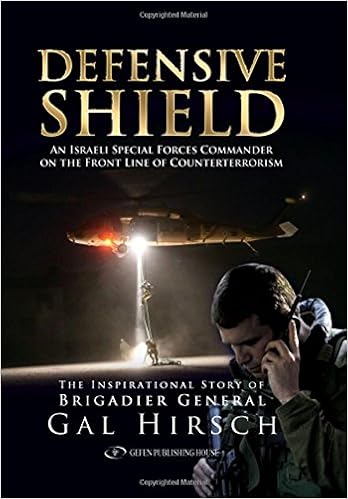
"Defensive Shield: An Israeli Special Forces Commander on the Front Line of Counterterrorism" was written by Gal Hirsch and published by Gefen

An exceptional story of leadership, illustrating the importance of professionalism, responsibility, accountability, values, culture, command climate, leading change, referential leadership, etc. Hirsch's accounts of the combat actions he led and wars he fought are vivid and relevant, putting into perspective all that should matter to the military leader, within the greater context of Israel's struggle against Terrorism. He also ventures into the operational art, at first slightly over-emphasizing the importance of new words to generate new ideas. However, he quickly moves away from such study of the phenomena to a theory of action in his in-depth account of the 2006 Lebanon War.
For students of warfare, Middle East enthusiasts or anyone inspired by stories of redemption after a fall from grace, a new English version of a book by retired Israeli Brig. Gen. Gal Hirsch, the original scapegoat of Israel’s 2006 Lebanon War, is well worth reading.
In "Defensive Shield: An Israeli Special Forces Commander on the Front Line of Counterterrorism," Hirsch engagingly escorts the reader through his 34 years in uniform, starting at age 15 in a pre-military academy up through the backbiting post-war period when he’s forced to fall on his sword for perceived wartime failings.
Timed to coincide with the 10th anniversary of that hybrid war with Hezbollah, Hirsch’s account of the 34-day fight and its aftermath is a compelling, albeit subjectively cautionary tale of the best and the worst of the Israel Defense Forces (IDF).
From the former commander of the 91st Division that bore the brunt of the fight in that summertime war, we gain insight into forces trained for high-threat ground maneuvers, yet relegated to a deterrence-sapping, anti-ambush posture across more than 100 kilometers of the border.
From his impassioned yet narrow field of view, Hirsch paints a chilling portrait of comrades in arms who conspired and cowered in the face of the faltering leaders they were honor-bound to obey and the casualty-averse public they were sworn to defend.
“An evil spirit struck the IDF at that time, and officers — mainly senior — acted behind the scenes in subversive and manipulative ways. ‘Me’ came before ‘we’ and I was stunned by the extent of this phenomenon,” he writes.
In the year leading up to the war, Hirsch’s division thwarted four abduction attempts and engaged more than a dozen, limited responses to cross-border provocations; responses Hirsch dismissed as “firing at rocks.” All the while, Hirsch insists he repeatedly warned that the defensive strategy of restraint — adopted following Israel’s withdrawal in 2000 from its 18-year occupation of South Lebanon — was unsustainable.
When Hezbollah eventually managed to pull off a July 12 attack on Israel’s side of the border fence — killing two reservists and absconding with what later was determined to be the bodies of two more — Hirsch ordered an air power-supported tank and infantry force on cross-border pursuit. But Hezbollah was well-prepared with a massive mine that sent the tank up in flames, killing all of its crew along with two more sent on the rescue mission.
Within 30 minutes of the attack that would trigger Israel’s second Lebanon war, the IDF lost 10 men. By the time it was all over — after three weeks of standoff strikes followed by a too-little, too-late ground offensive — the IDF had lost 121 of its best and brightest, 60 of them under Hirsch’s command.
Another 44 civilians would die in the more than 4,000 rockets that pummeled the homefront.
Once the war fog cleared and the cease-fire took hold, Hirsch writes bitterly about his no less brutal battles with peers maneuvering to supplant him; an “hysterial” media seeking a fall guy; and superiors who hoped one head on a platter would spare them a similar fate.
In detailed accounts of after-action confrontations, Hirsch exposes critical intelligence that never made its way to Northern Command; petty and costly changes to operational plans in the name of morale-boosting photo ops; kangaroo hearings and other wrongs done to him by active-duty cadre and retired officers clamoring for his head.
And he names names.
His j’accuse includes Lt. Gen. Dan Haultz, then-IDF chief of staff; deputy IDF chief Moshe Kaplinsky; Udi Adam, the former commander of the northern front who now serves as director-general of Israel’s Defense Ministry; and then Maj. Gen. Gadi Eizenkot, since promoted to the country’s sole three-star billet as IDF chief of staff.
“I was naïve and focused only on fighting the enemy, even as I was being stabbed in the back,” he writes.
Israeli Army Advances deeper Into Lebanese Territory

Gal Hirsch, center, here as an Israeli army division commander, talks with the service's chief of staff, Dan Halutz, right, as they watch troops advance from Israel into Lebanon Aug. 12, 2006, from an observation point along Israel's border with its northern neighbor.
Photo Credit: Abir Sultan/IDF via Getty Images

At times, Hirsch’s road to redemption reads like that of a jilted lover. “I loved you for 15 years,” he tells Halutz, urging the IDF’s top officer to back him against trumped-up accusations.
At other times, the book reads like a white-knuckled thriller.
Two memorable scenes take place far earlier in his career that give readers a sense of the true grit Hirsch would draw upon a decade hence in his quest to remain in the IDF’s top ranks.
The first involved an April 1995 overnight mission deep inside Lebanon. Hirsch at the time commanded the Air Force’s Shaldag (Kingfisher) elite commando force. As dawn approached, superiors back home were frantically urging him and his team to head for the CH-53 extraction point. But Hirsch refused to abort until the mission was complete.
The other scenario, as chief of operations for Central Command’s Regional Division in February 1998, was far more personal yet similarly illustrative of how Hirsch favored risk over rules to overcome adversity.
In a well-planned ambush, as he drove through the West Bank town of Birzeit, Hirsch’s jeep was literally crushed by a boulder dropped from a bridge overhead. With collapsed lungs, broken ribs, a shattered collarbone and a fractured spine that left him partially paralyzed, doctors doubted whether he would ever walk again.
After a year of painful recuperation, the wounded warrior had resumed his upward trajectory throughout the ranks.
A stint at the IDF’s Operational Theory Research Institute — an internal think tank for developing new battle concepts — was followed by assignments as brigade commander in the West Bank and then chief of operations (J-3) for Central Command. It was in his J-3 capacity for Central Command, the theater responsible for the West Bank and Jerusalem, that Hirsch put into practice the theoretical concepts he helped coin.
636065969168244121-galhirschpic-3-.jpg

At times, Hirsch's words read like that of a jilted lover. At other times, the book reads like a white-knuckled thriller.
Photo Credit: Courtesy of Gefen Publishing House

Israel embarked on its 2002 Operation Defensive Shield in response to a suicide attack that killed 30 on the eve of the Jewish holiday of Passover. Designed primarily by Hirsh (hence the title of this book) with the promise of “defeating Palestinian terror,” the operation marked the largest campaign in the West Bank since the 1967 Six Day War.
Fourteen years after the fact, that operation and the technologies, tactics and procedures it prescribed are still credited in large part for maintaining the relative calm in the occupied territories.
But the most provocative parts of the book ultimately bring the reader back to Lebanon, where Hirsch, on balance, offers constructive criticism based on his experiences at the front lines. He devotes a full chapter to lessons learned, key among them:
  • Accomplish the mission, regardless of changes in plan.
  • Clearly identify war aims and communicate operational orders in language that is clearly understood.
  • Don’t allow fear of casualties to blunt momentum during ground maneuvers. “War is not a cake walk. … It is essential to do everything possible to avoid hysteria emanating from singular events; and to refrain from making sweeping, all-encompassing decisions based on them."
  • View airlift operations not as special missions but as another form of transportation for crack forces.
  • Make ample use of engineering forces to prepare the battle space.
  • Employ “swarms” of infantrymen to overtake key areas and outskirts of urban areas before sweeping in with armored forces driving on defined routes.
  • In all but cases of moral failings, commanders must assume responsibility for their subordinates — not “deflect criticism by throwing lower echelons under the bus.”
It took six years for the high command to welcome Hirsch — a man who could have risen to IDF chief of staff — back into the fold as an active reserve officer and deputy commander of the new special operations Depth Command.
Two years into that position, which he held from 2012-2015, Hirsch finally found full redemption by the judge who headed the government’s official commission of inquiry into the war. In a January 2014 letter to then-IDF Chief of Staff Benny Gantz, Judge Eliahu Winograd exonerated Hirsch, insisting he would have done so earlier but that his commission at the time was precluded from appearing to interfere in personnel matters:
“Ever since the submission of the Winograd Commission report pertaining to the events during the Second Lebanon War, my conscience has tormented me, as we could not, as we had meant, include a warm recommendation that the IDF offer Gal Hirsch to return to full service in its ranks. ... It would be an expression of respect and appreciation to the man and his deeds in the IDF after the difficult years he underwent and is still suffering, since his forced retirement.”
As evidence of the full circle traversed by Hirsch, the book’s back cover bears this message from the IDF chief of staff, one of his former detractors: “Gal Hirsch [is] one of the main people to whom the residents of the north owe the [peaceful] period since the Second Lebanon War. I think you are a role model. You are an Israeli patriot.”

Tuesday, May 30, 2017

All the Presidents' Gardens: Madison’s Cabbages to Kennedy’s Roses―How the White House Grounds Have Grown with AmericaApr 27, 2016 by Marta McDowell Hardcover (Timber Press)


All the President’s Gardens by Marta McDowell tells the story of the gardens at the White House and how they have been shaped over time by different US Presidents

Discover the story of the White House gardens, how they have been used and how they have been changed by different incumbents.

‘The White House head gardener is not a man to dictate to President Eisenhower,’ reports the Milwaukee Journal, ‘but he’d be happier if those helicopters would stop landing on his lawn. They burn the grass.’ Eisenhower’s introduction of ‘Marine One’ in 1957 is just one of a host of challenges that have faced the White House’s 14 head gardeners. The story of this famous garden is told here with relish.

The rich history of the garden, the gardeners and their presidents is told at a rapid pace with gems of information on every page. President Hoover wanted his gardeners to be ‘invisible’. The state of the White House lawn drove President Kennedy ‘crazy’ according to First Lady Jacqueline. Hillary Clinton had a soft spot for sculpture and added pieces to the garden, which had to be cleared for installation by the secret service.

With a fascinating collection of anecdotes, artworks, botanical drawings and garden plans, as well as a tremendous selection of photographs of former presidents in the White House garden, this is an entertaining and comprehensive read. A list of plants that have graced the gardens, along with biographies of the head gardeners, completes this compelling and eminently readable piece.

Monday, May 29, 2017

Jews in Poland and Russia: A Short History (Littman Library of Jewish Civilization) by Antony Polonsky Paperback(The Littman Library of Jewish Civilization in association with Liverpool University Press);The Persecution of the Jews in Russia: With a Map of Russia, Showing the Pale of Jewish Settlement - Primary Source Edition Paperback – February 22, 2014 by Russo-Jewish Committee(Nabu Press);The Persecution of the Jews in Russia: With Appendix Containing a Summary of the Special and Restrictive Laws, Also a Map of Russia, Showing the Pale of Jewish Settlement (Classic Reprint) Paperback – November 18, 2016 by Russo-Jewish Committee ((Forgotten Press);Jewish City or Inferno of Russian Israel?: A History of the Jews in Kiev before February 1917 (Jews of Russia & Eastern Europe and Their Legacy) Hardcover – March 31, 2016 by Victoria Khiterer ((Academic Studies Press);The Making of Jewish Revolutionaries in the Pale of Settlement: Community and Identity during the Russian Revolution and its Immediate Aftermath, ... Studies in the History of Social…Jul 18, 2014 by I. Shtakser Hardcover (Palgrave MacMillan)Triumph of Survival : The Story of the Jews in the Modern Era 1650-1995 Hardcover – by Rabbi Berel Wein(Shaar Press)

Related image


The Napoleonic Enlightenment, which emancipated the Jews of Western Europe, did not make it to Eastern Europe where most Jews lived in the 18th-19th centuries.

The largest concentration; of Jews ― about 5 million ― was located there, representing 40% of the Jewish population worldwide.
From 1791 until 1915, the majority of Jews living in Eastern Europe were confined by the Czars of Russia ― starting with Catherine the Great ― to an area known as the "Pale of Settlement" (meaning "borders of settlement"). The Pale consisted of 25 provinces that included Ukraine, Lithuania, Belorussia, Crimea, and part of Poland (which had been partitioned between Russia, Prussia, and Austria in 1772).
The western side of what had formally been Poland was absorbed into the Austro-Hungarian Empire. This western half of Poland (which contained important Jewish communities such as those located in Galicia) contained a smaller, but not insignificant, number of Jews. The physical and economic situation of these Jews of the eastern Austro-Hungarian Empire was generally much better than their fellow Jews living in western end of Czarist Russia.
The Jews of Russia were specifically expelled from Moscow and St. Petersburg and forced into the Pale. Later they were also expelled from rural areas within the Pale and forced to live only in shtetls.
Despite the oppression some amazing things happened in the Pale.
For one thing, charity ― tzedakah, which in Hebrew means "justice" ― thrived, as Jews helped each other. The historian Martin Gilbert writes in his Atlas of Jewish History that no province in the Pale had less than 14% of Jews on relief, and Lithuanian and Ukrainian Jews supported as much as 22% of their poor population:
"Among the charitable societies organized by Jews were those to supply poor students with clothes, soldiers with kosher food, the poor with free medical treatment, poor brides with dowries, and orphans with technical education."
This was an incredibly sophisticated social welfare system. In times of great hardship, no Jew was abandoned.
This caring for each other did not escape the notice of non-Jews.
In fact, as far back as the Middle Ages Rabbis had instituted takanot (rabbinic enactments) which forbade conversion to Judaism.1 The primary fear was that there would be an anti-Semitic backlash against the Jews for "stealing" a Christian from his faith, but there was also another reason. Why would a Christian want to convert to Judaism-which could possibly lead to arrest and execution? They realized that no Jew ever starved to death in the street, whereas if you were a Christian peasant you could easily starve to death in the street because no one was going to take care of you. The government wasn't going to do it and the Church wasn't going to do it. Even though the Jewish community gave charity to their Gentile neighbors the rabbis didn't want Judaism being flooded by insincere converts who were trying to save their lives by becoming Jews and benefiting from the Jewish social welfare system.
Torah Learning
Another amazing thing that happened in the Pale, despite the oppression, was the creation of the modern Yeshiva (school for Torah study).
Torah studies (as we saw in Part 52) was a "luxury" largely not available to the masses of Eastern European Jewry in the 18th century and had become a preserve of the elite.
In 1803, Rabbi Chaim ben Isaac of Volozhin (1749-1821), a student of the Vilna Ga'on, set about to revolutionize the concept of the Yeshiva. Most yeshivas during this period were small institutions of learning supported by individual towns in which they were based. Rabbi Chaim proposed to found a large institution, for the top students, and supported by many communities.
He sent letters to the chief rabbis of cities throughout Europe asking them to send to him their best students to study at his yeshiva in Volozhin, Lithuania, (which was later named Etz Chaim ― "Tree of Life" ― in honor of its founder) where he promised to provide them with financial support, top teachers, and a high-level standardized curriculum. The response to his letter was very positive and a large number of students were sent to the Volozhin Yeshiva, which eventually enrolled 450 students.
Unfortunately, the Volozhin Yeshiva didn't last too long as the Czarist government of Russia saw what was going on and tried to force it to adopt a more secular curriculum as part of making it less Jewish. It was closed by the Czarist government in 1879 and was reopened in 1881. While the Volozhin Yeshiva was able to yield to some of the demands of the Czarist government, the demand that all faculty members have diplomas from recognized Russian educational institutions in order to teach "Russian language and culture" was not acceptable. And so, the yeshiva was closed in 1892 by Russian inspectors and its students exiled.
Although it had been in operation less than 100 years, it had become the model and inspiration for the modern yeshiva. By the time the Volozhin closed, other yeshivas based on its models were already in operation, many started by the students of the Volozhin. A letter written in 1865 by Rabbi David Moses of Krynki, a former student of the Volozhin, attests to greatness of Rabbi Chaim and the Yeshiva he founded.
...the yeshiva of Volozhin is the mother and source of all the yeshivot and Talmud Torahs in the world. The latter are as pipes which come from the source... before our holy rabbi (Rabbi Chaim) founded the "house of God" the world was empty, literally without form; it was void, for even the term yeshiva was unknown, let alone what activities took place in one... Were it not for the fact that our holy rabbi founded his yeshiva, the Torah would have-God forbid-been forgotten to Israel. 2
Another major educational innovation of the period was the founding of the Beis Yaakov School for girls. The school was founded by Sarah Schnirer in Cracow, Poland in 1918 and later developed in a large education network that spread to both America and Israel.
The Mussar Movement
During the same period of time that saw the re-birth of Torah studies there arose in the Pale a new emphasis on what should be the primary focus of those studies. The impetus came from a very important movement within Judaism called the Mussar Movement ("Morality Movement").
Its founder was a most unusual man, Rabbi Israel Lipkin of Salant (1810-1883), better known as Rabbi Israel Salanter.
Many stories are told about his goodness. Among the most famous is the story of his disappearance one Yom Kippur from his synagogue. As the congregation fretted for his safety, delaying services until he arrived, one young mother took the opportunity to rush back home to check on her baby, which she had left alone. There she found the rabbi, rocking the cradle. Hearing the baby crying, he had stopped to comfort it, putting the needs of another human being ahead of his personal spiritual fulfillment.
Rabbi Salanter, though the epitome of kindness, could also be confrontational when the question of ethics or morality was at stake. Such was his stance, when he learned that a poor widow's two sons were drafted into the Russian Army, because a rich man had bribed the officials so that his son would not be taken. He confronted the entire community in the synagogue regarding the matter in order to win justice for the widow.
Rabbi Salanter was driven to establish the study of morality and ethics as a distinct subject within the larger curriculum of study in the yeshiva. He felt that the over emphasis on Talmudic study had neglected the methodology of developing one's relationship to God or in becoming a better person in relationship to one's fellows. The 18th century work by the Kabbalist Moshe Chaim Luzatto ― The Path of the Just‘ ― was adopted as the "manual" of the Mussar movement.
At the time that Rabbi Salanter initiated Mussar studies, his system was controversial simply because it was new. Orthodox Jews were worried at first that this might be another type of "reform" and the time spent on Mussar study would detract from the time spent on Talmud study.
But the Mussar movement overcame their misgivings and its teachings are now central to the curricula of many yeshivas.
The most famous of the yeshivas specializing in Mussar studies were the Navaradok Yeshiva, founded by Rabbi Joseph of Navaradok in 1896, a disciple of Rabbi Salanter and the Slobodka Yeshiva founded in 1863 by Rabbi Nassan Tzvi Finkel (which moved to Hebron, Israel, and when destroyed by the Arabs, to Jerusalem and Bnei Brak)
Other yeshivas, many of which were founded by the graduates of the Volozhin Yeshiva and which incorporated the teachings of Rabbi Salanter and the Mussar Movement, were:
  • the Mir founded in 1815 (the great yeshiva which migrated to Shanghai during the Holocaust and eventually relocated in Jerusalem and Brooklyn)
  • Telshe founded in 1875 (now in Cleveland, Ohio)
  • Slutzk founded in 1896 (now in Lakewood, New Jersey).
  • Pressburg founded in 1807 by Rabbi Moses Sofer (the Chatam Sofer) in the Austro-Hungarian Empire, (today called Bratislava in Slovakia) was the largest and most influential Yeshiva in Central Europe.
Forced Secularization
While most of the students studying in the yeshivot accepted and embraced the Mussar movement after an initial hesitation, the non-Orthodox continued to oppose it.
Chief among the opponents was a group called the Maskilim ("the Enlightened Ones"), who opposed traditional Judaism in any way, shape or form.
This was the group that aided the Czarist government in the closing of the Volozhin Yeshiva. Why? Because the Maskilim wanted their fellow Jews to drop Judaism and join the Russian culture. They argued: "Let's study Russian culture... let's speak in Russian and write in Russian... let's be just like them, and they'll accept us, and we'll be able to integrate more effectively into society and end the horrible poverty so many live under."
An important figure among the Maskilim was Dr. Max Lilienthal (1813-1882), a German Jew who came to Russia as director of the "enlightened" Jewish school of Riga. He was eventually appointed by the Russian government (of Czar Nicholas I) as the Minister of Jewish Education and went about attempting to convince the Jews of the Pale of the Czar's "benign intent" in establishing a new educational system for them.
A glimpse at part of the plan created by these maskilim for the Jews of Eastern Europe gives a clear sense of their plans for the Jews of Eastern Europe:
Maskilim to Govenors of the Pale ― A Program for Russification 1841:
The Russian government's objectives in the encouragement of enlightenment among the Jewish people [should be] special emphasis to the moral as opposed to the academic aspects of the education of the Jews... To pay special attention to the teaching of Russian history and language, for there is nothing which unites diverse ethnic groups... better than the dissemination of information concerning that nation's history and literature...
In order to thwart the harmful influence of the Talmud, without at this stage destroying the book... the rabbis should be empowered to prepare a short religious text... in accordance with the accepted principles regarding civil responsibilities to the tsar and the motherland... the Jews must be ordered to change their dress for the clothing commonly worn throughout the country...3
This was during the time when the Czar was attempting to "restructure" the Jewish society in Russia with laws forbidding the wearing of traditional clothing, decrees against Talmud study, and division of Jews into "useful" (farmers, artisans, skilled workers) and "useless" (unskilled workers, rabbis, orphans, the sick and unemployed).
In this climate, in 1843, a conference was convened on the subject of Jewish education, which pitted Lilienthal against Rabbi Yitzchak of Volozhin and Rabbi Menachem Mendel Schneersohn, the Rebbe of Chabad Lubavitch also known as the Tzemach Tzedek. Lilienthal could not stand up to the arguments of these rabbis, who managed to win the right for Jews to retain their traditional school system in competition with Lilienthal's new school system. (See Berel Wein's Triumph of Survival, p. 157.)
Within a decade, Lilienthal's schools closed for lack of faculty and students, though Lilienthal's defenders claim that he left because he realized that the Czar's "benign intent" was to convert Jews to Christianity. He migrated to Cincinnati, Ohio, where he headed up a Reform congregation.
The early 1800s marked the beginning of a significant change for Jewish life in Eastern Europe. The change took place in many different spheres and on many levels.

Population Explosion

The first was simply demographic: the Jewish population exploded during the 19th century. It is estimated that at the time of the Napoleonic Wars (i.e. the beginning of the 1800s) there were about 2.25 million Jews in the world. By 1880, that figure had reached 7.5 million. By 1900 it approached 9 million!
Many reasons are given for this population explosion. One is that it is not so much that the Jewish rate of birth increased as that the Jewish rate of death decreased, especially in the area of infant mortality.
Jews also married younger. The average age of marriage in Eastern Europe was estimated to be between 14 and 16. These young marriages helped increase the number of families and of children being born.

Urbanization

The second factor was the coming of the Industrial Revolution to Eastern Europe and the urbanization of its population. The Jews had lived in small, isolated communities—villages, farms, rural areas—as an agricultural-based people who lived among the peasants of Russia and Poland. The city of Warsaw had a very negligible Jewish population in the late 1700s. By 1850 it had 125,000 Jews, and by the time of the Second World War, it had a Jewish population 350,000.
The Jews came to the cities for various reasons. But they came for the same reason that urbanization was popular throughout the world. The cities meant an opportunity to get ahead. It meant a job. It meant getting off the farm.
During the 19th century therefore the Jewish people changed from a rural people to an urbanized one. And since the Jews, for whatever reason, had less attachment to the rural society, they urbanized much more quickly than their non-Jewish neighbors. They found the opportunities a grand challenge for their talents and their lifestyle.

Jews on the Move

A third matter that occurred then, in the beginning of the 19th century, was the complete mass emigration of Jews from one place to another. The Jews began to move.
They began to move within Russia, Poland and the Austro-Hungarian Empire. There was a shift in population of the Jews in Germany, from the eastern part close to the Austro-Hungarian border into Poland. Eastern European Jews began to move to southern Russia and the Ukraine. The large settlements of the Jews in northern Poland and northern Lithuania began to move south, as far as the Black Sea at the port of Odessa. There was a large Jewish migration from Galicia and from southern Poland to Romania and Hungary, so that the Jewish population increased tenfold there.
The coming of the Chassidic Movement to those areas of Europe where it had not existed before was part of this mass emigration. Beginning in the 1840s there was a trickle of emigration to the United States, but by the time of the American Civil War there were already 50,000 Jews in New York. Even though the basis of Jewish life there country was founded upon German Jews, who came first, Eastern European Jews began to come almost immediately thereafter. Then the great waves of migration in the 1880s until the First World War, and after it, brought millions of Jews to the shores of the United States.
Jews moved to England in great numbers, particularly Lithuanian Jews. A great number of Lithuanian Jews moved to such exotic places as South Africa, where in the Boer Republic that was established in the 1850s and 1860s there was already strong and with significant Jewish representation. At the time of the Boer War, at the end of the 19th century, there were almost 75,000 Jews in South Africa.
Jews moved to France. By 1850, there were 25,000 Eastern European Jews in Paris. Jews moved, for the first time, to Vienna, Budapest and Berlin. These cities now had sizeable Jewish populations.
All of this – the movement, the population explosion, the urbanization and the Industrial Revolution, the springing up of factories and different types of labor — served to unhinge the Jewish population. It brought an element of chaos into Jewish life. The old was going, never to come back again. The new was frightening, different, unpredictable, and the Jewish world was being thrust into it not only without preparation but without protection, with nothing to ease their way.

The Evil Decrees

The Jews were loyal to Russia during the Napoleonic War. This loyalty was rewarded by a series of decrees which, in the history of the Jewish people, are arguably the single worst series of decrees Jews have ever undergone. It would begin with Czar Alexander in the early 1820s and continue with his son Nicholas and then by Alexander III. Their intent was the utter destruction of the Jewish people.
It is rumored that the Czar’s minister said that the Jewish program of the Russian government was “one-third extermination, one-third emigration, and one-third assimilation (or conversion).” It is not overstating it that the elimination of the Jewish people in Russia was one of the goals of the Romanovs. It is interesting to see how that attitude was inherited by the revolution that overthrew the Romanovs, the Communist Revolution. The decrees were different but their purpose was the same.

The Pale of Settlement

The first main decree, which was put to effect in 1825, was establishment of the Pale of Settlement. This was an area within Russia where Jews were allowed to live. No Jews were allowed outside the Pale of Settlement. Within the Pale, Jews were not allowed to live in certain cities.
The Pale of Settlement decree, in effect, prevented any chance for Jews to advance economically. It was the ghetto on a grand scale. Jews were prevented from living anywhere within about 35 miles of the Russian border, which was heavily populated by Jews. The Russians openly said that the Jews were a risk and therefore they could not live close to the border. That meant that about 100,000 Jews were uprooted and forced to become refugees.
The Czar also forbade the Jews from living in any of the main cities of Russia. For instance, Jews were driven out of Kiev. They lived in all the small towns around it. The strong Jewish centers of population were overrun by penniless, itinerant Jews. All of this was meant to make certain that the Jews would not be able to adjust.

The Cantonist Decrees

In 1827, Czar Nicholas signed into law, “The Decree of the Cantonists.” From the beginning of the 1700s until the 1820s, Jews technically were liable for service in the Russian army. However, a Jew could legally buy his way out. If he paid a certain amount of money the conscription would be waived.
As part of the Czar’s program to break the Jewish people and force them to convert, and to help exterminate some of them and send a message to the rest that they had no future in Russia, the Czar passed a decree that no longer would it be acceptable to pay money to be exempted from the army, and that all the Jewish communities had to fulfill their quota.
The rate of suicide among the Jewish children who were taken was almost 60%, because they would not convert. From the moment they were taken away, they were forced to attend Russian Orthodox services. Many were forcibly baptized.
These children were taken into very rough conditions, to freezing cold places with poor sanitation. Not every 8-year-old child can march 10 or 12 miles every day. Out of those children who went into the army, very few came back. And out of those who did come back, very few of them came back as Jews.
The decree was unspeakably cruel. And it stayed in effect for almost 30 years. It was enforced more rigidly at some times and more leniently at others, but it was always there.

Good, Old Anti-Semitism

In 1840, Czar Nicholas produced the Mein Kampf of the Romanovs. He said exactly that the reason Jews cannot be assimilated into Russian society, and are not entitled to any of the Russian privileges, was because of their “terrible religion.”
Nicholas said that the problem with the Jews is that they believed in the “cursed book,” the Talmud. In Europe, there was an expression, “a Shas Jew” (Shas is a Hebrew acronym standing for the Six Orders of the Mishnah/Talmud). A Jew who knew the Talmud knew how to be a Jew. That is one of the reasons that even today in any sort of intensive Jewish education the emphasis is on Talmudic studies, even though the boy is not going to be a rabbi and may not even become a scholar. That has nothing to do with it. If he has studied Talmud for a number of years, then he has a chance to understand what it is to be a Jew.
The Czar also said that the problem with the Jews was that they thought of themselves as being in exile, because they were removed from Palestine, and therefore they wait daily for a Messiah to come and bring them there. All of these things were incompatible with Russian society and Russian patriotism.
He therefore appointed a commission called the Bureau of Jewish Affairs, whose purpose was to destroy the Jewish people. Part of the program was the establishment of schools, supported by the Russian government, that would teach Judaism — but not in the spirit of the Talmud. They would teach the Czar’s brand of Judaism.
They also would disband all the Jewish religious councils, and force the rabbis to take competency tests. These tests covered speaking, reading and writing in the Russian language, knowledge of Russian history and so on. Almost no rabbi in Russia could pass, or was even interested in passing, these tests.
The first half of the 19th century in Russia was a terrifying time for Jews. They were constantly targeted by the authorities, who placed upon them a series of terrible decrees whose impact lasted well into the latter half of the century and beyond. The sum total of these decrees would ultimately unleash various new and destabilizing Jewish movements in Eastern Europe, which in turn would spawn other Jewish movements to counteract them. The aftershocks of all these movements and events were so powerful that their repercussions can still be felt reverberating in the Jewish world today.

Sunday, May 28, 2017

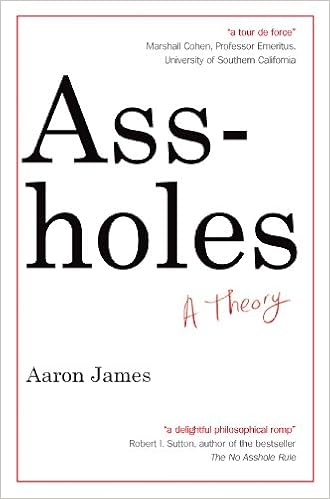
#OyVeyDonaldTrumpet and The Meaning of "Asshole"..... Assholes: A Theory Hardcover by Aaron James (Nicholas Brealey Publishing)


The Meaning of "Asshole"

Aaron James offers a cognitivist conjecture, which sheds light on foul language generally.


If you asked me what it means to call someone an "asshole" before I really thought about it, I probably would have suggested an “expressivist” analysis. The word, I might have elaborated, is just another term of abuse, a way of simply expressing one’s disapproval. Much as if one had said “Boo on you!”, one isn’t trying to say something that can be true or false, correct or incorrect. The job of foul language like “asshole” isn’t to describe the world, but simply to express one’s disapproving feelings, in an ejaculatory or cathartic burst facilitated by inherently emotive words.

I decided this was completely wrong one day in the summer of 2008, while surfing in a crowded line up. I was watching a guy brazenly break the rules of right of way and thought “Gosh, what an asshole”. That wasn’t a new thought, but I then noticed, for the first time, that this thought has what philosophers call “cognitive content”. I was trying to say that the guy in question was properly classified in a certain way. Other law-abiding surfers weren’t properly classified under that term, and so it could be true or false, correct or incorrect, to say that this guy was, in fact, an asshole.

That got me thinking about what it would be for someone to qualify as an asshole. Harry Frankfurt partly inspired this. I thought: Frankfurt put his finger on “bullshit”, and I am a philosopher, so I should define “asshole”. After considerable tinkering and with the help friends, I settled on this definition: the asshole is the guy who systematically allows himself special advantages in cooperative life out of an entrenched sense of entitlement that immunises him against the complaints of other people.

This definition is hopefully significant simply because it prompts one to think, “Hey, I’ve met that guy”. Maybe you encountered him this morning in the coffee shop. Maybe the guy wouldn’t quiet down on his mobile phone, despite obvious sneers. Maybe he drives as though he owns the road. He probably says, “Do you know who I am?” to the maître d’ at a restaurant when he’s not quickly seated. Although it of course matters how the definition’s details get worked out and applied, the main idea is that even those inclined to quibble in the small might agree that “asshole” doesn’t simply have expressive meaning. Its function is to classify a person, correctly or incorrectly, as having a particular kind of moral personality.

I soon discovered linguistic evidence for this “cognitivist” rather than “expressivist” treatment of the word. It makes perfect sense to say of someone, “Yes, he is my friend, and he’s fine to me personally, but I admit he’s an asshole”. You can also coherently say things like “General MacArthur was plainly an asshole, but in the end a force for good”. Now maybe those contexts don’t express all-out disapproval, because they still express disapproval in a muted form that is outweighed by other considerations. Yet even all-out approval seems perfectly coherent. It is coherent – and indeed commonplace – for an asshole to proudly own the name. He boasts “Yes I’m an asshole – deal with it”. He taunts his subjects with this pronouncement precisely because he seems to approve wholeheartedly.

An obvious worry here is that I have gone too far in a “cognitivist” direction. Surely the word “asshole” is often used to vent feelings with no concern for whether its target meets any set of necessary and sufficient conditions for its application. If nothing else, then, the emotional charge often associated with the term is something that must be explained.

An easy move here is to follow Stephen Finlay’s idea that ethical language “pragmatically indicates” attitudes of approval or disapproval within a normal conversation. If you call Trump an asshole while we are talking, it will normally make sense for me to interpret you as disapproving of Trump’s conduct. But that may only be a matter of what it is reasonable for me to infer about you given our conversational context and my general knowledge of how people feel when they speak. The very meaning of the word “asshole”, as set by the linguistic rules that govern its use, doesn’t itself imply that you disapprove. And so “Trump is an asshole” can count as true or false in a straightforward way. Expression is, in the standard parlance, a matter of “pragmatics” rather than “semantics”.

I take great comfort in Finlay’s idea, if nothing else as a last resort. It is also interesting that, if need be, a “cognitivist” account can go even further and simply admit expressive meaning as part of the very semantic meaning of “asshole”. As David Kaplan (and David Copp, in a different way) has explained, that needn’t undermine pretentions of objective truth.

Kaplan suggests that, alongside "descriptive" terms whose meaning can be given by a definition (like "fortnight"), we can explain the meaning of "expressive" terms ( "damn", "bastard", "ouch", "oops", and "goodbye") in terms of an idea of "expressive correctness”. So suppose someone sincerely uses an expressive term. This doesn't simply report certain purported facts; "ouch" doesn't just mean "I am in pain”. It does, however, purport to "display" things as being a certain way. I display the fact that I am in pain when I say "ouch", and I display the fact that I despise someone if I say "that bastard”. Use of the term is expressively correct, says Kaplan, when the supposed fact holds: I say "ouch" and I am, in fact, in pain; I say "that bastard" and I do indeed despise the person. Use of the term is expressively incorrect when the supposed fact doesn't hold – as when I'm not really in pain, but faking to get attention; or when I don't despise the person at all.

But now consider "oops”, which, unlike "ouch”, has an element of objectivity. To say "oops”, Kaplan suggests, is (roughly) to purport to display the fact that “one has observed a minor mishap”. So saying "oops" will be (expressively) correct when one has just seen someone inadvertently break a wine glass, but incorrect when the mishap isn't minor (for example, a whole building falls down, killing hundreds, in which case "oops" could at best be a macabre and vile joke). So whereas the correctness of "ouch" depends entirely on one's state of mind, the correctness of "oops" also depends on the world, independently of one's subjective attitudes.

Now turn to foul language. For a given foul term, we can ask whether its correctness conditions are fully subjective, as with "ouch”, or at least partly objective, as with "oops”. And, when you survey many foul terms – even the foulest of the foul – they easily seem to be objective expressives: their correctness can seem to depend, at least in part, on what is going on in out in the world. Here are several examples along with some tentative suggestions about what those “objective correctness conditions” might be.

"shit" – as when "shit!" is said after a fender bender (in contrast with something's being "shitty”, or of poor quality). This implies that an unexpected event has occurred that frustrates the speaker's aspirations (such as avoiding costly auto repairs, getting to work quickly). The aspirations are subjective, or up to the person, but the event in question has to actually occur. Shit happens, and has to happen, for it to be shit: shit has existence as its essence. Or, more plainly: if the fender bender or other untoward event hasn't actually occurred, it won't be expressively correct to say "shit!" (Except in fictional cases, when things are fictionally presented as actually happening – a pretty special context.)

"fucking"–as in "the fucking car wouldn't start, right there in the middle of the road”. This implies major frustration of someone's plans, though not necessarily the speaker's. I could be hearing the story of a woman whose car had stalled in the middle of the road and say "really, and the fucking car just wouldn't start?" Her plans would be majorly frustrated, but (unlike "oops") I wouldn't have had to observe the events myself or even myself have the frustrated plans (the event may have passed, in which case there is nothing, as regards that event, to plan for).

"fucker" – as directed at a toaster that burns one's toast or an electrical outlet that shocks one. The object is personified as having malicious intent. The expressive correctness of the terms depends on whether the metaphor is apt, given the situation’s descriptive features. (We'd usually say this of more readily personified objects, such as toasters or computers, but perhaps not a stationary rock.)

"mother fucker" – a metaphorical way of saying someone can't be trusted. You can't trust him not to have sex with your own mother if he had the chance. The term is inapt if someone is completely trustworthy.

"bastard" – much as with "mother fucker”, implies treachery, that the person in question is a traitor, or would-be traitor. When we aren't thinking of its non-derogatory meaning ("one without a father"), a person doesn't count as a bastard, in the central, paradigmatic sense, unless they are treacherous or prone to betray others in relationships. It would be a mistake to call someone a bastard if he (or she?) were reliably faithful in what his relationships required.

Kaplan seems to disagree about “bastard”. (He treats "That bastard X" as akin to "That damn X”.) But no matter. Though "damned" or "damnable" does have an older and very rich set of meanings, especially religious ones, I think Kaplan is right about one use of "damn”, which seems to be a purely "subjective" expressive, without external correctness conditions. If I say "Damn you!" it seems pretty clear that I in some sense express my disapproval of you. The word "damn" itself carries that implication when it is sincerely used, by virtue of the linguistic conventions that set its meaning. I can't sincerely (and properly) say "That damn Trump; but I really like him!"

So traditional emotivism gets one case right. Still, this seems an exceptional case. If so many foul terms seem to be “objective expressives”, then it is natural to see any expressive element in “asshole” in a similar way. My definition says when the term is descriptively correct. If we like, we can add that it will be expressively correct when, and only when, the speaker in fact disapproves, or finds disapproval appropriate, in virtue of the asshole’s acting upon entitlements that he does not in fact have.

This kind of reasoning has led me to be pretty sceptical about expressivist analyses of foul language generally. So much so that I’ve been flirting with the idea that there are four main categories of foul language and that expressivist treatments don’t apply to any of them straightforwardly.

The categories are these:

(1) vice terms, which purport to classify a kind of moral personality, correctly or incorrectly (e.g., “asshole”, jerk”, “bastard”, “motherfucker”, “schmuck”, “boor”, “cad”);

(2) pejorative terms, which assume false normative or moral claims about certain independently identifiable groups of people (e.g., "honkey”, "wop”, "kike”, “limey”, "chink”, "n----r");

(3) slurs, which invoke a metaphor (“four-eyes”, "pig”, "dickhead”, "cocksucker") that is often literally false and yet may be “true”, metaphorically speaking.

(4) objective expressives (e.g., “shit” and “fucking”), which are expressively correct or incorrect depending on what is going on in the world.

My conjecture is that these categories cover a lot if not most of foul language, and that each requires an appropriate “cognitivist” treatment. That is only a conjecture at this point, but it is not hard to appreciate its potential significance. If my hunch pans out, then expressivism is wrong even about most foul language. That is, it is wrong about the area of language where it has the best, fighting chance of being right.

I might add that this is presumably a further count against expressivism about ethical language generally. The case for a cognitivist “constructivism” about ethics of the kind I favour gets even better.

To be sure, everything then depends on how the different categories of foul language get developed. So here are few thoughts about “asshole” in relation to pejorative terms and slurs, taking each in turn.

Consider racist pejorative terms. In contrast with “asshole”, I’m inclined to see these terms quite differently, as systematically wrong. Here I mean the class of pejorative terms that get directed toward a particular group of people (“Yankee” or “honkey” and whites; "wop" and Italians; "kike" and Jews; "chink" and Chinese people; “limey” and English people; "n----r" and African-Americans). If we follow recent work by Chris Hom and Robert May, as I do, then the very meaning of these terms assumes certain normative beliefs or assumptions about the group in question. “Wop”, for instance, assumes that Italians are the appropriate object of contempt and discrimination, simply because they are Italian.

Now suppose the assumed judgements of appropriateness are radically mistaken. From a moral perspective, no one is the appropriate object of contempt or discrimination simply because they happen to belong to a racial group. In that case, the racist judgement that Berlusconi is a wop will lay claim to truth and yet fall into error by virtue of resting on a false presupposition. Since “wop” has a false presupposition, the claim that Berlusconi is a wop is neither true nor false.

We presumably won’t want to say that about “asshole”. We can surely be mistaken about what someone is or is not entitled to. Yet it is a pretty radical form of scepticism to hold that the moral presuppositions of an asshole judgement are systematically wrong. In that case, there are no kikes, no chinks, and certainly no “n-----rs”. And Berlusconi is not a wop – even if he is an asshole.

Now consider the different category of slurs, like “four eyes” and “dickhead”, understood as metaphors. “Asshole” probably initially got its meaning as a metaphorical slur.

Calling someone an asshole is of course literally false in the non-moral sense of “asshole” that refers to a physical body part, just as it is literally false to say of someone that he is his own left arm. To say either thing is at best some kind of metaphor. Yet, if I am right that “he’s an asshole” can be a literally true or false, from a moral perspective. This raises an interesting question: how could “asshole” come to have acquired a literal moral meaning? The real, full story is presumably complicated. Still, it is helpful, or at least interesting, to speculate with something like the following conjectural history.

In the beginning was the word, used as a mere metaphor. Geoffrey Nunberg tells us that “asshole” caught on in recent times among World War II soldiers. Imagine its first non-literal use: a solider called his superior officer – let’s call him Sargent Pug – "an asshole”, thereby inviting his fellow soldiers to imaginatively engage Pug in a certain unflattering light.

Although it is literally false that Pug is a body part, likening him to a foul and hidden part of his own body called attention to his arrogant disposition and repugnant personality. As with any good metaphor, at least as Richard Moran explains it, the point was to see or experience Pug as an asshole, to interpret him and his actions from an imaginative frame of reference that treats a man as the physical embodiment of a body part that behaves much as that body part might. They were to feel and almost believe that Pug is as problematic and as foul and yet shamefully exposing himself in public.

The more literal minded of soldiers might have objected: "Look, it’s not strictly speaking, literally true that Pug is an asshole any more than it can be literally true that Pug is his own left arm”. In reply, the soldiers would have laughed off the objection as beside the point. Sure, they'll say, the statement "Pug is an asshole" is literally false; "asshole" is just a metaphor. The point is that it is especially apt. Or as we might elaborate the idea, the use of the word by the soldiers says things about Pug that could not have been literally said of him up to this point. Perhaps some of those things can be put as literal truth-claims, such as the claim that Pug isn't worthy of respect, or that he abuses his office, or that he is contemptible. But those truths aren't the whole point of the metaphor, which is mainly to see Pug in an unflattering light that cannot be fully expressed in so many truths.

Because the metaphor was apt, it quickly caught on as a way of speaking. Use of the term became popular among the other soldiers on the base, in the wider army, and then in further reaches of society. The term was especially useful as communication. People found calling someone an asshole an especially handy way of conveying and perhaps even venting their contempt for abusive authority figures who are not, for them, worthy of respect. Those who heard the metaphor invoked found it especially easy to grasp what the speaker meant: they meant not simply to vent feelings of contempt, but to invite an interpretation of their target that would make those feelings of contempt fully appropriate. That’s because, when someone calls someone an asshole, you could easily tell that he or she has a certain moral view of things: the view that person called an asshole is not worthy of respect, because of how he treats those around him.

Soon enough, when someone used the word, you could readily land upon this interpretation of the user's meaning, without knowing very much about his or her context of utterance. The metaphor thus came into a different kind of meaning: calling someone an asshole moved away from mere metaphorical communication and became a literal, more routine claim to truth, a claim to the truth of a moral judgement: that the person in question is not worthy of respect because of the way he treats others.

Even now few were especially careful or aware about exactly what kind of unsavoury people they were calling an asshole. Still, there was a rough but remarkable convergence. The invited perspective would be appropriate for certain kinds of people and not for others. Knowing or not, people began to grasp the rules of normal usage, which called for one type of person to be called an asshole and left other types for better names.

Eventually, the rules settled. They became well enough established that a competent speaker of the language could entertain asshole judgements without meaning to express contemptuous attitudes. The curious user of the language would wonder whether this person is the right kind of person to qualify as unworthy of respect, even without feeling at all exercised about this, let alone speaking out about it. The curious person would ask questions that don't express negative attitudes, such as "Is Trump an asshole?" And people could reason with hypotheticals, such as, "If Trump is an asshole, I probably shouldn't watch his show; Trump does seem to be an asshole: so I probably shouldn't watch his show”.

Beyond private reflections, all of this could be discussed in a mode of cool-headed argument among friends. Over coffee, friends might agree that, yes, Trump indeed qualifies as an asshole, literally speaking. They might conclude on that basis that they probably shouldn't go out of their way to listen to him or watch his show, having reasoned together and reached agreement upon what they all regard as an objective matter of moral fact: Trump is, in fact, an asshole.

Now when a less agreeable fellow in the coffee shop says it isn't literally true that Trump is an asshole, the friends don't say what the soldiers said to their literal-minded fellow solider. They don’t agree and say that this is beside the point. They beg to differ. They reply: "no, that's wrong; Trump definitely qualifies; he's literally an asshole; you've made a mistake”. At that point, the journey of “asshole” from metaphorical slur to vice term was complete.