Showing posts with label . . @israelbookreview. Show all posts

Sunday, September 23, 2018

The Princess Dolls Ellen Schwartz; Mariko Ando, illus.Tradewind Books 2018 148 Pages


Esther, who is Jewish, and Michi, who is Japanese, live in Vancouver and are best friends. It’s 1942, and one of their favorite games is playing Princess Elizabeth and Princess Margaret, who they have seen in newsreels of the London Blitz and admire as heroic role models. When a local gift shop displays two matching dolls in the window, one dressed as Princess Elizabeth and the other as Princess Margaret, the two friends ache to each own a princess doll of their own. When Esther receives one of the dolls as a gift but Michi does not receive the other, a rift begins between them—one that might otherwise have healed naturally in time, but during wartime, life is much more complicated. While Esther and her family worry about the fate of their Jewish relatives who remain in Europe, Michi and her family face prejudice and suspicion at home, culminating in the relocation of Japanese families to faraway internment camps.

This intimate story of two young girls learning about true friendship intertwines with the stories of larger populations and their wartime tribulations. As Esther and Michi struggle with personal disappointments, they also feel the pressures of wartime life. Esther can't easily make up with her best friend if her friend has been interned a distance away as a suspected enemy alien.

The story resolves in a heartwarming way—the world at war, less so. Prejudice and fear of the other remain potent forces in today's world, and this novel brings these issues to the forefront in a way that is easily relatable to children.

This touching tale of two girls and two dolls gives readers ages 9 to 12 a look at how the Japanese citizens of the United States and Canada were treated during World War II, and provides valuable ethical insights.

Friday, September 21, 2018

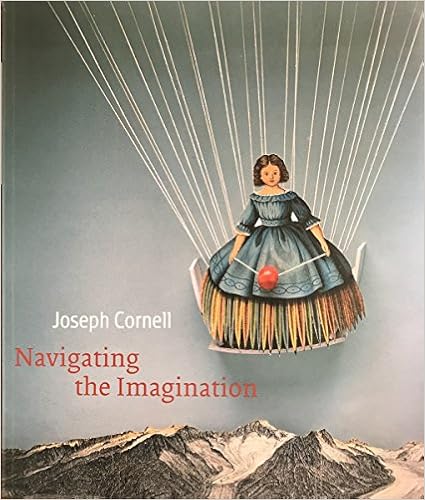
Joseph Cornell: Navigating the Imagination Hardcover (Peabody Essex Museum)


Joseph Cornell (December 24, 1903 – December 29, 1972) was an American artist and film maker, one of the pioneers and most celebrated exponents of assemblage. Influenced by the Surrealists, he was also an avant-garde experimental filmmaker. He was largely self-taught in his artistic efforts, and improvised his own original style incorporating cast-off and discarded artifacts. He lived most of his life in relative physical isolation, caring for his mother and his disabled brother at home, but remained aware of and in contact with other contemporary artists.

Joseph Cornell was born in Nyack, New York, to Joseph Cornell, a well-to-do designer and merchant of textiles, and Helen TenBroeck Storms Cornell, who had trained as a nursery teacher. The Cornells had four children: Joseph, Elizabeth (b. 1905), Helen (b. 1906), and Robert (b. 1910). Both parents came from socially prominent families of Dutch ancestry, long-established in New York State. Cornell's father died in 1917, leaving the family in strained circumstances. Following the elder Cornell's death, his wife and children moved to the borough of Queens in New York City. Cornell attended Phillips Academy in Andover, Massachusetts, in the class of 1921, although he did not graduate.

Except for the three-and-a-half years he spent at Phillips, he lived for most of his life in a small, wooden-frame house on Utopia Parkway in a working-class area of Flushing, along with his mother and his brother Robert, whom cerebral palsy had rendered physically challenged] Aside from the period he spent at the academy in Andover, Cornell never traveled beyond the New York City area.

Cornell was wary of strangers. This led him to isolate himself and become a self-taught artist. Although he expressed attraction to unattainable women like Lauren Bacall, his shyness made romantic relationships almost impossible. In later life his bashfulness verged toward reclusiveness, and he rarely left the state of New York. However, he preferred talking with women, and often made their husbands wait in the next room when he discussed business with them. He also had numerous friendships with ballerinas, who found him unique, but too eccentric to be a romantic partner.

He devoted his life to caring for his younger brother Robert, who was disabled and lived with cerebral palsy, which was another factor in his lack of relationships. At some point in the 1920s, or possibly earlier, he read the writings of Mary Baker Eddy, including Science and Health with Key to the Scriptures. Cornell considered Eddy's works to be among the most important books ever published after the Bible, and he became a lifelong Christian Science adherent.Christian Science belief and practice informed Cornell's art deeply, as art historian Sandra Leonard Starr has shown.

He was also rather poor for most of his life, working during the 1920s as a wholesale fabric salesman to support his family. As a result of the American Great Depression, Cornell lost his textile industry job in 1931, and worked for a short time thereafter as a door-to-door appliance salesman. During this time, through her friendship with Ethel Traphagen, Cornell's mother secured him a part-time position designing textiles. In the 1940s, Cornell also worked in a plant nursery (which would figure in his famous dossier "GC44") and briefly in a defense plant, and designed covers and feature layouts for Harper's Bazaar, View, Dance Index, and other magazines. He only really began to sell his boxes for significant sums after his 1949 solo show at the Charles Egan Gallery.

Cornell eventually began a passionate, but platonic, relationship with Japanese artist Yayoi Kusama while she was living in New York in the mid-1960s. She was twenty-six years his junior; they would call each other daily, sketch each other, and he would send personalized collages to her. Their lengthy association lasted even after her return to Japan, ending only with his death in 1972.

In 1967 the artist was reported in possession of two or three original drawings from Antoine de Saint-Exupéry's The Little Prince. The exiled Saint-Exupéry's wife, Consuelo, was similarly an artist and sculptor.

Cornell ended his career as a highly regarded artist but remained out of the spotlight. He produced fewer box assemblages in the 1950s and 1960s, as his family responsibilities increased and claimed more of his time. He hired a series of young assistants, including both students and established artists, to help him organize material, make artwork, and run errands. At this time, Cornell concentrated on making collages, and collaborated with filmmakers like Rudy Burckhardt, Stan Brakhage, and Larry Jordan to make films that were evocative of moving collages.

Cornell's brother Robert died in 1965, and his mother in 1966. Joseph Cornell died of apparent heart failure on December 29, 1972, a few days after his sixty-ninth birthday.[3]:xiv The executors of his estate were Richard Ader and Wayne Andrews, as represented by the art dealers Leo Castelli, Richard Feigen, and James Corcoran. Later, the Joseph and Robert Cornell Memorial Foundation was established, which administers the copyrights of Cornell's works and represents the interests of his heirs. Currently, the Foundation is administered by Trustees, Richard Ader, and Joseph Erdman.

Cornell first major museum retrospective, entitled An Exhibition of Works by Joseph Cornell opened at the Pasadena Art Museum (now the Norton Simon Museum) in December 1966, curated by legendary museum director Walter Hopps which traveled to the Solomon R. Guggenheim Museum in New York.

In 1970, the Metropolitan Museum of Art in New York mounted the second major museum retrospective of his collages, curated by the well-known Henry Geldzahler.[8]

In 1972, A Joseph Cornell Exhibition for Children was held at a gallery at Cooper Union which was a show he arranged especially for children, with the boxes displayed at child height and with the opening party serving soft drinks and cake. Another retrospective was held at the Albright-Knox in 1972.

In 1980, Cornell was subject to his fourth major museum retrospective at MoMA as part of a series of exhibitions celebrating its 50th Anniversary.

In 2007, Cornell was subject to his fifth major museum retrospective at SFMOMA which traveled to the Smithsonian American Art Museum and the Peabody Essex Museum.

In 2015, Cornell was subject to his sixth major museum retrospective at the Royal Academy of Arts in London which traveled to Kunsthistorisches Museum in Vienna.
]
Sculpture and collage


Joseph Cornell Untitled (Dieppe) c. 1958, Museum of Modern Art, (New York City).

Cornell's most characteristic art works were boxed assemblages created from found objects. These are simple shadow boxes, usually fronted with a glass pane, in which he arranged eclectic fragments of photographs or Victorian bric-a-brac, in a way that combines the formal austerity of Constructivism with the lively fantasy of Surrealism. Many of his boxes, such as the famous Medici Slot Machine boxes, are interactive and are meant to be handled.

Like Kurt Schwitters, Cornell could create poetry from the commonplace. Unlike Schwitters, however, he was fascinated not by refuse, garbage, and the discarded, but by fragments of once beautiful and precious objects he found on his frequent trips to the bookshops and thrift stores of New York. His boxes relied on the Surrealist use of irrational juxtaposition, and on the evocation of nostalgia, for their appeal.

Cornell never regarded himself as a Surrealist; although he admired the work and technique of Surrealists like Max Ernst and René Magritte, he disavowed the Surrealists' "black magic", claiming that he only wished to make white magic with his art.[citation needed] Cornell's fame as the leading American "Surrealist" allowed him to befriend several members of the Surrealist movement when they settled in the United States during the Second World War.Later he was claimed as a herald of pop art and installation art.

Cornell often made series of boxed assemblages that reflected his various interests: the Soap Bubble Sets, the Medici Slot Machine series, the Pink Palace series, the Hotel series, the Observatory series, and the Space Object Boxes, among others. Also captivated with birds, Cornell created an Aviary series of boxes, in which colorful images of various birds were mounted on wood, cut out, and set against harsh white backgrounds.

In addition to creating boxes and flat collages and making short art films, Cornell also kept a filing system of over 160 visual-documentary "dossiers" on themes that interested him;[citation needed] the dossiers served as repositories from which Cornell drew material and inspiration for boxes like his "penny arcade" portrait of Lauren Bacall. He had no formal training in art, although he was extremely well-read and was conversant with the New York art scene from the 1940s through to the 1960s.

His methodology is described in a monograph by Charles Simic as:
Somewhere in the city of New York there are four or five still-unknown objects that belong together. Once together they'll make a work of art. That's Cornell's premise, his metaphysics, and his religion.... Marcel Duchamp and John Cage use chance operation to get rid of the subjectivity of the artist. For Cornell it's the opposite. To submit to chance is to reveal the self and its obsessions.

Cornell was heavily influenced by the American Transcendentalists, Hollywood starlets (to whom he sent boxes he had dedicated to them), the French Symbolists such as Stéphane Mallarmé and Gérard de Nerval, and 19th-century ballet dancers such as Marie Taglioni and Fanny Cerrito.

Experimental film

Joseph Cornell's 1936 found-film montage Rose Hobart was made entirely from splicing together existing film stock that Cornell had found in New Jersey warehouses, mostly derived from a 1931 "B" film entitled East of Borneo. Cornell would play Nestor Amaral's record Holiday in Brazil during its rare screenings, as well as projecting the film through a deep blue glass or filter, giving the film a dreamlike effect. Focusing mainly on the gestures and expressions made by Rose Hobart (the original film's starlet), this dreamscape of Cornell's seems to exist in a kind of suspension until the film's most arresting sequence toward the end, when footage of a solar eclipse is juxtaposed with a white ball falling into a pool of water in slow motion.

Cornell premiered the film at the Julien Levy Gallery in December 1936 during the first Surrealist exhibition at the Museum of Modern Art (MoMA) in New York.Salvador Dalí, who was in New York to attend the MoMA opening, was present at its first screening. During the screening, Dalí became outraged at Cornell's movie, claiming he had just had the same idea of applying collage techniques to film. After the screening, Dalí remarked to Cornell that he should stick to making boxes and stop making films. Traumatized by this event, the shy, retiring Cornell showed his films rarely thereafter.

Joseph Cornell continued to experiment with film until his death in 1972. While his earlier films were often collages of found short films, his later ones montaged together footage he expressly commissioned from the professional filmmakers with whom he collaborated. These latter films were often set in some of Cornell's favorite neighborhoods and landmarks in New York City: Mulberry Street, Bryant Park, Union Square Park, and the Third Avenue Elevated Railway, among others.

In 1969 Cornell gave a collection of both his own films and the works of others to Anthology Film Archives in New York City

Saturday, September 15, 2018

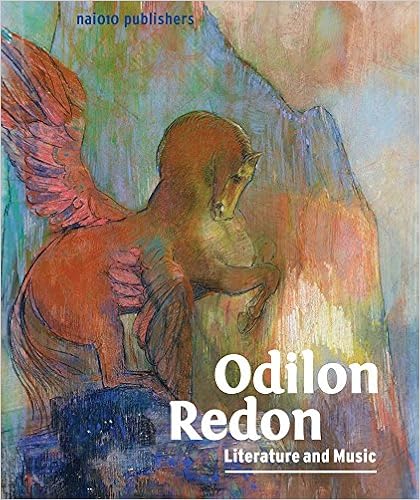
Odilon Redon: Literature and Music Paperback – July 24, 2018 by Cornelia Homburg (Author, Editor), Dario Gamboni (Author), Ted Gott (Author), Jean-David Jumeau-Lafond (Author), Martha Lucy (Author), Line Clausen Pedersen (Author), Odilon Redon (Artist) (nai010 publishers)


This wonderful book with more than 200 illustrations of works largely in private collections and held in the Kröller-Müller Museum, and with essays by renowned experts on Redon and symbolism, provides extensive insight into the importance of literature and music in Redon's oeuvre. Addressing some of Redon's favorite themes in abundant visual detail, Odilon Redon: Literature and Music shows how the artist transposed literary and musical motifs in his work, and how he reinvented such themes over and over again to create new associations and meanings.

Odilon Redon (born Bertrand Redon[; April 20, 1840 – July 6, 1916) was a French symbolist painter, printmaker, draughtsmanand pastellist. This wide-ranging production between mediums and materials paralleled Redon's fascination with synaesthesia, the idea that an experience can be registered by several senses simultaneously, and that the experience could be more intense when several senses are solicited together―a phenomenon which captured the imaginations of many symbolists.

Odilon Redon was born in Bordeaux, Aquitaine, to a prosperous family. The young Bertrand Redon acquired the nickname "Odilon" from his mother, Odile. Redon started drawing as a child; and, at the age of ten, he was awarded a drawing prize at school. He began the formal study of drawing at fifteen; but, at his father's insistence, he changed to architecture. Failure to pass the entrance exams at Paris’ École des Beaux-Arts ended any plans for a career as an architect, although he briefly studied painting there under Jean-Léon Gérôme in 1864. (His younger brother Gaston Redon would become a noted architect.)

Back in his native Bordeaux, he took up sculpting, and Rodolphe Bresdin instructed him in etching and lithography. His artistic career was interrupted in 1870 when he was drafted to serve in the army in the Franco-Prussian War until its end in 1871.

At the end of the war, he moved to Paris and resumed working almost exclusively in charcoal and lithography. He called his visionary works, conceived in shades of black, his noirs. It was not until 1878 that his work gained any recognition with Guardian Spirit of the Waters; he published his first album of lithographs, titled Dans le Rêve, in 1879. Still, Redon remained relatively unknown until the appearance in 1884 of a cult novel by Joris-Karl Huysmans titled À rebours (Against Nature). The story featured a decadent aristocrat who collected Redon's drawings.

In the 1890s pastel and oils became his favored media; he produced no more noirs after 1900. In 1899, he exhibited with the Nabis at Durand-Ruel's.

Redon had a keen interest in Hindu and Buddhist religion and culture. The figure of the Buddha increasingly showed in his work. Influences of Japonism blended into his art, such as the painting The Death of the Buddha around 1899, The Buddha in 1906, Jacob and the Angel in 1905, and Vase with Japanese warrior in 1905, amongst many others.

Baron Robert de Domecy (1867–1946) commissioned the artist in 1899 to create 17 decorative panels for the dining room of the Château de Domecy-sur-le-Vault near Sermizelles in Burgundy. Redon had created large decorative works for private residences in the past, but his compositions for the château de Domecy in 1900–1901 were his most radical compositions to that point and mark the transition from ornamental to abstract painting. The landscape details do not show a specific place or space. Only details of trees, twigs with leaves, and budding flowers in an endless horizon can be seen. The colours used are mostly yellow, grey, brown and light blue. The influence of the Japanese painting style found on folding screens byōbu is discernible in his choice of colours and the rectangular proportions of most of the up to 2.5 metres high panels. Fifteen of them are located today in the Musée d'Orsay, acquisitioned in 1988.

Domecy also commissioned Redon to paint portraits of his wife and their daughter Jeanne, two of which are in the collections of the Musée d'Orsay and the Getty Museum in California.] Most of the paintings remained in the Domecy family collection until the 1960s.

In 1903 Redon was awarded the Legion of Honor. His popularity increased when a catalogue of etchings and lithographs was published by André Mellerio in 1913; that same year, he was given the largest single representation at the groundbreaking U.S. International Exhibition of Modern Art(aka Armory Show), in New York City, Chicago and Boston.

Redon died on July 6, 1916. In 1923 Mellerio published Odilon Redon: Peintre Dessinateur et Graveur. An archive of Mellerio's papers is held by the Ryerson & Burnham Libraries at the Art Institute of Chicago.

In 2005 the Museum of Modern Art launched an exhibition entitled "Beyond The Visible", a comprehensive overview of Redon's work showcasing more than 100 paintings, drawings, prints and books from The Ian Woodner Family Collection. The exhibition ran from October 30, 2005 to January 23, 2006.

The Fondation Beyeler in Basel, Switzerland showed a retrospective from February to May 2014.

The Kröller-Müller Museum in Otterlo, The Netherlands, currently has an exhibition with an emphasis on the role that literature and music play in Redon’s life and work, under the title La littérature et la musique. The exhibition runs from 2 June to 9 September 2018.
]

Butterflies, around 1910 (Museum of Modern Art)

During his early years as an artist, Redon's works were described as "a synthesis of nightmares and dreams", as they contained dark, fantastical figures from the artist's own imagination. His work represents an exploration of his internal feelings and psyche. He himself wanted to place "the logic of the visible at the service of the invisible". A telling source of Redon's inspiration and the forces behind his works can be found in his journal A Soi-même (To Myself). His process was explained best by himself when he said:"I have often, as an exercise and as a sustenance, painted before an object down to the smallest accidents of its visual appearance; but the day left me sad and with an unsatiated thirst. The next day I let the other source run, that of imagination, through the recollection of the forms and I was then reassured and appeased."

The mystery and the evocation of Redon's drawings are described by Huysmans in the following passage:"Those were the pictures bearing the signature: Odilon Redon. They held, between their gold-edged frames of unpolished pearwood, undreamed-of images: a Merovingian-type head, resting upon a cup; a bearded man, reminiscent both of a Buddhist priest and a public orator, touching an enormous cannon-ball with his finger; a spider with a human face lodged in the centre of its body. Then there were charcoal sketches which delved even deeper into the terrors of fever-ridden dreams. Here, on an enormous die, a melancholy eyelid winked; over there stretched dry and arid landscapes, calcinated plains, heaving and quaking ground, where volcanos erupted into rebellious clouds, under foul and murky skies; sometimes the subjects seemed to have been taken from the nightmarish dreams of science, and hark back to prehistoric times; monstrous flora bloomed on the rocks; everywhere, in among the erratic blocks and glacial mud, were figures whose simian appearance—heavy jawbone, protruding brows, receding forehead, and flattened skull top—recalled the ancestral head, the head of the first Quaternary Period, the head of man when he was still fructivorous and without speech, the contemporary of the mammoth, of the rhinoceros with septate nostrils, and of the giant bear. These drawings defied classification; unheeding, for the most part, of the limitations of painting, they ushered in a very special type of the fantastic, one born of sickness and delirium."

The art historian Michael Gibson says that Redon began to want his works, even the ones darker in color and subject matter, to portray "the triumph of light over darkness."

Redon described his work as ambiguous and undefinable:"My drawings inspire, and are not to be defined. They place us, as does music, in the ambiguous realm of the undetermined."

Wednesday, August 22, 2018

Special People Hardcoverby Julie Nixon Eisenhower (Simon Schuster)


In this book Julie Nixon Eisenhower writes about a different famous person from history in each chapter--Golda Meir, Ruth Bell Graham, Prince Charles, Anne Morrow Lindbergh, Mao Tse-tung, and Mamie Eisenhower. She was able to interview them all. I read this for the first time in 1977 when it was first published and just re-read it in the last week.

The interview with Prince Charles especially is more interesting now that we know how history has played out. He was single when he spoke with Julie and he said that his marriage would have to last--that divorce was just not possible. I enjoyed hearing about the visit Prince Charles and Princess Anne paid to Washington D.C. and the account of the tours they went on with Julie and David. I found it very interesting to hear Julie's take on how the visit progressed especially with Princess Anne getting more irritable as the days dragged on.

Julie gives us a bit of history with a touch of the personal--we learn that Golda Meir had an obsession with shampooing her hair and that Billy Graham preferred that his wife Ruth dye her hair (brown hair looks better than white in the sunlight he claims).

Julie's father paved the way for her history-making visit with Mao Tse-tung (she is accompanied by her husband David Eisenhower). It's amazing to hear that Mao Tse-tung was so taken with the couple that he didn't want them to leave.

In these days when we have organizations set up for missing and exploited children and kidnappings of children have become more frequent than we would like, it's still shocking to read of the tragedy Charles and Anne Lindbergh suffered when their 18-month old son (their first-born) is kidnapped and murdered. I was interested to hear about how Anne Morrow Lindbergh's writing sustained her. She was able to grieve by expressing herself through both the spoken and written word, whereas her husband didn't express his grief outwardly.

It's a good book--a little slow going in parts but I enjoyed most of it and have kept it on my book shelf all these years as somehow I knew that it would prove to be even more interesting as time goes on.

Killing England: The Brutal Struggle for American Independence (Bill O'Reilly's Killing Series) Hardcover – September 19, 2017 by Bill O'Reilly and Martin Dugard (Henry Holy and Company)


This book brought to life the struggles of the first Americans, especially the signers of the Declaration of Independence and those who fought in the Revolutionary War. The Founding Fathers were not ordinary people. They were philosophers and truly understood the basic nature of human beings. All of their insights and knowledge contributed to the founding documents of the USA. We owe them a tremendous debt.

The concept that the rights of man come from God and not goverment was completely novel at the time and is fundamental to the Declaration of Independence. All this became very "self-evident" from reading Killing England. Unfortunately, this is not understood by many Americans today, who trust in the goverment believing that goverment provides and protects these rights. The Founders witnessed King George III's punitive actions on the colonies first hand. These are explained clearly in Killing England and the reader can see the basis of the Bill of Rights, the first ten amendments to the US Constitution.

I also came to understand the events the Revolutionary War and appreciate the incredible sacrifices made by the soldiers. I thought I knew a lot about the Founders but did not know that Benjamin Franklin broke ties to his loyalist son William or fully appreciated Thomas Jefferson's personal problems with a very sick wife. I learned a great deal about the contributions of people like Francis Marion, the Swamp Fox, John Paul Jones, LaFayette, and Baron von Steuben. Benedict Arnold's treason is described in detail sufficient to understand that it was horrific.

So basically, Killing England gave me a greater appreciation of the events of the founding of the United States of America and the men who gave their lives and fortunes so that we can live in this most wonderful country. Killing England is an easy read and I particularly liked the maps that show the movements of the armies and navies during major battles. The events come to life.

For the Common Good: A New History of Higher Education in America (American Institutions and Society) Hardcover – June 6, 2017 by Charles Dorn (Cornell University Press)


In For the Common Good, Charles Dorn demonstrates a rare recognition of how students' own choices impacted―and sometimes shifted―the declared missions of colleges and universities over time.Charles Dorn's refreshing analysis is persuasive in showing that higher education for the common good is both central and complex for American colleges and universities in the past, present, and future. Best of all, his book shows how historical research can be readable and pertinent to our policy discussions today.In this engaging look at a remarkable breadth of institutions, Charles Dorn offers compelling new insights into more than two centuries of higher education as well as reassurance that the common-good ethos will survive the current wave of corporatization and consumerism.Charles Dorn offers productive insights into the ways that higher education institutions in the United States have maintained their commitment to advancing the common good over time, even with profound social, political, and economic societal changes.

Are colleges and universities in a period of unprecedented disruption? Is a bachelor's degree still worth the investment? Are the humanities coming to an end? What, exactly, is higher education good for?
In For the Common Good, Charles Dorn challenges the rhetoric of America’s so-called crisis in higher education by investigating two centuries of college and university history. From the community college to the elite research university―in states from California to Maine―Dorn engages a fundamental question confronted by higher education institutions ever since the nation’s founding: Do colleges and universities contribute to the common good?
Tracking changes in the prevailing social ethos between the late eighteenth and early twenty-first centuries, Dorn illustrates the ways in which civic-mindedness, practicality, commercialism, and affluence influenced higher education’s dedication to the public good. Each ethos, long a part of American history and tradition, came to predominate over the others during one of the four chronological periods examined in the book, informing the character of institutional debates and telling the definitive story of its time. For the Common Good demonstrates how two hundred years of political, economic, and social change prompted transformation among colleges and universities―including the establishment of entirely new kinds of institutions―and refashioned higher education in the United States over time in essential and often vibrant ways.

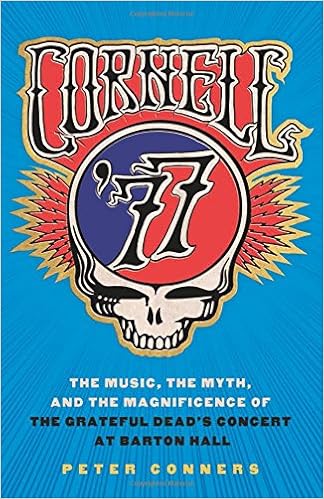
Cornell '77: The Music, the Myth, and the Magnificence of the Grateful Dead's Concert at Barton Hall Hardcover – April 11, 2017 by Peter Conners (Cornell University Press)


"I made my own mix to make myself happy and to hear what I wanted to hear." Betty Cantor-Jackson.

The May 8, 1977 show at Cornell University has long been touted as one of the Dead's best shows post-layoff and certainly one of their best shows ever. Some Deadheads say the show is overrated, but maybe that's because tapes of this gig have been "around" since the '80s. And having it recorded by Betty Cantor-Jackson ("Betty Boards") has helped elevate this show too. This concert is included in the National Recording Registry because of the quality of the band's playing that night. Plus, Dick Latvala has always liked this show (and the shows surrounding Barton Hall)--but never released it as a "Dick's Picks" because the tapes were circulated widely.

The author admits he wasn't at this show (he first heard the band in the '80s), and the book is published by Cornell University Press, which might make skeptics think "tie-in" with the box set featuring this show and three others from that period. To each his own on that subject. But as a Deadhead (since before the term was invented) I found the book has a number of interesting if not good insights and some information about the band and this show, and that era of '77.

The book begins with some background on the Sex Pistols, the disco era, and how that ties into the Dead as a band during that time. From that point the author begins to lay out the foundation of the Dead and the book. With many interviews (including Betty Cantor-Jackson) and 16 pages of photos, picturing the university and surrounding areas--not the show itself--and another section of 16 pages of photos including the band on stage at Barton Hall, newspaper clippings about the show, and other ephemera, you get a better idea of the Barton Hall gig. The author uses facts, opinions, interviews, and his own thoughts to paint a picture of that particular show and the people and era involved. You'll hear from Deadheads, non-Deadheads, scholars, tapers/traders, and others in the band's orbit at that time. But to be honest the author didn't get any interviews with band members simply because as Bob Weir said "I'm not sure I'm going to remember the sound check, or even that show." To the band it was just another show in a string of gigs--some better than others--but still just another show. The author also gives his opinions on the songs played that night--with information about the tune itself and how the song was played by the band.

If you're a Deadhead fan/collector (like me) this book is worth adding to your library. If you have only a passing interest in the band the impact of the book (and this particular show) may miss you entirely--and that's okay. But that string of gigs the band played in May of that year were some of the best shows after their lay-off from concerts. This book is included in the original issue of the box set from the Rhino/Dead gang, which quickly sold out. If you want to hear the music only, the box set is available without the book as a "music only" edition. The May 8 show is also available as a stand alone set.

There's a "Listening and Reading" section that lays out the sources used for the book, a section of notes for each chapter, and an index. The photos and other graphics are printed on glossy stock paper that greatly improves viewing.

This a good time for Deadheads--this book, the upcoming stand alone release of this '77 show and the box set, the upcoming movie and soundtrack, and the recently released 21 CD box set (with booklet) of shows from '71 for under 25 bucks. It's almost too good to be true

Saturday, August 18, 2018

Salento Style Hardcover – September 16, 2011 by Fiorella Congedo (Congedo Publishing / Congedo Editore )


Salento (Salentu in the Salentino dialect) is a geographic region at the southern end of the administrative region of Apulia in Southern Italy. It is a sub-peninsula of the Italian Peninsula, sometimes described as the "heel" of the Italian "boot".

It encompasses the entire administrative area of the province of Lecce, a large part of the province of Brindisi and part of that of Taranto.

The peninsula is also known as Terra d'Otranto, and in the past Sallentina. In ancient times it was called variously Calabria or Messapia.

This section needs expansion with: section. You can help by adding to it. (October 2010)
Messapia (from Greek Μεσσαπία) was the ancient name of a region of Italy largely corresponding to modern Salento. It was inhabited chiefly by the Messapii in classical times. Pokorny derives the toponym from the reconstructed PIE *medhyo-, "middle" and PIE *ap-, "water" (Mess-apia, "amid waters"). Pokorny compares the toponym Messapia to another ancient Italic toponym, Salapia, "salt water", a city in Apulia.

Salento peninsula is composed of limestone, dividing the Adriatic Sea from the Ionian Sea. Known also as "peninsula salentina", from a geo-morphologic point of view it encompasses the land borders between Ionian and the Adriatic Seas, to the “Messapic threshold”, a depression that runs along the Taranto-Ostuni line and separates it from the Murge.

Thursday, August 16, 2018

111 Places in Miami and the Keys That You Must Not Miss Paperback – November 30, 2015 by Gordon Streisand ( Emons Verlag / Emons Publishers)


As a Central Floridian, Miami is like an entirely different country to me. This guide book gave me all of the information I would ever need to enjoy a trip down south. I'm particularly looking forward to visiting number 92, as I have heard rumblings of the mysterious skunk ape even way up here in Daytona Beach. This book is thorough and insightful. Plus the author, Gordon, is a pretty cool dude, too. He has this weird thing with taking your picture and putting a dot on your face, though, not entirely sure what that's about. Anyways, buy the book - you'll be glad you did!


  • The ultimate insider's guide to Miami and the Keys; go off the beaten path to discover the hidden places, stories, and neighborhoods that reveal Miami's true character, history, and flavor
  • Features interesting and unusual places not found in traditional travel guides
  • Part of the international 111 Places/111 Shops series with over 150 titles and 1 million copies in print worldwide
  • Appeals to both the local market (over 5 million people call the greater Miami area home) and the tourist market (nearly 14 million people visit Miami and the Keys every year)
  • Fully illustrated with 111 full-page color photographs
  • Miami and the Keys are the cultural and geographical gateways to the United States; where Latin America gracefully blends into North America, and land embraces the sea.


This unusual guide leads you along the fulcrum that is Miami and the Keys, laden with world-class architecture, sandy beaches, pristine waters, nightclubs, and trendy hotels. Beneath the well-polished surface lies a history and culture that strays far from the conventional, bubbling up through unexpected places, like a coral fortress built for a spurned lover, a divey laundromat that serves the sweetest café con leche you've ever had, or an enclave of houses built on stilts in the midst of the ocean. Lose yourself in a glass rainforest. Glide over the mysterious waters of the Everglades. Visit your own desert island. Drink the sweet nectar of the Cuban coffee gods. Venture into the "other" Miami, beyond the glitz and glamor, steeped in natural beauty and deep-seeded tradition. See why Ernest Hemingway called the Keys his home.

Though teeming with tourists, there are still plenty of hidden gems to be unearthed, you just have to know where to look...

Saturday, August 11, 2018

The SBL Handbook of Style 2nd Edition by Society of Biblical Literature (SBR Press)


This is a major upgrade on the first edition. I use SBL style occasionally as a copyeditor, and I wasn't aware there was a second edition until I encountered a job that required it. So I ordered the book and liked it--except for the price. But this has much more detail than the first edition, with nice cross-refs to the Chicago Manual of Style, and I'm hoping it will be a valuable reference tool for the next several years.

The definitive source for how to write and publish in the field of biblical studies

The long-awaited second edition of the essential style manual for writing and publishing in biblical studies and related fields includes key style changes, updated and expanded abbreviation and spelling-sample lists, a list of archaeological site names, material on qur'anic sources, detailed information on citing electronic sources, and expanded guidelines for the transliteration and transcription of seventeen ancient languages.

Features:
Expanded lists of abbreviations for use in ancient Near Eastern, biblical, and early Christian studies
Information for transliterating seventeen ancient languages
Exhaustive examples for citing print and electronic sources

Degas' Little Dancer Aged Fourteen: The Earlier Version That Helped Spark the Birth of Modern Art Hardcover – November 8, 2016 by Gregory Hedberg (Arnoldsche Verlagsanstalt )


Dr. Hedberg’s book presents a scholarly, but riveting, analysis of this recently revealed plaster, which records an earlier version of Degas’ Little Dancer, Age Fourteen, as it existed before Degas reworked it beginning in 1903. His careful analysis of the empirical and documentary evidence is compelling and for the first time reveals why, in 1881, Degas’ sculpture was considered so radical and impactful.

Dr. Hedberg uses the plaster as the fulcrum for what is essentially a detective story sorting out the often confusing or conflicting aspects of what had been thought known about Degas’ famous wax and its history. He then continues with an exploration of its impact on other artists and relation to the subsequent evolution of art.

Chapter I outlines in detail the physical and documentary evidence that Degas reworked his Little Dancer, and that the newly revealed plaster records Degas’ figure as it was before he reworked it.

Chapter II contrast the wax’s original iconic pose with the contrapposto poses then prevalent and discusses artistic poses from ancient Egypt to 1881, the year Degas exhibited his Little Dancer in the sixth Impressionist exhibition in Paris, illustrating the radical departure of Degas’ approach.

Chapter III illustrates how poses began to change after avant-garde artists such as Whistler, Manet, Sargent and particularly Seurat saw Degas’ Little Dancer with its iconic pose in 1881, as revealed by the plaster.

Chapter IV takes the story of symmetrical iconic poses from 1900 until today with a particular emphasis on painting and sculpture in New York City after World War II.

The visual timeline and glossary of terms are very helpful and the five appendices provide abundant documentation for those wishing to further examine the underlying evidence for Dr. Hedberg’s thesis.

It is a book not only for scholars, but also artists and art lovers.

Wednesday, August 8, 2018

The Psychology of Art Obsession........Obsession: Nudes by Klimt, Schiele, and Picasso from the Scofield Thayer Collection an exhibition at the Met Breuer, New York City, July 3–October 7, 2018 Catalog of the exhibition by Sabine Rewald and James Dempsey Metropolitan Museum of Art, 132 pp., $25.00 (distributed by Yale University Press) The Psychology of an Art Writer by Vernon Lee, David Zwirner Books, 135 pp., $12.95 (paper)


The English writer Clive Bell called it “significant form.” Later generations of artists, critics, and historians, rejecting Bell’s elegant coinage, favored “formalism,” a more clinical term for more clinical times. Whatever the nomenclature, a conviction that the power of the visual arts is grounded in lines, shapes, colors, and compositions rather than in representations, symbols, and narratives held sway for more than a hundred years, beginning in the days of Walter Pater and Oscar Wilde. By the time the critic Clement Greenberg’s reputation was at its zenith in the 1960s, formalism was seen by many as an ideological fortress; at times it might be embattled but ultimately it was impregnable. If formalism was silenced in Stalin’s Russia, it would be renewed in the anti-Stalinist avant-garde circles of New York. But fortresses, even ideological fortresses, only last so long.

Formalism began as an investigation of fundamental artistic and even artisanal principles; its proponents believed it would ultimately bridge classes, cultures, and centuries. The time has come to revisit the old formalist faith. We can glimpse bits and pieces of that open-ended and generous-hearted spirit in a new book and a new exhibition. The Psychology of an Art Writer is a small collection of writings by the English fin-de-siècle essayist Vernon Lee, who spent most of her life in Italy and thought deeply about the formalist theories then evolving all over Europe. “Obsession: Nudes by Klimt, Schiele, and Picasso from the Scofield Thayer Collection,” an exhibition at the Met Breuer organized by Sabine Rewald, provides an opportunity both to linger over some unabashedly erotic works by three modern masters and to explore the life and thought of Scofield Thayer. He was a wealthy American who—along with his partner, James Sibley Watson Jr.—not only bankrolled but also guided the great days of The Dial, a magazine that was a beacon of modernist experimentation, with Marianne Moore for a time the editor and Ezra Pound a significant adviser.

There is a paradox at the heart of formalism, one that we must confront before we can even begin to consider its rich and varied history. All visual art, even art that sets out to defy or confound the experience of the eye, is fundamentally a matter of form. Marcel Duchamp, who early in the twentieth century began to designate certain commercially made objects as Readymades, must have known that he was launching an assault on good old-fashioned aestheticism when he forced artists and critics to admit that even antiformalism was a kind of formalism. Although Duchamp said that he had initially selected his Readymades—a bicycle wheel, a bottle rack, a urinal, a snow shovel—for their “visual indifference,” soon enough they were being regarded as forms that were anything but plain and simple. In 1951 the painter Robert Motherwell went so far as to declare Duchamp’s Bottle Rack “a more beautiful form than almost anything made, in 1914, as sculpture.”

But if visual indifference can inspire visual delight, then where does that leave formal values? Duchamp was among the very first people to ask that question. By now, it seems everybody is asking. In our anything goes era, some argue that formal values are whatever anybody says they are. The collapse of distinctions makes it all the more important to establish what the distinctions were in the first place.

Many powerful voices in the contemporary art world have rejected art-as-art, an old rallying cry that some avant-gardists saw as a bulwark against philistinism, in favor of art-as-politics, another old idea, but one that has fresh urgency in the Age of Trump. Like all visual art, political art has its forms, even if they sometimes amount to little more than forms of delivery. Adrian Piper, whose socially and politically oriented work was the subject of a recent retrospective at the Museum of Modern Art,* was joining this tangled conversation way back in 1971, when she announced, “I can no longer see discrete forms or objects in art as viable reflections or expressions of what seems to me to be going on in this society.”

In Piper’s work—much of it text-driven, photographic, and monochromatic—what many have regarded as art’s primary responsibility to fill the eye is rejected in favor of art as something like an X-ray machine generating reams of social and psychological data. There is no question that Piper’s work has its forms. Like a number of widely admired contemporary artists—Bruce Nauman and Isa Genzken come to mind—Piper is formally promiscuous. She has produced paintings, drawings, photographs, typescripts, collages, screenprints, performances, videos, and installations. What some may describe as her stylelessness, others will embrace as a new kind of stylistic heterogeneity.

Piper turns formal matters into utilitarian matters. That may well be her intention. She is certainly not alone. The danger here, as I see it, is that formalism becomes nothing more than a means of visual delivery—a question of how to illustrate, promote, or brand some particular story or idea. What is getting lost is the sense that formal values have an inherent emotional, symbolic, or moral weight. A perfectly natural human appetite for fresh subject matter—it can be political, social, or sexual—can all too easily overwhelm a sensitivity to the nuances of formal experience that is woven into the fabric of human experience, not only in modern times but in all times. The illustrations in Clive Bell’s book Art, first published in 1913, include a praying figure from fifth-century China, a possibly eleventh-century Persian dish, and a sixth-century Byzantine mosaic from Ravenna, all of which Bell regarded as examples of “significant form.” Bell’s idea—which was radical then and remains radical today—was that the subject didn’t matter. What mattered was how shapes, colors, and compositions were joined to express ineffable feeling.
argument that formal values are timeless, universal values is rooted in the same traditions of philosophical idealism that celebrate freedom as a universal value. If formalism is embattled today it is in part because universalism is more generally being questioned, by thinkers on the left as well as the right. Considerations of the arts are gripped by the same struggles between the demands of the universal and the particular that preoccupy anybody involved with serious discussions of race, gender, immigration, and any number of other topics. However amorphous universal values may sometimes seem, to jettison them risks turning particulars into predilections or, worse, mere prejudices. Both Vernon Lee and Scofield Thayer were products of a time when universal values remained a bulwark.

The Psychology of an Art Writer is a small book that gives only the tiniest fragment of the enormous body of work that Vernon Lee—the pen name of Violet Paget—produced in the packed decades of a life that spanned countries and centuries; she was seventy-eight when she died in 1935. She grew up in a somewhat bohemian and itinerant English family; her mother, twice married, settled near Florence with Violet and her half-brother, Eugene, in a house Violet lived in for the rest of her life. She took an interest in the musical as well as the visual arts and produced fiction as well as nonfiction that ranged from travel writings to aesthetic theory. She was a lesbian, with a number of passionate attachments and a following among a group of young women. Her friends in the expatriate world of the late nineteenth and early twentieth centuries included at one time or another Walter Pater, Henry James, and Bernard Berenson. In 1881 John Singer Sargent—whom she knew from childhood, when their families were fairly close—painted an invigorating portrait of her. You feel a sharp, alert energy in her flashing eyes, partly open lips, and short, casually cropped hair.

The Psychology of an Art Writer consists of an autobiographical text in which Lee explores the basis of her view of aesthetic experience, followed by a series of very specific reflections on paintings and sculptures. What occupies her attention as she moves through the Uffizi in Florence and the Capitoline and Vatican museums in Rome are works of ancient and Renaissance art, many well known. What’s striking about Lee’s writing here is the openness and what one might almost describe as the nakedness with which she embraces the multiplying sensations and apprehensions that shape her experience. We are far from the schematic discussions of the relations between form and content that became popular in the second half of the twentieth century and that the art historian Yve-Alain Bois has characterized as “the old metaphysical opposition.”

For Lee the experience of a work of art is always dynamic. What counts is not only “the direct percept of a form as such,” but also “its interpretation in terms of what it’s meant to represent” and “emotional qualities inherent in perceiving the form or tied to it by association.” For Lee, formal values—although they don’t eclipse all others, as they will for some later critics—definitely demand special attention. She explains that “the long and short of all this is that normally, when we look at a picture or statue, we think the subject, and feel the form, and express the first in rich and varied language intelligible to everyone, while we only indicate the effect of the other on us in vague terms not much more than translations of gestures.” She wants to deepen our understanding of those feelings while avoiding cut-and-dried prescriptions.

Lee owes much to Pater, who in his extraordinary essays on Leonardo, Giorgione, and other Renaissance masters tends to downplay older concerns with narrative and symbolic content in favor of a visceral experience generated by his responses to lines, forms, colors, and the way the artist, through the working of hand and eye, forges a poetic whole. What makes Lee’s writings especially interesting for us now is that unlike Pater, who produces a sensuous literary effect so seamless as to confound dissection, Lee invites us to linger over her own conflicting impulses and impressions. She is by no means inattentive to subject matter and the “parade of associations” it generates. She wonders, looking at a sculpture by the neoclassical master Canova, why “works of art that reproduce exceptionally perfect anatomical forms…can still seem banal and even trivial.” She grapples with the paradoxical situation of disliking the subject of a painting but nevertheless finding herself caught up in the painting’s poetry.

The visceral, physical reactions generated by works of art are one of Lee’s great interests. She comments on how in a classical Greek figure sculpture “the arrangement of planes” has an impact that acts “independently of its anatomical structure.” And of an unfinished Leonardo, she observes that the figures “balance each other like the lines of a Gothic window” and “the total effect is very Gothic: exciting, lucid, interesting and yet holding one,” creating “a complex whole.” She is fascinated and sometimes even bewildered by the psychological power of certain works of art. She suggests that a visual impression—the sense of movement in a work of art, for example—can trigger an almost physical response, perhaps a tightening or flexing of the muscles, which in turn moves the mind in unexpected directions.

What stands out, reading Vernon Lee more than a hundred years after she wrote these words, is how restlessly she negotiated what she obviously believed to be the fluid boundaries between form and content. The work of art engages every part of her, in ways that remain unpredictable, subject to constant change. She is certainly not alone in this questing, questioning spirit; her thinking owes much to Kant and the German Romantics and the sculptor Adolf von Hildebrand’s The Problem of Form in Painting and Sculpture, first published in 1893. For me the importance of her voice is as a reminder of how porous modernist thinking really was in its early decades and generations.

Scofield Thayer, whose collection of erotic drawings is only part of a large bequest he left to the Metropolitan Museum of Art, made his mark as an impresario of modernism in the years just after World War I, when Vernon Lee’s star had already faded. Alyse Gregory, who was for a time the managing editor of The Dial and a friend and perhaps a lover, described Thayer as “slender of build, swift of movement, always strikingly pale, with coal-black hair, black eyes veiled and flashing, and lips that curved like those of Lord Byron.” He was a passionate man whose pursuit of art and literature was matched by his erotic adventures. He was also a troubled spirit who underwent psychoanalysis with Freud in the early 1920s but in the mid-1920s had a breakdown from which he never recovered. When he died in 1982 at the age of ninety-two, he had been out of the public eye and in and out of mental institutions for more than half a century. Purchased for what now seem extraordinarily small sums of money on some rather frantic visits to galleries in Europe, the drawings now at the Met Breuer reflect the interests of a sensualist whose private papers include a photograph of a naked Louise Bryant, who had been married to the Communist John Reed and in 1920, the year Reed died, had an affair with Thayer.

The several dozen drawings of the female nude that Thayer left to the Metropolitan Museum of Art range from some of Gustav Klimt’s and Egon Schiele’s recklessly erotic studies to a group of Picassos in which the neoclassical line suggests not coolness but banked heat. These drawings, especially the Klimts and Schieles, are works that it would be ridiculous to even attempt to treat as if form could be detached from content. When a male artist gives this kind of undivided attention to a female model’s genitalia, critics who speak of the quality of the line risk turning connoisseurship into a joke. But it must be said that what makes it possible, at least some of the time, for Klimt and Schiele to avoid pornographic sentimentalism or sensationalism is precisely the blunt, even knockabout elegance of their lines. The line is what powers these often unnervingly forthright sexual images. Klimt and Schiele perform graphic high-wire acts, which leave me feeling that the artist is, if not anywhere near as exposed as the model, exposed nonetheless. Some similar process is at work in the single painting in the show, Picasso’s early Erotic Scene (1902–1903). Here the young artist is getting a blow job from a long-haired young woman, and the roughhewn painterly informality turns a subject out of an old pornographic postcard into an unforgettable image of youthful self-realization.

Thayer remains an elusive figure, despite an admirable biography, The Tortured Life of Scofield Thayer, by James Dempsey (who also contributed to the exhibition catalog). He published a few dozen rather striking poems (Dempsey quotes from them extensively in his biography) and there is a considerable correspondence, much if not most of it involving financial matters that range from purchases of art to the operations of The Dial. When Thayer wrote about aesthetic matters in The Dial, my impression is that his focus was generally on the literary rather than the visual arts; he was among those who believed that Joyce was a stronger writer in Dubliners than in the later elaborations of Ulysses.

Thayer nurtured a skepticism about institutions not unexpected in an avant-gardist of his time; he once wrote that “museums like Minotaurs devour the fairest of mankind.” Art involved experiences that were too complex and elusive to be measured by any single standard. “Beauty is not in the eye of the beholder,” Thayer wrote. “Neither is it in the work of art—these are but the flint and tinder, which, being brought together, give the spark called beauty. As there is no sound when a tree falls if there be not present an ear, so there is not beauty unless some soul observe the object.” Beauty, Thayer seems to be arguing, isn’t entirely objective, but it isn’t entirely subjective, either. The significance of significant form lies somewhere between the two; the form of the object is the tinder that sparks the experience.

In considering Thayer’s sensibility, it may be useful to look at some of Ezra Pound’s thoughts about formal values, for the two of them were in dialogue in the years after World War I when The Dial was in its heyday. Writing in the magazine The New Age about a portrait of three women by Matisse, Pound argued that “the contender for ‘pure form’ and for ‘forms in relation’” ought not be “stumped” by what in this instance was a relatively naturalistic and therefore (at least by Matisse’s avant-garde standards) traditional representational work. Pound was especially attentive to the women’s eyes in the painting. Although “the geometric means” weren’t complicated, he argued that “like all simple means used by an artist, the artistic depth, as in contrast to the mathematical plainness, is due to great subtlety in the use, ergo, to great sensitiveness in the user; and, in the end, sensitiveness plus experience and perseverance is great knowledge.” Pound emphasized the elemental form of the eyes Matisse painted: “the geometric means is no more than the relation of a disc to the two concave curves above and below it, tangent or almost tangent to the disc.” But the “simple means” generated “great subtlety” and “artistic depth”—and thus a psychological power. There was a richness, maybe even a messiness, about aesthetic experience as it was described by a considerable variety of writers in the years when modernism was still young. All too much of that was lost as formalism hardened into theory.

Writing to Vernon Lee in 1885 about her novel Miss Brown, Henry James said, “Cool first—write afterwards. Morality is hot—but art is icy!” Miss Brown is by most estimates not a great success, and James, to whom it was dedicated, had waited some time before writing to Lee about what he felt to be her exaggerated caricature of the bohemian art world of late-nineteenth-century London. But his remark, though not addressed to Lee’s writings on aesthetics, seems to me to resonate powerfully in our present moment, when formalism is in retreat if not in mortal peril.

In the arts there is a growing preoccupation with what James would have regarded as the hot topics: matters of morality and moral justice. In the museums and the media we hear more than ever before about the relationship between the museum and the wider community and the need to adequately represent the varied interests and priorities of a pluralistic society. By titling the exhibition of Thayer’s drawings “Obsession,” the curators at the Met Breuer have made it clear that they have a hot topic on their hands. Here we have drawing after drawing in which the artist, who is a man, gazes at the most private places of a woman’s body. But there is also a good deal of what James would call ice in the drawings of Klimt, Schiele, and Picasso. I am referring to the ice of style and stylization, of formal values. Some museumgoers will find that the ice gives these drawings their staying power. Others will argue that the ice of art is nothing more than an obfuscation, an elaborate guise designed to distract us from the degradation of these women.

All too often now, formal values are regarded as nothing more than the chilly packaging, something to be torn away so we can get to the hot stuff. Some see an inherently conservative or even reactionary aspect to formal values, which they believe muffle or defang controversial subjects. When Holland Cotter of The New York Times reviewed the Adrian Piper exhibition at the Museum of Modern Art, he set up a number of oppositions between what he saw as the priorities of the museum, which has for much of its nearly ninety-year history been known for its defense of formalism and formal values, and the work of an artist who often deals with questions of gender and race. Cotter wrote that the show “makes the museum feel like a more life-engaged institution than the formally polished one we’re accustomed to.” He found that the “fiery issues of the present—racism, misogyny, xenophobia” were now “burning in MoMA’s pristine galleries.” And he concluded that “historically, institutionally MoMA has favored smoothness and symmetry, whiteness. It has tended to shave off the awkward corners of art, sand its sharpest edges down.”

It isn’t easy to disentangle what amounted to Cotter’s broad-brush attack on the Museum of Modern Art. I wonder whether, when he wrote that the museum favored “whiteness” (and isolated and thereby almost italicized the word), he meant to suggest that MoMA’s iconic white-painted galleries reflect some sort of racial preference or prejudice. However one chooses to read Cotter’s words, what is clear is his underlying assumption, namely that an embrace of formal values is almost by definition a rejection of social values and many other kinds of values.

Nothing could be farther from the truth. MoMA’s history proves the point. Few institutions have done more than the Museum of Modern Art to demonstrate that formal values can live on easy terms with other values. Has Cotter forgotten that Picasso’s Guernica, the twentieth century’s most radical visual critique of fascism, was on display at MoMA for a generation? When Alfred H. Barr, Jr., a great advocate of formal values, was the institution’s guiding spirit, there was a not insignificant amount of support for the work of African-American artists, women artists, and what are now referred to as outsider artists. Formal values are equal opportunity values. From the very beginning that was the message of the Museum of Modern Art.

There is no question that when formalism was at the height of its influence some of the movement’s most voluble supporters demanded a theoretical purity that has proven self-limiting if not self-defeating. In retrospect, Clement Greenberg’s 1961 essay “Modernist Painting,” once regarded as a quintessential statement of formalist principles, suggests ideological authoritarianism. Greenberg believed that modernism depended on “the use of characteristic methods of a discipline to criticize the discipline itself.” Though he was anything but a Marxist by the time he wrote “Modernist Painting,” he nevertheless approached historical questions in a dialectical spirit. Modern artists, he argued, were using their paints and brushes to deconstruct the naturalistic illusions that earlier artists had used their own paints and brushes to construct. What modernism amounted to was a critique. If that kind of self-reflexive thinking is what formalism is all about, then certainly too much of human experience has been overlooked.

Many of Greenberg’s contemporaries were making that point more than a generation ago; they referred to him ironically as the Pope of Modernism and were impatient with his rejection of the hotter elements in Picasso and Matisse and any number of other artists. But the problems didn’t begin with Greenberg. The novelist William Plomer, who moved in the Bloomsbury world, recalls in his memoirs hearing jokes about Clive Bell’s insistence, during a lecture at the National Gallery in London, on referring to the figure of God the Father in one painting as “this important mass.” That brand of belligerent aestheticism was bound to spark a reaction. But the reaction has gone way too far.

For anybody old enough to remember the vigorous conversations that were the lifeblood of the arts thirty years ago, there can be something a little eerie about the current situation, when formal matters are rarely discussed. I do not think it would be amiss to speak of the silencing of formalism. When Yve-Alain Bois and Rosalind Krauss, art historians and critics both once associated with Greenberg, embraced the ideas of the renegade French Surrealist Georges Bataille in an exhibition and book that they titled Formless: A User’s Guide, they discussed Greenberg only in passing, although the entire project was a rejection of his ideas. A page had been turned. There was no more to say.

What is perhaps the most expansive series of studies of modern art currently being published—Documents of Contemporary Art, a project of the Whitechapel Gallery in London—now contains nearly four dozen volumes including ones titled Destruction, Boredom, Painting, Queer, Craft, Ruins, but nothing on Form or Formalism. The volume entitled Abstraction does include a section on “Formal Abstraction,” but here formalism is described reductively as a “self-reflexive and idealistic enquiry into art and its function.” This hardly does justice to the interests and priorities of the early modernists. As for Greenberg, I think it is significant that he is not even among the writers whose work is anthologized in Abstraction.

What was quite clear to artists and writers in the early years of the modern movement was that all visual art is a process of abstraction, including the most naturalistic art. Something—whether an image or an idea—is given concrete form. The question that fascinated Vernon Lee was how form conveyed feeling. But if the artists and writers of her generation approached these questions with a new analytical spirit, the fundamental questions are ancient ones. Formalism, understood in the broadest sense, is about the building blocks of the visual arts. In this sense it’s anything but timebound, certainly not merely “modern.” We see it in the medieval architect Villard de Honnecourt’s notebook, where he illustrates the geometric forms (triangles and so forth) that he believed might be models for human and animal forms. We see it in Leonardo’s discussions in his notebooks about methods of generating compositions from the shapes of the stains on a wall or the clouds in the sky. We see it in Poussin’s argument that paintings with different rhythmic structures precipitate different moods and emotions. Artists were concerned with the affective power of form long before Bell wrote about “significant form.”

What an artist is saying can never be separated from the way the artist says it. This statement, which I once imagined was self-evident, is now in need of defense. In our moment of heightened social, sexual, and political awareness, there are many museumgoers who are weary of art that stands apart from life. But what is art if it is not unlike life? If Schiele’s drawings of the female body are anything more than occasions for a debate about the battle between the sexes, it’s because art, which is all about form, has been brought to bear on the raw material of life. Such negotiations between art and life are the subject of Vernon Lee’s challenging writings. She knew that morality in art was different from morality in life. She also knew that the difference wasn’t always easy to grasp, much less explain. That the difference now demands a defense is one among the many challenges we face in these bewildering times.

Tuesday, August 7, 2018

Etruscan Bucchero in the British Museum (British Museum Research Publication) Paperback – December 18, 2007 by Philip Perkins ( British Museum Press)


This book will remain useful for many years not only as a comprehensive treatment of the British Museums bucchero collection, but also for anyone who wishes to learn more about bucchero in general and to appreciate better its ramifications for our understanding of Etruscan culture

Bucchero is the most distinctive class of ceramic produced in Etruria, Italy, between the 7th and the 5th centuries BC. This publication aims to provide a complete up-to-date listing and description of the collection of bucchero in the British Museum; a collection that consists of over three hundred items including examples of all the important regional productions of bucchero. A previous partial publication of the collection in 1932 is now out-dated and in need of replacement. In addition to being a new, complete, fully referenced and illustrated catalogue, technical aspects of the production of the vessels have been meticulously studied in order to reconstruct a working sequence - detailing the steps in the manufacture of each vase. A final important contribution of the study is the investigation of the formation of the collection, which dates back to 1756, and the history of the study of bucchero.

About the Author
Philip Perkins is Senior Lecturer in the Department of Classical Studies at the Open University, with extensive research interests in Italian archaeology, particularly Etruscan studies.

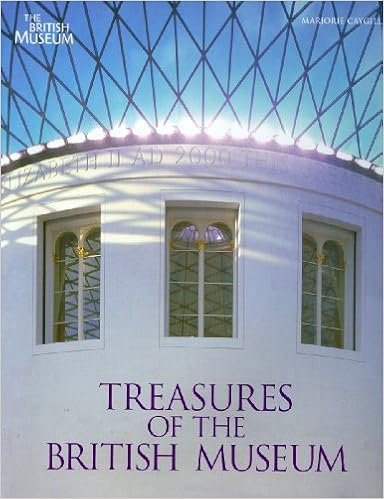
Treasures of the British Museum Revised Edition by Marjorie Caygill ( British Museum Press)


Coming from every part of the world and from all ages, these art works and artefacts collectively form an overview of human cultural achievement across civilisations.The British Museum  is the greatest treasure house in the world and it could fill many books with pretty pictures ... but this is more than that. A choice selection of topics, some well known and obvious (Sutton Hoo, the Royal Cemeteries at Ur, the Elgin Marbles), others less obvious (the Folkton Drums, the Lothar Crystal), fifty in all, serve as the basis for description and discussion of both objects and collectors and the way in which the BM has acquired them. This unusual and interesting approach makes for a magnificent book: superb pictures, highly readable descriptions and lots of human interest anecdotes. The 2009 edition is significantly expanded with twelve new objects discussed, representing a refocusing away from Europe and the Near East and also showcasing artefacts, such as the Ringlemere Cup, acquired over the last few decades. `About as good as a book of this sort can be. A magnificent present ... if you can bear to part with it.'

The range of the displayed objects is spectacular. Audiences will discover archaeological treasures from Egypt, Mesopotamia, Greece and Rome. They will encounter, too, artistic masterpieces from Asia, the Middle East, Africa, the Americas, Oceania and Europe.

Every object displayed here is exceptional and each has its own story to tell: from hand axes made by our earliest human ancestors in East Africa, through to Medieval luxury wares, to contemporary art works that reflect the concerns of our modern age.

The British Museum Treasures offers visitors a sense of the British Museum collection as it can be experienced in London. Comprising objects from the whole world, past and present, the exhibition allows us to consider the varied ways in which made things can embody ideas and concerns common to all humanity.

Monday, August 6, 2018

The Odyssey By Homer, Emily Wilson W. W. Norton & Company 592 Pages


By my count, we have seen 27 translations of Homer into English since 2000, so no one can say we languished for want of a new Odyssey. It’s all the more remarkable, then, that Emily Wilson is making her presence felt in so crowded a field. This she does with the full literary arsenal of our age. She tweets, she appears discreetly photographed and interviewed in The New York Times Magazine, and writes for The New Yorker. Her tweeting then becomes a topic in itself for The New Yorker and Bustle. She makes the rounds on two continents for readings and chats. Good for her! We classical scholars can only rejoice to see a colleague hit the big time. Of course, tweeting is an offensive weapon, and she has ruffled feathers by taking her predecessors to task for misogyny — while also tweeting footage of dreamy Mark Ruffalo reading her verse for some celebrity cachet. So let me anticipate the inevitable criticism with an observation: Emily Wilson is not breaking norms of behavior as the first woman to translate Homer’s Odyssey into English; she is fulfilling them. From the outset, our English translators have all been on the make. Take our founding father, George Chapman. His translation is surrounded by punchy commentary and wild claims, both for Homer’s genius and his own bona fides as a translator — to the extent of calling one critic an “envious windfucker” for suggesting he had not really read the Greek (the word refers to a type of kestrel, so maybe it’s not as bad as it sounds).

Chapman’s successors were reinventing the book business, effectively, with innovative schemes. John Ogilby made use of a clever subscription drive, getting wealthy aristocrats to pay for the illustrations (which he adorned with their crests) to help float his huge folio Homers and Virgil. Alexander Pope was the ultimate artist of the deal; his Homer made him one of the first people in history able to live off the proceeds of a literary translation. So before the critics dismiss Wilson for taking to Twitter and making the most of her moment, I say look to her predecessors and know that Chapman and Pope would definitely have had Twitter accounts. Translations have a way of finding new readerships, and if Wilson is actively responding to her readers and building a different audience for Homer, then she is doing the gods’ work and well deserves a silver bowl — maybe even a gleaming chariot — for her efforts.

“Tell me about a complicated man.” So this new Odyssey begins, and with this verse Wilson plants her flag of difference. It’s a line that introduces a fundamental ambivalence toward the epic’s hero, whom Renaissance translators strove to make a wise and stoic mirror of princes. Wilson dove into the meanings pooled in the keyword polytropon and swam up with “complicated,” the kind of euphemism you use to describe a person you once admired, but who has hurt you. It’s kind of a trilingual play on words, as “much turned/turning” shades into “folded up” (from Latin complicare) and comes out, “complicated” (we never really sense the physicality of our Latinate words, but the classicist learns to savor it). The funny thing is, though this verse complicates Odysseus’ stature, it greatly simplifies the syntax of Homer’s opening sentence, which includes a number of snaking clauses and actually ends on line five. But this single verse introduces both her take on the work’s hero and a poetics of reduction that she observes rather ruthlessly in order to make a poem that matches Homer’s line for line. That’s quite a challenge when rendering Homer’s dactylic hexameter (ranging from 12 to 17 syllables) into iambic pentameter (comprising 10 or 11 syllables), a meter that slips behind easily unless you toss things overboard. But Wilson would rather match the old bard verse for verse than allow herself the indulgences of past translators. The result is a lean, wiry Homer, shorn of his more ornamental features. In this she is consistent, even to a fault.

Take, for example, the moment we might imagine a female translator would relish: Penelope’s challenge of the bow contest to the suitors. Male translators in the past have made Penelope very much a queen in this moment — or as Pope says, a “matron, with majestic air.” Wilson’s Penelope is remarkably understated, sounding almost depressive by contrast.

She said,

“Now listen, lords. You keep on coming
to this house every day, to eat and drink,
wasting the wealth of someone who has been
away too long. Your motives are no secret.
You want to marry me. I am the prize.
So I will set a contest. This great bow
belonged to godlike King Odysseus.”

Contrast this with the high dudgeon of Robert Fitzgerald’s Penelope:

“My lords, hear me:
Suitors indeed, you commandeered this house
to feast and drink in, day and night, my husband
being long gone, long out of mind. You found
no justification for yourselves — none
except your lust to marry me. Stand up, then:
we now declare a contest for that prize.”

Fitzgerald’s Penelope is irritated and indignant, pointing out they are violating her husband’s space. Wilson’s in contrast only vaguely refers to a “someone” whose wealth is being wasted, though she is still very much attached to the house. Fitzgerald resorted to the plural of majesty for the contest’s big reveal; Wilson’s speaks in short sentences, with diamond clarity but little defiance. We have come a long way from Pope’s, “If I the prize, if me you seek to wife / Hear the conditions, and commence the strife.”

Epic blank verse is making a comeback recently, and to her credit Wilson knows how to craft her lines in the most flexible way, including a number of those ridiculously named “feminine” endings (an unstressed 11th syllable — this is only shocking if your notion of iambic pentameter comes from Pope and not Shakespeare, whose “To Be or Not to Be” starts with five 11-syllable lines in a row). But while her verse is traditional and flexible, her syntax is so clipped and terse at times she seems to be channeling Hemingway. Her sense of poetic diction is so austerely modern it’s as though she has jettisoned all the frippery from Homer’s argosy, paring it down to the frame. Perhaps it’s just as well — Odysseus only needed a raft to set out for Ithaca.

The result pitches between the ancient and modern as any translation must if it chooses to pursue the vitality of storytelling over the archeology of poetic form. Translating epic is, after all, a marathon, not a sprint; you have to be careful what you grab onto. Wilson’s verse may be traditional, but it contains an interesting variety of modern conveniences. Canapés and kebabs are now being served aboard Homer. Odysseus is a “scalawag.” Demeter has “cornrows in her hair” — anachronistically, if the metaphor is based on new-world maize; ironically, when we think she is an agricultural goddess.

Wilson shows humane concern about the status of slave women, though we might quibble that calling female slaves “girls” may not be not as enlightened as she thinks (to Homer they are women), nor is the suggestion that their escapades with Penelope’s suitors were things those men “made them do.” No one seems to believe this in the poem, including the other slaves, and Wilson has chucked the option of class rebellion in favor of a protective if bougie instinct to save their reputations. There’s a thread of philological justification for this, and she is right to tweet out no one actually refers to them as sluts and whores in Homer. But that strong language of past translations was focalized through Telemachus and Odysseus, not the narrator. The brutality of the women’s execution by mass hanging — sadly, perhaps the only thing Telemachus thinks up on his own — still speaks for itself: uppity slaves get lynched.

Wilson strives quietly at moments for striking imagery in order to deliver on epic’s “poetry” beyond the ticking of plot points. This typically occurs when she faces the dilemma of Homer’s formulaic lines, part of the repetitive boilerplate of traditional poetic diction that unnerves the translator; “rosy-fingered Dawn” and “winged words” are already clichés in English. Wilson responds with imagistic variations: “The early Dawn was born, her fingers bloomed,” “When vernal Dawn first touched the sky with flowers,” “When early Dawn, the newborn child with rosy hands, appeared.” Homer’s functional formularity thus becomes an occasion to wax lyrical, as if to turn the routine signposts of oral tradition into so many miniaturist paintings. This lyricization of epic may restore the poetry through the backdoor, but it reveals the tension between Homeric and modern notions of poetry. Again, Wilson has the virtue of consistency in her choices here. As a classics professor, an Englishwoman at home in the United States, a deep reader of English and American verse, Emily Wilson has come by her Homer honestly. Her poem has the stamp of a clear and consistent vision, and brings Odysseus home to us again — cunning, eloquent, murderous; in sum, complicated.

One Part Woman Perumal Murugan, trans. from the Tamil by Aniruddhan Vasudevan. Black Cat, $16 trade paper (256p) ISBN 978-0-8021-2880-5


One Part Woman

This beautiful novel from Murugan, winner of the Translation Prize from India’s National Academy of Letters, plunges readers into Tamil culture through a story of love within a caste system undergoing British colonization in the early 19th century. Everything in Ponna and Kali’s lives seems fruitful: they have a flourishing herd of cows and a stunning flower garden. But after 12 years of marriage, Ponna still has not conceived a child. Ponna has taken the strange, bitter herbs her mother-in-law gives her, has traveled to make countless offerings to the gods, and has tried many traditional rituals, but nothing works. A deep source of shame, their childlessness isolates Ponna and Kali from their community and becomes a subject of ridicule from their friends and neighbors. Their families scheme together in secret to push one last ritual on the couple—at the annual chariot festival celebrating the half-man half-woman god, where men and women are free to copulate with anyone. It’s unthinkable to Kali, but Ponna may be willing to give it a try if it means they will be blessed with a child and their suffering will end. Murugan’s touching, harrowing love story captures the toll that infertility has on a marriage in a world where having a child is the greatest measure of one’s worth

Sunday, August 5, 2018

The Stylish Life: Tennis Hardcover – March 27, 2015 by Ben Rothenberg (teNeues)


This is a picture book. For coffee tables. If you are into sports fashions, you'll find this book of interest. If you are a hair style freak, the "do's" displayed over the years will mstake you laugh, or cry. If you are a tennis player and older than 21 years old, you'll find this book interesting for the tennis eras it displays. If you are a senior aged tennis player you will find this book fabulous. Its very well edited and organized and will provoke many memories of tennis life thirty, forty, fifty years ago. The narrative discussion actually enhances the pictures by nicely setting the context.

More than "just a game," tennis has always been a sociable pursuit where whom and where you play defines the whole experience. An entire culture has developed around this chic pastime. Witness a whole pantheon of tennis legends who combine athleticism with stylish flair while experiencing the charisma of such modern stars as Maria Sharapova and the charm of all-time great Arthur Ashe. From Wimbledon to other prestigious venues around the globe, tennis courts are a place to see and be seen--and admire the skill of the players, of course! Crisp, sporty tennis outfits by the likes of Lacoste and Fred Perry--beautifully showcased here--epitomize a relaxed yet active life. The Stylish Life - Tennis will inspire you to brush off your volley--or at least dream about taking part in this leisurely, sophisticated world..

The Watch Book Hardcover – October 15, 2015 by Gisbert Brunner (Editor) (teNeues)


Basically this is a picture book of timepieces, a celebration of eighteen of the world's top watchmakers and probably the only time I'll ever see these watches close-up. Each chapter starts with a brief illustrated history of the company (in English, German and French) and though interesting they are really written from a company PR perspective. This is followed by pages of superb photos, many of them huge close-ups of the watch face and these work particularly well with the skeleton models where it's possible to appreciate the design craftsmanship by looking through the watch.

I thought the large size of so many of these photos reveals some interesting points. The chronometer watches obviously use capital cities around the globe but because there isn't one between the Azores and Rio the incredibly small island of South Georgia is frequently used or the Fernando de Noronha, Jaeger-LeCoultre just use H2O on their Reverso Squadra World Chrono. Two of their other chrono watches have Donnington and Gaydon instead of London (GMT). I noticed that most companies don't seem to be able to get to grips with using clean, elegant type for the numbers, those on the Patek Philippe Calatrava Pilot look quite hideous. Easily the best looking solution is to use a thin line as so many do throughout the pages.

A really nice thing about this book is the production, excellent matt art paper for 175 screen printing and the first-class photos from each companies marketing division. There must be some fairly strict guidelines from the companies about how to photograph their products in a studio because throughout the book they all have a uniform feel with controlled lighting and it looks like many of them have been shot minus the glass to avoid annoying reflections.

As I said this is a visual celebration of the watchmakers art and there is a second volume that looks at twenty-two brands with a broader coverage than this first book's look at the top end of the luxury market.