Showing posts with label . . . #IsraelBookReview. Show all posts

Tuesday, October 23, 2018

Oxford Companion to the English Language (Oxford Quick Reference) 2nd Edition by Tom McArthur (Editor), Jacqueline Lam-McArthur (Editor), Lise Fontaine (Editor) (Oxford University Press)

This work is a collection of essays of varying lengths on a wide variety of English-related projects. As such, it often makes for fascinating reading. As a reference work it falls a bit short, as the amount of attention given a particular topic seems to bear no relation to the topic's significance, nor does there seem to be any attempt at a comprehensive or well-rounded treatment of the book's subject.

Also, some of the articles have a tongue-in-cheek tone that seems a bit more casual than one would expect from a reference work; at the same time, this informality is an essential contributor to the unique character of this book. Similarly, the fact that the entire collection of esssays were written by a relatively small number of people allow for unique connections between topics -- I often found myself following paths of cross-references from one article to the next, as particular authors wrote articles on related or similar topics. (The entries on "Golden Bull Award", "Doublespeak", and related topics are truly memorable.)

Somewhat surprisingly for Oxford, there are actually several articles to which some might take offense, most notably the fairly extensive discussion of Black English Vernacular (BEV) wherein the definitions and the 'example' sentences and phrases seem -- astoundingly -- deliberately chosen from stock racial cliches. In mentioning the word 'crib', for instance, we read: "...once used to refer only to an infant's bed, comes to mean any place of residence, including a public housing project." Or, "As in Appalachian vernacular, the particle 'a' is oft used to express intention: "I'm a shoot you!"" These seem so blatently lacking in political correctness (and expediency) that one must assume they're intended to be humorous.The Oxford Companion to the English Language provides an authoritative single-volume source of information about the English language. It is intended both for reference and for browsing. The first edition of this landmark Companion, published in 1998, adopted a strong international perspective, covering topics from Cockney to Creole, Aboriginal English to Caribbean English and a historical range from Chaucer to Chomsky, Latin to the World Wide Web. It succinctly described and discussed the English language at the end of the twentieth century, including its distribution and varieties, its cultural, political, and educational impact worldwide, its nature, origins, and prospects, and its pronunciation, grammar, vocabulary, word-formation, and usage.

This new edition notably focuses on World Englishes, English language teaching, English as an international language, and the effect of technological advances on the English language. More than 130 new entries include African American English, British Sign Language, China English, digital literacy, multimodality, social networking, superdiversity, and text messaging, among many others. It also includes new biographical entries on key individuals who have had an impact on the English language in recent decades, including Beryl (Sue) Atkins, Adam Kilgariff, and John Sinclair.

These caveats notwithstanding, the book is a pleasure to read, and I thoroughly recommend it to anyone with an interest in the English language.

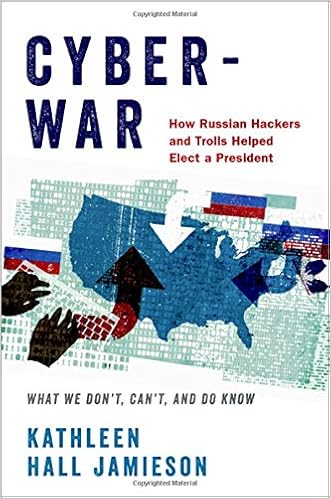
Cyberwar: How Russian Hackers and Trolls Helped Elect a President What We Don't, Can't, and Do Know Hardcover – October 3, 2018 by Kathleen Hall Jamieson (Oxford University Press)


If you care about the American political process, this book is as thorough as one could find in the analysis of the 2016 Presidential election. As someone who majored in Political Science, albeit over 40 years ago, and has read my share of dry textbooks and articles layered with facts and assumptions, this is not a book for someone who is not openminded when trying to ascertain who did what, and how that affected the candidates, voters, and even the media, in the political gamesmanship department.

With the title being CYBERWAR: HOW RUSSIAN HACKERS AND TROLLS HELPED ELECT A PRESIDENT, you would think this book would be only about the cyberwar, but it isn't. Dr. Jamieson discusses what was said by the candidates, when they said it, and even makes assumptions as to what would have happened had they said something different, or even nothing.

CYBERWAR does not tell us what we are to think, and it is not one of those publications written to influence the reader, but, for me, at least, it is an alarming account of how we, especially those of us who have a feeling we know the Internet since we have been using it for almost 40 years, allowed ourselves to be manipulated by others. This isn't an updated version of THE $ELLING OF THE PRESIDENT, where you see how one party packaged a candidate. CYBERWAR uses surveys, news articles, and even the campaign rhetoric to show how specific events shaped voter opinion.

As one who has studied politics for most of my life, this book is scary because right now it seems like what occurred in 2016 has morphed into something even more dangerous for our nation. I gave it four stars mostly because of its seriousness, and five stars might have someone buy it who cannot commit to reading all of it. This book is not for the casual reader or the light sleeper.
Read less

Monday, October 22, 2018

The Secret World: A History of Intelligence Hardcover – September 4, 2018 by Christopher Andrew (Yale University Press)


This book is a history of intelligence work covering roughly 3000 years of human history. It is a scholarly work (16% is notes, references...) lightened with quick-moving, free-flowing prose. There is plenty of scope for further study, encouraged by the excellent bibliography, and there are lots of interesting facts, and some entertaining quotes, like this one: “the most distrustful persons are the biggest dupes”. I discovered that the history of intelligence is also a history of leakers of information important to governments and organizations.

The introduction and conclusion were especially fascinating because they relate many current events to the premise of the book, and drive home the premise: histories have been written without the inclusion of the key element of espionage and intelligence, creating mistaken interpretations of historical events, and that the lack of historical knowledge has caused mistaken interpretations of intelligence.

The author makes a clear case for the importance of intelligence, both secret and that available from open sources, for positive actors on the world stage: to avoid conflicts and wars, to win wars, to build alliances, to support allies, to have clarity when making momentous decisions, to undermine aggressors out to destabilize regions or countries.

A group's use of intelligence for nefarious purposes is also presented in the book: for the destruction of rivals, for financial gain for a clique, for the acquisition of power and influence ultimately for the acquisition of financial gain, and to enhance the egos and sense of security of deluded actors on the world stage.

The chapters are historical divisions, which are always a false form of organization in histories since real life has no smooth beginnings nor endings, but instead tentacles that thread in and out of events, spread out over time. That means there is much overlap between the chapters.

I'm a fan of history books, but they can be mind-numbingly monotonous, just a long series of wars, conflicts, treaties, royals, ministers, pretenders, historical figures, etc. They are very difficult to write, and it is very challenging to keep the reader's interest. I've read great histories and not so great historical accounts. This book falls mid-range, so my advice is take the reading slowly so as not to become overwhelmed.

Since the book clocks in at 960 pages, it will take a while to get though it! It is best if the reader has a sound founding in world history. If not, you can read up along the way, but expect to be overwhelmed. I started with the beginning and conclusion, then hit then the eras of most interest to me, after which I moved on to the other eras. Some chapters I read more diligently than others, to be honest.

The author points out along the way the most common reasons for intelligence community failures, which is fascinating in itself: not seeing things in historical context, prejudice influencing interpretations, underestimating opponents due to arrogance, rivalry within the intel-community hurting the sharing of knowledge, relying on the various crackpots who seem to be attracted to espionage, tailoring analyses to the powers-that-be's expectations, overestimating the organization of enemies, not considering enough the open-versus-authoritarian nature of an opponent's system and how it can affect intelligence, letting myth and religion influence interpretations.

While reading, I created a mental picture of the author as an elderly man, and I wasn't wrong. I found the use of the archaic word “flamboyant” for homosexual men odd in today's more open environment. Also odd was the near universal avoidance of the role that people's sexuality can play in intelligence gathering and interpretation, and the effect of being from a sexual minority, especially a persecuted minority, has on someone becoming a spy or a leaker or an assassin, despite there being historical and current instances. There was also scant mention of sexual blackmail and sexual manipulation in the spying game, which I found hard to fathom considering both human nature and sexual bigotries that have existed through time.

One section in the last chapter especially caught my eye. It is about autocrats and begins with a description of Iraqi dictator Saddam Hussein. Autocrats are described as being by nature self-delusional, uneducated and ignorant, irrational, self-destructive, surrounded by sycophants, and being people who put out false narratives that they come to believe, and on which they make major decisions to disastrous effect. The example of Saddam Hussein was offered to show that when dealing with autocrats, analysts can be way off, because the analyst can rarely get into the mind of a self-deluded person. What do they really believe? No one really knows. That is when you are in the danger zone of an unpredictable-actor. I received a review copy of this book; this is my honest review.

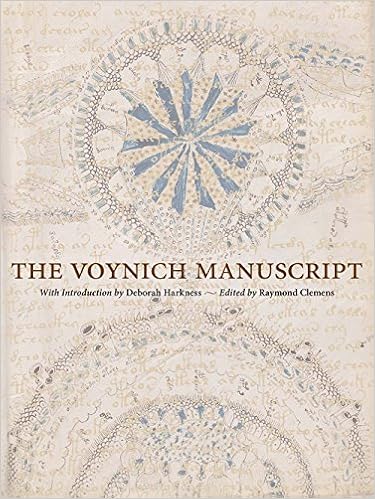
The Voynich Manuscript Hardcover – November 1, 2016 by Raymond Clemens (Editor), Deborah E. Harkness (Introduction) (Yale University Press)


This oversized, hardcover reprint of Beinecke MS 408, commonly known as the Voynich Manuscript after Wilfrid Voynich who purchased it in 1912, makes for a nice addition to anyone's collection. As Raymond Clemens writes in the preface, "This facsimile strives to reproduce as much of the experience of leafing through the original as possible. Each photograph in the facsimile section is reproduced at roughly the same size as the original page in the Voynich Manuscript" (pg. xvi). The essays following the enigmatic fifteenth century manuscript examine the earliest owners, Voynich the buyer, physical findings, cryptographic attempts, alchemical traditions, and the world's most mysterious manuscript, along with a chronology of the document. Deborah Hakrness, author of the introduction, writes, "This collections of essays, and the facsimile of the Voynich Manuscript that accompanies it, do not attempt to arrive at definitive answers to the many perplexing questions that remain about the text. Instead, they invite the reader to join us at the heart of the mystery as we strive to better understand this complex book and its history" (pg. ix). Those interested in the esoteric or bizarre will find this a great addition to their collection.The first authorized copy of this mysterious, much-speculated-upon, one-of-a-kind, centuries-old puzzle. The Voynich Manuscript is produced from new photographs of the entire original and accompanied by expert essays that invite anyone to understand and explore the enigma.

Many call the fifteenth-century codex, commonly known as the “Voynich Manuscript,” the world’s most mysterious book. Written in an unknown script by an unknown author, the manuscript has no clearer purpose now than when it was rediscovered in 1912 by rare books dealer Wilfrid Voynich. The manuscript appears and disappears throughout history, from the library of the Holy Roman Emperor Rudolf II to a secret sale of books in 1903 by the Society of Jesus in Rome. The book’s language has eluded decipherment, and its elaborate illustrations remain as baffling as they are beautiful. For the first time, this facsimile, complete with elaborate folding sections, allows readers to explore this enigma in all its stunning detail, from its one-of-a-kind “Voynichese” text to its illustrations of otherworldly plants, unfamiliar constellations, and naked women swimming though fantastical tubes and green baths.

The essays that accompany the manuscript explain what we have learned about this work—from alchemical, cryptographic, forensic, and historical perspectives—but they provide few definitive answers. Instead, as New York Times best-selling author Deborah Harkness says in her introduction, the book “invites the reader to join us at the heart of the mystery.”


Churchill: The Greatest Briton Hardcover – February 6, 2018 by Christopher Catherwood (Andre Deutsch)


This is a  richly visual examination of the most revered Briton in history, from his birth at Blenheim Palace, to his inspirational wartime leadership, to his final years as a grand old man of world politics.

Winston Churchill, whose nine decades spanned the early era of cavalry charges to the nuclear age, has been voted the greatest Briton. With his keen historical perspective and analytical mind, he was quick to oppose Hitler and thus played a seminal part in ensuring the survival of Britain—and arguably Western democracy itself. Churchill had his disasters and blind spots (the Gallipoli campaign, the creation of Iraq, India), but his achievements assure his place in posterity. This illustrated portrait, complete with 160 painstakingly researched photographs, artworks, speeches, and letters sourced from the family archives at Cambridge, provides insight into every facet of this remarkable man: the outspoken public figure, the powerful orator, the loving husband and father, the enthusiastic painter, and even the sportsman.

My Drunk Kitchen: A Guide to Eating, Drinking, and Going with Your Gut Hardcover – August 12, 2014 by Hannah Hart (Dey Street Books)


One day, sad cubicle dweller and otherwise bored New York transplant Hannah Hart decided, as a joke, to make a fake cooking show for her friend back in California. She turned on the camera, pulled out some bread and cheese, and then, as one does, started drinking. (Doesn't everyone cook with a spoon in one hand and a bottle of wine in the other?) The video went viral and an online sensation was born.

My Drunk Kitchen includes recipes, stories, full color photos, and drawings to inspire your own culinary adventures in tipsy cooking. It is also a showcase for Hannah Hart's great comedic voice. Hannah offers key drink recommendations, cooking tips (like, remember to turn the oven off when you go to bed) and shares never-before-seen recipes such as:


  • The Hartwich (Knowledge is ingenuity! Learn from the past!)
  • Can Bake (Inventing things is hard! You don't have to start from scratch!)
  • Latke Shotkas (Plan ahead to avoid a night of dread!)
  • Tiny Sandwiches (Size doesn't matter! Aim to satisfy.)
  • Saltine Nachos (It's not about resources! It's about being resourceful.)

This is a book for anyone who believes they have what it takes to make a soufflé for the holiday party and show up the person who apparently has nothing better to do than bake things from scratch. It also recommends the drink you'll need to accompany any endeavor of this magnitude. In the end, My Drunk Kitchen may not be your go-to guide for your next dinner party . . . but it will make you laugh and drink . . . I mean think . . . about life.

The Middle East and the United States 6th Edition by David W. Lesch (Routledge )


This book is one of the bestt single work dealing with the relationship between the United States and the Middle East, has been updated to include new chapters on Turkey and Afghanistan, and new material that addresses important aspects of this fraught relationship, notably the Arab-Israeli conflict and the successive crises in the Gulf. With these additions, it remains a timely and useful work. The Middle East and the United States is one of the most important collections of readings on US policymaking in a region of strategic importance to American interests. It is a valuable tool for students of US foreign and security policymaking, helping them to understand the complicated nature of decisionmaking in a frequently tense political environment.David Lesch and Mark Haas have crafted an excellent overview of the evolution of US policy in the Middle East, the reasoning behind it, and the impact of it on the region today. . . Excellent editing ensures that each chapter is both concise and accessible and all could be read on their own merit. . . This book is the ideal entry point for interested observers and students of international relations.This book is indispensible for scholars and policymakers interested in understanding America's past and current involvement in the Middle East. The essays are authoritative, compelling, and engaging. Collectively, they represent some of the smartest analysis on how the United States and the Middle East got where they are today.

An indispensible resource for understanding contemporary US policies in the region.This volume remains an authoritative resource for practitioners and academics, for students in courses in US foreign policy or Middle Eastern history, and for the general reading public. Highly recommended.

This book, the best single work dealing with the relationship between the United States and the Middle East, has been updated to include new chapters on Turkey and Afghanistan, and new material that addresses important aspects of this fraught relationship, notably the Arab-Israeli conflict and the successive crises in the Gulf. With these additions, it remains a timely and useful work.

Homeland: Zionism as Housing Regime, 1860–2011 (Planning, History and Environment) 1st Edition by Yael Allweil (Routledge)


On 29 March 2016 the New York based online journal, Realty Today reported ‘Israel is facing a housing crisis with …[the] home inventory lacking 100,000 apartments… House prices, which have more than doubled in less than a decade, resulted in a mass protest back in 2011’.

As Yael Allweil reveals in her fascinating book, housing has played a pivotal role in the history of nationalism and nation building in Israel-Palestine. She adopts the concept of ‘homeland’ to highlight how land and housing are central to both Zionism and Palestinian nationalism, and how the history of Zionist and Palestinian national housing have been inseparably intertwined from the introduction of the Ottoman Land Code in 1858 to the present day.

Following the Introduction, Part I, ‘Historiographies of Land Reform and Nationalism’, discusses the formation of nationalism as the direct result of the Ottoman land code of 1858. Part II, ‘Housing as Proto-Nationalism’ focuses on housing as the means to claim rights over the homeland. Part III, ‘Housing and Nation-Building in the Age of State Sovereignty’, explores the effects of statehood on national housing across several strata of Israeli society. The Afterword discusses housing as the quintessential object of agonistic conflict in Israel-Palestine, around which the Israeli polity is formed and reformed

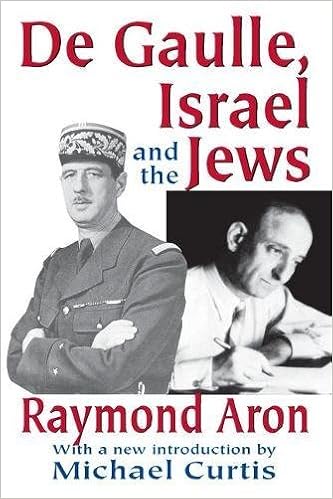
De Gaulle, Israel and the Jews Revised Edition by Raymond Aron (Author), Michael Curtis (Introduction) (Routledge)


The lives of Raymond Aron and Charles de Gaulle intersected at significant moments in twentieth-century history, though they differed on many issues during World War II and over the subsequent decades. Aron, for example, distinguished between the attitude and responsibility of the Vichy government and the French Nazi collaborators in Paris, unlike de Gaulle, who regarded anyone who obeyed Marshal Petain as a traitor. In the postwar period, Aron differed from de Gaulle on a number of issues, including Algeria. But the strongest direct criticism by Aron of de Gaulle's language and policy resulted after a 1967 press conference, where he referred to Jews as "an elite people, self-assured and domineering."
This comment led Aron to write DeGaulle, Israel and the Jews. Aron saw de Gaulle conflating the issues of Israel and that of French Jews, and the question of Israeli policy in 1967 and other times. He stressed the right of individuals to be, at the same time, French and Jewish, and raised the question of whether de Gaulle intended to deliver a message to the Jews in the Diaspora or simply wanted to attack those in Israel. While Aron did not accuse de Gaulle of anti-Semitism, he felt that for the first time in postwar Europe, a leader had used language that lent respectability to anti-Semitism and made it legitimate.
De Gaulle, Israel and the Jews, translated from the French by John Sturrock and graced with a new introductory essay by Michael Curtis, allows us the opportunity to raise questions about de Gaulle and his policy in the Middle East. Was he anti-Semitic? What were his real attitudes and policies toward Israel, and how did they relate to his policies on the Middle East and on international affairs? This is a volume of contemporary relevance for students of political science, Middle East affairs, and international policy.

How History Gets Things Wrong: The Neuroscience of our Addiction to Stories (The MIT Press) 1st Edition by Alex Rosenberg (The MIT Press)


In How History Gets Things Wrong, Rosenberg presents a lively and quite devastating indictment of narrative history, demonstrating both its seductive power and damaging effects.  narrative history long been held hostage to 'theory of mind,' and, thus, getting things all wrong? It has, and it is likely to continue doing so, as long as it reflexively accomodates itself to minds eager to be 'besotted by stories,' argues Alex Rosenberg in his thought-provoking new book that brings together social sciences, neuroscience, and cognitive evolutionary psychology and anthropology. It is a page-turner (Rosenberg knows how to tell a good story!) that starts an expertly and timely conversation about the role of cognitive adaptations in shaping academic and popular discoursesEven those who are unconvinced by his argument for the radical falsity of our theory of mind will find plenty in the book that stands independently of that, and that adequately supports his main conclusions.The precise way in which causes lead to effects is a notoriously difficult philosophical problem. Why, then, are we all convinced that we can learn the causes of past events by studying history? Alex Rosenberg suggests that we might just be fooling ourselves. To understand something, you need to know its history. Right? Wrong, says Alex Rosenberg in How History Gets Things Wrong. Feeling especially well-informed after reading a book of popular history on the best-seller list? Don't. Narrative history is always, always wrong. It's not just incomplete or inaccurate but deeply wrong, as wrong as Ptolemaic astronomy. We no longer believe that the earth is the center of the universe. Why do we still believe in historical narrative? Our attachment to history as a vehicle for understanding has a long Darwinian pedigree and a genetic basis. Our love of stories is hard-wired. Neuroscience reveals that human evolution shaped a tool useful for survival into a defective theory of human nature.

Stories historians tell, Rosenberg continues, are not only wrong but harmful. Israel and Palestine, for example, have dueling narratives of dispossession that prevent one side from compromising with the other. Henry Kissinger applied lessons drawn from the Congress of Vienna to American foreign policy with disastrous results. Human evolution improved primate mind reading―the ability to anticipate the behavior of others, whether predators, prey, or cooperators―to get us to the top of the African food chain. Now, however, this hard-wired capacity makes us think we can understand history―what the Kaiser was thinking in 1914, why Hitler declared war on the United States―by uncovering the narratives of what happened and why. In fact, Rosenberg argues, we will only understand history if we don't make it into a story.In this provocative book, Rosenberg argues that minds and purposes aren't nearly as important as the stories of history would lead us to believe."


Peelin Orange: Collected Poems Paperback – March 1, 2017 by Mervyn Morris (Carcanet Press Ltd.)


Peelin Orange is the definitive Collected Poems by one of Jamaica's leading voices, the current Poet Laureate, Mervyn Morris. These poems explore the everyday, the erotic, love and the melancholy and comedy of being. Often drawing upon Creole dialect, Morris explores his Jamaican heritage with trademark musicality. Each poem offers a pared-down shard of concentrated feeling and social observation. This Collected Poems is a landmark tribute to the winner of the Order of Merit (Jamaica) 2009 and highlights his distinguished contribution to West Indian Literature

Mervyn Morris was born in Jamaica in 1937 and studied at the University College of the West Indies and St Edmund Hall, Oxford. In 1992 he was a UK Arts Council Visiting Writer-in-Residence at the South Bank Centre. His previous collections include The Pond, Shadowboxing, Examination Centre and On Holy Week; he also edited The Faber Book of Contemporary Caribbean Short Stories and published 'Is English We Speaking' and other essays. He lives in Kingston, Jamaica, where he is Professor Emeritus of Creative Writing & West Indian Literature.

Love in Another Language: Collected Poems and Selected Translations Paperback – December 1, 2017 by Dick Davis(Carcanet Press Ltd.)


In Love in Another Language Dick Davis is shown to be the outstanding formal poet of his generation, a master of rhyme and metre, a poet worthy of keeping company with the best lyric writers in our tradition. His Collected Poems draws on eight previous publications and includes a section of new work. Davis has also established himself as ‘the leading translator of Persian literature in our time’ (Washington Post) and this volume includes a selection of his celebrated translations.

Dick Davis was born in Portsmouth in 1945 and educated at Cambridge (ba and ma in English Literature) and Manchester (PhD. in Medieval Persian Literature). He retired from Ohio State University, where he had been Professor of Persian and Chair of the Department of Near Eastern Languages and Cultures, in 2012. As author, translator, or editor, he has published academic works on American and Persian literature, translations from Italian (prose) and Persian (prose and verse), and books of his own poetry.

John Masefield Paperback – December 1, 2016 by Muriel Spark (Carcanet Press Ltd.)


John Masefield perfectly combines fantasy, suspense, piracy, thievery, witchcraft, talking animals, and a little boy who does not enjoy conjugating Latin verbs into one of the most delightful children's books I have ever read. Some editions include a very nice afterward by Madeleine L'Engle. The main character is a young boy who is aided by Nibbins, the cat, in finding a treasure that was entrusted to an ancestor and lost. One of the great charms of the story is the boy pitting himself against a group of witches who want to find the treasure for themselves. Young Kay Harker wants to find the treasure and return it to the church that entrusted it to his ancestor. Anyway, it is a book worth finding and reading as an adult or a child.

John Masefield (1878–1967) lived a life as varied as his work. At the age of fifteen he went to sea as an apprentice in a windjammer and made the voyage round Cape Horn. The next three years he spent in New York, in a bakery, a livery stable, a saloon and a carpet factory. Back in England, he wrote for the Guardian and in the First World War served with the Red Cross. Throughout these years he had been writing poetry, and when in 1923 his Collected Poems appeared they sold over 200,000 copies. In 1930 he succeeded Robert Bridges as Poet Laureate.

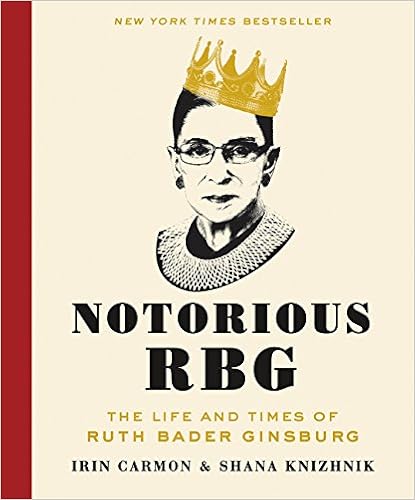
Notorious RBG: The Life and Times of Ruth Bader Ginsburg Hardcover – October 27, 2015 by Irin Carmon and , Shana Knizhnik (Dey Street Books)


I don't think someone from my generation would have the imagination to design a book this way, or to include a photo feature about a Supreme Court Justice's "swag." But fundamentally this is a wonderful book about the difference an individual can make. The book's breezy style has a deeper and more serious significance, as well.Supreme Court Justice Ruth Bader Ginsburg never asked for fame—she has only tried to make the world a little better and a little freer.

But nearly a half-century into her career, something funny happened to the octogenarian: she won the internet. Across America, people who weren’t even born when Ginsburg first made her name as a feminist pioneer are tattooing themselves with her face, setting her famously searing dissents to music, and making viral videos in tribute.

Notorious RBG, inspired by the Tumblr that amused the Justice herself and brought to you by its founder and an award-winning feminist journalist, is more than just a love letter. It draws on intimate access to Ginsburg's family members, close friends, colleagues, and clerks, as well an interview with the Justice herself. An original hybrid of reported narrative, annotated dissents, rare archival photos and documents, and illustrations, the book tells a never-before-told story of an unusual and transformative woman who transcends generational divides. As the country struggles with the unfinished business of gender equality and civil rights, Ginsburg stands as a testament to how far we can come with a little chutzpah.

I was touched by many things in this book, not only the courage of Justice Ginsburg's opinions, or the loving handwritten note from her dying husband, but even by the photos illustrating her close friendship with Justice Scalia, one of her ideological opposites - it's rare to see such a mensh in these times. The format is terrifically creative for this sort of subject: the NY Times reviewer aptly described it as being "as if a scrapbook and the Talmud decided to have a baby." The latter comes in especially for the way the book's margins are used for commenting on everything -- not just for the obvious connections to a Justice who is Jewish. (Apropos of that, though, one thing did puzzle me: the recipe for pork in milk at the back. Breaking two of the Jewish religion's food taboos at once -- isn't that a little gangsta? Was that the idea, or is the whole thing a joke? And actually, one other thing: the publisher's subject classification on the back cover is "Fiction." Aside from the recipe, I hope not.)

Heroes don't have to have huge biceps and wear a flowing, red cape. Some heroes, like the best presents, come in small packages. Supreme Court Justice Ruth Bader Ginsburg is just such a hero to all Americans, especially women, gays and blacks. At barely 5-feet tall, this diminutive woman has made a huge impact on our country's laws, doing all she can to ensure that all people are duly protected by the edicts of the U.S. Constitution.


This inspirational and highly-readable book by Irin Carmon and Shana Knizhnik, capitalizes on RBG's popularity by promoting her fascinating story.
• Find out the somewhat humorous story of why she studied the law in the first place.
• Find out how she managed in the 1950s to go to law school while she had a toddler in tow, something that is difficult even now but totally unheard of then without a societal infrastructure (read: daycare) to help.
• Find out details about her incredible, loving marriage to Marty Ginsburg that will make every woman just sigh with pleasure. (Men, read this and take notes.)
• Find out what she said to the school's headmaster when she was just fed up with being the parent who was always called when her son misbehaved—and what happened after that.
• Find out her bizarre work hours and how little she sleeps.
• Find out her even more bizarre gym workout and how it may be too challenging for you to do.

This is a book that is so fascinating, fun and intriguing that it will likely inspire, rouse and stir its readers to be more like RBG. What a treasure she is for our country!

Taking the Stand: My Life in the Law Kindle Edition by Alan Dershowitz (Broadway Books)


Taking the Stand: My Life in the Law by [Dershowitz, Alan]

The list of legal issues and controversies that bear Dershowitz’s thumbprints is breathtaking. That one man involved himself in the Pentagon Papers case, the Clinton-Lewinsky scandal, Kennedy’s Chappaquiddick investigation, Sharansky’s release from a Soviet prison, the O.J. trial, Bush v. Gore, the Mike Tyson rape case, the Woody Allen-Mia Farrow custody dispute, the Julian Assange WikiLeaks investigation and the public debate over Trayvon Martin, reflects not just the breadth of Dershowitz’s experience but also its depth and duration. Love him or hate him, Dershowitz has lived a life that matters, hugely and enduringly. He is a man in full at a time when most of us aspire to be little more than a presence on Twitter." -

My political philosophy and that of Professor Dershowitz could not be farther apart, but I admire him for the many good things he has done throughout his legal career. This book was an eye opener for me, as I was really not well versed in his many and varied cases, other than the ones that made national news. He has taken many principled stands in his life, and is not willing to back down from what he believes. Not a lot of lawyers, these days, can say that.One of the most distinguished lawyers of his generation reflects on his life and extraordinary career...The youngest full professor ever at Harvard Law School...more than four decades, he has used this perch to teach, write and speak about the law’s intersections with science and psychiatry and especially about matters pertaining to constitutional and criminal law. Most unusually for a law professor, Dershowitz has maintained a highly active appellate practice, and he narrates...his life in the law through the many cases he’s handled. Many of these unfailingly interesting tales feature high-profile clients like Leona Helmsley, O.J. Simpson, Mike Tyson and Bill Clinton...Dershowitz has become an important voice with an active role in the evolution of American law, touching on an astonishing breadth of issues, including capital punishment, affirmative action, pornography, national security, academic freedom and human rights. An engaging recounting of a life of serious purpose and splendid flair.

My only disagreement with him is in his characterization of the case of Bush v. Gore. He opines that the majority in that matter voted to support the way they voted in the ballot box. There's really no way of knowing that, however. While he castigates the majority's political stance, he neglects to assume also that the minority may have voted to support the way they voted at the ballot box. Decisions termed "political" cut both ways, you know. That disagreement with his remarks did not change my wholehearted admiration for him, and particularly his avid support for Israel. As a Catholic attorney who has had two Jewish partners, I can understand the Professor's position. Israel is the only true democracy in the Middle East, and must contend not only with its neighbors, but also with the anti-Israel faction in the United nations. Dershowitz supports Israel, and so do I.


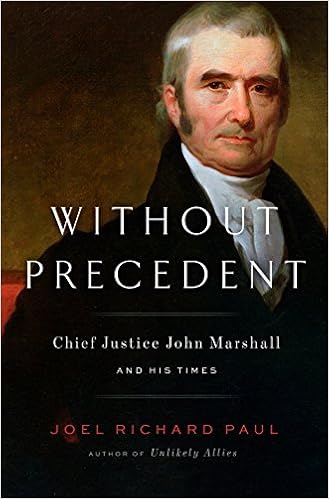
Without Precedent: Chief Justice John Marshall and His Times Hardcover – February 20, 2018 by Joel Richard Paul (Riverhead Books)


There are a great many biographies of John Marshall (1755-1835), 4th Chief Justice, but I think this new one has a lot of advantages, especially for the general reader who does not have extensive backgrounds in early national history or the Supreme Court. It is also unusually well written; it was just a pleasure to read such fine prose. Always an important issue for a Marshall biographer is how much of your book (this one runs about 500 pages text, notes and selected bibliography) should be dedicated to discussing his Court career. Here, the author has devoted about 50% of the book to Marshall's pre-Court activities. I used to get upset if a Marshall biography didn't quickly get him on the Court. But the author here, a law professor, was wise to carefully discuss Marshall's pre-Court career.

And what a career it was! Working with Washington during the revolution; member of the Virginia legislature; master of an extensive and lucrative legal practice in Richmond; one of three diplomats sent to France to negotiate a treaty with Talleyrand; elected to Congress from Virginia; and secretary of state under John Adams. It is easy to see why Marshall rose to such political and judicial heights--he was extraordinarily competent, industrious, and a master legal craftsman. So the book really educates the reader as to the richness of Marshall's background and accomplishments so we can better understand why he became "the great Chief Justice."

Another dilemma for Marshall biographers (especially law professors) is how many legal technicalities and concepts to discuss once Marshall is handing down well over 500 decisions. Here the author does not run through a large number of cases (though he does cover all of the big ones), which could overwhelm the reader. Instead, he devotes concise chapters, with minimal legal jargon, to individual decisions and smoothly carriers the reader to the point of understanding that case's significance. So have no fear you will be buried in pages of obtuse legal argument.

Another advantage is that the reader learns a good deal about American revolutionary and early national history. My only real criticism is that the author really has it in for Jefferson and takes almost constant potshots at him. But in discussing Marshall working with Washington both as general and president, and his service in the Adams cabinet, the reader learns a good deal about the birth of political parties, the role of Hamilton, how the Federalists governed and why they had a downfall, the rise of Andrew Jackson, and the role of slavery as a divisive political issue. The author also includes some of the best analysis on the Indian removal cases before the Court that I have seen.

Reading this solid book, therefore, is a good investment of the reader's time. The author's research is extensive, including heavy reliance upon the published Marshall papers and the "Documentary History of the Supreme Court." And the story is told with crisp clarity so that even readers of prior bios will still learn a great deal new. Simply a winner all the way round.

Franklin's Halloween Paperback by Paulette Bourgeois (Author), Brenda Clark (Illustrator) (Kids Can Press) (IBRChildrensBooks)


It's 2011, and Franklin begins the celebration of his 25th anniversary with this wonderful book - a 25th anniversary edition of his very first adventure. This includes the complete, original "Franklin in the Dark." In the story, Franklin finds himself with a big problem. Turtles sleep in their shells, but it's dark in there, and Franklin is afraid of the dark. He drags his shell behind him and goes on a journey, looking for someone to help him with his problem. Though he doesn't find anyone who has a problem just like his, his adventure does give him an idea for how to overcome his fear.

This 25th anniversary edition has so much more than the original story however. Included at the very beginning is Paulette Bourgeois's original manuscript - "The Turtle They Called Chicken," giving fans a rare look into the early development of the series. There is also original storyboard artwork and sketches, as well as letters from both Paulette Bourgeois and Brenda Clark.

The pages at the back of the book contains even more excellent supplementary material. Readers are given a look at the development of the entire series - from the books to the television show, with the promise of an upcoming CGI series in 2011. There are also pictures of many different types of "Franklin" merchandise, some of which I didn't even know existed. There is also a wonderful look at the Franklin Children's Garden in Canada and a section on international editions of "Franklin."

If you or your children are fans of this intrepid young turtle, this 25th anniversary edition of the original is a can't miss.

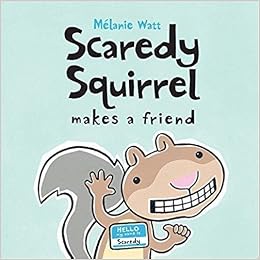
Scaredy Squirrel Makes a Friend Paperback by Mélanie Watt (Author, Illustrator) (KIds Can Press) (IBRChildrensBooks)


That lovable little worrywart is back. And he's as scaredy as Schedule ever! In his latest adventure, Scaredy Squirrel sets out to make The Perfect Friend. The Scaredy Squirrel series is so complex and yet can be done so simply in reading. They're great for multiple levels of literacy development (ex: identifying/understanding literary structures like lists TO very higher level language comprehension with inferences and lots of social language opportunities). Highly recommend. So clever and entertaining for adults and children. Great medium for talking about anxiety and the appropriate sizes of one's reactions too!

And once he's spotted a perfectly safe candidate (with no teeth), Scaredy's ready. Armed with a name tag, mittens, a mirror and a lemon, he's prepared to make The Perfect First Impression. But just when every detail is under control, Scaredy's Action Plan takes a surprising --- and ?toothy? --- turn. Will he survive this ordeal? Will he find his kindred spirit? Will he discover the true meaning of friendship? Read Scaredy's nutty story to find out ..

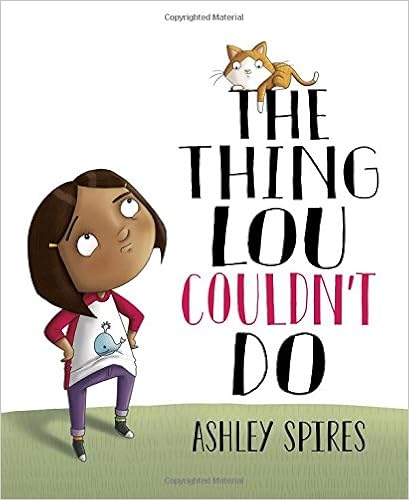
The Thing Lou Couldn't Do Hardcover – May 2, 2017 by Ashley Spires (Author, Illustrator) (Kids Can Press)(IBRChildrensBooks)


Lou and her friends love daring adventures, but when it comes to climbing trees, Lou sulks because she can't do it. Playing high in the branches of a tree, her companions are slow to notice Lou's plight. Midway through the story, they come down to offer help, but Lou isn't ready to climb the tree yet. After considering a few alternative ways to get into the tree, Lou gives climbing a try—and fails. Finally, recognizing her lack of skill, the friends take their game out of the tree and back to the ground. Lou holds no grudges and decides to try climbing another time. Digital illustrations include a set of culturally diverse, cartoonlike characters who are expressive yet somewhat unappealing, often set on a background of stark white space with some shading. The artwork is serviceable, but the book's main value is in the message it imparts—that it's better to attempt a challenge than to avoid it, although success is not always guaranteed. Lou goes through a range of emotional states in her struggle to overcome her inability to climb, but she doesn't let her obstacle defeat her. VERDICT This tale about meeting life's challenges and not giving up is a good purchase for medium or larger libraries.

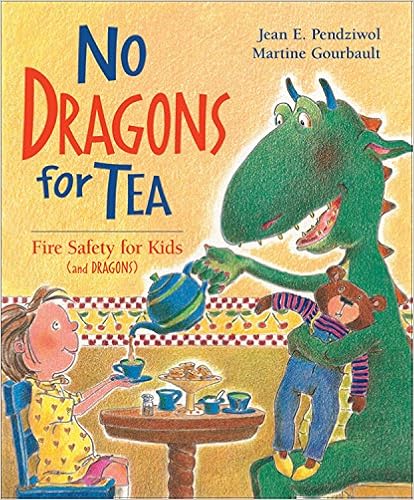
No Dragons for Tea: Fire Safety for Kids (and Dragons) Paperback by Jean E Pendziwol (Author), Martine Gourbault (Illustrator) (KIds Can Press) (IBRChildrensBooks)


A low-key but effective approach to the serious topic of fire safety ? An attractive, useful volume.

A unique way to introduce a very important subject.

This clever rhyming story is effective in conveying the rules of fire safety to children. Colorful illustrations clearly depict correct responses to an emergency situation. At the back of the book is an easy-to-learn safety rhyme and a fire safety checklist for parents and teachers to discuss with their children. This excellent book should be in every home and school library. Highly recommended.

This book has just the right combination of fact, fun and fantasy to help your little one understand what to do in a fire emergency ... This story is perfect for role-playing. your children will enjoy acting out every scene from the tea-party to the firefighters’ actions. This kind of play may some day save your children’s lives.

A girl finds herself in the middle of a fire when her new friend (who happens to be a dragon) sneezes ... The girl is obviously well schooled inn fire safety, knows just what to do. The dragon, however makes some mistakes. He hides under the rug, then once he gets outside, he wants to go back for his stuffed bear. The girl sets him straight. “Don’t ever go back — that just will not do. We can get a new bear, but we can’t replace you.” Humourous colored pencil illustrations accompany the lively rhyming text, which ends with a catchy fire safety poem that kids can easily memorize to help them remember basic fire – safety rules. An entertaining way to teach or reinforce fire safety concepts, this will come in handy during fire-awareness wee.

Martine Gourbault is a painter and illustrator. She has illustrated a number of picture books including, I Went to the Bay, Mr.McGratt and the Ornery Cat and the Dragon Safety series. She resides in Vancouver, Canada.