Israel Book Review

Jews Praying In The Synagogue on the Day of Atonement by Maurycy Gottlieb (Tel Aviv Museum of Art) The Israel Book Review has been edited by Stephen Darori since 1985. It actively promotes English Literacy in Israel .#israelbookreview is sponsored by Foundations including the Darori Foundation and Israeli Government Ministries and has won many accolades . Email contact: israelbookreview@gmail.com Office Address: Israel Book Review ,Rechov Chana Senesh 16 Suite 2, Bat Yam 5930838 Israel

Showing posts with label @Stephendrus. Show all posts

Sunday, April 1, 2018

The Hunger and the Howling of Killian Lone by Will Storr Paperback ( Short Books Ltd / Marble Arch / Simon & Schuster) (IBRCookBooks)


A dark concoction about an ambitious culinary apprentice in 1980s London, Storr’s debut features a complex title character, gothic undertones and an unnerving plot.


Killian Lone begins his journey as a sympathetic young man, a target for neighborhood bullies into adulthood and the product of a dysfunctional family. His only source of solace is his great-aunt Dorothy, who spends hours teaching him to cook when he visits her at Dor Cottage, the old family home. Killian is descended from a long line of talented chefs, including the original owner of the cottage, Mary Dor, who cooked for the first Earl of Sussex and was burned at the stake as a witch. When he's accepted at culinary school, Killian’s skills prove exceptional, and his instructor secures him an apprenticeship at the chic restaurant run by Killian’s idol, acclaimed chef Max Mann. Killian’s dreams of being taken under the chef's wing unravel as he discovers the gulf between Mann’s public persona and his private actions. Though Killian tells himself Mann is under tremendous pressure to earn a third Michelin star, the horrendous kitchen conditions begin to splinter his “turnspit dog” loyalty. Killian's work is undermined by Mann's assistant, and he's subject to a blind "taste test" that involves crackers spread with excrement. As he strives for success, his future becomes increasingly tied to a secret he uncovers at Dor Cottage following Dorothy’s death; using it transforms his career, spurs speculation about his ethics and culinary abilities, affects his relationship with the woman he loves and consumes his life. An award-winning journalist, Storr has created a disturbing tale about cutthroat rivalries in a high-profile industry, and his claim that many of the kitchen incidents are based on true stories makes it even juicier.


Readers with a taste for the unusual (and who don't mind some nauseating passages) will find this a palatable novel about ambition, human fallibility and revenge.


Posted by BardofBatYam at 9:47 PM No comments:
Email ThisBlogThis!Share to XShare to FacebookShare to Pinterest
Labels: . . #IsraelBookReview, . @israelbookreview, . #stephendarori, . #stephendrus, . Israel Book Review, . The Darori Foundation, @Stephendrus, Stephen Darori, Stephen Drus

Wednesday, May 31, 2017

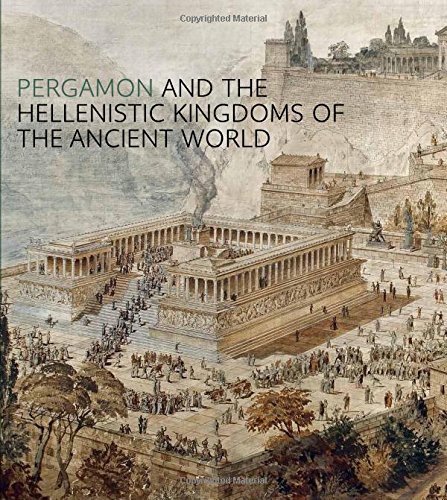
Pergamon and the Hellenistic Kingdoms of the Ancient World Hardcover – May 10, 2016 by Carlos A. Picón (Editor), Seán Hemingway (Editor)( Metropolitan Museum of Art)


T
his wonderful and beautiful catalog replicates the vastly inspired exhibition just finished at the Metropolitan Museum. The essays are absolutely wonderful, by informed, balanced and insightful curators and other scholars. Everything about this catalog replicates the richness and beauty of the exhibition itself, without the physical weariness of actually going through the show. This catalog is full of great pix and wonderful essays. While perhaps one third of the pieces on display are from Berlin, I wonder why we cannot create a location with all of the pierces available for viewing in perpetuity. I understand the difficulties. Now that the exhibition is closed, buy this magnificent catalog!


A fragment of the colossal sculpture “Head of a Youth” is among the ancient art works on display at the Met’s exhibition of Hellenistic art.Photograph courtesy the Met Museum

When Alexander the Great conquered the Achaemenid Persian Empire and hauled off the treasures of its royal capitals, he unleashed perhaps the greatest economic stimulus package of all time. The city of Persepolis alone, taken by the Macedonian Army in 331 B.C., yielded enough gold and silver to fill the saddlebags of twenty thousand mules and five thousand camels, according to an account by Plutarch. This tidal wave of wealth sloshed all around the eastern Mediterranean during the three centuries that followed, the era known today as the Hellenistic Age. It soaked the shores of the half-dozen new kingdoms carved out of Alexander’s conquests. Those who styled themselves Alexander’s Successors, the generals who served under him and founded the monarchies that carried his legacy forward, or those rulers who sought to proclaim, as Alexander had done, that their power was tempered by justice and reason, used the riches to finance extravagant building projects or amass glittering collections of statues, many copied from famous originals in Athens, the epicenter of Hellenic enlightenment.

A large chunk of this windfall ended up stored in a hilltop fortress called Pergamon, in what is today western Turkey, in the charge of a cunning Army officer named Philetaerus. Though he served Lysimachus, a Successor who had become King of Thrace, Philetaerus deserted his master and struck out on his own, using the wealth and strategic position of Pergamon to establish an autonomous rump state. Philetaerus was a soldier’s soldier, a strongman who relied on the support of loyal (and well-paid) troops for his authority. The Metropolitan Museum of Art’s “Pergamon and the Hellenistic Kingdoms of the Ancient World” exhibition includes a marble bust that portrays him with vivid realism: his fleshy neck, thick brow, and chlamys, or military cloak, reveal a man of force and action, not a sage or statesman. The same thuggish visage would appear on Pergamene coins for more than a century, as successive rulers honored the founder of their dynasty.


The bust is one of dozens brought together by the Met for this exhibition, along with a vast trove of other objects, rich enough to impress any Alexandrian dynast. The assemblage of marbles and bronzes, accented by smaller works in gold, silver, terracotta, and glass, attests in its amplitude to the wealth, power, and cultural aspirations of the Successors. The exhibition’s scale and scope are colossal; indeed, it even contains something of a colossus, a ten-foot-high marble image of Athena, which once stood in a temple enclosure in Pergamon—a copy, at one-third scale, of the sculptor Phidias’ lost Athena Parthenos, once the glory of the Acropolis at Athens.

The great age of Pergamon began in the late third century B.C. One of Philetaerus’ successors, Attalus I, defeated an army of marauding Galatians (sometimes called Gauls), in part by adopting the new “heavy” weapon that Alexander had begun using, the Indian war elephant. (A terracotta statuette in the Met show portrays a Galatian getting trampled by one of them.) Attalus had himself crowned king, and he and his successors set about building a magnificent marble complex on the city’s acropolis, designed to evoke the iconic Acropolis at Athens. In some instances, they merely copied existing monuments, but in others they innovated grandly, creating, for example, a Great Altar of Zeus—a low-slung, three-sided structure atop a sloping staircase, wrapped round by a frieze showing a battle of gods and giants. (That altar, and other buildings of the Pergamene Acropolis, were excavated by German archeologists in the late nineteenth century, removed to Berlin, and displayed there in what became known as the Pergamon Museum. The anticipated closing of that museum’s altar hall led to a hugely successful Pergamon show at Berlin’s Staatliche Museen, in 2011, a precursor to the current Met exhibition.)

The Attalids, the Pergamene dynasty begun by Philetaerus, wanted a masterpiece to rival the Parthenon at Athens and, to judge by the samples collected in the central room of the Met exhibition, and by the frieze’s photographic reproduction, which covers three of the room’s walls, they got what they paid for. The amplitude of the crowded frieze, and the elaborate details of every architectural element, proclaim a regime that could afford to employ squadrons of expert Greek artists. And yet the Met has made them merely the central node of a much larger project. The whole span of the Hellenistic world is sampled in the exhibition—from Alexander the Great to Octavian (whose victory at Actium brought the last independent Hellenistic kingdom under Roman control, and led to his becoming the Emperor Augustus), from the Indus River Valley to the Adriatic. The show’s grand sweep gives a sense of the interconnectedness of this age, in which ease of travel and trade, and rising levels of wealth, created a market for fine art and luxury goods across large stretches of three continents. Beloved sculptures were copied and recopied; a sleeping hermaphrodite shown here is one of at least ten versions of the same figure, and no doubt several have perished for every one that survives. Thanks to new tools and techniques, the glories of Hellenism could be commodified and commercialized.

All this gives point to the timing of “Pergamon and the Hellenistic Kingdoms,” which coincides with the New York State Presidential primary. Ancient Greek had no phrase precisely equivalent to “income inequality,” nor was there ever an Occupy the Acropolis movement. But the wealth that Alexander’s campaigns unlocked largely went into the hands of an international élite, who used it to project power and create displays of their Hellenic values. It’s their world that’s on show here, whether in the grand public displays of the Pergamene rulers or in quieter, more domestic objets d’art. A set of silver cups recovered from a buried hoard in Sicily reveals the exquisite elegance with which a western Greek family sat down to dine, while, across half the Mediterranean, a clan of warrior-kings, enriched by heaps of plundered gold and silver, transformed the rocky crag of Pergamon into a shining city on a hill.
Posted by BardofBatYam at 5:41 AM No comments:
Email ThisBlogThis!Share to XShare to FacebookShare to Pinterest
Labels: . The Darori Foundation, .Israel Book Review, @israelbookreview, @Stephendrus, #IsraelBookReview, #stephendarori, #stephendrus, Stephen Darori, Stephen Drus

Sunday, May 21, 2017

50th Anniversary of the 1967 War : Nasser's Legacy....Nasser's Gamble: How Intervention in Yemen Caused the Six-Day War and the Decline of Egyptian Power Paperback – June 23, 2015 by Jesse Ferris(Princeton University Press);Nasser's Peace: Egypt’s Response to the 1967 War with IsraelMar 21, 2017 by Michael Sharnoff Hardcover (Routledge), Gamal Abdel Nasser: The Life and Legacy of Egypt's Second PresidentSep 7, 2014 by Charles River Editors Paperback;Ike's Gamble: America’s Rise to Dominance in the Middle East Hardcover – October 11, 2016 by Michael Doran (Free Press)


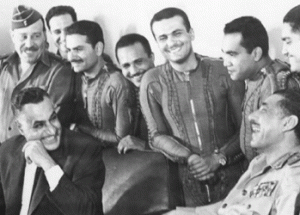
Nasser and Egyptian pilots pre-1967, via Wikimedia Commons

Egypt under Gamal Abdel Nasser once shaped and guided Arab public opinion. Cairo was the capital of the Middle East, and Nasser’s secular pan-Arab ideology challenged the West, Israel, and other Arab states. Nasser’s Egypt showed how a developing country with a large population could persevere despite tremendous economic, political, and military challenges. As the 50th anniversary of the 1967 War approaches, Egyptians and Arabs of that generation might reflect with nostalgia on a bygone era when Cairo dominated the Middle East.
Cairo was the political capital of the Middle East in the 1950s and 1960s. Egyptian President Gamal Abdel Nasser was the most charismatic ruler in the region, and he tried to become the undisputed leader of the Arab world. In his 1954 memoir, The Philosophy of the Revolution, Nasser revealed his vision of Egypt as a unique geostrategic influence in the African, Arab, and Islamic world. He believed Egypt was destined to play a pivotal role in Arab affairs.

Initially, Nasser was concerned primarily with consolidating power and expelling the British from Egypt. After stabilizing his rule by suppressing communists and members of the Muslim Brotherhood, he championed pan-Arabism as a strategic tactic to unify the Arab world under his command. Pan-Arabism was a secular ideology that advocated Arab unity, freedom from foreign control, and the liberation of Palestine – a euphemism for a Palestinian state built on Israel’s ruins.

Nasser’s political star rose after he nationalized the Suez Canal in 1956 and subsequently survived a direct assault from the UK, France, and Israel. He graced international venues as a hero of the Nonaligned Movement, rubbing shoulders with established anti-imperialist leaders like Tito of Yugoslavia, Nehru of India, Nkrumah of Ghana, and Sukarno of Indonesia. No major world leader could dispute Nasser’s growing popularity and legitimacy.

Through his spokesperson Muhammad Heikal, editor of Egypt’s state-run newspaper al-Ahram, Nasser adopted a brilliant strategic communications campaign to shape and influence public opinion. Cairo became the Arab capital of influence. Nasser’s policies were cautiously observed by Israel, neighboring Arab states, and the Western powers, as well as the Soviet Union. In the era of Cold War rivalry, Nasser adroitly played off the two rival superpowers to maximize his country’s economic, political, and military stature while offering minimal concessions.


Nasser’s Egypt demonstrated how a developing country with a large population could persevere in the face of tremendous economic, political, and military challenges. Despite the expectations of Western and Soviet intelligence officials, the regime did not collapse. Egypt lost the Sinai Peninsula and the Gaza Strip after the 1967 War, but Nasser managed to turn that stunning military defeat into a political victory. He employed skillful diplomacy at the UN to appease Moscow and the West in order to rebuild Egypt’s military and sustain his own unique leadership status in the Arab world.

Nasser remained defiant. Egypt endured, despite losing territory and suffering from a depressed economy due to a collapse in tourism and the closure of the Suez Canal. After the war, Egypt lost $30 million a month to lost Canal revenues and an additional $1.5 million in tourism each week. (The Canal remained closed until 1975, when Israel withdrew its troops from the east bank as part of US Secretary of State Henry Kissinger’s shuttle diplomacy and the second Egyptian-Israeli disengagement agreement).

After Nasser’s untimely death in 1970, other Arab leaders like Qaddafi, Assad, and Saddam tried to replicate his successes – but none had the charisma or mandate to shape public opinion and extract concessions from Washington and Moscow. Islamist movements like the Muslim Brotherhood, long suppressed under Nasser, gradually resurfaced, capitalizing on the political and ideological vacuum.

Those movements argued that Muslims had become weak because Nasser, Qaddafi, Saddam, and Assad were not true believers. They had failed to implement sharia (Islamic law), aligned with kuffar (infidel) Western or Russian powers, and abandoned the pursuit of the liberation of Palestine. They had become apostates, unfit to rule, and should be replaced with Islamic governance.

The solution to secular pan-Arabism, in their view, was Islam. They promoted Islam as the only ideology with the capacity to satisfy Muslim aspirations. Secularism, nationalism, liberalism, socialism, and communism were foreign concepts incompatible with Muslims.

The Muslim Brotherhood expanded its influence through social services and redoubled its devotion to the eventual construction of an Islamic state governed by sharia. Extremist Islamist movements like al-Qaeda and ISIS continue to seek to achieve these goals by engaging in terrorism against the West and committing genocide against non-conforming Muslims and ethnic and religious minorities.

The removal of Saddam and subsequent violence and instability of the 2003 Iraq War, the 2011 uprisings in the Arab world, and the 2015 Joint Comprehensive Plan of Action (JCPOA) accelerated the expansion of these non-state Islamist actors, as well as Iran. In this “new” Middle East, these players compete for influence while Egyptian and Arab leaders grapple with instability, insurgency, civil war, and failed states.

Egypt’s declining influence shows no sign of reversing itself in the near future. In 2017, there is no Arab leader remotely resembling Nasser in terms of prestige. As the 50th anniversary of the 1967 War approaches, many Egyptians from that generation might reflect with nostalgia on a bygone era when Egypt dominated Middle Eastern affairs.

The ultimate lesson of the 1967 War is the total shift of power and influence from Egypt to non-state Islamist actors and Iran. Egypt can barely contend with the scores of domestic challenges it faces, let alone project influence beyond its borders. Cairo struggles to contain an Islamist insurgency in Sinai, protect its Christian population, sustain its economy, and provide meaningful twenty-first century skills and jobs to its youth to prevent brain drain and radicalization.
Posted by BardofBatYam at 11:53 PM No comments:
Email ThisBlogThis!Share to XShare to FacebookShare to Pinterest
Labels: .Israel Book Review, @israelbookreview, @Stephendrus, #IsraelBookReview, #stephendarori, #stephendrus, Stephen Darori, Stephen Drus

Monday, May 8, 2017

King Solomon's Table: A Culinary Exploration of Jewish Cooking from Around the World Hardcover – April 4, 2017 by Joan Nathan (Knopf) (#IBRCookBooks


From the James Beard Award-winning, much-loved cookbook author and authority: an around-the-world collection of recipes from the global Jewish diaspora—an essential book of cooking and culture.

Driven by a passion for discovery, King Solomon is said to have sent ships to all corners of the ancient world, initiating a mass cross-pollination of culinary cultures that continues to bear fruit today. With King Solomon’s appetites and explorations in mind, here celebrated author Joan Nathan gathers more than 170 recipes that span the millennia: from classics like Yemenite Chicken Soup with Dill, Cilantro, and Parsley; Spinach and Feta Bourekas; Hummus with Preserved Lemon and Cumin; and Hamantaschen with Poppy Seed or Chocolate Filling…to contemporary riffs on traditional dishes such as Smokey Shakshuka with Tomatoes, Peppers, and Eggplant; Homemade Herbed Labneh with Beets and Puy Lentils; Baghdadi Chicken with Rice, Coconut, and Cilantro; and Roman Ricotta Cheese Torte. We travel with Joan from India to France, from Italy to Mexico, from El Salvador to Israel and, of course, all across North America, in a gorgeously illustrated culinary exploration that is filled with fascinating historical details, personal histories, and fantastic recipes that showcase the diversity of Jewish cuisine. It is the most ambitious and satisfying book of Joan Nathan’s stellar, four decades-long career.
Posted by BardofBatYam at 7:36 PM No comments:
Email ThisBlogThis!Share to XShare to FacebookShare to Pinterest
Labels: @israelbookreview, @Stephendrus, #CameosFromZion, #IsraelBookReview, #JustARipRoaringZionist, #stephendarori, #stephendrus, Israel Book Review, Stephen Darori, Stephen Drus, The Darori Foundation

Friday, May 5, 2017

THIS FIGHT IS OUR FIGHT The Battle to Save America’s Middle Class By Elizabeth Warren 337 pp. Metropolitan Books/Henry Holt & Company. $28.


Elizabeth Warren Lays Out the Reasons Democrats Should Keep Fighting

These days, one often hears laments that academia has become too insular, that scholars aren’t willing to participate in the hurly-burly of real-world debate. “Professors, we need you!” declared my New York Times colleague Nicholas Kristof, urging academics not to “cloister yourselves like medieval monks.”

Such laments are often accompanied by praise for the handful of professors who do step outside the cloister — people like Jill Lepore, who combines the roles of Harvard historian and New Yorker staff writer. Oddly, however, I’ve never seen Elizabeth Warren mentioned in this category. Yet it’s hard to think of a better example.

Warren went from Harvard law professor to highly effective policy activist. The Consumer Financial Protection Bureau, a key part of the 2010 Dodd-Frank financial reform, was her brainchild, and by all accounts has been remarkably successful at catching and deterring fraud. Then she became an influential senator, one who was widely expected to be a sort of external conscience for Hillary Clinton’s presidency, de facto leader of the “Democratic wing of the Democratic Party.

Then came the Trump upset. Now prominent Democrats need to figure out how to be effective leaders of the opposition — as the party’s base sees it, the resistance. Warren’s new book is in effect a manifesto offering one vision about how that role should be played. Is it persuasive? The answer is complicated.

Warren lays out a position I’d call enlightened populism. She rails against the growing concentration of income and wealth in the hands of a tiny elite; argues that this concentration of economic rewards has also undermined our political system; and links unequal wealth and power to the stagnating incomes, growing insecurity and diminishing opportunities facing ordinary families. She puts a face on these stresses with capsule portraits of middle-class travails: a Walmart worker who needs to visit a food pantry, a DHL worker forced to take a huge pay cut, a millennial crushed by student debt.

She also makes good use of the autobiographical mode, contrasting her stories of modern hard times with the opportunities her (and my) generation had in a more generous, less unequal era. Her own success story, she tells us, depended a lot on the now-vanished availability of high-quality, low-cost public universities, plus a relatively high minimum wage — “a $50-a-semester tuition changed my life.”

But how can the harshening of life for ordinary Americans be turned around? Warren calls for restored financial regulation, stronger social programs and renewed investment in education, research and infrastructure. Isn’t this the standard Democratic position? Yes and no.

Yes, what Warren is preaching sounds very much like the second coming of the New Deal — as she herself acknowledges: “We built it once, and we can build it again.” But: Warren brings an edge to her advocacy that many Democrats have shied away from, at least until recently. Even the Obama administration, while doing much more to fight inequality than many realize, balked at making inequality reduction an explicit goal.

Furthermore, Warren comes down forcefully on the left side of an ongoing debate over both the causes of inequality and the ways it can be reduced.

One view, which was dominant even among Democratic-leaning economists in the 1990s, saw rising inequality mainly as a result of ineluctable market forces. Technology, in particular, was seen as the driver of falling wages for manual work, and attempts to fight this trend would, the argument went, do more harm than good — raising the minimum wage, for example, would lead to job losses and higher unemployment among precisely the people you were trying to help.

Given this view, even liberals generally favored free-market policies. Maybe, they suggested, rising income inequality could be limited by spending more on education and training. But limits on income concentration and support for workers would, they assumed, mainly have to come from progressive taxes and a stronger safety net.

The alternative view, which Warren clearly endorses, is all for taxing the rich and strengthening the safety net, but it also argues that public policy can do a lot to increase workers’ bargaining power — and that inequality has soared in large part because policy has, in fact, gone the other way.

This view has gained much more prominence over the past couple of decades, mainly because it’s now backed by a lot of evidence (which is why I call Warren’s populism “enlightened”). At the beginning of her book Warren talks about her frustration with politicians refusing to raise the minimum wage even though “study after study shows that there are no large adverse effects on jobs when the minimum wage goes up.” She’s right. Later, she writes about the adverse effects of the decline of unions; that, too, is a view supported by many studies, from such left-wing sources as, um, the International Monetary Fund.

So Warren in effect gives intervention in markets equal billing with taxes and social spending as a way to combat inequality, marking a significant move left in Democratic positioning.

But why has actual policy gone the other way? Here Warren, both in the Senate and now in this book, has been harsher and more explicit than most Democrats have been in the past, condemning the corruption of our system by big money — and naming names.

A case in point, recounted in “This Fight Is Our Fight”: Back in 2015 there was a congressional hearing on the Labor Department’s proposed “fiduciary rule,” requiring that investment advisers act in the interests of their clients. (No, that wasn’t already the case — and kickbacks for giving bad advice were a regular part of the scene.) When a prominent financial economist associated with the Brookings Institution, Robert Litan, testified against the rule, Warren did what most politicians wouldn’t: She pointed out that his research supposedly making the case against was effectively a piece of paid advocacy on behalf of a big mutual fund manager. (Litan ended up severing his ties with Brookings, which said he had broken the rules.)

So “This Fight Is Our Fight” is a smart, tough-minded book. But is it an effective blueprint for progressive political revival? The evidence suggests that it’s incomplete.

Consider the case of West Virginia, where Obamacare cut the number of uninsured by about 60 percent, where minimum wage hikes and revived unions could do wonders for workers in health care and social services, the state’s largest industry. That is, it’s a perfect example of a state that would benefit hugely from an enlightened-populist agenda.

But last November West Virginia went almost three-to-one for a very unenlightened populist who made nonsense promises to bring back long-gone coal jobs, and has tried — so far unsuccessfully — to gut Medicaid, which covers more than a quarter of the state’s residents. Why? A lot of the explanation surely involves identity politics — white and male identity politics. To her credit, Warren repeatedly acknowledges the political importance of prejudice; she’s not one of those people who insist, as Bernie Sanders sometimes seems to, that bigotry won’t be a political factor if only your economic program is progressive enough. But she doesn’t offer any good answers. And let’s be honest: Republicans have gone after Warren herself, in a way they haven’t gone after Sanders, in part because of her gender.

But maybe it’s a matter of time, and what Democrats need right now is a reason to keep fighting. And that’s something Warren’s muscular, unapologetic book definitely offers. It’s an important contribution, even if it isn’t the last word.
Posted by BardofBatYam at 12:00 PM No comments:
Email ThisBlogThis!Share to XShare to FacebookShare to Pinterest
Labels: . The Darori Foundation, @israelbookreview, @Stephendrus, #CameosFromZion, #IsraelBookReview, #stephendarori, #stephendrus, Israel Book Review, Stephen Darori, Stephen Drus

Wednesday, April 5, 2017

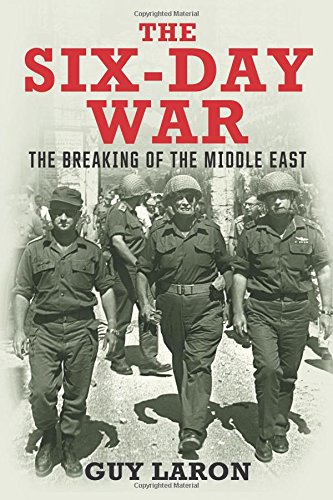
The Six-Day War: The Breaking of the Middle East Hardcover – February 21, 2017 by Guy Laron


Considering the ways Israel’s opponents have changed over the decades, the collective yearning among Israelis for a decisive, 1967-style victory is unrealistic. The false hope for such success impedes clarity of thinking and causes the Israeli public to lose confidence in both the military and the political leadership. The only approach that can succeed in Israel’s current conflicts is a patient, attritional, repetitive use of force. Israelis should take comfort that time is on Israel’s side.

In June 1967, the Israel Defense Force (IDF) waged war alone against Egypt, Jordan, and Syria. It achieved a stunning victory in six days. The military skill demonstrated by the Israelis was remarkable – so much so that battles from the Six-Day War continue to be studied at war colleges around the world.

Israel’s military achievement had another extremely important effect. It went a long way towards convincing the Arab world that Israel cannot be easily destroyed by military force; Israel is a fact the Arabs must learn to live with. Indeed, ten years later – after Egypt had lost another war to Israel, this one in 1973 – its president, Anwar Sadat, came to Jerusalem (November 1977) to offer peace.

The swift and decisive victory of 1967 became the standard to which the IDF aspired – and the kind of victory expected by Israeli society in future engagements. This is problematic, considering the ways Israel’s opponents have changed and the means they now deploy.

The unrealistic anticipation that victories on the scale of 1967 should be the end result of any military engagement hampers clear thinking and impedes the adoption of appropriate strategy and tactics. Moreover, it encourages what is often an impossible hope for a quick end to conflict. In the absence of a clear-cut and speedy outcome, Israelis lose confidence in the political as well as the military leadership.

Israelis, many of whom have limited military experience, still long for decisive victories in the Gaza and South Lebanon arenas. The wars in which the IDF has participated so far in the twenty-first century, which appeared to end inconclusively, left many Israelis with a sense of unease. They miss the victory photographs of the 1967 war.

Slogans of the Israeli right, such as “Let the IDF Win”, reflect this frustration. Similarly, the left claims that Judea and Samaria can be safely ceded to a Palestinian state because these territories can be reconquered, as they were in 1967, if they become a base for hostile actors. The calls for the destruction of Hamas also bear witness to a lack of understanding of the limits of military power.

But grand-scale conventional war, in which the IDF faces large armored formations and hundreds of air fighters as it did in 1967, is less likely today. The 1982 Lebanon War was the last to display such encounters. Since 1982, Israel has scarcely fought any state in a conventional war.

To a significant extent, the statist dimension in the Arab-Israeli conflict has itself disappeared. Egypt and Jordan are at peace with Israel. Syria and Iraq are torn by domestic conflict and are hardly in a position to challenge Israel militarily. Many other Arab countries, such as the Gulf and Maghreb states, have reached a de facto peace with Israel, an orientation buttressed by the common Iranian threat.

For the past three decades, Israel has been challenged primarily by sub-state actors, such as Hamas (a Sunni militia) and Hezbollah (a Shiite militia). Such organizations have a different strategic calculus from that of states. Because of their religious-ideological zeal, they are more difficult to deter than states, and their learning curve is much slower.

It took Egypt three military defeats (1948, 1956, and 1973) and a war of attrition (1968-70) within a span of 25 years to give up the goal of destroying Israel. In contrast, Hezbollah has been fighting Israel for a longer period and remains as devoted as ever to its goal of the elimination of the Jewish state. The heavy price inflicted upon Gaza since 2007 by the Israeli military has not changed the strategic calculus of the Hamas leadership, which still aspires to Israel’s demise.

Hamas and Hezbollah do not possess arsenals of tanks and air fighters, which would be easy targets for Israel. The decentralized structure of their military organizations does not present points of gravity that can be eliminated by swift and decisive action. Moreover, their use of civilian populations to shield missile launchers and military units – a war crime – makes IDF advances cumbersome and difficult due to slower troop movement in urban areas and the need to reduce collateral damage among civilians. Urbanization among Israel’s neighbors has greatly reduced the empty areas that could have been used for maneuvering and outflanking. The use of the subterranean by Israel’s foes, be it in Gaza or South Lebanon, is another new element that slows advances.

It is naïve to believe the IDF can or should win quickly and decisively every time it has to flex its muscles. Yitzhak Rabin warned several times during his long career against the expectation of a “once and for all” victory. The defeat of Israel’s new opponents requires a different strategy: attrition.

Israel is engaged in a long war of attrition against religiously motivated enemies who believe both God and history are on their side. All the IDF can do is occasionally weaken their ability to harm Israel and create temporary deterrence. In Israeli parlance, this is called “mowing the grass” – an apt metaphor, as the problem always grows back.

The patient, repetitive use of force is not glamorous, but it will eventually do the trick. Unfortunately, many Israelis do not understand the particular circumstances of the great 1967 victory. They have lost patience and do not realize that time is, in fact, on Israel’s side.
Posted by BardofBatYam at 6:00 AM No comments:
Email ThisBlogThis!Share to XShare to FacebookShare to Pinterest
Labels: . Stephen Darori, .Israel Book Review, @israelbookreview, @Stephendrus, #IsraelBookReview, #stephendarori, #stephendrus, Stephen Drus, stephendarori, stephendrus

Tuesday, April 4, 2017

The Case Against Academic Boycotts of Israel edited by Cary Nelson and Gabriel Noah Brahm MLA Members for Scholars’ Rights, distributed by Wayne State University Press, 552 pp., $34.99


Last year, the British scholar Alan Johnson spoke up against a resolution to boycott Israel at the National University of Ireland, Galway. As he recounts the experience, “Anti-Israel student activists tried to break up the meeting by banging on the tables, using the Israeli flag as a toilet wipe, and screaming at me, again and again, ‘Fuck off our fucking campus you fucking Zionist!’” This outburst came from students “whose heads were filled with the common sense of intellectual circles in Europe—Zionism is racism, the Zionists ‘ethnically cleansed’ the natives from the land in 1948, Israel is an ‘Apartheid State,’ Israel is committing a slow genocide against the remaining Palestinians, and so on.” Johnson recognizes that students who recite this litany of angry accusations are “in thrall to an Anti-Zionist Ideology” that turns them into dedicated “Anti-Zionist Subjects.” Most probably know little if anything about the history of Zionism or have any first-hand experience of Israel, but this ignorance does not keep them from eagerly participating in the BDS (boycott, divestment, sanctions) movement or from putting forward resolutions such as the one to which Johnson objected. Johnson’s essay appears in Cary Nelson and Gabriel Noah Brahm’s impressively comprehensive collection The Case Against Academic Boycotts of Israel.

The students Johnson encountered in Ireland have their counterparts among students, faculty members, and community activists on college and university campuses across the United States, Canada, and various European countries. They are a diverse group, and their motives may vary, but they are linked by an ideological and political stance towards Israel fueled by what Paul Berman calls “inexhaustible sources of rancor and rage.” As the chapters of this book persuasively demonstrate, one can develop a strong case against the anti-Israel boycott proposals, but inasmuch as these proposals are fueled by overwrought and adversarial passions, rational counter-arguments are unlikely to change many minds.


Israeli Apartheid Week, May 2010, University of California, Los Angeles campus. (Courtesy of AMCHA Initiative.)


Last year, the British scholar Alan Johnson spoke up against a resolution to boycott Israel at the National University of Ireland, Galway. As he recounts the experience, “Anti-Israel student activists tried to break up the meeting by banging on the tables, using the Israeli flag as a toilet wipe, and screaming at me, again and again, ‘Fuck off our fucking campus you fucking Zionist!’” This outburst came from students “whose heads were filled with the common sense of intellectual circles in Europe—Zionism is racism, the Zionists ‘ethnically cleansed’ the natives from the land in 1948, Israel is an ‘Apartheid State,’ Israel is committing a slow genocide against the remaining Palestinians, and so on.” Johnson recognizes that students who recite this litany of angry accusations are “in thrall to an Anti-Zionist Ideology” that turns them into dedicated “Anti-Zionist Subjects.” Most probably know little if anything about the history of Zionism or have any first-hand experience of Israel, but this ignorance does not keep them from eagerly participating in the BDS (boycott, divestment, sanctions) movement or from putting forward resolutions such as the one to which Johnson objected. Johnson’s essay appears in Cary Nelson and Gabriel Noah Brahm’s impressively comprehensive collection The Case Against Academic Boycotts of Israel.

The students Johnson encountered in Ireland have their counterparts among students, faculty members, and community activists on college and university campuses across the United States, Canada, and various European countries. They are a diverse group, and their motives may vary, but they are linked by an ideological and political stance towards Israel fueled by what Paul Berman calls “inexhaustible sources of rancor and rage.” As the chapters of this book persuasively demonstrate, one can develop a strong case against the anti-Israel boycott proposals, but inasmuch as these proposals are fueled by overwrought and adversarial passions, rational counter-arguments are unlikely to change many minds.

Mark LeVine, a professor of history at the University of California, Irvine and an outspoken supporter of BDS, is hardly any more convincing. LeVine recently wrote that “There is only one criticism of Israel that is relevant: It is a state grown, funded, and feeding off the destruction of another people. It is not legitimate. It must be dismantled, the same way that the other racist, psychopathic states across the region must be dismantled. And everyone who enables it is morally complicit in its crimes.”Intellect, in fact, is not what is first and foremost at work here. Indignation is, and it is hard to persuade angry and indignant people to rethink their positions. How, for instance, could one hope to reason with Omar Barghouti, one of the founders of the BDS movement, who is certain that “we are witnessing the rapid demise of Zionism, and nothing can be done to save it.” He unashamedly boasts, “I, for one, support euthanasia.” Barghouti claims that some of Israel’s “racist” and “sadistic” actions against the Palestinians “are reminiscent of common Nazi practices against the Jews.” Needless to say, he offers no evidence to support these outlandish charges. Barghouti, who is pursuing an advanced degree in philosophy at Tel Aviv University, leads a movement that would boycott the very institution where he studies, a consequence that seems to trouble him not in the least.


Academic scholars, of all people, should recognize that excoriation is not an acceptable substitute for argument, but, in fact, it pervades much of the discourse that today passes as “criticism of Israel.” In 2009, for instance, a letter was sent to President Obama accusing Israel of pursuing an “insidious policy of extermination” so merciless in its character and extent as to constitute “one of the most massive ethnocidal atrocities of modern times.” It was signed by more than 900 academics. Since then, still larger numbers of people have endorsed proposals to boycott Israeli universities, cultural events, and commercial products, including Sabra-brand hummus, which has been banned from certain American university dining halls.

What is going on? The anti-Zionism that has been emerging in recent years usually has little or nothing to do with Zionism itself. What distinguishes anti-Zionism more than anything else is the negative passions it embodies. Through the frequent repetition of a limited but emotionally charged lexicon of defamatory slogans, anti-Zionism has developed a language of its own, voicing in strongly felt terms a now-familiar litany of accusations and indictments directed at Israel. The truth-content of these charges is taken to be self-evident. Fixation, fervor, the hubris of moral certainty, and a heightened degree of self-righteous anger are enough to get many to sign on. Add the consolations of groupthink, and it is no wonder that, in his contribution, Paul Berman refers to the phenomenon less in political terms than in pathological ones, as a fevered “madness.”

Nevertheless, BDS is emphatically a movement with political goals and a reasoned strategy to meet those goals. Cary Nelson describes these in detail in his useful introduction, which offers a brief history of BDS. It began at the University of California, Berkeley in early 2002 and soon thereafter spread to Columbia, Harvard, MIT, Princeton, and elsewhere. Recognizing that academic boycotts violate the norms of academic freedom, hundreds of college and university presidents have spoken out against them, and virtually every major multidisciplinary academic organization has opposed them as well. Still, the movement maintains a good deal of momentum, and divestment drives and proposals to boycott Israeli universities are ongoing and will likely continue. Depending on which BDS spokesperson one listens to, the aims may vary somewhat, but all of them speak up for greater Palestinian rights and argue that Israeli universities somehow deny those rights. Yet any informed observer knows that Israeli universities are among the most liberal institutions in the country, that many of their faculty members and students actively advocate for a two-state solution, and that large numbers of Arabs attend these institutions. Ilan Troen’s chapter, “The Israeli–Palestinian Relationship in Higher Education: Evidence from the Field,” is particularly clarifying in this regard. Academic boycotts, divestments, and sanctions are not, in fact, likely to work in favor of the Palestinians. There is ample reason, therefore, to suspect that the movement has more ambitious goals in mind than boycotts of Israeli universities. One of its advocates says as much. As As’ad Abu Khalil writes:

The real aim of BDS is to bring down the state of Israel . . . That should be stated as an unambiguous goal. There should not be any equivocation on the subject. Justice and freedom for the Palestinians are incompatible with the existence of the state of Israel.

The political philosophy that guides such an eliminationist goal is deftly analyzed in several of this book’s most notable chapters, including those by Alan Johnson, Sabah Salih, and David Hirsch. Other chapters, by Martha Nussbaum, Russell Berman, Gabriel Noah Brahm and Asaf Romirowsky, and Emily Budick, expose the hollowness of the supporting arguments and the political bad faith of the BDS campaigns. Several other contributors—Sharon Ann Musher, Michael Bérubé, Donna Robinson Divine, Nancy Koppelman, Samuel M. Edelman, and Carol F.S. Edelman—point out the threats to academic freedom that BDS activities pose and offer revealing case studies of damage already done on certain campuses.

Cary Nelson’s dismantling of Judith Butler (“The Problem with Judith Butler: The Philosophy of the Movement to Boycott Israel”), the movement’s leading philosopher and political theorist, succeeds strikingly. His analysis of the abstract, ahistorical notion of justice on which Butler bases much of her argument for the dissolution of Israel is fully convincing. To Butler, as Nelson points out, the history of the Jewish people in the land of Israel and the land’s connection to Judaism are without meaning. She simply “eschews the Zionist linkage of nation to land” and rejects the very existence of a Jewish state, not just its policies. Adopting the moral stance of an absolutist, she insists on justice as the basis for a state’s legitimacy and finds justice only in the Palestinian cause. For her, “there is no valid case to be made for Israelis as citizens of a Jewish state.” In the rhetorical economy of her work there are no competing arguments. It is a conflict between truth and error. Positioned on the side of error, Jews, therefore, are to give up their state and submit to governance by a Palestinian majority, a prospect that the overwhelming majority of Israeli Jews are not likely to endorse. Nelson is correct to conclude, then, that Butler’s proposal for a one-state solution is “a recipe for war,” for Israelis would not stand idly by while the Jewish State disappears and they fall under the dominance of Muslim Arab rule. They would fight, an outcome that never figures into Butler’s fantasy of a non-violent route to a single state.

Is it also a recipe for or a product of anti-Semitism? The question comes up time and again in this book with respect to the whole BDS movement. Butler is Jewish, as she repeatedly avows, but that fact hardly adds validity to arguments she makes against the Jewish State or necessarily keeps her at a distance from Israel’s fiercest enemies. She is on record, for instance, affirming Hamas and Hezbollah as “progressive” movements that are to be supported as part of a global left wing, a position that most Jews would find abhorrent. Nelson claims no knowledge of what is in Butler’s heart, but his analysis of her thinking, which he finds “fundamentally flawed by its unmitigated hostility toward Israel,” leads him to conclude that the positions she argues for “have antisemitic consequences and lend support to antisemitic groups and traditions.” Kenneth Marcus devotes an entire chapter to this question (“Is BDS Anti-Semitic?”), offering a learned review of definitions of anti-Semitism, as well as several categories that are useful in thinking through the issue. He concludes that “in the last analysis, the BDS campaign is anti-Semitic.” Even if some of its proponents may hold no particular disdain for Jews, they “operate out of a climate of opinion that contains elements that are hostile to Jews.”

One wants to know more about this “climate of opinion” and, in particular, understand why certain academics are so receptive to it. Tammi Rossman-Benjamin answers these questions in her groundbreaking chapter, “Interrogating the Academic Boycotters of Israel on American Campuses,” a carefully researched, empirical study of 938 faculty members at 316 American colleges and universities who have endorsed statements calling for an academic boycott of Israeli universities.

Rossman-Benjamin’s findings are revealing: A vast majority of these scholars—789 (86 percent)—are located within the humanities (453 or 49 percent) or social sciences (336 or 37 percent). Those in engineering and the natural sciences comprise a mere 7 percent of the total (4 percent were affiliated with the arts). The departments with the largest number of boycotters are English or literature (21 percent), followed by ethnic studies (10 percent), history (7 percent), gender studies (7 percent), anthropology (6 percent), sociology (5 percent), linguistics or languages (5 percent), politics (4 percent), American studies (3 percent), and Middle Eastern or Near East studies (3 percent). Analyzing her data in order to understand the boycotters’ ideological motivation, Rossman-Benjamin discovers four recurring themes at the heart of their work: race, class, gender, and empire. Rossman-Benjamin posits that scholars invested in the study of these subjects are apt to understand human experience in terms of power relationships that divide the world into the oppressed and their oppressors. Thereafter, it is but “a short ideological leap to seeing the Palestinian-Israeli conflict in the same binary terms, casting the Palestinians as the oppressed and the Israelis as the oppressors.”

To view the Palestinian-Israeli dispute in these terms is, of course, to reduce its complexity to Manichean notions of good and evil. This is not the way one would hope that our teachers of history, literature, and society think, but, of course, Rossman-Benjamin is right that it is the kind of thinking that shapes much of the discourse of Israel’s academic boycotters. The language and the anti-Zionist politics they reflect are largely products of the ideological left, with which many of those who pursue race, class, gender, and empire studies align themselves. Within certain scholarly and intellectual circles, to be a member of the left in good standing today almost requires that one be an anti-Zionist. As Cary Nelson comments, “An overall progressive agenda cannot move forward without first dismantling the State of Israel. Anti-Zionism becomes the necessary precondition of all other progressive commitments.”

Try as they might, BDS and other campus-based anti-Israel activists will not succeed in dismantling the Jewish State, nor will the tiny minority of Israeli scholars who have emerged as boycott advocates (they deserve a study unto themselves). Their various boycott campaigns have scored no major victories to date, but by constantly maligning Israel as an unjust, racist, apartheid state, they no doubt are making the country seem sinister in the eyes of growing numbers of people. Instances of Israeli scholars being dropped from the editorial boards of certain journals or otherwise shunned are documented in this book. One also hears anecdotally of scholars who will no longer collaborate with Israeli colleagues or participate in conferences at Israeli universities. In such cases, it is more than just good professional manners that are being violated: decency is, and fairness, and personal and national dignity.

It is hard, personally and professionally, for Israelis to know how to respond to such insults. To answer indignation with indignation will not ease the Israeli-Palestinian dispute, but, then, neither will BDS and its faithful followers. What it will do is let the latter know that Israelis and their supporters will not remain passively on the receiving end of moral smugness and undeserved insults. To refuse to accept an imposed defensive crouch as one’s natural posture, as this book admirably does, also makes a case against academic boycotts of Israel.
Posted by BardofBatYam at 3:33 PM No comments:
Email ThisBlogThis!Share to XShare to FacebookShare to Pinterest
Labels: . @stephendarori, . Stephen Darori, . Stephen Drus, .Israel Book Review, @israelbookreview, @Stephendrus, #stephendarori, #stephendrus, stephendarori, stephendrus

10 Greatest Poems ( under 50 lines)..... Do you agree?


10 Greatest Poems Ever Written
From least greatest (10) to greatest greatest (1), the poems in this list are limited to ones originally written in the English language and which are under 50 lines, excluding poems like Homer’s Iliad and Edgar Allan Poe’s “Raven.” Each poem is followed by some brief analysis. Many good poems and poets had to be left off of this list. In the comments section below, feel free to make additions or construct your own lists. You can also submit analyses of classic poetry to submissions@classicalpoets.org. They will be considered for publication on this website.


10. “The Road Not Taken” by Robert Frost (1874-1963)

Two roads diverged in a yellow wood,
And sorry I could not travel both
And be one traveler, long I stood
And looked down one as far as I could
To where it bent in the undergrowth;

Then took the other, as just as fair,
And having perhaps the better claim,
Because it was grassy and wanted wear;
Though as for that the passing there
Had worn them really about the same,

And both that morning equally lay
In leaves no step had trodden black.
Oh, I kept the first for another day!
Yet knowing how way leads on to way,
I doubted if I should ever come back.

I shall be telling this with a sigh
Somewhere ages and ages hence:
Two roads diverged in a wood, and I—
I took the one less traveled by,
And that has made all the difference.


Meaning of the Poem

This poem deals with that big noble question of “How to make a difference in the world?” On first reading, it tells us that the choice one makes really does matter, ending: “I took the one less traveled by, / And that has made all the difference.”

A closer reading reveals that the lonely choice that was made earlier by our traveling narrator maybe wasn’t all that significant since both roads were pretty much the same anyway (“Had warn them really about the same”) and it is only in the remembering and retelling that it made a difference. We are left to ponder if the narrator had instead traveled down “The Road Not Taken” might it have also made a difference as well. In a sense, “The Road Not Taken” tears apart the traditional view of individualism, which hinges on the importance of choice, as in the case of democracy in general (choosing a candidate), as well as various constitutional freedoms: choice of religion, choice of words (freedom of speech), choice of group (freedom of assembly), and choice of source of information (freedom of press). For example, we might imagine a young man choosing between being a carpenter or a banker later seeing great significance in his choice to be a banker, but in fact there was not much in his original decision at all other than a passing fancy. In this, we see the universality of human beings: the roads leading to carpenter and banker being basically the same and the carpenter and bankers at the end of them—seeming like individuals who made significant choices—really being just part of the collective of the human race.

Then is this poem not about the question “How to make a difference in the world?” after all? No. It is still about this question. The ending is the most clear and striking part. If nothing else, readers are left with the impression that our narrator, who commands beautiful verse, profound imagery, and time itself (“ages and ages hence”) puts value on striving to make a difference. The striving is reconstituted and complicated here in reflection, but our hero wants to make a difference and so should we. That is why this is a great poem, from a basic or close reading perspective.


9. “The New Colossus” by Emma Lazarus (1849-1887)

Not like the brazen giant of Greek fame,
With conquering limbs astride from land to land;
Here at our sea-washed, sunset gates shall stand
A mighty woman with a torch, whose flame
Is the imprisoned lightning, and her name
Mother of Exiles. From her beacon-hand
Glows world-wide welcome; her mild eyes command
The air-bridged harbor that twin cities frame.
“Keep, ancient lands, your storied pomp!” cries she
With silent lips. “Give me your tired, your poor,
Your huddled masses yearning to breathe free,
The wretched refuse of your teeming shore.
Send these, the homeless, tempest-tossed to me,
I lift my lamp beside the golden door!”


Meaning of the Poem

Inscribed on the Statue of Liberty in New York harbor, this sonnet may have the greatest placement of any English poem. It also has one of the greatest placements in history. Lazarus compares the Statue of Liberty to the Colossus of Rhodes, one of the Seven Wonders of the Ancient World. Like the Statue of Liberty, the Colossus of Rhodes was an enormous god-like statue positioned in a harbor. Although the Colossus of Rhodes no longer stands, it symbolizes the ancient Greek world and the greatness of the ancient Greek and Roman civilization, which was lost for a thousand years to the West, and only fully recovered again during the Renaissance. “The New Colossus” succinctly crystallizes the connection between the ancient world and America, a modern nation. It’s a connection that can be seen in the White House and other state and judicial buildings across America that architecturally mirror ancient Greek and Roman buildings; and in the American political system that mirrors Athenian Democracy and Roman Republicanism.

In the midst of this vast comparison of the ancient and the American, Lazarus still manages to clearly render America’s distinct character. It is the can-do spirit of taking those persecuted and poor from around the world and giving them a new opportunity and hope for the future, what she calls “the golden door.” It is a uniquely scrappy and compassionate quality that sets Americans apart from the ancients. The relevance of this poem stretches all the way back to the pilgrims fleeing religious persecution in Europe to the controversies surrounding modern immigrants from Mexico and the Middle East. While circumstances today have changed drastically, there is no denying that this open door was part of what made America great once upon a time. It’s the perfect depiction of this quintessential Americanness that makes “The New Colossus” also outstanding.


8. “Ozymandias” by Percy Bysshe Shelley (1792-1822)

I met a traveler from an antique land
Who said: “Two vast and trunkless legs of stone
Stand in the desert . . . Near them, on the sand,
Half sunk, a shattered visage lies, whose frown,
And wrinkled lip, and sneer of cold command,
Tell that its sculptor well those passions read
Which yet survive, stamped on these lifeless things,
The hand that mocked them, and the heart that fed:
And on the pedestal these words appear:
‘My name is Ozymandias, king of kings:
Look on my works, ye Mighty, and despair!’
Nothing beside remains. Round the decay
Of that colossal wreck, boundless and bare
The lone and level sands stretch far away.”


Meaning of the Poem

In this winding story within a story within a poem, Shelley paints for us the image of the ruins of a statue of ancient Egyptian king Ozymandias, who is today commonly known as Ramesses II. This king is still regarded as the greatest and most powerful Egyptian pharaoh. Yet, all that’s left of the statue are his legs, which tell us it was huge and impressive; the shattered head and snarling face, which tell us how tyrannical he was; and his inscribed quote hailing the magnificent structures that he built and that have been reduced to dust, which tells us they might not have been quite as magnificent as Ozymandias imagined. The image of a dictator-like king whose kingdom is no more creates a palpable irony. But, beyond that there is a perennial lesson about the inescapable and destructive forces of time, history, and nature. Success, fame, power, money, health, and prosperity can only last so long before fading into “lone and level sands.”

There are yet more layers of meaning here that elevate this into one of the greatest poems. In terms of lost civilizations that show the ephemeralness of human pursuits, there is no better example than the Egyptians—who we associate with such dazzling monuments as the Sphinx and the Great Pyramid at Giza (that stands far taller than the Statue of Liberty)—yet who completely lost their spectacular language, culture, and civilization. If the forces of time, history, and nature can take down the Egyptian civilization, it begs the question, “Who’s next?” Additionally, Ozymandias is believed to have been the villainous pharaoh who enslaved the ancient Hebrews and who Moses led the exodus from. If all ordinary pursuits, such as power and fame, are but dust, what remains, the poem suggests, are spirituality and morality—embodied by the ancient Hebrew faith. If you don’t have those then in the long run you are a “colossal wreck.” Thus, the perfectly composed scene itself, the Egyptian imagery, and the Biblical backstory convey a perennial message and make this a great poem.


7. “Ode on a Grecian Urn” by John Keats (1795-1821)

Thou still unravish’d bride of quietness,
Thou foster-child of silence and slow time,
Sylvan historian, who canst thus express
A flowery tale more sweetly than our rhyme:
What leaf-fring’d legend haunts about thy shape
Of deities or mortals, or of both,
In Tempe or the dales of Arcady?
What men or gods are these? What maidens loth?
What mad pursuit? What struggle to escape?
What pipes and timbrels? What wild ecstasy?

Heard melodies are sweet, but those unheard
Are sweeter; therefore, ye soft pipes, play on;
Not to the sensual ear, but, more endear’d,
Pipe to the spirit ditties of no tone:
Fair youth, beneath the trees, thou canst not leave
Thy song, nor ever can those trees be bare;
Bold Lover, never, never canst thou kiss,
Though winning near the goal yet, do not grieve;
She cannot fade, though thou hast not thy bliss,
For ever wilt thou love, and she be fair!


Keats’s own drawing of the Grecian Urn.

Ah, happy, happy boughs! that cannot shed
Your leaves, nor ever bid the Spring adieu;
And, happy melodist, unwearied,
For ever piping songs for ever new;
More happy love! more happy, happy love!
For ever warm and still to be enjoy’d,
For ever panting, and for ever young;
All breathing human passion far above,
That leaves a heart high-sorrowful and cloy’d,
A burning forehead, and a parching tongue.

Who are these coming to the sacrifice?
To what green altar, O mysterious priest,
Lead’st thou that heifer lowing at the skies,
And all her silken flanks with garlands drest?
What little town by river or sea shore,
Or mountain-built with peaceful citadel,
Is emptied of this folk, this pious morn?
And, little town, thy streets for evermore
Will silent be; and not a soul to tell
Why thou art desolate, can e’er return.

O Attic shape! Fair attitude! with brede
Of marble men and maidens overwrought,
With forest branches and the trodden weed;
Thou, silent form, dost tease us out of thought
As doth eternity: Cold Pastoral!
When old age shall this generation waste,
Thou shalt remain, in midst of other woe
Than ours, a friend to man, to whom thou say’st,
“Beauty is truth, truth beauty,—that is all
Ye know on earth, and all ye need to know.”


Meaning of the Poem

As if in response to Shelley’s “Ozymandias,” Keats’s “Ode on a Grecian Urn” offers a sort of antidote to the inescapable and destructive force of time. Indeed, “Ode on a Grecian Urn” was published in 1819 just a year or so after “Ozymandias.” The antidote is simple: art. The art on the Grecian urn—which is basically a decorative pot from ancient Greece—has survived for thousands of years. While empires rose and fell, the Grecian urn survived. Musicians, trees, lovers, heifers, and priests all continue dying decade after decade and century after century, but their artistic depictions on the Grecian urn live on for what seems eternity.

This realization about the timeless nature of art is not new now nor was it in the 1800s, but Keats has chosen a perfect example since ancient Greek civilization so famously disappeared into the ages, being subsumed by the Romans, and mostly lost until the Renaissance a thousand years later. Now, the ancient Greeks are all certainly dead (like the king Ozymandias in Shelley’s poem) but the Greek art and culture live on through Renaissance painters, the Olympic Games, endemic Neoclassical architecture, and, of course, the Grecian urn.

Further, what is depicted on the Grecian urn is a variety of life that makes the otherwise cold urn feel alive and vibrant. This aliveness is accentuated by Keats’s barrage of questions and blaring exclamations: “More happy love! more happy, happy love!” Art, he seems to suggest, is more alive and real than we might imagine. Indeed, the last two lines can be read as the urn itself talking: “Beauty is truth, truth beauty,—that is all / Ye know on earth, and all ye need to know.” In these profound lines, Keats places us within ignorance, suggesting that what we know on earth is limited, but that artistic beauty, which he has now established is alive, is connected with truth. Thus, we can escape ignorance, humanness, and certain death and approach another form of life and truth through the beauty of art. This effectively completes the thought that began in Ozymandias and makes this a great poem one notch up from its predecessor.


6. “The Tiger by William Blake (1757-1827)

Tiger Tiger, burning bright,
In the forests of the night;
What immortal hand or eye,
Could frame thy fearful symmetry?

In what distant deeps or skies.
Burnt the fire of thine eyes?
On what wings dare he aspire?
What the hand, dare seize the fire?

And what shoulder, and what art,
Could twist the sinews of thy heart?
And when thy heart began to beat,
What dread hand? and what dread feet?

What the hammer? what the chain,
In what furnace was thy brain?
What the anvil? what dread grasp,
Dare its deadly terrors clasp!

When the stars threw down their spears
And water’d heaven with their tears:
Did he smile his work to see?
Did he who made the Lamb make thee?

Tiger Tiger burning bright,
In the forests of the night:
What immortal hand or eye,
Dare frame thy fearful symmetry?


Meaning of the Poem

This poem contemplates a question arising from the idea of creation by an intelligent creator. The question is this: If there is a loving, compassionate God or gods who created human beings and whose great powers exceed the comprehension of human beings, as many major religions hold, then why would such a powerful being allow evil into the world. Evil here is represented by a tiger that might, should you be strolling in the Indian or African wild in the 1700s, have leapt out and killed you. What would have created such a dangerous and evil creature? How could it possibly be the same divine blacksmith who created a cute harmless fluffy lamb or who created Jesus, also known as the “Lamb of God” (which the devoutly Christian Blake was probably also referring to here). To put it another way, why would such a divine blacksmith create beautiful innocent children and then also allow such children to be slaughtered. The battery of questions brings this mystery to life with lavish intensity.

Does Blake offer an answer to this question of evil from a good God? It would seem not on the surface. But, this wouldn’t be a great poem if it were really that open ended. The answer comes in the way that Blake explains the question. Blake’s language peels away the mundane world and offers a look at the super-reality to which poets are privy. We fly about in “forests of the night” through “distant deeps or skies” looking for where the fire in the tiger’s eye was taken from by the Creator. This is the reality of expanded time, space, and perception that Blake so clearly elucidates elsewhere with the lines “To see a world in a grain of sand / And a heaven in a wild flower, / Hold infinity in the palm of your hand, / And eternity in an hour” (“Auguries of Innocence”). This indirectly tells us that the reality that we ordinarily know and perceive is really insufficient, shallow, and deceptive. Where we perceive the injustice of the wild tiger something else entirely may be transpiring. What we ordinarily take for truth may really be far from it: a thought that is scary, yet also sublime or beautiful—like the beautiful and fearsome tiger. Thus, this poem is great because it concisely and compellingly presents a question that still plagues humanity today, as well as a key clue to the answer.


5. “On His Blindness” by John Milton (1608-1674)

When I consider how my light is spent
Ere half my days in this dark world and wide,
And that one talent which is death to hide
Lodg’d with me useless, though my soul more bent
To serve therewith my Maker, and present
My true account, lest he returning chide,
“Doth God exact day-labour, light denied?”
I fondly ask. But Patience, to prevent
That murmur, soon replies: “God doth not need
Either man’s work or his own gifts: who best
Bear his mild yoke, they serve him best. His state
Is kingly; thousands at his bidding speed
And post o’er land and ocean without rest:
They also serve who only stand and wait.”


Meaning of the Poem

This poem deals with one’s limitations and shortcomings in life. Everyone has them and Milton’s blindness is a perfect example of this. His eyesight gradually worsened and he became totally blind at the age of 42. This happened after he served in an eminent position under Oliver Cromwell’s revolutionary Puritan government in England. To put it simply, Milton rose to the highest position an English writer might at the time and then sank all the way down to a state of being unable read or write on his own. How pathetic!

The genius of this poem comes in the way that Milton transcends the misery he feels. First, he frames himself, not as an individual suffering or lonely, but as a failed servant to the Creator: God. While Milton is disabled, God here is enabled through imagery of a king commanding thousands. This celestial monarch, his ministers and troops, and his kingdom itself are invisible to human eyes anyway, so already Milton has subtly undone much of his failing by subverting the necessity for human vision. More straightforwardly, through the voice of Patience, Milton explains that serving the celestial monarch only requires bearing those hardships, which really aren’t that bad (he calls them “mild”) that life has burdened you with (like a “yoke” put on an ox). This grand mission from heaven may be as simple as standing and waiting, having patience, and understanding the order of the universe. Thus, this is a great poem because Milton has not only dispelled sadness over a major shortcoming in life but also shown how the shortcoming is itself imbued with an extraordinary and uplifting purpose.


4. “A Psalm of Life” by Henry Wadsworth Longfellow (1807-1882)

What the heart of the young man said to the Psalmist

Tell me not, in mournful numbers,
Life is but an empty dream!
For the soul is dead that slumbers,
And things are not what they seem.

Life is real! Life is earnest!
And the grave is not its goal;
Dust thou art, to dust returnest,
Was not spoken of the soul.

Not enjoyment, and not sorrow,
Is our destined end or way;
But to act, that each tomorrow
Find us farther than today.

Art is long, and Time is fleeting,
And our hearts, though stout and brave,
Still, like muffled drums, are beating
Funeral marches to the grave.

In the world’s broad field of battle,
In the bivouac of Life,
Be not like dumb, driven cattle!
Be a hero in the strife!


Trust no Future, howe’er pleasant!
Let the dead Past bury its dead!
Act,—act in the living Present!
Heart within, and God o’erhead!

Lives of great men all remind us
We can make our lives sublime,
And, departing, leave behind us
Footprints on the sands of time;—

Footprints, that perhaps another,
Sailing o’er life’s solemn main,
A forlorn and shipwrecked brother,
Seeing, shall take heart again.

Let us, then, be up and doing,
With a heart for any fate;
Still achieving, still pursuing,
Learn to labor and to wait.


Meaning of the Poem

In this nine-stanza poem, the first six stanzas are rather vague since each stanza seems to begin a new thought. Instead, the emphasis here is on a feeling rather than a rational train of thought. What feeling? It seems to be a reaction against science, which is focused on calculations (“mournful numbers”) and empirical evidence, of which there is no, or very little, to prove the existence of the soul. Longfellow lived when the Industrial Revolution was in high gear and the ideals of science, rationality, and reason flourished. From this perspective, the fact that the first six stanzas do not follow a rational train of thought makes perfect sense.

According to the poem, the force of science seems to restrain one’s spirit or soul (“for the soul is dead that slumbers”), lead to inaction and complacency from which we must break free (“Act,—act in the living Present! / Heart within, and God o’erhead!”) for lofty purposes such as Art, Heart, and God before time runs out (“Art is long, and Time is fleeting”). The last three stanzas—which, having broken free from science by this point in the poem, read more smoothly—suggest that this acting for lofty purposes can lead to greatness and can help our fellow man.

We might think of the entire poem as a clarion call to do great things, however insignificant they may seem in the present and on the empirically observable surface. That may mean writing a poem and entering it into a poetry contest, when you know the chances of your poem winning are very small; risking your life for something you believe in when you know it is not popular or it is misunderstood; or volunteering for a cause that, although it may seem hopeless, you feel is truly important. Thus, the greatness of this poem lies in its ability to so clearly prescribe a method for greatness in our modern world.
3. “Daffodils” by William Wordsworth (1770-1850)

I wandered lonely as a cloud
That floats on high o’er vales and hills,
When all at once I saw a crowd,
A host, of golden daffodils;
Beside the lake, beneath the trees,
Fluttering and dancing in the breeze.

Continuous as the stars that shine
And twinkle on the milky way,
They stretched in never-ending line
Along the margin of a bay:
Ten thousand saw I at a glance,
Tossing their heads in sprightly dance.

The waves beside them danced; but they
Out-did the sparkling waves in glee:
A poet could not but be gay,
In such a jocund company:
I gazed—and gazed—but little thought
What wealth the show to me had brought:

For oft, when on my couch I lie
In vacant or in pensive mood,
They flash upon that inward eye
Which is the bliss of solitude;
And then my heart with pleasure fills,
And dances with the daffodils.


Meaning of the Poem

Through the narrator’s chance encounter with a field of daffodils by the water, we are presented with the power and beauty of the natural world. It sounds simple enough, but there are several factors that contribute to this poem’s greatness. First, the poem comes at a time when the Western world is industrializing and man feels spiritually lonely in the face of an increasingly godless worldview. This feeling is perfectly harnessed by the depiction of wandering through the wilderness “lonely as a cloud” and by the ending scene of the narrator sadly lying on his couch “in vacant or in pensive mood” and finding happiness in solitude. The daffodils then become more than nature; they become a companion and a source of personal joy. Second, the very simplicity itself of enjoying nature—flowers, trees, the sea, the sky, the mountains etc.—is perfectly manifested by the simplicity of the poem: the four stanzas simply begin with daffodils, describe daffodils, compare daffodils to something else, and end on daffodils, respectively. Any common reader can easily get this poem, as easily as her or she might enjoy a walk around a lake.

Third, Wordsworth has subtly put forward more than just an ode to nature here. Every stanza mentions dancing and the third stanza even calls the daffodils “a show.” At this time in England, one might have paid money to see an opera or other performance of high artistic quality. Here, Wordsworth is putting forward the idea that nature can offer similar joys and even give you “wealth” instead of taking it from you, undoing the idea that beauty is attached to earthly money and social status. This, coupled with the language and topic of the poem, which are both relatively accessible to the common man, make for a great poem that demonstrates the all-encompassing and accessible nature of beauty and its associates, truth and bliss.


2. “Holy Sonnet 10: Death, Be Not Proud” by John Donne (1572-1631)

Death, be not proud, though some have called thee
Mighty and dreadful, for thou art not so;
For those whom thou think’st thou dost overthrow
Die not, poor Death, nor yet canst thou kill me.
From rest and sleep, which but thy pictures be,
Much pleasure; then from thee much more must flow,
And soonest our best men with thee do go,
Rest of their bones, and soul’s delivery.
Thou art slave to fate, chance, kings, and desperate men,
And dost with poison, war, and sickness dwell,
And poppy or charms can make us sleep as well
And better than thy stroke; why swell’st thou then?
One short sleep past, we wake eternally
And death shall be no more; Death, thou shalt die.


Meaning of the Poem

Death is a perennial subject of fear and despair. But, this sonnet seems to say that it need not be this way. The highly focused attack on Death’s sense of pride uses a grocery list of rhetorical attacks: First, sleep, which is the closest human experience to death, is actually quite nice. Second, all great people die sooner or later and the process of death could be viewed as joining them. Third, Death is under the command of higher authorities such as fate, which controls accidents, and kings, who wage wars; from this perspective, Death seems no more than a pawn in a larger chess game within the universe. Fourth, Death must associate with some unsavory characters: “poison, wars, and sickness.” Yikes! They must make unpleasant coworkers! (You can almost see Donne laughing as he wrote this.) Fifth, “poppy and charms” (drugs) can do the sleep job as well as Death or better. Death, you’re fired!

The sixth, most compelling, and most serious reason is that if one truly believes in a soul then Death is really nothing to worry about. The soul lives eternally and this explains line 4, when Donne says that Death can’t kill him. If you recognize the subordinate position of the body in the universe and identify more fully with your soul, then you can’t be killed in an ordinary sense. Further, this poem is so great because of its universal application. Fear of death is so natural an instinct and Death itself so all-encompassing and inescapable for people, that the spirit of this poem and applicability of it extends to almost any fear or weakness of character that one might have. Confronting, head on, such a fear or weakness, as Donne has done here, allows human beings to transcend their condition and their perception of Death, more fully perhaps than one might through art by itself—as many poets from this top ten list seem to say—since the art may or may not survive may or may not be any good, but the intrinsic quality of one’s soul lives eternally. Thus, Donne leaves a powerful lesson to learn from: confront what you fear head on and remember that there is nothing to fear on earth if you believe in a soul.


1. “Sonnet 18” by William Shakespeare (1564-1616)

Shall I compare thee to a summer’s day?
Thou art more lovely and more temperate:
Rough winds do shake the darling buds of May,
And summer’s lease hath all too short a date:
Sometime too hot the eye of heaven shines,
And often is his gold complexion dimm’d;
And every fair from fair sometime declines,
By chance, or nature’s changing course, untrimm’d;
But thy eternal summer shall not fade
Nor lose possession of that fair thou ow’st;
Nor shall Death brag thou wander’st in his shade,
When in eternal lines to time thou grow’st;
So long as men can breathe or eyes can see,
So long lives this, and this gives life to thee.


Meaning of the Poem

Basically, the narrator tells someone he esteems highly that this person is better than a summer’s day because a summer’s day is often too hot and too windy, and especially because a summer’s day doesn’t last; it must fade away just as people, plants, and animals die. But, this esteemed person does not lose beauty or fade away like a summer’s day because he or she is eternally preserved in the narrator’s own poetry. “So long lives this, and this gives life to thee” means “This poetry lives long, and this poetry gives life to you.”

From a modern perspective this poem might come off as pompous (assuming the greatness of one’s own poetry), arbitrary (criticizing a summer’s day upon what seems a whim), and sycophantic (praising someone without substantial evidence). How then could this possibly be number one? After the bad taste of an old flavor to a modern tongue wears off, we realize that this is the very best of poetry. This is not pompous because Shakespeare actually achieves greatness and creates an eternal poem. It is okay to recognize poetry as great if it is great and it is okay to recognize an artistic hierarchy. In fact, it is absolutely necessary in educating, guiding, and leading others. The attack on a summer’s day is not arbitrary. Woven throughout the language is an implicit connection between human beings, the natural world (“a summer’s day”), and heaven (the sun is “the eye of heaven”). A comparison of a human being to a summer’s day immediately opens the mind to unconventional possibilities; to spiritual perspectives; to the ethereal realm of poetry and beauty. The unabashed praise for someone without a hint as to even the gender or accomplishments of the person is not irrational or sycophantic. It is a pure and simple way of approaching our relationships with other people, assuming the best. It is a happier way to live—immediately free from the depression, stress, and cynicism that creeps into our hearts. Thus, this poem is strikingly and refreshingly bold, profound, and uplifting.

Finally, as to the question of overcoming death, fear, and the decay of time, an overarching question in these great poems, Shakespeare adroitly answers them all by skipping the question, suggesting it is of no consequence. He wields such sublime power that he is unmoved and can instead offer remedy, his verse, at will to those he sees befitting. How marvelous!
Posted by BardofBatYam at 6:50 AM No comments:
Email ThisBlogThis!Share to XShare to FacebookShare to Pinterest
Labels: . @stephendarori, . Stephen Darori, . Stephen Drus, .Israel Book Review, @israelbookreview, @Stephendrus, #IsraelBookReview, #stephendarori, #stephendrus, stephendarori, stephendrus

Wednesday, March 29, 2017

The Despot’s Accomplice: How The West is Aiding and Abetting the Decline of Democracy. Brian Klaas. Hurst. 2016.


The Despot’s Accomplice: How the West is Aiding and Abetting the Decline of Democracy, Brian Klaas’s new book, is an engaging account of the contemporary history of democracy, its promotion and the flaws in the West’s approach. Drawing on first-hand experience and interviews, the book provides insights into the impact of current policy as well as proposals as to how this strategy could be altered.

An academic at the London School of Economics, Klaas has also acted as an election monitor in a variety of locations and worked with a number of NGOs. This experience provides the core material for The Despot’s Accomplice, which contains extensive research and is written in a lively and highly readable style. As such, it will be enjoyed by the general reader as well as by university students and specialists. Klaas combines personal observation with astute political analysis. Many of the book’s insights are also gleaned from interviews with both high profile and lesser known figures, including former Thai Prime Minister, Abhisit Vejjajiva, and a former Belarussian Presidential candidate, Mikalai Statkevich, as well as other key actors in Tunisia, Cote d’Ivoire and Madagascar. These interviews are a key feature of the book.

The structure of The Despot’s Accomplice includes an overview of democracy promotion, followed by several thematic chapters based around policy recommendations. The first section charts the recent history of the apparently unstoppable rise of the democratic ideal. Following the end of the Cold War, democracies proliferated across the world and the West helped facilitate this trend through its democracy promotion policies. The EU, for instance, tied democratic reform to access to its markets and regional development funds. One key case study given to illustrate this point is Latvia. Klaas outlines how until recently the tiny Baltic state was under the authoritarian control of the Soviet Union and the KGB. Since independence in 1991, the country has made the transition to become a lively liberal democracy, incentivised by EU accession, which it achieved in 2004. Comparing the Baltic country’s current situation within the EU with its Soviet past is instructive, and has been brought into sharper focus in light of Russia’s recent belligerence towards its ‘near abroad’.

Today, however, this process appears to have stalled or even to be in retreat. The Despot’s Accomplice identifies a number of policy mistakes that have made matters worse: for instance, waging war to impose democracy in the Middle East; tolerating authoritarianism in the hope that autocrats can be cajoled into reform; and generally giving legitimacy to ‘counterfeit’ democracies. Klaas outlines the West’s baleful habit of branding elections partly ‘free and fair’, when in reality they are often neither. Klaas describes why this trend is so critical:


Democracy’s core attributes do affect daily life considerably. The aspirations of billions of people hinge upon this seemingly academic debate. Democracy, in its essence, has fundamental advantages over dictatorship. Consolidated democracies spawn more economic opportunity, enjoy better physical security and are bastions of greater justice (219).
Image Credit: (HOGRE CCO)

Readers familiar with the subject will be keenly aware of the shadow imposed by China and Russia on democracy promotion, covered in the chapter titled ‘The Bear and the Dragon’. The influence of these two powers is impeding democratisation, while the ‘Beijing Consensus’ – aid not tied to democratic or institutional reform – is providing an alternative option for authoritarian regimes in need of cash. The impact of this trend is being seen in many regions, an apt example here being Thailand. As a result, the resolve of Western policymakers – desperate to maintain influence – towards democracy promotion is waning. As Klaas forcefully argues, this is a mistake: ‘Global democracy is in decline. As a result, the world is becoming less stable, less prosperous, and vastly more dangerous’ (213).

The recommendations found in The Despot’s Accomplice offer a fascinating and innovative approach to this topic. These include pragmatism, such as offering a ruling despot a ‘way out’ if they have lost an election and fear retribution from the victor. Klaas describes how often there is no incentive for despots to relinquish power; in fact, the opposite is usually true. Other chapters feature practical suggestions like encouraging a new regime to include elements of the old one. The West should also not directly interfere with elections and should concentrate its resources on reformers as opposed to wasting money on counterfeit democrats.

Another theme identified in the book is that the West, in order to convincingly promote democratic norms, has to lead by example (177-80). Nowhere has this been more apparent than in the recent Presidential elections in the United States. Across the Western world, a deluge of propaganda, opinion being prioritised over facts as well as the ‘fake news’ phenomenon are all discrediting democratic practices. Cries of hypocrisy strengthen the narrative provided by the likes of Russia.

However, the most thought-provoking chapter concerns the idea of a ‘League of Democracies’ (152-60). This would entail an apolitical trading area of consolidated democracies, membership of which would be contingent on democratic behaviour and standards. Although this proposal would be fiendishly difficult to put into practice, linkage with economic incentivisation is a key reason why democracies proliferated in the 1990s.

The very notion of democracy promotion by the West has proven controversial in recent years and readers may not agree with all of Klaas’s principles. Nevertheless, as the world drifts further into an era guided by narrow self-interest and Realpolitik, the overarching argument here is convincing. Democracies form a more stable international system, a so-called ‘democratic zone of peace’. Working out how to encourage democratic transition and consolidation is crucial.

There are numerous books on the West’s strategy towards democracy promotion. Others highlight different approaches, such as a security focus, the importance of regional peace as a precursor to democracy, reducing corruption or building institutions alongside democracy. The Despot’s Accomplice has a different emphasis, providing a number of thought-provoking policy principles. Klaas’s dynamic new book is as vital as it is timely, and should be required reading for foreign ministries engaged, however notionally, in democracy promotion.
Posted by BardofBatYam at 4:33 AM No comments:
Email ThisBlogThis!Share to XShare to FacebookShare to Pinterest
Labels: ., . @stephendarori, . Stephen Darori, .Israel Book Review, .The Darori Foundation, @israelbookreview, @Stephendrus, #IsraelBookReview, #stephendarori, #stephendrus, stephendarori, stephendrus
Older Posts Home
Subscribe to: Posts (Atom)

About Me

BardofBatYam
View my complete profile

Blog Archive

  • ▼  2018 (4496)
    • ▼  December (1)
      • Trumped Up: How Criminalization of Political Diffe...
    • ►  November (21)
    • ►  October (324)
    • ►  September (576)
    • ►  August (448)
    • ►  July (430)
    • ►  June (436)
    • ►  May (834)
    • ►  April (823)
    • ►  March (302)
    • ►  February (187)
    • ►  January (114)
  • ►  2017 (1441)
    • ►  December (73)
    • ►  November (67)
    • ►  October (121)
    • ►  September (268)
    • ►  August (83)
    • ►  July (73)
    • ►  June (112)
    • ►  May (249)
    • ►  April (140)
    • ►  March (101)
    • ►  February (94)
    • ►  January (60)
  • ►  2016 (252)
    • ►  December (10)
    • ►  November (10)
    • ►  October (37)
    • ►  September (32)
    • ►  August (31)
    • ►  July (19)
    • ►  June (11)
    • ►  May (35)
    • ►  April (48)
    • ►  March (16)
    • ►  February (3)
  • ►  2014 (1)
    • ►  August (1)
Simple theme. Powered by Blogger.