Showing posts with label #CameosFromZion. Show all posts

Monday, June 5, 2017

ANATOMY OF TERROR From the Death of Bin Laden to the Rise of the Islamic State By Ali Soufan 359 pages. W.W. Norton & Company. $27.95.


CreditAlessandra Montalto/The New York Times


In his revealing and timely new book, “Anatomy of Terror,” the former F.B.I. special agent Ali Soufan compares Al Qaeda and its vicious spinoff, the Islamic State, to the Hydra from Greek mythology: Cut off one head and two more quickly sprout.

More than a decade and a half after Sept. 11, and a half-dozen years after the killing of Osama bin Laden, he writes, “the cancer of bin Ladenism has metastasized across the Middle East and North Africa and beyond, carried by even more virulent vectors.”

“Whereas on 9/11 Al Qaeda had around 400 members,” he goes on, “today it has thousands upon thousands, in franchises and affiliates spread from the shores of the Pacific to Africa’s Atlantic seaboard.” And he notes that bin Laden’s 20-something son Hamza — who “grew up with a fervor for jihad and a determination to follow” in his father’s footsteps — is “being prepared for leadership” with several of his father’s most trusted lieutenants. Meanwhile, the Islamic State has brought mass murder to Iraq and Syria, and conducted or inspired attacks in more than two dozen countries; the group claimed responsibility for last week’s deadly bombing in Manchester, England.

As he did in his best-selling 2011 book, “The Black Banners,” Soufan writes with immense knowledge and authority. He was the lead investigator of the bombing of the American destroyer Cole and a supervisor of counterterrorism operations and the investigation of events surrounding Sept. 11. He was instrumental in identifying the Sept. 11 hijackers and Khalid Shaikh Mohammed as the architect of those attacks, and he extracted such crucial information not by torture or “enhanced interrogation techniques” (E.I.T.s), but by building a rapport with his subjects, sparring with them over interpretations of the Quran, and using old-fashioned logic and psychology.Photo

Soufan, who left the F.B.I. in 2005, has been an outspoken critic of the Bush administration’s so-called E.I.T.s, arguing that torture is both morally wrong and ineffective and dangerous — generating false leads and unreliable information, and helping terrorists find new recruits.

In “The Black Banners,” Soufan provided a compelling insider’s account of American efforts to track down the perpetrators of Sept. 11, and recounted the story of Al Qaeda up through the death of bin Laden. His new book covers some of the same ground, but focuses on that terrorist group after bin Laden’s death, and how it and the Islamic State have evolved since — their different philosophies and divergent trajectories, and how the personalities of their leaders have shaped the organizations. Of the relationship between the soft-spoken bin Laden and Abu Musab Al-Zarqawi, the fiery militant who founded the group that would become the Islamic State, Soufan quotes an intelligence officer: It was a case of “loathing at first sight.”

Much of this has been covered in books like “Black Flags: The Rise of ISIS” by Joby Warrick, “ISIS: Inside the Army of Terror” by Michael Weiss and Hassan Hassan, and “ISIS: The State of Terror” by Jessica Stern and J. M. Berger. But Soufan brings firsthand, on-the-ground experience hunting down and interrogating Qaeda members. “Anatomy of Terror” not only tells a gripping story but is filled with insights that put today’s terror attacks by the Islamic State and Al Qaeda in perspective with the history and complicated geopolitics of the region.

Soufan underscores the disastrous role that the United States invasion of Iraq and its bungled occupation played in fueling terrorism, creating chaos and a power vacuum in Iraq — the perfect incubator for insurgent violence and bloodshed. Two calamitous decisions made by the Americans (dissolving the Iraqi Army and banning members of Saddam Hussein’s Baath Party from positions of authority) would prove fateful. Soufan writes that embittered and unemployed “former Baathists soon became the backbone of the new Islamic State of Iraq.” He adds, “With their governmental, intelligence, and military experience, these men made themselves essential both to ISI’s battlefield achievements and to the terror tactics it has deployed against ordinary citizens.”

He lucidly describes the nefarious modus operandi (borrowed, in part, from Hussein’s regime) by which ISI — which would be renamed ISIL (Islamic State of Iraq and the Levant) or ISIS (Islamic State of Iraq and Syria), and later simply IS, the Islamic State — began aggressively conquering territory in Iraq and Syria in 2013. It would start, in each town, by opening what appeared to be a religious community center, then selecting fervent young men “to inform on their neighbors and spy on any rival rebel groups in the area.”

While gathering intelligence and blackmail material on residents, Soufan explains: “ISIL would begin concentrating its fighters in the area — typically foreigners who would have less compunction about killing or subjugating the natives. When the local faction judged that it had amassed enough manpower and enough leverage with the local population, it would go public and seize the municipal government, violently if necessary.” Leaders of rival groups would be assassinated, and anyone who opposed ISIL’s rule would be killed — terror tactics that compelled allegiance from local tribes.

In other chapters, Soufan gives a detailed portrait of Al Qaeda’s more bureaucratic operation, describing bin Laden’s long view of history and his penchant for micromanagement. (“Please send me the résumés of all the brothers who might be nominated for high administrative positions now or in the future.”)

Such passages give a keen sense of how these terrorist groups operate day to day. Soufan also uses some of the techniques he learned as an interrogator to get inside the heads of his subjects, mapping the factors that lead many to become jihadis, and the ways Al Qaeda and the Islamic State use publicity and propaganda to recruit members and promote their brand.

“Know your enemy,” he quotes Sun Tzu, adding that empathy is a useful tool in this war — “not in the colloquial sense of sharing another person’s perspective, but in the clinical sense of being able to see the world through another person’s eyes.” By understanding Al Qaeda and the Islamic State, he writes, we can better “combat the destructive ideology they represent.”

Sunday, May 21, 2017

OPTION B Facing Adversity, Building Resilience, and Finding Joy By Sheryl Sandberg and Adam Grant 226 pp. Alfred A. Knopf. $25.95.

Sheryl Sandberg Finds Comfort for Herself and Offers It to Others


Sheryl Sandberg CreditEric Risberg/Associated Press

You could almost hear the collective gasp when news broke, in May 2015, that the internet entrepreneur Dave Goldberg had died suddenly while on vacation in Mexico with his wife, Sheryl Sandberg. Their marriage had become a public one ever since the publication, two years earlier, of “Lean In,” her book about women and leadership. In it she had written some revolutionary things about marriage (she called it having a “partner,” but the book was so much about redefining gender roles that she clearly seemed to be talking about husbands). Deciding to get married — and the choice of whom to marry — weren’t just central to one’s private life, she wrote. Together they made up the “most important career decision that a woman makes.” She observed that most women at the top aren’t the lonely, single women of clichés; they are married women whose husbands support their ambitions and take equal responsibility for making a home. She said that her great success (she is the chief operating officer of Facebook, which has made her a billionaire) would have been impossible without the unwavering support of her husband. Now, in the cruelest way, she had lost him.

“Lean In” sparked a movement, but it had its critics, among them single mothers, women who worked outside corporate America, and those who could not afford to hire the nannies and helpers upon whom the Sandberg-Goldberg household clearly depended. There were also those who thought the principal value underlying the book was flawed. They didn’t want to find ways to make their work more exhilarating; they wanted to find ways to accommodate it to their lives as parents. The tragedy was a vicious reminder of the truth we work hard to forget: Life is cruel. It will casually take away the people we love the most. Even the vaunted “C-suite” job is cold comfort when it cost you hours with a lost loved one. Now, two years after Goldberg’s death, Sandberg has written a new book, “Option B,” which forthrightly addresses all of these issues. It is a remarkable achievement: generous, honest, almost unbearably poignant. It reveals an aspect of Sandberg’s character that “Lean In” had suggested but — because of the elitism at its center — did not fully demonstrate: her impulse to be helpful. She has little to gain by sharing, in excruciating detail, the events of her life over the past two years. This is a book that will be quietly passed from hand to hand, and it will surely offer great comfort to its intended readers.


“I have terrible news,” she told her children, after flying home from Mexico. “Daddy died.” The intimacy of detail that fills the book is unsettling; there were times I felt that I had come across someone’s secret knowledge, that I shouldn’t have been in possession of something that seemed so deeply private. But the candor and simplicity with which she shares all of it — including her children’s falling to the ground, unable to walk to the grave when they arrive at the cemetery — is a kind of gift. She was shielded from the financial disaster that often accompanies sudden widowhood, but in every other way she was unprotected from great pain.Photo


As she did in the memorable Facebook post composed a month after the death, she reports turning in her misery to the psychologist Adam Grant, a friend who had flown to California to attend the funeral and is an expert in the field of human resilience. She told him that her greatest fear was that her children would never be happy again. He “walked me through the data,” she writes, and what she learns offers comfort. Getting “walked through the data,” is as modern a response to grief as the notion that “resilience” is some kind of science. The book includes several illustrative stories that seem to come from Grant’s research, but they are not memorable. It is Sandberg whose story commands our riveted attention, and it is her natural and untutored responses to the horror that are most moving. “This is the second worst moment of our lives,” she tells her sobbing children at the cemetery. “We lived through the first and we will live through this. It can only get better from here.” That is grief: Somehow, you find a language; somehow you get through it. No research could have helped her in that moment. She is the one who knew what to do and what to say. They were her children, and she knew how to comfort them.

Death humbles each of us in different ways. Suddenly a single mother, Sandberg realized how hollow her “Lean In” chapter about the importance of fully involved husbands (“partners”) must have been to unmarried women. If only she had known how little time she would have with her husband, she thinks, she would have spent more of it with him. But that’s not the way life works; Dave Goldberg fell in love with a woman who wanted to lead, not one who wanted to wait for him to come home from the office. The unbearable clarity that follows a death blessedly fades with time. We couldn’t live with it every day.

Sheryl Sandberg followed the oldest data set in the world, the one that says: The children are young, and you must keep going. Slowly the fog began to lift. She found she had something useful to offer at a meeting; she got the children through their first birthdays without their father; she began to have one O.K. day and then another. She made it through a year, all of the “milestone days” had passed and something began to revive within her. Grief is the final act of love, and recovery from it is the necessary betrayal on which the future depends. There is only this one life, and we are the ones who are here to live it.

Transitioning from Yom Hashoah to Yom Haatzmaut : Fate and Destiny: From Holocaust to the State of Israel by Joseph B. Soloveitchik (KTAV Publishing House);The Holocaust Industry: Reflections on the Exploitation of Jewish Suffering Paperback – January 6, 2015 by Norman G. Finkelstein ( Verso);Americans and the Birth of Israel Hardcover – April 1, 2017 by Lawrence J. Epstein (Rowman & Littlefield Publishers)

Image result for auschwitz march of the living


For Jews, anxiety and opportunity are not opposites, they are interdependent partners, the basic elements that impel us forward.

More than any other generation, contemporary Jewry shuttles between anxiety and opportunity, unease and confidence.

A few days ago, world Jewry observed Holocaust Remembrance Day, a day devoted to remembering the six million men, women and children who perished at the hands of the Nazis and their collaborators. We who live in the extended shadow of the darkest hour of Jewish if not all human history know well our obligation to remember, to bear witness, to live up to the commandment of “never again,” all the more so in these decades witnessing the passing of the survivor generation. We know the atrocities that humanity is capable of inflicting, we know what it means to sit helpless as the world watches, and we stand nervously vigilant lest the ancient hatred of antisemitism rear its ugly head.

And then, just a few days from now, we will celebrate Independence Day, having observed Remembrance Day for the Fallen of Israel’s Wars, the day prior. If Holocaust Remembrance Day is all about the perils of powerlessness and victimization, then Independence Day is about Jewish self-determination, sovereignty, and the right of Jews, in the words of Dr. Ken Stein, “to be the subject of our own sentence rather than object of someone else’s.” From exile to homecoming, victims to victors, to be a free people in our own land is the promise, the power and the miracle of the modern State of Israel that we celebrate on Israel’s Independence Day and every day. Destruction and rebirth, sorrow and gladness, the retreat of God’s presence and God’s bold re-assertion into Jewish history. The days between Holocaust Remembrance Day and Independence Day are, to say the very least, a roller coaster ride.

It is a ride, to be sure, that we are on not only at this time of year, but that exists at the very heart of our Jewish condition. No different than the Israelites of old, we are an emancipated people, able to freely express our faith, living through a time when Jewish engagement is a loving and voluntary choice that anyone can make. The unprecedented blessings of American Jewry are compounded by the presence of the modern miracle that is the sovereign State of Israel. First and foremost a Jewish homeland, but also a formidable actor on the world stage, an innovator in too many fields to count, and a daily fulfillment of the prophetic challenge to be a light among nations. We live in a time with more blessings and opportunities than can be counted.


There are bad actors on the world stage – in Israel and in the United States, in Europe and elsewhere. Iran’s nuclear ambitions are an ongoing existential threat to our Jewish homeland. With two delicate exceptions, Israel’s neighbors do not recognize her right to exist. Beyond the physical threats, Israel faces charges and challenges on the stage of public opinion that no other nation would countenance. Here in the America, swastikas are spray-painted on the walls of JCCs and synagogues, while hate speech infects webpage after webpage. On campus after campus, our children face the challenge of BDS, and here in New York, a convicted terrorist can publish an op-ed having been described as a “leader” and “parliamentarian.” From the alt-right to the liberal Left, on the continent, campus and beyond, with the scar of the Shoah ever-present and ever-felt, and our own demographic problems to worry about, is it at all hard to understand why contemporary Jewry is anxious about its present and future?

In the years to come, it will be through the prism of this balancing act between anxiety and opportunity by which the conversations of contemporary Jewry will be understood. Every issue, no doubt, has its particulars. And yet individually and collectively, the concerns on our docket are all symptomatic of the fact that we are a Jewish generation living in the dialectic of strength and vulnerability, victor and victim, joy and sorrow. We are necessarily absorbed by those issues that bring to the fore the paradoxes, contradictions and disorienting perplexities of what it is to be a modern Jew today.

THINK ABOUT it. Why are our conversations about Israel so tense? Why is there so much vitriol and toxicity to the debate? I imagine that part of the reason is our struggle to reconcile the fact of Israel being a powerful, sovereign and imperfect state that must stand in the face of a constant barrage of physical threats and public attacks. As when we break a glass at a wedding, we are both filled with joy and aware of how fragile that joy is. How much does Israel need us? How much do we need them? Do they speak for us? Do we speak for them? These are complicated questions, and they are being played out daily, whether we acknowledge them or not.

What about the present debates on intermarriage, conversion and outreach? Why a renewed interest in the subject; it is, after all, not new. I think at least part of the reason is the unexpressed but ever-present truth that we know that we live in a time and place when we can opt to engage in Jewish life any way we see fit, but we, our children and our children’s children don’t necessarily opt to do so. We are a generation sandwiched between those who lost their lives on account of being Jewish and those who are increasingly choosing to live beyond the bounds of the Jewish community. Our debates over the boundaries of who is and who isn’t a Jew are symptoms of much deeper, unspoken anxieties about the Jewish past and future.

What about refugees? Why do we debate their fate? On the one hand, we were once strangers in a strange land, more recently a people the world turned its back on. Perhaps more than any people, Jews have an obligation to aid those seeking refuge, and now that we are in a position to do so, we must do so. And yet, perhaps more than any other community, Jews stand on guard against those who would seek to do us harm, in America, Israel and elsewhere. We are caught betwixt and between our impulse to respond to a shared and suffering humanity and our reflex to protect our parochial well-being.

We can go down the list: relations between American Jewry and Israel, antisemitism, religious pluralism, BDS on campus. All of these conversations – very different in their particulars – are in some way symptomatic of the tensions of our age. Each one of these struggles signals that we are a people who, on the one hand, have never had it so good, and yet on the other hand are deeply anxious for our Jewish past, present and future. There are freedoms we enjoy that no generation before could have dreamed of, and there are freedoms of our age that may prove to be our undoing. It is a tension that perhaps cannot be resolved, but it is the age in which we live and we do ourselves a disservice not to acknowledge its nature and the complexities it brings.

SO WHERE do we go from here? As with all things, the first step is to name and frame the conversation. Next, knowing what we know, we must be careful to avoid the extremes. We should not schrei gevalt at every turn, and we must treat each other, even those with whom we disagree, with respect. The Cossacks are not coming, it is not 1938 and we don’t live in Anatevka anymore. Not all criticism of Israel is antisemitism, and not every threat is an existential one. Besides, the blessings of American Jewry and Israel are just too good to be glossed over and ignored. It is a good time, a very good time, to be a Jew, and so we must not squander the opportunity with infighting. We must leverage our blessings toward building up the Jewish future, defending Jewish interests, advocating on behalf of the Jewish state and working tirelessly – by way of our Jewish identity – toward the betterment of our common humanity.

To know that life is delicate, to stand squarely in the face of the darkest moments of Jewish history, and know that ancient hatreds still persist is a sobering thought to say the very least. And yet, it need not immobilize us. Quite the contrary, it can serve to empower us. We can, if we so choose, be prompted to live our Jewish lives to the fullest, treating every moment as precious and every human being with respect, and to be truly grateful for every blessing we have. For Jews, anxiety and opportunity are not opposites, they are interdependent partners, the basic elements that impel us forward. Aware of our past, eyes open to the present, and always looking to the future, in this week between Holocaust Remembrance Day and Independence Day, may we rise to the calling of the hour, forging a future worthy of the unrealized dreams of the six million forever in our hearts, worthy of the highest hopes of the generations still yet to come.

The Godless State of Israel :The Making of Modern Zionism: The Intellectual Origins of the Jewish State 2nd Edition by Shlomo Avineri ( BAsic Books);God and Israel Paperback – May 25, 2016 by John D. Garr (Golden Key Press), The Case for Zionism: Why Christians Should Support IsraelFeb 20, 2017 by Thomas Ice Paperback(New Leaf Press), The New Christian Zionism: Fresh Perspectives on Israel and the LandAug 20, 2016 by Gerald R. McDermott Paperback (IVP Academic)


Give Thanks for the Godless State of Israel

Ben-Gurion and the other founders knew what they were doing when they kept God out of the Declaration of Independence. Israel still functions thanks to them
An official holding the Declaration of Independence signed by Prime Minister David Ben-Gurion, left, in Tel Aviv on May 14, 1948.
An official holding the Israeli Declaration of Independence, signed by Prime Minister David Ben-Gurion, left, in Tel Aviv on May 14, 1948. ASSOCIATED PRESS

A friend who watched the excellent new documentary “Ben-Gurion, Epilogue” noted afterward how in all the archive footage of the first prime minister’s political career, in the years he was building the state, you can’t spot anyone around him wearing a kippa. How different from today, when religious men are so ubiquitous in the upper echelons of the country’s leadership.

There’s no doubt the foundation of Israel was a fundamentally secular enterprise. David Ben-Gurion and his colleagues even fought off requests from the small religious parties in the temporary government to mention God in the Declaration of Independence, settling instead for the ambiguous “Placing our trust in the ‘rock of Israel’” in the final paragraph. Independence would not be an act of God.

Many religious Israelis are still disturbed by the overt secularity of the state’s foundation. In recent years there has been an attempt, on the far margins of the religious right, to redefine the history of Jewish statehood. No matter how right wing most Israeli governments have been in the last few decades, the pullbacks from Sinai, Gaza and small parts of the West Bank have given birth to a new religious-Zionist sect that sees the secular Zionist founders of the state as heretics. However, unlike the hardcore Neturei Karta group – the tiny, remaining minority of ultra-Orthodoxy that still abominates the Jewish state and prays for its downfall – this new sect believes in Jewish statehood in our age. They have been forced to search for other sources of inspiration.

Meir Ettinger, 25, is widely known as the leader of a new generation of Jewish zealots living on the West Bank hilltops, some of whom have carried out violent attacks against their Palestinian neighbors and property. On Thursday, he tweeted the hilula (anniversary of a famed rabbi’s death) of Rabbi Menachem Mendel of Vitebsk, “leader of the first (real) aliyah to Eretz Yisrael … 240 years ago,” adding that “Zionism joined 100 years later.”

Ettinger and his friends and rabbis believe in a different version of the Jewish return to their homeland. For them, the true founders were not the secular Russian pioneers like Ben-Gurion who began arriving at the end of the 19th century, but the first wave of followers of the Baal Shem Tov (the founder of Hasidism), who arrived in 1777. And then the disciples of the Vilna Gaon, who began arriving in small groups in 1808, led by Rabbi Menachem Mendel of Shklov.

While historians argue over whether their motivation was messianic – an attempt to bring about divine redemption – or simply a religious belief that a Jew’s place is in the Holy Land, there is no historical argument as to their achievements.

While the few hundred Hasidim and mitnagdim who arrived in the sleepy Ottoman province bolstered the small communities of mainly Sephardi Jews living in the ancient “Holy Cities” of Jerusalem, Safed, Tiberias and Hebron, and who at the time together numbered only a few thousand, they didn’t lay down the foundations of a state.

Ultra-Orthodox people watch fireworks on Independence Day in Jerusalem.Uriah Tadmor/GINI

Some of their descendants would go on to establish the tiny settlements of what are today cities like Petah Tikva and Rosh Pina. But the new arrivals would also eventually become the “old Yishuv” of Jerusalem, which was adamantly opposed to Jewish statehood.

Ethno-nationalists who today seek to transform the Menachem Mendels of Vitebsk and Shklov into founding fathers are not only giving them credit for something they never achieved, or even aspired to. They are also warping their religious beliefs. They didn’t see themselves as a conquering elite, intent on pushing out their neighbors and making way for Jewish settlement. They were humble students and ascetic mystics, devoted to a life of learning.

But the yearning on the extreme religious right for father figures who sacrificed their lives, without sacrificing their belief in God, is telling. Even in today’s Israel, where religion and belief are so much more commonplace in public life than in Ben-Gurion’s day, the ethos of secular statehood is so strong and threatening that there are those who seek to replace it by creating a totally alternative, and false, narrative.

For 70 years, Jews have been asking “Where was God?” during the Holocaust. No one ever asks “Where was God?” when Israel was fighting for independence three years later.

Haredi theology blames the murder of millions of Jews in Europe on our multiple sins; on our forsaking belief, tradition and Torah for the temptations of assimilation, for godless materialism, socialism and Zionism. But how then to explain God allowing those same heretical Zionists who wouldn’t learn their lesson from the Holocaust to defy the odds and establish a flourishing state in his own land?

There is no necessary contradiction between Zionism and the Jewish faith. On Monday night, hundreds of thousands of religious Jews will begin the 70th year of Israel’s independence in synagogues, saying the Hallel, like on other ancient Jewish festivals. The Prayer for the Peace of the State, written in 1948 by Chief Rabbi Yitzhak Halevi Herzog – and, to my mind, the most beautiful piece of modern Hebrew liturgy – opens with an ironic allusion to the Declaration of Independence: “Our father in heaven, the rock of Israel and its redeemer.” Herzog, a fervent religious Zionist, believed that the foundation of Israel was a display of divine redemption, even though he knew it was essentially a godless, secular state.

For all the talk of the rise of the rabbis and religion in today’s Israel, the vast majority of religious Israelis are no different to Ben-Gurion, who gave up on God in his early teens. They recognize the supremacy of the secular state he founded. That is why, save for a tiny minority, nearly all the Haredim today pay taxes and vote in elections, and are joining the army in increasing numbers. They have grudgingly accepted that a secular state works, which is why they backed down a few months ago when the government carried out major infrastructure work on Shabbat.

It’s also why every time an Israeli government has ordered the eviction of settlements, the number of religious settlers barricading themselves inside has been far outnumbered by the religious soldiers and police officers carrying out orders and dragging them away. God isn’t in the chain of command, and they know Israel is better off for it.

And despite the fears that an army with a growing proportion of kippa-wearing commanders will refuse in the future to evict West Bank settlements, I have no doubt the overwhelming majority will do so once again.

Ben-Gurion and the other founders knew what they were doing when they kept God out back in 1948. For all its many faults, Israel today is a functioning state and democracy – albeit only within the pre-1967 borders – because it has remained godless. That’s one thing we can still give thanks for on Independence Day.

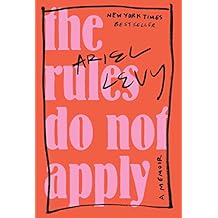
Future Sex: A New Kind of Free Love Hardcover – October 11, 2016 by Emily Witt ( Farrar, Straus and Giroux) The Rules Do Not Apply: A Memoir Hardcover – Deckle Edge, March 14, 2017 by Ariel Levy(Random House).;Female Chauvinist Pigs: Women and the Rise of Raunch Culture by Ariel Levy (FRee Press)

Product DetailsProduct Details

The New Yorker writer had a life that balanced domesticity with intellectual and sexual adventure. Then it fell apart

Ariel Levy’s new memoir begins with a description of disorientation. “For the first time I can remember, I cannot locate my competent self,” she writes. “In the last few months, I have lost my son, my spouse, and my house. Every morning I wake up and for a few seconds I’m disoriented, confused as to why I feel grief seeping into my body, and then I remember what has become of my life.” In the book that follows, Levy examines the choices that brought her to this point of collapse. Was she the agent of her own destruction? Did she ask too much of life?


‘All my friends had some nightmare experience trying to get pregnant. My story took the cake’
 Read more
The story of how Levy lost her son was first published in the New Yorker in 2013. A staff writer for the magazine, she had a miscarriage in a hotel room while on assignment in Ulaanbaatar, Mongolia, when she was 19 weeks pregnant. Her son was born alive, but did not survive; Levy held him in her hand as he died. She spent a night in the hospital, then returned home to New York with “a longing – ferocious, primal, limitless, crazed – for the only person I had ever made”.

The loss caused Levy to assess her life as a hubristic experiment gone awry. “I knew, as surely as I now knew that I wanted a child, that this change in fortune was my fault,” she writes. “I had boarded a plane out of vanity and selfishness, and the dark Mongolian sky had punished me.” A doctor assured Levy that it was not the flight that had caused the miscarriage, but a placental abruption, a rare condition possibly related to her age (she was 38). Still: “The future I thought I was meticulously crafting for years has disappeared, and with it have gone my ideas about the kind of life I’d imagined I was due.”

That life had balanced domesticity with the pursuit of intellectual and sexual adventure. By the age of 35, Levy was a homeowner with an organised linen closet and a writer at an elite magazine who travelled the world. She was married to a woman. She got pregnant via artificial insemination with a male friend, a co-parent who wanted “the love without the labour” of procreation. She had chosen her career as a writer for love instead of money, but felt comforted by the material wealth of her sperm donor, who was “not insignificantly” rich. As she put it, “I had managed to solve the Jane Austen problems that women have been confronting for centuries – securing a provider for your children, finding a mate to pass the time with, and creating a convivial home – in an entirely unconventional way.”

Anything seemed possible if you had ingenuity, money, and tenacity. But the body doesn’t play by those rules

Levy defied convention, and then her life fell apart. The title of this inquiry, The Rules Do Not Apply, refers to both the before and the after – a life lived in defiance of restrictions led to a crisis with no user manual. The cause-and-effect relationship that Levy superimposes on her tragedy is brutal in its self-recrimination. She sees the misfortunes that befell her as punishment for having lived a decadent life. As she phrases it, in one iteration: “Anything seemed possible if you had ingenuity, money, and tenacity. But the body doesn’t play by those rules.” In another: “Daring to think that the rules do not apply is the mark of a visionary. It’s also a symptom of narcissism.” And in another: “We want a mate who feels like family and a lover who is exotic, surprising. We want to be youthful adventurers and middle-aged mothers. We want intimacy and autonomy, safety and stimulation, reassurance and novelty, coziness and thrills. But we can’t have it all.”

The marriage collapsed after the miscarriage. Levy had fallen in love with her spouse, Lucy, when she was in her late 20s and Lucy in her early 40s. Having babies was postponed so Levy could focus on her writing. “The important thing was to be married, and that I had already accomplished on my own smug, non-traditional terms,” she says. The couple bought a house on Long Island where they planted beds of hydrangeas and tomatoes and cuddled with their cat. Then Levy had an affair with an ex-lover. The marriage survived, but with damage, until Lucy’s secret life as an alcoholic became an unavoidable fact. The house was collateral damage.

This book is so stark and succinct it can be read in one afternoon, and Levy’s honesty is blistering. The first publication of the account of her miscarriage shredded through the middlebrow nicety of the New Yorker house style like a tornado through a cornfield. The expansion here disappoints only when it veers into what the feminist author Rebecca Traister has described as the “don’t forget to have a baby” school of literature. The joke being: as if you could forget. It is when Levy chides herself and her friends for having waited to try to get pregnant that she loses some authority. “One day you are very young and then suddenly you are 35 and it is Time,” she writes. For now, at least in the US, the calculation to delay pregnancy for many women is more likely to come from an instinct of self-preservation than self-absorption.

The compassion Levy does not give to herself is left to the reader, who will feel it on her behalf – at the honest moments, when she describes how it feels to be sexually attracted to both men and women, or in the unexpected correspondence she takes up with the South African doctor who treated her in Mongolia. While a magazine article has to adopt a tone of authority, here Levy allows herself to revise impressions of the people she has profiled with room for doubt or admiration, and her own narrative is interspersed with stories of reporting on the South African runner Caster Semenya, the rightwing American politician Mike Huckabee and the leader of a gang of lesbian separatists named Lamar Van Dyke.

The book ends on a note of uncertainty: “For the first time in my life,” Levy concludes, “I have no plan.” It offers a sign of hope: she sought to live an original life within the conventional boundaries of feminine success (marriage, motherhood). In the end, against all her plans and wishes, conventional domesticity eluded her. It’s an unwanted freedom, but one suspects she will use it well.

•

Saturday, May 20, 2017

The Financial Diaries: How American Families Cope in a World of Uncertainty. Jonathan Morduch and Rachel Schneider. Princeton University Press. 2017.


Political and media attention on the increasingly precarious nature of work has been fuelled by the high profile, often controversial, growth of the ‘gig economy’. Insecurity, however, runs deeper than recent changes to the labour market. For many people, it is the volatility caused by the predictable challenges of everyday life, as well as the lack of a reliable paycheck, that makes it difficult to make ends meet.

In the twentieth century, researchers like Michael Harrington exposed the extent of extreme poverty in the US. In turn, they helped to build the intellectual foundations for policies that aimed to combat that poverty. Though the problem of extreme poverty is by no means consigned to history, an equivalent success for researchers in the twenty-first century might be to do the same for insecurity. Financial Diaries: How American Families Cope in a World of Uncertainty succeeds in shining a light on the extent and experience of volatile household finances in the US. Whether it helps to build the case for policies to target insecurity will depend on its reception.

The primary value of Jonathan Morduch and Rachel Schneider’s work lies in the uniqueness of the research. The book is based on diaries with 235 households, conducted in five states across the US: Ohio, Kentucky, California, Mississippi and New York. Building on research in low income communities, including by Morduch, the diaries recorded every transaction made by households over the course of 2012-13. The resulting 300,000 transactions give an unrivalled insight into the cash flows as well as the hidden rhythms, concerns and aspirations of people’s financial lives.

The structure of the book is clear. There are three main sections: the first describes how insecure US households have become; the second, how they cope; and the third sketches what that means for how we should think about poverty and what might be done about it. Section One contains the two most illuminating chapters.
Image Credit: Broken piggy bank (http://401kcalculator.org CC BY SA 2.0)

In the first chapter, the researchers focus on household earnings. Much of the content is familiar. The decline of manufacturing and trade unions, the shifting nature of work and the rise of contingent, or ‘gig’, labour are all cited as reasons for the growing volatility and insecurity of people’s incomes. The diaries allow the authors to dig below the surface and add colour to that picture. For every new statistic – nearly half of participant households had a gain or loss of income of 25 per cent or more from one year to the next – there is a detail no national survey could tell you. For instance, for one participant, Janice, a card dealer in Mississippi, a cause of income insecurity was the fact that in odd years – when Mississippi State’s football team plays two of its key fixtures away – she missed out on two good paychecks.

If the first chapter is rich but often familiar, in the second chapter – which focuses on spending – the unique contribution of the research is even clearer. Spending is the side of the household balance sheet that is often overlooked by researchers. Focusing, as in Chapter One, on one household, the researchers show how Sarah and Sam, while ostensibly middle-class with an income of $65,000, often struggle to make ends meet. The diaries allow the researchers to see why. Each time the researchers visit the family they have had another major expense: three car breakdowns, two graduations and a burst water pipe, to name a few.

Sarah and Sam’s experiences, like Janice’s in Chapter One, are not anomalies. On average, the research found that spending is almost as volatile as income. Typically, households had five months in the year where their spending was either 25 per cent above, or 25 per cent below, their average monthly spending for the year.

Three important arguments run throughout the book. The first is that insecurity and uncertainty do not just make it difficult for people to make ends meet; it often directly conflicts with aspirations of mobility. The diaries show both sides of the coin. One participant, Jeremy, a car mechanic, moved to a lower paid, but more stable job. In contrast, Sarah, who we meet in Chapter Two, continued to aim high by studying for a college degree instead of a full-time job. The consequence for Sarah and her family was sacrificing stability in the short term.

The authors are also carefully critical of the most common response to the type of challenges faced by the diaries’ households: namely, better budgeting. The assumptions made by too many financial education initiatives about how households live mean they are often irrelevant – focusing on long-term goals and the allocation of spare resources. Moreover, they often make moral judgements about the use of money: people who can’t manage their money use ‘debt’; those who can use ‘credit’.

When you step back from a spreadsheet, many ‘non-essentials’ look more like what one participant refers to as ‘really really needs’. What keeps people from building savings isn’t a ‘lack of awareness or a lack of discipline. Rather, it’s that the day they’re saving for isn’t very far away’ (96). In fact, the researchers found that while those who performed better on financial literacy tests were more likely to have lofty savings goals, they were only slightly more likely to actually have those savings. The reality of people’s lives, rather than their attitude or aspirations, had a more dramatic effect on their financial management.

The third, and most important, theme of the book is highlighting the commonality of uncertainty. The diaries’ households were deliberately diverse: 23 per cent were classified as poor and 26 per cent earned more than twice the poverty line. Yet, nearly a third of participants in the latter group spent at least one month below the poverty line. While the diaries’ participants were not nationally representative, statistics from the Federal Reserve, the University of Michigan’s Panel Study of Income Dynamics and from the JP Morgan Chase Institute’s analysis of Chase accounts are used throughout to corroborate Morduch and Schneider’s findings. Volatility is both widespread and getting worse.

For many, the long arc of the lifecycle theory of saving simply does not reflect the reality of their experiences. The causes of their insecurity are ‘not infrequent disruptions to basic steady income […] the base condition is unsteady’ (34). Deviations from that arc are not noise: instead, ‘the noise is the story’ (11).

On that final point, the book could be more explicit. In the introduction, uncertainty is described as a form of ‘hidden inequality’. There are two weaknesses to that framing. First, it aligns the challenge of volatility and uncertainty with an often intractable political debate. That is likely to trigger instinctive rejection by some policymakers. Second, as a social problem, inequality is more abstract and less relatable. Unlike inequality, financial uncertainty is tangibly experienced across income groups and, as the diaries demonstrate, the impact on people’s lives is stark. It is the commonality of the uncertainty exposed in Financial Diaries that provides the strongest case that a new policy agenda to tackle insecurity is needed.

Wednesday, May 17, 2017

HOW THE LIBRARY (NOT THE PRINCE) SAVED RAPUNZEL by Wendy Meddour, illustrated by Rebecca Ashdown Age Range: 5 - 8 (Frances Lincoln)


Take a popular fairy tale, modernize it and make the princess a sassy lass who refuses to let her hair down, and you have a nifty fairy-tale twist with a library message.

“On the sixteenth floor of a tall tower block / sat Rapunzel, quite idle, whilst growing her locks.” The milkman calls up, “The lift is not working, the stairs are too steep / my asthma is bad and my heart is too weak.” But Rapunzel refuses to let down her hair for him or the postman, the baker, her aunt and even the prince! She just sits passively, so each visitor goes away. Worried that they are neglecting her due to their reluctance to climb 15 flights of stairs, the troupe gathers together and soldiers up to the 16th floor to cook Rapunzel supper and deliver a letter. “Rapunzel leapt up and shouted with glee: / ‘I’ve got a new job at the library!’ ” So begins her love affair with library books and the discovery that “there’s more to life than growing your hair!” (The question of how she gathered the wherewithal to apply for the job is not addressed.) The bouncy illustrations match the whimsy. Rapunzel’s hair is wildly curly and red; the prince arrives on a scooter wearing a helmet, black goatee and shades; the cast is multiethnic. The rhymes give lilt to the tale. (Two British terms, “lift” and “spanner,” are used for elevator and wrench, but this doesn’t get in the way of the fun.)

There’s plenty of hair flair and fun, if not quite so much logic. (Picture book. 5-8)

Tuesday, May 16, 2017

Crimes Unspoken: The Rape of German Women at the End of the Second World War. Miriam Gebhardt. Polity. 2016.


Miriam Gebhardt opens Crimes Unspoken: The Rape of German Women at the End of the Second World War by asking a critical question: is there anything new to say about the topic at hand? Historical studies have told us that over two million women were raped by Soviet troops when the Red Army liberated Berlin in 1945, and some pedantry about numbers aside, it is certainly true that many thousands of women were assaulted by these occupying forces. However, Gebhardt argues that we must reframe our prejudices when confronting the topic, which has hitherto offered a dubious platform for moralists (i.e. ‘the Germans got what they deserved’) and nationalists (i.e. ‘the Russians were entirely to blame’).

Critics of attempts to bring the rape of German women by Allied forces into wider discussions of World War II have argued that by recognising the sexual violence, the impact of German aggression during the war is minimised and the horrors of the Holocaust relativised. However, Gebhardt argues that a fundamental motivation behind her research is the fact that many women who were raped in this period between 1945 and 1955 were never formally recognised as victims. This issue is particularly pressing in light of the fact that many of the women are now either dead or reaching the end of their lives. Women raped by Soviet troops, the author argues, were at least afforded some recognition as victims, even if this victimhood was often manipulated to serve ideological ends.

The two main existing accounts of wartime sexual violence in occupied Germany are A Woman in Berlin by Anonymous and feminist filmmaker Helke Sander’s 1992 documentary, BeFreier und BeFreite (Liberators Take Liberties), in which she interviewed women raped by Soviet troops. Sander also released an edited volume with Barbara Johr as a companion to her documentary, BeFreier und BeFreite: Krieg, Vergewaltigungen, Kinder (Liberators Take Liberties: War, Rapes, Children). These are valuable historical accounts, but Gebhardt argues that they have in part helped to reinforce the notion that Soviet soldiers were the sole perpetrators of rape during this time. Crimes Unspoken aims to unpack these misconceptions and generalisations, and uncovers the degree to which women found themselves further victimised by unsympathetic doctors, social workers and legal authorities. Whilst Crimes Unspoken cannot offer a complete overview of events after World War II, it takes an in-depth look into individual cases and their consequences.
Image Credit: US Inf.-Div. in Nürnberg, 20 April 1945 (Wikipedia Public Domain)

Crimes Unspoken is comprised of five principal chapters; due to length, this review can only discuss two of these in depth. Chapter One, ‘Seventy Years Too Late’, provides readers with vital insight into Gebhardt’s methodological approach, and Chapter Three, ‘South Germany—Who Will Protect Us From the Americans?’, presents us with a case study of the unimaginable violence faced by German women at the hands of US troops.

In Chapter One, Gebhardt argues that we can get a more accurate idea of the occurrence of rapes by looking at the number of ‘occupation children’: i.e. children fathered by Allied troops. Using figures from the Federal Statistics Office (1956), she combines two approaches: one is based on the assumption that around five per cent of occupation children were fathered through rape. The other is based on the estimate that one in ten rapes ended in pregnancy. There is plenty of scope for error, concedes the author, but she estimates that 68,000 occupation children were born to German women between 1945 and 1955: 55 per cent were fathered by Americans, 15 per cent by the French; 13 per cent by the British; 5 per cent by Soviets; 3 per cent by Belgians; and 10 per cent by other nationalities. According to the mothers themselves, 3,200 of these children were the result of rape; the figures compiled by the American Provost Marshal adds 1,100 children to the total. Thus, Gebhardt calculates the total as 4,300 ‘rape children’: five per cent. The author’s estimate of the total rape victims— 860,000 — is by her own admission on the low side, but it presents an analytical challenge to the standard figure of two million rapes purported to have been committed by Soviet troops, according to the calculations of Sander and demographer Gerhard Reichling in the aforementioned collection, BeFreier und BeFreite.

Men were also victims of rape, but they are absent from Gebhardt’s calculations because of the lack of data available. Male rape was often downplayed or was reinterpreted by the victims themselves in order to avoid social stigma. Both boys and adult men were victims. For example, the State Ministry of the Interior notes that on 19 June 1946, two GIs forced two boys to perform oral sex. A document in the Freiburg State Archives notes the case of W.H, who was raped by a Moroccan soldier in 1945. The case only came to light fifteen years after the event when W.H made a claim for compensation subsequently denied by the German authorities because of a lack of evidence, despite W.H having contracted ‘third degree syphilis’ from the attack.

Research into the topic began too late for oral histories, writes Gebhardt: the interview method would reopen old wounds for the small number of living survivors. There are few official records of rape during the period in question as the Germans had absolutely no leverage when it came to taking legal action against occupying forces. Thus Gebhardt recognises that the archival sources that do exist need to be treated with care: personal testimonies were often written to seek ‘exoneration’ from accusations of ‘fraternisation’ and constructed so as to have the best possible chance of being appropriately considered by authorities, particularly when applying for compensation. Gebhardt acknowledges she has come under some criticism for basing her calculations on the reports of victims themselves. Yet, this is reflective of the patriarchal notion that the testimony of rape victims should automatically be doubted in principle, she argues, and further disrespects victims.

When US troops took Munich on 30 April 1945, the widely held conviction was that they would be well-behaved and considerate towards German civilians. In Chapter Three, the author notes that this impression quickly evaporated: the arrival of US soldiers in Upper Bavaria was accompanied at first by widespread looting and destruction, and then rape. According to the Military Prosecutor General, German women were more frequently injured, beaten unconscious, abused more frequently in front of husbands or relatives and more frequently penetrated orally or anally by GIs than by the British or French. Such acts were met with only a moderate degree of indignation, particularly by ecclesiastical authorities. Jakob Engl of Obertaufkirchen wrote: ‘women and girls were also raped. Unfortunately the girls themselves were to blame in some cases […] they […] smiled at blacks and begged for chocolate until the calamity occurred.’ There was also a racialised response to allegations of rape: black GIs faced punishment from their superiors far more often than white peers who had committed the same crime. Ludwig Axenbück, a pastor from Schönau parish, wrote that after ‘carousing’ with GIs, an evacuated woman was run over by her attackers, leaving her with a pelvis fractured in five places, but at no point seems to consider the notion that the victim was entirely blameless for the attack. There was little sympathy for raped women, particularly those who had interacted with US troops in some, often insignificant, way.

US Lieutenant General Edwin Lee Clarke responded to reports of rape by stating that: ‘German women are creating a feeling of great insecurity among our soldiers by untrue charges of rape and that these tactics might be part of a German plan.’ After launching an investigation, Lee Clarke refuted this statement; however, physical resistance by victims was the ultimate yardstick by which he measured the legitimacy of rape allegations. The rapes committed by GIs were arguably a demonstration of power directed against a civilian population that had put up an ‘unexpectedly fierce’ resistance to the advance of US forces, particularly in the Battle of Moosburg. However, Gebhardt notes that we should try not to compartmentalise these events as some kind of gendered ‘higher-level battle of the sexes’: it is important to recognise the intersections of societal, ethnic, racial, religious and other differences as important categories.

Crimes Unspoken presents a compelling insight into a little explored topic, and deserves a place in wider narratives surrounding World War II. Gebhardt wryly notes that historians speak neatly of ‘a gap in the research’ when little evidence is found about a topic. However, demands for accountability are not justification enough for the author: there are more important reasons for embarking on such a project, the main one being the demand for fair treatment. The ultimate goal of Crimes Unspoken is giving victims the recognition they deserve.

Saturday, May 13, 2017

Grandad's Island by Benji Davies ( Candlewick Press and Simon & Schuster Children's UK)


In this gentle, magic-tinged allegory, Grandad lives in a small house back behind Syd's home. After opening a "big metal door" in Grandad's attic, the two are transported to the deck of a giant ocean liner, which towers over the neighboring buildings in their seaside town...As with The Storm Whale, Davies offers a story of loneliness and togetherness distinguished by understated, deeply felt emotions and a nautical milieu.

This book is innovative and useful as a way to talk about the idea of loss without ever referring to actual death. Parents and educators can use this to talk with a child about how it s normal to be sad and miss loved ones...Cheerful, brightly colored illustrations make this a fine choice to use with the youngest of audiences. Since death isn t directly specified, this title also works for when a child s loved one is moving far away. An excellent vehicle to gently approach the topic of loss. Recommended for collections needing these types of materials.
Syd has a very close relationship with his Grandad, whose house and garden back onto his own. On one of his regular visits, he finds Grandad in the attic. Grandad appears to be ready to make a journey and the pair set out on a voyage, entering onto the deck of a ship by passing through a large metal door that Syd has never noticed before. They spend a wonderful time together on a beautiful tropical island before Grandad reveals that he will be staying there and Syd has to make the journey home alone. A sensitive story about the loss of a loved one which is moving and uplifting at the same time. The illustrations make it unnecessary for the words to be explicit about what may be reality and what may be imagination. This is left to reader who can infer information from such detail as the depiction of Grandad’s belongings and mood from the brightness and colour of the island and the sombre shades of the rough sea which Syd must traverse to arrive home.

The Classical Cookbook Front Cover Andrew Dalby, Sally Grainger Getty Publications, - Cooking - 144 pages;Food in the Ancient World from A to Z Front Cover Andrew Dalby Routledge, - History - 432 pages; Empire of Pleasures: Luxury and Indulgence in the Roman World Front Cover Andrew Dalby Psychology Press, Literary Criticism - 335 pages


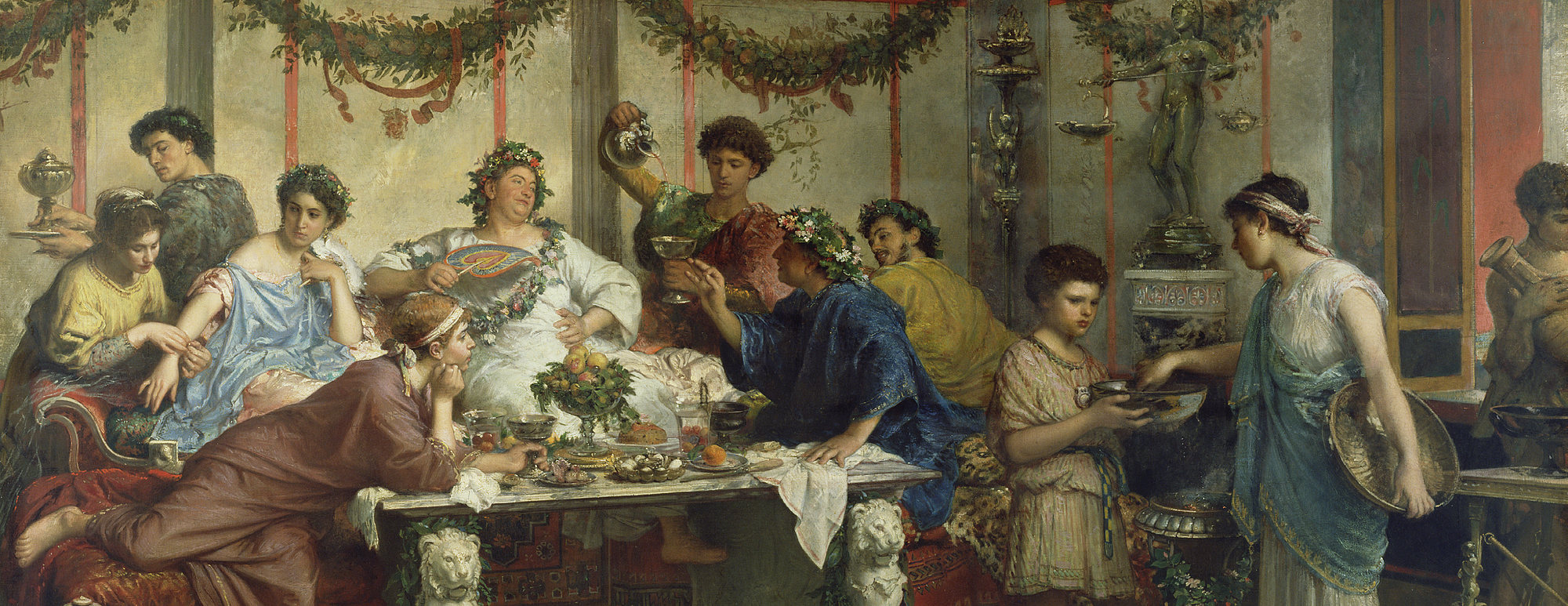
Roberto Bompiani, “A Roman Feast” (c. 1887)
To Make White Wine Out of Red Wine (Vinum ex atro candidum facies)
Put bean meal or three egg-whites into the flask and stir for a very long time. The next day the wine will be white. The white ashes of vine have the same effect
—Apicius 5 (Tr. Flower and Rosebaum)

Such is the kind of “recipe” that one finds in the Roman cookbook attributed to Apicius. So when world-renowned chef Grant Achatz announced that the 2017 menu for his restaurant Next would include “Ancient Rome” — inspired by executive chef Jenner Tomaska’s presenting him with a copy of Apicius — foodies were naturally intrigued. Although translations have been adapted for use for amateur chefs, it’s difficult to imagine what a progressive restaurant known for molecular gastronomy might do with such source material. Next had already garnered rave reviews at their opening in 2011 with their first foray into historical cooking, “Paris 1906,” so it seemed critical for any good classicist worth their salt (insert salary joke here) to get there and roll the proverbial dice.

Would the restaurant tap into the over-the-top decadence we associate with a Roman banquet? Grapes fed by toga-clad waiters, perhaps? Or, as per Life of Brian: lark’s tongues, jaguar’s earlobes, wolf’s nipple chips? The most familiar literary source of such a Roman meal, the Cena Trimalchionis in Petronius’Satyricon doesn’t quite whet the appetite. Trimalchio’s clumsy, over-the-top nonsense does not provide a clear idea of what might be served at a decent table where one might actually want to dine. The promotional video that Achatz posted suggested we might be getting some sword-and-sandal type fun, but said little about what we would actually eat.

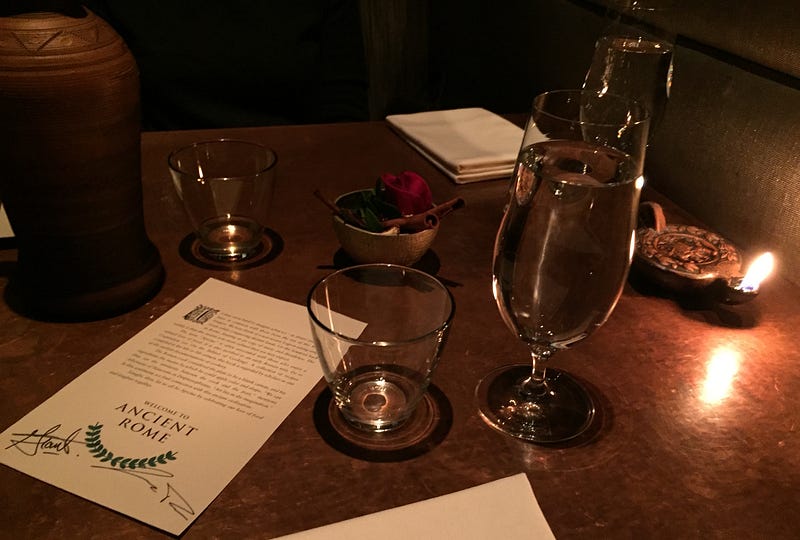
When we parted the black veil to access the restaurant’s tiny foyer, we were greeted by a bust of Augustus, reminiscent of the kitsch of Caesar’s Palace in Vegas. But only tasteful touches followed: the table was set with a clay pitcher of enigmatic liquid, a small working Roman oil lamp, a theatrically-aged copy of The Roman Cookery Book (a translation of Apicius by Barbara Flower and Elizabeth Rosenbaum) and a printed menu card. Each menu item was keyed to the recipe in Apicius, which made Classicists familiar with numerical references to, say, comic fragments, feel right at home. The menu’s descriptions consisted of a short reference to an Apicius dish in Latin followed by a corresponding list of ingredients in English used in the modern adaptation (e.g., “cuminatum in ostrea et conchylia ([Apicius] 30) // kamut pancake, oyster, pomengranate”). We were therefore immediately able to consult our text of Apicius for the fuller information on our first dish, vinum ex atro candidum facies, cited above.

A Roman mensa. All photos by Laura Gawlinski
Served as a mead-based savory cocktail, it set the dramatic stage for the rest of the evening and exemplified the methodology behind the modernization of the ancient recipes. This drink went through a series of colorful chemical changes as various ingredients like egg whites were added, all while the server provided a brief introduction to alchemy’s relationship to antiquity and bartending: “Don’t watch me, watch the vessel,” she warned, as she performed her magic. It immediately brought to mind the visual tricks of Roman dining, such as is found in the Lycurgus Cup, a large, glass drinking vessel of the 4th century CE now in the possession of the British Museum. The glasswork changes color from red to green depending on the direction of the light shining through it. The drink itself was unusual, the key ingredient oddly being cabbage juice — Cato would have definitely been a fan, even if not everyone at our table was.

All told, we had eighteen separate dishes, several appearing with some overlap, paired with eight different wines (all from locales familiar to the ancient Romans). Each course arrived with an artistic flourish and an explanation via a local server (standing in for the amiable dinner companions of Petronius’ Encolpius). The food was very, very good — even decadent at parts — but the spectacle, by Jove, the spectacle!

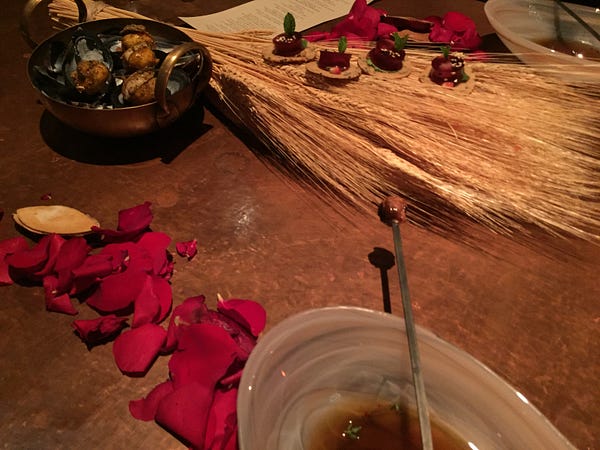
clockwise from left: mussels, kamut pancake served on wheat sheaf, meat sword with broth, patina among rose petals

The fifth course, patinam de rosis (“a patina from roses”) had the most Petronian flourish. There are many different recipes in Apicius for something called a patina; it seems to have been a frittata or quiche of sorts, a mix of ingredients baked all together. In our case, a mix of mashed asparagus flavored with rosemary had been molded into a rough leaf shape. Although it might appear to be no more than a delicious cracker, an unusual floral ingredient transformed it into an experience. A server arrived bearing glass jars filled with rose petals. With a flourish, she spread the contents out in a line in front of each diner: resting softly amongst the petals were two bites of patina. Perhaps Trimalchio would have done something far more crass, but even he would have applauded this spectacle.

This was followed by what was one of the tastiest dishes in the feast, although it was only a mere bite or two. Aliter tubera: elixas et aspero sale (“another method of truffles: boiled and sprinkled with salt”) was served alongside gustum de betacios et pullus (“a taste of beetroot and chicken”). The black truffle part of this course (tubera) was wrapped with a piece of chicken skin and served on the end of a small metal sword. This came to us balanced over an opaque white bowl into which was poured the gustum, a broth heavily flavored with roasted beets and honey. We swirled the chicken piece in the broth before eating, and then slurped the flavored broth afterward, directly from the bowl.

Presentation continued to matched taste. The next dish, pisam coques (“cooked peas”), was conceptualized as a visual and culinary representation of the ocean. On a spread of whipped mascarpone cheese (representing the sea foam) lay a small piece of mackerel topped with a bit of caviar. Cresting above it, representing the waves, was a fried piece of enoki mushroom. It was light, salty, and not too fishy, a postmodern deconstructed bagel with cream cheese and lox (hold the bagel). Luckily, at this point the pretense of Roman forklessness was dropped, and we were able to enjoy this ocean without making a mess. The cutlery also served to mark the shift from appetizers to main courses and a progression to heavier and meatier foods: fish, then bird, then various meats.

Oceanic wavy blue glass plate and whipped mascarpone
At this point we began to confront our expectations more directly. The briny taste of the “ocean” course highlighted the fact that we had not seen, heard about, or tasted garum, the fish sauce ubiquitous in Roman cooking, or its counterpart, liquamen. Liquamen was regularly listed among the ingredients in Apicius’ version of any given recipe, but we could not tell whether it was included in any of the re-imaginings. However, in cooking with anchovies—a key ingredient for making modern garum—modern chefs can discover much hidden flavor to a dish, so perhaps it was indeed everywhere, just not announced.

We were also surprised by the lack of pork. Pork was so significant to the meat portion of the Roman diet that pork consumption can be linked archaeologically with Roman identity. Larger group tables at Next were able to pay more for the option of a suckling pig: in this case, it was reserved for the highest class and we, dining as mere plebians, were not permitted parity of porkiness.

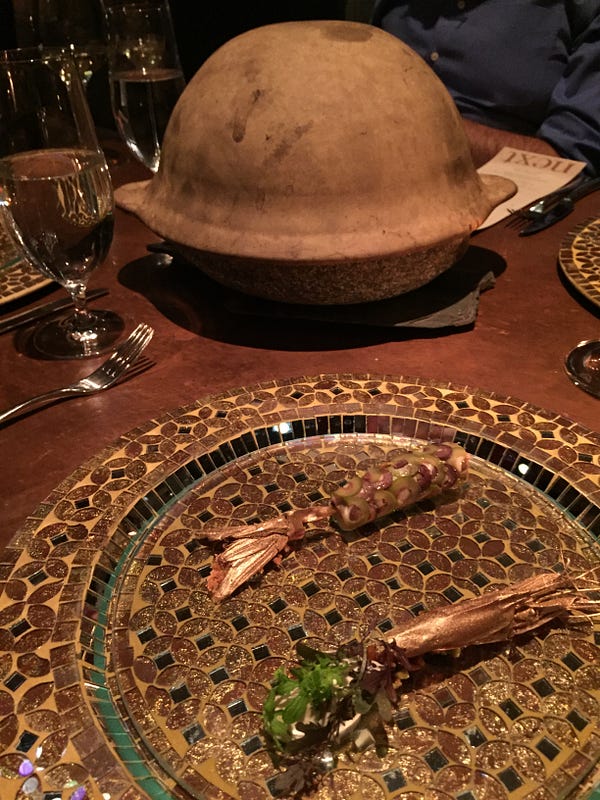
Furthermore, while we were pleased with the unimposing decor devoid of cheesiness, the minimalist, grey-walled room did not quite fit with the rest of the Roman experience. The non-obtrusive scenery functioned to turn the diners’ focus exclusively onto the food at the table — which made this food, along with its plating and cutlery, the sole decorative art and conversational centerpiece. There would be no distractions from the mosaic plates, salads on monocles, or gold-plated crustaceans. Achatz had curated these accouterments like a Roman emperor, flitting through the provinces gathering a variety of marbles. For the ancients, however, not only was the tableware for show, but the whole space. An extreme example comes from Tiberius’ villa at Sperlonga where a large cave was outfitted for outdoor dining. The decoration included multiple over-life-size sculptural groups — including, most appropriately for a cave, Odysseus preparing to blind the cyclops Polyphemus. None of these diversions at the palace of Achatz.

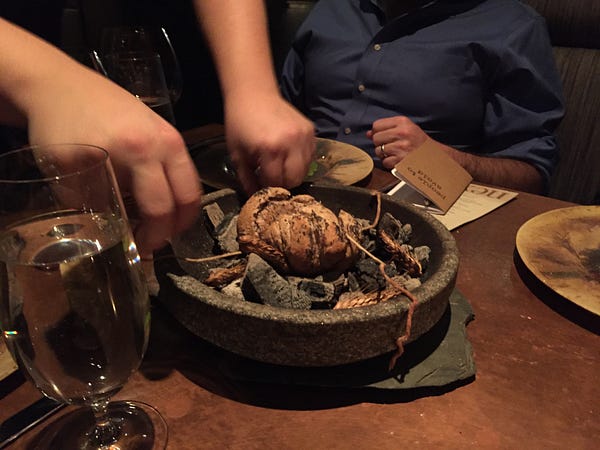
Our next course provides the perfect example of how the food itself made the setting. The servers brought out a large stone dish filled with smoldering pieces of wood, setting it on a raw chunk of slate. As it was set down, a lump of raw dough coated with poppy seeds, tied up in a piece of cord, was brought along and dropped in the middle of the dish. This, we were told, was a personalized miniature oven and the bread would be baked by what our server dubbed — with all the self-consciousness of a good Plautine servus callidus sharing a witticism — charmelization, the cooking of the dough over the charred wood. The server also informed us that this was how Roman soldiers took their bread on-the-go, but for us, the real Romanitas was in the active participation in the process and the performative presentation.

The segmenting of the bread

The platter was then covered again with the lid, and we moved on to other courses while smelling the baking bread. The suspense, as we wondered what would appear once the lid was removed, added its own spice to the next few courses. When the oven was finally opened, the bread was revealed, beautifully baked. By pulling on the string tying it together, the bread magically collapsed into quarters. Our server explained that because the Romans did not use butter, he would top our bread with a liquified beef fat. This bread, for sure, was both panem and circusem.

Prawns of gold and olive, bread baking in background

One of the dishes theatrically served as we waited for the bread was the maritime isicia de scillis vel de cammaris amplis (“Rissoles of squid or large prawn”). What we actually ate was a prawn, but it was surrounded by an armored suit of sliced olives — shockingly the only recognizable appearance of olives throughout the evening. The real prawn shell had been removed whole and put to the side, decadently painted with real gold.

Our final meat dish contained the most impressive display of the mains. The food itself was oxtail, based on sales conditos ad multa (“aromatic salt used for many purposes”), but the visual focus was the salt of the title. The oxtail was served pot-roast style in a small glass bowl mixed with pieces of turnip and some fried pieces of horseradish for extra flavor. This glass bowl rested in the middle of a much larger copper bowl richly filled with aromatic salt (salt with cloves, anise seeds and other spices). Lining the back of the bowl were smoldering cinnamon sticks, driven into the salt like stakes protecting the Greek navy positioned in the sand of Troy. Between the smell of the spices and the tactile pleasure of the salt (no one could keep themselves from running their fingers through it), we were reminded how much a good meal appeals to all the senses.

sales conditos ad multa

The final dishes were desserts, accompanied by a last, very sweet wine from the Canary Islands. The penultimate course, gustum de praecoquis (“stew of apricots”), we now remember very fuzzily, as an Aristodemus-like haze from the wine and food had set in (our notes from the evening at this point merely say, “Where’s my cheesecake?”). The meal then satisfied the saying, ab ovo usque ad mala: having begun with an egg, emulsified into the magical first drink, it ended with an apple. Not quite an apple, though: that “apple” in the final, towering fruit basket was but a final illusion. Pulling out slices we found not fruit but a delightful candy-shelled ice cream. Alongside it, a final, memorable taste, donum felix (“happy gift”), a piece of taffy fittingly made of mastic, the tree sap that comes from the island of Chios, birthplace of Homer.

When asked about the historically-based Paris menu in the NY Times, Achatz had mused that it’s better for a good restaurant to choose the replication of a philosophy over the replication of a recipe. His Roman meal at Next might not have been exactly what Apicius had in mind, but the philosophy and aesthetic were solidly Roman. Thumbs up!

Democracy A Life Paul Cartledge (OXford University Press)


Democracy When?
A review of Paul Cartledge’s Democracy: A Life


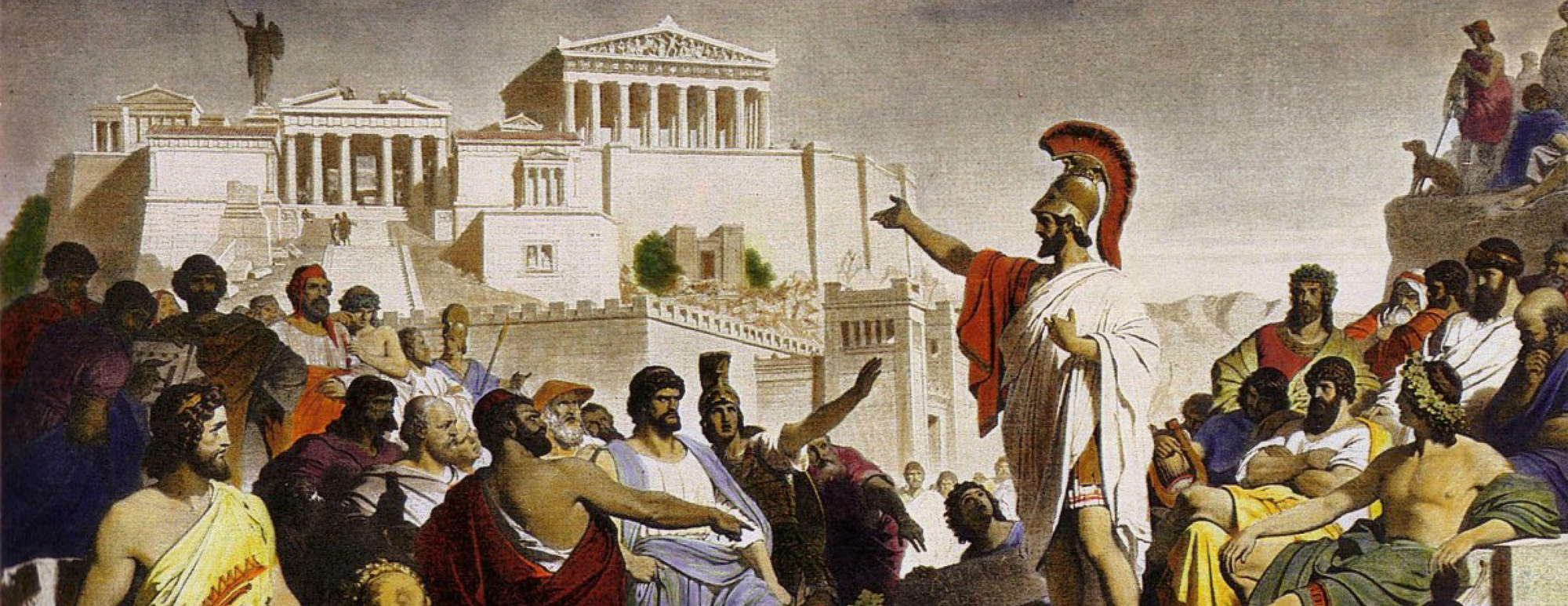
Philipp Foltz, “Pericles’ Funeral Oration” (c. 1877)


The following is from the “background” section of a lesson plan for a unit called “Greece: the Foundation of the Modern World,” directed at gifted and talented sixth-graders in New York City public schools:
Modern democratic nations owe their fundamental political principles to ancient Greece, where democracy originated. Because of the enduring influence of its ideas, ancient Greece is known as the cradle of western civilization. In fact, Greeks invented the idea of the West as a distinct region; it was where they lived, west of the powerful civilizations of Egypt, Babylonia, and Phoenicia.

Nowadays we are taught from a young age that democracy is the (only) right, civilized political system. It is a pillar of the West’s imagined collective identity; the NATO charter claims it as the glue that binds North America and Europe together. In antiquity even influential Athenians doubted the prudence and effectiveness of democracy, but today mainstream modern debates in the United States and Europe don’t tend to engage with questions of how we might remix our national constitutions with bigger helpings of oligarchic or monarchic power structures.

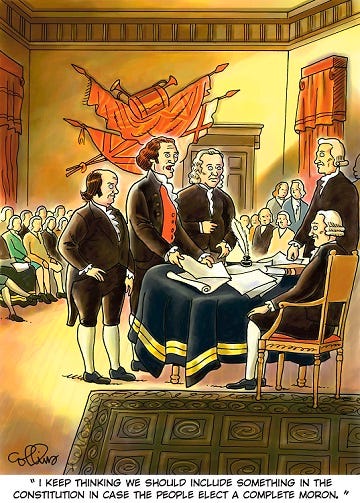
Cartoon by Dan Collins, licensed by CartoonStock.com

Yet, even in countries that pride themselves on strong democratic traditions, democracy seems to be failing — or at least, we the people are failing it. This circus of a U.S. election season is a case in point. Hillary Clinton’s (apparently) successful bid to become the Democratic Party’s (presumptive) nominee was clinched by the promises of 718 unelected superdelegates. But the anti-democratic primary system is nothing compared to the Electoral College, which in 2000 handed the presidency to George W. Bush despite Al Gore’s popular win — by over a half of a million votes.

In Europe things are in a bigger knot, since problems of popular democracy are there interwoven with struggles to strike a balance between true union and national sovereignty. Take the case of Greece: last June, Prime Minister Alexis Tsipras announced that he would put the question of continued austerity measures to the people by referendum (the “Greek Bailout Referendum”). In an address to Greek Parliament, he predictably tied this radical act of democracy to the legacy of ancient Athenian dēmokratia, just as George Papandreou did when he proposed, but then withdrew, a similar referendum in 2011. On July 5, 2015, more than 61% of the Greek voters who turned out to vote in the Bailout Referendum cast a “no” vote to end austerity. But just eight days later, in wholesale rejection of the people’s will, Alexis Tsipras’ Syriza-led government shamefacedly accepted a new financial bailout with even harsher austerity measures attached. “People power” indeed.

Now another referendum is marking an attempt to reclaim democracy, even if it means knocking the wind out of the entire EU project. This Thursday, the people of Great Britain and Northern Ireland will vote on whether the United Kingdom should “Remain a member of the European Union” or “Leave the European Union” (sample ballot here). Like the Greek Bailout Referendum, the “Brexit” Referendum looks to true democracy — one person, one vote — in part from larger worries over the slow decay of true democracy in the labyrinth of EU administration, where power often seems less “to the people” than in the hands of unelected, and ultimately unaccountable, technocrats in Brussels.

The common question today is not whether democracy is the best kind of political system. Whatever decisions may be brokered in smoke-filled rooms (or simply behind the closed-doors of Eurogroup meetings, TTIP negotiations, and so on), in the mainstream conversation democracy’s theoretical virtue is unquestionable. So, unlike Polybius or Plato, what we are debating is why our societies aren’t really as democratic as we want or imagine them to be.

In his timely and eloquent book, Paul Cartledge goes a little bit further. He begins from the premise that, at least by ancient Greek standards, we’re not really living in democracies at all.

Taken alone, the conclusion is hardly a mic drop. The bibliography on democracy and “what’s gone wrong” with it is enormous, and has ballooned even more as a result of the euro crisis. Roslyn Fuller’s Beasts and Gods: How Democracy Changes Its Meaning and Lost Its Purpose is just one example of another recent contribution arguing that our own concept of democracy bears more resemblance to oligarchy than to the radical democracy of fifth- and fourth-century Athens (Cartledge is more explicit on this point in an article for The Conversation than he is in his book). At the root of both books is a fundamental valorization of ancient Greek democracy (or democracies) as something better — something more fundamentally democratic — than any major system of governance going today.


Cartledge’s Democracy: A Life unfolds in five “acts.” Over the first three, he describes and accounts for the emergence of dēmokratia, “People Power,” in the ancient Greek world. He follows this thread to the beginning of democracy’s end, heralded by the Macedonian conquest of Athens in 322 BCE. For him, Greek democracy’s true hallmarks went beyond franchise of the full (male, free) citizen body: in its purest form, a dēmokratia was direct (not representative) and filled offices (archonships, jury roles, etc.) by sortition. It also exhibited high rates of citizen-participation, had structures in place to ensure full franchise for the poor and unpropertied, and openly committed itself to anti-tyrant ideology (constructed and performed in classical Athens by oaths, ostracisms, and so on). Measured by these yardsticks alone, today’s liberal democracies might be a far cry from ancient dēmokratia. On other very important counts, though, we moderns squarely defeat the ancients: women can vote and slavery is illegal. Those differences deserve more than cursory acknowledgement whenever the temptation arises to set the democratic bar in classical Athens.

The rich and expertly-told story of Greek democracy’s emergence, wax, and wane accounts for about two-thirds of Cartledge’s book. Naturally, given the evidence, it is heavily weighted towards the case of Athens, though Cartledge also chronicles the explosion of democracy in the mid-fourth century BCE and carefully documents the existence of democracy in other corners of the ancient Greek world. The historical existence of those other democracies (even if in some cases imposed by Athens) is essential to his premise that the emergence and success of dēmokratia was owed to a unique and wider ancient Greek spirit. The discussion here is so absorbing that one almost forgets that Greek poleis with democratic constitutions were always a minority.

In the second main part of the book, Cartledge accounts for the death of classical-era dēmokratia. He rapidly traces its last Greek gasps in the Hellenistic Period, a transitional era that “provides much scope for interpretative confusion” (244). Over this batch of brief chapters (the last is just six pages, but covers “Late Antiquity, the European Middle Ages, and the Renaissance”), he traces democracy’s steady decay, beginning in Republican Rome. This narrative is unabashedly one of cultural decline: the discussion of Justinian’s reign is capped with the slogan Sic transit gloria mundi antiqui and no hesitation hedges such phrases as “mediaeval twilight.”

It was only, so this story goes, in seventeenth-century England that “After a long sleep, democracy — as an idea, and in name, but not yet substance — began to reawaken” (283). The last major section briefly considers landmark attempts to revive, or at least debate the merits of reviving, ancient Greek democracy: in the United States, France, and Britain. The usual suspects are here — Rousseau, Voltaire, Paine, Jefferson, Madison, Tocqueville, Burke, and Mill — but the rehearsal of their names and roles is quick, sometimes edging on dutiful. Thus by the end of the book, the early marvelous torrent — of ideas, evidence, and arguments — has subsided into a trickle.

Inevitably, a title such as Democracy: A Life promises more than it can deliver (the name of the Cambridge undergraduate lecture course that inspired the book, “Ancient Greek Democracy — and its Legacies,” would be a more accurate, if less marketable, descriptor). What this book really traces is the filiation of Athenian dēmokratia from its prehistory in Greece through dips, dives, and near-disappearance up to its re-theorization in the United States, Britain, and France in the late eighteenth and early nineteenth centuries. Cartledge is not interested in the history of “democracy” in today’s loose sense of the term, but rather in how post-classical thinkers were influenced by ancient Greek democracy, especially when they set about framing new constitutions.

Despite this smaller-than-promised actual scope, this book makes a clear contribution to our panoramic understanding of ancient Greek democracy. It’s also a hugely valuable synthesis and an enjoyable read. Much of the argumentation — particularly on points of ancient Greek politics — is careful, compelling, and measured. The prose throughout is elegant, never patronizing. We are invited to step into Cartledge’s thought world and he is a gracious host throughout the visit. Yet he also knows and even hoped that the book will be provocative; on this count, too, (at least for this reader) he succeeds.


Democracy: A Life is one-sided in its celebration of a Greek miracle. In this sense it complements Josiah Ober’s 2015 Rise and Fall of Classical Greece. Both authors credit their conclusions to the vast data set compiled by Mogen Herman Hanson’s Copenhagen Polis Centre (in a brief chronology at the front of the book, Cartledge lists the publication of An Inventory of Archaic and Classical Poleis as a “post-antique landmark” — effectively putting it on par with the American Declaration of Independence and the outbreak of the French Revolution). This rosy view of Greek — but let’s be serious, Athenian — democracy has had its challengers, even among classicists. You would barely know it, though, from the story that is told here.

In What’s Wrong with Democracy? From Athenian Practice to American Worship, for example, Loren J. Samons argued that Athens’ dark imperial underbelly was directly related to its democracy, where the assembly and court system handed down decisions that were neither just nor expedient. In a sense that book, too, marked a case of a classical scholar taking what was once a kind of received wisdom (Athenian democracy devolved into a kind of tyranny and brought about its own undoing), tweaking the framework, updating the evidence, and repackaging it as a radical new intervention.

But still, I would have liked to hear Cartledge engage with an Athenosceptic view. How would he answer the allegation that democracy was the apparatus of an evil empire? He roundly presents ancient Greek democracy as good, admirable, and successful, but what are the metrics and criteria for this appraisal? Last month Bernie Sanders told the Associated Press that “Democracy is messy…Democracy is not always nice and quiet and gentle.” What did the mean and loud and rough side of Greek dēmokratia — in terms of both political process and outcomes — look like?

I also wondered how Cartledge might answer his Cambridge colleague Robin Osborne, who has written that “Athenian democracy depended crucially on the homogeneity of the citizen population, a homogeneity which was consciously cultivated — and cultivated at the expense of individual freedom.” The liberal democracy that underpins so-called Western values today is premised on a suite of individual rights articulated by the Enlightenment. So if today we celebrate democracy’s ability to engender diversity and plurality, how do we understand the Athenians’ (to us paradoxical) commitment to democratically-structured sameness, but sameness all the same?

I don’t mean to argue that Cartledge need have engaged directly with Samons or Osborne, but rather to highlight how much I wished to hear him deal — as he would, no doubt, deftly have done — with criticisms of the Athenian political system and with those aspects of it that are best left to history.

Likewise with the delicate question of slavery: I believe that Cartledge should have addressed the issue head on and at greater length, and not (only) because classicists haven’t yet collectively worked out how to confront this ancient reality. In his chapter on the American Revolution, he makes the important point that democracy’s eighteenth-century American reboot took place in what Moses Finley called a “slave society” (and not “a society with slaves”). Here, though not in the earlier chapters on antiquity, Cartledge comments that “ancient (chattel) slavery and ancient Greek democracy could be said to be joined at the hip” (296). Why? How? This is a relevant matter of real historical importance to the story of democracy’s “life.”

In his La démocratie contre les experts. Les esclaves publics en Grèce ancienne(2015), for example, Paulin Ismard has now explained at length how the day-to-day operation of the Athenian democracy was left almost entirely in the hands of public slaves. How would Cartledge account for the relationship between the emergence of Greek dēmokratia and the institution of slavery, if he were to address the question as assiduously as he critiques Polybius? I know, more or less, the Cartledge line on democracy’s Greekness and greatness, so it would have been interesting to see him get down in the muck.

But perhaps he thought that a warts-and-all approach to ancient Greek democracy would undermine his agenda. Particularly at the beginning of the book, he takes a tone of frank speech — of political-correctness-be-damned kind of honesty. In an article in Oxford Today, he even explained that a “subsidiary” goal of his book was “to trounce the touchy-feely ‘inclusive’ view that democracy wasn’t a peculiarly ancient Greek invention. It was.” In the book, the main purveyor of this touchy-feeliness is singled out as economist Amartya Sen. Inspired by John Stuart Mill’s definition of democracy as “government by discussion,” Sen has argued that “Since traditions of public reasoning can be found in nearly all countries, modern democracy can build on the dialogic part of the common human inheritance.”

In his Prologue, Cartledge essentially says that this is nonsense, but I did not see the necessity of such a polemical stance. Sen’s claim is that there is nothing innately Western about democracy or the values that can support it. His is really an argument about modernity and how we understand (or more often underestimate) universal human potential. And in fact in an earlier essay (“Democracy as a Universal Value”), Sen had written:
The idea of democracy originated, of course, in ancient Greece, more than two millennia ago. Piecemeal efforts at democratization were attempted elsewhere as well, including in India. But it is really in ancient Greece that the idea of democracy took shape and was seriously put into practice (albeit on a limited scale), before it collapsed and was replaced by more authoritarian and asymmetric forms of government. There were no other kinds anywhere else.

So what is the value or purpose of turning Sen of all people into a kind of liberal bogeyman? What is more, if we’re going to be taking such a strict view of democracy — of dēmokratia — as a political structure that, by its very essence, grants the people the “power of decision and control” (7), why bother wasting any time at all on the workings of the Byzantine Empire or the Italian city states? If democracy is strictly about the political process, why discuss the theater qua democratic institution, or accept that triremes were “schools of democracy”? Could such “democratic” institutions not also be found in societies lacking in strictly Greek-style dēmokratia (and isn’t that what Sen was saying)?

Again, the issue here is the mismatch between the claim made by the book’s title and its actual scope: this is a book about ancient Greek democracy and its reception, in a few places in the West, at a very few moments in time. It could have done without the Who Killed Homer-Hoover Institution kind of pseudo-straight talk. I was particularly surprised, for example, to read on page 36 that “critical analysis” is “itself a legacy of ancient Greek ways of thinking,” and genuinely baffled by the claim that the word “politics” is “linguistically European in origin.” Are we really still doing this?

Finally, why end democracy’s life in nineteenth century Britain? Why not cover radical democratic developments of the sort that would have horrified the ancient Greeks (e.g. the passage of the Fifteenth Amendment in the U.S.; the advent of women’s suffrage…). Democracy has even been called “the most successful political idea of the twentieth century.” How would Cartledge gloss that pronouncement by the Economist, surely a favorite magazine among this book’s intended readership?

Engagements with democracy in the twentieth century certainly took cues, at least nominally, from ideas about how ancient Athenian democracy worked. Sociologist and historian Despina Lalaki has unraveled how, in the context of the Cold War, liberal democracy invented an autobiography that hinged on an origins-narrative in Athens — a narrative that practically justified the Monroe Doctrine and American and British intervention against the communist side in the Greek Civil War (1946–1949). Archeologists working in Greece were, as Lalaki shows, critical to spinning that narrative. Cartledge even occasionally mentions ancient Athenian efforts to impose democracy on “allied” cities, and the twentieth and twenty-first centuries are fertile ground for comparison. Is violent political evangelism an inbuilt feature of democracy? Does Democracy Peace Theory, which holds that established democracies tend not to engage in war with each other, stand up to the evidence of antiquity?

I raise these questions simply because this book made me curious to see how Cartledge would tackle them. As it stands, he has produced a splendid, updated account of the old standard narrative, the story whose very boiled-down essence we still find in middle-school lesson plans: the Greeks, our Western forefathers, invented democracy, and on that count we owe them a great debt. Inasmuch as nuancing, substantiating, and retelling this story was the task that Cartledge set for himself, the book is wholly successful. But for those of us who have a problem with the story itself: the real challenge is to sit down and write a new one, and hope that one day it will trickle into sixth-grade lesson plans.