Showing posts with label @#stephendarori. Show all posts

Monday, December 4, 2017

Sarah Perry’s The Essex Serpent is published by Serpent’s Tail. (Custom House )

Product Details

The Essex Serpent by Sarah Perry  – a compulsive novel of ideas.An Essex village is terrorised by a winged leviathan in a gothic Victorian tale crammed with incident, character and plot

In Sarah Perry’s second novel, 1890s London is mad about the sciences, especially palaeontology. Every six months someone publishes a paper “setting out ways and places extinct animals might live on”, while smart women collect ammonites or wear necklaces of fossil teeth set in silver. New widow Cora Seagrave is patently relieved by the death of her unpleasant husband, a civil servant with “twice the power of a politician and none of the responsibility”; accompanied by her socialist companion Martha and her autistic son Francis, she leaves the capital for the wilds of Essex. There, “never sure of the difference between thinking and believing”, she hears of the Essex Serpent, a folktale apparently come to life and terrorising the Blackwater estuary; and meets its spiritual adversary, the rector of Aldwinter, William Ransome, with whom she is soon entangled in a relationship of voluble opposition and unspoken attraction.

A woodcut from a 1669 pamphlet called ‘The Flying Serpent or Strange News Out of Essex’.

Perry’s excellent debut, After Me Comes the Flood, was short and strange, narrated out of a sensibility difficult to define or place, from a distance that seemed both alienated and intimate. Scenes shifted filmily across one another, characters slipped in and out of view, the effect being of something not fully told, yet fully present; not quite visible, yet producing a troubled enchantment. The Essex Serpent, by contrast, is fully acted out. Fertile, open, vocal about its own origins and passions, crammed with incident, characters and plot, it weighs in at a sturdy 441 pages. It is a novel of ideas, though its sensibility is firmly, consciously, even a little cheekily, gothic. The dreamy delivery of the previous book becomes, in this one, outright story. Narrative and voice coil together until it is very difficult to stop reading, very difficult to avoid being dragged into Aldwinter’s dark and sometimes darkly comic waters.

Since the discovery after new year celebrations of a drowned man, “naked, his head turned almost 180 degrees, a look of dread in his eyes”, the village has felt itself “under judgment”. Why has the serpent – which last terrorised the locality with its leathery wings and snapping beak in 1669 – returned? What have the villagers done wrong? They’re a simple, pagan lot, stringing up dead animals to scare it off, hanging horseshoes in the branches of a tree known as Traitor’s Oak. Even the children are performing rituals, down by the water. With Cora’s arrival, everything ramps up, and an outbreak of madness at the school leads to a disastrous attempt to hypnotise the rector’s daughter. A winged leviathan “with eyes like a sheep”, which causes men to lose their reason and never find it again: the author’s glee at all this hugger-mugger is barely hidden.

Perry artfully exploits her monster’s symbolic potential, leaving the reader to sort the many subtexts from the good red herrings, displaying both with a collectorly enthusiasm, on equal terms. It’s a trick of the light, a tale told to frighten children, a story sold to tourists; it’s an upwelling of individual or collective guilt, a blatant sexual symbol hauling itself like Bram Stoker’s White Worm out of the Blackwater estuary in convulsions of Victorian anxiety. It’s an Aesculapian metaphor and a cheerful pastiche of “eerie England”. In some lights and on some days, according to whose point of view Perry is inhabiting at the time, it represents nothing less than the Essex landscape – its coils being the Blackwater’s moods and weathers, the skilfully depicted serpentine passage of its year. For Cora, a woman who wants more from life than choosing a skirt to wear at the Savoy, it is less a serpent than the possibility of a genuine Palaeozoic survival, a living ichthyosaur – a taste of the surprise, the delight, the opening-out of the world promised by feminism and the death of her husband. For the rector of Aldwinter, it is a nuisance.

In reducing the certainties of his parishioners, William believes, science has left them deep in explanatory failure. People need the security of religion, or they begin to invent demons. Besides, he says, geology and evolution are only today’s intellectual fads; tomorrow, something else will come along, and then something else again, theory replacing theory and nothing settled. We need God, he believes, if we are to remain rational. Cora’s modernity, meanwhile, confuses him further. She is rich and attractive, but dresses like a bag lady and so energetically breaks stones in search of specimens that the air around her reeks of cordite. She hasn’t so much lost her faith, as willingly given it up in exchange for the freedom to think. There are “no fewer miracles,” she tells him, “in the microscope than in the gospels”. They already agree on this, in a way: their oppositions so obviously stem from a shared immersion in the Victorian sublime, the fall into the “miracle” of the natural world.

But, of course, there is more to folie à deux than a sense of wonder, and intellectual attraction can cover a multitude of sins. Eventually they strike sparks off each other once too often, as we knew they would. The consequences ripple away to perturb their circle of friends: Luke Garrett, London’s finest young surgeon, whose hands are so clever he can sew up a pericardial sac, desperately in love with Cora since page one; George Spencer, a rich man trying to approach socialism through his doomed admiration for Cora’s companion; the rector’s beautiful wife Stella, racked with consumption, who writes in her diary, “HE sent the serpent into Eden’s beflowered garden/and he sends it now and the penance must be paid … ”; Charles and Katherine Ambrose, high-ranking conservatives with hearts of gold, who, safe and secure, will always do their generous best to pick up the pieces nearest, dearest or most familiar to them. Inadvertent emotional damage is the novel’s other major theme. “What use,” Francis the autistic child asks at one point, crawling out from under the table, “to observe the human species and try to understand it? Their rules were fathomless and no more fixed than the wind.”

This volatility infects the politics of the novel: the narrative, moving restlessly between the city and the marshes, concerns itself increasingly with “the problem of London”, the relationship between governance, business and poverty summed up in slum renting, slum life – the endless, insoluble matter of how privilege can be persuaded to act outside its own interests, or even see beyond its own limits. In the tenement dwellers of Bethnal Green, Charles Ambrose – otherwise, we are led to believe, a decent man – sees “not equals separated from him only by luck and circumstance, but creatures born ill-equipped to survive the evolutionary race”. From this distance it seems impossible to give him the benefit of the doubt. Perry extends her considerable generosity not just to her characters but to the whole late Victorian period, with its fears for the present and curious faith in the future; at the same time she is asking clearly, how do we do better than that? Life is an excitable medium. Every thoughtless act knocks on. How do we forgive, mend, give ourselves space to breathe, move forward?

Saturday, June 3, 2017

The Caliphate by Hugh Kennedy (Penguin Pelican), ISBN 9780141981406)


On 10 June 2014, in the Iraqi city of Mosul, leader of so-called Islamic State Abu Bakr al-Baghdadi officially declared the ‘first’ caliphate in the Muslim world since the dissolving of the last one, with the demise of the Ottoman Empire, in 1924.

But what exactly does the concept of a caliphate mean? And who gets to decide its rules?

In The Caliphate Hugh Kennedy says the term itself means ‘successor to the prophet of God’.

While Islamic State’s narrow fundamentalist use of the term is one that goes back to what is known as the orthodox period of caliphs, the idea itself has a rich and varied tradition. It was once, for example, the most advanced polity in the whole of Western Eurasia.

Since the death of the Prophet Muhammad in 632 to the present day, the idea of the caliphate has been expounded, developed, adopted, discussed and rejected, in countries stretching as far as Southeast Asia to Portugal.

What this comprehensive historical analysis shows is that, while the idea of a caliphate is today used to promote hatred, violence, brutality and sectarianism across the most unstable region in the Middle East, it can, and has, at certain periods over the past 14 centuries, been used progressively too: in the world of statecraft, government, empire, art, literature, music and culture.

The group that calls itself Islamic State does not have ownership of the idea, partly because it’s one that has never had one single, fixed, permanent meaning but is constantly open to reinterpretation.

Friday, May 26, 2017

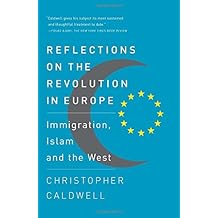
Reflections on the Revolution In Europe: Immigration, Islam and the West Paperback by Christopher Caldwell (Anchor Books)


Christopher Caldwell claims Reflections on the Revolution in Europe is not a lecture to Europeans about how to handle their Islam problem. But his analysis leaves room for only one conclusion. White Europeans need to start fighting fire with fire, shed their exalted notions of multiculturalism and human rights, find religion and civilizational purpose, and, for good measure, dig back a few centuries to rediscover arranged marriage so they can start matching immigrants baby for baby. They might also consider sending all those Muslims—referred to occasionally as “invaders” and colonizers—back where they came from. Otherwise, in no time, Europe will cease to exist. Caldwell, an editor at the Weekly Standard, doesn’t admit any other possible outcome for the battle between the two caricatures he draws. When in one corner you have “an insecure, malleable, relativistic culture” and in the other a “culture that is anchored, confident, and strengthened by common doctrines,” which would you put your money on?

That he arrives at such a Manichaean understanding is unfortunate, since it effectively short-circuits a nuanced conversation about some good and challenging questions. Caldwell is right to wonder about the inevitability of the mass immigrations that began on the Continent in the 1950s and continued unabated through the 1990s, when Europe relaxed many restrictions on refugees and asylum seekers. The reflex answers are well known: The postwar economies needed the manpower. Guest workers were doing jobs no one wanted. Europe, with its history of murderous nationalism and exploitative colonialism, had an obligation.

But where was the long-term thinking as hundreds of thousands of immigrants streamed in? The industrial jobs that guest workers filled were fast becoming obsolete. And few stopped to consider that these immigrants would choose to stay and build their lives in Europe rather than returning home, that Europeans were importing, as Caldwell puts it, “not just factors of production but factors of social change”—people who, among other stresses, might weigh down Europe’s cherished welfare system.

Most Western European countries now have a foreign-born population that tops 10 percent, and for Caldwell it’s their overwhelmingly Muslim identity that is the threat. He regards Islam’s role in Europe today in the same way cold warriors understood Communism in the 1950s: as an all-consuming force that will take advantage of

the West’s freedom in order to destroy its values and way of life. Regardless of where they came from, whether the Maghreb or Turkey, and where they have settled, whether Denmark or Spain, Caldwell sees Muslim immigrants as adherents of an adversarial worldview, which seeks to establish what ethnographer Rauf Ceylan calls “ethnic colonies” in the hope of eventually conquering Europe “street by street.” Even benign Muslim institutions are “worrisome, no matter how innocent their ends or how peaceful their ethos.” Caldwell ties together many events since 9/11, from the Danish-cartoon uproar to the riots in Paris banlieues to the killing of Theo van Gogh, as symptoms of the same disease: a hostile Muslim population that will never assimilate and—through high birthrate and fervent belief—will Islamize Europe in short order.

He saves his true scorn, though, for Europeans. The Islamic ethos at least has traditional values and cohesiveness. Next to it, Europe is nothing but decadence and uncertainty. His analysis drips with disgust for societies that lack self-confidence, that are willing to fight, if at all, only for gay rights and sexual permissiveness. As he sees it, this is the legacy of a guilt-ridden postwar moral order that put the need for tolerance above all else, sacrificing “order, liberty, fairness and intelligibility” on its altar.

Caldwell presents his argument in such with-us-or-against-us terms that it hurts to acknowledge the places he is right. It is un-deniable that there is a disgruntled and dangerous sense of victimhood among Muslim immigrants, and a culture that secular Europeans can’t help but view as misogynistic. These developments both pose immense obstacles to integration. But do they mean that integration is impossible? For every “ethnic colony,” there is also a sign of slow but steady adaptation to Europe, whether in the realm of the cultural, the religious, or the sexual. Caldwell rarely mentions political power—in his reading, it’s irrelevant when a minority rules through intimidation. But it is not at all irrelevant on a continent where democracy remains sacred. For the most part, these large immigrant groups have almost no political representation and no ability to counter the anti-immigration laws currently sweeping Europe. But it’s also telling that those who have risen to power—like Cem Özdemir, the son of guest workers, who is now a chairman of Germany’s Green Party, and Rachida Dati, the daughter of a Moroccan bricklayer and now France’s justice minister—have done so as loyal citizens.

As for European society, it is much stronger than Caldwell gives it credit for. Multiculturalism has given back to Europeans what the twentieth century took away: an ability to feel good about one’s country. Letting in strangers, challenging though it’s been, has not only helped Europe overcome its history, it has forced an expansion, in vibrant and diverse ways, of what it means to be German or French or English. Moving in the opposite direction, a retreat into some pre-Enlightenment ethnically and religiously based idea of the nation-state is not an option—as Caldwell himself has to know. Too much has happened since.

Park Chung Hee and Modern Korea: The Roots of Militarism, 1866-1945. Carter J. Eckert. Harvard University Press. 2016.


The tension had been simmering beneath the surface for years. After more than a decade of cronyism, economic stagnation and rigged elections, students at Korea University gathered at a rendezvous point in Seoul and began marching toward Blue House to demand the ousting of strongman Syngman Rhee. As the band of young citizens made their way toward the presidential residence, their ranks swelled. Less than a week later on 25 April 1960, throngs of people, including college professors, joined the crowd of protesters. In the face of overwhelming opposition, Rhee resigned the next day.

For one brief moment, hope returned. Yet, the victory of the people proved ephemeral. After a year of political squabbling and internal disorder, a career soldier, Park Chung Hee (1917-79) launched a successful coup and held the reins of power until his assassination in 1979. As head of state, Park ushered in an era of prosperity through industrialisation and turned South Korea into an export-driven economy. At the same time, however, his authoritarianism, which quashed the rights of workers and subordinated the constitution to executive fiat, alienated a considerable portion of the population. In Park Chung Hee and Modern Korea: The Roots of Militarism, 1866-1945, Harvard University historian Carter J. Eckert meticulously examines how Japan’s military occupation of Korea (1910-45) and Manchuria (1931-45) shaped the future contours of Korean politics and society to the detriment of individual rights and democracy.

Over the course of ‘Part One: Contexts’, Eckert devotes three lengthy chapters to tracing the rise of martial ideals in East Asia throughout the nineteenth and early-twentieth centuries. After surviving naval confrontations with France (1866) and the United States (1871), the 500-year-old Choson Dynasty effectively came to an end with a gunboat attack by Japan. Subsequent to surrendering a significant portion of its sovereignty in the Treaty of Kanghwa (1876), King Kojong (1852-1919) and the Korean elites undertook a number of military initiatives to free the nation from foreign control. In occupying the peninsula during the Sino-Japanese War (1894-95), Japan both accelerated the pace of reform and the desire for independence among the Korean populace. From the newly-founded Great Han Empire (1897) to the establishment of a Japanese protectorate over Korea in 1905, Hanseong (Seoul) more than doubled military expenditures, set up a Supreme Military Council and a military court and ‘openly [adopted] the Meiji [Japan] slogan of ‘‘rich country, strong army’’’(33).
Image Credit: South Korean Army parade at Armed Forces Day in 1973 (Baek, Jong-sik CC BY SA 2.5)

At the fin de siècle, the intelligentsia promoted a critical, top-down, social reconceptualisation of Korea. Two scholars in particular, Yu Kilchun (1856-1914) and Pak Yonghyo (1861-1939), wielded wide-ranging influence over their contemporaries. While the former commanded a cadre of academic acolytes a decade after publishing Observations on the West (1895) – a pioneering monograph that endorsed a larger role for the military – the latter, who had studied in Japan, formed a ‘modern army unit’ as an official of his province and vociferously advocated the benefits of sea power in his writings (50). For Pak, Korea’s emphasis on mun (civilisation, learning) rather than mu (war, strength) explained why the nation had succumbed to Japanese subjugation.

In Chapter Three, Eckert introduces Park as a young and impressionable student at the highly regimented Taegu Normal School in the mid-1930s. Under a steady diet of drills and propaganda, the future president of Korea thrived, and not only embraced the military culture of the institution but also became a fanatical admirer of fascist leaders Benito Mussolini and Adolf Hitler. Indeed, his single-minded devotion to discipline, which earned him the nickname baka-majime (crazy-serious), afforded him the opportunity of joining the Japanese-run Manchurian Military Academy (MMA) and the Japanese Military Academy (JMA) in 1940 and 1942 respectively.

By detailing the draconian life of Park and his fellow classmates at the MMA and JMA in five successive chapters in ‘Part Two: Academy Culture and Practice’, Eckert draws substantive connections between Park’s combat-ready socialisation and his developing worldview. At the MMA and JMA, students were regaled with heroic tales of Japanese conquest (i.e. the Sino-Japanese War, Manchuria) and participated in group singalongs honoring the Meiji Restoration for its overthrow of the shogunate and the reestablishment of empire in 1868. Accepting military rebellion as a legitimate means to ‘restore’ or ‘renew’ society served as a core component in the emerging ethos of the academies, and the failed attempt by a segment of the Imperial Japanese Army (IJA) to topple the government in Tokyo through assassination on 26 February 1936 furnished a template for disgruntled and disaffected officers longing for a quasi or full dictatorship. In fact, nearly all of the officers who participated in the crushed mutiny hailed from the JMA.

Ideologically, the academies were divided between rightists and reactionaries and secret or semi-secret coteries of Marxists and neo-Marxists. In accordance with a stricture issued by the Emperor Meiji, members of the armed forces were trained to achieve shisso or complete ‘simplicity’ in every aspect of their lives – a directive that bridged neo-Confucianism and Marxism. Between currents of socialism, thunderous calls for a Showa Restoration to return Japan to Empire (the February 26 Incident) and strains of ultranationalism, Park and his Korean comrades-in-arms emerged from the academies with a unique set of beliefs and practices.

Park’s monolithic mentality and relentless drive can also be attributed in large part to his inculcation of the teachings of the IJA at the MMA and JMA. In their curricula, instructors championed human will or willpower and ‘willful activity [as] ‘‘virtuous’’ (zenryo), healthy (kenzen), and just (seito)’ – a view wholly consistent with the tenets of fascism (254). Consequently, the spirit of maintaining offensive attacks as well as a ‘belief in certain victory’ despite the odds complemented the hyper-masculine culture that equated male weakness with being womanly (261-62). How did officers keep their pupils in line at all times? As cadets were subject to constant peer observation or ‘informal surveillance’ on a daily basis, disobedient or dysfunctional behaviour was either immediately corrected or reported to superiors (293-94). In the MMA and JMA, the individual virtually ceased to exist. Each recruit, including Park, sacrificed his ‘self’ for the sake of his military unit and national glory.

On 15 August 1974, Park appeared at the National Theater of Korea in Seoul to commemorate the anniversary of South Korea’s independence. During his remarks, a series of gunshots suddenly rang out. One of the bullets fired at Park struck and killed his beloved wife, Yuk Young-soo. A commotion ensued, and the assassin was quickly seized. True to his MMA and JMA training, the president returned to the podium to finish his speech. He did not flinch, and his will had seemingly triumphed over adversity. Yet, one day after her state funeral on 20 August, Park privately composed the following verses:


My wife has departed alone

Only I am left

Like a lone Magnolia blossom bending to the wind

Where can I appeal

The sadness of a broken heart

In writing a poem lamenting the loss of Young-soo, Park momentarily transcended his rigid indoctrination and expressed humanity. Nevertheless, he would increasingly rule with an iron fist over his remaining years.

From his engaging thesis and prodigious research, Eckert has delivered a robust analysis of the consequences of continuous conflict on the Korean peninsula and the resulting permeation of military values into various echelons of society. By interpreting the history of twentieth-century South Korea as a product of long-term geopolitical factors in both East Asia and the wider world, Park Chung Hee and Modern Korea represents a salient paradigmatic shift in the study of the region and thus richly deserves the highest plaudits from the scholarly community. As for Park, his legacy in South Korea today – fittingly – remains embattled. Hopefully, the forthcoming second volume, which will chronicle the post-WWII years and detail his polarising presidency, will offer an incisive portrait of the period, with Eckert justly balancing the inherited past with the flaws and failures of his subject.

Saturday, May 13, 2017

Grandad's Island by Benji Davies ( Candlewick Press and Simon & Schuster Children's UK)


In this gentle, magic-tinged allegory, Grandad lives in a small house back behind Syd's home. After opening a "big metal door" in Grandad's attic, the two are transported to the deck of a giant ocean liner, which towers over the neighboring buildings in their seaside town...As with The Storm Whale, Davies offers a story of loneliness and togetherness distinguished by understated, deeply felt emotions and a nautical milieu.

This book is innovative and useful as a way to talk about the idea of loss without ever referring to actual death. Parents and educators can use this to talk with a child about how it s normal to be sad and miss loved ones...Cheerful, brightly colored illustrations make this a fine choice to use with the youngest of audiences. Since death isn t directly specified, this title also works for when a child s loved one is moving far away. An excellent vehicle to gently approach the topic of loss. Recommended for collections needing these types of materials.
Syd has a very close relationship with his Grandad, whose house and garden back onto his own. On one of his regular visits, he finds Grandad in the attic. Grandad appears to be ready to make a journey and the pair set out on a voyage, entering onto the deck of a ship by passing through a large metal door that Syd has never noticed before. They spend a wonderful time together on a beautiful tropical island before Grandad reveals that he will be staying there and Syd has to make the journey home alone. A sensitive story about the loss of a loved one which is moving and uplifting at the same time. The illustrations make it unnecessary for the words to be explicit about what may be reality and what may be imagination. This is left to reader who can infer information from such detail as the depiction of Grandad’s belongings and mood from the brightness and colour of the island and the sombre shades of the rough sea which Syd must traverse to arrive home.

The Hawk of the Castle: A Story of Medieval Falconry By Danna Smith. Illustrated by Bagram Ibatoulline.40 pp. Candlewick. $16.99. (Picture book; ages 6 to 10)


The Hawk of the Castle: A Story of Medieval Falconry

Sweeping views of a medieval castle and its rural surroundings frame this lyrical look at the ancient sport of falconry. The daughter of a castle falconer narrates as she and her father take their goshawk out to hunt: “This is the arm Father raises just right/ that signals our hawk when it’s time to take flight./ With a stretch of his wings, he flies from the fist/ and soars above the castle.” Though not cumulative, the narrative recalls the rhythmic “The House That Jack Built”; each of Smith’s (Arctic White) four-line stanzas begins with “this is” or “these are” and ends with “the castle.” Ibatoulline’s (The Matchbox Diary) stunningly realistic acrylic and gouache scenes illustrate from all angles, offering close-ups of the hawk, pastoral panoramas, and breathtaking aerial vistas. Small rectangular insets contain factual asides about hawking, and an author’s note gives a brief history of the sport and its traditions. What young readers may appreciate most, though, is the story, beautifully presented, of the bonding between a daughter and father. Ages 4–8. 

Smith’s rhyming story of a medieval girl who learns falconry from her father delivers loads of information about hawking, in the chronicle of a day out hunting and in sidebars about details like the bells on the bird’s legs (to help the falconer find the bird once it’s gotten the prey). Ibatoulline invites you into his sweeping, realistic scenes with cleverly shifting perspectives. But perhaps most thrilling is a book with a castle featuring a girl who’s curious and accomplished, with her social status and marital prospects blissfully beside the point.