Showing posts with label . . #IsraelBookReview. Show all posts

Thursday, July 19, 2018

Alice's Adventures in Wonderland (Wordsworth Classics) by Lewis Carroll Paperback – by Lewis Carroll (Wordsworth Editions )


Its fantasy plot, humorous rhymes and brilliant use of nonsense was revolutionary.

What’s down the rabbit hole?

A hot summer’s day on the riverbank, and young Alice is bored. Bored, that is, until a white rabbit in a checked jacket scurries past in a great hurry, examining a pocket watch. Burning with curiosity, Alice can’t help but follow the rabbit down the hole which leads to a long passageway – and a tiny door too small to get through.

So begins Alice’s adventures in the amazing world of Wonderland. In the pages that follow a strange liquid will shrink her to only ten inches tall; a curious cake will disappear before her eyes; a mad hatter will invite her to tea – and Alice will play a very dangerous game of croquet…

The character of Alice is based on Alice Liddell, the ten-year-old daughter of an academic at Christ Church College in Oxford, where author Lewis Carroll studied and taught. Carroll would tell Alice stories to entertain her: Alice begged him to write them out and he presented them to her in 1864. He was later persuaded to publish and, after further additions, the book as we know it today appeared in 1865, including the famous illustrations by John Tenniel.

Alice in Wonderland was Lewis Carroll’s first novel and its fantasy plot, humorous rhymes and brilliant use of nonsense was revolutionary. Nineteenth-century children’s writing usually served moral or educational purpose, but Alice was written firmly and purely for the amusement of children. Critical response was lukewarm, but the book was still a great success, and remains a hugely influential classic of children’s literature.

Alice appeals to adults as well as children and over the years readers and critics have found within it all manner of riddles, puzzles, mathematical concepts and references to Carroll’s famous and not-so-famous friends.

Lewis Carroll was the pen-name of Charles Lutwidge Dodgson, born in 1832 in Cheshire in the north of England. His father, the local rector, came from a family of distinguished scholars and clergymen. Dodgson continued the academic family tradition and studied mathematics and theology, eventually becoming a mathematician at Oxford University.

He first began to write comic poetry and prose in the 1850s and had several pieces published in magazines, where he first began to use the name Lewis Carroll. In 1856 he met four-year-old Alice Liddell who was to inspire the book which made Dodgson’s name, Alice’s Adventures in Wonderland, published in 1865. The book was an immediate success, was translated into many languages and soon established itself as an English classic. Its sequel, Through the Looking-Glass, appeared in 1871. Their revolutionary combination of word-play, humour and nonsense had never been seen before in writing for children. His other great masterpiece of nonsense is the poem The Hunting of the Snark (1876), and other books for children including Phantasmagoria (1869) and Sylvie and Bruno (1889).

Charles Dodgson never married and remained at Oxford all his adult life, where he wrote several books on mathematics and logic as well as devising board games and brainteasers. He was also an expert photographer, famous for his portraits of children and many artistic personalities of the day. He died in 1898.

Tuesday, June 19, 2018

Israeli Women's Studies: A Reader Edition by Professor Esther Fuchs (Editor, Contributor), Professor Judith Buber Agassi (Contributor), Professor Deborah Bernstein (Contributor), Professor Tamar El-Or (Contributor), Professor Ayala Emmett (Contributor), Professor Yael Feldman (Contributor), Professor Manar Hassan (Contributor), Professor Hanna Herzog (Contributor), Professor Dafna Izraeli (Contributor), Professor Orly Lubin (Contributor), Professor Tamar Mayer (Contributor), Professor Sharon NeÆeman (Contributor), Professor Shulamit Reinharz (Contributor), Professor Orna Sasson-Levy (Contributor), Professor Susan Sered (Contributor), Professor Simona Sharoni (Contributor), Ella Shohat (Contributor), Professor Yael Yishai (Contributor), Professor Nira Yuval-Davis (Contributor)


Israeli women do not enjoy the equality, status, and power often attributed to them by the media and popular culture. Despite significant achievements and progress, as a whole they continue to earn less than their male counterparts, are less visible and influential in the political arena, do not share equal responsibilities or privileges in the military, have unequal rights and freedoms in family life and law, and are less influential in shaping the nation's self image and cultural orientation.
Bringing together classic essays by leading scholars of Israeli culture, this reader exposes the hidden causes of ongoing discrimination and links the restrictions that Israeli women experience to deeply entrenched structures, including colonial legacies, religious traditions, capitalism, nationalism, and ongoing political conflict. In contrast, the essays also explore how women act creatively to affect social change and shape public discourse in less ostensible ways.
Providing balanced perspectives from the social sciences and the humanities, this comprehensive reader reflects both an emerging consensus and exciting diversity in the field. It is the definitive text for courses in Israeli women's studies.

Thursday, June 14, 2018

ROOTS The Saga of an American Family, The 30th Anniversary Edition by Alex Haley (Vanguard / Perseus)


If you are of a certain age and were anywhere near the United States in early 1977, you probably remember the bona fide social phenomenon that was the first airing of the miniseries Roots. For a week in late January, across the country, Roots parties were the rage, while across all media a national conversation began on the always uncomfortable question of slavery and its contribution to America’s course and character.

At the same time, Roots, the book, continued to fly off the shelves, a bestseller with more substance than most. Published in August 1976, nicely timed for a bicentennial year, Roots had already touched off a genealogy craze. Its author, Reader’s Digest senior editor Alex Haley, professed to be a little surprised at his book’s quick success, but there was nothing quick about its making. For a decade, Haley said, he had been making false and true starts on bits and pieces of an oral history that his grandmother had related to him back home in Tennessee, a history that worked its way across fields and rivers to the ocean, and thence to a mighty river. There Haley’s 120-chapter epic begins: “Early in the spring of 1750, in the village of Juffure, four days upriver from the coast of The Gambia, West Africa, a man-child was born to Omoro and Binta Kinte.” That man-child would be named Kunta, in honor of his Mauritania-born grandfather. Soon he would bear another name, and only memories of that place.

Roots, billed as a “genealogical novel,” was an earthy book. It was also unsparing in its depictions of slavery. The 30th anniversary edition (apparently commemorating the show, not the original book), published on May 22 by Vanguard Press, carries a talk given by Haley to his Reader’s Digestcolleagues in which he describes crossing the Atlantic by freighter. “I couldn’t tell the captain, who was such a nice man, nor [the] mate what I wanted to do because they wouldn’t allow me to do it,” he recalls, the project in question being to spend nights down to the hold lying atop a board to approximate Kunta Kinte’s journey across the Middle Passage, one that, Haley was careful to specify, lasted “two months, three weeks, two days.” The experiment didn’t last long—but long enough for Haley to feel suicidal, to say nothing of doubtful about writing his book in the first place.

He did write it, though, and Roots went on to make history as a phenomenon of publishing, media, and popular culture, setting off a wave of interest in books about America’s many pasts. (Would there have been an Angela’s Ashes without Roots? Perhaps--but perhaps not.) It also touched off controversies, as books about any past will, not only because goodly portions of the book were borrowed from at least one other book, but also because Haley’s genealogies did not always add up, at least to scholarly satisfaction. Haley, who died in 1992, can no longer respond to those ongoing discussions, but it is to the good that his “genealogical novel,” so long in the making, is still around to spur them in the first place.

Friday, May 18, 2018

The Gulag Archipelago Abridged: An Experiment in Literary Investigation (P.S.) Paperback by Aleksandr Solzhenitsyn ( Harper Perennial Modern Classics)


A must-read for those of us raised in comfort. A reminder that life needn't be (and through most of human history, wasn't) so comfortable. It is a reminder of the dangers posed by Authoritarianism, and a lesson that "evil" is not "out there" somewhere, lurking in a foreign land, but swirling amidst the "good" in the heart of every man. The vagaries of fate and disposition can leave any man as either executor or executed... or both at different times.

A few quotes:

"If only there were evil people somewhere insidiously committing evil deeds, and it were necessary only to separate them from the rest of us and destroy them. But the line dividing good and evil cuts through the heart of every human being. And who is willing to destroy a piece of his own heart? During the life of any heart this line keeps changing place; sometimes it is squeezed one way by exuberant evil and sometimes it shifts to allow enough space for good to flourish. One and the same human being is, at various ages, under various circumstances, a totally different human being. At times he is close to being a devil, at times to sainthood. But his name doesn't change, and to that name we ascribe the whole lot, good and evil. Socrates taught us: Know thyself! Confronted by the pit into which we are about to toss those who have done us harm, we halt, stricken dumb: it is after all only because of the way things worked out that they were the executioners and we weren't.”

“Ideology—that is what gives evildoing its long-sought justification and gives the evildoer the necessary steadfastness and determination. That is the social theory which helps to make his acts seem good instead of bad in his own and others' eyes, so that he won't hear reproaches and curses but will receive praise and honors. That was how the agents of the Inquisition fortified their wills: by invoking Christianity; the conquerors of foreign lands, by extolling the grandeur of their Motherland; the colonizers, by civilization; the Nazis, by race; and the Jacobins (early and late), by equality, brotherhood, and the happiness of future generations. Thanks to ideology, the twentieth century was fated to experience evildoing on a scale calculated in the millions. This cannot be denied, nor passed over, nor suppressed.”

“There is a simple truth which one can learn only through suffering: in war not victories are blessed but defeats. Governments need victories and the people need defeats. Victory gives rise to the desire for more victories. But after a defeat it is freedom that men desire—and usually attain. A people needs defeat just as an individual needs suffering and misfortune: they compel the deepening of the inner life and generate a spiritual upsurge."

Tuesday, April 24, 2018

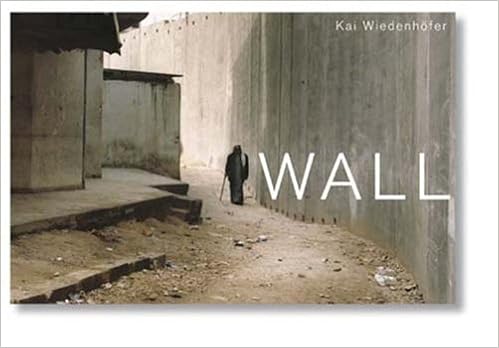
Kai Wiedenhöfer: Wall Hardcover by Kai Wiedenhöfer (Photographer)


"Over a nine meter wall you cannot shake hands," says a Palestinian pensioner who lives in the shadow of Israel's growing Separation Barrier. Kai Wiedenhàfer, who documented the fall of the Berlin Wall in 1989 and has been photographing the Israeli-Palestinian conflict for more than a decade, has spent the last few years documenting inhabitants of the Occupied Palestinian Territories who find themselves in the path of the barrier. He has also documented the growing barrier itself, a 650-kilometer mix of walls, fences, ditches and earth mounds that serves as a border between Israel and a projected future Palestinian entity. Working in color and black-and-white with a 6x17 cm panoramic camera, Wiedenhàfer has produced depictions of the wall--and life in its lengthening shadow--that make it hard not to share his view, informed by a life in Berlin, that separation barriers do not offer real solutions to political conflict.

Wednesday, April 18, 2018

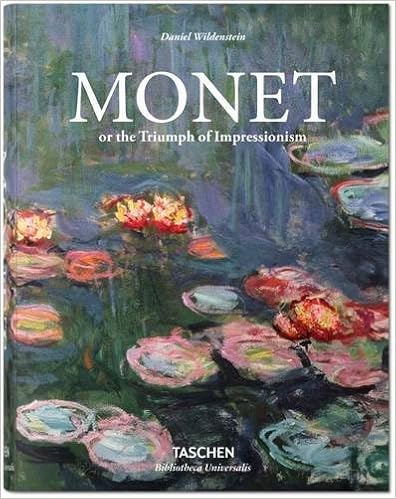
Monet or The Triumph of Impressionism Hardcover – May 15, 2014 by Daniel Wildenstein (Taschen)


A Review of Daniel Wilderstein’s Monet (or the Triumph of Impressionism)


Seascape, Night Effect (1866).

Daniel Wilderstein’s Monet, or the Triumph of Impressionism is a work that fails to distinguish itself from other works in the field. Like many monographs from the Taschen line, it has beautiful reproductions of a number of Claude Monet’s works and a plethora of biographical information dealing with both Monet’s personal and business life. The work is flawed in many respects though. It fails to offer any sort of overview of the critical response since Monet’s death, or the significance of the break from classic painting. What is the purpose of the approach Money adopted?


Water Lillies and Japanese Bridge (1897).

Where did he gather his inspiration? There is also a lack of an emotive portrait of Monet. Wilderstein offers biographical information, but one does not have a clear understanding of the connection between either Monet and his first wife, Camille, or his second, Alice. Wilderstein mentions in passing that Alice had Monet destroy all the letters from Camille after her death, but does not explore this. Why would Monet allow this? Why would Alice demand it? Also lacking is a full exploration into the birthing of the relationship between Alice, who was married to a patron of Monet’s. The monographs notes that Monet destroyed a number of his own paintings as he was not satisfied with them, but there is not exploration as to what made them inferior in Monet’s eyes. It is said that he was unhappy with them, but does not say why. What was his reasoning? Such things are of a personal matter, and this is an academic work, so it is perhaps unfair to expect such details, but if the academic work focuses strictly on biographical information and deals little with critical response, other than to detail who did and didn’t ‘like’ Monet’s work, then it has to offer something beyond thr biographical information which can be summarized adequately by Wikipedia.


Woman With Parasol

What the book is filled with is prices that were paid for Monet’s paintings and his annual salaries, as well as beautiful reproductions of his work. As to the salaries, there are not the least bit interesting, and even if they were they are in accessible. Wilderstein rattles off sums, which sound, even by today’s standards, like a great deal of money, but speaks to Monet’s seeming poverty early in his life (even though he has enough money to afford servants). The sums Wilderstein shares though have no context. We do not know if 820 francs is a lot. How much is that in today’s currency? How many euros is that? Or pounds? Or American dollars? How many chickens could that buy? And why does anybody care how much money Monet made? Sure, it is interesting to hear how much a painting fetches at auction when it sets a record, but to hear the prices paid for literally scores of paintings which all get around 1000 francs (give or take 200 francs) gets more than a little boring. Hearing how many paintings he had in a show and how much they sold for compared to his contemporaries is only stimulating to those interested in having a pissing match about such details. The monograph would have been better served to exclude the excessive inclusion of numbers that make the book read more like an almanac than an academic work in favour of including critic responses, and by critical responses I mean something other than mentioning which critics raved about how great the work was and which raved about how awful it was.


London Parliament At Sunset

As for the reproductions, though they meet the high quality I have come to expect from books in the Taschen collection, I have never seen images presented in such a disorganized manner. Typically such images are organized in one of several ways. Such images may appear chronologically in the biographically-based text and alphabetically in the index with page numbers attached both to their title in the index, and in parenthesis in in-text citations. This makes it easy for the reader to find the image. If the page number the image being referenced isn’t in the in-text citation, then all one need do is simply look the painting up alphabetically in the index to find the page. Another option is to assign each image a number with 1 given to the first painting that appears, 2 assigned to the next and so


Monet and his fucking haystacks!

on. When the paintings are mentioned, the number that corresponds is included in parenthesis and all the reader has to do is look that number up in the index to see what page it is on, or flip through the pages as the images are in numerical order. Neither method was employed for this monograph. Instead, images are assigned seemingly random numbers. One painting on an early page may have a higher numerical value than the number assigned an image later in the book, or vice versa. There is simply no order. One would normally turn to the index for assistance in such a case, but the index offers not help as it simply lists the assigned numbers in the order they appear, so when a title has a number behind it, one has to scour through the index looking for the corresponding number. One would assumed that the numbers would be in numerical order, but they are not, simply in the order in which they appear. This makes it tedious to find a work that the author is referencing. Why they couldn’t simply put the page number the image appears on in parenthesis for in-text citation and list them either alphabetically or numerically in the index is beyond me, but the option which the editors chose for this edition is beyond perplexing.


The prose is dull, the information is tedious and the images are completely unorganized. Considering the esteem Monet has and the fact that Taschen made this monograph much longer than most of its other books for individual painters, I’m surprised that so little effort seems to go into this. Also missing is an exploration of Monet’s ecocritical perspective. At a time when many were still doing portraits, Monet stepped away from that trend and alienated buyers to focus on nature and uplift nature through his landscape paintings. Though this is referenced in the monograph several times, neither the reasons for this choice, nor the implications of it are explored. Yes, it is mentioned that Monet loved nature and thought it beautiful, but Wilderstein does not explore why Monet felt this way. The images are beautiful to look at, but the book is a disappointment.

Tuesday, April 10, 2018

The Kamado Smoker and Grill Cookbook: Recipes and Techniques for the World's Best Barbecue Hardcover by Chris Grove (Author, Photographer) (Ulysses Press) (IBRCookBooks)


This is a very interesting book. I typically jump around in cookbooks. This one is organized so that there’s a skill being taught along with each recipe. It’s not clear to me whether the order was intentional or not, but I’m going to go through the book in order in case it is. A lot of the recipes have a “try this next” after it, giving you other jumping off points to play with.

We had an electric smoker for years and loved it. When it died, I bought this grill, and am very happy with it. There’s a bigger learning curve, but to my delight, it’s surprising low maintenance. Pit Boss 71240 Kamado BBQ Ceramic Grill Cooker, 24"

Picured below:
Pics 1-2) Lesson#1: Paper towel lighting method and Spinach-Stuffed Pork Chops – p 19-22. Ha! The lighting method works! The chops reminded me of a Jacques Pépin recipe that I love, so I made his butter glazed carrots to accompany it. Delicious, and not my standard grill fare!
Pics 3-5) Lesson#2: Gas torch lighting method and Game Day Chili Cheeseburger – p 23-26. I don’t have a torch, so I went with this thing instead.
Pit Boss 74120 Electric Charcoal Igniter The electric starter’s really easy. You don’t even need starter cubes. The burger was really awesome.
Pic 6) Lesson#3: Direct grilling and Grilled Steaks with Cajun Butter – p 27-30. That is a *great* steak.
Pic 7) Lesson#4: Indirect grilling and Fire-Roasted Meatloaf Sandwiches – p 31-35. Awesome. I never considered grilling a meatloaf before. I adore the flavor. He said you could toss a little wood on, so I added just a few chips.
Pic 8) Lesson#5: Spatchcocked poultry and Hickory Smoked Chicken – p 37-39. Oh my gosh, yes! That’s a delicious chicken! I made veggie kabobs (bell peppers, zucchini, shrooms, and onions) brushed in olive oil and sprinkled in season salt to go with it. They go on for the lat 1 ½ hours at the chicken smoking temp. This was another indirect grilling one. You can see the heat deflection plate in the background.

Here’s the rest of the lessons/recipes being taught. I’ll update this as I work my way through it.
Lesson#6: Smoking, low and slow, and Smoked Pork Butt with Carolina Slaw – p 40-44.
Lesson#7: Smoking, hot and fast, and Turbo Brisket – p 45-48.
Lesson#8: Cooking wings over direct heat and Beer-Brined Wings – p 49-51.
Lesson#9: 30-20-10 wings and Thai Sticky Wings – p 52-54.
Lesson#10: Roasting rack/pan combo and Fire-Roasted Pork Loin with Root Vegetables – p 55-57.
Lesson#11: Injecting flavor and Agave-Glazed Smoked Turkey Breast – p 58-60.
Lesson#12: Using brines and Pork Tacos with Corn Salsa – p 61-64.
Lesson#13: Creating and using marinades and Island-Style Chicken Sandwich – p 65-68.
Lesson#14: Dutch ovens and Cherry Cheese Danish Cobbler – p 69-71.
Lesson#15: Convection Baking and Appalachian Apple Flambé – p 72-74.
Lesson#16: Sear/roasting steaks and chops and Cowboy Ribeye with Ranch-Style Beans – p 75-77.
Lesson#17: Reverse searing steaks and chops and Two-Finger Pork Chops – p 78-80.
Lesson#18: Reverse searing roasts and Three-Chile Tri-Tip with Grilled Salsa Verde – p 81-84.
Lesson#19: Hot tubbing and Flat Iron Steak Tacos with Green Chile Crema – p 85-87.
Lesson#20: Stuffed cheeseburgers and Green-Chile Stuffed Burgers with Avocado Ranch Dressing – p 88-90.
Lesson#21: Stir-firing and Thai Beef with Basil Fried Rice – p 91-94.
Lesson#22: Brick-press grilling and Brick-Grilled Chicken Panini – p 95-97.
Lesson#23: Plank grilling and Ponzu-Glazed Salmon with Pineapple-Jalapeno Pico de Gallo – p 98-100.
Lesson#24: Steam Cooking on a Kamado and Beer-Steamed Snow Crab with Corn and Potatoes – p 101-103.
Lesson#25: Grill toppers and veggie woks and Steak Fajita Rice Bowls – p 104-107.
Lesson#26: Corn three ways and Butter-Braised Corn – p 108-110.
Lesson#27: Wok-top broiling and Grilled Kentucky Hot Browns – p 111-113.
Lesson#28: Raised direct grilling and Grilled Ranch Chicken – p 114-116.
Lesson#29: Cooking with stoneware and Veggie Potstickers – p 117-120.
Lesson#30: Using grill grates and Chilean Sea Bass with Pineapple-Mango Salsa – p 121-123.
Lesson#31: Grilling with Skewers and Pork Kebabs with Cashew Sauce – p 124-126.
Lesson#32: Flexible skewers and Curry Chicken with Coconut Basil Sauce – p 127-129.
Lesson#33: Spider rig searing and Seared Beef Fillet with Creole Brandy Sauce – p 130-132.
Lesson#34: Pan roasting and Skillet Chicken Verde – p 133-135.
Lesson#35: Sous-vide and Grilled Herb Chicken with Red Jalapeño Sauce – p 136-138.
Lesson#36: Cold smoking and Smoked Fontina Cheese Mashed Potatoes – p 139-141.
Lesson#37: Salt block grilling and Salt-Seared Tuna Salad with Tropical BBQ Vinaigrette – p 142-145.
Lesson#38: Smoking with electronic controllers and Baby Back Ribs with Bootlegger BBQ Sauce – p 146-151.
Lesson#39: Breakfast on the Kamado and Grilled Stuffed French Toast and Classic Breakfast “Fatty” – p 152-155.
Lesson#40: Dip and flip and Shrimp Scampi on a Stick – p 156-158.
Lesson#41: The Kamado as a brick oven and ABT Pizza – p 159-161.
Lesson#42: Baking bread and Mary Alice’s Sourdough Bread – p 162-165.
Lesson#43: Griddle cooking and Sliders Mignon – p 166-168.
Lesson#44: Blackening and Blackened Chicken Wraps – p 169-171.
Lesson#45: Single serve dishes and Spinach Alexis – p 172-174.
Lesson#46: Because you can and Grilled Shrimp and Grits Appetizer – p 175-177.
Lesson#47: Roulade-style roasts and Flank Steak Roulade with Manchego Cheese, Spinach, and Sun-Dried Tomatoes – p 178-181.
Lesson#48: Cast iron skillets and Black Bean Burgers – p 182-184.
Lesson#49: Coordinating cooks and Turtle Eggs, ABTs, and Bacon-Wrapped Tots – p 185-188.
Lesson#50: Beer-can chicken and Shot Glass Cornish Hens – p 189-190.
Lesson#51: Grilling on the coals and Persimmon-Grilled Lamb Chops – p 191-193.
Lesson#52: Prime rib and Reverse Seared Prime Rib – p 194-198.
Appendix: Troubleshooting and conversions.

Monday, April 9, 2018

THE UNPERSUADABLES Adventures with the Enemies of Science by Will Storr (Overlook)


A cerebral ride into the world of the unorthodox.

Sallying forth to take on the benighted creationists, novelist and Esquire contributing editor Storr (The Hunger and the Howling of Killian Lone, 2014, etc.) takes pause and realizes that his way of thinking is not all that different from what is being presented from the pulpit of the church. Yes, his chosen approach is that of a rationalist, but how biased and compromised is it? What, really, does he know about the nitty-gritty of evolution, unmediated by the fine reasoning of a Darwin or a Dawkins? And where do our beliefs come from? It is unproductive and deluding to simply dismiss a belief as stupid; intelligence does not arbitrate against odd beliefs, for some clearly bright people hold some curious, complex, elusive notions. So Storr ventures with new eyes into their territory, to the outlandish and the heretical, all the while exploring theories of the brain and how it perceives the world. As he notes, each of us is a concoction of sensory pulses that fashions a unique vision: “Cognitive dissonance, confirmation bias, the brain’s desire to have the outer, real world match its inner models—it takes us part of the way there,” he writes. “It tells us that a properly functioning brain cannot be trusted to think rationally….” The author presents superb stories of visiting with voice-hearers, smug skeptics, sufferers of the Morgellon itch, Holocaust deniers, recovered-memory confabulators, and he combines these stories with his often humorous personal tale—which included experiencing his own murder through the process of hypnosis. Storr’s piercing narrative is piquant and full of surprises and reversals of circumstance, as well as plenty of undeniably valuable information.

“The mind remains, to a tantalizing degree, a realm of secrets and wonder,” writes the author, and so, too, does the world around us, which he entertainingly scours for the possibility of crucial anomalies.


God: A Human History Hardcover – November 7, 2017 by Reza Aslan (Random House)


The bestselling author of Zealot and host of Believer explores humanity’s quest to make sense of the divine in this concise and fascinating history of our understanding of God.

In Zealot, Reza Aslan replaced the staid, well-worn portrayal of Jesus of Nazareth with a startling new image of the man in all his contradictions. In his new book, Aslan takes on a subject even more immense: God, writ large.

In layered prose and with thoughtful, accessible scholarship, Aslan narrates the history of religion as a remarkably cohesive attempt to understand the divine by giving it human traits and emotions. According to Aslan, this innate desire to humanize God is hardwired in our brains, making it a central feature of nearly every religious tradition. As Aslan writes, “Whether we are aware of it or not, and regardless of whether we’re believers or not, what the vast majority of us think about when we think about God is a divine version of ourselves.”

But this projection is not without consequences. We bestow upon God not just all that is good in human nature—our compassion, our thirst for justice—but all that is bad in it: our greed, our bigotry, our penchant for violence. All these qualities inform our religions, cultures, and governments.

More than just a history of our understanding of God, this book is an attempt to get to the root of this humanizing impulse in order to develop a more universal spirituality. Whether you believe in one God, many gods, or no god at all, God: A Human History will challenge the way you think about the divine and its role in our everyday lives.

Tuesday, April 3, 2018

Why Be Jewish?: A Testament Hardcover – March 22, 2016 by Edgar Bronfman (Twelve)


Edgar M. Bronfman's clarion call to a generation of secular, disaffected, and unaffiliated Jews, this book addresses the most critical question confronting Judaism worldwide.

Completed in December 2013, just weeks before he passed away, WHY BE JEWISH? expresses Edgar Bronfman's awe, respect, and deep love for his faith and heritage. Bronfman walks readers through the major tenets and ideas in Jewish life, fleshing out their meaning and offering proof texts from the Jewish tradition gleaned over his many years of study with some of the greatest teachers in the Jewish world.

With honesty, poignancy, and passion, Bronfman shares In WHY BE JEWISH? insights gleaned from his own personal journey and makes a compelling case for the meaning and transcendence of a secular Judaism that is still steeped in deep moral values, authentic Jewish texts, and a focus on deed over creed or dogma.

Monday, April 2, 2018

Because We Say So (City Lights Open Media) Paperback – September 1, 2015 by Noam Chomsky (Author),‎ Henry A. Giroux (Foreword) (City Lights Publishers)

In the forward to the book, it is mentioned that Chomsky writes a newspaper column, but that there are no papers in the United States that will publish them. After reading this book, I am not surprised as he gores some of the more sacred cows of both the left and the right. In fact, I am not surprised that he went to City Lights to get this book published.
This book is a collection of those newspaper columns that have been written and published in overseas during the past 3-4 years. Interestingly enough, Chomsky is able to sell his columns outside of the US without difficulty. There are also a few edited versions of speeches he has given at various places over the past few years.
Chomsky is not afraid to tackle issues that create controversy. He has a particular interest in the Israel-Palestine situation and the atomic research being done by Iran, as well as America's positions on issues in the Middle East. His conclusions of some of the material are startling, but really shouldn't be when you begin to think about what he says.
I highly recommend this book for people who think for themselves and a sick of swallowing the standard Washington spin machine edicts, as well as the standard lines put out by the Republicrats.
Because We Say So presents more than thirty concise, forceful commentaries on US politics and global power. Written between 2011 and 2015, Noam Chomsky's arguments forge a persuasive counter-narrative to official accounts of US politics and policies during global crisis. Find here classic Chomsky on the increasing urgency of climate change, the ongoing impact of Edward Snowden's whistleblowing, nuclear politics, cyberwar, terrorism, Iraq, Afghanistan, Iran, Israel, and the Middle East, security and state power, as well as deeper reflections on the Obama doctrine, political philosophy, the Magna Carta, and the importance of a commons to democracy.
Because We Say So is the third in a series of books by Chomsky published by City Lights Publishers that includes Making the Future (2012) and Interventions (2007), a book banned by US military censors. Taken together, the three books present a complete collection of the articles Chomsky writes regularly for the New York Times Syndicate, and are largely ignored by newspapers in the United States. Because We Say So offers fierce, accessible, timely, gloves-off political writing by America's foremost public intellectual and political dissident.
Noam Chomsky is one of the world's most well-known critics of US policy. He has published numerous groundbreaking and best-selling books on global politics, history, and linguistics

Saturday, March 31, 2018

MY BEST POP-UP CONSTRUCTION SITE BOOK by DK Publishing ; illustrated by DK Publishing Age Range: 2 - 4 (DK)


With an electronic rattle and roar, heavy machines dig and dump, haul and lift as an apartment building goes up.

Depicted in photographic images digitally buffed to a plastic sheen, a massive excavator, dump and cement trucks, heavy-duty forklifts, and other bright-yellow behemoths dominate each sturdy double-page spread. In peculiar contrast, the workers, who are of both sexes and show slight but perceptible differences in skin tone, are tiny, stylized toylike figures. Along with identifying their roles in the project, these workers bustle about the site making comments (“Look out everyone! This is a really big hole”)—and announcing that they’re off for coffee or lunch breaks. Readers accustomed to the conventions of comic strips will be puzzled to see that all of this dialogue appears to be internal, as it’s expressed in thought bubbles rather than speech balloons. Scene-expanding flaps and one gatefold add visual variety to each stage of the construction, and a chip embedded in the rear cover provides a few seconds of atmospheric engine noise with each push of a button.

Despite the sound effect, an unexceptionable addition to the fleets of like fare for diapered diggers. (Pop-up informational book. 2-4)

The American Revolution: A Visual History Hardcover – April 5, 2016 by DK (DK)


St

Friday, March 30, 2018

Ghosts of War: A History of World War I in Poems and Prose Hardcover – May 1, 2017 by Andrew Ferguson (The History Press)


The grand narratives of World War I focus on the action and strategy of combat: this masterful work retells the war in an accessible and genuinely moving way. This work tracks the progress of the global war using the words of more than 100 poets and writers. Their words bring the conflict to life in a real, dramatic and sometimes humorous manner. Numerous accounts of the Great War are written from an Anglo-centric viewpoint but Ghosts of War includes global contributions and stresses the Scottish contribution to both the fighting and the poetry.

Haikus for Jews: For You, a Little Wisdom Hardcover by David M. Bader (Harmony)


Haiku (俳句) About this sound listen  (plural haiku) is a very short form of Japanese poetry. It is typically characterized by three qualities:

The essence of haiku is "cutting" (kiru). This is often represented by the juxtaposition of two images or ideas and a kireji ("cutting word") between them, a kind of verbal punctuation mark which signals the moment of separation and colours the manner in which the juxtaposed elements are related.
Traditional haiku consist of 17 on (also known as morae though often loosely translated as "syllables"), in three phrases of 5, 7, and 5 on, respectively.] (An alternative form of haiku consists of 11 on in three phrases of 3, 5, and 3 on, respectively.)
A kigo (seasonal reference), usually drawn from a saijiki, an extensive but defined list of such terms.

Of all the many forms of Jewish-Japanese poetry, the Jewish haiku is perhaps the most sublimely beautiful," begins the foreword to the wickedly funny and tirelessly bizarre Haikus for Jews by David M. Bader. If you can't abide a little fun with stereotypes, read another book. But if you don't mind a little ribbing, take a look at the following haiku, which gives only a mild taste of the yummy-as-lox treats gathered in this collection: 
Jewish voodoo tip 
mention an acting career,
 then watch for chest pain.

And if you liked that, you'll love this: 
Lightbulb out again --
how many of us must meet 
 to change it this time?" 
And they just keep getting better.

Why is this haiku book different from all other haiku books? 

For centuries, the Japanese haiku has been one of the world's most dazzling poetic forms. In just three short lines, it captures the sublime beauty of nature--the croak of the bullfrog, the buzzing of the dragonfly, the shriek of the cicada, the scream of the cormorant. Now, with Haikus for Jews, there is finally a collection that celebrates the many advantages of staying indoors.
        
Inspired by ancient Zen teachings and timeless Jewish noodging, this masterful work is filled with insights that will make you exclaim, "Ah!" or at least "Oy!" Whether you are Jewish or you simply enjoy a good kosher haiku, these chai-kus (so called because of their high chutzpah content) are certain to amuse. What's more, with each poem limited to seventeen syllables, Haikus for Jews is perfect for people in a hurry. Find out why God has made these The Chosen Haikus.

Thursday, March 29, 2018

The Jewish Revolution: Jewish Statehood Hardcover by Israel Eldad (Gefen Publishing Company)


This brilliant treatise on Zionism and Israel by one of the Lehi fighters offers an amazing glimpse into the past and yet, despite the fact that it was originally written 1970, it offers important lessons for today. The book begins with the fate of the Jews in Europe and why assimilation and equal rights failed to provide security for Jews. Some may disagree that "before the emancipation, before the Jews attained their civil liberties, there was no 'Jewish problem' ". However the emancipation led to the theory of racial anti-Semitism. The author points out, correctly, that the inquisition was not directed against Jews, but Jewish converts. He points out correctly that "outward signs of Jewishness [were] the first ingredients of shame and self-contempt that entered the soul of the emancipated Jews." He draws an important parallel between Karl Marx and Joseph, each desired to help the other and forgot about his own people and the result in both cases was that a "new pharaoh" came to rule over the Jews.

Succeeded chapters detail the forgotten world of extreme Soviet anti-Semitism and how that anti-Semitism infected western leftists. He details his own meetings with the Mufti's brother while they were both in a British prison in Palestine. Most moving of all, Eldad speaks of Jewish military prowess "suddenly gathering all its latent military strength, stirring the embers of its ancient courage and strategic talents." He also notes the increasing attempt by the left to compare Israeli actions to hose of the Nazis; this "all to frequent analogy made by Jewish intellectuals in order to denigrate Zionism and Israel and thus give vent to their own self-hate."

His discussions of the Israel-Arab conflict are less original today. Declaring that Jordan is not a state rooted in history and that there are no Palestinians is not new. Statements such as "the swastika was a direct descendant of the cross" may annoy some.

Other premonitions are quite brilliant, noting that "the whites I South Africa will suddenly remember that the Jews were actively inciting the blacks against them and the blacks of South Africa will remember that the Jews are members of the white race that has been exploiting them." The statement has been born out as were the authors predictions about problems between Africa-Americans and Jews in the U.S.

He sums up his brilliant work noting that "we still have created no paradise here. Sometimes it smacks somewhat of hell. But it is our hell, and our job to turn it into the paradise we want."

Modern Menu Paperback by Kim Kushner (Gefen Publishing Company) (IBRCookBooks)


The concept for this book has been building for the last decade. During these years the author has been teaching, out of her own kitchen, various groups of friends how to cook and put together menus. At the end of the day, everyone needs and loves to eat, especially when what s on offer is made with love. And the truth is, a thoughtfully prepared dish is far more interesting than a perfectly prepared one. In fact, the author never approaches any dish with the idea that it will be perfect. Not only is this attitude freeing, but it inspires her to try new ingredients, flavors, and techniques. She has prepared the recipes in the book dozens of times; they re tried and true, foolproof, and beautiful. Her students always want to know what goes with what, so she organized the recipes into menus, named for the way the dishes make her feel. There s a Vibrant menu, filled with color, which inherently translates to flavor; the Crisp menu is loaded with pleasing crunch; the Saucy menu highlights the transformational power of a well-made yet simple sauce. The menu arrangements are simply suggestions; feel free to mix and match as you like. But never, ever skimp on the passion you put into making any dish, right down to a simple salad dressing. Because when it comes to cooking, what you put into it is what you get out of it.

Wednesday, March 28, 2018

Selling Hitler: Propaganda and the Nazi Brand Hardcover – 30 Jun 2016 by Nicholas Jackson O'Shaughnessy (C Hurst & Co Publishers Ltd )


Hitler started out in PR. He was an army propagandist. When the war was over and he found himself back in civilian life, he joined a small labor party as communications director. He soon ousted the founder and created an incident in Munich that led to a sensational trial. This made him a national politician and celebrity. He devoted two chapters of Mein Kampf to the importance of propaganda. He developed the truck-mounted loudspeaker to publicize speeches and martial music. He was constantly on the radio. He invented quasi-religious ceremonies like the entrance of the flagbearers. The endless repetition of simple and simplistic slogans cemented his party’s control of mindset. He admired the British propaganda machine, claiming it was responsible for victory over Germany in WWI. Under Hitler, Germany became enamored of Madison Avenue, and applied its lessons. Selling Hitler is a master class in brand marketing.

The Nazis controlled all communication. When Hitler made a speech, everyone had to place speakers in the streets so all would hear him. The party bought a film studio and produced newsreels to suit, as well as feature films that reminded viewers of the greatness that was Germany, the traditions and the myths that built a nation. In addition to radio, newspaper, film and public spectacles, Hitler actively spread rumors in whisper campaigns. Like internet “facts” today, Nazi propaganda, repeated constantly, soon became truths. “The idea was not to brainwash, but to show that the great mass of Germans believed” – and so should you. Everyone was to be on message, all the time. It was as high pressure and comprehensive a marketing campaign as was ever implemented.

Symbolism was the default mode of Nazi terminology. Everything was measured for its symbolic possibilities. To the point where roofs had to be pitched because flat roofs were Middle Eastern and therefore Jewish. The word fanatic became the highest term of approval. Absolutely everything was meant to persuade. From architecture to ceremonies, from word choice to myths, from symbols to sounds, everything had to add value to the Nazi brand. Hitler himself rotated the swastika to give it dynamism (moving upwards towards the right). Every public space was an opportunity for a symbolic message, carved in stone, draped in a flag or mounted with a statue.

So when Hitler announced it was Poland that invaded Germany, everyone believed it. There was no other credible source. During the war, the propaganda machine simply attributed German atrocities to the victims, making local Germans the true victims of Polish, British or French horrors. Everyone bought it.

O’Shaugnessy’s book is as thorough and complete as it could possibly be. He examines every aspect of language, custom, dress, myths, media, words, phrases and scapegoats. He acknowledges that Hitler actually invented none of it. All of these tactics have been employed before (and since). But Hitler pulled it all together, and with Goebbels as his tool, implemented ubiquitously.

There is a great deal of space given to Jews as scapegoats, but even Hitler admitted that if there were no Jews, he would have had to invent them. There was actually risk that if he did manage to eliminate all Jews, he would lose mindshare. It was that central to distracting Germans, and he knew it. In an interesting side note, Alexis de Tocqueville warned that idiotic notions of race superiority and social Darwinism would play only too well in Germany. This was the 1850s, when the word Aryan got transferred from the name of a language to the name of a (nonexistent) race. Germans already had a reputation for being suggestible to such myths.