Showing posts with label #OyVeyDonaldTrump. Show all posts

Saturday, October 7, 2017

The Beautiful Poetry of Donald Trump Hardcover – 31 Aug 2017 by Robert Sears (Canongate Books)

Chapter and Verse of #OyVeyDonaldTrump


The US president’s almost primal language is a source of widespread amusement and horror. But some have begun exploring its aesthetic power

“I know words … I have the best words,” Donald Trump once declared with his usual, braggadocious aplomb. For once, he may be right. Dreaded by transcribers and translators worldwide, Trump wields his lively, if limited, vocabulary like a rubber hammer; this is a man who uses “schlong” as a verb and whose babbling is too frequently leapt upon by pundits and despairing lexicographers: bigly, covfefe, the aforementioned braggadocious.

But like his fellow wordsmith Shakespeare, Trump has produced a remarkable burst of something like poetry. There is Hart Seely’s Bard of the Deal, a 2015 book of poetry compiled from interviews, speeches, and tweets; at least two different collections called Make Poetry Great Again (one in Norwegian); and the forthcoming Bigly: Donald Trump in Verse by Cheers writer Rob Long. He has also inspired others to verse: A Hundred Limericks for a Hundred Days of Trump, Trumpetry, and the self-published Shit My President Says Poetry.

The latest collection of Trumpian verse is The Beautiful Poetry of Donald Trump, by McSweeney’s writer Rob Sears. Consider:


I am the best(1)
I predicted Apple’s stock would fall(2)
I will build a great, great wall(3)
I build buildings that are 94 stories tall(4)
My hands – are they small?(5)

Sears is far from the first to notice potential in Trump’s voice: after all, elevating a man who struggles bigly to articulate himself to poetry is inherently funny. “He does speak in very compact, distilled phrases that tell you a lot about who he is, in a small number of words. So it’s not that far away from poetry,” says Sears. “Lots of declarative sentences, a staccato rhythm. There is no complexity to anything he says. People have said he writes like a third grader with a limited vocabulary. I’ve read so many of his words and there really are no exceptions.”

Working with the Trump Twitter Archive, the Trump Archive and American Presidency Project to collect long-deleted tweets and forgotten quotes from the pre-internet era, Sears describes “a weird process, more like being a data scientist than writer”. More than 30 years of Trump’s misogyny, xenophobia and taste for vengeance are on display – all fastidiously footnoted. And as Sears says: “I am certain there are tons of good quotes that have never been written down.”

The president may still wish that many of these quotes were never written down, such as his now startling call for coordinated global action on climate change in 2009 (in Sear’s poem “We’ll be fine with the environment”); or the grotesque pass he dribbled at a female Celebrity Apprentice candidate, in the third line of following poem:


Hot little girl in highschool6

I’m a very compassionate person (With a very high IQ)7

Just think, in a couple of years, I’ll be dating you8

It must be a pretty picture, you dropping to your knees9

Come here, I’ll show you how life works10. Please11

For all the fun with his buffoonery, Trump’s language still holds power, because of a style of speech that might be described as demagogic water-cooler banter: constant references to us versus them, and “winners” and “losers”, the latter being possibly the most frequent word in Sears’s collection, which includes several blistering haiku dismissing John McCain (“Doesn’t know how to win”), Rosie O’Donnell (“Sad sack”) and Ted Cruz (“Dyin’ Ted”).
Advertisement


“I thought maybe he was, on some weird level, a kind of strategic genius,” says Sears of Trump’s ability to convince average Americans. “But now I know there’s nothing clever or pre-planned about what he says. It is just lucky for him that he communicates this way, and that he has such simple ideas.”

But there was one speech that convinced Sears that there was more to the president than met the eye. “I came across a speech on the White House website, addressed to the people of Flint, Michigan, about the water scandal. It was quite reassuring and had a lot of figurative turns of phrase. It really surprised me, and I thought, ‘He’s not so simple, there is another side to Trump,’” he says. “And then I got to the bottom and realised I’d got my dates wrong. It was Obama.”


1. Tweet, 8 August 2013

2. Tweet, 28 January 2014

3. Presidential bid announcement at Trump Tower, 16 June 2015

4. Campaign rally in Plymouth, New Hampshire, CSPAN, 7 February 2016

5. Hannity, Fox News, 29 February 2016

6. Discussing losing his virginity, on The Howard Stern Show, 1997

7. Tweet, 21 April 2013

8. Quoted as saying this to two 14-year-old girls in the Chicago Tribune, December 1992

9. To Brande Roderick on The Celebrity Apprentice, 2013 season

10. The New Yorker, 19 May 1997

11. Speech after winning Florida, Illinois and North Carolina primaries, 15 March 2016

Sunday, May 28, 2017

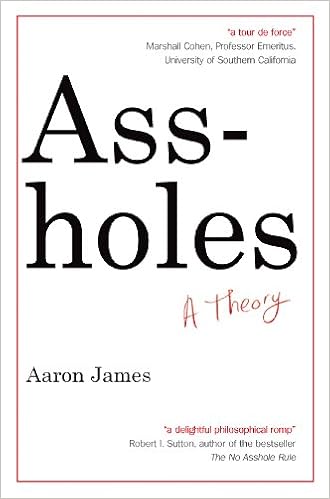
#OyVeyDonaldTrumpet and The Meaning of "Asshole"..... Assholes: A Theory Hardcover by Aaron James (Nicholas Brealey Publishing)


The Meaning of "Asshole"

Aaron James offers a cognitivist conjecture, which sheds light on foul language generally.


If you asked me what it means to call someone an "asshole" before I really thought about it, I probably would have suggested an “expressivist” analysis. The word, I might have elaborated, is just another term of abuse, a way of simply expressing one’s disapproval. Much as if one had said “Boo on you!”, one isn’t trying to say something that can be true or false, correct or incorrect. The job of foul language like “asshole” isn’t to describe the world, but simply to express one’s disapproving feelings, in an ejaculatory or cathartic burst facilitated by inherently emotive words.

I decided this was completely wrong one day in the summer of 2008, while surfing in a crowded line up. I was watching a guy brazenly break the rules of right of way and thought “Gosh, what an asshole”. That wasn’t a new thought, but I then noticed, for the first time, that this thought has what philosophers call “cognitive content”. I was trying to say that the guy in question was properly classified in a certain way. Other law-abiding surfers weren’t properly classified under that term, and so it could be true or false, correct or incorrect, to say that this guy was, in fact, an asshole.

That got me thinking about what it would be for someone to qualify as an asshole. Harry Frankfurt partly inspired this. I thought: Frankfurt put his finger on “bullshit”, and I am a philosopher, so I should define “asshole”. After considerable tinkering and with the help friends, I settled on this definition: the asshole is the guy who systematically allows himself special advantages in cooperative life out of an entrenched sense of entitlement that immunises him against the complaints of other people.

This definition is hopefully significant simply because it prompts one to think, “Hey, I’ve met that guy”. Maybe you encountered him this morning in the coffee shop. Maybe the guy wouldn’t quiet down on his mobile phone, despite obvious sneers. Maybe he drives as though he owns the road. He probably says, “Do you know who I am?” to the maĆ®tre d’ at a restaurant when he’s not quickly seated. Although it of course matters how the definition’s details get worked out and applied, the main idea is that even those inclined to quibble in the small might agree that “asshole” doesn’t simply have expressive meaning. Its function is to classify a person, correctly or incorrectly, as having a particular kind of moral personality.

I soon discovered linguistic evidence for this “cognitivist” rather than “expressivist” treatment of the word. It makes perfect sense to say of someone, “Yes, he is my friend, and he’s fine to me personally, but I admit he’s an asshole”. You can also coherently say things like “General MacArthur was plainly an asshole, but in the end a force for good”. Now maybe those contexts don’t express all-out disapproval, because they still express disapproval in a muted form that is outweighed by other considerations. Yet even all-out approval seems perfectly coherent. It is coherent – and indeed commonplace – for an asshole to proudly own the name. He boasts “Yes I’m an asshole – deal with it”. He taunts his subjects with this pronouncement precisely because he seems to approve wholeheartedly.

An obvious worry here is that I have gone too far in a “cognitivist” direction. Surely the word “asshole” is often used to vent feelings with no concern for whether its target meets any set of necessary and sufficient conditions for its application. If nothing else, then, the emotional charge often associated with the term is something that must be explained.

An easy move here is to follow Stephen Finlay’s idea that ethical language “pragmatically indicates” attitudes of approval or disapproval within a normal conversation. If you call Trump an asshole while we are talking, it will normally make sense for me to interpret you as disapproving of Trump’s conduct. But that may only be a matter of what it is reasonable for me to infer about you given our conversational context and my general knowledge of how people feel when they speak. The very meaning of the word “asshole”, as set by the linguistic rules that govern its use, doesn’t itself imply that you disapprove. And so “Trump is an asshole” can count as true or false in a straightforward way. Expression is, in the standard parlance, a matter of “pragmatics” rather than “semantics”.

I take great comfort in Finlay’s idea, if nothing else as a last resort. It is also interesting that, if need be, a “cognitivist” account can go even further and simply admit expressive meaning as part of the very semantic meaning of “asshole”. As David Kaplan (and David Copp, in a different way) has explained, that needn’t undermine pretentions of objective truth.

Kaplan suggests that, alongside "descriptive" terms whose meaning can be given by a definition (like "fortnight"), we can explain the meaning of "expressive" terms ( "damn", "bastard", "ouch", "oops", and "goodbye") in terms of an idea of "expressive correctness”. So suppose someone sincerely uses an expressive term. This doesn't simply report certain purported facts; "ouch" doesn't just mean "I am in pain”. It does, however, purport to "display" things as being a certain way. I display the fact that I am in pain when I say "ouch", and I display the fact that I despise someone if I say "that bastard”. Use of the term is expressively correct, says Kaplan, when the supposed fact holds: I say "ouch" and I am, in fact, in pain; I say "that bastard" and I do indeed despise the person. Use of the term is expressively incorrect when the supposed fact doesn't hold – as when I'm not really in pain, but faking to get attention; or when I don't despise the person at all.

But now consider "oops”, which, unlike "ouch”, has an element of objectivity. To say "oops”, Kaplan suggests, is (roughly) to purport to display the fact that “one has observed a minor mishap”. So saying "oops" will be (expressively) correct when one has just seen someone inadvertently break a wine glass, but incorrect when the mishap isn't minor (for example, a whole building falls down, killing hundreds, in which case "oops" could at best be a macabre and vile joke). So whereas the correctness of "ouch" depends entirely on one's state of mind, the correctness of "oops" also depends on the world, independently of one's subjective attitudes.

Now turn to foul language. For a given foul term, we can ask whether its correctness conditions are fully subjective, as with "ouch”, or at least partly objective, as with "oops”. And, when you survey many foul terms – even the foulest of the foul – they easily seem to be objective expressives: their correctness can seem to depend, at least in part, on what is going on in out in the world. Here are several examples along with some tentative suggestions about what those “objective correctness conditions” might be.

"shit" – as when "shit!" is said after a fender bender (in contrast with something's being "shitty”, or of poor quality). This implies that an unexpected event has occurred that frustrates the speaker's aspirations (such as avoiding costly auto repairs, getting to work quickly). The aspirations are subjective, or up to the person, but the event in question has to actually occur. Shit happens, and has to happen, for it to be shit: shit has existence as its essence. Or, more plainly: if the fender bender or other untoward event hasn't actually occurred, it won't be expressively correct to say "shit!" (Except in fictional cases, when things are fictionally presented as actually happening – a pretty special context.)

"fucking"–as in "the fucking car wouldn't start, right there in the middle of the road”. This implies major frustration of someone's plans, though not necessarily the speaker's. I could be hearing the story of a woman whose car had stalled in the middle of the road and say "really, and the fucking car just wouldn't start?" Her plans would be majorly frustrated, but (unlike "oops") I wouldn't have had to observe the events myself or even myself have the frustrated plans (the event may have passed, in which case there is nothing, as regards that event, to plan for).

"fucker" – as directed at a toaster that burns one's toast or an electrical outlet that shocks one. The object is personified as having malicious intent. The expressive correctness of the terms depends on whether the metaphor is apt, given the situation’s descriptive features. (We'd usually say this of more readily personified objects, such as toasters or computers, but perhaps not a stationary rock.)

"mother fucker" – a metaphorical way of saying someone can't be trusted. You can't trust him not to have sex with your own mother if he had the chance. The term is inapt if someone is completely trustworthy.

"bastard" – much as with "mother fucker”, implies treachery, that the person in question is a traitor, or would-be traitor. When we aren't thinking of its non-derogatory meaning ("one without a father"), a person doesn't count as a bastard, in the central, paradigmatic sense, unless they are treacherous or prone to betray others in relationships. It would be a mistake to call someone a bastard if he (or she?) were reliably faithful in what his relationships required.

Kaplan seems to disagree about “bastard”. (He treats "That bastard X" as akin to "That damn X”.) But no matter. Though "damned" or "damnable" does have an older and very rich set of meanings, especially religious ones, I think Kaplan is right about one use of "damn”, which seems to be a purely "subjective" expressive, without external correctness conditions. If I say "Damn you!" it seems pretty clear that I in some sense express my disapproval of you. The word "damn" itself carries that implication when it is sincerely used, by virtue of the linguistic conventions that set its meaning. I can't sincerely (and properly) say "That damn Trump; but I really like him!"

So traditional emotivism gets one case right. Still, this seems an exceptional case. If so many foul terms seem to be “objective expressives”, then it is natural to see any expressive element in “asshole” in a similar way. My definition says when the term is descriptively correct. If we like, we can add that it will be expressively correct when, and only when, the speaker in fact disapproves, or finds disapproval appropriate, in virtue of the asshole’s acting upon entitlements that he does not in fact have.

This kind of reasoning has led me to be pretty sceptical about expressivist analyses of foul language generally. So much so that I’ve been flirting with the idea that there are four main categories of foul language and that expressivist treatments don’t apply to any of them straightforwardly.

The categories are these:

(1) vice terms, which purport to classify a kind of moral personality, correctly or incorrectly (e.g., “asshole”, jerk”, “bastard”, “motherfucker”, “schmuck”, “boor”, “cad”);

(2) pejorative terms, which assume false normative or moral claims about certain independently identifiable groups of people (e.g., "honkey”, "wop”, "kike”, “limey”, "chink”, "n----r");

(3) slurs, which invoke a metaphor (“four-eyes”, "pig”, "dickhead”, "cocksucker") that is often literally false and yet may be “true”, metaphorically speaking.

(4) objective expressives (e.g., “shit” and “fucking”), which are expressively correct or incorrect depending on what is going on in the world.

My conjecture is that these categories cover a lot if not most of foul language, and that each requires an appropriate “cognitivist” treatment. That is only a conjecture at this point, but it is not hard to appreciate its potential significance. If my hunch pans out, then expressivism is wrong even about most foul language. That is, it is wrong about the area of language where it has the best, fighting chance of being right.

I might add that this is presumably a further count against expressivism about ethical language generally. The case for a cognitivist “constructivism” about ethics of the kind I favour gets even better.

To be sure, everything then depends on how the different categories of foul language get developed. So here are few thoughts about “asshole” in relation to pejorative terms and slurs, taking each in turn.

Consider racist pejorative terms. In contrast with “asshole”, I’m inclined to see these terms quite differently, as systematically wrong. Here I mean the class of pejorative terms that get directed toward a particular group of people (“Yankee” or “honkey” and whites; "wop" and Italians; "kike" and Jews; "chink" and Chinese people; “limey” and English people; "n----r" and African-Americans). If we follow recent work by Chris Hom and Robert May, as I do, then the very meaning of these terms assumes certain normative beliefs or assumptions about the group in question. “Wop”, for instance, assumes that Italians are the appropriate object of contempt and discrimination, simply because they are Italian.

Now suppose the assumed judgements of appropriateness are radically mistaken. From a moral perspective, no one is the appropriate object of contempt or discrimination simply because they happen to belong to a racial group. In that case, the racist judgement that Berlusconi is a wop will lay claim to truth and yet fall into error by virtue of resting on a false presupposition. Since “wop” has a false presupposition, the claim that Berlusconi is a wop is neither true nor false.

We presumably won’t want to say that about “asshole”. We can surely be mistaken about what someone is or is not entitled to. Yet it is a pretty radical form of scepticism to hold that the moral presuppositions of an asshole judgement are systematically wrong. In that case, there are no kikes, no chinks, and certainly no “n-----rs”. And Berlusconi is not a wop – even if he is an asshole.

Now consider the different category of slurs, like “four eyes” and “dickhead”, understood as metaphors. “Asshole” probably initially got its meaning as a metaphorical slur.

Calling someone an asshole is of course literally false in the non-moral sense of “asshole” that refers to a physical body part, just as it is literally false to say of someone that he is his own left arm. To say either thing is at best some kind of metaphor. Yet, if I am right that “he’s an asshole” can be a literally true or false, from a moral perspective. This raises an interesting question: how could “asshole” come to have acquired a literal moral meaning? The real, full story is presumably complicated. Still, it is helpful, or at least interesting, to speculate with something like the following conjectural history.

In the beginning was the word, used as a mere metaphor. Geoffrey Nunberg tells us that “asshole” caught on in recent times among World War II soldiers. Imagine its first non-literal use: a solider called his superior officer – let’s call him Sargent Pug – "an asshole”, thereby inviting his fellow soldiers to imaginatively engage Pug in a certain unflattering light.

Although it is literally false that Pug is a body part, likening him to a foul and hidden part of his own body called attention to his arrogant disposition and repugnant personality. As with any good metaphor, at least as Richard Moran explains it, the point was to see or experience Pug as an asshole, to interpret him and his actions from an imaginative frame of reference that treats a man as the physical embodiment of a body part that behaves much as that body part might. They were to feel and almost believe that Pug is as problematic and as foul and yet shamefully exposing himself in public.

The more literal minded of soldiers might have objected: "Look, it’s not strictly speaking, literally true that Pug is an asshole any more than it can be literally true that Pug is his own left arm”. In reply, the soldiers would have laughed off the objection as beside the point. Sure, they'll say, the statement "Pug is an asshole" is literally false; "asshole" is just a metaphor. The point is that it is especially apt. Or as we might elaborate the idea, the use of the word by the soldiers says things about Pug that could not have been literally said of him up to this point. Perhaps some of those things can be put as literal truth-claims, such as the claim that Pug isn't worthy of respect, or that he abuses his office, or that he is contemptible. But those truths aren't the whole point of the metaphor, which is mainly to see Pug in an unflattering light that cannot be fully expressed in so many truths.

Because the metaphor was apt, it quickly caught on as a way of speaking. Use of the term became popular among the other soldiers on the base, in the wider army, and then in further reaches of society. The term was especially useful as communication. People found calling someone an asshole an especially handy way of conveying and perhaps even venting their contempt for abusive authority figures who are not, for them, worthy of respect. Those who heard the metaphor invoked found it especially easy to grasp what the speaker meant: they meant not simply to vent feelings of contempt, but to invite an interpretation of their target that would make those feelings of contempt fully appropriate. That’s because, when someone calls someone an asshole, you could easily tell that he or she has a certain moral view of things: the view that person called an asshole is not worthy of respect, because of how he treats those around him.

Soon enough, when someone used the word, you could readily land upon this interpretation of the user's meaning, without knowing very much about his or her context of utterance. The metaphor thus came into a different kind of meaning: calling someone an asshole moved away from mere metaphorical communication and became a literal, more routine claim to truth, a claim to the truth of a moral judgement: that the person in question is not worthy of respect because of the way he treats others.

Even now few were especially careful or aware about exactly what kind of unsavoury people they were calling an asshole. Still, there was a rough but remarkable convergence. The invited perspective would be appropriate for certain kinds of people and not for others. Knowing or not, people began to grasp the rules of normal usage, which called for one type of person to be called an asshole and left other types for better names.

Eventually, the rules settled. They became well enough established that a competent speaker of the language could entertain asshole judgements without meaning to express contemptuous attitudes. The curious user of the language would wonder whether this person is the right kind of person to qualify as unworthy of respect, even without feeling at all exercised about this, let alone speaking out about it. The curious person would ask questions that don't express negative attitudes, such as "Is Trump an asshole?" And people could reason with hypotheticals, such as, "If Trump is an asshole, I probably shouldn't watch his show; Trump does seem to be an asshole: so I probably shouldn't watch his show”.

Beyond private reflections, all of this could be discussed in a mode of cool-headed argument among friends. Over coffee, friends might agree that, yes, Trump indeed qualifies as an asshole, literally speaking. They might conclude on that basis that they probably shouldn't go out of their way to listen to him or watch his show, having reasoned together and reached agreement upon what they all regard as an objective matter of moral fact: Trump is, in fact, an asshole.

Now when a less agreeable fellow in the coffee shop says it isn't literally true that Trump is an asshole, the friends don't say what the soldiers said to their literal-minded fellow solider. They don’t agree and say that this is beside the point. They beg to differ. They reply: "no, that's wrong; Trump definitely qualifies; he's literally an asshole; you've made a mistake”. At that point, the journey of “asshole” from metaphorical slur to vice term was complete.

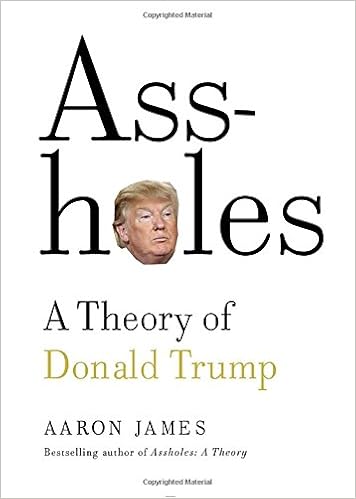
Assholes: A Theory of Donald Trump ( Anchor Books / Doubleday) The name of the book may put you off but the concepts within are worth it. Neither left nor right, it is a book for those who wish to understand the Trump phenomenon. There is more to this than Trump, there is also an element of devolution within our system which is revealed to have opened the door to someone like trump.) The name of the book may put you off but the concepts within are worth it. Neither left nor right, it is a book for those who wish to understand the Trump phenomenon. There is more to this than Trump, there is also an element of devolution within our system which is revealed to have opened the door to someone like trump.


The name of the book may put you off but the concepts within are worth it. Neither left nor right, it is a book for those who wish to understand the Trump phenomenon.
There is more to this than Trump, there is also an element of devolution within our system which is revealed to have opened the door to someone like trump.

Almost everyone now knows that Donald Trump is an asshole. Much to his credit, Aaron James pointed this out in Assholes: A Theory (Anchor Books 2012) well before Trump took center stage in American politics. In his new book, James sets out to develop this idea in greater detail. According to the back cover, the book does not ask whether Trump is an asshole. This much is assumed. Instead, it raises the further question: What sort of asshole is Trump? As such, the book is presented as a contribution to what the author calls “assholeology”.

Readers will quickly learn that the book covers much more than this. Only the introduction and the first chapter are, properly speaking, exercises in assholeology. Even the first chapter, “The Ass-Clown and Asshole”, is more about offering a general theory of Trump’s person than a strict examination of his assholery, and the final three chapters not only ask whether having an asshole like Trump for president is a “sound proposition”, they also point to the larger problem of what James calls “asshole political capitalism”.

James begins the work by recapping the definition of the asshole he developed in his first book. On this view, the asshole has three essential features: First, he – James notes that assholes are mostly men – “allows himself special advantages in social relationships in a systematic way”; second, he is “motivated by an entrenched (and mistaken) sense of entitlement”; and third, he is “immunized against the complaints of other people”. Although James presents these as three separate yet equal features of the asshole, the entrenched sense of entitlement seems to be the causal mechanism behind the asshole’s systematic privileging of himself as well as his immunity to the criticisms of others. So understood, an asshole might simply be someone with an entrenched sense of entitlement.

James claims that Trump is – like Ted Cruz – an asshole in this sense, but “being an ass-clown is Trump’s distinctive style of assholery”. According to James, the ass-clown “is someone who seeks an audience’s attention and enjoyment while being slow to understand how it views him”. Much like a man who chases women to flatter his own ego, Trump chases the electorate “to affirm his worth by being seen as powerful, the center of attention”. To win the affections of this lover, Trump must become a showman. Like a clown, he seeks to entertain, but like an ass, Trump fails to understand that he is the clown. For these reasons, James classifies Trump as an ass-clown.

Although there are good reasons for thinking that Trump is an asshole so defined, two aspects of James’ analysis seem to conflict with this generally agreed upon premise. First, despite the common term “ass”, ass-clowns and assholes appear to be distinct and mutually exclusive types. Whereas the asshole’s immunity to criticism implies that he has little concern for the opinion of others, the ass-clown seeks the affection of others and so seems to lack the asshole’s innate sense that he is something special. Second, James eventually backpedals on his promise – implicit in the title – to offer “a theory of Donald Trump”. Because Trump is so many things – showman, bullshitter, racist, sexist, civically oblivious, authoritarian, demagogue – James concludes that there is no “real” Trump. But if there is no “real” Trump, Trump cannot really be an asshole. In contrast, the various aspects of Trump’s person that James identifies seem to be explained by a single fact: he really is an asshole!

Chapter two, “A Force for Good?”, raises the question of whether an asshole like Trump is really good for our democracy, and James presents the interesting thesis that many value Trump as an über-asshole capable of managing all the other assholes – like Ted Cruz and Chris Christie – that inhabit the political sphere. Nevertheless, James proceeds to claim in chapter three, “The Strongman”, that an asshole president “will only further unravel the soft fabric of cooperation upon which our experiment is premised”, and he devotes the final chapter, “Saving the Marriage”, to exploring ways that we might rescue our democracy from the proliferation of assholes.

There is much in James’ work that will interest the philosophically inclined reader, and he should be applauded for bringing philosophical theories to bear directly on contemporary issues. However, readers may question some of the specific moves James makes along the way. For instance, he often appeals to Hobbes and Rousseau to unpack a number of his ideas but in ways that do not always fit his argument. On the one hand, James claims that the aforementioned “strategy of asshole management” can be traced back to Hobbes. However, there seems to be an important difference between a proto-fascist über-asshole and Hobbes’ absolute sovereign: whereas the former rises to power by crushing opposition and promising benefits to a certain in-group of supporters at the expense of others, the latter is largely established through a consensual and mutual transfer of rights for the benefit of all.

On the other hand, James’ claim that the asshole suffers from an inflamed sense of Rousseau’s amour-propre seems to be misguided. Whereas amour-propre instils in us a burning desire to appear well and be regarded as superior in the eyes of others, the asshole, again, is not particularly concerned with how others regard him. This is because he recognises himself as superior and treats others accordingly. If anyone suffers from amour-propre in James’ analysis, it seems to be the non-asshole who resents the way in which the asshole refuses to recognise him or her as a person worthy of equal respect.

In the end, there is much to be said for a central thesis that runs throughout the final chapters of James’ work: the ethos of capitalism breeds a culture of assholes that, in turn, threatens the moral and social fabric essential to a healthy democracy and a well-functioning economy. Nevertheless, Assholes: A Theory of Donald Trump is a work written quickly for a popular audience in response to current events, and so the aforementioned thesis deserves more serious reflection than this book provides. Although James covers some of this ground in his first book and I encourage interested readers to consult it, the history of philosophy may have more to say about the asshole than James’ writings thus far suggest. Critical treatments of asshole-like psychologies by Plato – the tyrant of Republic IX – and Aristotle – improper self-love in the Nicomachean Ethics – as well as arguably more positive assessments by Hume – “Greatness of Mind” in A Treatise of Human Nature – and Nietzsche – the “nobles” of the first essay of On the Genealogy of Morality – immediately come to mind, and we would do well to turn to these resources in thinking about assholes more generally and the ever-increasing threat that one particular asshole poses to our democracy.

The rise of the American asshole is a serious issue, and we should not only thank James for drawing our attention to it, but also hope that his most recent work stimulates further conversation among both philosophers and the broader public alike.

Sunday, May 21, 2017

Fake news and its corrosive impact on western democracy :Post-Truth: The New War on Truth and How to Fight Back (Ebury Press, £7.99) by Matthew d’Ancona for £6.79, Post-Truth: How Bullshit Conquered the World (Biteback Publishing, £9.99) by James Ball for £8.49 or Post-Truth: Why We Have Reached Peak Bullshit (Little, Brown, £20) by Evan Davis for £17


If the medium is the message, then the message of the web is “bullshit”. Long before today’s crisis, the American philosopher Harry Frankfurt broke from the conventions of a discipline not known for its plain speaking and explained Donald Trump, Boris Johnson, Andrew Wakefield, the Canary, Breitbart, Putin propagandists, Holocaust deniers, climate change fantasists, truthers, birthers, Salafists, sexbots and Mr Michael Gove of the London Times.


Liars respect truth in their way, wrote Frankfurt in his 2005 essay On Bullshit. They care about it enough to know what the truth is and find ways to suppress it. Bullshitters are more dangerous. They neither know nor care whether what they say is true or false, only whether they can advance their interests by fooling the gullible.


Trump’s victory is the bullshitters’ apotheosis. Whether the west can survive the corruption of its leading nation is unknowable. But we already know that the events of 2016 have led to our assumptions about how “mature” democracies work unravelling. What is mature, after all, about American or British democracy, when both prefer bawling charlatans to uncomfortable truth-tellers?


The crisis is apparent in the publication of three books in one week all called Post-Truth, all analysing bullshit and all infused with the spirit of WH Auden’s grim lines from September 1, 1939: “Defenceless under the night/ Our world in stupor lies.”


The authors try to come to terms with the consequences of the web, where no gatekeepers insist you pay the price of accuracy before publishing and lies are given the same status as truth. After that, they diverge, as they must. For asking why we believe lies raises vast questions about human psychology and history, which did not appear from nowhere in 2016 or emerge with the invention of the web. Meanwhile, asking why we must worry about cognitive biases now raises equally pertinent questions about how recent history has seen a collapse in faith in the rational ordering of society.


To anyone who is invigorated by urgent writing, Matthew d’Ancona’s work is as startling as a cold shower. His book, which surely announces his arrival as a first-rate essayist, is just 176 pages but manages to convey a super-abundance of learning without breaking into a sweat.


Trump stalks his pages like an orange panther. But as d’Ancona acknowledges, the least interesting thing about Donald Trump is Donald Trump. Rather, the triumph of “the visceral over the rational, the deceptively simple over the honestly complex” that Trump’s victory represented demands our attention. He does not believe the populists’ rise to become our new elite will ensure their downfall when they fail to deliver on their promises. I do not share his pessimism. If America and, more particularly, defenceless Britain can find a competent opposition to nail them, ​US journalist Salena Zito’s observation that Trump’s voters took him “seriously but not literally” may not be the last word on his presidency, particularly if he takes away their healthcare. But to date there is little evidence of a reckoning. As d’Ancona says, the Brexit campaign’s direct lie that a vote to leave the EU would provide £350m a week for the NHS has not hurt Leave politicians, who are flourishing today like weeds in a well-manured bed.


His explanations for the current crisis do not stay in the world of Amos Tversky and Daniel Kahneman. However brilliant their work on cognitive biases, it cannot explain why demagoguery triumphs now when it did not triumph in the past. The immediate causes of the collapse in faith in institutions are well understood: the decision to force the public to bail out the banks without prosecuting the bankers destroyed the assumption that the upholders of the status quo possessed even the vaguest notion of natural justice.


Davis's care and his determination to make complicated ideas accessible show why he is such a good broadcaster

Given their opportunity, demagogues can now fight in a rigged match. As Trump, Putin and Gove know, the experts they target are unlikely to fight back or even know how to fight back because they abide by the code of intellectual honour. The American climate change denier Marc Morano explained with relish: “You go up against a scientist, most of them are going to be in their own policy wonk world or area of expertise: very arcane, hard to understand, hard to explain and very boorring.”


The appeal of false narratives fills James Ball’s book. He may be the least well known of the three authors, but​he does not deserve to be the least read. Better than anyone I know, Ball explains how the economics of the web is destroying the possibility of financing serious news and raising the question ​of ​whether readers want a cautious fact-checked article when it is cheaper and much more profitable to follow Breitbart, the Express or the Canary and whack out clickbait, which is anything but “boorring”.


Political books by broadcasters usually fail, not because users of the spoken word can’t write, but because the impartiality rules stand in their way when they should be following ideas to their conclusion. But although the orange panther stalks his pages too, Evan Davis tackles bullshit by largely eschewing politics and producing a measured account of irrationality in economics. His care and his determination to make complicated ideas accessible show, above all, why he is such a good broadcaster.


Davis ends with the BBC-ish conclusion that in the end truth will out, good government will reassert itself and all will be well. D’Ancona ends with a rallying call to defend democracy from those who would turn it into a Putinesque paradise for liars and grafters. As a natural optimist, he finds hope even in the universities, where Trump’s intellectual ancestors in the postmodern movement have been replaced by philosophers who understand that the relativist doctrine “There are no facts, only interpretations” inevitably leads to the conclusion: “The reason of the strongest is always the best.”


A backlash against the backlash is in order, of course. Every generation must refight the battles of the Enlightenment. Our age has had more than its fair share of battles. First, it had to fight armed Islamism and must now fight its reactionary twin, white nationalism. But before we become too bellicose we must understand many do not want to fight. Scientists and medics, for example, are getting out of British universities rather than waste their lives there.


Most of us in Britain and America cannot and do not want leave. We have no choice but to stay and fight. No one should be in any doubt that the struggle will be long. When and if we get through to the other side, we will not be the same people we were yesterday.

Monday, May 15, 2017

Two rotten peas in a pod .The Nixonization of #OYVeyDonaldTrump ......The Plot to Scapegoat Russia: How the CIA and the Deep State Have Conspired to Vilify Putin Paperback – June 6, 2017 by Dan Kovalik ( Sky House Publishing) ;Richard Nixon: The Life Hardcover – March 28, 2017 by John A. Farrell ( Doubleday);The Gatekeepers: How the White House Chiefs of Staff Define Every Presidency Hardcover – April 4, 2017 by Chris Whipple (Crown);Washington Journal: Reporting Watergate and Richard Nixon's Downfall 1st Edition by Elizabeth Drew ( The Overlook Press);All the President's Men Reissue Edition by Bob Woodward (Author), Carl Bernstein (Simon & Schuster); In the Shadow of the White House: A Memoir of the Washington and Watergate Years, 1968-1978 Hardcover – May 16, 2017 by Jo Haldeman (Author), Evan Thomas (Introduction)(Rare Bird Books);Nixon's White House Wars: The Battles That Made and Broke a President and Divided America Forever Hardcover – May 9, 2017 by Patrick J. Buchanan ( Crown);Enemies: A History of the FBI Paperback – February 26, 2013 by Tim Weiner ( Random House)


.


We’re barely into the Trump administration and we’ve had war on the press, electronic eavesdropping, a sacked attorney general, humongous demonstrations, fury over a Democratic National Committee break-in, Cold War­­–style skirmishes, and scandalous intrigues akin to Watergate.

Sound familiar?

“Imagine packing 6 yrs of the Nixon admin into 3 weeks,” tweeted Nicole Hemmer, a scholar from the University of Virginia’s Miller Center (and Vox columnist), in February. “It’s like Nixon speed-dating.”

Veteran hands like Dan Rather, Bill Moyers, John Dean, and William Kristol have joined youngsters like Rachel Maddow in drawing parallels between Richard Nixon and Donald Trump.


As the author of a new biography of Nixon, I get asked — a lot — how I plotted the book’s release to coincide with the surge in discussion, in the press and social media, of similarities between the disgraced 37th president of the United States and his latest successor, Donald Trump.


Having lived the past six years with Nixon in my head (I seek no pity; just buy the book), I approach the idea of comparing the two leaders with caution and restraint, for there are important differences.

As bad as Nixon was, for example, he never embraced white nationalists, much less sat one on his National Security Council. Nixon supported every major civil rights bill in the 1960s, and may have lost the 1962 gubernatorial election in California as a result of his spirited denunciation of the John Birch Society, the alt-right wack jobs of their day. “It was time to take on the lunatic fringe,” he wrote to Dwight Eisenhower.


Which is not to cast Tricky Dick as a saint. Fallacious comparisons cut both ways. When Trump dismissed acting Attorney General Sally Yates, a Justice Department holdover from the previous administration, for declining to defend his executive order on immigration, the episode was immediately compared to Nixon’s “Saturday Night Massacre.” But Trump’s move hardly rates with Nixon’s. The stakes were far higher in 1973, with war in the Middle East, a nuclear alert, and the resignation of a corrupt vice president as a backdrop. Nixon’s own attorney general and his successor resigned over principle after refusing to fire the Watergate special prosecutor, before Solicitor General Robert Bork stepped in to do the deed.

So restraint keeps me from overstating the echoes. But then Trump will produce a performance like his rambling, combative February 16 press conference (“Russia is fake news!”) so rich with “narcissism, thin skin and deeply personal grievances,” as NBC’s Brian Williams put it, that the analogies with Nixon’s piteous “last press conference” of 1962, or his Watergate-era clashes with the media, are insistent and appropriate.

And finally, perhaps inevitably, Trump himself joined the game: He alleged that Barack Obama had bugged Trump Tower in an act worthy of “Nixon/Watergate.” (You want to see your book sales leap on Amazon? Have POTUS tweet your topic.)


Why is Nixon the go-to model for presidential misbehavior? For one thing, he is deeply embedded in our lives and culture. The only president to resign in disgrace was famously polarizing long before Watergate. This red-baiter from Southern California was the point man for McCarthyism, earning the eternal enmity of postwar liberals.

In the swinging ’60s, he was the stodgy self-made man: the square in the age of hip. As such, Nixon was a model for Mad Men’s Don Draper and, after stretching out the Vietnam War for four additional years, his reign helped inspire the evil Galactic Empire in Star Wars (according to George Lucas). He may not be the subject of a hip-hop Broadway musical, but he has served as the central figure in an opera (Nixon in China) and played the villain in the X-Men and Watchmen movies.It took Nixon a while to provoke protests like these. Andrew Caballero-Reynolds / Getty

On the other hand, some two-thirds of the current American population were either not alive or not residents of the United States, when Nixon resigned in 1974. In my Nixon biography, and in what follows, I’ve tried to portray this oft-caricatured scoundrel, in all his glories, for Gen X-ers and millennials who may know him only as the disembodied head on Futurama.

Thinking through the points of similarity between Nixon and Trump, and where they differ, may help us to better understand both men.
Psychobiography — correlation: modest

The differences in their upbringing — Trump came from a wealthy home in New York, Nixon from the California outback and a family wracked by illness, death, and poverty — make any comparison between the two men on this score somewhat strained. Yet both are known for self-centered, narcissistic personalities — and these, perhaps were sired by the emotional austerity of their childhoods. Trump exhibits insecurity, harbors grandiose fantasies, and shows a tetchiness about criticism. So did Nixon.


The Nixon home was known for its physical and emotional severity. Frank Nixon was a crotchety and abusive dad described, by a nephew, as “a highly acquisitive person and a slave driver” who “worked all his children and he worked his wife.” Nixon’s mother, Hannah, a devout Quaker, gave the future president his sense of idealism: He really did want to bring peace to the world. But she was preoccupied with his four brothers, two of whom died as youths, and the demands of the family store. Dick craved her approval, but she never, as Nixon famously confessed, told him that she loved him.

Historians tread lightly when it comes to psychobiography, but Nixon’s career “vindicates one of that maligned genre’s most trustworthy findings: The recipe for a successfully driven politician should include a doting mother to convince the son he can accomplish anything, and an emotionally distant father to convince the son that no accomplishment can ever be enough,” wrote Rick Perlstein in Nixonland.

Much of that may apply to Trump. As biographers Michael Kranish and Marc Fisher describe him in their book, Trump Revealed, the president’s father, Fred Trump, was also a disciplinarian, a workaholic, and a skinflint. At 13, Donald was culled from his family and exiled to military school as a disciplinary remedy. It may not be unreasonable to suggest that, like Nixon, Trump has spent his life seeking to fill an emotional void.
The press — correlation: high

It is no accident that both Nixon and Trump are famous for waging war beyond reason with the press. In men with their backgrounds, criticism may be interpreted as rejection, ripping the scabs from old psychic wounds and inducing emotional pain and hostility.

It’s also no small irony that each was quite successful at courting the press in their early years. Nixon was a protĆ©gĆ© of the Chandler family, which owned the then-right-wing Los Angeles Times and promoted Nixon’s career through the simple tactic of imposing news blackouts on his opponents. Trump was a dealmaking playboy in New York’s tabloid jungle. The experiences left both men spoiled by the media’s fawning, cynical about its professed values, and reckless with the truth.Trump surveys the “enemy of the people.” Mark Wilson / Getty

Trump’s well-documented disregard for veracity was well matched by Nixon’s: He lied repeatedly about Vietnam and Watergate as president. When announcing that he was dispatching troops to invade Cambodia, Nixon solemnly assured the nation that the US had been scrupulous, to that point, in observing that poor country’s neutrality. In fact, he had been bombing Cambodia, secretly, for a year.


Nixon was as brash about his lying as Trump. On one occasion, when he thought the camera had stopped filming, Nixon told an interviewer how he had inserted a crude obscenity into a quote from Lyndon Johnson, because it made for a more colorful story — and portrayed Johnson as a vulgar bumpkin. When his aides could not find the chopsticks he used during his famous trip to China, Nixon told them to use any pair for a museum display, as the public would never know the difference.

Striving to maintain control, Trump rages over leaks. Nixon, too, confessed to being “paranoid” about leakers, and famously declared: “The press is the enemy.” Trump has friends in some corners of the media, and his declaration of war may be cynical and manipulative. For Nixon, the hate was real.

Trump, erupting in nocturnal tweets — emissions quite similar to those captured on Nixon’s White House tapes, except that they are instantaneously blasted out to tens of millions of Twitter fans — has taken it further. The press is not just his enemy, he tweeted, but the “enemy of the American people.”
Their politics — correlation: modest

Trump and Nixon both rode the politics of grievance — particularly white grievance — to the White House.


“I am your voice,” Trump told the disaffected electorate of the South, West, and Midwest, who responded by giving him an Electoral College majority. In his speeches, Trump called for the return of “law and order,” just like Nixon in 1968. “The silent majority is back,” Trump said, identifying his voters precisely as Nixon did. “We are going to take the country back.”

The division between coastal elites and the heartland is a hardy theme in American political history — the tension between frontier farmers and the Founding Fathers led to open rebellions in 1787 and 1791. In crises, the country draws together, then the old divisions reemerge in times of peace.

The gulf yawned after World War I, when the carnage of industrial warfare and the doctrines of scientific and moral relativity inspired a fundamentalist response in the midlands. Americans came together during the Second World War, but the rifts reappeared thereafter. In 1946, a young Navy veteran, running as a Republican, unseated a New Deal Congress member in rural California with a campaign that promised, “Richard Nixon Is One of Us” — not one of the pointy-headed pinko elitists running things in Washington.

Arriving in Washington, as a member of the House Committee on Un-American Activities, Rep. Nixon embraced journalist Whittaker Chambers, a reformed communist agent, and went to war with the establishment by identifying one of the New Deal’s golden lads, the former diplomat Alger Hiss, as a Soviet spy.

It was “an epitomizing drama,” Chambers wrote in his memoir Witness, a book that would become a bible for the conservative movement. There was “a jagged fissure” between “the plain men and women of the nation and those who affected to act, think and speak for them … from their roosts in the great cities, and certain collegiate eyries.” The left “controlled the narrows of news and opinion,” Chambers wrote, but “my people, humble people, strong in common sense, in common goodness” were led and inspired by Nixon — “the kind and good.”


Nixon used the Hiss case as a launchpad to the Senate, and then to a spot as Eisenhower’s running mate. He survived a brush with scandal over a campaign slush fund filled by wealthy businessmen with a now-legendary televised address, in which he made memorably mawkish mention of his mortgage, his wife’s cloth coat, and the family cocker spaniel, Checkers.

“The sophisticates … sneer,” wrote columnist Robert Ruark, but Nixon’s speech “came closer to humanizing the Republican Party than anything that has happened in my memory. … Tuesday night the nation saw a little man, squirming his way out of a dilemma, and laying bare his most private hopes, fears and liabilities. This time the common man was a Republican.”

That was 1952. Long before the ’60s, the culture war was raging. The ’50s were “the Nixon years,” columnist Murray Kempton would write, when “the American lower middle class in the person of this man moved to engrave into the history of the United States, as the voice of America, its own faltering spirit, its self-pity and its envy, its continual anxiety about what the wrong people might think, its whole peevish resentful whine.” And so Trump and his legions follow Nixon down a well-worn path in American politics.

However, there is one significant difference in how Nixon and Trump got elected. As circumstances had it, in all three of Nixon’s campaigns for the presidency —against John Kennedy’s “New Frontier” in 1960, amid the chaos of 1968, and against George McGovern in 1972 — he ran as the candidate of moderation, of calm and experience. His speeches were generally soothing.

A young Navy officer named Bob Woodward cast his vote for Nixon, convinced he was the candidate who could end the Vietnam War. Even Hunter S. Thompson bought in.


“For years I’ve regarded his very existence as a monument to all the rancid genes and broken chromosomes that corrupt the possibilities of the American Dream; he was a foul caricature of himself, a man with no soul, no inner convictions, with the integrity of a hyena and the style of a poison toad,” Thompson wrote in 1968. But “the ‘new Nixon’ is more relaxed, wiser, more mellow.” Nixon’s were campaigns, as the political scientists Richard Scammon and Ben Wattenberg put it, of “social stolidity.”

Trump is anything but stolid.
Monkey-wrenched elections — correlation: high?

It is a testament to the efficacy of the Republican cover-up that four months after a foreign power affected — may even have determined — the outcome of an American presidential election, we still don’t know the facts. The timidity of the electorate, permitting Congress to let this pivotal question go unanswered, is stunning.

Anna Chennault was Nixon’s secret liaison with the South Vietnamese government before the 1968 election. The extent of President Trump’s possible contacts with a foreign government before the 2017 election has come under scrutiny. Ira Gay Sealy / Getty

From what we do know, it is safe to say that the Russians sought to influence the outcome of the 2016 election, in favor of Donald Trump. We don’t know how or if he and his advisers, in contacts with Russian officials, acted to further the illegal hacking of Democratic organizations and officials. We know that Trump publicly encouraged the Russians to do so (though whether this was a serious request or a glib comment is debatable). This has been written off, like several such misdeeds, as “Trump being Trump.”

In Nixon’s case, it has taken almost half a century for the truth to come out about the 1968 election — about his own conspiring with a foreign power, and the steps that he tookto affect that year’s outcome.

Nixon feared that Lyndon Johnson’s election year initiative to negotiate an agreement that would bring an end to the Vietnam War was nothing more than an “October Surprise” designed to elect Vice President Hubert Humphrey. (LBJ had pulled such a trick in the off-year elections of 1966.) And so Nixon employed a campaign official, Anna Chennault, to act as a go-between and persuade South Vietnam to drag its feet and scuttle peace talks with North Vietnam. He — and she — promised the South Vietnamese better terms if Nixon won.

Tragically, peace was indeed close at hand in 1968. The Soviet Union, wanting to promote Humphrey, had promised Johnson a “breakthrough” in the talks and vowed to pressure North Vietnam. But Nixon’s attempts to monkey-wrench the talks were successful. In a telephone call to Sen. Everett Dirksen, a bitter LBJ, who had been getting details of Nixon’s machinations from electronic eavesdropping conducted by US intelligence agencies, accused Nixon of “treason.”

(Trump has offered no evidence for his claim that his campaign was “tapped” by President Barack Obama last fall, but there is no doubt that LBJ was eavesdropping on Chennault, a Nixon campaign official, in her discussions with the South Vietnamese Embassy in Washington.)

There is a law — the Logan Act — that makes it illegal for a private citizen to interfere in the foreign affairs and diplomacy of the United States. Nixon appears to have crossed that line; without more facts, we cannot say that Trump did too.
The deep state — correlation: modest

Like Julius Caesar, cut down by Brutus and a gang of conspirators, Richard Nixon fell victim to a coalition of mutinous forces. He had clashed repeatedly with Congress over its power to declare war, to appropriate funds, and to have access to presidential documents and tapes. He declared war on the press. His antipathy for the State Department, the CIA, the military brass, and other power centers was well-known, and his reliance on backchannel diplomacy with China and the USSR spurred the Joint Chiefs of Staff to plant a spy in the White House. Nixon may also have alienated the federal judiciary by pledging to end its lifelong terms and security.


Follow

Donald J. Trump
✔@realDonaldTrump


How low has President Obama gone to tapp my phones during the very sacred election process. This is Nixon/Watergate. Bad (or sick) guy!
2:02 PM - 4 Mar 2017

53,28553,285 Retweets
163,779163,779 likes


The FBI offers an instructive test case on what Nixon’s rash antipathy yielded. Nixon had come to power in Washington with the help of Director J. Edgar Hoover, but after Hoover died, the president provoked the bureau by trying to install a Nixon loyalist as a replacement. “Deep Throat” — the legendary anonymous source for Washington Post reporters Carl Bernstein and Bob Woodward — was Mark Felt, a deputy director that Nixon passed over when choosing Hoover’s successor.

Trump has been tormented by leaks he blames on Obama holdovers in the national security agencies and other entrenched bureaucracies. Trump profited during the campaign from FBI Director James Comey’s eleventh-hour revelation about Hillary Clinton’s emails. But Comey was reportedly outraged by Trump’s allegation that Obama tapped Trump’s headquarters during the campaign and, according to leaks, demanded a public repudiation of the imputation. (And now, of course, Comey has been fired.)
Scandals — correlation: to be determined

There are more than half a million responses to a Google search for Trump and Watergate. But as much as his critics hope to see the 45th president exit the White House like Nixon, we have a long way to go before “Russiagate” is reasonably equated to Watergate.

There are obvious parallels. Both scandals stem from break-ins at the Democratic Party headquarters, whether real or virtual. Both involve electronic eavesdropping. And credit must be given to Roger Stone, a minor figure in the Watergate wars, who managed to survive the decades since and surface once more in the Russiagate stew.

Yet Nixon had years to dig his grave, and the Watergate scandals were, as Woodward and Bernstein famously wrote, “a massive campaign of political spying and sabotage.”

The DNC headquarters at the Watergate were one of a half-dozen targets for burglary and/or bugging, including the campaign headquarters of Sens. Edmund Muskie and George McGovern and the offices of the psychiatrist who treated Daniel Ellsberg, leaker of the Pentagon Papers. By the time Nixon resigned, Watergate was a vast umbrella. The scandal brought to light subsidiary issues — like whether Nixon shortchanged the Treasury on his income taxes, and used taxpayer funds to protect and improve his Florida vacation home — that have obvious correspondence to Trump’s behavior.

But there will have to be some remarkable revelations — proof that Trump and his aides offered inducements to the Russian hackers — before Russiagate can be compared to Watergate. On the other hand, if it is proven that the Trump campaign, in league with a foreign power, stole the White House, it could supplant Watergate as the greatest political scandal of them all.

After President Donald Trump fired FBI Director James Comey on May 9, a historical comparison was invoked with renewed vigor: His actions, many said, were Nixonian. While the letters from Trump’s Deputy Attorney General Rod Rosenstein and Attorney General Jeff Sessions about Comey’s conduct made no mention of the FBI’s ongoing investigation of Russian interference in the 2016 U.S. election, politicians and pundits of all political leanings expressed concern. President Richard Nixon, of course, fired the special prosecutor investigating his Administration’s involvement in the Watergate burglary. Three days later, Congress was flooded with resolutions to impeach him.

***

The comparisons between Trump and Nixon are not new. But beyond that basic and broad similarity, the specific differences and similarities do potentially provide some useful understanding of what is happening.

The People Fired Were Both Accused of Politicking

When Nixon hired Archibald Cox as a special prosecutor, he did so despite Cox’s history serving under Democrats. Cox had been President John Kennedy’s Solicitor General. He also headed the Wage Stabilization Board under President Truman, but resigned on principle after Truman acted against his advice.

“He was viewed as an upright Boston Brahmin,” said Duquense University President Ken Gormley, who wrote a 1997 Cox biography titled Conscience of a Nation. Eliot Richardson, the Attorney General who Nixon hired after the Watergate revelations felled several members of his staff, told Gormley that when Nixon balked at the idea of hiring Cox, he told Nixon something to the effect of: “Archie Cox would just as soon cut off his right arm before he did anything improper or inappropriate,” Gormley said.

But that did not shield Cox. Mere months later, as Nixon advisor Pat Buchanan told TIME, “I recommended that [Nixon] burn the tapes and shut down the prosecutor’s office.” His reason? “It was quite obvious what [the investigation] was: It was a partisan, vindictive effort to get Nixon.”

Trump inherited Comey, whose apolitical bonafides have been questioned for months now — though less by Trump allies than his opponents, who accused Comey of turning the election for Trump by publicly commenting on the investigation into Hillary Clinton’s private email server. The Administration later adopted a similar position that Comey has been irreparably politicized, and the President has touted his opponents’ old complaints about Comey as evidence.
The Justice Department Backed Trump

Nixon could not turn to his Attorneys General for support in firing Cox. Both Richardson and his deputy resigned on October 20, 1973, instead of firing Cox themselves. That evening, known as the “Saturday Night Massacre," still outnumbers the scale of the Comey firing. Third-in-command Solicitor General Robert Bork eventually executed Nixon’s wishes.

Today, current Attorney General Jeff Sessions, who recused himself from the Russia investigation, recommended in a letter to the President that he “remove” Comey “and identify an experienced and qualified individual” to take his place. His deputy Rod Rosenstein concluded in a letter to Sessions that “the decision should not be taken lightly” but that “the FBI is unlikely to regain public and congressional trust until it has a Director who understands the gravity of the mistakes” Comey made in the handling of the investigation of the email inquiry.

The Washington Post has reported, though, that Rosenstein threatened to resign after seeing the White House's narrative largely credit him with the idea of firing Comey.

Trump Did Not Expect the Reaction

Recent reports say that Trump was surprised by the blowback he received for his decision. He now faces a hostile media and a hostile Congress (now distracted from any shared legislative goals) — neither of which were utterly inclined to accept him.

“When I went to dinner that night with my wife and some friends, I walked in and said, ‘There’ll be impeachment resolutions in on the House on Tuesday,’” says Buchanan, who has a chapter on the Saturday Night Massacre in his new book, Nixon’s White House Wars.

“Trump and Nixon faced the same enemies,” Buchanan continued. “Basically, you’ve got a media and a political elite, which were trying to bring them down…. Similar forces are trying to bring down Trump and you’re getting somewhat of the same hysteria. But this to me looks like it’s going to pass very quickly.”

“There’s a whole lot of people who say Trump should have done it sooner, and others who say, ‘Well, it’s just a cover-up,’” Buchanan said. “But it’s a much less grave and less serious matter.”

Investigations Will Continue

The target of the investigation Nixon attempted to skirt was obvious: He did not want the private recordings of a president made public, because he said it would threaten national security. His path to achieving this was straightforward: Shut down the investigation.

By the time he fired Cox and his team, the case was already in the courts — meaning that Nixon had an opportunity to evade the outcome. “Half of the constitutional scholars in the country thought he might win,” says Gormley. “It was a toss-up whether the President did have that kind of absolute executive privilege to keep these kinds of things secret in order to carry out his job.”

Yet even with those much narrower confines, Nixon failed. He was forced into hiring a new special prosecutor, who eventually won out in the courts. Within less than a year, he was no longer president.

The investigation into potential Trump collusion is far younger — in part, as former FBI agent Michael German wrote for TIME, because of Comey. It’s also more diverse, though the FBI’s investigation has long been considered the most viable.

Though this doesn’t mean that the Trump investigation is protected from the President’s influence. “The President is the head of the Executive Branch,” Gormley says Nixon proved. “In the end, he can get a person who will do his bidding.” For Nixon, that was Bork. For Trump, the fear is it will be whomever he puts in Comey’s place. And unlike Nixon, he faces a Congress led by his own political party.

Meanwhile, with Sessions recused, Rosenstein, a relatively new Trump appointee, still maintains a great deal of control over what is to come. (Comey had only days prior requested more resources for the process.) And while Rosenstein entered the post with a commended reputation, so did Archibald Cox.

The Times Have A-Changed

On Jan. 24, 1974, Cox wrote an op-ed in the New York Times that may as well have been about the current atmosphere: “Regardless of the outcome, the value of the proceeding will depend on whether the process is so conducted that the country perceives it as a fair and legitimate measure for restoring integrity to government.”

Yet there are also familiar concerns about whether an entire country will agree on fairness and legitimacy. “The country is irretrievably divided now—culturally, socially, morally, politically, ideologically,” says Buchanan now. “And you’ve got some demonstrations, and some of them are turning violent in places.” But he maintains: “Look, we’re not in the sixties now. We had 250,000 guys on the Monument grounds and buses surrounding the House. We’re not there yet.”

Friday, May 5, 2017

#OyVeydonaldTrump's education of Andrew Jackson or is that supposed to be the other way round.Avenging the People: Andrew Jackson, the Rule of Law, and the American Nation 1st Edition by J.M. Opal (Oxford University Press); Jacksonland: President Andrew Jackson, Cherokee Chief John Ross, and a Great American Land Grab Paperback – May 17, 2016 by Steve Inskeep (Penguin Books) ;Andrew Jackson's Presidency: Democracy in Action (Spotlight on American History) Paperback – August 15, 2016 by Steve ;(Powerkids Press)


This combination photo shows President-elect Donald Trump and former U.S. President Andrew Jackson. Damon Winter—

It was dusk on Monday, Sept. 3, 1827, when the party from South Carolina drew up at the Hermitage, Andrew Jackson’s plantation near Nashville. One of the travelers, a young woman named Julia Ann Conner, left a diary account of her surprise at finding that Jackson, whom she had expected to be a wild backwoodsman with a dictatorial bent that led his opponents to call him an American Bonaparte, was in fact nothing of the sort. He was, she recorded, a “venerable, dignified, fine-looking man, perfectly easy in manner.” The Hermitage was filled with history. A brace of pistols that the Marquis de Lafayette had given to George Washington were on the mantelpiece, a gift to Jackson from the Washington family. “They are preserved with almost sacred veneration,” as was a small pocket spyglass of the first President’s, Conner wrote. And most important, the visitor benefited from her host’s help during a game of chess. An “excellent player,” Jackson “frequently directed my moves—apparently much interested in the fate of the game ... there were no traces of the ‘military chieftain’ as he is called!”

This sketch of Jackson the tactician—a player of chess, a game that rewards careful thought and foresight—explains much about his character. He could at times seem reckless, but more often he played the games of politics and war with skill and patience. And Conner was surely right when she observed that Old Hickory was “much interested in the fate of the game”—he was always interested in the fate of the game, or of the battle, or of the vote. She had detected something deep and fundamental about Jackson in her days under his roof: he was more than a frontier politician or a mindless populist rabble rouser. His enemies—and much of posterity—never quite understood that the largest fact about Jackson was not a problem with his “passions” (or temper, in contemporary terms) but his ability, more often than not, to govern them and harness the energies that would have driven other political figures to ruin.

With Donald Trump’s rise to power as America’s 45th President, those in search of an illuminating analogy have frequently cited the example of the seventh. Steve Bannon, now Trump’s senior White House strategist, has made this explicit, arguing that the Trump revolution is akin to Jackson’s populist insurgency in the 1820s and ’30s. There are, of course, surface similarities. Both movements gained popularity based on freeing the country from established, ossified interests with a promise to return the nation to greatness (in Trump’s formulation) or to Jeffersonian republican simplicity (in Jackson’s). Both startled the existing order (the Clintons and the mainstream media in Trump’s case; John Quincy Adams and Henry Clay in Jackson’s). And both had powerful personalities at the head of the ticket.

There is, however, an essential difference, one that will tell us much about the coming years in U.S. life and politics. For all his bombast, Jackson was an experienced public figure—he had served as a judge, a Senator and a general—who understood his weaknesses and took care to compensate for them. He could thunder and storm; he was prone to fits of rage and temper. Yet he was self-aware, and with that came a kind of self-restraint. He was, as his visitor to the Hermitage noted, as at home with a chessboard as he was with charging blindly forward. We simply don’t yet know whether Trump possesses the kind of discipline 

that Jackson brought to the presidency


.

Jackson’s character and worldview reflected a genuine conviction in the ultimate wisdom of the people. He was no opportunist. He came to his populism not as a political device but as a result of his experience. Born at the lower end of white colonial society—he never knew his father, who died before he was born—Jackson had been orphaned during the Revolution yet rose through force of will and a good marriage to the slave-owning planter class. A self-made man, he saw his political mission in stark terms: to remove what he believed to be corrupting influences (the Second Bank of the United States, entrenched federal appointees, monied speculators) so that ordinary Americans—what he called “the planter, the farmer, the mechanic and the laborer”—could rise to prosperity.

Jackson could be woefully wrong. He was an unapologetic defender of slavery and the main architect of Native American removal. (Even before he was President, his many Indian wars destroyed much of tribal culture in a headlong grab for land.) In each of these instances, he was largely a creature of his time and place. This is not to excuse his culpability in the twin American sins of slavery and removal. It is to say, though, that history requires us to judge the figures of the past not by our own moral standards but by those of the ages in which they lived and worked.

Yet the Jackson example also offers us a way of assessing the moral climate and stakes of our own time. If generations past could get things so badly wrong, then we are forever vulnerable as well, and the moral utility of history may well lie in its capacity to remind ourselves that we are always at risk of falling short in the unending search to perfect the Union. That was true in the age of Jackson, and it is surely true in the age of Trump.

For another lesson of Andrew Jackson is that we have only ourselves to blame—or to credit. “Great is the confidence which he has always reposed in the discernment and equity of the American people,” Senator Thomas Hart Benton said in summing up Jackson’s presidency. “I have been accustomed to see him for many years, and under many discouraging trials; but never saw him doubt, for an instant, the ultimate support of the people ... He always said the people would stand by those who stand by them.” Such is the covenant of democracies—and the fate of that democracy lies both in the hands of the people and of the President. And now it is President Trump’s move.

Thursday, May 4, 2017

Women Who Work: Rewriting the Rules for Success Hardcover – May 2, 2017 by Ivanka Trump . Ivanka Trump Gets Real About Working Motherhood


The famous first daughter reveals how she balances both work and family—and is encouraging her employees to do the same.
By Audrey Goodson Kingo , Republished from Working Mother Magazine with permission of the author and publication

Love her or loathe her, there’s no denying that Ivanka Trump makes working motherhood look easy. And that’s pretty impressive considering that, before serving in her father’s administration as assistant to the president, Ivanka was an executive vice president of The Trump Organization—while also overseeing her eponymous line of fashion items. This mom of three stays busy.

And sure, she probably has lots of help around the house, but that doesn’t change the fact that, like all working moms, she wants to spend as much time with her kids as possible while also climbing the career ladder. No surprise then that navigating those competing priorities looks to be a big focus of her new book, Women Who Work: Rewriting the Rules for Success, which hits shelves tomorrow. (To avoid conflicts of interest, Ivanka says she will donate all proceeds to charity and is skipping the usual book publicity tour.) Fortune shared several exclusive excerpts, which largely focus on the challenges of balancing work and family.

Though the first daughter’s admittedly glamorous lifestyle is aspirational at best for most working moms, even her detractors may find themselves nodding along in understanding as she describes her struggles to balance babies and boardrooms. And it’s hard not to admire her efforts to foster a family-friendly work environment for her employees.

And maybe, like us, you'll be fascinated by the snippets that have been revealed so far:

1. She didn’t share a photo of her youngest daughter Arabella publicly until after her first birthday. That's because she worried “being a young female executive with a baby would undermine my authority in the eyes of my colleagues and peers in a very male-dominated industry.”

2. The positive reinforcement she received online from other moms encouraged her to show more of her own experience. “So many people expressed surprise and relief that I was comfortable revealing a more private side of myself,” she explains. “Especially in the first couple of years, I often heard things like, “It’s so inspiring that you’re such a hands-on mom and not intimidated to show that part of you.”

3. Work-life balance doesn’t exist even for Ivanka. “If I am negotiating a major partnership, I might work three weeks straight. If I’m planning a work trip, I know not to book something the night before I leave or after I return because I want to spend time with my family. Then I have other moments, like if one of the kids is sick, that completely change the dynamic of the day (or the week!). It’s about taking a bigger-picture approach and creating a routine that works for you and your family.”

4. During high-stress times (like when she was on the campaign trail for her father), she lets go of self-care and seeing friends. (It certainly didn't show!)

5. She doesn’t usually work from home. Ivanka says during the campaign she often worked from home—which is unusual for her—to make up for the time she was away from her family.

6. She prefers short vacations. “I sprint hard for eight to 12 weeks and then I’ll take a long weekend with the aim of resting and recovering. Taking a traditional week or two off happens much less often, but this routine works well for me.”


7. She doesn’t expect her employees to check their email at 11 p.m. “My team knows that I trust them to make the right decisions about how they allocate their time, and they would never abuse the privilege. They also know to expect e-mails from me at 11 p.m.—and that I don’t expect an answer at that hour, unless they, like me, leave early!”


Fox News Host Says She Was Banned On Air After Talking About Her Endometriosis
By Audrey Goodson Kingo
Her searing op-ed encouraged women to share their infertility stories; now she says she's being punished for her words.


8. She announces when she’s leaving to go on vacation or pick up her kids from school. “If a leader sends the message that flexibility is tolerated or even embraced, she creates an honest, supportive work environment in which other people feel it’s acceptable to acknowledge their lives outside of the office, and are inspired to go beyond what’s expected of them to deliver great results.”

9. She used to have a standing weekday lunch date with her daughter, Arabella. “By occasionally bringing my kids to the office, I’m sharing what I love to do with them but also sending the message to my team that I prioritize my family and they can, too.”

10. Arabella has her own mini desk in Ivanka’s office. “She prefers my ‘pink’ Ivanka Trump office to my real estate one, in part because it has a kids’ desk that folds out of the wall, complete with treats, toys, colored pencils and markers.”