![Trumped Up: How Criminalization of Political Differences Endangers Democracy by [Dershowitz, Alan]](https://images-na.ssl-images-amazon.com/images/I/418B0kLHA7L.jpg) In Trumped Up Professor Dershowitz demonstrates beyond any doubt that he is a man of both letters and principles. Commercially, that may prove to be the undoing of the book since the extremists on both sides of the political spectrum will find plenty to condemn. But that is exactly why this book is so important. Dershowitz has refused to buy into the binary politics that have paralyzed public debate and, in so doing, threaten democracy itself.
In Trumped Up Professor Dershowitz demonstrates beyond any doubt that he is a man of both letters and principles. Commercially, that may prove to be the undoing of the book since the extremists on both sides of the political spectrum will find plenty to condemn. But that is exactly why this book is so important. Dershowitz has refused to buy into the binary politics that have paralyzed public debate and, in so doing, threaten democracy itself.
As you would expect from a professor of law at Harvard, the writing is superb. It is concise and clear and you don’t need a Harvard degree to understand it. Dershowitz deftly avoids the jargon of both academia and political extremism. Perhaps most refreshingly, he studiously avoids the weasel words and phrases (e.g., “experts say,” “mainstream opinion,” etc.) that have destructively diluted the authenticity of political dialogue and debate today.
In discussing “corrupt motive”, for example, Dershowitz concludes, “Anglo-American law is based on precedent. What happens today can be used tomorrow. So beware of creating precedents that lie around like loaded weapons in the hands of overzealous or politically motivated prosecutors.” Simple, concise, and clear.
By definition words are imprecise. Unlike oxygen and sunshine, they are a human convention. A skillful writer or orator can use the wiggle room that always exist in their meaning to promote a position that is strongly supported, but not entirely conclusive. We can’t expect anyone of the professor’s lingual skills not to utilize those skills any more than we can expect a MLB outfielder to intentionally drop a fly ball now and again to prove he is human. But while Dershowitz races up to the warning track in a few cases he always pulls up. It would be unfair, I think, to characterize anything in this book as distorted or misleading.
My only reservation about the book is that it doesn’t always stay within the lines of its title. While he covers the criminalization of political differences in depth, he does get sidetracked from time to time in his defense of Israel and, for example, the role of Keith Ellison on the Democratic National Committee, and his past disagreements with people like John Flannery and Noam Chomsky. His positions are well-reasoned and important expansions of the public record. I only worry that they will draw attention away from the primary theme of the book.
That is to be expected from a man of principle, however. The man has the fortitude it takes for constancy. And, in the end, I applaud the professor for both his passion and his courage.
At 193 pages it is a quick read. I highly recommend it.

Why write? Philip Roth answered the question in a 1981 interview with Le Nouvel Observateur. He wrote, he said, in order “to be freed from my own suffocatingly boring and narrow perspective on life and to be lured into imaginative sympathy with a fully developed narrative point of view not my own.”
A more intriguing question: Why not write? For this is what Roth, since 2009, has chosen to do: not write. When asked to explain his decision, he has tended to summon a Bartlebyesque detachment: “I have no desire any longer to write fiction,” he told one disappointed interviewer in 2014. “I did what I did and it’s done.” He elaborated slightly a month later, in a conversation with Sweden’s Svenska Dagbladet, crediting his self-imposed silence to
a strong suspicion that I’d done my best work and anything more would be inferior. I was by this time no longer in possession of the mental vitality or the verbal energy or the physical fitness needed to mount and sustain a large creative attack of any duration on a complex structure as demanding as the novel.
“Attack” is the word that rises, three-dimensionally, from the text. It recurs often throughout Roth’s nonfiction, invoked to describe the various aggressions he has absorbed, his resentment toward his critics, and his assault on the blank page that faced him each morning. During his early writing years in Chicago, Roth began each morning by shouting at the young face peering out from the mirror at him: “Attack! Attack!”
The force of Roth’s attack, sustained for more than a half-century, is what made his retirement so startling. It is also the quality that, more than anything, sustains this volume, which serves as an addendum to the Complete Novels, published in nine parts by the Library of America. Why Write?: Collected Nonfiction 1960–2013—a title that is itself a minor fiction, since three of the essays date from 2014—divides into three sections: a partial selection from Reading Myself and Others of 1975 (omitting his essays about baseball, politics, and literary eroticism), paired with four querulous interviews from the 1980s; an anthology of encounters with other novelists during the 1980s and 1990s; and a series of late essays, interviews, and award speeches. Occasionally there emerge vivid biographical fragments, like a description of the cafeteria near Lake Michigan where once a week he treated himself to a thick slice of roast beef lathered in its bloody juice, or his chance encounter, on a morning walk in Prague shortly after the Velvet Revolution, with a crowd of people laughing at giant television screens showing footage of a Communist Party meeting held several months earlier. “I thought that this must be the highest purpose of laughter,” Roth writes, “to bury wickedness in ridicule.” His novels carry the same lesson.
In a speech that recalls his childhood, he notes that fiction’s “ruthless intimacy” derives from the “scrupulous fidelity to the blizzard of specific data that is a personal life.” But in these pages he rarely approaches the intimacy of his two short books of memoir—The Facts (1988), about his development as a writer, and Patrimony (1991), about his father’s death—books that possess all the wrenching emotional nuance of his fiction. Instead he is generally at great pains to depict his adult life as a dreary parade of professional monotony. (If we take him at his word this is dim news for Blake Bailey, who is six years into an anticipated decade-long process of writing an authorized Life.) As Roth put it in a 1974 interview with Joyce Carol Oates, in a sentiment he would often repeat, “Writing in a room by myself is practically my whole life.”
It’s true that most writers, especially those as productive as Roth—thirty-one books in fifty-one years—have little time to do anything else but sit in a room and write. But few novelists have been as dogged by personal interrogations as Roth, or as publicly distressed by them. Anthony Burgess did not spend much time worrying that viewers of Stanley Kubrick’s A Clockwork Orange assumed him to be a violent psychopath, after all, and Vladimir Nabokov did not care when literal-minded readers mistook him for a child rapist. But Roth doesn’t find it very funny to be mistaken for Alexander Portnoy. He is nearly as peeved to be confused for David Kepesh, Peter Tarnopol, and Nathan Zuckerman. His objection to the underlying assumption—that his characters, many of whom share his physical traits, circumstances, and sometimes even his name, are thinly veiled autobiographical portraits—is this volume’s dominant refrain.
“What nonfiction I have written has arisen mainly from a provocation.” The original provocation came from Jewish readers offended by the publication of his story “Defender of the Faith” in The New Yorker in 1959. A prominent New York rabbi claimed that Roth had “earned the gratitude” of anti-Semites and demanded that the Anti-Defamation League “silence” him the way they did in medieval Europe. During the next few years Roth defended himself at synagogues, Yeshiva University, Jewish ladies’ groups, Jewish community centers, and symposia sponsored by B’nai B’rith, fielding accusations screamed from the audience.
He embarked on this public-speaking campaign for reasons he later called “stupid”: to defend himself and to explain himself to the paranoid assimilationists of his father’s generation who berated him for “informing” the goyim that some Jews might not be paragons of virtue and might even possess human qualities. “Fiction is not written to affirm the principles and beliefs that everybody seems to hold,” he told his detractors, but his introductory lecture in literary theory failed to mollify them. The publication of Goodbye, Columbus (1959) sparked another flare, and after the Semitically blameless Letting Go (1962) and the Jewless When She Was Good (1967), Portnoy’s Complaint (1969) was received like a firebomb thrown into a Hillel House. Writing in Haaretz, Gershom Scholem, perhaps unwittingly, echoed nearly verbatim the rabbi’s slander of a decade earlier, calling Portnoy “the book for which all anti-Semites have been praying.”
For many years Roth denied the charge that he wrote the novel out of an impulse to stick it to the Anti-Defamation Leaguers; he dedicated an entire essay, “In Response to Those Who Have Asked Me: How Did You Come to Write That Book, Anyway?,” to an involved account of the novel’s prehistory as a series of failed drafts and abandoned dramatic devices, and cited Kafka as a literary model. But in a 1984 interview with the London Sunday Times, he acknowledged the influence of certain extraliterary impulses. “My Jewish detractors,” he said, “wouldn’t let up, no matter what I wrote. So I thought finally, ‘Well, you want it, I’ll give it to you.’ And out came Portnoy, apertures spurting.”
By then Roth, having largely won his personal culture battle against the scandalized rabbis and their congregants, turned to defend himself from charges of sexual deviance (“my overnight notoriety as a sexual freak”), misogyny, and, most insulting of all, failure of the imagination. Questioned by a French interviewer about similarities between his life and those of his characters, he replies:
You should read my books as fiction, demanding the pleasures that fiction can yield. I have nothing to confess and no one I want to confess to. As for my autobiography, I can’t begin to tell you how dull it would be. My autobiography would consist almost entirely of chapters about me sitting alone in a room looking at a typewriter.
Later: “Am I Lonoff? Am I Zuckerman? Am I Portnoy?… As of now I am nothing like so sharply delineated as a character in a book. I am still amorphous Roth.” To the London Sunday Times: “You’re confusing me with all those astute book reviewers who are sure that I am the only novelist in the history of literature who has never made anything up.” When Hermione Lee, in a 1984 interview with Roth in The Paris Review, notes the link between the dead parents in his books and the death of his mother, Roth suggests icily that she ask his father, then still alive, about the climactic death of Nathan Zuckerman’s father: “I’ll give you his phone number.”
Despite these denials, or perhaps because of their vehemence, the salacious confusion between his work and his life at times benefited his sales. In 2004, ahead of the publication of The Plot Against America, he wrote an essay for The New York Times denying that the novel was “a roman à clef to the present moment in America”—a protestation that guaranteed it would be treated exactly that way. It became his first best seller in seventeen years. His preoccupation with the autobiographical question outlasted his career. At the conclusion of his 2014 interview with Svenska Dagbladet, the final one in the volume, he brings it up himself when the interviewer fails to ask it: “If you won’t mind, may I use the occasion of your final question to say what is probably already clear to [your] readers?” For four paragraphs he expands on the difference between a writer’s own thoughts and the thoughts of his characters.
Roth knows he shouldn’t bother. He endorses Edmund Wilson’s observation that most of what is written about fiction is a “collection of opinions by persons of various degrees of intelligence who have happened to have some contact with [the writer’s] book.” Why dignify unlettered, ad hominem attacks by granting them the standing of “criticism”? But he can’t help himself. In his crusade of defiance no line of criticism is beneath him, and no critic.
In 2012 he published in The New Yorker an open letter to Wikipedia, objecting that the entry for The Human Stain alleged that the novel was “inspired by the life of the writer Anatole Broyard.” The premise of the essay is that he must publish his correction in The New Yorker because a Wikipedia “Administrator” insists upon confirmation from a verified secondary source. It is not clear whether Roth understands that anyone in the world can be an editor of Wikipedia and that changes can be made at any time, so phrases like “Wikipedia contends…” or “Wikipedia writes…” have little meaning. But the humor lies in the image of the literary lion, in his retirement, furrow-browed over his keypad, writing several thousand words in defense of his genius—“I had invented him as a full-blown character from scratch”—against the confusions of anonymous, semiliterate critics on a newfangled crowd-sourced website.
As it turns out, there were several extensive additional chapters that The New Yorker did not publish, in which Roth disputes Wikipedia’s treatment of Nathan Zuckerman, Operation Shylock, and American Pastoral. Most of his complaints address further allegations of biographical similarity. He concludes with a quotation of Flaubert’s: “Everything one invents is true, you may be perfectly sure of that…. My poor Bovary, without a doubt, is suffering and weeping in twenty villages in France at this very moment.”
At the heart of Roth’s defense of himself lies a defense of fiction itself. Though the biographical fallacy is his main personal tormentor, he also takes on the intentional fallacy—the notion that readers should take a writer’s own ideas about a work into account. Roth happily shares his own views when prompted, needless to say (“the last line of My Life as a Man is meant to…”), but he doesn’t endorse the practice. “The intelligence of even the most intelligent novelist is often debased, or at the least distorted, when it’s isolated from the novel that embodies it,” he writes. “Detached from the fiction, a novelist’s wisdom can even be just so much talk.”
Shop Talk, originally published in 2001, is the name he gave to a series of encounters with other novelists, most of them taking the form of transcribed interviews that are expanded and edited by both participants, in the style of The Paris Review’s interview series. They are works of criticism in the guise of portraits: within his questions Roth nests mini-essays, sometimes running several paragraphs, analyzing his subjects’ fiction. Roth’s critical voice is higher-pitched than the voice of his novelistic narrators, occasionally pedantic, but he is a sympathetic reader, deeply perceptive, and shrewd in isolating the sensibility that unites an entire body of work. “It’s all one book you write anyway,” he says in his own interview with The Paris Review, and this conceit guides his own reading.
He suggests to Primo Levi, whom he visits months before his death, that Levi’s “entire literary labor [is] dedicated to restoring to work its humane meaning, reclaiming the word Arbeit from the derisive cynicism with which your Auschwitz employers had disfigured it.” He compares Aharon Appelfeld to Kafka in the way that their characters’ hardships arrive “inexplicably, out of nowhere, in a society seemingly without history or politics.” Levi and Appelfeld accept Roth’s readings, but not all of his encounters go smoothly. The chapter on Mary McCarthy is a single exchange of letters, in which McCarthy, at Roth’s invitation, offers a polite critique of The Counterlife, and Roth responds with a bristling point-by-point defense. (“Truly, I don’t see what there is to be offended by there, and maybe it wasn’t this that offended and irritated you.”) No response by McCarthy is recorded. On a final visit with Bernard Malamud, the declining writer reads to Roth the opening chapters of a novel in progress. It’s not very good. In the hope of trying to understand better what Malamud is attempting, Roth asks him what happens next. “What’s next isn’t the point,” replies Malamud, “in a soft voice suffused with fury.” A painful silence elapses between them. Malamud dies before they can meet again.
The volume’s most exciting piece is a hybrid, with a hybridized title: “‘I Always Wanted You to Admire My Fasting’; or, Looking at Kafka.” In the first section, a haunting account of Kafka’s strained relationship with women and the ponderous influence of his father gives way to a clever study of the theme of entrapment in his fiction. The second section is an imagined alternative history, in the style of The Ghost Writer and The Plot Against America, in which Kafka survives the war, travels to America, becomes Roth’s Hebrew school teacher, and is fixed up by Roth’s father with Roth’s spinster aunt. For a while, things go well in Newark for Kafka. He becomes a regular presence at family dinners. “Just look at him when he sits in that club chair,” exclaims Roth’s father, after one meal. “This is Franz Kafka’s dream come true.”
Roth describes his nonfiction as revealing himself “out from behind the disguises and inventions and artifices of the novel,” but he is never more himself than when he appears in disguise. The same is true of all great novelists.
Between the interviews given in self-defense, the conversations with peers, and the exchanges with angry Jews, there emerges from Roth’s nonfiction a unified theory of the novel as a bulwark against the excesses of modern society. The assaults on the novelist come from two fronts. The first is the social chaos of a nation in political crisis and cultural decline. Roth began to speak about this danger in 1960:
The American writer in the middle of the twentieth century has his hands full in trying to understand, describe, and then make credible much of American reality. It stupefies, it sickens, it infuriates, and finally it is even a kind of embarrassment to one’s own meager imagination. The actuality is continually outdoing our talents, and the culture tosses up figures almost daily that are the envy of any novelist.
This problem obsessed Saul Bellow too; it was the dominant subject of his nonfiction. “The noise of life is the great threat,” he wrote in 1970, “the sounds of the public sphere, the din of politics, the turbulence and agitation that set in about 1914 and have now reached an intolerable volume.” Bellow worried that the fervor of public life would destroy the private conditions necessary for the creation and appreciation of art. Roth, despite writing before the tumult of the Sixties, went farther, suggesting that a radically destabilized society had made it difficult to discriminate between reality and fiction. What was the point of writing or reading novels when reality was as fantastic as any fiction?
Such apprehensions may seem quaint when viewed from the comic-book hellscape of 2018, though it is perversely reassuring that life in 1960 felt as berserk as it does now. American reality continued to overwhelm the imagination during the Vietnam War, which Roth likened to “living on a steady diet of Dostoevsky,” and under the administration of the “grotesque” Richard Nixon, the subject of Our Gang. And in Reagan’s Eighties, dominated as they were by “a proliferation of… media stupidity and cynical commercialism—American-style philistinism run amok,” a time when, Roth complained, it became “easier for even the best-educated people” to discuss movies and television shows than literature.
The threat continued in the 1990s, when Roth bemoaned to Ivan Klíma the obliterating influence of “that trivializer of everything, commercial television”; during the administration of George W. Bush (“we are ambushed…by the unpredictability that is history”); and in the final years of the Obama administration: “Very little truthfulness anywhere, antagonism everywhere, so much calculated to disgust, the gigantic hypocrisies, no holding fierce passions at bay, the ordinary viciousness you can see just by pressing the remote, explosive weapons in the hands of creeps….” This year, in an e-mail published in The New Yorker, Roth worried about the newest manifestation of this threat: “It isn’t Trump as a character, a human type—the real-estate type, the callow and callous killer capitalist—that outstrips the imagination. It is Trump as President of the United States.”
Toward the end of his career, in his novels and public statements, Roth began to prophesy the extinction of a literary culture—an age-old pastime for aging writers. But in his earlier critical essays, he described literature as not only immune to the incursions of the “mass electronically amplified philistine culture,” but its most powerful antidote. What better refuge from the simplifying influence of mass culture than the richness of great fiction, with its openhearted embrace of moral contradiction and emotional complexity? As the shrill hue increases to an insane volume, fiction’s value grows ever more precious. “Where the mass media inundate us with inane falsifications of human affairs,” Roth wrote in 1990, “serious literature is no less of a life preserver, even if the society is all but oblivious of it.” In the current deluge, we have more reason to cling to that preserver than ever before.
The attacks that accompanied the publication of his first stories alerted Roth to a second, even more insidious threat. The allegations of anti-Semitism seem to have pained him, in part, because they came from the kind of people he had known his whole life. Even as he was enraged by their misplaced piousness, he was sensitive to their fears and their paranoia. He understood that “going wild in public is the last thing in the world that a good Jew is expected to do—by himself, his family, his fellow Jews…. Or so history and ingrained fear argue.” One does not spend five decades defending oneself against such charges unless they leave a wound.
But the wound was not only personal. The attacks of anti-Semitism were attacks on the integrity of fiction. In “New Jewish Stereotypes,” a speech given in 1961, Roth holds up for derision Leon Uris and Harry Golden, Jewish authors who wrote popular fiction about Jews of unambiguous heroism or charm. Their stories filled their Jewish readers with pride, the authors’ pockets with dough, and their gentile readers with relief, “for if the victim is not a victim, then the victimizer is probably no victimizer either.”
This kind of pandering, Roth argues, is not merely a form of soft bigotry but bad fiction: clichéd, clumsy, cartoonish. Its aims are anti-literary. It grinds the complexity of a human life, with its moral contradictions and immoderate seethings, into a harmless pablum. It is a form, in other words, of propaganda. Certainly Jews could use some effective propaganda. But novelists shouldn’t feel forced to write it. As Roth puts it: “The novelist asks himself, ‘What do people think?’; the PR man asks, ‘What will people think?’”
The generation of Jews offended by Philip Roth is long gone, and its concerns may seem pitiful in retrospect, but Roth’s point holds. At a time of renewed sensitivity to questions of cultural identity, the biographical fallacy has returned in full force. Readers and critics, distraught at the nihilism of the current political nightmare, have sought comfort in fiction that affirms their principles and beliefs, fiction in which victimized peoples rise triumphant. They desire a new Exodus, new Leon Urises. And they will get them. But we should hope for something more. We should hope for new Philip Roths.
“A writer needs his poisons,” Roth said in his Paris Review interview. “The antidote to his poisons is often a book.” He published more than two dozen such books. Why Write? is not one of them. It more closely resembles an account of the poisons Roth was made to swallow and the symptoms they caused—the headaches, the convulsions, the bouts of delirium. Roth may still resent his exposure to these toxins, but there’s no denying that they did their job.
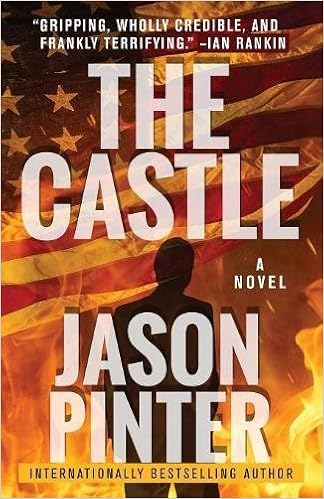
Jason Pinter’s The Castle is a tense, fast-moving thriller, a nightmare journey through a contemporary political world that is all too alarmingly familiar to us. Having written the book during the bizarre electoral circus that culminated in the victory of Donald Trump, Pinter “wanted people to be able to read it now right in the wake of the election” (Hudson Reporter), so opted to avoid the delays of conventional publishing by creating a new company, Armina Press, which was able to bring the novel out in June 2017.
In the months following Trump’s election, many have echoed the question posed by the journalist and thriller writer, Jonathan Freedland: “How could any fiction come up with a drama as lurid and compelling as the nightly news from the US?” When the highest office is gained by a chaotic, ignorant, paranoid narcissist, wielding his power with no apparent moral compass, how is it possible to incorporate such a reality into the fictional world of the political thriller? How does a novelist give urgency to his plot when all taboos seem already to have been broken, all lines crossed?
The approach of The Castle to this formidable task is bold and effective. An action-packed thriller can’t really afford to wade into the sort of political quagmire that has been created by the real-life model for Pinter’s man of power. In constructing The Castle, Pinter’s key move is to excise some of the more repetitive and exhausting aspects of the politician represented – the childish petulance, wild inconsistencies, insecurity, absurd lies and weak excuses. Instead, Rawson Griggs, the billionaire arch villain of The Castle, is sharply intelligent and focused – a far more competent and altogether more coherent adversary: “Rawson does what it takes to win. It’s not always pretty. But it’s effective.” There is abundant common ground between actual and fictional worlds: Griggs is bullying, self-centred, hubristic and paranoid. But although this utterly unscrupulous manipulator habitually deceives people, his lies are cunning rather than transparent. His deceptions are the Machiavellian manoeuvres of a strong, determined political operator who, behind the scenes, threatens everyone around him.
The protagonist drawn into this arrogant, aggressive world is Remy Stanton, a young corporate strategist who, in a moment of rash daring, intervenes to rescue two strangers being attacked by a gunman. When it turns out that the lives he has saved are those of Griggs’ daughter and son-in-law, Remy suddenly finds himself a central figure in the third-party political campaign of the powerful business magnate. He is a useful hero of the hour, with a clear role to play in the supporting cast of a populist, nativist bid for the presidency.
It is a far more hazardous and unpredictable role than Remy bargained for. With his talk of unleashing “the Beast Within”, Rawson Griggs is spiralling out of control, and there is no one he won’t sacrifice should they threaten to undermine his cult of personality or to interfere with his rise to power. By turns credulous, appalled and terrified, Remy gives us increasingly alarmed insights into this surreal political landscape, and Pinter creates an unfailingly suspenseful encounter with the underlying brutality of political ambition on this scale: “…it seemed that Rawson had grown unhinged, bolder. And if what Remy Stanton had said was true, Rawson was capable of truly frightening things.”
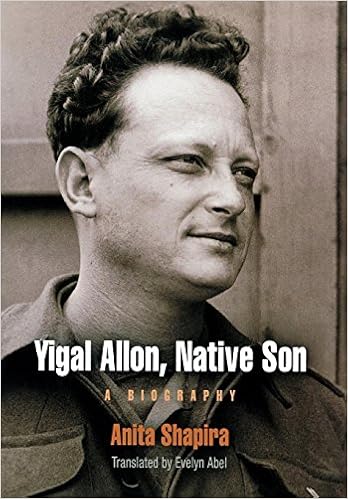 Winner of the 2004 Zalman Shazar Award for Research in Jewish History
Born in 1918 into the fabric of Arab-Jewish frontier life at the foot of Mt. Tabor, Yigal Allon rose to become one of the founding figures of the state of Israel and an architect of its politics. In 1945 Allon became commander of the Palmah—an elite unit of the Haganah, the semilegal army of the Jewish community—during the struggle against the British for independence. In the 1947-49 War of Independence against local and invading Arab armies, he led the decisive battles that largely determined the borders of Israel. Paradoxically, his close lifelong relations with Arab neighbors did not prevent him from being a chief agent of their sizable displacement.
A bestseller in Israel and available now translated into English, Yigal Allon, Native Son is the only biography of this charismatic leader. The book focuses on Allon's life up to 1950, his clash with founding father David Ben-Gurion, the end of his military career, and the watershed in culture and character between the Jewish Yishuv and Israeli statehood. As a statesman in his more mature years, he formulated what became known as the "Allon Plan," which remains a viable blueprint for an eventual two-state partition between Israel and the Palestinians. Yet in the end, the promise Allon showed as a brilliant young military commander remained unfulfilled. The great dream of the Palmah generation was largely lost, and Allon's name became associated with the failed policies of the past.
The story of Allon's life frames the history of Israel, its relationship with its Arab neighbors, its culture and spirit. This important biography touches on matters—Israel's borders, refugees, military might—that remain very much alive today.
 There has never been an artist like the polymathic Chilean director, author, and mystic Alejandro Jodorowsky. For eight decades, he has blazed new trails across a dazzling variety of creative fields. While his psychedelic, visionary films have been celebrated by the likes of John Lennon, Marina Abramovic, and Kanye West, his novels—praised throughout Latin America in the same breath as those of Gabriel García Márquez—have remained largely unknown in the English-speaking world. Until now.
Where the Bird Sings Best tells the fantastic story of the Jodorowskys’ emigration from Ukraine to Chile amidst the political and cultural upheavals of the 19th and 20th centuries. Like One Hundred Years of Solitude, Jodorowsky’s book transforms family history into heroic legend: incestuous beekeepers hide their crime with a living cloak of bees, a czar fakes his own death to live as a hermit amongst the animals, a devout grandfather confides only in the ghost of a wise rabbi, a transgender ballerina with a voracious sexual appetite holds a would-be saint in thrall. Kaleidoscopic, exhilarating, and erotic, Where the Bird Sings Best expands the classic immigration story to mythic proportions.
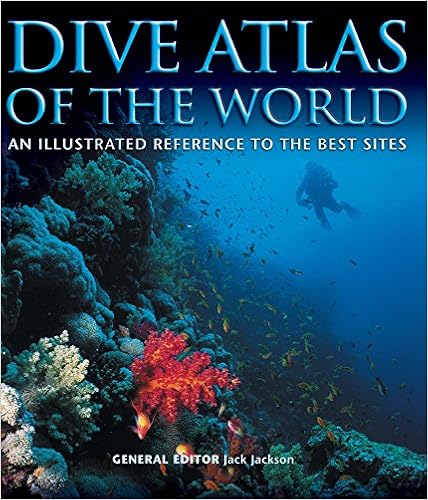
The Dive Atlas of the World offers an inspirational tour of top dive sites around the world, based on first-hand experience, and photographed by experts.
- 300 page fully updated global guide to the world's top dive sites
- Written by experienced dive authors, based on their first-hand experience
- Inspirational reference for divers who wish to personally or vicariously experience the best diving the planet has to offer
- Helps you select and locate the type of diving experience you are looking for
- Superb quality underwater photography shows famous wrecks, a wide range of marine habitats, and a huge diversity of species
- Appendix with lists of travel and dive information, climate, best time to go, contacts, dive operators, and emergency facilities
- From the Blue Hole at Lawson Reef and the wreck of the Umbria in the Red Sea, to Michaelmas on the Great Barrier Reef, the Dive Atlas of the World offers a global tour of top dive sites, described and photographed by experts.
From well-known classics to sites that have only recently been discovered, this global selection offers the discerning diver a feast of locations to choose from, including an expanded selection of Caribbean dive sites.
Whether you favor muck diving and macro photography, wrecks, walls, reefs, caves, blue holes or the adrenaline rush of high-speed drift dive in a strong current (or all of these), you will find well-written, clearly mapped accounts of the top places where you can enjoy these dives.
This book features contributions from local experts, leading writers and award-winning photographers such as Jack Jackson and Lawson Wood.

I
n her insightful and well-researched book Lingering Bilingualism: Modern Hebrew and Yiddish Literatures in Contact, author Naomi Brenner investigates the fascinating layers of connection between Yiddish and Hebrew during the last hundred years. Yiddish, a distinctly Jewish language of Germanic origin, is infused with Hebrew, Aramaic, and Slavic words. Before the Second World War, ten million Yiddish-speaking Jews lived in Europe. At the same time, Hebrew, after two thousand years of dormancy, was resurrected as the spoken language of the majority of a far smaller number of Jews living in Palestine. Brenner’s book maps the complex interchanges between these two exclusively Jewish languages.
In the late nineteenth century, most European Jewish writers produced works in both Yiddish and Hebrew. Writing in Yiddish provided a broad audience and a large income. Hebrew was the uncontested language of literary prestige, but few Jews read or spoke Hebrew, so Yiddish and Hebrew, Brenner explains, coexisted with little tension—until Hebrew became the spoken language of the Zionist movement. The common view is that Yiddish then became associated with the weak position of Jews in exile, and Hebrew with the renewed sense of Jewish nationalism and self-reliance in Palestine.
Brenner’s work counters that theory, illustrating that Hebrew and Yiddish both played complex roles, and each influenced the other. She explains, “this book argues that continued Hebrew–Yiddish literary contact was critical to the development of each literature, cultivating literary experiment.” For even when “bilingualism . . . was denied, negated, or believed to be left behind in Eastern Europe,” it still played a dominant role after the Second World War. Brenner carefully and thoroughly follows the points of contact between the two languages by “focusing on a series of literary collisions between Hebrew and Yiddish . . . [to] . . . discern a dynamic cultural field in which literatures were constantly negotiating and renegotiating their terms of engagement.” Brenner shows us that the collision of Hebrew and Yiddish released creative powers latent in both languages.
She examines these “terms of engagement” in the production of dual Hebrew–Yiddish literature between the world wars. The magazines Rimon and Milgroym (Hebrew and Yiddish, respectively, for “pomegranate”) both treated “Hebrew and Yiddish as functionally equivalent.” Both magazines shared the mission “to disseminate modern and modernist Jewish culture.” Although published in Berlin, the editors of Rimon and Milgroym tailored the magazines for audiences outside of Germany. Most Hebrew or Yiddish journals at this time issued manifestos expounding a specific political or aesthetic ideology. Rimon and Milgroym avoided this, in part, by producing a dual-language journal designed to bridge the language divide. Although the magazine was short lived, Brenner argues that its impact continued to exemplify the interdependence of Hebrew and Yiddish between the wars and beyond, demonstrating that “the two languages were in vital and productive contact with each other.”
But Yiddish and Hebrew also met with less friendly terms of engagement. Brenner details the harsh reception of Yiddish in the communities of Jewish Palestine. Despite attempts by Hebrew-speaking zealots to rout Yiddish from Palestine, “Yiddish remained a force to be reckoned with” in the Holy Land. Writers produced Yiddish works in Palestine even though doing so ran counter to the tenants of Zionism. Brenner details the work of several writers who expressed a staunch Hebraic Zionist program while continuing to write in Yiddish. Often such writers wrote in Yiddish to “convert” the Jewish masses to Zionism, but more often they were attracted to the income that Yiddish literature generated.
By the early 1940s, Hebrew and Yiddish had drifted apart from the intimacy they shared during the last two generations. Younger Yiddish writers in Europe no longer had a firm command of Hebrew, and young writers in Palestine grew up in a strictly Hebrew environment. At this time, translation between the languages was hotly contested. Brenner shows that most Hebrew writers believed that translating Yiddish books to Hebrew would harm the nascent Hebrew-speaking communities of Palestine. She explains that none could have imagined that “the circumstances surrounding Hebrew–Yiddish translation would change dramatically,” but of course, after the destruction of Yiddish-speaking communities in Europe, the translation debate ended.
In fact, after the Second World War, Hebrew writers fought to keep Yiddish literature alive through translation. This mission had unintended consequences. During this translation of Yiddish into Hebrew, an inevitable transformation occurred: Yiddish became “part of the Hebrew literary past” and began to be divorced from its singular context. Hebrew, in turn, was also altered by Yiddish translations. Even in the late 1940s, Hebrew struggled as a vernacular language, but Yiddish works in Hebrew provided the more established colloquial and literary language, with words, phrasing patterns, and even grammatical structures that expanded and matured the range of literary Hebrew.
Brenner’s meticulously researched and elegantly written work reveals a unique set of cultural and linguistic conditions during a time when the majority of Jewish people were linguistically and culturally bound to two Jewish languages. Brenner convincingly demonstrates that Hebrew and Yiddish constantly altered each other and presents a solid case for the idea that Jewish culture was truly “bilingual” for most of the late nineteenth and twentieth centuries, and that such a persistently bilingual quality—even to this day—profoundly shaped modern Jewish literary culture.

The fifth edition of this widely praised and highly esteemed reference guide has been updated with new information to reflect the way we eat in today's world. The authors have taken into account our healthier lifestyles and more diverse palates to include:
Over 500 new listings, including Korean, Persian, and South American additions
Updated information for hundreds of existing entries
A blood alcohol concentration chart for men and women
An extensive breakdown of food labels and nutritional facts
Department of Agriculture recommendations for a 2,000 calorie per day food plan
Among the myriad foods and culinary subjects defined and explained are cooking tools and techniques, meat cuts, breads, pastas, and literally everything else related to good food and enjoyable dining. Handy appendices cover many topics including suggestions for substituting recipe ingredients, a microwave oven conversion chart, recommended safe cooking temperatures for meats and fish, and much more.
The New Food Lover's Companion is a reference guide—not a cookbook—but it includes hundreds of cooking tips plus an extensive bibliography of recommended cookbooks. More than 7200 entries plus line art are included in this seminal work.
 In April of 1925, Lord Arthur James Balfour, former British foreign minister and author of the 1917 “Balfour Declaration,” which stated the British government’s support for the creation of a “national home for the Jewish people” in what was then Ottoman Palestine, embarked on a tour of the post-World War I mandatory states imposed on the Middle East by the victorious British and French powers. Balfour’s journey began in Jerusalem. While there, he gave the inaugural address for the Hebrew University of Jerusalem and received honors from numerous Zionist dignitaries. The visit did not escape the attention of the Arabic press from across the eastern Mediterranean. By the time Balfour reached Damascus, a large crowd of demonstrators was waiting for him. The following day, despite the security measures taken by French mandate officials, demonstrators marched through Suq al-Hamidiyya and besieged Balfour in the Victoria Hotel. Under the cover of French riot police and suppressing fire, Balfour was rushed out of the city by a heavily armed convoy, finally reaching Beirut. The events of the previous two days had sent a clear message. Upon his arrival in Beirut, Balfour was immediately ferried to a British ship anchored in the harbor. There he received guests and conducted all official business until he left the region two days later, never again setting foot on land (157-158). Although the defeated Ottoman armies had been forced to retreat from the region nearly seven years earlier, the post-Ottoman settlement was and would continue to be actively contested by many of the former Ottoman subjects it dispossessed and subsequently subjected to British and French imperial power.
In The Last Ottoman Generation and the Making of the Modern Middle East, Michael Provence makes a valuable contribution to the emergent trend breaking with much of the earlier scholarship on the region that was concerned with national histories and the rise of particular nationalisms. In so doing, the work “tries to imagine the viewpoint of many former Ottoman citizens who argued that the divisions of and governing arrangements of the post-Ottoman, colonial period were inferior, less free, and less representative than what had come before” (4). The central argument of the book consists of three points: the legacy of Ottoman modernization is second only to the colonial legacy in shaping the history of the Middle East; the colonial legacy is a common experience that transcended national borders; and the tendency to view the region through the particular Iraqi, Jordanian, Lebanese, Palestinian, Syrian, and Turkish national histories has obscured the commonalities that were clear until the middle of the twentieth century (6). In short, armed and political resistance, often of a trans-national character, on the part of former Ottoman subjects posed an existential threat to the mandate system and worldview of European colonialism throughout much of the two decades following the fall of the empire.
The core of the last Ottoman generation consisted of the military officers born in the 1880s and 1890s (45). The common thread between them was their shared experience of Ottoman modernity, passing through the empire’s military academies. In the cases of many of the men, the bonds forged by these institutions would outlive the empire itself. Contrary to later Arab nationalist portrayals, a majority of surviving military academy graduates from the predominantly Arab regions of the empire would later serve the Turkish Republic. With respect to the famed Arab Revolt and forces of Faysal ibn Husayn, rather than relying on nationalist defectors, many of the Arab officers who joined Faysal only did so after the final defeat of Ottoman forces in Syria by the Entente (103-104).
Dissatisfaction with the post-war settlement manifested itself in non-military forms as well. At first ignorant of the role of petitions in the Ottoman Empire due in no small part to pervasive views of “oriental despotism,” colonial and mandate authorities ignored then stifled the appeals for justice on the part of countless individual petitioners (175). In the end, rather than abandoning the Ottoman state, its most devoted subjects learned the painful truth that the state had in fact abandoned them. Mustafa Kemal’s abolition of the caliphate, agreements with the French, and embrace of ethnic nationalism ultimately came at the expense of those beyond the borders of the nascent Turkish Republic (150-151, 265).
The Last Ottoman Generation is the latest addition to an important wave of scholarship over the last decade, culminating with the centennial of WWI. This includes such titles as Eugene Rogan’s The Fall of the Ottomans, Leila Fawaz’s A Land of Aching Hearts, Sean McMeekin’s The Ottoman Endgame, Ryan Gingeras’ Fall of the Sultanate, and Mustafa Aksakal’s The Ottoman Road to War in 1914. While the WWI centennial was accompanied by a broader popular and scholarly interest in the subject, these works in particular have gone a long way toward integrating Ottoman decision-making, experiences, perspectives, and wartime theaters into the larger story of the conflict, thus highlighting the centrality of the empire to the course of events. Indeed, in the case of the Ottoman Empire, the Entente powers fell for what had been over a century of their own propaganda, expecting an easy victory over the “sick man of Europe,” and suffering numerous humiliating defeats as a result (60). The underestimation of Ottoman resilience can perhaps serve as a cautionary tale for more recent history, where over the past quarter-century and spanning the post-Ottoman space from the Balkans to the heart of the Middle East, Western policymakers have routinely underestimated the resilience of various regimes, often to their own peril, along with those on the ground.
The extensive archival research on which the book is based spans regional record collections in Syria, Lebanon, and Turkey; the archives of European powers in Britain, France, and Germany; and the files of the League of Nations Mandates Commission, one of the most valuable sources preserving the numerous petitions of former Ottoman subjects. Additional sources include period Arabic, French, and English language newspapers, memoirs, and interviews conducted by the author with descendants of members from the final generation of Ottoman military and political figures, such as the family of Yasin al-Hashimi. The product of the research based on these and other sources is written in engaging and highly readable academic prose. The timeline of events at the start and sub-headings within each chapter make the book suitable for both graduate students and upper-level undergraduates. The contribution made to the study of late-Ottoman history and the mandate period will make The Last Ottoman Generation of interest to specialist and non-specialist readers alike.
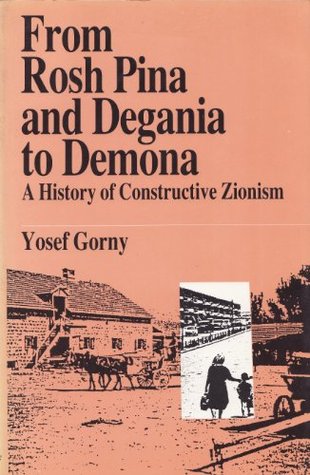 I read this book in Hebrew a number of years ago. I found it to be a largely sympathetic and highly informative account of the building of the land of Israel. The story of a people returning to its land after two- thousand years of exile and creating a modern vibrant state is a moving and compelling one. Ingathering the largely poor, tired, and hungry, the refugees of persecution from over one - hundred lands Israel has through the dedicated work of its people , despite the hostility of neighbors, made major achievements. One is the revival as spoken and living language of the Biblical language, Hebrew. Another is the forging of an economy which began at the bottom and now has reached the lower level of the most prosperous nations. Yet a third achievement is the outstanding contributions made by Israelis to world agriculture, music, computer- science, medicine, and other areas.
The book explores, in the light of immigration, the Jewish settlement of Palestine and Israel, including urban population growth, and economic, social, and political development. The Jewish Thought Series from Israels MOD Books, now distributed exclusively by Jewish Lights. A part of Israel s Broadcast University Series, each book is written by leading experts and authors in their respective fields. They are published jointly by Tel Aviv University, the Chief Education Office of the IDF, and IDF Radio.
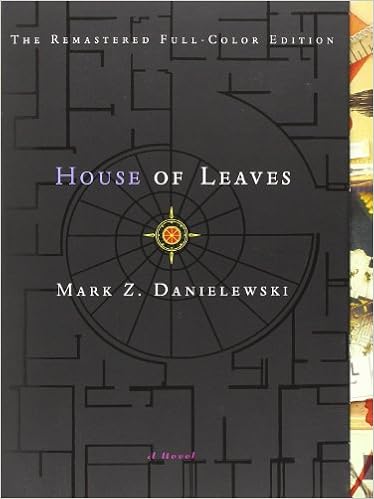 This book came into my possession in while I was stationed in Iraq, hanging out with a battle buddy. He and I were hanging out in the recreation tent at Baghdad International Airport (BIAP, aka Camp Sather) watching DVDs and perusing books. Sam, my battle buddy, hands me a battered copy of this book, and says, "I tried reading this-- but I think it's more your speed."
We parted ways in November. I was headed home, he went to another location. I was on a layover at an airbase in Al Udeid when I started reading this book.
And by "reading this book", I meant devouring it, like Bastian did as he holed himself in the attic of his primary school, surrounded by food, covered in a rough blanket, sequestered from the rest of the world, pouring through a mighty tome about a story without an end.
I didn't put the book down save to sleep and trek out to the latrine to do what needed to be done every few hours or so. I usually burn through a book in a few hours, but this one demanded time and attention, lest I run over vital. I was taken by the unreliable narrator of Johnny Truant, and I was enthralled by the journey Navidson endured in reclaiming his life from the horrifying macguffin that was the house his family lived in (and people died horribly in).
Navy and Johnny were two sides of the same coin, bound together by the mysterious scratches of a dead, Milton-esque man. Their stories were so disparate and yet so interconnected. The fabric between them was everywhere from rough and roughly hewn to diaphanous and metaphysical. The footnotes of footnotes were layers upon layers -- toying with the reality in which the contents of the book existed. Rules were set up and broken, and yet, everything was cohesive as long as the reader had the endurance to follow along.
Not everything is a slamming action-fast-paced piece of NASCAR fiction that grabs one by the genitals and rips them off in the first two pages. If you aren't in for the slow burn, then the first five words of the book ring true:This is not for you.
House of Leaves became a seminal event in my life when I finished reading it. The darkness in my life, punctuated with walking away from a war with my life and body in tact, became that much clearer from the light-- and I somehow began finding awe and inspiration with greater ease. Some have said that it's a story about people coming to grips with loneliness and/or depression. Some have said it's a love story.
No one is wrong in their discovery. The only wrong that may be done is to criticize a book unread.
To that end, I've ended up buying different copies of this book, like a madman collecting any copy of JD Salinger's "Catcher in the Rye" they could get their hands on, or a person who absolutely could not would not leave the house without a pair of gloves to shield their hands from the world. Whenever I mentioned the book to a friend, they usually ended up being the recipient of the copy I bought.
The original copy I received, the one Sam gave me, is in a fireproof safe. Well-worn with a hand-written note scribbled on the front page, I refuse to part with it. But at this point, I'm considering buying a new copy so that I can read it again.
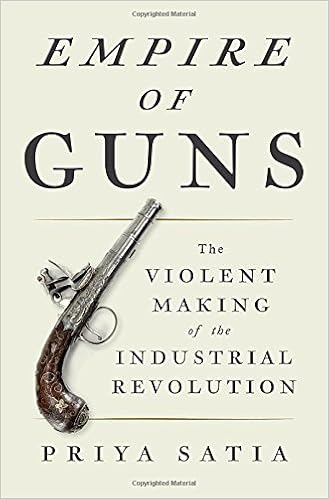
By Priya Satia, PhD, a Stanford History teacher, the details documented in this book are mind numbing. It is, as a documentary of historical fact, an outstanding, detailed piece of history. Aside from the fact where she starts with one of her own ancestors shooting (and regretfully) and killing a relative, she states her ancestor was changed (corrupted?) by the (hand) gun.
The tactics employed by the English Crown to ensure a steady supply of arms for their wars (the violence), was to fragment the (government) contracting. Something being done to this day in all "civilized" countries - USA included.
Aside from her discourse on her ancestor being changed by the gun, that is about the end of it in regards to politics. It IS an excellent discourse of the history of British gun making, population control and how gun making grew up concurrently with the industrial revolution, sometimes driving it, sometimes benefitting from it. She gives excellent examples of warfare but seems somewhat puzzled at how the firearm was used (not used) during that period of history she writes about. She does write and hints at the cultural differences between colonists and the Native Americans, concept of property rights and the defense of same even noting hardly justifiable uses of firearms and the complete assumption of power in their use and applications, not always in a just and prudent manner. Kind of like today.

I always look forward to these books **see pics**. The Lonely Planet books are always high quality with sometimes even too much information. Even as a frequent traveler to London (at least once a year) I still found tips and things to do and see to make each trip feel just as new. Ok once you leave Heathrow. That never seems to change.
The four sections in the book, with color coded page edges, are:
1 - Plan Your Trip (Red)
2 - Explore (Blue)
3 - Understand (Green)
4- Survival Guide (Grey)
Planning is straight forward with quite a bit of information that could be considered Explore as well. Explore is broken into sub sections (the tabs are in groups down the page edges) for different areas of London. You have to understand how dense London is with things to do. Each part feels like a different experience. Neighborhood walks are even outlined and mapped to save you the effort of trying to map it all out.
The Survival Guide section is the quick go to for major information. Airports, tours and a general listing of things like hospitals, money, etc are broken down quickly. I think they could cross link the Planning with the Survival to make it even more useful.
Lastly there is a fold out map as updated as the release of the book. I took a picture of that for you as well so you can see how large it is. If I could add a tip for you, download the Tube app to your device and update regularly (daily) to get all the Tube closures and changes while there. It is a huge help and timesaver. The map is great with the markers and side information.
Note that you can get this book in digital format to make it easy to search and carry around with the Kindle app. I happened to get the hard copy for the review. Overall Lonely Planet rocked it again with the new London version.

This is a wonderful guide with a massive amount of information, but designed so the information isn’t overwhelming. The book breaks down the top places to go in different areas of Japan and tells you which rail lines to take, how much it costs, and how much time it will take, among other things. There are tips peppered throughout the book that are actually really helpful, like daily itineraries, extra information on top places to see, tips on using the different transportation systems, etc. There’s even a whole section in the back on the initial travel planning for airlines, visas, language, etc. One thing that makes this guide stand out to me is that it’s easy to read and get the information you need, and it’s not a dry read; the authors really included their own perspective which makes it feel more real.
Overall, this seems to be a really well organized, information packed guide to Japan travel.
I would give this a 5 star, but I’m taking one off because the book I received looked like someone had already been reading through it: there were some bends on the corners of the cover, the binding was loose like it had been used before unlike a new book that’s a little stiff, and the Tokyo map included had been torn out already though it was still in between the pages and hadn’t fallen out which was good. Absolutely not a deal breaker, but just a bit surprising and odd to get a new book in that condition.

There was a time, not so long ago, when the history of the Jewish communities of 12th- and 13th-century England was a neglected subject in English historical studies. No longer. Starting with the seminal work of Barrie Dobson and Paul Hyams during the 1970s, the importance of medieval Jewish history to a proper understanding of medieval English history has been affirmed, embraced, and demonstrated by a generation of English medievalists that includes such luminaries as Paul Brand, David Carpenter, Barrie Dobson, John Maddicott, and Nicholas Vincent. By and large, this work has been published in specialized articles and scholarly books that are not likely to be read by a wide popular audience – although David Carpenter’s splendid survey for the Penguin History of England, The Struggle for Mastery (1), is an obvious exception to this claim. In all this work, however, the focus has been overwhelmingly on the significance of royal policies toward Jews for what we might regard as the ‘larger history’ of the medieval English state. For a synthetic account that foregrounds the historical experience of English Jews themselves, readers have for long had to rely on the first five chapters of Cecil Roth’s A History of the Jews in England, first published in 1941 and last revised in the early 1960s.(2)
In 2006, Richard Huscroft provided a fine, highly readable summary of this new work on Jews and the English state in a short book he entitled Expulsion: England’s Jewish Solution.(3) Robin Mundill now enters these same lists, aiming to attract a similar audience of general readers and students but with a topical rather than narrative focus, with The King’s Jews: Money, Massacre and Exodus in Medieval England. Dr. Mundill is well-known to specialists working on the history of the medieval Anglo-Jewish community for his 1998 book, England’s Jewish Solution: Experiment and Expulsion, 1262-1290 (4), and for a series of article-length studies he has written since 1990 on the changing roles Jews played in the credit markets of 13th-century England. In The King’s Jews, however, he aims to broaden his remit. Ever since he participated in the making of ‘All the King’s Jews,’ a BBC Timewatch documentary broadcast in 1990 to mark the 700th anniversary of the expulsion of the Jews from England, Mundill ‘had always aimed to write a book which would take readers back into the world of the small colony of Jews who came to England between the eleventh and thirteenth centuries’ (p. ix). The opportunity to fulfill this ambition came when Michael Greenwood of Continuum Books commissioned the volume we now have before us. With a degree of self-discipline that I can only envy, Mundill completed the book during a Lenten term of sabbatical leave in 2009 from Glenalmond College, where he is a full-time teacher and administrator.
Mundill’s great strength is his unrivalled knowledge of the financial records the royal government kept of credit transactions between Christians and Jews. These records, most unpublished and likely to remain so, are the foundation on which his book rests, and they shape the book’s contents and structure. Mundill’s account is strongest when dealing with subjects on which these archival sources shed the most light. There are useful and frequently colourful discussions of the mechanics of Jewish lending and their consequences. Readers who have wondered about tallies, chirographs, bonds, quitclaims, starrs, gages, and fee debts will find clear and authoritative explanations of these matters in chapter two, ‘Jews and the economy’. In chapter three, ‘A community within a state’, Mundill gives a fine description of the organization of the English Jewish community as it appeared to the royal government, starting with the Exchequer of the Jews and the Archpresbyter, and then working his way down through the chirographers, the sheriffs and the undersheriffs, to the local Jewish communal officials who looked after the synagogues and buried the dead. On ‘Saints and martyrs,’ however, the subject of chapter four, the financial records are uninformative; instead Mundill is thrown back upon Joshua Trachtenberg’s outdated book, The Devil and the Jews (5), which leads him to assume that evidence Trachtenberg drew, rather haphazardly, from an uncritical assemblage of late medieval, mostly German sources can be used to illuminate the attitudes of 13th-century English Christians toward such matters as mezzuzot and Kabbalah (p. 71). Chapter five, ‘Christians and Jews,’ returns us to the 13th-century financial markets, where Mundill notes persuasively the extent to which Jewish lending ultimately redounded to the profit of Christian courtiers and financiers. Chapter six, ‘Church and synagogue,’ is the least successful chapter, for reasons I discuss below. Finally, in chapter seven, “Dissolution and diaspora,” Mundill turns to the expulsion of the entire Jewish population from England in 1290, which he sees as a long-contemplated plan, perhaps originating as early as 1275, motivated by a long list of causative factors, including ‘religious animosity, antipathy and angst … complicated by religious and social perceptions as well as political interests, and of course the bitterness and determination of Archbishop John Pecham that the Jews should be continually punished for the death of Christ’ (p. 159).
The idea for this book has been long in gestation; but the book nonetheless shows signs of haste. None of the resulting mistakes is fatal, of course; but their cumulative effect does undermine confidence. Chapter six, ‘Church and synagogue’ is particularly badly served. On pp. 141–2, two versions of the same sentence follow each other seriatim; and every single endnote from 40 to 96 is misnumbered. The note that should have been endnote 40 was apparently omitted altogether; and so thereafter, note 41 in the text corresponds with endnote 40; note 42 in the text corresponds with endnote 41; and so on to the end of the chapter. Some sentences don’t make good sense (p. 143, for example: ‘Some communities had as much disregard for apostates as they had hatred for an informer’.) There are also inconsistencies between this chapter and others in the volume that treat the same subjects. On p. 133, for example, Mundill declares that the Jewish badge ‘had been officially enforced in England since 1218’, whereas in chapter seven he declares, correctly, that the badge was not ‘officially enforced by the state’ until 1253 (p. 151). In neither place, however, does he cite Nicholas Vincent’s definitive article on the imposition of the badge.(6) In chapter four (pp. 90–2), he discusses the infamous coin-clipping charges of 1278–9, as a result of which some 300 Jews (ten to 15 per cent of the entire Jewish population) were hanged; but he does so without taking into account Paul Brand’s important reconstruction of these events, to which Mundill alludes in chapter six (p. 137 n. 59, recte n. 60). There is also a degree of casualness in the way Mundill represents the views of the authors whose work he cites in his notes. On p. 135, for example, Mundill cites Joe Hillaby’s 2009 article demolishing the claim that there was ever a ‘House of Converts’ at Bristol, while asserting in the text that there was indeed such a house (pp. 8, 135). He also seems to believe that there was a ‘House of Converts’ in Oxford (pp. 134, 135), another misunderstanding corrected by Hillaby in the same article, but again not noticed by Mundill.
More often, however, authors with views different from Mundill’s own are simply not cited at all. This is, of course, an author’s prerogative; and it is understandable that in an account written for a popular audience, an author would not wish to weigh down his narrative with the petty disagreements of professional historians. Readers should nonetheless be aware that this is not a book on which they can rely for an up-to-date summary of current historiography. Quite the contrary: the number of citations to and quotations from outdated authors is surprisingly high, and occasionally (as on p. 99, where Mundill quotes the Rev. L. B. Larkin, a 19th-century clergyman and local antiquary) these quotations lend a jarring tone to a book whose author is a paragon of tolerance and good will.
Usually, this odd reliance on outdated authorities is simply puzzling. But sometimes it leads to errors of a more significant kind. Mundill’s account of Bishop Robert Grosseteste’s attitudes toward Jews (pp. 14, 129–30) is based almost entirely on L. M. Friedman’s 1934 study, Robert Grosseteste and the Jews.(7) In the circumstances of 1934, it is perhaps understandable why an author might wish to portray a saintly 13th-century bishop’s attitudes toward Jews in the most favorable light possible: fascist anti-Semitism certainly needed no encouragement. 80 years later, however, it is harder to understand how Mundill can read Grossteste’s vituperative letter to the Countess of Winchester, urging her either to expel outright a refugee Jewish community that had recently settled in her half of Leicester, or else to confiscate all the Jews’ property and force them to work at menial occupations in servitude to Christians, and conclude from it that ‘Grosseteste had a firm but enlightened attitude towards the Jews’ (p. 130) or that Grossteste’s letter ‘display[ed] his knowledge of the Jewish people’ (p. 129), unless this latter remark was meant ironically. It is equally difficult to understand how Grosseteste’s successful efforts to claim jurisdiction over 45 Oxford students, who had been arrested by the sheriff and imprisoned in the royal gaol for robbery and assault upon the Jews of Oxford, showed how Grosseteste ‘clearly tried to keep a balance between the two religions’ (p. 130). Soon after the students were handed over to him, Grosseteste freed them all without charge, ‘the evidence being held insufficient to convict them of felony’, in the graceful words of Cecil Roth.(8)
Far from being ‘benign and enlightened’ with respect to Jews (p. 130), Grosseteste was an extremist whose anti-Jewish animus was equaled among 13th-century English bishops only by John Pecham, the Franciscan archbishop of Canterbury under Edward I. Grosseteste was certainly not the only churchmen who took the view that all lending at interest was immoral and that the ‘perpetual servitude’ ostensibly imposed upon Jews as punishment for the death of Jesus should be interpreted in the most literal manner possible. But Grosseteste’s views on these subjects were far more severe than was contemporary canon law, which permitted Jews to lend at moderate rates of interest and opposed the expulsion of Jewish populations from Christian territory, stressing instead that Jews had a protected, albeit subordinate, place within Christian society as the people of the ‘Old Law.’
Canon law is not Mundill’s strength. Nor is his handling of the narrative evidence entirely secure. Mundill retells the story of the ‘Jew of Tewkesbury’ (p. 69) as if it were fact, without mentioning that this tale, of a Jew who falls into a latrine but whose reverence for the Sabbath leads to his death, was an exemplary story told in Christian sermons all over northern Europe between the 12th century and the 14th. It is interesting, and worthy of remark, that this story not only found an English audience, but was also retold in an English context, with recognizable historical actors, including Earl Richard de Clare of Gloucester, being assigned prominent roles in it. But there is absolutely no reason to think that any such event occurred, either in England or elsewhere.(9) In a similarly literal vein, Mundill reads Richard of Devizes’ satirical account of a ritual crucifixion allegation at Winchester as evidence that an actual allegation of ritual crucifixion was lodged there in 1192. He also takes seriously William of Malmesbury’s report of King William Rufus’s declaration that he would convert to Judaism if Jews won a religious debate with Christians; Mundill concludes that since Rufus did not convert, the Christians must have won the debate (p. 125). Here as elsewhere, Mundill treats 12th-century accounts of Jewish-Christian disputations as being records of actual debates that took place between real Jews and real Christians with conversionist purposes, rather than seeing these tracts as Christian literary and theological productions, written for Christian audiences and reflecting little or no knowledge of contemporary Judaism.
It is not easy to organize a book that aspires to cover the 200-year history of an entire medieval Jewish community. Huscroft organized his book chronologically, with a single topical chapter, squarely in the middle, on ‘Jewish life and lending.’ As a result, his book has a strong narrative thrust, but offers relatively little fine-grained description or analysis of Jewish life. Mundill’s book, by contrast, is organized topically by chapters, and then chronologically within each chapter. This too is an effective strategy, but one that comes with some costs. Description outweighs argument; there is much about how things worked, but less about why the Jewish community in England developed as it did, or about the peculiarities of its history in comparison with other Jewish communities elsewhere in medieval Europe. The book’s topical arrangement also makes it harder to explain the interconnectedness of events: the ways in which, for example, developments in Jewish lending during the 1240s and 1250s (discussed in chapter five), combined with the crushing weight of royal taxation during these same decades (discussed in chapter seven), led to the proliferation of anti-Jewish and anti-Semitic myths (discussed in chapter four), and ultimately produced a crisis within the Jewish community that resulted in conversions on a hitherto-unprecedented scale (discussed in chapter six). Nor is there always a clear sense of change over time, of how much the early 12th-century Jewish community differed from the community under Henry II and Richard I, or of how different Jewish life was in 1250 from what it was in 1150. As Mundill portrays it, Jewish life in medieval England was shaped largely by factors and influences external to the Jewish community itself and that did not change very much between 1100 and 1290.
Fundamentally, therefore, this isn’t so much a book about the Jews of medieval England as it is a book about how Christians and Jews interacted in their business dealings, and the effect those interactions had upon their relationships with one another. Mundill’s goal, to ‘take readers back into the world of the small colony of Jews who came to England between the eleventh and thirteenth centuries’, is an admirable one, well-deserving of an important book. To fulfill that goal, however, we will need a history that takes us into the hearts, the homes and the lives of this small but extraordinarily well-documented Jewish population. That is a history that remains to be written; but until it is written, we will need to continue to rely on the ageing works of Cecil Roth.
Notes
David Carpenter, The Struggle for Mastery: Britain 1066-1284 (London, 2004).Back to (1)
Cecil Roth, A History of the Jews in England (3rd edition, Oxford, 1964).Back to (2)
Richard Huscroft, Expulsion, England’s Jewish Solution: Edward I and the Jews (Stroud, 2006).Back to (3)
Robin Mundill, England’s Jewish Solution: Experiment and Expulsion, 1262–1290 (Cambridge, 1998).Back to (4)
Joshua Trachtenberg, The Devil and the Jews (New Haven, CT, 1943).Back to (5)
Nicholas Vincent, ‘Two papal letters on the wearing of the Jewish badge, 1221 and 1239’, Jewish Historical Studies, 34 (1994–6).Back to (6)
L. M. Friedman, Robert Grosseteste and the Jews (Cambridge, MA, 1934).Back to (7)
Cecil Roth, The Jews of Medieval Oxford (Oxford, 1945–6), p. 127.Back to (8)
Anthony Bale, The Jew in the Medieval Book: English Antisemitisms, 1350–1500 (Cambridge, 2006), pp. 23–53. Mundill cites Bale’s book, but does not note its implications for his treatment of this story.Back to (9)

