Tuesday, February 28, 2017

The French Revolution: From Enlightenment to Tyranny. Ian Davidson. Profile Books. 2016.


This new history of the French Revolution avoids immersing readers in the complex scholarly debates that have long characterised the subject, instead seeking to offer the best of what is currently known about this crucial historical process. Ian Davidson’s narrative should be praised for its eclecticism: there is no central trend or salient figure around which the events unfold, no one hero or group of heroes. Each part aspires to give fair treatment to a large number of relevant factors and personalities and to illustrate their complex interrelations. The cost of this breadth is that the alternation between different aspects might make the reading experience difficult for some, but this risk is compensated by the richness of details offered by the book.

Various historical factors are described in the context of a general theme: namely, the process by which the political events of 1789 descended into tyranny and the ‘reign of terror’ of 1793. Davidson describes how the democratic institutions established at the beginning of the Revolution were quickly overturned by the revolutionaries when circumstances proved particularly difficult for their political projects. Davidson’s narrative is more orientated towards description than to explanation, however, and the bookdoes not propose reasons for understanding why the turn towards tyranny and terror happened. Rather, he is interested in establishing how the main events progressively moved away from what he calls ‘a framework of legality’ with less focus on what concretely explains this shift.

The book generally succeeds, nevertheless, in describing with clarity how events developed and interacted. Davidson highlights how the revolutionaries were unable to achieve broad support throughout the country and proved incapable of attaining comprehensive legitimation of their actions. The problems attached to the currency (‘assignats’) introduced by the National Assembly, the strictly Parisian boundaries of the popular movement and the direct confrontation with the Catholic Church are all described as salient factors that contributed to the estrangement of the revolutionaries from the majority of the French population, predominantly religious and peasant. This exacerbated discontent and generated many popular rebellions, such as that of Vendée, all of which were brutally repressed by the revolutionaries.
Image Credit: Metro Bastille, Paris (FaceMePLS CC BY 2.0)

The complex relations between the sans-culottes of the popular movement in Paris and the bourgeois revolutionaries of the National Assembly and the National Convention, as well as the main aspects of such crucial events as the fall of the monarchy, the September Massacres, the fall of the Girondins, the cult of the Supreme Being, the anti-Christian campaign and the establishment of the Committee of Public Safety, are well depicted. At times, however, the roots of some events and processes are not sufficiently explained. A more detailed account was needed, perhaps, to show why the National Assembly consented so easily to the demands of the sans-culottes in the latter’s insurrection in 1792 as well as to illustrate how the power relations within the National Assembly and the National Convention were configured, and how Robespierre manoeuvred to consolidate his political authority within them.

Given the variety of the topics covered, the central theme of the book might also escape the reader at certain points. But perhaps the problem is that it is considerably difficult to portray the events of the Revolution in a methodical manner. Their complexity makes the Revolution look like an erratic storm constantly changing direction and intensity in unpredictable ways. Its violence targeted the royalists who defended the king before his dethronement, the Republicans after the attempted escape by and acquittal of the king, the resistant peasants, the sans-culottes and a large number of the revolutionaries themselves, including leading figures Danton and Robespierre. One of Davidson’s major points is that four in ten of the main individuals involved in any of the Revolution political factions or groups suffered a violent death.

A strong feature of The French Revolution is its reliance on a wide array of relevant literature, including ‘classic’ historians of the Revolution such as Michelet, Mathiez and Tocqueville, as well as some of the most important contemporary authors. Davidson is particularly indebted to the work of François Furet, perhaps the most widely known of recent historians of the French Revolution. However, he approaches his work and the wider literature with a critical disposition, often diverging from what is normally taken as the safer interpretation. For instance, one of the most intriguing aspects about which scholarly opinions widely split, and for which Davidson proposes new explanations, is Robespierre’s manifold positions and attitudes, whose underlying motives are often hard to determine with the available evidence.

Some features concerning Davidson’s method, however, are not entirely satisfactory. In historiography, the risk of looking at past events through contemporary suppositions is always present, and Davidson’s narration sometimes exhibits this. For example, in the initial chapters Davidson makes wide use of the concept of the Ancien Regime as it is understood today to explain the onset of the Revolution. But a careful reader might ask if the major figures involved in these events, even while having radical aspirations, truly possessed the idea of a drastic separation between historical ages that it is implied by the modern concept of Ancien Regime or if they understood the idea of revolutionary action in today’s sense. It is not implied here that these categories are unhelpful for understanding the events; rather, the intentions and perceptions of the actors are best appreciated in the context of their own conceptual framework.

What is important to keep in mind in this narration, as well as in any history of the Revolution, are the differences between the symbolic and intellectual impact of the Revolution both inside France and abroad, its actual outcomes and what the revolutionaries intended to do: distinctions which Davidson makes to some extent clear in the epilogue of the book. These three elements are part of the history, but it is difficult to integrate them in a single historical perspective on account of their respective complexity. Deep explorations of each of them, however, are helpful steps towards the building of this comprehensive perspective, and the importance of Davidson’s book is its capacity to make known with clarity the intricacies of the historical outcomes of the Revolution.
Ebook

Miss Jane.


Watson, Brad (author).

 
July 2016. 224p. Norton, hardcover, $25.95 (9780393241730); Norton, e-book (9780393285444).
REVIEW.  First published September 20, 2016 (Booklist Online).

In rural Mississippi in 1915, country doctor Ed Thompson is fairly certain that the child born to Sylvester and Ida Chisholm—sure to be their last—is a girl. But a strange formation of key parts leads him to do further research before reporting back with certainty, tempering what was already a rather uncelebrated birth, unplanned and late in the Chisholms’ lives. With luck and some surprise, baby Jane’s condition—the use of a common channel for all bodily eliminations—causes her no infant sickness, and she thrives into girlhood. Cared for by her sister, Grace, 10 years her senior and aggrieved by her duties, Jane is good natured and brave, curious and sunny in her generally dour family. She soon understands her uniqueness, and that she isn’t likely to ever be cured of it, and she learns strategies to accommodate and later conceal the bodily functions she can’t control. After an attempt at formal schooling among her peers, Jane opts instead for learning through deep observation of life: human, of course, but also the goings-on of the plants and animals on her family’s land. She grows strong in herself. The ultimate witness to the sexual world, Jane is at first deeply affected by her outsider status. Eventually though, as the novel spans Jane’s entire life, the pain of her existence becomes a sweet one, until “the fact of her body” is no longer a nuisance at all. Watson’s story is inspired by a great aunt who had a similar condition and explores the questions of what defines normalcy, humanity, and love. His narrative, which closely follows Jane, the gruff father who’s only tender with her, and the wise, warm doctor who becomes her closest companion, is affecting, nature-bound, and grounded in its glory

What to Do about the Solomons.


Ball, Bethany (author).

 
Apr. 2017. 256p. Atlantic Monthly, hardcover, $25 (9780802124579)
REVIEW.  First published February 3, 2017 (Booklist Online).

The large Solomon clan—spread out across the book’s main settings, primarily Israel (a Hebrew glossary would have been useful) and Los Angeles—is this unusual novel’s unique subject. In her staccato style, cleverly tracking back and forth in time, Ball tells the story of the newly arrested (gambling, we are told) Marc Solomon; his wife (a former prostitute), Carolyn; varied siblings; Guy Gever, who is suffering some sort of breakdown back in Israel (and his wife, Keren, Marc’s sister); and the mysterious Skymatsky brothers. Ball, with great humor, profound wit, and notable insight, vividly captures a singular family. The Solomons’ patriarch is Yakov, whose death, funeral, and shiva provide the novel’s climax. This novel from a most promising writer has been compared to the work of Isaac B. Singer and Grace Paley, as well as Nathan Englander and Jennifer Egan. Try Eudora Welty with sex and Jews. 

The Mayo Clinic Guide to Stress-Free Living.


Sood, Amit (author).

 
Jan. 2014. 320p. Da Capo/Lifelong, hardcover, $19.99 (9780738217123). 616.9. 
REVIEW.  First published January 1, 2014 (Booklist).

This practical, can-do guide, written by a positive-energy medical doctor at the Mayo Clinic, offers clear steps to take to decrease the bad kind of stress. As Sood notes, “Good stress motivates you, preps you for a challenge and gives you extra pep.” Bad stress is caused by “excessive workload, lack of control, and lack of meaning.” To cope with negative pressure, Sood highlights the principles of stress-free living: gratitude, compassion, acceptance, higher meaning, and forgiveness. Each principle gets a chapter. So do “tribe” (family and friends) and “relaxation and reflection.” Sood also provides his “seven-point program for increasing energy”: eating healthy food, sleeping seven to eight hours a day, keeping company with good people, avoiding news overdoses, following an exercise routine, doing something meaningful each day, and thinking good thoughts for others. Just reading Sood’s lucid, commonsensical recommendations is a start to eliminating negative stress

Sunday, February 26, 2017

Peter van Ham’s Guge: Ages of Gold. The West Tibetan Masterpieces has just been published by Hirmer Verlag.


J. Poncar/Peter van Ham
Detail of the swimming competition for Gopa, in the Red Assembly Hall, Tholing, 1436-1449

Among the Shangri-Las scattered through the remote mountain valleys and passes of the Himalayas and the Karakoram, the most exotic may well be the once flourishing medieval kingdom of Guge. It’s not so easy to go there; the closest airport is at Ali (Ngari) in far western China, still a grueling ten-hour drive or more from the great Guge sites. The roads south from Lhasa, some 1,200 miles away, are a challenge. The altitude is high, the climate harsh, the entire route rough as a real pilgrimage should be.

Guge was once home to a major inner-Asian dynasty whose artists and craftsmen produced a plethora of masterpieces over some five centuries. Although many of these works did not survive the Chinese Cultural Revolution, those that did—including some large-scale murals and exquisitely carved and painted sculptures depicting Buddhist visions of the cosmos and its deities—give us a tantalizing sense of the lost world that imagined them into being. These works, little known in the West largely because of Guge’s inaccessible location, have now been richly and systematically documented in the photographer and art historian Peter van Ham’s astonishing new book, Guge: Ages of Gold.D. Bendak//Peter van Ham
A row of Guge stupas near Tholing, in the tenth-century Kashmir-informed style, 2009

The modern political borders of Guge and its hinterland are misleading: historic western Tibet is split today among India (the far, high-altitude northern region of Spiti and Kinnaur), Pakistan, the Tibetan Autonomous Region (TAR) of China, and the western reaches of Nepal. We would do better to imagine this region (known as Nari Khorsum in Tibetan) as a continuous world of high mountain ranges connected by steep passes and relatively fertile valleys, with its political center eventually fixed on the stark mountaintop of Tsaparang and its religious-intellectual life centered in the famous monastery of Tholing, both in Guge.

Tholing, one of the most important historic sites of Tibetan Buddhism, was spectacularly creative throughout the first half of the second millennium AD, when the Guge kings repeatedly commissioned the building, renovation, and expansion of temples and stupa shrines along with their elaborate iconographic sequences of painting and sculpture. Many of the artists, whose names we unfortunately do not know, must have belonged to the huge Tholing monastic establishment itself.

Mike King

The monumental paintings that have survived in the Guge caves and temple-monasteries guide the meditating monk, also the casual visitor, through overlapping universes. They follow an iconographic program set out in detail in Sanskrit texts known as the Tantras of Practice. At the center of many of the artistic sequences (in Guge as in the famous monastery of Tabo in the Spiti Valley in the Indian Himalayas) is the Buddha of Intense Light, Vairocana, one of a series of three, or five, or thirty-seven, or even a thousand Buddhas and other divine beings who, worshiped together, can release the disciplined seeker from all sorrow. These painted and sculpted mandala diagrams, each of them a world in its own right meant for pragmatic use on the path toward liberation, belong to several distinct periods and styles.

Many of the finest images come from the eleventh and twelfth centuries and reflect the influence of Kashmiri models, though there are later masterpieces as well, from the fifteenth and sixteenth centuries (the so-called Second Golden Age), notably in the royal shrines at the capital Tsaparang. It is sad to have to report that in van Ham’s estimate the Cultural Revolution destroyed 99 percent of the Guge treasures, including the vast, intricately decorated complex built around the Tsugla Khang sanctuary at Tholing. Still, what is left is a remarkable archive of western Tibetan art created according to the guidelines set down in major Tantric texts such as the Compendium of Truth about All Buddhas and, especially, the Purification of All Evil Outcomes (also, somewhat later, the texts known as Supreme Tantras with their esoteric sexual imagery). The Guge paintings thus share, with much local inflection, the conceptual and aesthetic worlds of greater Western Tibet and the iconographic programs informed by the Mahayana Buddhist ethos of visualization, meditation, and profound self-transformation. The latter goal is to be attained with the help of a pantheon of Buddhas and other deities conjured up by the artists and by the practitioner’s own mind.L. Fournier/Peter van Ham
Detail of a wall painting in the Red Temple showing members of the Guge royal family attending the consecration of the temple, Tsparang, fifteenth century

Guge rose to prominence in the tenth century following the collapse of the early Tibetan empire ruled from central Tibet. Tibetans speak of a “second diffusion” (chidar) of Buddhism to the high mountain plateaus under the patronage of the Guge kings, who developed a distinctive form of political organization: one of the royal princes would assume what might be called secular power, while his brothers and nephews would take monastic vows; among them, one became abbot of the Tholing monastery and thus emerged as the religious leader of the entire Guge region. Our modern categories should not, however, mislead us.

In Guge, as later in Tibet as a whole, the monastic-intellectual aristocracy retained immense political and economic power. There were also times when king and abbot vied for control of the rich resources of this Silk-Road kingdom; such rivalry may have played a part in the arrival in Guge in 1630 of an army from Ladakh that, after a brutal siege, demolished the capital of Tsaparang and killed the last of the great Guge kings—the beginning of the end for the kingdom. This episode is the subject of a visually powerful but highly romanticized film released in 2006 by Discovery Networks and France 5—Guge, The Lost Kingdom of Tibet—largely in the Shangri-La genre, but with excellent commentary by archaeologists John Bellezza and Tsering Gyalpo.

Guge: Ages of Gold is a companion volume to van Ham’s earlier book on the great monastery of Tabo, which I wrote about previously for the NYR Daily. As in that volume, his photographs of the murals and sculptures of monastic and temple sites in small villages such as Charang, Ropa, Poo, and Nako (on the Indian side of the Chinese border) are at the outer limit of what is humanly possible—limpid, subtly textured, incandescent. The reader feels that he or she is seeing directly through van Ham’s eyes.Peter van Ham
Detail of the Manjushri Mandala at the Temple of the Great Translator, Nako, late eleventh to early twelfth century

One needs time to immerse oneself in the visionary worlds of these paintings; van Ham’s text helps by identifying the many Buddhas, Buddhas-to-be, gods, goddesses, and demons by noting the iconographic cycles to which they belong and the evolution of artistic styles. Consider, for example, the amazing cosmogram known as the Mandala of the Buddha-to-Be, Manjusri (“Gentle Wonder”), Lord of Sound and Stuff of Truth, at the Temple of the Great Translator in Nako (perhaps datable to the twelfth century). Seen in abstract geometric reduction, we have a set of embedded squares opening up, like flowers, into painted circles of five or, at the center, nine painted figures. An almost unimaginable concentration of Buddhist goddesses and Hindu deities linked to points on the compass and to various mythic roles constitute a world in rapid movement. It is as if the business of creation and cosmic devolution—a vision common to both these religions—had been arrested for just long enough for these beings to assume visible form.

A great delicacy of line and color is evident in many of the Nako Mandala images, for example that of the little-known god Jayakara, an attendant of the greater deity Vishnu, or that of the Creator, Brahma, finely dressed in East-Iranian fabric and riding two white geese. This over-populated universe is no utopia; there are spooky characters such as black Yama, lord of death and the underworld, and the skeletal Bhringin, a forlorn hyper-male lacking the flesh that comes only from the feminine, who is also the eternal witness to his master Siva’s obsession with playing dice (Siva, incidentally, powerful deity that he is, always loses at this game). One clearly needs to view this mandala as a whole, but also to engage with its individual figures and to sense their distinct textures; more to the point, the spectator is expected to do something useful with this detailed map of the cosmos, something that will change his life.Peter van Ham
Detail of a wall painting showing Brahma, the God of Creation, with four heads and four arms, riding two geese, Nako, late eleventh to early twelfth century

It is good to keep in mind that images such as these are organized in careful patterns meant not merely to make the divine beings present—more precisely, to create them out of the thick emptiness that infuses all that is—but also to allow them, once brought into being, literally to enter into the heart of the adept who is capable of receiving them. Once inside, they can be dissolved back into the emptiness that is their source. Note the mental relief that this sense of infinite spaciousness can provide.

Paradoxically, such infinite spaciousness tends to be experienced in relatively cramped physical spaces, meant for circumambulation of a central set of sculpted images or for meditative meandering along the densely painted walls. I have not been to Guge, but I have seen similar Dukhang assembly rooms and their associated shrines in nearby Ladakh. One enters a narrow chamber crammed with images in familiar yet always somehow divergent, innovative sequences that at first overwhelm the visitor’s eyes and baffle the mind through sheer profusion. If the caretakers of such sanctuaries allow one to linger in these teeming worlds, and if one has the patience required to see deeply into them, the painted surface may crack open to reveal hidden shadows and, still further inside, an unnerving luminosity. At some point it becomes clear that the walls and pillars are themselves no more than brittle surfaces projected outward from a vibrant interior where the deities live, and where they can be reached, seen, touched, and at least momentarily known.M. Beck/Peter van Ham
Temple room in Dungkar Cave 1, one of four caves that were residences of the Guge dynasty beginning in the twelfth century

Tibetan Buddhism must rank among the most optimistic of the great world religions, since it asserts, with conviction born from centuries of disciplined experimentation, that the human mind has the potential to see reality as it truly is and that the mind can realize that potential through processes of training, purification, polishing, and continuous self-examination. Insight, prajna, though unpredictable, can flash through a mind engaged in such processes, transforming it in ways that enhance the free and compassionate nature that is our birthright. Prajna is also a living goddess whom we see on the walls of sanctuaries, often depicted as the consort of a Buddha or Bodhisattva, for example in the image of green Karmavajri in the Red Assembly Hall at Tholing or as the Perfection of Insight, Prajnaparamita, in the White Temple there. Here is another general principle in action: we have to imagine a world that inhabits the mind, arises and vanishes there, moving through an infinite series of mental metamorphoses, but that is at the same time entirely tangible, real, personal, and causally effective. A mental world is no less durable—arguably, it is far more durable—than the Himalayan mountains and arid deserts of western Tibet, visible outside the monasteries and the caves.Peter van Ham
Clay statue of Vajradharma, Amitabha’s first Bodhisattva, in the Temple of the Self-Born Guardian, Charang, mid eleventh century

Never has empty space been so full. Buddhas already enlightened or Bodhisattvas on the verge of enlightenment haunt the walls of these shrines “like sesame seeds packed in a pod” or “like motes of dust swirling through infinite worlds,” as the Tantric texts say. Entire universes present themselves in seductive colors: thus in the important Nature-of-Diamond complex seen, with considerable local variation, in so many of the Guge sites, the white Vairocana is encircled by the green Buddha known as Amoghasiddhi, “Never Fruitless;” the yellow-orange Ratnasambhava, “Born of Jewel”; the red Amitabha, “Infinite Radiance”; and the glowing blue Akshobhya, “Imperturbable” (see the striking and playful set of painted clay figures at the Ropa temple.

These colors, linked to specific attributes associated with each member of this five-fold set, are seen as if refracted by unblemished, transparent crystal, the adamantine element (vajra-dhatu) that permeates any Buddha’s awareness and may also permeate ours. Colorless crystal thus generates a sparkling chromatic range, often radiating from a dark-blue backdrop, strangely satisfying to the eye; within this varied palette, there is a noticeable drift toward warm hues of red and crimson, though the most moving images, in my view, are painted green-to-gold.L. Fournier/Peter van Ham
Painting showing the story of the Conversion of the Householder Yasa, who became a mendicant and was established as an Arhat, in the Red Temple in Tsparang, fifteenth century

We can see these figures—but in fact, on a deeper level of existence, we are meant to hear them, for each resonates as a particular mantra, or as the “seed” of sound sequences that, taken one by one, can radically transform what passes for external reality. I realize this statement may seem puzzling, and rather unlikely, so let me give an example or two. Perhaps the most beloved of all Buddhas-to-Be, the many-headed Avalokiteshvara, exists not only in his visible images but, on a more primary level, as the syllabic and musical sequence ra ra hum jah. Uttering this mantra under proper conditions makes this deity accessible to perception. If one replaces the above mantric syllables with the sequence ha ha ha sutanu, the handsome Bodhisattva known as Kshiti-garbha may appear and reveal his secret wisdom—or, more precisely, he may activate that same wisdom from its latent but hitherto unconscious existence within the practitioner’s mind.Namgyal/Peter van Ham
Avalokiteshvara painting of a fisherman in distress during a storm, in the northeast stupa of the Temple of Yeshe Ö, Tholing, Kashmiri origin, circa eleventh century

No one should assume that such sound patterns are arbitrary accretions to an evolving ritual practice, nor should we think of them as symbolic or as meaningful in the ways that language normally conveys reference. They are, rather, pragmatic and effectual: the eye sees what the tongue utters and the ear can hear. The Guge caves and temples are thus alive with visible sound, a painted or sculpted symphony designed to change the consciousness of whoever is listening. It is no small achievement to have captured those sounds on the walls of the Guge caves, or—even more impressive—on a page. Such pre-semantic sounds, sometimes described as a barely audible murmur or quiver, are also defined by the Tantric texts as gates or doorways, opening up dimensions of existence and sensation that are normally blocked to human perception. What we see in the paintings is both the sound-syllables themselves, vibrating, buzzing, singing, and the gradual emergence of a path that can be entered through many gateways, each echoing with a secret sonic key.L. Fournier/Peter van Ham
Detail of a wall painting showing the bodhisattva Maitreya on the south wall of the Red Assembly Hall, Tholing, 1436-1449

I have followed the Buddhist sources in speaking of the “mind,” but the English word and its associations should not confuse us. The paintings are far from cerebral; indeed, cognition itself, or analytical understanding, are both suspect in these Tantric systems. We might speak instead of a passionate emptiness shimmering with light and joyful abundance. The Buddhist Tantras, many of them translated from Sanskrit into Tibetan in Guge itself by the prolific translator Rinchen Zangpo (958-1055), have ways of elucidating their basic tenets, sometimes couched in enigmatic terms. In “Vairocana’s Sutra of Enlightenment,” the immensely popular Vairocanabhisambodhi Sutra, also known as the “King of Very Long Texts,” Vairocana explains the point of meditative and ritual practice to his acolyte Vajrapani, Bearer of the Lightning Bolt, soon to become a Buddha himself:


The Buddha said, “Lord of Mysteries, what is awakening (bodhi)? It means to know one’s mind as it really is.” Vajrapāṇi then said to the Buddha, “World-honored One, who is it that seeks omniscience? Who is it that accomplishes perfect awakening?” The Buddha said, “Lord of Mysteries, it is in one’s own mind that one seeks awakening and omniscience. Why? Because its original nature is pure. The mind is neither within nor without, nor can the mind be apprehended between the two. Lord of Mysteries, the Tathāgata [the Buddha], worthy [of worship] and perfectly and fully awakened, is neither blue nor yellow nor red nor white nor crimson nor the color of crystal, neither long nor short nor round nor square, neither bright nor dark, and neither male nor female nor neuter… The mind, which has the characteristic of empty space, is free from all differentiation and non-differentiation. In this manner, Lord of Mysteries, the three entities of mind, the realm of empty space, and awakening are without duality. They have compassion as their root.” *

This sounds good, but how is one actually to experience such things, to know them for oneself with certainty? Duality is our ingrained habit, antimonies and polarities the foundation of thought itself. From its earliest beginnings, Buddhism has had an empirical and skeptical streak; the Buddha is said to have told his disciples, “Don’t take my words on faith; experiment on yourselves.” But our default awareness is hardly luminous with insight; if you’re like me, you live mostly in an encompassing fog. So what are we to do? Will we ever taste the truth?Peter van Ham
Detail of a wall painting showing the inner offering goddess Gandha holding a shell filled with perfume, Nako, late eleventh or early twelfth century

One could try the Buddhist Tantric path and spend twenty years meditating in a cave under the watchful eyes of the cumulating, colorful Buddhas-to-be. The texts say this works wonders. On the other hand, it’s not impossible that we do see into the heart of reality, naturally, without premeditation, in fleeing moments that leave subtle, unconscious traces in the mind—intimations of a oneness lying just beneath or above or within the endless proliferation of selves and forms that we inhabit.

For all its richly articulated structures of practice and its fondness for disciplined visualization of hidden worlds, Tibetan Buddhism shares something with the Hindu non-dualist system of the Advaita, which claims that ignorance—our inevitable point of departure—is actually so precarious that the slightest breath of air may, under the right circumstances, be enough to do away with it forever. It’s like trying to walk while balancing an apple on your nose. We all have, so they say, intimate, profound, congenital knowledge of truth. In fact, this is the only form of dependable knowledge human beings can claim, though only rarely do they fully acknowledge it and use it. Usually, something from outside has to trigger a deeper self-awareness. So if you are wondering what it might feel like to turn yourself into Vairocana, a dense yet empty mass of light and sound, also defined as insight, that is the stuff of all reality as well as our only means of hearing and seeing what is real—you could start by opening this book.G. Schwantes/Peter van Ham
Painting of Vaishravana, Lord of the Yakshas, and the Realm of Plenty, in the White Temple of the Ornamented World, Tholing, fifteenth century

* Adapted and abridged from Rolf W. Giebel, The Vairocanabhisambodhi Sutra, Berkeley: Numata Center for Buddhist Translation and Research, 2005, pp. 6-7.


Politics at Ground Zero and the Remaking of Lower Manhattan ...Power at Ground Zero: Politics, Money, and the Remaking Remaking of Lower Manhattan by Lynne B. Sagalyn Oxford University Press, 901 pp., $39.95 One World Trade Center: Biography of the Building by Judith Dupré Little, Brown, 284 pp., $35.00 Who Owns the Dead? The Science and Politics of Death at Ground Zero by Jay D. Aronson Harvard University Press, 318 pp., $29.95


A rendering of the new World Trade Center buildings in Lower Manhattan, with the reflecting pools of the National September 11 Memorial in the foreground. Three of the buildings have been completed, including One World Trade Center (far left).
1.

No urban design project in modern American experience has aroused such high expectations and intense scrutiny o the rebuilding of the World Trade Center site in New York City. It has taken fifteen years since the terrorist assault of September 11, 2001, for the principal structures of this sixteen-acre parcel in Lower Manhattan to be completed. In a field where time is money in a very direct sense (because of interest payments on the vast sums borrowed to finance big construction schemes), such a long gestation period usually signifies not judicious deliberation on the part of planners, developers, designers, engineers, and contractors, but rather economic, political, or bureaucratic problems that can impede a speedy and cost-efficient conclusion.

For example, in contrast to this slow-motion rollout, it took less than a decade to erect the Associated Architects’ twenty-two-acre, fourteen-building Rockefeller Center of 1930–1939, accomplished without benefit of the countless technological advances devised since then. That swiftness was owed in part to the project being underwritten by the richest family in America during the Great Depression, when jobs were scarce and both designers and laborers were grateful for work, but it was a logistical triumph nonetheless. With Ground Zero (the popular name for the site that emerged in the attack’s immediate aftermath), the lengthy delay reflected the project’s divided and ambiguous leadership as well as the political tenor of the times.

Who was really in charge of the undertaking remained a persistent and vexing question. As the latest studies make abundantly clear, the transformation of the World Trade Center site was hampered to a shameful degree by the intransigent self-interest of both individuals and institutions. As a result, an effort ostensibly meant to display our country’s unified spirit in response to an unprecedented calamity instead revealed that communal altruism of the sort that helped America to survive the Great Depression and triumph in World War II had largely become a thing of the past. Although all major construction schemes face tremendous problems, the World Trade Center rebuilding encapsulates everything that is wrong with urban development in a period when, as in so many other aspects of our public life, the good of the many is sacrificed to the gain of the few.

The actual and emotional centerpiece of the new grouping is the magnificent National September 11 Memorial, the hypnotic pair of reflecting pools recording the names of victims by the architect Michael Arad, and the surrounding park by the landscape architect Peter Walker, which was dedicated on the tenth anniversary of the disaster.* In May 2014 came the adjacent National September 11 Museum, a much less successful design that resulted from a shotgun marriage between two wholly mismatched firms, the high-style Snøhetta (which designed the trendily off-kilter exterior) and the workaday Davis Brody Bond (responsible for the awkward interiors). This doomed division of labor produced a disjointed building that unintentionally reflects the continuing conflicts over the way the 2001 attacks should be interpreted and responded to.

Three of the five reflective, glass-skinned office towers that will ultimately surround Arad’s pools have thus far been finished: the vapid 7 World Trade Center (2006) by David Childs of SOM; the equally disappointing 4 World Trade Center (2013) by Fumihiko Maki; and the Western Hemisphere’s tallest skyscraper, Childs’s One World Trade Center (2013), a 1,776-foot-tall monolith that supplants Minoru Yamasaki’s Twin Towers of 1966–1977. Not as bad architecturally as it is conceptually, One World Trade Center is faute de mieux the best of the lot.

The chief virtues of this building—which was dubbed the Freedom Tower by New York Governor George Pataki but later “rebranded” to tone down jingoistic associations that might scare off potential tenants—are that it effectively addresses the huge open space to its south, including Arad and Walker’s memorial, and overpowers its lackluster neighbors. Though hardly an intriguing work of architecture, it nonetheless succeeds in anchoring the unruly scrum of contiguous lower structures through the sheer force of its gigantic scale and simple sculptural presence.

The building’s symmetrical, upwardly tapering prismatic contours make it stand out clearly against the Lower Manhattan skyline, especially when slanting sunlight gives its four angled corners a clear contrast against the rest of its mirror-like glass cladding. If not ideally proportioned in its height-to-mass ratio, Childs’s tower comes close enough to being an agreeable composition, and is a notable improvement over the architect’s other conspicuous Manhattan skyscrapers—the bloated Postmodern campanile of his Worldwide Plaza of 1986–1989 in Midtown West (which occupies the entire city block between 49th and 50th Streets and Eighth and Ninth Avenues) and his glitzy twin-towered Time Warner Center of 2000–2003 on Columbus Circle.

Unparalleled security concerns required that the reinforced concrete-and-steel base of One World Trade Center, approximately nineteen stories high, be as impenetrable as a 1950s atomic bomb shelter. In a dubious attempt to prettify this fortification, Childs originally intended to cover it with two thousand clear prismatic glass panels and welded aluminum-and-glass screens. However, after $10 million had been spent on this decorative flourish, it proved technically daunting to execute and more conventional glazing was substituted. In the end, One World Trade Center cost $3.9 billion, more than twice the price of Western Europe’s tallest building, Renzo Piano’s $1.9 billion Shard of 2000–2013, on London’s South Bank; this is the world’s most expensive skyscraper by a wide margin.


The tower’s interior is far stranger than its straightforward exterior, understandably because of urgent protective measures. Visitors to the observatory on the 102nd floor (2.3 million came during its first year) are shepherded through a labyrinthine series of unnervingly lighted and plastic-feeling walkways and holding areas on the ground floor, where security checks are made before they arrive at the Sky Pod Elevators. These lifts propel them to the summit in forty-two seconds, while an animated time-lapse video, brilliantly designed by the California firms Blur Studio and Hettema Group, plays on nine seventy-nine-inch high-definition screens that line the cabs.

This simulation imagines how an eastward outlook from the site appeared during the past five centuries, beginning with lightly forested marshes circa 1500 and, a century later, gabled Dutch houses that pop up and vanish. In due course the skyscrapers that made Manhattan world-famous shoot heavenward and are replaced by ever taller ones. Finally, for a fleeting four seconds, we catch a peripheral glimpse of one of the vertically striped Twin Towers, which swiftly vanishes, happily without any sign of what took place. One exits from this intense ride thankful for the majestic panoramic views that extend peacefully in every direction beyond the glass-walled rooftop gallery.

Without knowledge of Ground Zero’s terrible history, Childs’s design would seem even less exceptional, just another super-colossal, shiny skyscraper made possible by all sorts of advanced engineering marvels but unmistakably a thing of the past because of its fundamental lack of forward-thinking urban planning ideas. It seems impossible to see this as anything other than a place-holder for half of what once stood in its approximate place, a feeling reinforced by the eloquent voids of Arad’s heart-rending memorial right in front of it.

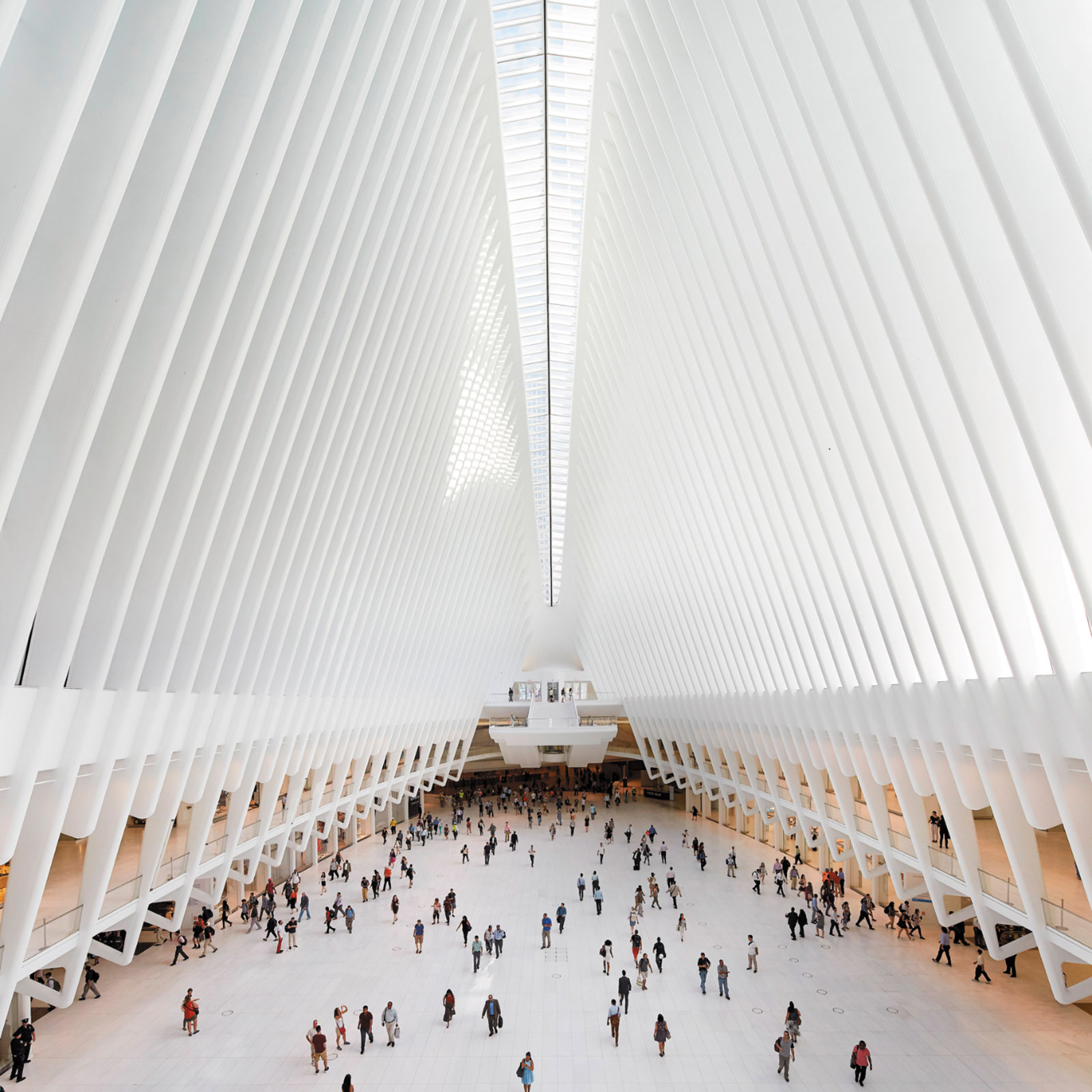
The most architecturally ambitious portion of the ensemble, Santiago Calatrava’s World Trade Center Transportation Hub (commonly called the Oculus), opened to the public in March 2016, though with no fanfare whatever, doubtless to avoid drawing further attention to this stupendous waste of public funds. The job took twelve years to finish instead of the five originally promised, and part of its exorbitant $4 billion price will be paid by commuters in the form of higher transit fares. The fortune spent on this kitschy jeu d’esprit—nearly twice its already unconscionable initial estimate of $2.2 billion—is even more outrageous for a facility that serves only 40,000 commuters on an average weekday, as opposed to the 750,000 who pass through Grand Central Terminal daily. Astoundingly, the Transportation Hub wound up costing more than One World Trade Center itself.

Calatrava’s budgetary excesses were already well known among professionals by the time he received this commission in 2003. But the Lower Manhattan Development Corporation (LMDC)—the joint city-state body established to carry out the reconstruction effort—had just gone through a bruising public struggle to select a master planner for the site, and in its eagerness for an architectural showpiece, it paid insufficient attention to the Spanish architect’s troublesome track record and fell for the maudlin sentimentalism of his design.

What was originally likened by its creator to a fluttering paloma de la paz (dove of peace) because of its white, winglike, upwardly flaring rooflines seems more like a steroidal stegosaurus that wandered onto the set of a sci-fi flick and died there. Instead of an ennobling civic concourse on the order of Grand Central or Charles Follen McKim’s endlessly lamented Pennsylvania Station, what we now have on top of the new transit facilities is an eerily dead-feeling, retro-futuristic, Space Age Gothic shopping mall with acres of highly polished, very slippery white marble flooring like some urban tundra. Formally known as Westfield World Trade Center, it is filled with the same predictable mix of chain retailers one can find in countless airports worldwide: Banana Republic, Hugo Boss, Breitling, Dior, and on through the global label alphabet. (The Westfield Corporation is an Australian-based British-American shopping center company.) Far from this being the “exhilarating nave of a genuine people’s cathedral,” as Paul Goldberger claimed in Vanity Fair, Calatrava’s superfluous shopping shrine is merely what the Germans call a Konsumtempel (temple of consumption), and a generic one at that.

Still to come are 2 World Trade Center by the Bjarke Ingals Group (BIG) and 3 World Trade Center by the office of Richard Rogers. Plans are doubtful for a putative 5 World Trade Center (to replace the former Deutsche Bank Building, which was irreparably damaged by debris from the collapse of the Twin Towers and laboriously dismantled) and no architect has been selected. There will be no 6 World Trade Center to replace that eponymous eight-story component of Yamasaki’s original five-building World Trade Center ensemble, also destroyed on September 11.Hufton+Crow
The interior of the World Trade Center Transportation Hub, designed by Santiago Calatrava
2.

The enormous public interest in the resurrection of Ground Zero quickly prompted three books about the first phases of the effort, all aimed at a general readership and published within four months of each other around the disaster’s third anniversary. Goldberger’s Up From Zero: Politics, Architecture, and the Rebuilding of New York (2004) was one of his typically well-reported but never indiscreet overviews. Philip Nobel’s Sixteen Acres: Architecture and the Outrageous Struggle for the Future of Ground Zero (2005) offered a juicier, more anecdotal account of the same events. Both books suffered from a lack of adequate illustrations, a shortcoming rectified by Suzanne Stephens’s pictorially rich compendium Imagining Ground Zero: Official and Unofficial Proposals for the World Trade Center Site (2004). However, even though the recently issued One World Trade Center: Biography of the Building by Judith Dupré is as glamorously visual as one could imagine, her breathlessly boosterish tone makes it seem more like a promotional event than a serious monograph.

Now, more than a decade after the initial flurry of books, we have what is likely to remain the definitive account of this tortuous and unedifying saga, Lynne B. Sagalyn’s Power at Ground Zero: Politics, Money, and the Remaking of Lower Manhattan. Sagalyn, who retired as a professor of real estate at the Columbia University Business School, insists that there are no heroes or villains in her narrative. However, her meticulous and exceptionally clear exposition of the essential facts provides more than enough evidence for readers to come to their own, and often damning, conclusions, especially about the real estate developer Larry Silverstein, who bought a ninety-nine-year lease on the World Trade Center from the Port Authority of New York and New Jersey just six weeks before the disaster.

Sagalyn’s exhaustive research has revealed some fascinating interrelationships in the upper echelons of the city’s power elite, which will be unsurprising to those who know how the financial and cultural capital of the US really works, and insider glimpses are rarely revealed as directly as she does here. For example, she tells how the well-connected attorney Edward Hayes, a “New York political infighter” and “go-to guy,” urged Pataki, a former Columbia Law School contemporary of his, to pick Daniel Libeskind’s scheme in the competition for the site’s master plan.

Hayes had been introduced to Libeskind and his business-manager wife, Nina, by Victoria Newhouse—an architectural historian and the wife of the publishing magnate Si Newhouse—who was avid to see Libeskind win the commission. Pataki reassured Hayes that he was already in favor of Libeskind’s proposal and indeed intervened at the last moment to ensure that he was chosen. It was a Pyrrhic victory for the architect, however. Libeskind assumed that winning the contest would also entitle him to design the Freedom Tower, but because of his limited experience with such large-scale projects he was forced to collaborate with Childs, who edged him out of the commission with Machiavellian dispatch.

Si Newhouse resurfaces later in the story when the question of who would actually occupy the Freedom Tower becomes an urgent matter. Newhouse’s Condé Nast Publications was identified as the ideal “anchor tenant” by Silverstein’s longtime leasing broker, Mary Ann Tighe of CBRE, the world’s largest commercial real estate services firm, who had known the publisher for decades. Given the perceived danger of another terrorist attack, this would not be an easy sell, but Tighe recalled that Condé Nast had been previously receptive to an undesirable address at the right price when it relocated from its longtime Madison Avenue headquarters to the newly built 4 Times Square in 1999, when that area still had a seedy aura. (The developer of 4 Times Square, the Durst Organization, received tax incentives estimated at more than $280 million, which allowed it to give Condé Nast very favorable terms, a classic example of corporate welfare at taxpayer expense.) Durst partnered with the cash-strapped Silverstein on One World Trade Center once it became an active, risk-free proposition, and Condé Nast agreed to move to Ground Zero when it was offered yet another sweetheart deal on a property widely deemed to be very difficult to rent.

A more visible display of influence was orchestrated by Herbert Muschamp, the New York Times architecture critic from 1992 to 2004. As his friend Frank Gehry told the writer Clay Risen, they dined together in Manhattan the night before the Twin Towers attack, and the catastrophe so traumatized the critic that he felt unable to leave his forty-fourth-floor Tribeca apartment, several blocks north of Ground Zero, for some time afterward. Thus Muschamp deprived the Newspaper of Record of his immediate insights on the biggest architectural news story of modern times for nearly three weeks. Perhaps to compensate for this glaring lapse, he organized a special issue of The New York Times Magazine that presented his notions of how the site ought to be reconfigured, which was published the Sunday before the first anniversary of September 11.

Muschamp had been dismayed that several months earlier the LMDC and the Port Authority (which owns the Trade Center site but leased the now-vanished Trade Center buildings to Silverstein) selected the architectural and planning office Beyer Blinder Belle (BBB) to develop a master plan. Although that partnership had won universal praise for its exemplary restoration of Grand Central, Muschamp deemed BBB insufficiently adventurous for this assignment. Accordingly he invited many of his favorite practitioners—older figures of the New York avant-garde as well as younger trendsetters—to submit their own ideas and assigned parts of the project to them.

The fact that these hypothetical schemes lacked even the most basic information that architects need to draw up design proposals—a budget and a functional program beyond vague designations (school, arts center, and the like)—seemed not to bother either Muschamp or his nominees. As Sagalyn writes in one of her rare overt expressions of disapproval:


This was not city building. Architecture may be art and city building calls for art-like understanding of the fabric of a place, but a city is not a blank canvas to paint at will as Muschamp was advocating with his study project, most unrealistically….


Irresponsibly, Muschamp had preemptively pronounced his personal opinion of what was likely to result before BBB had even drawn a single line. Did this belong in the news section [sic] of the paper? Where does the press cross the line between presenting the news to inform the public and aiming to become a player by advocating a particular vision—other than on the editorial page?

Yet this self-appointed planner was scarcely oblivious to urban design realpolitik. (Nor were the LMDC and the Port Authority, which withdrew the commission from BBB and announced a competition to find a new planning firm.) Immediately after Libeskind’s master plan was chosen over Rafael Viñoly’s proposal—which was centered by a scaffold-like, smaller reiteration of the Twin Towers that the Times critic championed, but that Pataki tactlessly likened to a pair of skeletons—Muschamp made an astonishing volte-face and wrote that the best scheme had won after all.
3.

This aesthetic influence-peddling, whether in the back corridors of government, the salons of the powerful, or the nation’s most prestigious newspaper, was nothing compared to the nonstop machinations of the pivotal figure in this drama, Larry Silverstein, who before September 11 had been considered a fairly minor player and something of a bottom-fisher among the big deal machers of the New York real estate establishment. Although Sagalyn’s portrait of Silverstein accords with the general outlines of previously published reports, here he emerges even more unfavorably as his actions are recounted in greater detail than ever before, thanks to the author’s extensive interviews and her informants’ willingness to speak candidly about him (an indication of how much rancor he aroused).

At the heart of the matter was Silverstein’s unshakable determination that all ten million square feet of office space lost in the Twin Towers’ collapse be replaced, a position driven by his desire to protect the maximum future profitability of his investment. However, this did not accord with the changing economic realities of postmillennial Lower Manhattan, and his sheer stubbornness struck New York City Mayor Michael Bloomberg and the technocratic urbanists around him as fundamentally uninformed and misguided (to put it in the most polite terms).

Sagalyn quotes Daniel Doctoroff, Bloomberg’s deputy mayor for economic development and rebuilding, as pointing out that “Lower Manhattan before 9/11 had a growing residential population, but it had been losing worker population since 1970,” even as the construction of the original World Trade Center was still underway. The changing demographic needs of this part of the city, said Doctoroff, “were swept under the rug in the wake of 9/11 by this kind of nostalgia for the World Trade Center and the tremendous emotion that existed.” The Bloomberg administration favored a varied mix of components with far less emphasis on offices and more housing units, in line with the growing residential character of the Financial District, where many old commercial buildings no longer suitable for today’s high-tech businesses have been converted to apartments, often very costly ones.

But Silverstein’s representatives (including Mary Ann Tighe) aggressively pressed his case for a full ten-million-square-foot build-out, and hammered home the questionable assertion that the boom-or-bust nature of New York City building cycles demanded readiness for the next inevitable upswing (this was before the international market crash of 2008). Conveniently omitted by the developer’s team was the financial history of the World Trade Center. The complex was built during a recessionary period, and it took until the 1980s for it to finally turn a profit; it did so only because of the artificial life support of state government agencies that had been transplanted to the Twin Towers by New York Governor Nelson Rockefeller, brother of that quixotic scheme’s mastermind, David Rockefeller.

Bloomberg and his advisers repeatedly tried to gain control of the project and impose the focused leadership and purposeful direction it lacked. Their most ingenious attempt was a Solomonic solution advanced by Roy Bahat, a twenty-four-year-old aide to Doctoroff, who suggested a swap of the land underneath Kennedy and LaGuardia airports—the city owns that real estate but the Port Authority runs the facilities on it—in return for the Trade Center acreage, which is owned by the Port Authority. This would have allowed the city to invoke eminent domain, cancel Silverstein’s lease, and be done with him. Although the Times praised it as “the most creative idea to arise from the Lower Manhattan redevelopment process so far,” the trade-off foundered not only because of the tangled economics of how evaluations for the respective assets would be calculated, but also because it was stymied by officials who foresaw themselves losing power if the deal went through.

As is typical of such betrayals of the public trust, there was more than enough blame to go around. Sagalyn names names, and they include Port Authority Vice Chairman Charles Gargano, described by the author as “‘a loyal Pataki soldier’…said to be riled by the swap proposal, a threat to his influence; he had already been ‘a loser in a bid to control the [LMDC]’. In the end, it was a political decision—for Governor Pataki.” At that time Pataki harbored presidential ambitions and felt that his continuing involvement in rebuilding Ground Zero would elevate his national reputation. As a result of these and other complications, the swap died in June 2003.

Whatever one might think of Bloomberg’s often high-handed approach to urbanism, which tended to favor corporate interests at the expense of other concerns, there can be little doubt that he did a number of very good things for New York City, and would have been a far better overseer of the World Trade Center redevelopment than any other major figure on the scene at that time. Among the institutions involved in the rebuilding, none is portrayed more critically by Sagalyn than the Port Authority, and rightly so. Its preference for investing in chancy real estate speculations instead of focusing on an overburdened transportation system and crumbling regional infrastructure has been a long-running scandal. A thorough overhaul of that bistate agency would seem to be the only solution to correcting the abuses detailed so appallingly by Sagalyn in her quiet way.

High among other factors that greatly complicated the rebuilding of the Trade Center site are recent advances in DNA verification methods. The conjunction of those new capacities with the 2001 catastrophe is the basis for a thoughtful and solidly informed meditation, Who Owns the Dead?: The Science and Politics of Death at Ground Zero by Jay D. Aronson, a professor at Carnegie Mellon University and director of its Center for Human Rights Science. Because it is now easier than ever to identify human remains found at sites of mass disasters, expectations ran high among many families bereaved by the Twin Towers attack that they might reclaim some corporeal vestige of their dead relatives. It was once expected that those lost at sea would lie forever asleep in the deep, much as soldiers killed in foreign wars would be buried near where they fell. However, modern science has encouraged a broad belief that the retrieval of physical matter, no matter how tiny, is essential to attaining “closure”—that obsessive yet elusive goal of contemporary grieving.

As of last autumn, remains of 1,113 of the disaster’s victims—or some 40 percent of the death toll—continue to be unidentified. At several points during the slow, painstaking, dignified, and respectful recovery process, officials announced that the search had concluded, but family members who had not yet been given definitive physical proof demanded further forensic investigation.

As it turned out, spot checks confirmed that minute amounts of residue from the victims were still discernible in the surrounding area, a finding that prompted an even more microscopic search that in some areas went inch by inch through newly discovered concentrations of possible physical evidence. This late phase was pursued with a vigilance that the participating experts vouchsafed was much more thorough than any they had witnessed before, verging on the exactitude of an archaeological dig. And indeed, additional names were associated with the powdery particulate. But to what end was this increasingly obsessive search? As Aronson writes:


The thought of unidentified remains is unnerving, especially for a society that wants to believe it has the technical capacity to provide some measure of certainty in an uncertain world…. It is ironic, then, that the individualization of the victims of the World Trade Center has made it more politically palatable for the US government to engage in a seemingly perpetual war that has created innumerable casualties in Afghanistan, Iraq, Pakistan, Yemen, and elsewhere.

Military Became Everything: Tales from the Pentagon by Rosa Brooks Simon and Schuster, 438 pp., $29.95

Chip Somodevilla/Getty Images
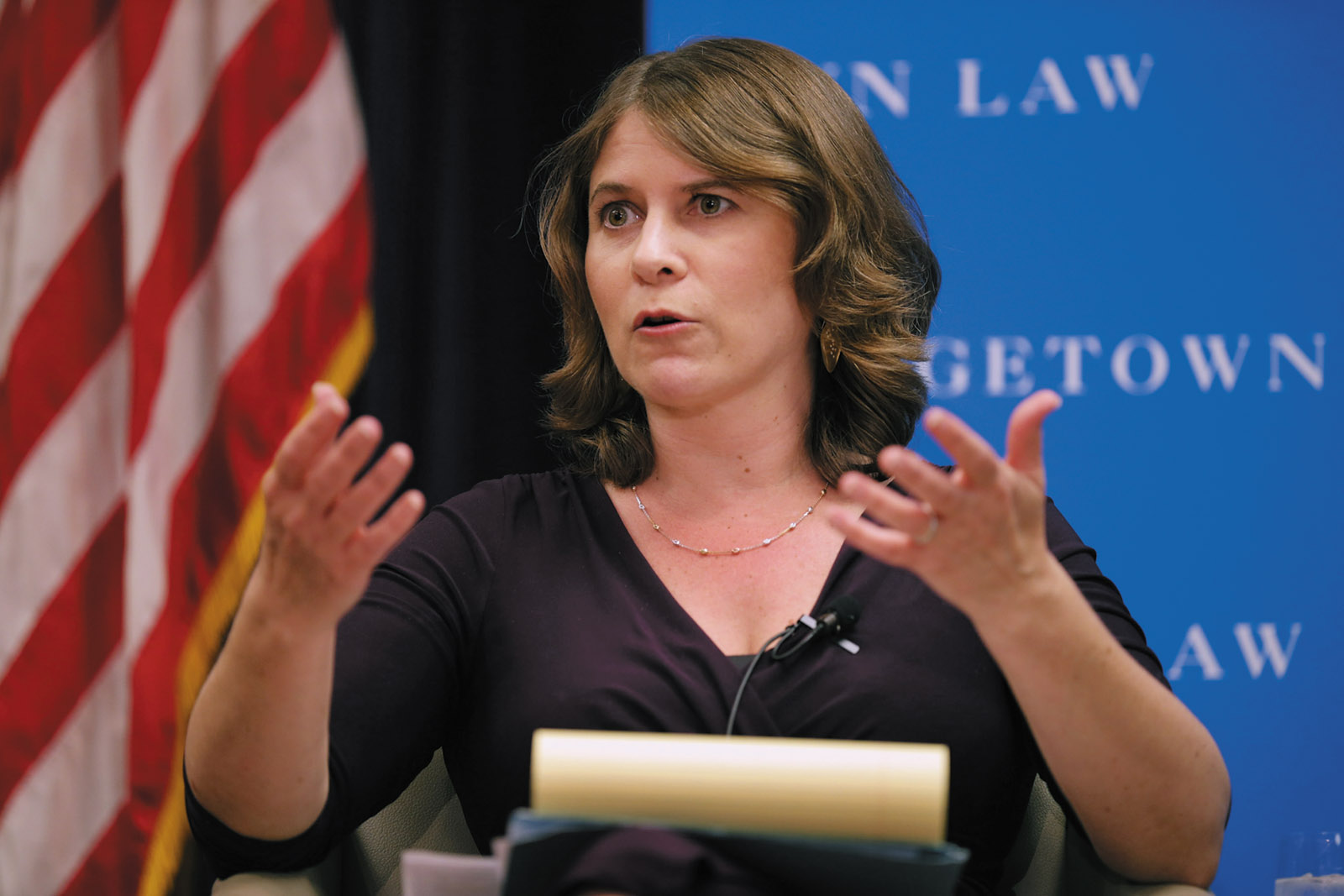
Rosa Brooks moderating a discussion on ‘the next generation’s human rights challenges’ during a program that was cosponsored by The New York Review, Georgetown University Law Center, Washington, D.C., April 2014

Societies often go to great lengths to separate war from peace. Wars are declared, sometimes with elaborate ritual. Soldiers wear uniforms and are part of specialized hierarchical organizations. Battlefields are often delineated. Maintaining this distinction is important because what is permissible in wartime is often prohibited in peacetime. Preventing the rules of war from infecting views of moral conduct in times of peace is essential for preserving civilization.

Yet particularly since September 11, 2001, the line between war and peace has blurred. The “war” on terrorism that President George W. Bush chose to declare was very different from, say, the confrontations between large national forces of World War II or even traditional counterinsurgency battles on a nation’s own territory. Al-Qaeda is a shadowy organization, many of its offshoots and successors even more so. The global and decentralized threat posed by the self-declared Islamic State presents a further complication.

The decision to treat the September 11 attack as an act of war rather than a horrible crime was a policy choice (one opposed in these pages by Philip Wilcox, a former American diplomat*). We could easily imagine a President Al Gore making a different choice. But once made, the decision to pursue “war” against al-Qaeda and its associated forces had major implications.

In war, opposing combatants can be targeted and killed by virtue of their status as combatants, without regard to their conduct at that moment. Captured combatants in wars between countries can be detained without charge or trial until the end of the armed conflict. In peacetime, by contrast, law enforcement rules allow the use of lethal force only as a last resort to stop an imminent lethal threat, and detentions generally can be sustained only after charges have been filed and a trial has taken place.

In view of the stakes, the debate about the proper way to characterize efforts to counter terrorism has understandably been intense. The stakes are only higher under President Donald J. Trump, given his apparent willingness to push the limits of legality in fighting terrorism. But as is often the case when alternative conceptions compete for recognition, resolving this debate has been difficult.

Rosa Brooks suggests, in her lively, informed, and insightful new book, that we consider a different approach. Brooks is a Georgetown law professor and former human rights investigator brought up by “left-wing antiwar activists.” But she also served as counselor to Michèle Flournoy, for two years the US undersecretary of defense for policy under Obama. From that position, Brooks had an insider’s perspective on many of the most difficult policy issues facing the Pentagon. She also ended up meeting her husband, an Army Special Forces officer with experience in Afghanistan and Iraq, who she says helped her understand how the issues she was dealing with played out in reality.

Brooks discusses the implications of today’s increasingly blurred line between war and peace and concludes that we may need to transcend these old distinctions. After the atrocities of World War II, governments of leading nations drafted the series of treaties that are the basis of international human rights law, the detailed rules limiting what governments can do to people. In time of war, these rules are supplemented by international humanitarian law (also known as the laws of war or the laws of armed conflict), much of which is contained in the 1949 Geneva Conventions and their Protocols.

Each set of laws is quite detailed, with the Geneva Conventions alone amounting to several hundred pages. Yet the law distinguishing peace from war—determining when humanitarian law’s more permissive rules for killing and detention kick in—is surprisingly sparse, leaving much room for dispute, especially when one of the ostensible parties to a conflict is a non-state armed group or a terrorist organization.

“War” occurs when a sufficient level of hostilities takes place between sufficiently organized military forces. Among the factors considered in the various protocols, commentaries, and tribunal decisions that address the issue are the number, duration, and intensity of particular confrontations; the use of military weapons; the number of participants in the fighting; and the resulting casualties and displacement of civilians.

A confrontation between two national armies is easy to classify as war. Sporadic acts of violence by criminal syndicates or even drug cartels are widely agreed not to be war. But how does one classify the periodic attacks by such groups as al-Qaeda or ISIS beyond their territorial bases, combined with the occasional violent response by Western military forces? That the United States deploys military forces is not enough, by itself, to qualify the result as an armed conflict. If that were sufficient, then a government could justify the summary killing of “combatants” simply by using its armed forces. Yet a state can enter into “war” with a non-state armed group on grounds of the magnitude and sustained nature of its military deployment.


If the fight against terrorist groups is hard enough to classify, consider new and emerging security threats—such as cyberattacks on critical infrastructure or the use of bioengineered viruses—that do not involve the kinetic or explosive weapons of traditional war. Does it make sense to speak of “combatants” when the attacker is not an armed soldier but a hacker at a computer terminal or a scientist in a biology laboratory? And even if they are combatants, is it a proper response to such attacks to authorize shooting or bombing them from afar, as is permitted in a traditional armed conflict?

International humanitarian law is clearly in need of elaboration in order to address these newer forms of conflict, but it should at least provide the starting point. For example, biological warfare unleashing deadly pathogens or cyber warfare shutting down electrical facilities are disturbing in large part because they could inflict widespread indiscriminate and disproportionate civilian casualties—concepts that are central to humanitarian law.

Similarly, a firmer grounding in international human rights and humanitarian law would have helped to avoid the kinds of perversions of that law that were orchestrated by the Bush administration, whose attorney general, Alberto Gonzales, dismissed the Geneva Conventions as “quaint” and “obsolete” and whose Justice Department cited a “new kind of war” to authorize “enhanced interrogation techniques” such as waterboarding, a form of torture. In fact, despite Trump’s musings about reviving it, international law prohibits torture—indeed, makes it a crime—in times of both peace and war.

Greater attention to human rights principles might also have led Trump to temper his executive order temporarily banning visitors to the United States from seven mainly Muslim countries. Ostensibly designed to fight terrorism, it made no effort to limit its scope to people who posed any identifiable threat, at enormous personal cost, if upheld by the courts, to the 60,000 people whose visas were suddenly not recognized.

Complicating matters further is the expanding role of the US military. Today, counterinsurgency strategy is broadly understood to involve far more than fighting an opposing military. It also has come to mean protecting the civilian population and building government institutions that serve rather than prey upon people, including a legal system that protects rights. Trump is now questioning the utility of such “nation-building,” but in the meantime it has led the Pentagon to sponsor a variety of programs that have little to do with confronting enemy troops.

As Brooks describes it, US soldiers now undertake public health programs, agricultural reform efforts, small business development projects, and training in the rule of law. This expanding mandate, as Brooks shows, has enabled the Pentagon to dramatically increase its budget—few in Congress deny requests for more spending on national defense—even as austerity eviscerates the budgets of the agencies that traditionally carry out these tasks, such as the State Department and USAID.

The radically different budgets of the Pentagon and its civilian counterparts only reinforce the tendency to look to the military to address nonmilitary problems—to treat it as a “Super Walmart” ready to respond to the nation’s every foreign policy need. “It’s a vicious circle,” Brooks explains, “as civilian capacity has declined, the military has stepped into the breach.”

Yet there is a cost to a self-reinforcing cycle of militarizing US foreign policy. Pursuing economic development, undertaking agrarian reform, expanding the rule of law—these are tasks requiring considerable expertise, including linguistic skills and cultural sensitivity not usually associated with the average military recruit, still chosen foremost for strength and agility even in a world in which traditional military tasks diminish in importance.

Moreover, humanitarian and development workers have typically enjoyed a degree of protection in the field because of their neutrality—their dedication to offering services on the basis of need rather than political preference. The militarization of these efforts has contributed to the “shrinking of humanitarian space” in which aid workers give assistance; they are increasingly endangered because they are perceived as military assets. The US may not be well served by Congress’s reflexive preference for military solutions to civilian problems.

Brooks discusses these emerging legal and practical problems with the clarity of an outsider given a seat at the insider’s table. But her book focuses on a more current problem: America’s use of aerial drones to kill terrorist suspects. In places where the United States is obviously at war, such as the fight against the Taliban in Afghanistan or ISIS in Syria and Iraq, the use of drones is relatively uncontroversial. Indeed, because of their exceptional accuracy, their small blast radius, and their ability to linger over an area to verify targets and choose a moment to attack when the fewest civilians are nearby, drones can help avoid civilian casualties—a central requirement of international humanitarian law.

But problems arise when drones are used in places where the US has not claimed to be at war, such as Yemen or Somalia. If law-enforcement standards are applied in such places, US security officials would still be permitted to use lethal force, but only in exceptional circumstances—when it is the only feasible way to avoid an imminent threat to life. In a 2013 speech at the National Defense University, President Obama accepted these law-enforcement standards for such situations, stating that the United States would use lethal force only against “terrorists who pose a continuing and imminent threat to the American people,” and even then, only if capture is not possible and there is “near-certainty that no civilians will be killed or injured.”NATO
A US Predator drone firing a Hellfire missile

In fact, as far as can be determined given the secrecy shrouding US drone attacks, Obama’s speech seems to have made little difference in the way attacks are actually carried out, and Trump in any event, in one of his first executive orders, has called for a reexamination of these rules. Part of the problem seems to stem from the US government’s elastic definition of a continuing “imminent” threat; its definition allows such a threat to be established regardless of how soon an alleged planned attack might take place. This sleight of hand seems to leave the United States operating more under war rules, in which a person’s status as an enemy combatant provides sufficient grounds to attack—was distinguished from the doctrine that the person must pose an imminent threat. It is as if the law-enforcement rules articulated by Obama have reverted back to war rules.

To make matters worse, even though it is unclear how the US government even makes such determinations, it sometimes seems to treat mere association with a suspect as evidence of membership in a terrorist group. That expands the range of targetable people still further—possibly beyond the definition of an enemy combatant even if war rules applied.

This matters not only for the victims of unlawful US counterterrorism efforts but also for many others. America’s monopoly on weaponized drones is already breaking down. Other governments are developing or purchasing this technology as well. Even ISIS reportedly has attacked with simple drones.

Moreover, if targeted killing is permitted under an expansive rationale for the “war against terrorism,” there may be no need for drones at all. Assassinations, poisoning, car bombs, “accidents”—there are plenty of ways to kill an “enemy combatant” once that characterization is accepted. And in an increasingly mobile world, even the most isolated governments will have opportunities to detain US citizens if broad, war-based standards for detention without charge gain wide acceptance. As Brooks notes, when the US government embraces controversial legal theories, it prepares “the way for other states to behave in similar ways.” She adds: “Let’s not kid ourselves: the legal arguments that the United States is now making will come back and bite us in the future.”

Unintended civilian casualties are not the issue. Regardless of the rules applied, the US government has a strong incentive to avoid such casualties, not only for humanitarian reasons but also because of the huge propaganda advantages they provide to terrorists. Rather, the central issue is who can be deliberately targeted. Who is the intended victim, and on what grounds?

A similar problem arises with respect to detention. In an ordinary armed conflict between countries, as noted, the laws of war permit detaining an enemy combatant until the end of the conflict. The rationale is not punitive—criminal prosecution rarely occurs and is not needed—but to prevent the combatant from returning to the battlefield and again taking up arms against the detaining power. But in traditional armed conflicts, the uniformed combatants, the battlefield, and the end of the conflict are all relatively easy to determine. As a result, there has been little requirement for judicial oversight, because most of the central facts justifying detention are obvious.

This is not so in the fight against terrorism, in which members of terrorist groups try to hide, their organizations operate under the radar, and there is no one with whom to sign an armistice even if one were desired. It is with these uncertainties in mind that the US Supreme Court granted Guantánamo detainees at least the nominal right to judicial oversight of the lawfulness of their detention. In fact, however, the federal judges involved have been extraordinarily deferential to the US military’s assessments of whether an individual is a member of an “enemy” group even when evidence is scant.

For much of the past fifteen years, the US officials favoring expansive powers to fight terrorism have been at loggerheads with human rights organizations that have been trying to limit those powers. In Brooks’s view, this debate is going nowhere because it is so difficult to demonstrate conclusively whether standards for war or for law enforcement should apply. As with the famous drawing, reproduced by Wittgenstein, that can be a rabbit or a duck depending on how you look at it, Brooks fears there is no right answer to this debate—or at least no answer that will convince someone already wedded to the opposing point of view. “Many U.S. counterterrorism practices simply defy straightforward legal categorization,” she concludes. The issue, she says, is not one of “lawbreaking, but of law’s brokenness.”

As Brooks notes, “there’s nothing natural or inevitable about any of our familiar categories or distinctions.” They reflect the concepts of a particular era. Rather than continue the effort to divide the world into two categories, she suggests “recognizing that war and peace are not binary opposites, but lie along a continuum.” The task then, she concludes, is to ask not what the law requires, since the law’s answer depends on the difficult-to-resolve dispute over the definition of war or peace. What matters instead is what is right, based on our values. Lawyers may feel less at home with this debate, she observes, but many others will feel that they can contribute to solutions.

For example, why not require some degree of judicial review before a suspect is put on the “kill list” for a drone attack? The traditional answer is that you can’t possibly have judges second-guessing split-second, life-and-death judgments on the battlefield. But that argument tends to assume that scenes of conflict resemble the Normandy invasion or even an urban battlefield where prior judicial review would indeed be impractical.

By contrast, most drone attacks today occur only after lengthy surveillance and extensive discussion among various elements of the executive branch. Rather than the anonymity of the traditional battlefield, today’s targets are often known in intimate detail. In such cases, there is plenty of time for an independent officer such as a judge to assess whether standards for using lethal force have been met. “The logic underlying the law of armed conflict’s permissive rules on status-based killing doesn’t apply here,” Brooks observes. Some judgments may still be made at the last second—such as determining when the target is most isolated in order to avoid unintended civilian casualties—but placing a target on a kill list is compatible with greater scrutiny, including judicial oversight, even if the standards of war are accepted. As Brooks points out, such a policy would help us “develop better mechanisms to prevent arbitrariness, mistake, and abuse in targeted killings.”

Similarly, even if judicial review is typically impractical and unnecessary for decisions about detention in the midst of an ordinary armed conflict, why should it not be extended to detainees like those in Guantánamo? Many of them find themselves accused of terrorist associations on flimsy grounds (using “intelligence” provided by dubious informants or even following torture), and their lengthy detention in the “forever war” against terrorism provides plenty of opportunity and need for an independent assessment.

In my view, Brooks has made a fresh and useful argument, but she carries it too far. I would not give up on the basic distinction between war and law enforcement, because to a very significant extent, at least under Obama, that argument was won in favor of the requirements of law enforcement, which are more protective of rights. Obama abandoned Bush’s “global war on terrorism” rhetoric. In his speech at the National Defense University, Obama endorsed the application of law-enforcement standards to drone attacks that do not take place in obvious war zones, even if his requirement of “imminence” was stretched beyond common understanding and the evidence used to select a target is often weak. As a practical matter, Obama also rejected the standards of war for detaining new terrorist suspects. During his eight years in office, all such suspects were brought into the criminal justice system for prosecution; no one new was sent to Guantánamo and its limitless detention, even if Obama continued to rely on war standards to deal with the Bush detainees at Guantánamo. This is important ground won that I would not cede, especially as we enter the uncertainties of the Trump administration.

Indeed, in the current political environment in which populist politicians are ascendant and centrist leaders often seem to have lost their voice, I would be reluctant to embark on any new attempt to set global standards on something as sensitive as counterterrorism policy. The opponents of stronger limits on governmental powers to kill or detain are now likely to come from both the White House and the Kremlin. Even Theresa May, the new British prime minister, vowed at the most recent Conservative Party conference “never again” to “let those activist, left-wing human rights lawyers harangue and harass the bravest of the brave—the men and women of [Britain’s] armed forces.” In such circumstances, it is unlikely that new standards would be more protective than the current ones.

But it may still be worth using Brooks’s argument to secure whatever additional safeguards we can from those who would continue to rely on war standards to counter terrorism. I would rephrase her argument not as a substitute for the “category problem” she identifies of distinguishing between war and peace but as a supplement to it. For example, one might argue: even if you think US drone attacks in Yemen should be governed by war rules, and granted the difficulty of judicial oversight in the midst of classic combat, surely we should accept some judicial oversight for the more deliberative actions taking place on the “battlefield.”

Or even if you think counterterrorism detentions should be governed by war rules, with very limited judicial scrutiny, surely we should accept more oversight before detention in a “conflict” in which it is difficult to say who the combatants are, or where the “war” takes place, and when it ends. Indeed, we should strongly prefer criminal prosecution to mere detention. These arguments should not be understood to substitute for rules of law enforcement, but to improve upon an unfettered application of war standards for those who still refuse to accept any law-enforcement approach to addressing terrorism.

As Brooks shows us, the battle of competing standards may well have left insufficient protection of the fundamental rights not to be killed or summarily detained. But the nuanced set of questions she poses should be used as much as possible to supplement existing standards, not to abandon them. Otherwise, we risk undermining the important if imperfect protections we already have. And with countries as diverse as Russia, Turkey, Iran, Israel, Saudi Arabia, and the United Arab Emirates today all involved in active efforts against armed or terrorist groups outside their territories, any weakening of the rules would give those countries greater latitude too—a frightening thought.