 Freedom of speech is said to be one of the cornerstones of modern Western civilisation and one of the most fundamental human rights. Throughout history, however, the commitment of governments and societies to such an ideal and its universal protection have proved less steadfast than is often claimed.
To date, freedom of speech is still discursively defended and upheld by most governments throughout the world, especially those in the West. After the tragic events that took place on 11 September 2001 in the United States, however, political leaders in various Western countries began to question long-standing perceptions and understandings about the nature of free speech and its relative value vis-à-vis other societal interests, namely physical security.
In Free Speech after 9/11, Professor Katharine Gelber discusses and examines the ways in which perceptions and understandings of free speech have changed over the past fifteen years in the United States, the United Kingdom and Australia in the context of the so-called ‘War on Terror’. In a forthright manner not often seen in academic or policymaking circles, Gelber makes a bold and well-argued critique of the policies that these national governments have introduced since 2001 to address the growing concerns of their populations over terrorism, both domestically and globally.
In Gelber’s view, after 9/11 governments across the world rapidly shifted their standard response to terrorist threats from reaction towards prevention. Such a move allegedly enabled authorities to operate better in domestic and global contexts that they now regarded as unfamiliar and increasingly dangerous. In principle, this change would have been more effective and efficient at preserving the security of these countries and their citizens.
Nonetheless, Gelber argues and demonstrates that such a move enabled political leaders and judicial authorities in otherwise liberal democratic countries to facilitate and undertake ever earlier and tougher interventions against the activities of individuals or groups who might be even remotely connected to the future planning or undertaking of a terrorist attack. Gelber argues that the Australian, British and US governments took advantage of the climate of uncertainty and fear created by 9/11 to implement a range of policy options ‘that probably would have been unthinkable’ previously, such as curtailing civil liberties at home or waging outright war abroad (16).
Free Speech After 911 imageImage Credit: ‘Free Speech: Conditions Apply’ (Newtown graffiti CC2.0)
The book’s main contribution is to question the claim that Western governments – specifically those of Australia, Britain and the US – have been compelled to curtail (and sometimes even violate) such rights in order to preserve the security of their countries. Gelber shows instead that the decision of these governments to pursue and implement harsh and human rights-infringing policies, both domestically and externally, was a deliberate policy choice. While Western governments had the physical, economic and political capacity (including the support of the international community) to set up domestic and international counter-terrorism frameworks that were more consistent with the global protection of human rights, they did not seriously consider such an alternative.
To provide evidence for this claim, Gelber analyses freedom of speech in Australia, the UK and the US as an indicator of both the state of human rights worldwide and the effectiveness of counterterrorism efforts in these countries. Her conclusion is disheartening.
Gelber shows that governments that routinely portray themselves as robust defenders of free speech were able and willing to rapidly and decisively restrict such a right when they considered it necessary to do so (1). Furthermore, she demonstrates that, as a result of the implementation of post-9/11 policies, the UK, the US and, to a larger extent, Australia, have witnessed a substantial erosion of the civil liberties of their populations. Even more concerning, such sacrifices seem to have been futile in preventing and deterring the recruitment of people for terrorist activities.
In the author’s view, the Australian, British and US governments are far from finding themselves in the purported dilemma between upholding the ideals of their liberal societies and preserving the physical security of their states. Instead, they have decisively sided with the latter. Gelber argues that it has now become ‘routine, indeed perhaps even expected, for governments in these three countries to posit themselves as preserving freedom of speech while also countering terrorism, […] while doing little or nothing to overturn’ the policies that curtail it (8).
The book’s thorough discussion and in-depth analysis prompt the reader to go beyond the mere reiteration of the rhetorical commitments of the Australian, British, US and, more generally, Western governments to this core human right. It also instigates readers to see past commonplace statements and symbolic acts, which to a large extent pay only lip service to the defence of freedom of speech. For example, the unity rally which followed the Charlie Hebdo shooting in Paris in 2015, where the German Chancellor Angela Merkel, French President François Hollande, then-British Prime Minister David Cameron and other world leaders marched arm-in-arm in a display of solidarity, allegedly determined to defend freedom of expression.
In Gelber’s view, the sole purpose of such acts and discourses by Australian, British and US government officials on their commitment to defending freedom of speech was only to justify the rights-infringing policies they were concurrently implementing. By positing such policies as both ‘necessary and appropriate’ (17), their governments were able to backtrack on centuries-long efforts to achieve freedom of speech domestically and worldwide.
While convincing and thoroughly researched, the book is, however, not without gaps. Gelber herself acknowledges that Free Speech after 9/11 puts aside numerous normative questions and philosophical debates on the role of the modern nation-state, which might have strengthened the case for pursuing more liberal policies regarding freedom of speech. Yet, this issue does not undermine in any way the quality of the study conducted. By taking freedom of speech as an enduring principle that should be valued and defended by all societies and governments around the world, Gelber allows for a more focused exploration of the significant and far-reaching policy changes that have been implemented in the three countries after 9/11.
In conclusion, Gelber makes a worthy, unique and timely contribution to the literature on human rights in general, and on freedom of speech in particular. By deconstructing and rejecting the apologetic discourse of the Australian, US and British governments on the purported need to balance freedom and security, she reveals these countries as deliberate transgressors of the principles they often claim to be defending. And, in her view, maintaining such misguided measures for much longer will only make these countries, and the West in general, more vulnerable to future attacks.

James E. Fleming, an orthodox confessor in the moral-philosophic church of Ronald Dworkin, has a problem. He declares himself an avowed enemy of constitutional originalism in any form on account of the debilitating effect it has on the American public conscience. Yet Fleming contradicts himself when he defines “the originalist premise” as the “assumption that originalism, rightly conceived, has to be the best—or indeed the only—conception of constitutional interpretation.”
Why does it have to be? “Because,” writes Fleming, “originalism, rightly conceived, just has to be. By definition. In the nature of things—in the nature of the Constitution, in the nature of law, in the nature of interpretation, in the nature of fidelity in constitutional interpretation. Axiomatically.”
The italics were in the original; he might not mean it, but he has reason to say it, because a great many people not only accept the originalist premise, they also conceive of it as a proposition grounded in philosophical truth and reality. Persistent and seemingly ineradicable, the “originalist premise” poses the largest obstacle to the search-and-destroy mission Fleming undertakes on behalf of constitutional fidelity to the imperfect Constitution of the United States.
The originalist premise will not down. It insinuates itself into the minds not only of citizens, but also of liberal elite scholars and law professors. In the poetic imagery of Francis Thompson’s “hound of heaven,” Fleming feels under relentless pursuit. Considering the role that Dworkin, the late political theorist and constitutional law scholar, plays in Fleming’s narrative, a more fitting metaphor might Herman Hesse’s “Magister Ludi” (master of the game). Indeed, the mysterious abstraction in Hesse can be likened to the imaginative game-theoretical evaluations and semantic maneuvers performed by Fleming as he sets out to expunge all manifestations of originalism.
In more prosaic terms, Fidelity to Our Imperfect Constitution: For Moral Readings and Against Originalisms is based on extensively revised articles, lectures, workshops, and conferences in which Fleming, the Honorable Paul J. Liacos Professor of Law at Boston University School of Law, has promoted his cause. Pondering “the supposed grip of originalism” on American constitutional culture, he argues that the reasons offered for it “demonstrate the grip of the aspiration to fidelity, not the grip of originalism itself.” That Fleming believes this to be the case is understandable, but the research strategy and epistemological horizon in which this thesis is situated are questionable.
For example, it is significant that nowhere in the book is reference made to Johnathan O’Neill’s Originalism in American Law and Politics: A Constitutional History (2005). Context is the calling card of historical scholarship. To exclude O’Neill’s history from a reflection on the meaning and significance of abstract principles and moral aspirations in constitutional interpretation is a sign of scholarly irresponsibility. It confutes Fleming’s claim that a fusion of fidelity and integrity is the decisive move in Dworkin’s determination of what should count as original meaning.
As O’Neill shows, pioneering originalists such as Raoul Berger and Robert Bork won recognition, and even a measure of approval, among legal liberals for altering the assumptions and questions that define modern constitutional law. From a legal realist point of view, however, Dworkin carried the day in claiming: “there is no stubborn fact of the matter—no ‘real’ intention fixed in history independent of our opinion about proper legal or constitutional practice—against which the conceptions we construct can be tested for accuracy.”
In Fleming’s opinion, all forms of originalism—old or new, narrow or broad, innocent or beguiling—are corrupt by reason of identification with the drafting of the U.S. Constitution. From Fleming’s standpoint of reductionist idealism, the problem of how to be faithful to an imperfect constitution is a case of mistaken identity, resolvable by setting aside those words of the Constitution’s Preamble that are empty of meaning. A void is thereby created in which “fit” can be recognized and taken into account. “Fit” is a Dworkinian locution referring to contextual circumstances that accommodate the appearance, recognition, and reception of abstract principles and aspirations in such a way as to justify a fidelity that aligns with the Progressive scheme of moral-philosophic enlightenment.
The Founders’ conception of fidelity stands in fundamental distinction to the Fleming-Dworkin modality of constitutional interpretation. The former consists in the establishment of an authoritative rule-of-law and limited government constitutional order to the end of securing the natural rights and liberties of individuals constituting a free people in a republican society.
The 1787 Constitution bears the mark of legitimate and rightful authority. Under the moral-realist truth that there is no right to be wrong, the inference can be drawn that “the right has a right to be right.” In an imperfect world, a constitution of government may require amendment to rectify error or injustice. That said, to dissolve the fundamental law of the American republic into abstraction, imagination, and aspiration in the name of Progressive ideology is to corrupt constitutional authority and consign it to oblivion.
Though committed to the Dworkinian magisterium, Fleming acknowledges the possibility that the master’s interpretive modality itself may partake of imperfection. He observes, for example, that “Dworkin never developed a moral reading as a general substantive liberal theory of our Constitution and underlying constitutional democracy.” Nor did Dworkin devise a Constitution-perfecting theory to counteract process-perfecting theories intended to reject substantive liberties such as privacy, autonomy, liberty of conscience, and freedom of association.
Some legal theorists, he writes, question whether Dworkin’s moral-philosophical approach “actually constrains constitutional interpretation to be anything other than his own liberal political theory.” He concedes that Dworkin “may have aggravated such concerns” in the famous series of essays he wrote for the New York Review of Books, which have been described by Michael Greve as proof that Dworkin’s “métier was sophistry, not metaphysics.”
In what might be considered the moral of the story, Fleming advises on page 94: “Do as Dworkin says, not as he does.”
Fidelity to Our Imperfect Constitution consists of a series of didactic, dense, and erudite essays in which Fleming acts the part of good-natured master of ceremonies engaged in dialogue with like-minded legal theorists. His object is to convert doubters to the Dworkinian magisterium. His means is indoctrination in the proposition that only through redefinition and propagation of abstract principles and aspirations, in derogation of historicist originalisms, can our Constitution be made the best it can be.
Citing chapter and verse, the author putatively engages a number of constitutional interpreters, including David Strauss on common law constitutionalism, Jack Balkin on living constitutionalism and new originalism, Bruce Ackerman on informal historicist living originalism, Lawrence B. Solum and Keith Whittington on new originalism, and John McGinnis and Michael Rappaport on neoconservative Berger and Bork originalism. Fleming offers criticism and advice on how to revise interpretations so as to form an intellectual-academic united front against all originalisms, and for Dworkinian moral-philosophic reading. This is the path of enlightenment that will make the Constitution truly worthy of our fidelity.
Fleming is cheerfully optimistic about his mission. Nevertheless, he is perplexed that many liberal and Progressive theorists approach interpretation on broad originalist grounds rather than on abstract and aspirational moral-philosophic grounds a la Dworkin. For example, Ackerman, a historically-minded political scientist, claims constitutional amendment legitimacy outside of Article V formalism. For Fleming, this move constitutes a “living constitution” challenge. He observes: “In sum, we have a constitutional war going on.” What Ackerman thinks We the People have repudiated, neoconservative originalists “think We the Judges have an obligation to restore. And so it goes on and on, without end.”
By the author’s lights, Ackerman’s interpretation shows that “even some critics of originalism are in the grip of the ‘originalist premise’”; nevertheless he ends up claiming that “Ackerman’s living constitutionalism is illuminatingly understood as a moral reading of the Constitution (in a general sense), not merely a historicist account of our constitutional development.” Fleming believes that “No middle way exists between narrow originalism and a moral reading or philosophic approach.” He reassuringly professes that “an ideal Constitution” will issue in: direct-popular-vote democracy; an anti-caste principle discerned in the Equal Protection Clause; and “equal participation and an equal voice in the political process” as a precondition of a republican form of government.
In what may charitably be described as a case of mistaken identity, Fleming writes: “I, like [Chief Justice John] Marshall, conceive the Constitution as a charter of abstract principles and ends, not a code of detailed rules or a deposit of historical practices.” The author is confident that a constitutional convention is not necessary. Instead, “rewriting the constitutional culture” can be a means for inculcating the “civic virtues and capacities necessary for successful constitutional self-government.”
Another resource in Fleming’s fidelity project is Walter F. Murphy’s “idea of constitutional interpretation as constitutional maintenance.” Professor Murphy’s idea “fosters a salutary concern for furthering the purposes of the constitutional order instead of being focused in a backward-looking way on interpreting narrowly conceived clauses in isolation or on taking a litigation-oriented perspective.”
Fleming hits pay dirt in defending anti-originalism against a secondary school teacher who protested to him: “But, Jim, you’ve got to understand that originalism is a Platonic noble lie.” In a long-winded reply, Fleming concedes that while “many citizens, scholars, and judges have come to believe in the noble lie of originalism,” he stands by his conviction that “originalism is at bottom authoritarian, an insult to the founders for their arrogance and an insult to us for our subservience.”
Unable to extricate himself from the intentionalist toils of historical reality, he asserts that “originalism is a double insult to the founders because at no point in the constitution that they left for us or in the literature of its adoption did any of them ever claim either infallibility or an interest in imposing their will on their posterity.” In other words, for them, original intent was to foreswear any claim of infallibility.
What Fleming is trying to say is that originalism in any form functions as an unwanted limitation on future generations—that it imposes a kind of gag rule that will obstruct the morally correct nostrums that Fleming and his compatriots believe will make the imperfect U.S. Constitution worthy of fidelity. He concludes his treatise on the high ground of judicial fidelity to abstract moral-philosophic principles and aspirations as evinced by Justice Anthony Kennedy in Lawrence v. Texas (2003) and Justices Kennedy, Sandra Day O’Connor, and David Souter in Casey v. Planned Parenthood of Pennsylvania (1992).
The author is confident that originalism is a thing of the past from which nothing good can come. The future belongs to the living, under the wise ministrations of liberal Progressive reform. Nonetheless, since the future has not been disclosed, it is pertinent to consider whether abstractive-aspirational constitutionalism is soundly conceived in philosophical or metaphysical terms. Is felicity-inspiring constitutionalism ontologically predicated on reality, truth, justice, and right? Or does Fleming’s amalgam of idealism, pragmatism, and existentialism portend moral and cultural decline?
For reflection on this issue, it is helpful to consult a 1986 volume entitled American Constitutional Interpretation whose coauthors are the above-mentioned Professor Murphy, James E. Fleming, and William F. Harris II.[1] The question to be considered, from a historical perspective, is the original intent, if you will, of Professor Murphy’s landmark treatise contained in that work.
In a section given the heading, “What is the Constitution? Problems of Continuity and Change,” Murphy and company advise that “Language evolves . . . Defenders of informal constitutional change reason that notions prevalent in one should not forever limit the reach of broad, constitutional concepts like equal protection.” They go on to say that “those who advocate change through judicial interpretation respond that almost all interpretation, including a quest for the ‘intent of the framers,’ is creative,” and that “those who accept current authority to adapt the Constitution commonly see ‘the Constitution’ as including much more than the document.”
The “defenders of informal constitutional change” tend to:
conceive of “the Constitution” as more than a concise and precise code and to look to constitutional interpretation as an effort, always struggling and often unsuccessful, to discover and apply imperfectly stated general principles to complex problems. Because they . . . visualize “the Constitution” as something more than the document, and because they accept human fallibility, changing the Constitution by interpretation is not especially bothersome to such people.
For those who believe the Constitution “commit[s] the nation to a vision of the good—or at least, better—society, interpretation is a creative and difficult art. One needs a subtle ‘constitutional aesthetic’ to say when creativity is necessary and how to use and apply it.” Such interpretation requires “discovering the Constitution’s spirit, its underlying values, and then recomposing its aspirations.” Interpretation “demands also faithful but imaginative adherence to that spirit, to the basic values that spawn its hopes for the good life.” Furthermore, those “who take an aspirational view of the Constitution claim to be more faithful to the text than those who see the Constitution as blue print.”
The bottom line in Professor Murphy’s interpretive modality is that “almost all interpretation, including a quest for the ‘intent of the framers,’ is creative.” Constitutional principles may be “permanent,” but “‘adaptation of principles’ is often also a creative act.”
Reviewing American Constitutional Interpretation in the Duke Law Journal, H. Jefferson Powell observed that under the influence of legal realism, the 1970s and 1980s were an “Era of Big Theory.” Most theorists shared “a crucial presupposition”: that the Constitution does not have “a meaning independent of what anyone in particular might want it to mean.” Although this fact was rarely admitted and “few would follow it to its nihilistic conclusion,” the presupposition was nevertheless there. The role of constitutional theory became, in Powell’s words, “one of filling the awkward conceptual gap created by the disappearance of an objective Constitution.”[2]
One solution to this problem, noted Powell, would be to follow a jurisprudence of original intent whereby the interpreter’s role is “to obey a speculative reconstruction of political principles the framers wanted enforced but perversely or incompetently failed to put into the text itself.” Another approach would be to declare the real constitution to be the system of human rights required by some extraconstitutional political theory.
Fleming’s constitutional fidelity project has followed the path laid out in that 1986 book, and in the moral-philosophic interpretive canon advocated by Dworkin, who declared, in his 1977 book Taking Rights Seriously (in a passage excerpted in American Constitutional Interpretation):
Constitutional law can make no genuine advance until it isolates the problem of rights against the states and makes that problem part of its own agenda. That argues for a fusion of constitutional law and moral theory, a connection that, incredibly, has yet to take place.
Or as Professor Murphy formulated it:
What systematic, defensible constitutional interpretation must have is a general scheme in which to arrange these fundamental rights and the values they reflect so that choices among them may be principled rather than ad hoc. To discover, or perhaps to construct, such a hierarchy requires a broad sort of structural analysis, one that includes but goes beyond the words of the constitutional document. Perhaps it requires, as much of constitutional interpretation does, the discovery, construction, or reconstruction of a complex political philosophy.
Or, as a student of Professor Murphy’s once said of him, “In his hands, the Constitution and the Supreme Court became magical and wondrous subjects.”
The present volume, too, expresses the vaulting spirit of Progressive aspirationalism. Constitutions, however, are not intended for flying into the wild blue yonder in search of utopia. To the extent that Fleming’s fidelity project gets off the ground, its intentionality, considered from a phenomenological point of view, will be to corrupt the principles, institutions, customs, and manners on which responsible liberty and limited government in free republican society depends.
The purpose of a good constitution is to establish the foundation for authoritative and binding rule of law. The intent of the constitution-maker is of paramount significance. In the end, the practical question is whether the original intent is good or bad, felicitous or unpropitious, effective or dysfunctional, encouraging or disheartening. Believing that the Dworkinian magisterium points the way to moral enlightenment, James Fleming invites his fellow citizens to glimpse for themselves the majesty of moral integrity. It would be irresponsible to ignore Fleming’s Progressive promise, but I would not want to bet on it.
[1] Walter F. Murphy, James E. Fleming, and William F. Harris II, American Constitutional Interpretation (Mineola, New York: The Foundation Press, 1986), pp. 127, 128, and 129.
[2] Ibid., p. 291.
[3] H. Jefferson Powell, “Constitutional Law as Though the Constitution Mattered,” Duke Law Journal 35 (1986), 915.
![]()
Images in the media of aggressive Israeli soldiers, Jewish settlement building, the destruction of Arab houses and brutality against Palestinians at checkpoints, do much to inform perspectives on Israel’s attitudes to ‘holy war’. The book Holy War in Judaism provides a more complex and ambivalent survey of Jewish perspectives on military action by taking a closer look at this notion of ‘holy war’ in traditional Jewish texts and in Jewish history from ancient to modern times.
Throughout much of Jewish history, religious leaders recommended a life of Torah study and observance, delegating victory over Israel’s enemies to God in future messianic times. It seems that the notion of ‘holy war’, that is, the belief in divinely legitimised military action against one’s enemies, was limited to periods of political sovereignty and to religious fundamentalists. For most of the time and for most Jews, war was neither a reasonable option nor an action for which they would claim divine support. On the basis of the Jewish literary tradition and centuries of subjection to foreign imperialism, Jewish attitudes towards military action appear in a very different light: author Reuven Firestone states, “among the religious systems I have studied, Judaism has the least developed and least politicized ideology of holy war, and when it is invoked, it has always applied to an extremely limited geographical scope” (viii).
Reuven Firestone is Professor of Medieval Judaism and Islam at the Reform-Jewish Hebrew Union College in Los Angeles. He has written this book as a corollary to his earlier book Jihad: The Origin of Holy War in Islam. He traces the understanding of and actual engagement in war from the biblical period to contemporary Israel, with a close examination of the various interpretations of war by Jewish religious authorities of the respective time periods. Although the Hebrew Bible, the most revered Jewish religious text, lacks a specific term for ‘holy war’, references to divinely sanctioned military actions against so-called idolators and against Israel’s enemies are as prevalent here as they are in the literatures of other ancient Near Eastern people and other monotheistic religions (Christianity and Islam). At the same time, biblical texts stress that God supported Israel only as long as Israelites obeyed his commandments. In retrospect – the biblical texts were written long after the events they relate and exhibit the ideology of their later editors – the divine sanctioning of military action appears as one aspect of the belief in God’s determination of history.
In the following, three post-biblical Jewish military actions are presented as “Jewish holy war in practice”: the Maccabean revolt against Antiochus IV Epiphanes’ persecution of Judaism in the second century B.C.E. and the two Jewish revolts against Rome in the first and second centuries C.E. (ch. 2 and 3). Whereas the Maccabean revolt was successful, the latter two were not. All three were meant to recreate conditions in which Jewish religious obervance could be carried out unhindered by foreign (Hellenistic and Roman) imperialist rule. Firestone does not examine the sources pertaining to these revolts in much detail and does not point to the complex combination of religious and political motivations. He stresses that not all Jews supported these revolts and that many, or most, preferred quietist stances towards the foreign rule, even when it became oppressive. The survival of Judaism was the goal, but how this goal could be achieved was heavily disputed amongst Jewish leaders and intellectuals.
After the failed Bar Kokhba revolt in the first half of the second century C.E., Jews did not engage in military actions until the British Mandate period and the establishment of the State of Israel in the mid-twentieth century. Throughout late antique, medieval, and modern times rabbis took quietist stances, advocating Torah study and piety in the present and hoping for divine redemption in the future. This “quietist messianism” (62) condemned human military action as interfering with God’s plans. Firestone views this rabbinic “re-alignment of priorities” (x) as a watershed in Jewish history and thought: Rabbis “made it virtually impossible for holy war to be an operative catergory in Judaism” (4). Nevertheless, they did not adopt a pacifistic stance and “holy war” remained a theoretical concept discussed by medieval Jewish scholars such as Nachmanides and Maimonides. Firestone’s focus on Jewish religious thinkers seems to neglect the real historical and political context of foreign dominion and Diaspora existance, which made further Jewish rebellions virtually impossible throughout these time periods. It seems that rabbis adapted their religious thinking to the changed circumstances Jews found themselves in: for a religious and ethnic minority under foreign rule a quietist stance seems to be the wisest possible option.
The situation changed with Zionism and the eventual establishment of the State of Israel, when war against political enemies became a reality again. From the 1930s onwards some religious Zionist rabbis began to revive the issue of holy or commanded war. This terminology was applied to the Israeli War of Independence (1947-48), the Six Day War (1967) and the Yom Kippur War (1973) on the basis of R. Abraham Kook’s teachings, which were reinterpreted by R. Tzvi Yehudah Kook, combining ultra-Orthodoxy with an “ideology of human activism inherent in modern nationalist movements” (283). Although the experience of the Holocaust constituted a turning-point in Jewish attitudes towards self-defense, many (ultra-) Orthodox rabbis continued to oppose human attempts to determine history by fighting against Israel’s enemies. They therefore advise their yeshiva students not to join the Israeli army which is a secular institution. The original Zionist leadership of the state was secular and would therefore not justify military actions as divinely commanded. The ‘holy war’ ideology and rhetoric has been revived only within the camps of fundamentalist religious Zionists, who became more outspoken after the successes of the 1967 and 1973 wars and stand behind the settlement building activities. Radical right wing groups such as Gush Emunim even view terrorist activities against Arabs as ‘holy war’ meant to advance the coming of messianic redemption. Firestone emphasizes at the end of his study that a peaceful solution to the Middle East conflict can be implemented only when fundamentalist radicalism and ‘holy war’ ideology cease on both the Israeli and Palestinian sides
Holy War in Judaism is written in a very clear and explanatory style and is therefore also suitable for non-expert readers with an interest in Judaism, Israel, peace and violence, and holy war. Students and scholars of political and social sciences, history, and religious studies will benefit most from its detailed discussion of Jewish religious thinking on divinely sanctioned military action

A rendering of the new World Trade Center buildings in Lower Manhattan, with the reflecting pools of the National September 11 Memorial in the foreground. Three of the buildings have been completed, including One World Trade Center (far left).
1.
No urban design project in modern American experience has aroused such high expectations and intense scrutiny o the rebuilding of the World Trade Center site in New York City. It has taken fifteen years since the terrorist assault of September 11, 2001, for the principal structures of this sixteen-acre parcel in Lower Manhattan to be completed. In a field where time is money in a very direct sense (because of interest payments on the vast sums borrowed to finance big construction schemes), such a long gestation period usually signifies not judicious deliberation on the part of planners, developers, designers, engineers, and contractors, but rather economic, political, or bureaucratic problems that can impede a speedy and cost-efficient conclusion.
For example, in contrast to this slow-motion rollout, it took less than a decade to erect the Associated Architects’ twenty-two-acre, fourteen-building Rockefeller Center of 1930–1939, accomplished without benefit of the countless technological advances devised since then. That swiftness was owed in part to the project being underwritten by the richest family in America during the Great Depression, when jobs were scarce and both designers and laborers were grateful for work, but it was a logistical triumph nonetheless. With Ground Zero (the popular name for the site that emerged in the attack’s immediate aftermath), the lengthy delay reflected the project’s divided and ambiguous leadership as well as the political tenor of the times.
Who was really in charge of the undertaking remained a persistent and vexing question. As the latest studies make abundantly clear, the transformation of the World Trade Center site was hampered to a shameful degree by the intransigent self-interest of both individuals and institutions. As a result, an effort ostensibly meant to display our country’s unified spirit in response to an unprecedented calamity instead revealed that communal altruism of the sort that helped America to survive the Great Depression and triumph in World War II had largely become a thing of the past. Although all major construction schemes face tremendous problems, the World Trade Center rebuilding encapsulates everything that is wrong with urban development in a period when, as in so many other aspects of our public life, the good of the many is sacrificed to the gain of the few.
The actual and emotional centerpiece of the new grouping is the magnificent National September 11 Memorial, the hypnotic pair of reflecting pools recording the names of victims by the architect Michael Arad, and the surrounding park by the landscape architect Peter Walker, which was dedicated on the tenth anniversary of the disaster.* In May 2014 came the adjacent National September 11 Museum, a much less successful design that resulted from a shotgun marriage between two wholly mismatched firms, the high-style Snøhetta (which designed the trendily off-kilter exterior) and the workaday Davis Brody Bond (responsible for the awkward interiors). This doomed division of labor produced a disjointed building that unintentionally reflects the continuing conflicts over the way the 2001 attacks should be interpreted and responded to.
Three of the five reflective, glass-skinned office towers that will ultimately surround Arad’s pools have thus far been finished: the vapid 7 World Trade Center (2006) by David Childs of SOM; the equally disappointing 4 World Trade Center (2013) by Fumihiko Maki; and the Western Hemisphere’s tallest skyscraper, Childs’s One World Trade Center (2013), a 1,776-foot-tall monolith that supplants Minoru Yamasaki’s Twin Towers of 1966–1977. Not as bad architecturally as it is conceptually, One World Trade Center is faute de mieux the best of the lot.
The chief virtues of this building—which was dubbed the Freedom Tower by New York Governor George Pataki but later “rebranded” to tone down jingoistic associations that might scare off potential tenants—are that it effectively addresses the huge open space to its south, including Arad and Walker’s memorial, and overpowers its lackluster neighbors. Though hardly an intriguing work of architecture, it nonetheless succeeds in anchoring the unruly scrum of contiguous lower structures through the sheer force of its gigantic scale and simple sculptural presence.
The building’s symmetrical, upwardly tapering prismatic contours make it stand out clearly against the Lower Manhattan skyline, especially when slanting sunlight gives its four angled corners a clear contrast against the rest of its mirror-like glass cladding. If not ideally proportioned in its height-to-mass ratio, Childs’s tower comes close enough to being an agreeable composition, and is a notable improvement over the architect’s other conspicuous Manhattan skyscrapers—the bloated Postmodern campanile of his Worldwide Plaza of 1986–1989 in Midtown West (which occupies the entire city block between 49th and 50th Streets and Eighth and Ninth Avenues) and his glitzy twin-towered Time Warner Center of 2000–2003 on Columbus Circle.
Unparalleled security concerns required that the reinforced concrete-and-steel base of One World Trade Center, approximately nineteen stories high, be as impenetrable as a 1950s atomic bomb shelter. In a dubious attempt to prettify this fortification, Childs originally intended to cover it with two thousand clear prismatic glass panels and welded aluminum-and-glass screens. However, after $10 million had been spent on this decorative flourish, it proved technically daunting to execute and more conventional glazing was substituted. In the end, One World Trade Center cost $3.9 billion, more than twice the price of Western Europe’s tallest building, Renzo Piano’s $1.9 billion Shard of 2000–2013, on London’s South Bank; this is the world’s most expensive skyscraper by a wide margin.
The tower’s interior is far stranger than its straightforward exterior, understandably because of urgent protective measures. Visitors to the observatory on the 102nd floor (2.3 million came during its first year) are shepherded through a labyrinthine series of unnervingly lighted and plastic-feeling walkways and holding areas on the ground floor, where security checks are made before they arrive at the Sky Pod Elevators. These lifts propel them to the summit in forty-two seconds, while an animated time-lapse video, brilliantly designed by the California firms Blur Studio and Hettema Group, plays on nine seventy-nine-inch high-definition screens that line the cabs.
This simulation imagines how an eastward outlook from the site appeared during the past five centuries, beginning with lightly forested marshes circa 1500 and, a century later, gabled Dutch houses that pop up and vanish. In due course the skyscrapers that made Manhattan world-famous shoot heavenward and are replaced by ever taller ones. Finally, for a fleeting four seconds, we catch a peripheral glimpse of one of the vertically striped Twin Towers, which swiftly vanishes, happily without any sign of what took place. One exits from this intense ride thankful for the majestic panoramic views that extend peacefully in every direction beyond the glass-walled rooftop gallery.
Without knowledge of Ground Zero’s terrible history, Childs’s design would seem even less exceptional, just another super-colossal, shiny skyscraper made possible by all sorts of advanced engineering marvels but unmistakably a thing of the past because of its fundamental lack of forward-thinking urban planning ideas. It seems impossible to see this as anything other than a place-holder for half of what once stood in its approximate place, a feeling reinforced by the eloquent voids of Arad’s heart-rending memorial right in front of it.
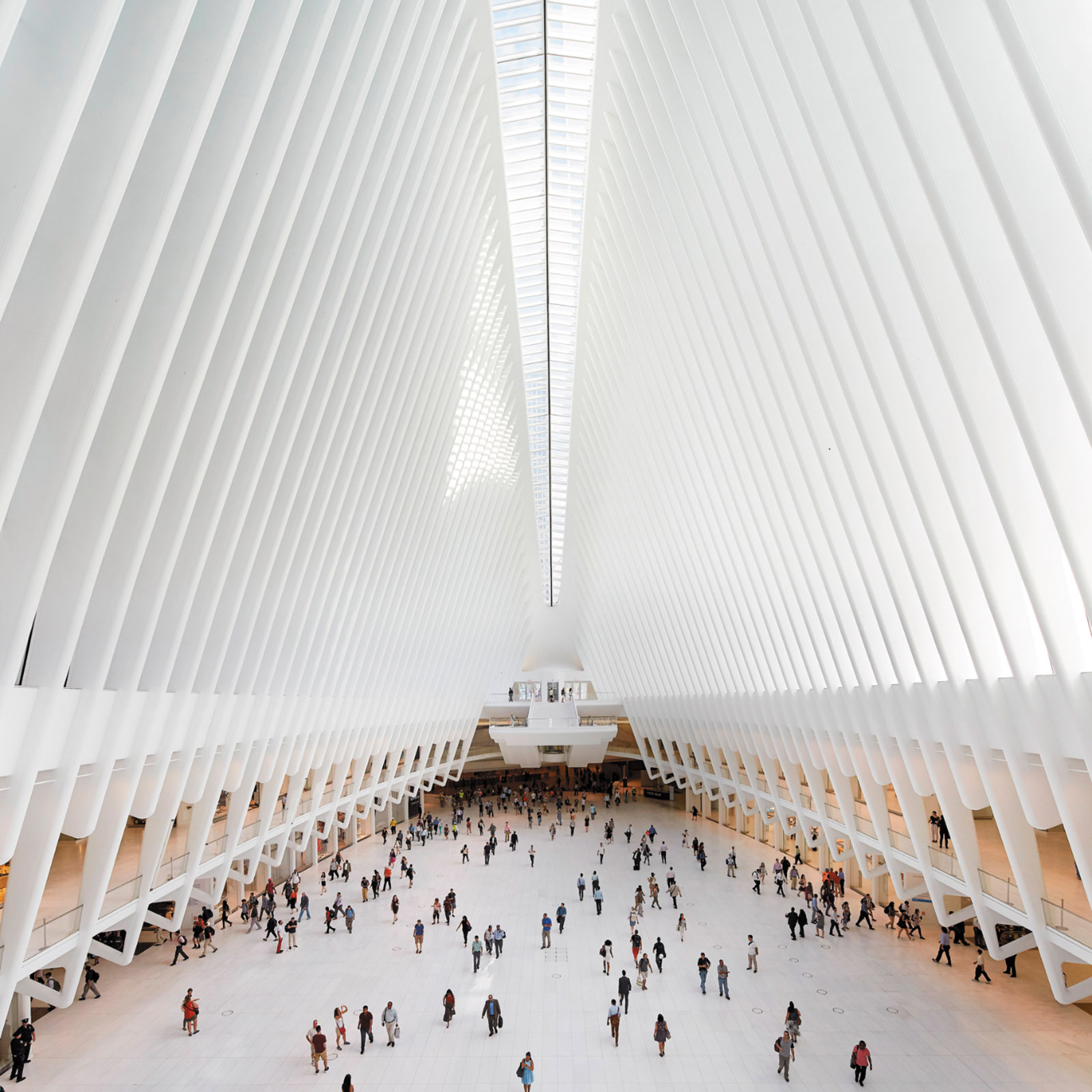
The most architecturally ambitious portion of the ensemble, Santiago Calatrava’s World Trade Center Transportation Hub (commonly called the Oculus), opened to the public in March 2016, though with no fanfare whatever, doubtless to avoid drawing further attention to this stupendous waste of public funds. The job took twelve years to finish instead of the five originally promised, and part of its exorbitant $4 billion price will be paid by commuters in the form of higher transit fares. The fortune spent on this kitschy jeu d’esprit—nearly twice its already unconscionable initial estimate of $2.2 billion—is even more outrageous for a facility that serves only 40,000 commuters on an average weekday, as opposed to the 750,000 who pass through Grand Central Terminal daily. Astoundingly, the Transportation Hub wound up costing more than One World Trade Center itself.
Calatrava’s budgetary excesses were already well known among professionals by the time he received this commission in 2003. But the Lower Manhattan Development Corporation (LMDC)—the joint city-state body established to carry out the reconstruction effort—had just gone through a bruising public struggle to select a master planner for the site, and in its eagerness for an architectural showpiece, it paid insufficient attention to the Spanish architect’s troublesome track record and fell for the maudlin sentimentalism of his design.
What was originally likened by its creator to a fluttering paloma de la paz (dove of peace) because of its white, winglike, upwardly flaring rooflines seems more like a steroidal stegosaurus that wandered onto the set of a sci-fi flick and died there. Instead of an ennobling civic concourse on the order of Grand Central or Charles Follen McKim’s endlessly lamented Pennsylvania Station, what we now have on top of the new transit facilities is an eerily dead-feeling, retro-futuristic, Space Age Gothic shopping mall with acres of highly polished, very slippery white marble flooring like some urban tundra. Formally known as Westfield World Trade Center, it is filled with the same predictable mix of chain retailers one can find in countless airports worldwide: Banana Republic, Hugo Boss, Breitling, Dior, and on through the global label alphabet. (The Westfield Corporation is an Australian-based British-American shopping center company.) Far from this being the “exhilarating nave of a genuine people’s cathedral,” as Paul Goldberger claimed in Vanity Fair, Calatrava’s superfluous shopping shrine is merely what the Germans call a Konsumtempel (temple of consumption), and a generic one at that.
Still to come are 2 World Trade Center by the Bjarke Ingals Group (BIG) and 3 World Trade Center by the office of Richard Rogers. Plans are doubtful for a putative 5 World Trade Center (to replace the former Deutsche Bank Building, which was irreparably damaged by debris from the collapse of the Twin Towers and laboriously dismantled) and no architect has been selected. There will be no 6 World Trade Center to replace that eponymous eight-story component of Yamasaki’s original five-building World Trade Center ensemble, also destroyed on September 11. Hufton+Crow
The interior of the World Trade Center Transportation Hub, designed by Santiago Calatrava
2.
The enormous public interest in the resurrection of Ground Zero quickly prompted three books about the first phases of the effort, all aimed at a general readership and published within four months of each other around the disaster’s third anniversary. Goldberger’s Up From Zero: Politics, Architecture, and the Rebuilding of New York (2004) was one of his typically well-reported but never indiscreet overviews. Philip Nobel’s Sixteen Acres: Architecture and the Outrageous Struggle for the Future of Ground Zero (2005) offered a juicier, more anecdotal account of the same events. Both books suffered from a lack of adequate illustrations, a shortcoming rectified by Suzanne Stephens’s pictorially rich compendium Imagining Ground Zero: Official and Unofficial Proposals for the World Trade Center Site (2004). However, even though the recently issued One World Trade Center: Biography of the Building by Judith Dupré is as glamorously visual as one could imagine, her breathlessly boosterish tone makes it seem more like a promotional event than a serious monograph.
Now, more than a decade after the initial flurry of books, we have what is likely to remain the definitive account of this tortuous and unedifying saga, Lynne B. Sagalyn’s Power at Ground Zero: Politics, Money, and the Remaking of Lower Manhattan. Sagalyn, who retired as a professor of real estate at the Columbia University Business School, insists that there are no heroes or villains in her narrative. However, her meticulous and exceptionally clear exposition of the essential facts provides more than enough evidence for readers to come to their own, and often damning, conclusions, especially about the real estate developer Larry Silverstein, who bought a ninety-nine-year lease on the World Trade Center from the Port Authority of New York and New Jersey just six weeks before the disaster.
Sagalyn’s exhaustive research has revealed some fascinating interrelationships in the upper echelons of the city’s power elite, which will be unsurprising to those who know how the financial and cultural capital of the US really works, and insider glimpses are rarely revealed as directly as she does here. For example, she tells how the well-connected attorney Edward Hayes, a “New York political infighter” and “go-to guy,” urged Pataki, a former Columbia Law School contemporary of his, to pick Daniel Libeskind’s scheme in the competition for the site’s master plan.
Hayes had been introduced to Libeskind and his business-manager wife, Nina, by Victoria Newhouse—an architectural historian and the wife of the publishing magnate Si Newhouse—who was avid to see Libeskind win the commission. Pataki reassured Hayes that he was already in favor of Libeskind’s proposal and indeed intervened at the last moment to ensure that he was chosen. It was a Pyrrhic victory for the architect, however. Libeskind assumed that winning the contest would also entitle him to design the Freedom Tower, but because of his limited experience with such large-scale projects he was forced to collaborate with Childs, who edged him out of the commission with Machiavellian dispatch.
Si Newhouse resurfaces later in the story when the question of who would actually occupy the Freedom Tower becomes an urgent matter. Newhouse’s Condé Nast Publications was identified as the ideal “anchor tenant” by Silverstein’s longtime leasing broker, Mary Ann Tighe of CBRE, the world’s largest commercial real estate services firm, who had known the publisher for decades. Given the perceived danger of another terrorist attack, this would not be an easy sell, but Tighe recalled that Condé Nast had been previously receptive to an undesirable address at the right price when it relocated from its longtime Madison Avenue headquarters to the newly built 4 Times Square in 1999, when that area still had a seedy aura. (The developer of 4 Times Square, the Durst Organization, received tax incentives estimated at more than $280 million, which allowed it to give Condé Nast very favorable terms, a classic example of corporate welfare at taxpayer expense.) Durst partnered with the cash-strapped Silverstein on One World Trade Center once it became an active, risk-free proposition, and Condé Nast agreed to move to Ground Zero when it was offered yet another sweetheart deal on a property widely deemed to be very difficult to rent.
A more visible display of influence was orchestrated by Herbert Muschamp, the New York Times architecture critic from 1992 to 2004. As his friend Frank Gehry told the writer Clay Risen, they dined together in Manhattan the night before the Twin Towers attack, and the catastrophe so traumatized the critic that he felt unable to leave his forty-fourth-floor Tribeca apartment, several blocks north of Ground Zero, for some time afterward. Thus Muschamp deprived the Newspaper of Record of his immediate insights on the biggest architectural news story of modern times for nearly three weeks. Perhaps to compensate for this glaring lapse, he organized a special issue of The New York Times Magazine that presented his notions of how the site ought to be reconfigured, which was published the Sunday before the first anniversary of September 11.
Muschamp had been dismayed that several months earlier the LMDC and the Port Authority (which owns the Trade Center site but leased the now-vanished Trade Center buildings to Silverstein) selected the architectural and planning office Beyer Blinder Belle (BBB) to develop a master plan. Although that partnership had won universal praise for its exemplary restoration of Grand Central, Muschamp deemed BBB insufficiently adventurous for this assignment. Accordingly he invited many of his favorite practitioners—older figures of the New York avant-garde as well as younger trendsetters—to submit their own ideas and assigned parts of the project to them.
The fact that these hypothetical schemes lacked even the most basic information that architects need to draw up design proposals—a budget and a functional program beyond vague designations (school, arts center, and the like)—seemed not to bother either Muschamp or his nominees. As Sagalyn writes in one of her rare overt expressions of disapproval:
This was not city building. Architecture may be art and city building calls for art-like understanding of the fabric of a place, but a city is not a blank canvas to paint at will as Muschamp was advocating with his study project, most unrealistically….
Irresponsibly, Muschamp had preemptively pronounced his personal opinion of what was likely to result before BBB had even drawn a single line. Did this belong in the news section [sic] of the paper? Where does the press cross the line between presenting the news to inform the public and aiming to become a player by advocating a particular vision—other than on the editorial page?
Yet this self-appointed planner was scarcely oblivious to urban design realpolitik. (Nor were the LMDC and the Port Authority, which withdrew the commission from BBB and announced a competition to find a new planning firm.) Immediately after Libeskind’s master plan was chosen over Rafael Viñoly’s proposal—which was centered by a scaffold-like, smaller reiteration of the Twin Towers that the Times critic championed, but that Pataki tactlessly likened to a pair of skeletons—Muschamp made an astonishing volte-face and wrote that the best scheme had won after all.
3.
This aesthetic influence-peddling, whether in the back corridors of government, the salons of the powerful, or the nation’s most prestigious newspaper, was nothing compared to the nonstop machinations of the pivotal figure in this drama, Larry Silverstein, who before September 11 had been considered a fairly minor player and something of a bottom-fisher among the big deal machers of the New York real estate establishment. Although Sagalyn’s portrait of Silverstein accords with the general outlines of previously published reports, here he emerges even more unfavorably as his actions are recounted in greater detail than ever before, thanks to the author’s extensive interviews and her informants’ willingness to speak candidly about him (an indication of how much rancor he aroused).
At the heart of the matter was Silverstein’s unshakable determination that all ten million square feet of office space lost in the Twin Towers’ collapse be replaced, a position driven by his desire to protect the maximum future profitability of his investment. However, this did not accord with the changing economic realities of postmillennial Lower Manhattan, and his sheer stubbornness struck New York City Mayor Michael Bloomberg and the technocratic urbanists around him as fundamentally uninformed and misguided (to put it in the most polite terms).
Sagalyn quotes Daniel Doctoroff, Bloomberg’s deputy mayor for economic development and rebuilding, as pointing out that “Lower Manhattan before 9/11 had a growing residential population, but it had been losing worker population since 1970,” even as the construction of the original World Trade Center was still underway. The changing demographic needs of this part of the city, said Doctoroff, “were swept under the rug in the wake of 9/11 by this kind of nostalgia for the World Trade Center and the tremendous emotion that existed.” The Bloomberg administration favored a varied mix of components with far less emphasis on offices and more housing units, in line with the growing residential character of the Financial District, where many old commercial buildings no longer suitable for today’s high-tech businesses have been converted to apartments, often very costly ones.
But Silverstein’s representatives (including Mary Ann Tighe) aggressively pressed his case for a full ten-million-square-foot build-out, and hammered home the questionable assertion that the boom-or-bust nature of New York City building cycles demanded readiness for the next inevitable upswing (this was before the international market crash of 2008). Conveniently omitted by the developer’s team was the financial history of the World Trade Center. The complex was built during a recessionary period, and it took until the 1980s for it to finally turn a profit; it did so only because of the artificial life support of state government agencies that had been transplanted to the Twin Towers by New York Governor Nelson Rockefeller, brother of that quixotic scheme’s mastermind, David Rockefeller.
Bloomberg and his advisers repeatedly tried to gain control of the project and impose the focused leadership and purposeful direction it lacked. Their most ingenious attempt was a Solomonic solution advanced by Roy Bahat, a twenty-four-year-old aide to Doctoroff, who suggested a swap of the land underneath Kennedy and LaGuardia airports—the city owns that real estate but the Port Authority runs the facilities on it—in return for the Trade Center acreage, which is owned by the Port Authority. This would have allowed the city to invoke eminent domain, cancel Silverstein’s lease, and be done with him. Although the Times praised it as “the most creative idea to arise from the Lower Manhattan redevelopment process so far,” the trade-off foundered not only because of the tangled economics of how evaluations for the respective assets would be calculated, but also because it was stymied by officials who foresaw themselves losing power if the deal went through.
As is typical of such betrayals of the public trust, there was more than enough blame to go around. Sagalyn names names, and they include Port Authority Vice Chairman Charles Gargano, described by the author as “‘a loyal Pataki soldier’…said to be riled by the swap proposal, a threat to his influence; he had already been ‘a loser in a bid to control the [LMDC]’. In the end, it was a political decision—for Governor Pataki.” At that time Pataki harbored presidential ambitions and felt that his continuing involvement in rebuilding Ground Zero would elevate his national reputation. As a result of these and other complications, the swap died in June 2003.
Whatever one might think of Bloomberg’s often high-handed approach to urbanism, which tended to favor corporate interests at the expense of other concerns, there can be little doubt that he did a number of very good things for New York City, and would have been a far better overseer of the World Trade Center redevelopment than any other major figure on the scene at that time. Among the institutions involved in the rebuilding, none is portrayed more critically by Sagalyn than the Port Authority, and rightly so. Its preference for investing in chancy real estate speculations instead of focusing on an overburdened transportation system and crumbling regional infrastructure has been a long-running scandal. A thorough overhaul of that bistate agency would seem to be the only solution to correcting the abuses detailed so appallingly by Sagalyn in her quiet way.
High among other factors that greatly complicated the rebuilding of the Trade Center site are recent advances in DNA verification methods. The conjunction of those new capacities with the 2001 catastrophe is the basis for a thoughtful and solidly informed meditation, Who Owns the Dead?: The Science and Politics of Death at Ground Zero by Jay D. Aronson, a professor at Carnegie Mellon University and director of its Center for Human Rights Science. Because it is now easier than ever to identify human remains found at sites of mass disasters, expectations ran high among many families bereaved by the Twin Towers attack that they might reclaim some corporeal vestige of their dead relatives. It was once expected that those lost at sea would lie forever asleep in the deep, much as soldiers killed in foreign wars would be buried near where they fell. However, modern science has encouraged a broad belief that the retrieval of physical matter, no matter how tiny, is essential to attaining “closure”—that obsessive yet elusive goal of contemporary grieving.
As of last autumn, remains of 1,113 of the disaster’s victims—or some 40 percent of the death toll—continue to be unidentified. At several points during the slow, painstaking, dignified, and respectful recovery process, officials announced that the search had concluded, but family members who had not yet been given definitive physical proof demanded further forensic investigation.
As it turned out, spot checks confirmed that minute amounts of residue from the victims were still discernible in the surrounding area, a finding that prompted an even more microscopic search that in some areas went inch by inch through newly discovered concentrations of possible physical evidence. This late phase was pursued with a vigilance that the participating experts vouchsafed was much more thorough than any they had witnessed before, verging on the exactitude of an archaeological dig. And indeed, additional names were associated with the powdery particulate. But to what end was this increasingly obsessive search? As Aronson writes:
The thought of unidentified remains is unnerving, especially for a society that wants to believe it has the technical capacity to provide some measure of certainty in an uncertain world…. It is ironic, then, that the individualization of the victims of the World Trade Center has made it more politically palatable for the US government to engage in a seemingly perpetual war that has created innumerable casualties in Afghanistan, Iraq, Pakistan, Yemen, and elsewhere.
The Soul of Republicanism

In the summer of 1787, the nascent American experiment reached a point of crisis. Meeting inside Independence Hall amid the stifling Philadelphia heat, delegates to the Constitutional Convention could not agree on a scheme of representation for a new national government, among other contentious issues. "The Fate of America," recalled Gouverneur Morris, a New York delegate, "was suspended by a hair."
Benjamin Franklin, then 81, sat quietly during most of the convention. But when the elder statesman spoke out, he commanded the room's attention. It was at this point of crisis, on June 28, that Franklin addressed George Washington in the speaker's chair and the rest of the delegates, calling for daily prayers at the convention and appeals for divine aid. The stalemate in negotiations provided "a melancholy Proof of the Imperfection of the Human Understanding," Franklin observed, and he wondered why the delegates had not "thought of humbly applying to the Father of Lights to illuminate our Understandings?":
In the Beginning of the Contest with Britain, when we were sensible of Danger, we had daily Prayers in this Room for the Divine Protection. Our Prayers, Sir, were heard;—and they were graciously answered. All of us, who were engag'd in the Struggle, must have observed frequent Instances of a superintending Providence in our Favour. To that kind Providence we owe this happy Opportunity of Consulting in Peace on the Means of establishing our future national Felicity. And have we now forgotten that powerful Friend? Or do we imagine we no longer need its assistance? I have lived, Sir, a long time; and the longer I live, the more convincing proofs I see of this Truth, that GOD governs in the Affairs of Men.
Franklin's speech, replete with historical and biblical references ("GOD governs in the Affairs of Men" echoes Daniel 4:17—"the Most High ruleth in the kingdom of men"), did not succeed. His motion for prayers failed due to practical considerations. There was no money to pay a chaplain; the delegates feared that reports of prayers could raise alarm among the public about the fractious deliberations; prayers could also provoke dissension among convention members of different religious sects. Washington and the delegates did, however, attend a church service in Philadelphia on July 4, where they prayed for divine favor and heard a patriotic sermon from a Baptist minister.
The exact nature of Franklin's faith remains unclear. Many of his writings suggest that, contrary to his speech at the convention, he held the deistic belief in a non-interventionist Creator and did not consider the Bible to be the revealed word of God. But he understood that the Bible contained eternal truths about human nature and that appeals to a Supreme Being could inspire humility, gratitude, and a commitment to transcending "little, partial, local Interests" for the common good.
Franklin's mastery of the Bible was not unique among the Founding Fathers. The founders "knew the Bible from cover to cover," writes Daniel Dreisbach in his superb new book, Reading the Bible With the Founding Fathers. Taking an expansive view of the term "founders" by including state lawmakers and patriot preachers with the signers of the Declaration of Independence and Constitution, Dreisbach asserts that the founders' religious beliefs and biblical knowledge shaped their political thought. Most believed that "there was a Supreme Being who intervened in the affairs of men and nations," that God-given rights should not be rescinded by man, and that a government led by fallen creatures should have its power curbed by the separation of powers, checks and balances, and federalism.
Most importantly, the founders believed that education and religion were essential to promoting the knowledge, morality, discipline, and social order necessary for self-government. As Benjamin Rush, a signer of the Declaration and defender of biblical instruction in schools, put it, "…this divine book, above all others, favours that equality among mankind, that respect for just laws, and all those sober and frugal virtues, which constitute the soul of republicanism." John Adams assented in a letter to Rush, calling the Bible "the most republican book in the world" for its ability to inculcate "the most perfect morality."
To be sure, not all the founders believed in the divine origins of the Bible and Jesus Christ. Yet even deists like Thomas Jefferson and Thomas Paine praised Jesus' moral teachings, the former calling them "the most benevolent and sublime probably that has been ever taught."
Dreisbach writes that "the shelves of a small library could be filled with all the scholarship written on [John] Locke's and Montesquieu's intellectual contributions to the founding." Yet amazingly, academics have mostly neglected the founders' study and use of the Bible—the most accessible and culturally influential book in eighteenth-century America. The late political scientist Wilson Carey McWilliams went so far as to suggest that the founders "rejected or deemphasized the Bible and biblical rhetoric." The Bible was so pervasive during the founding era that it was often quoted by the founders without citations, Dreisbach notes, making it difficult for some scholars not well-versed in biblical language to detect references. Moreover, the modern academy is often dismissive or even hostile toward the study of religious influence. Dreisbach sets out to refute the notion that the Bible did not influence the founders' political discourse, and he largely succeeds.
With its short, simple, and elegant prose, the King James Bible was the most widely read and influential book in the overwhelmingly Protestant culture of early America; it became a staple for literacy education in schools, where its use was vigorously debated by the founders, as it still is today. The founders were educated at colleges that promoted a Christian mission, which, quoting another scholar, Dreisbach describes as, "The production of morally earnest Christian gentlemen, well versed in liberal learning and in the classics of Greco-Roman and Biblical high culture, who would be able to assume leadership positions in American society." The Bible was thus a source of unity for elite and common man alike, in a way that is almost inconceivable in today's fragmented culture.
This biblical education manifested itself in the founders' rhetoric. In Washington's Circular Letter to the States (1783), written as he resigned his post as commander in chief of the Continental Army, he extolled the "pure and benign light of Revelation" in the Bible as the greatest blessing to society. Washington's writings teem with biblical allusions; his favorite biblical phrase "every man under his vine and under his fig tree" (Micah 4:4) is interpreted by Dreisbach as a metaphor for self-sufficiency, property rights, and religious liberty in the new American nation. Other biblical passages frequently quoted by the founders include Proverbs 14:34—"Righteousness exalteth a nation"—and Proverbs 29:2—"When the righteous are in authority, the people rejoice." Character is destiny, the founders believed, so the virtues and vices of the nations' citizens and leaders have consequences.
Dreisbach's argument is weakened somewhat by his admission that "[t]he Bible's influence … did not necessarily supersede or crowd out other influences on the founders' political thought and rhetoric," and it is sometimes unclear where the Bible ranked among other classical, Enlightenment, and English common law sources. Notwithstanding this uncertainty, he marshals more than enough evidence to support his claim that the Bible was a prominent source for the founders' political rhetoric. Indeed, he is right to assert that neglecting the role of the Bible in the founding "impoverishes our understanding of the American experiment in self-government."
America is a more diverse and pluralistic country today than it was during the founding era, and in many ways for the better. But Americans should also heed Dreisbach's contention that a nation cannot understand itself without studying its past and the ideas that motivated it. If it seems today that the liberal order is crumbling, perhaps it's worth revisiting the foundations of that order—liberal learning, biblical morality, and a notion of ordered liberty that embraces obligations toward a Creator and all human beings.


In her highly memorable 2016 Edward Said lecture, award-winning journalist and author Naomi Klein explained: ‘Fossil fuels require sacrifice zones: they always have […] you can’t have a system built on sacrificial places and sacrificial people unless intellectual theories that justify their sacrifice exist and persist.’ Orientalism as one such theory has enabled the West to satisfy its oil dependency by legitimising the existence of sacrificial zones in resource-rich authoritarian or failed states of the Middle East and Africa. Supported by images of its peoples as ‘exotic, primitive and bloodthirsty’, the theory of othering has made it far easier to legitimise the use of force against them when they have suddenly decided to own and control their oil.
In Oil and American Identity: A Culture of Dependency and US Foreign Policy, Sebastian Herbstreuth traces the evolution in the US perception of its moral entitlement to Middle Eastern oil from the 1920s. He concludes that since the oil shocks of the 1970s, ‘oil from the Middle East has been far more foreign than any other oil’ because the region has been placed outside of the cultural boundaries of the West’s liberal modernity and the US-led international order (157). Threats, he cogently argues, are not self-evident facts but cultural constructions. Fears of US dependence on foreign oil existed before the oil shock of 1973, but became entrenched in US political debate after the Organization of the Petroleum Exporting Countries (OPEC) embargo. The images that the US policy establishment (and public) held were those of a ‘modern, civilized sphere of Self and the foreign, atavistic, uncivilized sphere of the Other’ (139). OPEC’s actions elicited strong emotions, leading many to argue in favour of military intervention to secure Arab oilfields.
Sacrificial oil-producing regions, over which the United States would exert a high degree of influence if not control, were believed necessary to fuel US economic growth and support the distinctly US way of life. Herbstreuth tells of the extraordinary rise of the hydrocarbon society in the USA where, between the 1930s and 1970s, energy consumption increased by 350 per cent and was elevated to an unspoken civic duty. By consuming, US citizens stimulated the creation of jobs, economic growth and higher standards of living. Bigger could only mean better. Against the backdrop of the Cold War, mass energy consumption became a symbol of individual freedoms and political rights.
 Image Credit: (Steve Snodgrass CC BY 2.0)
The culture of energy consumerism was predicated on uninterrupted supplies of foreign oil and low prices. The US hydrocarbon society became dependent on abundant and cheap oil to the extent that ‘disruptions to the inflow of foreign oil amounted to a full-frontal assault on its material and cultural foundation’ (85). The OPEC 1973-74 crisis presented an ‘existential threat’: not to the US as a sovereign state but to the hydrocarbon society in which the right to use seemingly inexhaustible energy resources, including those of the Middle East, was viewed as an entitlement and even a birthright.
The structure of oil ownership fed this perception. In the 1950s, seven oil majors controlled some ninety per cent of reserves in the Third World. Of these, five were US companies that directly owned the oil reserves, determined production volumes and set prices (137). The strong convergence of interests between US companies and the state encouraged the perception that the oil was ‘in American hands’, and that it was oil to which the US had a legal and moral right. These were the sacrificial places of the time, and investment decisions were often made to maximise oil output even at the expense of the rapid depletion of the fields. For Americans, demand reduction ran counter to the value of, and desire for, continued abundance.
By 1973 the ‘OPEC Revolution’, which began inconspicuously in the 1950s, had resulted in the redistribution of ownership and profits (on average seventy per cent to thirty per cent) in favour of the host governments. This mattered a great deal, and was followed closely by US policymakers who acknowledged the ‘inescapable fact’ that Middle Eastern oil had become largely removed from the political geography of the US (140). Yet this redistribution did not end the public perception that the US had the right to this oil or, at the least, to demand that it be sold in unlimited quantities at market prices. The psychological impact of the OPEC embargo on US policymaking far outweighed the actual damage it inflicted on the US economy because it brought home the realisation that foreign oil could no longer be said to be US oil: from now on it was Arab oil; not just US oil from the Middle East but Middle Eastern oil.
While Herbstreuth’s account could have benefited from more detailed analysis of the spread of the OPEC Revolution and resource nationalism, his narrative is spot on in pointing out that the OPEC embargo shattered the assumption of the USA’s undisputed right to foreign oil. In the process, Arab producers were cast in the most unfavourable light as ‘disruptors of international order, motivated not by reason and benign economic consideration but by fanaticism, greed, and hatred of the West’ (171). However, a significant omission is the lack of discussion of the perceived threat posed by the Soviet Union in the emergence of the Carter Doctrine, which proclaimed that the US would use military force if necessary to defend its national interests in the Gulf. This is relevant as, in the US psyche, the perception and fears of the other did not only apply to Arabs but also to the Soviets, who were seen as quintessentially different and opposed to US values and lifestyles. Securing national interests, including the flow of abundant supplies of cheap oil, against these ‘others’ helped legitimise the issuance of thinly veiled threats by the Nixon administration and the maintenance of military intervention scenarios even after the end of the OPEC embargo in March 1974 (163).
 Image Credit: Oil Company Sunset (Svetoslav Nikolov CC BY SA 2.0)
But does the West need to wage wars and stage coups in its effort to maintain access to oil or does the preservation of the international trade regime in its current state often suffice? In his lucid book Blood Oil: Tyrants, Violence and the Rules That Run the World, Leif Wenar argues that international trade in oil and other resources is still marred by the rule of effectiveness where ‘might makes right’ and strong systemic incentives exist for the perpetuation of violence and corruption within the countries’ borders.
Effectiveness was a familiar characteristic of pre-modern international law, which legitimised territorial conquests, the slave trade and colonialism. The ‘jurisprudence of the jungle’, as Wenar aptly calls it, has been largely eradicated and replaced with the modern international system based on the principles stipulated in the UN Charter, signed in San Francisco in 1945 (142). Yet a large fragment of the Westphalian pre-modern international order continues to prevail in resource trade (oil, minerals, gems, timber, etc). Consumers in the West buy raw materials, such as oil, as well as finished products like smartphones (which need rare earth metals for key components) with little consideration as to whether these resources have been extracted and sold legally. Wenar draws on examples from across the world, portraying graphic scenes of pillage and mass murder where human bodies were cut in the shape of origami and young vicious militiamen boasted of their trophies in human remains as well as diamonds, oil and timber. His examples amply demonstrate that where people and institutions are weak, resources are taken and sold illegally. They are stolen from the people, their rightful owners, by either authoritarian rulers who have no right to them or gangs and armed militias who obtain access through acts of violence that exceed those of their opponents. The West is complicit in this theft as it continues to buy tainted resources, frequently hiding behind the arguments of international law.
It is indeed far easier for the West to justify the existence of sacrificial places in remote foreign lands where no accountability to an empowered citizenry exists and where oil rent-addicted authoritarians already plunder their own people using a mix of violence and clientelism. Wenar does not discuss Orientalism as such, but his analysis raises a legitimate question: if the West knowingly perpetuates the status quo by continuing to trade with resource-disordered states, does such engagement in itself constitute an act of othering? By drawing mental lines between ‘Us’ and ‘Them’, do Western customers tacitly approve the existence of sacrificial zones because the people inhabiting them are deemed to be different, to be other?
Wenar points out that an argument may be made that some authoritarian rulers are brutal despots while others are benevolent kings. It then could be suggested that the subjects of the benevolent king should rationally approve of their policies ‘because they are getting a good enough deal’ (239). Wenar methodically dismantles such suppositions and reasserts the key tenet of this book: that the modern model of political authority is popular sovereignty. This includes popular resource sovereignty, which means that the people of the country should control their country and its resources. No ruler can be considered generous or benevolent with resource revenues because they are not theirs to give; citizens are entitled to all the value of their resources and not just the pennies that trickle down after all the personal and clientelistic needs of the authoritarian have been met. Popular resource sovereignty is about the control that people have the right to exercise; and the proclaimed goal of the Clean Trade Act, which Wenar lays out in detail in Part Four, is to end effectiveness for the world’s natural resources.
 Image Credit: Green Oil (Sergio Russo CC BY SA 2.0)
Wenar’s argument is morally very compelling. Heart-wrenching accounts of the brutalities committed in Sierra Leone, Nigeria, Equatorial Guinea, South Sudan and Angola, to name a few, make a powerful case that the money that outsiders have paid for these countries’ resources have financed the torture, killing and subjection of their people. The impact of those petrodollars travels further as Western states that import resources from corrupt states threaten their own national interests: the money sent to authoritarian or failed states returns as a blowback in the form of terrorism and other national security threats.
Wenar’s book is thus a call to action. He asks Western democracies to stop trading with resource-disordered states; he asks its consumers to boycott the tainted goods and voluntarily bear the costs of that boycott, such as higher prices for natural resources, general inflation and lower economic growth. He quotes a number of thought-provoking historical examples, the most prominent of which is the end of the slave trade, and asks Westerners to take the moral high ground to end effectiveness-based trade in resources because it is the right thing to do.
This is a big ask. Wenar reasons that ending oil effectiveness today would be easier than at any time in the past because the United States has recently experienced a shale revolution; as a result, it has increased production and reduced its dependence on foreign oil. However, fracking, which enables the extraction of oil and gas from shale, comes at a huge environmental cost as does the production of tar sands in Canada. Developing these resources on a scale that would replace imported oil with domestic would require Western countries to expand significantly the sacrificial zones in their own backyards. This will likely cause a domestic political backlash.
The practicality of some of Wenar’s recommendations is questionable. The Clean Trade Act suggests that major Western consumers should ‘taper off stolen oil’ by setting reduction targets for the import and consumption of oil and gas (304). Wenar warns that this transition path should not lead to greater consumption of coal, thus implying that the solution lies with ‘green energy’. However, all renewable technologies, including wind turbines, electric car batteries and solar panels, currently require the use of rare earth metals. With China controlling the lion’s share (roughly 97 per cent) of the world’s production of rare earths, replacing fossil fuels from authoritarian states with renewables would come at the cost of significantly greater reliance on China.
 Image Credit: Oil Spill in Dalian, China (Peter Ma CC BY 2.0)
It is notable that rare earth metals are not, in fact, that rare and can be found across the globe, including in Brazil, Russia, India, Australia, Malaysia and the US. Yet their production is often unprofitable because they tend not to occur in sufficiently large concentration in economically exploitable ore deposits, and extracting them comes at a high environmental cost. Transitioning to renewables without increasingly relying on China would require the West to make a choice: either stimulate the development of sacrificial zones around the world or develop such zones on its own territory. The former risks creating the same pattern of dependency on tainted products (this time in rare earths) as currently seen in oil and gas; the latter carries environmental risks which many Americans will be unwilling to accept (e.g. leaks of radioactive wastewater) and, as the latest dynamics demonstrate, a market price that for US companies is both economically unprofitable and unsustainable.
Wenar does not have all the answers and this is refreshing. For all the legal and philosophical strengths of his argument, he does not claim to know how China would choose to act should the West adopt the Clean Trade Act. Would it align itself with repressive states to secure access to cheap oil or champion a global vision of prosperity with sustainability? Having been a strategic ally of the USA since 1945, Saudi Arabia is another big unknown: a ‘giant balloon that the world has inflated with trouble’ (95). While the Saudi dynasty has enormous financial resources and the backing of the West, Wenar is quick to point out that so did the Shah of Iran, until the Islamic Revolution of 1979.
Wenar willingly admits that international politics are duplicitous and adopting the Clean Trade Act will not follow a smooth trajectory. The world will need time to disengage from the most oppressive and corrupt regimes which happen to be large suppliers of natural resources. Wenar’s optimism sometimes contrasts with the events on the ground: the election of Saudi Arabia in September 2015 to chair a UN Human Rights Council panel, shortly after the sentencing of blogger Raif Badawi to 1,000 lashes and 10 years of imprisonment and amid plans to behead and crucify teenage protester Ali al-Nimr, seems to be the apogee of political hypocrisy.
Yet there may be hope for a more just world, and it may come not from the governments but from the grassroots. The successes achieved by the Global Witness in Cambodia, Libya and Angola demonstrate the power of informed, determined individuals who, in Said’s words, are part of ‘alternative communities across the globe, informed by alternative news sources, and keenly aware of the environment, human rights and libertarian impulses that bind us together’. So let us all take hope and inspiration from the strength of human spirit and capacity for principled unified action which, as Wenar demonstrates in his outstanding book, is our main weapon in the fight against the horrific injustices that disfigure human history.