Showing posts with label Darori. Show all posts

Friday, September 22, 2017

The FBI and the 1st Amendment : Days of Rage: America's Radical Underground, the FBI, and the Forgotten Age of Revolutionary Violence Paperback – April 5, 2016 by Bryan Burrough,(Penguin Books) ;Subversives: The FBI's War on Student Radicals, and Reagan's Rise to Power Paperback by Seth Rosenfeld (Picador & Farrar, Straus and Giroux) ; Cointelpro: The FBI's Secret War on Political Freedom Paperback by Nelson Blackstock (Pathfinder Press) ;Racial Matters: The FBI's Secret File on Black America, 1960-1972 Reprint Edition by Kenneth O'Reilly(Free Press) ,Berkeley at War: The 1960s 1st Edition by W.J. Rorabaugh (Oxford University Press)

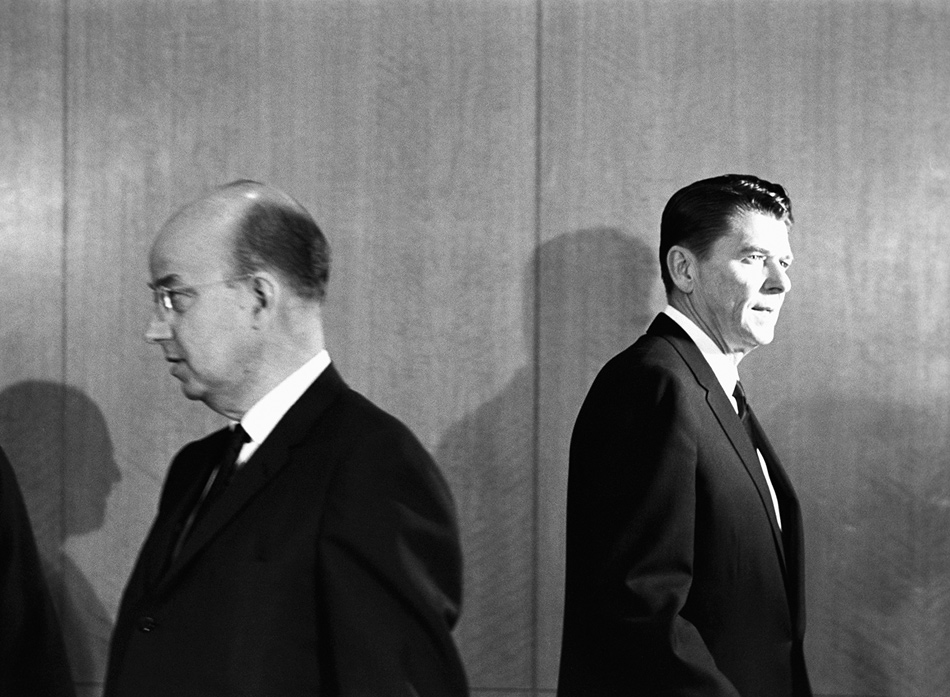
Ted Streshinsky/Corbis
Clark Kerr and Ronald Reagan leaving the meeting of the University of California’s board of regents at which Kerr was fired from his position as president of the university at Reagan’s insistence, Berkeley, January 1967

A curious thing about the United States is that anticommunism has always been far louder and more potent than communism. Unlike sister parties in France, Italy, India, and elsewhere, the Communist Party here has never controlled a major city or region, or even elected a single member to the national legislature. Henry Wallace’s Progressive Party in 1948 received no more than 2.4 percent of the popular vote with Communist support; and Wallace himself soon repudiated the Communists here and abroad.

American anticommunism, by contrast, built and destroyed thousands of careers; witch-hunted dissidents in Hollywood, universities, and government departments; and was a force that politicians like Joseph McCarthy and Richard Nixon rode to great prominence. Of course this was not the first time that heresy hunters have overshadowed the actual heretics: consider the Inquisition, which began before Martin Luther, the greatest heretic, was even born, or how, on accusations of Trotskyism, Stalin imprisoned or shot Soviets by the millions—numbers many times those of Trotsky’s beleaguered, faction-ridden actual followers. But heresy hunting is seldom really about ideas; it’s about maintaining power.

Power begins with surveillance, and the pioneer in American anti-Communist surveillance was Ralph Van Deman, whose elongated hawklike face made him someone a movie director would have cast for the job. A career US Army officer, Van Deman first made his mark keeping a close eye on Filipinos who might have the temerity to resist the long occupation of their country that began with the Spanish-American War. As the military intelligence chief in Manila starting in 1901, he used a web of undercover agents and the newest record-keeping technology—file cards—to track thousands of potential dissidents.

Later in his career, back in the United States, Van Deman filled his cards with the names of American socialists, labor activists, and supporters of the Russian Revolution, the sort of people rounded up in the notorious Palmer Raids of 1919–1920 that jailed some ten thousand leftists. He continued collecting information about Communists and other left-wingers long after he retired as a major general in 1929. With funding from the Army and J. Edgar Hoover’s new Federal Bureau of Investigation, he maintained a private network of informants until his death in 1952, keeping his 250,000 file cards in his house in San Diego, where they were frequently consulted by police Red squads and the FBI.1

It was Hoover, of course, who would take Van Deman’s search for real or imagined Communists to far greater heights. More than forty years after his death, we know a great deal about this unpleasant and power-hungry man, but the California investigative journalist Seth Rosenfeld adds significantly more in Subversives, which is based on some 300,000 pages of FBI documents, pried out of the resistant agency over more than two decades in a series of Freedom of Information Act lawsuits.

The papers largely concern FBI surveillance, disinformation, and other monkey business during the student revolts that roiled the University of California at Berkeley in the 1960s. These upheavals made Berkeley surely the only college campus in the world with four full-time daily newspaper correspondents stationed on it, and for a while, as a greenhorn reporter for the San Francisco Chronicle, I was one of them. I watched firsthand the mass arrest of 773 Free Speech Movement sit-in demonstrators in December 1964 for demanding an end to restrictions on political speaking and organizing on campus, the massive marches and teach-ins against the Vietnam War over the following several years,2 and the astonishing sight of a California National Guard helicopter swooping across the campus in 1969 indiscriminately spraying a dense white cloud of tear gas.

I thought I knew all that was going on, but it turns out there was much that none of us knew, from the fact that the FBI secretly jammed the walkie-talkies of monitors directing a huge 1965 anti-war march I covered to the agency’s decade-long vendetta against Clark Kerr, the man who was first chancellor at Berkeley and then president of the University of California system.

Everyone knew that the FBI had no love for student leftists, but Hoover’s intense hatred for Kerr is the major revelation of Rosenfeld’s careful and thorough book—and it was a revelation for Kerr as well when Rosenfeld shared some of this material with him shortly before Kerr died in 2003. “I know Kerr is no good,” Hoover scrawled in the margin of one bureau document.

Although Kerr was largely reviled by the activists of the Free Speech Movement, who were—quite rightly—protesting his university’s ban against political advocacy on campus, he was far more than the colorless bureaucrat he appeared. For one thing, he had a wry sense of humor, at one point quipping that the real purpose of a university was to provide sex for the students, sports for the alumni, and parking for the faculty. More importantly, he was a man of principle. From 1949 to 1951, for example, the university was riven by a fierce controversy over a loyalty oath required of all employees. More than sixty professors refused to sign, and thirty-one of them, as well as many other staff, were fired. Though a staunch anti-Communist, Kerr spoke out strongly against the firings and the witch-hunt atmosphere surrounding them. His stands on such matters won him the enmity of right-wingers, and he was soon on Hoover’s radar.

The heresy that Hoover feared most was not communism; it was threats to the power of the FBI. And so what pushed him over the line from hostility to absolute rage at Kerr was an exam question. University of California applicants had to take an English aptitude test, which included a choice of one of twelve topics for a five-hundred-word essay. In 1959, one topic was: “What are the dangers to a democracy of a national police organization, like the FBI, which operates secretly and is unresponsive to criticism?”

In response, a furious Hoover issued a blizzard of orders: one FBI official drafted a letter of protest for the national commander of the American Legion to sign; other agents mobilized statements of outrage from the Hearst newspapers, the Catholic Archdiocese of Los Angeles, and the International Association of Chiefs of Police. An FBI man went to see California Governor Edmund G. Brown and stood by while Brown dictated a letter ordering an inquiry into who wrote the essay question.

Hoover himself wrote to members of the university’s board of regents, who swiftly apologized. But his ire did not subside; he ordered an FBI investigation of the university as a whole, assigning an astounding thirty employees to the task. The result was a sixty-page report, covering professorial transgressions that ranged from giving birth to an illegitimate child to writing a play that “defamed Chiang Kai-shek.” The report also noted that seventy-two university faculty, students, and employees were on the bureau’s “Security Index.” This was the list Hoover kept of people who, in case of emergency, were to be arrested and placed in preventive detention, as in the good old days of the Palmer Raids. Like Hoover’s forebear Van Deman, the FBI maintained the index on file cards, but now these were machine-sorted IBM cards.

One of Rosenfeld’s finds is that when the FBI didn’t have another weapon handy, it sent poison-pen letters. The man initially suspected of writing the offending essay question, for instance, was a quiet UCLA English professor and Antioch College graduate, Everett L. Jones. When intensive sleuthing couldn’t find anything to tie Jones to the Communist Party—the usual FBI means of tarring an enemy—someone in the bureau wrote an anonymous letter on plain stationery to UCLA’s chancellor, signed merely “Antioch—Class of ’38,” saying that the writer had known Jones and his wife in college, where “they expressed views which shocked many of their friends,” and later became “fanatical adherents to communism.”

Hoover’s anger at Clark Kerr was reignited in 1960, when thirty-one Berkeley students were among those arrested in a large demonstration against a hearing by the House Un-American Activities Committee in San Francisco’s City Hall—an early landmark in what would be a tumultuous era of American student protest. Hoover was outraged when Kerr refused to discipline the students taking part. Kerr said, reasonably enough, that any student demonstrators were acting as private individuals and “were not in any way representing the university.”

The upheavals of the Free Speech Movement, which had Berkeley in turmoil during the 1964–1965 school year, and of the protests against the Vietnam War that began shaking the campus soon after, brought renewed scrutiny by the FBI. As always, Hoover’s anticommunism had little to do with the Soviets: although the FBI’s responsibilities include counterespionage, only twenty-five of the three hundred agents in Northern California were assigned to this, while forty-three were at work monitoring “subversives,” which meant people like student activists at Berkeley—and, it turns out, even some of those they thought were their enemies, like the university’s regents.

Hoover gathered information about several liberal pro-Kerr regents and funneled it and other ammunition to a major enemy of Kerr, regent Edwin Pauley, a wealthy Los Angeles oilman. An FBI official then reported back to Hoover that an appreciative Pauley could be a useful informant and could “use his influence to curtail, harass and…eliminate communists and ultra-liberal members on the faculty.”

The balance on the board of regents changed following Ronald Reagan’s election as California governor in 1966 (the governor and several other state officials are ex officio regents), and at Reagan’s first meeting, Kerr was fired. Even though Hoover can’t be blamed for Kerr losing his job, he had already made sure that there was another one the educator didn’t get. Some months earlier, President Johnson had decided he wanted Kerr to be the next secretary of health, education, and welfare. “I’ve looked from the Pacific to the Atlantic and from Mexico to Canada,” LBJ told Kerr in his famous arm-twisting mode, “and you’re the man I want.” Kerr said he would think it over. Meanwhile, Johnson ordered the usual FBI background check. Among the documents Rosenfeld wrested from the agency in his legal battle is the twelve-page report Hoover sent the president. Included in it were allegations from a California state legislative Red-hunter who claimed that someone named Louis Hicks had worked with Kerr in the 1940s and declared that Kerr was “pro-Communist.”

“Hoover’s report failed to note, however,” Rosenfeld writes, “that when FBI agents interviewed Hicks he denied making the charge.” The report made a string of similar misrepresentations, among them another such charge—with no mention of the FBIinvestigation that found it untrue. Before Kerr could tell LBJ that he had decided to turn down the post, the president withdrew the offer.

Hoover’s FBI did its best not only to wreck the careers of enemies like Kerr, but to promote those of its friends, like Ronald Reagan. Although Rosenfeld far overstates the bureau’s influence on Reagan’s rise, it is nonetheless jarring to see how much help he got from an agency that was supposed to stay above partisan politics. Reagan had been trading information with the FBI about alleged Communists and radicals ever since his days as president of the Screen Actors Guild in the 1940s, and he continued to feed the bureau Hollywood political gossip for long afterward. The FBI did various work for him in return, for example investigating whether a live-in boyfriend of his estranged daughter Maureen was already married (he was).FBI
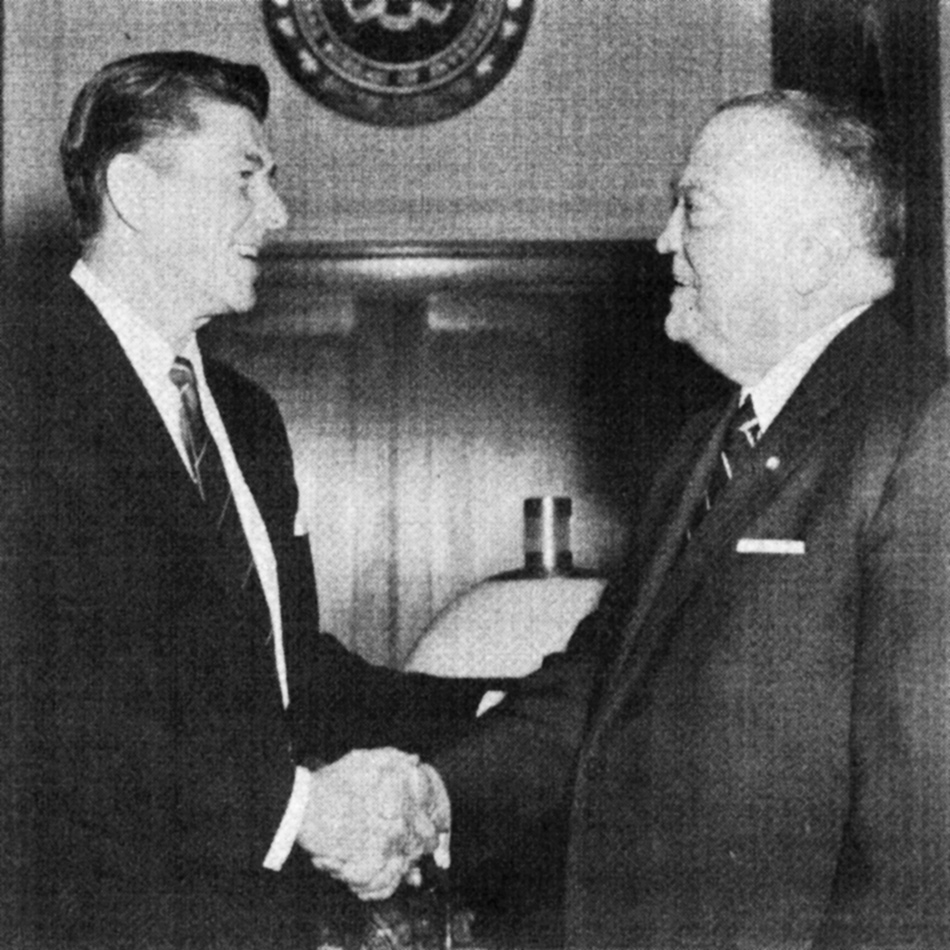
Ronald Reagan and J. Edgar Hoover at FBI headquarters in 1968, after a secret meeting about the Berkeley protests

Another FBI favor for Reagan also concerned a wayward child: his son Michael. In 1965, after Hoover had at last, reluctantly and under much pressure, finally begun investigating organized crime, an agent reported that “the son of Ronald Reagan was associating with” the son of Mafia clan chief Joseph “Joe Bananas” Bonanno. Both sons enjoyed pursuing girls and driving fast cars, and the young Bonanno already had a police record at eighteen. The routine procedure would have been for FBI agents to interview Reagan for any information about the Bonannos he might have learned, but Hoover ordered instead that the agents should simply suggest to Reagan that he tell Michael to find another companion. Reagan, just then gearing up for his first run for governor, was most grateful.

The FBI provided him many other courtesies over the years: a personal briefing from Hoover, data for his speeches, quiet investigations of people the University of California was thinking about hiring—even though screening applicants for jobs that didn’t have to do with the federal government was outside the bureau’s jurisdiction. But Hoover’s biggest favor of all for Reagan was something he didn’t do. In 1960, an informer the agency thought was “reliable” reported that Reagan secretly belonged to the John Birch Society—an organization even the FBI thought so extreme (it considered President Eisenhower a Communist) that it was kept under surveillance. Rosenfeld says that he could not tell from the available records whether this claim was true. But, he notes, “it was precisely the kind of uncorroborated information” that the bureau had quietly slipped to dozens of politicians or journalists over the years when it wanted to damage the reputation of someone like Clark Kerr. This report—which could easily have wrecked Reagan’s future political career—Hoover kept quiet.

One appeal of hunting alleged heretics is that it is relatively easy. By contrast, good police work—chasing down corporate crime or the Mafia, for instance—is extremely hard. Small wonder that in building the power of the FBI, Hoover preferred the first to the second. But what happens to a professional anti-Communist when, on the home front anyway, there are almost no more Communists? Rosenfeld’s book is in part a portrait of an FBI clumsily looking for new targets. In a curious echo of the hostility the Soviets and their satellite regimes had toward the anti-authoritarian overtones of rock music, Hoover grew alarmed about the counterculture. Ken Kesey and his Merry Pranksters came into his sights, as did organizations like Berkeley’s Sexual Freedom League.

But the world was shifting under the FBI’s feet. In the old days, of course, if you couldn’t wreck someone’s career by tying him to a known Communist, you could still do so by exposing a sexual misdeed. Or you could simply hint that you had such information—a method Hoover for decades used to blackmail potential congressional critics into silence. But even though the bureau dispatched a poison-pen letter in 1965 to reveal that a prominent Berkeley antiwar activist had fathered a child out of wedlock, the FBI’s Northern California chief wrote Hoover sadly that such leaks were no longer so effective. These student radicals, he explained, “do not have the same moral standards as a Bureau employee.” In such treacherously changing times, what was a poor blackmailer to do?

Although Subversives is perhaps one hundred pages too long (we don’t need to know a Free Speech Movement leader’s grades in each college course, for example), Rosenfeld’s many years of digging have produced other notable revelations. The most controversial concerns Richard Aoki, a military veteran and particularly confrontational student leader in the later stages of Berkeley 1960s activism—at one point he urged his comrades to steal weapons from National Guard armories. Aoki also provided guns to Black Panther Party members and gave them some of their first weapons training. When his book was first published, Rosenfeld startled just about everyone, it seems, by showing that Aoki was an FBI informant. This accusation has generated a furious fusillade in Aoki’s defense in the pages of the Chronicle of Higher Education and other publications. But in my reading of both sides, the charge seems well documented and convincing; moreover, when Rosenfeld asked him directly if he was an informer, Aoki gave a vague and ambiguous answer.

Aoki’s defenders do not believe that so charismatic a leader could have been anything other than the passionate fighter for justice he appeared. Yet in the murky world of surveillance and double agents, some people can serve two masters. Perhaps the most famous such figure was Yevno Azev (1869–1918), for a decade and a half the key informer for the tsarist secret police, on whose behalf he infiltrated the Russian revolutionary movement and betrayed hundreds of his comrades. But while leaking the details of some assassination plots to the authorities, he nonetheless zestfully helped plan others, including the murder of a provincial governor, of the Grand Duke Sergei (the tsar’s uncle), and of the minister of the interior. It appears that neither Azev nor his alarmed police handlers ever figured out which side he was really on. Was that true for Richard Aoki?3 We will never know: ill with kidney disease, he committed suicide four years ago.

Aoki’s record raises the question: Was the Black Panther Party’s descent into criminal violence mainly the work of FBI agents provocateurs? Were more undercover agents whom we don’t yet know about responsible for the move toward violent confrontation, also beginning around 1969, by other groups, such as the Weather Underground?

I think not. Even though new information about FBI manipulation may eventually surface, there was already plenty of madness in the air by end of the 1960s. The trail of Black Panther extortion, beatings, murders, and other crimes—especially in Northern California—is so long as to be far beyond the FBI’s ability to create it. And by 1970, there were also too many white leftists who romanticized third-world revolutionaries, talked tough, wore military fatigues, and spoke a different language than the nonviolent one of the Free Speech Movement leaders of 1964–1965.

The principal activists of that movement knew their fight was a universal one. They cared about civil liberties from Mississippi (where FSM leader Mario Savio had been a civil rights worker) to Moscow (a year after their own mass arrest, FSM veterans held a Berkeley campus rally for imprisoned Soviet dissidents Andrei Sinyavsky and Yuli Daniel). But political generations were short-lived in the 1960s, and by a few years later, some of the fatigue-clad solidarity activists who passed through Eastern Europe en route to North Vietnam showed little concern over the Soviet-bloc invasion that had crushed the Prague Spring of 1968.

Rosenfeld rightly appreciates the best of the Free Speech Movement leaders, especially the late Mario Savio, whom I came to know toward the end of his life: a gentle, eloquent, deeply intelligent man whose passion for civil liberties and social justice had the strength of a religion. Even though Savio’s lifelong battle with depression and keen belief that the movement could not thrive if it were centered on him personally led him to stay in the background after 1965, it did not prevent the FBI from following his every move, monitoring his bank account, and aggressively questioning his neighbors, employers, friends, and landlords.

Even at its worst, the FBI was far less draconian than dozens of secret police forces active around the world then and today. Poison-pen letters are one thing; disappearances, torture, and murder another. But changes in technology have vastly increased the ease of surveillance. In the 1950s, Rosenfeld reports, in order to eavesdrop on a meeting in Jessica Mitford’s house, two bumbling FBI agents hid in a crawl space beneath it; the mission almost came to grief when one fell asleep and started snoring. But today those agents would have access to vastly more: not just Mitford’s phone calls—which they were already tapping—but her credit card statements, her Google searches, her air travel itineraries, her bookstore purchases, her e-mails, her text messages, her minute-by-minute locations as signaled by the GPS in her mobile phone. To hold longtime records of this sort on whomever it chooses to monitor, the National Security Agency is building in Bluffdale, Utah, for $2 billion, the largest intelligence data storage facility on earth—five times the size of the Capitol building in Washington. It is scheduled to open later this year.4

Naturally, it’s all in the name of stopping terrorism, but the misuse of intelligence-gathering for political purposes, from Ralph Van Deman and the Palmer Raids to J. Edgar Hoover and his meddling with a university board of regents, should make us aware that such things can happen again. The combination of electronic data collection, a vague and nebulous foreign threat, and tens of billions of dollars pouring into “homeland security” each year is a toxic mix, ripe for new demagogues. Subversives is a timely warning. That essay question on the 1959 University of California entrance exam is one we must never stop asking.


1

For Van Deman’s story, see Alfred W. McCoy, Policing America’s Empire: The United States, the Philippines, and the Rise of the Surveillance State (University of Wisconsin Press, 2009).
2

This was enough to gain a notation in my own FBI files, which I obtained under the Freedom of Information Act years ago, that “acting as a representative of the press,” I had been in contact with the march organizers. Although I was a very small fish indeed, my FBI and CIA files from the 1960s run to more than one hundred pages.

3

He and Azev apparently both had personal motives for some of their actions: J. Edgar Hoover, surprisingly, had opposed the World War II internment of Japanese-Americans that had placed Aoki in a prison camp as a child, and Vyacheslav von Plehve, the minister of the interior whose assassination was plotted by Azev, a Jew, had orchestrated a series of pogroms.
4

See James Bamford, “The NSA Is Building the Country’s Biggest Spy Center (Watch What You Say),” Wired, March 15, 2012.

Thursday, September 21, 2017

Treason ... Evolution from from Dissent .......America and the Great War: A Library of Congress Illustrated History by Margaret E. Wagner, with an introduction by David M. Kennedy( Bloomsbury), 371 pp., $45.00; War Against War: The American Fight for Peace, 1914–1918 by Michael Kazin ( Simon and Schuster), 378 pp., $28.00; Spider Web: The Birth of American Anticommunism by Nick Fischer (University of Illinois Press), 345 pp., $95.00; $32.00 (paper)


Hulton Deutsch Collection/Corbis/Getty ImagesBoston police with seized radical literature, November 1919

As our newspapers and TV screens overflow with choleric attacks by President Trump on the media, immigrants, and anyone who criticizes him, it makes us wonder: What would it be like if nothing restrained him from his obvious wish to silence, deport, or jail such enemies? For a chilling answer, we need only roll back the clock one hundred years, to the moment when the United States entered not just a world war, but a three-year period of unparalleled censorship, mass imprisonment, and anti-immigrant terror.

When Woodrow Wilson went before Congress on April 2, 1917, and asked it to declare war against Germany, the country, as it is today, was riven by discord. Even though millions of people from the perennially bellicose Theodore Roosevelt on down were eager for war, President Wilson was not sure he could count on the loyalty of some nine million German-Americans, or of the 4.5 million Irish-Americans who might be reluctant to fight as allies of Britain. Also, hundreds of officials elected to state and local office belonged to the Socialist Party, which strongly opposed American participation in this or any other war. And tens of thousands of Americans were “Wobblies,” members of the militant Industrial Workers of the World (IWW), and the only battle they wanted to fight was that of labor against capital.

The moment the United States entered the war in Europe, a second, less noticed war began at home. Staffed by federal agents, local police, and civilian vigilantes, it had three main targets: anyone who might be a German sympathizer, left-wing newspapers and magazines, and labor activists. The war against the last two groups would continue for a year and a half after World War I ended.

In a strikingly Trumpian fashion, President Wilson himself helped sow suspicion of anything German. He had run for reelection in 1916 on the slogan “he kept us out of war,” but he also knew American public opinion was strongly anti-German. Even before the declaration of war, he had darkly warned that “there are citizens of the United States, I blush to admit, born under other flags…who have poured the poison of disloyalty into the very arteries of our national life…. Such creatures of passion, disloyalty, and anarchy must be crushed out.”

Once the US entered the war immediately after Wilson’s second term began, the crushing swiftly reached a frenzy. The government started arresting and interning native-born Germans who were not naturalized US citizens—but in a highly selective way, seizing, for example, all those who were IWW members. Millions of Americans rushed to spurn anything German. Families named Schmidt quickly became Smith. German-language textbooks were tossed on bonfires. The German-born conductor of the Boston Symphony Orchestra, Karl Muck, was locked up, even though he was a citizen of Switzerland; notes he had made on a score of the St. Matthew Passion were suspected of being coded messages to Germany. Berlin, Iowa, changed its name to Lincoln, and East Germantown, Indiana, became Pershing, after the general leading American soldiers in their broad-brimmed hats to France. Hamburger was now “Salisbury steak” and German measles “Liberty measles.” The New York Heraldpublished the names and addresses of every German or Austro-Hungarian national living in the city.

Citizens everywhere took the law into their hands. In Collinsville, Illinois, a crowd seized a coal miner, Robert Prager, who had the bad luck to be German-born. They kicked and punched him, stripped off his clothes, wrapped him in an American flag, forced him to sing “The Star-Spangled Banner,” marched him to a tree on the outskirts of town, and lynched him. It didn’t matter that he had tried to enlist in the US Navy but been turned down because he had a glass eye. After a jury deliberated for only forty-five minutes, eleven members of the mob were acquitted of all charges while a military band played outside the courthouse.

The next battle was an assault on the media unmatched in American history before or—so far—since. Its commander was Wilson’s postmaster general, Albert Sidney Burleson, a pompous former prosecutor and congressman. On June 16, 1917, he sent sweeping instructions to local postmasters ordering them to “keep a close watch on unsealed matters, newspapers, etc.” for anything “calculated to…cause insubordination, disloyalty, mutiny…or otherwise embarrass or hamper the Government in conducting the war.” What did “embarrass” mean? A subsequent Burleson edict gave a broad range of examples, from saying “that the Government is controlled by Wall Street or munition manufacturers, or any other special interests” to “attacking improperly our allies.”

One after another, Burleson went after newspapers and magazines, many of them affiliated with the Socialist Party, including the popular Appeal to Reason, which had a circulation of more than half a million. Virtually all Wobbly literature was banned from the mail. Burleson’s most famous target was Max Eastman’s vigorously antiwar The Masses, the literary journal that had published everyone from John Reed to Sherwood Anderson to Edna St. Vincent Millay to the young Walter Lippmann. While The Massesnever actually reached the masses—its circulation averaged a mere 12,000—it was one of the liveliest magazines this country has ever produced. Burleson shut it down; one of the items that drew his ire was a cartoon of the Liberty Bell crumbling. “They give you ninety days for quoting the Declaration of Independence,” declared Eastman, “six months for quoting the Bible.”

With so many recent immigrants, the United States had dozens of foreign-language papers. All were now required to submit to the local postmaster English translations of all articles dealing with the government, the war, or American allies before they could be published—a ruinous expense that caused many periodicals to stop printing. Another Burleson technique was to ban a particular issue of a newspaper or magazine, and then cancel its second-class mailing permit, claiming that it was no longer publishing regularly. Before the war was over, seventy-five different publications would be either censored or completely banned.

Finally, the war gave business and government the perfect excuse to attack the labor movement. The preceding eight years had been ones of great labor strife, with hundreds of thousands of workers on strike every year; now, virtually every IWW office was raided. In Seattle, authorities turned Wobbly prisoners over to the local army commander, then claimed that because they were in military custody, habeas corpus did not apply. In Chicago, when 101 Wobblies were put through a four-month trial, a jury found all of them guilty after a discussion so brief it averaged less than thirty seconds per defendant. By the time of the Armistice, there would be nearly 6,300 warranted arrests of leftists of all varieties, but thousands more people, the total unknown, were seized without warrants.

Much repression never showed up in statistics because it was done by vigilantes. In June 1917, for example, copper miners in Bisbee, Arizona, organized by the IWW, went on strike. A few weeks later, the local sheriff formed a posse of more than two thousand mining company officials, hired gunmen, and armed local businessmen. Wearing white armbands to identify themselves and led by a car mounted with a machine gun, they broke down doors and marched nearly twelve hundred strikers and their supporters out of town. The men were held for several hours under the hot sun in a baseball park, then forced at bayonet point into a train of two dozen cattle and freight cars and hauled, with armed guards atop each car and more armed men escorting the train in automobiles, 180 miles through the desert and across the state line to New Mexico. After two days without food, they were placed in a US Army stockade. A few months later, in Tulsa, Oklahoma, a mob wearing hoods seized seventeen Wobblies and whipped, tarred, and feathered them.

Even people from the highest reaches of society bayed for blood like a lynch mob. Elihu Root, a corporate lawyer and former secretary of war, secretary of state, and senator, was the prototype of the so-called wise men of the twentieth-century foreign policy establishment who moved easily back and forth between Wall Street and Washington. “There are men walking about the streets of this city tonight who ought to be taken out at sunrise tomorrow and shot,” he told an audience at New York’s Union League Club in August 1917. “There are some newspapers published in this city every day the editors of which deserve conviction and execution for treason.”

Woodrow Wilson is remembered for promoting the League of Nations to resolve conflicts abroad in an orderly fashion, but at home his Justice Department encouraged the formation of vigilante groups with names like the Knights of Liberty and the Sedition Slammers. The largest was the American Protective League (APL), with 250,000 members by the end of the war, some of them from existing business organizations, like California’s Midway Oilfields Protective Committee, whose membership joined as a group. Its ranks filled with employers who hated unions, nativists who hated immigrants, and men too old for the military who still wanted to do battle. APL members carried badges labeled “Auxiliary of the US Department of Justice,” and the Post Office gave them the franking privilege of sending mail for free.

The government offered a $50 bounty for every proven draft evader, which brought untold thousands to the hunt, from underpaid rural sheriffs to the big-city unemployed. Throughout the country, the APL carried out “slacker raids,” sometimes together with uniformed soldiers and sailors. One September 1918 raid in New York City and its vicinity netted more than 60,000 men. Only 199 actual draft dodgers were found among them, but many of the remainder were held for days while their records were checked. Wilson approvingly told the secretary of the navy that the raids would “put the fear of God” in draft dodgers.

Although brave and outspoken, Americans who opposed the war were only a minority of the population. The Wilson administration’s harsh treatment of them had considerable popular support. In early 1917 the unrestricted German submarine attacks on American ships taking cargo to the Allies and the notorious Zimmerman telegram, promising Mexico a slice of the American Southwest if it joined the war on Germany’s side, fanned outrage against Germany. The targeting of so many leftists and labor leaders who were immigrants, Jewish, or both drew on a powerful undercurrent of nativism and anti-Semitism. And millions of young men, still ignorant of trench warfare’s horrors, were eager to fight and ready to be hostile to anyone who seemed to stand in their way.

By the time the war ended the government had a new excuse for continuing the crackdown: the Russian Revolution, which was blamed for any unrest, such as a wave of large postwar strikes in 1919. These were ruthlessly suppressed. Gary, Indiana, was put under martial law, and army tanks were called out in Cleveland. When bombs went off in New York, Washington, and several other cities, they were almost certainly all set by a small group of Italian anarchists (indeed, one managed to blow himself up in the process). But “alternative facts” reigned: the director of the Bureau of Investigation, predecessor of the FBI, claimed the bombers were “connected with Russian bolshevism.”

The same year an outburst of protest by black Americans provided a pretext for vicious racist violence. Nearly four hundred thousand blacks had served in the military, then come home to a country where they were denied good jobs, schooling, and housing. As they competed with millions of returning white soldiers for scarce work, race riots broke out, and that summer more than 120 people were killed. Lynchings—a steady, terrifying feature of black life for many years—reached the highest point in more than a decade; seventy-eight African-Americans were lynched in 1919, more than one per week. But all racial tension was also blamed on the Russians. Wilson himself predicted that “the American negro returning from abroad would be our greatest medium in conveying Bolshevism to America.”

This three-year period of repression reached a peak in late 1919 and early 1920 with the “Palmer Raids,” under the direction of Attorney General A. Mitchell Palmer, helped at every step by a rising young Justice Department official named John Edgar Hoover. On a single day of the raids, for example—January 2, 1920—some five thousand people were arrested; one scholar calls it “the largest single-day police roundup in American history.” The raiders were notoriously rough, beating people and throwing them down staircases. After one raid, a New York World reporter found smashed doors, overturned furniture, wrecked typewriters, and bloodstains on the floor. Eight hundred people were seized in Boston, and some of them marched through the city’s streets in chains on their way to a temporary prison on an island in the harbor. Another eight hundred were held for six days in a windowless corridor in a federal building in Detroit, with no bedding and the use of just one toilet and sink.


Library of Congress
A New York Globe cartoon by H.T. Webster equating the Industrial Workers of the World with Kaiser Wilhelm II, 1917

Palmer was startlingly open about the fact that his raids were driven by ideology. After attacking “the fanatical doctrinaires of communism in Russia,” he vowed “to keep up an unflinching, persistent, aggressive warfare against any movement, no matter how cloaked or dissembled, having for its purpose either the promulgation of these ideas or the excitation of sympathy for those who spread them.” Campaigning for the Democratic nomination for president, he hysterically predicted a widespread Bolshevik uprising on May Day, 1920, scaring authorities in Chicago into putting 360 radicals into preventive detention for the day. When the day passed and absolutely nothing happened, it became clear that the United States never had been on the verge of revolution; membership in the country’s two feuding communist parties was, after all, minuscule.

Citizens—in particular a committee of a dozen prominent lawyers, law professors, and law school deans—were emboldened to speak out against the repression, and the worst of it came to an end. But it had accomplished its purpose. The IWW was crushed, the Socialist Party reduced to a shadow of its former self, and unions forced into sharp retreat; even the determinedly moderate work-within-the-system American Federation of Labor would lose more than a million members between 1920 and 1923.

Because this sorry period of our history is too often forgotten, it’s good to see it recalled this year by several writers and filmmakers marking the centenary of America’s entry into World War I. Library of Congress staff member Margaret E. Wagner’s America and the Great War breaks no new ground but makes clear that the story of this country and that war is not only about the Lusitania and doughboys in France. She covers the war at home as well, both in the text and in photos and artwork drawn from the library’s vast collections. The illustrations, for instance, include a vigilante leaflet, dissidents like John Reed and Eugene V. Debs (imprisoned for more than two years for speaking against the war), a lynch mob, and a haunting charcoal drawing by the artist Maurice Becker, a cartoonist for The Masses, showing how he and his fellow conscientious objectors were treated in military prisons: shackled to cell bars so they would be forced to stand on tiptoe nine hours a day.

Such people and events are also evoked in The Great War, some six hours of exceptionally well-crafted film from PBS’s American Experience, which portrays a very different America from the can-do-no-wrong country of traditional war documentaries. Most of the footage is about the fighting in Europe and all that led to it, but the filmmakers do not stint in looking at the ruthless stifling of dissent at home. We learn about the division of opinion in the country, the harsh treatment of returning black veterans by the government and lynch mobs alike, and vigilantes like the American Protective League, several of whose wild-eyed reports on supposed spies and subversives are shown onscreen. The war “had great costs,” says Nancy K. Bristow, one of many historians interviewed, near the close of the film. “Not only in loss of life. That war was won, but it was won by way of behaviors, policies, and laws that contradicted the very values for which the country was fighting.”

Several other historians talk about the figure who presided over so much of what happened in those years, Woodrow Wilson. Their collective portrait is of a complex man who in the end was blinded by his own sense of righteousness. Any person or group who stood in his way was to be swept aside, jailed, or deported. He was convinced that he knew what was best, and not just for his own country. As Michael Kazin, one of the historians interviewed, puts it, “He wanted to be president of the world.”

Kazin himself is the author of a much-needed book for this anniversary season, War Against War, which he begins by putting his cards on the table: “I wish the United States had stayed out of the Great War. Imperial Germany posed no threat to the American homeland…and the consequences of its defeat made the world a more dangerous place.” He goes on to paint a full and nuanced picture of the surprisingly diverse array of Americans who opposed the war. Fifty representatives and six senators voted against it; one of the latter, Robert La Follette, then began receiving nooses in his office mail. More resistance came from Socialists, anarchists, and other radicals; Emma Goldman, jailed for two years for organizing against the draft, was one of 249 foreign-born troublemakers placed under heavy guard on a decrepit former troopship in 1919 and deported to Russia. She reportedly thumbed her nose at Hoover, who was seeing off the ship from a tugboat in New York Harbor.

Remarkably, Kazin points out, the South had the highest percentage of noncooperators of any part of the country. (This seems to have had more to do with the rural/urban divide than with beliefs; many young southern men had a farm to maintain or a family to support and may have simply trusted the local sheriff not to turn them in.) Perhaps the biggest surprise in Kazin’s book is the sheer number of resisters. If you add together men who failed to register for the draft, didn’t show up when called, or deserted after being drafted, the total is well over three million. “A higher percentage of American men successfully resisted conscription during World War I than during the Vietnam War.” Several bold men and women, among them Norman Thomas, A. Philip Randolph, and Jeannette Rankin, lived long enough to speak out against both wars.

Once the Russian Revolution happened, much of the repression was carried out in the name of anticommunism. Nick Fischer’s history of the anticommunist frenzy in these years, Spider Web, is unfortunately written with little grace. For instance, he repeatedly studs a lengthy paragraph with half a dozen or more descriptive phrases in quotation marks, but then forces the reader to turn to the endnotes at the back of the book to find out just who is being quoted. However, his perspective is refreshingly original.

Anticommunism in this country, he points out, never had much to do with the Soviet Union. For one thing, it had already been sparked by the Paris Commune, decades before the Russian Revolution took place. “To-day there is not in our language…a more hateful word than Communism,” thundered a professor at the Union Theological Seminary in 1878. For another thing, after the Revolution, anticommunists knew as little as American Communists about what was actually happening in Russia. The starry-eyed Communists were convinced it was paradise. The anticommunists found they could shock people if they portrayed the country as one ruled by “commissariats of free love” where women had been nationalized along with private property and were passed out to men. Neither group had much incentive to investigate what life in that distant country was really like.

For a century or more, Fischer convincingly documents, the real enemy of American anticommunism was organized labor. Employers were the core of the anticommunist movement, but early on began building alliances. One was with the press (whose owners had their own fear of unions): as early as 1874 the New York Tribune was talking of how “Communists” had smuggled into New York jewels stolen from Paris churches by members of the Commune, to finance the purchase of arms. That same year the Times spoke of a “Communist reign of terror” wreaked by striking carpet weavers in Philadelphia. In 1887, Bradstreet’s decried as “communist” the idea of the eight-hour workday.

The anticommunist alliance was joined by private detective agencies, which earned millions by infiltrating and suppressing unions. These rose to prominence in the late nineteenth century, and by the time of the Palmer Raids the three largest agencies employed 135,000 men. Meanwhile, starting in the 1870s, the nation’s police forces began using vagrancy arrests to clear city streets of potential troublemakers (New York made more than a million in a single year). Then they developed “red squads,” whose officers’ jobs and promotions depended on finding communist conspiracies.

Another ally was the military. “Fully half of the National Guard’s activity in the latter nineteenth century,” Fischer writes, “comprised strikebreaking and industrial policing.” Many of the handsome redbrick armories in American cities were built during that period, some with help from industry, when the country had no war overseas. Chicago businessmen even purchased a grand home for one general.

By the time the US entered World War I, the Bureau of Investigation and the US Army’s Military Intelligence branch were also part of the mix, making use—and here Fischer draws on the pioneering work of historian Alfred McCoy—of surveillance and infiltration techniques developed by the army to crush the Philippine independence movement. An important gathering place for the most influential anticommunists after 1917, incidentally, was New York’s Union League Club, where Elihu Root had given his hair-raising speech about executing newspaper editors for treason.

Fischer carries the story farther into the twentieth century, giving intriguing portraits of several professional anticommunists. One, for instance, John Bond Trevor, came from an eminent family (Franklin and Eleanor Roosevelt attended his wedding) and got his start as director of the New York City branch of Military Intelligence in 1919. He moved on the following year to help direct a New York State investigation of subversives, which staged its own sweeping raids, and soon became active in the eugenics movement. He was a leading crafter of and lobbyist for the Immigration Act of 1924, which sharply restricted arrivals from almost everywhere except northwestern Europe. His life combined, in a pattern still familiar today, hostility to dissidents at home and to immigrants from abroad.

What lessons can we draw from this time when the United States, despite its victory in the European war, truly lost its soul at home?

A modestly encouraging one is that sometimes a decent person with respect for law can throw a considerable wrench in the works. Somewhere between six and ten thousand aliens were arrested during the Palmer Raids, and Palmer and Hoover were eager to deport them. But deportations were controlled by the Immigration Bureau, which was under the Department of Labor. And there, Assistant Secretary of Labor Louis F. Post, a progressive former newspaperman with rimless glasses and a Van Dyke beard, was able to stop most of them.

A hero of this grim era, Post canceled search warrants, restored habeas corpus rights for those detained, and drastically reduced or eliminated bail for many. This earned him the hatred of Palmer and of Hoover, who assembled a 350-page file on him. Hoover also unsuccessfully orchestrated a campaign by the American Legion for his dismissal, and an attempt by Congress to impeach him. All told, Post was able to prevent some three thousand people from being deported.

A more somber insight offered by the events of 1917–1920 is that when powerful social tensions roil the country and hysteria fills the air, rights and values we take for granted can easily be eroded: the freedom to publish and speak, protection from vigilante justice, even confidence that election results will be honored. When, for instance, in 1918 and again in a special election the next year, Wisconsin voters elected a Socialist to Congress, and a fairly moderate one at that, the House of Representatives, by a vote of 330 to 6, simply refused to seat him. The same thing happened to five members of the party elected to the New York state legislature.

Furthermore, we can’t comfort ourselves by saying, about these three years of jingoist thuggery, “if only people had known.” People did know. All of these shameful events were widely reported in print, sometimes photographed, and in a few cases even caught on film. But the press generally nodded its approval. After the sheriff of Bisbee, Arizona, and his posse packed the local Wobblies off into the desert, the Los Angeles Times wrote that they “have written a lesson that the whole of America would do well to copy.” Encouragingly, much of the national press is not doing that kind of cheerleading today.

The final lesson from this dark time is that when a president has no tolerance for opposition, the greatest godsend he can have is a war. Then dissent becomes not just “fake news,” but treason. We should be wary.

Old Herbaceous: A Novel of the Garden (Modern Library Gardening) Paperback – April 15, 2003 by Reginald Arkell (Author), Penelope Hobhouse (Introduction)(IBRClassicsReview)


You know, one of the really great things about gardeners is how wonderfully generous they are with advice, most of it rubbish of course and rarely is it advice they themselves follow in anything like a systematic way, as I have noticed. But every so often you pick up a nugget of great value from a gardening acquaintance, and experienced gardeners are always on the lookout for that. So here is something along the line of a pearl of rare price. If you have never read Old Herbaceous by Reginald Arkell, go out and buy this fine book immediately. It was written in 1950, near the end of the author's long life, and it is a novel about a crusty old English gardener near the end of his own long life, looking back on what made him the gardener - and the man - he is now. You can just hear the lilting sing-song of the rural accents of the village characters; Arkell has captured them with perfect pitch. What a lovely and humane book this is, a gentle comedy enriched with sober observation on the practice and philosophy of gardening. It has the broad comedy of Beverley Nichols' great gardening books but also their depth and perhaps a bit more gravitas. It is truly a gem and, though far too brief, something you will take to heart and cherish.

But don't just take my word for it. It is a standard-bearer of the Modern Library's gardening series, edited by the best-selling writer Michael Pollan. He writes in his introduction to the series that these are all books for literate gardeners: "And so I read to garden, and gardened to read, counting myself lucky for having stumbled on a sideline with such a lively and lasting literature. For what other pastime has spawned so many fine books?" And that is followed by enthusiastic comments on Old Herbaceous itself by gardening great Penelope Hobhouse.

The narrator's tone is elegiac and heavily nostalgic, as is not surprising in a gardener whose life and career began as a foundling and gardener's boy in the Victorian era, saw the great-house golden era of Edwardian times, the economic dislocations of World War I, the roaring twenties and then World War II and the post-war era of shortages and rationing. It plugs directly into the enlivening current that makes the television series "Downton Abbey" so popular: nostalgic, beautifully observed and humane, while history washes over and changes fully realized characters that we love and care about. Officially this is a book about gardening, but really it is a book about saying goodbye, letting go, having your life in its proper perspective at all times, living quietly and with beauty and dignity. All things gardeners are working out in their own gardens the world over.

You would have to have a heart of stone not to feel Old Herbaceous' pain in the scene when he has to part with his beloved but now frail Mrs. Charteris, who owned the manor home for many years and has to move into smaller quarters; or when he is cruelly given the sack late in life by the new owners (though this is later rescinded). Here is the likable and sunny Old Herbaceous himself, philosophizing about the good things that come to a man with age: "If you could peel the years from a man's life, as you do the leaves from a globe artichoke, you would find him having his happiest time between the ages of fifty and sixty-five...A golden, mellowing period which brings out all that is best in a man. Kindliness creeps in; cheerfulness spreads its warming rays, even a little humor..."

The warming rays and gentle humor of this book are certainly charming. It is a short, nostalgic and deeply humane novel that has earned its place as one of England's great gardening classics.

The Pilbara From the deserts the profits come by Bradon Ellem (University of Western Australia Press) 2017 PB 256pp $39.99

Product Details
The Pilbara is an important book for anyone thinking about the world of work and how it might be shaped in Australia.
Bradon Ellem tells us at the outset that his approach will be historical and geographical, that the past does not stay the same, and that the vast area of the Pilbara in north-west Western Australia is physically isolated. Without economics, however, there would be no modern story and this he relates in three phases: union dominance, intense conflict between mining companies and unions, and finally employer dominance through fly-in-fly-out (FIFO) workers, changes to labour laws, and the geography of work.
This is a powerful history of a transformed landscape, which has had wider implications for the conduct of industrial relations in Australia.
It begins in the 1960s with ‘ore bodies which were millions of years in the making’ and will likely end with them ‘being mined out in just one century of capitalist intervention’. Iron-ore mining required massive start-up costs as there were no railway lines, few sealed roads and only one suitable harbour at Port Hedland. State and global finance shaped the area at the beginning but curiously the state then moved aside:
The Australian state opened the way for global giants to profit from the Pilbara’s resources; but, with that done, it walked away from the attempts to use resource exploitation to drive downstream manufacturing development, as even conservative policy makers had wanted to do before World War II.
While unions were powerful in the early years, they faced obstacles. Physical isolation with the mines hundreds of kilometres apart, workers coming from all over the country, and a high labour turnover meant that unity was difficult. There were grievances galore over heat, flies, long working hours, deafening machinery and the lack of air-conditioning as well as work fragmentation (quarrying, crushing, transporting, treating, storing, loading) which led to demarcation disputes and a large number of awards. Collectivism took precedence over unionism, as did men over women, although the arrival of women in the towns and their employment as teachers, health workers and in administrative jobs softened the previous macho ethos of hard living and hard drinking.
Through most of the 1970s the working operation of the Pilbara becomes what Ellem terms ‘contested terrain’, a shift in power from worker to manager, the noteworthy role of convenors – full-time union officials whose wages are paid by the company, and disputes which are not confined to work sites but spill over to the towns. The companies attempt new ways of regulating wages and conditions but face worker opposition based on the argument that the Pilbara is a special place. Hamersley’s managers attempt to bring the unions under control in 1979 produces a 10-week strike and nationwide union support, but the end result is state intervention by Charles Court’s Liberal government in favour of the transnational company, which underlines union weakness.
The 1980s and 1990s see the mining companies build on this gain: first Peko Wallsend at Robe River, then Conzinc Rio Tinto Australia (CRA) at Hamersley, and finally BHP. Peko’s strategy of restoring managerial authority begins in 1986 and the statement attributed to the company’s industrial relations manager Herb Larratt that ‘every worker should go to work each day expecting to be sacked’ was a loathsome expression of a changing industrial world. CRA’s rethinking of its relations with its workforce in the early 1990s followed Peko’s success and its process of de-unionisation led to new ways of working with 12-hour shifts, longer overall working hours, and employees signing individual worker contracts by the end of the decade. BHP’s offer of individual contracts to its workers in 1999 would mark a testing ground for the unions that, although they had success retaining members, found it difficult to attract new members.
The testing ground also had a moral component as voiced both by the union newsletter, Rock Solid and in the words of founding convenor of Action in Support of Partners, Colleen Palmer:
We were all a long way from home and living in a very remote and isolated environment that wasn’t exactly conducive to family living. We all had concerns about our future in the Pilbara and worried about our children’s future and the future of working conditions we were to pass down to them.
Unfortunately, as Ellem observes, multinational companies have other concerns:
The towns had long been trouble for the companies … If towns could be done away with, so much the better. Not one new town has been built after the 1970s despite the massive growth in the industry.
In the 21st century the companies have remade the landscape as ‘a site of production’ in a globalised network, one where, as one Rio Tinto executive explained, mining would be simpler without human beings. The rise of the Pilbara Mineworkers’ Union at Hamersley was a new type of union cooperation, seeking a collective agreement but broken by the Australian Workers Union deal with Rio. In the boom years, while 60 per cent of Australia’s export income came from mining, the sector employed only two per cent of the workforce and raised concerns about the ‘indifference of policy-makers to the question of what would happen post-mining’:
The mining boom generated not only billions of dollars in cash flow but a debate about the distribution of its benefits and the nature of its legacy. The Labor government elected in 2007 picked up on this and planned to tax what it and others referred to as the ‘super profits’ of the corporations and then set up a sovereign wealth fund. Chief among the models they had in mind was Norway, where such a fund, based on revenue from offshore petroleum, had driven massive infrastructure developments beyond the norm for so small a country.
The political influence of the mining companies, backed by an expensive media campaign, took its toll on prime minister Kevin Rudd ‘such that his colleagues replaced him and “his” tax’. At the end of the boom it might well be suggested that Australians have not benefitted much, nor have Western Australians sufficiently, nor the region under discussion:
The boom put the Pilbara, the FIFO worker and the mind-bending figures around the industry at the centre of national media attention and public conversation. On the fringes, both literally and metaphorically, lay the descendants of the first inhabitants of the Pilbara from whose lands the profits flowed. It was impossible to reconcile mining’s investment levels and profits with the conditions of these people. On the outskirts of towns generating the highest profits ever recorded in Australian mining lay the abject poverty. It was ten minutes’ walk, not a ten-hour flight, to the Third World.
In many ways this is a depressing story because the bad guys seem to have won. At the same time it is an important book for anyone thinking about the world of work and how it might be shaped in this country’s future.
The Pilbara makes strong play in its subtitle on the AD Hope line ‘From the deserts prophets come’ but perhaps even more aptly it reinforces Donald Horne’s original ironic meaning of ‘Lucky Country’. Once again Australia has sold itself short.

Home Fire by Kamila Shamsie ,(Bloomsbury), $24.99


What happens to those left behind when men go off to fight? This electrifying novel is Pakistan-raised, London-based Kamila Shamsie's seventh. In her acknowledgements, she says she was inspired by Sophocles' story of Antigone, the young woman who defies the king's order that her brother remain unburied on the field of battle.

However, this story of the Pasha and Lone families in contemporary London, Syria, Pakistan and the US also has more than a touch of Romeo and Juliet.The power of family ties infuses the novel – family versus career, versus self-preservation, versus politics, versus jihad.

Home Fire, which was longlisted for this year's Man Booker Prize, opens with Isma Pasha being interrogated at London's Heathrow Airport as she prepares to board a plane to the US, where she will undertake her PhD – studies interrupted by the deaths of her mother and grandmother that forced her to become a surrogate parent to her younger brother and sister, 12-year-old twins Pavaiz and Aneeka.

Now the twins are 19, old enough to fend for themselves. But first she must endure hours of intrusive questions from officials that range from "Do you consider yourself British?" (she was born and raised in London) to her views on the division of Iraq, suicide bombers, and The Great British Bake Off.

We soon learn that this interrogation is not simply because she is a Muslim, but because of the past actions of her father, and the more recent choices of her brother Pavaiz.

Her father died while being taken to Guantanamo. We are not told what drove Abil Pasha towards jihadism; Isma sees it as simply one of a succession of enterprises to which he turned his hand: "guitarist, salesman, gambler, con man, jihadist– but he was most consistent in the role of absentee father".

The consequences for the family were not just the loss of a husband and father, but the attention of the police. On one occasion, the police take away a photograph album Abil Pasha has sent to Pavaiz with the inscription: "When you're old enough, my son." When it is eventually returned to the boy, the pictures of his father with his jihadist comrades have been removed.

Pavaiz is blessed with acute hearing and dreams of being a sound engineer. Aneeka feels the connection with her twin acutely, but now she is studying law she spends more and more time away from home. Pavaiz sees the break-up of their household as a kind of betrayal, a decision that has been made without him. So when Farooq appears, a man of "instant glamour" who speaks of his father as a hero who "understood that a man has larger responsibilities than the ones his wife and mother want to chain him to", Pavaiz is ready to listen.

Entwined with this story of the Pasha siblings is the story of the Lone family. The Pashas regard controversial MP Karamat Lone with contempt for failing to help them find answers when Abil Pasha died, but now Karamat has been made the country's first Muslim Home Secretary. His son Eamonn, a drifter living on his mother's money, falls hard for the beautiful Aneeka.

From this moment the fates of the two families become bound together in an inevitable trajectory towards tragedy.

Shamsie's last two novels have looped back and forth through history – from Nagasaki in 1941 to the US in 2002 in Burnt Shadows(shortlisted for the Orange Prize) and from Turkey in 515BC to Pakistan in 1930 in A God in Every Stone.

In contrast, Home Fires is compressed into a matter of months. Shamsie reveals the intimate – and conflicting – worlds of each of her five protagonists with enormous skill. The effect is more immediate and heartbreaking than any headline, and shows with devastating power how ordinary people can be caught up in the unthinkable.


White Tears A NOVEL By HARI KUNZRU Category: Literary Fiction | Noir Mysteries Paperback | 288 Pages (Penguin Random)h


White Tears by Hari KunzruSt
Kunzru, the author of four previous novels, has nailed a specifically American style of bourgeois appropriation through his main characters, Seth and Carter, 20-something white guys whose friendship is staked on a fetish for music. Carter is the alpha by virtue of his bank account — richer than Croesus but mortified about it. Seth, the sidekick and narrator, becomes consumed by the fallout of their forged recording of an invented black musician.

These kids are stupidly privileged, and they are not all right: even before they were born, they were complicit in sins of the past. White Tears time-bends through Jim Crow-era Mississippi and riverbank chain gangs, around characters who are owed personal reparations for not only the fake (or is it real?) recording but for other past wrongs. "History is literally present in all that we do," wrote James Baldwin, whose traces are here in Kunzru's pages. Crackling literary allusion is spliced throughout White Tears, slyly evoking works by Thomas Mann (Carter's decidedly Aryan, vaguely incestuous family), Ralph Ellison (Seth's persistent inability to make others notice him becomes an actual shift in skin color) and others.

For all that and then some, White Tears is a book that everyone should be reading right now. Near the end, Seth passively absorbs cable-news coverage of a police shooting — "Why would they kill him ... His hands were up" — and an idea Kunzru floats chapters before booms back: radio pioneer Guglielmo Marconi's theory that sound never dies. We are always, all of us, living with the past.

The Financial Diaries: How American Families Cope in a World of Uncertainty. Jonathan Morduch and Rachel Schneider. Princeton University Press. 2017.


Political and media attention on the increasingly precarious nature of work has been fuelled by the high profile, often controversial, growth of the ‘gig economy’. Insecurity, however, runs deeper than recent changes to the labour market. For many people, it is the volatility caused by the predictable challenges of everyday life, as well as the lack of a reliable paycheck, that makes it difficult to make ends meet.

In the twentieth century, researchers like Michael Harrington exposed the extent of extreme poverty in the US. In turn, they helped to build the intellectual foundations for policies that aimed to combat that poverty. Though the problem of extreme poverty is by no means consigned to history, an equivalent success for researchers in the twenty-first century might be to do the same for insecurity. Financial Diaries: How American Families Cope in a World of Uncertainty succeeds in shining a light on the extent and experience of volatile household finances in the US. Whether it helps to build the case for policies to target insecurity will depend on its reception.

The primary value of Jonathan Morduch and Rachel Schneider’s work lies in the uniqueness of the research. The book is based on diaries with 235 households, conducted in five states across the US: Ohio, Kentucky, California, Mississippi and New York. Building on research in low income communities, including by Morduch, the diaries recorded every transaction made by households over the course of 2012-13. The resulting 300,000 transactions give an unrivalled insight into the cash flows as well as the hidden rhythms, concerns and aspirations of people’s financial lives.

The structure of the book is clear. There are three main sections: the first describes how insecure US households have become; the second, how they cope; and the third sketches what that means for how we should think about poverty and what might be done about it. Section One contains the two most illuminating chapters.

Image Credit: Broken piggy bank

In the first chapter, the researchers focus on household earnings. Much of the content is familiar. The decline of manufacturing and trade unions, the shifting nature of work and the rise of contingent, or ‘gig’, labour are all cited as reasons for the growing volatility and insecurity of people’s incomes. The diaries allow the authors to dig below the surface and add colour to that picture. For every new statistic – nearly half of participant households had a gain or loss of income of 25 per cent or more from one year to the next – there is a detail no national survey could tell you. For instance, for one participant, Janice, a card dealer in Mississippi, a cause of income insecurity was the fact that in odd years – when Mississippi State’s football team plays two of its key fixtures away – she missed out on two good paychecks.

If the first chapter is rich but often familiar, in the second chapter – which focuses on spending – the unique contribution of the research is even clearer. Spending is the side of the household balance sheet that is often overlooked by researchers. Focusing, as in Chapter One, on one household, the researchers show how Sarah and Sam, while ostensibly middle-class with an income of $65,000, often struggle to make ends meet. The diaries allow the researchers to see why. Each time the researchers visit the family they have had another major expense: three car breakdowns, two graduations and a burst water pipe, to name a few.

Sarah and Sam’s experiences, like Janice’s in Chapter One, are not anomalies. On average, the research found that spending is almost as volatile as income. Typically, households had five months in the year where their spending was either 25 per cent above, or 25 per cent below, their average monthly spending for the year.

Three important arguments run throughout the book. The first is that insecurity and uncertainty do not just make it difficult for people to make ends meet; it often directly conflicts with aspirations of mobility. The diaries show both sides of the coin. One participant, Jeremy, a car mechanic, moved to a lower paid, but more stable job. In contrast, Sarah, who we meet in Chapter Two, continued to aim high by studying for a college degree instead of a full-time job. The consequence for Sarah and her family was sacrificing stability in the short term.

The authors are also carefully critical of the most common response to the type of challenges faced by the diaries’ households: namely, better budgeting. The assumptions made by too many financial education initiatives about how households live mean they are often irrelevant – focusing on long-term goals and the allocation of spare resources. Moreover, they often make moral judgements about the use of money: people who can’t manage their money use ‘debt’; those who can use ‘credit’.

When you step back from a spreadsheet, many ‘non-essentials’ look more like what one participant refers to as ‘really really needs’. What keeps people from building savings isn’t a ‘lack of awareness or a lack of discipline. Rather, it’s that the day they’re saving for isn’t very far away’ (96). In fact, the researchers found that while those who performed better on financial literacy tests were more likely to have lofty savings goals, they were only slightly more likely to actually have those savings. The reality of people’s lives, rather than their attitude or aspirations, had a more dramatic effect on their financial management.

The third, and most important, theme of the book is highlighting the commonality of uncertainty. The diaries’ households were deliberately diverse: 23 per cent were classified as poor and 26 per cent earned more than twice the poverty line. Yet, nearly a third of participants in the latter group spent at least one month below the poverty line. While the diaries’ participants were not nationally representative, statistics from the Federal Reserve, the University of Michigan’s Panel Study of Income Dynamics and from the JP Morgan Chase Institute’s analysis of Chase accounts are used throughout to corroborate Morduch and Schneider’s findings. Volatility is both widespread and getting worse.

For many, the long arc of the lifecycle theory of saving simply does not reflect the reality of their experiences. The causes of their insecurity are ‘not infrequent disruptions to basic steady income […] the base condition is unsteady’ (34). Deviations from that arc are not noise: instead, ‘the noise is the story’ (11).

On that final point, the book could be more explicit. In the introduction, uncertainty is described as a form of ‘hidden inequality’. There are two weaknesses to that framing. First, it aligns the challenge of volatility and uncertainty with an often intractable political debate. That is likely to trigger instinctive rejection by some policymakers. Second, as a social problem, inequality is more abstract and less relatable. Unlike inequality, financial uncertainty is tangibly experienced across income groups and, as the diaries demonstrate, the impact on people’s lives is stark. It is the commonality of the uncertainty exposed in Financial Diaries that provides the strongest case that a new policy agenda to tackle insecurity is needed.

Monday, September 18, 2017

Pnin Paperback, by Vladimir Nabokov (Vintage)


This book has left me with a lingering melancholy. With its shifting perspectives and unreliable narrator, combined with that narrator's masterful prose, I could not help but fall in love with PNIN. It is art, dense, complex, playful, as only Nabokov can deliver.

Although this is a less known novel of Nabokov, it is, in my opinion, just as great as LOLITA and PALE FIRE: although, it is a different type of greatness. Whereas PALE FIRE is a Rubin vase of absolute innovation, and LOLITA is masterfully allusive and erudite, PNIN is hilariously funny and pathetic. Pnin, the protagonist of PNIN, an emigre Russian living in the United States, is a likable, painfully oblivious professor at a college, where all of his coevals think him a hack. A veritable Don Quixote, the universe seems to conspire against Pnin, and everything he does ends in disaster-- such as try to take a train, or walk down some stairs, or wash some dishes. The sadness of the book comes from the fact that, like Don Quixote, Pnin is beautiful and pure and innocent in a uniquely "Pninian" way, which is not only admirable but lovable.

If one enjoyed LOLITA, then this book is a must. It was written at the same time as LOLITA, while Nabokov wrote at his most "American." Yet, clearly, it is very different than LOLITA. In comparing LOLITA to PNIN, one can see the skill of Nabokov. As PNIN is much more approachable than LOLITA, it should be a relatively easy task to read.

I do note, with a tinge of sadness, that the Kindle edition of this book has a few errors. For instance, on Kindle page 114, it reads, "...church at which one was supposed to turn left to reach Cooks Place." when it should read, as it does in my physical copy of PNIN, "...church at which one was supposed to turn left to reach Cook's Place" (114, First Vintage International Edition, June 1989). I found other solecisms within the Kindle text, which not detracting from the book on a serious level, were nonetheless unfortunate as they mar a great work.

I will read this book again and again, especially as the Kindle edition makes looking up the arcane and obscure words Nabokov revels in simple. I would recommend it to anyone who enjoys literature.

Sunday, September 17, 2017

Best Aubrey-Maturin Novels...Post Captain by O'Brian,Patrick. Paperback by O'Brian (W.W.Norton & Company) ;H. M. S. Surprise ) Paperback by Patrick O'Brian (W.W. Norton & Company),The Fortune of War Paperback by Patrick O'Briany (W.W.Norton & Company) ;The Far Side of the World Paperback by Patrick O'Brian (W.W.Norton & Company) ; Desolation IslandPaperback by Patrick O'Brian (W.W.Norton & Company)


The twenty-one novels in Patrick O’Brian’s Aubrey-Maturin series are the greatest sustained work of English-language fiction written in the 20th century for the high craft of their characters, story lines, language, and themes, for the breadth of their erudition, and for the sheer stamina of O’Brian’s invention.

The series follows Jack Aubrey, a fighting captain in the British Navy, and his particular friend, Stephen Maturin, naturalist, naval surgeon, and intelligence officer, as they fight in the Napoleonic wars as well as the War of 1812.
The series begins with superlative novels that include the books in my best of O’Brian list below. Then, like the happiest of long-running marriages, the Aubrey-Maturin novels take a modest step down to the level of very good indeed; with my metaphorical marriage encompassing not only Jack and Stephen’s monumental friendship, but more importantly, the great devotion of O’Brian and his readers to each other.
I’ve listed my five personal favorites, in order of admiration, with notes and some spoilers. (I’ve included a complete list of the Aubrey-Maturin novels below these reviews for convenience.)

Post Captain 

Post Captain - a best Aubrey-Maturin novel by O'BrianPatrick O’Brian’s magnificent sophomore work is the crown jewel of the series. The novel begins with O’Brian in full Jane Austen mode, following a young Jack Aubrey with prize money in his pocket and time on his hands because of an unfortunate lull in the Napoleonic wars, as he pursues his eventual wife, Sophie Williams.
Soon, fighting breaks out again but more significantly, Jack and Stephen’s friendship breaks down over a second woman (Stephen’s eventual wife, Diana Villiers) and they challenge each other to a duel. This is the only time in the series when the enduring friendship between the Aubrey and Maturin is shaken, and it makes for some of the most difficult and moving reading in the novels.
In Post Captain, O’Brian’s skill at writing complex, lucid, and compelling battle scenes emerges in all its glory, as does his humor, most especially when Jack is forced to escape suddenly hostile French territory by disguising himself as a dancing bear.
Unlike many of the later novels in the Aubrey-Maturin series, which don’t end as much as they simply stop, Post Captain concludes with a bang.
O’Brian places Jack in command of one of the four British ships that famously captured a Spanish treasure fleet bringing gold back from the New World to finance Spain’s entry into the war against England. Stephen, in his emerging role as an indispensable intelligence officer for the British, gathers the information that makes the capture possible. goodreads page.

HMS Surprise 

hms surprise best aubrey maturin obrianIn HMS Surprise, the pace is faster, the action more exciting, the stakes higher, and the plot architecture tighter than in Post Captain, which it immediately follows in the series’ sequence.
For my money, HMS Surprise features the best set-piece in the entire series: Jack’s brilliant and daring rescue of Stephen, who has been captured as a spy by the French and is being tortured in the town of Port Mahon on one of the Balearic Islands. This is also the moment when the friendship between Jack and Stephen becomes stronger than death, and so the great and enduring heart of the Aubrey-Maturin novels begins to beat.
In HMS Surprise, both Jack and Stephen face down significant rivals. For Jack, it is the French Admiral Linois, who defeated him in the series’ first book, Master and Commander. For Stephen, it is a new contender for Diana’s affections, who he challenges to a duel that leads to another of the series’ most famous sequences, in which Stephen performs surgery on himself.
Finally, HMS Surprise launches two more of the novels’ great elements. The first is the theme of marriage’s problematic nature, as Jack looks forward to bliss with Sophie in the book’s final lines (Jack predicts the future will be “pure paradise”). The second is exotic locales. India features prominently in HMS Surprise, and future novels will take Jack and Stephen all around the world. goodreads page.

The Fortune of War 

The Fortune of War - a best Aubrey Maturin novel O'BrianJack and Stephen are equal as friends, but Jack is more often the agent of action in the novels, partially because he is the captain of the frigates on which Stephen serves and partially because his appalling bad judgment in nearly every aspect of his life except as frigate captain is always getting him into trouble.
The Fortune of War is the single book in the Aubrey-Maturin series that truly belongs to Stephen. In it, he and Jack have been captured by the Americans during the war of 1812. Both are taken to Boston, where a severely wounded Jack is held prisoner, but Stephen walks about with considerable freedom, since the Americans believe him to be just a naval surgeon rather than a British agent.
French agents, also in Boston, know better however, and they engage Stephen in a deadly game of cat and mouse which transforms The Fortune of War into the series’ only true spy-thriller. Thrown in the mix are Diana Villiers, that brilliant complicator of Stephen’s life, and a hair’s breadth escape that wraps up the novel nicely.
Also in The Fortune of War, O’Brian brings the double nature of Stephen Maturin into sharp focus. In the novels to this point, we’ve known Stephen as an accomplished naturalist, a committed physician, and a talented spy – but only had hints of his deadly ruthlessness. Here, Stephen kills without hesitation or regret when driven by circumstances, and O’Brian creates another contrast with his great friend, Jack Aubrey.
Jack as a naval officer is personally responsible for far more deaths than Stephen, but Jack cheerfully regards war as the world’s greatest professional sport. The rewards are immense, the rules complicated and subtle, losing often deadly, but the players feel little actual animosity for their opponents as long as they adhere to the laws of the game. In Stephen’s war, there are no rules, the killing is vicious and personal, and grudges extend beyond declarations of peace. Another way to say it, of the two men, it is Stephen who has the soul of a killer. goodreads page.

The Far Side of the World 

far side world best aubrey maturingAs the Aubrey-Maturin series progresses, the plots of the books become less discrete and the arcs of the stories flatten; so the novels transform into one continuous narrative that blossoms with asides, digressions, false starts, storms and accidents, sudden reversals, changes of mission caused by the whims of Jack’s superiors or shifting geopolitics, and the messy complexity of the characters most of all.
The Far Side of the World is a particularly rich example of these qualities. In the novel, Jack is sent in the HMS Surprise to prevent an American frigate from attacking British whalers in the South Seas, and almost nothing goes right. He is significantly delayed by a lightning storm off the coast of Brazil that damages his ship and requires significant repairs, which allows the Americans to slip into the Pacific and strike the whalers. Later, a typhoon nearly wreaks Jack’s frigate and destroys the American ship for him. The crew is unhappy with an aging, incompetent midshipman who they believe is back luck. Stephen is entangled in political intrigue while reveling in his opportunities to collect scientific specimens. And much more.
There is something existential in all this chaos, and without suggesting that O’Brian intended to write a philosophical novel – he has entirely too much sense and talent as an artist to bother with such stuff – the total vision of The Far Side of the World delivers exactly that. goodreads page.

Desolation Island 

desolation island best aubrey maturin o'brianIf The Far Side of the World flirted with existentialism, Desolation Islands walks right up to this dreary philosophy and gives it a big wet kiss.
Jack accepts the command of the Leopard, an aging ship barely fit to navigate the English Channel, in a mission to transport prisoners to Australia. These prisoners attack and murder some of their guards. The ship is stuck in the doldrums and battered by storms. An epidemic kills most of the prisoners and much of the crew. The Leopard is chased and nearly destroyed by a vastly more powerful Dutch ship of the line. An iceberg damages the Leopard so severely that Jack makes a desperate landing on Desolation Island (one of many in the world at that time) where they are at risk of being marooned permanently.
Desolation Island contains two of my favorite extended set pieces. The first is the Dutch ship’s pursuit of the Leopard, which takes place in the Roaring Forties, where the waves are mountainous and O’Brian’s powers of description are superb. The second is the crew’s extended stay on the cold, bleak island of the novel’s title – which Stephen regards as a natural philosopher’s paradise he is in no hurry to leave. This is an example of O’Brian’s humor, of course. But it also suggests that joy and wonder can be found any place, if you just know how to look for it. goodreads page.

Complete List of Aubrey-Maturin Novels by Patrick O’Brian

Master and Commander (1970)
Post Captain (1972)
HMS Surprise (1973)
The Mauritius Command (1977)
Desolation Island (1978)
The Fortune of War (1979)
The Surgeon’s Mate (1980)
The Ionian Mission (1981)
Treason’s Harbour (1983)
The Far Side of the World (1984)
The Reverse of the Medal (1986)
The Letter of Marque (1988)
The Thirteen Gun Salute (1989)
The Nutmeg of Consolation (1991)
Clarissa Oakes or The Truelove (1992)
The Wine-Dark Sea (1993)
The Commodore (1995)
The Yellow Admiral (1996)
The Hundred Days (1998)
Blue at the Mizzen (1999)