When the most unpopular and least prepared president-elect in modern history took the oath of office on January 20, most of Washington, like most of the country and the world, had little idea of the turbulence and disruption that he intended to bring to the job. Nonetheless those who’d watched him closely over the past year and a half were aware that he was manifestly unfit for a job that’s beyond the capacities of most people.
Anyone who was still expecting a heretofore hidden inner statesman to emerge from the bombastic, crude, talkative candidate was harboring illusions. After the election, we had new evidence that Donald Trump wasn’t up to the position; during the transition that reality crept out of the cracks in the defensive wall thrown around him by protective advisers. An article in the New York Post on January 15 said that Trump was showing far more interest in trivialities about the inauguration planning than in preparing to govern. Tom Barrack, chair of the Presidential Inaugural Committee, told the Post, “He’s into every detail of everything. I beg him all the time to go back to running the free world and let me focus on setting the tables.”
Trump took office with only two cabinet officers ready to serve. (Barack Obama had nine.) And he came to the job with few political connections: mainstream Republicans had essentially shunned his campaign. But Vice President Mike Pence, a very conservative and well-liked former House member particularly close to the also highly conservative House Speaker Paul Ryan, had won Trump’s confidence by not appearing to be out for himself. So did Jeff Sessions, the Alabama senator who was the first in that body to endorse Trump and stayed close to him throughout the campaign. Sessions, whom Trump rewarded with the position of attorney general, has not fully revised his rural Alabama–rooted attitudes on race and has been a firm opponent of immigration. Pence and Sessions were mainly responsible for the selection of the most ideological cabinet in memory.
When he’s outside his few fixed views, Trump is a curiously malleable figure. His lack of knowledge about policy and his paucity of political connections force him to rely on the advice of others, which makes all the more critical the nature of the people he’s chosen to have around him. Not many foresaw the extent of the power that Steve Bannon, Trump’s intellectual guru and chief strategist, would exercise in the White House. Bannon is an alt-right white nationalist who as senior counselor now occupies an office a few steps from the president’s. He seemed to have his finger in everything, and Trump compounded this by placing Bannon on the National Security Council Principals Committee, of which a political adviser has never been a full-time member. (The New York Times reported that Trump was angry that he wasn’t “fully briefed” on the executive order establishing this role for Bannon.)
Moreover, while Bannon was to become a regular member of the NSC, under Trump’s reorganization the director of national intelligence and the chairman of the Joint Chiefs of Staff were demoted to attending only NSC meetings relevant to their direct responsibilities. This reshuffle may in part reflect Trump’s resentment of the intelligence community for saying that Russia had interfered in the election on his behalf, and also efforts by his national security adviser, retired General Mike Flynn, to preserve his position in the constellation of security officials around Trump. Recently, White House knives have been out for the bumptious Flynn, who, like Trump, is an impulsive figure with an affinity for Vladimir Putin. Unhappy over press reports of disorder among his staff, Trump has ordered a more hierarchical approach (which he’d never preferred), under Chief of Staff Reince Priebus.
Bannon’s closest ally among Trump’s political advisers has been Sessions’s former top aide Stephen Miller, who is a speechwriter for the president and senior adviser for policy. As Sessions’s aide, Miller was instrumental in getting immigration reform killed in the Senate. Bannon and Miller were the main authors of Trump’s inaugural address as well as its cousin, his acceptance speech at the Republican convention. As it happens, Trump’s supposedly closest adviser, his son-in-law Jared Kushner, shares many of Bannon’s radical right-wing views: the old establishment must be smashed, whether it’s in Congress, Washington, or Europe. Neither Kushner nor Bannon had had one minute of previous government experience.
Despite his so-called populism—Bannon has analogized him to Andrew Jackson—Trump is no threat to the Republican moneyed class. He made it clear in his campaign that he favored cutting taxes on the wealthy and corporations; the middle class, who constituted Trump’s base, was also to get a tax cut, but proportionally a much smaller one. And numerous middle-class households would actually be paying higher taxes. Probably more important to Trump’s business supporters was that he’d made it clear that he’d take a sledgehammer to the web of federal regulations, particularly those that in the name of protecting the environment restrict how businesses run their plants and extract raw materials from the earth. And he has begun to roll back rules imposed on banks by the Dodd-Frank Act in response to the 2008 financial crisis.
The direction Trump would go on the environment was made clear in the campaign when he called climate change a “hoax,” and he named a prominent climate change denier, Myron Ebell, as head of the transition team for the Environmental Protection Agency. Ebell ran a libertarian think tank financed by the coal industry and the Koch brothers. Though they didn’t back Trump for president and didn’t speak highly of him, the Kochs invested in Trump’s election—their political organization was active in Wisconsin and Pennsylvania—and their influence in the Trump administration was guaranteed by having been, along with other fossil fuel industrialists, strong backers of Pence, who has been a climate change denier.
After the election, the vast Koch network was only too happy to help Trump fill numerous job openings and develop policy proposals. Koch allies have turned up in various administration positions. They include Marc Short, the White House legislative director, who had worked for Pence and had headed the major organization that raised funds to promote the Kochs’ far-right, pro-corporate, anti-environmental agenda, including their opposition to the Affordable Care Act. The Kochs also want to see the end of numerous federal programs, though their hand in getting that done may remain invisible. They have another strong ally in Paul Ryan, who’s been a featured speaker at many of their gatherings.
Trump’s frenzied actions once he took office were intended to make him appear to be fulfilling campaign promises—though in several instances he is claiming a broader mandate than he has—and to show the country that he’s a man of action. He says and does so much that he’s hard to keep up with, and this has become a strategy. He’s a juggler par excellence. Several of his actions were largely born of his revanchism against Obama’s policies. Just hours after he was sworn in, Trump issued orders throwing the first harpoon at Obamacare by issuing an executive order instructing the states to go easy on any ACA policy that “imposes a financial or regulatory burden.” The substantive import of this vaguely worded order wasn’t clear: it could be sheer symbolism or it could be a step toward first damaging and then trying to kill the program, Obama’s most prized domestic achievement.
The executive order about Obamacare might buy time while Trump and congressional Republicans attempt to find their way through the minefield they’d created for themselves by making their number-one goal to “repeal and replace” Obamacare. To that end, later in its first week, the Trump administration threw another monkey wrench into the workings of the ACA by blocking the Department of Health and Human Services from advertising or using other forms of contact to encourage people to sign up for insurance before the January 31 deadline for coverage in 2017. After a public outcry, this order was partially withdrawn a few days later.
“Repeal and replace” was a slogan, not a policy—the Republicans’ real interest was in simply killing the ACA—and it was even proving harder to repeal the law than its opponents had anticipated, much less to reach agreement on what should replace it. Some Republicans began to cool on the idea of repeal before a replacement was in sight, and Trump became of that view as well. Toward the end of the transition Trump told reporters that he was working on a replacement and that it would be ready within a week, maybe an hour, of the confirmation of his nominee to head the Department of Health and Human Services, Georgia Congressman Tom Price.
Price is a fierce opponent not only of the ACA but of Medicare (which he has proposed privatizing) and some aspects of Medicaid; his confirmation had been held up, in large part because of questions surrounding his trading in health care stocks when he was chairman of the House committee with jurisdiction over health care. After Democrats tried to stall some confirmations by boycotting committee meetings, Republicans suspended committee rules that a member of the minority party be present and approved Price and would-be Treasury Secretary Steve Mnuchin despite lingering questions about ethics in both cases. When on Thursday of his first week in office Trump attended the GOP conference in Philadelphia, Republicans pressed him for guidance on how to replace the ACA but he had none to offer.
Barely noticed were other actions Trump took on the afternoon of his inauguration involving the Justice Department, which intervened to delay two pending court cases. One challenged a Texas voter ID law that federal district and circuit courts had deemed unconstitutional. Another sought to overhaul police practices in Baltimore, where in April 2015 a black man, Freddie Gray, died after being transported in a police van.
A considerable amount of theater accompanied Trump’s signing of each executive order, bound in a blue leather binder and solemnly handed to him by Chief of Staff Reince Priebus. Of course the show was made available for televising. Most of the executive orders were written by Bannon and Miller, and some posed legal and other problems. These newly minted top White House officials didn’t bother to consult relevant government agencies or Republican leaders on Capitol Hill. Some of the orders, such as overturning Obama’s veto of the Keystone and Dakota Access pipelines, won’t take effect automatically. Trump also demanded that the companies building the pipelines must submit new applications for approval and insisted that they use American steel, which would be expensive and may violate international trade laws.
It wasn’t unexpected that Trump would reinstate what’s called the Mexico City policy, which bars aid to international programs that provide abortions (even those not paid for with US funds) or counseling about abortions. This policy had begun under Ronald Reagan and has bounced back and forth between Republican presidents who sign executive orders to implement it and Democrats who sign executive orders to repeal it. But there was a difference this time: the Trump “gag order” was expanded to apply to any health services around the world, not just those that offer abortion or family planning advice, and therefore could stop government funding for dealing with such diseases as Ebola and Zika. In addition, the order called for a complete cut-off of funds for Planned Parenthood, a goal long sought by Mike Pence.
Then there was the Wall, which had begun as a political fantasy—an illusion of Trump’s creation to fire up his followers at rallies. The Wall was his metaphor for “getting tough with Mexico” for its ostensibly “sending us” criminals, drugs, and rapists, though Mexico has cooperated with the US government to prevent such immigration and drug running, as well as the transit of Central Americans trying to reach the US. In fact, immigrants have a lower crime rate than native-born Americans.
Trump’s case against illegal Mexican immigration into the US is counterfactual in still another sense: for years more Mexicans have been leaving the US than have been coming into the country. Trump and numerous congressional Republicans intone about the necessity for “border security,” but in fact the US has spent an estimated $132 billion since fiscal year 2005 on fences, additional agents, sensors, surveillance cameras with night vision, helicopters, drones, and radar—and illegal crossings have dropped dramatically.
Once elected, Trump had to at least act as if he was determined to build his chimerical but audience-pleasing Wall. If it happens to not be built, he can say he tried and pass the blame onto others for unwillingness to “protect our borders.” His second reckless, crowd-pleasing claim, that he’d get Mexico to pay for the Wall, plus his own inability to suffer a rebuke, got him into an unnecessary row with the president of Mexico, whose country of course has no intention of paying for the Wall. Trump asked Kushner to sort it out. Kushner has also been tasked by his father-in-law to broker a peace agreement between Israel and Palestine. Later, Trump managed to be exceedingly rude to the prime minister of our great ally Australia.

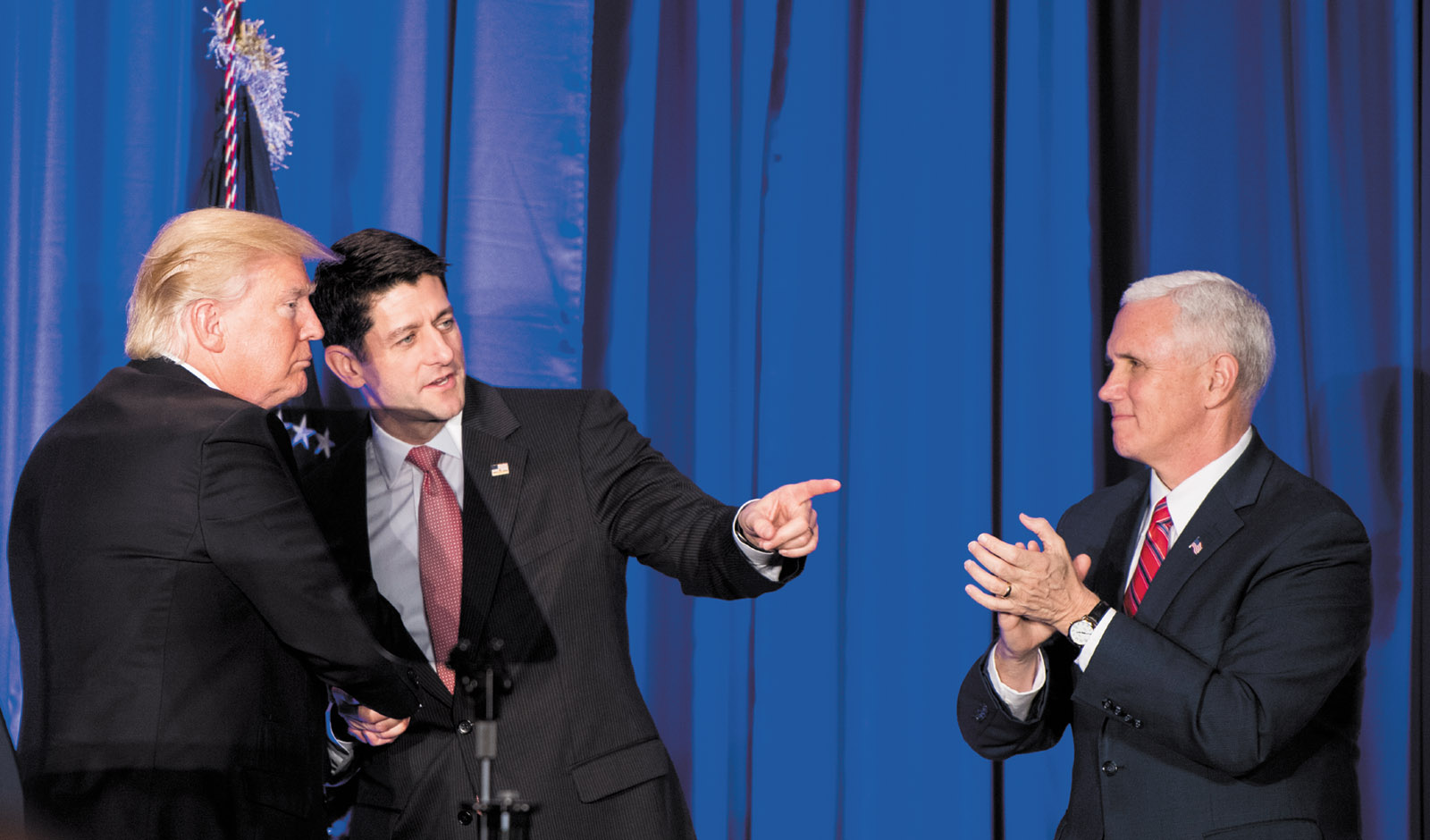
President Donald Trump, House Speaker Paul Ryan, and Vice President Mike Pence at the GOP congressional retreat, Philadelphia, January 2017
But for sheer shortsightedness and either ignorance or chilling cynicism, nothing else Trump did in his first ten days in office came close to his executive order on immigration, issued on the afternoon of Friday, January 27. The order’s effects on legally cleared immigrants were cruel and capricious, and it almost immediately caused the US problems at home and abroad. A ban on Muslim immigration by another name, the order at least temporarily barred immigration from seven Muslim-majority countries on the grounds that they were havens for terrorists. Titled “Protecting the Nation from Foreign Terrorist Entry into the United States,” it began by invoking September 11 three times. It put a three-month halt to immigration from Iraq, Iran, Syria, Sudan, Libya, Somalia, and Yemen, though the September 11 hijackers weren’t from any of them. In fact, since September 11 there’s been no terrorist attack in the United States by an immigrant from any of the seven countries.
The order also suspended the entire US refugee program for four months. Following that, Trump explained, priority would be given to Christian refugees from those countries. With the exception of diplomats, the executive order also covered travelers to the US who had gone to the designated countries, a very broad definition of the terrorist threat. And it imposed a flat ban on Syrians entering the United States, though no Syrian refugee has killed a single American in the United States.
Under the order the three-month ban on immigrants from the seven named countries could be extended ad infinitum unless applicants met certain new undefined requirements. During the campaign and in issuing the immigration order Trump placed a great deal of emphasis on the urgent need for “extreme vetting,” implying that the Obama administration had been lax, though it subjected would-be immigrants from certain Middle East countries to rigorous screening that could last as long as two years. An intelligence official told The Washington Post that no one in the intelligence community had asked for the order’s new restrictions.
The immigration executive order was so sloppily drafted that it took the White House three hours after the president signed it to release an explanation. It had been rushed and the relevant agencies weren’t consulted.
The order immediately raised a number of legal and constitutional issues—some so obvious that it’s a wonder they didn’t occur to the drafters—if they didn’t. The flat, wholesale ban on immigrants from designated countries, even if “temporary,” could violate a law that bars discrimination in issuing visas because of a person’s nationality or place of residence. It could also violate a legal prohibition on discrimination against immigrants on religious grounds—the very foundation of this country and enshrined in the First Amendment.
The priority to be given to Christians after the ban was lifted raised an obvious constitutional issue. (This discriminatory policy was made known on the same day that the White House issued an annual commemoration of the Holocaust that for the first time didn’t mention Jews. It was redolent of the anti-Semitic views expressed in Breitbart News, previously edited by Bannon, and it was a form of Holocaust denial.)
In apparent violation of the law, the order, which went into effect immediately, stopped immigrants who’d been cleared and were en route to the US; and at first even people with green cards who may have left the country for some reason were detained at airports or sent back to their native countries. The issue of whether or not green card holders would be barred from reentry went back and forth through Friday night and part of Saturday, with the White House insisting they would and the Department of Homeland Security saying they wouldn’t. The final ruling was that they wouldn’t but airport authorities were confused about what the policy was and some green card holders were detained anyway. The order arbitrarily split families who were on their way to uniting and produced painful anecdotes that were broadcast nationwide.
In the confusion, the ruling by a federal judge on Saturday night intended to block the stopping of legally cleared immigrants who were in transit to this country and saying that the US couldn’t deport immigrants from the prohibited countries if they were already legally here wasn’t always obeyed. In numerous cases Border Patrol officers didn’t allow volunteer lawyers, who went to various airports to help stranded immigrants and refugees, to see them. During the following week, a series of federal court rulings in effect declared that the order was open to constitutional questions and on February 3 came the ruling by a federal court judge in Seattle that implementation of the order be temporarily halted.1
However misconceived and badly executed, Trump’s executive order reflected and spoke to the strong anti-immigrant opinion among his followers and perhaps beyond them; Trump had made anti-immigration one of his principal issues in the campaign.
The order was shortsighted, counterproductive, and stupid. It would be immediately damaging to Silicon Valley and to numerous universities and hospitals. Further, why wouldn’t the US as a matter of policy welcome students from, say, Iran and Iraq, who would be exposed to Western values and return to their countries more skilled in important fields? Why alienate them? The dismaying reality that Trump couldn’t comprehend these things wasn’t a great surprise, but he was also exposed, for all his vaunted business background, as incompetent.
Drafts of other ill-considered orders were floating around the White House. One would have restored the CIA’s policy, banned by Obama, of maintaining “black sites” in certain countries where it could engage in the torture of detainees. Trump’s press secretary, Sean Spicer, at first denied that it was a government document, ostensibly leaving mysterious how it had landed on White House desks. Trump was trying to have it both ways on torture: to please many of his followers he repeated his campaign statement that he favored waterboarding and other forms of torture as effective methods of extracting information. This put him at odds with most of the intelligence community and the military as well. He finally said he’d go along with the views of his defense secretary, James Mattis, and his CIA director, Mike Pompeo, who had testified that they didn’t believe that torture was an effective way of eliciting information from captives. This convenient deference to his cabinet officers in this instance was quite at odds with how the immigration executive order was drafted.
Trump’s tenuous grasp on foreign policy became clear through his handling of two incidents: his imposing more sanctions on Iran in retaliation for its test of a ballistic missile wasn’t out of line with actions by the Obama administration, but Flynn’s announcement that Iran was now “on notice” and his known phobia against Iran—and a threatening tweet by the president—left numerous foreign policy experts worried that the US is on an escalatory path with that country. The botched military raid on Yemen was the result of Trump’s approval of the plan offered by the Pentagon without checking with the CIA and the State Department.

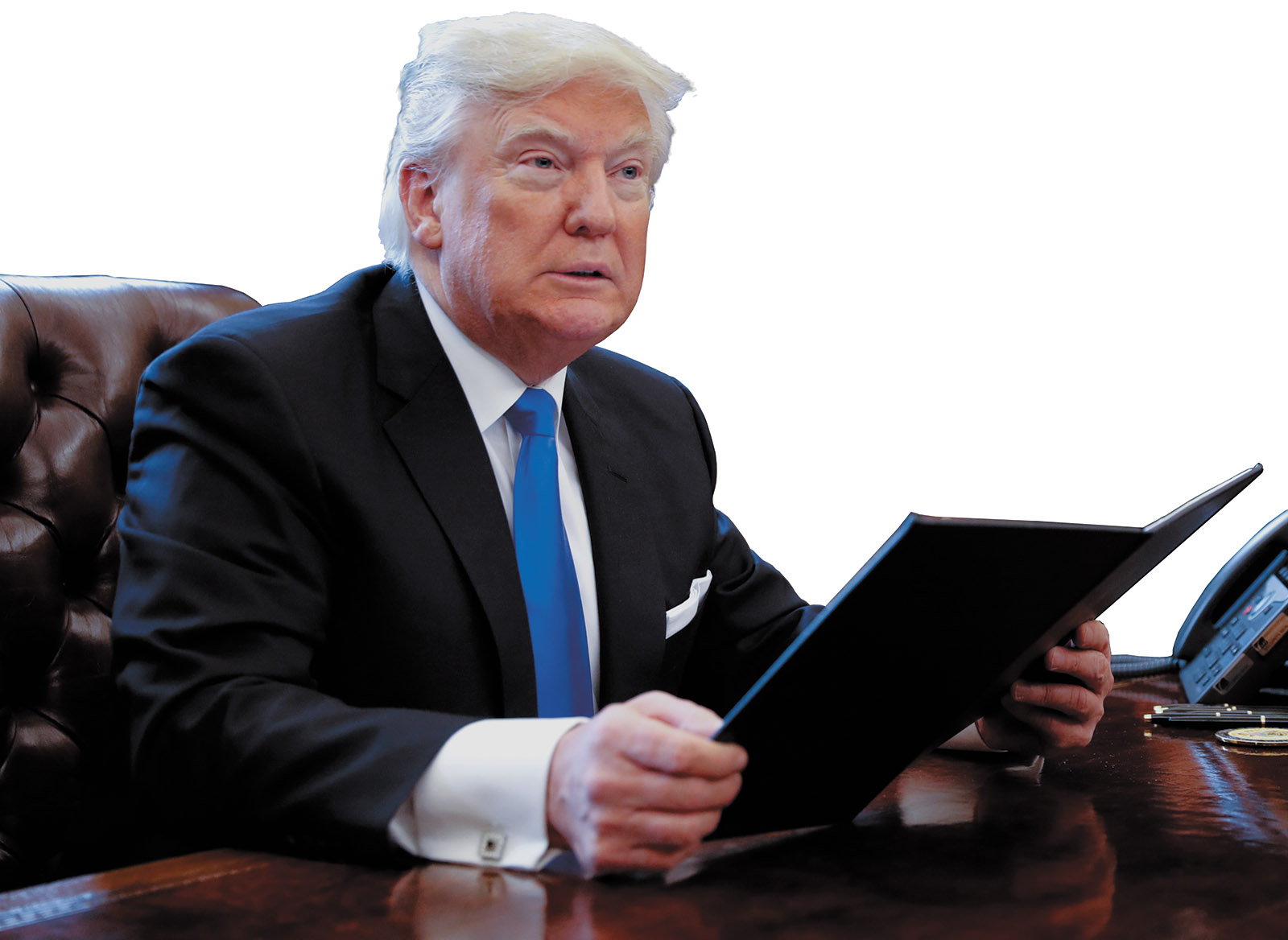
President Trump in the Oval Office, signing an executive order on oil pipelines, January 2017
Disturbingly early in the Trump administration a great many Americans didn’t know if they could believe the president of the United States. The compulsive lying by Trump and those who spoke for him threatened to undermine his ability to govern. And then there are the not-exactly-lies but Trump’s strange versions of reality that he seems to believe: such as when he insists that the sun was shining during his inaugural speech, which it wasn’t; and this is an easily checkable fact. Could we believe him in the event of an international crisis—or know if it was indeed a crisis?
The White House’s declared war on the press should be troubling to other citizens as well, as a demagoguish attempt to accrue additional presidential authority. Begun during the campaign—with Trump’s frequent incantations of “the dishonest media”—it’s gone beyond simply a matter of a tactic to discount its criticisms and is actually an effort to neutralize one of the potential checks on Trump’s freewheeling exercise of power. With Congress in the hands of the as-yet-timorous Republicans and the Supreme Court likely to be returned to the control of its conservative bloc, what’s left as a check on the president? Trump’s prime-time televised announcement of his appointment of Neil Gorsuch to the Supreme Court was moved up from later in the week to try to take people’s minds off the furor over the immigration order. Gorsuch is an originalist less bombastic than Antonin Scalia, whose seat he would fill, but possibly more conservative. He’s a hero to the Christian right, whom Trump especially wanted to please.
Another glimpse of how the Trump administration intends to use that power lies in its approach to federal workers who disagree with its policies. The most spectacular example so far is Trump’s summary firing of the acting attorney general, Sally Yates—a career prosecutor who had been asked by the Trump transition team to take the interim position—for her decision that the Justice Department wouldn’t enforce the immigration order because she wasn’t convinced it was constitutional. The White House’s disturbing statement saying that Yates had “betrayed” the Justice Department and “is weak on borders and very weak on illegal immigration” reflected the unmistakable voice of the president. After a letter to the president from State Department employees protesting the immigration order quickly gathered over one thousand signatures, Spicer, speaking at his press room podium, said that federal employees should “either get with the program or they can go.” This was completely at odds with the long tradition of toleration of dissent within the government.
Intolerance of dissent was evident almost as soon as Trump took office, in his administration’s pattern of firing or muzzling people who agree with the overwhelmingly accepted scientific consensus on climate change. Ominously, during the transition, the Energy and State Departments were ordered to make a list of employees who had so much as attended a meeting on climate change. Once the Trump administration took over, Environmental Protection Agency employees were told to take down the agency’s website page on global warming and they were put under a gag order barring them from making any public statements not in consonance with Trump’s expressed view that climate change is a hoax. Trump’s choice to head the agency, Scott Pruitt, the former attorney general of Oklahoma who is backed by mining interests, including the Koch brothers, had brought numerous suits against the EPA’s clean air and water regulations.
Similar restrictions on making public statements were placed on employees of the Departments of State, Health and Human Services, and Agriculture, some of which were rescinded after they become too controversial. Trump’s last cabinet pick, former Georgia governor Sonny Perdue, who has been in the agriculture business much of his life, has mocked climate change. The gag orders might violate the Whistleblower Protection Act and other federal rules. Ultimately, such a policy is a losing game; concerned government employees will find ways to get out information they think is critical to the national interest.
Even those of us not naturally inclined to believe the worst possibilities of a situation have had to face up to Trump’s authoritarian tendencies. One doesn’t have to assume that he sought the office in order to wield dictatorial power—it could be simply that he’s a businessman without public stockholders who’s used to having his way and is so incurious or compromised as to believe, or insist, that the world is the way he says it is. But that explanation overlooks too much that’s been right before us. And Trump has people around him who are seeking to exploit his talent for commanding the spotlight. He uses Twitter to embarrass and hurl threats at individuals and corporations and bully them into changing certain policies, thus expanding his powers beyond those commonly understood to belong to the presidency. Through his bullying, Trump has struck fear in many businesspeople.
By the end of his early days in office, despite all the turmoil over his immigration order, some of Trump’s aides told reporters that they believed that Trump and Bannon’s strategy of disruption and distraction had been successful. After all, they pointed out, in all the noise about the immigration order and in the swirl of other events as well, the controversy over Trump’s flaming and possibly unconstitutional conflicts of interest had gone away. That view assumes that no one has a memory and it overlooks the likelihood that the ethics matter will return.
In fact, Trump’s hold on power may be more tenuous than it appears. It’s not just that his hubristic dismissal of valid ethical concerns could produce a scandal at any time; he took office under the cloud of at least one investigation into possible underhanded if not illegal dealings with Russia on his part and continuing questions about the relations of some of his political associates with Putin or his associates. The ambiguity of Trump’s election victory complicates his presidency: having lost the popular vote by nearly three million, he started out as a minority president with a large mass of people feeling they’d been cheated and motivated to arise against him. This partly explains Trump’s fixation on the electoral vote and his and his associates’ insistence—incorrect—that he’d won an electoral vote “landslide.”
Trump’s possible mental deficiencies are also a troubling question: serious medical professionals suspect he has narcissistic personality disorder, and also oncoming dementia, judging from his limited vocabulary. (If one compares his earlier appearances on YouTube, for example a 1988 interview with Larry King, it appears that Trump used to speak more fluently and coherently than he does now, especially in some of his recent rambling presentations.) His perseverating about such matters as the size of his inauguration crowd, or the fantasy that three to five million illegal voters denied him a popular vote victory (he got these estimates from a dodgy source who has yet to offer documentation), or, as he told CIA employees, the number of times he’s been on the cover of Time (sometimes inflating the actual number) has become a joke, but it also suggests that there may be something troubling about his mental state. Numerous eminent psychologists and psychiatrists have written about or expressed their concerns about Trump’s mental stability.
Nearly a week after he was sworn in, according to Gallup, Trump’s net approval rating had dropped eight points—and this was before the issuance of his disastrous immigration order. The Republicans can be expected to tolerate him as long as they have reason to fear the intensity of his followers, but if the time comes when he becomes too politically costly for them to support, they’d be quite comfortable with Mike Pence as an alternative.
 The Trump-normalizing going on now has long since passed the rationalizing that were happening mid-campaign.PHOTOGRAPH BY TY WRIGHT / GETTY