Monday, January 29, 2018

The Sociology of Food: Eating and the Place of Food in Society. Jean-Pierre Poulain (trans. by Augusta Dörr). Bloomsbury. 2017. (IBRCookBooks))

In The Sociology of Food: Eating and the Place of Food in Society, Jean-Pierre Poulain offers an account of how food has emerged as a new field within sociological research. With the book also addressing the challenges of establishing a sociology of food as a single discipline, it gives a timely and insightful narrative to readers interested in finding out more about this developing sphere of research.


For anyone interested in the place of food in society, this newly translated work from leading food scholar Jean-Pierre Poulain offers an insightful account of the role of food and how it has come to be a new field in sociological research. The Sociology of Food provides a refreshing take on how to interpret food in today’s society whilst also establishing new sociological theoretical connections. Moreover, it discusses a number of challenges and issues in being able to establish what Poulain refers to as a ‘sociology of food’ as a single discipline. Nonetheless, he highlights the key movements, and concludes by suggesting that more work is needed to forge a sociology of food.


Poulain offers an account of the sociology of food by considering it as a distinctive field, and explores the possibility of studying food through social space. Eating is an act of sharing: a social, meaningful act established within cultural frameworks (xix). The Sociology of Food outlines how the meal is at the heart of the socialisation process in two specific senses. Firstly, it is a site of apprenticeship where the life rules governing a group are learned; and secondly, a place for the sociality of sharing and conviviality. Food as a nutritional social fact and a social fact are considered as two distinct areas that contribute to the well-being and health of humans. This review offers an overview of the two sections in which the textbook has been divided: the permanent and changing aspects of modern eating practices; and the shift from sociological interest in food to sociologies of food.


Before highlighting the key narratives in both parts, it is useful to consider that it was not until the late 1970s that the social sciences turned their attention to food, beginning with history and sociology (xvii). This saw the birth of a new social scientific heritage, particularly in the period 1990-2000, where historians, sociologists, anthropologists and psychologists began to highlight emerging discourses in the field of food studies.


In the first part of The Sociology of Food, Poulain explores localisation and the dietary issues that surround food. This includes five specific chapters that introduce the globalisation of the food supply; the domestic and economic spheres of culinary activity; the evolution of eating practices; food risks and safety; and obesity and the medicalisation of consumption. In Chapter Two, a discussion is developed concerning the domestic and economic spheres and Poulain highlights the similarities between agricultural activities in terms of the growing of crops and household food-related tasks. By this, Poulain draws on a comparison between food-related tasks within the home with wider society and highlights how gender inequality is prevalent in both spheres. He concludes by stating that although social roles are changing, it is happening gradually, and that food-related domestic tasks are still mainly associated with women.

In Chapter Three, the work of Claude Fischler (1979) is cited and his term ‘gastro-anomie’ is introduced. This was first developed by Fischler as a way of describing the consequences of modern eating practices, which are themselves characterised by three concurrent phenomena (41): an overabundant food supply; the relaxing of social constraints; and multiple discourses on food practices and their contradictory aspects. To provide an overview, Fischler makes links to Emile Durkheim’s concept of anomie which is a social condition in which there is a disintegration of norms and values, also described as ‘normlessness’. By gastro, Fischler refers to the stomach and nomos as the rules that govern food. Gastro-anomie is therefore associated with social deregulation (43).

In Chapter Four, the connotations of the term ‘food security’ are introduced, but more importantly its interpretation. The notion of risk is said to cover a series of dangers linked not only to a scarcity of food but also to its quality (63). In short, there are two types of risk that are identified and used to distinguish between phenomena: those who lack or live in fear of lacking food; and those who are afraid of what they eat. Consequently, a debate on food and eating is actually about much more than it being a common activity for all. It is also a debate on the ways in which society is organised.

Chapter Five introduces obesity and the medicalisation of everyday food consumption. Three key questions are posed in the chapter that contest the view of obesity as merely a physical issue: why obesity is unequally distributed across the social scale; what transformations in the structure of the food industry sector or in eating practices might explain the rapid development of obesity in today’s society; and how we can change eating habits. Ultimately, it is the issue of stigmatisation as discussed by Poulain that is neglected, and importance rests in trying to recognise these socially constructed aspects of obesity as distinct from the medical dimension. Moreover, sociohistoric and anthropological interpretations highlight the problem of obesity, which is partly said to result from the transformation that took place in the way society interprets the ‘large body’ and ‘fat-based products’ (111).

The second part of the text is dedicated to sociological interest in food and includes six chapters on major socio-anthropological movements; epistemological obstacles; sociologies of food and attempts to forge connections; the sociology of French gastronomy; and the notion of ‘food social space’. In the final chapter of the book, Poulain highlights the movement of cultural studies surrounding food and eating practices in the context of English- and French-speaking worlds. He also identifies the challenges of food studies and points out that research always involves careful investment and substantial knowledge of a discipline, including its paradigms, theoretical frameworks and methodologies.

In Chapter Six, Poulain argues that whilst it is possible to encounter aspects of eating in most sociological domains (i.e. rural sociology, work, mobility, health and illness), it is still not feasible to establish a sociology of food through food as a singular lens. The links that are established to the act of eating are mostly implicit and not justifiable. However, this is not to say that a sociology of food does not exist at all, but it is rather embedded within thematic sociological perspectives.

Chapter Nine confirms this view as Poulain argues that a single sociology of food has not been established: at this present time, we still have sociologies (168). Whilst this text makes gargantuan leaps to discover a sociology of food, it also recognises that it is very much an emerging discipline, and that in order to exist as a single field that has influence on policy, more theories and methods need to be developed. Nonetheless, a very topical and insightful narrative is developed in a text that draws readers into the unique and developing discipline surrounding the sociology of food.

Facing the Planetary: Entangled Humanism and the Politics of Swarming. William E. Connolly. Duke University Press. 2017.

In Facing the Planetary: Entangled Humanism and the Politics of Swarming, William E. Connollyaddresses deepening planetary crises by exploring the creative potential of a ‘politics of swarming’. In calling for an ‘entangled humanism’ to construct a radical, pluralist assemblage able to tackle our present ecological predicament, this invigorating and imaginative book merits attention.


In Facing the Planetary: Entangled Humanism and the Politics of Swarming, William E. Connolly focuses on deepening planetary crises, including climate change, and the existing, inadequate responses to these by political, social and economic actors, before outlining a politics necessary to defuse this situation. To illustrate how official narratives lurch from one crisis to another in the absence of a reliable alternative, Connolly uses a metaphor from the Book of Job, where Job suffers without any misdeeds of his own, yet is pressed to continue and even intensify his belief in a ‘higher purpose’. Mythological stories have become revelatory in understanding how a prevailing system reacts to crises, which is, as Connolly writes, evident in neoliberalism’s response: intensification of support for its ideology.

Connolly provokes our social and ecological imagination vis-à-vis anthropogenic ecological change by attending to several ‘force fields’ such as climate patterns, drought regions, the ocean system, species evolution, glacier currents and catastrophic hurricanes. He concludes the book with a convincing argument in favour of ‘entangled humanism’, challenging sociocentrism, on the one hand, and forging relations of reverence with multiple traditions around the world on the other.

In the first chapter, Connolly critically engages with many leading works of ‘sociocentrism’, by which scholars display a penchant toward explaining social processes solely through reference to other social processes. Even the best sociocentric scholars do not attend to the ‘self-organizing amplifiers and internal volatilities of planetary processes’ (16). Sociocentrism is also associated with human exceptionalism, which deems humans as the only capable agents in the world. Although a sociocentric propensity is noticeable in the work of many Western scholars, Connolly tours four key figures in this tradition: Jean-Jacques Rousseau, Isaiah Berlin, Friedrich Hayek and Karl Marx. To Connolly, all failed to underline how Western capitalist states and imperial orders created, and would continue creating, a world climate and ecological crisis that particularly affects poor and minority populations across the world.

I

In Chapters Two and Three, Connolly extends his dialogues to recent theories of species evolution and cultural theorists, respectively. In Chapter Two, he underscores the need to exchange ideas between the work of contemporary earth scientists and those in the social sciences and humanities. He pursues this in the next chapter by inviting scholars to engender a ‘critical politics’ necessary for dealing with the problems that are staring the world in its face. In Chapter Four, Connolly presents a history of how rapid changes in planetary forces, i.e. to glaciers, the climate and oceans, proceeded in the past (91), and how unbridled capitalist growth has triggered off a series of planetary-level, environmental crises.

In Chapter Five on the politics of swarming, Connolly addresses the democratic process and capitalism as they coexist today, emphasising the dilemmas of electoral politics, especially in the United States. The unchecked power of corporations, the media’s focus on insignificant or scandalous issues, gerrymandering and filibustering of the state and actions to disenfranchise minority populations all make electoral politics dysfunctional. However, Connolly suggests that we partake in electoral politics as well as break its ‘grid of intelligibility’ (123). Otherwise, actors of the political Right will utilise yet another institution to consolidate its agenda in this era replete with extremist potential.

Additionally, electoral politics render invisible the extractionist mission of capitalism, which imposes sufferings on ‘those who cannot easily publicize widely what is happening to them as they suffer effects of corporate invasions in long slow time’ (123). The question is: do we just stand idle in an epoch when problems are multiplying and solutions seem ineffective? To answer this question, Connolly cites Thomas D. Seeley’s metaphor of ‘honeybee democracy’. Here, female scouts check out possible relocation sites in the search for a new hive site, and each returns and suggests the attractiveness and feasibility of a new location. Other bees scout the location, gradually building a quorum upon the negotiation of multiple sites identified by secondary and tertiary scouts before the decision to move is made (124). To Connolly, such types of assembly-based swarming movements, having a variety of loci and foci of choices, may provide a promising clue in our search for planetary solutions. Connolly suggests that humans can also take experimental roles in numerous locations with diverse foci to ‘swarm’ regular politics: therefore, the politics of swarming ‘is composed of multiple constituencies, regions, levels, and modes of action, each carrying some potential to augment and intensify the others with which it becomes associated’ (125).

Connolly next discusses the potentiality of a ‘general strike’, drawing on scholars and activists such as Georges Sorel and Mahatma Gandhi. Sorel, for instance, discussed two different types of strikes: Local and General. The former is specific to short-term objectives, such as better working conditions, and the latter aims to demand a fundamental reordering of the world. Connolly, however, raises the caveat that a slow-motion strike alone may be insufficient. Thus, to affect the trajectory of contemporary politics, we also need to mobilise a ‘militant pluralist assemblage’ drawing from different classes, religions, creeds, age cohorts and genders (131). Moreover, although Connolly suggests the need for militant action, it must be strategic enough to avoid violence, in the manner of Gandhi in colonised India.

Connolly begins the last chapter with Rob Nixon’s notion of ‘slow violence’, a notion that adequately captures capitalism’s violence against the environment which takes place gradually and happens out of our sight. The Bhopal disaster of 1984 would be an example of slow violence because it is remembered only by its spectacle: thousands of casualties, whereas other hundreds of thousands suffered many long-lasting consequences, and the soil and groundwater remain contaminated to date.

Here, instead of being a passive nihilist, Connolly extols the notion of an entangled humanism, which encourages us to: 1) see symbiotic relationships between human species and other beings and forces; 2) revise the doctrines of human exceptionalism and sociocentrism and become more aware of other modes of experiences; 3) forge relations of respect across societies such as towards the traditions of indigenous groups; and 4) form a critical pluralist politics exceeding creedal differences which ‘pursues ecological actions at multiple sites’ (172) and simultaneously seeks to weaken its opponent in this perilous period. Finally, Connolly invites us to engage in an energetic cross-regional pluralist assemblage consisting of numerous minorities as opposed to decisions being taken from the centre.

To conclude, it seems there is no good omen for the future of this planet. Although the world continues to face catastrophic weather events and climate change appears to be leading towards the world’s sixth great mass extinction, the dominant political and economic systems seem resistant to addressing these planetary crises adequately. Given this situation, Connolly’s analysis of planetary calamities and proposal for a politics of swarming merit attention. The book effectively integrates a variety of sources, including from political theory, social theory, philosophy, theology, economics, geology, biology and paleontology, and covers a wide range of topics, reinvigorating discussion regarding not only the current ecological problems, but also what can be done given the prospect of a seemingly apocalyptic future.

Deconstructing Dirty Dancing. Stephen Lee Naish. Zer0 Books. 2017.

In Deconstructing Dirty Dancing, Stephen Lee Naish unpacks the enduring popularity of the film Dirty Dancing, released to mixed reviews in 1987 before going on to become a global hit. Offering a comparative study of the film with David Lynch’s Blue Velvet before a scene-by-scene analysis and reflections on the film’s personal resonance for the author, the book is an idiosyncratic and accessible take on this cultural phenomenon.


Dirty Dancing sells a million DVDs per year even now, 30 years after its release (3). In spite of receiving mixed reviews from critics at the time, this low-budget film became a hit through word-of-mouth recommendations. Since then it has inspired two remakes, an ill-fated TV series and a successful musical theatre show, but it is the 1987 original that continues to attract old and new audiences. Many films from the same era appear to have lost their relevance, but the centrality of the abortion plotline in Dirty Dancing and its depiction of class conflict remain groundbreaking and noteworthy even today.

Deconstructing Dirty Dancing attempts to unpack the film and reveal the reasons for its longevity. Stephen Lee Naish sets out to prove that Dirty Dancing, ostensibly about the romance between Frances ‘Baby’ Houseman, a middle-class Jewish teenager, and Johnny Castle, a working-class Irish-American dancer at Kellerman’s resort, exposes a great deal about America in the early 1960s and beyond. It is a slim volume of fewer than 70 pages, but the range of information it contains belies its size. Naish is an established writer on film, politics and popular culture, and the subject matter of his third book aptly combines those topics.

Naish ‘deconstructs’ Dirty Dancing though three different perspectives: firstly, as a comparative study with the film Blue Velvet (1986) by David Lynch; then through a scene-by-scene analysis; before ending with an essay on his personal experience of the film. The cover image gives a visual preview of this approach: a hand-drawn collage of items thematically linked to the film’s content, including a doctor’s bag, a watermelon and a woman dancing in a hula skirt.

The first section, ‘The Strange Coalescence of Dirty Dancing and Blue Velvet’, compares two films that initially appear thoroughly dissimilar in terms of genre, plot and directorial strategy, but also share some compelling similarities. Those who have watched both would benefit most from this discussion, but the summary of Blue Velvet is sufficient to service the comparison and to give the reader an understanding of its plot and atmosphere. The author presents a number of parallels between the films, such as the depiction of the early 1960s through the lens of the late 1980s, the loss of innocence and the representation of secret sexual relationships. Some of the comparisons, such as that between the severed ear in Blue Velvet and Frances’s aural awakening, could be considered tenuous. However, this brief comparative study succeeds in pushing the reader beyond superficial romantic interpretations of Dirty Dancing.


The references to Blue Velvet also continue in the central section, ‘Interpretation of Dirty Dancing’, which is a fascinating study for any student or fan of the movie. The chapters within this section are marked by timestamps from 00:00:00 to 1:37:03, when the end credits roll. The first chapter begins with the description of the Vestron logo, then ‘one minute and forty seconds of uninhibited grinding hips, flowing skirts and stares of intense passion’ (13) before we are introduced to the Housemans. As they drive to the Kellerman’s resort, Frances’s voiceover is heard above the sound of the radio: ‘That was before President Kennedy was shot. Before the Beatles, when I couldn’t wait to join the Peace Corps’ (14). Naish’s explanation of this quotation presents the early sixties as a period of optimism and innocence in US society and Frances as a symbol of this phase. However, this is belied by the social microcosm shown in Kellerman’s resort, even before Frances becomes involved with Johnny.

Throughout this section of the book, Naish analyses and illuminates each moment of the film, its dialogue, music, wardrobe, plot and themes, particularly drawing out its political threads. For example, in the second chapter (00:02:58), Frances’s father, the liberal Dr Houseman, jokes with his other daughter, Lisa, when she complains about her lack of coral shoes: ‘A tragedy is […] police dogs used in Birmingham.’ Naish explains this reference to the US civil rights struggle as well as Frances’s comment about monks immolating themselves in protest. In the following chapter, assistant hotel manager Neil Kellerman’s mention of joining the anti-racist Freedom Riders is explained as a possible sign of his participation in the New Left political movement, useful information for non-Americans who may not have understood the reference. However, it soon becomes clear that Neil’s apparent liberalism does not extend to his treatment of the dancers. These comments reveal that the conflict and inequality in the resort are class-based: the wealthy resort owners and their guests tolerate the white working-class staff while they support civil rights and international protests.

Not only does Naish interpret the film from a historical perspective, his commentary also decodes the film though a twenty-first-century lens, as shown when he describes Neil as ‘mansplaining’ during a conversation with Frances (28). Later, the discussion of the crucial scenes concerning the unplanned pregnancy of Penny, Johnny’s original dance partner, reminds the reader that the film is set ten years before abortion could be obtained legally in the USA, and so the options available to her as an unmarried woman were to ‘abort illegally, or give birth and become an outcast from society’ (36). Naish notes the centrality of the abortion subplot to the entire film, and gives credit to the film’s screenwriter, Eleanor Bergstein, for not bowing to pressure from sponsors to remove it (38).

The author also engages with existing film scholarship on Dirty Dancing and beyond. For example, he applies Michele Scheiber’s notion of a ‘postfeminist cycle’ of contemporary romance films (25) to the narrative, showing how Dirty Dancing fits the pattern whilst also subverting it with the lack of a happy-ever-after ending. Furthermore, like a textual film commentary track, the behind-the-scenes information revealed by Naish provides fascinating insights into the crafting of the narrative. For instance, he describes several deleted scenes from the film or early drafts of the screenplay, and reflects on how they might have affected the end result. An example of this is when he reveals a removed scene in which Neil is beaten up by the dancers, which would have made his character more sympathetic (22).

Lastly, the final section, ‘A Personal Essay’, delivers Naish’s individual perspective on the film. He describes being introduced to the film during his childhood by his older sister and being particularly taken by its soundtrack. Later, as a young adult, he felt that he could never live up to Johnny Castle’s ‘vision of almost-perfect masculinity’ (64). Naish also presents the universality of the film in its evocation of family holidays and the awkwardness of approaching a potential love interest, both of which he compares to episodes from his own life growing up in Britain. The essay is an absorbing account of his uneven relationship with the film, which will resonate with a wide range of readers, whether fans of the film or otherwise.

In conclusion, Deconstructing Dirty Dancing is an idiosyncratic and accessible analysis of this popular film. I would particularly recommend it to fans seeking insight into the historical, political and cultural contexts surrounding Dirty Dancing. It is also an excellent addition to the existing field of scholarship – including The Time of Our Lives: Dirty Dancing and Popular Culture – related to this enduring popular subject.

The Time of Our Lives: Dirty Dancing and Popular Culture (Contemporary Approaches to Film and Media Series) Paperback by Siân Lincoln (Editor, Contributor),‎ Yannis Tzioumakis (Editor, Contributor),‎ Amanda Howell (Contributor),‎ Bill Osgerby (Contributor),‎ Claire Molloy (Contributor),‎ Cynthia Baron (Contributor),‎ Frederick Wasser (Contributor),‎ Gary Needham (Contributor),‎ George Rodosthenous (Contributor),‎ Hilary Radner (Contributor),‎ Jane Feuer (Contributor),‎ Mark Bernard (Contributor),‎ Millie Taylor (Contributor),‎ Oliver Gruner (Contributor),‎ Pamela Church Gibson (Contributor),‎ Richard Dyer (Contributor),‎ Tamar Jeffers MacDonald (Contributor),‎ Tim McNelis (Contributor) (Wayne State University Press)

A low-budget independent film made by a now defunct video company in the late 1980s, Dirty Dancingbecame a sleeper hit with a huge, primarily young audience. Even twenty-five years on, the film has found millions of devoted fans around the world through TV, video, and DVD releases. In The Time of Our Lives: Dirty Dancing and Popular Culture editors Yannis Tzioumakis and Siân Lincoln bring together leading scholars of film, media, music, culture, theater, dance, and sociology to examine for the first time the global cultural phenomenon of Dirty Dancing.
Tzioumakis and Lincoln begin by assessing Dirty Dancing's cultural impact in the decades since its release and introduce contributors in four sections. Essays in "Dirty Dancing in Context" look at the film from several perspectives, including its production and distribution history, its blending of genres, its treatment of race, and its place in the political and visual culture of the 1980s. In "Questions of Reception," contributors examine the many ways that the film has been received since its release, while those in "The Production of Nostalgia" focus on the film's often critiqued production of an idealized past. Finally, contributors in "Beyond the Film" examine the celebrated synergies that the film achieved in the "high concept" film environment of the 1980s, and the final two essays deal with the successful adaptation of the film for the stage.

With the enormous cultural impact it has made over the years, Dirty Dancing offers many opportunities for thought-provoking analysis. Fans of the movie and students and scholars of cultural, performance, and film history will appreciate the insight in The Time of Our Lives.

Jacques Offenbach and the Classical Can Can....Jacques Offenbach and the Making of Modern Culture by Laurence Senelick Cambridge University Press, 354 pp., $120.00 The Real “Tales of Hoffmann”: Origin, History, and Restoration of an Operatic Masterpiece by Vincent Giroud and Michael Kaye, with a foreword by Plácido Domingo Rowman and Littlefield, 563 pp., $130.00; $75.00 (paper)


Bibliothèque de l’Opéra Garnier, Paris/Bridgeman Images
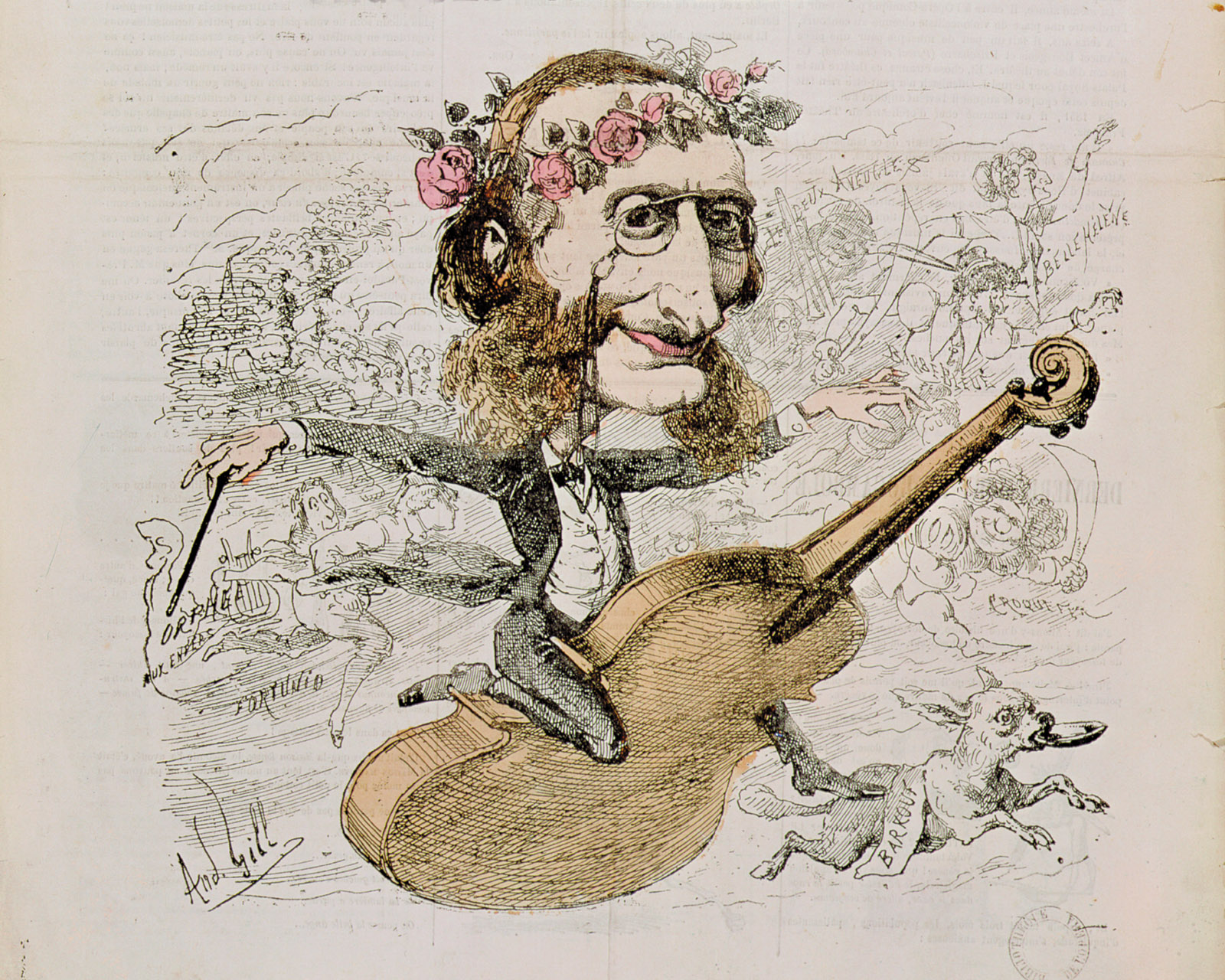
Jacques Offenbach; engraving by André Gill from the cover of La Lune, 1866

By the time he died in 1880 at the age of sixty-one, Jacques Offenbach had composed more than one hundred works of musical theater, from two-character sketches to full-scale operas. Yet today, in the United States at any rate, his reputation rests primarily on just one piece, his very last—Les contes d’Hoffmann. Hoffmann is a staple of the operatic repertoire and has been recorded many times, while the works that made Offenbach world-famous in his lifetime—comic operettas like La belle Hélène, Orphée aux Enfers, and La Grande-Duchesse de Gérolstein—are known only to devotees. And even they represent just the peaks of Offenbach’s immense output; there must be many hours of his music that no one alive today has ever heard.

This bifurcation of Offenbach’s achievement, into Hoffmann and everything else, makes it hard to appreciate his real significance—not just as a composer but as a major figure in the history of popular culture. For Hoffmann is, both musically and thematically, unrepresentative of his work. It is an intellectual, poetic, and melancholy creation, the story of a poet’s disillusionment in love. But if you asked a Parisian theatergoer in the 1860s what was unique about the shows known as offenbachiades, he would have named quite different qualities. They were comic, knowing, exciting; they lampooned everything respectable, from classical mythology to military glory to the sanctity of marriage; they featured actresses baring their legs and shoulders as they danced the cancan. The contrast can be captured in the two tunes of Offenbach’s that are best known today: the Barcarolle from Hoffmann, with its swaying langour, and the galop infernal (often referred to as Offenbach’s cancan), with its mad propulsion.

The moral insouciance of Offenbach’s stage works was crucial to their appeal from the beginning. His first hit was a sketch called “The Two Blind Men,” which featured a pair of beggars who fake blindness and quarrel over prime begging spots. Several of Offenbach’s collaborators urged him not to stage the piece, on the grounds that it was in bad taste to mock the poor; but he was vindicated when it drew cheers and laughter. He pushed the envelope further with Orphée, which became a worldwide sensation by spoofing classical myth, turning Orpheus and Eurydice from symbols of deathless love into a pair of quarreling, adulterous spouses. Offenbach, who delighted in musical parody, impudently quoted the aria “Che farò senza Euridice?” from Gluck’s version, sticking out his tongue at its sublimity.

The show’s popularity was ensured when an indignant music critic, Jules Janin, lambasted it in print as a “profanation of holy and glorious antiquity.” It was as if Janin was auditioning for the role of Public Opinion, who serves as the moralistic chorus in Orphée. (It is Public Opinion who compels Orpheus to try to rescue Eurydice from Hades, even though he is quite glad to be rid of her.) That kind of officious high-mindedness was the butt of Offenbach’s music, and of the witty libretto by his frequent collaborator Ludovic Halévy. Offenbach, knowing the publicity value of a scandal, replied gleefully in the pages of Le Figaro: “Bravo Janin! Thanks Janin, good old Janin, excellent Janin, the best of friends, Janin, the greatest of critics!”

By then, Offenbach was already one of the best-known figures in Paris, his face—long nose, bald head, benevolent smile—made familiar by caricaturists. It was an improbable fate for a man born to a poor, obscure family of German Jews, and a sign of how powerful a solvent of social boundaries fame had become in the nineteenth century. The composer’s father, Isaac Eberst, had been a cantor, itinerant singer, and violinist who eventually settled in Cologne, where he adopted the name of his hometown, Offenbach am Main. His son Jakob was born in 1819, in the aftermath of the Napoleonic Wars that brought Jewish emancipation to Germany. The doors now stood open to a much wider world, and when Jakob proved to be a prodigy on the cello, his father seized the opportunity, bringing him to Paris to audition for the Conservatoire in 1833. Family legend had it that the director, Luigi Cherubini, initially turned young Jakob away on the grounds that he was not French, only to drop his objection after hearing the boy play just half a page of music.

As it turned out, however, it was the teenage Offenbach, now going by Jacques, who rejected the Conservatoire. After a year he dropped out, preferring to earn a living as an orchestra player for the Opéra-Comique, one of the city’s leading theaters. To understand why, one only has to look at the memoirs of Hector Berlioz, who had been a student at the Conservatoire a few years earlier. Berlioz depicts his own first run-in with Cherubini, who chased him out of the library for using it without authorization. It was a foretaste of things to come. The Conservatoire was a hidebound, hierarchical institution, more concerned with musical politics than musical progress, and it drove the young Berlioz wild with impatience.

Perhaps Offenbach had the same reaction, or perhaps he simply realized early on that the theater, not the academy, was his native element. His dream was to see one of his works staged at the prestigious Opéra-Comique. But while his career as a cello virtuoso took off, and he had the opportunity to tour Europe and play for crowned heads, he could not budge the theater’s management. It was not until 1855 that Offenbach the composer got his big break. This was the year of the Exposition Universelle, with which Napoleon III aimed to outdo the famous Great Exhibition that had brought so many tourists to London four years earlier. Knowing that Paris would be flooded with visitors, Offenbach used his government connections to obtain the lease on a small, unused theater on the Champs-Elysées. At the time, the law strictly regulated what kind of work could be performed at each Paris theater, and the license for Théâtre des Bouffes-Parisiens, as Offenbach’s house was named, specified that it could feature no more than four characters on stage.

Yet within this limitation, Offenbach’s comic genius flourished. “In an opera which lasts only three-quarters of an hour…and [in which] an orchestra of at most thirty persons is employed, one must have ideas and tunes that are as genuine as hard cash,” he observed. Instead of the pompous, overstuffed pageants that played at the Opéra, the Bouffes would give people what they actually wanted—entertainment. “The Two Blind Men” premiered on the opening night, soon to be followed by Ba-ta-clan, a farce set in China. (The title, which was meant to sound Chinese, was popular enough for a Parisian theater to be named after it; the Bataclan became known around the world in 2015, when terrorists killed eighty-nine people at a rock concert there.) The Bouffes became one of the city’s most popular theaters, and Offenbach was dubbed—by no less an authority than Rossini—“the Mozart of the Champs-Elysées.”

By 1858, Offenbach was permitted to put on shows with bigger casts, and he seized the chance with Orphée aux Enfers, his first full-scale operetta. The next decade was the peak of his success. His great operettas followed in quick succession: La belle Hélène,another Greek travesty, this time of Helen of Troy; Barbe-bleue, a retelling of the Bluebeard legend; La Grande-Duchesse de Gérolstein, set at a fictional German court, which was seen by just about every royal visitor to the 1867 Paris Exposition. Indeed, one of the remarkable things about Offenbach’s shows is that, for all their burlesque of gods, kings, and generals, the powerful found them highly congenial.

In his influential book about Offenbach, Orpheus in Paris (1937), the German cultural critic Siegfried Kracauer argued that in the France of the Second Empire, theater became a cultural power because power itself was just a variety of theater. Napoleon III was a play-emperor who maintained his grip on power with a series of showy adventures abroad and grands projets at home. No wonder he admired Offenbach and showered him with signs of favor, including making him a French citizen and awarding him the Légion d’honneur. Indeed, the overlap between theater and government was sometimes even clearer: Offenbach’s favorite librettist, Halévy, held a senior position in the civil service. Halévy’s boss, the Duc de Morny, who was Napoleon III’s half-brother, served as foreign minister but wrote plays in his spare time. If our own era is characterized by the intersection of politics and celebrity—when a reality Tvpersonality can be elected president of the United States—we are following in the footsteps of the Second Empire.

For Offenbach’s critics, by the same token, his music stood as a symbol of everything they detested in the public culture of their time—the flash, the decadence, the frivolity. Kracauer saw Offenbach as an ambivalent figure whose music hastened the very social decay it embodied. In a dialectical fashion, Offenbach was a progressive because he exposed the Second Empire’s reactionary corruption for what it really was: he “had done more than anyone else to destroy the Empire from within,” Kracauer wrote. (In its deft Marxist analysis of Paris as the capital of the nineteenth century, Orpheus in Parisis the book that Walter Benjamin hoped his Arcades Project would be.)

Of course, it was not lost on Offenbach’s enemies that this agent of corruption was Jewish. (By birth, at any rate: he converted to Catholicism at the age of twenty-five, in order to appease his wife’s family, and was generally irreligious.) As Laurence Senelick shows in Jacques Offenbach and the Making of Modern Culture, his comprehensive study of Offenbach’s reception around the world, the composer’s Jewishness was always close to hand as a hostile explanation for his irreverence. When La belle Hélènewas performed in Berlin in 1875, a local newspaper described it as a “Jewish speculation on the spirit of modern society [that] caricatures whatever is regarded as sublime and sacred in family life.” In the same spirit, Édouard Drumont, one of the leading French anti-Semites during the Dreyfus Affair, railed against the “obscene innuendo, the lecherous rhythms” of Offenbach’s music.

In these attacks, Offenbach’s Jewishness is made to serve as a shorthand for corrosive modernity and the vulgarization of mass culture. In the twentieth century, Tin Pan Alley and rock and roll would face similar attacks; and as with those genres, it was precisely the democratic, irreverent, liberating energy of Offenbach’s music that made it so popular. Because listeners in the English-speaking world tend to associate operetta with Gilbert and Sullivan, it can be hard for us to appreciate just how transgressive the genre originally was. For Gilbert and Sullivan, knowing English taste and Victorian prudery, deliberately excised the qualities that made Offenbach so original—the overt sexuality, the rhythmic agitation. To his first listeners, Offenbach captured the thrill of being modern: “La belle Hélène is the present, our society, it is us, our beliefs and our tastes and our gaiety and our spirit of analysis which knows not parents nor friends nor tradition,” wrote a Parisian journalist in 1864.

The year before, in his essay “The Painter of Modern Life,” Baudelaire had declared that beauty is a compound of the ideal and eternal with the ephemerally modern, which he called “the amusing, enticing, appetizing icing on the divine cake.” Offenbach was the musical equivalent of that icing—not nourishing, perhaps, but undeniably delicious. Indeed, many qualities of his work—its abundance and novelty, its catchy melodies and exciting rhythms that people loved to sing and dance to—bring it close to today’s studio-generated pop hits. If he were alive today, he would probably not be a classical musician but a music producer.

Because Offenbach was so closely associated with the Second Empire, the fall of Napoleon III in 1870 marked a turning point in his career. After a long run of hits, he seemed to lose his touch, and a couple of box office failures reduced him to bankruptcy. He was forced to lease his country house, the Villa Orphée, and undertake a well-paying tour of the United States in 1876. When he returned to France, he dedicated himself to a new project that was very different from anything he had done before: an opera based on the stories of the German Romantic writer E.T.A. Hoffmann, who had been a favorite in France since the 1820s. In 1851, a play incorporating the plots of several Hoffmann stories and featuring the writer himself as the hero had been a success in Paris. The authors, Jules Barbier and Michel Carré, went on to write the libretto for Gounod’s Faust, among many other works. By now Carré was dead, but Offenbach and Barbier joined forces to turn Les contes d’Hoffmann into an opera.

Offenbach typically composed at a frantic pace: in 1873 alone he had five new works on the boards. His carriage was equipped with a desk so he could keep writing music on the road. But with Hoffmann he took a different approach, working on it for three years, and he achieved a musical and dramatic complexity beyond even the best of his earlier work. In his last days, he was heard to say that he was living only to see Hoffmann performed. The wish wasn’t granted. By the time he died, Offenbach had mostly completed the piano score, but the orchestrations had to be entrusted to another composer, Ernest Guiraud. Just as important, Offenbach was not able to guide the production or revise the opera in response to audience reaction, as he usually did.

The result was that, for decades after, producers and directors felt free to alter Hoffmann in accordance with their own dramatic instincts or the needs or limitations of their troupes. In the very first production, in 1881, one of the opera’s three acts was cut. Later versions of the score reassigned tunes to different characters and even included a spurious aria, “Scintille, diamant,” based on a melody borrowed from another Offenbach work. (There was at least good precedent for this: the opera’s most famous tune, the Barcarolle, was recycled by Offenbach himself from an earlier opera.) In recent decades, musicologists have used Offenbach’s manuscripts to restore the opera to something like its original form, but there will never be a single, authentic version of Hoffmann.

This protean quality seems oddly appropriate for a work so resistant to formula and fixity. In an age that set great store by genre distinctions—Offenbach’s catalog includes opéra-comiques, opéra-bouffes, operettes, and more—the composer gave Hoffmann a unique designation: it was an opéra-fantastique, a fantastic or supernatural opera. In The Real “Tales of Hoffmann,” a phonebook-sized new volume that includes the full libretto of the opera, the script of the 1851 play, and a collection of scholarly essays, the editor Vincent Giroud explains that Hoffmann’s stories were translated into French as contes fantastiques—supernatural tales. For the first generation of French Romantics, the unique atmosphere of Hoffmann’s tales—the way they combined magical elements with depth psychology, giving the effect of nightmares come to life—came as a revelation. Gérard de Nerval proclaimed, “In literature we aim at the fantastique.”

What makes Les contes d’Hoffmann so appealing and so dramatically challenging is the way Offenbach filters this German Romanticism through his own French psychological realism, thus uniting the two halves of his identity. The opera’s three central acts each depict Hoffmann’s doomed love for a different woman. The first, Olympia, turns out to be a living doll, an automaton built by her mad-scientist “father”; the second, Antonia, is a singer who can’t resist the call of performance, even though she is doomed to die if she sings; and the third, Giulietta, is a heartless Venetian courtesan who aims to steal Hoffmann’s reflection.

Marty Sohl/Metropolitan Opera
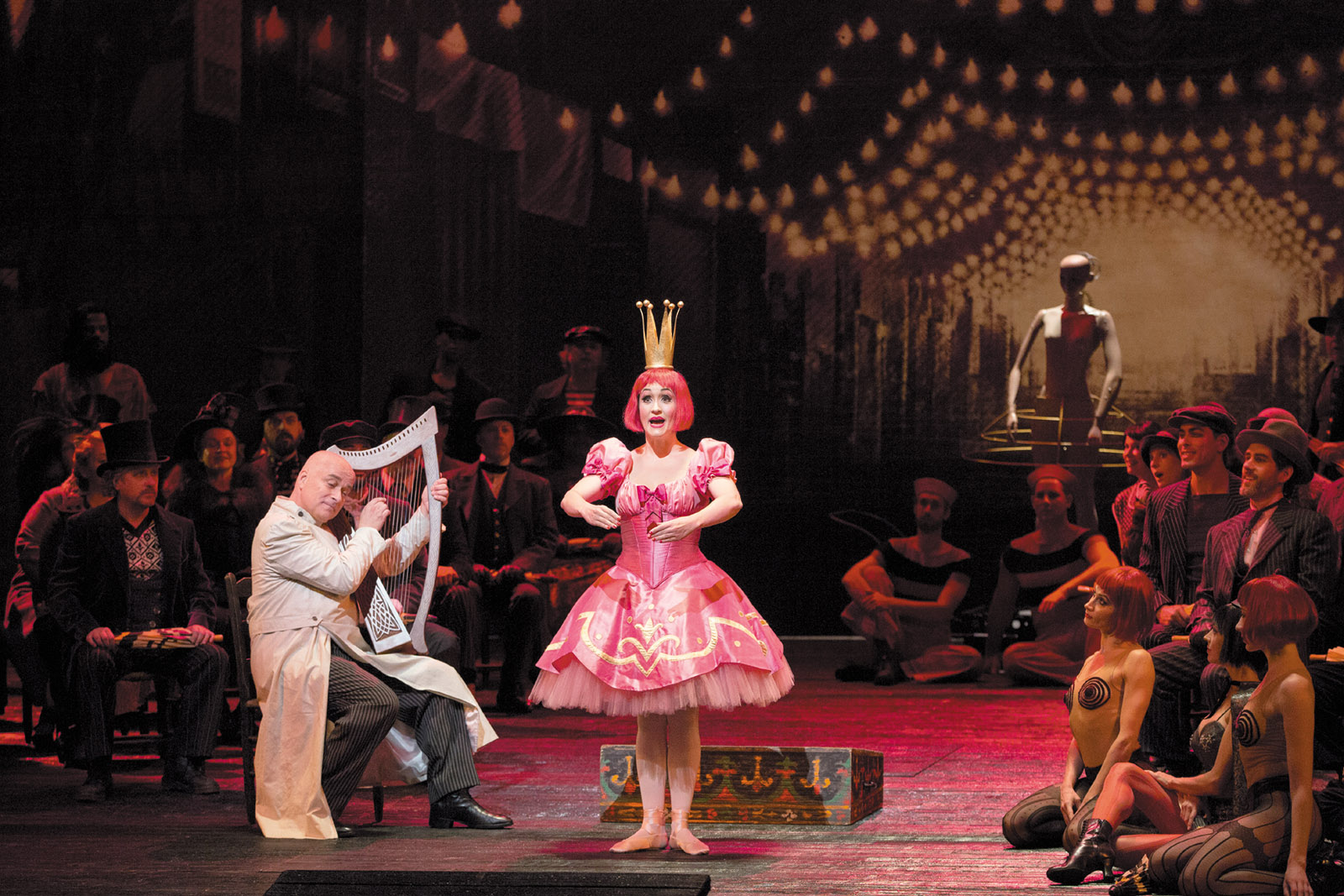
Mark Schowalter as Spalanzani and Erin Morley as Olympia in the Metropolitan Opera’s recent production of Offenbach’s Les contes d’Hoffmann

These stories are framed by a prologue, in which we see the drunken Hoffmann at a tavern with friends, and an epilogue, in which we learn that each of the love objects is fictional, meant to represent a different aspect of the woman he really loves, the actress Stella. In this way, the three episodes are made to serve as stages in a young man’s sentimental education. First comes blind love, based on first impressions, without knowledge of the woman’s real nature; then an idealistic, romantic passion thwarted by circumstances; and finally a debauched love that alienates him from his true self. The psychological acuity of the composite portrait gives the opera the unity that it lacks dramatically.

In the original Hoffmann stories, each of these unrelated characters points to a different moral than they do when brought together by Barbier and Offenbach. Take Antonia, who appears in the story “Councillor Krespel.” In Hoffmann’s version, Antonia’s singing is clearly a version of sexual passion: it leaves her flushed, “intoxicated with bliss,” “swimming in delight,” yet it terrifies her father, Krespel, who refuses to allow her to meet with her suitor, the composer B. When B. finally does get Antonia to sing, she perishes in a kind of Liebestod.

In the opera, on the other hand, sex is absent from the equation. Instead, Antonia’s singing is seen—in terms that Offenbach surely understood and identified with—as a form of theatrical ambition. When the diabolical Doctor Miracle tries to coax Antonia into singing, it is by using the lure of fame:

All the blessings that heaven entrusted to you,
Must they be buried in the shadow of a household and family life?…
Did you not proudly dream of hearing,
Like the wind through the trees in a forest,
The soft murmuring rustle of the packed crowd,
Praising your name and following you with their eyes?

The substitution of ambition for desire has the effect of lowering the emotional temperature. Indeed, Les contes d’Hoffmann is a self-conscious, self-reflexive work, in a way that Hoffmann’s own tales are not. Because everything in the opera is a symbol or parable, the audience experiences Hoffmann more as the artist devising the tale than as the hero living through it. This makes it difficult to keep the stage action unified and give it narrative momentum. The recent revival of Bartlett Sher’s production of Les contes d’Hoffmann, which debuted at the Metropolitan Opera in 2009, often lost sight of Hoffmann himself: Vittorio Grigolo sang beautifully and cut a handsome figure, but was generally to be found off to the side of the stage, striking a tragic pose while events unfolded around him.

By contrast, Tara Erraught as Nicklausse, Hoffmann’s sidekick who is actually his muse in disguise, was more central to the action. Always on stage as an ironic observer of Hoffmann’s follies, she shares the audience’s point of view, and thus serves as a more natural focus of identification than the nominal hero. Meanwhile, the set design, by Michael Yeargan, gave in to the almost irresistible temptation to disintegrate the work into a series of spectacular tableaux. The Olympia act, in particular, was awash in Surrealist imagery, which was certainly striking, yet emotionally unrelated to what is supposed to be Hoffmann’s plight.

Sunday, January 28, 2018

Curated Decay: Heritage Beyond Saving. Caitlin DeSilvey. University of Minnesota Press. 2017.

In Curated Decay: Heritage Beyond Saving, Caitlin DeSilvey takes an experimental methodological approach to heritage practice, examining a series of projects and sites where the appropriate course of action may in fact be minimal intervention, if at all. While not fully convinced by the notion of ‘curated decay’, This book.s self-reflexive exploration raises vital questions for the heritage sector regarding the tendency towards preservation at all costs.


‘We are meddlers born’ (130), asserts Caitlin DeSilvey in discussing our relationship to cultural heritage sites. As a trainee Conservation Architect, this notion strikes at the heart of what I do, and what I hope to do more of in the future. My day is full of discussions relating to what is significant about a place, what is the appropriate thing to do to a building and how its integrity can be retained. Not only am I a meddler born, but I’m actively learning how to meddle even more. In Curated Decay: Heritage Beyond Saving, cultural geographer Caitlin DeSilvey questions the value of this meddling instinct, examining a series of projects and sites where the appropriate course of action appears to be to do very little, if anything at all.

From the outset, DeSilvey makes it clear that the techniques and approaches described in the book are experimental and that she intends to ‘follow experimental practice to the point of failure’ (21). This, coupled with the awareness that these ideas may not be well received in some quarters, lends the book its structure. From her ‘poking about a derelict homestead in Montana’ (23) as a research student in Chapter Two to the bittersweet demise of Orfordness Lighthouse in Suffolk in Chapter Seven, a personal narrative arc is presented showing how the author has developed her thesis and continues to do so. Making use of reflective storytelling and poetic rumination, a set of theories emerges which prove to be nuanced and philosophically rich rather than the profanity against normative heritage practice they might initially appear to be.

The author’s work in the Montana homestead – described as an ‘ad hoc archaeology of the recent past in a place not yet old enough to be interesting to (most) archaeologists’ (23) – establishes the main themes explored and developed throughout the rest of the book. The consideration of an encyclopedia dated 1888, found amidst the tattered remains of other books constituting a mouse nest, reveals a tension between examining such an object as an archaic social artifact and what DeSilvey refers to as an ‘ecofact – a relic of other-than-human engagements with matter, climate, weather and biology’ (28). With this comes an appreciation that man-made elements are unstable arrangements of natural matter, and their unmaking allows us to live with the tension between natural and cultural elements. The question then emerges as to how to deal with these artifacts in a way that maintains this tension. The esoteric and eccentric practices divulged in the homestead – including the creation of ‘found’ Dadaist poetry from fragments of decaying literature – shows how an appreciation of objects caught in the transition from the cultural back to the natural can be reached using ‘serious play’ (43).


 Demolished Building, Woodstock Road, Belfast

Chapter Three takes the ideas developed in the relative seclusion of the homestead and applies them to a place not only under the statutory protection of the National Trust, but also deeply cared for by local residents. It details the arguments surrounding Mullion cove in Cornwall and the National Trust’s decision to undertake a ‘managed retreat’ from caring for the nineteenth-century harbour walls in the face of their unmanageable destruction precipitated by climate change. DeSilvey describes how, on first encountering the harbour in 2007, she saw it as an ‘opportunity to scale up the ideas (she) had been developing through (her) work at the homestead’ (47). ‘The conundrum facing the National Trust at Mullion’, the author explains, ‘was as much about how to tell the story of the harbour and its future as it was about how to manage the eventual demise of the physical structure’. The story of the harbour, built in the 1890s, is one of the constant destruction and rebuilding of a structure which was intended to be sacrificial: it would bear the brunt of the storms rather than the precious fishing fleet within the breakwaters. Therefore, the eventual destruction at the hands of the turbulent Atlantic was always an important part of the story. DeSilvey’s argument here is much more nuanced than simply permitting the decline of the site, instead questioning the practice of preservation of such a structure.

The chapter goes on to describe the author’s fascination with the harbour and her run-ins with a local activist whose interpretation of the story of Mullion was ‘evidence not to prepare for the harbor’s (sic) future unmaking but to shore up the case for investment in its continued persistence’. This disagreement never quite reaches a resolution and the chapter finishes with a sense of frustration. This is not due the continued efforts to maintain the harbour, but rather the author’s feeling that the arguments for managed decline – with regards to both contributing to the site’s story and recasting nature as something to be worked with rather than against – were yet to be fully articulated.

The debate around neglect versus interference and the possibility of balancing both continues in Chapter Five with the examination of two sites: Duisborg Nord, a former ironworks in western Germany, and the abandoned St Peter’s modernist seminary in Kilmahew on the outskirts of Glasgow. Both sites were being subjected to radical experiments in ‘counterpreservation heritage practice’ (100). Here, the concept of entropy is extended to describe not just what is occurring physically to the sites in question, but also as a methodological approach. Conservation and preservation, so often concerned with preventing the loss of physical fabric, could not apply to either of these sites: one a post-industrial brownfield site and the other a modern ruin riddled with asbestos. Both sites actively resist traditional approaches to conservation and reuse and, as such, are ripe for experimentation as a ‘tentative procedure […] adopted in uncertainty’ (99).

At the end of these experimentations, however, the author feels unsatisfied. The management of both sites endeavours to preserve the unmaking of their man-made elements while also permitting the spaces to be used to a certain degree, and DeSilvey’s belief appears to be that this tension should be acknowledged and highlighted, but not overcome. As such, the Duisborg Nord site is viewed tentatively as a success in establishing a ‘model (of) entropic heritage practice’ (130), whereas the approach to Kilmahew is perhaps more concerned with the appearances of the entropic, as opposed to authentic entropy. Despite the feeling of deflation and disappointment evident at the end of the chapter, it is obvious that DeSilvey still views the experimental practice, successful or not, as of immense value to the development of the concept of ‘curated decay’.

DeSilvey’s thesis certainly won’t be to everyone’s tastes: indeed, I was highly dubious on starting out. Invested as I am in ‘normative’ heritage practice, however, the book poses a series of extremely pertinent questions which are not easily answered. The notion that such sites ‘are not being saved because they are valued, but are valued because they are being saved’ (178) was at first mildly disturbing. The mechanics of heritage practice have quite possibly overtaken common sense in their absent-minded reflexive reliance on preservation at all costs. Applying this notion, however, to individual cases as they arise holds the possibility of setting aside this reflex and gaining a more nuanced appreciation of the value of the site and the range of potentially appropriate responses to its significance.

On the other hand, one of the primary purposes of preserving heritage sites is to permit an understanding of the past to extend into the future and create a sense of temporality for generations to come. Where it is certainly true that observing the inevitable corrosion of sites such as Mullion Harbour creates a more acute awareness of our temporal nature, it only does so for those lucky enough to be present at that specific time. However, the arguments are incredibly well-constructed, particularly as we are carried along with DeSilvey’s own narrative arc as she tests her methodology to breaking point. Therefore, while I may not be entirely convinced of ‘curated decay’ as methodology, I believe the fundamental questions the book asks of the heritage sector are worth paying attention to.

The Hungry Mind: The Origins of Curiosity in Childhood. Susan Engel. Harvard University Press. March

Curiosity is vital, but it remains a surprisingly understudied characteristic. The Hungry Mind explores what curiosity is, how it can be measured, how it develops in childhood, and how it can be fostered in school. Although the reader might have come across some of the insights in this book elsewhere, the author does a brilliant job connecting a wide range of essential 20th century research on the development of children.

The Hungry Mind: The Origins of Curiosity in Childhood
.

“When people want to know, they learn”. Although this insight might appear rather simple and self-evident, it is a crucial fact that is often discarded when we consider methods of fostering learning or ways of designing education systems. Therefore Susan Engel’s The Hungry Mind, a book which engages in depth with how our interest and desire to explore the world evolves, makes a valuable contribution not only to the body of academic literature on the developmental and educational psychology of children, but also to our knowledge on why and how we learn.

Starting from the assumption that the very “linchpin of intellectual achievement” is curiosity, Engel presents a range of interesting insights into how this feature expresses itself and develops throughout childhood. While her findings may not always be new and the reader might have come across some of the insights already, the author does a brilliant job connecting a wide range of essential 20th century research on the development of children and turning these insights into a coherent narrative about how children become aware of and interact with their environment.

In the initial chapters, Engel introduces the different sources and forms of curiosity that exist among babies and toddlers; she points out that the feeling for “bad math” or “natural concepts” about what objects belong together already exist at a very early stage in our life. She then goes to trace the role that language has for the child’s ability to expand its knowledge by asking questions and telling stories. Here the author finds not only that a “child’s early question-asking experience lays down a foundation for her future”, but also that children who hear and tell stories in collaboration with their parents become better story-tellers, more engaged readers and self-reflective personalities. Another interesting aspect in this regard has to do with the way children perceive of themselves, either in relation to the stories they hear and read or when they interact with their peers. In elementary school, children develop and “carry around representations of dynamic social matrices”, as Engel puts it, which clearly facilitates their understanding of human relationships, as does gossiping. In Engel’s interpretation, the latter is therefore not understood as a despicable human activity but rather as simply a different way by which children acquire insights into how the world and other human beings function.

The author also traces the role played by parents and teachers and underlines the danger of adults who expect children to learn according to a particular script. Rather than for a prescriptive approach to learning à la “First you do a, the you do b, follow the instructions until you accomplish c”, she argues that children need free time and solitude in order to identify which issues and activities they truly find interesting. Children “absorb, understand, and retain various kinds of information and skills” often when they the opportunity to explore things on their own . Yet Engel does not advocate a complete laissez-faire attitude to learning and education. Rather, she underlines that while some children are “naturally” more inquisitive than others, adults and the setting they provide, impact heavily on the way children learn and develop curiosity. Encouragement to explore, access to unexpected and complex materials, and contact with other children and adults are thus found to be potent ingredients for intellectual advancement.

Even though Engel’s work is first and foremost concerned with the development of curiosity in children and will therefore appeal predominantly to readers interested in this particular field, the books touches on such a large range of subjects that it makes for a valuable read for a much wider audience. The distinction between specific and diversive curiosity, for instance, will resonate with anyone interested in the different ways people acquire knowledge, choose books or engage with internet search engines such as Google. Similarly, readers interested in psychology are likely to be fascinated by the insight that reading fiction enhances people’s ability to also “read people” and to demonstrate empathy, while educators might want to debate how for need for solitude and free time can be reconciled with strict class-room settings and pre-defined learning outcomes.

The fact that The Hungry Mind combines the work of some of most prominent scholars on the childhood development such as Dewey, Piaget or Cuffaro, with lesser-known researchers and examples from Engel’s own childhood, makes the book not only a highly informative but also very enjoyable read that leaves the audience with a number of important takeaways: throughout their life, human beings have an “urge to know about things that have no obvious or utilitarian function”, a feature that distinguishes them from other species; Furthermore Engel finds that this extraordinary kind of curiosity can and needs to be cultivated in order to tap its full potential; And finally, Engel’s findings suggests that a parent or teacher who “knows what the itch to find out feels like is in a better position to foster that itch” in others. What better reason could there be to remain curious?