Thursday, March 2, 2017

What is Populism? Jan-Werner Müller. University of Pennsylvania Press. 2016.


Populism is a hot topic of which there is no shortage of analysis. By combining theoretical rigour with his knowledge about the empirical realities of populism, Jan-Werner Müller nevertheless manages to add some important and so-far neglected points in What is Populism? He organises his book around three questions, the latter two of which still lack scholarly attention: namely, what do populists say; what do populists do when they are in power; and how should they be dealt with? To discuss the merits of the book, it is worth outlining Müller’s answers to each of these questions.

Müller starts by characterising populism as a specific form of identity politics that is critical of elites, anti-pluralist and has a moral claim of representation (2-3). The introduction and the first chapter (‘What Populists Say’) represent the scholarly ‘meat’ of the book and discuss competing definitions of populism. Müller argues against conflating populism with ‘irresponsible politics’ or equating it with the fears or anger of voters. Such psychologising analyses, according to the author, show voters that the so-called ‘liberal elites’ are condescending and ‘unable to live up to their own democratic ideals by failing to take ordinary people at their word’ (16). Instead, he settles on the form of representative claims as a criterion of populism: namely, that populist claims are moral and symbolic rather than empirically testable. Populists are those politicians that claim to represent ‘100%’ of citizens while not accepting the legitimacy of other actors that make representative claims.

The second chapter addresses what populists do when in power. While this question is gaining attention, Müller still argues against the basic misconception that populists are unable to govern (4). He identifies three populist techniques of governing: the occupation of the state; mass clientelism; and the repression of civil society (44). While these strategies may also occur in other regimes, populist governments can practise them openly as they make a moral claim to the state. For populists, it is imperative that ‘the people’ (or their representatives) take control of state institutions. As populists turn states partisan, he extensively criticises the terminology of ‘illiberal democracy’ (49), and instead suggests ‘defective democracies’ (58). He also returns to his definition of populism by discussing how in democracies different representative claims coexist, while populists in government (and the constitutions they write) attempt to put an end to democracy’s perennial boundary problems and internal renewal (72).
Image Credit: Donald Trump in Reno, Nevada, 10 January 2016 (Darron Birgenheier CC BY SA 2.0)

The last chapter addresses the pressing question of how to respond to populists. While much of the chapter is dedicated to explaining populism’s appeal and criticising common responses to populism, Müller ultimately suggests that to engage with populists: ‘One can take their political claims seriously without taking them at face value’ (84). Thus, politicians and the media should address the issues raised by populists but challenge their framing. Regarding the US, he makes a case for addressing the doubts of citizens who call for cultural closure by alleviating their economic worries (91-93). Regarding Europe, he cautions that its political systems were built on a distrust of popular sovereignty, fuelled by the experience of fascism (93-96). Thus, scepticism towards the technocratic response to the Euro crisis is often conflated with populism. Müller criticises actors who condemn any critique of elites as populist as well as those who imagine a ‘left populism’ that is less exclusive. Instead of lamenting populists’ disrespect for pluralism and inclusive political communities, we have to find more convincing arguments for both. Politically, rather than engaging in the construction of ‘the people’ as a whole, he suggests building partial majorities within political systems that bring in the excluded without marginalising the currently powerful (99).

Müller’s book is both analytical and involved, the work of a public intellectual in the best sense. It addresses a variety of issues related to populism today, whether it is new constitutions and referenda in Eastern Europe, the US election campaign or the questionable inner-party democracy of the Italian Cinque Stelle movement (31). Müller is not afraid to ask uncomfortable questions, such as whether the liberal critique of populism has failed or whether populists are simply successful politicians disliked by mainstream candidates. While going through a range of examples, he maintains a level of abstraction that makes the book interesting to all readers.

Academically, the book is most promising where Müller addresses democratic theory. Exemplary is his discussion of Hungarian Prime Minister Viktor Orbán’s use of illiberal democracy, where Müller not only fervently defends liberalism as an integral part of democracy but also outlines what an illiberal democracy would look like by pointing to the history of Christian democracy as a culturally illiberal ideology that nevertheless upheld politically liberal rights (54). Thus, he provides strong arguments why populist leaders should not ‘get to keep ‘‘democracy’” (56). This is based on a conviction he shares with much of the populism literature: namely, that populism does not offer an attractive ideological alternative to democracy. Instead, populists use democracy’s broken promises and ‘the language of democratic values’ (6) to deform democracy. Thus, many of his arguments are a call for a democratic renewal that takes its own principles more seriously.

The analytical value of Müller’s definitions nonetheless remains to be seen. Since the book is not an empirical study, he does not provide a coherent operationalisation. Distinctions between populist and liberal claims in practice are sometimes upheld through hypotheticals (40) or context criteria (73) rather than rigorous definition. Some of his ideas, like the characterisation of populists in power and particularly the civil society aspect, remain without concretisation. This is partly due to the format of the book: it is not a systematic structure but Müller’s argumentative chains that drive the narrative. His arguments are recursive, addressing similar issues from different angles. This draws readers in, but it also means they have to reconstruct the answers to each chapter’s guiding questions throughout the entire text. As a result, as with any thought-provoking book, the reader may find as many new doubts as answers.

With its vivid style, What is Populism? is very timely and remains accessible to a general audience despite Müller’s extensive engagement with political theory. At just over one hundred pages, the book is so engaging that while writing this review, I discovered more and more friends and colleagues were eagerly reading it. Thus, with Christmas approaching, What is Populism? may be the perfect gift for researchers as well as for interested friends and family members who have always wondered what political scientists actually do.

Urban China by. Xuefei Ren, Polity.


Image result for Urban China by. Xuefei Ren, Polity.
While bottles of champagne were opened, ribbons were cut, and millionaires and billionaires were made, many ordinary residents lost their homes and relocated to the urban periphery, joining the army of the poor.
Ren (2013: p. 164)
China’s economic miracle, closely related to its urban transition, is both fascinating and mind-boggling. On the one hand, China’s GDP grew at an average of 9.99 percent per year from 1978 to 2010, and its per capita GDP in 2010 is 79 times higher than in 1978 (p. 1). On the other hand, China’s Gini coefficient is 0.474 in 2012, higher than the warning level of 0.4 set by the United Nations. China’s super-large cities (with populations of more than 2 million) increased in number from 10 in 1995 to 42 in 1992 (p. 11). China’s migrant population, defined as people living in a different place from that of their hukou record (i.e. household registration) for six months or more increased by 83 percentage points from 2000 to 2010 (p. 10).
In Urban ChinaXuefei Ren provides an accessible and engaging overview of China’s urban story for expert and non-expert readers. Her concisely-written book addresses four key themes: firstly, how China’s urbanisation came about; secondly, the mechanisms that perpetuate China’s urbanisation processes; thirdly, the consequences of the urbanisation process; and finally, some pointers to emergent problems as well as early signs of spaces for social change.
However, Ren’s intention stretches ambitiously beyond the sole focus on China. As she explains in the Preface (p.xiii-xx), China’s urban story offers opportunities to reflect about broader urbanisation and political economy issues. These include China’s economic miracle, the interconnectivity of the global economy, and implications for urban theory developed from predominantly Western contexts. Her book is also intended to caution against “fast policy transfers” (p. xx) typically adopted by other cities aspiring to model themselves after the success stories of some Chinese cities. This cautionary insight is informed by Ren’s parallel work on comparative urban governance and citizenship rights in China and India.
The book is clearly structured into six chapters, with a separate preface and conclusion. Chapter 1 provides the contextual introduction: firstly, China’s historical development; and secondly, the relationship between the urbanisation process and the global economy. Chapters 2 to 6 zoom into individual themes of what can be termed ‘urban consequences’. The themes cover urban governance and shifting power structures (exemplified in land rights, the housing market, infrastructure development, and the governance of regions and communities); new forms in the urban landscape; the housing and labour rights of rural-urban migrants; social, spatial and urbanisation-induced inequalities; and new developments in the cultural economy. These themes emphasise Ren’s reading of Brenner’s (2013) “Theses on Urbanization” – Ren sees the urban as a process with positive and negative “moments” and “effects” (p.191).
What I find useful is that some chapters are written with a combination of ‘big stories’ and ‘small stories’. The ‘big stories’ provide the broader social, economic and political forces and trends at work, while the ‘small stories’ provide personal and individual accounts to contextualise what the broader phenomena meant to individual social agents. For example, in Chapter 2, Ren provides her family’s housing evolution “from a self-constructed house in a work-unit compound, to five apartments in three cities in north, central, and south China” (p.66) to illustrate the impact of China’s housing-market boom for some Chinese families. In Chapter 5, Ren uses the rise of a real-estate developer to demonstrate “how the once egalitarian society has become increasingly divided between the haves and have-nots” (p.146). Finally, in Chapter 6, Ren describes a Beijing woman’s lifestyle changes to offer a glimpse into the emergence of China’s urban middle class and their increasingly globalised consumption lifestyle.
The short conclusions at the end of each chapter are also useful features. These provide excellent summaries of ideas discussed in the chapter. The contents of the chapters are also complemented by informative maps, tables and graphs. However, the book lacks photographs, which could be useful in illustrating the different urban landscapes. For example, Chapter 3 mentions new developments such as the 798 Factory in Beijing, the redevelopment of historical buildings in Qianmen Avenue in Beijing, Guangzhou University Town, and Tianjin Eco-City. These could be visually contrasted with old and neglected urban spaces such as inner-city neighbourhoods and degraded workers’ villagers mentioned in Chapter 5.
Despite Ren’s suggestion to “[use] urbanization in Asia to prove, reject, or revise Western urban theory” (p. xvii), this has unfortunately not been delivered in this book. While she rightly points out that “the frontier of urbanization has unmistakably shifted to Asia” and that we need “new theoretical tools and vocabularies” (ibid.) to understand this process, her book has not made any steps in advancing her call to urban China studies. An additional chapter, or at least further elaboration in the Conclusion, could have elevated this book from merely a concise account of China’s urban story to a significant contribution opening up important debates about the continued dominance of urban theories developed from Western perspectives.
Overall, this book is an excellent resource for anyone interested in obtaining a succinct and updated overview of China’s urban transition. Ren’s coverage of urban consequences would appeal to readers interested in a range of related themes, including urban governance, urban politics, architecture and urban forms, rural-urban migration, citizenship rights (in relation to housing, land and labour rights), urban inequalities, urban economy (particularly arts, culture and heritage), and urban theory.

Capital Without Borders: Wealth Managers and the One Percent. Brooke Harrington. Harvard University Press. 2016.


Displaying

In recent years, we have seen a plethora of books on wealth, inequality, the super-rich and the ‘one percent’ (e.g. Dorling 2014; Forrest et al 2017; Piketty 2014). Research tells us that we are living in an era of ‘extreme inequality’: in 2014, the richest one per cent of the world owned 48 per cent of the global wealth (Oxfam 2015); by 2015, the richest 62 individuals had the same wealth as 3.6 billion people (Oxfam 2016); and in 2016, the eight richest individuals hold the same wealth as the poorest 50 per cent of the world’s population (Oxfam 2017). As a response to rapidly rising inequality, we have seen protests (e.g. Occupy Wall Street) and public criticisms of the wealthy and the super-rich (CNN 2014; Unite 2014).

However, as Brooke Harrington argues in Capital Without Borders: Wealth Managers and the One Percent, little attention has been paid to the people who make the rich rich. While there have been critical accounts of offshore tax havens (Palan et al 2010; Shaxson 2011), these earlier works have not explicitly shone the spotlight on wealth managers per se. As Harrington observes: ‘the offshore system is of course not self-managing: it is manipulated, directly and indirectly, by actors such as elite professionals’ (294). It is only recently – with coverage of the leaked Panama Papers and the 1MDB controversy, for example – that we can begin to understand the intimate relationships between global financial scandals, the intricacies of the offshore system and the creative tactics used by legal and financial professionals to orchestrate these projects. These recent exposés, however, are only the tip of the iceberg.

Riding on this shift towards increasing awareness of the roles played by wealth managers and intermediaries of the super-rich (The Guardian 2016), Capital Without Borders offers an in-depth look into the wealth management profession. Harrington uses what she calls ‘immersion ethnography’ to research an industry that is not easily accessible to outsiders since it shrouds itself under high levels of privacy and confidentiality (see also Karen Ho’s 2009 ethnography of Wall Street). Her methodology involves enrolling in a two-year wealth management training programme, where she immersed herself in the ethos, techniques and vocabularies of her study subjects. Between 2008 and 2015, Harrington ‘follow[ed] the money’ (274), interviewing 65 wealth management professionals in 22 locations, spread across eighteen countries.

The book is very clearly written, avoiding unnecessary and complicated jargon. The simple and clear narrative is effective in unravelling the complex world of wealth managers and their clients for readers who may not be familiar with the world of the one percent. The select and clever use of figures and tables also helps to explain more complex ideas. For example, Figure 4.2 on page 190 clearly illustrates how assets are strategically structured under companies, trusts and foundations in order to protect clients against ‘the many forces of dissipation’ (277), such as economic downturn, political change and divorce.

Overall, the book is also logically organised, explaining the historical evolution of the profession (Chapter Two), relationships with clients (Chapter Three) and wealth management strategies (Chapter Four), before broadening out to socio-political issues of inequality (Chapter Five) and the implications for national borders and states (Chapter Six). The concluding chapter, which I highly recommend, discusses insights on broader socio-political issues such as ‘inequality, the family, globalization, the professionalization process, and state authority’ (272-73), gained from an in-depth understanding of the wealth management industry.

What struck me most in reading this book is the respondents’ understanding of their role and profession on a broader scale. Instead of viewing themselves as expert professionals who preserve and grow their clients’ wealth portfolio, many of them ‘saw themselves as playing a vital and very positive role in the economic development of former colonies’ (257). This is best exemplified in the following quote by a wealth manager based in Hong Kong:

Without our profession, there wouldn’t be the large pools of capital available to fuel economic development. So many of us, if not all, see our work as primarily about helping people – not just our clients, but more generally by helping maintain capital flows for investment and economic growth. But we can’t get this message out effectively. We have, by the nature of our work, cultivated privacy and discretion, so the profession is totally unprepared to respond to the claims being made about us and about the industry […] We cannot win publicly, let’s face it (257-58).

While this discourse sounds convincing and perfectly legitimises the work of wealth managers, it sits uncomfortably with the problematic consequences of the profession. These include capital flight, inequity in resource and wealth distribution, the de facto ‘economic colonisation’ of developing states, the concentration of economic and political powers in the hands of a select group of transnational elites, the undermining of national sovereignty and the increasing erosion of state powers to protect the interests of the masses.

This is a thoroughly researched, carefully thought out and comprehensively indexed book. By tracing the development of the wealth industry ‘from voluntary work undertaken by friends and kinsmen into a thriving form of expert power’ (294) and detailing ‘the workings of agency in producing larger patterns of stratification’ (274), this is an important work for our increasingly unequal world. Instead of uncritically blaming the wealthy and the super-rich or national and state governments, it is high time to focus our attention on the brokers, intermediaries and agents who constitute the ‘middleman economy‘ of global inequality.

Wednesday, March 1, 2017

Terrifying #OyVeyDonaldTrump...Should we really be ?.The Truth about Trump Paperback – 3 Jan 2017 by Professor Michael D'Antonio , St Martin's Press, President Donald Trump Tells it Like it Is, 46 Days of Trump on Twitter Paperback – 16 Feb 2017,by Christian Mosco Donald Trump: The Making of a World View Paperback – 8 Feb 2017 by Brendan Simms ,Charlie Laderman Game of Thorns: The Inside Story of Hillary Clinton's Failed Campaign and Donald Trump's Winning Strategy Paperback – 28 Feb 2017, by Doug Wead, Biteback Publishing How To Survive The Donald Trump Era in 29 Easy Steps Paperback – 14 Feb 2017 by Cliff Stevens The Truth about Trump Paperback – 3 Jan 2017, St Martin's Press by Professor Michael D'Antonio

When the most unpopular and least prepared president-elect in modern history took the oath of office on January 20, most of Washington, like most of the country and the world, had little idea of the turbulence and disruption that he intended to bring to the job. Nonetheless those who’d watched him closely over the past year and a half were aware that he was manifestly unfit for a job that’s beyond the capacities of most people.

Anyone who was still expecting a heretofore hidden inner statesman to emerge from the bombastic, crude, talkative candidate was harboring illusions. After the election, we had new evidence that Donald Trump wasn’t up to the position; during the transition that reality crept out of the cracks in the defensive wall thrown around him by protective advisers. An article in the New York Post on January 15 said that Trump was showing far more interest in trivialities about the inauguration planning than in preparing to govern. Tom Barrack, chair of the Presidential Inaugural Committee, told the Post, “He’s into every detail of everything. I beg him all the time to go back to running the free world and let me focus on setting the tables.”

Trump took office with only two cabinet officers ready to serve. (Barack Obama had nine.) And he came to the job with few political connections: mainstream Republicans had essentially shunned his campaign. But Vice President Mike Pence, a very conservative and well-liked former House member particularly close to the also highly conservative House Speaker Paul Ryan, had won Trump’s confidence by not appearing to be out for himself. So did Jeff Sessions, the Alabama senator who was the first in that body to endorse Trump and stayed close to him throughout the campaign. Sessions, whom Trump rewarded with the position of attorney general, has not fully revised his rural Alabama–rooted attitudes on race and has been a firm opponent of immigration. Pence and Sessions were mainly responsible for the selection of the most ideological cabinet in memory.

When he’s outside his few fixed views, Trump is a curiously malleable figure. His lack of knowledge about policy and his paucity of political connections force him to rely on the advice of others, which makes all the more critical the nature of the people he’s chosen to have around him. Not many foresaw the extent of the power that Steve Bannon, Trump’s intellectual guru and chief strategist, would exercise in the White House. Bannon is an alt-right white nationalist who as senior counselor now occupies an office a few steps from the president’s. He seemed to have his finger in everything, and Trump compounded this by placing Bannon on the National Security Council Principals Committee, of which a political adviser has never been a full-time member. (The New York Times reported that Trump was angry that he wasn’t “fully briefed” on the executive order establishing this role for Bannon.)

Moreover, while Bannon was to become a regular member of the NSC, under Trump’s reorganization the director of national intelligence and the chairman of the Joint Chiefs of Staff were demoted to attending only NSC meetings relevant to their direct responsibilities. This reshuffle may in part reflect Trump’s resentment of the intelligence community for saying that Russia had interfered in the election on his behalf, and also efforts by his national security adviser, retired General Mike Flynn, to preserve his position in the constellation of security officials around Trump. Recently, White House knives have been out for the bumptious Flynn, who, like Trump, is an impulsive figure with an affinity for Vladimir Putin. Unhappy over press reports of disorder among his staff, Trump has ordered a more hierarchical approach (which he’d never preferred), under Chief of Staff Reince Priebus.

Bannon’s closest ally among Trump’s political advisers has been Sessions’s former top aide Stephen Miller, who is a speechwriter for the president and senior adviser for policy. As Sessions’s aide, Miller was instrumental in getting immigration reform killed in the Senate. Bannon and Miller were the main authors of Trump’s inaugural address as well as its cousin, his acceptance speech at the Republican convention. As it happens, Trump’s supposedly closest adviser, his son-in-law Jared Kushner, shares many of Bannon’s radical right-wing views: the old establishment must be smashed, whether it’s in Congress, Washington, or Europe. Neither Kushner nor Bannon had had one minute of previous government experience.

Despite his so-called populism—Bannon has analogized him to Andrew Jackson—Trump is no threat to the Republican moneyed class. He made it clear in his campaign that he favored cutting taxes on the wealthy and corporations; the middle class, who constituted Trump’s base, was also to get a tax cut, but proportionally a much smaller one. And numerous middle-class households would actually be paying higher taxes. Probably more important to Trump’s business supporters was that he’d made it clear that he’d take a sledgehammer to the web of federal regulations, particularly those that in the name of protecting the environment restrict how businesses run their plants and extract raw materials from the earth. And he has begun to roll back rules imposed on banks by the Dodd-Frank Act in response to the 2008 financial crisis.


The direction Trump would go on the environment was made clear in the campaign when he called climate change a “hoax,” and he named a prominent climate change denier, Myron Ebell, as head of the transition team for the Environmental Protection Agency. Ebell ran a libertarian think tank financed by the coal industry and the Koch brothers. Though they didn’t back Trump for president and didn’t speak highly of him, the Kochs invested in Trump’s election—their political organization was active in Wisconsin and Pennsylvania—and their influence in the Trump administration was guaranteed by having been, along with other fossil fuel industrialists, strong backers of Pence, who has been a climate change denier.


After the election, the vast Koch network was only too happy to help Trump fill numerous job openings and develop policy proposals. Koch allies have turned up in various administration positions. They include Marc Short, the White House legislative director, who had worked for Pence and had headed the major organization that raised funds to promote the Kochs’ far-right, pro-corporate, anti-environmental agenda, including their opposition to the Affordable Care Act. The Kochs also want to see the end of numerous federal programs, though their hand in getting that done may remain invisible. They have another strong ally in Paul Ryan, who’s been a featured speaker at many of their gatherings.


Trump’s frenzied actions once he took office were intended to make him appear to be fulfilling campaign promises—though in several instances he is claiming a broader mandate than he has—and to show the country that he’s a man of action. He says and does so much that he’s hard to keep up with, and this has become a strategy. He’s a juggler par excellence. Several of his actions were largely born of his revanchism against Obama’s policies. Just hours after he was sworn in, Trump issued orders throwing the first harpoon at Obamacare by issuing an executive order instructing the states to go easy on any ACA policy that “imposes a financial or regulatory burden.” The substantive import of this vaguely worded order wasn’t clear: it could be sheer symbolism or it could be a step toward first damaging and then trying to kill the program, Obama’s most prized domestic achievement.


The executive order about Obamacare might buy time while Trump and congressional Republicans attempt to find their way through the minefield they’d created for themselves by making their number-one goal to “repeal and replace” Obamacare. To that end, later in its first week, the Trump administration threw another monkey wrench into the workings of the ACA by blocking the Department of Health and Human Services from advertising or using other forms of contact to encourage people to sign up for insurance before the January 31 deadline for coverage in 2017. After a public outcry, this order was partially withdrawn a few days later.


“Repeal and replace” was a slogan, not a policy—the Republicans’ real interest was in simply killing the ACA—and it was even proving harder to repeal the law than its opponents had anticipated, much less to reach agreement on what should replace it. Some Republicans began to cool on the idea of repeal before a replacement was in sight, and Trump became of that view as well. Toward the end of the transition Trump told reporters that he was working on a replacement and that it would be ready within a week, maybe an hour, of the confirmation of his nominee to head the Department of Health and Human Services, Georgia Congressman Tom Price.


Price is a fierce opponent not only of the ACA but of Medicare (which he has proposed privatizing) and some aspects of Medicaid; his confirmation had been held up, in large part because of questions surrounding his trading in health care stocks when he was chairman of the House committee with jurisdiction over health care. After Democrats tried to stall some confirmations by boycotting committee meetings, Republicans suspended committee rules that a member of the minority party be present and approved Price and would-be Treasury Secretary Steve Mnuchin despite lingering questions about ethics in both cases. When on Thursday of his first week in office Trump attended the GOP conference in Philadelphia, Republicans pressed him for guidance on how to replace the ACA but he had none to offer.


Barely noticed were other actions Trump took on the afternoon of his inauguration involving the Justice Department, which intervened to delay two pending court cases. One challenged a Texas voter ID law that federal district and circuit courts had deemed unconstitutional. Another sought to overhaul police practices in Baltimore, where in April 2015 a black man, Freddie Gray, died after being transported in a police van.


A considerable amount of theater accompanied Trump’s signing of each executive order, bound in a blue leather binder and solemnly handed to him by Chief of Staff Reince Priebus. Of course the show was made available for televising. Most of the executive orders were written by Bannon and Miller, and some posed legal and other problems. These newly minted top White House officials didn’t bother to consult relevant government agencies or Republican leaders on Capitol Hill. Some of the orders, such as overturning Obama’s veto of the Keystone and Dakota Access pipelines, won’t take effect automatically. Trump also demanded that the companies building the pipelines must submit new applications for approval and insisted that they use American steel, which would be expensive and may violate international trade laws.


It wasn’t unexpected that Trump would reinstate what’s called the Mexico City policy, which bars aid to international programs that provide abortions (even those not paid for with US funds) or counseling about abortions. This policy had begun under Ronald Reagan and has bounced back and forth between Republican presidents who sign executive orders to implement it and Democrats who sign executive orders to repeal it. But there was a difference this time: the Trump “gag order” was expanded to apply to any health services around the world, not just those that offer abortion or family planning advice, and therefore could stop government funding for dealing with such diseases as Ebola and Zika. In addition, the order called for a complete cut-off of funds for Planned Parenthood, a goal long sought by Mike Pence.


Then there was the Wall, which had begun as a political fantasy—an illusion of Trump’s creation to fire up his followers at rallies. The Wall was his metaphor for “getting tough with Mexico” for its ostensibly “sending us” criminals, drugs, and rapists, though Mexico has cooperated with the US government to prevent such immigration and drug running, as well as the transit of Central Americans trying to reach the US. In fact, immigrants have a lower crime rate than native-born Americans.


Trump’s case against illegal Mexican immigration into the US is counterfactual in still another sense: for years more Mexicans have been leaving the US than have been coming into the country. Trump and numerous congressional Republicans intone about the necessity for “border security,” but in fact the US has spent an estimated $132 billion since fiscal year 2005 on fences, additional agents, sensors, surveillance cameras with night vision, helicopters, drones, and radar—and illegal crossings have dropped dramatically.


Once elected, Trump had to at least act as if he was determined to build his chimerical but audience-pleasing Wall. If it happens to not be built, he can say he tried and pass the blame onto others for unwillingness to “protect our borders.” His second reckless, crowd-pleasing claim, that he’d get Mexico to pay for the Wall, plus his own inability to suffer a rebuke, got him into an unnecessary row with the president of Mexico, whose country of course has no intention of paying for the Wall. Trump asked Kushner to sort it out. Kushner has also been tasked by his father-in-law to broker a peace agreement between Israel and Palestine. Later, Trump managed to be exceedingly rude to the prime minister of our great ally Australia.


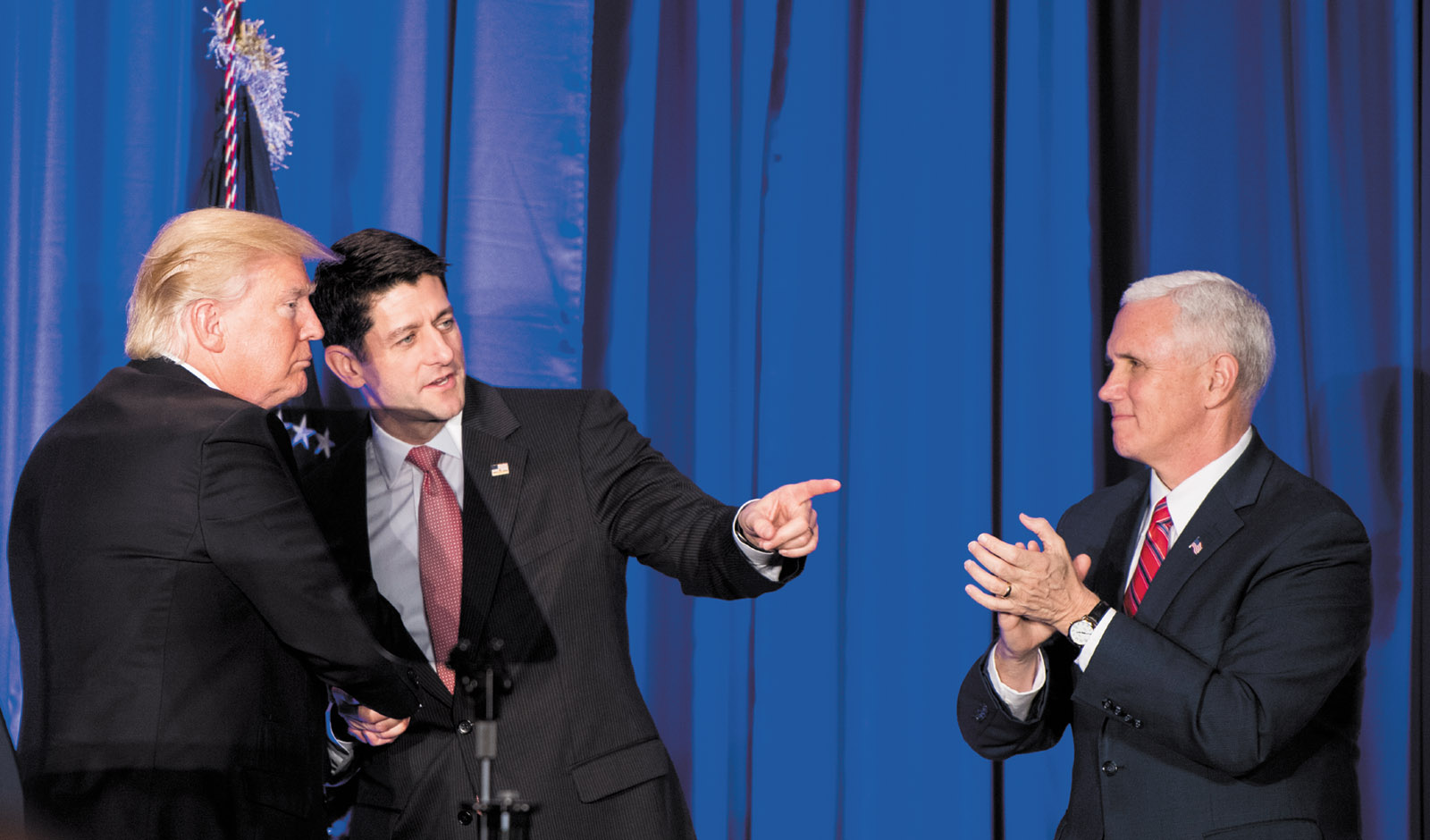
President Donald Trump, House Speaker Paul Ryan, and Vice President Mike Pence at the GOP congressional retreat, Philadelphia, January 2017


But for sheer shortsightedness and either ignorance or chilling cynicism, nothing else Trump did in his first ten days in office came close to his executive order on immigration, issued on the afternoon of Friday, January 27. The order’s effects on legally cleared immigrants were cruel and capricious, and it almost immediately caused the US problems at home and abroad. A ban on Muslim immigration by another name, the order at least temporarily barred immigration from seven Muslim-majority countries on the grounds that they were havens for terrorists. Titled “Protecting the Nation from Foreign Terrorist Entry into the United States,” it began by invoking September 11 three times. It put a three-month halt to immigration from Iraq, Iran, Syria, Sudan, Libya, Somalia, and Yemen, though the September 11 hijackers weren’t from any of them. In fact, since September 11 there’s been no terrorist attack in the United States by an immigrant from any of the seven countries.


The order also suspended the entire US refugee program for four months. Following that, Trump explained, priority would be given to Christian refugees from those countries. With the exception of diplomats, the executive order also covered travelers to the US who had gone to the designated countries, a very broad definition of the terrorist threat. And it imposed a flat ban on Syrians entering the United States, though no Syrian refugee has killed a single American in the United States.


Under the order the three-month ban on immigrants from the seven named countries could be extended ad infinitum unless applicants met certain new undefined requirements. During the campaign and in issuing the immigration order Trump placed a great deal of emphasis on the urgent need for “extreme vetting,” implying that the Obama administration had been lax, though it subjected would-be immigrants from certain Middle East countries to rigorous screening that could last as long as two years. An intelligence official told The Washington Post that no one in the intelligence community had asked for the order’s new restrictions.


The immigration executive order was so sloppily drafted that it took the White House three hours after the president signed it to release an explanation. It had been rushed and the relevant agencies weren’t consulted.


The order immediately raised a number of legal and constitutional issues—some so obvious that it’s a wonder they didn’t occur to the drafters—if they didn’t. The flat, wholesale ban on immigrants from designated countries, even if “temporary,” could violate a law that bars discrimination in issuing visas because of a person’s nationality or place of residence. It could also violate a legal prohibition on discrimination against immigrants on religious grounds—the very foundation of this country and enshrined in the First Amendment.


The priority to be given to Christians after the ban was lifted raised an obvious constitutional issue. (This discriminatory policy was made known on the same day that the White House issued an annual commemoration of the Holocaust that for the first time didn’t mention Jews. It was redolent of the anti-Semitic views expressed in Breitbart News, previously edited by Bannon, and it was a form of Holocaust denial.)


In apparent violation of the law, the order, which went into effect immediately, stopped immigrants who’d been cleared and were en route to the US; and at first even people with green cards who may have left the country for some reason were detained at airports or sent back to their native countries. The issue of whether or not green card holders would be barred from reentry went back and forth through Friday night and part of Saturday, with the White House insisting they would and the Department of Homeland Security saying they wouldn’t. The final ruling was that they wouldn’t but airport authorities were confused about what the policy was and some green card holders were detained anyway. The order arbitrarily split families who were on their way to uniting and produced painful anecdotes that were broadcast nationwide.


In the confusion, the ruling by a federal judge on Saturday night intended to block the stopping of legally cleared immigrants who were in transit to this country and saying that the US couldn’t deport immigrants from the prohibited countries if they were already legally here wasn’t always obeyed. In numerous cases Border Patrol officers didn’t allow volunteer lawyers, who went to various airports to help stranded immigrants and refugees, to see them. During the following week, a series of federal court rulings in effect declared that the order was open to constitutional questions and on February 3 came the ruling by a federal court judge in Seattle that implementation of the order be temporarily halted.1


However misconceived and badly executed, Trump’s executive order reflected and spoke to the strong anti-immigrant opinion among his followers and perhaps beyond them; Trump had made anti-immigration one of his principal issues in the campaign.


The order was shortsighted, counterproductive, and stupid. It would be immediately damaging to Silicon Valley and to numerous universities and hospitals. Further, why wouldn’t the US as a matter of policy welcome students from, say, Iran and Iraq, who would be exposed to Western values and return to their countries more skilled in important fields? Why alienate them? The dismaying reality that Trump couldn’t comprehend these things wasn’t a great surprise, but he was also exposed, for all his vaunted business background, as incompetent.


Drafts of other ill-considered orders were floating around the White House. One would have restored the CIA’s policy, banned by Obama, of maintaining “black sites” in certain countries where it could engage in the torture of detainees. Trump’s press secretary, Sean Spicer, at first denied that it was a government document, ostensibly leaving mysterious how it had landed on White House desks. Trump was trying to have it both ways on torture: to please many of his followers he repeated his campaign statement that he favored waterboarding and other forms of torture as effective methods of extracting information. This put him at odds with most of the intelligence community and the military as well. He finally said he’d go along with the views of his defense secretary, James Mattis, and his CIA director, Mike Pompeo, who had testified that they didn’t believe that torture was an effective way of eliciting information from captives. This convenient deference to his cabinet officers in this instance was quite at odds with how the immigration executive order was drafted.


Trump’s tenuous grasp on foreign policy became clear through his handling of two incidents: his imposing more sanctions on Iran in retaliation for its test of a ballistic missile wasn’t out of line with actions by the Obama administration, but Flynn’s announcement that Iran was now “on notice” and his known phobia against Iran—and a threatening tweet by the president—left numerous foreign policy experts worried that the US is on an escalatory path with that country. The botched military raid on Yemen was the result of Trump’s approval of the plan offered by the Pentagon without checking with the CIA and the State Department.


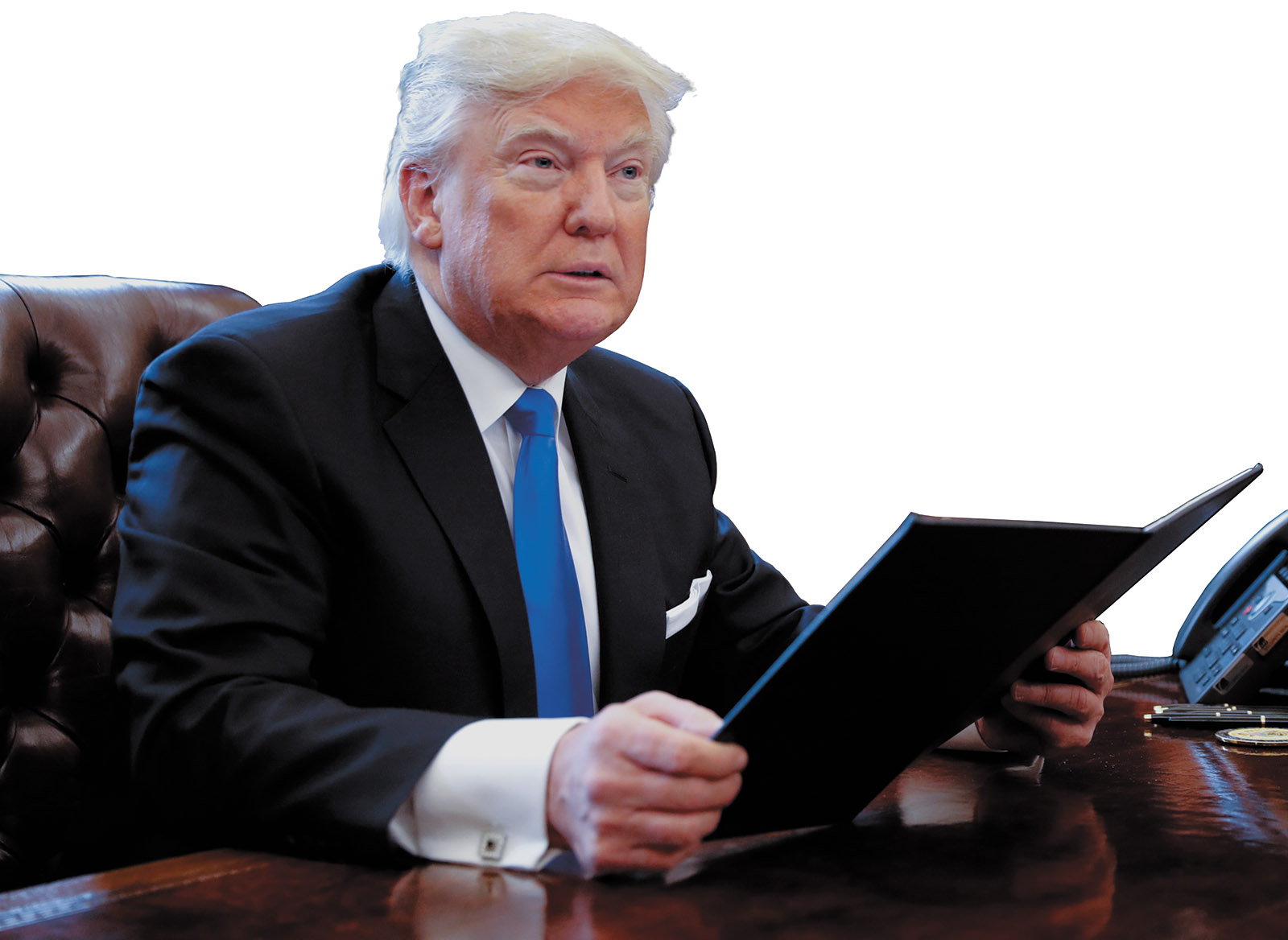
President Trump in the Oval Office, signing an executive order on oil pipelines, January 2017


Disturbingly early in the Trump administration a great many Americans didn’t know if they could believe the president of the United States. The compulsive lying by Trump and those who spoke for him threatened to undermine his ability to govern. And then there are the not-exactly-lies but Trump’s strange versions of reality that he seems to believe: such as when he insists that the sun was shining during his inaugural speech, which it wasn’t; and this is an easily checkable fact. Could we believe him in the event of an international crisis—or know if it was indeed a crisis?


The White House’s declared war on the press should be troubling to other citizens as well, as a demagoguish attempt to accrue additional presidential authority. Begun during the campaign—with Trump’s frequent incantations of “the dishonest media”—it’s gone beyond simply a matter of a tactic to discount its criticisms and is actually an effort to neutralize one of the potential checks on Trump’s freewheeling exercise of power. With Congress in the hands of the as-yet-timorous Republicans and the Supreme Court likely to be returned to the control of its conservative bloc, what’s left as a check on the president? Trump’s prime-time televised announcement of his appointment of Neil Gorsuch to the Supreme Court was moved up from later in the week to try to take people’s minds off the furor over the immigration order. Gorsuch is an originalist less bombastic than Antonin Scalia, whose seat he would fill, but possibly more conservative. He’s a hero to the Christian right, whom Trump especially wanted to please.


Another glimpse of how the Trump administration intends to use that power lies in its approach to federal workers who disagree with its policies. The most spectacular example so far is Trump’s summary firing of the acting attorney general, Sally Yates—a career prosecutor who had been asked by the Trump transition team to take the interim position—for her decision that the Justice Department wouldn’t enforce the immigration order because she wasn’t convinced it was constitutional. The White House’s disturbing statement saying that Yates had “betrayed” the Justice Department and “is weak on borders and very weak on illegal immigration” reflected the unmistakable voice of the president. After a letter to the president from State Department employees protesting the immigration order quickly gathered over one thousand signatures, Spicer, speaking at his press room podium, said that federal employees should “either get with the program or they can go.” This was completely at odds with the long tradition of toleration of dissent within the government.


Intolerance of dissent was evident almost as soon as Trump took office, in his administration’s pattern of firing or muzzling people who agree with the overwhelmingly accepted scientific consensus on climate change. Ominously, during the transition, the Energy and State Departments were ordered to make a list of employees who had so much as attended a meeting on climate change. Once the Trump administration took over, Environmental Protection Agency employees were told to take down the agency’s website page on global warming and they were put under a gag order barring them from making any public statements not in consonance with Trump’s expressed view that climate change is a hoax. Trump’s choice to head the agency, Scott Pruitt, the former attorney general of Oklahoma who is backed by mining interests, including the Koch brothers, had brought numerous suits against the EPA’s clean air and water regulations.


Similar restrictions on making public statements were placed on employees of the Departments of State, Health and Human Services, and Agriculture, some of which were rescinded after they become too controversial. Trump’s last cabinet pick, former Georgia governor Sonny Perdue, who has been in the agriculture business much of his life, has mocked climate change. The gag orders might violate the Whistleblower Protection Act and other federal rules. Ultimately, such a policy is a losing game; concerned government employees will find ways to get out information they think is critical to the national interest.


Even those of us not naturally inclined to believe the worst possibilities of a situation have had to face up to Trump’s authoritarian tendencies. One doesn’t have to assume that he sought the office in order to wield dictatorial power—it could be simply that he’s a businessman without public stockholders who’s used to having his way and is so incurious or compromised as to believe, or insist, that the world is the way he says it is. But that explanation overlooks too much that’s been right before us. And Trump has people around him who are seeking to exploit his talent for commanding the spotlight. He uses Twitter to embarrass and hurl threats at individuals and corporations and bully them into changing certain policies, thus expanding his powers beyond those commonly understood to belong to the presidency. Through his bullying, Trump has struck fear in many businesspeople.


By the end of his early days in office, despite all the turmoil over his immigration order, some of Trump’s aides told reporters that they believed that Trump and Bannon’s strategy of disruption and distraction had been successful. After all, they pointed out, in all the noise about the immigration order and in the swirl of other events as well, the controversy over Trump’s flaming and possibly unconstitutional conflicts of interest had gone away. That view assumes that no one has a memory and it overlooks the likelihood that the ethics matter will return.


In fact, Trump’s hold on power may be more tenuous than it appears. It’s not just that his hubristic dismissal of valid ethical concerns could produce a scandal at any time; he took office under the cloud of at least one investigation into possible underhanded if not illegal dealings with Russia on his part and continuing questions about the relations of some of his political associates with Putin or his associates. The ambiguity of Trump’s election victory complicates his presidency: having lost the popular vote by nearly three million, he started out as a minority president with a large mass of people feeling they’d been cheated and motivated to arise against him. This partly explains Trump’s fixation on the electoral vote and his and his associates’ insistence—incorrect—that he’d won an electoral vote “landslide.”


Trump’s possible mental deficiencies are also a troubling question: serious medical professionals suspect he has narcissistic personality disorder, and also oncoming dementia, judging from his limited vocabulary. (If one compares his earlier appearances on YouTube, for example a 1988 interview with Larry King, it appears that Trump used to speak more fluently and coherently than he does now, especially in some of his recent rambling presentations.) His perseverating about such matters as the size of his inauguration crowd, or the fantasy that three to five million illegal voters denied him a popular vote victory (he got these estimates from a dodgy source who has yet to offer documentation), or, as he told CIA employees, the number of times he’s been on the cover of Time (sometimes inflating the actual number) has become a joke, but it also suggests that there may be something troubling about his mental state. Numerous eminent psychologists and psychiatrists have written about or expressed their concerns about Trump’s mental stability.


Nearly a week after he was sworn in, according to Gallup, Trump’s net approval rating had dropped eight points—and this was before the issuance of his disastrous immigration order. The Republicans can be expected to tolerate him as long as they have reason to fear the intensity of his followers, but if the time comes when he becomes too politically costly for them to support, they’d be quite comfortable with Mike Pence as an alternative.

Sisters and Lies by Bernice Barrington,Penguin Ireland


One hot August night, Rachel Darcy gets the call everyone fears. It's the police. Her younger sister Evie's had a car crash, she's in a coma. Can Rachel fly to London right away?
With Evie injured and comatose, Rachel is left to pick up the pieces of her sister's life. But it's hard fitting them together, especially when she really doesn't like what she sees.
Why was Evie driving when she doesn't even own a licence?
Who is the man living in her flat and claiming Evie is his girlfriend?
How come she has never heard of him?
The more mysteries Rachel uncovers the more she starts asking herself how well she ever really knew her sister. And then she begins to wonder if the crash was really the accident everybody says it is.
Back in hospital, Evie, trapped inside an unresponsive body, is desperately trying to wake up. Because she's got an urgent message for Rachel - a warning which could just save both their lives . . .

Sisters and Lies follows the story of two Irish sisters Rachel and Evie. Rachel is a successful writer but Evie has had a more turbulent life and when Rachel receives a phone call to say her sister has been in a car crash in her boyfriends car and as a result is in a coma Rachel travels to London to be by her sisters bedside and is determined to get to the bottom of why her sister was driving when she doesn’t even have a license and to her knowledge doesn’t have a boyfriend! Things just don’t add up but who can Rachel trust and will Evie ever wake up from her coma?

I really liked how this book was told from Rachel’s POV as she is trying to piece together the pieces of her sisters life and also told from Evie’s POV as she is stuck in her coma unable to communicate and is reflecting back on what happened to result in her accident and also looking back on her life growing up. I loved both sisters although they didn’t seem to have a great bond they both were likeable characters although Evie did take longer for me to warm to as due past actions and way of life but as the storyline progressed and we get to know Evie through her own thoughts rather than other people’s perception I really felt for her and could see in a warped way why she did what she did.

Evie's boyfriend Donnagh was a shady character, from the moment I met him I was on guard this guy was too squeaky clean and yet he wasn't devoted to sitting around his girlfriends bed every day but I also felt like it was to obvious that he had any involvement into Evie's accident. I found I was gripped the whole way through and I loved that the author pulled the wool over my eyes with her twist, I never for a moment came close to discovering the truth. 

The storyline is fast paced and there is a flow of secrets revealed which kept me interested, waiting to see what would be revealed next to see if I could solve the mystery before Rachel.

The Evolution of Minds by Daniel C. Dennett W.W.Norton, 476 pp., $28.95


Image result for The Evolution of Minds by Daniel C. Dennett W.W.Norton, 476 pp., $28.95

For fifty years the philosopher Daniel Dennett has been engaged in a grand project of disenchantment of the human world, using science to free us from what he deems illusions—illusions that are difficult to dislodge because they are so natural. In From Bacteria to Bach and Back, his eighteenth book (thirteenth as sole author), Dennett presents a valuable and typically lucid synthesis of his worldview. Though it is supported by reams of scientific data, he acknowledges that much of what he says is conjectural rather than proven, either empirically or philosophically.

Dennett is always good company. He has a gargantuan appetite for scientific knowledge, and is one of the best people I know at transmitting it and explaining its significance, clearly and without superficiality. He writes with wit and elegance; and in this book especially, though it is frankly partisan, he tries hard to grasp and defuse the sources of resistance to his point of view. He recognizes that some of what he asks us to believe is strongly counterintuitive. I shall explain eventually why I think the overall project cannot succeed, but first let me set out the argument, which contains much that is true and insightful.

The book has a historical structure, taking us from the prebiotic world to human minds and human civilization. It relies on different forms of evolution by natural selection, both biological and cultural, as its most important method of explanation. Dennett holds fast to the assumption that we are just physical objects and that any appearance to the contrary must be accounted for in a way that is consistent with this truth. Bach’s or Picasso’s creative genius, and our conscious experience of hearing Bach’s Fourth Brandenburg Concerto or seeing Picasso’s Girl Before a Mirror, all arose by a sequence of physical events beginning with the chemical composition of the earth’s surface before the appearance of unicellular organisms. Dennett identifies two unsolved problems along this path: the origin of life at its beginning and the origin of human culture much more recently. But that is no reason not to speculate.

The task Dennett sets himself is framed by a famous distinction drawn by the philosopher Wilfrid Sellars between the “manifest image” and the “scientific image”—two ways of seeing the world we live in. According to the manifest image, Dennett writes, the world is


full of other people, plants, and animals, furniture and houses and cars…and colors and rainbows and sunsets, and voices and haircuts, and home runs and dollars, and problems and opportunities and mistakes, among many other such things. These are the myriad “things” that are easy for us to recognize, point to, love or hate, and, in many cases, manipulate or even create…. It’s the world according to us.

According to the scientific image, on the other hand, the world


is populated with molecules, atoms, electrons, gravity, quarks, and who knows what else (dark energy, strings? branes?).

This, according to Dennett, is the world as it is in itself, not just for us, and the task is to explain scientifically how the world of molecules has come to include creatures like us, complex physical objects to whom everything, including they themselves, appears so different.

He greatly extends Sellars’s point by observing that the concept of the manifest image can be generalized to apply not only to humans but to all other living beings, all the way down to bacteria. All organisms have biological sensors and physical reactions that allow them to detect and respond appropriately only to certain features of their environment—“affordances,” Dennett calls them—that are nourishing, noxious, safe, dangerous, sources of energy or reproductive possibility, potential predators or prey.

For each type of organism, whether plant or animal, these are the things that define their world, that are salient and important for them; they can ignore the rest. Whatever the underlying physiological mechanisms, the content of the manifest image reveals itself in what the organisms do and how they react to their environment; it need not imply that the organisms are consciously aware of their surroundings. But in its earliest forms, it is the first step on the route to awareness.

The lengthy process of evolution that generates these results is first biological and then, in our case, cultural, and only at the very end is it guided partly by intelligent design, made possible by the unique capacities of the human mind and human civilization. But as Dennett says, the biosphere is saturated with design from the beginning—everything from the genetic code embodied in DNA to the metabolism of unicellular organisms to the operation of the human visual system—design that is not the product of intention and that does not depend on understanding.

One of Dennett’s most important claims is that most of what we and our fellow organisms do to stay alive, cope with the world and one another, and reproduce is not understood by us or them. It is competence without comprehension. This is obviously true of organisms like bacteria and trees that have no comprehension at all, but it is equally true of creatures like us who comprehend a good deal. Most of what we do, and what our bodies do—digest a meal, move certain muscles to grasp a doorknob, or convert the impact of sound waves on our eardrums into meaningful sentences—is done for reasons that are not our reasons. Rather, they are what Dennett calls free-floating reasons, grounded in the pressures of natural selection that caused these behaviors and processes to become part of our repertoire. There are reasons why these patterns have emerged and survived, but we don’t know those reasons, and we don’t have to know them to display the competencies that allow us to function.


Nor do we have to understand the mechanisms that underlie those competencies. In an illuminating metaphor, Dennett asserts that the manifest image that depicts the world in which we live our everyday lives is composed of a set of user-illusions,


like the ingenious user-illusion of click-and-drag icons, little tan folders into which files may be dropped, and the rest of the ever more familiar items on your computer’s desktop. What is actually going on behind the desktop is mind-numbingly complicated, but users don’t need to know about it, so intelligent interface designers have simplified the affordances, making them particularly salient for human eyes, and adding sound effects to help direct attention. Nothing compact and salient inside the computer corresponds to that little tan file-folder on the desktop screen.

He says that the manifest image of each species is “a user-illusion brilliantly designed by evolution to fit the needs of its users.” In spite of the word “illusion” he doesn’t wish simply to deny the reality of the things that compose the manifest image; the things we see and hear and interact with are “not mere fictions but different versions of what actually exists: real patterns.” The underlying reality, however, what exists in itself and not just for us or for other creatures, is accurately represented only by the scientific image—ultimately in the language of physics, chemistry, molecular biology, and neurophysiology.

Our user-illusions were not, like the little icons on the desktop screen, created by an intelligent interface designer. Nearly all of them—such as our images of people, their faces, voices, and actions, the perception of some things as delicious or comfortable and others as disgusting or dangerous—are the products of “bottom-up” design, understandable through the theory of evolution by natural selection, rather than “top-down” design by an intelligent being. Darwin, in what Dennett calls a “strange inversion of reasoning,” showed us how to resist the intuitive tendency always to explain competence and design by intelligence, and how to replace it with explanation by natural selection, a mindless process of accidental variation, replication, and differential survival.

As for the underlying mechanisms, we now have a general idea of how they might work because of another strange inversion of reasoning, due to Alan Turing, the creator of the computer, who saw how a mindless machine could do arithmetic perfectly without knowing what it was doing. This can be applied to all kinds of calculation and procedural control, in natural as well as in artificial systems, so that their competence does not depend on comprehension. Dennett’s claim is that when we put these two insights together, we see that


all the brilliance and comprehension in the world arises ultimately out of uncomprehending competences compounded over time into ever more competent—and hence comprehending—systems. This is indeed a strange inversion, overthrowing the pre-Darwinian mind-first vision of Creation with a mind-last vision of the eventual evolution of us, intelligent designers at long last.

And he adds:


Turing himself is one of the twigs on the Tree of Life, and his artifacts, concrete and abstract, are indirectly products of the blind Darwinian processes in the same way spider webs and beaver dams are….

An essential, culminating stage of this process is cultural evolution, much of which, Dennett believes, is as uncomprehending as biological evolution. He quotes Peter Godfrey-Smith’s definition, from which it is clear that the concept of evolution can apply more widely:


Evolution by natural selection is change in a population due to (i) variation in the characteristics of members of the population, (ii) which causes different rates of reproduction, and (iii) which is heritable.

In the biological case, variation is caused by mutations in DNA, and it is heritable through reproduction, sexual or otherwise. But the same pattern applies to variation in behavior that is not genetically caused, and that is heritable only in the sense that other members of the population can copy it, whether it be a game, a word, a superstition, or a mode of dress.

This is the territory of what Richard Dawkins memorably christened “memes,” and Dennett shows that the concept is genuinely useful in describing the formation and evolution of culture. He defines “memes” thus:


They are a kind of way of behaving (roughly) that can be copied, transmitted, remembered, taught, shunned, denounced, brandished, ridiculed, parodied, censored, hallowed.

They include such things as the meme for wearing your baseball cap backward or for building an arch of a certain shape; but the best examples of memes are words. A word, like a virus, needs a host to reproduce, and it will survive only if it is eventually transmitted to other hosts, people who learn it by imitation:


Like a virus, it is designed (by evolution, mainly) to provoke and enhance its own replication, and every token it generates is one of its offspring. The set of tokens descended from an ancestor token form a type, which is thus like a species.

The distinction between type and token comes from the philosophy of language: the word “tomato” is a type, of which any individual utterance or inscription or occurrence in thought is a token. The different tokens may be physically very different—you say “tomayto,” I say “tomahto”—but what unites them is the perceptual capacity of different speakers to recognize them all as instances of the type. That is why people speaking the same language with different accents, or typing with different fonts, can understand each other.

A child picks up its native language without any comprehension of how it works. Dennett believes, plausibly, that language must have originated in an equally unplanned way, perhaps initially by the spontaneous attachment of sounds to prelinguistic thoughts. (And not only sounds but gestures: as Dennett observes, we find it very difficult to talk without moving our hands, an indication that the earliest language may have been partly nonvocal.) Eventually such memes coalesced to form languages as we know them, intricate structures with vast expressive capacity, shared by substantial populations.

Language permits us to transcend space and time by communicating about what is not present, to accumulate shared bodies of knowledge, and with writing to store them outside of individual minds, resulting in the vast body of collective knowledge and practice dispersed among many minds that constitutes civilization. Language also enables us to turn our attention to our own thoughts and develop them deliberately in the kind of top-down creativity characteristic of science, art, technology, and institutional design.

But such top-down research and development is possible only on a deep foundation of competence whose development was largely bottom-up, the result of cultural evolution by natural selection. Without denigrating the contributions of individual genius, Dennett urges us not to forget its indispensable precondition, the arms race over millennia of competing memes—exemplified by the essentially unplanned evolution, survival, and extinction of languages.

Of course the biological evolution of the human brain made all of this possible, together with some coevolution of brain and culture over the past 50,000 years, but at this point we can only speculate about what happened. Dennett cites recent research in support of the view that brain architecture is the product of bottom-up competition and coalition-formation among neurons—partly in response to the invasion of memes. But whatever the details, if Dennett is right that we are physical objects, it follows that all the capacities for understanding, all the values, perceptions, and thoughts that present us with the manifest image and allow us to form the scientific image, have their real existence as systems of representation in the central nervous system.

This brings us to the question of consciousness, on which Dennett holds a distinctive and openly paradoxical position. Our manifest image of the world and ourselves includes as a prominent part not only the physical body and central nervous system but our own consciousness with its elaborate features—sensory, emotional, and cognitive—as well as the consciousness of other humans and many nonhuman species. In keeping with his general view of the manifest image, Dennett holds that consciousness is not part of reality in the way the brain is. Rather, it is a particularly salient and convincing user-illusion, an illusion that is indispensable in our dealings with one another and in monitoring and managing ourselves, but an illusion nonetheless.

You may well ask how consciousness can be an illusion, since every illusion is itself a conscious experience—an appearance that doesn’t correspond to reality. So it cannot appear to me that I am conscious though I am not: as Descartes famously observed, the reality of my own consciousness is the one thing I cannot be deluded about. The way Dennett avoids this apparent contradiction takes us to the heart of his position, which is to deny the authority of the first-person perspective with regard to consciousness and the mind generally.

The view is so unnatural that it is hard to convey, but it has something in common with the behaviorism that was prevalent in psychology at the middle of the last century. Dennett believes that our conception of conscious creatures with subjective inner lives—which are not describable merely in physical terms—is a useful fiction that allows us to predict how those creatures will behave and to interact with them. He has coined the term “heterophenomenology” to describe the (strictly false) attribution each of us makes to others of an inner mental theater—full of sensory experiences of colors, shapes, tastes, sounds, images of furniture, landscapes, and so forth—that contains their representation of the world.

According to Dennett, however, the reality is that the representations that underlie human behavior are found in neural structures of which we know very little. And the same is true of the similar conception we have of our own minds. That conception does not capture an inner reality, but has arisen as a consequence of our need to communicate to others in rough and graspable fashion our various competencies and dispositions (and also, sometimes, to conceal them):


Curiously, then, our first-person point of view of our own minds is not so different from our second-person point of view of others’ minds: we don’t see, or hear, or feel, the complicated neural machinery churning away in our brains but have to settle for an interpreted, digested version, a user-illusion that is so familiar to us that we take it not just for reality but also for the most indubitable and intimately known reality of all.

The trouble is that Dennett concludes not only that there is much more behind our behavioral competencies than is revealed to the first-person point of view—which is certainly true—but that nothing whatever is revealed to the first-person point of view but a “version” of the neural machinery. In other words, when I look at the American flag, it may seem to me that there are red stripes in my subjective visual field, but that is an illusion: the only reality, of which this is “an interpreted, digested version,” is that a physical process I can’t describe is going on in my visual cortex.

I am reminded of the Marx Brothers line: “Who are you going to believe, me or your lying eyes?” Dennett asks us to turn our backs on what is glaringly obvious—that in consciousness we are immediately aware of real subjective experiences of color, flavor, sound, touch, etc. that cannot be fully described in neural terms even though they have a neural cause (or perhaps have neural as well as experiential aspects). And he asks us to do this because the reality of such phenomena is incompatible with the scientific materialism that in his view sets the outer bounds of reality. He is, in Aristotle’s words, “maintaining a thesis at all costs.”

If I understand him, this requires us to interpret ourselves behavioristically: when it seems to me that I have a subjective conscious experience, that experience is just a belief, manifested in what I am inclined to say. According to Dennett, the red stripes that appear in my visual field when I look at the flag are just the “intentional object” of such a belief, as Santa Claus is the intentional object of a child’s belief in Santa Claus. Neither of them is real. Recall that even trees and bacteria have a manifest image, which is to be understood through their outward behavior. The same, it turns out, is true of us: the manifest image is not an image after all.

There is no reason to go through such mental contortions in the name of science. The spectacular progress of the physical sciences since the seventeenth century was made possible by the exclusion of the mental from their purview. To say that there is more to reality than physics can account for is not a piece of mysticism: it is an acknowledgment that we are nowhere near a theory of everything, and that science will have to expand to accommodate facts of a kind fundamentally different from those that physics is designed to explain. It should not disturb us that this may have radical consequences, especially for Dennett’s favorite natural science, biology: the theory of evolution, which in its current form is a purely physical theory, may have to incorporate nonphysical factors to account for consciousness, if consciousness is not, as he thinks, an illusion. Materialism remains a widespread view, but science does not progress by tailoring the data to fit a prevailing theory.

There is much in the book that I haven’t discussed, about education, information theory, prebiotic chemistry, the analysis of meaning, the psychological role of probability, the classification of types of minds, and artificial intelligence. Dennett’s reflections on the history and prospects of artificial intelligence and how we should manage its development and our relation to it are informative and wise. He concludes:


The real danger, I think, is not that machines more intelligent than we are will usurp our role as captains of our destinies, but that we will over-estimate the comprehension of our latest thinking tools, prematurely ceding authority to them far beyond their competence….


We should hope that new cognitive prostheses will continue to be designed to be parasitic, to be tools, not collaborators. Their only “innate” goal, set up by their creators, should be to respond, constructively and transparently, to the demands of the user.

About the true nature of the human mind, Dennett is on one side of an old argument that goes back to Descartes. He pays tribute to Descartes, citing the power of what he calls “Cartesian gravity,” the pull of the first-person point of view; and he calls the allegedly illusory realm of consciousness the “Cartesian Theater.” The argument will no doubt go on for a long time, and the only way to advance understanding is for the participants to develop and defend their rival conceptions as fully as possible—as Dennett has done. Even those who find the overall view unbelievable will find much to interest them in this book.