Showing posts with label Foundation. Show all posts

Wednesday, August 23, 2017

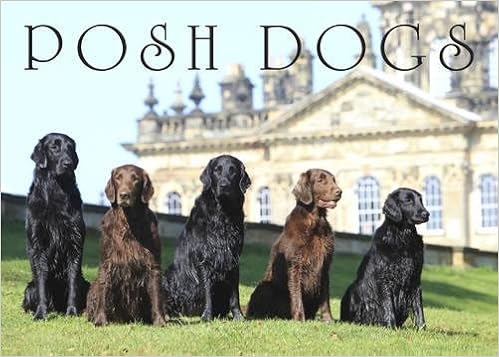
Posh Dogs Nov 1, 2016 by Pimpernel Press Hardcover (Pimpernel Press)


Dogs have been at the heart of Country Life magazine ever since it was first published in 1897. The very first issue on January 8 featured the Princess of Wales with her borzoi, Alex. The second issue, a week later, went behind the scenes of the Prince of Wales's kennels. Since then every type, from working dogs to pampered pets and champion pedigrees to mixed breeds have been included. There is no doubt that dogs, whatever shape or size, are at the heart of British country life. Posh Dogs features a selection of canines that have graced the pages of Country Life magazine from those early years to the present day. They have been chosen to select different facets of country life and whether 'upstairs' and 'downstairs' they are all equal in their owner's eyes. Posh Dogs celebrates dogs in their element amidst the timeless beauty of the British countryside. The dogs of Downton Abbey garnered as many fans as the cast. The dogs featured in Posh Dogs are the real life incarnations of the Earl of Grantham's beloved labrador and all the other dogs of Downton. This is a must-have gift book for all dog lovers.

Great Britains Poshest Dogs 


Clockwise from left Bramble, a springer spaniel; Teasle, a lurcher; Beetle, a Norfolk terrier; and Bertie, an Italian greyhound, all pictured at The Lanesbrough Hotel CREDIT:BRIAN MOODY

Ever since the first issue of Country Life featured the borzoi belonging to the Princess of Wales in January 1897, dogs have been an intrinsic part of the magazine. A selection of the most photogenic are featured in the book Posh Dogs, which ‘celebrates dogs in their element amidst the timeless beauty of the British countryside’.

Meticulously presented and privately educated, the dogs in this line-up exhibit the character and decorum one would expect from the pages of Country Life. There are some new-fangled types here – a labradoodle (labrador and poodle cross), a spanador (spaniel-labrador cross) and a puggle (God help us) – but on the whole these dogs spring from classic English stock with good breeding and noble heritage: no riff-raff.

Spaniels, lurchers, whippets and setters, Newfoundlands and terriers are seen going about their daily rural business, engaging in a variety of activities such as hunting, destroying furniture and looking at art. It’s not all work though: some of the dogs are seen here on a minibreak: relaxing at The Lanesborough.


CREDIT: JEROME MURRAY


1. Lucy, a Jack Russell whom Lucian Freud proclaimed had ‘a beautiful brow’

C


2. Mary, a terrier puppy, with Mini Hog, an African albino hedgehog.


3. A Dandie Dinmont terrier


4. Nina (a Sheltie), Domino (a dalmation) and Mopsie (a pug) contemplate their ancestors as they look at paintings at Christie's auction house


6. A dog sits outside next to fishing rods and a pram at Fingask Castle


7. A dog sits on a wall in the village of Bisley


8. Puddles the duck and Jessie the doberman

Friday, May 19, 2017

Where Poppies Blow John Lewis-Stempel (Weidenfeld & Nicolson, £20)


Where Poppies Blow

Clive Aslet
November 9, 2016
10shares


Clive Aslet enjoys this moving account of how First World War soldiers found hope through their connection with Nature.


There have been so many books on the First World War since the centenary started that one would have thought the subject was published out. Not so. Where Poppies Blow makes an important contribution to the literature by studying the British soldiers’ relationship with Nature. Today, most ordinary people don’t know much about farming, landscape, the horse or wildlife in all its forms. That wasn’t the case in 1914.

The poet Edward Thomas may have been born in Lambeth, but he was one of many who identified with, in John Lewis-Stempel’s words, King and Countryside. Their life in the trenches of the Western Front— muddy, primitive, rat-infested—reduced them to a condition little different from wild animals. We know the horror, but there could be moments of wonder in it, too.

This book provides a different vantage point from that of the recognised War Poets, whose attitudes weren’t always those of their generation as a whole. It’s written from the letters, diaries and memoirs of a wide range of participants, generally unknown to history, and interspersed with amateur verse. There is rage, of course—particularly at the fate of horses.

‘Oh! My beloved animals,’ cried Sir Edward Elgar of the Hampstead Volunteer Reserve in 1916 and his sentiment was echoed on the battlefield by the driver who fell to his knees when the horse pulling his ammunition wagon was killed; all he could say in response to the Brigadier’s ‘Never mind, sonny’ was ‘Bloody Germans’. Maj-Gen Jack Seely recalled that ‘one of the finest things about the English soldier of the front line was his invariable kindness and, indeed, gentleness at all times to the horses’.

Skylarks sang above the downland of the Somme. This was just one of the species that Capt Patrick Chubb, writing for British Birds, found unaffected by shellfire. Others were the house sparrow, swallow, house martin, chaffinch, yellowhammer, willow wren, magpie, kestrel and wood pigeon. The birders of those days were an unsentimental breed, who thought nothing of shooting birds to identify them (one officer carried a small-bore shotgun disguised as a walking stick for the purpose) or collecting their eggs.

The birds sometimes thrived in battlefield conditions. Unburied corpses fed carrion-eaters and generated huge numbers of flies: Ford Madox Ford describes the hero of Parade’s End being mobbed by swallows when he walks through waist-high thistles ‘after a famous victory’.

A book that the author doesn’t mention is Observations and Reflections on Wild Creatures (1923), written by G. T .K. Maurice from his experiences on the Salonika front; it reveals that a vulture, although unable to penetrate a uniform, can pick the skeleton inside it clean by penetrating the body cavity via the thorax. Evolution made them bald for a reason.

Animals could be eaten, hunted or adopted as pets. Omnipresent lice made less welcome companions, but other insects attracted study: two ‘Ants from the Front’ were exhibited at the South London Entomological Society in February 1915. Even the Western Front had its quiet spots, one corporal being fed up with the ‘thousands of frogs’ around Ruminghem, whose ‘croaking noise… is just awful’.

In the least promising conditions, men showed their faith in the future by planting gardens. This moving, strangely life-affirming book describes how the poppy became the symbol of the war, its meaning reinforced by numerous cultural memories. We now know that its seeds remain viable for many decades. Could any of the poppies that bloom next spring have grown from seeds shed during the conflict?

Tuesday, April 18, 2017

Yom Hashoah 2017 ( Holocaust Memorial day) is on Sunday 23rd .... Best Books on the Holocaust recently published My Grandfather Would Have Shot Me: A Black Woman Discovers Her Family’s Nazi Past (The Experiment, 2015) by Jennifer Teege and Nikola Sellmair;They Were Like Family to Me: Stories (Scribner, 2016) Helen Maryles Shankman; The Archive Thief: The Man Who Salvaged French Jewish History in the Wake of the Holocaust (Oxford University Press, 2015) by Lisa Moses Leff,;The Crime and the Silence: Confronting the Massacre of Jews in Wartime Jedwabne (Farrar, Straus and Giroux, 2015) By Anna Bikont

The 7 Best New Books About the Holocaust, as Recommended by Scholars
The seven best include an examination of theories trying to explain the Holocaust and a look at how Hitler saw Islam as a religion that could be exploited for anti-Semitic purposes

From Anne Frank’s diary to Elie Wiesel’s “Night,” books about the Holocaust remain some of the most powerful and well-known pieces of literature published in the past century. Books have the power to educate about the Shoah’s unimaginable horrors and bring to life the stories of its victims, as well as unearth hidden details about wartime crimes.

Ahead of Yom Hashoah, Holocaust Memorial Day, JTA reached out to Jewish studies scholars across the country seeking their recommendations on recently published books dealing with the Holocaust. Their picks, all published in the past three years, include an investigation into the 1941 massacre of Jews in the Polish town of Jedwabne (two scholars recommended the same book on that topic), a critical examination of theories trying to explain the Holocaust and a look at how Adolf Hitler saw Islam as a religion that could be exploited for anti-Semitic purposes.

The Crime and the Silence: Confronting the Massacre of Jews in Wartime Jedwabne (Farrar, Straus and Giroux, 2015) By Anna Bikont

This book, a winner of the 2015 National Jewish Book Award, was written by a Polish journalist who discovered she was Jewish in her 30s and became deeply engaged in the topic of Polish-Jewish relations. After Jan T. Gross’ controversial book “Neighbors: the Destruction of the Jewish Community in Jedwabne, Poland” (2000) proved that the local Poles — not the Germans — committed the massive pogrom in that town in July 1941, Bikont went to Jedwabne and its surroundings, interviewing eyewitnesses to the crime in the years 2000 to 2003, shedding new light on the character of the perpetrators, bystanders and the intricate way the crime was concealed for 50 years after the Holocaust. It is written in the form of a journal of the author’s travels and conversations with people.

I first read about the Jedwabne massacre in Gross’ book and still remember being riveted by the cover image of a barn engulfed in flames. Perhaps because my paternal grandfather was from Łomża, Poland — a city relatively near Jedwabne — I felt a particular connection to this atrocity, as well as gratitude to him for leaving the country years before the Holocaust. I directed Tadeusz Słobodzianek’s “Our Class,” a play loosely based on the events in Jedwabne, at Tufts in 2012, and remain fascinated by this story of greed, treachery and cruelty, a horrific crime in which as many as 1,600 Jewish men, women and children perished. Bikont’s magnificent work of investigative journalism details her meticulous reconstruction of the massacre and its subsequent decades-long coverup. It is a sobering and compelling account of anti-Semitism, denial and isolated acts of heroism.

The Archive Thief: The Man Who Salvaged French Jewish History in the Wake of the Holocaust (Oxford University Press, 2015) by Lisa Moses Leff

This award-winning book recounts the amazing story of Zosa Szajkowski, the scholar who rescued archives that might otherwise have been lost in the Holocaust. Szajkowski wrote numerous books and articles, but was also a known archive thief, caught red handed stealing valuable papers from the New York Public Library. Leff’s meticulous account reads like a thriller, yet conveys invaluable information concerning the fate of Jewish archives during and after the Shoah, and why removal of archives from their original home matters. Brandeis University and my late father, Bible scholar Nahum Sarna, play bit parts in this story. I remember Szajkowski, too; in fact, I took a class with him as a Brandeis undergraduate. He told lots of stories in class about his archival experiences during and after World War II, but it was only after reading Leff’s wonderful book that I understood “the rest of the story.”

Why? Explaining the Holocaust (W.W. Norton & Company, 2017) By Peter Hayes

I recommend this book for a lucid, well-crafted introduction to the history of the Holocaust. Unlike most works on the Holocaust written for a general audience, which tend to emphasize how the Holocaust was carried out and experienced, Hayes’ book concentrates, as its title suggests, on helping readers to understand why the Holocaust occurred when it did, where it did, in the manner it did and with the results it produced. It offers readers a window onto how historians go about finding answers to these questions, why some answers turn out to be more compelling than others and how new evidence can change understanding.

Probing the Ethics of Holocaust Culture (Harvard University Press, 2016) Edited by Claudio Fogu, Wulf Kansteiner and Todd Presner


This book comes out a quarter of a century after the publication of Saul Friedlander’s crucial edited volume, “Probing the Limits of Representation: Nazism and the Final Solution” (1992), which had challenged the conventional discourse on the mass murder of the Jews and critiqued its popular representation. The current volume attempts to grapple with the wider impact of Holocaust scholarship, fiction and representation in the intervening period. It includes fascinating essays on new modes of narrating the Shoah, the insights provided by the “spatial turn” on research and understanding of the event and the politics of exceptionality, especially the contextualization of the Holocaust within the larger framework of modern genocide. As such, it enables readers to understand both the ongoing presence of the Holocaust in our present culture and the different ways in which it has come to be understood in the early 21st century.

Islam and Nazi Germany’s War (Belknap Press, 2014) By David Motadel

This is a major work of scholarship, examining the various ways the Nazis fostered a relationship with Muslims both before the war and especially during the war. Jeffrey Herf wrote a book a bit earlier, “Nazi Propaganda for the Arab World,” detailing Nazi anti-Semitic propaganda sent, in Arabic translation, to North African Muslims, and Motadel expands the range of influence: that Hitler understood Islam as a warrior religion that could be exploited for propaganda efforts and to serve in both the Wehrmacht and the SS. The indoctrination of Muslims with Nazi anti-Semitic propaganda may well have had effects lasting long past the end of the war, a topic that deserves additional attention.

My Grandfather Would Have Shot Me: A Black Woman Discovers Her Family’s Nazi Past (The Experiment, 2015) by Jennifer Teege and Nikola Sellmair

Teege’s memoir, published in German in 2013 and translated into English in 2015, is a fascinating contribution to the discussion of the ongoing impact of the Holocaust over multiple generations. When she was in her late 30s, Teege discovered that her grandfather was a Nazi war criminal. And not just any Nazi: he was Amon Goeth, the commandant of Plaszów depicted in the film “Schindler’s List.” Because Teege is herself a black German woman — the daughter of a Nigerian father and a white German mother who was herself the daughter of Goeth’s mistress — her story takes on additional resonance. Intercut with contextualizing passages by Sellmair, a journalist, Teege’s memoir both confronts historical conundrums about race, reconciliation and responsibility for the past, and offers glimpses of very contemporary questions about the contours of German identity. Her earnest reckoning with family and national history can inspire us all to reflect on what it means to be implicated in histories of racial violence, even those we have not participated in directly.

They Were Like Family to Me: Stories (Scribner, 2016)  Helen Maryles Shankman

Writing literature about the Holocaust is many things, but it is never easy; and writing Holocaust literature in the vein of magic realism is more difficult yet. It risks taking the great horror of the 20th century and rendering it ungrounded, imaginative, even — God forbid — whimsically slight. But when a skillful writer pulls it off — David Grossman, for example, and now Shankman — the fantastic casts illuminating and terrible light on the dark shadows of the history of the war against the Jews. The stories in her collection are by no means factual in all respects. But they contain unmistakable truth