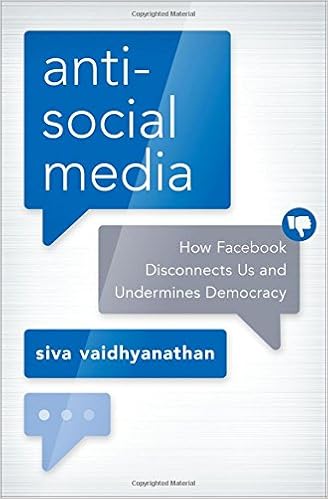
A highly readable, obviously relevant, critical examination of the deleterious effects Facebook has had on our lives, social structures, polis, and culture. This is a scholarly book (which is a good thing), so, Vaidhyanathan draws connection to Neil Postman's work as well as other media and communication scholars. But as scholarly and informed as the book is, Vaidhyanathan does not mince words when exposing the Facebook effects. He also broadens the discussion under Postman's technopoly framework where social issues are depoliticized and treated as technical issues. Alas, there is no salvation by algorithm (which we should know by now since there is already substantial literature on this). So, yes, this is a pretty pessimistic account Facebook cannot be "reformed" and its founder still gets it wrong. In the end, Vaidhyanathan offers a few prescriptions that might have a better chance of happening outside the US, considering our current political climate, in part generated and amplified by Facebook.
If you wanted to build a machine that would distribute propaganda to millions of people, distract them from important issues, energize hatred and bigotry, erode social trust, undermine respectable journalism, foster doubts about science, and engage in massive surveillance all at once, you would make something a lot like Facebook. Of course, none of that was part of the plan.
In Antisocial Media, Siva Vaidhyanathan explains how Facebook devolved from an innocent social site hacked together by Harvard students into a force that, while it may make personal life just a little more pleasurable, makes democracy a lot more challenging. It's an account of the hubris of good intentions, a missionary spirit, and an ideology that sees computer code as the universal solvent for all human problems. And it's an indictment of how "social media" has fostered the deterioration of democratic culture around the world, from facilitating Russian meddling in support of Trump's election to the exploitation of the platform by murderous authoritarians in Burma and the Philippines.
Facebook grew out of an ideological commitment to data-driven decision making and logical thinking. Its culture is explicitly tolerant of difference and dissent. Both its market orientation and its labor force are global. It preaches the power of connectivity to change lives for the better. Indeed, no company better represents the dream of a fully connected planet "sharing" words, ideas, and images, and no company has better leveraged those ideas into wealth and influence. Yet no company has contributed more to the global collapse of basic tenets of deliberation and democracy. Both authoritative and trenchant, Antisocial Media shows how Facebook's mission went so wrong.
With this book and others (I'm thinking Weapons of Math Destruction: How Big Data Increases Inequality and Threatens Democracy by Cathy O'Neil or Twitter and Tear Gas: The Power and Fragility of Networked Protest by Zeynep Tufekci), we are definitely leaving the era of utopian pronouncements on information wanting to be free and disruptive innovation and entering a bleaker (but more realistic) era of social media scholarship.

No comments:
Post a Comment