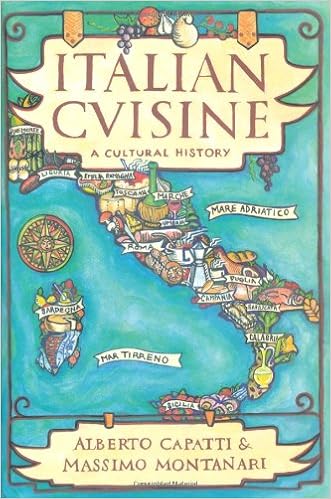
The latest volume in the Art and Traditions of the Table series focuses on the cultural history of Italian cooking. With an authoritative command of the subject, Capatti and Montanari trace the changing vocabulary of Italy's earliest cookbooks from classical Latin to vernacular Italian, showing how this shift reflected the increasing significance of passing culinary skill from one generation to the next. Bit by bit, Italian cookbook writers also eliminated Gallicisms from their vocabulary to express the uniqueness of Italian cooking. Pleasures of the table then, as today, related to images of health and well being, the north favoring voluptuous fatness, the south tending to ascetic thinness. The authors limn the decline of the servant class and the gradual shift to femininity in the Italian kitchen. Contrary to contemporary emphases on Italian cookery as an agglomeration of microcuisines, Capatti and Montanari stress its unity across the nation. This relentlessly academic work has an impressive bibliography of historic Italian sources
Italy, the country with a hundred cities and a thousand bell towers, is also the country with a hundred cuisines and a thousand recipes. Its great variety of culinary practices reflects a history long dominated by regionalism and political division, and has led to the common conception of Italian food as a mosaic of regional customs rather than a single tradition. Nonetheless, this magnificent new book demonstrates the development of a distinctive, unified culinary tradition throughout the Italian peninsula.
Alberto Capatti and Massimo Montanari uncover a network of culinary customs, food lore, and cooking practices, dating back as far as the Middle Ages, that are identifiably Italian:
o Italians used forks 300 years before other Europeans, possibly because they were needed to handle pasta, which is slippery and dangerously hot.
o Italians invented the practice of chilling drinks and may have invented ice cream.
o Italian culinary practice influenced the rest of Europe to place more emphasis on vegetables and less on meat.
o Salad was a distinctive aspect of the Italian meal as early as the sixteenth century.
The authors focus on culinary developments in the late medieval, Renaissance, and Baroque eras, aided by a wealth of cookbooks produced throughout the early modern period. They show how Italy's culinary identities emerged over the course of the centuries through an exchange of information and techniques among geographical regions and social classes. Though temporally, spatially, and socially diverse, these cuisines refer to a common experience that can be described as Italian. Thematically organized around key issues in culinary history and beautifully illustrated, Italian Cuisine is a rich history of the ingredients, dishes, techniques, and social customs behind the Italian food we know and love today.

No comments:
Post a Comment