Showing posts with label children's Books. Show all posts

Thursday, September 29, 2016

Roald Dahl, Chartlie and the Chocolate Works, Black and White Publishing

Roald Dahl gets 'mair serious' Scots translation

Translator says Chairlie and the Chocolate Works, published to mark the writer’s centenary, avoids some of ‘the honkin and hackit and mingin stuff’
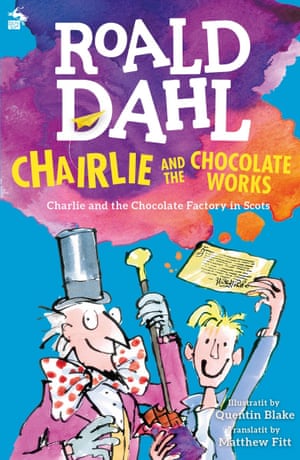
 Cover of Chairlie and the Chocolate Works.
Detail from the cover of Chairlie and the Chocolate Works.
 ‘Honkin and terrible things’ … detail from the cover of Chairlie and the Chocolate Works. 

After much deliberation from translator Matthew Fitt, the Oompa-Loompas have become the Heedrum-Hodrums in the latest in a series of Scots translations of Roald Dahl’s books, Charlie and the Chocolate Factory.

Dahl’s classic 1964 children’s story is renamed Chairlie and the Chocolate Works in Fitt’s translation, published to mark the centenary of the author’s birth. Telling the story of Mr Wullie Wonka’s invitation of five children into his chocolate factory – “Has Violet Boakregarde bitten aff mair than she can chaw? Will Mike Teeveeheid finally end up on TV? Will Chairlie go up and oot in Wullie Wonka’s Muckle Gless Lift?” – it follows in the footsteps of Black & White Publishing’s Scots translation of The BFG, renamed The Guid Freendly Giant, which was released earlier this year.

Novelist and poet Fitt, who has translated Dahl’s The Twits (The Eejits) and George’s Marvellous Medicine (Geordie’s Mingin Medicine) in the past, said at a Scottish Book Trust event in September that coming up with a Scots equivalent for the Oompa-Loompas had been one of the most challenging elements in his latest translation.

“I took ages trying to get one for that,” he said. “You think a oompa, well it’s kinda got a oompa, it’s a kinda trombone sound, oompa, oompa, stick it your joompa feel to it, there’s a musical element. And I was thinking, well how dae ye, ye dae wi this? And I had lots of ideas. I remembered there’s a great word for old-fashioned Scottish music … which is Heedrum-Hodrum and so once I’d settled on that, that was it.”

Charlie and the Chocolate Factory, he said, was one of the more serious of Dahl’s novels. “Although it’s funny, and it’s honkin and terrible things happen to the bairns in the story, the spoilt bairns, it seems to be a much mair serious, one of the mair serious Roald Dahl stories. Because the story begins in poverty and Chairlie and his grandfaither … are jist aboot dying o starvation and he looks longingly at this chocolate factory and wins this gowden ticket,” Fitt said. “I think that there is a much mair sophisticated development of the relationship between Wullie Wonka and who he is, as a person. And daeing that in Scots was great because it didnae aw have to be the honkin and hackit and mingin stuff, you could tell some o the mair serious parts of life.”

But taking on any translation of Dahl was, he admitted, “a bit worrying to start with”, particularly with the plethora of words the author made up.

Fitt said he hoped Dahl would have appreciated his efforts. “He would, a wid hope. Quentin Blake, the illustrator of Roald Dahl’s books, he got a copy of one of the translations I did a wee while ago …. I think it was The Eejits, and he keeps it on his mantelpiece in his studio in London. [He says] that’s his favourite edition of any of the Roald Dahl books that he’s worked on, which was brilliant for us, but it’s also great for the Scots language to hear that folk ootside Scotland think it’s great and think it’s valuable.”


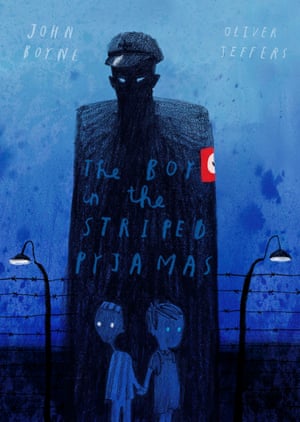
A Child of Books is published by Walker Books. The illustrated edition of John Boyne’s The Boy in the Striped Pyjamas will be published 6 October by Penguin Random House.

A Child of Books is published by Walker Books. The illustrated edition of John Boyne’s The Boy in the Striped Pyjamas will be published 6 October by Penguin Random House.

Oliver Jeffers: 'I was always an artist' – but not a child of books


The title of the children’s illustrator’s latest volume, A Child of Books, does not apply to the artist himself, who says his career was ‘very much an accident’
Oliver Jeffers Photograph: John Messinger
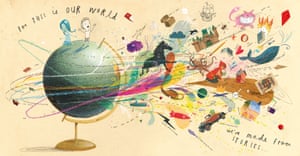
Oliver Jeffers’s latest book is called A Child of Books. The illustrator and writer’s collaboration with fellow artist and typographer Sam Winston follows a young girl who makes a world for herself – and a young boy she meets – out of stories.

So I ask him: was he a child of books? No, he tells me in his sunny, clean Brooklyn studio, with hints of both embarrassment and pride in his voice: “I was much more interested in going out in the street and playing and kind of getting into mischief.”

Jeffers attributes this taste for mischief to his upbringing in Belfast; born in Australia, he was later raised in Northern Ireland with a healthy disrespect for authority. Any discipline he had was always devoted to his drawing. “I think I was always an artist,” he says.

FacebookTwitterPinterest From A Child of Books, by Oliver Jeffers and Sam Winston (Walker Books). Photograph: Walker Books

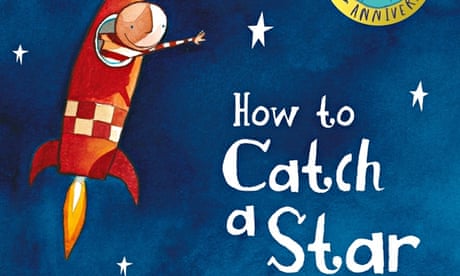
The world agreed from the beginning: How to Catch a Star, his first book, was published in 2004 to floods of acclaim, sales, and awards nominations. The Incredible Book Eating Boy, published in 2006, went on to win the Irish children’s book award. He has worked steadily on children’s books ever since; the tale of a boy and his penguin in Lost and Found, the touching story of loss in The Heart in the Bottle, the charming story of workplace protest The Day the Crayons Quit. Even A Child of Books, barely out a month, is already a bestseller, with Jeffers’s illustrated version of John Boyne’s The Boy in Striped Pyjamas coming in October too.

Oliver Jeffers: How I made How to Catch a Star – in pictures

Describing Jeffers’s art style is naturally difficult, in a dancing-about-architecture sort of way. His figures might appear, at first, roughly hewn in their simplicity. The little girl who takes the reader through A Child of Books wears an uncomplicated sailor’s pinafore, and her plaited hair is only lightly sketched out with a few lines. In all his books, images are accompanied by Jeffers’s distinctive handwriting: deceptively awkward-looking, like the work of a schoolboy whose natural chicken-scratch hand is being forced into grammar-school cursive, though the capitalization of key words makes it clear how deliberately Jeffers composes the words alongside the image. The effect of it all is exceptionally inviting, to children and adults alike.

Jeffers says he did not set out to become a children’s book writer and illustrator – not at all. “The kids’ books came very much as an accident,” he says; his ambitions had always been in fine arts. But when he formulated the idea, all the way back in art school at the University of Ulster, for How to Catch a Star, the children’s book form simply fit his aims.

Now he finds himself with such a long, successful track record in the form that people might believe he is “only” a children’s illustrator, a designation that does not particularly seem to bother him. “I didn’t really test my books on kids,” he said. “They weren’t really made with an idea of what a contemporary audience of children might want to hear, but they were more to satisfy my own sense of curiosity.” It was pure luck that the Venn diagram had a lot of overlap.


He continues to work in fine art, which he says people in the publishing world find odd, and vice versa. “I used to care a lot about how that was perceived and then I think about a decade ago, I just stopped,” Jeffers says. “It is what it is.”

The energy he used to spend worrying about it has been refocused into simply producing work that interests him. Taking me to the back of his studio, set up as a kind of mini-gallery, he shows me a series of canvases he has painted for a newexhibition at the Bryce Wolkowitz gallery in New York. They’re seascapes. Though they look a little different from his children’s illustrations, that trademark handwriting is there, too. He’s painted numbers on the canvas, each of them intended to show the depth of the sea. They do add something essential to the image that might otherwise go unnoticed.

Including this sort of information with a visual image is a preoccupation of his. “I started putting words on these images at a really early point because I just thought that it was a cool graphic device and you could do interesting things by complimenting or contrasting what the image was showing,” he says. “By doing that, you could effectively create a completely different meaning, piece of work, all together, a completely different story.”
FacebookTwitterPinterest Oliver Jeffers’ portrait of his friend Sanky. Photograph: Oliver Jeffers

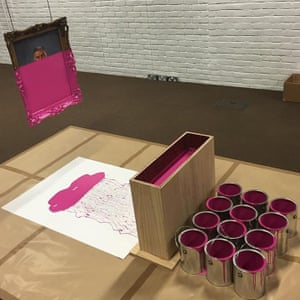
Another of Jeffers’s “adult” projects is a series of dipped paintings; he finds subjects, interviews them extensively, then paints their portrait – only to dip half the image in a bucket of paint so it is lost forever. The ambiguity of an image that can only be remembered, not seen, intrigues him: “The first one that I dipped, I just accidentally forgot to take a photograph of it before I put it in because I was so distracted with the mechanics of how to make the box and how much paint to put in. Loads of people asked: did I really paint the whole thing?”

I ask him how he balances all this work – seeing his studio in person, this is a truly staggering amount of productivity – with his life. He smiles and says he’s getting better, even though he spent his last Christmas vacation working on The Boy in the Striped Pyjamas. “I was literally researching images of Auschwitz. It was grim, but possibly, with hindsight, that might not have been a bad mindset to be in when actually doing this, because there’s a grimness that sort of gets funnelled in through the work.” Photograph: Penguin Random House

Jeffers has worked with Boyne before, illustrating his children’s novel Noah Barleywater Runs Away. But this project was different: in the illustrations Jeffers shows me, the colour palette is very simple, only red and blue and black line drawings. He kept the facial features down to a minimum, particularly in one image of Hitler and Eva Braun. “I was really pleased with how this came out,” he says and thinks about that a moment. “Pleased is a weird word.”

But he is right. The images are beautiful in the right way, honouring the subject without making it sentimental and erasing its humanity.

Jeffers is, you could say, now more of a man of books, and he tells me that although his one-year-old son is like him – not quite a book addict yet – there are hints that the passion has passed on to the next generation. “Last night before bath time, he was walking around upstairs, buck naked with a book,” Jeffers says. “Just sort of speaking gibberish, but with a book that was upside down. I just thought it was the most adorable thing.”


A Child of Books is published by Walker Books. The illustrated edition of John Boyne’s The Boy in the Striped Pyjamas will be published 6 October by Penguin Random House.

A Child of Books is published by Walker Books. The illustrated edition of John Boyne’s The Boy in the Striped Pyjamas will be published 6 October by Penguin Random House.

A Child of Books is published by Walker Books. The illustrated edition of John Boyne’s The Boy in the Striped Pyjamas will be published 6 October by Penguin Random House.

Oliver Jeffers: 'I was always an artist' – but not a child of books


The title of the children’s illustrator’s latest volume, A Child of Books, does not apply to the artist himself, who says his career was ‘very much an accident’
Oliver Jeffers Photograph: John Messinger
Oliver Jeffers’s latest book is called A Child of Books. The illustrator and writer’s collaboration with fellow artist and typographer Sam Winston follows a young girl who makes a world for herself – and a young boy she meets – out of stories.

So I ask him: was he a child of books? No, he tells me in his sunny, clean Brooklyn studio, with hints of both embarrassment and pride in his voice: “I was much more interested in going out in the street and playing and kind of getting into mischief.”

Jeffers attributes this taste for mischief to his upbringing in Belfast; born in Australia, he was later raised in Northern Ireland with a healthy disrespect for authority. Any discipline he had was always devoted to his drawing. “I think I was always an artist,” he says.

FacebookTwitterPinterest From A Child of Books, by Oliver Jeffers and Sam Winston (Walker Books). Photograph: Walker Books

The world agreed from the beginning: How to Catch a Star, his first book, was published in 2004 to floods of acclaim, sales, and awards nominations. The Incredible Book Eating Boy, published in 2006, went on to win the Irish children’s book award. He has worked steadily on children’s books ever since; the tale of a boy and his penguin in Lost and Found, the touching story of loss in The Heart in the Bottle, the charming story of workplace protest The Day the Crayons Quit. Even A Child of Books, barely out a month, is already a bestseller, with Jeffers’s illustrated version of John Boyne’s The Boy in Striped Pyjamas coming in October too.

Oliver Jeffers: How I made How to Catch a Star – in pictures

Describing Jeffers’s art style is naturally difficult, in a dancing-about-architecture sort of way. His figures might appear, at first, roughly hewn in their simplicity. The little girl who takes the reader through A Child of Books wears an uncomplicated sailor’s pinafore, and her plaited hair is only lightly sketched out with a few lines. In all his books, images are accompanied by Jeffers’s distinctive handwriting: deceptively awkward-looking, like the work of a schoolboy whose natural chicken-scratch hand is being forced into grammar-school cursive, though the capitalization of key words makes it clear how deliberately Jeffers composes the words alongside the image. The effect of it all is exceptionally inviting, to children and adults alike.

Jeffers says he did not set out to become a children’s book writer and illustrator – not at all. “The kids’ books came very much as an accident,” he says; his ambitions had always been in fine arts. But when he formulated the idea, all the way back in art school at the University of Ulster, for How to Catch a Star, the children’s book form simply fit his aims.

Now he finds himself with such a long, successful track record in the form that people might believe he is “only” a children’s illustrator, a designation that does not particularly seem to bother him. “I didn’t really test my books on kids,” he said. “They weren’t really made with an idea of what a contemporary audience of children might want to hear, but they were more to satisfy my own sense of curiosity.” It was pure luck that the Venn diagram had a lot of overlap.


He continues to work in fine art, which he says people in the publishing world find odd, and vice versa. “I used to care a lot about how that was perceived and then I think about a decade ago, I just stopped,” Jeffers says. “It is what it is.”

The energy he used to spend worrying about it has been refocused into simply producing work that interests him. Taking me to the back of his studio, set up as a kind of mini-gallery, he shows me a series of canvases he has painted for a newexhibition at the Bryce Wolkowitz gallery in New York. They’re seascapes. Though they look a little different from his children’s illustrations, that trademark handwriting is there, too. He’s painted numbers on the canvas, each of them intended to show the depth of the sea. They do add something essential to the image that might otherwise go unnoticed.

Including this sort of information with a visual image is a preoccupation of his. “I started putting words on these images at a really early point because I just thought that it was a cool graphic device and you could do interesting things by complimenting or contrasting what the image was showing,” he says. “By doing that, you could effectively create a completely different meaning, piece of work, all together, a completely different story.”
FacebookTwitterPinterest Oliver Jeffers’ portrait of his friend Sanky. Photograph: Oliver Jeffers

Another of Jeffers’s “adult” projects is a series of dipped paintings; he finds subjects, interviews them extensively, then paints their portrait – only to dip half the image in a bucket of paint so it is lost forever. The ambiguity of an image that can only be remembered, not seen, intrigues him: “The first one that I dipped, I just accidentally forgot to take a photograph of it before I put it in because I was so distracted with the mechanics of how to make the box and how much paint to put in. Loads of people asked: did I really paint the whole thing?”

I ask him how he balances all this work – seeing his studio in person, this is a truly staggering amount of productivity – with his life. He smiles and says he’s getting better, even though he spent his last Christmas vacation working on The Boy in the Striped Pyjamas. “I was literally researching images of Auschwitz. It was grim, but possibly, with hindsight, that might not have been a bad mindset to be in when actually doing this, because there’s a grimness that sort of gets funnelled in through the work.” Photograph: Penguin Random House

Jeffers has worked with Boyne before, illustrating his children’s novel Noah Barleywater Runs Away. But this project was different: in the illustrations Jeffers shows me, the colour palette is very simple, only red and blue and black line drawings. He kept the facial features down to a minimum, particularly in one image of Hitler and Eva Braun. “I was really pleased with how this came out,” he says and thinks about that a moment. “Pleased is a weird word.”

But he is right. The images are beautiful in the right way, honouring the subject without making it sentimental and erasing its humanity.

Jeffers is, you could say, now more of a man of books, and he tells me that although his one-year-old son is like him – not quite a book addict yet – there are hints that the passion has passed on to the next generation. “Last night before bath time, he was walking around upstairs, buck naked with a book,” Jeffers says. “Just sort of speaking gibberish, but with a book that was upside down. I just thought it was the most adorable thing.”


A Child of Books is published by Walker Books. The illustrated edition of John Boyne’s The Boy in the Striped Pyjamas will be published 6 October by Penguin Random House.

Friday, September 23, 2016

Anna Dewdney Hail And Farewell .... Writer of Beloved Books for Children. My kids loved them( and so did I)

Image result for Anna Dewdney

Anna Dewdney Hail And Farewell .... Writer of Beloved Books for Children. My kids loved them( and so did I) .

Her works, like the great texts of Jewish tradition, came to life only when read aloud

Earlier this month, Anna Dewdney succumbed to brain cancer. She was 50, and if there are small children in your life, you are probably familiar with her work, particularly those lovely books about a sweet little llama learning to master his emotions and navigate the thicket of family, friends, the flu, and other things that are difficult to avoid.

I’m a big fan of Dewdney’s work, yet before I heard the sad news of her passing, I never really stopped to wonder why. But now that I know there will be no future llamas, I reached out for llamas past, those wonderful books I had always enjoyed picking up at bedtime, and read them out loud to my kids.

To understand what makes Dewdney’s work so precious is to understand what makes children’s literature more like alchemy than art. Like running marathons, say, or doing improvisational comedy, writing for the very young has regrettably become a pursuit in which too many people who have no business attempting now indulge. Even without consulting the most injurious entries in the category—like Madonna’s atrocious The English Roses, a picture book about why her daughter will always be wealthier, more beautiful, and more special than yours—you can see the central problem of writing for children right away: Adults are not children. And when adults try to create something that appeals to children, they usually stumble into one of several states of mind, all regrettable. Some are cloying and didactic. Some try to curry favor by desperately advertising that they’re cool, and that unlike those musty other grownups, they’re all about the farts and the snot and the other staples of toddlerhood’s humor, and nothing much else. Some insist on a serenity that is typical of children in life-insurance commercials and nowhere else. They’re all wrong, of course, and they all make the nightly ritual of reading to your kids an experience dotted with rolls of the eye and small rivulets of inner rage: We’re adults, and we know a faker when we see one, and so, of course, do our children.

Image result for Anna Dewdney
But Dewdney was real. Her llama is sweet, but his world is far from some cheap emotional construct. When his mother says her final goodnight and leaves him alone in his room in the dark, llama feels terror that readers aged 2 to 99 can immediately tell IS palpable and terrifying, even to those of us long accustomed to unlit bedrooms and parental absence. He fights, he gets angry, he ails, and, even when a loving embrace and some soft and sensible words eventually restore his calm, readers are left with the sense that the next crisis and the next consolation are just around the corner. If there are small children in your life, you know that no other rhythm rings true.

So what makes Dewdney’s work so wonderful, and what might we deem her legacy? Two observations come to mind.

The first is that children are beasts, joyous and wild. “I think children are far more like animals than they are like adults,” Dewdney told an interviewer in 2013. “Small children are ‘unadulterated’ beings. They experience and recognize feelings in themselves and others much like animals do, without all that other stuff on top.”

Walter Benjamin, hardly a favorite of the preschool set, reached for zoological metaphors, too, when considering the way children approach books, drawings, and life. For the child, he wrote in one essay about the way children see the world, color is not the misleading coating of individual particular things in space and time. Where color provides the contours, objects are not reduced to things but are constituted by an order consisting of an infinite range of nuances: The color is individual, but not as a dead thing fixed in individuality, but as winged, flying from one pattern to another.” And like winged creatures, children, too, Benjamin argued, “have no reflection, only intuition.” By which he did not mean to suggest children were inferior; quite the contrary: To Benjamin—and to Dewdney—children are magical because, unlike us musty grownups, they haven’t yet blunted their ability to simply feel, to see one or five or more layers to reality, to look at a cardboard box and believe it can be a space shuttle, to look at the color red and see it not as a background but as an essence, to believe in any and all possibilities. To do that, you need to keep your emotions very close to the surface, like madmen and artists and little llamas.

Dewdney’s second major insight will be even more familiar to her Jewish readers. “A good children’s book can be read by an adult to a child, and experienced genuinely by both,” she said in another interview. “A good children’s book is like a performance. I don’t feel my world really exists until an adult has read it to a child.”
Image result for Anna Dewdney
Books as performance: Is there a more pithy way to describe so much of Jewish history? Seated around the table at the beit midrash, the Talmud open before them, our fathers didn’t just read books but read them out loud, together, to each other. Like their fathers before them, who kept the Torah alive by passing it orally from generation to generation, they saw texts not as the conclusion of a conversation but as the beginning of one. We can feel the sparks of this tradition each Passover night as we sit and engage in a textual performance of our own. The Haggadah, on the page, is lifeless narration; but on the tongues of our aunts and mothers, our brothers and husbands and sons, it comes to life. It becomes a story, and one, to use Benjamin’s beautiful phrase—he was talking about the tales children tell themselves when playing—appropriate to our size. Unlike our modern stories, which are complicated and cold, the Haggadah is emotionally straightforward, a tale of redemption lubricated by blood. That’s why we enjoy reading it again and again and again, like the great books we cherish as children: It’s an invitation to an inquiry that never ends and that can never be untangled alone.

When I heard of Dewdney’s death, I picked up one of her books and read it out loud. My children were delighted by its cadence and its candor. They didn’t even notice the quiver in my voice. For them, for me, and for anyone else who loves Dewdney’s work, she’ll remain, like llama’s mama at dusk, always near, even if she’s not right here.

Monday, May 23, 2016

The Fault in our Stars by John Green , Dutton Books

Image result for the fault in our stars

John Green is possibly the most renowned author of Young Adult Fiction currently operating. His most well known book so far is probably this one, The Fault In Our Stars. The basis of the story is that a girl named Hazel who has cancer meets a boy named Augustus who she falls in love with. The two of them try to deal with cancer, love, and books. It's your average boy meets girl, girl has cancer, boy and girl talk about how a fictional book ends book. The whole story is beautifully written and is just breathtaking. The metatextual elements with references to the fictional book which the two are both a fan of (An Imperial Affliction) have a very Third Policeman–esque vibe to it, which, as a great fan of The Third Policeman was very enjoyable. I thought the plot was wonderful, the characters were absolutely believable and you do completely fall in love with them. Hazel and Augustus are fantastically drawn and the voice of them both is very funny and very well done. It is not a sick lit novel, despite having many of the trappings associated with the genre, it is a story about two people in love, one of whom has cancer. It also has a certain philosophical bent in which it discusses the meaning of life and death.

Of course, I cannot talk about The Fault In Our Stars without mentioning the brilliant film adaptation. It is equally as brilliant as the book and, in my opinion, enhances the novel which very few films do. For me, the novel and book are now as one, each dependent on the other. Augustus will always be Ansel Elgort and Peter Van Houten will always be that guy who I thought was John Hurt but wasn't and then realised was in The Life Aquatic. Or Willem Dafoe for short.

I would recommend that everyone reads this book. It is beautiful, enthralling, funny and just fantastic. It shows how a short life can still be an infinity, even if it is a lesser one. It enthralls, entertains and educates and offers a jumping off point for young people to explore and discuss important philosophical issues.

And yes, I did get something in my eye at the end.

But it was totally dust.