Showing posts with label Just A Rip Roaring Zionist. Show all posts

Tuesday, October 25, 2016

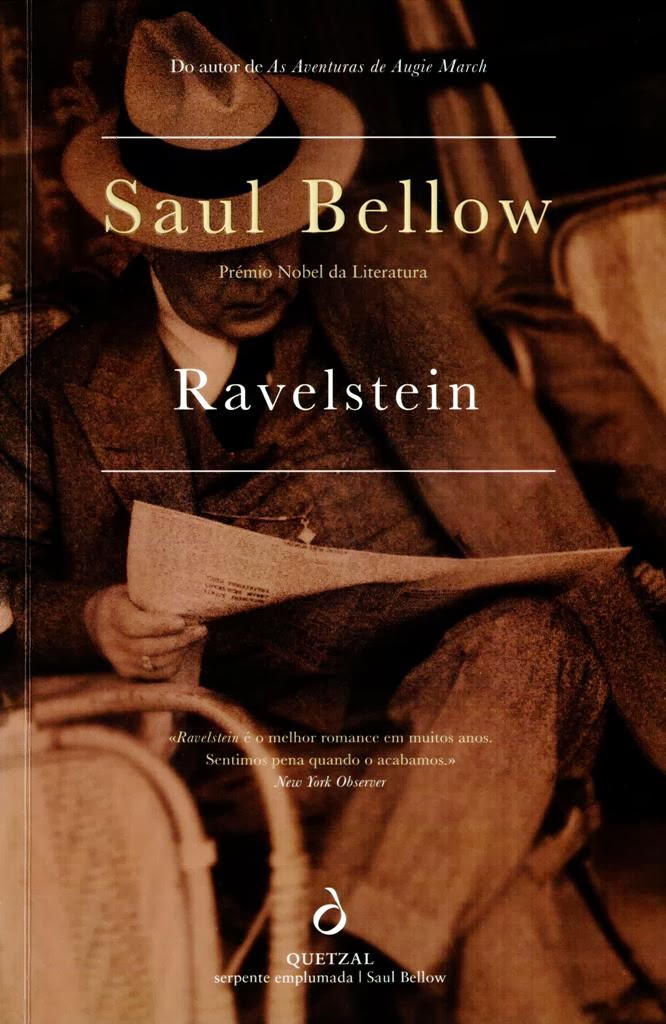
Ravelstein by Saul Bellow Viking, 254 pp, £16.99, April 2000, ISBN 0 670 89131 2

Image result for Ravelstein by Saul Bellow

Ravelstein by Saul Bellow
Viking, 254 pp, £16.99, April 2000, ISBN 0 670 89131 2


Novelists can be lucky in their editors, in their friends, in their mentors and even in their pupils. Sometimes they are generous or sentimental enough to fictionalise the relationship. In Keep the Aspidistra Flying, George Orwell gave his friendless, dowdy and self-pitying protagonist, Comstock, one true pal: the editor and patron Ravelston, proprietor of the small yet reliable magazine Antichrist. This Ravelston – some composite of Sir Richard Rees and John Middleton Murry – was a hedonistic yet guilt-ridden dilettante, good in a pinch, and soft on poets, but too easily embarrassed by brute exigence. Saul Bellow – who has already shown a vulnerability to exigent poets in his wonderful Humboldt’s Gift – now presents us with Ravelstein, a hedonistic kvetch who manifests patience towards none. As is known to all but the meanest citizens of the republic of letters, the novel is an obelisk for the late Allan Bloom, author of the 1987 shocker, The Closing of the American Mind. This book, which was a late product or blooming of the University of Chicago Committee on Social Thought, argued that the American mind was closed because it had become so goddamned open – a nice deployment of paradox and a vivid attack on the relativism that has become so OK on campus these days. Bloom’s polemic swiftly became a primer for the right-wing Zeitgeist; a bookend for the shelf or index sternly marked ‘all downhill since 1967’. And even then, there were those who detected a Bellovian lending, or borrowing as the case might be.


When The Closing of the American Mind first came out, Robert Paul Wolff, then a professor of philosophy at Amherst, wrote a short review in Academe, the journal of the American Association of University Professors. Let me quote from his prescient opening staves:


Aficionados of the modern American novel have learned to look to Philip Roth for complex literary constructions that play wittily with narrative voice and frame. One thinks of such Roth works as My Life as a Man and The Counterlife. Now Saul Bellow has demonstrated that among his other well-recognised literary gifts is an unsuspected bent for daring satire. What Bellow has done, quite simply, is to write an entire coruscatingly funny novel in the form of a pettish, bookish, grumpy, reactionary complaint against the last two decades. The ‘author’ of this tirade, one of Bellow’s most fully-realised literary creations, is a mid-fiftyish Professor at the University of Chicago, to whom Bellow gives the evocative name ‘Bloom’. Bellow appears in the book only as the author of an eight-page ‘Foreword’, in which he introduces us to his principal and only character.

Right away one thought of Herzog, the super-kvetch of all kvetches. But here again, in his foreword to Bloom or ‘Bloom’, Bellow kept us guessing. As he phrased it (teasingly?):


There are times when I enjoy making fun of the educated American. Herzog, for instance, was meant to be a comic novel: a PhD from a good American university falls apart when his wife leaves him for another man. He is taken by an epistolatory fit and writes grieving, biting, ironic and rambunctious letters not only to his friends and acquaintances, but also to the great men, the giants of thought, who formed his mind. What is he to do in this moment of crisis, pull Aristotle or Spinoza from the shelf and storm through the pages looking for consolation and advice?

Rather archly, perhaps, Bellow went on to smile at the simplicity of some of his public:


Certain readers of Herzog complained the book was difficult. Much as they might have sympathised with the unhappy and comical history professor, they were occasionally put off by his long and erudite letters. Some felt that they were being asked to sit for a difficult exam in a survey course in intellectual history and thought it mean of me to mingle sympathy and wit with obscurity and pedantry. But I was making fun of pedantry!

Well, taking things all in all, I think we had better be the judge of that. Because now we have an ostensibly full-out novel, this time under Bellow’s real name, which reveres pedantry and is all about the life and death of Allan Bloom. Indeed, with its many real names and actual locations, it constitutes a novelistic and realistic memoir of him. And it is related, partly in anguish, by a Herzog character – ‘a PhD from a good American university’ whose wife has just left him for another man, or at any rate for other men.


For some reason that I cannot pretend to decode, this Boswell is named ‘Chick’. He it is who proposes that Ravelstein write the egghead bestseller (‘It’s no small matter to become rich and famous by saying exactly what you think’) and who in return accepts Ravelstein’s commission to become his – probably posthumous – biographer. So far, so accurate: Bellow was the egghead’s egger-on, and also his angel in the publishing world, and here we find the second half of the debt redeemed. The story is authentic too, as far as it goes, about Ravelstein/ Bloom’s egghead allegiances. Bloom was an adept or disciple of the Chicago philosopher Leo Strauss, a German-Jewish émigré who was, according to your bias, sinister or arcane. Modelling himself on Aristotelian and Machiavellian theories of the covert formation of princes, Strauss never sought public renown and insisted on close explication of the occult element in classic and classical texts. His American disciples, of whom Francis Fukuyama is probably the most celebrated, achieved a brief nearness to real power during the Reagan and Bush Administrations, one of them (William Kristol, son of Irving) being the Aristotelian mentor of Dan Quayle. The giveaway in Straussian critiques is the employment of the term ‘regime’ to denote styles of rulership. Bellow captures this neo-cultist element quite deftly:


But Ravelstein knew the value of a set. He had a set of his own. Its members were students he had trained in political philosophy and longtime friends. Most of them were trained as Ravelstein himself had been trained, under Professor Davarr, and used his esoteric vocabulary. Some of Ravelstein’s older pupils now held positions of importance on national newspapers. Quite a number served in the State Department. Some lectured in the War College or worked on the staff of the National Security Adviser. One was a protégé of Paul Nitze. Another, a maverick, published a column in the Washington Times. Some were influential, all were well informed; they were a close group, a community. From them Ravelstein had frequent reports, and when he was at home he spent hours on the telephone with his disciples. After a fashion, he kept their secrets. At least he didn’t quote them by name.

That’s the first and almost the last we hear of the crucial and seminal Felix Davarr, who as Leo Strauss is mentioned only once in The Closing of the American Mind, where he makes the oddly trite observation that the moderns ‘built on low but solid ground’. Bloom’s reticence, though, is appropriate: it is that of the close-mouthed and knowing initiate, while Bellow treats Strauss as if he were like Anthony Powell’s Sillery: no more than a don with a number of influential ex-pupils. When Alexandre Kojève is mentioned a few pages later, he is drawn in the same rather lifeless terms as ‘the famous Hegelian and high official who had educated a whole generation of influential thinkers and writers’. Someone who had really done that could once have expected a more lapidary (or do I just mean less tired?) sentence from Bellow’s pen.

The cynicism of Strauss’s theory and practice was summarised in his antithesis between Athens and Jerusalem. I am certain to vulgarise the recondite here, but Straussians believe in religion and not in God. Philosophy is the high calling of the élite: a strenuous and contemplative effort directed at the moulding of a cultural and political leadership. Obviously, superstition and piety are mere encumbrances in the discharging of this elevated task. But the masses, of whom no such effort can be expected, must draw their ethical and disciplinary rations from the commissary of the supernatural. ‘Chick’/ Bellow shows no grasp at all of this dialectic, which he repeatedly expresses as Ravelstein’s fascination with Athens and Jerusalem, as if Plato and the Talmud were equal treasures from the bran tub of antiquity.

That of course was the ad hoc conclusion of the autodidact and omnivore Augie March, Bellow’s most superbly rendered fictional creation. March passes long stretches on the periphery of the University of Chicago, and at one point makes a sort of jackdaw living by stealing ‘great books’ on commission for scholars like the lanky Hooker Frazer. His first major haul is ‘a big Jowett’s Plato’ but he soon diversifies: ‘Two volumes of Nietzsche’s Will to Power I had a hell of a time swiping, for they were in a closed case at the Economy Book Store; I also got him Hegel’s Philosophy of Right, as well as the last volumes of Capital from the Communist bookshop on Division Street, Herzen’sAutobiography, and some de Tocqueville.’ The influence of the University on the city, especially on its outcast or indigent element, can be felt all the time in The Adventures of Augie March. There is Padilla, the impoverished Mexican who gets a scholarship to develop his genius for mathematics, and there’s Clem, amassing erudition in a fly-blown rooming-house.

In Augie March, too, we sense Bellow’s interest in gurus and savants and mentors. Here’s the disabled local fixer and broker William Einhorn:


The first superior man I knew. He had a brain and many enterprises, real directing power, philosophical capacity, and if I were methodical enough to take thought before an important and practical decision and also if I were really his disciple and not what I am, I’d ask myself: ‘What would Caesar suffer in this case? What would Machiavelli advise or Ulysses do? What would Einhorn think?’ I’m not kidding when I enter Einhorn in this eminent list. It was him that I knew, and what I understand of them in him. Unless you want to say that we’re at the dwarf end of all times and mere children whose only share in grandeur is like a boy’s share in fairy-tale kings.

When Einhorn’s father dies, his self-educated and slum-bred son reaches for the ‘deep-water greatness’ of the ancients and strains pathetically but nobly for an elevated note and a high calling. In his dignified filial death-notice for the neighbourhood paper he writes without embarrassment: ‘“My father was not familiar with the observation of Plato that philosophy is the study of death, but he died nevertheless like a philosopher, saying to the ancient man who watched by his bedside in the last moments … “That was the vein of it.’


I can’t resist adding two more themes from Bellow’s triumph in 1953. One is a hatred of workhouse condescension towards the underclass: ‘Something in his person argued what the community that contributed the money wanted us poor bastards to be: sober, dutiful, buttoned, clean, sad, moderate.’ And the other a real demotic admiration for the Greeks, for their ancient willingness to face things as Augie tries to face the humilations of jail and the Stygian gloom of Erie, Pennsylvania and other wasteland spots:

Only some Greeks and admirers of theirs, in their liquid noon, where the friendship of beauty to human things was perfect, thought they were clearly divided from this darkness. And these Greeks too were in it. But still they are the admiration of the rest of the mud-sprung, famine-knifed, street-pounding, war-rattled, difficult, painstaking, kicked in the belly, grief and cartilage mankind, the multitude, some under a coal-sucking Vesuvius of chaos smoke, some inside a heaving Calcutta midnight, who very well know where they are.

By contrast, Ravelstein, and Ravelstein, are shadows on the wall of Augie March’s cave. The great city of Chicago is now represented as a heaving Calcutta midnight, awash in feral delinquency. Ravelstein segregates himself in an apartment building, with the pretentious name of ‘The Alhambra’, where his only contact with the world of the streets is a superannuated black skivvy: ‘As nearly as any honky could, he took into account her problems with her prostitute daughter, her jailed criminal son, and with the other son whose HIV troubles and scrambled wives and children were too complicated to describe.’ Why does one get the impression that Bellow would rather these people were ‘sober, dutiful, buttoned, clean, sad, moderate’? Ravelstein, meanwhile, looks on his students as the raw material of a future conservative hierarchy owing a debt to himself. (In a moment of lucid callousness we are informed that ‘if they weren’t going to make it he didn’t hesitate to throw them out.’) Also, we soon discover that this newmaître, who possesses none of the coarse vigour of Einhorn, has ‘HIV troubles’ of his own.

Chaos, most especially the chaos identified with pissed-off African Americans, was the whole motif of The Closing of the American Mind. Bloom had taught at Cornell during the campus upheaval of 1968, and never recovered from the moment when black students produced guns to amplify their demands. (He also never reconciled himself to the ghastly fondness of the young for rock music. ‘Whether it be Nuremberg or Woodstock,’ he wrote in a passage of extreme dyspepsia comparing everybody to the Brownshirts, ‘the principle is the same.’) However, there was hope. A small group of classics students copied out and xeroxed a passage against ochlocracy from Plato’sRepublic and passed it out as a leaflet. Bloom sounds just like Bellow when he recalls this moment: ‘They had learned from this old book what was going on and had gained real distance on it.’

Actually, Glaucon’s evening with Socrates would have been a poor shadowy guide to an American ‘regime’ which was then engaged in confronting a revolt of the helots, and in fighting a war far more cruel and unjust and irrational than the Peloponnesian. But what Bloom liked was the attachment to form. At least, he liked it most of the time. The worst thing he could think of to say about one of his academic antagonists was that he was ‘an assiduous importer of the latest Paris fashions’. By this of course he meant an interest in Sartre or Althusser or perhaps Foucault; it makes it all the funnier that when we first meet ‘Ravelstein’ he is in Paris on a vulgar spree of consumerism: Lanvin jackets, costly scarves, Lucullan restaurants and hotel suites; if you’ve got it, baby, flaunt it. Before too long there is a fast car with all the fixings being ordered for ‘Nikki’, the travelling companion, and we further learn that Abe (Ravelstein’s seldom used first name) is en rapport with at least some young blacks for his fashion sense alone. By these signs, and a few others, Bellow makes it easy to know what ‘Bloom’ never admitted in his paeans to the Greek style: that for all his contempt for the counter-culture he was a live-dangerously homosexual.

As depicted by Bellow, this is perhaps the most attractive and sympathetic aspect of the man. But, as the novel fails to register, it was also a negation of his whole public stance. Allan Bloom thought, and Abe Ravelstein thinks, that sex – any sex – is a poor expression of Eros, but better than nothing at all. Heavy weather is made of this simple point:


Naturally there was a Greek word for it, and I can’t be expected to remember every Greek word I heard from him. Eros was a daimon, one’s genius or demon provided by Zeus as a compensation for the cruel breaking-up of the original androgynous human whole. I’m sure I’ve got that part of the Aristophanic sex-myth straight. With the help of Eros we go on, each of us, looking for his missing half. Ravelstein was in real earnest about this quest, driven by longing. Not everyone feels that longing, or acknowledges it if he does feel it. In literature Antony and Cleopatra had it, Romeo and Juliet had it. Closer to our own time Anna Karenina and Emma Bovary had it, Stendhal’s Madame de Rênal in her simplicity and innocence had it. And of course others, untaught, untouched by open recognition, have it in some obscure form.

The ‘obscure form’ in which ‘Bloom’ really experienced it was of this kind:

One day he said to me: ‘Chick, I need a cheque drawn. It’s not a lot. Five hundred bucks.’

‘Why can’t you write it yourself?’

‘I want to avoid trouble with Nikki. He’d see it on the cheque stub.’

In the first proof of the novel that I read, Bellow went on to be explicit about the sexual elements that were masked by this accountant version of anonymity. He has since excised that paragraph, perhaps or presumably in deference to the unease produced by his candour about Bloom’s escapades. (Pre-publicity for the book drew some moans of pain from the old-school Chicago hands.) However, the chief point is allowed to survive its euphemisation: Allan Bloom died of Aids, as was finally and reluctantly admitted by his admirers. Nor is this a detail. Bloom never mentioned the gay movement in his series of assaults on promiscuous Modernism. Throughout his posthumously published book Love and Friendship, a rather superior effort to analyse Eros and agape from Alcibiades to Émile, he hoarded his own views on pederasty well on the other side of the closet door. No ordinary reticence was involved here. The philosophical movement associated with Leo Strauss regards ‘sodomy’ as sterile and nihilistic, and as an unmanly betrayal of tribe and family. And the Straussian intellectuals have undergone a schism, every bit as sulphurous and Talmudic as the Trotskyist faction-fights that were known to Augie March and indeed the young Bellow. Professor Harry Jaffa, Strauss’s most ardent disciple and Bloom’s one-time collaborator in a volume on Shakespeare’s politics, has authored a stream of polemics against homosexuality as a violation of ‘natural law’. This very trope currently forms the moral cement of the American Right. There may or may not be a suggestive and contradictory connection between ‘Ravelstein’s’ secretive sex life and his attachment to arcane doctrines – between the erotic and the esoteric – but Bellow can’t seem to be bothered with it.

This is perhaps because his narrator has problems of his own. Domestic traumas – heterosexual and banal ones, to be sure – are eating him up, and like Herzog he finds little release in pulling Aristotle or Spinoza from the shelf. Indeed, when he tries to scan anything at all, this happens:


One day when I was reading a book (my regular diet of words) she wandered into the room entirely nude, came to my bedside and rubbed her pubic hair on my cheekbone. When I responded as she must have known that I would she turned and left with an air of having made her point. She had won hands down without having to speak a word. Her body spoke for her, and very effectively too, saying that the end was near.

Bellow has always had a fierce instinct for the blunt messages that female pudenda can convey, especially in closure. The much younger and tougher Augie March had to endure the following:


In heat like this she preferred to go naked in her room. When I wanted to recall how she was, naked, I found I could do it very well. She saw my eyes on her lower belly and her hand descended to hold the edge of the robe there. Seeing that colourful, round-fingered hand descend, I bitterly felt how my privilege had ended and passed to another man.

The pubis-flaunting female in the present case – enough to drive anyone nuts, if not necessarily queer – is the coldly scientific and dedicated Romanian wife we last met inThe Dean’s December. By degrees, as Ravelstein sickens and dies, ‘Chick’ shuffles forward to become the subject and object of his own novel. He realises that his wife has outpointed him emotionally and also legally. Lamenting his own dullness, and also lapsing into terrible colloquialism, he kvetches: ‘You deaden your critical powers. You stifle your shrewdness. Before you know it you are paying a humongous divorce settlement to a woman who had more than once declared that she was an innocent who had no understanding of money matters.’ The spring-heeled and amoral Ravelstein is probably the near-perfect friend to have in such a fix; he mocks the wife’s robotic ways and her frigidly perfectionist style, and suggests that her Romanian pals are probably Iron Guard fascists anyway. (He punctuates his monologues with the tic phrasing ‘thee-ah, thee-ah’, which Bellow records skilfully without noting that such mannerisms are designed to make the speaker uninterruptible, and are thus an unfailing sign of the closet authoritarian.) Still, Chick’s best-ever pal turns out to be his next wife, who realises that he is not just sick but actually in mortal peril after he eats the wrong fish on a Caribbean holiday, and who exerts herself to pluck him back from the lip of the grave. I’m sorry that the narrative breaks off before the latest big news in Bellow’s life, which is his fathering of a daughter at the age of eighty-plus, with the same staunch and estimable woman who did the plucking.


Thin though this novel may be, and perfunctory in keeping its commitment as the unwritten memoir that Bellow promised to Bloom in a moment of weakness, it does exemplify some of the stoicism of the neo-conservative mentality. ‘Ravelstein’ doesn’t whine as the end approaches. We don’t actually see him die (Bellow’s own near-death experience follows, perhaps, too hard upon) but we witness him in the humiliating shipwreck of his last illness and he remains a wise-cracking atheist and materialist. ‘Chick’ chooses to see this as a pose, and to take literally Ravelstein’s expiring gags about a reunion beyond the grave, which strikes me in the light of a slight but significant breach of faith. Say what you will about the Straussians, they aren’t hypocrites or weaklings and they don’t burble about heavenly rewards to make up for when the mind has gone. Indeed, they have made rather a pointed study of the dignified hemlockian terminus. Bloom should have been allowed this last nobility.

Bellow’s own attitude to Jerusalem is given a mild work-out in these pages. In the past few decades he has had a fluctuating relationship with the neo-conservative movement. He first endorsed the bogus work of the pseudo-demographer Joan Peters, who argued that there had been no Palestinian population to be dispossessed in the first place, and then honourably withdrew his encomium when the facts about the book became known. He signed up with the grandiosely titled Committee for the Free World, run by Midge Decter and Norman Podhoretz, and then let his sponsorship lapse when the same outfit published hysterical slanders against Norman Mailer and Gore Vidal. In the argument about standardised courses in ‘Western Civilisation’, he intervened with the now notorious remark that the Papuans had no Proust and the Zulus had no … was it Zola? He wrote a crabbed and resentful account of a visit to the Holy City, which seemed to some of us to be an Arab v. Jewish allegory of the fears and resentments – about black populism and demagogy in New York and Chicago – which have been more cheaply annexed by Tom Wolfe but which found an outlet also in Mr Sammler’s Planet. InRavelstein he presents the Jewish experience principally and unexceptionably as one of survival. With a tinge of self-pity, though, he also advances it as something that non-Jews can’t be expected to understand. Even great humanists like Maynard Keynes, when you con the list of ‘great books’, disclose their rodent prejudice. ‘I had a Jewish life to lead in the American language, and that’s not a language that’s helpful with dark thoughts.’ There’s a quavering note here which, ironically in its way, contrasts with Abe Ravelstein’s robust and amoral and defiant and very American style; a style redeemed from being merely reactionary by its understanding of the ancients, and the understanding (to which it incidentally or accidentally assists us) that intellectuals never sound more foolish than when posing as the last civilised man.

Sunday, October 23, 2016

Surviving Amid Chaos: Israel's Nuclear Strategy (Weapons of Mass Destruction)Apr 4, 2016 by Louis René Beres. Hardcover.Rowman & Littlefield Publishers In his new book, Prof. Louis René Beres delves into the complexities of one of the most heated issues in the Middle East and all world politics. As he examines the current nuclear doctrine of the Jewish state, he also suggests that a suitably revised doctrine is in order


Surviving Amid Chaos: Israel's Nuclear Strategy (Weapons of Mass Destruction)Apr 4, 2016
by Louis René Beres. Hardcover.Rowman & Littlefield Publishers

In his new book, Prof. Louis René Beres delves into the complexities of one of the most heated issues in the Middle East and all world politics. As he examines the current nuclear doctrine of the Jewish state, he also suggests that a suitably revised doctrine is in order


This timely and original scholarly book critically examines Israel's rapidly evolving nuclear strategy, a subject with which the author has been authoritatively acquainted for many years. Now facing an unprecedented configuration of existential threats, and, as corollary, a potentially deteriorating "correlation of forces," Israel's leaders must consider such urgent and overlapping survival issues asdeliberate nuclear ambiguity (the "bomb in the basement"); regional nuclear proliferation; Jihadist terror-group intersections with enemy states;rationality or irrationality of state and sub-state adversaries; assassination or "targeted killing;"preemption; and probable effects of "Cold War II" between Russia and the United States. As Professor Beres' new book will explain, these issues underscore the overarching complexity of critical strategic interactions in the Middle East, including more-or-less plausible synergies between Israel's chosen strategic policies, and also the expected reactions of its multiple and often "hybrid" enemies.

Throughout, the author's examination of these issues expressly references pertinent considerations of international law, especially humanitarian international law (the law of armed conflict); terrorist extradition and prosecution; and anticipatory self-defense. Surviving Amid Chaos, therefore, is a book that presents an altogether original synthesis of strategic and jurisprudential factors regarding Israel's nuclear strategy

In the final analysis, as this new book argues convincingly, Israel's nuclear strategy must spring from antecedent nuclear doctrine. What should be the core components of such a doctrine? How has this doctrine actually evolved, from the early days of Prime Minister David Ben-Gurion, to the present moment? What should be the core components of doctrine going forward? To what extent, if any, should these components be made explicit or recognizable? To what extent, if any, should Israel's strategic nuclear doctrine be fashioned on the assumption that there will be endlessly "shifting sands" of friends and foes in the region? To what extent, if any, should Jerusalem construct this doctrine with a view to sharing certain conceptual and operational details with Washington?

Surviving Amid Chaos addresses these distinctly nuanced and interrelated questions.

Israel's emerging strategic nuclear doctrine, we may learn from this book, can never be based upon singular threats. Always, this doctrine must always emerge from a suitably comprehensive consideration of all ascertainable security hazards, a consideration that looks at each particular threat from the much broader and more coherent perspective of vital "correlations" between them. An example would be the Iranian nuclear threat, which is examined here together with the prospect of a Palestinian state. Also discussed by Professor Beres is the role of certain relatively intangible components of enemy force correlations, especially Jihadist belief systems that promise immortality to "martyrs." Here, in the context of examining Israel's nuclear strategy, Surviving Amid Chaos considers a long-neglected source of correlative power in world politics – that is power over death.

Professor Beres' book also looks factually and precisely at different scenarios of regional nuclear proliferation, and at Israel's corresponding obligations and opportunities. Will a newly nuclear Shiite Iran spawn additional nuclear aspirants in Sunni Egypt and/or Saudi Arabia? If so, what would this suggest about possible sub-state nuclear proliferation hazards, to both Shiite (e.g., Hezbollah) and Sunni (e.g., ISIS) terrorist organizations? Should Israel plan to deal with these multiple and intersecting threats with more frequent and more devastating "self-help" resorts to preemption (including assassination and "regime targeting"), or instead by fashioning long-term strategies of deterrence? Moreover, the book inquires, is there a forseeably productive role here for the United Nations and world diplomacy, or do persistently "Westphalian" international relations render moot any such expanded collective security role?

Most importantly, perhaps, Surviving Amid Chaos focuses especially upon the question of "deliberate ambiguity," or the "bomb in the basement." Looking ahead, should Israel's strategy favor a shift to certain potentially useful forms of "disclosure," or should Jerusalem continue with its historic position of "no comment?" As the Chair of Project Daniel (PM Sharon, 2003), and as the editor of Security or Armageddon; Israel's Nuclear Strategy (Lexington Books, 1986) – one of the very first books to consider this question – Professor Beres looks intensely and authoritatively at these particular issues. Among other things, his book will explain why the best argument for ending deliberate nuclear ambiguity has nothing to do with simply re-stating the obvious, but rather with the deterrence-enhancing advantages of undertaking certain limited and incremental disclosures. Iran and other centers of future nuclear threat could be more durably deterred by Israel's nuclear strategy if that strategy suitably expressed the usability, survivability, and penetration-capability of Israel's indispensable nuclear forces.

Saturday, October 22, 2016

Against Elections: The Case for Democracy. David Van Reybrouck. Bodley Head. 2016.


Against Elections: The Case for Democracy. David Van Reybrouck. Bodley Head. 2016.


Against Sortition


In governance, sortition (also known as allotment or demarchy) selects officers as a random sample from a larger pool of candidates.In ancient Athenian democracy, sortition was the traditional and primary method for appointing political officials and its use was regarded as a principal characteristic of democracy.Sortition is commonly used to select prospective jurors in common law-based legal systems and is sometimes used today in forming citizen groups with political advisory power (citizens' juries orcitizens' assemblies).

The public sphere is full of analyses and lamentations about the inability of Europe’s current political parties and elites to represent their peoples/electorates/nations. Peter Mair’sRuling the Void provides an excellent history of the problem. The end of the Industrial Revolution in the 1960s-70s saw the decline of large class structures, and thus the identities that allowed parties to represent big class or occupational groups; the end of Communism and the triumph of neoliberalism left existing parties with only one ideology to choose from. Parties became state-funded agencies run by media or policy experts as there was no mass base to provide a wider pool of leadership recruits; they became a ‘cartel’ of parties and a ‘caste’ of party leaders. These are despised by an increasingly disengaged, volatile, capricious and angry electorate. The end result is nasty or irresponsible populism.

This review looks at one author’s novel approach to solving our crisis of representation. David Van Reybrouck, a Belgian author and public intellectual, wrote an excellent history of The Democratic Republic of Congo. In his newest book, Against Elections: The Case for Democracy, he reprises some of Mair’s points about the decline of party-electorate linkages. His solution is to bring back sortition – that is, the selection of public officials through the drawing of lots. To Van Reybrouck, the problem isn’t democracy, it is ‘electoral-representative democracy’ and ‘electoral fundamentalists’.

Van Reybrouck argues that the electoral principle has long been understood as undemocratic. The ancient Athenian polis, whose constitution he discusses in great detail, only deployed election to offices requiring specific expertise, such as military positions; otherwise, magistracies were chosen by lot. This system found endorsement by Montesquieu and Rousseau, but was abandoned for the more aristocratic principle of election by the bourgeois meritocrats of the French and American revolutionary eras. It became the election of ‘men who possess the most wisdom to discern, and the most virtue to pursue the common good of society’ (The Federalist Paper #57). This mechanism eventually became embedded in a system of mass parties: a ‘democratisation of elections’ Van Reybrouck condemns as ‘a bogus process’ aided by the redefinition of the word ‘democracy’ and the association of sortition with military conscription.
Image Credit: (Jeff Turner CC BY 2.0)

Key to Van Reybrouck’s diagnosis and proposed solutions is a specific idea of democracy, and an implicit idea of how society is organised and should be represented. Van Reybrouck seems to see elective representation itself as aristocratic, at least for offices not requiring special knowledge. ‘Democracy is not government by the best in our society, because such a thing is called aristocracy, elected or not […] Democracy, by contrast, flourishes precisely by allowing a diversity of voices to be heard’ (152-53). He wants to deal with the problem of the elite-electorate gap by collapsing it completely.

Van Reybrouck certainly makes a valuable contribution to political theory and discussion with his book, and he is a skilled author and researcher. His sketch of how classical Athens worked is one of the best parts of the book, and I would enjoy seeing him put his skills to a history of its democracy. Indeed, the book serves as a very good introduction to the history of sortition in classical, medieval and modern politics, using examples from Europe and North America. Anyone wanting to experiment with Van Reybrouck’s theories will find plenty of practical guidance here.

However, Van Reybrouck’s proposals, however innovative and fresh, only deal with a single aspect of modern disaffection: the alienation of voters from parties and politicians. That’s no small thing, but it is also not a freestanding problem. Politicians may seem like cookie-cutter reproductions of the same neoliberal PR account manager, but that is partly because free-market liberalism has been the only ideology on offer for something like a quarter century, because capital has broken free of national borders and eroded the public sphere. Those global pressures transcend national boundaries, and the ideologies that justify them do as well; simply changing the way states select officials fails to address that larger problem. Greece could pick a new government by drawing lottery balls tomorrow; that government would still have to deal with the bond markets. And Van Reybrouck’s model still relies on experts and officials to help advise the citizens chosen by lot. Nothing suggests that these counsellors would be any more ideologically diverse than the technocrats currently employed by the IMF, the European Union or various finance ministries.

Another problem is Van Reybrouck’s approach to structures other than parties that lie between the citizen and their state. It is perfectly legitimate to complain that ‘lobbies, think tanks and all kinds of interest groups’ have more access to the policymaking process than ordinary citizens (156), but he also seems to assume that those sorted into policymaking or review roles will neither be members of political parties nor engage in ‘tactical voting […] political haggling [or] back-scratching’, instead making decisions ‘according to their conscience, according to what he or she feels best serves the general interest in the long term’ (146).

This implies that there is only one definition of the general interest, which everyone can neutrally work out with enough ratiocination and good will. This ignores questions of class, race, occupation, sub-nationalism and all the other identities, material interests and philosophical concerns we carry into politics. How would this work in a federal system, where you effectively have not just one general national interest, but also the general interests of several states or provinces? From an economic standpoint, how do you come up with a general interest that distributes (or more challengingly, redistributes) resources? For all his condemnation of the first bourgeois republicans of the late-eighteenth century, Van Reybrouck borrows their ideas about a politics without party. That worked for Enlightenment liberals because they could pretend there was only one general interest, since the elected represent only one class of capital owners. He lists several examples of premodern political units that used lot-drawing, but in all of these cases, the ‘citizens’ were a homogenous group of a few thousand or ten thousand men of similar wealth.

In any case, choosing governors by lot does not automatically mean that the public will see those chosen as representing them. Sortition may produce a more representative assemblage of policymakers, but it does not actually empower ordinary citizens unless they are chosen. In Van Reybrouck’s touchstone, Athens, this was not a problem: every citizen was part of the legislature, and there were more than a thousand executive and legislative posts chosen by lot. Every citizen was in some way empowered (a task made easier by excluding most inhabitants from citizenship), and service in an executive role was almost impossible to avoid. In a modern state, this sort of mass participation is not possible, so most citizens will, at most, get to leave comments on the assembly website or vote in occasional referenda. Elections are democratic precisely because they grant choice to citizens, even if it is only a Schumpeterian choice between elites.

Finally, the book’s model for a system run on these ‘aleatory-democratic’ (‘aleatory’ meaning ‘based on chance’) lines, though very thoughtful, is also hugely complex. It involves no fewer than six types of assembly: An assembly to set the overall agenda; ‘interest panels’ to propose specific legislative topics; a review panel to prepare detailed bills; a ‘policy jury’ that would vote on the bills (but not debate them); an oversight council to handle complaints and judicial review; and a rules council to set rules for the other bodies. It is unlikely even the most educated, wonkish voter would find such a Rube Goldberg machine an attractive model. It reminded me of Olivier Bernier’s description of the legislature in Napoleonic France: ‘The Tribunat was composed of one hundred members who discussed the bills brought to it by the executive, but could not vote on them. The Corps Législatif had three hundred members who voted the bills into law, but could not discuss them’ (65).

Van Reybrouck does politics a great service by opening up our discussions of political structure and agency, questioning age-old ideas about elections, representation and the division of powers. That, and his considerable and well-presented historical research, make this book well worth reading. But in an age of such profound citizen dissatisfaction, it is far from clear we can leave something as central as representation to mere chance; leaving things to the supposedly ‘aleatory’ justice of the market is, after all, part of what got us into this mess.

Central Asia in Art: From Soviet Orientalism to the New Republics. Aliya Abykayeva-Tiesenhausen. IB Tauris. 2016.

Central Asia in Art: From Soviet Orientalism to the New Republics. Aliya Abykayeva-Tiesenhausen. IB Tauris. 2016.
central-asia-in-art-coverOften a historian’s role is to act as a voice for the unheard or silenced, undoing the folded lies of propaganda and bias. Kazakh art historian Aliya Abykayeva-Tiesenhausen performs a rendition of this role, not so much in speaking out for the silenced but in dismantling the layered stereotypes and distorted images of Central Asia. Central Asia in Art: From Soviet Orientalism to the New Republics focuses primarily on Soviet approaches to portraying Kazakhstan, Uzbekistan and Kyrgyzstan in art. Abykayeva-Tiesenhausen’s book blends accessible art analysis and detailed historical context to create a thought-provoking exegesis of identity and the control of perceptions not just in Central Asia but in Russia too. The reader learns that the Central Asian countries’ inability to control the discourse surrounding them did not collapse with the Berlin Wall, but lives on in new guises such as Sacha Baron Cohen’s Borat; interestingly though, where the USSR used selected images of Central Asia to buttress empire, Cohen’s Borat is used as an Other to critique the Western Self.
Much of Central Asia in Art concentrates on Socialist Realist art produced during Stalin’s stranglehold over the USSR. Socialist Realism was a homogenous supranational style developed to lionise Soviet values through realistic imagery, and was deployed in the Central Asian peripheries of the USSR to foster greater unity between Central Asian nations and Moscow. Paradoxically, this was done whilst trying to celebrate different national identities, albeit within tight constraints; indeed, as Abykayeva-Tiesenhausen asks: ‘why would a union of nations be celebrated through the persistent accentuation of difference?’ The USSR empire was a bizarre construction, as the author pithily notes, exerting a ‘constant demonstration of dominance and simultaneous denial of it’.
The book is comprised of large, beautifully detailed plates accompanied by Abykayeva-Tiesenhausen’s probing commentary, which, combined, give the reader a comprehensive, empathetic and encyclopaedic understanding of the featured artworks. This brings to life interesting leitmotifs, such as the Russian declaration of a civilising mission in Central Asia. For Russian audiences, artists would infantilise Central Asian nations by depicting young central Asian females ‘ready to be emancipated and which have been educated and pacified’. Frequently, whenever a painting shows Russians interacting with Central Asians, the former are often shown undertaking paternal activities, such as teaching chess or demonstrating their artistic skills. Interactions between Russian and Central Asian artistic subjects can be even more dynamic, such as in David Flekman’s Recovery of Sight (the very first image the reader sees on opening the book), in which a Russian nurse and doctor inspect a Kyrgyz woman after she has regained her vision. The painting bludgeons home Soviet messages of female and Kyrgyz national emancipation as well as Soviet modernisation.
central-asia-in-art-imageImage Credit: Landscape as Art Exhibition 2009, Olivia Garnett’s 3-D model of Alexander Volkov, Caravan (University of Michigan School of Natural Resources and Environment CC BY 2.0)
Modernisation is a recurrent theme of Soviet Realism: the open steppes and virginal lands are portrayed as awaiting Soviet development. In Abylkhan Kasteev’s 1930s paintings, Haymakingand Collective Dairy Farm, lush verdant landscapes exude abundance and high yield whilst Kazakhs harmoniously working together on the collective farm. Equally, depictions of urban spaces are used to press home Soviet modernisation, where a point is made by Soviet artists of electricity, culture and permanent infrastructure to nations of more nomadic historical leanings. Yuri Zaitsev’s 1935 nighttime scene, Building Site in Balkhash, represents this economic rejuvenation well, glorifying a building site not only in depiction but also in medium. Abykayeva-Tiesenhausen points out that this medium brings the worksite to the plateau of high art, a ‘sacrifice for the creation of the new world’, destined to remain ‘eternal’ on a museum wall as opposed to transient press photographs.
The reader learns that the creation of art was not a one-way street for Russian artists and audiences, but rather an exercise to reconcile Russian identity too. Russian Orientalism portraying Central Asians through stereotypes, such as with watermelons and attached to the land, helped Russians situate themselves in their limbo position between the East and the West. An interesting medley of the Russian Self and Asian Other is Alexander Volkov: born in Turkestan (the former name of the Central Asian territories) and educated in St Petersburg and Kiev, he immersed himself in Central Asian culture for many decades far from the reach of Moscow. His work stands out as not being concerned with a unity of nations or modernisation, but rather for that rare thing other Soviet artists were unprepared to show: the effort and associated stresses incurred by Central Asian labour to propel modernisation. The works do not ‘openly talk about the Soviet nature’ of the exertion; but even acknowledging such toil sets him apart from many other Soviet artists. As the author points out, in art history a special mindset is required for judging artists in a totalitarian environment: usually an artist is judged by what they did, but in totalitarian states it is about what they did not do.
Despite the title implying a longer time span, the book is focused mostly on art developments during Stalin’s leadership. Few pages are devoted to art post-Khrushchev and the interesting times of independence. This is a shame as the few pages the author devotes to the 1990s and 2000s are filled with astute analysis of Central Asia grappling with identity in the midst of Boratand a globalised world. Given the author’s forensic analysis of Soviet history throughout the twentieth century, it is surprising that she has little to say about the effects of present political control by autocratic regimes in Uzbekistan and Kazakhstan on contemporary art (the current ‘strongman’ leader of Kazakhstan has wielded power since 1991, whilst his Uzbek equivalentwho ruled for the same time died in September of this year).
The book, however, is a visual feast and cerebral stimulant recommended to art historians, USSR specialists and dilettantes alike. It is at the forefront of an increasing historical art focus on the relationship between Central Asia and Russia, whilst building on major critiques of Socialist Realism by the likes of Boris Groys (Gesamtkunstwerk Stalin and Art Power) and Gleb Prokhorov (Art under Socialist Realism: Soviet Painting, 1930-1950). Abykayeva-Tiesenhausen’s work is profound and empathetic; combined with a scholar’s comprehensiveness, this is most aptly displayed in her poignant analysis of one of the most famous pieces of Soviet art: A Daughter of Soviet Kyrgyzia by Semion Chuikov. Abykayeva-Tiesenhausen dissects the painting in great detail, showing the forward motion of the girl in the painting striding proudly towards the future and away from an imperialist past. With allusions to the present and Central Asia, Abykayeva-Tiesenhausen notes sagaciously:
The girl in Chuikov’s painting is forever young. The model for his painting has, however, aged. It seems that her schooling, if it took place at all, brought the Communist utopia into the village, rather than the young girl into the future [the girl never left the village]. The girl was allowed to look ahead but never managed to walk out of the village she was born in.

Friday, October 21, 2016

Citizens in Europe: Essays on Democracy, Constitutionalism and European Integration. Claus Offe and Ulrich K. Preuss. ECPR Press. 2016.

Citizens in Europe: Essays on Democracy, Constitutionalism and European Integration. Claus Offe and Ulrich K. Preuss. ECPR Press. 2016.
citizens-in-europe-coverIn Citizens in Europe: Essays on Democracy, Constitutionalism and European Integration, two prominent German political researchers, Claus Offe and Ulrich K. Preuss, offer a collection of essays dealing with contemporary European issues, the place that European citizens play in building up-to-date political institutions and the ways to solve some of the problems within what journalists, policymakers and academics refer to as the current ‘Euro crisis’. This is not the first time these authors have worked together: English readers will likely be familiar with theirseminal book on institutional design in post-communist societies, published almost twenty years ago.
In Citizens in Europe, Offe and Preuss present 22 essays published since 1983, written by one or by both of them, either in the form of peer-reviewed articles or book chapters. The main goal of this collection is to use the normative and analytical arguments presented in their earlier work to throw light on the issues that the European Union and its citizens must come to terms with if the current turbulences in the European integration process are to be endured (1). Without presenting specific policy recommendations, the authors suggest keeping the old or creating new institutional mechanisms that enforce citizens’ political participation and turn the EU into a supranational welfare state.
The book targets both a general and academic public – not necessarily current university scholars or students but readers interested in recent European developments but with minimum knowledge about many issues. The writing style rarely uses specific social scientific terms. Nevertheless, it is not a collection of journalist writings, even if the subject matter can look quite similar.
For the purpose of this review, I focus on the four most recent essays, published since the beginning of the current Euro crisis. Two were written by Offe and two by Preuss; two were first published as peer-reviewed articles and the others as book chapters. This narrowing down is necessary to provide enough material for further critical assessment, yet these four chapters are not representative as far as the discussed topics are concerned. They are, however, representative regarding the model of demonstration that typically leads the authors from the research question to different institutional solutions.
citizens-in-europe-imageImage Credit: Lights of the Night, Europe (Mapbox CC BY 2.0)
In Chapter Four, ‘Crisis and Innovation of Liberal Democracy: Can Deliberation be Institutionalised?’, Offe discusses institutional designs for democratic innovation to improve the functioning of liberal democracies. Two groups of innovation are currently considered as remedies for some of the observed deficiencies of democracy. The first deals with strengthening the voice of citizens and the expression of their will, such as through changes to the electoral system, making voting mandatory, allowing for direct democratic legislation, increasing the autonomy of local authorities, introducing gender quotas, etc. The second group, which Offe implicitly recommends, deals with improving will-formation through deliberations. Deliberations make citizens better informed on the issues at hand, increase the scope of citizens that are informed and have the potential to widen the social inclusion of participants.
In Chapter Eleven, ‘Constitutionalism in Fragmented Societies: The Integrative Function of Constitutions’, Preuss discusses how to reform corrupt political structures that pervade society, further political apathy and cynicism and encourage the renaissance of nationalist, xenophobic and anti-Semitic tendencies. The solution is to include within constitutional texts several vague principles open to very diverse, even opposing, interpretations. The idea is that such vagueness will invite political actors to fight in the field of constitutional interpretation and will therefore guide antagonists away from the brink of civil war (223).
In Chapter Sixteen, ‘Revisiting the Rationale Behind the European Union’, Preuss considers whether the peoples of the member states of the EU have believed, and still believe, in the dominant narrative about the Union: a narrative that sees ever-closer Union as an embodiment of lasting peace and economic prosperity. Has this story undergone changes in the course of the 60 years since the EU’s foundation? The author concludes that it is the end of the political vision of the European Union as a polity in which many peoples blend into one body whose coercive character requires the homogeneity of the rulers and the ruled. Instead, he offers a new vision in which the idea of solidarity is grounded in the mutual recognition of otherness and the development of modes of cooperation, which requires a reduction of social inequality among Union citizens.
Finally, in Chapter Twenty-Three, ‘Europe Entrapped: Does the EU Have the Political Capacity to Overcome its Current Crisis?’, Offe discusses what should and can be done to overcome the crisis with the common European currency. The solutions, as expected, require reforms within institutional settings. Among them, the author signs up to the idea of an EU-wide tax harmonisation applying to direct taxes; to an increase of taxes on high income and wealth; and to proposals for creating an EU-wide system of unemployment insurance and social assistance, which will have as a side effect a boost to mass identification with Europe as a political entity. Politically, Offe suggests strengthening the European Parliament and transforming the Commission into something like a parliament government (487).
The institutional design school is one of the main approaches within contemporary political science when it comes to suggesting solutions for acute social, economic and political problems. It is strong, especially within comparative analysis, because it can demonstrate how among several cases one significant change within institutional design can lead to different outcomes. However, the major limitation of this approach comes when similar institutional designs still produce different political outcomes, or when unexpected new outcomes emerge without significant changes within institutional designs.
Citizens in Europe is a good example of both the strengths and limitations of the institutional design approach. The essays are not formal discussions detached from empirical foundation; instead, suggested institutional solutions are grounded in comparative political experience. In other words, these solutions are expected to work as planned because they have worked in similar situations elsewhere. The possible critique of these solutions is also rather typical and comes from comparative politics too. For example, empowering citizens through deliberations (Chapter Four) may have unexpected consequences in also empowering charismatic leaders with anti-liberal and anti-democratic political agendas. Shifting the dominant discourse of the EU from liberal ideas to ideas of solidarity (Chapter Sixteen) may unexpectedly backlash; instead of taming the market beast, the result may be an impoverished, greying Europe, and  the same criticism could follow each and any of the suggested economic and financial measures presented in Chapter Twenty-Three. Yet, these theoretical limitations notwithstanding, Citizens in Europe is a very useful read for people curious to find institutional ways for solving the current European crisis.

Sunday, October 16, 2016

by Stephen M. Silverman and Raphael D. Silver
Alfred A. Knopf, 464 pp., $45

edited by Holli Levitsky and Phil Brown
Academic Studies Press, 416 pp., $69

by Marisa Scheinfeld, with essays by Stefan Kanfer and Jenna Weissman Joselit
Cornell University Press, 200 pp., $29.95
Image result for Catskills Jewish
The famous Catskills fortresses—Kutsher’s, The Concord, and Grossinger’s heading the list—were, in novelist Mordecai Richler’s words “Disneyland with knishes” and in Damon Runyon’s “Lindy’s with trees,” which meant that they weren’t just fancy resorts in the mountains. They were quintessentially Jewish resorts—of, by, and for Jews. This is the Catskills of Marjorie Morningstar, Dirty Dancing, and of Stefan Kanfer’s boisterous, bawdy, and ultimately wistful history, A Summer World. It is the Catskills where so much of Jewish entertainment was born and where so much of the American Jewish experience was defined.Mention the Catskills to any Jew of a certain generation and what immediately comes to mind is the “Borscht Belt”—the string of elegant, oversized resorts, basically all-inclusive compounds, in upstate New York where, for decades, Jews from the Eastern Seaboard spent their summers swimming and basting in the sun; playing canasta, shuffleboard, bingo, canasta, mah jongg, and “Simon Sez”; laughing at fresh young comics and some famous older ones (and not laughing too); being tickled by tummlers who roamed the premises to provide mischief and fun lest the guests find themselves bored for an instant; occasionally seeking romance; and three times a day, without fail, eating—above all, eating, lots and lots of eating. “Jews ate like Vikings,” remembered Billy Crystal.
It may come as a surprise, then, that there is an entirely different Catskills, the one described in Stephen Silverman’s and Raphael Silver’s encyclopedic new book simply titled The Catskills. Yes, the Borscht Belt is there, but it is not center stage, just one tableau in a long set of tableaux. The story Silverman and the late Silver (who produced the films Hester Street and Crossing Delancey, both directed by his wife, Joan Micklin Silver) tell is the story of a pristine wilderness, God’s setting, along the river named after its discoverer, Henry Hudson, who aptly enough found it while searching for the Northwest Passage to the Orient, and of man’s attempted conquest of that wilderness.
Jews didn’t play much of a role in this contest until much, much later in the Catskills’ history. In the beginning, a land-speculating Dutchman named Johannes Hardenbergh got a grant from the British in 1708 for two million acres. (The name Catskills means cat creek in Dutch and may have had something to do with the mountain lions that roamed the forests at the time.) Over the following 200 years, the Catskills became America’s “first national landscape,” even as its natural riches were serially plundered. In telling this story, Silverman and Silver introduce a gallery of eccentrics: Zadock Pratt, who, in the 1820s, discovered that the bark of the Catskills’ plentiful hemlock trees was useful for tanning hides and denuded the forests while making the area a capital for tanning; “Bluestone King” John Fletcher Kilgour, who quarried the bluestone for pavement and construction, but wound up penniless; Undersheriff Osman “Bud” Steele, who was murdered trying to put down an anti-rent protest by angry, exploited tenant farmers; multimillionaire Jay Gould, who opened the area to the railroads; and gangsters like “Dutch” Schultz, who, according to a legend sparked by his dying words (“Wonder who owns these woods? . . . he’ll never know what’s hidden in ’em . . . My gilt-edged stuff . . . What did that guy shoot me for?”) allegedly left a fortune buried in the Catskills.
It was Catskills resident Washington Irving who, in stories such as “Rip Van Winkle” and “The Legend of Sleepy Hollow,” imputed to the mountains a magical romance, and America’s first great novelist, James Fenimore Cooper, who, in his Leatherstocking Tales, celebrated the untouched wilderness, invoking a time before the Catskills were corrupted by intruders. For them, the Catskills represented what was best about this young country—its beautiful, awe-inspiring, primeval rawness. And if this gently mountainous land was our first national landscape, it was also, because of that, a place where America first became America—a place that defined us as both rustic and reverential.
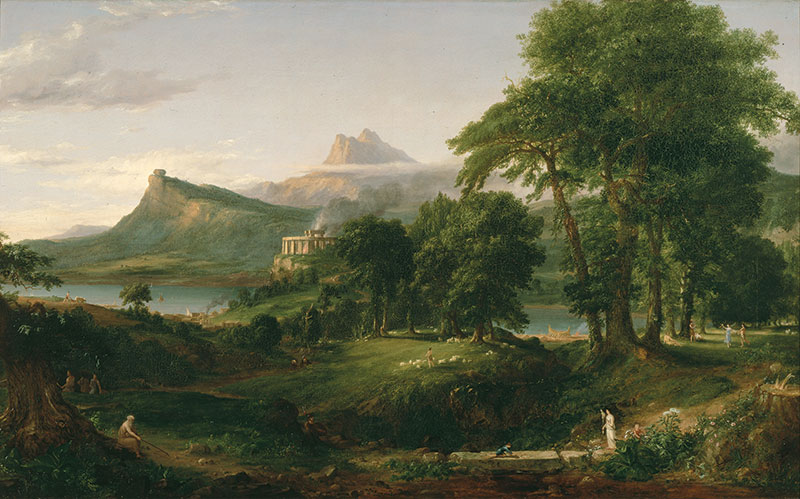
The Arcadian or Pastoral State, the second painting in The Course of Empire by Thomas Cole, 1834. Note  the size of the human figures in relation to the landscape. (Courtesy of the New York Historical Society.)
The Arcadian or Pastoral State, the second painting in The Course of Empire by Thomas Cole, 1834. Note the size of the human figures in relation to the landscape. (Courtesy of the New York Historical Society.)
Perhaps nowhere is this more in evidence than in the magnificent and magnificently large Hudson River School paintings of Thomas Cole, Asher Durand, and Frederic Church, men whose canvases functioned in their day the way blockbuster movies do in ours. People actually paid to see these cinemascopic paintings that gave testimony to the verdant lushness of the Catskills and to its providential glory. In these lush landscapes, man was always subordinate, both literally and figuratively. He was a small dot dwarfed by nature. Cole’s great five-painting series from the 1830s,The Course of Empire, which depicts one landscape through history, illustrates what happens when man asserts himself against nature. What happens is destruction and desolation.

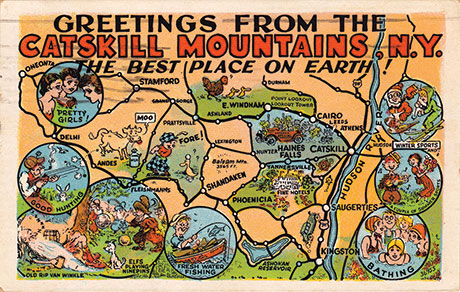
Vintage postcard from “the best place on earth,” ca. 1950s–1960s.
The Jews who came to the Catskills didn’t fit neatly into this schema. They didn’t want to ruin nature, but they didn’t exactly come to commune with it either. There had been Jewish farmers in the Catskills from the 1770s, though it was an improbably difficult place to raise crops.  A Jewish agricultural community in Ulster County in the 1830s lasted only five years. (One feels a Borscht Belt joke coming, but Henny Youngman and his colleagues didn’t do history.) By the last quarter of the century, farming had faded, and the Catskills had become a recreation retreat with monumentally large hotels perched on the mountainsides and a railroad disgorging guests directly from New York City.
But not Jews. The hotels were restricted—so restricted that in 1877 even the prominent Jewish banker Joseph Seligman, a peer of John Jacob Astor and Andrew Carnegie, and a friend of President Grant, was denied a room at the Grand Union Hotel, on the edge of the Catskills in Saratoga Springs. He wrote an indignant letter to the hotel’s owner, and their exchange was picked up by newspapers across the country, triggering a brief national debate on anti-Semitism. It was a debate the Jews lost. If Gentiles were going to God’s country to relax, the last thing they seemed to want was to have communicants with the God of the Old Testament there with them.
When Selig Grossinger, a Galician immigrant with a fourth-grade education who had failed at everything at which he had tried his hand, came to the Catskills in the 1910s, he had no intention of opening a hotel for Jews. Not heeding the warnings of history, he bought a farm in Sullivan County. After failing yet again, he converted his farm into a boarding house catering to Eastern European Jewish immigrants from New York City. Usually they stayed either at boarding houses or at what were called kuchalayn, where one cooked one’s own food in bare rooms with few amenities, aside from the beauty of the outdoors.
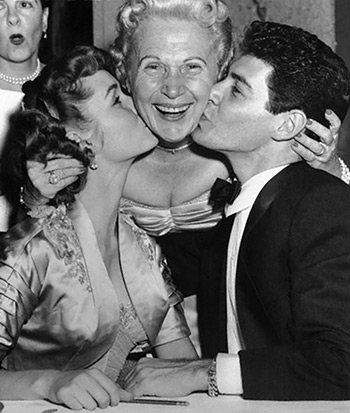
Jennie Grossinger with Debbie Reynolds and Eddie Fisher at Grossinger’s Catskill Resort Hotel, mid-1950s.
Grossinger’s evolved into something very different, both from the kuchalayn and from the Gentile resorts. Run by Selig’s daughter, Jennie, who would become the grande dame of the Borscht Belt by recognizing that Jews enjoyed opulence no less than Gentiles, Grossinger’s was somewhat overwrought in the American-Jewish tradition of too-muchness, where more was always more. It had tennis courts, an 18-hole golf course, a 400-seat dining room, and a theater. But, as Silverman and Silver describe it, that didn’t seem sufficient, so Grossinger’s kept growing and adding: a newspaper, a fire department, a shul, a riding academy, a ski slope, a post office, and, perhaps the pièce de résistance, an airfield.

Belying its Jewish grandiosity, however, was its gemütlich atmosphere, which was also prototypically Jewish. By contrast, Silverman and Silver quote historian Samantha Hope Goldstein on 19th-century Gentile activities in the Catskills: “sketching, writing poetry, strolling . . . and other focused activities which emphasized a refined passivity,” which she attributed to the old Hudson School idea that a visitor there was a “vessel to receive the greatness of God through His landscapes.” The Gentiles came to the Catskills to glory in nature; the Jews came for something else. For them, the Catskills were not nature idealized; it was Jewish family life idealized, which is why it was no coincidence that the two greatest Jewish resorts, Grossinger’s and its rival, The Concord, were run by women, basically Jewish mothers fussing and tut-tutting over their guests. More, for Jews, the Catskills resorts weren’t only an escape from the crowded city; they were also an escape into—into the Jewish community of friends and relatives, many of whom would return year after year after year, underscoring the sense of family on which these resorts were predicated. At Grossinger’s, The Concord, and Kutsher’s, Jews didn’t dissolve their identities into some Whitmanian universal; they asserted it. And for Jews, the last thing they desired was passivity—the Jewish resorts positively buzzed with activity.
As for the God thing, Jews were different from Gentiles there too. For the Gentiles, vacating to the Catskills was all about reverence.  Jews were no less religious; the kitchens were, after all, kosher. But they were less reverent. And maybe that’s where the humor came in. Perhaps, humor was to Jews what gazing upon nature was to Gentiles: a reckoning with God.

As much as anything, the Borscht Belt would become known for the great comedians and comic writers who interned there—among them, Danny Kaye, Phil Silvers, Jerry Lewis, Don Rickles, Red Buttons, Alan King, Sid Caesar, Mel Brooks, and, in later years, Andy Kaufman and Jerry Seinfeld. In short, where Gentiles communed, Jews laughed. Humor was self-protection, negotiation, and balm. You kibitzed with everybody, including God. You had to.
As one old joke goes, a Jew is walking in the forest and, feeling the spirit of God, begins to speak to Him. “God, are you there?” And God says, “Yes my son, I am here.” So the man, in a philosophical mood, says, “God, what is a million years to you?” And God replies, “Well, my son, your million years is like a second to me.” The man lets that sink in. Then he looks to the sky and says, “God, what is a million dollars to you?” And God replies, “My son, your million dollars is less than a penny to me. It means nothing to me.” So the man thinks a moment, then looks up to the sky and says, “God, can I have a million dollars?” And God replies, “In a second.”
Not everyone appreciated this kind of thing. In his novel Enemies: A Love Story, set partly in the Catskills, Isaac Bashevis Singer has his protagonist ask, “Why is it all so painful to me? The vulgarity in this casino denied the sense of creation. It shamed the agony of the Holocaust.” Singer compared the refugees from Nazism who had flocked to the Catskills shortly after the war to moths “attracted by the bright lights, deceived by a false day,” eventually dying by beating themselves against a wall or singeing themselves on light bulbs.
A Hasidic family out for a walk, Woodbourne, NY. (Courtesy of Eli Wohl.)
He wasn’t entirely wrong. It is hard to square the noisy, voluptuary, funny Catskills with the Holocaust, and easy to see it as a kind of willful refutation of Jewish suffering. “It’s so peaceful here at night,” Art Spiegelman says in Mausof the Catskills, “It’s almost impossible to believe Auschwitz ever happened.” To the Singers of the world, it didn’t matter that, in some measure, this was one of the points of the Jewish Catskills: There was no time for reflection there and no desire for it. 
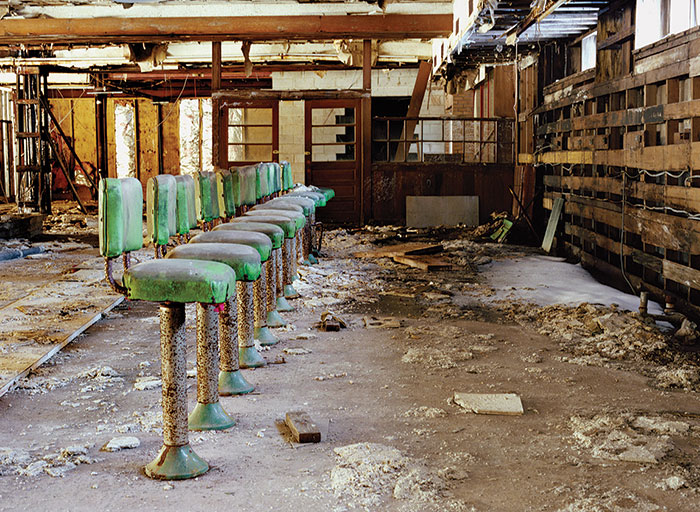
Coffee shop, Grossinger’s Catskill Resort Hotel, Liberty, NY. Bottom: (Courtesy of Marisa Scheinfeld.)E
Coffee shop, Grossinger’s Catskill Resort Hotel, Liberty, NY. Bottom: (Courtesy of Marisa Scheinfeld.)
Phil Brown, in an essay in an anthology he co-edited with Holli Levitsky titledSummer Haven: The Catskills, the Holocaust, and the Literary Imagination, calls the dissonance between American Jews’ summer pleasure and the recent mass extermination of their European cousins a “horrific contradiction,” though it was also, in some ways, cause and effect. Obviously, the great Jewish resorts pre-dated the Holocaust. But the so-called Golden Era of those resorts was the 1950s and 1960s, after the Holocaust. And while the Holocaust made no overt mark on the resorts, it did serve as subtext. As the cliché goes, you laughed so you wouldn’t cry, you played so you didn’t have to contemplate, you gorged to compensate for the European Jews who couldn’t, and you occupied yourself so you wouldn’t have to remember. Brown calls the Catskills a “mini-Jerusalem” where Jews could be Jews. But clearly it was a Jerusalem without grief.
The Borscht Belt wouldn’t last. In part it was a casualty of the very thing that had helped create it. As restricted hotels declined, so did the need for unrestricted ones. At their height, there were some 2,000 hotels in the Catskills. With the rise of assimilation, the need for a mini-Jerusalem, a Jewish refuge, was obviated. Grossinger’s closed in 1982 and was demolished in 1986; The Concord lasted until 1998. Kutsher’s, where Wilt Chamberlain had once been a bellboy, outlasted them all, but it finally closed in 2013 to be converted into a yoga retreat. There was still a Jewish presence in the Catskills after the resorts’ demise. Now, however, it was Hasidim who replaced the secular Jews by buying up some of the old resorts and bungalow colonies, and bringing Yiddish (and a very different kind of Yiddishkeit) to the Catskills.
: Outdoor pool,  Vegetarian Hotel, Woodridge, NY. (Courtesy of Marisa Scheinfeld.)
Outdoor pool, Vegetarian Hotel, Woodridge, NY. (Courtesy of Marisa Scheinfeld.)
But the ghosts remain. Photographer Marisa Scheinfeld has documented the end of the great resorts in The Borscht Belt: Revisiting the Remains of America’s Jewish Vacationland, which features page after page of photos of waterless, cracking pools, dirt-caked floors, weathered and withered wooden cottages, gashed ceilings and gushing insulation, graffiti-bedecked walls, rows of bereft beach chairs, and, perhaps above all, emptiness where there had once been fullness. Scheinfeld’s photos remind one of the old Catskills’ theme of nature despoiled, a contemporary counterpart to the desolate final painting in Cole’s The Course of Empire.
It is hard to imagine a place once so overstuffed with life now so devoid of it. Scheinfeld’s photos are images of desolation, and one feels the urge to mourn the loss of these “mini-Jerusalems,” but perhaps that wouldn’t quite be in the Grossinger’s spirit. As Silver and Silverman inform us, when it finally came time to demolish the great resort’s playhouse, Eddie Fisher, who had debuted there, pushed the plunger—an old relic dynamiting an even older relic. It feels like the kind of black irony his Borscht Belt colleagues and audiences would have appreciated.