Showing posts with label . . . . #IsraelBookReview. Show all posts

Sunday, September 30, 2018

A Philosophy of Israel Education: A Relational Approach 1st Edition, Kindle Edition by Barry Chazan (Palgrave MacMillan)


This short book is a written analysis of the relational approach that  the Israeli people take to education in their country. This was a nice history of what Israel education was and what it can be.This book develops a new philosophy of Israel education. “Person-centered” Israel education is concerned with developing in individual learners the ability to understand and make rational, emotional, and ethical decisions about Israel, and about the challenges Israel regularly faces, whether they be existential, spiritual, democratic, humanitarian, national, etc. Chazan begins by laying out the terms of the conversation then examines the six-pronged theory of “person-centered” Israel education to outline the aims, content, pedagogy, and educators needed to implement this program. Finally, the author meditates on what a transformation from ethnic to ethical education might look like in this context and others.

This book develops a new philosophy of Israel education. “Person-centered” Israel education is concerned with developing in individual learners the ability to understand and make rational, emotional, and ethical decisions about Israel, and about the challenges Israel regularly faces, whether they be existential, spiritual, democratic, humanitarian, national, etc. Chazan begins by laying out the terms of the conversation then examines the six-pronged theory of “person-centered” Israel education to outline the aims, content, pedagogy, and educators needed to implement this program. Finally, the author meditates on what a transformation from ethnic to ethical education might look like in this context and others.

Barry Chazan is Professor of Education and Founding Director of the Master of Arts in Jewish Professional Studies Program at the Spertus Institute of Jewish Learning and Leadership. He is Emeritus Professor at the Hebrew University of Jerusalem, Israel.

Friday, September 21, 2018

Revolting New York: How 400 Years of Riot, Rebellion, Uprising and Revolution Shaped a City. Neil Smith and Don Mitchell, with Erin Siodmak, Jenjoy Roybal, Marnie Brady and Brendan P. O’Malley (eds). University of Georgia Press. 2018.

First conceived by Neil Smith and posthumously completed by colleagues, Revolting New York: How 400 Years of Riot, Rebellion, Uprising and Revolution Shaped a City offers a collection of essays exploring the history of protest in New York City. Without suggesting that riots always have immediate, obvious results, the volume shows the physical and cultural effects that 400 years of rebellion have had on the landscape of the city


Like any city, New York overflows with alternate histories. After Occupy Wall Street and the flood of protests around the 2016 national election – including citywide marches for Black Lives Matter, the JFK Airport protests and the New School student occupation – New York’s motley history of riots is one well worth visiting. Revolting New York was first conceived by Neil Smith, a CUNY geography professor, and was completed by his students as a collection of essays after his death. At first glance, the book is a representative history of mass political violence in New York. As a project spearheaded by geographers, however, Revolting New York shows the physical and cultural effects that riots have had on the city’s landscape. Smith himself claimed that the uneven development (the ‘production’) of space is an intrinsic aspect of capitalist society, and New York is an exemplary illustration of that principle.

Along those lines, the volume’s lead editor, Don Mitchell, asserts that riots are ‘lightning flashes’ that illuminate ambiguous relationships and social currents that solidify during conflict. Riots are not unruly chaos; rather, the editors argue that through them:


we can see in whose interest the landscape is built and what happens to those who must necessarily be part of it (slaves, working people, immigrants, many women) but who are excluded from its formal mechanisms of power (2).

Those electrifying moments reveal a city’s geography of power, and the realisations they provoke remake that geography into new forms.

Amanda Huron and Raymond Pettit begin Revolting New York with the Dutch traders who claimed land from local Munsee tribes by the Hudson river (originally called the Muhheakantuck) to form New Amsterdam. For colonial New York, the authors show rioting as a carnivalesque, ritualised affair: a temporary suspension of norms that eases social strains and prevents a complete revolution in culture or politics: ‘People acted out fantasies, told moral stories, and played out preferred political outcomes […] Rioting was a safety valve’ (44). Law enforcement was not so formalised in the young United States, and its allegiances and interventions were uncertain. The police were so disorganised and ‘ritual’ riots so established that the 1800s are dotted with protests over worker’s rights or against the aristocracy that held the city hostage for days.

But carnivalesque does not mean peaceful – many early New York riots were slave revolts or their ensuing backlashes, which forged New York’s oft-unmentioned history of race riots. In 1863, for example, growing anger over the American Civil War sparked the infamous Draft Riots. Protesters held a strike against new draft lotteries that escalated into arson, assault and the murder of black New Yorkers in the city streets. That same riot inspired reform of building standards and fire departments, but it also began, as chapter authors Rachel Goffe and Esteban Kelly suggest, ‘the conscription of New York’s ethnic Europeans into an expanded white identity – a project that would consume the city for the next hundred years’ (101).
I

‘The Riots in New York: The Mob Burning the Provost Marshal’s Office’, 1863

After the Draft Riots, the norms of mob action shifted, and the city no longer viewed raucous public protest as legitimate. Beginning in the late 1800s, Revolting New York also documents many ‘police riots’, where New York metropolitan police resorted to disorderly violence for fear of losing control in the streets. Police riots particularly merit mention in Revolting New York as moments where police or activists have tried to redefine what is appropriate for political expression in public. Even the rumour of political action has been enough to spur on authoritarian crackdowns: reports from the Paris Commune and its potential influence on an upcoming labour demonstration incited the January 1874 police riots in Tompkins Square – a cautionary tale for all of us in the age of misinformation. With the formalisation of the New York Police Department (NYPD), their growing anti-labour bent also became clear. As Smith writes: ‘the police represented not so much a neutral body devoted to keeping the peace as an armed arm of the state devoted to protecting class interests already written into law’ (112). The unimpeachable violence of NYPD was entrenched after the 1900 Tenderloin race riot, where cops beat African-American citizens who came to them for protection from white mobs. No officer was indicted.

Around that time, the city government also began consciously reshaping New York’s ‘geography of power’. Only a few years and one mass demonstration of communists after 1874, city engineers planted trees and public amenities so Tompkins Square could become Tompkins Square Park. In the 1930s, these park elements were expanded by Robert Moses, further cementing the park in its new role as a ‘place of leisure and recreation, no longer a space for dissent’ (113). This was only a partially successful project – the park hosted anti-war and anti-gentrification actions in the 1960s and 1980s, and it is still a gathering place for yearly Mayday protests today.

The twentieth century brought a rising tide of radical left groups and unions as industrialisation and urban poverty galvanised workers to organise amidst disasters like the 1911 Triangle Shirtwaist Factory fire. For them, the street was still a valid venue for political action. During the Depression, communist groups planned ‘unevictions’, pulling personal belongings strewn into the streets by landlords back into apartments and homes. Later, groups like the Black Panthers and the Young Lords filled the vacuum left by the city under its ‘planned shrinkage’ policy during New York’s fiscal crisis in the 1970s. Miguelina Rodriguez describes that era of New York geography as pockmarked by ‘antilandscapes’, a term used David Nye and Sarah Elkind in their 2014 book, The Anti-Landscape, to mean ‘spaces that do not sustain life’ 

The 1990s and early 2000s brought renewed struggle as the revitalised city attempted to quash organised spaces, like community gardens, and World Trade Organisation summits drew out mass protests against globalisation. Learning from the Seattle WTO protests, New York police began to employ ‘Miami model’ tactics – pre-emptive arrests, mass surveillance, command-and-control deployment – for reining in protests. (The 2015 report, Suppressing Protest, analyses this approach’s effect on Occupy Wall Street.) These harsh measures forced activists to use different tactics as well, like Reclaim the Street’s raucous street party in the Lower East Side and Occupy’s relief work following Hurricane Sandy in 2012.

The editors of Revolting New York do not insist that riots have immediate radical results – the book is full of disorganised riots, police riots, ‘ritual’ riots that serve to consolidate power at the top or dispel political energy. Their overarching thesis on the space ‘produced’ by riots is unfortunately hampered, however, by the structure of the book. Each section does discuss New York’s general history, but it feels inadequately interstitial, especially for any causes or effects that are riots. As Mitchell admitted in an interview:


The danger in writing the history of a city through protest is that we miss all the organizing that goes into a moment of unrest, and we miss the day-to-day politics that are just as important in shaping a city.

And even where Revolting New York demonstrates connections between riots, I was sceptical sometimes. In the moment, how many rioters would know or remember that a similar event occurred on the same soil a century and a half before? For the academic, I recommend Revolting New York as a useful reference within those limits, as a ‘helpful distortion’ to complement a more complete history of New York or a unified theory of protest (like Zeynep Tufekci’s recent Twitter and Teargas).

That said, while living in the NYC neighbourhood of Crown Heights, I had immense use for Revolting New York as a guide. In its text, I followed the echoes of 1917 Gary Plan student riots to the later Ocean-Hill–Brownsville strikes by the New York City’s United Federation of Teachers in 1968. Accusations of anti-Semitism from the union against local community boards following teacher dismissals led to the splintering of the long-standing Jewish–African-American alliance in central Brooklyn, which in turn fuelled the disastrous results of the 1991 riots in nearby Crown Heights. That splintering is visible today – Crown Heights still has a stark division between its Caribbean-American and Hasidic sections. I had seen the permanent NYPD surveillance posts, facing east on Eastern Parkway outside Lubavitcher headquarters. But the geography alone wouldn’t tell me why.

Monday, September 17, 2018

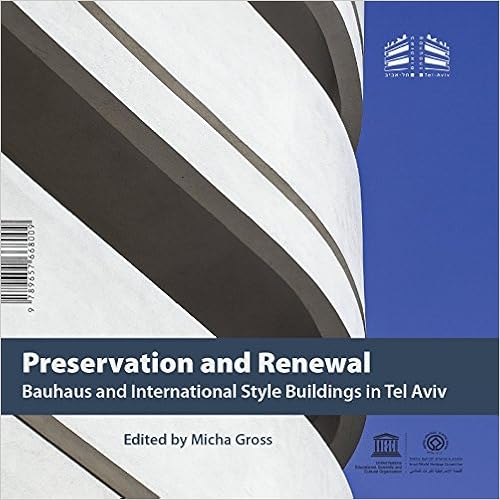
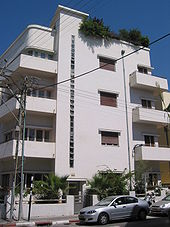
Preservation and Renewal: Bauhaus and International Style Buildings in Tel Aviv Paperback – June 25, 2015 by Micha Gross (ed.) (Author), Micha Gross (Editor) (Bauhaus Center Tel Aviv)


Bauhaus Center's No. 1 Bestselling Book, by Dr. Micha Gross (ed.). The only book dealing exclusively with state-of-the-art renovation in the "White City". The book shows a detailed description of 34 renewal projects realized in the past years by Israel's top preservation architects: Prof. Nitza Metzger Szmuk, Prof. Amnon Bar Or, Gidi Bar Orian and many others.

Languages: English & Hebrew
Format: 308 pages, 6.3" x 6.3" (16 cm x 16 cm), color, many plans and photos, paperback
Publisher: Bauhaus Center Tel Aviv, 2015.


The publication is available from the Bauhaus Center in Tel Aviv https://www.bauhaus-center.com/  The Bauhaus Center contacts walking tours of Bauhaus Buildings in Tel Aviv and has a shop at 77 Disengioff Street, Tel Aviv. The Book can also be purchased  from  Amazon

The White City (Hebrew: העיר הלבנה‎, Ha-Ir ha-Levana; Arabic: المدينة البيضاء‎ Al-Madinah al-Baydha’a) refers to a collection of over 4,000 buildings built in a unique form of the Bauhaus or International Style in Tel Aviv from the 1930s by German Jewish architects who immigrated to the British Mandate of Palestine after the rise of the Nazis. Tel Aviv has the largest number of buildings in the Bauhaus/International Style of any city in the world. Preservation, documentation, and exhibitions have brought attention to Tel Aviv's collection of 1930s architecture. In 2003, the United Nations Educational, Scientific and Cultural Organization (UNESCO) proclaimed Tel Aviv's White City a World Cultural Heritage site, as "an outstanding example of new town planning and architecture in the early 20th century." The citation recognized the unique adaptation of modern international architectural trends to the cultural, climatic, and local traditions of the city. Bauhaus Center Tel Aviv organizes regular architectural tours of the city.


Dizengoff Square in the 1940s


The Bauhaus museum in Tel Aviv


The Bauhause Center in Tel Aviv at 77 Disengoff street , Tel Aviv


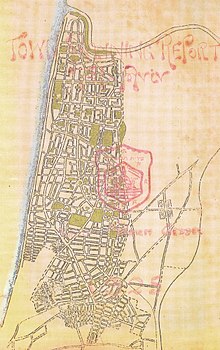
Geddes Plan for Tel Aviv

The concept for a new garden city, to be called Tel Aviv, was developed on the sand dunes outside Jaffa in 1909.Stottish urban planner Patrick Geddes, who had previously worked on town-planning in New Delhi, was commissioned by Tel Aviv's first mayor, Meir Dizengoff, to draw up a master plan for the new city. Geddes began work in 1925 on the plan, which was accepted in 1929. The view of the British Mandatory authorities seemed to have been supportive. In addition to Geddes, and Dizengoff, the city engineer Ya'acov Ben-Sira contributed significantly to the development and planning during his 1929 to 1951 tenure.

Patrick Geddes laid out the streets and decided on block size and utilisation. Geddes did not prescribe an architectural style for the buildings in the new city. But by 1933, many Jewish architects of the Bauhaus school in Germany, like Arieh Sharon, fled to the British Mandate of Palestine. Both the emigration of these Jewish architects and the closing of the Bauhaus school in Berlin were consequences of the rise to power of the Nazi party in Germany in 1933.

The residential and public buildings were designed by these architects, and by architects born locally including Ben-Ami Shulman, who put the principles of modern architecture into practice. The Bauhaus principles, with their emphasis on functionality and inexpensive building materials, were perceived as ideal in Tel Aviv. The architects fleeing Europe brought not only Bauhaus ideas; the architectural ideas of Le Corbusier were also mixed in. Furthermore, Erich Mendelsohn was not formally associated with the Bauhaus, though he had several projects in Israel in the 1930s as did Carl Rubin, an architect from Mendelsohn's office. In the 1930s in Tel Aviv, many architectural ideas were converging and Tel Aviv was the ideal place for them to be tested.


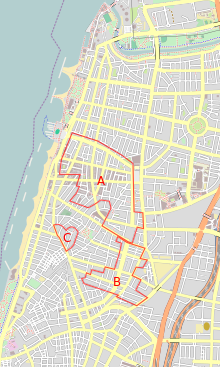
Location map of the three conservation zones included in the WHS listing

In 1984, in celebration of Tel Aviv's 75th year, an exhibition was held at the Tel Aviv Museum of Art entitled White City, International Style Architecture in Israel, Portrait of an Era. Some sources trace the origin of the term "White City" to this exhibition and its curator Michael Levin, some to the poet Nathan Alterman. The 1984 exhibition traveled to New York, to the Jewish Museum. In 1994, a conference took place at the UNESCO headquarters, entitled World Conference on the International Style in Architecture. Credit was given to Israeli artist Dani Karavan who made a sculpture garden at the headquarters, and had earlier made a sculptural environment entitled Kikar Levana that was inspired by the White City.In 1996, Tel Aviv's White City was listed as a World Monuments Fund endangered site. In 2003, UNESCO named Tel Aviv a World Heritage Site for its treasure of modern architecture.


Adaptation to local climate


Cinema Hotel, formerly an International Style movie theater built in the 1930s

However, the architecture had to be adapted to suit the extremes of the Mediterranean and desert climate. White and light colors reflected the heat. Walls not only provided privacy but protected against the sun. Large areas of glass that let in the light, a key element of the Bauhaus style in Europe, were replaced with small recessed windows that limited the heat and glare. Long, narrow balconies, each shaded by the balcony above it, allowed residents to catch the breeze blowing in from the sea to the west. Pitched roofs were replaced with flat ones, providing a common area where residents could socialize in the cool of the evening.


The Engel House by architect Zeev Rechter, 1933. A residential building that has become one of the symbols of Modernist architecture. The first building in Tel Aviv to be built on pilotis.

Buildings were raised on pillars (pilotis), the first being the 1933 Engel House designed by Zeev Rechter.These allow the wind to blow under and cool the apartments, as well as providing a play area for children. In 1935, at the office building Beit Hadar, steel frame structure was introduced, a technique which facilitates opening the first floor for such purposes.

The style of architecture and construction methods used in the hundreds of new buildings came to define the character of the modern city. Most of the buildings were of concrete (reinforced concrete was often applied from 1912 on) and in the summer were unbearably hot despite their innovative design features. Tel Aviv’s residents took to the streets in the evenings, frequenting the numerous small parks between the buildings and the growing number of coffee shops, where they could enjoy the evening air. This tradition continues in the café society, and nightlife of the city today.

The apartment blocks provided a variety of services such as childcare, postal services, store, and laundry within the buildings themselves. Additionally, having a connection to the land was viewed as extremely important, so residents were encouraged to grow their own vegetables on an allotment of land set aside next to or behind the building. This created a sense of community for the residents, who were in the main, displaced people from differing cultures and origins.


Preservation plans


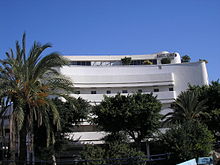
Classical Bauhaus building with "thermometer" windows


Classical Bauhaus building - "The Thermometer House" named after the shape of its windows

Many of the buildings from this period, some architectural classics, had been neglected to the point of ruin, and before legislation was passed, some were demolished. However, out of the original 4,000 Bauhaus buildings built, some have been refurbished and at least 1,500 more are slated for preservation and restoration.The municipal government of Tel Aviv passed legislation in 2009 that was supposed to cover some 1,000 structures. In 2015 the German government and the city of Tel Aviv entered into an agreement under which Germany would contribute 2.8 million euros ($3.2 million) towards the preservation project over a ten-year period; some of the money would be used for the establishment of a preservation center in Tel Aviv's Max-Liebling House to foster collaboration among architects, craftsmen and artists.


Documentation and exhibitions

The widest architectural survey of the White City has been held by Nitza Metzger Szmuk. It was later transformed into a book and an exhibition called "Dwelling on the Dunes". The exhibition was originally held at the Tel Aviv Museum of Art in 2004 and then traveled to Canada, Switzerland, Belgium and Germany.

On occasion of the 100 years since the city's founding, Docomomo International published Docomomo Journal 40 in March 2009, with most of the coverage in the journal on "Tel Aviv 100 Years: A Century of Modern Buildings."


Bauhaus Center Tel Aviv

For a broader coverage of this topic, see Bauhaus Center Tel Aviv.

Established in 2000, Bauhaus Center Tel Aviv is an organization dedicated to the ongoing documentation of the architectural heritage.In 2003, it hosted an exhibition on preservation of the architecture that showcased 25 buildings. The Center is also an independent publishing house on the topics of Bauhaus and International Style architecture and the city of Tel Aviv. As of 2017, it has published more than 15 titles on these subjects.


Bauhaus Museum

A small Bauhaus Museum was opened in Bialik Street, near the old City Hall in 2008.

Saturday, August 25, 2018

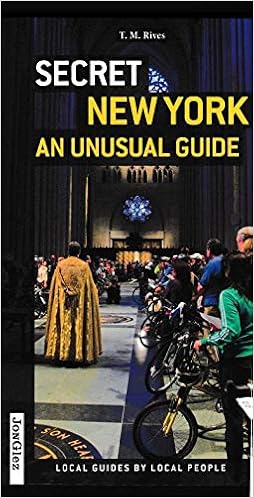
Secret New York - An Unusual Guide: Local Guides by Local People Paperback – July 17, 2012 by T.M. Rives (Jonglez Publishing)

The title is apt - this is truly an unusual guide. It contains a wealth of information about unusual or relatively unknown sites in the great metropolis that is New York City. Undeniably, here are some places which this reviewer did already know; but more importantly, here are vast numbers of places which were totally unknown to him. It is a wee bit Manhattan-centric; but then, so are most guidebooks. The book should be required reading for those who want to see New York properly, and really understand what the City is all about (along with many other books!).


The book is arranged so that each odd-numbered page has the text about the site, while the preceding even-numbered page has a color picture. Many of the places are hard-to-notice details in an otherwise well-known building, museum or statue. Invariably there will be places which hold little interest for some - the "Kymaerica Plaque" in the East Village, which "commemorates" an "event" which "occurred" in "another dimension," is hardly a must-see site for people with an interest in history, architecture, art, religions, sociology, anthropology, or other conventional obsessions! In fact, this "plaque" itself as much "in another dimension" as the event that it "commemorates" - even the very building, in whose stairwell it allegedly is located, is nonexistent, as there is no 83 Avenue A (81 and 85 are next-door neighbors). But a reader who overlooks this nonsensical mumbo-jumbo will find a huge number of fascinating entries, many of which, at least with this reviewer, provoked constant trips to the computer to check things on the Internet. Even so, in a city like New York, there are definitely lots more places to cover!

The one gripe for this reviewer is on page 411. As a proud Jew, this reviewer feels offended by the condescending remarks about the Jewish religion's rules for Shabbos (the Sabbath); this is especially since the book contains no condescending remarks about Christianity, Hinduism or even Islam, all of which have places of worship referenced. The eruv, a symbolic fence that allows religiously observant Jews to carry objects outside their private home on Shabbos, is totally unobtrusive and unnoticeable even to those who search for it. The text implies that non-Jews are annoyed by this, when, in fact, apart from anti-Semites, the only ones who are annoyed are some anti-religious Jews, who often incite the anti-Semites against the Jews. This entry should be deleted in the next edition, because the eruv is totally lacking in interest and can virtually not even be seen. Mind you, this is not an accusation of anti-Semitism; the book references three other Jewish sites - the Kehila Kedosha Jenina Synagogue in the Lower East Side (page 75), the old Shearith Israel Cemetery in Lower Manhattan (page 85) and 770 Eastern Parkway (the world headquarters of Chabad/Lubavitch Hassidim) in Brooklyn's Crown Heights (page 407) - with no complaints from this reviewer.

Despite this glitch, this book is absolutely essential for those who desire to see New York better than just the standard tourist sites.

Sunday, August 19, 2018

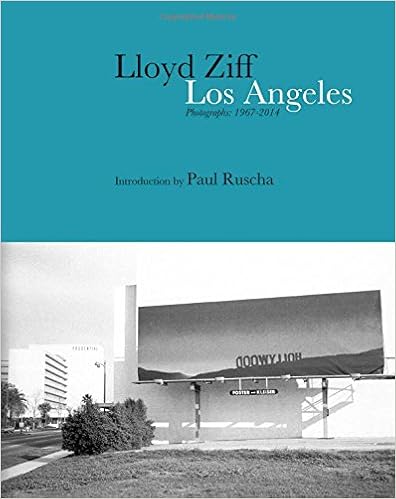
Los Angeles: Photographs: 1967-2015 Hardcover – by Lloyd Ziff (Author), Paul Ruscha (Foreword) (KMW Studio )


Lloyd's photographs hone in on the sometimes-subtle, oft-times overt wonders of everyday California West Coast locales. His landscapes of sand, surf, and the setting sun register in each frame a sense of peace and quiet isolation.

Los Angeles (US: /lɔːs ˈændʒələs/  Spanish for "The Angels"; Spanish: Los Ángeles; Spanish: [los ˈaŋxeles]; officially the City of Los Angeles, known colloquially by its initials L.A.) is the second-most populous city in the United States, after New York City, and the most populous city in the Western United States. With an estimated population of four million,[19] Los Angeles is the largest and most populous city in the state of California and the cultural, financial, and commercial center of Southern California.

Los Angeles is located in a large basin bounded by the Pacific Ocean on one side and by mountains as high as 10,000 feet (3,000 m) on the others. The city proper, which covers about 469 square miles (1,210 km2), is the seat of Los Angeles County, the most populated county in the country. Los Angeles is the principal city of the Los Angeles metropolitan area; with a population of 13.1 million residents it is the second largest in the United States after that of New York City. It is part of the Los Angeles-Long Beach combined statistical area, also the second most populous in the nation with a 2015 estimated population of 18.7 million.

Nicknamed the "City of Angels" partly because of its name's Spanish meaning, Los Angeles is known for its Mediterranean climate, ethnic diversity, and sprawling metropolis. The city is also one of the most substantial economic engines within the nation, with a diverse economy in a broad range of professional and cultural fields. Los Angeles is also famous as the home of Hollywood, a major center of the world entertainment industry. A global city, it has been ranked 6th in the Global Cities Index and 9th in the Global Economic Power Index. The Los Angeles combined statistical area also has a gross metropolitan product of $831 billion (as of 2008), making it the third-largest in the world, after the Greater Tokyo and New York metropolitan areas. Los Angeles hosted the 1932 and 1984 Summer Olympics and will host the event for a third time in 2028.

Historically home to the Chumash and Tongva, Los Angeles was claimed by Juan Rodríguez Cabrillo for Spain in 1542 along with the rest of what would become Alta California. The city was officially founded on September 4, 1781, by Spanish governor Felipe de Neve. It became a part of Mexico in 1821 following the Mexican War of Independence. In 1848, at the end of the Mexican–American War, Los Angeles and the rest of California were purchased as part of the Treaty of Guadalupe Hidalgo, becoming part of the United States. Los Angeles was incorporated as a municipality on April 4, 1850, five months before California achieved statehood. The discovery of oil in the 1890s brought rapid growth to the city.[23] The completion of the Los Angeles Aqueduct in 1913, delivering water from Eastern California, later assured the city's continued rapid growth.

Los Angeles is a superb collection of photographs taken of one of America and the world's most fascinating cities as seen through the eyes of photographer, art director and award-winning designer Lloyd Ziff. Shot over the last 4 decades in classic black and white and contemporary color photography, Ziff's Los Angeles captures the changing landscape of the city's architecture, streets and people as only a seasoned Angeleno can.


Thursday, August 2, 2018

More All-of-a-Kind Family Sydney Taylor Lizzie Skurnick Books 2014 168 Pages $12.95 ISBN: 978-1939601155


Full disclosure: I love the All-of-a-Kind Family! I wish I could be part of the All-of-a-Kind Family! That said, (the reissue of) this book, the second in the series, does not disap­point in any way, even a full sixty years after its original publication. This book follows the further adventures of the five sisters and one little brother of the All-of-a-Kind family, and their extended family and friends. This time, the plots include a romance between Uncle Hyman and “greenhorn” Lena and another romance between oldest daughter, Ella, and Jules. There’s the polio epidemic that sweeps through New York City and ends up touching one of the book’s central characters in a major way. There’s the move from the Lower East Side up to the Bronx, which ends the book. And throughout, there are all the Jewish customs to savor and the holidays to celebrate together. Mostly the story is a quiet one, comprised of a series of small, intimate, and lovely moments—the book is old-fashioned in the best sense. Overall, it’s awfully hard to resist the charm of this early twentieth-century family. Highly recommended for ages 8-12.

Tuesday, July 31, 2018

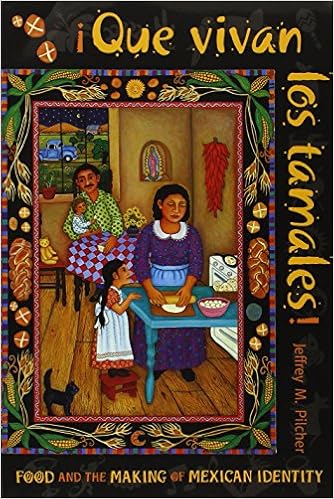
Que vivan los tamales!: Food and the Making of Mexican Identity (Diálogos) Paperback Jeffrey M. Pilcher (university of New Mexico Press) (IBRCookBooks)


Connections between what people eat and who they are--between cuisine and identity--reach deep into Mexican history, beginning with pre-Columbian inhabitants offering sacrifices of human flesh to maize gods in hope of securing plentiful crops. This cultural history of food in Mexico traces the influence of gender, race, and class on food preferences from Aztec times to the present and relates cuisine to the formation of national identity.
The metate and mano, used by women for grinding corn and chiles since pre-Columbian times, remained essential to preparing such Mexican foods as tamales, tortillas, and mole poblano well into the twentieth century. Part of the ongoing effort by intellectuals and political leaders to Europeanize Mexico was an attempt to replace corn with wheat. But native foods and flavors persisted and became an essential part of indigenista ideology and what it meant to be authentically Mexican after 1940, when a growing urban middle class appropriated the popular native foods of the lower class and proclaimed them as national cuisine.

Monday, July 30, 2018

The Cholent Brigade Michael Herman; Sharon Harmer, illus. Kar-Ben Publishing 2017 24 Pages $7.99 ISBN: 978-1512408454


On a snowy day, Monty Nudelman shovels the driveways of everyone in the neighborhood. However, come Shabbat, Mr. Nudelman doesn’t show up at synagogue because he hurt his back from all the shoveling. The children of the congregation bring him lots of cholent to make him feel better, and together they enjoy Shabbat lunch. The charming story illustrates community cooperation and individuals helping one another, rendered in a way children can relate to easily with fun and a touch of humor.

The pictures in The Cholent Brigade are expressive and engaging, and show a diverse community of Jews of various colors and levels of observance all working together to perform a deed of loving-kindness for Mr. Nudelman.

The end of the book includes a description of, and recipe for, cholent. The cholent looks delicious and this can be a great introduction to this traditional food for the young readers of this book.

Recommended for children ages 3 to 7.

Sunday, July 29, 2018

Dwelling in Conflict: Negev Landscapes and the Boundaries of Belonging 1st Edition by Emily McKee (Stanford University Press)


The landscape in Palestine, like the land, is a site of political struggle. It is continuously being militarized, walled, and destroyed by a colonizing state. Beginning in 1948, through Zionist settler-colonial practices, the landscape in Palestine was profoundly transformed: villages and cities were destroyed and the Palestinian population displaced. Thus, today, one of the objectives of Palestinian resistance is to reclaim visibility in the landscape and reestablish attachment to it. Emily McKee’s Dwelling in Conflict: Negev Landscapes and the Boundaries of Belonging is an important contribution to research on bedouins’ struggle over their land, landscape, and dwelling practices in the shadow of displacement and coerced urbanization in the Naqab/Negev.

McKee explores dwelling practices of two communities in the Naqab on the margins of the Israeli state: the Arab bedouin township of ‘Ayn al-‘Azm and the Jewish settlement Dganim (both communities’ names are pseudonyms). Historicizing the landscape in the Naqab, McKee describes Israeli state practices and policies that resulted in the displacement of bedouins and the establishment of Jewish settlements. Early government strived to modernize and “Judaize” the desert—its landscape and indigenous population—primarily through agricultural development, which made the settlement of Jewish immigrants possible. In the shadow of such policies, McKee insightfully argues that dwelling, for the bedouins, becomes politicized: dwelling is mastering the art of “patience”—sabr, associated with a slightly subtle form of resistance—and that of “steadfastness”—sumud, a politicized form of national resistance.

Chapter 1 juxtaposes dominant Zionist-Orientalist and counter-Zionist environmental discourses as competing narratives of land claims. Although McKee presents Zionist discourses of religious and national ties to the desert landscape through her conversations with Jewish settlers, she narrates Arab bedouin connection to the land/landscape more extensively. Zionist discourses framed the bedouin in the Naqab as “uncivilized” natives. However, this discourse failed to grant bedouins indigenous claims to land or to recognize their dwelling practices. The Orientalist attribution of “nomadism” enabled Israeli authorities to deprive bedouins of their land claims, and paradoxically, of their mobility. Thus, bedouin relations to the land are “rendered incomprehensible in the Israeli legal system” (p. 48).

In chapter 2, McKee explores the everyday dwelling practices of both the Dganim and ‘Ayn al-‘Azm communities. Although both communities face different forms of state discrimination and seek its redress, McKee is interested in how bedouins narrate the past and protest current legal norms of ownership. A key tension emerges between approaches taken by members of bedouin communities: the first is to seek state recognition and incorporation into the Israeli societal fabric; the second is to contest the state’s Zionist expansive desires in appropriating Arab lands, by producing a nationalist counterdiscourse. This tension is expanded upon in chapter 4, where McKee explores the Dganim community’s history and the pressure of place-making and participation in Zionist aspirations. In the 1950s, Jewish immigrants from India settled in Dganim while the majority of bedouins were expelled. In the years since, a combination of government neglect and agricultural difficulties left Dganim struggling economically. Notably, this did not shift Dganim’s racist discourses against their bedouin neighbors.

Despite the shared experiences of marginalization faced by both communities, McKee demonstrates how the persistence of racial division serves state interests in maintaining separation through both discourse and infrastructure. Regulating dwelling practices in the Naqab meant that the state kept the Jewish and bedouin communities segregated. Despite being on the margins of Israeli society, most Jewish settlements in the Naqab enjoy legal legitimacy while bedouins do not. Successive Israeli government policies of evicting bedouins from their lands and relocating them in townships were carried out despite bedouins’ protests. McKee identifies the repercussion of such practices as “de-cultural accommodation”—the abandonment of collective and tribal affiliations for individual subjectivities, which underlies the premise of inclusion of bedouins in Israeli society. Yet, McKee does not explore this deculturalization as a form of denationalization, through which bedouins are stripped of their Palestinian historical ties.

McKee highlights the tension between bedouin resistance and cultural loss in chapter 3, where she examines the ‘Ayn al-‘Azm community’s displacement and relocation into government-built, crumbling townships. As bedouins remain connected to dwelling through past losses and memories, the significance of traditional kinship ties is replaced with individualist and nuclear family ideals. Yet, despite the relocation, many bedouin cultural practices persist which, McKee explains, function as a form of resistance to state modernization and urbanization.

Engaging with critical questions concerning bedouins as indigenous communities in Israel, McKee attempts to trace how displacement and community-building function in the geographic proximity of a landscape shared by colonized and colonizer, contested through discourses and practices of dwelling that both contextualize and decontextualize belonging. Bedouin dwelling, despite state displacement and relocation, is an act of resistance and an adherence to indigenous ways of living. The author fails, however, to strongly connect practices of displacement of Naqab’s bedouin communities with the wider context of the colonization of Palestine, such as in the occupied Palestinian territories. These linkages were empirically invoked by McKee’s interlocutors, who claimed that Israel’s settlements, expansive policies, house demolitions, and displacement of Palestinians from their homes take place both inside Israel and in the Palestinian territories. The book hints at the racialization of bedouins in Zionist discourses, which invites further investigation, since Zionism is, nonetheless, a racial project.

Saturday, July 28, 2018

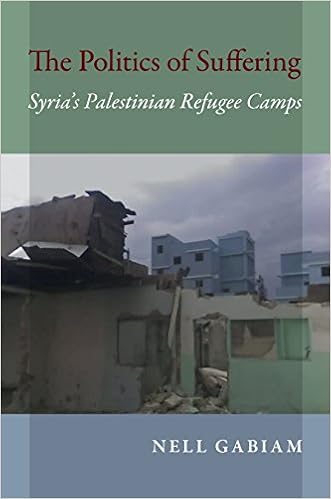
The Politics of Suffering: Syria's Palestinian Refugee Camps (Public Cultures of the Middle East and North Africa) Paperback – May 9, 2016 by Nell Gabiam (Indiana University Press)


As the Syrian conflict shows no sign of resolution, interest in the country’s Palestinian population has rarely been higher. Anthropologist Nell Gabiam’s first monograph provides an ethnographic study of three Palestinian camps in Syria— Yarmouk, Ein el Tal, and Neirab—in the immediate prewar period. Following two years of fieldwork and voluntary work in these camps, she uses UNRWA’s Neirab Rehabilitation Project as a case study for evaluating how international development is tied to refugee politics. Running from 2000 until the Syrian war halted it in 2012, this project was driven by UNRWA’s shift from relief to development.† UNRWA used the project to test the feasibility of sustainable development in Palestinian camps, by relocating refugees from crumbling 1940s barracks in Neirab to brand new housing in Ein el Tal.

While Gabiam’s evaluation of development has broad significance, her analysis remains firmly grounded in the Palestinian context. She takes as her starting point the loaded nature of the very idea of development for Palestinian refugees anxious about permanent resettlement. The Neirab Rehabilitation Project is an ideal case study in this regard, as the refugees’ concerns about its longterm implications make the project emblematic of the camps’ political symbolism. If living in a camp symbolizes belief in the right of return, projects designed to relocate refugees permanently can be seen as encouraging the abandonment of this ideal.

Gabiam’s nuanced study of Syria’s Palestinian community is an engaging and informative read, highlighting the variations between Neirab and Ein el Tal. Her ethnographic research methodology enables her to interweave broader analysis with personal anecdotes and accounts. This adds depth and distinction to what might otherwise be a dry study of development politics. However, the study of Yarmouk—included as an example of a Palestinian camp that has undergone successful urban development—feels detached and could be better integrated into the rest of the text.

While The Politics of Suffering: Syria’s Palestinian Refugee Camps makes few groundbreaking new arguments, its contributions to the field come in other forms. Most importantly, Gabiam devises a new analytical framework around the “politics of suffering” and the “politics of citizenship.” The former denotes “the ways in which suffering becomes a means—whether deliberately or not— of attaining political legitimacy and rights” (p. 9). She observes that the Palestinian refugees tend to adhere to this, persistently rejecting the standard humanitarian presentation of their plight as detached from politics. Meanwhile the Western-dominated international community largely promotes the † UNRWA, the United Nations Relief and Works Agency for Palestine Refugees in the Near East, was founded in 1949. —Ed. Recent Books Summer 2017 || 117 “politics of citizenship,” supporting programs and policies that “enabl[e] individuals to attain the social privileges associated with citizenship, if not citizenship itself” (p. 9). This can go hand in hand with undermining the refugees’ connection to their homeland, leaving many suspicious of the motives behind it. Gabiam thus contends that these two different “politics” are essentially in conflict in the camps. With this framework she crystallizes themes previously discussed by fellow anthropologists Ilana Feldman and Julie Peteet.

Gabiam’s second major contribution to the field is her detailed analysis of UNRWA, arguing that its ambivalent relationship with the Palestinians is grounded in the fact that UNRWA is “not a monolith [but] a hybrid characterized by the overlap of the Western-dominated political order that oversaw its creation and the very Palestinian refugees it was created to assist” (p. 61). She uses UNRWA’s hybrid nature to explain its conflicting objectives, as it encompasses crisis, relief, and development tasks simultaneously to satisfy the multiple demands placed on it from all sides. Given the usually fleeting attention paid by scholars to UNRWA’s dynamics, this is especially valuable.

In focusing on a relatively small-scale UNRWA project, The Politics of Suffering takes an unusual approach to the well-worn genre of Palestinian refugee camp politics. This is typical of the series to which it belongs: Indiana University Press’s “Public Cultures of the Middle East and North Africa” seeks to produce nontraditional studies that reframe understandings of the region. Despite this, Gabiam’s work is still wedded to the conventional research question (p. 2), what is it that makes a place a camp? In fact, her more interesting analyses emerge not from this conceptual frame but from her observations of quotidian life in the camps. For example, Gabiam’s descriptions of the refugees’ cumbersome trips from Ein el Tal to Aleppo to buy basic necessities effectively depict the daily struggles of refugee life. This may be indicative of new research directions in the field, building on Diana Allan’s critique of the insufficient scholarly engagement with camp residents’ everyday concerns.


The relevance of Gabiam’s study extends beyond the Palestinian field and also encompasses development and refugee studies. For Palestine-focused scholars, its greatest value lies in how it illuminates Palestinian camp life in prewar Syria, a host country that has often been overlooked in favor of Lebanon. Overall, this is a well-researched and well-written account of Palestinian life in Syria at what turned out to be a historically critical time. While Gabiam does not craft new insights or overturn key preconceptions, she effectively frames and articulates some of the underlying themes that have long been central to the situation of Palestinian refugees.

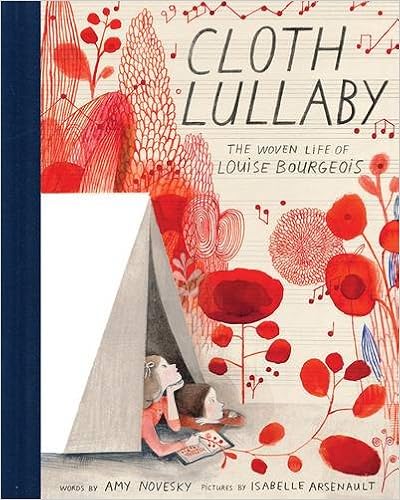
Cloth Lullaby: The Woven Life of Louise Bourgeois Hardcover – March 1, 2016 by Amy Novesky (Author), Isabelle Arsenault (Illustrator) (Abrams Books for Young Readers )


This picture book biography of artist Louise Bourgeois (1911–2010), who was best known for her installation art and sculpture, highlights the roots of her inspiration. Through text and images, the author and illustrator emphasize the aspects of Bourgeois's childhood that influenced her: the river that flowed past her house, the colors of the flowers and plants in the garden, the "web of stars above her," and her nurturing mother, who taught her how to weave and repair tapestries. Novesky makes excellent use of simile ("Her family lived in a big house on the water that wove like a wool thread through everything.") and alliteration ("She taught her about the warp and the weft and how to weave."). Bourgeois's mother is also compared to a spider—"a repairer of broken things." As the story progresses, the images of flowers and plants, the cloth, and the water become larger, sometimes taking up most of the page. The perspective also changes, as readers see what Bourgeois saw as a young girl—the beauty of nature, her mother at work, and the tools her mother used—and, finally, her creations: giant spiders and webs, spirals and circular webs, and cloth drawings and books. VERDICT An inventive introduction to the work of a celebrated artist and a useful mentor text for exploring how language and imaginative, varied illustrations can work together to convey an idea

Louise Bourgeois (1911–2010) was a world-renowned modern artist noted for her sculptures made of wood, steel, stone, and cast rubber. Her most famous spider sculpture, Maman, stands more than 30 feet high.


Just as spiders spin and repair their webs, Louise’s own mother was a weaver of tapestries. Louise spent her childhood in France as an apprentice to her mother before she became a tapestry artist herself. She worked with fabric throughout her career, and this biographical picture book shows how Bourgeois’s childhood experiences weaving with her loving, nurturing mother provided the inspiration for her most famous works. With a beautifully nuanced and poetic story, this book stunningly captures the relationship between mother and daughter and illuminates how memories are woven into us all.

Thursday, July 26, 2018

September Paperback – April 17, 2018 by Rosamunde Pilcher (A Thomas Dunne Book for St. Martin's Griffin)


September, by author of The Shell Seekers Rosamunde Pilcher, is another book in a long line by this author which most readers will enjoy thoroughly. Set in Scotland, this book focuses on several people gathering together to celebrate the 21st birthday of a local girl. While firmly set in the present through the use of flashbacks, we come to know these people and the events which bring them to this point in time.

Among the various people gathering members and friends of two well known families of the village. Archie Balmerino is a major landowner of the area who is a Lord rather down on his income. During a military exercise he suffered a tragedy which has altered his chance for a livelihood once he left the military as well as leaving him emotionally fragile. Isobel his loving wife hosts tourist families during the season at their stately home while their daughter travels the continent trying to find a place for herself. And then there is Pandora, Archie's sister who left the family home at 18, and is only now returning after 20 years to be with family and friends before it is too late.
The Aird family includes Violet, the 78 year old matriarch of the family and a woman reminiscent of Penelope Keeling from The Shell Seekers. Her prosperous son Edmund is married to his second wife Virginia although he has a secret he never shared with her which is now threatening to undo them. Alexa is Edmund's daughter from his first marriage who now finds happiness with an older man and Henry the progeny of the Airds second marriage is about to leave for boarding school at the tender age of 8 which upsets Virginia greatly. And seeing over this family is Edie who as Mrs. Aird's housekeeper cares for all of them as if they were her own

Tuesday, July 17, 2018

The Lost World Audible Audiobook – Unabridged Michael Crichton (Author), Scott Brick (Narrator), Books on Tape (Publisher) (Books on Tape)


Here's how to write a Michael Crichton best seller in five easy steps: 
Text:

1. Pick a hot-button subject like genetic engineering ("Jurassic Park"), sexual harassment ("Disclosure") or Japan's threat to America ("Rising Sun") and use it to lend your novel a glossy veneer of topicality.

2. Cast the novel with some really detestable villains (like the lying, scheming, man-eating Meredith Johnson in "Disclosure") and some really nice, appealing heroes (like Meredith's poor, well-meaning victim, Tom Sanders) so inattentive readers will automatically know whom to root for.

3. End each chapter on a scary, cliff-hanging note to make sure that readers will keep reading, regardless of the characters' vapidity.

4. Include lots of frantic chase scenes or race-against-the-clock scenes that will translate graphically to the screen.

5. Put plenty of technical, pseudo-specialist talk (about computers, medicine, biology or chaos theory) into your characters' mouths to give readers the illusion that they're learning something as they quickly flip the pages.

Certainly Mr. Crichton's latest book, "The Lost World," fulfills all these criteria. It should, after all, as it's basically a retelling of his tried-and-true 1990 best seller, "Jurassic Park," and more or less an outline for what will surely be the movie sequel.

The central hero of "The Lost World," improbably enough, is Ian Malcolm, the cynical chaos theorist Mr. Crichton impetuously killed off in the book version of "Jurassic Park." Mr. Crichton makes no attempt to explain the scientist's mysterious reappearance in this book, though it's safe to say that Malcolm's resurrection probably has less to do with DNA recovery and cloning experiments (the process that brought the dinosaurs back from extinction in "Jurassic Park"), than with the simple demands of making and casting a movie sequel.

Now, Malcolm is not only back, but also headed right to the area where the trouble with the genetically cloned dinosaurs began in the first place. In the opening chapters of "The Lost World," we learn that Jurassic Park has been destroyed, that the story of people being killed by dinosaurs has been hushed up and that InGen, the company behind the dinosaur cloning, has gone bust. One of Malcolm's colleagues, a wealthy paleobiologist by the name of Richard Levine, however, has heard rumors that remnants of the dinosaur project survive on a nearby island, and he decides to organize a search party for this "lost world."

Although Malcolm tries to deny all prior knowledge of Jurassic Park, he allows himself to be drawn into Levine's plans. Rounding out their team are Jack Thorne, a former professor of applied engineering who has outfitted Levine with all sorts of high-tech gadgets; Sarah Harding, Malcolm's former girlfriend, who happens to be an expert on animal behavior, and two children, Arby and Kelly, who stow away on the trip. In other words, a virtual reconstitution of the team of good guys who starred in "Jurassic Park."

Pitted against Malcolm and company is the evil Lewis Dodgson, who started all the trouble in "Jurassic Park" by paying one of the park's employees to steal some dinosaur embryos. Dodgson is still eager to get his hands on some dinosaur babies: unlike the good guys who want to study the dinosaurs for the advancement of science, Dodgson regards them as a simple product that can make him rich. He and his weaselly underlings also set off to find the lost world of the dinosaurs.

Having set up this basic mise en scene, Mr. Crichton proceeds to give the reader a tired rehash of "Jurassic Park," one so predictable and unimaginative that it seems to have been intended to save special-effects technicians the hassle of doing new work on the movie sequel. Once again, we see a hungry tyrannosaur snack on one of the bad guys. Once again, we see some voracious velociraptors chase the good guys around. And once again, we see the good guys escape, thanks to the savvy of the children. As in "Jurassic Park," there are lots of scenes of dinosaurs romping about a scenic island and lots of scenes of man's technology succumbing to the raw force of nature. All, needless to say, without the surprise or ingenuity that made "Jurassic Park" entertaining the first time around.

Mr. Crichton has never exactly been known for his attention to character, and "The Lost World" must surely represent a new low in this area. Take, for instance, Ian Malcolm, who was played by Jeff Goldblum in the movie. Except for complaining about the injuries he suffered in "Jurassic Park," Malcolm makes virtually no reference to his previous visit to dino-land: we are not even given any insight into his feelings about returning to the place where he (nearly) died. Given Malcolm's irreverence, it seems hard to believe that he would abide by "nondisclosure agreements" with InGen or the Costa Rican Government, or that he would feel indebted by InGen's payment of his medical bills. Had he -- or Lewis Dodgson, for that matter -- really needed to make money, they could have simply written a book about their experiences in Jurassic Park, gone on the talk-show circuit and made a fortune.

Instead of even making a half-hearted attempt to turn Malcolm into a reasonable facsimile of a person, Mr. Crichton cynically uses him as a mouthpiece for all sorts of portentous techno-babble about chaos theory, extinction theories and mankind's destructive nature. As for the other characters, they are each given handy labels for easy identification. We know that Sarah is a feminist because she's less afraid of the dinosaurs than the men are. We know that Arby and Kelly are resourceful children because they're better at using computers than the adults are. And we know that Dodgson is an evil opportunist because he goes to a dinosaur nest and tries to steal eggs belonging to a loving pair of tyrannosaurs.

In the past, Mr. Crichton has been credited with inventing the "techno-thriller," a term given new meaning by "The Lost World": namely, a novel with lots of technology, lots of technical talk and not one recognizable human being.

NEW FEDERALIST PAPERS Essays in Defense of the Constitution. By Alan Brinkley, Nelson W. Polsby and Kathleen M. Sullivan. 179 pp. New York: A 20th Century Fund Book/ W. W. Norton & Company. $23.


The authors do their best imitations of Madison, Hamilton and Jay

The men who assembled at the Constitutional Convention of 1787 had a daunting goal: to create a new Federal Government that would knit together jealously independent states. They had to be optimists, but they would surely be astonished at the success of their creation.

How ungrateful we are today for the miracle of their governmental structure. We live in a time of political discontent that goes even to our basic institutions. Radicals in Congress, calling themselves conservative, press for major surgery on the Constitution. Some demand an end to the judicial independence that has assured our freedom. The very idea of the Federal Government is treated with contempt.

This contemporary assault on our system led the 20th Century Fund to commission ''New Federalist Papers,'' essays in defense of the Constitution by Alan Brinkley, Nelson W. Polsby and Kathleen M. Sullivan, respectively professors of history at Columbia University, political science at the University of California, Berkeley, and law at Stanford. As the title of the collection indicates, the authors go back to first principles -- to the arguments made in the Federalist Papers to save the Constitution from defeat in the state ratifying conventions to which it was submitted.

We are mostly unaware now what a close thing ratification was. Americans had just carried out a revolution against the centralized power of an English king. Many feared that the proposed new Federal Government would bring tyranny again.

Defenders of the Constitution responded to that fear with what Bernard Bailyn of Harvard has called ''one of the great surges of creative political thought in Western history,'' most of all in the articles that constitute the Federalist Papers. This collection, by James Madison, Alexander Hamilton and John Jay, was produced mainly for newspaper publication, at the astounding average rate of 1,000 words a day for over six months. Yet it is rightly compared to the work of the greatest political philosophers.

The Federalist Papers' answer to the fear of power was that safety lay, as Madison put it, in ''the extent and proper structure'' of the proposed Federal Government. The very size and diversity of its constituent states and populations would make it safer than smaller, more homogeneous polities because ''the greater variety of parties and interests'' would prevent a passing political passion from overwhelming the system. A second defense against political extremism was that the constitutional system was not a direct democracy, with all the dangers of popular emotionalism, but a republic -- in which the people's views would be filtered through elected representatives.

But it was the governmental structure, the most ingenious of the Framers' creations, on which the Federalist Papers most heavily relied as assurance against abuse of power. Authority was divided between the states and the national Government. And within the latter there was the separation of powers among the three branches -- executive, legislative, judicial -- each on guard against overreaching by the others.

The wisdom of the Framers has been proved so often over 200 years that it should not be necessary to examine their views again. But it is necessary, as ''New Federalist Papers'' makes plain. For those who are attacking the constitutional system now make some of the same arguments that were made against the Constitution at the beginning -- in corrupted form.

Thus we are told that the Federal Government is inherently evil, that its functions should be turned over to the states. But for the reasons that Madison and his colleagues saw, it would be exactly wrong -- unsafe -- to leave Americans to the mercies of the separate states. Moreover, the cry for ''states' rights'' is hypocritical, in fact masking a desire to advance particular interests. The same people who denounce Federal power have federalized ordinary criminal law to an extent that would have appalled the Framers, and demand that tort law -- always a province of the states -- be federalized to protect corporate defendants from large judgments.

Brinkley explains how we have lost what was the premise of 1787: the belief that government can work. Fewer and fewer citizens perform their essential duty -- voting. Most see politics on a television screen, and regard it as a closed world ''in which nothing is real and nothing is true.''

Public contempt for government, he says, produces a vicious circle that makes government worse. Suspicion of scandal immobilizes bureaucracies. Official discretion is feared, so that we surround every potential decision with conditions that prevent action.

Sullivan examines the current attempts to impose social or economic policies by amending the Constitution. We tried that once before, she notes, with the Prohibition amendment: not a happy precedent. If we had had a balanced budget amendment in force for the last 50 years, she says, ''the nation's economic health would be a great deal weaker now.''

POLSBY asks Americans, movingly, to think about how well we have done in governing a continental nation: ''If one accepts the premise that tribalism is a human universal, then the incarceration of Japanese-Americans in World War II, the exclusion of Jews from universities and the professions in the 1920's and 1930's, the ruthless persecution of Mormons, the removal of Indian tribes and the maintenance of a brutal, racial caste system in the pre-1960's South seem less remarkable than the eventual alleviation, reversal or abandonment of all these social policies by the American political system.''

It is not possible to give more than a few examples of the themes in ''New Federalist Papers.'' Some of it examines particular issues of only passing interest. But there is much here that goes to the roots of our political system and its present illness.

The authors do not offer easy remedies, and I do not suppose there are any. But the more Americans read and understand this wise book, the healthier our political society will be. We might become less cynical about politics. We might be less susceptible to political quackery about the evil of the United States Government.

Audible Sample Audible Sample Jane Eyre (AmazonClassics Edition) Audible Audiobook – Unabridged Charlotte Brontë (Author), Susan Ericksen (Narrator), Brilliance Audio (Publisher) (Brilliance Audio)


The Pinnacle of the Gothic Romance

Gothic romance, type of novel that flourished in the late 18th and early 19th cent. in England. Gothic romances were mysteries, often involving the supernatural and heavily tinged with horror, and they were usually set against dark backgrounds of medieval ruins and haunted castles. The Castle of Otranto by Horace Walpole was the forerunner of the type, which included the works of Ann Radcliffe , Matthew Gregory Lewis , and Charles R. Maturin , and the novel Frankenstein by Mary Shelley . Jane Austen's novel Northanger Abbey satirizes Gothic romances. The influence of the genre can be found in some works of Coleridge, Le Fanu, Poe, and the Brontës. During the 1960s so-called Gothic novels became enormously popular in England and the United States. Seemingly modeled on Charlotte Brontë's Jane Eyre and Daphne du Maurier's Rebecca, these novels usually concern spirited young women, either governesses or new brides, who go to live in large gloomy mansions populated by peculiar servants and precocious children and presided over by darkly handsome men with mysterious pasts. Popular practitioners of this genre are Mary Stewart, Victoria Holt, Catherine Cookson, and Dorothy Eden.

The Gothic romance is a staple of English literature, but none is as successful in this genre as Emily Bronte's Wuthering Heights. She excels in capturing the essential ingredients of any novel: plot, character, and setting. She is particularly adept at creating a rich world of fascinating characters, and the various settings in which the action takes place are so deeply described that they become characters as well.

This is a strong and powerful book that deservedly has withstood the passage of time. It has been the subject of several movies, but, alas, none of the movies capture the intensity and richness of the novel. Unfortunately, they tend to distort the book rather than represent it. This is a book that demands to be read. There is a reason this text is considered part of the Western literary canon, and it is so often assigned reading. What must not be overlooked, however, is the thoroughly entertaining nature of this book. It is not another dreary assignment to be drudged through. The tempestuous romance that drives this novel must be emphasized.

Although the text itself presents a rich tapestry on its surface, it reveals an even greater depth when the covers are pulled back for a deeper analysis of the novel. One point to be noted at the outset are the multiple layers of narration in the book, none of which can be deemed reliable. Even the ostensible master narrator who speaks to the reader is shown to be unreliable as he repeatedly makes mistakes that are pointed out to the reader. What other mistakes does he make that remain unrealized?

With multiple narrators come multiple frames. There is the master narrator, and the bulk of the story is told to him by a servant. This servant's narrative, too, is subject to omission and is tainted by what she wishes to disclose to her auditor. The book's author herself hides behind a pseudonym when the book was published originally. What is hidden and what is revealed? At its deepest level, the novel raises the question of what unambiguously can be known about *any* work of fiction.

Another device that pervades the text is the use of doubling and mirroring of the characters. Characters form pairs that stand in opposition to each other, as well as pairs that resemble each other. The book provides an exceptionally rich ground for an outpouring of analyses and interpretations. Ultimately, however, this novel resists any definitive interpretation. I do not consider this a flaw in a text, but, rather, a factor that makes it more intriguing and interesting.

The edition I read was the Fourth Edition of the Norton Critical Edition. (I recommend choosing the Norton Critical Edition whenever it is an option). This volume includes a selection of contemporaneous reactions to the text, as well as a selection of critical essays. The critical essays are varying in quality. J. Hillis Miller's essay is particularly outstanding, and Lin Haire-Sargeant's essay describing how the novel was translated into its numerous cinematic versions also was helpful. Still, I recommend reading all of the critical apparatus because readers may find other essays more useful. This edition also included a sampling of Emily Bronte's poetry, and she is as able a poet as she was a novelist.

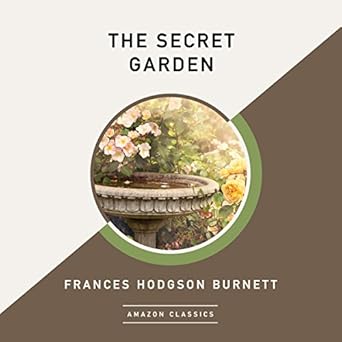
The Secret Garden (AmazonClassics Edition) Audible Audiobook – Unabridged Frances Hodgson Burnett (Author), Susan Duerden (Narrator), Brilliance Audio (Publisher) (Brilliance Audio)


The death of Shirley Temple inspired me to download the movie“The Little Princess” from Amazon Instant movies. And that inspired me to order this unabridged version (but the original edition was called “Sara Crewe or what happened at Miss Minchin's.”) I had not read Princess for three quarters of a century (I am now well over 80) but I never forgot the charming book which I read many times as a child and thoroughly identified with the plucky little Sara, absorbing the atmosphere of foggy London and Sara's dismal attic, being happy with her when things were going well, shedding a tear or two when things were not. One of the scenes that haunted me most as a child was when Sara, cold and hungry, throws Emily, her beloved doll, on the floor and cries “You are nothing but a doll!” She is almost at the end of her tether, but not quite. Also, her giving a beggar child five of six rolls a kindly baker had given the half-starved Sara made a huge impression on me as a little girl. Children immerse themselves in books more thoroughly than an adult, they really live inside the plot, they can and do smell the roses. When Sara was hungry, so was I.

Princess is a whacking good story which allows the tale to rise above being a lesson in morals. Kids don't want to be preached to but given a good story and interesting characters they'll get the point subtly. But that is also true with adults.

Some reviewers have criticized the book because at the end of the story Becky went home with Sara as her maid. Author Burnett, however, is being true to 1899 London. The Cockney Becky could never be the equal of Sara Crewe the heiress. It's the way things were and to some extent the way things still are. Other reviewers have complained that Sara is too perfect. She is, however, too spunky to be insipid and she is certainly not goody-goody like Pollyanna. As a child reader I didn't regard her as too perfect nor do I now.

You will laugh at an old lady reading a children's book she hasn't read in 75 years But now I read as a literary critic and Princess is not wanting in the quality of its writing and the deft originality of the plot. Ms. Burnett can write with beautifully apt descriptions and a taut, quickly moving plot. She in no way dumbs down her prose when writing for children. She puts you into foggy London right away, and introduces Sara and her father to Miss Minchin's Seminary “where the very armchairs seemed to have hard bones in them” and Miss Minchin herself had “large cold fishy eyes and a large cold fishy smile.”

If you have any little girl in your family who has not read “The Little Princess” do pop the book into her Christmas stocking. She'll love it, trust me! And so will you!

Fahrenheit 451: A Novel Audio CD – Audiobook, CD, Unabridged by Ray Bradbury (Author), Tim Robbins (Reader) ( Brilliance Audio)


Summary Audio CD Version of Fahrenheit 451 
Away in the dark near future, there is a still a profession called 'fireman', but they don't save houses from burning (houses are fireproof now), but now they start fires. Not for houses, but for books. The book follows the story of one of these firemen as he starts to question why they are doing what they do, and instead starts saving and hiding books. After he is found out, he becomes the victim of the system he used to be a part of. 

My Thoughts
This is a classic of dystopian fiction. The scary thing is, though some elements are over the top, much is too accurate. Bradburry rightly predicts (originally published in 1951) that books won't be banned by the government or people in the majority for challenging the status quo, but instead, books will be questioned or banned for offending some group or another. We see this happening today, especially with elements of history that people do not like. He also predicted the heavy use of what are basically headphones. I went for a walk this morning and noticed every one of the dozen or so people I saw had headphones in. 

As a big book-reader and someone who isn't paranoid about the government, I see Bradburry's vision as much more accurate than something like 1984. He was even wrong that the government would actively burn books by the will/request of the people. We don't have to worry about that now, people just stopped reading them. Hell, people buy digital books, so you can't even burn them anyway. But it doesn't matter, in the most recent Pew study (2014) 23% of people hadn't read a book in the past year. That's up from 8% in 1978, the first year they asked. The median number of books read a year by American adults is 4. We don't need to burn book, and the government doesn't need to ban them. We are doing this to ourselves. We have 100 of channel showing pointless shit on TV and endless ways to stalk people we don't even like on facebook and twitter, who needs books?

Maybe his most accurate portrayal was related to this. One of the characters in the book, whom the police watch due to being 'peculiar', lives in the only house that doesn't glow blue at night. The family has their lights on and can be seen through the window sitting around talking, everyone else has their lights off and is watching TV, so that only a low, flickering blue color can be seen from the street. Where he is wrong is that no one thinks it odd now, but most people likely never think about it. I know I never did, but now if I walk around at night, I notice all the windows from the back of the houses and some of the bedrooms are dark and flickering blue. It becomes kind of eerie if you look or think about it too much. 
 
 Anyway, over all, the book is a bit over-dramatic at times, well not being dramatic enough in others, due to un-imagined technological change. The concepts are great and the portrayal of why life could be like in this dystopian future is frighteningly accurate at times. I as I said above, it is a classic in the genre, and a book to put on your listening list. 

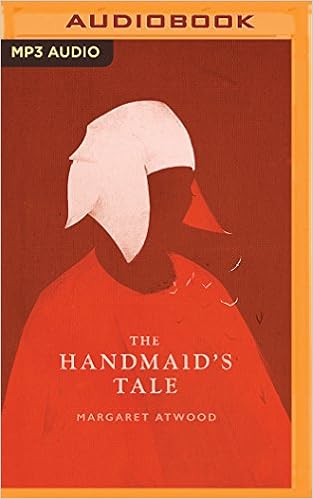
The Handmaid's Tale (The Classic Collection) MP3 CD – Audiobook, MP3 Audio, Unabridged by Margaret Atwood (Author), Claire Danes (Reader) (Brilliance Audio)


The Handmaid

‘Science fiction has monsters and spaceships; speculative fiction could really happen.’ Margaret Atwood’s chilling cautionary tale is illustrated by the Balbusso sisters.

Surely the essential element of a cautionary tale is recognition. Surprised recognition, even, enough to administer a shock. We are warned, by seeing our present selves in a distorting mirror, of what we may be turning into if current trends are allowed to continue. That was the effect of ''Nineteen Eighty-Four,'' with its scary dating, not 40 years ahead, maybe also of ''Brave New World'' and, to some extent, of ''A Clockwork Orange.''

It is an effect, for me, almost strikingly missing from Margaret Atwood's very readable book ''The Handmaid's Tale,'' offered by the publisher as a ''forecast'' of what we may have in store for us in the quite near future. A standoff will have been achieved vis-a-vis the Russians, and our own country will be ruled by right-wingers and religious fundamentalists, with males restored to the traditional role of warriors and us females to our ''place'' - which, however, will have undergone subdivision into separate sectors, of wives, breeders, servants and so forth, each clothed in the appropriate uniform. A fresh postfeminist approach to future shock, you might say. Yet the book just does not tell me what there is in our present mores that I ought to watch out for unless I want the United States of America to become a slave state something like the Republic of Gilead whose outlines are here sketched out.

Another reader, less peculiar than myself, might confess to a touch of apathy regarding credit cards (instruments of social control), but I have always been firmly against them and will go to almost any length to avoid using one. Yet I can admit to a general failure to extrapolate sufficiently from the 1986 scene. Still, even when I try, in the light of these palely lurid pages, to take the Moral Majority seriously, no shiver of recognition ensues. I just can't see the intolerance of the far right, presently directed not only at abortion clinics and homosexuals but also at high school libraries and small-town schoolteachers, as leading to a super-biblical puritanism by which procreation will be insisted on and reading of any kind banned. Nor, on the other hand, do I fear our ''excesses'' of tolerance as pointing in the same direction. Liberality toward pornography in the courts, the media, on the newstands may make an anxious parent feel disgusted with liberalism, but can it really move a nation to install a theocracy strictly based on the Book of Genesis? Where are the signs of it? A backlash is only a backlash, that is, a reaction. Fear of a backlash, in politics, ought not to deter anybody from adhering to principle; that would be only another form of cowardice.

The same for ''excessive'' feminism, which here seems to bear some responsibility for Gilead, to be one of its causes. The kind of doctrinaire feminism likely to produce a backlash is exemplified in the narrator's absurd mother, whom we first hear of at a book-burning in the old, pre-Gilead time - the ''right'' kind of book-burning, naturally, merely a pyre of pornographic magazines: ''Mother,'' thinks the narrator in what has become the present, ''You wanted a women's culture. Well, now there is one.'' The wrong kind, of course.

The new world of ''The Handmaid's Tale'' is a woman's world, even though governed, seemingly, and policed by men. Its ethos is entirely domestic, its female population is divided into classes based on household functions, each class clad in a separate color that instantly identifies the wearer - dull green for the Marthas (houseworkers); blue for the Wives; red, blue and green stripes for the Econowives (working class); red for the Handmaids (whose function is to bear children to the head of the household, like Bilhah, Rachel's handmaid in Genesis, but who also, in their long red gowns and white wimple-like headgear, have something of the aura of a temple harlot); brown for the Aunts (a thought-control force, part-governess, part-reform-school matron). The head of the household - whose first name the handmaid takes, adding the word ''of'' to show possession -''Offred,'' ''Ofwarren'' - is known as the Commander. It is his duty to inseminate his assigned partner, who lies on the spread thighs of his wife. THE Commanders, presumably, are the high bureaucracy of the regime, yet they are oddly powerless in the household, having no part in the administration of discipline and ceremonially subject to their aging wives. We are not told how and in what sense they govern. The oversight perhaps accounts for the thin credibility of the parable. That they lack freedom, are locked into their own rigid system, is only to be expected. It is no surprise that our narrator's commander, Fred, like a typical bourgeois husband of former times, does a bit of cheating, getting Offred to play Scrabble with him secretly at night (where books are forbidden, word games become wicked), look at his hoard of old fashion magazines (forbidden), kiss him, even go dressed in glitter and feathers to an underground bunny-type nightclub staffed by fallen women, mostly lesbian. Nor is it a surprise that his wife catches him/ them. Plusca change, plus c'est la meme chose. But that cannot be the motto for a cautionary tale, whose job is to warn of change.

Infertility is the big problem of the new world and the reason for many of its institutions. A dramatically lowered birth rate, which brought on the fall of the old order, had a plurality of causes, we are told. ''The air got too full, once, of chemicals, rays, radiation, the water swarmed with toxic molecules.'' During an earthquake, atomic power plants exploded (''nobody's fault''). A mutant strain of syphilis appeared, and of course AIDS. Then there were women who refused to breed, as an antinuclear protest, and had their tubes tied up. Anyway, infertility, despite the radical measures of the new regime, has not yet been overcome. Not only are there barren women (mostly shipped to the colonies) but a worrying sterility in men, especially among the powerful who ought to be reproducing themselves. The amusing suggestion is made, late in the book at a symposium (June 25, 2195) of Gileadean historical studies, that sterility among the Commanders may have been the result of an earlier gene-splicing experiment with mumps that produced a virus intended for insertion into the supply of caviar used by top officials in Moscow.

''The Handmaid's Tale'' contains several such touches of deft sardonic humor - for example, the television news program showing clouds of smoke over what was formerly the city of Detroit: we hear the anchorman explain that resettlement of the children of Ham in National Homeland One (the wilds of North Dakota) is continuing on schedule - 3,000 have arrived that week. And yet what is lacking, I think - what constitutes a fundamental disappointment after a promising start - is the destructive force of satire. ''Nineteen Eighty-Four'' had it, ''A Clockwork Orange'' had it, even ''Brave New World'' had it, though Huxley was rather short on savagery. If ''The Handmaid's Tale'' doesn't scare one, doesn't wake one up, it must be because it has no satiric bite.

The author has carefully drawn her projections from current trends. As she has said elsewhere, there is nothing here that has not been anticipated in the United States of America that we already know. Perhaps that is the trouble: the projections are too neatly penciled in. The details, including a Wall (as in Berlin, but also, as in the Middle Ages, a place where executed malefactors are displayed), all raise their hands announcing themselves present. At the same time, the Republic of Gilead itself, whatever in it that is not a projection, is insufficiently imagined. The Aunts are a good invention, though I cannot picture them as belonging to any future; unlike Big Brother, they are more part of the past - our schoolteachers.

But the most conspicuous lack, in comparison with the classics of the fearsome-future genre, is the inability to imagine a language to match the changed face of common life. No newspeak. And nothing like the linguistic tour de force of ''A Clockwork Orange'' - the brutal melting-down of current English and Slavic words that in itself tells the story of the dread new breed. The writing of ''The Handmaid's Tale'' is undistinguished in a double sense, ordinary if not glaringly so, but also indistinguishable from what one supposes would be Margaret Atwood's normal way of expressing herself in the circumstances. This is a serious defect, unpardonable maybe for the genre: a future that has no language invented for it lacks a personality. That must be why, collectively, it is powerless to scare. ONE could argue that the very tameness of the narrator-heroine's style is intended as characterization. It is true that a leading trait of Offred (we are never told her own, real name in so many words, but my textual detective work says it is June) has always been an unwillingness to stick her neck out, and perhaps we are meant to conclude that such unwillingness, multiplied, may be fatal to a free society. After the takeover, she tells us, there were some protests and demonstrations. ''I didn't go on any of the marches. Luke [ her husband ] said it would be futile, and I had to think about them, my family, him and her [ their little girl ] .'' Famous last words. But, though this may characterize an attitude - fairly widespread - it does not constitute a particular kind of speech. And there are many poetical passages, for example (chosen at random): ''All things white and circular. I wait for the day to unroll, for the earth to turn, according to the round face of the implacable clock.'' Which is surely oldspeak, wouldn't you say?

Characterization in general is weak in ''The Handmaid's Tale,'' which maybe makes it a poet's novel. I cannot tell Luke, the husband, from Nick, the chauffeur-lover who may be an Eye (government spy) and/ or belong to the ''Mayday'' underground. Nor is the Commander strongly drawn. Again, the Aunts are best. How sad for postfeminists that one does not feel for Offred-June half as much as one did for Winston Smith, no hero either but at any rate imaginable. It seems harsh to say again of a poet's novel - so hard to put down, in part so striking - that it lacks imagination, but that, I fear, is the problem.

The Lady Was Not for Hanging

The dedication of ''The Handmaid's Tale'' -''For Mary Webster and Perry Miller'' - holds clues to the novel's roots in our Puritan past. ''Mary Webster was an ancestor of mine who was hanged for a witch in Connecticut,'' Margaret Atwood explained. ''But she didn't die. They hadn't invented the drop yet'' - the part of the platform that falls away - ''so they hanged her but she lived.'' The author's studies in early American history under the Harvard scholar Perry Miller also informs her theme of religious intolerance. ''You often hear in North America, 'It can't happen here,' but it happened quite early on. The Puritans banished people who didn't agree with them, so we would be rather smug to assume that the seeds are not there. That's why I set the book in Cambridge,'' said the Canadian author, who lives in Toronto and has traveled widely in the United States. Like many of her fictional women (she has written poems, essays and novels, notably the feminist classic ''Surfacing''), she is wryly unpolemical. ''Feminist activity is not causal, it's symptomatic,'' she said of the book's antiwoman society. ''Any power structure will co-opt the views of its opponents, to sugarcoat the pill. The regime gives women some things the women's movement says they want -control over birth, no pornography - but there's a price. If you were going to put in a repressive regime, how would you do it?'' Despite the novel's projections from current events, Margaret Atwood resists calling her book a warning. ''I do not have a political agenda of that kind. The book won't tell you who to vote for,'' she said. But she advises, ''Anyone who wants power will try to manipulate you by appealing to your desires and fears, and sometimes your best instincts. Women have to be a little cautious about that kind of appeal to them. What are we being asked to give up?''