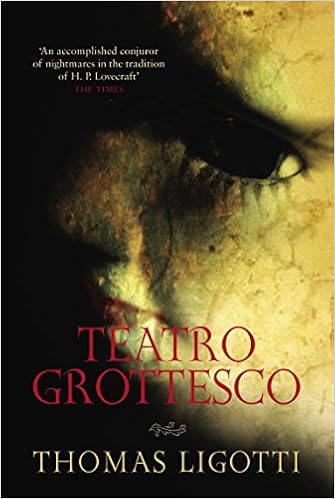
-- not for the suicidal. This is my first exposure to the author's incisively bizarre imagination which is expressed in precise and clinically sterile language typical of a detached observer rather than a participant, the narration being in first person notwithstanding. The often hypnotic and, with subtle alterations, repetitive prose serves perhaps to intuit the incessant chatter within the disturbed psyche of obsessed individuals fixated on the inexplicable and abysmal nature of their perceived realities.
Reclusive oddball loners with haunting secrets of murder and unnatural repercussions (fueled by the need of some sort of vengeance by the parties involved) and hopeless treadmill wage-slaves, maintaining the system with their monotonous daily grinds at the assembly blocks or in drab storefront offices, inhabit the gloomy landscape of some godforsaken, foggy northern border town gradually fading into the bleak environment of oblivion. Occasionally, grim and seemingly indifferent clowns, a marionette puppet menacing in its persistence, and the garb of a jester/fool join the surreal parade as messengers of fate/death, as manifestations of the trickster archetype of liminality.
"Our company [Teatro Grottesco Ventures] is so much older than its own name, or any other name for that matter. (And how many it's had over the years - The Ten Thousand Things, Anima Mundi, Nethescurial.)...I go around with a trunkful of aliases, but do you think I can say who I once was really?...Possibly I was the father of Faust or Hamlet - or merely Peter Pan" (p. 180).
Featured in three short stories ('the town manager', 'my case for retributive action' and 'our temporary supervisor'), although explicitly named only in two of them, is the shadowy and dreaded Quine Organization, the all-pervading presence of which is conveyed by the writer in a tangentially Kafka-esque, Dickian fashion. It is a monopolist entity, a political as much as a commercial one, "whose interests and activities penetrate into every enterprise, both public and private,...[and] in whose employ are all the doctors [and pharmacists] on this side of the border...and perhaps also on your side" (pgs. 82, 88, 97, 99).
Common threads that run through several or all of the five stories from the last (3rd) segment dubbed 'The Damaged and the Diseased', albeit varied in articulation and intensity, are: artistic underworld, art-magic, schizophrenia/split personality, women dressed in purple/crimson/emerald green, "backstreet hospital with dated fixtures and a staff of sleepwalkers" (p. 175), and, last but not least, gastrointestinal agony induced by a sense of anxiety "to be a success at doing something and at being something" (p. 261), or by bacterial/amoebic infestation. Either way, I wonder, without revealing too much, if the hilarious and somewhat gross concluding piece ('the shadow, the darkness') is, in part, a not so veiled assessment of post-modern art.
Finally, T. Ligotti's diagnosis of the human condition is encapsulated in the following passage:
"We should give thanks...that a poverty of knowledge has so narrowed our vision of things as to allow the possibility of feeling something about them...[W]ithout the suspense that is generated by our benighted state...who could take enough interest in the universal spectacle to bring forth even the feeblest yawn, let alone exhibit the more dramatic manifestations which lend such unwonted color to a world that is essentially composed of shades of gray upon a background of blackness?...All our ecstasies, whether sacred or from the slime, depend on our refusal to be schooled in even the most superficial truths and our maddening will to follow the path of forgetfulness. Amnesia may well be the highest sacrement in the great gray ritual of existence. To know, to understand in the fullest sense, is to plunge into an enlightenment of inanity, a wintry landscape of memory whose substance is all shadows and a profound awareness of the infinite spaces surrounding us on all sides" ('a soft voice whispers nothing', pp. 143-4).
And what solution is offered as a way out of this entrapment?
"I wanted to believe that th[e] artist had escaped the dreams and demons of all sentiment in order to explore the foul and crummy delights of a universe where everything had been reduced to three stark principles: first, that there was nowhere for you to go; second, that there was nothing for you to do; and third, that there was nothing for you to know" ('the bungalow house', p. 214). In other words, non-striving and disengagement through non-attachment

No comments:
Post a Comment