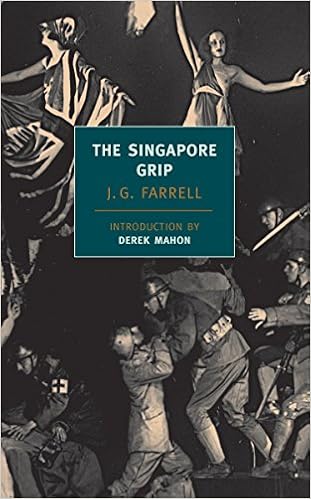
A vast and absorbing work of historical fiction, this magnificent novel is set in Singapore, in the months leading to the fall of the city to the Japanese in 1942. The unexpected and total defeat of the commonwealth allies by forces whose fighting abilities they had previously pooh-poohed has been called the worst defeat in British military history. Farrell describes these events very well, both by getting inside the minds of the real-life commanders and by inventing more humble characters on both sides who experience the fighting at first hand. But the main focus of the book is on the civilians, especially the merchant princes whose forefathers founded the colony at the southern tip of the Malay peninsula in the early nineteenth century, and the fictional firm of Blackett and Webb in particular.
The central figure at the start of the book is the rubber millionaire Walter Blackett, immensely proud of his firm's tradition, but concerned about handing it over to the next generation. Recognizing that his son Monty is a useless playboy, he concentrates on finding a suitable match for his elder daughter Joan, who has both brains and beauty. Much of the early part of the book has the romantic wit of Jane Austen, the dynastic maneuvering of John Galsworthy, and the jazz-age pizzazz of F. Scott Fitzgerald.
The philosophical antithesis to Walter is Matthew Webb, the estranged son of his long-retired business partner, who arrives to take over his father's estate. Innocent and idealistic, he provides a pair of fresh eyes with which to view the colony. And what he sees first puzzles then horrifies him: exploitation of the native growers, the creation of a dependent economy rather than one that can be locally self-sustaining, and the manipulation of prices through a rubber cartel that holds the rest of the world to ransom. Matthew has much charm; in a rather confused way he eventually discovers passion; by the end of the book he has become a strong man of action; but his naive idealism never leaves him. Here the author who most comes to mind is Tolstoy, with Matthew the spiritual descendant of Levin in ANNA KARENINA.
Farrell is Tolstoyan too in his apparently effortless juggling of world events with personal intimacies, in the range of his characters from the mighty to the insignificant, in the fact that his people grow or decline, in his social awareness and moral conscience, and in his sheer ability to tell a story. Like WAR AND PEACE, this is a long book, and I read it during a three-week period when sometimes I could only manage a chapter or two a day, but never once did I lose the onward momentum or my interest in the characters and their situation; there are very few books that can promise that. The only thing that slightly disappointed me was the love story; Farrell's erotic scenes are somewhat more explicit than Tolstoy's, but there is little sense of grand romance, no Pierre and Natasha, no Kitty worthy of this Levin.
THE SINGAPORE GRIP is the third novel in JG Farrell's so-called "Empire Trilogy." The books are connected in that all deal with various moments in the decline of the British Empire, but they expand notably in scope. The first, TROUBLES, though set in the Irish War of Independence, is essentially a social comedy in form, focused on a group of mostly-elderly people living in a crumbling seaside hotel. The small enclave has become larger in the second novel, THE SIEGE OF KRISHNAPUR, where it is an entire garrison town under siege by sepoys in the Indian Mutiny of 1857. That book also expands the range and number of its characters, enabling the author to portray through them a great variety of attitudes in Victorian Britain towards religion, duty, and colonialism in all its aspects. With THE SINGAPORE GRIP, the enclave is now an entire city-state, and the range is wider still, now extending its political vision to the global scale and having a great deal more to say about commerce and economics. It shows an author Tolstoy-like in his vision, and very close to Tolstoy in his powers.
And the meaning of the title? The Singapore Grip might be any of several things, such as a rattan suitcase or a touch of the flu. But the most special meaning is revealed only at the end, a last touch of the humor that has never been totally absent from this book, no matter how grim the events that it describes.

No comments:
Post a Comment