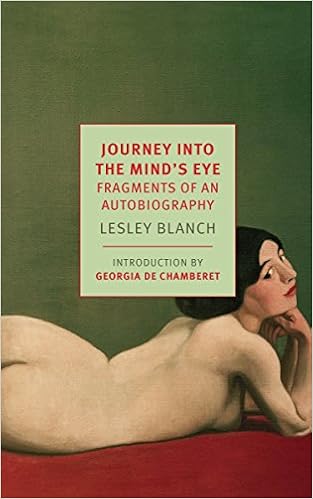
Like Rupert Brooke, Blanch has spent her long life loving an extraordinary number of people, places, & things, but her greatest passion is for The Traveler, her mentor & lover, and Russia. From her sedate pre-WW I nursery onwards, The Traveler brings an air of Siberia to quiet London. Perhaps a former suitor of her mother's, he delicately seduces Blanch with visions of wolves and Easter, church bells and crisp snow, icons and fire-light. They consummate their affair when she is 17. But there is nothing of tawdiness, exploitation, or abuse in all this; it's a great romance told ruefully, with humor and delight. Her Traveler expands her horizons forever, and teaches her a tremendous capacity for love. Centering the memoir is a journey on the Siberian train in the 1960s, long after his disappearance. She is seeking their Russia, long gone, and some trace of him. Though she fails, it's a lovely read.
Blanch’s brilliance lies in her honesty about the subjectivity of her work. For her, travel is neither an act of discovery nor an explication….but the endless attempt to bridge that vast land of otherness with the worlds we’ve created in our own minds….If Blanch’s Journey isn’t a traditional travelogue, it’s not because she can’t write about the Russia in front of her. It’s because that Russia…can never be the only one she sees.This book is a jewel: the prose is immaculate, the delineation of the human heart is unclouded by sentiment, and, in terms of contemporary feminism, it is almost on par with Freud’s Dora. An excellent study of the etiology of hysteria, Journey Iinto Tthe Mind’s Eye is one of the charter myths of contemporary women’s studies.It is hard to classify her as a writer, unless as a scholarly romantic in a school of her own. Such is the depth of her research that other writers plunder her books shamelessly..
About the Author
Lesley Blanch (1904–2007) was born in west London. From 1922 to 1924 she studied painting at the Slade School of Art and worked steadily as an illustrator and commercial artist for the next decade, designing book jackets as well as costumes and sets for the theater and the ballet. After writing for several British magazines, Blanch turned to journalism full-time, and in 1937 she was named the features editor of British Vogue. She left the magazine in 1945, the same year she married the French novelist and diplomat Romain Gary. The couple moved to Bulgaria; Blanch would never reside in the United Kingdom again. Over the next two decades, they were posted to the Balkans, Switzerland, and the United States. In 1963, Gary divorced her to marry the actress Jean Seberg. Blanch traveled to Russia, Turkey, Central Asia, Iran, and North Africa, researching what would become twelve books. They include the biographies The Wilder Shores of Love (1954), The Sabres of Paradise (1960), and Pierre Loti: Portrait of an Escapist (1983); and one novel, The Nine-Tiger Ma (1965). Her memoirs On the Wilder Shores of Love: A Bohemian Life (2015) were published posthumously, along with a companion volume, Far to Go and Many to Love: People and Place (2017). She died in the south of France at the age of 103.
Georgia de Chamberet is an editor, translator, and journalist. She is one of the founding members of English PEN’s Writers in Translation Committee, a founder of the publishing consultancy BookBlast Ltd., and the editor of the online journal The BookBlast Diary. She is the literary executor of the estate of Lesley Blanch.

No comments:
Post a Comment