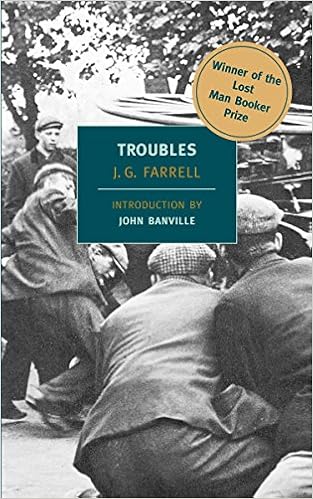
TROUBLES is a distinctive, and mildly disconcerting, novel. It is set in the fictional town of Kilnalough, in the County of Wexford, on the southeast coast of Ireland. The time span of the novel is 1919-1921, the years of the Irish War of Independence. "Troubles", of course, is the misleadingly bland term often applied to the ethno-religious-nationalistic conflict that bedeviled Ireland for the entire twentieth century. That conflict, "a war without battles or trenches," looms over the novel.
There are two main characters. The first is Major Brendan Archer, a Brit who is a Great War veteran, having survived four years of trench warfare. While in France "The Major" (as he is referred to in the novel) periodically received letters from a young woman, signed "Your loving fiancée, Angela." Her father owns the Majestic, a large, formerly grand and elegant, coastal resort hotel in Kilnalough. So once the Major has been restored to some level of normalcy, he goes to Ireland and the Majestic to visit Angela (to whom he does not believe he ever proposed) and clarify their relationship. Angela, however, is dying from leukemia. The Major, who has neither family nor home to speak of, stays on at the Majestic, becoming friends with Angela's father, Edward Spencer, and falling in love like a puppy with Sarah, who had been Angela's best friend. And thus, the Major becomes a first-hand witness to the Troubles that gradually envelop, and then oust, the Protestant Anglo-Irish of Kilnalough.
The other principal character, to my mind, is the Majestic. "It had once been a fashionable place. It had once been considered an honour to be granted accommodation there during the summer season." Over three hundred rooms; in front, a life-size statue of Queen Victoria on horseback; a grand reception foyer; dining rooms and ballroom, bars and smoking room; tennis courts and squash court; a glass-enclosed Palm Court. But the days of grandiosity and elegance are gone, and the Majestic is barely hanging on. Its residents are mostly old ladies who have nowhere else to go; while walking down the corridors of the uppermost floor, people step through floorboards weakened by rot; the vegetation of the Palm Court, fed by some sort of underground sewer leak, is riotously overtaking everything; scores of cats infest the hotel; and pigs are now stabled in the squash court. The Majestic is the British Empire, circa 1920.
Life bumps along. From time to time there is yet another flare-up of the Troubles, with its irrationality and violence. For the Protestant Anglo-Irish and the Majestic, the course of the novel is a downward spiral. On the whole, it is a melancholic novel. Curiously, though, it never becomes tragic, because there are so many very funny scenes and because so many happenings are farcical, macabre, or just plain absurd.
Written in 1970, TROUBLES was the first of what became an "Empire Trilogy". I earlier read its successors -- "The Siege of Krishnapur" and "The Singapore Grip". The three novels treat different episodes in the decline of the British Empire, and they display some similarities. But the tone of TROUBLES is markedly different than that of the two later novels, which, in my opinion, are better than TROUBLES. While it has many brilliant scenes, there are some that don't work and a few that are even distasteful. Certain traits of many of the characters are exaggerated, thereby rendering them unrealistic, even ludicrous. To me, the Major, in his fecklessness and his pining for Sarah, is a rather pathetic figure. (He surfaces again, nearly twenty years older, in "The Singapore Grip", by which time he has more character.) Finally, the novel is too long and rambling; "The Siege of Krishnapur" is much more compact and focused, and "The Singapore Grip", while even longer, has more action and more characters to sustain this reader's interest.

No comments:
Post a Comment