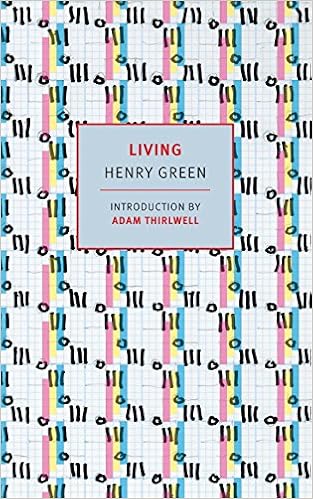
It seems safe to suppose that we will be hearing quite a bit about Henry Green for the next few years. The reissue of his work will surely spark more interest in this author, and the article published in The New Yorker is a huge step in his canonization process. We all have lacunae in our reading, so I will confess that I had not even heard of Henry Green until a few months ago, when while browsing at a Toronto bookstore my eyes fell on a series of slim volumes bearing the familiar New York Review Books design on their spine. The titles caught my attention: "Living", "Loving", "Nothing", "Back".. I decided to explore Green's work in the near future without doing any previous research on him, and since I was new to the author I thought it would be a great idea to read his works chronologically, beginning with "Blindness" As fate would have it, however, "Living" fell into my hands first.
Published in 1929,"Living" is Green's second novel. In a sense, and as the title indicates, the novel is simply about people living their lives, and/or making a living. The setting is an iron foundry in Birmingham, but _Living_ explores universal concerns within this microcosm. The novel does not rely heavily on plot, employing instead the literary device of the dèrive. Briefly put, this concept (adapted from Guy Debord's theories) implies narrative freedom and spontaneity. Instead of following a strict and artificial formula (such as Freytag's pyramid), the narrator's gaze is adrift, and it illuminates the characters' lives by presenting episodes that the reader then puts together. (For more on dèrive, please see my review of Haroldo Conti's _Southeaster_, another novel about people living life.) "Living" is, in other words, a mosaic of life. The use of vignettes, which is adequate to the portrayal of life in a bustling industrial town, is reminiscent of John Dos Passos'"Manhattan Transfer_ (1925), and Camilo José Cela's _The Hive_ (1951), two novels of the big city (New York and Madrid, respectively). The mosaic/vignette style is often referred to as literary impressionism, since the brief episodes work as the equivalent of the small brushstrokes that the viewer puts together when appreciating an impressionist painting.
In _Living_, we follow a dozen characters. Five or six of them could be considered main characters, and the ones that stand out are Bert Jones, his girlfriend Lily Gates, Mr. Craigan, Mr. Dupret the boss, and his son, initially identified as young Mr. Dupret. Much of the novel is concerned with the relationship between Lily, who lives in Mr. Craigan's house and takes care of him, and Bert, who dreams of leaving town. Young Mr Dupret struggles to make a name for himself under the shadow of his powerful father, while Mr. Craigan deals with the difficulties that accompany loneliness and aging. Green interweaves these narrative threads and a few others to produce the vibrant tapestry that is _Living_.
Stylistically, the prose bears the unmistakable mark of Joyce, whose _Ulysses_ was published in 1922. The characters' thoughts are not exactly presented in the stream of consciousness form, but Green offers glimpses of them mixed into the narrative. In addition, at least in this novel (I don't know about the others yet), the narrator often skips the article. Here's a good example: "as he passed by open door of dining room to go and dress and saw brilliance of lights there and clash and glitter of women's dresses, and heard their laughing, he had a sickening in stomach" (111). From what I have read, Green used this style in order to convey the sense of directness that characterizes work at a factory. By omitting the article, the narrative sounds almost like an instruction manual, which is quite appropriate to the setting. The factory is almost a character in itself, and it becomes a living organism. I kept thinking of Fritz Lang's "cannibal dynamo" (the phrase is Allen Ginsberg's) in _Metropolis_. _Living_ also reminded me of Fritz Kahn's illustration "The Human Factory," which depicts the human organism as if it were a series of interconnected industrial processes. This engraving would have been a perfect illustration for the cover of _Living_. (You may see it on the cover of the Penguin edition of Deleuze and Guattari's _Anti-Oedipus_.)
Green is usually described as a modernist. Without dismissing this label, I would say _Living_ is a bridge between realism (maybe even naturalism) and modernism. The novel seeks to reproduce the style of Birmingham factory workers (which Green knew from working at his family's factory for a while), and presents an often straightforward view of life. "Us working people we got to work for our living," says one of the characters, "till we're too old. It's no manner of use thinking about it, it's like that, right on till we're too old for them to use us. Then our children will make provision for us" (65). There's nothing more simple, direct, and natural than Lily Gates' prayer of maternal longing (91). This "simplicity" is combined with exquisite and fresh poetic metaphors. A hopeless sick man, for instance, is compared to a sunken submarine: "above, on the surface of the ocean men work frantically but the day grows on into the evening, night falls, there is another day, another night, and as everyone realizes gradually that they cannot hope to raise the submarine in time, their efforts are not so frantic, they take a little longer over what they do. In the same way fresh doctors were still fetched to [the sick man], but no daring experiments were expected of them" (78-79). In a recurring simile, tropical birds are equated to thoughts: "as sometimes, coming across the sea from a cold country to the tropics [...], so as you are coming tropical birds of exquisite colours settle to rest on the deck, unexpected, infinitely beautiful, so things she remembered of him came one by one back to her mind" (126-127). When it comes to writing, it is said that the "what" does not matter as much as the "how." Green's triumph consists in showing us the ordinary (to the extent that such a thing can be said to exist) through a personal gaze, in a beautiful style.
I was amazed by _Living_. I am happy I've read it, not only because of the pleasure it afforded me, but also in anticipation of what lies ahead. There are nine Henry Green books I haven't read, and I can't wait to read them all.

No comments:
Post a Comment