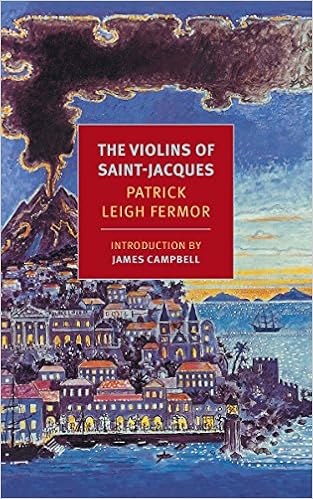
The only work of fiction by Patrick “Paddy” Leigh Fermor (the decorated war hero, admired travel writer and stylist) is doubly a period piece. Written and first published just over half a century ago, in 1953, its main action is set another half-century before that, in 1902. It is also, in its way, a masterpiece...There is more than a hint of mischief, and indeed humour, about Paddy’s nostalgia for a lost world, and its ethereal afterglow that lives on in the violins of the title.A sojourn in the Caribbean inspired a travel book and a novella, set in 1902 on an island in the Antilles, about love and intrigue in the over-blown and over-mannered society of the French aristocracy...The Violins of Saint-Jacques is a masterpiece in the minor mode.The Violins of Saint Jacques, filled with lush imagery and elaborate historical reconstruction, deserves to be more widely known.
Far better known for his extensive travel writing, the British author Patrick Leigh Fermor tried his hand at this somewhat fantastic novella in the 1950s of the vanished decadent social world of an imaginary Caribbean island. With its elaborately embroidered descriptions of high living at the turn of the century in a French sugar plantation town and extensive catalogues of names and objects, THE VIOLINS OF ST. JACQUES reads more like a tall tale than anything else. We keep waiting for the embedded narrator's explanation of how this lavish fantastic world came to its end one night during an expensive town-wide Mardi Gras celebration, and when it comes Fermor basically goes berserk, with challenges to duels, elopements, and visitations of lepers. The cover, of course, gives away the final (completely foreseeable) twist: "And to top it all off, the volcano erupts!" (as the wife sings in Leonard Bernstein's TROUBLE IN TAHITI). The plot action is clearly based on the real-life eruption of Mt. Pelee in 1902 on the island of Martinique, which eradicated the town of St. Pierre, although even the details of that notorious catastrophe pales before what happens according to Fermor's imagined variation on this theme. It's too silly to take very seriously, and the (literally) over-the-top denouement renders too ridiculous the lost glamorous world for which the novella longs.
About the Author
Patrick Leigh Fermor (1915–2011) was an intrepid traveler and a heroic soldier who is widely considered to be one of the finest travel writers of the twentieth century. After his stormy school days, followed by the walk across Europe to Constantinople that begins in A Time of Gifts (1977) and continues through Between the Woods and the Water (1986) and The Broken Road (published posthumously in 2013), he lived and traveled in the Balkans and the Greek archipelago. His books A Time to Keep Silence (1957), Mani (1958) and Roumeli (1966) attest to his deep interest in languages and remote places. In the Second World War he joined the Irish Guards, became a liaison officer in Albania, and fought in Greece and Crete. He was awarded the DSO and OBE. Leigh Fermor lived partly in Greece—in the house he designed with his wife, Joan, in an olive grove in the Mani—and partly in Worcestershire. In 2004 he was knighted for his services to literature and to British–Greek relations. Artemis Cooper’s biography, Patrick Leigh Fermor: An Adventure, was published by New York Review Books in 2013.
James Campbell is the author of several works of nonfiction, including Invisible Country: A Journey Through Scotland, Exiled in Paris: Richard Wright, James Baldwin, Samuel Beckett and Others on the Left Bank, and Syncopations: Beats, New Yorkers, and Writers in the Dark. He writes the weekly NB column in the Times Literary Supplement under the pen name J.C.

No comments:
Post a Comment