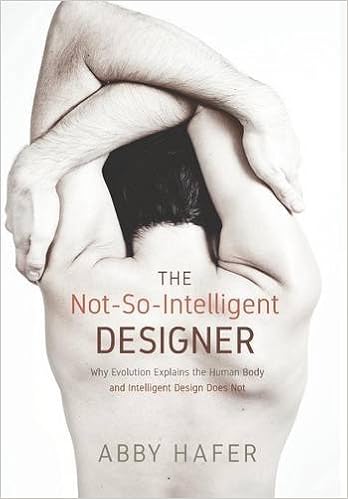
The Not-So-Intelligent Designer: Why Evolution Explains the Human Body and Intelligent Design Does Not by Abby Hafer
“The Not-So-Intelligent Designer” is a delightful contribution that provides compelling information of how the human body is badly “designed”. Dr. Hafer provides the public with an accessible reference on evolution while exposing the Intelligent Design (ID) movement as a political pressure group of science denialism. This enlightening and fun 266-page book includes thirty-five short chapters covering a wide-range of topics on evolution and creationism.
Positives:
1. An engaging well-written book with a touch of humor.
2. The fascinating topic of evolution and exposing the Intelligent Design (ID) as the political science denial movement that it is.
3. Dr. Hafer has a doctorate in zoology who teaches human anatomy and physiology at Curry College. She has mastery of the topic and uses her wit and knowledge to enlighten the public.
4. This book focuses on the many quirks of the human body and convincingly shows how the human body evolved versus being created. “Human bodies are just too badly put together to stand up to even reasonable design specifications, much less infallible ones.”
5. Succeeds in clearly showing how the ID controversy is not a scientific issue, but a political one. “ID is the idea that biological organisms have come about due to the deliberate work of an intelligent Creator. It further argues that new species cannot come about through evolution by natural selection, and must be the work of a Designer.”
6. Goes over the classic debunked examples of the ID movement. “The usual examples given for irreducible complexity are the human blood clotting sequence, the bacterial flagellum, and the human eye.”
7. Clearly shows that the ID movement is a Christian religious lobby. “This case was called Kitzmiller v. Dover Area School District. In it, Judge John E. Jones III found that ID and creationism are fundamentally the same thing, and that therefore since creationism is religion, then ID is too.”
8. Exposes the Discovery Institute and its infamous Wedge Strategy. “So the Discovery Institute intends to defeat science by doing politics.”
9. My favorite example on how denying evolution can hurt society. “The last major political group to oppose Darwin’s theory of evolution on ideological grounds was the Communist Party of the Soviet Union under Josef Stalin.”
10. Some quotes are truly memorable. “In fact, ID is just a form of ‘political correctness’ for the Christian Right.”
11. Explains what science is versus what it’s not. “ID proponents simply refuse to make testable hypotheses about the material world, and they certainly do not test them. So without predictions, experiments, or quantifiable results, ID cannot realistically claim to be science.” Bonus, “Scientists still haven’t found anything in a controlled experimental setting that supports claims of anything supernatural.”
12. The book is loaded with many examples of bad design: testes, birth canal, the eye, etc… to name a few. “One would think that a benevolent Creator would not make childbirth into such a problem in the first place. In fact there are simple things that could have been done better, if only we had been designed rather than evolved.”
13. In support of the facts and science. “All the evidence in biology supports evolution by natural selection, but questions about specific organisms or questions about the rate of change during evolution always occur.”
14. Examples of unusual animals, like the mudskipper. “Animals that no rational Creator would have come up with exist perfectly well in our evolved world because they work well enough, and survive from generation to generation.”
15. An interesting look at the poorly “designed” human throat. “A better-designed system would keep the tubes for air and food separate, to avoid unnecessary fatalities. If we were designed, why did the Designer do this job so badly?”
16. Challenges the “Almighty”. “More than 90 percent of all the species that have ever lived on earth are extinct. Why did the Designer make so many forms during the Cambrian period, for instance, only to have them go extinct?”
17. A look at irreducible complexity and the human eye. “In fact, it is clear that vision has evolved separately many times in the animal kingdom, and it is clear that some animals have eyes that are actually better put together than ours.”
18. A look at scurvy. “Here’s why our biochemical pathways are a case of bad design: we have the pathway for making vitamin C, but it isn’t finished. Having an incomplete pathway for making a vital nutrient is bad design.”
19. Putting the Cambrian Explosion in perspective. “Mammals, birds, fish, amphibians, and reptiles are all post-Cambrian. Meanwhile, most Cambrian organisms are extinct. So what was the Designer doing with all those Cambrian animals—rehearsing?”
20. Linked to notes and provides an appendix of supporting material.
Negatives:
1. There are more substantive books out there but fewer as interesting, particularly for the layperson.
2. The book provides some helpful illustrations but lacks tables that would have summarized some of Dr. Hafer’s finding in a more elegant manner.
3. A bit uneven. I don’t mind short chapters but the book’s flow was a little off.
4. No formal bibliography.
In summary, this book succeeds in capturing the interest of the public by providing quirky facts about evolution while simultaneously exposing the Intelligent Design movement as a political movement with dangerous ramifications. This is an excellent book for the layperson but perhaps on the too light side for evolution-minded groupies. Accessible and fun, I recommend it!
Further recommendations: “Undeniable: Evolution and the Science of Creation” by Bill Nye, “Evolution vs Creationism” by Eugenie C. Scott, “Why Evolution Works (and Creationism Fails)” by Matt Young, “The Greatest Shown On Earth” by Richard Dawkins, “Evolving Out of Eden” by Robert M. Price, “Your Inner Fish” by Neil Shubin, “Understanding Evolution and Ourselves” by Dennis Littrell, “Why Evolution Is True” by Jerry A. Coyne, “The Rocks Don’t Lie” by David R. Montgomery, “What Evolution Is” by Ernst Mayr, “Evolution: What the Fossils Say and Why it Matters” by Donald R. Prothero, and “The Making of the Fittest” by Sean B. Carroll.

No comments:
Post a Comment