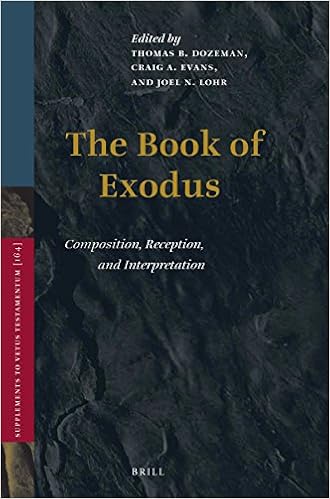
Written by leading experts in the field, The Book of Exodus: Composition, Reception, and Interpretation offers a wide-ranging treatment of the main aspects of Exodus. Its twenty-four essays fall under four main sections. The first section contains studies of a more general nature, including the history of Exodus in critical study, Exodus in literary and historical study, as well as the function of Exodus in the Pentateuch. The second section contains commentary on or interpretation of specific passages (or sections) of Exodus, as well as essays on its formation, genres, and themes. The third section contains essays on the textual history and reception of Exodus in Judaism and Christianity. The final section explores the theologies of the book of Exodus.
The book at hand consists of four parts plus preface, abbreviations, list of contributors, and indices of ancient texts and modern authors. Specifically, the four parts which make up the heart of the volume are
Part 1 – General Topics (3 essays)
Part 2- Issues in Interpretation (8 essays)
Part 3- Textual Transmission and Reception History (11 essays)
Part 4 – Exodus and Theology (2 essays)
Those content statistics illustrate quite well the chief aim of the volume, which is to examine in some depth issues connected to textual transmission and the history of reception. They also illustrate quite well that theological concerns have become, and are becoming in many quarters, the ‘red-headed step child’ of biblical studies. When Brueggemann on ‘The God who Gives Rest’ and Fretheim on ‘Issues of Agency in Exodus’ are the only theological themes to receive serious treatment in a volume on Exodus readers are left wondering about the other significant theological themes which have been left aside.
Still, there’s only so much that can be accomplished in one volume that measures in at over 660 pages and it has always seemed to me a bit unfair and somewhat disingenuous when reviewers nit-pick issues authors and editors don’t cover rather than evaluating those they do.
Unlike many volumes of this sort, this one isn’t the outcome of a conference or other academic gathering, it’s the consequence of invited contributors being asked to use their talents and learning for the benefit of the long term Supplements to Vetus Testamentum. The link at the top of the present review will take readers to the list of those who wrote essays for the volume. All of them are well known in the field of Hebrew Bible.
Critiquing such a volume is a tasking venture. The contributions are, uniformly, interesting and informative. Konrad Schmid’s ‘Exodus in the Pentateuch’ opens with a quote from my old Professor of Hebrew and Biblical Interpretation’s commentary on Exodus (John I. Durham): “The Book of Exodus is the first book of the Bible”. Schmid remarks (in the footnote) that ‘… more correct is Thomas B. Dozeman, … ‘The Book of Exodus is the second book in the Hebrew Bible” (p. 27). I don’t suspect that Schmid ever met Durham (though he may have) but Durham would have appreciated the ‘correction’ though to be fair it seems that Schmid was himself influenced by Durham’s viewpoint because the former writes later on in his contribution
Despite its links to the book of Genesis and the following books, the Moses story in the book of Exodus… was probably first an independent literary piece that was later combined with the Genesis that precedes it in the canonical Pentateuch (p. 57).
Readers will not be surprised to learn that Part two includes discussions of the miracle at the Sea, the Wilderness materials, Lawgiving, the Law, the Covenant Code, and the Tabernacle. Part three, again, the lengthiest and apparently for the editors the most important, discusses Exodus and the DSS, the LXX, the Vulgate, and the Targumim. It also contains discussions of Philo of Alexandria, the New Testament, Josephus, the Book of Jubilees, the Church Fathers, and the Rabbinic tradition and all of their connections with and uses of Exodus.
Unsurprisingly, one of the highlights of the assembled essays is that of Bruce Chilton (who is, I think it accurate to say, far better at interpreting and understanding the Targumim than he is the life of the Historical Jesus). Chilton has a novelist’s gift for language, writing such delightful phrases and sentences as
Targums are constellations of oral traditions and opportunities for those traditions to flourish in the context of the biblical text (p. 387).
And
Absent from Mount Moriah, Sarah is the only parent emotionally present to her son, and the ram’s horn that is blown every new year conveys her grief (p.395).
Chilton really is a lovely writer to read just for the pure sake of reading. I wish he had written more than he does in his present essay given the fact that his style is superb and what one gains from it and from what it says is astonishing.
There is much to learn from this volume as a whole and it serves as something of an ‘encyclopedia’ of the subject. Anything anyone could possibly wish to know about Exodus can be found here except reference Eichrodt’s notion of Covenant and the importance of the book of Exodus for that concept (unless somehow I missed it- which I doubt because I was looking for it).
Were this collection to be improved upon it would best be improved with a fuller treatment of the theological issues (as hinted at above). But given the aims of the volume and the intentions of the editors it is justifiable to say that this accessible work provides a ‘one stop shop’ for all things (well, almost all things) Exodus. Libraries and researchers specifically investigating the book of Exodus will require a copy. Others will need to be satisfied with borrowing a copy from their library because it is extremely expensive.

No comments:
Post a Comment