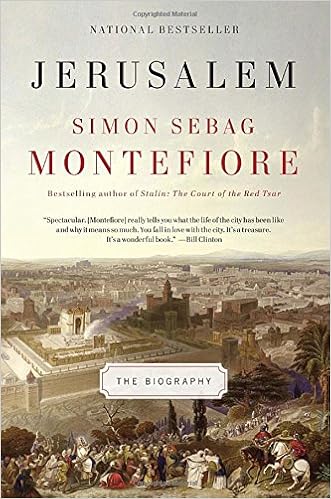
A remarkably objective account of the holy city's turbulent history
"Jerusalem is the holy city," writes Simon Sebag Montefiore, "yet it has always been a den of superstition, charlatanism and bigotry . . . the cosmopolitan home of many sects, each of which believes the city belongs to them alone." Jew, Christian and Muslim alike feel compelled to rewrite its history to sustain their own myths. "A hundred patients a year," Montefiore notes, "are committed to the city's asylum suffering from the Jerusalem syndrome, a madness of anticipation, disappointment and delusion." The 3,000-year conflict provides a terrible story, which he tells surpassingly well, and although not his purpose, one that is likely to confirm atheist prejudices.
Montefiore takes the history of the old city from its beginnings as a fortified village through every conquest or occupation – Canaanite, Israelite, Assyrian, Babylonian, Persian, Macedonian, Seleucid, Roman, Byzantine, Ummayad, Abassid, Fatimid, Seljuk, Crusader, Saracen, Tatar, Mamluk, Ottoman, British, Jordanian and finally Israeli. Rival places of worship were destroyed and new ones constructed with the stones of earlier buildings, thus making Jerusalem the most complicated archaeological site in the world. Populations were slaughtered or sold into slavery, then later replaced by new waves of immigration. Montefiore's book, packed with fascinating and often grisly detail, is a gripping account of war, betrayal, looting, rape, massacre, sadistic torture, fanaticism, feuds, persecution, corruption, hypocrisy and spirituality.
 Jerusalem ... 'A den of supserstition, charlatanism and bigotry'. Photograph: Menahem Kahana/AFP/Getty Images
Before going back to the earliest times and King David, Montefiore begins with the sack of Jerusalem and the destruction of the Temple in AD70 by Titus. Jerusalem was packed with refugees and pilgrims for Passover. After his victory, 500 Jews a day were crucified until the Romans ran out of wood. Some survivors were sold into slavery; many others were held back to die in the circus, fighting each other or wild animals.
Titus's destruction of Jerusalem did not start the diaspora – there were large Jewish communities already in Babylon, Parthia, Egypt and Cyprus – but it certainly focused yearning on the lost city and the destroyed Temple. And not all Jews were banished. Sixty years after Titus, Emperor Hadrian faced another, far better-led Jewish revolt. In fact the Jewish population was to rise and fall over the following centuries, depending on the whims of the conquerors and on outside events, such as the expulsion of the Jews from Spain at the end of the 15th century.
With the decision of Emperor Constantine in the fourth century to impose Christianity on both the eastern and western empires, Judaism faced a new challenge. Empress Helena remodelled the ruins of Jerusalem with churches, including that of the Holy Sepulchre. The city became a centre of Christian pilgrimage. No one could have predicted that Constantine's nephew, Julian the Apostate, would reverse the process. To the astonished joy of the Jews, he set out to rebuild the Temple. But on his death the new emperor, Theodosius, raised Christianity again and banned the Jews from Jerusalem.
In the seventh century, Islam, the third monotheistic religion, was also drawn to Jerusalem. Muhammad, who revered the Bible and saw Moses and Jesus as prophets, believed, like Jews and Christians, that Jerusalem would be the site of the Last Judgment, or "the Hour". The Christians surrendered Jerusalem without a fight, and the Jews especially welcomed the tolerance of their new masters. All admired the celestial beauty of the Dome of the Rock soon dominating the city skyline. Yet for the Jews, its position on the Temple Mount meant that they could not rebuild the Temple of Solomon.
The easygoing Umayyad dynasty was replaced in a massacre by the austere Abassids, who lost interest in Jerusalem just at the time when Christian Europe, led by Charlemagne, looked towards the holy city. It was not, however, until the end of the 11th century, following the persecutions of Caliph Hakim and the massacre of pilgrims, that Christian kings began to think of reconquering Jerusalem. Their timing was fortunate, for the caliphate had been battered by the Seljuk Turkmen and fragmented. In 1099, the first Crusader army took Jerusalem with appalling slaughter. Their knights "rode in blood up to their bridles", recounted an enthusiastic chronicler. The city stank for six months afterwards.
The Kingdom of Jerusalem, with fluctuating fortunes, lasted until Guy de Lusignan, the husband of Queen Sibylla, marched out in 1187 towards Galilee led by the True Cross to fight the great Saladin. Thirst and Armenian archers did for his mighty cavalry. Jerusalem soon fell, and those of its population who could not afford a ransom were sold into slavery or the harem. Other crusades followed. In 1228, the Holy Roman Emperor Frederick II Hohenstaufen reached the Holy Land and exploited the divisions among Saladin's descendants. After secret negotiations with the Sultan Kamil, he occupied Jerusalem, but gave the Muslims complete rights over the Temple Mount. His tolerance, enforced by the leader of the Teutonic Knights, Hermann von Salza, was a rare event in Jerusalem's history. (Bizarrely, Heinrich Himmler later named Waffen-SS formations after both Hohenstaufen and Salza.) But in 1244, Christian Jerusalem fell for the last time until General Allenby's army defeated the Ottoman Turks in 1917.
By the time of the first world war, both Jewish and Arab nationalism had begun to develop. The Jews suffered from rising antisemitism in Russia and western Europe, while the Arabs grew restive under the yoke of the Ottoman empire. The necessities of war in the Middle East encouraged the British to make promises to the Arabs that they had little intention of keeping, while philo-semitism in Lloyd George's cabinet led to the Balfour Declaration, raising Zionist aspirations. Even before their betrayal by the British at the Versailles conference, the Arabs had become alarmed at the scale of Jewish immigration. Tel Aviv had been founded on the coast in 1909, and two years later came the first kibbutz. Zionists persuaded themselves that Palestinian Arab and Jew could live happily alongside each other. But the secular and socialist idealists of the first waves of immigrants were very different from the hardliners who came later.
Lloyd George decided to carve up the Middle East, taking Palestine for Britain while giving Syria to France. The British, especially the urbane governor Sir Ronald Storrs, believed that they could persuade Zionists and Arabs to live together. But in 1920 riots broke out in Jerusalem when 60,000 Arabs protested against the Balfour Declaration. Shooting broke out when a secretly raised Jewish defence force tried to protect the Jewish quarter. A cycle of mutual fear and violence was bound to develop. Arabs stoned Jewish worshippers at the Western Wall. And by 1936, three years after Hitler's rise to power, there were 100,000 Jews in Jerusalem, with only 60,000 Christians and Muslim Arabs.
In 1936, British police cornered and shot down a cell of armed fundamentalist Arabs in the Judaean hills. The Arab revolt began. The grand mufti of Jerusalem backed it, splitting the Arab community, and fled abroad where he later sought support from Hitler. Jewish paramilitary groups fought back. Neville Chamberlain reversed the Balfour Declaration as the British struggled to control Palestine.
With opportunities for a settlement missed, largely through an Arab rejection of a separate Jewish state, the situation became impossible. Zionist paramilitaries fought a vicious guerrilla campaign against British troops, and at the end of the war an unstoppable flood of Jewish refugees arrived from European camps. Clement Attlee found that turning to the United States provided little comfort. American Baptists and Evangelicals were strongly pro-Zionist, to say nothing of the increasingly vocal Jewish community. President Truman insisted that another 100,000 Jews should immediately be granted entry. Britain gave up the mandate in despair, and the first Arab-Israeli war immediately ensued.
Montefiore's narrative is remarkably objective when considering his own family's close links with Jewish Jerusalem. One might quibble with certain details, but overall it is a reliable and compelling account, with many interesting points.
Britain's biblical enthusiasm in the 19th century was soon far surpassed in the US. Since then, messianic Christianity has intensified. American fundamentalist Christians, excited since 1967 that Jerusalem was again Jewish, believe that the "second coming" is now imminent. Some have even been trying to breed an unblemished red heifer for sacrifice according to the prophecy. Now that the peace process appears to have finally collapsed, Montefiore's book indicates that the Jerusalem syndrome of the comparatively few may well affect us all.
