The idea of “Sabbath” has always meant or implied rest. From its first recording in Genesis 1, through the conflicts described in the Gospels between Jesus and the Pharisees and teachers of law, right down to our more secular notions of “sabbatical,” rest has always been central in any discussion or understanding of “Sabbath.”
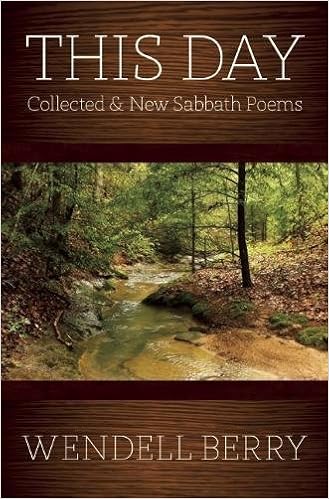
And so it is in Wendell Berry’s “This Day: Collected & New Sabbath Poems,” published in 2013 (and often paired with his “New Collected Poems” published earlier last year). Of course, with Berry, everything is of a piece. As he notes in his introduction, he spends traditional Sabbaths in the old family church, unless the weather is good, or even tolerable. Then he heads for the woods and fields near his home in Kentucky, and discovering the reality of the Sabbath (and perhaps worship) just as much as he does sitting in a pew. Perhaps more.
This is not the first time Berry has published a collection of Sabbath poetry. The heart of the new collection is poems from “A Timbered Choir: The Sabbath Poems 1979-1997.”
You read a collection like “This Day,” and you quickly learn how critically important the idea is in the poet’s understanding of nature, the land, God, aging, humanity, industrial civilization, and agriculture. To read Berry’s fiction and essays is to read and gain insights into his poetry, and vice versa. His writing is consistent and whole, reflecting a philosophy and a faith stretching over decades of work.
Many of his Sabbath poems are mediations of what he understands as industrial civilization. As surprising as it might be, just below the surface of these poems lies anger directed at how much of community, nature, and relationships is sacrificed to greed. Sometimes the anger isn’t only below the surface, as in this untitled poem from 2008:
We forget the land we stand on
and live from. We set ourselves
free in an economy founded
on nothing. On greed verified
by fantasy, on which we entirely
depend. We depend on fire
that consumes the world without
lighting it. To this dark blaze
driving the inert metal
of our most high desire
we offer our land as fuel,
thus offering ourselves at last
to be burned. This is our riddle
to which the answer is a life
that none of us has lived.
What prevents poem like this from subsiding into political polemic is, I suspect, Berry’s faith, and his understanding of family and community (and it’s difficult if not impossible to separate any of these in his poetry and fiction). Another untitled poem, this one from 2005, shows how quickly a rainy Sunday afternoon can lead to a gentle mediation on aging, family, those who have come before, and how all of it is a kind of representation of heaven.
Some Sunday afternoon, it may be,
you are sitting under your porch roof,
looking down through the trees
to the river, watching the rain. The circles
made by the raindrops’ striking
expand, intersect, dissolve,
and suddenly (for you are getting on
now, and much of your life is memory)
the hands of the dead, who have been here
with you, rest upon you tenderly
as the rain rests shining
upon the leaves. And you think then
(for thought will come) of the strangeness
of the thought of heaven, for now
you have imagined yourself there,
remembering with longing this
happiness, this rain. Sometimes here
we are there, and there is no death.
Don’t miss that parenthetical line in the second stanza, “…for you are getting on/ now, and much of your life is memory…” That line stopped me in the middle of the reading, speaking wisdom, understanding and acceptance of what cannot be changed. And I realized that more than half of my own life is now lived in memory.
I’ve read “A Timbered Choir” twice straight through, and then gone back and reread marked favorites. So it is with “This Day.” Berry suggests finding a quiet place in the woods, or at least a quiet room, to read these poems. And he’s right. That’s how they should be read, a kind of Sabbath observance all their own.
As for spending the occasional Sabbath in the woods rather than in a pew, he does provide a rationale that speaks to the hearts of poets: “To be quiet, even wordless, in a good place is a better gift than poetry.”

No comments:
Post a Comment