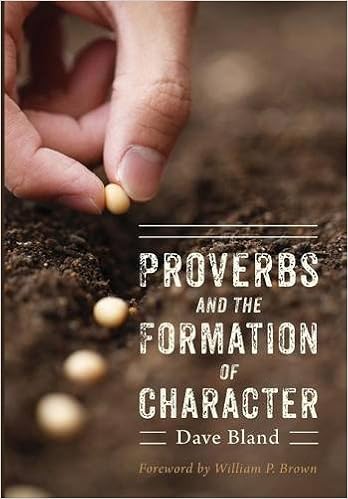
People must never confuse one’s image with one’s character. Dave Bland has created a book that has turned the clock back to an age of character defining the individual instead of an “image based” mindset. Dr. Bland is highly qualified to speak on this topic. He has combined scholarship with preaching for numerous years as he is currently a professor of Homiletics at Harding School of Theology, and for numerous years, he was the Preaching Minister for the White Station church of Christ in the Memphis area. Bland also completed a dissertation years ago on the book of Proverbs. He has been connected to the churches of Christ from his childhood. His parents were members of the church in Colorado. His book moves past the feel good methodology of society to the be good virtues of Proverbs.
Dr. Bland’s work on Proverbs is over numerous years. After countless years of study into this often neglected book, he sits down at his desk and compiles years of study, with personal reflection into one of the most needed books in the church today. Proverbs is a text that is often difficult to examine. The book jumps around quickly from wisdom saying to wisdom saying, with little focused attention. The author wades through the pithy sentences to give his readers an accessible work of wisdom rooted in the sages of old. He does this through the paradigm of character formation. He structures his text through explaining the nature of a Proverb. In this section he mentions the issues in correctly interpreting this genre of scripture. He breaks the scattered proverbs down into various chapters on relevant wisdom on various topics like language, wealth, parenting, honesty, and community, and highlights how proverbs speaks into these areas for personal growth. At the core of Proverbs and Bland’s book is the sages concern for the youth. The foundation of his work is that “the person who controls the self accomplishes more than the one who controls others” (47).
One of the strengths of the book is the cultural relevancy throughout Bland’s work. Instead of a mere commentary on the Proverbs, Bland is having a conversation with the current wisdom and practices of this world. He highlights the cultures fascinations with creating image instead of character, he discusses “homeschooling”, the positive psychology movement, and even spanking. Over and over again, he writes about modern parenting practices, and allows the wisdom literature of the Jews to reinforce and to critique modern day styles of child rearing.
Another strength of the book is the focus on life’s tensions. The book is balanced in its wisdom because this is the nature of the Proverbs themselves. Instead of the trite wisdom of modern parenting books, this book notes the vast application of parenting practices. Anyone with children will know that each child is different and the styles of parenting them will be diverse. Bland’s insights into Proverbs is nuanced. He says “most often, individuals carelessly use proverbs to oversimplify complex issues. They use proverbs to express the ‘definitive statement’ on a subject…” (70) Throughout the book, the author highlights all of the wisdom on a topic through Proverbs. True wisdom is knowing when to apply the advice in a situation. Wisdom is larger than choosing between right and wrong, rather wisdom is learning to navigate the grey. The wisdom literature helps one develop a value scale. “The sages were not shackled to a fixed way of evaluating experiences. Values choices are not always between good and evil. Often, as in the ‘better” proverbs, the choices are between good and better.” (130).
This is a needed book in modern America. What is special about the book is the far reach of the text. Often books are geared to one segment of society, like to parents or to teens, but this book has permanent wisdom that transcends age brackets. This book should be read by every parent and every teen in the church. This book would be the ultimately text to bring grandparents and young people together in a shared time of learning. In our fragmented churches, the wisdom in this text can inspire all ages to exalt generational wisdom together. Proverbs 13:20 states “Whoever walks with the wise becomes wise.” Perhaps reading this text might be one of the most rewarding metaphorical walks ever.

No comments:
Post a Comment