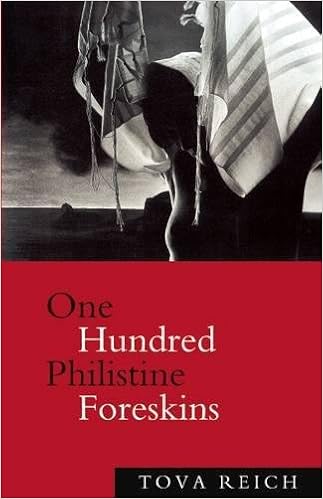
You don't have to be an Hassidic Jew or even Jewish, for that matter, to read Tova Reich's novels. She's written five in the past thirty or so years; "Mara" was her first and is one of my favorite novels. Her fourth novel, "My Holocaust", published in 2007, is one of the least politically-correct - and funniest - novels I've read. Every character in "My Holocaust" was venal and the book was a savage look at the Holocaust-memorial "business", both in the United States and eastern Europe. In her new novel, "One Hundred Philistine Foreskins", Reich returns with a softer book, in which she asks some questions about the Jewish vision of the Messiah, and who might ultimately be that person.
"One Hundred" is set mainly in Israel and is the story of Tema Bavli, born in the 1930's in Brooklyn, who has evolved into Temima Ba'alotOv, or "Mother Temima" after she moves to Israel. She was born and raised in the Hassidic community as an only child, brilliant and beautiful, who at the age of 11 mourns her mother's death. Her father, a wealthy sochet, remarries a young woman, scarcely older than Tema, who has survived the Holocaust and settles in Brooklyn as Tema's father's third wife. The young third wife is no more successful than Tema's mother in giving her husband what he prizes most - a son who will say Kaddish over him when he dies. Tema is educated haphazardly are as girls seem to be in the Hassidic community and she always seeks more learning. Finally, she's married to a fellow New Yorker and they make aliyah to Israel and join the Hassidic community in Jerusalem.
After a few years in Jerusalem, Tema, now Ima Temina, has gathered a group of followers, mostly women, but some men. She gives birth to three children by three different men, but always manages to keep her band as she moves from Hebron to Jerusalem and to other points in Israel. Reich gives her main character the beauty, the charm, the learning, and the "people skills" to attract those who seek knowledge and see its dispenser in Ima Trmima.
For the reader, there's as much interest in the Hassidic sects - both in Israel and the United States - as there is in Ima Temima and her smaller community. This is a world where the stories of Adam and Eve and Abraham, Isaac, and Jacob have as much relevance in how one's life is led today as they did two thousand years ago. Tova Reich carries her seeming innate distaste for Jewish religious figures from book to book, and they end up here in full bloom. Whether its the Osweciem Rebbe or a pair of southern black convicts reborn into black Hebrews with a semi-outlaw Jewish polygamous group, there's not an honest figure among the rabbis. Reich is a little more gentle with her other characters in this book; some actually have redeeming characteristics.
But the main character - and one who I found very sympathetic - was Ima Temima. This woman who has tried to dispense wisdom through her unique power of interpreting Torah and by giving physical aid to her followers - who are basically a very motley, needy bunch - and is seen by the end of the book as a possible Messiah. But can the Messiah be a woman? In the uber-patriarchial rule of the Hassidic Jews could the Messiah be anything but a man? Reich doesn't give an answer. She gives the reader a woman, a leader, a visionary, who could be seen in many ways. From her supporters to her detractors, Ima Temima - or Tema Bavli from Brooklyn - is the center of so much light or darkness.
Tova Reich is not an easy writer. Her sentences are much too long, sometimes seeming to stretch for pages. But she writes with a humor - always deadpan and ironic - and a sympathetic eye to the displaced among us. This book is a gem for the "right" reader.

No comments:
Post a Comment